




Abstract
This study examines the challenges faced by entrepreneurs during the COVID-19 pandemic, with an emphasis on their learning processes, the strategies they implemented, and the insights they earned. The research employs Interpretative Phenomenological Analysis (IPA) to provide insights into entrepreneurs’ experiences during the crisis. We used purposeful sampling to select small and medium-sized business owners on Java Island who survived the pandemic. We conducted semi-structured interviews and analyzed the data using NVIVO 12 software. This study introduces the Survival Learning Framework (SLF), a structured approach enabling entrepreneurs to navigate crises like COVID-19. SLF consists of three phases—knowing, understanding, and execution—emphasizing resilience, strategic awareness, and holistic transformation to foster adaptability and long-term sustainability. The Survival Learning Framework (SLF) offers a structured, multidisciplinary approach to entrepreneurial resilience, prioritizing transformation and long-term growth over mere recovery. By integrating adaptive resilience, experiential learning, and effectuation theories, it fills a critical literature gap, providing both theoretical advancements and practical strategies for navigating crises like COVID-19.
Plain language summary
This study examines how businesses navigated the COVID-19 pandemic, including their learning, strategies, and knowledge. The study uses interpretive phenomenological analysis (IPA) to provide more information about how businesses felt during the crisis. We used purposeful sampling to find small and medium-sized business owners on Java Island who had made it through the outbreak. We used NVIVO 12 software to look at the data from semi-structured interviews that we did. This study introduces the Survival Learning Framework (SLF), a structured method that helps business owners deal with crises like COVID-19. SLF is made up of three steps: knowing, understanding, and putting it into action. It focuses on resilience, strategic awareness, and whole-system change to encourage adaptation and long-term sustainability. Uniqueness: The Survival Learning Framework (SLF) is a methodical, cross-disciplinary approach to building business resilience that puts more emphasis on change and long-term growth than on recovery. It fills in a major gap in the research by blending theories of adaptive resilience, experiential learning, and effectuation. It provides new theoretical insights and useful methods for dealing with disasters like COVID-19.
Keywords
Introduction
The COVID-19 pandemic has presented entrepreneurs with both challenges and opportunities (Akula & Singh, 2021). Although the overall impact has been negative (Yang et al., 2021), some entrepreneurs perceive it as an opportunity to create new ventures (Davidsson et al., 2021). Many businesses are experiencing financial losses or contemplating closure, exacerbating unemployment issues (Rauf et al., 2023). The COVID-19 pandemic has resulted in substantial changes to community life, including social distancing, shifts in consumer behavior (Sayyida et al., 2021), potential adjustments to business models (Morgan et al., 2020), innovation (E. T. Sari, 2020; Scheidgen et al., 2021), and even recommendations for redirecting research focus (Shepherd, 2020).
The COVID-19 pandemic posed significant challenges for Indonesian entrepreneurs, leading to a decline in the country’s GDP growth (Olivia et al., 2020) and causing abnormal value movements in the financial market (Herwany et al., 2021). Approximately 84% of small and medium enterprises (SMEs) reported decreased revenue, yet there remains optimism for their survival (Sri & Afriza, 2021). Additionally, some entrepreneurs benefited from changes in consumer behavior during this period (Sayyida et al., 2021). Entrepreneurial competencies play a crucial role in supporting business resilience through dynamic capabilities and innovation ambidexterity (Hanifan & Dhewanto, 2022). The research on Indonesian entrepreneurs who remained optimistic and bounced back better than their pre-COVID-19 performance is limited.
Prior business studies exhibit significant diversity; thus, the authors employ input, process, and output perspectives to enhance clarity. The input perspective encompasses psychological resilience (Hadjielias et al., 2022), entrepreneurial ability (Purnomo et al., 2021), business performance (P. A. Sari et al., 2022), and various forms of capital, including human capital (Azizi et al., 2021), social capital (Al-Omoush et al., 2020), and organizational capital (Liu & Sun, 2024). The process entails utilizing creativity to address issues, converting chaos into opportunity, and executing adaptable solutions in corporate planning, financial management, and emotional support. (Giones et al., 2020). Examples of processes encompass business strategy (Naudé, 2021), implementation of corporate social responsibility (Mahmud et al., 2021), business restructuring (Mavlutova, 2013), digital transformation (Klein & Todesco, 2021), digital social innovation (Scheidgen et al., 2021), innovation (Thukral, 2021), and interventions aimed at mitigating the negative impacts of lockdowns and revitalizing ecosystems (Thukral, 2021). The output encompasses the actual impact, changes, and performance outcomes of these strategies (Rauf et al., 2023). Outputs encompass business disruption (Koren & Pető, 2020), industry impact (Gamil & Alhagar, 2020; Vărzaru et al., 2021), stock market gains (Herwany et al., 2021), and consumer behavior (Sayyida et al., 2021).
Current research on entrepreneurs’ reactions to the COVID-19 crisis predominantly emphasizes the activities and strategies implemented during the crisis, with insufficient examination of the fundamental mechanisms of survival or recovery. Even studies that address “how” often neglect to consider the crucial phases of recovery and flourishing. This highlights a substantial study deficiency in comprehending the entirety of the entrepreneurial resilience process.
This study examines the challenges entrepreneurs faced during the COVID-19 pandemic, focusing on their learning processes and strategies to adapt and sustain their businesses. It seeks to understand (1) how the pandemic influenced entrepreneurs’ perceptions and decision-making. (2) What adaptive strategies did they develop, and how did they contribute to long-term business sustainability? And (3): What critical lessons have entrepreneurs learned from the COVID-19 crisis, and how have these insights influenced them?
Literature Review
COVID-19 Management Practices
The pandemic has had social and environmental repercussions in addition to its economic ones (Ranjbari et al., 2021). Lockdown measures, restrictions on physical activity, and social distancing regulations present challenges for industries such as hospitality, shopping, dining, entertainment and organizations necessitating intimate contact or direct engagement (Koren & Pető, 2020). Numerous businesses are incurring losses or even ceasing operations, thereby reinforcing the unemployment crisis (Rauf et al., 2023). Despite the pandemic’s overall negative impact, some entrepreneurs see it as an opportunity-generating external enabler, highlighting potential for innovation and growth (Davidsson et al., 2021).
The first thing to prepare for in a crisis is cash (Cowling et al., 2020). Cash plays a crucial role in preventing exits, allowing for a learning process, or reducing the threat during the available time. Entrepreneurial resilience and government assistance interventions play a critical role in the transition to the new era (Stephan et al., 2021).
Additionally, the protracted pandemic period brought about numerous alterations (Naudé, 2021). Business organizations must adopt a more proactive approach in managing their operations, taking into account future risks, opportunities, and prospective challenges (Buheji & Ahmed, 2020). In addition, the pandemic has prompted numerous transformational and innovative initiatives (Klein & Todesco, 2021). This pandemic has highlighted the role of digital transformations. E. T. Sari (2020) discusses the use of personality traits in innovation. The business sector faces significant challenges, necessitating innovation and transformation in supply chain operations to survive the pandemic and gain a competitive edge (Craighead et al., 2007; Farooq et al., 2021).
The alterations resulting from the COVID-19 epidemic necessitate that entrepreneurs function as both disruptive agents that capitalize on opportunities and as stabilizing forces who foster collaboration for new ventures (Shepherd, 2020). An agency-centric entrepreneurship approach is critiqued by Davidsson et al. (2021), with the argument being made that diverse entrepreneurial actions, including planning, resource management, and emotional support, are necessary for success. The COVID-19 pandemic shows the importance of a more holistic perspective in the role of entrepreneurs, as demonstrated by the increasing importance of green entrepreneurs (Gupta & Dharwal, 2022) and social entrepreneurs (Ruiz-Rosa et al., 2020).
Entrepreneurial Resilience and Learning
Creating opportunities and figuring out how to use available resources to generate value are the first steps in the entrepreneurial process (Hoang & Gimeno, 2005). Behaviorist groups like McLeland studied entrepreneurship within the framework of behavioral science during its development (Filion, 2014). The theory of effectuation (Williams Middleton & Donnellon, 2014) suggests that entrepreneurs actively create opportunities rather than merely discovering them.
Entrepreneurial theory focused mainly on opportunity until the early 2000s (Murphy et al., 2005). It was only after the late 20th-century financial crisis that research on entrepreneurship during crises began to develop (Doern et al., 2019). Attention to resilience and critical events emerged in the early 21st century (Awotoye & Singh, 2017), with resilience being identified as a vital trait for entrepreneurs, particularly in overcoming challenges and failures (Cope, 2011). Resilience in entrepreneurship is particularly significant as it moderates business performance and sustainability in the face of high-impact challenges (Awotoye & Singh, 2017). It enables entrepreneurs to “bounce back” (Yamakawa et al., 2015) through a structured process of personal reflection, learning, and transformation (Cope, 2003; Korber & McNaughton, 2018).
Entrepreneurial resilience is a process of creative recovery, transformation, and learning (Korber & McNaughton, 2018). It focuses on how entrepreneurs interpret experiences, engage in self-reflection, and take action based on meaning and learned insights (Byrne & Shepherd, 2015).
Failure is a crucial part of entrepreneurial learning, compelling entrepreneurs to reevaluate their experiences, confront their emotions, and make sense of setbacks (Byrne & Shepherd, 2015). In highly competitive and uncertain environments, business continuity depends on the entrepreneur’s ability to adapt, learn, and evolve (Cope, 2003). Entrepreneurial learning plays a crucial role in this adaptation, as it involves transforming experiences into knowledge and applying insights to business operations. Traditionally, entrepreneurship education has focused on building entrepreneurial intention, behavior, innovation, and resource acquisition, but crisis-driven learning has only recently gained attention (Doern et al., 2019). Learning from failure and crisis requires critical self-reflection and the ability to process experience effectively (Cope, 2011). Entrepreneurs must balance persistence (persevering through problems) and transformation (adapting to change), as resilience alone is insufficient without strategic learning and evolution. (Olsson et al., 2015).
Entrepreneurial Learning
Research on entrepreneurial learning is highly fragmented, diverse, and strongly individualistic, hampering further understanding and development (Wang & Chugh, 2014). Researchers provide various definitions of entrepreneurial learning. According to Politis (Politis, 2005), people often describe entrepreneurial learning as a continuous process that aids in the acquisition of knowledge essential for initiating and overseeing new businesses. According to Rae (2006), entrepreneurial learning is a dynamic process of awareness, reflection, association, and application that involves transforming experience and knowledge into functional learning outcomes. According to Holcomb et al. (2009), entrepreneurial learning is when people learn new information through direct experience and by watching others’ behaviors, actions, and results. They then use heuristics to deal with the problems that arise when learning new things in uncertain situations, and they organize the new information they’ve learned by connecting it to things they already know. The definitions of entrepreneurial learning share commonalities in that they all describe it as a knowledge generation process. However, the remaining aspects of these definitions are intricate and may be challenging to comprehend.
Systemic thinking can facilitate the organization of entrepreneurial learning into three distinct categories: input, process, and output. The output comprises research on the influence of entrepreneurial learning, including multiple studies that demonstrate its significance in the field of business. Various aspects, including strategic foresight (Peterson & Wu, 2021), performance (Shen et al., 2021), and innovation (W. Zhao et al., 2021), demonstrate the impact of entrepreneurial learning. Wing and Man (2007) conducted research on competency-based entrepreneurial learning, and Kempster et al. (2018) examined the importance of human, social, and organizational capital in entrepreneurial learning. Both studies focus on the input. Studies on the process of entrepreneurial learning highlight the significance of firsthand knowledge and practical exposure (W. Zhao et al., 2021). These researchers focus on events that trigger critical reflection on the experience process (Paulsen, 2020), such as discontinuous events (Cope, 2003), crises (Doern et al., 2019), adversity (Shepherd & Williams, 2020), and failures (Cope, 2011; Wang & Chugh, 2014).
Survival Learning Framework
Understanding entrepreneurial learning is easier with a framework that describes the experience process and its supporting structure. While several models exist, they often lack detail. Figure 1 provides an overview of the progression in entrepreneurial learning models, from Politis (2005) to Cope (2011). Politis (2005) explains how entrepreneurs transform into knowledge entrepreneurs, while Holcomb et al. (2009) divide this process into experiential and vicarious learning. Cope (2011) offers a comprehensive description, including phases like hiatus, critical reflection, and reflective action that lead to higher-level learning, such as transformative, double-loop, and generative learning.
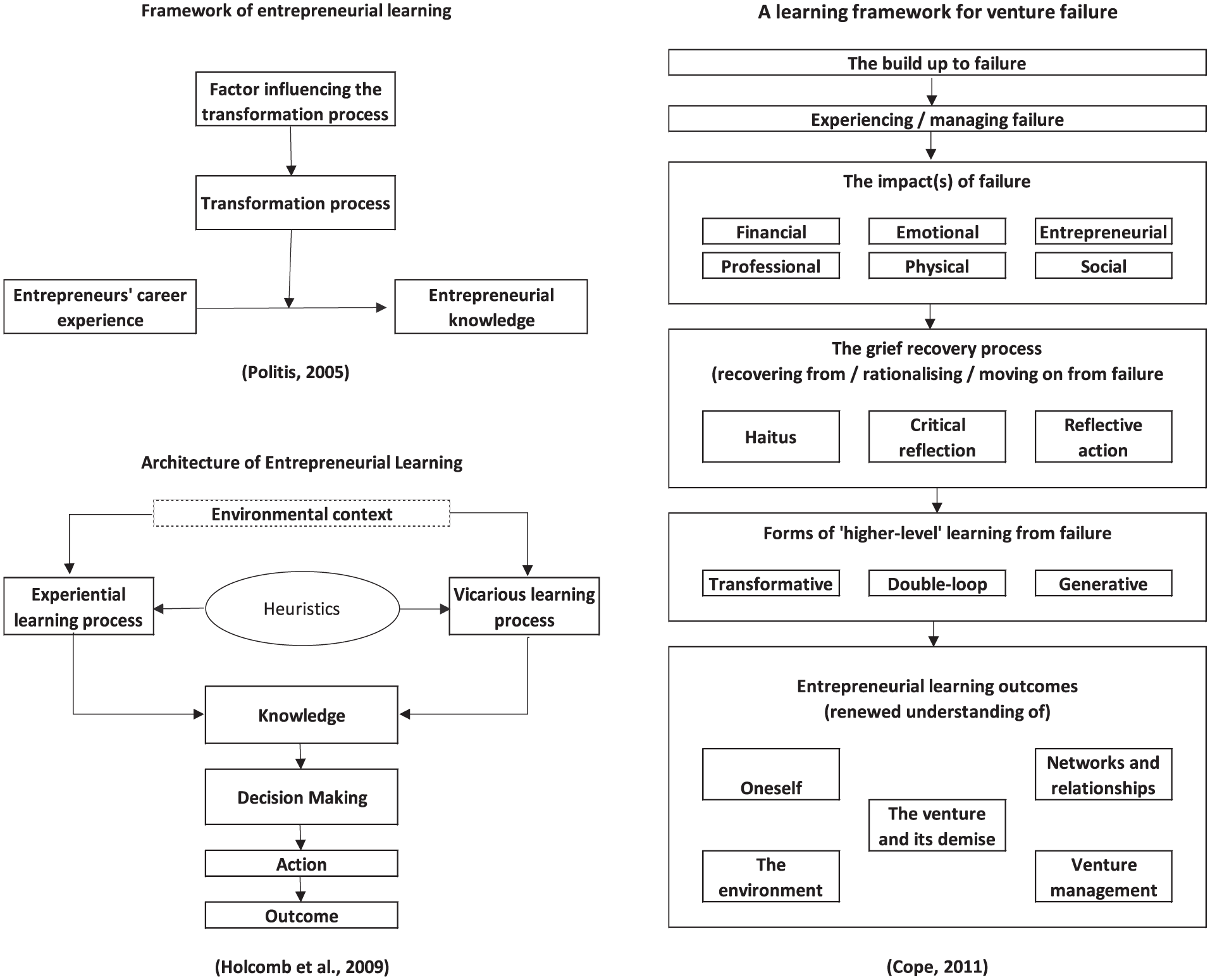
Diverse models of entrepreneurial learning.
Paulsen (2020) identifies four phases of experience: sensing (attention), perceiving (categorization), reflecting (meaning), and creating (transformation). Holcomb et al. (2009) align these phases with entrepreneurial learning: experiential learning corresponds to sensing, vicarious learning to reflecting, and reflective action to creating. By integrating these frameworks, we can observe how different circumstances impact the transformation process, particularly in detecting and converting experiences into knowledge. For example, Cope’s (2011) hiatus aligns with perceiving, critical reflection with deep contemplation, and reflective action with creating.
This study synthesizes Paulsen’s (2020) experience process with Cope’s (2011) recovery process, resulting in the Integrated Stages of Experience and Recovery (Figure 2). These stages—Knowing, Understanding, and Execution—form the foundation of the Survival Learning Framework (SLF). The term “survival” emphasizes thriving in challenging conditions, such as the COVID-19 crisis.

Integrated stages of experience and recovery.
Three stages of SLF unfold through a dynamic process of knowing, which involves sensing, perceiving, and identifying problems; comprehension, where information is analyzed, interpreted, and transformed into insights; and execution, where strategies are formulated, implemented, and translated into action.
The SLF integrates these stages with themes related to crisis management, focusing on external pressures, internal resilience, and adaptive thinking. The next stage of research, data analysis, will produce themes and super-themes that refine the SLF.
Methodology
Research Approach
This study employs interpretative phenomenological analysis (IPA; Eatough & Smith, 2017) to explore entrepreneurs’ lived experiences during the COVID-19 pandemic. IPA combines phenomenology, hermeneutics, and ideography, ensuring a deep exploration of individual experiences while maintaining analytical rigor. The dual hermeneutic process involves participants interpreting their experiences and researchers interpreting these narratives, preserving the uniqueness of each case (Starks & Brown Trinidad, 2007).
IPA’s idiographic approach allows for in-depth, case-by-case analysis, making it suitable for exploring entrepreneurs’ personal meanings, strategic responses, and adaptive learning during crises. Despite challenges in balancing subjective meaning with analytical rigor (Fiona et al., 2021), IPA provides a comprehensive understanding of the experience process and its supporting elements.
Sampling and Informants
The study uses purposeful sampling to select small and medium-sized business owners on Java Island who successfully navigated the COVID-19 crisis. A multiple-perspective approach ensures diverse viewpoints from individuals with shared experiences (Larkin et al., 2019). The sample size of 10 informants allows for in-depth analysis while maintaining manageability, slightly above the recommended six to eight (Pietkiewicz & Smith, 2014).
Participants were selected based on business-related criteria and personal qualities, including:
- Communication skills: Ability to articulate experiences and strategies.
- Resilience: Demonstrated ability to overcome past business challenges.
- Reflective mindset: Habit of analyzing experiences and drawing insights.
- Strategic thinking: Capacity to navigate uncertainty and make informed decisions.
- Innovation and adaptability: Ability to pivot business models and explore new opportunities.
These attributes ensure meaningful contributions to the study, offering deep insights into survival learning and entrepreneurial adaptation.
Informant Profile
Table 1 provides an overview of the 10 informants, including their enterprises, markets, and operational histories (all exceeding 15 years). The diverse businesses—ranging from metal casting to rural banking—demonstrate resilience during the pandemic. Detailed descriptions of each informant are provided in subsequent sections.
Informants’ Profiles.

Source. Data processed by the author (2025).
Data Collection and Analysis
We conducted data analysis using NVIVO 12, following five stages: (1) data preparation, (2) coding, (3) theming, (4) findings, and (5) refinement (Figure 3). Semi-structured interviews explored the following aspects:
How the pandemic influenced entrepreneurs’ perceptions and decision-making.
Adaptive strategies developed and their contribution to long-term sustainability.
Critical lessons learned and their impact on future strategies.

Data analysis process.
Interviews, conducted in April and May 2022, lasted approximately 1 hr. Transcripts were reviewed multiple times for accuracy, with follow-up interviews as needed. Line-by-line coding identified 111 relevant codes. Themes were derived by synthesizing conceptual statements, incorporating phenomenological and interpretive elements (Pietkiewicz & Smith, 2014).
Figure 4 shows how 111 relevant codes converge into 11 themes, and from those 11 themes into 4 super-themes.

From codes to themes.
Comparative analysis grouped themes into superordinate themes, forming the conceptual model. The final output is the Survival Learning Framework, which integrates cross-case themes with prior theoretical insights. Table 2 defines the themes and superordinate themes, while Figure 5 illustrates the framework’s development.
Themes Definition.
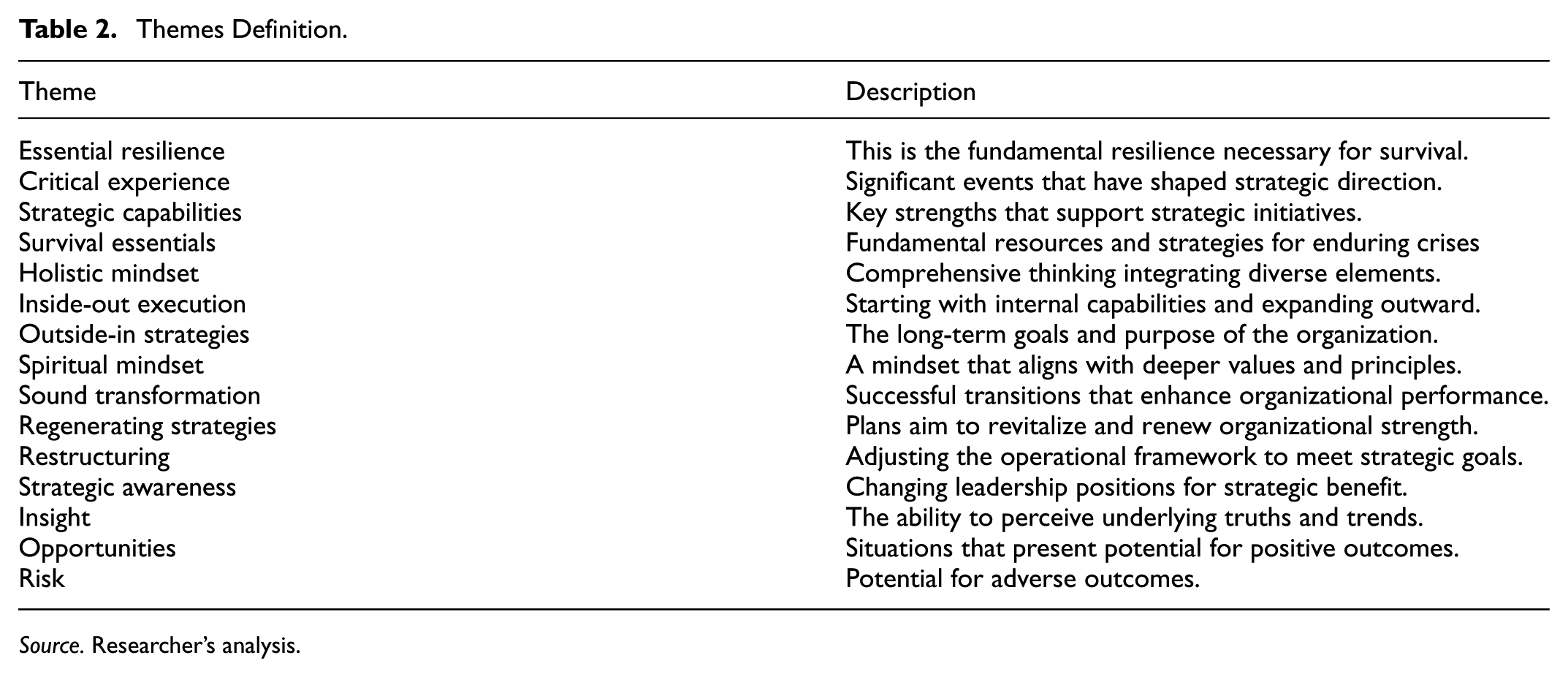
Source. Researcher’s analysis.

Survival learning framework development.
Survival Learning Framework
The analysis process yielded four superordinate themes, forming the Survival Learning Framework (SLF): Essential Resilience, Strategic Awareness, Holistic Mindset, and Sound Transformation. These themes represent the critical phases of entrepreneurial adaptation during crises, structured within the Knowing, Understanding, and Execution dimensions.
Superordinate themes include topics:
- Essential Resilience (Knowing phase): Comprises Survival Essentials, Critical Experience, and Strategic Capabilities. This phase focuses on sensing and perceiving challenges to build resilience.
- Strategic Awareness (Understanding phase): Emerges from Risk, Opportunity, and Insight. It involves reflecting on experiences to identify strategic directions.
- Holistic Mindset (Execution phase): Developed through Outside-In Strategies, Inside-Out Execution, and a Spiritual Mindset. It balances external demands with internal strengths to create solutions.
- Sound Transformation (Execution phase): Driven by Restructuring and Regenerating Strategies. It ensures businesses evolve amid changing circumstances.
Figure 6 illustrates the SLF, providing a structured approach to entrepreneurial resilience and transformation during crises.
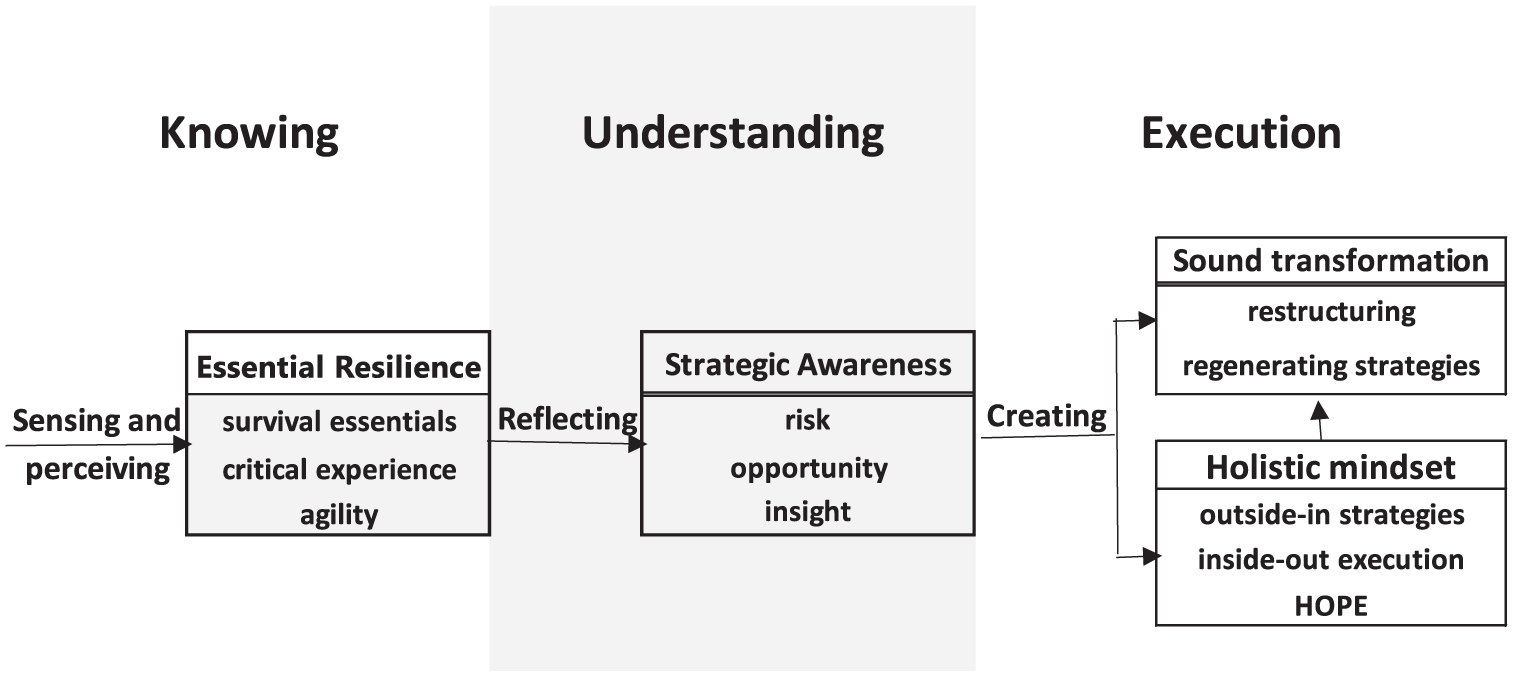
The survival learning framework.
The subsequent sections provide a detailed description of each process and its outcomes.
Essential Resilience
Essential resilience results from sensing and perceiving challenges, yielding survival skills, critical experience, and strategic capacities.
Survival Essentials
Surviving entrepreneurs have essential resilience in common; it is the fundamental thing necessary for survival. Prior studies mention cash is needed; businesses that were undercapitalized were more likely to suffer higher income loss and longer time to recover, and were less likely to be resilient (Katare et al., 2021). Meanwhile, a key element of financial fragility is having sufficient funds to operate a corporation. Finally, one topic related to the resilience strategy is the importance of adaptability. (Surya, 2021). Organization and environment fit is an important factor for the company’s competitive advantage, but also for sustainability during a crisis (Amankwah-Amoah et al., 2021). Social capital hedges firms against systematic shocks by mitigating employee-related litigation risk (Fiordelisi et al., 2022).
Sufficient financial capital is crucial to ensure both liquidity and long-term solvency in the period of the COVID-19 crisis. Bob describes his experience with a financial deficit from 2015 to 2016, which almost forced him to exit the business.
The worst situation was a monthly cash shortfall; the cash flow has been in deficit all month. (Bob)
In the COVID-19 pandemic period, all informants are in good financial conditions. Sufficient funds for emergency is a common practice for Amin.
Therefore, there should always be sufficient funds available for emergencies. (Amin)
One of the informants, Mey, can even survive for 2 years on a limited income.
Large-scale social restrictions caused even my clinic to stop operating due to government restrictions. It was only when the omicron virus variant emerged that patients slowly started coming in. So I had no income for about two years. (Mey)
Sustainability requires organizational capital in addition to sufficient financial capital to bounce back. Bin said his company will not only survive but thrive due to the competitive advantage of the product.
Because we design the product ourselves, we have an advantage. We are close to the market, so we know more about its needs. (Bin)
Hadi said there is no big change in his organization during the COVID-19 crisis.
The first is a positive mindset from the top leadership, which produces an impact; the second is the credibility of the company’s branding, which gives very positive results. Then the people, I am very focused and concerned about the welfare of employees. There is no difference; we are running on a system that is already good. Why change when it’s already good?. (Hadi)
Steve and Amin mentioned the significance of social capital in their survival.
The good relationship that was developed benefited me greatly, because many parties wanted to sell products to me or on the contrary, really wanted to buy products from me. In that position as a middleman, I gained a lot. (Steve) Supplier credit has been particularly helpful so far. I am deeply grateful for their trust. I can accept the goods without making a payment upfront; a month later, I will definitely make the payment. (Amin)
Critical Experience
Experience is essential in entrepreneurial education (Afshan et al., 2021). Entrepreneurial action exhibits varying responses to adversity: it stabilizes during specific events and destabilizes in ongoing conditions (Shepherd & Williams, 2020). Crises serve as critical junctures that compel businesses to reevaluate their strategies and enhance their resilience. (Doern et al., 2019). New insights into the knowledge acquired by female entrepreneurs during the COVID-19 experience (Afshan et al., 2021)
Bin and Lili confirm the previous crisis, the economic crisis of 1998 experience helps them in the COVID-19 survival process. Bob mentions about learning from failures.
Regarding COVID, we can overcome it since we have already faced the 1998 crisis and the global economic downturn in the past two years. (Bin) The first was 1998, the great crisis that hit Asia. Because of that experience, I first learned how to survive. (Lili) Fortunately, I’ve experienced numerous falls. We should already have what we have mentally—our skeleton, our muscles—for big cases. (Bob)
Success experiences also count, since they resulted in many good practices, and the organization is in a good position to face the crisis. Successful experiences are significant as they have led to many effective practices, positioning the organization well to confront the crisis.
During COVID, the performance of my place has increased. Assets are increasing, outstandings are increasing, and there is no non-performing loan. I think it’s natural. (Hadi) So, for us to survive, we must be conservative and willing to change. The goal is efficiency. (Bin)
Strategic Capabilities
Previous research indicates that dynamic capabilities and advanced technologies play a crucial role in survival during the COVID-19 pandemic. Dynamic capabilities encompass three dimensions: sensing, which pertains to business assessment and information acquisition; seizing, which relates to product portfolio decisions and technological investments; and reconfiguring, which focuses on innovation and knowledge management (Weaven et al., 2021).
Advanced technologies during COVID-19 lockdowns provide competitive advantages and survival by adapting business models—even unintentionally, demonstrating the importance of adapting to the pandemic (Akpan et al., 2021).
The survival learning framework proposes more detailed concepts, including accuracy, agility, foresight, and momentum.
Accuracy. Accuracy is the Precision and Correctness of Actions and Decisions
The COVID-19 business crisis brought unprecedented unpredictability and quick market shifts, making precision more important than ever. Lili is very concerned about accuracy since her business is in entertainment and accommodation. which is influenced badly by the COVID-19 crisis Everything must be well calculated. Look for a business that has a small investment but a more promising income. (Lili) Let’s say we are building a new hotel. We need to conduct a comprehensive study that includes various scenarios. (Lili)
Agility. Agility is the Capacity to Swiftly Adjust to Alterations
Throughout the COVID-19 crisis, agility was essential for firms to adjust to disruptions, customer habits, and market conditions. Companies that adapted their processes, adopted digital transformations, and innovated were better positioned for survival. Lili mentions the need for a sophisticated financial model to support decision-making.
Indeed, financial figures are of paramount importance. You should possess a collection of current and accurate assumptions along with an advanced financial model. Should the variable of the assumption change, the decision-making process will likewise adjust. My perspective is that alterations in the input will result in corresponding changes in the outcome. (Lili)
Digitalization has been highlighted as a viable solution and source of income during the COVID-19 crisis. However, Bob asserts that these benefits are only applicable to or experienced by prepared parties.
Yesterday marked the era of COVID. I recognized that this era is characterized by digital, contactless banking operations, including the process of creating a bank account. My technology is the one I developed; I am prepared, so when the pandemic occurs, I will be among the first to possess an application. It signifies that who cannot be in that state; they are marginalized. (Bob)
Foresight. Anticipatory Thinking for Proactive Decision-Making
Making proactive decisions requires anticipatory thinking. Forethought is a crucial element in initiating planning for future competitive advantage and sustainability. Competitive advantage and organizational sustainability require time to cultivate and are often the consequence of prolonged or, at a minimum, medium-term cumulative efforts. In alignment with Bob’s endeavor to lead in banking digital technology, he consistently attempts to forecast trends at least 5 years in advance.
Therefore, entrepreneurs should be able to predict the trends for the next five years. Entrepreneurs must be visionaries; otherwise, they will not be able to survive. (Bob)
Insights gained from the 1998 economic crisis, characterized by a severely restricted supply of agricultural machinery resulting from the cessation of production by most suppliers. Bin did not capitalize on that opportunity. Bin endeavored to adopt a more proactive approach while being cautious during the COVID-19 situation.
Amid the COVID-19 pandemic, we are generating a substantial quantity of products. Consequently, rather than decelerating, we are accelerating. Upon our return, we shall be better equipped. (Bin)
Momentum. Momentum Refers to the Capacity to Maintain and Accelerate Progress
In a company, the timing of investment or growth decisions can be subjective; however, it serves as a crucial distinction. Lili keeps on developing new hotels even in the middle of the COVID-19 crisis based on her belief in the prospect of Indonesia’s economy.
Indonesia has tremendous potential; perhaps in five years, we will be among the countries with the highest GDPs in the world. This is number ten. That’s my calculation. (Lili)
Mey expanded a tiny dental clinic into a medium-sized Pratama clinic that also accepts patients from the government social security program. It is a condition that most physicians overlook, but Mey decided to make a significant contribution to the government.
The administration proposed initiating with a dental facility and subsequently locating a general practitioner who can assist with Social Security matters. Notwithstanding the projected challenges in achieving profitability, I resolved to continue. This is a period of retribution for me. (Mey)
Strategic Awareness
Contemplation on fundamental resilience will enhance strategic awareness throughout the comprehension phase. Strategic awareness encompasses opportunity, risk, and insight.
Opportunity
The COVID-19 pandemic, despite its challenges, offered opportunities for organizations that had undergone digital transformation. Organizations possessing digital capabilities demonstrated superior capacity to navigate challenges and achieve growth. Digital initiatives such as e-commerce, remote services, and automation enabled businesses to adjust to evolving customer behaviors and endure the crisis (Rupeika-Apoga et al., 2022).
The informants in this study identified opportunities that extend beyond digital transformation, which vary according to each entrepreneur’s context, encompassing strategic, operational, or financial dimensions.
Opportunity Related to Finance
Lili terminated a hotel management contract to improve financial health and stability. A practice that did not negatively impact hotel operations.
This certainly includes not having to pay a management fee because we canceled the hotel chain contract. This is really a lesson from COVID. (Lili)
Opportunity Related to Operations
Steve leverages his network to assist pempek (famous Indonesian fishcake) vendors and restaurants in sourcing fish flesh during COVID-19, resulting in a new profitable business segment.
At present, I have installed a large freezer in one of my properties to store fish meat, which yields a substantial profit, exceeding two to three times the rental value of the premises. (Steve)
Strategic Opportunity Identified
Conditions that enable strategic initiatives. Opportunities are accessible only to individuals who are adequately prepared or qualified for them. Sugi has adequately prepared his biodegradable plastic products, Mey’s clinic is equipped for the antigen program, and Hadi is well-prepared to assist customers at his bank.
I take pride in the fact that my research is patentable and feasible. My product was immediately used in supermarkets, but the patent process took me seven years. (Sugi) There is a new antigen testing program. Such a program did not exist before, so the intention was to help, but in the end, there was a profit. (Mey) Because they believe in us, they trust us even more during times of crisis. Our financial situation is now overly liquid. The more people who place deposits, the more banks can lend. (Hadi)
Risk
The COVID-19 pandemic presents substantial risks for business founders, potentially leading to adverse outcomes. The industries most adversely affected are hospitality, retail, dining, entertainment, and institutions (Koren & Pető, 2020). A multitude of enterprises are experiencing financial losses or shutting down, consequently exacerbating the unemployment issue (Rauf et al., 2023). Survival obstacles encompass financial constraints, operational disruptions, and existential threats. (Zutshi et al., 2021).
Monetary Risk. Risks to Financial Stability and Performance
Yusuf identifies certain financial risks resulting from a decline in turnover and bank interest rates.
The biggest threat is the potential loss of customers due to business closures or a decrease in turnover. (Yusuf) The hardest hit are those with large bank loans. There are no activities; the loan interest keeps on increasing. (Yusuf)
Operational Risk. Potential for Operational Disruptions
Asiang mentions change and the ability to adapt. For Bob, lack of experience is a problem.
Something that makes a corporate organization often lose is because something has changed and this change cannot be adapted. (Asiang) The first factor is that lack of experience makes us misstep. (Bob)
Strategic Risk: Risks Associated With Strategic Decisions
Bob mentions the inability to keep up with the rapid advancements in technology poses a significant risk. Yusuf mentions the technical problem of tenders in Indonesia.
This indicates that the situation is dynamic and not static. The technology industry is developing very quickly; it used to change every five years; now it is yearly. (Bob) Contracts typically only state conditions in accordance with the offer. If our bid is too detailed, we usually won’t win the tender. (Yusuf)
Insight
The ability to discern essential facts and patterns is very necessary. Capacity to recognize the advantages of digital transformation, including mobile payment (Y. Zhao & Bacao, 2021), e-commerce (Bhatti et al., 2020), and online information service (Toubes et al., 2021). Digital transformation necessitates technological strategies (Madurai Elavarasan & Pugazhendhi, 2020). Transitioning from a hybrid model to a fully entrepreneurial one (Rugpath & Mamabolo, 2022), businesses have responded to the COVID-19 epidemic by supporting essential stakeholders, including employees, customers, communities, and society at large, through corporate social responsibility initiatives (Mahmud et al., 2021)
Capitalization: The Act of Securing and Using Capital Effectively
Hadi contends that exceptional branding is cultivated via sustained effort rather than spontaneous inspiration. Asiang posits that the capacity to endure the COVID-19 crisis mostly stems from organizational capital, defined as the accumulation of long-term experience and capability.
No, this is not because of a great idea. However, pioneers have developed a process to establish company branding within the community. (Hadi) Companies that can withstand the pandemic do not necessarily reflect the outcomes of their responses during that period. But it is more of an accumulation of long-term experience and ability. (Asiang)
Change Drivers. The Factors That Initiate and Sustain Organizational Transformation
Bin clearly highlighted how a crisis led a company to change in order to be more sustainable, and how COVID-19 accelerated Bin’s digitalization efforts.
The 1998 crisis was both nasty and salutary in that it caused us to rethink our attitudes significantly. Then it was followed by a series of additional catastrophes. So, we are prepared to face change. The good news is that we are pretty prepared before a catastrophe occurs. So, by 2020, during COVID, the organization was already in good shape. So it’s more resistant. We are progressing towards our goal, but COVID has expedited the process. It has a great influence on accelerating the change process. (Bin)
Learning/Modeling. It is the Process of Acquiring Knowledge or Skills Through Observation and Practice
Bob acquires extensive knowledge through reading and mentorship. Hadi concentrates on enhancing organizational capital. Lili asserts that learning is crucial for effective firm management.
After reading the reference, I discovered another important aspect of study: having a mentor. Mentors are very important to shape our endurance and study. (Bob) Those thoughts are the culmination of a lot of experience. So it doesn’t happen suddenly; it takes time until it becomes a belief. (Hadi) Yes, we must open our minds. We must continue to update and keep learning. Know trends and developments. If you don’t learn, you can’t manage it. (Lili)
The strategic awareness derived from the understanding phase initiates creation in the execution phase. The outcome is a
Holistic Mindset
A holistic worldview incorporates integrative thinking that synthesizes multiple components. A holistic mindset includes inside-out execution, outside-in planning and a spiritual mindset.
Inside-Out Execution
Inside-out execution commences with internal competencies and extends outward.
Addressing uncertainty through a singular assurance: the available resources (Haan-Cao, 2023). The presence of human capital (Azizi et al., 2021), social capital (Al-Omoush et al., 2020), and organization capital (Liu & Sun, 2024) ) are essential for survival during the COVID-19 crisis. The link between social capital and service innovation capability was completely influenced by strategic environmental scanning, while it only partly influenced the relationship between organizational capital and service innovation capability. (Blaique et al., 2024).
Hadi emphasizes the significance of possessing a loyal and substantial consumer base. Social capital constitutes the essence of Hadi’s concern.
The primary market segment that generates sales and money. A loyal customer base is crucial as it can attract additional customers. (Hadi) The objective is to gain their affection, not merely their intellect. (Hadi)
Asiang and Bin emphasize the significance of human capital, both advocating for the promotion of individuals.
Humans possess individual souls. Have I began by seeking individuals, subsequently acquiring machinery, followed by construction, and finally operation. I refer to that as inner to outer. (Bin) -vision- and
  -wisdom-. Initially, we must comprehend individuals. Comprehending individuals allows us to manage matters more efficiently. Mastering it facilitates entry into the commercial realm. (Asiang)
Mey places an emphasis on providing high-quality service. In addition, Amin mentions the importance of quality and maintaining commitments. In order to develop the organization’s capital, gaining the trust of patients or customers is essential.
Individuals must deliver optimal service. The physician, the dentist, and all associated professionals must deliver optimal service. If they collaborate effectively to assist patients, the outcomes will undoubtedly be favorable. (Mey) In business, it is crucial to maintain focus by executing all essential tasks, including due diligence and honoring promises. (Amin)
Outside-in Strategies
Innovative techniques employed by small firms influence their success and sustainability, while external support is beneficial. External support enhances the survival of small firms’ innovation practices rather than their performance (Adam & Alarifi, 2021). Access to the external environment encompasses governmental assistance (Bartik et al., 2020; Leung & Liu, 2022). Maintain competitiveness by adjusting to your surroundings. The significance of sustainability is emphasized (Tu et al., 2023).
Mey possesses significant attributes such as open-mindedness, strong flexibility, and a propensity for risk-taking. During the COVID-19 crisis, Mey experienced a substantial decrease in revenue but made considerable advancements in organizational and social capital.
There’s a new antigen testing program. Because such a program had never been before, the goal was to help, but there was also a profit. The government is exceedingly helpful. The clinic is a project that receives medical supplies such as hand sanitizer, masks, and other items. At the time, there were numerous patients’ needs that we couldn’t afford to buy, but we obtained assistance from the government. (Mey)
Lili emphasizes the importance of organization and environmental compatibility, thus striving to maintain an open mind to acquire the most current information.
Yes, we must open our minds. We must continue to update and keep learning. Know trends and developments. If you don’t learn, you can’t manage it. (Lili)
Hadi possesses the capability to discern client trends and modify judgments accordingly. This significantly aids both survival and long-term sustainability.
Because they believe in us, they trust us even more during times of crisis. Our financial situation is now overly liquid. The more people who place deposits, the more banks can lend. (Hadi)
Spiritual Mindset
Entrepreneurs cultivate a mentality that incorporates ethical, spiritual, and purpose-driven principles into their decision-making and adaptability tactics during the COVID-19 crisis dynamics (Seryczyńska et al., 2021). Throughout the pandemic, enterprises have engaged in numerous commendable corporate social responsibility. (CSR) initiatives. These activities were likely motivated by both utilitarianism and deontology to satisfy the requirements of internal and external stakeholders (Manuel & Herron, 2020). By using spiritual capital, businesses skillfully navigated uncertainty, balancing their ethical duties, involvement with the community, and long-term sustainability. The pursuit of creating a spiritual capital is expected to cultivate a sense of well-being and bolster resilience within the workplace (Vasconcelos, 2021).
Belief. A Firmly Held Conviction or Opinion
Indonesian entrepreneurs are generally influenced by religious values. Steve’s perspective corresponds with biblical principles of servant leadership, generosity, and selflessness, whereas Sug’s assertion reflects the Christian tenet of prioritizing service to others over self-interest. Yusuf’s comment underscores the Christian conviction that blessings are fundamental to success, emphasizing that divine favor ultimately dictates achievement, thereby reinforcing faith in God’s providence.
I have experienced many such incidents, and many people come to me to ask for help. But in the end, they are the ones who help me. (Steve) In business, we refuse kickbacks because we are based on the idea that I came not to sell; you know, I came to help you. (Sugi) However, it has always been said that the key to success is a blessing. Well, a blessing. (Yusuf)
As a Muslim, Amin attributes survival during COVID-19 to God’s control, emphasizing faith and divine intervention as crucial factors in overcoming challenges and uncertainty during the crisis.
I’m sure all of God is in control. Indeed, God plays a significant role in our survival during this COVID-19 pandemic. (Amin)
Care. The Concern and Effort Put Into Maintaining Well-Being and Comfort
Most entrepreneurs prioritize protecting their employees by running a business at a loss.
I continued to work because this business provided food for 13 families. Afterward, the clinic closed, forcing them to relocate and seek new employment opportunities. (Mey) So far, we have received a lot of kindness from our employees. I believe this is my opportunity to return the favor. (Steve) Welfare and salary remain the same without any deductions, vitamins, or medicines related to COVID guaranteed by the company. (Hadi)
Positive Thinking. The Habit of Interpreting Situations in a Positive, Constructive Way is Crucial
During the COVID-19 business crisis, positive thinking enabled entrepreneurs to reframe challenges as opportunities, fostering resilience, creativity, and proactive risk-taking to sustain and grow their businesses despite uncertainty. Hadi perceives COVID-19 as a challenge that must be converted into an opportunity.
So, we believe that when other organizations are scared, we have an opportunity to demonstrate that our site is superior. I always view challenges as chances for growth. We’re proud. Because of this habit, we will have greater difficulties in being active and creative. (Hadi)
Lili is embracing risk as a teacher, not a threat Risk is not for us to avoid, we learn to make it an opportunity for us. We must get the beauty and benefits of risk. (Lili)
Hadi and Lili prove that crises don’t define businesses—mindset does. Through courage and optimism, they didn’t just survive; they laid the groundwork for lasting resilience and success
Sound Transformation
Restructuring
The COVID-19 business crisis forced companies to adopt various strategic responses beyond mass layoffs and redundancies. Alternative employment adjustments, such as restructuring and operational modifications, emerged as essential strategies to maintain stability (Johnstone, 2024). Business process re-engineering enabled firms to enhance performance by transforming their processes to align with long-term goals and customer satisfaction (Albelbaisi, 2022). Organizations also adjusted their operational frameworks to meet strategic objectives, including credit restructuring to manage financial strain (Agustina, 2021). Additionally, acquisition and restructuring strategies played a crucial role in ensuring financial sustainability and competitive advantage, particularly as part of a broader turnaround strategy rather than isolated actions (Japhet, 2021). These approaches highlight the importance of adaptability in navigating crises and securing long-term business resilience.
Lili, a financial and strategic expert from her previous role as a consultant for Indonesian conglomerates during the 1998 crisis, commenced financial restructuring and asset utilization enhancement at the onset of the COVID-19 issue.
Once COVID began, we promptly reorganized. It is clear that the sole path forward involves financial restructuring. (Lili) We are beginning to concentrate on the use of assets that have not been fully utilized. (Lili)
Bin uses innovative technologies to streamline operations Justifying? Computers let us talk about one cost at a time in enough depth. Understanding numbers helps us believe that this cost is not necessary or can be lowered. (Bin) We used to do a lot of paid TV advertising, but now we’re focusing on social media because we think it reaches more people and costs less. (Bin)
Organizational restructuring entails modifying structures and roles to align more effectively with strategic objectives. Lili implements a notable alteration in her organization following the termination of the contract with Amaris, a hotel chain operator. The above statistic indicates a notable reduction in costs, while the hotel continues to operate effectively.
At this point, we have ended our relationship with Amaris; yes, we can move forward. Quality is not inferior, even with a better return on investment. (Lili)
Sugi’s operational reorganization entails building a new line of business; technically, this is a form of product vertical diversification.
My technology company was just started by me about five years ago. That’s why I now sell plastic seeds as well as supplying plastic packages. We’ll be selling technology in the future. (Sugi)
Regenerating Strategies
The COVID-19 epidemic has compelled businesses to reevaluate their plans for survival and future expansion. Modifications to business models became important (Katare et al., 2021), while not all adjustments resulted in favorable outcomes. Certain enterprises encountered bankruptcy, necessitating liquidation or restructuring, while others required downsizing or acquisition to sustain viability (Greenwood et al., 2020). Mergers, acquisitions, and restructuring have become essential strategies for organizations poised for growth in the post-crisis landscape, utilizing technology and innovative business models (Kooli & Lock Son, 2021)
Hadi advances the ethical framework of Mr. Sinamo within his organization. Lili prepared her shophouses for office use and rented them out to generate additional income. Hadi and Lili both engage in corporate growth strategy practices.
I also developed ethics in my organization based on the concept of Mr. Jansen Sinamo, which I modified with a reflection of my work experience. (Hadi) Our shophouses are available. We have a stock of shophouses that we rent out to offices. For the renter, the cost can drop by 60%; for me, there will be new income. (Lili)
Sugi implements a spin-off plan with a new firm that focuses on concentric diversification of products.
We opened a new company that migrated to using plastic in restaurants. This company performs exceptionally well due to the high volume of deliveries. (Sugi)
Lili employs a related diversification strategy. Hotels and restaurants cater to hospitality and tourism customers, resulting in shared markets, supply chains, and operational synergies.
We will indeed establish our own hospitality management company with our brand name. (Lili)
The antigen test program prompted Mey to establish a diagnostic service unit in her clinic. Mey executes an expansion strategy.
There is a new antigen test program. There was no such program before, so the intention was to help, but in the end, there was profit. (Mey)
Discussion
This research introduces the Survival Learning Framework (SLF). This section will examine theories that correspond with the SLF and the connection of the findings to the issues posed by COVID-19.
Connecting Survival Learning Framework With Literature
The SLF is a novel and multidisciplinary methodology that amalgamates entrepreneurial concepts, encompassing both entrepreneurship and diverse management disciplines. The goal is to provide a methodical and strategic framework for crisis management. The SLF prioritizes transformation and growth over mere recovery, in contrast to conventional resilience theories, and aligns with adaptive resilience (Bergeman & Nelson, 2024), experiential learning (Kolb, 1984), and effectuation (Sarasvathy, 2001).
Kolb’s Experiential Learning Theory (ELT) and the Survival Learning Framework (SLF) underscore the importance of active learning via reflection and action. The SLF, based on the experiences of Indonesian entrepreneurs, is results-driven and emphasizes crisis resilience and entrepreneurial perseverance. It provides culturally pertinent insights and seeks to deliver practical solutions for organizational sustainability amid crises, thereby enriching the learning experience.
The Survival Learning Framework (SLF) and the ADAPTOR Framework for Adaptive Resilience both emphasize resilience in adverse conditions. SLF is designed for business education and survival tactics, whereas ADAPTOR emphasizes personal resilience. SLF underscores resilience, adaptation, and entrepreneurial learning, whereas ADAPTOR assesses broader outcomes such as mental health and long-term adaptability. SLF integrates the experiences of entrepreneurs and offers pragmatic insights for them to recuperate and prosper amid crises.
The Survival Learning Framework (SLF) and Effectuation Theory serve as instruments for entrepreneurs to maneuver through unpredictable and demanding conditions. SLF is intended for crisis like the COVID-19 pandemic, highlighting resilience, adaptability, and survival tactics. Effectuation Theory offers a comprehensive framework for entrepreneurial decision-making in uncertain environments, highlighting resourcefulness and adaptability. Both frameworks prioritize utilizing existing resources, risk management, flexibility, opportunity, collaboration, and future governance. SLF underscores perseverance when confronted with unforeseen challenges, whereas Effectuation’s Lemonade Principle advocates transforming unexpected occurrences into opportunities. Both frameworks promote proactive measures, with the survival-oriented decision-making of SLF corresponding to the Pilot-in-the-Plane Principle of Effectuation.
The survival learning framework (SLF) connects various themes to established entrepreneurial principles. Essential resilience aligns with entrepreneurial resilience (Korber & McNaughton, 2018), emphasizing the ability to adapt during crises. Critical experience serves as a catalyst for entrepreneurial learning (Politis, 2005), turning challenges into growth opportunities. Strategic capabilities correspond to entrepreneurial capabilities (Teece, 2012), highlighting necessary competencies for navigating dynamic environments. Survival essentials reflect entrepreneurial resourcefulness (Baker & Nelson, 2011), focusing on innovative resource utilization. The holistic mindset parallels the entrepreneurial mindset (McGrat & MacMillan, 2000), fostering adaptability and opportunity recognition. Entrepreneurial self-efficacy relates to inside-out execution (Saoula et al., 2023), emphasizing confidence in decision-making. Outside-in strategies connect with entrepreneurial networking (Galkina & Jack, 2022), underlining the importance of external relationships for sustainability. The spiritual mindset is associated with entrepreneurial ethics (Baucus & Cochran, 2014), stressing the role of values in decision-making. Sound transformation reflects entrepreneurial transformation (Tan, 2005), showcasing the evolution of business concepts.
The Survival Learning Framework in COVID-19
The Survival Learning Framework (SLF) is a versatile and adaptive methodology that prioritizes resilience, education, and flexibility, rendering it particularly relevant in unpredictable contexts like the COVID-19 pandemic. In contrast to static models, SLF incorporates essential entrepreneurial concepts from several management disciplines, rendering it accessible to both business practitioners and scholars.
To evaluate SLF’s efficacy in tackling COVID-19 problems, it is essential to contextualize the pandemic within a recognized dynamic global model. The optimal alignment exists between VUCA and BANI (Salun & Zaslavska, 2024). While VUCA elucidates overarching commercial and organizational difficulties, BANI more accurately encapsulates the fragility, anxiety, nonlinearity, and incomprehensibility characterizing the crisis. The epidemic exposed the fragility of healthcare and supply lines, intensified societal fear, established nonlinear cause-and-effect dynamics, and engendered a pervasive sense of uncertainty.
SLF strongly correlates with BANI by tackling these difficulties through its adaptive learning methodology. It assists entrepreneurs in cultivating resilience against fragility, managing stress and anxiety through education, navigating unpredictability via iterative adaptation, and enhancing knowledge agility to address complexity. These attributes differentiate SLF from traditional models, rendering it especially pertinent for managing severe uncertainty.
SLF equips entrepreneurs to succeed in volatile environments by providing a formal yet adaptable framework for business professionals and academics, delivering essential insights on how to manage crises and transform sectors.
Conclusion
Summary of Objectives and Findings
This study examines the challenges entrepreneurs faced during the COVID-19 pandemic, focusing on their learning processes and the strategies they employed to adapt and sustain their businesses. Through the development of the Survival Learning Framework (SLF), this research provides a structured approach to understanding entrepreneurial adaptation in times of crisis.
The study successfully addresses its research questions: (1) How the pandemic influenced entrepreneurs’ perceptions and decision-making, (2) What adaptive strategies they developed and how these strategies contribute to long-term business sustainability, and (3) What critical lessons entrepreneurs learned from the COVID-19 crisis and how these insights have influenced their businesses. The findings reveal that the crisis reshaped entrepreneurs’ perspectives, making them more aware of risks, opportunities, and the necessity of strategic foresight. The adaptive strategies identified—such as leveraging networks, restructuring business models, and integrating technological innovation—played a vital role in ensuring business continuity and future resilience. Furthermore, entrepreneurs internalized key lessons in financial preparedness, operational agility, and the value of continuous learning, all of which have shaped their long-term business strategies.
The SLF contributes theoretically by advancing knowledge on entrepreneurial resilience and learning in crisis contexts, emphasizing transformation and growth rather than mere recovery. Practically, it offers insights for business owners, policymakers, and support organizations on fostering adaptive, crisis-ready entrepreneurial ecosystems.
As global disruptions become more frequent, this study reinforces the importance of learning-driven resilience, positioning SLF as a valuable framework for navigating uncertainty in a BANI world. Future research should explore its application across different industries and crises to further validate its effectiveness in shaping sustainable and adaptable business practices.
Implications
Practical Implications
Entrepreneurs must prioritize financial resilience by maintaining emergency funds and diversifying revenue streams to withstand economic disruptions. Strategic awareness and agility are crucial in navigating uncertainty, allowing businesses to respond effectively to unforeseen crises. By integrating digital transformation and adopting innovative business models, entrepreneurs can enhance their long-term competitiveness in volatile markets. The findings of this study emphasize that fostering adaptive leadership, engaging in continuous learning, and leveraging strategic foresight are essential for sustaining business growth in an unpredictable environment
Theoretical Implications
This study advances the field of entrepreneurial resilience by introducing the Survival Learning Framework (SLF) as a structured approach to understanding how entrepreneurs navigate crises. The SLF integrates key concepts from adaptive resilience, experiential learning, and effectuation theories, offering a novel perspective on how businesses develop resilience through learning and strategic adaptation.
The SLF contributes to adaptive resilience theory by demonstrating that resilience is not simply a reactive response to crises but rather a progressive capability developed through continuous learning, strategic adjustments, and proactive transformation. By emphasizing iterative adaptation instead of static endurance, the SLF illustrates how entrepreneurs cultivate resilience over time, transitioning from short-term survival to long-term sustainability.
From an experiential learning perspective (Kolb, 1984), the SLF reinforces the idea that entrepreneurs develop crisis management capabilities through cycles of experience, reflection, and experimentation. The framework underscores how real-world disruptions serve as catalysts for learning, enabling entrepreneurs to refine their strategic decision-making, enhance risk perception, and improve adaptability. By making sense of past challenges and applying those lessons to future uncertainties, entrepreneurs build a resilient mindset grounded in continuous learning.
Furthermore, the SLF expands effectuation theory (Sarasvathy, 2001) by illustrating how entrepreneurs in crisis situations rely on available means, stakeholder networks, and iterative decision-making to navigate uncertainty. Unlike traditional causation-based strategies that assume predictability, the SLF aligns with effectuation principles by highlighting how entrepreneurs leverage existing resources, experiment with adaptive strategies, and embrace uncertainty as an opportunity for innovation. This study demonstrates that effectual reasoning, when combined with structured learning processes, enhances an entrepreneur’s ability to pivot, reconfigure business models, and capitalize on emerging opportunities in turbulent environments.
By bridging these theoretical perspectives, the SLF provides a comprehensive framework for understanding how entrepreneurs not only survive crises but emerge stronger. Future research should explore its applicability across diverse industries and contexts to further validate its role as a universal framework for entrepreneurial resilience and adaptive learning.
Policy Implications
Policy makers play a crucial role in fostering entrepreneurial resilience by implementing targeted support programs that enhance businesses’ adaptive capabilities. Given the challenges entrepreneurs face during crises, this study highlights the need for digital transformation grants to help businesses transition to technology-driven models, financial literacy training to strengthen entrepreneurs’ risk management and financial planning skills, and crisis preparedness workshops to equip business owners with strategic tools for navigating future disruptions.
Additionally, financial relief measures such as tax incentives and low-interest loans can provide much-needed stability for small and medium-sized enterprises (SMEs) during economic downturns. Beyond financial aid, policymakers should encourage reflective learning through structured mentorship programs and knowledge-sharing networks, enabling entrepreneurs to develop long-term resilience and strategic foresight.
To further support SMEs, governments should fund business agility training to enhance adaptive leadership and foster innovative thinking. Creating financial safety nets that facilitate strategic risk-taking rather than mere survival can empower entrepreneurs to invest in transformation rather than focusing solely on short-term survival.
By implementing these initiatives, policymakers can strengthen the entrepreneurial ecosystem, ensuring businesses are better equipped to withstand future disruptions while fostering a culture of continuous learning, adaptability, and long-term sustainability.
Limitations
While this study offers valuable insights, it is important to acknowledge certain limitations:
This study, despite its extensive duration, multiple perspective method, and conceptual alignment with the issues posed by COVID-19, is qualitative in nature and possesses limited generalizability for its findings.
Subjectivity of Interpretative Analysis—The Interpretative Phenomenological Analysis (IPA) approach, while insightful, introduces potential biases due to researcher interpretation and participants’ retrospective recollections. A mixed-methods approach combining qualitative and quantitative data could strengthen future analyses.
Lack of Longitudinal Data—This study captures a snapshot of entrepreneurial experiences during the pandemic, but it does not examine long-term impacts. Future research should employ longitudinal studies to track how entrepreneurs sustain resilience over time.
Future Research Directions
Entrepreneurial adaptation during crises demands a structured approach to resilience, strategic awareness, mindset shifts, and transformation. The Survival Learning Framework (SLF) provides a conceptual foundation for understanding these phases, yet future research must refine its empirical validity and practical applications. This section outlines key areas for further exploration, emphasizing measurement, sustainability, and validation.
First, developing quantifiable metrics for SLF components is essential to enhance its predictive capabilities. While the framework identifies crucial dimensions—essential resilience, strategic awareness, holistic mindset, and sound transformation—future studies should translate these into measurable indicators. Research could examine how resilience manifests across different industries, whether tech startups, service-based firms, or traditional manufacturing businesses. Additionally, a longitudinal approach could analyze how entrepreneurs prioritize different resilience strategies at various stages of their ventures, leading to a more profound understanding of adaptation across time.
Second, research should investigate SLF’s role in fostering long-term business sustainability. Entrepreneurs who successfully navigate crises often develop models that balance short-term survival with lasting innovation. Future studies might explore how adaptive strategies under SLF contribute to sustainable entrepreneurship, incorporating environmental, social, and economic dimensions. Furthermore, assessing differences between for-profit enterprises and social ventures could reveal whether resilience-building strategies differ based on the business mission. Cross-cultural perspectives could also illuminate how entrepreneurs in various economies interpret and implement survival learning principles.
Third, action research and framework validation can provide practical insights into SLF’s real-world effectiveness. Partnering with incubators, accelerators, and entrepreneurial training programs can facilitate structured implementation of the framework. Researchers could analyze how mentorship, networking, and structured learning environments influence resilience-building processes. Additionally, investigating collective resilience at the firm level—aggregating team members’ experiences rather than solely focusing on individual entrepreneurs—could refine policies for entrepreneurial education and corporate innovation.
In conclusion, refining the SLF into a measurable, sustainable, and actionable model will strengthen its contribution to entrepreneurship research. By integrating empirical testing, comparative analysis, and applied validation, future studies can ensure that entrepreneurs survive crises and thrive through structured adaptation. The evolving nature of entrepreneurship calls for continuous refinement of resilience frameworks, ensuring relevance in diverse contexts and industries.
Supplemental Material
sj-docx-1-sgo-10.1177_21582440251370428 – Supplemental material for Thriving Through Adversity: A Survival Learning Framework for Entrepreneurial Transformation During the COVID-19 Crisis in Indonesia
Supplemental material, sj-docx-1-sgo-10.1177_21582440251370428 for Thriving Through Adversity: A Survival Learning Framework for Entrepreneurial Transformation During the COVID-19 Crisis in Indonesia by Fransiskus Xaverius Husni, Fransiskus Xaverius Suwarto, Evo Sampetua Hariandja and Jacob Donald Tan in SAGE Open
Supplemental Material
sj-docx-2-sgo-10.1177_21582440251370428 – Supplemental material for Thriving Through Adversity: A Survival Learning Framework for Entrepreneurial Transformation During the COVID-19 Crisis in Indonesia
Supplemental material, sj-docx-2-sgo-10.1177_21582440251370428 for Thriving Through Adversity: A Survival Learning Framework for Entrepreneurial Transformation During the COVID-19 Crisis in Indonesia by Fransiskus Xaverius Husni, Fransiskus Xaverius Suwarto, Evo Sampetua Hariandja and Jacob Donald Tan in SAGE Open
Footnotes
Authors Note
I confirm that I will personally cover the publication fees associated with the submission of my manuscript. The fees will be paid from my personal funds, and I do not have any external funding or sponsorship for this purpose. I declare that I have no conflicts of interest related to the submission of this manuscript. I confirm that there are no financial, personal, or professional relationships that could be construed as a conflict of interest influencing the content or interpretation of the research presented in this manuscript.

Ethical Considerations
All informants in this study has already review the final version of the study.
Funding
The authors received no financial support for the research, authorship, and/or publication of this article.
Declaration of Conflicting Interests
The authors declared no potential conflicts of interest with respect to the research, authorship, and/or publication of this article.
Data Availability Statement
Data sharing not applicable to this article as no datasets were generated or analyzed during the current study.
Supplemental Material
Supplemental material for this article is available online.
References
Supplementary Material
Please find the following supplemental material available below.
For Open Access articles published under a Creative Commons License, all supplemental material carries the same license as the article it is associated with.
For non-Open Access articles published, all supplemental material carries a non-exclusive license, and permission requests for re-use of supplemental material or any part of supplemental material shall be sent directly to the copyright owner as specified in the copyright notice associated with the article.
