




Abstract
This present work uses artificial neural networks (ANNs) to examine the association between various dimensions of coaching leadership and turnover Intention. The coaching leadership data were collected from 194 employees across multiple schools in Korea. The ANN models are capable of higher predictive accuracy than conventional linear regression analysis. An individual ANN software was developed to predict and evaluate the relative importance of input variables on turnover intention. Furthermore, we identified the nonlinear relationship by performing a sensitivity analysis on the model. Based on the results, we concluded that coaching leadership strongly affects teachers’ attitudes toward not leaving their school. The graphical illustration of results provided strong evidence of nonlinear and complexity, suggesting that ANN models can recognize the relationship between coaching leadership dimensions with turnover Intention.
Keywords
Introduction
Today, there are numerous challenges that school leaders have to face, such as a lack of resources and funds, teacher turnover, dealing with discipline, lack of learner motivation, and shortage of skilled personnel (Amzat & Idris, 2012). School leaders are the only decision-makers concerning staff and student prospects (Anthony & van Nieuwerburgh, 2018). In addition, for high-quality education, the importance of a teacher with superior competency compared to an outstanding educational program or physical environment is necessary (Long et al., 2014), and one of the key factors influencing the reinforcement of the teacher’s job competency is the principal’s leadership.
Those challenges necessitate the school leader to re-design its present management methods to retain staff. The principal’s leadership significantly influences student achievements through indirect effects on teachers, the educational procedure, and the surrounding environment (Leithwood et al., 2004). So, the principal’s leadership quality in education frequently stands in the limelight (Hitt & Tucker, 2016).
Meanwhile, recently coaching leadership has been used in several organizations such as corporations, charities, medical institutions, government agencies, and educational institutions. The term coaching leadership is recognized in society. For these causes, coaching leadership gets attention from academic and practical areas. The principal’s leadership is a vibrant factor in impacting members’ attitudes and behavior in school for a compelling performance.
Coaching leadership is effective and powerful in developing the necessary competencies to carry out member roles and having a decent relationship with followers established on trust and understanding. Coaching leadership is an efficient leadership method for school principals in an organization. Coaching leadership has a dominant effect on teacher attitudes such as commitment, satisfaction, and turnover intention (Alonderiene & Majauskaite, 2016; Anderman, 1991; Griffith, 2004; Lee et al., 2016; Littrell et al., 1994; Shaw & Newton, 2014; Wetherell, 2002). However, the research on manager coaching leadership and employee turnover intention is limited.
Additionally, the prevailing research primarily used the linear regression technique that supported the relationship between factors. In this study, we examine how a leader with coaching leadership can reduce the turnover intentions of members in school sectors. To explore the relationship between coaching leadership and turnover intention, we use the artificial neural networks (ANNs) technique, the more efficient method for modeling the nonlinear relationships among dependent and independent variables. Therefore, this paper investigates the relationship between coaching leadership and teacher turnover intention using ANN.
Literature review
Korean Education System
The education system in Korea consists of 3 years of early childhood education, 6 years of elementary school, 3 years of middle school, 3 years of high school, and in the case of a university, 2 years at a junior college, 4 years at a university, 2 to 3 years of a masters degree at a graduate school, 4 to 5 years of a doctoral course (Kim et al., 2019). The compulsory education system introduced to cultivate the qualities required as a citizen is free of charge by the government for 14 years (Robinson, 2018; Tyack, 1990).
Regarding educational facilities and education personnel, focusing on elementary schools, as of 2021, the number of elementary school facilities is 6,157, the number of teachers is 191,224, the number of administrative staff is 23,768, and the number of elementary school students is 428,405 (Korean Statics, 2021). According to the government guidelines, the national-level curriculum presents common and general standards for the elementary school curriculum that should be organized and operated in elementary and secondary schools (Pinar et al., 1995). The school-level curriculum strengthens the curriculum-centered school education system under the elementary school principal’s responsibility. It actively reflects the needs of educational subjects, including teachers, students, parents, and regional specialties, to create a flexible curriculum. In addition, specialized education suitable for each school situation can be practiced, and a curriculum that pursues excellence in teaching is organized and operated.
The school education organization comprises the principal, vice-principal, department headteacher, general teachers, and administrative staff. Under the direction and supervision of the principal, educational tasks such as education operation, curriculum organization, education methods, and school safety are implemented. Further, under the responsibility of the elementary school principal, the School Education Operating Committee is in charge of deliberation and resolution on necessary matters related to school operation.
Coaching Leadership
Leadership styles are associated with turnover intention (Lim et al., 2017; Long & Thean, 2011; Tse et al., 2013). Research on relationships between other leadership styles except for coaching leadership and members’ attitude such as satisfaction, commitment, and turnover intention has been conducted for various sectors.
Meanwhile, coaching is directly associated with skills needed by leaders. Coaching is the single most commonly debated leadership skill and is an active topic in management (Hunt & Weintraub, 2004). Besides, coaching is an essential skill for organizational managers (Grant, 2007). Corporate leaders should spend additional time coaching and developing their skills as internal coaches (Hunt & Weintraub, 2006).
The interest in coaching leadership has inspired academic research and practical use. There is some evidence that coaching can successfully support complicated teaching practices (Teemant et al., 2011; Vogt & Rogalla, 2009) and other factors relative to the teacher job (Goff et al., 2014; Lefstein et al., 2018).
Additionally, a practical leader’s behavior is setting direction, communicating it to the staff, having a strategic vision, creating a positive organizational climate, treating staff fairly, involving academic staff in crucial decision making, and providing feedback on performance (Bryman, 2007). As such, we need to focus on the components of effective coaching constituting coaching leadership into four categories: direction, development, accountability, and relationship, presented by Stowell (1987). Namely, sub-dimensions of coaching leadership of direction, development, accountability, and relationship are essential elements of leadership. Further, these four sub-dimensions are crucial elements for the National Leader of Education suggested by The National Archives (2020). Four sub-dimensions of coaching leadership are described as follows. Direction is to show vison and the way the organization purses to members. As a representative in the organization, the leader proposes the vision and directs which way the organization pursues. Development means that the leader provides members work-related educational opportunities, information, or knowledge. Development is to help members develop their talents, abilities, and skills to improve their performance (Leithwood et al., 2020). Accountability means that the leader gives members feedback on their work (Goff et al., 2014) and the evaluation of their work. Therefore, leaders give members self-sufficiency, and members take responsibility for their work. A relationship means that leaders and followers maintain a good relationship with open communication based on mutual trust (Peterson & Hicks, 1996). For instance, while the leader praises and encourages members, a leader has a close relationship with members.
Meanwhile, the National College for Teaching and Leadership (NCTL) proposed that coaching skills contribute to the learning of aspiring educational leaders. Except for understanding and improving school culture, all factors are similar to the concept of Stowell (1987). Therefore, we adopted coaching leadership based on previous studies, constituting direction, development, accountability, and relationship. The sub-dimensions of Stowell (1987) are the central concept of coaching leadership.
Turnover Intention
Turnover intention mentions to the employees’ voluntary withdrawal from the organization (Heinen et al., 2013; Tett & Meyer, 1993). Numerous individual and organizational variables have influenced employee turnover intention. Different related factors included age (Heinen et al., 2013), gender (Al Momani, 2017; Sousa-Poza & Sousa-Poza, 2007), work tenure, etc. Organizational-related factors included job stress (Arshadi & Damiri, 2013), job characteristics (Lee, 1995), poor workplace environment, and inadequate management support and leadership (Demirtas & Akdogan, 2015; Vecchio & Norris, 1996; Wells & Peachey, 2011). Besides, employee turnover may, in turn, lead to adverse effects on organizational performance, such as low productivity (Hayes et al., 2012), and counterproductive work behavior.
Meanwhile, the Mobley model (Mobley, 1977) was a landmark conceptual piece that explained how job dissatisfaction could lead to employee turnover. Mobley suggested that employees with dismay showed several dissatisfied attitudes or behavior. For instance, unhappy employees think about quitting their present job; additionally, they intend to search for alternative employment and eventually leave their current jobs (Lee, 1988).
The Relationship Between Coaching Leadership and Turnover Intention
The turnover intention has become an essential variable in managing members of an organization. In the vein of organizational management, the management of employee turnover intention to induce people who have turnover intention to remain in the organization in advance or turnover intent to help recruit new employees and forecast demand in preparation for turnover is critical. Therefore, a leader with active leadership in an organization is one of the vital factors in motivating, satisfying, and intention to stay the members (Boukis et al., 2020; Cherkowski, 2012; Kiersch & Peters, 2017; Li & Shi, 2008; Lim et al., 2017; Shaw & Newton, 2014). On the other hand, a leader with ineffective leadership is the key to dissatisfaction, causing members to have psychological anxiety, job stress, or distrust and compelled to leave the organization (Ahn et al., 2015; Skaalvik, 2007; Skaalvik & Skaalvik, 2010). Principals’ leadership in school is a vital factor influencing teacher attitude and behavior (Alonderiene & Majauskaite, 2016; Behery & Al-Nasser, 2016; Griffith, 2004; Ladegard & Gjerde, 2014; Nazarudin et al., 2009). Especially, Stander and Stander (2016) emphasized that school principals can play a significant role in teachers’ willingness to stay on the job.
Recently, among different leadership styles, researchers have proved that coaching leadership is a beneficial leadership style in diverse areas. For instance, coaching leadership and emotional intelligence impact on turnover intention of workers in an elderly care facility; Lee (2017) demonstrated that coaching leadership had a positive influence on organizational commitment but hurt the turnover intention of teachers in an elderly care facility. Dewettinck and van Ameijde (2011) proposed that effective leadership, such as coaching leadership, directly and indirectly impacted job satisfaction, and negatively influenced actual turnover. Jung and Oh (2020) suggested four sub-factors of coaching leadership—direction, development, accountability, and relationship. The study on directors coaching leadership and organizational culture in early childhood education institutions on teachers’ job satisfaction and turnover intention demonstrates the relationship between coaching leadership, organizational culture, teacher job satisfaction, and turnover intention. As an outcome of the study, the kindergarten director’s coaching leadership had a deep correlation between the teacher’s job satisfaction and turnover intention.
Previous researchers present several core elements of coaching leadership, direction (Edwards, 2013; Seok et al., 2021), development (Savage et al., 2013), accountability (Goff et al., 2014), communication (McLean et al., 2005), and relationships (Seok et al., 2021). In fact, at the core of the coaching approach is the facilitation of learning using active listening inquiry and providing appropriate challenges and support. An article shows that coaching leadership has progressively been accepted in schools. The schools endorse dedicated coaching resources to support the development of coaching practice amongst staff and pupils (Anthony & van Nieuwerburgh, 2018). At present, there is a shift in the teacher role from instructor to the facilitator (Griffith, 2004) using a coaching Socratic approach where teachers are beginning to support students “to learn rather than teaching them” (Whitmore, 1996). Like this, the role of the principal is also to develop the teacher’s competency through professional feedback on work and form an amicable relationship with active communication by demonstrating coaching leadership. Coaching leadership aims to support the development of teachers (Devine et al., 2013). In light of this view, coaching leadership is a successful leadership style that provides a supportive climate to teachers and satisfies and commits teachers through coaching. Additionally, a leader with coaching skills can control the turnover intention of members in an organization such as a school. We set up the following hypotheses based on the prior research
H1: Direction of coaching leadership has a negative influence on teacher turnover intention
H2: Development of coaching leadership harms teacher turnover intention
H3: Accountability of coaching leadership hurts teacher turnover intention
H4: Relationship of coaching leadership has a negative influence on teacher turnover intention
Data Source and Questionnaire Design
Data Source
The surveys were circulated to several people, and we collected 194 completed surveys (Seok et al., 2021). The demographic features of the study are presented in Table 1.
Demographic Characteristics of the Survey Respondents (Seok et al., 2021).

Questionnaire Design
Each of the 25 items was rated employing a seven-point Likert scale from 1 (strongly disagree) to 7 (strongly agree) (Seok et al., 2021). The questionnaire had satisfactory internal reliability with Cronbach’s alpha constants. The survey items were designed from previous studies. We use five items of relationship, direction, development, and accountability in coaching leadership (Stowell, 1987). Besides, we adopted five items of teacher turnover intention from Mobley (1977).
Scatter Matrix of Coaching Leadership Sub-Dimensions and Turnover Intentions
Figure 1 represents the pair plots of each coaching variable and turnover intention of employees in education sector data. The Scatter plots display precisely how much another or their association influences one coaching variable. It represents each input variable correlation with the help of small circles in two dimensions. The crosswise plots designate the histogram plots for the scattering of the individual parameter. From Figure 1, we can see a complex correlation between coaching sub-dimensions and turnover intention. Initially, we used to model this data with the help of multilinear regression analysis and found the correlations coefficient (adj. R2) is .03. We understood that modeling the complexity by regression analysis is difficult, so we used ANN techniques.

Scatter matrix representing coaching sub-dimensions and turnover intentions.
Figure 2 displays a schematic representation of the present ANN model; the demographic factors and the coaching leadership sub-dimensions were considered inputs to the model, and turnover intention was an output parameter.

Schematic representation of the present ANN model.
ANN Model Development
This study considers five demographic variables (gender, age, job position, duration of job experience, educational level) and four sub-dimensions of coaching leadership (direction, development, accountability, and relationship) as the inputs to the ANN model and turnover intention as an output parameter as shown in Figure 2. We used the backpropagation learning algorithm for relating the inputs and output.
Determination of hidden layers and hidden neurons
To recognize the optimum structure for the present ANN model, we varied the hidden layers from one to three. The hidden neurons in each layer changed from 1 to 50, and the predictions were evaluated for each model. The results for all investigations were noted in terms of the correlation coefficient (adj. R2) and the mean average error (MAE) for the testing data, training data, and total data. We observed that a single hidden layer is more accurate than two and three.
Avoiding overfitting and determination of iterations
One more critical issue is the termination of model training. There are no hard-and-fast rules that have been established about when to stop training. The process depends on the problem. (Edwards, 2013; Walczak, 2007). Hence, we considered adj. R2 values for selecting the number of iterations. Once the 9-37-1 architecture was selected, the number of iterations changed between 500 and 12,000 in the steps of 500. We calculate the adj. R2 for testing data, training data, and all data revealed in Figure 3. We observed maximum R2 (.2776) values for test data at 5,000 iterations. After 5,000 iterations, the test errors were more significant than before. Consequently, the training was stopped at 5,000 iterations.

Determination of min adj. R2 values for testing data by a varying number of iterations.
Determination of hyperparameters
Two hyperparameters, named learning rate, η, and momentum factor, α, are essential (Hameed et al., 2016; Lippmann, 1987; Yu & Chen, 1997) for controlling the magnitude of the alteration of the weight along with the descent direction and for mapping the relationship between dependent and independent variables. These η and α values lie between .1 and .9. The η controls how fast an algorithm converges. With 9-37-1 ANN architecture and 5,000 iterations, we varied the α and η from .1 to .9 and recorded the adj. R2 values for all training and testing data. We obtained α of .4 and a η of .2. This final 9-37-1 ANN model structure extracts the relationship between independent and dependent variables.
Results
The performance of the fifteen top ANN models based on R2 values on the validation test data are shown in Table 2. Although 9-49-1 architecture had the smallest MAE (0.975), the R2 value (.206) is much lower than 9-37-1 (.273). Hence, 37 hidden neurons in the one layer were selected to analyze further the relationship between demographic, coaching sub-dimensions, and turnover intention. The obtained training agrees with published literature (Bishop, 1995; Ripley, 2007); others have claimed the use of more than one hidden layer (Somers, 1999; Somers & Casal, 2009). We understood that this problem is best addressed through conducting several neural network architectures.
Results for 15 Best Artificial Neural Networks Architectures (Based on Adj. R2 Values of Unseen Testing Data).

Transformation of Network Weights Distribution in the ANN model
The present model establishes the relationship between the inputs and outputs through synaptic network weights, which have information about the association between demographic, coaching leadership, and turnover intention. Individual neurons are linked with a different weight that indicates the strength of inputs and outputs (Jiang et al., 2007; Lee et al., 2016). The size and distribution of these weights are in charge of the relationship between input and output variables. ANN model parameters like hidden layers, neurons, hyperparameters, and iterations adjust the weights in the ANN model during training (Sadan et al., 2016). The lower error for test data was found with 5,000 iterations. Figure 3 shows the original weights and the changed weights. There are overall of 364 [(9 + 1) × 37 + (37 + 1) × 1 = 370 + 38 = 408] weights obtained in the present study, and the initial values of the weights were arbitrarily produced in the middle of −0.5 to +0.5. The best model weights transformed between −9.68 and +7.2455, as shown in Figure 4. These weights can accurately predict new testing data and draw the correlation among outputs and inputs. Using this 9-37-1 network, we established a individual user interface design to analyze the correlation among the coaching leadership parameters and turnover intention, as shown in Figure 4.

Alteration of the original weights to optimally trained model weights.
Visual Analysis
Once the ANNs model was assessed with test data samples, we produced ANN software, as shown in Figure 5, using the model’s best weights. Primarily, we generated a simulated system with the average values of data sets and entered them into the model’s user interface. The anticipated turnover intention with the average values for male and female employees is 1.913 and 1.658, as displayed in Figure 5, and the results are realistic. These estimates align with the previous male and female job turnover intention principles.

Screenshot of the developed ANN software for prediction and analysis of turnover intention within the ranges of independent variables.
We developed a user-friendly ANN model to predict turnover intention with the help of the best architecture (9-33-1) weights, and various graphical user interface (GUI) was designed better to understand the association among dependent and independent variables, as shown in Figure 5. Multiple screens of the developed software are presented in Supplemental Data to help for analyzing the relationship between independent and employee turnover intention. This includes prediction at new instances, one, two, and total variable sensitivity analyses. Within the range of input variables, there are countless arrangements possible. The ANNs model can calculate with an accuracy of approximately 79% within 20% of actual turnover intention (Figure 5).
Graphical studies denote patterns resulting from the model, and the Y-axis indicates the predicted values of turnover intention. Other than gender, all the remaining variables are numerical; therefore, we extracted the associations concerning the predictor variables and turnover intention displayed in Figures 6 and 7.

Predicted turnover intention by changing one input variable from minimum to maximum by keeping the remaining variables at mean values: (a) direction, (b) development, (c) relationship, and (d) accountability.
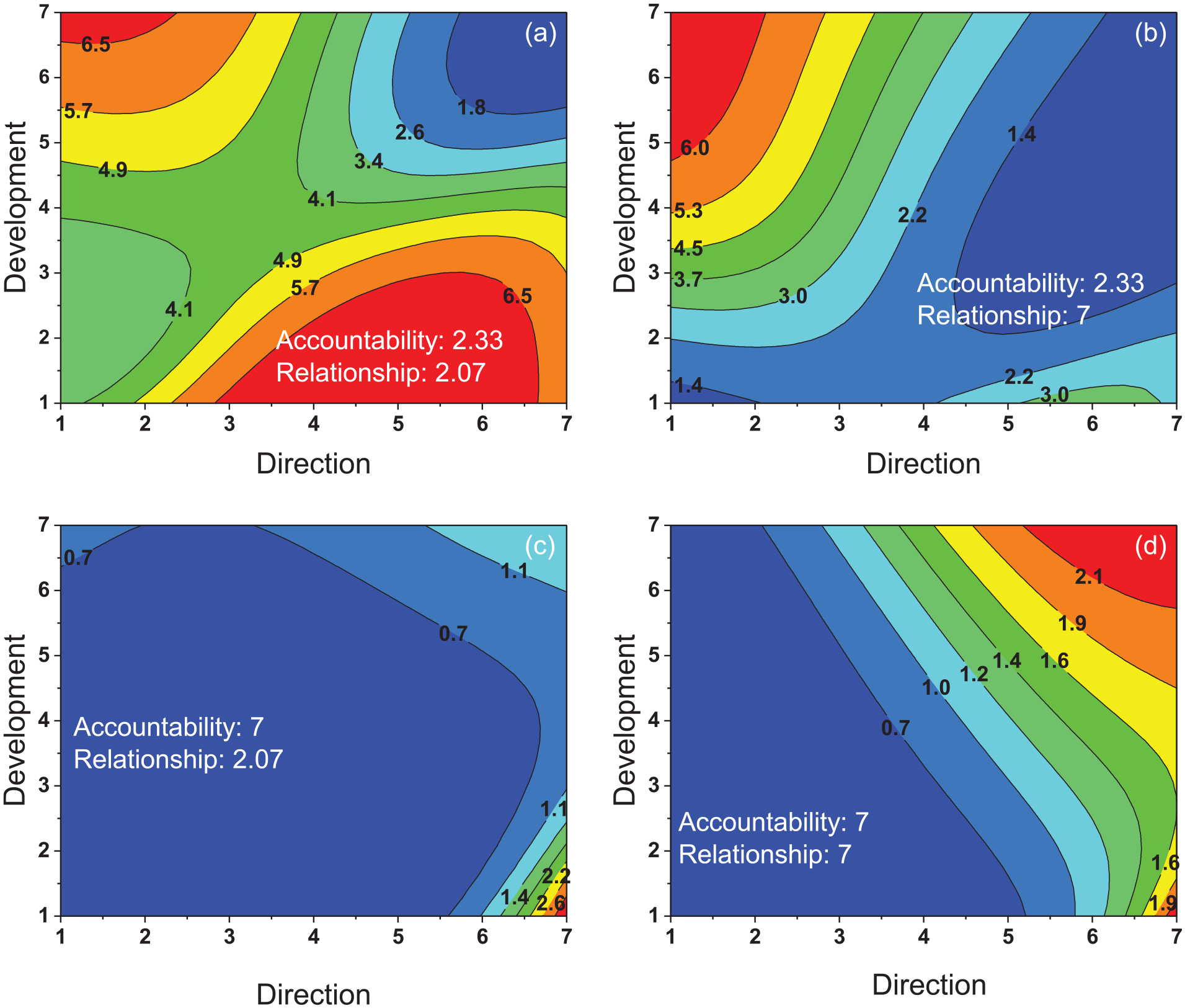
Predicted turnover intention as a function of four coaching leadership parameters: (a) Minimum values of accountability and relationship, (b) Minimum accountability and maximum relationship, (c) Maximum accountability and minimum relationship, and (d) Maximum values of accountability and relationship. Direction and development values were varied from minimum to maximum.
Single Variable Sensitivity Analysis
We changed every predictor parameter at significantly smaller intervals. We predicted turnover intention by carrying out sensitivity analysis (Lu et al., 2001; Minbashian et al., 2010; Somers & Casal, 2009) to estimate the relative importance of input variables on employee turnover intention. We examined how the demographic and coaching leadership variables influence turnover intention using the developed software. The remaining variables were kept at the average values of the database throughout the calculations. Figure 6 shows bivariate relations among four coaching sub-dimensions and turnover intention for male and female participants. The present predictions map the relationship between turnover intention and independent variables differently for male and female members.
Two Variable Sensitivity Analyses
We predicted three-dimensional interactions of turnover intention through different coaching sub-dimension variables, that is, development and direction at a combination of minimum and maximum values of accountability and relationship for female teachers. Figure 7 shows the ANN model predicted effect of turnover intention as a function of development and direction at (a) minimum values of accountability and relationship, (b) minimum accountability and maximum relationship, (c) maximum accountability and minimum relationship, and (d) maximum values of accountability and relationship.
Discussions
These complex surface response figures show that the relationship between coaching leadership and turnover intention is nonlinear. Based on these results, as shown in Figure 6, the red area of each figure offers a high turnover intention. For instance, the value of turnover intention appeared above 6.0 in the case of accountability 2.33 value and relationship 2.07 value, as shown in Figure 6a. The value of turnover intention appeared below 2.2 in the case of accountability 7.0 value and relationship 7.0 value, as shown in Figure 6d. Namely, the higher value of accountability and relationship, the lower value of turnover intention.
Further, as seen in Figure 6b and c, the value of turnover intention is higher in the case of accountability 2.33 value and relationship 7.0 value in Figure 6b than in the case of accountability with a 7.0 value and relationship 2.07 value in Figure 6c. This means that accountability is a more influential factor than a relationship.
Based on our results and direction and development, accountability and relationship of coaching elements in school leadership roles to decline turnover intention are essential core elements. These results are consistent with the study that leaders’ coaching behavior negatively influences the turnover intention of organizational members by Seong et al. (2016) Therefore, we can conclude that the “principal’s accountability behavior to a teacher, dominant sub-dimension of coaching leadership” strongly affects the teacher’s attitude.
Conclusions
This paper proposes an ANN technique as a substitute for the researchers to study the relationship between coaching leadership and turnover intention. The predicted correlation coefficients are higher than multiple linear regression. We created an individual ANN software for analyzing the relationship between coaching variables and turnover intention for the first time. This model will produce turnover intention for new data of endless combinations of coaching variables (Figure 3). Execution of sensitivity analysis on the ANN model aids in mapping the trends between dependent and independent variables. Graphical illustration in 2D and 3D displays all the variables’ functions and shows the nonlinear relationships. We recognized the best coaching leadership variables for the desired turnover intention.
In terms of managerial implications, the observed outcomes obtained from ANN model analysis can give principals in schools, by providing them vital information on coaching leadership effectiveness. Due to Covid-19, all education institutes, including elementary schools, conduct online education according to the chief of education institute’s direction in Korea since the 2019 pandemic. In the case of the elementary school, the principal has the critical and heavy responsibility of operating the school to improve the effectiveness of education without the loss of education. In particular, in the period of rapid environmental change, the principal’s leadership receives the attention of the inner group and outside groups such as teachers, parents, and the government. Therefore, coaching leadership is critical for the principal to develop; it improves teacher satisfaction and decreases teacher turnover.
Limitations
The present ANN method is sensitive to noisy data and irregularity, and hence we need to take care during the data compilation. The performance of the current ANN model predictions depends on the choice and range of independent variables. The ANN model is problem-specific, and hence the model training is time-consuming as there is no systematic approach for getting an optimum model.
Determining the ideal ANN architecture necessitates several experiments. In the current study, we investigated 190 distinct model architectures.
The present results were purely based on data; the results need to be interpreted in the context of leadership theories.
This study suggested only four key sub-dimensions of coaching leadership. Therefore, it would be meaningful to examine the influence relationships between coaching leadership and turnover intention by adding other components of coaching leadership such as problem-solving support and communication using the ANN method.
Future Scope
In practical implications, ANN can achieve higher accuracy on more intricate tasks than traditional regression analysis, although it requires a few additional computational resources. ANN models have effectively mapped nonlinear relationships between independent and dependent variables in numerous research areas. The association concerning independent and dependent variables in social sciences is complex (as shown in the results and others; Minbashian et al., 2010; Somers, 2001) due to many multifaceted scenarios.
The present anticipated ANN technique would open up new theories by analyzing the relationships between coaching leadership and turnover intention. The current work examines the relationships among the dependent and independent variables. Additionally, ANN modeling needs fewer manual interventions to craft accurate features or appropriate data transformations. Hence, we can employ ANN methods to connect several dependent variables with independent variables to model nonlinearity. The ANN methods perform exact operations on images, videos, and texts. The enormous success by which ANNs have been used to model nonlinear system behavior indicates that this approach can be helpful in the field of social sciences.
Supplemental Material
sj-pptx-1-sgo-10.1177_21582440221126885 – Supplemental material for Modeling the Nonlinearities Between Coaching Leadership and Turnover Intention by Artificial Neural Networks
Supplemental material, sj-pptx-1-sgo-10.1177_21582440221126885 for Modeling the Nonlinearities Between Coaching Leadership and Turnover Intention by Artificial Neural Networks by Won Seok Bang, Wee Kuk Hoan, Ju Young Park and Nagireddy gari Subba Reddy in SAGE Open
Footnotes
Declaration of Conflicting Interests
The author(s) declared no potential conflicts of interest with respect to the research, authorship, and/or publication of this article.
Funding
The author(s) disclosed receipt of the following financial support for the research, authorship, and/or publication of this article: This work was supported by the Gyeongsang National University Fund for Professors on Sabbatical Leave, 2021-2022. N. S. Reddy greatly acknowledges Gyeongsang National University for granting Sabbatical leave. NSR acknowledges YSJ-PVSR for the inspiration.

Supplemental Material
Supplemental material for this article is available online.
References
Supplementary Material
Please find the following supplemental material available below.
For Open Access articles published under a Creative Commons License, all supplemental material carries the same license as the article it is associated with.
For non-Open Access articles published, all supplemental material carries a non-exclusive license, and permission requests for re-use of supplemental material or any part of supplemental material shall be sent directly to the copyright owner as specified in the copyright notice associated with the article.
