



Abstract
The achievement of the goals specified in the Paris Agreement and the 2030 Agenda for Sustainable Development depends on whether synergies between climate action and sustainable development policies are enhanced and their trade-offs are minimized. This study aims to identify research trends, debates and gaps in the growing literature on interlinkages between climate mitigation and adaptation with the Sustainable Development Goals (SDGs) and how these interlinkages can be developed into coherent policies. A literature review was conducted based on the Preferred Reporting Items for Systematic Reviews and Meta-Analyses (PRISMA) framework. Literature was sourced from the SCOPUS and Web of Science databases on the 10th of August 2022. Of the 487 records identified, 21 were included and analyzed in the review. The analysis included an additional seven documents, which were used to develop the search strategy for the review. The analysis suggested that even though the impacts of climate mitigation on the SDGs have been well studied, research gaps remain. There is a need for future research into (1) the impacts of achieving the SDGs on climate action, (2) the interlinkages between climate adaptation and sustainable development, (3) the interlinkages between climate action and social aspects, (4) the indirect interlinkages compared to direct interlinkages, and (5) the interlinkages relevant for developing countries. Future research also needs to provide clear guidelines on strengthening synergies while developing coherent policies, which invites discussions on current policy instruments and governance structures.
Introduction
Human-induced climate change is already adversely impacting nature and people and poses additional future risks to the survival and well-being of humanity and natural environments (IPCC, 2022). Climate change is a threat multiplier that likely worsens key sustainable development indicators, such as health, poverty, hunger, inequality, and ecosystem preservation. At the same time, the inherent link between climate change and sustainable development presents an opportunity to synergize actions and build a more sustainable, resilient, and prosperous future for all (Zhenmin & Espinosa, 2019).
In 2015, two transformative global agreements on sustainable development and climate change were adopted. The 2030 Agenda for Sustainable Development and the United Nations Framework Convention on Climate Change (UNFCCC) Paris Agreement set a goal to build a more resilient, productive, and healthy environment for all (Zhenmin & Espinosa, 2019). On the one hand, the 2030 Agenda introduces the 17 Sustainable Development Goals (SDGs), encompassing governance and institutional issues, and the three dimensions of sustainable development, including social, environmental, and economic. On the other hand, the Paris Agreement is a legally binding international treaty that provides a framework for the reduction of greenhouse gases (GHGs) to limit the temperature rise to well below 2°C, preferably to 1.5°C, compared to pre-industrial levels (UNFCCC, 2022). The Paris Agreement and the SDGs cannot be independently pursued as climate change intertwines with economic, social and environmental issues. Negative trade-offs between climate action and the pursuit of the SDGs must be minimized, while the synergies between both agendas must be maximized (Gomez-Echeverri, 2018). Nevertheless, the short timeframe and the unprecedented nature of the transformations needed in the energy, land, industry, and waste sectors place additional pressure on fully exploiting the interlinkages with rapid and coordinated actions (Soergel et al., 2021; Zhenmin & Espinosa, 2019).
In recent years, the complex interlinkages between sustainable development, the effect of climate change, and climate change mitigation and adaptation have been increasingly researched (Roy et al., 2021; Sompolska-Rzechuła & Kurdyś-Kujawska, 2021). Literature focuses on the SDGs as the framework for sustainable development, as they are globally and politically accepted and considered the most relevant indicators for development focusing on long-term sustainability and human well-being (Cohen et al., 2021; Fuso Nerini et al., 2019; Roy et al., 2021; von Stechow et al., 2016).
Given the complexity of the interlinkages between climate action and the SDGs, this study conducted a literature review based on the Preferred Reporting Items for Systematic Reviews and Meta-Analyses (PRISMA) framework (Page et al., 2021). The literature was sourced from the SCOPUS and Web of Science (WoS) databases. The objectives of the research were:
(1) To present bibliometric trends about literature on the interlinkages between climate action and the SDGs published between 2012 and 2022.
(2) To identify critical debates and research gaps in the growing literature on the interlinkages between climate action and the SDGs.
This paper is organized as follows. The methodology of the review is outlined in Section “Materials and Methods.” Section “Results” presents the analysis of the bibliometric data of the literature included in the review, while Section “Discussion” discusses the content of the literature by identifying common themes and research gaps, including the identification of interlinkages between climate action and the SDGs and the integration of climate and sustainable development policy. Section “Conclusions” concludes the review.
Materials and Methods
Search Strategy and Sources
Based on the PRISMA framework, this study reviewed academic papers and grey literature on synergizing climate action and the SDGs. It focused on the literature on interlinkages between climate action and the SDGs. It must be noted that the focus is on the whole SDGs framework, therefore on all SDGs, rather than on a selected group of goals within the SDGs. Seven relevant papers were chosen from the references of the Intergovernmental Panel on Climate Change (IPCC, 2022) report and the background note of the Third Global Conference on Strengthening Synergies between the Paris Agreement on Climate Change and the 2030 Agenda for Sustainable Development (United Nations Department of Economic and Social Affairs (UNDESA) & Secretariat of the UN Framework Convention on Climate Change (UNFCCC), 2022) to guide the development of the search strategy for the literature review, as both documents contain the most updated and relevant references regarding interlinkages between climate action and the SDGs. The set of seven papers covers review articles, articles, research letters, and comment papers and are listed in the SCOPUS database and the WoS database (Fuso Nerini et al., 2019; Karlsson et al., 2020; Sanchez Rodriguez et al., 2018; Soergel et al., 2021; “Sustainable Development Through Climate Action,”2019; Yeeles, 2019; Zhenmin & Espinosa, 2019).
Based on these seven papers, the search strategy for the literature review was developed. Consequently, literature for the review was sourced from the SCOPUS and WoS databases by inputting (“climate change” OR “Paris Agreement”) AND ((“trade-off” OR “trade off” OR “trade-off” OR “synerg*”) OR (“adaptation” OR “mitigation”)) AND SDGs into both databases. The search was implemented by focusing on article titles, abstracts, and keywords.
Screening Criteria and Full-Text Review Process
On the 10th of August 2022, the SCOPUS database generated 406 document results, while the WoS database generated 81 document results, resulting in a total of 487 documents to be screened. These were all published in English between 2012 and 2022. One reviewer screened all documents without the use of automation tools. Figure 1 outlines the review framework and results from the screening processes under the PRISMA framework.
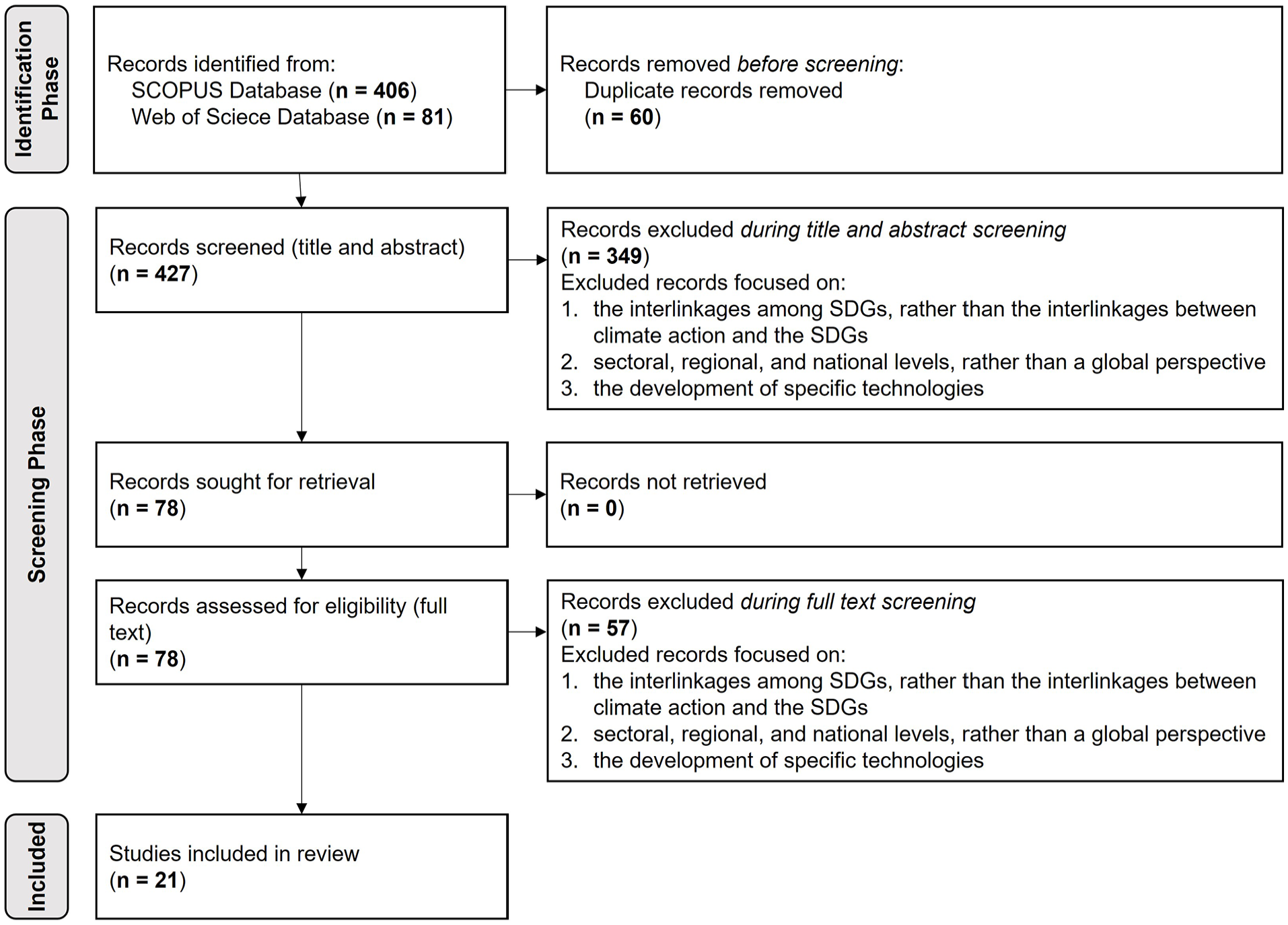
Review framework adapted from the PRISMA framework.
No documents were excluded based on their publication date as documents before the adoption of the SDGs and the Paris Agreement in 2015 could still provide insights into the interlinkage between climate change and sustainable development. Duplicate articles between the WoS and SCOPUS databases were identified and removed, resulting in the removal of 60 documents. The remaining 427 papers were screened based on their title and abstract. Documents were removed if they:
Did not explicitly focus on the interlinkages between climate action and sustainable development, such as documents focusing on the development of specific technologies and the interlinkages among the SDGs rather than specifically on climate action.
Did not take a global perspective on synergizing climate action and the pursuit of the SDGs, but rather concentrated on a particular sector, region, or country.
Focused mainly on the development of specific technologies, such as carbon capture and storage solutions.
A document passed the initial screening and went through the full-text review process in the case of uncertainty about the document’s relevancy. Based on the title and abstract screening, 349 papers were excluded, leaving 78 documents to be assessed based on their full text. The same three exclusion criteria were used as described in the title and abstract screening, which resulted in the exclusion of 57 further documents, as they did not explicitly focus on the interlinkages of climate action and sustainable development and/or did not take a global perspective. This left 21 documents to be included in the review.
Document Analysis
Document analysis was completed for the 21 documents deemed relevant by the full-text review and the seven documents chosen initially to guide the development of the evaluation. Therefore, bibliometric data and content data were extracted from 28 papers. The bibliometric data presented in Section “Results” includes authors, year of publication, document type, country locations of authors’ institutions, and author keywords. The content data presented in Section “Discussion” focuses on the research aim, methodology, and research themes, such as directions of the interlinkages between climate action and SDGs, types of climate action, the approach to sustainable development, and the status of coherent climate and sustainable development policy.
Table 1 shows the seven documents chosen during the review development phase, while Table 2 presents the 21 studies that resulted from the systematic screening and full-text review. It provides details on the authors, year published, document title, document type, type of methodology used, and research aim of each document.
Literature Chosen During the Review Development Phase.

Source. Authors.
Literature from the Literature Review from SCOPUS and WoS.

Source. Authors.
Results
Bibliometric Analysis
Consistent with the SDGs’ timeline, all 28 documents were published after 2015, when the SDGs were announced, as seen in Figure 2a. The number of documents published annually is greater in recent years than in 2016 and 2017, suggesting that research on the interlinkages between climate action and the SDGs has gained momentum. Additionally, as seen in Figure 2b, while most documents are research articles, the 28 documents demonstrate a range of document types, including review articles, research letters, two comment papers, one Q&A and one editorial.

(a) Documents by publication year, own representation and (b) documents by document type, own representation.
Furthermore, 14 out of 28 documents employ qualitative methods, while nine employ quantitative methods, three use conceptual methods, and two use mixed methods. Qualitative methods include content analysis, multi-stakeholder workshops, interviews, and reviews. Quantitative methods tend to be based on integrated assessment models. The trend of implemented methodologies has remained unchanged over the years.
The authors’ institutions tend to be in developed countries. The institutions are most frequently in Germany (8 authors), the United States (6), Austria (5), Sweden (5), the United Kingdom (5), Japan (4), and Italy (3). The remaining are in Australia, Canada, China, Denmark, France, Ghana, Hungary, India, Mexico, Nigeria, Poland, Saudi Arabia, and Ukraine. Thus, authors based in developing countries represent a minority of the literature, which could imply that there is less awareness or less prioritization for assessing the interlinkages in developing countries or that efforts to do so are not being published in the SCOPUS and WoS databases.
Author Keyword Co-occurrence
Keyword co-occurrence maps provide valuable insights into the recurring topics discussed in the literature. The network visualization map created in VOSviewer represents items with a label and a circle, of which the weight of the item determines the sizes. The weight represents the total number of keyword occurrences in all documents. Items closely related to each other are put into a cluster, which receives a different color. Lines between the items represent links created between keywords that co-occur in the same document. The width of the link indicates the number of publications in which the two terms have been published together. The distance between the items approximately represents the relatedness of the keywords (van Eck & Waltman, 2022).
The keyword co-occurrence analysis in this study includes 20 academic articles (out of 28) that provide author-suggested keywords. From the 81 keywords, the most extensive set of connected items consisted of 64 keywords, shown in Figure 3. The following keyword clusters are revealed: “Paris Agreement,”“sustainable development goals,”“sustainable development goals (sdgs),”“sdgs,”“climate change,” and “climate change mitigation.” The outlying keywords, for example, “afolu,”“decision-making” and “cge model,” suggest the different focuses of the found literature.

Author keyword co-occurrence graph, made in VOSviewer.
To better assess the linkages between the keywords, similar keywords were grouped to produce Figure 4. The following changes were made: (1) “sdgs” covered “sustainable development goals,”“SDG,” and “sustainable development goals (SDGs),” (2) “climate change mitigation” included “mitigation” and “mitigation actions,” (3) “synergy” covered “synergies,” (4) “co-benefits” included “co-benefit,” (5) “integrated assessment model” included “integrated assessment modelling,” and “integrated assessment model (IAM),” and (6) “2030 Agenda” included “2030 Agenda for sustainable development” and “Agenda 2030.”
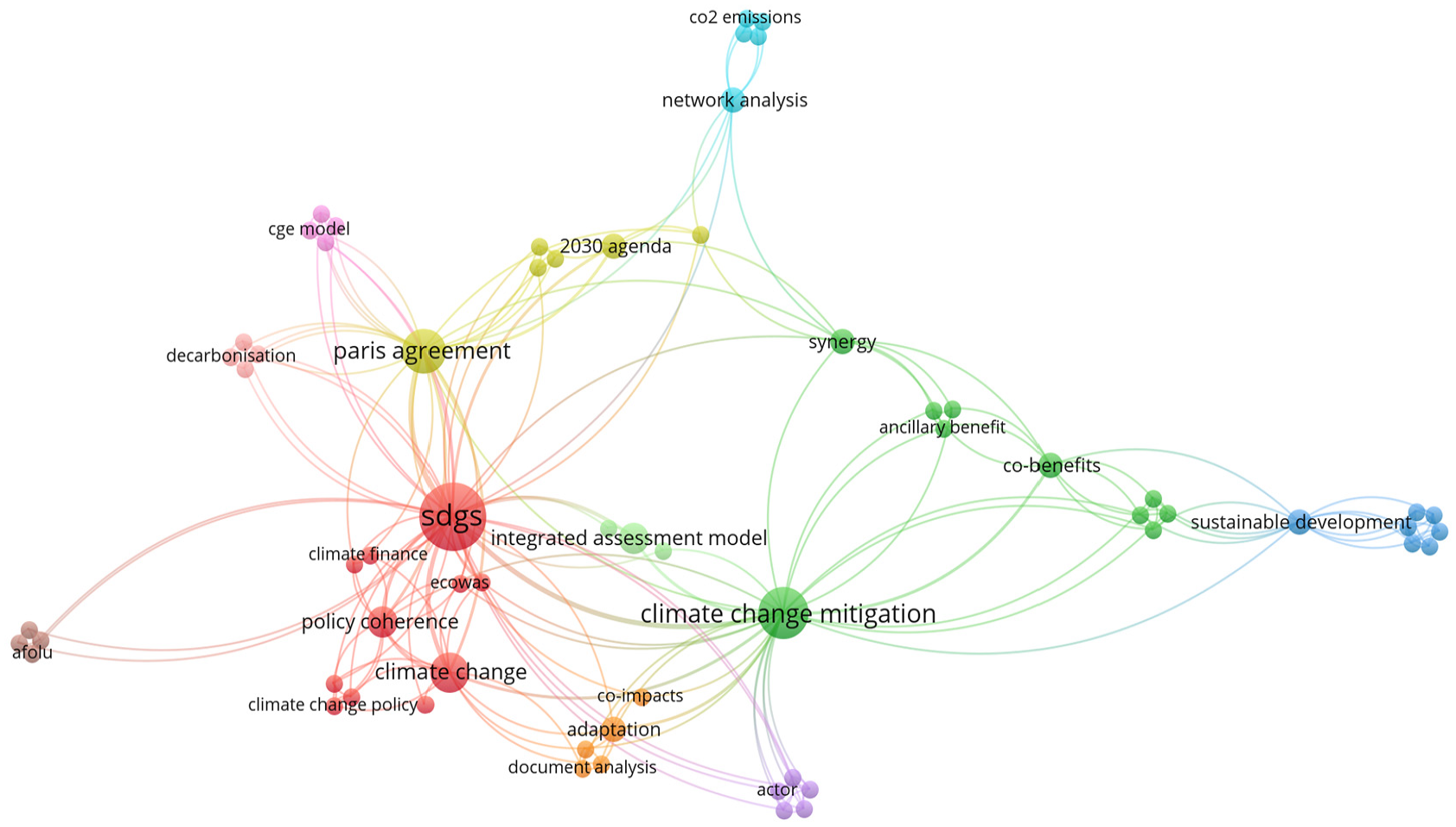
Adapted author keyword co-occurrence graph, made in VOSviewer.
The clusters in Figure 4 are more defined than in Figure 3. The most significant cluster is “sdgs,” interrelated with subclusters “paris agreement” and “climate change mitigation.” Adaptation is covered to a lesser extent, suggesting a research focus on the interlinkages between the SDGs and climate mitigation action rather than climate adaptation action. However, analyses based on author keyword co-occurrence graphs may not accurately reflect the topics discussed in the documents included in the review because authors may not identify their keywords in the same way. Some authors may highlight specific topics more than others, for instance, highlighted by the presence of “afolu” in Figures 3 and 4. Apart from the agriculture, forestry, and other land use (AFOLU) sector, no other sectors are listed in the co-occurrence graphs. In light of this, the subsequent section discusses the literature’s main themes based on a full-text review of the 28 documents.
Discussion
The discussion of the results is based on two thematic areas derived from the 28 documents. The thematic areas are (1) the identification of synergies and trade-offs between climate actions and the SDGs and (2) the integration of climate policy and sustainable development policy. The first thematic area is a prerequisite to developing effective policy packages as part of the second thematic area (IPCC, 2022).
Identification of Synergies and Trade-Offs Between Climate Action and the SDGs
Despite the existing literature on these complex interlinkages, knowledge gaps remain, and there is a call for more evidence of the synergies and trade-offs between climate action and sustainable development (Cohen et al., 2021; Fujimori et al., 2020; Fuso Nerini et al., 2019; Gomez-Echeverri, 2018; Iacobuţă et al., 2021; Roy et al., 2021). Five main discussion points related to the nature of the interlinkages emerge from the analysis of the 28 documents. First, the impacts of climate action on SDGs tend to be explored more than the impacts of achieving the SDGs on climate change and other environmental issues. Second, literature tends to focus on the interlinkages between climate change mitigation rather than adaptation and sustainable development. Third, the interlinkages between climate action and social aspects tend to be investigated to a lesser extent than those between climate action and environmental, economic, or technical elements. Fourth, there is a geographical imbalance in the scope of the interlinkage exploration. Fifth, the direct impacts of climate action on the SDGs are better covered than indirect ones.
Directions of Impacts Between SDGs and Climate Action
The literature on synergizing climate action and SDGs can be categorized according to the direction of the explored impacts. The effects of climate mitigation and adaptation on the pursuit of the SDGs have been investigated to a greater extent than the effect of achieving the SDGs on climate action. 20 of the 28 papers focus on the impact of climate action on the SDGs, compared to only three that consider the impact of achieving the SDGs on climate action and five that consider the bi-directional interlinkages. The impact of climate action on the SDGs is generally assessed in two ways: (1) specific mitigation or adaptation actions and their effects on the SDGs (Bertram et al., 2018; Cohen et al., 2021; Fuldauer et al., 2022; Fuso Nerini et al., 2019; von Stechow et al., 2016) and (2) the effect of reduced CO2 or GHG emissions of mitigation actions on the SDGs (Campagnolo & Davide, 2019; Fujimori et al., 2020). The chosen mitigation actions commonly reflect those stated in countries’ Nationally Determined Contributions (NDCs) (Campagnolo & Davide, 2019; Cohen et al., 2021; von Stechow et al., 2016) and reflect the findings of an IPCC special report on “Global Warming of 1.5°C” (Roy et al., 2018) that assessed the linkages between climate action within the SDG framework (Fuso Nerini et al., 2019; Roy et al., 2021). It is becoming more evident that the activities proposed in the NDCs contribute to the achievement of SDGs (Cohen et al., 2021; Iacobuţă et al., 2022), as found from content analysis of 164 NDCs (Janetschek et al., 2020) and more regional studies, for example, West Africa (Antwi-Agyei et al., 2018).
In cases where research explores the impacts of achieving the SDGs on climate action, the integration of climate and development policy tends to be viewed holistically rather than focusing on the effects of achieving individual SDGs or their targets on climate actions (Fuso Nerini et al., 2019; Gomez-Echeverri, 2018; Yeeles, 2019). To gain a deeper insight into the complex interlinkages, this direction of the impacts must also be explored, especially as it has been demonstrated that there are positive effects to be reaped from achieving SDGs on climate action. For example, achieving selected SDGs related to AFOLU would mitigate 2.1 GtCO2eq/year in 2050 without any targeted mitigation efforts in the land sector (Frank et al., 2021). However, significant SDG advancements were also shown to increase per capita CO2 emissions in another study (Kobayakawa, 2021). Another example is that hunger reduction programs may cause environmental degradation, whereas environmental conservation possibly deters the progress of zero hunger (SDG2) (Pingali & Plavšić, 2022). These trade-offs resulting from progress toward the SDGs demonstrate the need for further research into the consequences of achieving the SDGs on climate action.
Types of Climate Action Assessed
A second way to categorize the research on interlinkages between SDGs and climate action is to identify the types of climate action studied in the literature. Research primarily focuses on the co-impacts of climate change mitigation actions and climate change on the SDGs, such that synergies and trade-offs in these areas are well acknowledged in the literature (Bertram et al., 2018; Cohen et al., 2021; Roy et al., 2021; von Stechow et al., 2016). However, a research gap exists in assessing how climate change adaptation action can be synergized with the SDGs. Filling this gap is crucial to developing adaptation actions that recognize the more comprehensive social, cultural, economic, political and institutional elements (Fuldauer et al., 2022; Sanchez Rodriguez et al., 2018). Of the 28 documents, only three explicitly focus on linking adaptation efforts to the SDGs, of which two are specific to small coastal towns and cities (Major et al., 2018; Sanchez Rodriguez et al., 2018). Fuldauer et al. (2022), on the other hand, propose and globally apply a sector-scale framework on the bi-directional interlinkages between adaptation efforts and SDG targets, which contrasts with other studies investigating the broad scale of the relationship between the SDGs and climate adaptation. However, there is still room for improvement in the research on the interlinkages between climate adaptation efforts and the SDGs rather than mitigation efforts.
Approach to Sustainable Development
In addition to the literature focusing on different types of climate action, studies also differ in how they approach sustainable development. For example, different SDGs or SDG targets are focused on when assessing the co-benefits and trade-offs between climate action and sustainable development efforts. There is a trend for co-impact assessments of climate change policies to take into account more sustainability objectives in the evaluation, such that recent studies tend to consider all 17 SDGs rather than selected SDGs (Bertram et al., 2018; Cohen et al., 2021; Fuso Nerini et al., 2019; Iacobuţă et al., 2021; von Stechow et al., 2016). However, before this trend, research traditionally focused on the impacts on selected sustainability objectives, especially the technological and economic effects and challenges (von Stechow et al., 2016), and selected environmental consequences, such as air pollution, water scarcity and deforestation, land-use change, and biodiversity (Bertram et al., 2018; Campagnolo & Davide, 2019). The impact of policies on social aspects, such as poverty, inequality, and affordability of technologies, has been explored to a lesser extent (Campagnolo & Davide, 2019; Roy et al., 2021). Moreover, evidence of synergies and trade-offs among climate change policies and SDGs is lacking in other aspects, especially for social goals, such as gender equality (SDG5) and reduced inequalities (SDG10). By incorporating socioeconomic policies in the interlinkage discussion, climate policies’ effectiveness in achieving SDGs can be better assessed (Liu et al., 2021).
There is also limited research on the impact of climate action on the SDGs at the target level compared to the goal level (Fujimori et al., 2020; Fuso Nerini et al., 2019; Roy et al., 2021). Focusing on the 169 individual targets allows detailed mapping of the complex interlinkages (Fuso Nerini et al., 2019). However, this complexity is not easily quantifiable as it is non-linear and varies in time (Fujimori et al., 2020; Roy et al., 2021).
Geographical Imbalance in the Scope
The fourth key takeaway is that a geographical imbalance exists in the scope of the exploration of the interlinkages. Considering interlinkages on a global scale possibly poses risks of overgeneralizing the impacts of such interlinkages, as most of the 28 studies do not distinguish between developed and developing nations (Bertram et al., 2018; Campagnolo & Davide, 2019; Gomez-Echeverri, 2018; Sanchez Rodriguez et al., 2018; Shockley, 2018; von Stechow et al., 2016). Therefore, analyzing and interpreting the impacts from a national context is also necessary (Iacobuţă et al., 2021). However, this literature review cannot confirm that there are insufficient country and micro-level analyses and case studies (Iacobuţă et al., 2021), as literature focusing on specific countries was removed in the screening process to keep the global view of policy development. Therefore, exploring how to assess synergies and trade-offs in a context-specific manner is significant in providing policy recommendations that do not follow the one-size-fits-all pattern.
Additionally, apart from Coenen et al. (2022), when a region is specified in the selected studies’ analyses, these focus mainly on national climate action and sustainable development progress rather than on the commitments of transnational climate initiatives operating beyond countries’ borders. Research has also focused on state-led climate actions, thereby neglecting the actions of non-state actors (Coenen et al., 2022), highlighting the importance of considering actions of non-state actors that can operate transnationally, in addition to the actions of national governments. Coenen et al. (2022) demonstrated that transnational climate actions can promote broader social, environmental and economic development goals and that non-state actors can complement states’ actions.
Direct and Indirect Impacts
Lastly, literature tends to focus solely on the first-order (direct) impacts between climate policies and SDGs rather than considering the indirect synergies and trade-offs, possibly to simplify the complex interlinkages. For example, renewable energy sources as part of climate mitigation action can facilitate the expansion of electricity in remote areas, improving education, health services and other economic activities (Iacobuţă et al., 2021). These cascading effects may not be incorporated in first-order impact assessments. However, indirect and interdependent cascading effects may have the most far-reaching risks and benefits (Fuldauer et al., 2022). Therefore, exploring positive and negative externalities of the second-order (indirect) impacts between climate actions and SDGs in future research helps inform policymakers how to internalize those indirect effects into the decision-making process.
Integration of Climate Policy and Sustainable Development Policy
In addition to identifying the synergies and trade-offs between climate action and SDGs, debates on the integration of climate policy and sustainable development policy emerge (Gomez-Echeverri, 2018). This integration is commonly referred to as developing coherent policies, defined as “the systematic promotion of mutually reinforcing policy actions across government departments and agencies creating synergies toward achieving the defined objective” (OECD, 2001). The main discussion points related to policy integration are as follows.
Lack of a Suitable Framework to Translate the Identified Synergies and Trade-Offs into a Coherent Policy
First, the literature generally agrees that identifying synergies and trade-offs between climate action and the SDGs can aid in prioritizing and financing climate action and development policies (Gomez-Echeverri, 2018; Janetschek et al., 2020; Okitasari et al., 2022; Okitasari & Korwatanasakul, 2023; Takemoto et al., 2022). For instance, the Group of Twenty (G20) countries adopted climate change mitigation measures that present more co-benefits with the SDGs (Iacobuţă et al., 2021). However, studies tend to be pessimistic about the current state of translating these interlinkages into synergized climate action and development policy. For example, countries from the European Union tend to implement the goals of “good health and well-being” (SDG3) and “climate action” (SDG13) based on compromise rather than on enhancing synergies (Sompolska-Rzechuła & Kurdyś-Kujawska, 2021), while policies on economic and social development in southern African countries only partially align to climate policy (England et al., 2018). This misalignment in policy development is commonly related to the lack of research on translating the identified synergies and trade-offs into coherent and effective integrated policy (Cohen et al., 2021). There is a need for clear guidelines on aligning planning, implementation and monitoring frameworks to connect climate action and sustainable development (Cohen et al., 2021; Fuso Nerini et al., 2019). Although Iacobuţă et al. (2021) proposed a scoring framework, there is no standardized method to quantify and analyze the co-benefits nor how these synergies and trade-offs should be weighted and valued for prioritization and to assist policy development. Research on the monetization of co-impacts is limited, and the method itself is often challenging due to the limited availabilities of valuation techniques and the uncertainties around choosing context-specific indicators (Cohen et al., 2021; Karlsson et al., 2020). Furthermore, research on climate policy integration specifically for developing countries is scarce. Challenges remain for NDC implementation, such as integrating climate change objectives into sectoral and development policies and receiving financial support (Garcia Hernandez & Bolwig, 2021; Zhenmin & Espinosa, 2019).
Suitability of Existing Arrangements and Commitments to Synergize Policy
Second, the discussion on developing coherent policies also tends to focus on the suitability of existing arrangements to integrate climate and development policies and whether the commitments are ambitious enough, such as the NDCs, the SDGs, and the National Sustainable Development Strategies (Gomez-Echeverri, 2018; Janetschek et al., 2020; Shockley, 2018; Zhenmin & Espinosa, 2019). NDCs are currently not ambitious enough and, thereby, do not reflect the urgency of reaching net zero GHG emissions by 2050, threatening decades of development progress and future inclusive and sustainable growth (Gomez-Echeverri, 2018; Shockley, 2018; Zhenmin & Espinosa, 2019). Moreover, no noticeable improvement in the alignment between activities described in countries’ NDCs and climate-relevant finance was noticed after the release of the NDCs following the Paris Agreement of 2015 (Iacobuţă et al., 2022). There is an additional call that, in their current form, the NDCs and the SDGs do not align the development efforts and the response to climate change well. NDCs should include more connections to the SDGs and consider existing national development strategies (Iacobuţă et al., 2021; Janetschek et al., 2020). Shockley (2018) argues that the fundamentally subjective nature of NDCs causes this instrument to be ill-suited to integrate development efforts and climate change responses. While the SDGs reflect universal concerns and, therefore, are independent of the expressed interests of nations, NDCs are voluntary and depend on what countries are willing to do rather than what they need to do with the global climate aims in mind (Shockley, 2018). This view is shared by Cohen et al. (2021), who argue that NDCs tend to focus on activities that promote co-benefits with development priorities rather than reducing potential trade-offs.
Need for Stakeholder Participation to Overcome Current Siloed Approaches Used in Governance
Third, the misalignment in climate and sustainable development policy is caused by insufficient or ineffective stakeholder participation. Governments, for example, tend to take a siloed global and national governance approach, such that there is little coordination between different levels of government (Sanchez Rodriguez et al., 2018). Ministries and agencies tend to work on the Paris Agreement agenda and the 2030 Agenda separately (Janetschek et al., 2020; Karlsson et al., 2020), and policy design for climate adaptation and its implementation tends to be separated into silos (Fuldauer et al., 2022; Sanchez Rodriguez et al., 2018). Furthermore, to pursue the unprecedented changes required to meet the 2030 Agenda and Paris Agreement, in addition to the government, stakeholders from academia, civil society, and the private sector need to be integrated into policy development (Yeeles, 2019; Zhenmin & Espinosa, 2019). These stakeholders’ participation supports coherent climate and sustainable development policy. Highlighting non-climate related benefits of climate actions (Cohen et al., 2021; Iacobuţă et al., 2022; Janetschek et al., 2020) boosts such support. Furthermore, the benefits reaped by balancing environmental, economic and social objectives need to be pointed out rather than simply focusing on mitigation costs associated with climate policy (Cohen et al., 2021; Karlsson et al., 2020). Emphasizing the co-impacts of climate and development actions allows for more efficient and cost-effective actions and policies to be developed as actions can target multiple co-benefits while minimizing trade-offs (Cohen et al., 2021; Fuso Nerini et al., 2019).
Conclusions
This literature review has demonstrated the need to synergize climate action and sustainable development policy to achieve the SDGs by 2030 and the goals set out in the Paris Agreement. While research and debate on synergizing climate action and sustainable development policy are emerging, research gaps remain. The gaps are related to (1) the extent to which the interlinkages have been identified and (2) how these interlinkages can be translated into coherent climate and development policy.
In particular, there is a need for future research into (1) the impacts of achieving the SDGs on climate action, (2) the interlinkages between climate adaptation and sustainable development, (3) the interlinkages between climate action and social aspects, (4) the indirect interlinkages compared to direct interlinkages, and (5) the interlinkages relevant for developing countries. Future research also needs to provide clear guidelines on strengthening synergies in developing coherent policies, which invites discussions on current policy instruments and governance structures.
The presented research could be improved by including additional literature in the analysis, thereby increasing the number of analyzed articles beyond 28. Sources other than SCOPUS and Web of Science could be used to obtain further literature. The search criteria could also be refined based on the findings of this research to find more relevant papers. This may also lead to the inclusion of documents published in 2017 that were not included. Additionally, more recent articles published since the database search in August 2022 could be included to make the research more relevant. Methodically, the analysis of chosen literature could be deepened in consequent research phases using methods such as meta-regression analysis or sensitivity analysis.
Footnotes
Acknowledgements
No acknowledgements are made.
Declaration of Conflicting Interests
The author(s) declared no potential conflicts of interest with respect to the research, authorship, and/or publication of this article.
Funding
The author(s) disclosed receipt of the following financial support for the research, authorship, and/or publication of this article: This research was supported by the Ministry of Education, Culture, Sports, Science and Technology, Japan.
Ethical Approval
No empirical research with human or animal study participants was conducted, such that an ethics statement is not applicable.

Data Availability Statement
Data sharing is not applicable to this article as no datasets were generated or analyzed during the current study.