




Abstract
Livehouse is a small venue for live music performance, a term commonly used in the Asian context. This article adopts an insider’s perspective to look at the connections between livehouse and its audiences. Instead of treating spaces and objects as silent textures of live music experiences, we regard livehouse as an active site filled with ideas and feelings. The meaning of livehouse is made by audiences through both human and non-human agents and extends to the broader social and cultural context of Shanghai. By highlighting the power of things and networking in between, this article combines the affordance theory to illustrate the experiential dimensions and interpretive processes of livehouse audiences in Shanghai. Drawing on ethnographic data from 26 in-depth interviews and participant observation, we conclude the social, cultural, and emotional affordances of livehouses perceived through tangible and intangible objects and settings.
Introduction
Live music has attracted scholarly attention for more than two decades. Born in the nexus of urban culture and public discourse, live music is “bound up with the social production of place” (Cohen, 1995, p. 444). Previous academic approaches situate live music in broader economic, managerial, and cultural conversations, particular in the western contexts (Chatterton & Hollands, 2002, 2003; Gallan, 2015; Gibson & Homan, 2004; Holt, 2010; Roberts, 2015; van der Hoeven & Hitters, 2019). These macro perspectives also provide an overall picture to understand live music in society and culture where live music breeds. Nonetheless, the nuanced differences between particular places and the subjectivity of individual actors are downplayed to a great extent.
To navigate the dynamic live music scenes in Shanghai and to illustrate the people-place connections in live music, this article focuses on the uses of and values perceived by audiences of live music venues, or livehouses to be specific. Livehouse is a relatively small indoor venue and is often equipped with professional stereo sets for live music performances. Unlike rock clubs or jazz bars, music performed in livehouses has a wider range, including folk music, heavy metal, rap, and so on. The term “livehouse” is rarely used in Western discourses but is commonly employed in live music studies in China (Gu et al., 2021; Liu & Cai, 2014), as it has become an independent category of live music venues in Chinese live music industry. This article thus uses the term “livehouse” instead of “live music venue” to highlight the uniqueness and specificity of livehouse perceived by Chinese audiences. Livehouse originates in Japan but is developing very fast in China. The box office of livehouse was 125 million RMB in 2017, a year-on-year growth of 51%. 1 In 2018, the box office of livehouse reached 250 million RMB. 2 In Shanghai, the growth rate of the livehouse market grew by 68.4% in 2018, outnumbering the rest cities in China. 3 However, little is known about the livehouse popularity in Shanghai. Based on an insider’s perspective, this article seeks to adopt a bottom-up approach, realizing the people-place connections through objects in Shanghai’s livehouses.
Things Matter: Realizing People-Place Connections Through Objects
Early accounts of live music are associated with subculture studies which located it within a frame of Birmingham Cultural Studies to discuss it as a reaction to the dominant culture, and a class-based culture resistant to parent culture. Through exploring the social class’s working experiences, Dick Hebdige’s analysis of subculture centers on “imagination” and its subversive sense occurs through its creative invention and reinvention (Blackman, 2020). Subsequent studies, in particular post-subcultural analysis, moved away from the subcultures frame to focus on “scenes,” conceptualized as a space for gathering that is bounded by music taste rather than class Peterson & Bennett, 2004; Straw, 1991). We aim to understand live music through its relationship with place and agreed upon the argument that live music is a commodity “but also creates a sense of ‘scene’ in particular spaces (particularly public houses) . . .inscribing meaning in landscapes” (Gibson & Homan, 2004, p. 69). Thus, to better understand how relationships between people such as performers, audiences, and organizations such as agents and venues shape the cultural form of live music, we adopt the concept of live music ecology in this article to further analyze different actors. The live music ecology, a prominent concept used to analyze dynamics in the music industries, draws “out the complexities of [the] highly variegated industrial and geographical relationships” in the live music sectors and its wider connections to the process of policy-making (Behr et al., 2016, p. 20). Live music venues, consequently, play an increasingly important role in the live music ecologies and in shaping the live music experience (Bennett & Rogers, 2016). Live music is “geographically contingent” since they are “neither about a McLuhanesque world-wide community getting to grips with a common human essence, nor the homogenizing implication of the expansion of Western capital” (Saldanha, 2002, p. 347). As a result, live music is place-oriented. Shifting our perspective to Chinese live music ecology supplements existing research in the Western context. The subject of Chinese live music ecology is not new. Previous studies have outlined the recent development and key features of the popular music industry and live music ecology in China, especially in Shanghai (Chun et al., 2004; Gu et al., 2019, 2021; Jian, 2018; Zhang & Negus, 2020). However, the affective atmosphere and materialized experience in Chinese live music ecology are often overlooked.
The argument that places shape live music experiences has been well documented (see, e.g., Gibson, 1999; Kavanagh, 2020). What remains to be examined is what exactly in a place that shapes live music experiences and how and why individuals’ perceptions matter in these experiences. Live music venues in previous studies were generally taken as cultural infrastructures themselves that contribute to urban culture and the night-time economy (Baker et al., 2009; Gallan, 2015). A place can be viewed holistically but can also be divided into several tangible and intangible cultural amenities or objects that all together tell the features of the local scene (Silver, 2012). These cultural amenities or objects also require ordering, that is, the interpretations of human beings, to contribute to the local scene. As a result, an audience’s perception or sense of a place is the interpretation of objects in the environment. Objects perceived by audiences, in turn, “mediate human interaction. . . [since they provide] meanings and condensing social discourses and world visions” (Caronia & Mortari, 2015, p. 405). To substantiate the initiative of objects in an environment, we should allow the interplay between space and subjectivity. Music in live music venues, for example, can be taken as a form of intangible object in that particular setting whose meaning relies on the mutuality of music texts and individual subjectivity (Cohen, 1993). The thing power, identified by Bennett (2010) to describe the ways in which nonhuman actants exert agency, needs to be recognized here. The power is more easily detectable when the actants are unruly, undesired, or becoming resisting our intentions. Through looking at “thing power,” we can better understand how the tangible and intangible objects are combined to make sense of a place.
To understand the meaning-making process in a place, the affordance theory is an appropriate approach. The affordance theory (Gibson, 1979), originating from cognitive psychology, addresses the properties of an object that allows for specific actions by an individual. Since then, the affordance theory has been widely adopted by scholars from different disciplines. According to the affordance theory, “any environment (or object) has cues that indicate possibilities for action,” and subsequently, objects can constrain the meaning-making process and “create possibilities which work in favour of the genesis of certain meanings and courses of action rather than others” (Caronia & Mortari, 2015, p. 403). The physical and cognitive availability of objects will determine the sense-making process of audiences. Therefore, the interpretations and social-spatial analysis of objects in any given situation shape the audiences’ experiences and affect the qualities of life. The affordance theory emphasizes the experiential dimensions of the environment through action and active participation of human beings. Moreover, the affordance theory offers an insider’s perspective to explain the perception and behavior of audiences in a particular environment. In this study, we combine the affordance theory to understand how livehouse audiences “come to ‘latch on’ to particular aesthetic objects to connect their own situated action to wider cultural frameworks” (Acord & DeNora, 2008, p. 228). Previous studies have established the necessity of analyzing the role and affordance of music or sound in live music venues (Gallan, 2015; Liu & Cai, 2014; Nowak & Bennett, 2014; van der Hoeven et al., 2022). The value of music, however, lies in the interactions associated with the sounds rather than the sound itself. The affordance theory also contributes to the live music ecology framework we have adopted in understanding the dynamic and interactive livehouse experience in Shanghai.
In this paper, we advance an empirical approach to realizing the people-place connections by examining the affordance of tangible objects (such as lighting and wall decorations) and intangible objects (such as music, interactions, and spatial settings) in the place. We seek to explore how these objects in livehouses are sensed and applied to understand and create meanings in the environment. We attempt to illustrate how these “human and non-human agents participate in building the life-world [of livehouses] and how they cooperate in this shared meaning-making process” (Caronia & Mortari, 2015, p. 402). Moreover, we examine the history of Shanghai’s live music scenes and situate our analysis in the broader live music ecology in Shanghai.
An Insider’s View
Shanghai is one of the most developed and vibrant cities in China, whose gross domestic product (GDP) has ranked first in China for more than 40 years. 4 Shanghai’s spending power reached 1.8 trillion RMB in 2021 alone, outnumbering the rest Chinese cities. 5 The rapid economic development and reliable spending power also boosted and diversified the nightlife in Shanghai, where one can choose almost all kinds of live music performances.
Shanghai’s popular music industry and live music scene date back to the early 20th century. Shanghai was a semi-colonized and semi-feudal city back then, and “a metropolis famous for its nightlife and cabarets . . .[with] American, Filipino, Russian, Indian and other Oriental bands playing American jazz, ballroom dance music or Chinese popular songs in different venues” (Chen, 2005, p. 109). Live music venues, including cafes, cabarets, and bars, symbolizing Shanghai’s modernity, became hotspots for both Western settlers and local people. For example, the famed Jazz Bar Peace Hotel and Paramount Ballroom performed mainly jazz during the 1920s to 1930s, catering to Western settlers and the emerging local “white-collar” workers such as compradors and employees at Shanghai’s foreign companies. Since the rise of Chinese popular music and Chinese national entrepreneurs in the mid-1930s, live music venues not only welcomed the Western community but also “Chinese elites from politicians to gangsters to movie stars” (Farrer & Field, 2015, p. 27). Besides the dominant jazz music, the early-stage Chinese popular music and traditional Chinese operas also had opportunities for public performances during that historical episode. When the Chinese Communist Party took over mainland China, the Chinese popular music industry slowed down and even paused during the radical social and political campaign Cultural Revolution (1966–1976).
Since the reform and opening policy in 1978, popular music gradually revitalized in China. Together with the advancement of technology such as cassette tape and CD, audiences from mainland China were exposed to a greater variety of popular music from Hong Kong, Taiwan, and the West (de Kloet, 2005). Boosted by further opening and reforms and the increasing influence of foreign culture in the 1990s, cities such as Beijing and Shanghai “saw a boom in spaces dedicated to live musical performances, which catered to foreigners and to a newly emerging class of white-collar Chinese eager to learn foreign ways” (Field, 2019, p. 157). These venues include cafes, discos, and nightclubs. The Jazz Bar Peace Hotel and Paramount Ballroom continued to provide jazz music in contemporary Shanghai, attracting tourists from home and abroad and local Shanghainese who wanted to experience the 1920s to 1930s Shanghai through music and interior design. Despite venues that feature DJs or use music as an ornament, Shanghai also saw the rise of the first jazz and blues livehouses in the 1990s such as the House of Blues and Jazz and the Cotton Club, dedicated more exclusively to music performance and incubating a new generation of local musicians (Field, 2019).
The continued economic development and opening up in Shanghai since the new millenium led to a more dynamic live music scene and robust live music economy with diversified music tastes, abundant audiences, and increasing live music venues. Live music venues have turned a global nightscape for people to seek out social activities that cross-culture, race, and gender (Farrer, 2011; Farrer & Field, 2015). Besides providing live music performances and encouraging social activities, livehouses are more dedicated to local live music venues and bring cultural variety to the city. Since 2006, district governments communicate with underground live music venues and hope to legitimate these venues “as a response to the soft planning urban ideologies of creative cities,” and “selling an urban edginess of the city” (Gu et al., 2019, pp. 3–4). With the further development of the cultural and creative industry, the Shanghai Municipal Government brought forward an initiation to build Shanghai into “the capital of Asia’s performing arts” 亚洲演艺之都 in 2017 (Shanghai Municipal Administration of Culture and Tourism, 2017). To implement the initiation, Shanghai Municipal Administration of Culture and Tourism further made a public list of “100 new spaces of performing arts” 100 家“演艺新空间” in 2021, which also aims to leave the best cultural recourses to people and make citizens and tourists better enjoy the poetic and warm city of Shanghai, especially during the epidemic times (Shanghai Municipal Administration of Culture and Tourism, 2021). This public list includes several livehouses such as Mao Livehouse, Yu Yin Tang, and Modernsky lab. Similar initiations to designate “music as one of the pillar cultural industries” and construct “flagship live houses and musical festivals to ‘build city through culture’ and ‘enrich public culture in favour of the people’” (Wang & Chen, 2019, p. 350) is also evident in other Chinese cities such as Shenzhen. Phenomenal music talent shows produced by online platforms such as The Rap of China (premiered on iQiyi in 2017) and The Big Band (premiered on iQiyi in 2019) brought the once marginalized music genres and live performances to the spotlight. Accepted by both the government and the market, livehouses now attract more than fans and niche followers but draw “larger crowds who consider them hip urban leisure pursuits” (Jian, 2018, p. 225). We have briefly illustrated the historical process of Shanghai’s live music scene to help understand the current livehouse sensation and realize the people-place connection in livehouses, we now shift our attention to those hip urban leisure pursuits.
We have selected nine livehouses 6 in Shanghai as the sample livehouses to conduct our research. The nine livehouses are popular, mainstream, and typical live music venues in Shanghai, which were chosen based on a recommendation from a global platform focused on city life, Time Out Shanghai (Robidoux, 2019), and the real-life situation of our interviewees. These nine livehouses locate in or near the once colonized areas of Shanghai, a geographical continuation of the live music scene during the 1920s and 1930s Shanghai (see Figure 1). However, our focus of this study is not on livehouses per se but on the behavior and perception of audiences, which were seldom heard in the Chinese context (see Liu & Cai, 2014, for an exception). Live music audiences or consumers are both recipients, participants, interpreters, and producers of experiences and identities. Different social and cultural contexts also offer diversified affordances perceived by live music audiences. This research is based on an ethnographical understanding of music audiences. The ethnographic method is aligned with what Murphy (2002) understands in studying performance, that is, an embodied form of research through direct observation, interpretation, and participation from the researchers.
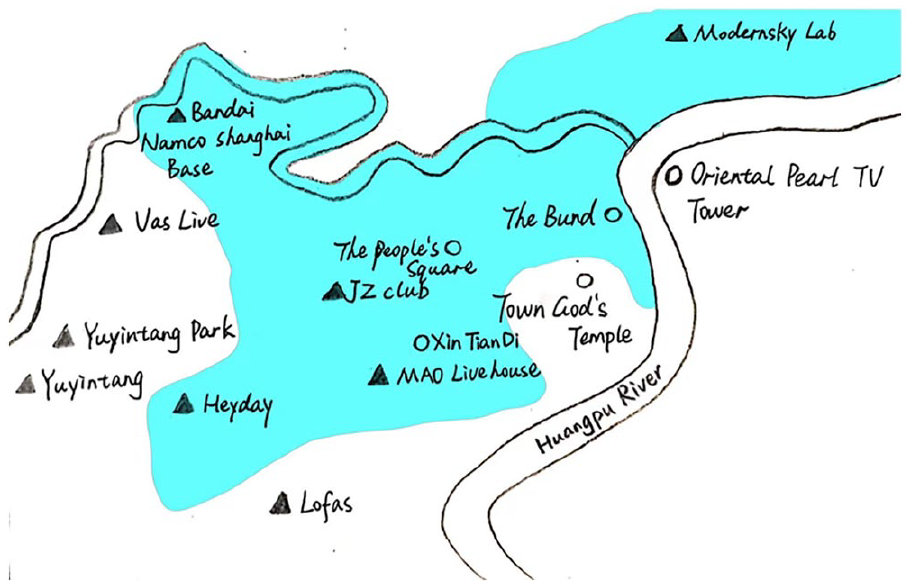
Location of the sample livehouses and landmark places in downtown areas.
We then conducted one-on-one semi-structured interviews with 26 livehouse goers (aged from 18 to 32), who had been to at least one livehouse, out of the selected nine, once. We are not sure if we could collect enough interviewees for this research so we have set a low barrier for selecting samples. Only one respondent has been to one of these nine livehouses three times. The rest interviewees are frequent livehouse goers whose frequency ranges from once every 3 months to twice every week. Except for two interviewees, who are unwilling to take voice interviews and are interviewed through online chatting, the rest interviews were made offline or through telephone calls. The voice interviews lasted for 48 to 120 minutes, an average of 90 minutes, and were all recorded and transprited. 7 To realize the people-place connections through tangible and intangible objects in livehouses, general questions, such as “What is livehouse to you?,” “What do you normally do in livehouses?,” and “Can you describe some unforgettable moments (positive and negative) in livehouses?,” were asked during the interview. Interviewees were also encouraged, along the process, to share their ideas and feelings related to livehouse from any aspect. Interviewees were notified beforehand for recording and permitted to use their interview data in this study under anonymous conditions. Moreover, fieldnotes from the authors’ participant observation at 12 live performances in six livehouses, out of the selected nine, were combined in due course to illustrate our viewpoint. The authors are frequent livehouse goers, providing insiders’ perspectives in conducting and constructing this research.
Getting Involved in the Scene
Existing research has encapsulated the social values (social capital, public engagement, and identity) and cultural values (musical creativity, cultural vibrancy, and talent development) of live music from music reports and policies (van der Hoeven & Hitters, 2019). However, focusing too much on the instrumental value of live music might cause significant “experiential gaps” between live music consumers and regulators (Chatterton & Hollands, 2002). Live music audiences might not perceive an intrinsic value of live music “not just as the source of secondary benefits but in and of itself” (Behr et al., 2016, p. 405). Studies drew on empirical data from audiences also noted the social functions of live music and live music venues such as developing interpersonal relationships and strengthening community ties, especially between audiences and performers (Behr et al., 2016; Cohen, 1991; Finnegan, 2007). Different from these approaches to understanding live music and live music venues; we highlight the link between people and place by analyzing the affordance of objects in livehouses. According to the affordance theory, “any environment (or object) has cues that indicate possibilities for action,” and the environmental “features and engineering anticipate paths of action and project new possible identities for the users” (Caronia & Mortari, 2015, p. 403). Both human and non-human objects in livehouses can be perceived and will affect live music audiences, linking people to place.
Previous studies have found that audiences are aware of the social connections in live music venues and regard visiting live music venues as social practice (Roberts, 2015). Live music venues from the 1920s and 1930s Shanghai were also places for businessmen, politicians, local gangsters, and movie stars to establish social relations and exchange information. Livehouse audiences in contemporary Shanghai usually go with their friends or acquaintances online. Instead of the common pre-drinks in Western nightlife, audiences in Shanghai’s livehouses would normally go with their friends for a midnight snack or post-drink after the performance. Audiences would sometimes build social ties with strangers at the scene during post-drinks or midnight snacks after the performance. However, the primary motivation for visiting a livehouse is not for extending social networks. Like one of our interviewees, Noah (age 29, male) says, “I normally go to livehouse with my friends. . .I find it hard to make new friends in livehouses [because] I have a specific purpose, either for the music or for relaxing, not for social. . .If I want social activities, I will go to a bar instead.”
Although developing an interpersonal relationship in livehouses is not perceived by most of our interviewees, alternative social connections are established during performances. In livehouses, audiences would conduct a series of group activities along with the music (see Figure 2 for example), such as headbanging, pogoing, moshing, circle pit, wall of death, and stage diving. Different musical styles have their corresponding activities conducted by audiences together, sometimes with the performing band involved. These are alternative strategies shared by frequent livehouse goers. Unlike other live music venues, livehouse is a niche with its own social norms (Whiting, 2021). The audiences’ subcultural strategies thus form part of the social norms and connect audiences physically and mentally, confirming their identity in that particular social group. Harrison (age 24, male) believes that the reaction of audiences is the most crucial factor for his livehouse experiences because live music performances in livehouses are interactive: “you should jump and sway when you should.” The sense of involvement with other audiences and the band is considered a good vibe in livehouses. This vibe even continued after the show, as Paul (age 21, male) felt an indescribable sympathy for strangers when he smoked with the band and other audiences outside the livehouse after the show is over.

Stage diving in MAO Livehouse, Shanghai (September 30th, 2019).
Besides human agents, non-human objects are perceived by audiences in livehouses, strengthening people-place connections. Unlike clubs or bars, livehouse has only one stage for the band to perform and a spacious area in front of the stage, with no tables or seats. The spatial setting of livehouse shortens the social distance between audiences and performers and among audiences themselves. Our interviewees are aware of the spatial setting and consider it the essence of livehouse. The spatial arrangement and distance between audiences afford inferences that draw upon “the spatial proximity of the objects” (Caronia & Mortari, 2015, p. 404). Lighting and stage settings in livehouses are the other two most frequently mentioned objects perceived by audiences. The light is usually dim and the stage is not very high, a few inches from the ground where audiences stand. These settings isolate audiences from the outside world and help audiences better immerse into the live performance. Cohen (1995, p. 445) has argued that music “creates its own time, space and motion, taking people out of ‘ordinary time.’” In the case of live music, not only music but also other materialized objects in the venue can take people out of ordinary time and space. For example, Linda (age 21, female) notes that livehouse can provide a unique atmosphere, composed of the settings and lighting, “the light beams make people gather together. . .I like the light beams because they create fogs on stage. . .When light shines from above the stage, there will be light beams. It makes me feel he [the performer] is the only one I can see.”
Different from previous studies on the role of alcohol at live music venues (Roberts, 2015), audiences in Shanghai’s livehouses do not consider alcohol or other drinks necessary. This finding aligns with Farrer and Field’s (2015) observation of Shanghai’s rock music club. Tables to place drinks are usually located in the peripheral areas of livehouse. Audiences, who want to be involved in the central area, have to hold the drink all the time. Moreover, it is not convenient to hold a drink while doing social activities with other audiences. Although most livehouses sell drinks, audiences seem to resist the “performative force of things” (Caron & Caronia, 2007), that is alcohol and other drinks in this case, according to the social affordance they perceived in livehouses.
Cultural Variety in International Shanghai
van der Hoeven and Hitters (2019, p. 269) have generated the cultural values of live music, that is, “musical creativity, cultural vibrancy and talent development,” associated with relevant spaces, activities, and characteristics. Cultural values of live music concluded from policies do not equal to cultural values afforded by livehouse audiences in Shanghai, though some cultural values overlapped. The cultural affordance of livehouse is perceived through objects and extends to broader social and cultural context beyond live music per se. In this study, context refers to the environment of live music, including livehouse and broader cultural discourse in Shanghai.
We have argued earlier that Shanghai is a global city with a diverse and vibrant culture that dates back to the 1920s. The cultural context of Shanghai provides a broader cultural framework for livehouse audiences to “connect their own situated action” through “particular aesthetic objects” (Acord & DeNora, 2008, p. 228). Livehouse also tells something about the city where it locates. Livehouse, together with its repertoires and audiences, is perceived as a demonstration of Shanghai’s cultural diversity. Shanghai’s livehouses have rich and vast repertoires where different audiences can find almost any music performance they like, especially performances from foreign bands. Popular music interacts with local culture, “such as local dialect and vernacular tradition in the production of rich and highly nuanced perceptions of space and place” (Bennett & Rogers, 2016, p. 492). However, unlike in other Chinese cities where performers and audiences often use local dialects in livehouses (Liu & Cai, 2014), our interviewees noted that they seldom heard Shanghai dialects at Shanghai’s livehouses, either by performers or by audiences. Our interviewees believe that not using dialects is in accordance with the city’s tolerant and international cultural context. As Marcus (age 26, male) puts it, “Shanghai’s livehouses are mostly located in commercial areas while Beijing’s livehouses are mostly located in hutong [lanes and alleys between traditional courtyard houses]. The geographic layout of Shanghai’s livehouses represents the city’s tonality, that is tolerant, free, and commercialized.” Even for more underground livehouses, most performers are not originally from Shanghai, nor are lyrics performed in Shanghainese (Gu et al., 2019). Although Shanghai’s live music scene is not place-specific, the city encourages a dynamic and vibrant live music ecology.
The cultural context of a city also influences the perceptions and experiences of livehouse audiences. Livehouse help to generate cultural variety in the city both officially and unofficially. Wall decorations outside and in the livehouses, such as graffiti and stickers, strengthen the alternative identity of livehouse. Yu Yin Tang (opened in 2006) and MAO Livehouse (opened in 2009) are two frequently mentioned livehouses by our interviewees for their history and uniqueness. “I prefer MAO Livehouse and Yu Yin Tang because of their histories and feelings. Yu Yin Tang is shabby, small, and old. Many other livehouses are located inside shopping malls, but Yu Yin Tang is just a small building along the street. . .Inside Yu Yin Tang, there are many posters, CDs, and vinyl on the wall. . .Everything is old and a little messy” (Nicole, age 32, female). The shabbiness and materialized cultural heritage of the place strengthen the alternative cultural dimensions of livehouses. Strong and Whiting (2018) have examined the role of posters in music venues as a form of heritage-as-praxis that create a sense of identity and community. Posters, stickers, CDs, vinyl, and graffiti on the walls of livehouses are all material items perceived by livehouse audiences as cultural affordance (see Figure 3). “I still remembered the first time I went to MAO Livehouse. There are many stickers on the wall. I felt that the place has a long history and its own culture. I think it is interesting, not strange. Of course, livehouse and rock music are subcultures, but I do not feel this way because I am in them. I am [a form of] subculture myself” (Zack, age 24, male).
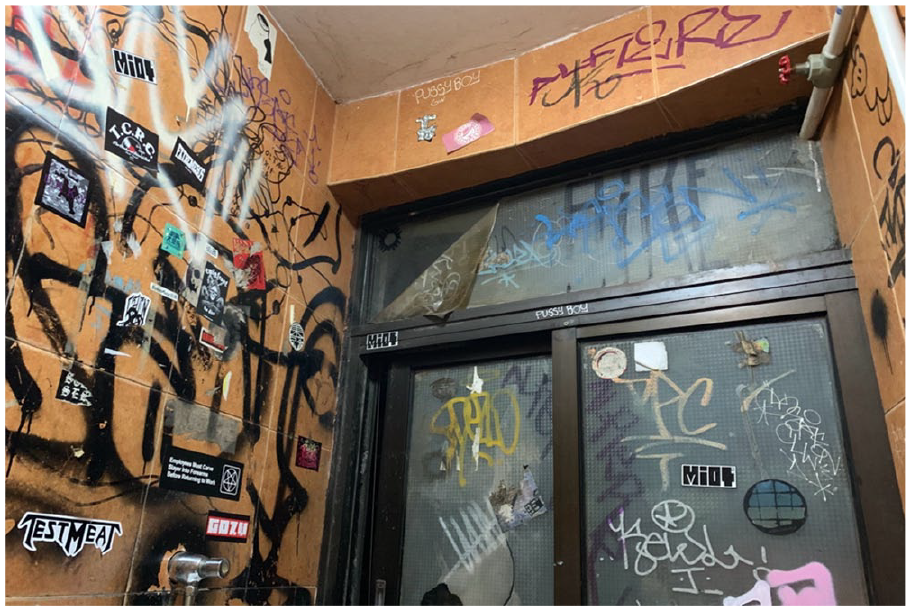
Graffiti and stickers on walls outside Yu Yin Tang, Shanghai.
Livehouse and objects in it not only connect audiences to broader cultural and historical context but also afford cultural identity constructed through lifestyle and the purchase of commodities (Rowe & Bavinton, 2011). In this sense, livehouse is a unique music venue where audiences are gathered for music performances and share similar music tastes. Our interviewees also kept distancing themselves from participants in other nightlife venues by strengthening their taste and love for music. “We go to livehouse for music, not for some monkey businesses like those in bars and clubs” (Helena, age 23, female). The livehouses chosen for this study are mainly mainstream whose entrance fees are relatively high (around 100 RMB to 300 RMB per performance). The entrance fee is quite a cost for the working-class and university students in Shanghai. In this sense, a mainstream livehouses is not a typical underground live music venue attracting subcultural vagabonds but rather a fancy spot for cultural elites. However, according to our interviews, livehouse audiences still consider themselves subcultural practitioners who would sacrifice their material needs for spiritual pursuit, or just get sponsored by their parents. Music and livehouses are ways to link with “alternative or bohemian sections of society” (Talbot, 2004) that cannot go without. “I can only hear music that I like in livehouse. . .[because] I like niche music which could not be performed on big stages but only in livehouses” (Rebecca, age 23, female). Livehouse audiences distinguish between “insiders” and “outsiders” through music taste and consuming behavior. As Farrer (2011, p. 755) observes, “Shanghai nightlife has become increasingly stratified and segregated, especially by class, age and musical taste, and to a lesser extent by nationality or race.” Audiences now choose the music and the way they are engaged to present their esthetics and lifestyle choice (Nowak & Bennett, 2014). Livehouse thus becomes lifestyle sites and alternative strategies, within which objects have meaningful ties with other objects and, ultimately, with humans.
Authenticity in Experiencing Music
Choice of music and lifestyle constructs cultural identity. However, the “inside” of livehouse audiences’ choice is the “emotional, aesthetic, and affective preparation” (Acord & DeNora, 2008, p. 228), that is, the affordance of choice. We have argued the social and cultural affordance of livehouses and objects and spatial arrangements inside. Music, livehouses, and the ways they are experienced are important approaches for individuals to form an emotional affiliation to local spaces (Bennett & Rogers, 2016). Music venues thus generate an interweaving system of experiences, emotion, memory, value, and meaning.
Music and other objects in livehouses do not create social action “but like other components of human experience. . .they provide means through which social action takes place and through which experience is subjectivized” (Acord & DeNora, 2008, p. 235). In this sense, music becomes conceptual and symbolic (Cohen, 1995). “I remember once after I watched a live performance in a livehouse, I thought of my miserable love life. I stood in the cold wind for half an hour watching photos and videos [that I took from the live performance], immersed in my own world” (Neil, age 25, male). Cosmopolitan cities like Shanghai not only have a dynamic cultural environment but also a high living costs and unstable life for individuals. Livehouse thus becomes a significant experiential object for individuals to perceive their social identity and presence grounded in space and place.
In the case of live music, emotional affordance is realized in music and also the whole situation/venue as “the only unique situation left” and “the truest form of musical expression” (Frith, 2007, pp. 8–9). Live performances are at the top level of authenticity, according to Sinnreich’s (2010) hierarchy of uniqueness. Livehouse audiences perceive the uniqueness and authenticity of live performances. The notion of authenticity often indicates a route of actualizing self, either in the individual or collective manner. It is framed in two distinct ways: the first is that authenticity is antagonistic to society (see Lewin & Williams, 2009; Schwarz & Williams, 2021). The second is that authenticity is tied to group membership or social identity (Schwarz & Williams, 2021; Williams & Copes, 2005). The word 真实 [real] is often used by our interviewees to describe their experiences in livehouses, and demonstrates the process of actualizing a self in a collective environment through the livehouse experience.
The highest value for livehouse is that it makes me relax and happy. . . [because in a livehouse I were] crazier and more real. [This emotional status] is very important! Rock music should not only be heard via headphones. You should be in the scene to feel the vibe. . . I felt everybody was so real. Even if we were just smoking by the street [outside a livehouse], it made me happy’ (Zoe, age 18, female).
Authenticity lies in both the performance and the experience. Audiences experience a sense of belonging in livehouses where they can realize self-actualizing with other audiences sharing the same esthetic taste and habitus, a process usually absent outside the scene. Although our interviewees admitted that they would take out cameras or smartphones to take pictures and record videos, they gave priority to watching the performances and feeling the vibe. The authenticity perceived in livehouses cannot be recorded or reproduced. However, the “authentic” experience is not purely atmospheric. The experience of “I Was Thereism” for livehouse audiences is strengthened by the symbolic capital of the place and interaction with objects in that place left in the memory (Forbes, 2012). Popular music education has long been marginalized in mainland China despite its involvement since the early 21st century (Ho, 2016). Students access and learn about popular music outside the formal and authorized school education. Some livehouses do not require an ID check so teenagers will sometimes sneak into the show. Music performed in livehouses is not the more commercialized popular music but the “cool” and niche indie music. Likewise, livehouse becomes more than a live music venue but a symbolic icon, or a “utopia” as described by our three interviewees, of the most “real” and dynamic popular music experience and education.
The authentic livehouse experience is also strengthened by individuals’ involvement in the participation, perception, and presentation of “a specific, collectively shared emotional geography” (Bennett & Rogers, 2016, p. 492). In this way, livehouse audiences interweave into the emotional geography of livehouse space, becoming part of the performance themselves by perceiving and interacting with objects in the place. Besides interactions with music and performers discussed in previous sections, tangible objects in livehouses also afford memories and emotions. Livehouses associate festive moments among young people that underpin “the freshness and coolness that the words ‘live’ and ‘performance’ connote in popular culture” (Holt, 2010, p. 253). Objects, such as interior decorations, create these festive and subversive moments, immersing audiences in the scene. Places, in return, strengthen the linkage that is of particular emotional significance. Gibson (1999, p. 20) has argued that rave culture, as a subversive site, operates in spaces “normally used for industrial and manufacturing production – old warehouses, factories, carpet showrooms – spaces whose meanings are inverted from those in the wider mainstream.” For example, the original site of the famous Yu Yin Tang was a warehouse and the Vas live was originally a cinema. Our interviewees have stressed how the shabbiness of livehouse venues contributes to their authentic experience. “[Of all the livehouses I have been to] I prefer Yu Yin Tang because it is small and shabby. . .the central air-condition with no decorations above my head, the small projector, the neon lights. . .so old and worn-out. They make me feel good. That is what a livehouse should look like, not like the new commercial ones” (Harrison, age 24, male). Livehouses with “such levels of shabbiness represented a form of access to a new and ‘real’ adult experience” (Forbes, 2012, p. 609). However, the emotional network within livehouse is not exclusive to audiences.
Emotional affordance perceived by livehouse audiences also involves the participation and fabrication of various actors such as policymakers, cultural elites, and venue owners (Wang & Chen, 2019; Wang et al., 2020). We have argued how livehouse is legitimated by authorities due to its cultural values in preserving and highlighting “the rebellious energy of local creative industries” (Gu et al., 2019, pp. 3–4). Emotional values of live music and livehouses can also become emotional investments turning “emotional self-realisation, authenticity and creativity into capitalism, and with intensified consumption habits” (Hesmondhalgh, 2008, p. 330). Our interviewees have attributed livehouse as one of the reasons they love and choose to stay in Shanghai because the city embraces diversified cultural forms. In Shanghai, the emotional investment over livehouse fosters emotional conversations among audiences, venues, and the city.
Conclusion
We start this research by scrutinizing the space of live music venues in studies of live music and the night-time economy. Examining venues not as a mute background of live music or nightlife experiences but as an active site of feelings makes us understand livehouse in Shanghai differently. More than a place to watch live music performance, livehouse provides “a site of imagination, celebration, experience and grief” (Gallan, 2015, p. 565). To translate experiences and feelings into live music ecology, we use the affordance theory to link people to place, making sense of the interpretive process of livehouse audiences through both human and non-human agents. In this study, we highlight the specificity of Shanghai’s livehouses by focusing on both humans and things as objects in the venue and beyond the venue.
Unlike previous studies that focus on live music ecology in Western countries, this article highlights the values of livehouse perceived by audiences in Shanghai. We have argued earlier that live music is geographically contingent and so is live music ecology. Interestingly, we have observed a few variations from studies on general nightlife and live music experiences in Western discourse and other nightlife venues. For example, livehouse experience is not an alcohol-fueled nightlife (Roberts, 2015) that develops social ties, but rather a lifestyle consumption that identifies the audiences “with alternative youth or music subcultures” (Gallan, 2015, p. 565). Moreover, the perception of space and place manifested through the use of dialects in popular music and music venues is not afforded by Shanghai’s livehouse audiences. Instead, our interviewees believe that not hearing Shanghai dialects and access to live performances by foreign bands are more closely related to the cultural environment of Shanghai. These variations from previous studies, in turn, call for a recognition of place- and context-specific live music ecology.
Drawing on ethnographic data from 26 in-depth interviews and participant observation, we encapsulate three affordances of livehouse, that is, social, cultural, and emotional. Rather than viewing livehouse as a holistic entity, we break down livehouse into “tangible, material arrangements that constrain human cognitive capacities to influence interpretive processes” (Stoltz & Taylor, 2017, p. 27). Audiences make meanings into objects in livehouses and generate different affordances and feelings from these objects. We also relate the dynamic and interactive livehouse experience to broader historical, political, social, and cultural contexts.
We hope to provide a basic understanding of live music ecology in Shanghai by focusing on the affordance of livehouse and objects within the venue. Also, the livehouses selected for this study are mainstream live music venues in Shanghai. We have mentioned that live music is place-oriented. The affordance of alternative livehouses in Shanghai needs further examination.
Footnotes
Declaration of Conflicting Interests
The author(s) declared no potential conflicts of interest with respect to the research, authorship, and/or publication of this article.
Funding
The author(s) disclosed receipt of the following financial support for the research, authorship, and/or publication of this article: This research is supported by the grant awarded by The National Social Science Fund of China (Project No 18CD179).
