




Abstract
In the opening of the 21st century, housing affordability was described by the U.S. Congress as the most urgent issue facing America. This article provides an analysis of how feasible Mayor de Blasio’s Five Borough Ten-Year Plan will be in providing adequate affordable housing to low-income residents in New York City (NYC). It examines three main topics: (a) the Plan’s focus on using the private sector to achieve public goals and whether this is likely to come with unintended consequences such as less focus on the needy and gentrification of struggling neighborhoods, (b) the role of the nonprofit sector, which has historically been a major player in housing policies in the NYC, and (c) how much influence or control a municipal government has on economic forces to avoid negative outcomes. The analysis reveals that while providing any number of affordable units is a positive thing, it is unreasonable to assume that this intervention alone can adequately address the housing affordability crisis in NYC. This article also exposes other emerging problems as the plan is being implemented. One major concern is that through tax credits and rezoning efforts to encourage private-sector development, the Plan may wind up benefiting housing developers and gentrifiers more than actually ameliorating the housing crisis in NYC. Housing affordability is a multifaceted issue which requires a multifaceted approach from federal and state governments working in tandem with local governments.
Keywords
Introduction
In 2002, a United States Congress bipartisan commission concluded that housing affordability is the single most important issue facing Americans in the new millennium (The Millennial Housing Commission, 2002). Affordable housing is defined as one that a household can obtain for 30% or less of its income (U.S. Department of Housing and Urban Development [HUD], 2018). A dwelling is considered affordable for low-income families if it costs less than 24% of the area median income (HUD, 2018). In his widely read book Evicted: Poverty and Profit in the American City, Mathew Desmond (2016) observed that “Today, over 1 in 5 of all renting families in the country spends half of its income on housing” (p. 302). Although housing need exists across the country, the issue is particularly acute in New York City (NYC). In May 2018, The New York Times ran a series of articles titled “Unsheltered” on the housing crisis in the City, affirming that the poor pay as much as 60% to 80% of their income on housing (Barker, Silver-Greenberg, Ashford, & Cohen, 2018; Barker, 2018; Kleinfield, 2018). In the past, NYC has responded to housing affordability by combining two approaches: one that provides subsidies to the needy and another that focuses on adding new units to the market through construction and rehabilitation.
Looked at in a simple way, housing affordability is a function of diminishing supply in times of increasing demand. Looked at in a more nuanced way, affordability is a multifaceted problem that can go beyond simple supply and demand formulations since landlords can use various tactics to keep vacant units from the market which creates artificially high rent prices. Barker (2018) showed that landlords can keep units off the market by simply claiming that they are doing renovation, or remove units from rent-stabilized stock by conducting capital improvements that lead to increase in rental rates. Meantime, for the average renters there is lack of affordable units in the market and this shortage has reached a crisis point. A recent survey indicated that 50% of the City’s residents cannot afford to live in the city (Barone, 2016). In addition, between 2000 and 2012, NYC lost 400,000 units renting for less than US$1,000 per month (NYC Comptroller, 2014). Generally, the loss of these units can be attributed to market forces, but gentrification, in particular, coupled with loopholes in rent regulations were responsible for rent increases.
In response to this affordability crisis, shortly after he was elected to office in 2014, Mayor Bill de Blasio introduced Housing New York: A Five, Ten-Year Plan to supply affordable housing units within the five boroughs (WNYC, 2014). Like his predecessors, Mayor de Blasio’s plan focused on creating more units. The plan originally aimed to create 200,000 affordable units for all income groups with special focus on low-income groups. In 2017, it was adjusted to create and/or preserve 300,000 affordable housing units (Housing New York 2.0, 2017). This article provides an analysis of how feasible Mayor de Blasio’s Five Borough Ten-Year Plan will be in providing adequate affordable housing to low-income residents in NYC. It will examine three main topics:
The Plan’s focus on using the private sector to achieve public goals and whether this is likely to come with unintended consequences such as less focus on the needy and gentrification of struggling neighborhoods.
The role of the nonprofit sector, which has historically been a major player in housing policies in NYC.
How much influence or control a municipal government has on economic forces to avoid negative outcomes.
Organizationally, this article is divided into five sections. This introductory section covered how the problem of housing affordability in NYC is conceptualized and approached. The second section offers brief comments on the overarching characteristics of national housing policies and their impacts on the existing affordable housing programs. The third section provides a brief explanation of the research design and methodology used to conduct the study. The fourth section discusses de Blasio’s Housing New York plan, presenting the plan’s specifics and relating them to potential outcomes. The final section gives brief concluding remarks.
Housing Policies and Affordable Housing Programs
Scholars studying housing are likely to agree on a few common defining characteristics of federal housing policies and their impacts on affordability. First, “Most housing programs in the United States do not focus on the most pressing housing needs” (Mueller & Schwartz, 2008, p. 122). Second, “there is no policy, only a collection of individual programs, which despite significant improvements, remain poorly integrated and continue to have implementation problems” (Sullivan & Power, 2013, p. 331). Third, the federal funding for the existing affordable housing programs continues to dwindle year after year (Freeman, 2002; Kleit & Page, 2015; Martens, 2009). As for how these programs impacted affordability, Adams (2009) succinctly observed that the problem of affordable housing is a systemic one with many parts and will not be remedied by a bandage. In addition to the federal role, local governments also play a role in housing policies, especially NYC.
The history of NYC housing policy goes back to the Tenement House Act of 1879, which predates any meaningful federal interventions (NYU Furman Center, 2006). This unique position afforded NYC the opportunity to devise ambitious local housing programs. Various mayoral administrations in NYC have implemented affordable housing programs. In the recent past, Mayor Koch implemented a housing plan that came to be known as the Ten-Year Plan for Housing in 1985, which lasted for 15 years and extended into Dinkins’s and Giuliani’s administrations. Mayor Koch’s plan spanned more than 100 programs, which can generally be categorized as utilizing three policy tools. The first tool provided low-interest loans to owners to make upgrades and repairs. The second approach consisted of programs that provided subsidies for new construction projects, targeting home ownership. The largest of these programs was The New Homes Program of the New York City Housing Partnership, a public–private partnership. The third area was the use of Community Development Corporations (CPCs) and nonprofit organizations such as the Mutual Housing Association, St. Francis Friends of the Poor, and the Neighborhood Redevelopment Program, all of which recognized the need and provided support for affordable housing units for low-income families (NYU Furman Center, 2016). To finance the plan, Mayor Koch used mixed sources, which included rent revenues from Battery Park City, the City’s Housing Development Corporation (a public benefit corporation that issues bonds to raise capital for affordable housing), the city’s capital budget, and other state and federal sources.
Mayor Bloomberg’s New Housing Marketplace Plan (2003-2014) was by design built on partnerships between private sector, nonprofit, and public agencies. These partnerships grew from a US$3.4 billion program to build and preserve 68,000 units by 2008, to a US$7.5 billion plan to build and preserve 165,000 units by 2013 (NYC Housing Preservation and Development [HPD], 2016). Using a mix of public and private financing, Koch and Bloomberg’s plans together provided a total of 332,106 units at a cost of US$12.6 billion dollars (NYU Furman Center, 2016). Notably, both plans targeted all income groups, but two thirds of Bloomberg’s created units (124,106) were not affordable to low-income groups (Association for Neighborhood and Housing Development, Inc., 2012).
Generally speaking, decades of national and local interventions resulted in fragmented housing programs existing side by side in NYC, often managed by multiple departments. The national programs are implemented through coordination between HUD and various local authorities. The current mix of affordable housing efforts in NYC can broadly be categorized in six areas in addition to the City’s unique approach for housing the homeless. Table 1 provides a summary of the existing affordable housing programs, outlining programs’ originators, recipients, management, and current status.
A Summary of Affordable Housing Programs in New York City.
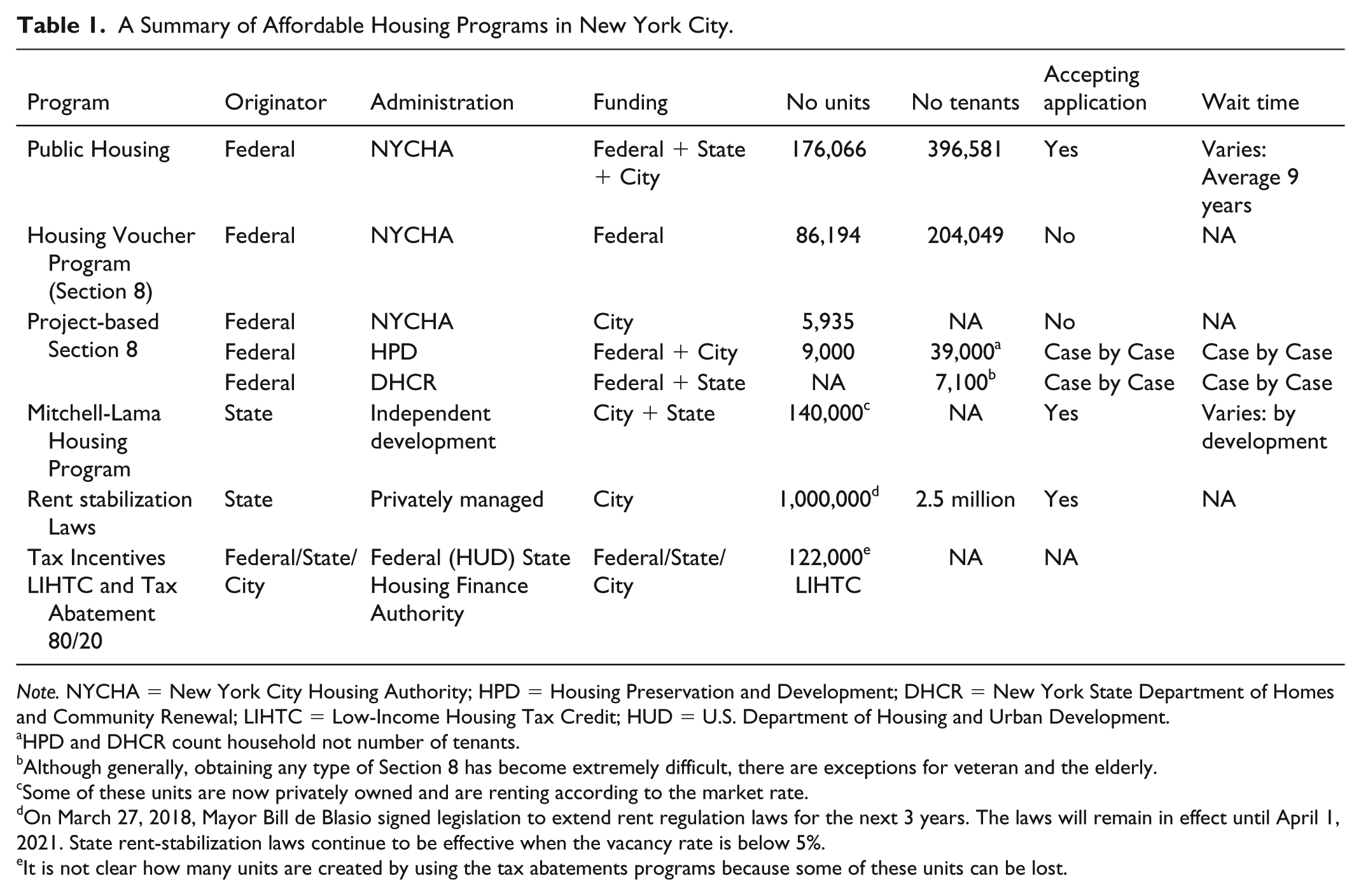
Note. NYCHA = New York City Housing Authority; HPD = Housing Preservation and Development; DHCR = New York State Department of Homes and Community Renewal; LIHTC = Low-Income Housing Tax Credit; HUD = U.S. Department of Housing and Urban Development.
HPD and DHCR count household not number of tenants.
Although generally, obtaining any type of Section 8 has become extremely difficult, there are exceptions for veteran and the elderly.
Some of these units are now privately owned and are renting according to the market rate.
On March 27, 2018, Mayor Bill de Blasio signed legislation to extend rent regulation laws for the next 3 years. The laws will remain in effect until April 1, 2021. State rent-stabilization laws continue to be effective when the vacancy rate is below 5%.
It is not clear how many units are created by using the tax abatements programs because some of these units can be lost.
First, the conventional public housing programs which are funded jointly by the federal, state, and local authorities and administered through New York City Housing Authority (NYCHA), the largest public housing authority in North America. Historically, NYCHA was considered one of the most successful public housing agencies in the country—success in terms of functionality and durability. Currently, one in 14 New York residents live in an NYCHA-managed unit. NYCHA is the sole responsible entity for managing the application process for new tenants as well as administering and maintaining public housing stocks (NYCHA, 2018). As of 2018, NYCHA owns and manages 176,066 apartments, which serve 174,282 families and 396,581 authorized residents (NYCHA, 2017). Unfortunately, NYCHA has been dealing with a decline in federal and state funding for both capital and operations projects, and this has left it in need of US$17 billion in major repairs (NYCHA, 2018). Its financial woes began in 1998 when former New York Governor George Pataki pulled state funding that had been used to operate more than 12,000 NYCHA apartments (WNYC, 2014). Unsurprisingly, the question of who is financially responsible for NYCHA continues to fuel the ongoing feud between Governor Andrew Cuomo and NYC Mayor Bill de Blasio. To help with NYCHA’s financial troubles, the City has stepped up in major ways. In his 2018 State of the City Address, Mayor de Blasio stated that his administration has provided US$2.1 billion of the City’s resources to NYCHA since he took office in 2014 (NPR, 2018). Yet, NYCHA runs into frequent publicized management crises, the most recent of which was the lack of lead inspection and adequate heating during cold winter months (Gartland, 2018).
Tenants in public housing pay 30% of their household income toward rent. The wait time for eligible applicants varies based on their priority code; employed individuals in certain high need categories receive preference (Metropolitan Council on Housing, 2017). The wait time for individuals in low priority categories can average 9 years. During that wait time, applicants must remain eligible and continue to reapply to stay on the waiting list for open apartments. It is worth mentioning that the de Blasio administration has not only made a commitment to improving the conditions of existing public housing stock but also is working to expand it through project-based Section 8 (NYCHA, 2018). Mayor de Blasio has reiterated his administration’s commitment to maintaining NYCHA’s operation despite the reductions in federal funding. Although far from adequate, it is arguable that NYC is taking the lead in ensuring housing affordability to the most vulnerable groups whose average household income is US$23,672 with an average rent of US$483 a month (NYCHA, 2018). Unfortunately, despite these efforts, there are many people who remain on the waiting list who are paying 50% or more of their income for housing.
Second, the Housing Choice Voucher (HCV) Program (also known as Section 8) is another federal program managed by NYCHA, NYC HPD, and New York State Department of Homes and Community Renewal (DHCR). The largest portion of Section 8 is managed through NYCHA, which administers units serving 204,049 tenants residing in 86,194 apartments with 26,297 participating private landlords. Unlike public housing, HCV gives recipients a choice about where to live. Sadly, the waiting list for HCV is currently closed and the federal government has reduced the funding allocated to the program, which means that the City might have to cover more financial ground to maintain housing for current Section 8 tenants. How feasible this will be remains to be seen.
Third, Project-Based Section 8, a version of the HCV Program, is a subsidized housing program for particular developments. Project-Based Section 8 is similar to the Section 8 portable vouchers, the only difference is that project-based vouchers (PBVs) are for particular buildings and cannot be used elsewhere (Metropolitan Council on Housing, 2017). Tenants living in Project-Based Section 8 buildings also dedicate 30% of their income toward rent and the local authority pays the balance. NYCHA currently manages 4,350 units under the Project-Based Section 8 apartments in NYC (NYCHA, 2017). The Section 8 program is expanding: “Between 2016 and 2019 NYCHA plans to add an additional 2,200 units to this program” (NYCHA, 2017, p. 2). There are parts of PBV Section 8 that are run and managed through NYC HPD and New York State DHCR. Also, there are PBV units that are privately owned and managed. Currently, HPD provides subsidies to over 39,000 households in all five boroughs with 9,000 participating landlords (NYC HPD, 2018). DHCR also runs the state-wide Section 8 program, but its Subsidy Service Bureau administers Section 8 vouchers in NYC. The Subsidy Service Bureau currently assists more than 7,100 families in NYC (DHCR, 2018). Some PBV units are privately owned and managed buildings, some of which lead to home ownership. For the purpose of this study, the numbers of families assisted by HPD and DHCR are reported without distinction between privately owned and managed and those still managed by government entities. In addition, vouchers provided by both HPD and DHCR vary considerably in the amount they pay and are subject to various rules in terms of portability.
Fourth, is the New York State-sponsored Mitchell-Lama Housing Program, which was conceived as a middle-income housing development program. It operated from the 1950s through the mid-1970s, creating more than 140,000 rental and limited-equity cooperative apartments. By design, Mitchell-Lama buildings are privately owned, but are regulated under state law to maintain affordable prices to middle-income households. Landlords have the option of leaving the Mitchell-Lama arrangement after the end of the contract, which usually lasts 20 years. However, if the building was occupied before 1974, it is likely to be subject to the rent-stabilization laws that came in 1974. Tenants in buildings participating in the program after 1974 (the cut-off-date) can see an increase in their rents if the owner opts to leave the program. Owner-occupants cannot sell their units for profit during the 20-year contract; instead of rent they pay a maintenance fee. As for eligibility and access to these units, each Mitchell-Lama development maintains its own waiting list and the wait time varies depending on the demand. In 2017, one of the introduced changes to the Housing New York plan includes saving 15,000 Mitchell-Lama units. This will be discussed further later. Unfortunately, like NYCHA the fate of the Mitchell-Lama program depends largely on whether New York Governor Andrew Cuomo and Mayor Bill de Blasio can develop a working relationship to address housing affordability.
Fifth, the Rent Stabilization Laws are a set of state laws that regulate rents and leases in certain privately owned buildings. These are generally buildings with six or more units that were constructed prior to 1974 as well as more recently constructed buildings that received subsidies. Landlords of rent-stabilized buildings can only increase rent to certain levels set by local rent boards. Generally, tenants cannot be evicted or denied the right to renew their lease except for nonpayment of rent, breaking terms of their lease, or being a nuisance. As of 2017, there are approximately 1 million rent-stabilized apartments in NYC (Metropolitan Council on Housing, 2017). Although these laws cannot guarantee that the rent-stabilized buildings are affordable to low-income groups, they are the first line of defense for housing affordability in a tight market. Currently, there are more than 2.5 million residents who live in these protected units. Ironically, rental rates in the rent-stabilized buildings are often lower than rates in the so-called affordable housing units created through tax incentives programs (Low-Income Housing Tax Credit [LIHTC] and 80/20). This reality incentivized landlords to lobby state elected officials, which eventually resulted in the weakening of rent-stabilization laws in the past decade. Another troubling reality is that the City does not have much control over the future of these laws. Landlords can remove their units from the rent-stabilized list if the unit rent exceeds US$2,733.75, or if the combined income of a household exceeds US$200,000 (Barker, 2018; DHCR, 2017). The most common tactic that landlords utilize to bring the unit rent to or above US$2,733.75 is the use of Major Capital Improvements (MCI). After going through the process, landlords can be granted rent increase for expenses incurred for these improvements, which can drive the rent up enough to force out some of the existing tenants (Barker, 2018).
Sixth, the Tax Incentives Programs, which include the LIHTC, a federal program and Local Tax Abatements Programs. LIHTC was created through the Tax Reform Act of 1986 and it is one of the federal mechanisms for “encouraging the development and rehabilitation of affordable rental housing . . . tax credits are awarded to developers of qualified rental projects via a competitive application process administered by state housing finance authorities” (Cantwell & Schumer, 2016, p. 5). Generally, private investors (a for-profit or a nonprofit organizations) without any connection to the project can purchase tax credits to be subtracted from their federal income tax. The payments are then put into a fund distributed to state governments, which in turn allocate funds to developers to build affordable housing. Nationally, LIHTC “has contributed to the development of more than 1.5 million rental units (more than the entire stock of public housing)” (Schwartz, 2010, p. 8). Between 1986 and 2013, LIHTC has helped create or preserve more than 170,290 homes in New York State, of which an estimate of 122,000 properties are in NYC (Cantwell & Schumer, 2016). The Local Tax Abatements Programs tend to benefit private developers directly because they either eliminate or reduce future property taxes on for-profit development in return for an allocation of below-market-priced units (usually 80/20). They may also forgive sales taxes on construction materials. In terms of providing long-term affordability, the extent to which low-income people actually get access to affordable units in these properties is unclear as landlords and developers have been accused of utilizing various loopholes in these programs (NYU Furman Center, 2016).
Finally, is Mayor de Blasio’s Effort to House the Homeless. Although de Blasio’s considerable efforts to house the homeless do not directly connect to the Housing New York Plan, they do constitute a crucial element in providing housing to the most vulnerable groups who are unlikely to be served by the income structure included in the plan. De Blasio made a commitment to address the homeless problem in the City when he was elected to office for the first time. To do so, in 2015, his administration proposed “plans to create 15,000 additional units of housing that will be paired with social-service support, an initiative estimated to cost about $3 billion” (Dawsey, 2016, p. 1). By the end of his first term in 2017, de Blasio’s homeless policies were considered his biggest failure (Max, 2017), for the number of homeless people was at an historic high and the cost of temporary shelters was exceeding US$2 billion annually with no end in sight. This policy invited a louder and harsher criticism, much of which was devoted to cluster sites (satellite shelters) and providing accommodation in expensive hotels (“Report: City Spending $400K Per Day to House Homeless in Hotels,” 2017). The most recent twist in the tale of de Blasio’s effort to deal with the homeless problem was his announcement of plans to use eminent domain to take control of private property. Under this newly devised initiative, the City would provide public financing for nonprofits to buy roughly a third of the apartments (800) that are currently used as shelters and convert them into affordable housing units (Stewart, 2017). If successful in this takeover, de Blasio will accomplish two goals with one move: reducing homelessness and adding to the city’s affordable housing units. Despite the criticism, the de Blasio administration’s continuing efforts to house the homeless represent a serious commitment to addressing an affordability crisis that affects the most vulnerable.
As we have seen, affordable housing programs in NYC provide housing to more than 3 million of the City’s 8.6 million residents. The direct subsidies (public housing and vouchers) serve more than 600,000 residents while 2.5 million live in rent-stabilized buildings. Thousands of families reside in the 122,000 units created through LIHTC since its inception in 1986. It is unknown exactly how many people live in units provided through the Mitchell-Lama Housing Program and other local Tax Abatements Programs (80/20), but the modest estimate of one person per unit suggests that Mitchell-Lama apartments house more than 105,000 individuals. It is arguable that NYC would not be the same without these programs. Yet, despite all these efforts, more than half of the City’s residents are considered rent-burdened (Sugar, 2016). The following section gives a brief description of methods used to conduct this study before turning to the analysis of de Blasio’s Housing New York Plan.
Research Design and Method
This is an exploratory study using mixed methods. It includes a systematic review of secondary data to assess the Housing New York Plan and its potential impacts. This methodological design explains the driving forces for the increasing shortage of affordable housing and allows us to go beyond description to prediction. The data used in this study comes from scholarly work and other sources such as the Housing New York Five Borough Ten-Year plan, the NYU Furman Center (a housing research center), the HUD, NYC’s Department of Housing Preservation and Development, the NYCHA, and the U.S Census Bureau. In particular, data drawn from the HUD is helpful in comparing several affordable housing policies that have been in place even if gradually shrinking.
Instead of employing solely quantitative data, I seek to clarify the underlying forces driving housing affordability, something that cannot adequately be explained simply by quantifying the number of units constructed or the number of households assisted. In processing the data, I make inferences from the literature on affordable housing and from comparisons of de Blasio’s plan to the outcomes of similar plans implemented by former mayors. Finally, an explanatory analysis is carried out of the Housing New York Plan’s specifics to determine whether building or renovating 300,000 units with costs exceeding US$44 billion will be adequate to address the chronic housing affordability crisis in NYC.
Mayor de Blasio’s Housing New York Plan and the Affordability Quest
Although NYC might have historically shaped national housing policies, today the realities of the City’s housing affordability are impacted by these national policies (NYU Furman Center, 2016). A serious plan to address housing affordability in NYC has to look beyond the existing affordable housing programs. Nationally and locally, this is the context within which de Blasio introduced the Housing New York: A Five Borough, Ten-Year Plan (hereafter referred to as the Plan) in 2014, stating that We have a crisis of affordability on our hands. It’s a crisis in many ways built on New York City’s success . . . And that success story has put pressure on our housing stock . . . Affordable housing is part of the bedrock of what makes New York City work . . . And that is why today, we are laying out a comprehensive plan to build and preserve 200,000 affordable units over the coming decade. (p. 1)
The Plan incorporates an array of broad objectives that oftentimes appear as aspirational goals rather than achievable outcomes because there is no clear mechanism for meeting them. Table 2 presents these objectives and the approaches for achieving them as shown in the Plan document.
A Summary of the Plan’s Objectives and the Tools for Obtaining Them.

In dissecting the Plan, five major points are highlighted and discussed in further detail in the following paragraphs. First, the results of the City’s past policies indicate that interventions centered primarily on private-sector development using cross-subsidies as the vehicle for generating supply have had limited impacts on housing affordability. Second, de Blasio’s Plan can inadvertently become a driver for gentrification because it relies on rezoning as a tool for land acquisition. Third, the income structure in the Plan is likely to leave low-income households underserved; its reliance on Mandatory Inclusionary Housing (MIH) has been problematic in the past and likely to be in the future. Fourth, the Plan failed to clearly define a role for nonprofit organizations despite the existence of a broad umbrella of nonprofit stakeholders. Fifth, the use of the tax incentives programs (LIHTC and Local Tax Abatements Programs in form of 80/20), as a way to incentivize private developers to build more units, can result in overproduction in generally attractive areas while leaving behind struggling neighborhoods. Tax Incentives can also result in controversies like separate entrances for market-rate tenants and low-income tenants. This section closes with additional observations about the Plan’s guiding principles for stakeholder engagement, proposed funding sources, and relevant potential challenges.
First, a fundamental design flaw in the Plan is that it assumes that providing a steady supply of new units can mitigate an affordability crisis in a tight market. For instance, the Plan states that “New York City’s shortage of affordable housing has reached a crisis point. The crisis has many causes, starting with the erosion of New Yorkers’ purchasing power in the housing marketplace” (Housing New York: A Five Borough, Ten-Year Plan, 2014, p. 5) and that “Another cause of the affordable housing crisis is the mismatch between demand for, and the supply of, housing” (p. 5). As such, the cornerstone of the plan is to intervene through “increasing and protecting the supply of affordable housing” (p. 6). There have been two notable past attempts to increase affordable housing stock by two former mayors (Koch and Bloomberg) as previously discussed. Although both mayors created, preserved, and restored hundreds of thousands of units, housing affordability remained a critical problem for low-income households. Without explaining why his approach will produce different outcomes compared with his predecessors, in November 2017, mayor de Blasio announced that the Housing New York Plan “has financed 77,651 affordable homes since its inception in 2014—breaking records for the most affordable housing produced in any three years in New York City’s history” (Housing New York 2.0, 2017, p .1). Because of this early success, the Mayor has raised the target to build and preserve 300,000 units. The new target will be accomplished by investing US$250 million to save 15,000 units under the Mitchell-Lama program that are at risk of shifting to market-rate rent (Housing New York 2.0, 2017). In addition, during the release of the new targets, the Mayor’s office stated that Under the accelerated and expanded plan, the City will boost the number of affordable homes for seniors and families to an unprecedented 25,000 per year, while also increasing resources and strategies for affordable homeownership programs and not-for-profit organizations purchasing rent-regulated buildings to preserve affordability. (p. 1)
Despite the early celebrated success, the factors governing affordability remain unchanged. Historically, the decline in the supply of affordable housing coincided with the decline of purchasing power for low-income households, creating the biggest challenge for affordability. Figure 1 shows that the number of rent-burdened households has increased between the years 2005 and 2015. Because wages were not keeping up with the rising rental costs, the number of struggling renters continued to increase.

Number of rent-burdened households, 2005 and 2015 comparing NYC to the rest of East Coast Metros.
One obvious observation is that there are more low-income residents who are becoming rent-burdened than the plan is designed to help. In 2016, the American Community Survey (ACS) indicated that more than half of the city residents are rent-burdened. New York City Rent Guidelines Board (2018) reported that “Rent stabilized tenants report a median gross rent-to-income ratio of 36.0%, meaning a majority of rent stabilized tenants are not able to afford their apartments” (p. 10). Sugar (2016) stated that More than half of renters nation-wide are still paying more than 30 percent of their pre-tax incomes in rent, and . . . the number is even higher in New York City, where a full 54.1 percent of renters are cost-burdened. (p. 1)
What makes things even worse is that other affordable housing programs have limited impacts and the initiative to house the homeless remains under severe criticism for being costly and unsustainable. Even though public housing, HCV and homeless shelters are currently serving a considerable segment of low-income families, these programs are unlikely to be useful tools in dealing with the affordability crisis in the future for three reasons. First, currently NYCHA (2017) “is no longer accepting new Section 8 applications” (p. 1) and in the absence of federal funding this situation is unlikely to change. Within existing public housing the length of the waiting list and the eligibility requirements leave a large number of people unserved. Second, public housing and housing vouchers are federal programs and are perpetually affected by budgetary concerns at the national level. The Trump administration expressed a clear desire to further cut the federal subsidies, which could add to the pool of those in need of housing. Third, there are many residents whose income exceeds the eligibility requirement for public subsides but cannot afford a market rental rate.
To complicate things further for de Blasio’s efforts, there are more than twice as many low-income households needing housing than there are affordable units available as shown in Figure 2. Despite the previous attempts, the numbers of low-income families struggling to afford basic housing continues to rise. The shortage of adequate affordable housing will continue to have detrimental effects on all low-income groups, for “living in unaffordable housing causes stress for families because it often forces them to spend less on other necessary items such as food, health and education” (Buchanan & Budiwski, 2009, p. 19).

Supply and demand among extremely low-income and very low-income renter households.
According to the New York City Rent Guidelines Board (2018), the increase in rent and utility costs resulted in a larger numbers of renters becoming rent-burdened. The compromises low-income families have to endure can potentially have lasting effects in the future. Desmond (2016) warns that “Our cities have become unaffordable to our poorest families, and this problem is leaving a deep and jagged scar on the next generation” (p. 299). When low-income households suffer the pain of unaffordable housing, the City also suffers by providing other social services. Simply increasing housing supply in NYC does not appear to be the answer as landlords may keep vacant units off the market to await the opportunity to raise rent. The Association for Neighborhood and Housing Development (2018) made the case in this statement: Despite the recent building boom, the share of rental units in the City fell from 64.2% in 2014 to 62.9% in 2017, and the share of homeownership units dropped during the same period . . . New York City saw a huge jump in the number of vacant units not available for sale or rent, from 182,600 in 2014 up to a whopping 248,000 in 2017. The number of vacant units not available for rent or purchase is more than all the new housing units created from 2014 to 2017. (p. 1)
A recent New York Times article partially explains why the number of vacant units not available for rent or purchase has risen; it states that In neighborhoods already gentrified or in the throes of gentrifying, a relatively new class of mega-landlords has driven up rents by exploiting enforcement gaps in a web of city and state agencies. By churning through enough tenants and claiming enough renovations, landlords can raise the rent enough—beyond $2,733.75 a month—to wrest an apartment from regulation’s grip and into the free market (Barker, 2018, p. 2).
The housing affordability crisis is also likely to be exacerbated by the projected growth of the City’s population, which is predicted to increase to 9 million residents by 2030, requiring a net gain of 318,500 housing units, with 250,660 of those units affordable to low and moderate-income (NYC Department of City Planning, 2016).
Second, is the challenge of whether the Plan will become a driver for gentrification because of the controversial rezoning reforms. In theory, the purpose of rezoning was “to create new residential density that would include large numbers of affordable apartments” (Murphy, 2017, p. 1). In reality, however, rezoning is feared to become a driving force for gentrification as real estate investors rush in to transform neighborhoods for quick profits. In a place like NYC, where land is scarce and hard to acquire, rezoning creates opportunities for developers to build in rezoned areas, and real estate value start to appreciate faster, leading to increases in rent and property taxes. This increase eventually makes gentrification an all but inevitable by-product. Although rezoning may prove counterproductive to the Plan’s ultimate objective of providing and protecting affordable housing to preserve the City’s diverse communities, Mayor de Blasio has not evaded that the plan will continue to encourage rezoning as a revitalization strategy (WNYC, 2018).
Third, the income structure in the Plan leaves low-income households underserved. According to the Housing New York: A Five Borough, Ten-Year Plan (2014), 8% of affordable housing will be designated for the extremely low-income category (less than US$25,150), 12% for the very low-income category (US$25,151-US$41,950), 58% in the low-income category (US$41,951-US$67,120), 11% in the moderate-income category (US$67,121-US$100,680), and 11% in the middle-income group (US$100,681-US$138, 435). These targets have received a wide range of criticisms (Real Affordability for All Coalition [RAFA], 2017; Walker, 2017; Zimmer, 2017). In a report, RAFA (2017) concluded that “To make a dent in the homelessness crisis, we must increase the number of units developed for households who earn less than $25,000 a year—households that are not served by the private market” (p. 2). In response to criticism, newly proposed changes in the plan slightly increased the percentage for the very low-income groups. In the adjusted plan, 25% (instead of 20%) of the created units will be set aside for families with very low and extremely low income (less than US$41,950), 55% for low-income households (US$41,951-US$67,120) and 19.5% for moderate and middle-income households (US$67,121-US$138, 435). These changes are still far from addressing the needs of many struggling families.
Reflecting views of the Plan’s critics, Murphy (2017) noted that “Since the expanded plan doesn’t alter those income targets, concerns about income levels—whether the housing is targeted at the deepest needs, whether the Mayor’s affordable housing might gentrify neighborhoods with very low incomes—will persist” (p. 1).
The Plan calls for the creation of an Implementation Advisory Board to engage on a regular basis with the City leadership. The board is comprised of stakeholders from the City’s housing community. The Plan also includes the implementation of new mixed-income programs through the introduction of MIH. According to the Housing New York: A Five Borough, Ten-Year Plan (2014), “the affordable units in traditional 80/20 are targeted towards a narrow band of households” (p. 10).
Fourth, what is the role of nonprofit organizations in the Housing New York Plan? A major shortcoming in the original Plan was the small—and vague—role given to the nonprofit sector. In recent decades, nonprofit organizations across the country—often CDCs—have been instrumental in creating successful partnerships with HUD and local governments in revitalizing dilapidated housing and selling or renting the units to low-income households. NYC has a unique history of the nonprofit sector’s involvement in creating affordable housing programs. As such, it was assumed that de Blasio’s plan would give nonprofit organizations a greater role in creating affordable units. This lack of a clear role for the nonprofit sector in the original plan has invited wide criticisms from housing advocates and neighborhoods associations (Murphy, 2017). However, to be fair to de Blasio’s efforts, a crucial distinction must be made here. Mayor Koch’s plan was executed during a time when there were many vacant buildings that the city acquired through foreclosure. In New homes Programs, these buildings were then turned over to CDCs to create affordable units. Today, land acquisition for developing affordable housing is much more expensive, which is why rezoning is being used to increase the space available for housing construction despite the growing criticism.
In response to criticism about the lack of clear role for nonprofit organizations, the newly introduced changes appear to give the nonprofit sector a bigger role, though it remains unclear how big. One area of change is the role nonprofits are expected to play in obtaining housing units (known as satellite shelters) that are currently rented by the City to house the homeless. Another change is said to come in a program known as Neighborhood Pillars through which the City plans to spend US$275 million to buy older rent-regulated buildings in changing neighborhoods where market speculation threatens existing affordable housing stock. This program is intended to “target 1,000 homes a year and 7,500 over the life of the plan” (Murphy, 2017, p. 1).
Fifth, the use of the tax incentive programs—LIHTC and Tax Abatements programs 80/20—as a tool for encouraging the private or nonprofit sector to develop affordable housing remain problematic and ineffective. In the past, many of the units built using LIHTC funds were allocated to relatively well-off household. To break away from past mistakes, the Plan requires that the City mandate a portion of new housing development to be permanently affordable to low- or moderate-income households. To date most of the created units (more than 70,000) came through the use of the City’s capital resources not through use of LIHTC, Tax abatements or private MIH development. In practice, the implementation of MIH can be a deterrent for many developers because “for developers to agree to build 20% or more units of affordable housing, they have to be persuaded that the building’s remainder will be lucrative enough to fill the gap” (Dawsey, 2016, p. 1). Obviously, developers prefer to take on tasks that generate more profitable outcomes than housing low-income groups. More importantly, tax incentive programs (federal and local) and MIH may combine to create perverse incentives for developers, leading to overproduction of units in certain part of the City or totally gentrifying struggling areas (Bagli, 2016).
Additional Observations About de Blasio’s Plan
In regard to working with stakeholders, partners, and players, the Plan was developed through coordination among 13 agencies and with input from more than 200 stakeholders. It incorporates more than 50 initiatives to support the goal of building or preserving 300,000 units. According to the Plan, the guiding principles are 1) Our housing policies must address the City’s changing demographics and those we serve; 2) The City’s planning processes and land-use policies need to be revamped; 3) Economic diversity must be a cornerstone of housing development; 4) Our municipal tools and public assets should be deployed more effectively; 5) We must strategically protect past investments and lock in affordability in changing neighborhoods; 6) The City needs to protect tenants in rent-regulated units more aggressively; 7) We must leverage today’s favorable markets and adapt quickly to future conditions; and finally 8) We must increase capital funding to our housing programs. (Housing New York: A Five Borough, Ten-Year Plan, 2014, p. 7)
Although these are noble principles, there is no clear path or defined tool to honor them or the rest of the Plan’s bloated objectives. For instance, de Blasio’s administration plans to use the same general tools—rezoning, LIHTC, Tax Abatements and MIH, rent-stabilization laws, protecting Mitchell-Lama units—to preserve the existing affordable housing stock and to construct new units. Although rent-stabilization regulations fall under New York State jurisdiction, in 2017, Mayor de Blasio signed legislation extending rent regulations up until April 1, 2021, because the state regulations continue to be in effect as long as the vacancy rate is below 5% (Center for New York City Law, 2018). This extension allows the City to ensure that landlords cannot move units from rent-stabilized stocks to market rates faster, for if the vacancy rate is higher than 5%, the State has the legal jurisdiction over rent laws and landlords can lobby legislators in Albany to weaken rent-stabilization laws. In 2017, the vacancy rate in NYC remained at 3.63. However, the City cannot ensure the long-term existence of rent-stabilization regulation since the State has shown a propensity for loosening those regulations in the past, which has allowed landlords to aggressively pursue eviction (Barker et ;al., 2018). Regardless of the vacancy status, the state still has rent regulations that are in place, what remains to be seen is how effective these regulations would be in protecting affordability in the City. The de Blasio administration announced that the City will provide tenants facing eviction with lawyers, which is commendable, but covering legal fees will not address the broader set of problems leading to housing courts. For example, when landlords are renovating other units in the building, tenants endure unhealthy conditions, noise, and inconvenience. The ultimate goal for most landlords is to take a unit out of the rent-stabilization program and put it into market rate, so driving tenants out by making living in the building unbearable might be part of their overall strategy. Moreover, the Plan will now run to 2026 instead of 2024, beyond the end of de Blasio’s second term on December 31, 2021. This will leave the Plan at the mercy of his mayoral successor.
In addition, the 100,000 increase in the number of units to be preserved or built requires an additional commitment of the City’s resources. So far, Mayor de Blasio has added US$1.9 billion in City funding to pay for the part of the plan targeting low-income household, seniors, and veterans. Funding for the plan will come from mixed sources, including the City’s capital budget. The adjusted plan is estimated to cost more than US$44 billion by the time of its completion. The Plan was estimated to cost US$8.2 billion of the City’s money in 2014, and this number is now adjusted to US$13.5 billion for the 12-year duration. The sources of funding for the Plan are outlined in Table 3, which shows the original breakdown of public and private funding as envisioned in the Plan. The majority of the funds will be allocated to create new units and the remaining funding will be used to preserve existing housing stock. It is unclear, though, whether the City can be confident of receiving money from the state and federal government in the current political climate.
Mayor de Blasio’s Housing Plan Original Budget Breakdown.

Source. The information in the table was extracted from Housing New York: A Five Borough, Ten-Year Plan (2014).
Although ambitious in its quest, de Blasio’s Housing New York Plan acknowledged the potential challenges, roadblocks, and shortcomings. In the Plan, it was made clear that tackling the housing affordability crisis in NYC cannot be achieved without state and federal action, for “The State and Federal governments have been stalwart partners throughout many years and across multiple administrations, and their renewed commitment to affordable housing is absolutely crucial to address the City’s affordability crisis” (Housing New York: A Five Borough, Ten-Year Plan, 2014, p. 12). However, considering the current political conditions, it is highly unlikely that the City will receive adequate help from the federal government. To the contrary, the City might need to commit even more resources to preserve the existing affordable housing programs. What is clear is that the conundrum NYC faces regarding devising an effective plan for providing affordable housing is typical compared with attempts of other local governments.
In the meantime, de Blasio’s Plan is unlikely to fundamentally reduce the hardships low-income families face despite the declared intentions, as it will not provide an adequate supply necessary to meet the needs of the existing numbers in low-income groups. To do de Blasio’s Plan justice, it must be acknowledged that a municipal government does not have many policy tools to influence larger economic forces.
In an exhaustive report titled Rethinking Local Affordable Housing Strategies: Lessons from 70 Years of Policy and Practice, Turner, Brown, Cunningham, and Sawyer (2003) concluded that prior local housing plans, though successful, have not been effective in providing adequate affordable housing on the scale needed. The analysis provided in this article concurs with Turner et ;al.’s findings. Adding thousands of new units is an inadequate response to the affordability crisis. Broadly speaking, de Blasio’s Housing New York Plan falls within the domain of urban planning that caters to the powerful, builds on neoliberal ideology and relies on trickle-down economic growth. The Plan caters to the powerful by relying on a rezoning strategy that often leads to gentrification. It builds on a neoliberal ideology in its reliance primarily on private developers. Fainstein (2010) eloquently observed how this approach plays out in this statement: Decisions concerning where to locate facilities become warped by considerations of their economic, as opposed to their social, impacts. Thus, capital investments by city governments are intended to support development projects rather than improve the quality of peripheral neighborhoods, and rezoning for higher densities occurs in response to developer demands for more profitable investment opportunities. (p. 1)
Future research should focus on scrutinizing whether de Blasio’s approach for creating thousands of units can make an immediate measurable impact on the relationship between supply and demand (through rent prices) as the Plan proclaimed. In addition, future research might ask whether billions of dollars would be more efficacious in assisting rent-burdened residents if they were targeted directly through subsidies rather than indirectly provide benefit to developers (see Desmond, 2016).
Conclusion
In the beginning, this article asked how feasible Mayor de Blasio’s Five Borough Ten-Year Plan will be in providing adequate affordable housing to low-income families in NYC. The analysis in this article shows that Mayor de Blasio’s Plan is likely to fall short in making a considerable change in the City’s housing affordability dilemma because (a) the Plan does not focus enough on serving the very low-income households and (b) housing affordability cannot be resolved solely by creating new units. This article also exposes other emerging problems as the Plan is being implemented. One major concern is that through tax incentives programs and rezoning efforts to encourage private-sector development, the Plan may wind up benefiting housing developers and gentrifiers more than actually ameliorating the housing crisis in NYC.
Footnotes
Declaration of Conflicting Interests
The author(s) declared no potential conflicts of interest with respect to the research, authorship, and/or publication of this article.
Funding
The author(s) received no financial support for the research, authorship, and/or publication of this article.