




Abstract
The employee behavior literature is very much dominated by studies on “good” or “positive” behaviors, but relatively little has been researched on the negative attitudes and behaviors of people within the workplace, in particular, job dissatisfaction and counterproductive work behavior (CWB). Therefore, the present study is intended to (1) investigate the influence of job stressors (i.e., role overload, role conflict, role ambiguity, and organizational constraints) on job dissatisfaction among university staff and (2) examine the influence of job dissatisfaction on university staff’s CWB. Data was gathered through 266 questionnaires and tested using partial least squares structural equation modeling. The results revealed that organizational constraints, role overload, and role ambiguity are significant stressors that increase job dissatisfaction, which in turn, increase CWB. Thus, the findings highlight the vital role of specific job stressors (i.e., role overload, role ambiguity, and organizational constraints) in causing job dissatisfaction and CWB among university staff. The findings contribute to the stressor-emotion model and Herzberg’s motivation-hygiene theory. Theoretical and practical implications are discussed.
Keywords
Introduction
Counterproductive work behavior (CWB), also known as workplace deviance behavior, can be defined as any voluntary action of an employee that is likely to jeopardize organizational wealth and well-being (Bowling & Eschleman, 2010). Such CWB include disobeying orders, working slowly to claim unnecessary overtime pay, falsifying receipts, engaging in habitual tardiness, misusing working hours for personal matters, wasting organizational resources, and divulging organizational information with an unauthorized person (Robinson & Bennett, 1995). CWB has important implications for organizations, such as engendering adverse effects in terms of low productivity, increasing human capital costs from high turnover, lowering employees’ morale, and damaging organizational reputation (Baharom et al., 2017; Carpenter & Berry, 2017). Sayeed and Nazir (2019), in their literature review, reported that many researches emphasized CWB as a disruptive problem for every organization and deserves serious attention. Researchers, such as Bolin and Heatherly (2001), Metofe (2017), Moore et al. (2012), and Nawaz et al. (2018) found that employees are likely to exhibit CWB based on their negative job attitudes. One critical attitude that might relate to employees’ CWB is their sense of job dissatisfaction (De Clercq et al., 2020; Muafi, 2011; Zubaidah et al., 2019). Research indicated that in most circumstances, employees’ job dissatisfaction is spurred by several adverse work-related factors, such as organizational constraints, role overload, role conflict, and role ambiguity (Conley & Woosley, 2000; Okeke & Mtyuda, 2017; Pindek & Spector, 2016). The common feature these factors have is that they force bad feelings in employees, leading them, at one point or another, to feel dissatisfied with their work conditions. Piccoli (2013) noted that dissatisfied employees have a high propensity to act negatively because they experience frequent negative mood states, for instance, an employee may retaliate against unfavorable work conditions by exhibiting behaviors that would harm the organization. Employees believe such retaliatory act is necessary to protect their well-being. Therefore, it is deemed necessary to understand CWB and its work-related attitude to uncover measures to neutralized CWB.
The present study seeks to address two research gaps. The first gap pertains to the lack of research on CWB itself, as most studies on behavior at work very much revolves around the “good” or “positive” behaviors of employees, particularly job engagement, organizational citizenship, and job satisfaction. Only a handful of studies (Brender-Ilan & Sheaffer, 2019; Chen et al., 2020) have attempted to examine “negative” attitudes and behavior like job dissatisfaction and CWB simultaneously, thus indicating the need for more research in this area. The second research gap which needs to be filled concerns the predictors of CWB. Although previous studies (Chiu et al., 2015; Meier & Spector, 2013; Zhang et al., 2019; Zhou et al., 2014) have established links between job stressors and CWB, their results did not provide a clear understanding of how job stressors can promote job dissatisfaction and how such dissatisfaction can lead to CWB, particularly among university staff. Given that the funding for higher education has been reduced by the Malaysian Government since 2016, it is of great challenge for universities to provide their staff with the resources and the facilities required to perform daily tasks (Abdullah, 2017); therefore, it is in fact, timely to study the effect of job stressors on job dissatisfaction and CWB among university staff (academic and administrative). In addition, university staff under budget pressure, must achieve functional efficiency while adapting to limited resources. Furthermore, some university staff are required to perform more tasks with no additional allowance (Netto, 2016). This has created tension among university staff as not only must they deal with additional roles but also with inadequate resources. Prior studies, such as those by Spector and Jex (1998) and Probst (2011), found that employees who are exposed to prolonged demanding work conditions are likely to experience negative emotions, which trigger them to act counterproductively (i.e., engage in misbehaviors that could threaten employer’s wealth) to express their dissatisfaction. It is, therefore, essential to understand the relationship between job stressors, job dissatisfaction, and CWB so that employers can to take proactive measures to design effective workplace policies, thus mitigating CWB. Accordingly, the present study aims to:
(1) Investigate the influence of job stressors (i.e., organizational constraints, role overload, role conflict, and role ambiguity) on job dissatisfaction.
(2) Examine the influence of job dissatisfaction on CWB.
In achieving these objectives, this study carries practical and theoretical ramifications. In terms of practical implications, this study is expected to help universities identify significant determinants of CWB among university staff (academic and administrative). By doing so, the management of universities can implement appropriate measures to alleviate problems related to organizational constraints, role overload, role conflict, and role ambiguity that could cause job dissatisfaction. Theoretically, the present study adds to the body of knowledge in the domains of the stressor-emotion model and Herzberg’s motivation-hygiene theory. The integration of these theories in a single framework is useful to better understand the linkages among the variables under study. Most importantly, the current study extends the literature on job stressors, job dissatisfaction, and CWB.
Literature Review
Conceptual Definition of Variables
CWB encompasses any form of intentional behavior by an individual employee which may have a destructive effect on the well-being of an organization or its members (Aftab & Javeed, 2012; Gruys & Sackett, 2003). CWB can also be referred to as employees’ misconduct, organizational misbehavior, and/or anti-social behavior, which includes adverse behavior such as theft, fraud, tardiness, misuse of organizational resources, and disciplinary problems (Roberts et al., 2007; Samnani et al., 2014). Bennett and Robinson (2000) defined CWB as employees’ undesirable behavior that happens due to low motivation to conform to workplace policies. It involves employees’ wrongdoing, for which they can be punished through workplace disciplinary systems. According to Robinson and Bennett (1995), CWB can be classified into two major categories: (1) interpersonal (i.e., behaviors that are potentially harmful to individual employees’ benefits within an organization, such as stealing something belonging to a co-worker) and (2) organizational (i.e., behaviors that are potentially harmful to the employer’s benefits, such as wasting the employer’s resources). Scholars have also noted that it is not necessary for an employee to exhibit behaviors of both categories to be considered as performing CWB (Marcus et al., 2016). Any intentional behavior, no matter interpersonal or organizational, signifies CWB, as long as such behavior goes against organizational norms and breaches the employment contract. Therefore, the present study defines CWB as any form of harmful behavior that violates organizational norms.
In relation to CWB, job dissatisfaction was examined in this study as an unfavorable attitude that led to CWB. Locke (1976) defined job satisfaction as a favorable emotional state that derives from the judgment of one’s job experience. Job dissatisfaction, on the other hand, is the opposite; it refers to the unfavorable feeling an employee has toward his/her job (Azeem et al., 2020; Hu et al., 2020; Shin & Jeong, 2020). Job dissatisfaction denotes employees’ negative emotions toward their job aspects. As indicated by Barrett (1980), job dissatisfaction is also connected to unhappiness at work, as when an individual is dissatisfied with an event, he/she will feel unhappy. De Clercq et al. (2020, 2019) supported this notion, stating that job dissatisfaction is a condition in which an employee feels unhappy at his/her job. This implies that dissatisfaction and unhappiness share similar conceptualizations. Besides unhappiness, Spector (1997) and Muniz et al. (2020) stated that job dissatisfaction also refers to the extent to which an employee dislikes his/her job. Therefore, the present study conceptualized job dissatisfaction as the state of having unfavorable feelings about one’s job.
Job stressors were investigated as antecedents to job dissatisfaction in this study. Spector and Jex (1998) defined job stressors as stressful aspects of jobs or working conditions that could potentially result in an employee’s negative attitudes and behaviors. Cullen et al. (1985) noted that job stressors involve demanding work situations that cause psychological strain, such as role overload and role conflict. Generally, job stressors are destructive factors that decrease employees’ motivation, performance, and productivity. Following the definition of Spector and Jex (1998), the present study defined job stressors as four workplace factors that cause psychological strain among employees, that is, organizational constraints, role overload, role conflict, and role ambiguity. Table 1 presents the definitions of the four job stressors examined in this study.
Definitions of Job Stressors.

Source. Spector and Jex (1998).
Theory and Hypotheses Development
The stressor-emotion model suggests that job stressors are workplace factors that stimulate employees’ unfavorable emotions (e.g., job dissatisfaction) as a response to these stressors (Spector & Fox, 2005). This implies that job dissatisfaction is an employee’s emotional reaction to his/her job experience, influenced by stressful working conditions (i.e., job stressors). The job stressors in this context are organizational constraints, role overload, role conflict, and role ambiguity (Spector & Jex, 1998). Additionally, Herzberg’s motivation-hygiene theory proposes that the mismanagement of hygiene factors, such as work conditions and company policies, can spur employees’ negative attitude and behavior (Alrawahi et al., 2020; Herzberg, 1987; Herzberg et al., 1959). Consistent with this, job stressors stemming from unfavorable work conditions can be considered as hygiene factors that cause job dissatisfaction. This is because poor work conditions, such as heavy workloads, limited resources, and dysfunctional equipment, can lead to employees’ job dissatisfaction (Okeke & Mtyuda, 2017; Shin & Jeong, 2020).
When employees face conflicting roles, they are unable to properly perform tasks as they need to serve several roles concurrently. Incompatibility in their roles will surface, especially when there is limited information about the job responsibilities of each role. These issues are likely to create tension among employees as they are uncertain about which roles are more important and how to execute their roles rightly. For example, a human resource (HR) administrator may have to take the roles of a trainer, a mentor, and a counselor at the same time. He/she may be confused about the responsibilities of each role if there is no clear job description provided. When an employee is unable to meet the needs of each role, negative emotions in the form of job dissatisfaction will arise. This was supported by Conley and Woosley (2000) and Saijo et al. (2008), who found that role conflict and role ambiguity trigger job dissatisfaction while diminishing job satisfaction. Chiu et al. (2015), Zhang et al. (2020), and Wood et al. (2021) further established that role conflict and role ambiguity could deter employees from performing their jobs effectively, and thereby lead to employees’ frustration and dissatisfaction.
Other than role conflict and role ambiguity, role overload and organizational constraints are additional job stressors that could provoke an employee’s job dissatisfaction. Prior studies (Billah et al., 2021; Chiu et al., 2015; De Clercq et al., 2019; Penney & Spector, 2005) discovered that role overload and organizational constraints could induce employees’ negative emotions because employees perceive threats in their surrounding conditions. At work, employees’ completion of various tasks is mostly threatened by demanding work conditions such as an overload of duties and limited organizational resources. When an employee has roles and responsibilities that are in excess of what he/she is able to perform, and that need to be completed within a stipulated time, his/her emotions of unhappiness and dissatisfaction will arise. For example, an academician needs to perform numerous tasks (e.g., teaching, assignment grading, consultation, supervision, research, and publication, etc.) in their daily work lives. Continuously working in such stressful conditions is, thus, likely to raise academicians’ dissatisfaction. This link was supported by prior research (Chou & Robert, 2008; Mittal & Bhakar, 2018; Pearson, 2008) which found that role overload diminished job satisfaction. Moreover, Bessa et al. (2021), Ferguson and Cheek (2011), Liu et al. (2010), Okurame (2009), Pindek and Spector (2016), and Pindek et al. (2019) revealed that organizational constraints significantly predict job dissatisfaction. Organizational constraints have a detrimental effect on employees’ job satisfaction since poor work conditions and limited resources make doing one’s job difficult. Employees may need more time to complete a task, which impedes their performance. As a result, the failure to effectively perform their job responsibilities could lead to poor job experiences and, consequently, job dissatisfaction. In line with discussion, following are the hypotheses of this study:
H1: Role overload has a positive influence on job dissatisfaction
H2: Role conflict has a positive influence on job dissatisfaction
H3: Role ambiguity has a positive influence on job dissatisfaction
H4: Organizational constraints have a positive influence on job dissatisfaction
Further, scholars (Mount et al., 2006; Tillman et al., 2018; Zhang et al., 2019) have asserted that employees with negative attitudes, like job dissatisfaction, may have a higher tendency to exhibit CWB. Their studies suggest that employees’ workplace behavior is largely influenced by their attitudes and feelings. Indeed, Ajzen (1993) asserted that employees who experience unfavorable feelings will act in a negative manner. Based on the attitude-behavior relationship, an individual’s behavior represents his/her attitudes about his/her job (Ajzen, 1993). When employees are dissatisfied with their job, they may reciprocate with negative work behavior such as lateness, internet misuse, fraud, and theft to express their discontentment (Bolin & Heatherly, 2001; De Clercq et al., 2020; Muafi, 2011; Tillman et al., 2018; Zhang et al., 2019). Hence, it is believed that employees who are highly dissatisfied at work are more likely to exhibit CWB.
Cohen et al. (2013) pointed out that there are five examples of CWB often demonstrated by dissatisfied employees. First, unsatisfied employees may spread harmful rumors at work and tend to be rude to customers. Second, they work falsely and intentionally slow down production. Third, dissatisfied employees are more likely to damage office equipment and fourth, they tend to steal office supplies. Finally, dissatisfied employees are always late to work without permission and may misuse working hours for personal matters. As a result of employees’ job dissatisfaction, these unethical behaviors emerge and constitute CWB. Hence, it is hypothesized that:
H5: Job dissatisfaction has a positive influence on CWB.
Methodology
Sample
The study sample consisted of university staff (administrative and academic) from three public universities located in Peninsular Malaysia. As recommended by Faul et al. (2009), a priori power analysis via G*Power was used to identify the minimum required sample size. The results indicated that the minimum sample size for this study was 85 to achieve 80% (.80) statistical power for a medium effect (.15) on 95% significance level (power = .80, effect size = .15, α = .05). To maximize participation, 600 sets of questionnaires were distributed, whereby 200 sets were sent to each of the three participating universities. Using purposive sampling, participants were chosen based on three selection criteria, such that they were: (1) administrative and academic staff, (2) Malaysian, and (3) employed in the respective university for 1 year or more.
Self-administered questionnaires were used in the study. Upon receiving permission from the respective universities, questionnaires were then distributed to the respondents (academic and administrative staff) by the researcher and associated representatives. An envelope was enclosed with the questionnaire for respondents to return the completed questionnaire by sealing it in the envelope and placing it in boxes prepared in the administration office. This, in a way, ensured the anonymity of the respondents. The returned questionnaires were collected by the associated representatives after 1 week.
After discarding incomplete questionnaires and outliers, 266 questionnaires were usable for data analysis. A frequency analysis showed that a majority of the respondents were female (59.8%), married (71.1%), and above 40 years old (39.5%). Most of the respondents were permanent staff (80.5%), while a minority were employed on contractual bases. Academic staff made up of 54.5% of the total respondents, while administrative staff comprised the rest. Approximately half of the respondents (56%) had worked in their respective universities for 1 to 10 years. Table 2 presents the demographic profile of the respondents.
Demographic Profile.

Measures
Three job stressors (i.e., role conflict, role overload, and role ambiguity) were assessed using a 15-item scale adapted from Abdel-Halim (1978) which was initially developed by Rizzo et al. (1970) and Beehr et al. (1976). More recently, this measure has been used by Teoh et al. (2016) and has reported reliability scores ranging from .82 to .85. Sample items for role conflict include “I have to do things that should be done differently” and “I work with two or more groups who operate quite differently.” Sample items for role ambiguity are “I feel uncertain about how much authority I have” and “I have unclear objectives for my job.” Two sample items for role overload are “It seems like I have too much work for one person to do” and “I often notice a marked increase in my workload.” The fourth job stressor, organizational constraints, was measured via 11 items taken from Ferguson and Cheek (2011) which were originally developed by Spector and Jex (1998). The measure was also used by Pindek et al. (2019) and Striler et al. (2021) in their recent studies. The items include “lack of equipment and supplies” and “inadequate help from others.” Job dissatisfaction was assessed by eight reversed items adapted from Brayfield and Rothe (1951). The same scale has been used by Matta et al. (2017), who reported a coefficient alpha of .82. The items include “I consider my job rather unpleasant” and “I definitely dislike my work.”
In order to measure CWB among academic and administrative staff, a focus group interview was conducted with six academic and six administrative university staff. The focus group provided a clearer understanding and identification of CWB norms within the university setting. Based on the focus group results, six types of CWB likely to be committed by both academic and administrative staff were finalized (i.e., from a list of 28 types adapted from Bennett & Robinson, 2000) and used as measurement items for the construct. The composite reliability for this scale was .91. The items include “Taken a longer break than is acceptable at your workplace” and “come to work late without permission.” A 5-point Likert-scale ranging from 1 (never) to 5 (very often) was used to rate CWB, organizational constraints, role overload, role ambiguity, and role conflict. Job dissatisfaction, on the other hand, was rated on a 5-point Likert scale labeled 1 (strongly disagree) to 5 (strongly agree).
Results
Common Method Bias (CMB)
Since the data was obtained from a single source, common method bias was a likely possibility. Therefore, a few actions were taken to minimize the possibility of CMB. For example, the items were precisely worded to ensure the clarity of the questions (Reio, 2010). Moreover, both the anonymity and the confidentiality of the responses were assured (Chang et al., 2010). Harman’s single factor test was also conducted to detect any evidence of CMB via an un-rotated principal component factor analysis of all measurement items (Podsakoff et al., 2003; Reio, 2010). The result indicated that the maximum variance explained by first factor was 23.14%, which was lower than the threshold value of 50%; thus, CMB was not a noticeable problem in this data set (Babin et al., 2016).
Reliability, Validity, and Hypotheses Testing
The measurement model was assessed using partial least squares structural equation modeling (PLS-SEM). First, item loadings, composite reliability (CR), and average variance extracted (AVE) were computed to examine the constructs’ convergent validity. Table 3 depicts the results of the measurement model assessment. A total of nine items were removed for having item loadings below the cut-off value of 0.60 (Hair et al., 2017). But, one item each from role overload (i.e., Rover2) and organizational constraints (i.e., Ocon6) were maintained as these items significantly contributed to the achievement of CR and AVE (Hair et al., 2017). Depicted in Table 3, the CR and AVE values for all constructs exceeded the cut-off values of 0.70 and 0.50, respectively. Hence, satisfactory convergent validity was achieved for all constructs in this study.
Measurement Model Results.

Note. AVE = average variance extracted; CR = composite reliability.
Next, the heterotrait-monotrait (HTMT) ratio with a threshold of .85 was used to determine the discriminant validity of the variables (Henseler et al., 2015). Table 4 depicts that all the study variables fulfilled this criterion, wherein all the correlation values among the variables were not above the threshold of .85. Further, all the independent variables (i.e., organizational constraints, role ambiguity, role overload, and role conflict) had variance inflation factor (VIF) lower than the threshold value of 5.0 (Hair et al., 2017). Therefore, discriminant validity was confirmed.
Discriminant Validity Results.
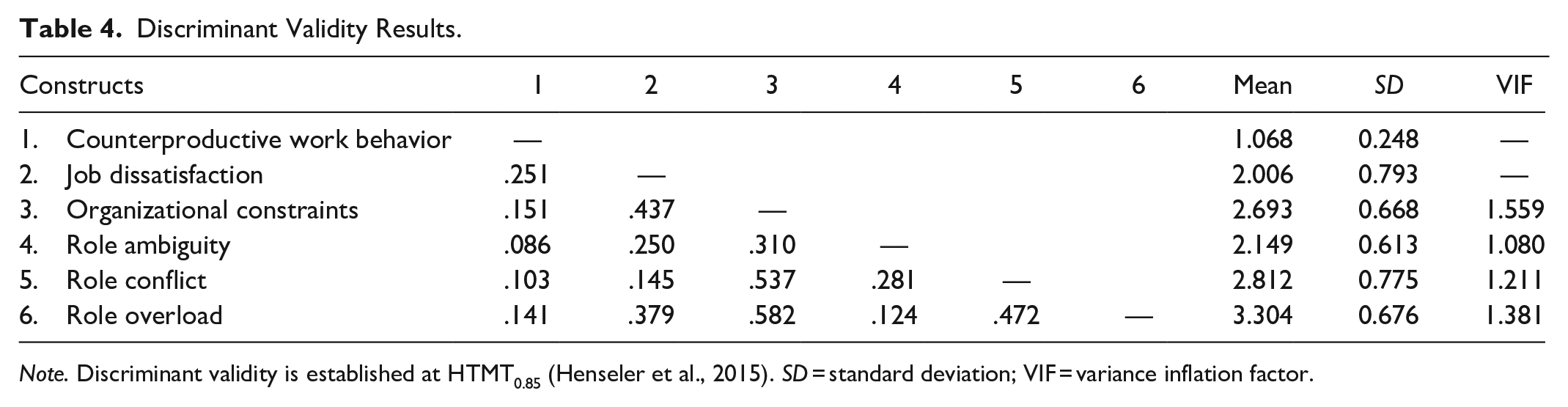
Note. Discriminant validity is established at HTMT0.85 (Henseler et al., 2015). SD = standard deviation; VIF = variance inflation factor.
Establishing the reliability and validity of the measurement model paved the way for the analysis of the structural model, which tested the hypothesized relationships. The study hypotheses were analyzed using a bootstrapping procedure with 5000 resamples (Hair et al., 2017), the results of which are presented in Table 5. The findings indicated that of the four job stressors, only role conflict (β = .086, p > .05) had an insignificant influence on job dissatisfaction. However, the other job stressors, namely role overload, role ambiguity, and organizational constraints, had a positive and significant influence on job dissatisfaction. In particular, organizational constraints exerted the highest impact on job dissatisfaction, followed by role overload and role ambiguity. Meanwhile, job dissatisfaction was found to have a positive influence on CWB (β = .295, p < .01). Overall, four (H1, H3, H4, and H5) out of the five study hypotheses were supported.
Hypotheses Testing Results.

Note. β = path coefficient; f2 = effect size.
Significant at p < .05. **Significant at p < .01.
In addition, the coefficient of determination (R2) results showed that job stressors (i.e., organizational constraints, role overload, role conflict, and role ambiguity) explained 25.7% of the variance in job dissatisfaction, while job dissatisfaction explained 8.7% of the variance in CWB. As per Cohen’s (1988) criterion, the R2 of this study was substantial for job dissatisfaction and small for CWB, indicating the superior power of job stressors in explaining job dissatisfaction. In terms of effect size (f2), all the independent constructs (organizational constraints, role conflict, role overload, and role ambiguity) contributed to the explanation of the dependent variable (job dissatisfaction) with small effect sizes. Similarly, a small effect was denoted in the influence of job dissatisfaction on CWB based on Cohen’s (1988) guidelines (see Table 5).
The predictive relevance (Q2) of the model was also analyzed using the blindfolding procedure. Fornell and Cha (1994) noted that Q2 shows how well the data can be reconstructed with the help of PLS parameters. As per the guidelines provided by Hair et al. (2017), an omission distance of six for the sample size of 266 was used. Hair et al. (2017) suggested that if the Q2 value is greater than zero, the model has predictive relevance. The results confirmed that both the dependent variables, job dissatisfaction (Q2 = .196) and CWB (Q2 = .025), demonstrated adequate predictive relevance of the model.
Discussion and Implications
This study extends our knowledge on job dissatisfaction and CWB, particularly in the context of university staff. The results revealed that role overload, role ambiguity, and organizational constraints are independently associated with university staff’s job dissatisfaction. These results are aligned with other studies (Alrawahi et al., 2020; Beehr, 1981; Conley & Woosley, 2000; Saijo et al., 2008; Spector & Jex, 1998; Wood et al., 2021) on job dissatisfaction and validate the stressor-emotion model, as well as Herzberg’s motivation-hygiene theory. It is likely that these three stressors, role overload, role ambiguity and organizational constraints, reflect the actual working conditions experienced by most university staff. Currently, academics are not the only ones burdened with multiple roles, as administrative staff are similarly exhausted with myriad tasks caused by the government’s budget cuts (Abdullah, 2017; Netto, 2016). With the general statement of job descriptions and insufficient information about job responsibilities, it is difficult for university staff to see the connection between their roles and the duties they perform. In addition to that, with limited financial resources, university management teams have resorted to hiring freezes, benefit cuts, and minimal supplies as coping mechanisms. Consequently, university staff face growing workloads that become too difficult or too stressful to manage. Chou and Robert (2008) found that employees with heavy workloads experience low levels of job satisfaction, especially when they do not have enough resources to perform their jobs (Billah et al., 2021; Ferguson & Cheek, 2011; Liu et al., 2010; Okeke & Mtyuda, 2017; Zhang et al., 2020). The lack of resources in the university context refers to inadequate information, outdated tools, poor equipment, and unavailable support from colleagues that create challenges in completing one’s job successfully. Hence, university staff who suffer role overload, role ambiguity and organizational constraints ultimately experience job dissatisfaction.
This study’s findings in relation to job dissatisfaction that leads to CWB is also consistent with previous studies (Bolin & Heatherly, 2001; Cohen et al., 2013; De Clercq et al., 2020; Metofe, 2017; Muafi, 2011; Tillman et al., 2018; Zhang et al., 2019). The positive correlation between job dissatisfaction and CWB confirms the attitude-behavior relationship asserted by Ajzen (1993), which implies that university staff’s involvement in CWB is dependent on their attitudes toward their jobs. The failure to control their negative attitude triggers university staff to exhibit CWB as an expression of dissatisfaction and a method of retaliation against their employer. Therefore, university staff who experience high levels of job dissatisfaction are more likely to perform CWB.
Notably, the results suggest that university staff with high levels of job dissatisfaction are those who experience multiple job demands as well as limited resources at work. Subsequently, they are incited to perform CWB due to negative emotional reactions to these stressors. That is, heavy job stressors yield frustration and dissatisfaction that indirectly lead to CWB. Consistent with prior studies (Bennett & Robinson, 2003; Pindek & Spector, 2016; Striler et al., 2021; Zhang et al., 2020), job stressors are adverse work conditions that prevent university staff from performing their job successfully. These constraints create stress that triggers job dissatisfaction, which ultimately results in CWB among university staff.
This research contributes to the extant literature in two important ways. First, previous research had extensively concentrated on the “good” or “positive” behaviors of employees but had largely neglected the negative aspect of attitude and behavior, although it is also a significant part of organizational life (Muniz et al., 2020; Zhang et al., 2020). The present study has filled this gap by examining the relationships among job stressors, job dissatisfaction, and CWB. In doing so, this research contributes to the organizational behavior literature by unraveling potential factors that influence employees’ undesirable attitudes and behaviors at work.
Second, this research adds empirical support to the stressor-emotion model and Herzberg’s motivation-hygiene theory, both of which posit that job stressors (hygiene factors) promote negative emotions, and subsequently, CWB. This study further validates prior studies’ findings on the links among job stressors, emotions, and CWB in the Asian context, as the Western context may not accurately be generalized to Malaysia. This is because Malaysia has a unique multi-cultural society that focuses on societal values (Abdullah, 1996). Thus, it is not too far-fetched to claim that this research has extended the application of the two aforementioned theories by examining job dissatisfaction and CWB in the Malaysian public sector (i.e., public universities). This is crucial because targeting different research settings can expand the practical application of theories.
The findings of this research also provide substantial practical value to the management of universities, especially the Registrar’s Department. Since job dissatisfaction was found to be a significant predictor of CWB, the occurrence of CWB among university staff should be eliminated by effectively tackling problems related to job stressors (i.e., role ambiguity, role overload, and organizational constraints). Universities should strive toward improving work conditions and providing adequate resources to university staff as means of decreasing job dissatisfaction, and thereby, eliminating CWB. The Registrar’s Department also needs to smartly plan ways to help university staff streamline their workload. For instance, efforts must be taken to improve work procedures and eliminate redundant tasks. Additionally, the Registrar’s Department should introduce clear workplace policies for all university staff. Most importantly, the Registrar’s Department has to ensure that such policies are well-communicated.
Limitations and Conclusion
This study is not without its limitations. First, the sample of university staff was drawn from only three public universities in Peninsular Malaysia, which excluded private universities and several other public universities in Peninsular and East Malaysia. Therefore, the results of this study may not be generalizable to all public and private universities as they might have varying work cultures, practices, management systems, and policies that affect their employees’ work-related attitudes and behaviors. Future researchers should undertake a comparative study of university staff from both public and private universities and should draw from a larger sample of universities. This would elicit more meaningful findings to add to the growing body of CWB literature.
Second, the use of self-report data to examine CWB is a limitation. Although there has been support for the use of self-reports (Berry et al., 2012; Zhang et al., 2019), the sensitive nature of CWB often leads to an underestimation of its level of occurrence. The single source data in this study may have added to the likelihood of common method variance as well. To improve objectivity, future researchers may consider employing the dyad method to rate CWB. This entails collecting data from pairs of superiors and subordinates who both rate an individual’s CWB. Finally, given the low R2 value for CWB (8.7%) attributed to the job dissatisfaction factor, future research should investigate other attitudinal factors that better explain CWB among employees.
Overall, this study has contributed to the limited literature addressing adverse attitudes and behaviors simultaneously. It has empirically validated the link between job stressors, job dissatisfaction, and CWB. The results found that job stressors (role overload, role ambiguity and organizational constraints) play a significant role in predicting university staff’s job dissatisfaction, and job dissatisfaction is a driving force that leads to CWB among university staff. These findings carry important implications for future researchers and practitioners in the field of organizational behavior.
Footnotes
Acknowledgements
Researchers would like to thank Ministry of Higher Education (MoHE) of Malaysia for the financial support in conducting the research by awarding the Fundamental Research Grant Scheme (FRGS/2/2013/SS05/UUM/02/1).
Declaration of Conflicting Interests
The author(s) declared no potential conflicts of interest with respect to the research, authorship, and/or publication of this article.
Funding
The author(s) disclosed receipt of the following financial support for the research, authorship, and/or publication of this article: The work was supported by the Ministry of Higher Education, Malaysia through the Fundamental Research Grant Scheme (Grant Reference Code: FRGS/2/2013/SS05/UUM/02/1).
