




Abstract
Present study aimed at evaluating the psychopathic inclination among youth and finding the gender differences in psychopathy. An indigenously developed Psychopathy scale (Urdu) has been used in this study. Alpha reliability of the scale was .90. The study was conducted on 100 males (50 criminals and 50 non-criminals) and 100 females (26 criminals and 74 non-criminals) using a convenient sampling technique from three districts of Hazara division: Haripur, Abbottabad, and Mansehra. Results confirmed that there is significant difference in psychopathic inclination of males and females; criminals differed significantly from the non-criminals. The study also paves way for further investigation in the field in Pakistan.
Introduction
Psychopathy is related to criminal behavior revealing violent social disruption. Neither all psychopaths are criminal nor all criminals are psychopaths. Individuals with psychopathic traits are found in every walk of life. There is a significant representation of the psychopaths in rapists, beaters, criminals, unlicensed practitioners, child abusers, sexual offenders, mass murderer, serial killers, and cunning leaders (Copley, 2008b).
In the past few decades, Pakistan has witnessed a rise in crime rate. The number of crimes committed by Pakistanis such as robbery, car theft, snatching valuable items, rapes, gang rapes, and mass murders has been increased. It is reported that in 2010, 1,672 women were killed, and 539 were raped and then killed; another 179 were raped and 133 were gang raped. (Assadi, 2011). According to a report, most crimes committed in Pakistan are car theft and mobile snatching. Most of these crimes are committed by young uneducated individuals aged 16 to 24. Most of the young offenders soon become recidivists and hardened criminals (“Youth in Crisis,” 2007). In 2014, 329 gang rape and 3,285 rape cases were reported as most of the cases were reported from Punjab (Anjum, 2015). According to Butt (2015), 3,508 cases of child sexual abuse were reported with an increase of 17% in 2014.
According to Daniel (2010), nearly all psychopaths find themselves in trouble with the law because of their impulsiveness and inflated sense of self-worth, without considering the consequences of the crimes they commit. Crimes such as murders, fraud, forgery, and theft are most common that are committed by the psychopaths. According to Copley (2008a), psychopathic children have the habit of stealing, having sex, taking drug, and being cruel to animals and other children, and have no fear of punishment.
Psychopaths have been characterized as having superficial charm and adequate intelligence, also exhibiting features of poor adjustment such as deviant behavior. Psychopaths act on impulse; have poor judgment, showing lack of empathy, remorse, shame; and are insincere. They have poorly motivated antisocial behavior showing ego centricity. Psychopaths fail to learn from experience, including punishing experience (Corr, 2010).
Psychopathy is said to have been associated with delinquency, crimes, or aggressive behavior. It is observed that psychopaths have early criminal careers, commit more violent and varied types of crimes, and show high rates of recidivism (Hart & Hare, as cited in Sullivan, 1996).
According to Edens, Campbell, and Weir (2007), psychopaths display less fear of negative stimulus and a heartless misuse of others especially for personal benefits, exhibit severe antisocial behavior that is violent in nature as well, and show a high rate of recidivism (see also Frick & Dickens, 2006; Frick & White, 2008; Leistico, Salekin, DeCoster, & Rogers, 2008).
It is found in National Comorbidity Survey that 5.8% of men and 1.2% of women population have lifetime risk of developing psychopathy. The prevalence rate of serious criminals stands at 75%. Males score higher as compared with females and present a larger proportion (Port, 2007).
In the sample used by Harris, Rice, Hilton, Lalumiére, and Quinsey (2007), 48% of participants were below 16 years, and their age significantly related to the psychopathy scores. Coid et al. (2009) measured the prevalence rate of 0.06% in household population. Bauer (2001) reported that prevalence rate of imprisoned females is 26% as compared with 30% of males imprisoned.
Hare (as cited in James, 2010) reported that 15% to 25% incarcerated male samples are psychopaths. Salekin, Rogers, Ustad, and Sewell (1998) pointed out that female psychopathy has a prevalence rate of 15%, and that 25% to 30% of males are psychopaths.
Psychopathy has been reported higher in adult as well as juvenile offenders, serial killers, mass murderers. Vaughn, Newhill, DeLisi, Beaver, and Howard (2008) investigated the psychopathic features among female delinquents, and found that interpersonal and affective facets of psychopathy related with violence and theft.
Psychopathy has also generally been found associated with recidivism and violence. Hemphill, Hare, and Wong (1998) reported that there is strong relationship among psychopathy, recidivism, including violent recidivism and sexual recidivism. They found that there is 3 times more risk involved in committing a crime again.
Buffington-Vollum, Edens, Johnson, and Johnson (2002) reported that psychopathy is associated with committing violent offenses within institutions. Similar findings were reported by Hicks, Rogers, and Cashel (2000) that there was a high rate of committing a violent infraction among psychopaths as compared with non-psychopaths.
Porter, Birt, and Boer (2001) studied the relationship between commencing violent crimes and psychopathy, and found that high psychopathic individuals commit more crimes and carry on doing so after adolescence.
The construct of psychopathy has shifted from adults to the assessment of juvenile offenders, and its predictive power of aggressive behavior and violent acts among adolescents (Edens, Skeem, Cruise, & Cauffman, 2001). Under Juvenile Justice Ordinance 2000, the juvenile was defined as a child aged between 15 and 18. Pakistan is one of the countries where juvenile laws are not fully implemented. It is argued that juvenile delinquency has reached its epic proportion, and both law and society are unwilling to understand the danger related to it. Most of the children are kept with adults, which also increases the risk of abuse or maltreatment (Sarfaraz, 2008). Kausar et al. (2012) investigated the relationship between juvenile delinquency and personality types of delinquents. They studied both delinquent and non-delinquent youth aged between 16 and 18 years, and found that delinquent youth scored higher on the psychopathic measure of Minnesota Multiphasic Personality Inventory (MMPI). Fakhar (2014) argued that Pakistan is one of the countries with higher rates of juvenile delinquency. She put forward a number of reasons for the delinquent behavior of youth such as poor socioeconomic status, parenting styles, and peer group affiliations. She suggested that the juvenile justice system should incorporate better policies to address the need of delinquents. In a study by Gadit, Vahidy, and Khalid (1997), it was found that 9% of the child offenders met the criteria for the psychopathy, and there is a potential risk of continuing it in later adulthood. According to Cauffman and Skeem (n.d.), juvenile acts sometimes are a reflection of psychopathic personality rather than simple acts of immaturity.
It has been argued that adolescence is the period where changes in developmental maturity have negative relationship with psychopathy (Cauffman & Skeem, n.d.). According to Rubio, Krieger, Finney, and Coker (2014), determining juvenile psychopathy has both clinical and criminal justice applications, and finding out the underlying causes might be helpful in understanding the phenomenon. The current study focused on the assessment of psychopathy among Pakistani-imprisoned youth. The following hypotheses were proposed on the basis of literature review.
Objective
To measure the level of psychopathic tendencies among youth
To measure the difference between criminal and non-criminal youth with reference to psychopathy
To measure the difference in level of psychopathic tendencies on the basis of gender
Hypotheses
Method
Participants
Participants for the current study were taken from three districts of Pakistan: Abbottabad, Mansehra, and Haripur. The sample comprised two groups: adolescent criminals and non-criminals. A total sample of 200 individuals was taken from three districts. Criminals were taken from the prisons and police stations present in Haripur and Mansehra districts, with the individuals between 17 and 24 years of age and having been convicted for crimes.
Instrument
An indigenously developed scale in Urdu language comprising 70 items was used. The items were rated on a 5-point Likert-type scale, with responses ranging from strongly agree to strongly disagree. Items were rated 5 for strongly agree, 4 for agree, 3 for uncertain, 2 for disagree, and 1 for strongly disagree. Item numbers 7, 9, 12, 16, 17, 25, 36, 37, 39, 42, 52, 55, and 59 were phrased reverse that scored 5 for strongly disagree and so forth.
An item pool was generated based on the available construct definitions of the psychopathy (see, for example, Decuyper, De Pauw, De Fruyt, De Bolle, & De Clercq, 2009; Hare & Neumann, 2009; Port, 2007; Wynn, Høiseth, & Pettersen, 2012).
Procedure
The 70-item scale was constructed based on the available literature. Scale items were assessed by a panel of experts, two PhD and a PhD scholar for face validity. The scale was pilot tested on a sample of 20.
The main study was conducted on a sample of 180 individuals. To conduct the study in prison, permission was obtained from the respective authorities prior to study. Participants were approached individually, and after a brief introduction of the research, their verbal consent was obtained for the study. After obtaining informed consent, they were given questionnaires to complete. Filled questionnaires were collected the same day, and participants were thanked for their participation.
Results
The collected data were statistically analyzed to test the hypothesis. Alpha reliability of the scale was determined to check the internal consistency of the scores (α = .90). The t test was used to check the differences among gender and criminal status.
Table 2 reveals that there is a significant difference in the level of psychopathy among criminals and non-criminals. Mean score of criminals was 259.93 (16.54) as compared with the mean score of non-criminals, which was 203 (34.63).
The results in Table 3 show that there is a significant difference in the psychopathy level of males and females, indicating that males scored significantly higher as compared with the females.
Discussion
Recent interest in the study of the psychopathic profile of incarcerated and normal individuals, implications of the assessment procedures to criminal justice systems, and screening individuals for their violent acts has gained momentum. The present study is aimed at assessing the presence of psychopathic inclination among youth. Major objective of the research was to check the difference in the level of psychopathy among criminal and non-criminal youth. The demographic characteristics of the participants are shown in table 1. It was hypothesized that criminals would score higher on psychopathy questionnaire. The result confirmed the hypothesis, and criminal youth significantly differed from youth who were never convicted or accused of any crime. The results of the study are consistent with those of the previous studies. Porter et al. (2001) found that individuals scoring high on psychopathic measures committed more crimes as compared with low scoring individuals.
Demographic Characteristics of the Sample.
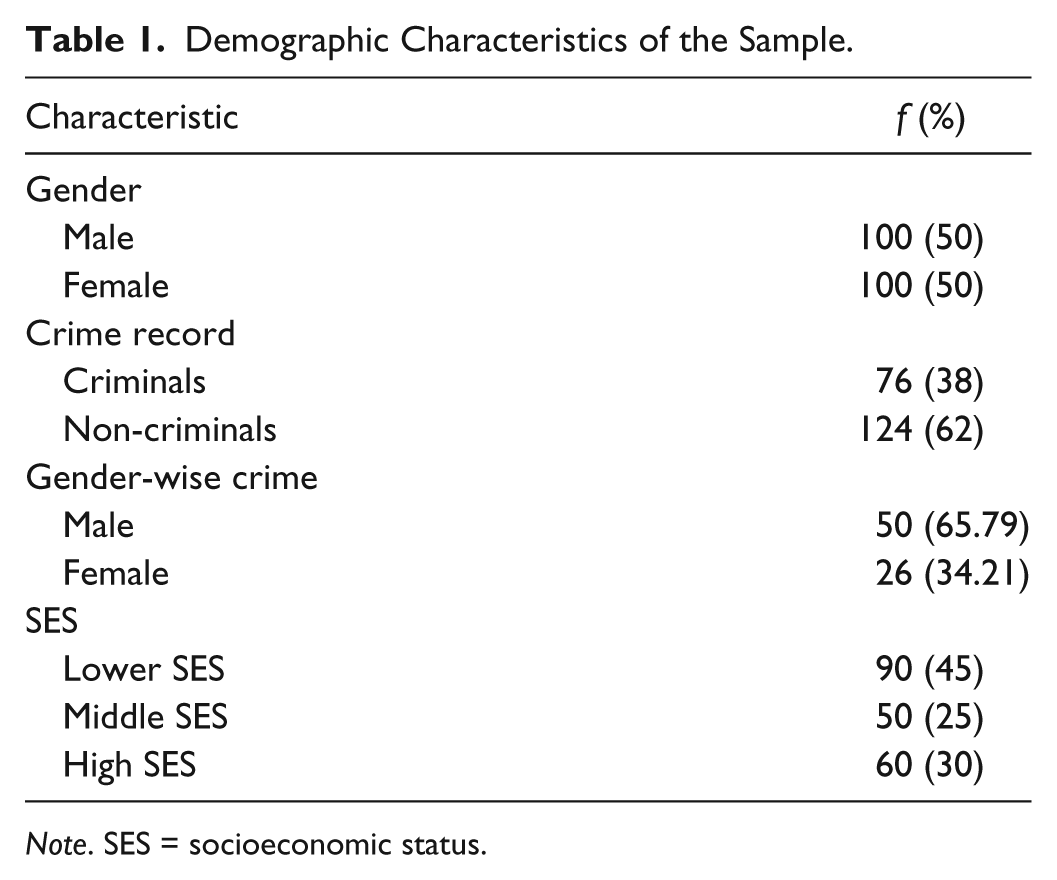
Note. SES = socioeconomic status.
Mean, Standard Deviation, and t-Scores of Psychopathy Among Criminals and Non-Criminals (N = 200).

Mean, Standard Deviation, and t-Scores of Psychopathy Among Male and Female (N = 200).

Hemphill et al. (1998) reported that psychopaths are at increased risk of committing crimes. Salekin, Rogers, and Sewell (1996) stated that imprisoned individuals have higher rates of psychopathy and are more likely to commit criminal violence and recidivism. They also stated that both criminal violence and recidivism can be predicted by psychopathic scores. de Pádua Serafim, de Barros, Bonini Castellana, and Gorenstein (2014) investigated the differences among psychopathic scores of the psychopathic murderers, non-psychopathic murderers, and non-criminals. The results showed that non-criminals scored lower as compared with both groups of criminals.
The present study was also aimed at finding the difference in the level of psychopathy across gender. The results show that males scored significantly higher as compared with the females; that is, the score for males on psychopathic measure was 240.65 (32.173) and that for females was 209.19 (41.00). The present research findings are consistent with those of previous research. Essau, Sasagawa, and Frick (2006) reported that females score less on dimensions of psychopathy as compared with males. Similar findings were reported by Frick et al. (2003). According to them, boys had a higher score on callous unemotional dimension of psychopathy as compared with the girls having committed more delinquent acts.
Frick, Bodin, and Barry (2000) also studied the impulsiveness and unemotional dimension of psychopathy, and found that girls scored significantly lower as compared with females. The results of the present study are also similar to those of Cale and Lilienfeld (2002) who found that the mean level of psychopathy in men is higher as compared with the women. Vitale and Newman (2001) pointed out that females’ scores on psychopathic measure were significantly different from males’. They tend to score lower as compared with males. According to Dotterer (2014) males scored higher on total psychopathy and sub facet scores as compared with females.
The present study is among few indigenous studies that focused on the psychopathic traits among Pakistani (see, for example, Jhatial, Jariko, Tahrani, & Jam, 2013; Kausar et al., 2012). The importance of assessing psychopathy and its early identification is really vital. As research evidences have shown that interventions used at earlier age such as using decompression model or using increased relationship bond with peers and parents, are helpful in treating psychopathy (e.g., Edwards, 2015). Developing such an approach in Pakistan especially in juvenile justice system and introducing it in facilities such as Remand Homes, Industrial and Reform Schools can assist the society in a more productive way.
Limitations
Like other research, this research has some limitations. A few of them are identified during the course of research:
The study is conducted on a smaller area, and only three cities of Pakistan, Abbottabad, Haripur, and Mansehra were taken.
It was observed that the public view of the crimes differs. Focus group studies are needed to assess what individuals think about committing crimes and being criminals. What indices of psychopathy may be used to assess the level among masses?
The data were mainly collected from youth. A more varied sample is needed to assess the level of psychopathy among normal population.
Implications of Study
The study was conducted to investigate the difference in the psychopathic level of criminal and non-criminal youth. The construct of psychopathy is so important that various criminal offenses and use of instrumental aggression by psychopaths demand attention. Psychopaths among normal individuals are also needed to be assessed and treated. The study has implications in the criminal justice system and psychoeducation, providing an insight to clinicians and educationists about the construct.
Conclusion
The aim of the study was to assess the level of psychopathy among youth. The study focused on measuring the difference in the level of psychopathy among criminal and non-criminal youth. It also focused on the gender differences with reference to psychopathy. The sample was taken from three districts of the Hazara division. The total sample was 200 youth (100 males and 100 females). Data were assessed using an indigenously developed Urdu Psychopathy scale. The scale consisted of 70 items, and the reliability for the scale was .90. The results confirmed our hypothesis that criminals showed higher rates of psychopathy. Similarly, males exhibited more psychopathic traits as compared with females.
Footnotes
Declaration of Conflicting Interests
The author(s) declared no potential conflicts of interest with respect to the research, authorship, and/or publication of this article.
Funding
The author(s) received no financial support for the research and/or authorship of this article.