




Abstract
Project management in today’s intensely competitive environment has compelled organizations to adopt project management approach for better business results. Therefore, current research study aims to investigate the impact of servant leadership on project success with the mediating role of team motivation and team effectiveness in the software industry. A field survey was conducted, using a questionnaire as a survey tool. Data were collected from 219 respondents who have been working as team members of software development projects. The statistical results were obtained using the SPSS Process macro. The results show project managers need to exhibit a servant leadership style due to its strong influence on project success, albeit through team motivation and effectiveness. The findings from this study contribute to the field of leadership and project management along with the field of information systems and software engineering.
Keywords
Introduction
Project management is in vogue and today’s intensely competitive environment is compelling organizations to adopt project management approach for better business results such as reduced risks, costs, and improved success rates. Project management has become a growing field with well-established principles and techniques to help complete the projects efficiently and effectively. Despite the establishment of well-developed project management techniques and tools, many projects continue to fail. A plethora of human and non-human factors affect any project’s success and failure, as the projects operate in the surrounding of triple constraints like time, cost, and quality. Of the human factors, project leadership has been highlighted as the most important factor that can determine the success of the project. Therefore, “project leaders need a varying set of leadership competencies to navigate such complexities to reach successful project completion. The problem is that project leaders might lack specific set of leadership skills to navigate the complexities noted above to reach successful project completion” (Cleveland & Cleveland, 2020, p. 35).
The project managers have been continuously facing problems and challenges related to leadership like stress, motivation, learning, teamwork, and leadership styles (Berg & Karlsen, 2007; Thell, 2020). Due to this, the researchers have discussed the need for many positive leadership styles (Lemoine et al., 2019). A project leader is always considered to be accountable for the effectiveness of the team and project success. For this reason, the service-oriented approach of leadership is taken as an effective measure of team effectiveness because “leadership is defined as an ability to grasp the emotion of team members accurately, to empathize with them, and to appropriately develop human relations” (Maruyama & Inoue, 2016).
Among several leadership styles, servant leadership is believed to be “a holistic approach to leadership that encompasses the rational, relational emotional, moral, and spiritual dimensions of leader-follower relationships such that followers enhance and grow their capabilities” (Graham, 1991). Like other project management sectors, software project management also depends on their project manager’s leadership capabilities. Although numerous studies have been conducted to examine the leadership styles in project management, studies in information systems and software engineering project management are scarce (Yoshida et al., 2014) especially in the South Asian context.
As a specific form of project, software projects must also be supported by project management methods. Furthermore, because the software development life cycle plays a critical part in software development, project management would be essential (Fareed & Su, 2022). This brings a need for agile software project management where teams work effectively to deliver value to the customers. “The importance of leadership and the team dynamics in the agile projects’ success has been adequately brought out through three of the twelve principles in Agile Manifesto.” (Balasubramaniyan & Kenneth, 2021). These principles are “(i) Business people and the developers must work together daily throughout the project, (ii) Build projects around motivated individuals. Get them the environment and support they need and trust them to get the job done and (iii) At regular intervals, the team reflects on how to become more effective, then tunes and adjusts its behavior accordingly” (Agile Alliance 2001 as cited in Balasubramaniyan & Kenneth, 2021). These principles highlight the need for leadership behavior for motivated and effective teams.
Software development projects fail, and their cancellation rates remain high. There have been many advances in the project management field to ensure the success of the software project. However, despite this progress, many projects still fail (Smith et al., 2004). Among many reasons, lack of effective leadership or its styles has been cited as a major reason that managers face (Berg & Karlsen, 2007; Schmid & Adams, 2008). The incapacity of executives to promote organizational changes due to insufficient leadership competencies, according to existing literature, is one of the most crucial concerns contributing to project failures (Gartzia et al., 2018; Khan et al., 2022). Hence, ineffective leadership is the major hurdle in a project’s success in software industry. Therefore, it is necessary to investigate the linkage between project leadership and software project success through team effectiveness and motivation.
Existing literature has looked at the links between task-focused and relationship-focused leadership constructs and project team outcomes (Aga et al., 2016; Tyssen et al., 2014). To address the never-ending team and organizational issues, project leaders need a follower-centric vision and behaviors (Bakker et al., 2013; Floris & Cuganesan, 2019; Lemoine et al., 2019 as cited in Bilal et al., 2021). Servant leadership is entirely focused on the needs of individuals (Joseph Jeyaraj & Gandolfi, 2022; Parolini et al., 2009), to the point where the organization’s goals are sometimes extrapolated from the followers’ goals (Aarum Andersen, 2009). As the software projects are distinct and special, there is a need of robust support of project management practices and processes (Gandomani et al., 2020) that are based on team structure. Therefore, it can be said that project success highly depends on team-related behaviors.
It is presently common practice in leadership research to assume that leadership influences various individuals, teams, and organizational related outcomes with an occasional examination of mediating or moderating variables. Hence, a causal relationship between servant leadership and the success of an IT project can be assumed (Harwardt, 2020) through mediating variables like team effectiveness and team motivation. There are only afew studies on team effectiveness in the context of agile software development and that also employed general team leadership paradigms (Holtzhausen & de Klerk, 2018). Therefore, the primary motivation of the study is to fill this researchgap by exploring one of the most important leadership styles in software team management and its effect on software project success through mediating role of team motivation and team effectiveness.
Furthermore, there has been a growing interest in studying the role of servant leadership; however, the role of servant leadership in creating project team motivation and effectiveness as well as on project success is scarce. Servant leadership is believed to be a motivating factor for enhancing the human resource skills that are required to mobilize the project team’s success (Schmid & Adams, 2008). Moreover, in the context of servant leadership, Eva et al. (2019) have also found considerable gaps in the literature of servant leadership. There is also limited research conducted on the role of servant leadership in software project success and this also forms the necessity of conducting this study. By identifying the need for studies on exploring the linkage between servant leadership and project management, this research will make a significant contribution to the body of knowledge of project management and leadership. This research aims to determine the appropriateness of servant leadership style for team motivation, effectiveness, and in turn project success. The main objective of the study is to explore the impact of servant leadership on project team motivation and effectiveness and their resultant effect on project success. The specific objectives of the study are as follows:
(a) To examine the impact of servant leadership on the project team’s motivation in the software industry.
(b) To examine the impact of servant leadership on project teams’ effectiveness in the software industry.
(c) To study the effect of servant leadership and project team motivation and effectiveness on project success in the software industry.
Literature Review
Theoretical Background
Recently, Verwijs and Russo (2021) proposed “a theory of scrum team effectiveness” that explains what makes a scrum (agile software) team effective. The theory highlights various factors that would help make software teams effective including continuous improvement (sprint-retrospective quality, quality concern, psychological safety, shared learning), team autonomy (self-management, cross-functionality), management support, stakeholder concern (value focus, stakeholder collaboration, sprint review quality, shared goals), responsiveness (release frequency, refinement). The team effectiveness included dimensions of team morale and stakeholder satisfaction. According to the authors of the theory, “So far, Scrum teams and their internal dynamics are rarely at the center of scholarly investigations.” Hence, the theory of scrum team effectiveness helps to understand the team level factors to make the scrum software teams effective (Verwijs & Russo, 2021). One of the authors of the theory of scrum team effectiveness also proposed the Agile Success Model (Russo, 2021). The model highlighted that product owner involvement, developers’ skills, scrum master leadership, and top management commitment affect the project success in the software context.
The agile success model is the general theoretical framework for agile software performance while the theory of scrum team effectiveness provides “a theoretical model to understand how team-level factors interact to determine the effectiveness of Scrum teams.” The agile success model has a particular focus on project success as the outcome of all factors and the theory of scrum team effectiveness takes into account the team effectiveness as an outcome of all team-related variables. The theory of scrum team effectiveness highlights the management support where managers should have a supportive rather than directive role for team effectiveness. The agile success model specifically pointed out the scrum master leadership that is desired for a software project success. According to the model, the scrum master leadership should have problem-solving skills, facilitation skills, and organization knowledge. They should “provide solutions to developers regarding unplanned/rising issues, adaptability to change, creativity to address unexpected problems rapidly, active listening and problem comprehension, effective communication, bridging between different jargons - linking both organization’s and team’s needs and expectations, explicit and implicit knowledge of the organization, when problems arise, knowing at which door to knock, clarify to the team unsaid/implicit expectations.”
Both theoretical frameworks are used in this study to provide strong support for the leadership role in software teams. Although these frameworks did not highlight any specific leadership role that would be best suited for such an agile team, the current study fills the gap by testing the role of a specific leadership style that is, servant leadership. The servant leadership traits are best matched with the traits described by the theory of scrum team effectiveness and the agile success model.
Servant Leadership
Servant leadership believes in a selfless aspiration to lead others. The idea of servant leadership was conceptualized by Robert Greenleaf when he put forward the definition of servant leadership “through serves first, not lead” (Rachmawati & Lantu, 2014). In his words: “It begins with the natural feeling that one wants to serve, to serve first. Then conscious choice brings one to aspire to lead. The difference manifests itself in the care taken by the servant – first to make sure that other people’s highest priority needs are being served. The best test is: Do those served to grow as persons; do they, while being served, become healthier, wiser, freer, more autonomous, more likely themselves to become servants?” (Greenleaf, 1970).
Servant leadership depends on the notion that to bring out the best in their devotees, pioneers depend on one-on-one correspondence to comprehend the capacities, needs, wants, objectives, and capability of their flowers or employees in an organizational context. By understanding each follower’s exceptional qualities and interests, leaders help them in accomplishing their potential through their confidence building (Liden et al., 2008). Servant leadership is viewed as upright, very moral, and depends on the notion that serving the followers is the crux of this leadership (Ogochi et al., 2022; Sendjaya et al., 2008). Servant leaders also possess the traits of “altruism, humility, hope, integrity, vision, caring for other people, trustworthiness and interpersonal acceptance” (van Dierendonck, 2011). There has been an extensive application of servant leadership theory in organization management from both theoretical and practical perspectives, for example, Huang et al. (2016).
A servant leader helps his followers to grow and improve (Luthans & Avolio, 2003). He inspires, gives self-confidence, and provides knowledge, feedback, and any needed resources to his followers (Liden et al., 2014). Servant leaders do not employ their supremacy to get things done, instead, he uses communication and attention to their followers which helps the leader to know their needs, desires, abilities, goals, and potentials (van Dierendonck, 2011; van Dierendonck & Nuijten, 2011). Recognizing the counterintuitive relationship, scholars have underlined the importance of focusing on how servant leadership’s fundamental mechanisms affect organizational outcomes (Chiniara & Bentein, 2016 as cited in Saleem et al., 2020). Therefore, the current study has studied the effect of servant leadership on project success with mediating role of team effectiveness and team motivation in the software project context.
Servant Leadership in Project Managers
In a very recent study, Kauppila et al. (2022) found the support of servant leadership styles on several employees’ outcomes including commitment and satisfaction. Nguyen (2016) investigated some workplace factors like cultural, functional, and organizational differences among 10 agile software development team project managers in the United States. Among many factors, he identified that “teams should have a communal location for all written knowledge, like a wiki; and servant leadership - leaders should enable teams rather than direct them.” Dogaru (2016) in a quantitative study that was exploratory in nature tried to find the answer to the maturity level of project management in the light of servant leadership. They collected the data from 80 people from different departments like project managers, supervisors, members of the project team, etc. They confirmed that the project’s success is mainly dependent on servant leadership and partially dependent on the constraints of time, cost, quality, and performance. This servant leadership can help them to overcome many problems faced by the project managers.
Gwaya et al. (2014) in their study determined the extent of servant leadership effectiveness in enhancing project success in South Africa. In this study, they found strong support for their hypotheses that servant leadership is successful for project managers. Thompson (2010) also regarded the lack of leadership styles as one of the causes of project failures. In his research, he also found that previous research did not pay much attention to this leadership style as an issue. In his descriptive survey study, he also found strong support for his belief that servant leadership is important for project success. Anantatmula (2010) conducted a literature review that identified people-related success factors for the project. Then surveys and structured, personal interviews were also used to draw a project manager leadership and management model. He found that the leadership styles of project managers have great importance in motivating project teams by creating an effective environment.
Previously, research on servant leadership has focused on positions of organizational leaders, for example, CEOs (Peterson et al., 2012), line managers (Wang et al., 2018), and supervisors (Chiniara & Bentein, 2016), etc. However, little focus has been observed in the context of software project leaders. Prifling (2010) investigated that specific leadership styles of IT project managers brought the success of IT projects in India. In the literature, it was found that servant leadership has been used to investigate project success; however, there is a shortage of such studies that investigate this effect in project managers in the software industry. Secondly, there is also a lack of studies that explore the effect of servant leadership on project team motivation and effectiveness. This study tries to add to the existing body of knowledge by taking into account all these aspects. The agile success model emphasizes the need of investigating role of leadership in software projects.
Servant Leadership in Project Success
Due to prevailing challenges in the environment, projects are ended up being a viable vehicle for organizations to be flexible and versatile to their changing surroundings. These projects are also ready to help organizations accomplish their strategy, in the advancement of new products and services and to ceaselessly enhance the organizations and its product and service (Winter et al., 2006) as cited by Leyva and Matović (2011). According to Ahmed et al. (2013) for achieving the success of the project, it is necessary to have perfect leadership, skills, knowledge, expertise, and management, so that the right decisions can be made at the right time with proper allocation of resources. Harwardt (2018) measured IT project success with various dimensions such as adherence to schedule, budget, and scope. Harwardt (2020) investigated the effect of servant leadership on IT project success and found strong support for such an effect.
The incapacity of executives to promote organizational changes due to insufficient leadership competencies, according to existing literature, is one of the most crucial concerns contributing to project failures (Gartzia et al., 2018). Project leadership is again crucial because it defines project missions clearly and plausibly that can ultimately be evaluated (Anantatmula, 2010; Strukan et al., 2017). Although, there is no perfect leadership style in all situations, however, Thompson (2010) stressed that servant leadership is a leadership model that can facilitate to combat many challenges faced by project managers. Relationship-oriented leaders such as servant leadership are considered to be more effective in attaining satisfactory project outcomes (Nauman et al., 2019). Servant leaders have a reputation for being excellent listeners (Johnson, 2017). These types of leaders pay close attention to their followers’ comments and take necessary action to fix any concerns that may jeopardize their followers’ growth (Cleveland & Cleveland, 2020). The agile success model also emphasizes the need for “active listening and problem comprehension” of scrum project leaders. Therefore, in the light of servant leadership and agile success model, it is hypothesized that:
Servant Leadership and Project Team Motivation
Team motivation in the software project can be considered as the team members’ degree of willingness to put in efforts toward attaining software project goals and making it a success. Motivating employees is the most crucial and difficult responsibility that a leader has to accomplish (Almansour, 2012), therefore, managers must develop as leaders to understand their team members’ needs and expectations (Al Rahbi et al., 2017). Redick et al. (2014) identified that amongst the most difficult undertakings of the leader and project manager, or sponsor is to get the project team to cooperate as a group since, without a durable group, the project could be in danger of being unsuccessful. This can also be a difficult challenge in software teams that are involved in many complex tasks. There are not a sufficient number of studies that have investigated the effects of leadership on the role of team motivation (Al Rahbi et al., 2017; Rehman et al., 2021), even though motivation is linked to innovative work practices, according to previous studies (Yidong & Xinxin, 2013).
The theory of scrum team effectiveness and the agile success model did not include motivation as an explicit variable for affecting project success and team effectiveness. However, the theory took into account team morale as an outcome variable mediated by certain other factors. Morale is “an elusive quality which involves feelings, emotions, attitude, and perception towards the organization and its members” (Shaban et al., 2017), and motivations is “the driving force within individuals by which they attempt to achieve a specific goal to fulfill some needs or expectations” (Osabiya, 2015). Although, team morale and team motivation have a difference in their definitions, yet both of them deal with the inner state of individuals. Motivation seems more goal-oriented and its importance in project success cannot be ignored. Shaban et al. (2017) in their study, connected both of them and found that low morale leads to low motivation, and both have a significant effect on productivity and competitiveness.
According to Yoshida et al. (2014) servant leadership requires deferring own needs for others and subservience of their objectives for the well-being of the team and ultimately for an organization. There is a general agreement in previous research that servant leadership has positive impacts on team outcomes (Eva et al., 2019), as it has a trait of altruistic calling which helps to develop positive attitudes among employees or team members (Sendjaya et al., 2008). In the context of servant leadership, more support has been found related to motivation, for example, Hu and Liden (2011) advocated that servant leadership can boost team members’ motivation through improving cognitive processes and encouraging genuine, problem-solving dialog (as cited in Yang et al., 2017). Similarly, recently, Opoku et al. (2019) also argued that “servant leaders build personalized relationships with their followers, followers are likely to hold perceptions of belonging to the inner circle, thus providing strong intrinsic motivation to engage in innovative behavior.” This indicates that motivation can act as a mediator between servant leadership and project success. In their study, Schwarz et al. (2016) studied the mediating effects of motivation of public service employees on the relationship between servant leadership and their job performance. Gutierrez-Wirsching et al. (2015) studied motivating language as a mediator between servant leadership and employee outcomes. According to them, motivating language is “a powerful tool that servant leaders can use to communicate effectively with their subordinates to increase desirable subordinate attitudes and behaviors.” Bezerra et al. (2020) found motivation an important human factor influencing software teams’ productivity. In the context of software engineering, Franca et al. (2020) proposed a theory of work motivation and job satisfaction of software engineers (TMS-SE) that highlights several work-related characteristics that lead to work motivation and job satisfaction of software engineers. Although this theory does not explicitly highlight the leadership role, the authors claimed that “The TMS-SE can offer a theoretical framework to interpret and predict how the attitudes and decisions of leaders will influence the work motivation of software engineers.” The theory also points out the need to understand the work motivation of the members of a software team. Hence, by considering the gaps found in the theory of scrum team effectiveness, the agile success model, and TMS-SE theory, the current study has attempted to draw a directional path from servant leadership to team motivation and project success. The hypothesis has been developed that
Servant Leadership and Project Team Effectiveness
Team effectiveness. is defined as the “attainment of common goals or objectives through the coordination of team members’ work activities” (Irving & Longbotham, 2007). The agile success model has taken effectiveness as a second-order theme of the main construct of top management commitment, while the theory of scrum team effectiveness discussed team effectiveness as the main outcome variable. In this theory, team effectiveness is characterized by two main variables that is, team morale and stakeholder satisfaction. The theory states that continuous improvement, team autonomy, management support, stakeholder concern, and responsiveness affect the team effectiveness in software agile projects. The factor of management support in this theory highlights certain specific roles that should be played by managers as a leader, for example, the theory highlights that “Train management in the skills needed to support rather than direct.” Members in a team always work better and together for attaining the organizational goals, when they have “inspirational and moral confidence in their leader” (van Dierendonck, 2011).
Servant leadership provides such opportunities to employees that help them to grow (Luthans & Avolio, 2003; Simha & Urick, 2022) by enhancing their confidence, presenting role models, and disseminating clear information, and providing resources and feedback to them (Liden et al., 2008). In this way, they understand each employee/follower’s need and characteristics through which a servant leader can help them in achieving their goal by utilizing their potential (Liden et al., 2008). Hoch et al. (2018) and Alafeshat and Tanova (2019) advocated that servant leadership brings some powerful employee outcomes.
Mahembe and Engelbrecht (2013) in their research confirmed the role of servant leadership in increasing team effectiveness and affective team commitment. Bilal et al. (2021) conducted a study to investigate the effect of servant leadership on project team effectiveness and found that servant leadership can clarify the goals and test processes among teams that enhance their effectiveness. Team effectiveness has mainly been studied as the main dependent variable and very few studies have been conducted to investigate the mediating role of team effectiveness. Recently, Khan, Adil et al. (2021) have studied the mediating role of team effectiveness between knowledge sharing behavior and team performance. Okoronkwo (2017) also identified the factors that drive team performance and project success by arguing that “the success of any project largely depends on the effectiveness of the project team.” The agile success model emphasizes scrum master leadership for project success and the theory of scrum team effectiveness emphasizes team effectiveness. Therefore, by finding the gap in previous literature, the current study has made an effort to draw a direct path by specifying the effect of servant leadership on project success through the mediating role of team effectiveness. Hence, it is hypothesized that:
Figure 1 presents the pictorial view of the hypotheses, where servant leadership is the independent variable and project success is the dependent variable.

Proposed research model.
Methodology
The study is explanatory in nature where the effect of servant leadership was investigated on project success. Study applied a quantitative causal technique to examine whether a relationship exists between successful project success and servant-leadership or not. The study explored relationships among variables through the testing of hypotheses. A field survey was conducted to get the data, hence, both primary and secondary sources of data were used to gather information about the subject of inquiry. The study was cross-sectional in nature.
Software development organizations working in Pakistan were the population. The ministry of information technology was approached to sort out the organizations based on the nature of work. Participants were members of software development teams working at various positions and roles.
Initially, around 300 sample size was targeted by consulting Pakistan software board statistics. However, only 219 useful responses were received and used for the data analysis. Convenience sampling was used to collect the data from respondents, as there are many advantages of convenience sampling like expedited data collection, ease of research, readily available, and cost-effective.
Instrument
For this survey research, adopted structured questionnaire was used. Items in the questionnaire were measured at a five-point Likert scale in which the lowest value 1 was assigned to “Strongly Agree,” 2 to “Agree,” 3 to “Neutral,” 4 to “Disagree,” and the highest value 5 was assigned to “Strongly Disagree.” Questionnaire used in this study consisted of two parts. Part one contained questions about the demographic or background information of respondents like age, gender, experience, etc. While part two contained questions about measuring theoretical variables like servant leadership, team effectiveness, team motivation, and project success.
The variable of servant leadership was measured using a 23-items scale developed by Barbuto and Wheeler (2006). This scale measures servant leadership on the dimensions of altruistic calling, emotional healing, wisdom, persuasive mapping, and organizational stewardship. Examples of items are as follows: “My project leader puts my best interests ahead of his/her own” and “my project leader is good at convincing me to do things.” The construct of team effectiveness was measured using 19 items instrument developed by Wang and Imbrie (2009). The example items are “My team collaborated effectively to complete our assignments” and “My team used clear, long-term goals to complete tasks.”
The variable of team motivation was measured using 6 items scale developed by Kuvaas (2006). Sample items of the scale team motivation are “The tasks that I do at work are enjoyable” and “My job is so interesting that it is a motivation in itself.” The variable of project success was measured using 11 items developed by Mahaney and Lederer (2006). Project success was measured using three dimensions namely client satisfaction, perceived quality, and implementation process. The sample items are “Given the problem, this project seems to be the best choice among alternatives” and “The project came in within its original schedule.”
Questionnaire Validity and Reliability
Before starting the distribution of the questionnaire, the necessary pre-testing took place, to verify its content validity. The face validity of the questionnaire was checked by consulting the experts from the relevant field. A pilot study was also conducted to ensure the reliability of the questionnaire. During pilot testing, 20 respondents were selected. Their responses were used to analyze the reliability of the questionnaire.
Data Collection Planning
The primary data were collected through questionnaires while secondary data consisted of all the previous literature. Primary data were collected by using two methods. One was through manual data collection and the other was electronic data collection. Both have their advantages and disadvantages. For electronic data collection, Google form was created, and the link was shared among respondents working in different software development organizations.
Results
Demographical Analysis
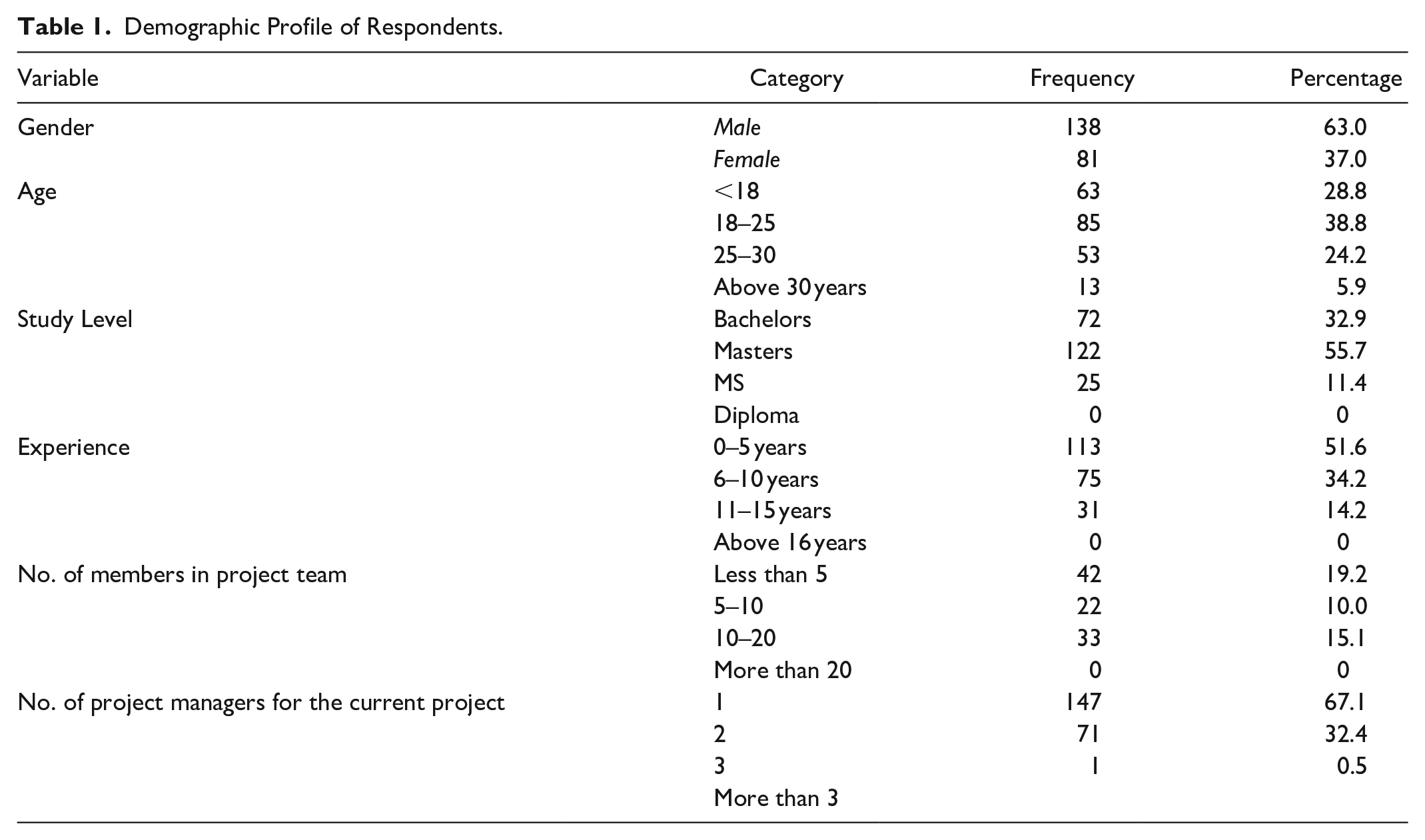
The demographic analysis is presented in Table 1 which shows gender, age, education level, experience, and project information of respondents. The sample size used for the analysis was 219. The statistics showed that there were 138 (63%) males and 81 (37%) female respondents. The age is divided into four categories: 85 respondents fell at the age of 18 to 25 years which is 38.8%, 53 were in the age of 25 to 30 years which is 24.2%, while 76 were above 30 years old which is 34.7%. The study level of the respondents shows that 72 (32.9%) held bachelor’s degrees, 122 (55.7) held master’s degrees, and 25 (11.4%) held MS-level degrees. Regarding experience, a majority (113, 51.6%) of them were having less than 5 years of experience, 75(34.2%) were having 6 to 10 years of experience and 31 (14.2%) were having 11 to 15 years of experience of software development. About team members in the project, majority 42 (19.2%) of that the respondents mentioned that they have less than 5 members, 22 (10%) said that they have 5 to 10 members in a team, and the rest of them (15.1%) mentioned that they have 10 to 20 members in a team. Regarding the number of project managers, 147 (67.1%) were having one project manager, 71 (32.4%) were having two managers, and only one indicated three managers for the project.
Demographic Profile of Respondents.
Correlation Analysis
Correlation and descriptive analysis were conducted to show the relationship among the variables, Cronbach alpha, mean, and standard deviation. The values of correlation analysis, mean, and standard deviation are shown in Table 2.
Mean, Standard Deviation, and Correlation Analysis.

p < .01, *p < .05, N = 219.
The statistical values of mean, standard deviation, Cronbach alpha, and correlation values in Table 2 indicate that the mean value of servant leadership is (M = 1.93, SD = 0.17), team motivation is (M = 1.88, SD = 0.38), team effectiveness is (M = 1.87, SD = 0.19) and project success is (M = 1.79, SD = 0.23). The Person’s correlation values in Table 2 show that servant leadership has a significant positive relationship with project success (r = .26, p < .01), team effectiveness (r = .25, p < .01) and team motivation (r = .24, p < .01). Similarly, team effectiveness was also having significant and positive relationship with team motivation (r = .36, p < .01) and project success (r = .47, p < .05). Moreover, project success was also positively correlated with servant leadership (r = .26, p < .01), team motivation (r = .21, p < .01) and team effectiveness (r = .47, p < .05). All correlation values are positive, hence, depicting a positive correlation among the variables. To conduct a reliability analysis of scale items, Cronbach’s alpha was calculated. It was found that all items of the selected scale fell into the required range of reliability that is above 0.6. The highest reliability was found in the scale of servant leadership (α = .87), followed by team effectiveness (α = .85), project success (α = .83), and team motivation (α = .79). All statistical values confirm the internal consistency of items which indicated a reliable scale.
Hypotheses Testing
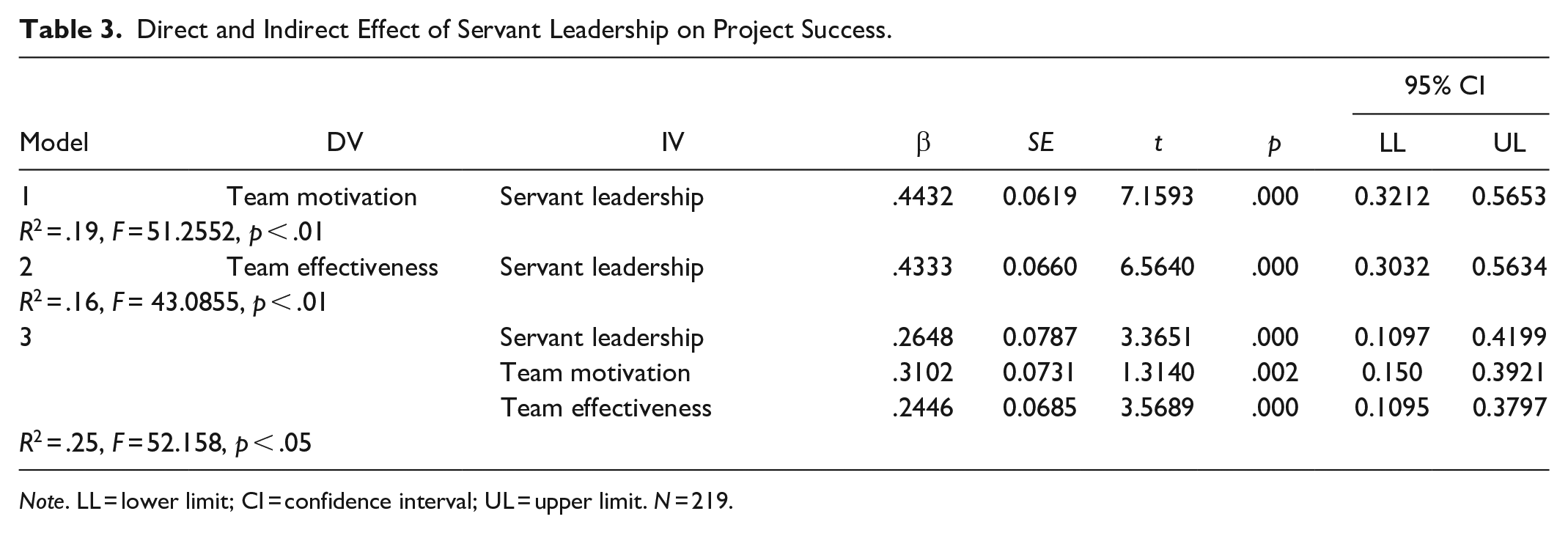
To build the theoretical relationships among variables, different hypotheses were developed in the light of previous research and theory. For this purpose, data were analyzed using Hayes and Preacher’s (2010) macro v3.4 in SPSS. This macro is based on the bootstrapping method that takes random sampling to produce the results which enhance the accuracy of the data. As the theoretical model included two mediators, hence, parallel mediation analysis was done using model 4 in the Process macro.
Firstly, servant leadership was entered as an independent variable (X), project success as an outcome variable (Y), and team motivation and team effectiveness as mediator variables (M1 and M2). In Model 1, we estimated the effect of servant leadership on team motivation (Mediator 1) and in Model 2, on team effectiveness (Mediator 2). In Model 3, the effects of servant leadership and both mediators (team motivation and team effectiveness) were estimated on project success. The results of parallel mediation show that the direct effect of servant leadership on project success was still significant (β = .264, SE = 0.0787, CI [0.1097, 0.4199], p < .01) when controlling for mediators. Moreover, a significant indirect effect of servant leadership on project success through the mediator team motivation (β = .310, SE = 0.0731, CI [0.1505, 0.3921], p < .01) and mediator team effectiveness (β = .244, SE = 0.0685, CI [0.1095, 0.3797], p < .01) was found as expected in hypothesis (Table 3).
Direct and Indirect Effect of Servant Leadership on Project Success.
Note. LL = lower limit; CI = confidence interval; UL = upper limit. N = 219.
Discussion
This research study aims to find out the potential impact of servant leadership on team motivation and team effectiveness and their resultant effect on project success. The project team motivation and effectiveness were playing a mediating role in this effect. The outcome of this study confirmed that servant leadership was strongly linked with project success in the software industry. The findings confirm the notion of previous studies such as Ahmed et al. (2013) who strongly advocated the role of proper leadership as a mandatory factor in project success. Many other studies also supported the idea that leadership is a vital element for project success (Khan et al., 2022; Roe & Elton, 1998).
In previous studies, it is reported that servant leadership is a collection of moral forms (Lemoine et al., 2019) that has appeared as an important leadership construct (Hoch et al., 2018) across many domains. Based on the assumptions in previous literature, the current study investigated the mechanism through which servant leadership can bring success to the software projects (Nauman, Musawir et al., 2022). The study found that if software development managers follow servant leadership, then they can enhance project team motivation and effectiveness and through which project success can be achieved. The results are supported by the study conducted by Bilal et al. (2021) where authors confirmed the impact of servant leadership on team effectiveness in the context of Information Technology projects.
Servant leadership is considered as an ethical, righteous, thing because serving others or followers is the central part of leadership (Sendjaya et al., 2008). The original notion of servant leadership proposed by Greenleaf is “‘primus inter pares’ (i.e., first amongst equals)” which means servant leaders don’t merely focus on getting things done, but they also focus on persuading and convincing staff (Van Dierendonck et al., 2017). The significant relationship between servant leadership and team effectiveness indicates that managers in the software industry who practice traits of servant leadership enhance the overall effectiveness of project teams. This happens because software project managers as servant leaders focus on the development of their followers or subordinates, which ultimately bring success to their projects. The servant leaders in the software industry establish such a working environment in an organization that brings team motivation and effectiveness, thus, enhancing their performance and bringing success to the projects. These findings are consistent with previous studies where many other researchers such as Hu and Liden (2011), and confirmed a similar relationship between these servant leadership and team effectiveness. Previous research also confirmed that servant leadership is not only conducive for bringing out individual-level performance but for team-level performance as well ( Hu & Liden, 2011; Rehman et al., 2021; Schaubroeck et al., 2011).
Servant leadership theory demonstrates that servant leaders put others’ interests over their own, subsequent in followers with upgraded development and prosperity who ultimately take part in such practices that advantage stakeholders as well (Barbuto & Wheeler, 2006; Ehrhart, 2004). Thompson (2010) argued that servant leadership helps in overcoming many of the challenges faced by managers on a project, especially in the software industry. For project success, it is necessary to focus on activities performed at three levels namely the project sponsor, project managers, and project team members (Kilkelly, 2011; Thompson, 2019). Redick et al. (2014) pointed out that “one of the most challenging tasks of the leader or project sponsor is to get the project team to work together as a team since, without a cohesive team, the project could be in jeopardy of being unsuccessful” (as cited in Krog & Govender, 2015).
The complex nature of software development projects requires a leadership style that could enhance not only motivation but also the effectiveness of employees. Ebener and O’connell (2010) highlighted it as “Servant leader behaviors in their model included showing concern for the interests of others, encouraging others in their career goals, delegating important work responsibilities, and emphasizing the importance of giving back to the community. It was discovered that the practice of servant leadership was associated with greater work performance in the workforce and higher commitment among workers for their organizations” (Nauman, Bhatti et al., 2022). Servant leaders are always listening to their followers, they have high concerns about their needs, and they are engaged in high ethical standards. These are the main qualities that make them a motivating agent where employees can feel productive and motivated. As team members feel empowered and they put collaborative efforts (Rehman et al., 2022) into software projects, hence, the chances to succeed for a project are very high. Servant leaders demonstrate a complete set of behaviors including altruistic calling, emotional healing, wisdom, persuasive mapping, and organizational stewardship. By having all these traits in managers, employees feel that their boss as servant leaders goes above and beyond the call of duty to meet their needs; s/he could help them mend their hard feelings; s/he is good at anticipating the consequences of decisions being very persuasive and who brings community spirit in the workplace.
Thus, servant leadership has been proven to bring teams up to such a level that not only influences their feelings like motivation but also shapes their productive behavior (Khan, Mubushar et al., 2021). Overall, the results confirm that servant leadership is significantly linked with project success in the software industry. Moreover, this study also proved that project team motivation and team effectiveness acts as mediating variables between servant leadership and project success.
Theoretical Contributions
The available literature lacks sufficient proof of the critical team processes through which servant leadership can influence project team effectiveness (Lee et al., 2020). Therefore, the current study provides a useful contribution to the existing body of knowledge. To theoretically support the study variables, a theory of scrum team effectiveness and agile success model was used. Both theories are developed for the software teams and project environments. The theory of scrum team effectiveness focuses on team effectiveness as the main outcome, while the agile success model emphasizes project success as the outcome. The theory of scrum team effectiveness discusses at the team level while the agile success model highlights factors at a project level. The current study developed and tested a research model that included variables at the individual level (servant leader), team level (team motivation & team effectiveness), and the project level (project success). Hence, this study contributes to the theory by studying the three main levels, none of which can be ignored in the software industry. In this way, the study argues that team-related factors bring certain outcomes for the organizations or projects.
The leadership role was highlighted in the agile success model, whereas it was buried under the aspect of management support in the theory of scrum team effectiveness. There is another contribution of the current study that has specified a particular emerging leadership style that is useful for both team level and project level outcomes. This study has also broadened the scope of existing research by studying team motivation and the outcome of servant leadership and its effect on project success. When Franca et al. (2020) proposed a theory of motivation and satisfaction of software engineers (TMS-SE) argued that “the number of studies on this topic is relatively small, and it is only possible to find a few attempts to evaluate work motivation or job satisfaction theories or models in software engineering contexts.”
The findings of this study have many contributions to not only project management literature but also leadership area as well as information systems area. Moreover, the study has also contributed to the team management as well as project management literature. The study is different in a way that it combined two distinct fields namely project management and leadership and applied them in software industry context. Thus, it enhances its usability in three distinct fields of theory. The findings are also useful for scholars and researchers because the domain of servant leadership requires constant attention in many fields such as project management. The study has applied the concept of servant leadership in the field of software project management, which helps to understand the management and leadership issues. Servant leadership is an emerging area and new empirical studies are necessary to conduct. Therefore, this study has added to the literature of three distinct fields of management/leadership, project management, and software development.
Managerial Implications
By studying the impact of servant leadership on IT project success, Harwardt (2020) poignantly said that “These findings are highly important to the management because now they have a toolbox of how to act and to behave that can lead to successful projects.” This study proves that if project leaders exercise servant leaders’ traits, then they can increase the chances of project success. These findings provide useful insight related to the working styles and behaviors at work. These findings can help to rethink or re-calculate the current managerial or leadership style so that team members can become motivated and productive in a project. The study suggests that projects managers in the software development industry when understanding employees’ needs and caring for them, prefer employees’ interests over them can best develop and bring positive outcomes in them. Employees can have a higher level of satisfaction or motivation by feeling autonomy and energy, thus, enhancing team spirit which will not be useful for them at an individual but project level as well. Thus, projects managers should adopt servant leadership traits to make their employees feel motivated and effective and consequently make projects successful. Organizations can also understand that not only tangible and financial benefits help project employees to show motivation, but intangible behavior such as servant leadership is also valued by their employees. Hence, they should also invest in intangible but valuable resources that can also ensure the success of their projects. The findings and implications of this study may help organizations improve the effectiveness and motivation of their project team members by refocusing on servant leadership. The findings show that servant leadership style by itself and in combination with project manager’s experience can predict the success of projects in the software industry.
Conclusion
Servant leadership plays a vital role in projects success especially in the software industry of Pakistan, where projects are very complex in nature. Software projects require many characteristics as far as process and products are concerned likemaintainability, robustness, correctness productivity, timeliness, visibility, reliability, efficiency, and usability. This study demonstrates that servant leadership plays a vital role in bringing out project team effectiveness and motivation which works best for attaining the goal of project success. Motivating project team members and enhancing their abilities or productivity make it possible to combat the complex and high demands of software projects. Thus, this study demonstrates the importance of servant leadership in software projects. The study concludes that if project organizations prioritize the project and team level goals and objectives, then they should pay attention to the effects of servant leadership because of its effects on team motivation and effectiveness. As team-building interventions can be used to assist project teams to make projects a great success.
Limitations and Future Research Directions
This study employed self-reported data from the employees regarding their managers/leaders. This can cause common method bias. Data collection from only the software industry which was concentrated in only a few cities also caused the limitations of generalizability. The sample size was relatively small. The study has focused on individual team members’ motivation and effectiveness and did not count the overall organizational effectiveness.
Project management and leadership are a vast field and future studies can study individual dimensions of servant leadership to assess the relative importance of each dimension of this trait. Future studies can also employ longitudinal method to check any possible change during or after the execution of a project. Future studies can also investigate the effect of other demographic variables like age, gender, and experience on this relationship. Furthermore, future studies can also be conducted at the same scale in other fields’ projects like construction and energy.
Footnotes
Declaration of Conflicting Interests
The author(s) declared no potential conflicts of interest with respect to the research, authorship, and/or publication of this article.
Funding
The author(s) received no financial support for the research, authorship, and/or publication of this article.
