




Abstract
The International Organization for Standardization (ISO) provides standards that support organizations and professionals in several fields. The ISO 21502:2020 is a standard that focuses on concepts and practices of project management. “Success” is referenced in several sections of the standard, including guidance towards the need to define criteria to measure project success. However, despite the significant changes in the new version of the standard, formal activities for carrying out Success Management have still not been included. Aiming to contribute to filling this gap, this article describes how Success Management activities can be integrated into the ISO project management standard. The research method was design science research. The main result is an integrated model of Success Management and ISO 21502:2020 project management practices. The proposed model expands the Success Management body of knowledge and, in practice, provides the project management team with the basis for planning, controlling, and reporting the project’s success together with ISO 21502:2020.
Keywords
Introduction
Management techniques and tools have been developed and improved over the years (Cardoso et al., 2022; Dias & Tenera, 2023; Dieterich & Ohlhausen, 2023). However, achieving project success remains a challenge (Bilir & Yafez, 2021; Hefley & Bottion, 2021), even for experienced project managers (Takagi & Varajão, 2019). One of the project management standards that recently evolved is the standard ISO 21502:2020 (previously ISO 21500:2012) from the International Organization for Standardization (ISO, 2020). The ISO 21502:2020 integrates several elements that are found in other project management standards, guides, and methodologies, such as the Project Management Body of Knowledge (PMBOK; PMI, 2021) and the Process Groups – A Practical Guide (PMI, 2022) by the Project Management Institute (PMI), the Project Management Methodology (PM2) developed by the European Commission (EU, 2021), and PRojects IN Controlled Environments (PRINCE2) maintained by Axelos (AXELOS, 2017).
Although success is referenced in ISO 21502:2020 (ISO, 2020), stressing the importance of defining and measuring a project’s success, the standard does not present specific activities for Success Management, such as identifying success factors or evaluating success. In the literature, there is a proposal for an integrated model of Success Management with the standard ISO 21500:2012 (Takagi & Varajão, 2022), which is the former version of the ISO 21502:2020 (ISO, 2020). However, the two versions have significant differences, and to the best of our knowledge, there is no work describing how success can be explicitly managed in projects that follow the ISO 21502:2020 (ISO, 2020) standard. This absence in the literature defines our research question: How can Success Management activities be integrated into ISO 21502:2020?
We propose a model for integrating ISO 21502:2020 (ISO, 2020) and formal Success Management activities. The development was based on other models described in the literature considering Success Management and project management references (Takagi & Varajão, 2020, 2021; Takagi, Varajão, & Ribeiro, 2019; Takagi et al., 2021; Varajão, 2016), including with the ISO 21500:2012 (Takagi & Varajão, 2022).
The contribution of this research is twofold. First, this work contributes to the theory by describing a new model combining ISO 21502:2020 (ISO, 2020) processes and concepts from Success Management theory (Varajão et al., 2022). Second, it contributes to practice by presenting how a project management team can plan, control, and report success throughout the project life cycle.
This article is organized as follows. The second section briefly describes ISO 21502:2020 and the Success Management theory, and reviews integrated project management success models. The third section presents the research method. The fourth section presents the integrated model. The fifth section presents expert insights on the integrated model. Finally, the last section closes this work with contributions, limitations, and guidelines for future work.
Background
Standard ISO 21502:2020
The International Organization for Standardization (ISO) is a worldwide network of experts in various fields (e.g., manufacturing, academia, information technology). The standards presented by ISO are important references for academia, professionals, and organizations. In the project management domain, the standard ISO 21502:2020 (ISO, 2020) is an updated version of the standard ISO 21500:2012 (ISO, 2012), including the subject groups and activities improvement. For example, now includes formal practices regarding benefits management and change management.
Two sections of the standard focus on project management practices. The first section is related to “integrated project management practices” and describes a relationship between practices throughout the project and the related roles (e.g., sponsor, project manager, work package leader). Practices are planned from pre-project to post-project, through to project delivery control and management activities. The second section is related to “management practices for a project.” This section presents practices that can be used when undertaking integrated project management. The practices are related to managing subjects such as scope, risk, cost, quality, benefits, procurement, and communications. Overall, more than 60 project management activities are presented in these two sections.
Figure 1 is a structured view of project management activities based on ISO 21502:2020 (ISO, 2020). There is a sequence of groups of activities organized in the project lifecycle, starting with “pre-project activities,” progressing through “initiating a project,”“developing the plan,”“managing the start, progress, and close of each work package,”“closing or terminating a project” and ending in “post-project activities.” Parallel to this is the “controlling a project” group of activities. The activity “planning, managing and controlling physical and material resources” is the only one present in more than one group of activities.

Project management activities based on ISO 21502:2020 (ISO, 2020).
One of the advantages of the ISO 21502 standard is conciseness. For example, it has a longer list of management activities and approximately 14% of the pages compared to the PMI’s “Process Groups – A Practical Guide” (PMI, 2022). This is also a disadvantage since it does not describe processes in detail. Another aspect of the ISO 21502 standard is that it contains elements from various project management references, which minimizes bias and standardizes project management concepts. Being uniform and direct in concepts also makes it easier to understand the activities for managing the various areas of project management.
Success Management Theory
Success Management is a theory for design and action, focusing on defining, leveraging, and securing the success of endeavors by gaining a comprehensive awareness of what is valued by stakeholders to achieve success and managing according to such understanding (Varajão, 2016; Varajão et al., 2022). Success Management theory is based on the following principles (Varajão et al., 2022): success needs to be evaluated with appropriate criteria and measurement methods; success presents several facets; there are different perspectives on success, and success evolves over time; success evaluation is complex and contingent; the factors influencing success must be taken into account; the PDCA cycle should be applied.
Success Management promotes the creation of a formal process focused on the success evaluation, highlighting stakeholders’ expectations and guiding the level of management effort in critical project areas (Takagi & Varajão, 2022). Overall, it provides more transparency to what is most important to focus on to achieve project success. The Success Management activities are as follows (Varajão, 2018; Varajão et al., 2022):
Plan Success Management: defines how the Success Management process will be carried out in a particular context (e.g., a project). It includes the definition of several relevant aspects focused on how success will be evaluated, monitored, and communicated;
Define success evaluation details: details how the evaluation of success will be performed. This detailing includes procedures to be followed (e.g., the structure of the meetings with the stakeholders), techniques to adopt in the evaluation, monitoring, and reporting of success, characterization of success factors and success criteria, etc.;
Monitor and control success: is carried out several times (it has several iterations) and includes subactivities such as performing intermediate success evaluation; validating and reporting intermediate success; performing preventive and corrective actions; and reviewing Success Management and recording lessons learned;
Perform final success evaluation and prepare for the future: collects and analyzes the data necessary for the evaluation of success at the end of the project. This activity also starts the preparation for the continuation of the post-project success evaluation;
Validate and report final success and closure of Success Management: Validate and report the end-of-project success evaluation to the relevant stakeholders, complete the final record of lessons learned, and formally close the Success Management process.
The Success Management activities that were the basis for this theory (Varajão, 2018; Varajão et al., 2022) were also used in an earlier integration with ISO 21500:2012 (ISO, 2012) and other project management references.
Success Management Integrated Models
Project management standards, guides, and methodologies are the basis of project management, being addressed in academia and applied by project managers. Integrating Success Management activities into project management references can be a path to improving the success rates of organizations and project management practices (Takagi & Varajão, 2019).
Integrating formal activities to manage the success in project management standards and guides is not new. In the literature, there are works focusing the integration of Success Management with the PMBOK guide (Takagi & Varajão, 2020; Varajão, 2016), the PM2 methodology (Takagi, Varajão, & Ribeiro, 2019), the PRINCE2 methodology (Takagi et al., 2021), the SCRUM (Takagi & Varajão, 2021) and the ISO 21500:2012 standard (Takagi & Varajão, 2022; Varajão, 2016). Success Management integrated with other activities related to project management can also be found, such as knowledge management (Takagi, Varajão, & Nascimento, 2019; Todorović et al., 2015). The Success Management activities described in these management models are summarized in Table 1.
Success Management Related Activities Integration in Standards, Guides, and Other.

Despite the several works related to integrated models considering the project management standards and guides and Success Management, to the best of our knowledge, the integration of Success Management theory (Varajão et al., 2022) and ISO 21502:2020 (ISO, 2020) was still not addressed. More research is needed since it can support project management teams to address stakeholder expectations better and thus improve project success rates.
Research Method
The research method of this article is based on Design Science Research (DSR) by Kuechler and Vaishnavi (2008) (Figure 2). Even though success is cited as important in several parts of the ISO 21502:2020 standard (ISO, 2020), success is not managed explicitly in specific processes (awareness of the problem step). ISO 21502:2020 (ISO, 2020) is a major project management standard; thus, integrating Success Management activities can increase project success rates worldwide (suggestion step). The development of the integrated model (development step) was based on the analysis of Success Management theory (Varajão et al., 2022), the analysis of the integrated models presented in the background section of this article (Takagi & Varajão, 2020, 2021, 2022; Takagi, Varajão, & Nascimento, 2019; Takagi, Varajão, & Ribeiro, 2019; Takagi et al., 2021; Todorović et al., 2015; Varajão, 2016, 2018), and the analysis of the activities of ISO 21502:2020 (ISO, 2020).
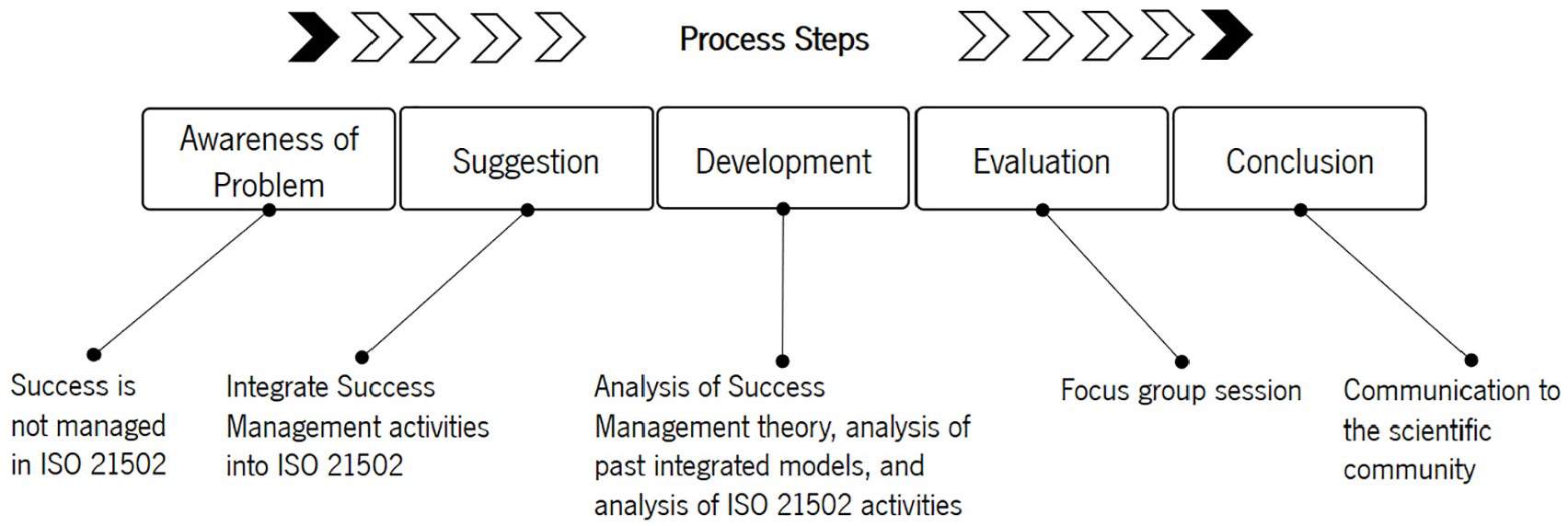
Design Science Research (DSR), based on Kuechler and Vaishnavi (2008).
The integrated model (evaluation step) was evaluated by comparing the proposed model with other models integrating Success Management into the project management standards and guides. A focus group session was also carried out with three experts (researchers and practitioners).
The criteria for selecting the experts were related to experience in project management and diversity of perspectives. Experience covered the management of high-impact projects, time working as a project manager, and role as a disseminator of knowledge in the area of project management (e.g., researcher, professor, author of academic project management works). The diversity of perspectives focused on finding active experts with different and independent views. This diversity was related to the public projects area, research, and consultancy for private organizations.
Focus groups are dynamic group discussions used to collect information (Harrell & Bradley, 2009). The selected experts had more than 10 years of experience in project management and different profiles. The first expert is a consultant, professor, speaker, and author of project and strategic management books. The second expert is a project manager in a public institution in which projects impact thousands of public servants and millions of citizens. The third expert is a professor and researcher in project management with extensive experience in high-impact societal projects. The focus group session lasted two hours and was divided into two parts. The first part contextualized the research, and the second part focused on the discussion about the developed integrated model. The focus group session was video recorded. The session recording was then transcribed and analyzed. For each activity of Success Management integrated into the model, the collected contributions were reflected in the final model version presented in this article (conclusion step).
Research Results
In this research, the ISO 21502:2020 activities (ISO, 2020) were logically organized into the project management lifecycle. The Success Management theory (Varajão et al., 2022) and the integrated models identified in the literature (Table 1) are the basis for Success Management activities of this work. In all, six Success Management activities have been explicitly integrated into ISO 21502:2020, as illustrated in Figure 3:
S1: Identify success criteria and success factors;
S2: Plan Success Management and define success evaluation details;
S3: Manage success evaluation;
S4: Review Success Management;
S5: Monitor and control success;
S6: Validate, report and closure Success Management.
The “S1. Identify success criteria and success factors” activity was included in the initiation activities group. This activity aims to define the initial set of criteria required to evaluate the project’s success and capture factors that can impact it. These success elements must be included in the project charter, the main artifact generated by the “project governance and management approach” initiation activity by ISO 21502:2020 (ISO, 2020).

Success Management activities integrated into groups of activities from ISO 21502:2020.
The activity “S2. Plan Success Management and define success evaluation details” was included in the planning activities group. This activity is responsible for defining how and when the identified success criteria will be evaluated. Furthermore, it is also planned how the factors that impact the project’s success would be monitored during the Project. This success plan answers questions such as: What activities will be undertaken? When will the activities be carried out? Who will be involved in the activities? What resources will be needed? Where will the activities be carried out?
The activity “S3. Manage success evaluation” was included in the execution activities group. This activity is responsible for collecting data regarding the success indicators (related to the success criteria) and performing actions to ensure that the success factors are under control. The collected data is the basis of analysis for monitoring and controlling the project.
Two activities were included in the control activities group. The “S4. Review Success Management” is an activity that supports a continuous improvement cycle in the integrated model. The main focus is to review Success Management details and define what can be improved for the next cycle. The “S5. Monitor and control success” activity compares the success obtained (based on the data collected) with the planned data. If it has any variation outside the defined boundaries, it triggers preventive or corrective actions in the execution of the project.
Finally, the “S6. Validate, report, and close Success Management” activity was included in the closing activities group. This activity informs stakeholders about the project’s success indicators and the actions taken to manage success. The partial reporting is done at the end of each phase, and the final reporting is done at the end of the project.
Discussion and Insights from Experts
The insights presented in this section are based on the analysis of other integrated models and feedback obtained in the focus group session. Since Success Management is based on the stakeholders’ expectations value (Varajão et al., 2022), how success will be evaluated (success criteria) and what can impact it (success factors) should be identified from the vision of the project. The flow of success elements and interaction with other project management activities based on ISO 21502:2020 (ISO, 2020) can be visualized in Figure 4.
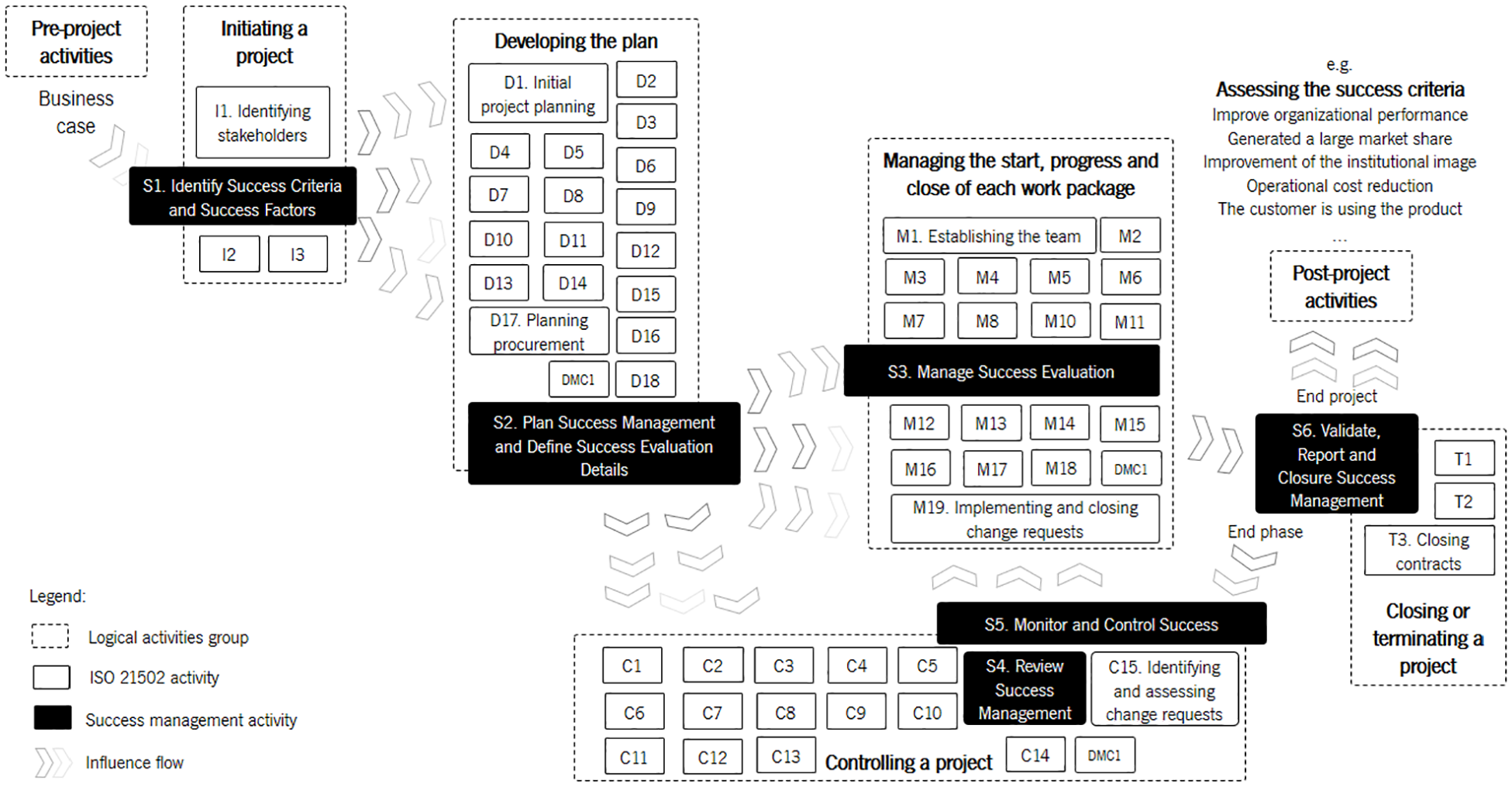
Success Management and ISO 21502 project management activities.
The evaluation of the project should be based on the business case (Busch et al., 2023; Robertson, 2004) and can have several dimensions (e.g., efficiency, preparing for future, etc.; Shenhar et al., 1997). The business case is presented in some organizations as a pre-project artifact and may already describe a previous identification of success criteria and success factors. The focus group session brought insight into the content of the business case in practice: “In the business case, in practice, the success criteria are usually related to the financial area, such as net present value and return on investment, to assess whether the project is worthwhile. However, the success criteria should not only be financial; they can be related to several other areas, such as staff relationships and learning impact on the team. It is necessary to pay attention to this change of thinking.”
The success criteria and success factors should be reassessed in the initiation phase and included in the project charter. With the success criteria and success factors identified, a view of what is important to the project stakeholders is obtained (Davis, 2014; Wang et al., 2023). With this view, the project management team would better know where to focus the project management effort. In other words, the success criteria and success factors have a powerful influence on the project management effort.
It was noted that the success criteria and success factors initially identified may change during the project, so it is necessary to review them continually during the project. From this insight, the activity “S4. Review Success Management” was placed in the subject group of control. The focus group session also brought an insight into identifying success criteria and success factors in project conception: “There are different types of projects, some more predictive and some less predictive. Be or not predictive is related to the project’s products. Identifying success factors and success criteria early in the project lifecycle can help project management be even more predictive.”
The following question was also discussed with the experts: For identifying criteria and success factors, would a generic list to be made available to the stakeholders (as an example) help? The contributions were as follows: “The generic list can be used as a source of inspiration (as projects can be different)”; “It may help, but in addition to identifying the criteria and success factors, it is important to prioritization what has been identified. In risk management and stakeholder management, after the identification, there is an evaluation of what is most important and what causes the most impact on the project. The same should be done for the list of success criteria and success factors. Usually, there are no resources to handle everything”; “It helps, despite the risk of biasing the stakeholders. There is the risk of the criteria/factors being based only on the generic list. However, another positive point relates to the concepts of success criteria and success factors, which are different and not necessarily easy to understand initially. The previous list can help to assimilate the concepts.”
The Success Management plan should contain, for example, definitions of how and when project success will be measured and what actions will be taken to track and control the factors that can impact project success (Varajão et al., 2022). Several ISO 21502:2020 project management artifacts, such as the schedule, benefits list, and communication plan, must be integrated with Success Management. The planning activity related to Success Management can be performed in parallel with other planning activities: “The success plan done in parallel to other project management plans helps to verify which activities are the most impactful for the project.”
At the end of the planning development phase, a checkpoint should be performed to ensure that the identified success criteria and factors align with the other planning areas (e.g., cost, risk, change, and stakeholders). As a new organizational concept, Success Management planning depends on the organizational project management maturity: “Success Management planning can be conducted in different ways, depending on the maturity of the organization’s project management. In organizations with a defined project management method, the existing activities must be carefully evaluated to check how Success Management will be integrated. In organizations that do not have formal project management methods, training project managers on Success Management will be crucial for effective planning and control of project success.” Without this kind of training, there is the risk of Success Management not gaining much traction.
There are several success criteria (e.g., budget compliance (Berg & Ritschel, 2023; Iriarte & Bayona, 2020; Kanski & Pizon, 2023; Serrador & Turner, 2015), meeting technical specifications (Belassi & Tukel, 1996; Thomas & Fernández, 2008), team satisfaction (Atkinson, 1999; Pereira et al., 2022), etc.) and success factors (e.g., top management support (Belassi & Tukel, 1996; Sony et al., 2021), realistic and clear objectives (Banihashemi et al., 2017; Wateridge, 1995), etc.). The “S3. Manage success evaluation” includes the actions defined in the Success Management plan and can differ in each project. For example, schedule compliance may be a priority criterion in one project, so the project management team should evaluate it as such. In another project, the priority may be to increase market share. In other words, the defined success criteria and success factors support a rational avenue for prioritizing the efforts of the project execution team.
The monitoring of success is based on the success baseline and the result collected from the “S3. Manage success evaluation” activity. Control actions are put into practice if there are any deviations outside the boundaries. This monitoring and controlling of the project’s success are performed by the “S5. Monitor and control success” activity. The success control actions can be directed at preventive actions or corrective actions through the change management activities. The focus group session presented one more approach to this management and control of success: “The success control can be responsible for consolidating the results of the other project management activities, comparing them with what was planned, and carrying out the success control actions.” This does not mean a work overhead since the project managers must do it anyway. On the contrary, it gives a structured way of doing things.
Success Management reporting can done in several moments: (1) when there is something that should be decided or adjusted as soon as possible; (2) at the end of each evaluation iteration; (3) at the close of each project phase – these reports help managers to visualize how the management of the project success has been conducted; and (4) at the final evaluation of the project. This report aims to describe the success achieved and help define Success Management guidelines for the post-project. The concern with the transition of the project outputs is important because some success criteria can be measured only after the project (e.g., organizational performance, reduced operational cost, increased market share; Varajão & Carvalho, 2018). Some criteria are related to benefits. Defining benefits and managing benefits is not a simple task and can be understood in several ways (Aubry et al., 2021). The focus group session highlighted this idea: “Organizations don’t want only the product of the project – organizations want the project’s benefits. It is important that the management of success criteria is not confused with Benefits Management, because some of the success criteria can also be benefits. However, the management method may be different, and it needs to be clear what is part of Success Management and what is part of the Benefits Management foresaw in ISO 21502.” The relationship between Success Management and Benefits Management is also discussed by Varajão et al. (2022). According to these authors, Success Management is related to performance management and benefits management by expanding their focus and bringing together learning from both. Furthermore, “Success Management’s crux is a mindset shift from performance and benefits management towards focusing management efforts on maximizing success by considering the evolving stakeholders’ needs and perspectives (project management performance and business benefits are measures of a holistic and integrated perspective of success)” (Varajão et al., 2022, pp. 485–486).
Most project management practitioners do not define formal processes for managing success (Pereira et al., 2022). In this research, the experts indicated that they only do a part of Success Management. Some of the most commonly cited success criteria in the literature (e.g., schedule compliance, budget compliance) are directly related to project performance but not to the benefits expected by the organizations (e.g., increased market share). The Success Management activities integrated with ISO 21502:2020 expand the project management team’s view of value expectations and how to manage them throughout the project life cycle.
As Takagi and Varajão (2019) point out, Success Management activities can also be integrated into other areas, such as Integration Management. However, considering these activities explicitly in a Success Management knowledge area helps give them due importance and focus management efforts on what matters to stakeholders. Furthermore, integrating the Success Management activities into ISO 21502 (ISO, 2020) is fundamental because it helps the project manager understand at which point of the project the Success Management activities should be carried out.
Conclusions
The ISO 21502:2020 (ISO, 2020) states that success must be measured during the project. However, it does not formally present full coverage of Success Management activities. Achieving success is a challenge, even for experienced project managers, and one avenue to improve success is to integrate Success Management activities into the project management standards, guides, and methodologies (Takagi & Varajão, 2019). This article presents how Success Management activities can be integrated into project management activities when following ISO 21502:2020 (ISO, 2020), regardless of project type or industry.
This article contributes to the literature by presenting a new model for applying Success Management theory (Varajão et al., 2022) together with the project management ISO 21502:2020 standard (ISO, 2020), thus evolving a prior model integrated with ISO 21500:2012 (Takagi & Varajão, 2022). As project managers and scholars use ISO standards, this work contributes with a new resource focused on improving project success rates and guiding training centers and project management courses in higher education.
The main limitation of this article is related to the high-level descriptions of the Success Management activities’ inputs, techniques, tools, and outputs. As further work, it is recommended to detail them to help practitioners to carrying out these activities.
Footnotes

Funding
The authors received no financial support for the research, authorship, and/or publication of this article.
Declaration of Conflicting Interests
The authors declared no potential conflicts of interest with respect to the research, authorship, and/or publication of this article.
Data Availability Statement
Data sharing not applicable to this article, as no datasets were generated or analyzed during the current study.