




Abstract
Trade governance is important for the efficient implementation of trade policies that support and controls most of the global value chains (GVCs) trade in African countries. Poor trade governance leads to misalignment of trade policies and affects the sustainability of the agricultural commodities supply chains. This study used cross-sectional survey data of 375 randomly selected sugar supply chain actors in Tanzania to evaluate the level of trade governance in Tanzania and ascertain its effects on the sugar trade. Exploratory (factor analysis) and confirmatory (weighted least square regression) models were used for data analysis. The major findings are that governance affects the sugar trade with the magnitude of its effects being felt differently between farmers and traders. It shows further that abrupt trade policy change significantly (p < .05) reduces sugar trade by almost half (47.7%) and lowers the overall level of efforts to invest within the sugar supply chain. Ensuring trade policies are stable and predictable will increase trade by allowing forward contracting and investments. It is also important to create awareness of institutions and organizations managing the sugar supply chain by encouraging transparency in trade policy administration and practices for improving trade governance.
Introduction
Global value chains (GVCs) are key in connecting farmers of agricultural commodities with consumers across the world to acquire the benefits of trade (OECD, 2020). Trade in GVCs is managed using trade policies that require a good trade governance system to achieve its efficiency. Trade policies are set to facilitate the movement of goods and services within and outside the country. They can take the form of national legislation, regional, bilateral, or multilateral agreements (Kumari & Bharti, 2021). They are formal and informal institutions of trade (rules of the game; De, 2010). They include trade regulations, rules, agreements, goals, safety, and quality standards that are set to manage and control production, prices, domestic trade, imports, and exports (Zhang, 2008). They involve the use of instruments of trade policies that include tax and price policies such as tariffs and subsidies and domestic regulation of the products; quantitative restrictions such as the use of import quotas and export bans; and macro-economic management which involves the manipulation of the macro-economic variables such as exchange rate management (Thurlow et al., 2018). However, there exist inefficiencies in the implementation of trade policies in many countries which are linked to the challenges in achieving good trade governance (Hoekman, 2018).
Sugar is one of the GVCs in Tanzania that experiences inefficiencies in the implementation of trade policies. The existing inefficiencies in the implementation of sugar trade policies in Tanzania can be attributed to the challenges of achieving good trade governance in the sector (Agritrade, 2014; Andreoni et al., 2020; Rabobank, 2013; Sulle & Dancer, 2020). The key challenges regarding the implementation of sugar trade policies include international trade challenges in sugar-related to dumping which leads to the importation of cheap sugar, unstable policy administration, high tariffs, and indirect taxes, ad hoc price controls as well as the difficulties surrounding the issuance of import permits. The implementation of these policy instruments has been resulting in illicit trade practices such as traders hoarding to create artificial scarcity, smuggling, and millers/producers’ cartel for raising profit margins (Andreoni et al., 2020; Rabobank, 2013). For example, Tanzania is losing an average of 462 billion (January, 2015) Tanzanian shillings annually from sugar tax evasion and smuggling (The Citizen Reporter, 2015).
The existing challenges have resulted in complaints from various trade participants in the sugar sector regarding the implementation of trade policies and the quality of institutions managing the sugar sector (Rabobank, 2013; Sulle & Dancer, 2020). The quality of institutions is key in supporting trade growth and development in the country (Álvarez et al., 2018). These include complaints of consumers about increased prices, loss of government revenues through illicit sugar trade practices, dumping, reduced wages, and jobs and trade policy instability affecting decisions of various trade participants including the decisions regarding forward contracting and investments. According to Machimu (2020), sugarcane out-growers complain of the lack of opportunity to oversee various activities of the supply chain and loss of sovereignty on quality controls, price settings, weighing of sugarcane, and timing of payments.
The prevailing challenges in the Tanzania sugar sector present an opportunity to explore governance problems affecting most of the GVCs trade in African countries. Therefore, the objective of this study is to evaluate the level of trade governance in the sugar sector in Tanzania and to ascertain its effects on the sugar trade. The study uses indicators that measure the perceptions of trade participants on trade governance.
This study is important given the fact that trade governance is indispensable for the efficient implementation of trade policies. This means that trade policies cannot efficiently control trade in the absence of good trade governance. Trade governance aims to create a fair-trading ground (play of the game) that can ensure there is efficient delivery of benefits to all participants of trade (Williamson, 1996). Additionally, Dasandi et al. (2015) assert that past studies have concentrated on global governance with little emphasis on country-specific governance which is the precondition for achieving the Sustainable Development Goals (SDGs), especially goal number sixteen which calls for strong institutions.
Development of the Sugar Sector in Tanzania
Sugar is the most widely traded agricultural commodity in the world with a total value of 44.3 billion dollars (January, 2020; OEC, 2022). It is a key commodity in Tanzania which is produced from a sizeable manufacturing sector (Rweyendela & Mwegoha, 2021). Tanzania produces an average of 372,210 tons of sugar per annum (May, 2022; Sugar Board of Tanzania [SBT], 2022a). However, the produced quantity does not meet the domestic demand which means Tanzania is a sugar trade deficit country. The total domestic demand is estimated at 585,000 t (May, 2022), of which 71% (May, 2022) is for human consumption or direct consumption and 29% is for industrial use (SBT, 2022b). The demand is met through imports. Tanzania imports sugar from Thailand, India, United Arab Emirates, Pakistan, and Brazil (ITC, 2022). The country also imports from the major sugar-producing countries in Africa which are South Africa and Egypt (Andreoni et al., 2020). Exports are minimal and mostly molasses which is exported to Uganda. The country occasionally exports sugar to Malawi, Oman, and Yemen.
Sugar is one of the most intervened commodities in Tanzania. The sugar market is an oligopoly in nature dominated by four millers who also own estates. The two millers are locally owned and the other two are owned by transnational cooperation. The country implements import quotas and domestic price controls as key instruments of trade policies in managing the sector (Agritrade, 2014). The sugar trade policies in Tanzania are aligned to its trajectory it has taken since it was established in 1924 through private firms. In 1967, private firms were nationalized, and the development of the sugar sector was then done by the National Food Cooperation (NAFCO). According to SBT (2022b), “In 1992, sugar trade was liberalized, followed by the privatization of the sugar companies starting with Kilombero Sugar Company Limited in 1997/98, Mtibwa Sugar Estates Limited in 1998/99, Tanzania Plantations Company (TPC) in 2000/01 and finally Kagera Sugar Estates in 2001/02.” This was followed by the enactment of the sugar sector act of 2001 that transformed the Sugar Development Cooperation into the Sugar Board of Tanzania (SBT) which is charged with the role of promotion, improvement, development, and regulation of the sugar sector. The changes in trade policies and management landscape such as domestic millers to import gap sugar, tightening rules to stop sugar smuggling and change in import taxes have increased the level of sugar production by 61% over the past 5 years spanning 2016–2020 (BOT, 2021). Nevertheless, the country is still set to accelerate its growth to close the supply gap and achieve self-sufficiency in sugar production.
Increased sugar production is expected to be achieved through the establishment of new factories and farms under the ongoing industrialization and agricultural transformation process (SBT, 2022b). Two new factories that have been established Mkulazi Holding Company Ltd and Bagamoyo Sugar Company Ltd are expected to contribute 300,000 t of sugar annually. It is evident that the increased sugar production will contribute to the livelihood improvement of the people in the country. The sugar sector in Tanzania contributes to employment, food security, and government revenues (Andreoni et al., 2020; Rweyendela & Mwegoha, 2021).
Increased sugar production will also create social and environmental costs. Studies such as Solomon et al. (2019) and Rweyendela and Mwegoha (2021) have shown that growth of the sugar sector is associated with sustainability challenges. The social costs include land fragmentations and food insecurity which are likely to face the people living close to the sugar-producing areas. Environmental costs are high in the production of sugar. They include soil acidification, the addition of heavy metals to the soil, water pollution, emission of greenhouse gases and habitat destruction.
The demand for sugar in the country is expected to keep growing due to the increase in population, demand for sugar-based products, processed food products especially soft drinks, baking, and confectionary (Andreoni et al., 2020). However, the growing global health concerns about reducing the consumption of sugar are likely to affect the demand in the country as well (Thow et al., 2021). This signifies that as Tanzania develops the sugar sector to the level of a net exporter, trade policies should also be aligned to sustainability standards to ensure the sugar trade is sustainable. Sustainable production of sugar (a production that meets social, economic, and environmental objectives) has been achieved in many countries (Solomon et al., 2019). This is also possible for Tanzania given the fact that it currently benefits from a number of regional trade agreements in the sugar sector (Chisanga et al., 2016). According to Chisanga et al. (2016), the agreements include “Africa, Caribbean, and Pacific (ACP); Lome Convention; Cotonou Agreement; Everything But Arms (EBA); and the Economic Partnership Agreement (EPA) with duty free and quota free imports and exports of sugar between the European Union and African countries.” However, the sugar industry in Tanzania does not benefit from these agreements due to the shortage of sugar to export as these agreements offers duty and quota free access of exports from developing countries (Seleka & Dlamini, 2020).
Literature Review
Theoretical Framework
This study is grounded in the institutional theory which is central to governance practices, organizations, and institutions that are key in setting the scene for trade policies and trade policy governance in the sugar sector. According to North (1994), “institutions are the rules of the game and imply humanly devised constraints that structure human interactions.” Institutions exist as formal (binding trade rules, trade regulations, and legal orders) and informal (conventions, accepted ways of doing things, and norms of behavior).
Institutions conform to the framework of regulative, normative, and cognitive pillars (Scott, 2014). The regulative pillar is key in the sugar sector due to the high level of commercialization and vested government interests in the sugar supply chain. The regulatory pillar includes rules, regulations, laws, and sanctions. The government uses this pillar in setting rules, monitoring, and sanctioning various activities related to sugar trade. The normative pillar includes standards, quality, and other compliance issues and practices in the sugar trading activities. The cultural cognitive pillar refers to the shared attitude, common values, and knowledge among the sugar trade participants. In tandem with institutions being rules of the game, North (1994) described organizations as players of the game. The functioning of the institutions requires legitimate organizations which are socially accepted and credited in the country. Additionally, Williamson (1996) asserts that governance is the play of the game. This study uses this theory to assess sugar trade governance through governance practices, organizations, and pillars of institutions (regulative, normative, and cognitive).
Empirical Review
Trade policies require trade governance which is key in enhancing trade flow within the country and among nations including the associated investments in the sector (Dehshiri et al., 2013). The sector growth and reliability of the trade policy practices in the country depend on how good governance can improve the business environment to spur trading activities and investments (Ng & Yeats, 1999). The institutions of trade such as trade agreements are also supported by good governance (Adedoyin et al., 2020). This implies that trade governance is an important condition to achieve optimal implementation of trade policies.
Past studies have indicated that trade governance is key in supporting the application of instruments of trade. It enhances free trade, trade agreements, and trade facilitation services such as easing the rules of imports, exports, and domestic trading (Ababakr, 2022; Kumari & Bharti, 2021). The study by Nadeem et al. (2014) found trade governance to be an important determinant of trade. However, the actual impact of trade governance on trade, implementation of trade policies, or economic development in general, depends on its measurement.
The measurement of trade governance has been a concern for many scholars. The “Worldwide Governance Indicators (WGIs)” by the World Bank are the commonly used measures of governance. According to Kaufmann et al. (2011), “the World Bank measures governance using six indicators which include: voice and accountability, political stability, efficiency and government effectiveness, the financial burden of regulations, rule of law, and corruption.” These indicators have been criticized as being too general, having measurement bias, and literally unable to measure trade governance within the specific supply chain unless operationalized to reflect the key dynamics within the supply chain under consideration (Fukuyama, 2016; Langbein & Knack, 2010; Thomas, 2010). Additionally, Álvarez et al. (2018) assert that data used in the computation of WGIs are collected from various sources of country experts’ interviews and aggregated which introduces bias when specifically used for a particular supply chain. To avoid these critiques and contribute to the trade governance literature, this study uses the institutional theory and extant literature to develop indicators from data collected from specific sugar supply chain actors to enable innovative evaluation of trade governance.
Conceptual Framework
Trade governance requires synergies with policies of other sectors of the economy (i.e., trade policy coherence) for efficient implementation of trade policies in the sugar sector in Tanzania. This means that trade policies should promote synergies with other sectors and have to be aligned with national plans and objectives (Andreoni et al., 2020). Trade policy coherence is important given the fact that agricultural trade policies involve a lengthy and complicated process at the national level that requires coordination of various sectors of the economy. Trade policies require a horizontal coordination process as trade encompasses more than one sector of the economy (Siitonen, 2016).
Trade governance directly affects the trade in-country and outside the country (imports/exports) and the associated investments in the sugar sector. Thus, this study thought to test the null hypothesis that trade governance does not affect sugar trade. That is

The conceptual framework of the study.
Data and Methodology
Study Design
A cross-sectional study design was used. The cross-sectional study of trade governance was preferred because it is an excellent measure of a country based and value chain specific trade governance indicators. Previous studies such as Williams and Siddique (2008) have shown that responses on governance issues are provided by actors directly affected by the institutional environment of the trade policy landscape in the country when a cross-sectional study design is used.
Sampling Methods and Sample Size
The study used a two-stage cluster sampling. The Simple Random Sampling (SRS) method was used in the first stage to select areas of the study “(primary sampling units or the enumeration areas).” SRS was implemented by randomizing the names of the regions using Excel rand syntax (RAND). This established a unique number for each region (random number). The unique number was sorted in an ascending order and the selection of regions was then conducted. Two study regions that are sugar producing—Morogoro and Kilimanjaro—and two trading cities—Dar es Salaam and Tanga were selected (Figure 2).
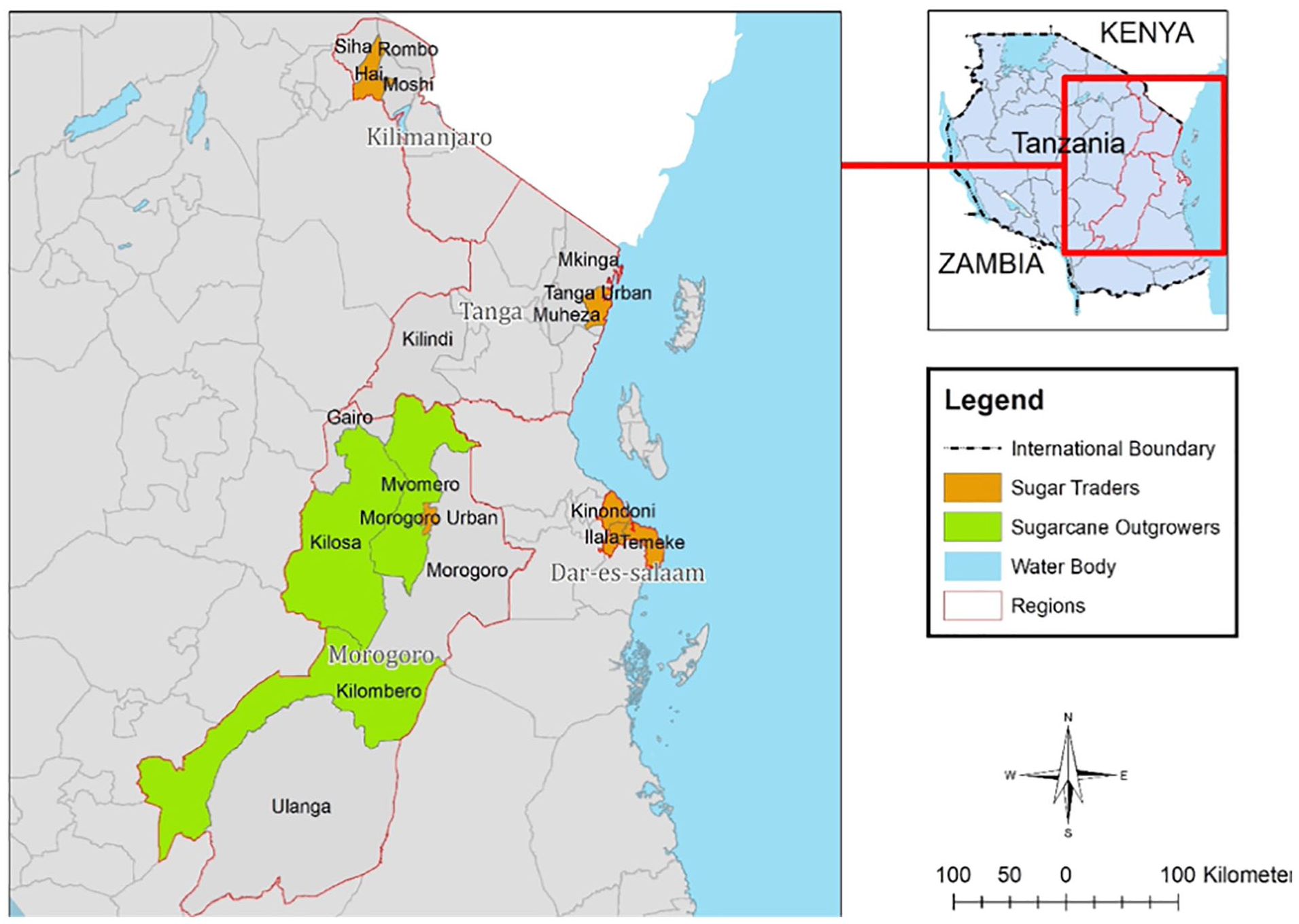
A section of the Tanzania map showing the study regions.
The second stage was the selection of sugar supply chain actors/respondents from sampling frames. Respondents were selected independently from every region and from each category/stratum of traders (super agents/stockists, importers, exporters, and domestic traders mainly wholesalers) and farmers using systematic random sampling. Sampling frames for traders were obtained from regional offices whereas for farmers were obtained from out-growers’ associations. Systematic random sampling was implemented by selecting each fourth supply chain actor from the sampling frame after reshuffling it.
The study covered 360 respondents. Equation (1) by Cochran (1963) was used in estimation of the sample size (n).

Where “Z score = 1.96 (95% confidence level), P = 0.5 maximum variability, and e = margin of error/desired level of precision ±5.2%.” It follows therefore that,
The sample size of each category/stratum for traders and farmers was determined using the proportionate stratification formula in equation (2).

Where “
Description of the Study Areas
Morogoro region contributes 46% (January, 2022) to the total sugar produced and traded in the country. The region is the home of two sugar manufacturing plants that are “Kilombero Sugar Company Limited and Mtibwa Sugar Estates Limited.” Kilimanjaro region hosts one sugar manufacturing plant known as Tanganyika Plantation Company (TPC) which makes up to 29% of the total national sugar production. Thus, the two regions involved in the study contribute about 75% (January, 2022) of the total sugar production in the country (SBT, 2022a). Dar es Salaam region is the biggest city and a trading hub in the country with the population of 5.4 million people (June, 2021; NBS, 2021). It is the region with the highest consumption base in the country. Likewise, Tanga region is the trading hub connecting the Northern part of the country through the Tanga harbour.
Data and Methods Used in Data Collection
The study collected both quantitative and qualitative data from 375 respondents randomly selected among key supply chain actors in the sugar sector in Tanzania. The 360 respondents were traders and farmers. For triangulating the data and study findings, the study also collected data from 15 key informants. These were organizations for collective actions and policy advocacy (3) which included cooperatives and the Tanzania Sugar Producers Association (TSPA); representatives from Ministries, Departments, and Agencies (MDAs) (5); sugar producing companies/millers (4); research institute (1); and financial institutions (2).
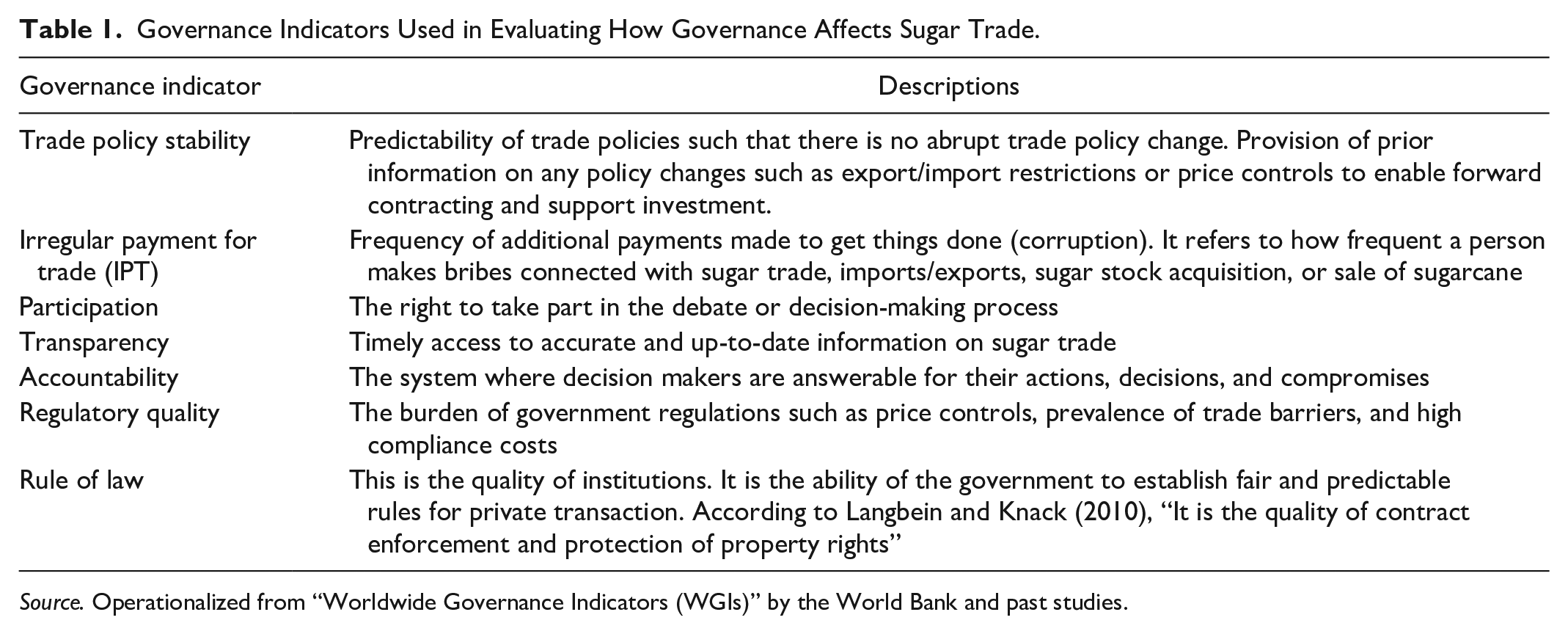
Ethical clearance procedures were followed before start of data collection activity. It involved inquiring a permit “approval on Code of Practice on Ethical Standards in Research which includes the General Data Protection Regulations (GDPR).” After getting ethical clearance a semi-structured questionnaire was developed. The questionnaire was developed to capture governance indicators (Table 1) and other socio-economic characteristics of trade participants. Additionally, the data collection was also preceded by the training of enumerators on data collection ethical issues and data handling using tablets. Data were collected through individual interviews. The study collected qualitative and quantitative cross-sectional data. Data collection was implemented using tablets specifically on KoBoCollect application through the humanitarian response platform. After the data collection, data were then downloaded from the server and accordingly cleaned before analysis.
Governance Indicators Used in Evaluating How Governance Affects Sugar Trade.
Source. Operationalized from “Worldwide Governance Indicators (WGIs)” by the World Bank and past studies.
Data Analysis Methods
Two methods “descriptive statistics and an econometric method” were used in evaluating how governance affects sugar trade in Tanzania. The descriptive statistics included proportions, frequencies, and cross-tabulations of the variables under the study. In econometrics, the study used two models which were “exploratory (factor analysis) and confirmatory (regression) models.” The exploratory factor analysis model was applied in data reduction from the 5-point Likert scale questions and creation of summated scales of the trade governance indicators. It involved combining indicators to form a single score. Hair et al. (2019) defines summated scale as a “method of combining several variables that measure the same concept into a single variable in an attempt to increase the reliability of the measurement.”
The Likert scale was such that “1 = Strongly disagree, 2 = Disagree; 3 = Neutral/undecided; 4 = Agree; and 5 = Strongly agree.” The disagreement scale represented that the perception of the trade participant on the trade governance indicator is unfavorable (negative), and the agreement scale represented a favorable (positive) perception as mostly suggested by Ajzen and Fishbein (1975). The study operationalized and applied seven indicators to measure trade governance in the sugar supply chain in Tanzania. Some of these indicators were operationalized from the “Worldwide Governance Indicators (WGIs)” by the World Bank (Table 1).
The factor analysis model was specified as shown in Equation 3.

Where;
Measure of Sampling Adequacy (MSA) and sphericity tests were performed as model adequacy tests. This was meant to test the suitability of the factor analysis method in data reduction. The findings indicated that the Kaiser-Meyer-Olkin (KMO) which measures MSA was 0.64 which is acceptable. The rule of thumb is that this value should be greater than 0.5 (Cleff, 2019). The Bartlett’s Test of Sphericity was found to be significant (p < .01; Table 2). These findings suggested suitability of the use of factor analysis method.
Factor Analysis Model Adequacy Tests.

Source. Authors’ calculations using sugar supply chain actors 2021 survey data.
p < .01.
The Kaiser or latent root criterion was used in retaining factors. According to Cleff (2019), “the criterion requires extracting all factors with eigenvalue greater than 1.” Therefore, all factors or components above the break line were retained (Figure 3).

Eigenvalues of the trade governance indicators.
The governance indicators factor loadings showed that among all the seven indicators, five indicators loaded in one component or factor and the other two indicators loaded in different components or factors (Table 3). Thus, the five governance indicators were combined into a composite measure of trade governance using summated scale since they have been shown to be measuring the same concept. The summated scale is the composite measure which increases the reliability of the measurement by reducing the measurement errors (Cleff, 2019; Hair et al., 2019).
Factor Loadings of the Governance Indicators.

Source. Authors’ calculations using sugar supply chain actors 2021 survey data.
Note. Number of observations = 360; Retained factors = 3; LR χ2(21) = 334.21; prob > χ2 = .000.
Indicate loading was found in the first factor.
Indicate loading was found in the second factor.cIndicate loading was found in the third factor.
The composite measure of trade governance was then used to empirically ascertain how governance affects sugar trade. According to Dehshiri et al. (2013), Nadeem et al. (2014), and Fuller and Kennedy (2019), trade is hypothesized to have a linear relationship of Ordinary Least Square (OLS) with governance that can be represented as shown in Equation 4.

Where
However, greater variations in the level of value of sugar traded were observed among the respondents who participated in the study indicating presence of heteroscedasticity and failure in meeting the normality assumptions. Under these situations, the OLS becomes biased and inconsistent which requires to be corrected using a weighted OLS that is the Weighted Least Square (WLS) model. The Weighted Least Square (WLS) model was obtained by substituting the linear standard model into the Weighted Least Square (WLS) Fit Function shown in equation 5.

Where “

The WLS model shown in equation (6) was estimated using Weighted Least Square (WLS) estimator shown in equation (7).

Where
Empirical Results
Sugar Supply Chain Actors’ Awareness of Institutions and Organizations Supporting and/or Regulating the Sugar Supply Chain
The study established the level of awareness of organizations and institutions responsible for regulating and/or supporting the sugar supply chain including the sugar trade. It included awareness of existing rules, standards, laws, and regulations guiding the sugar trade. The study findings indicate significant variations in the level of awareness among supply chain actors (p < .05). Nevertheless, the overall level of awareness was found to be low. Study findings indicated that 23.3% and 38.6% of the sugar supply chain actors were aware of organizations and institutions respectively. The sugar sector act of 2001 (Cap. 251) and its regulations are among the key institutions guiding the sugar sector, including its trade. The “Sugar Board of Tanzania, Tanzania Sugar Producers’ Association (TSPA), Research Institutions, Tanzania Sugarcane Growers Association (TASGA), and ministries (Ministry of Agriculture-MoA, Ministry of Industry, Trade and Investment-MITI, and President’s Office Regional Administration and Local Government-PO RALG)” are among the organizations in the sugar supply chain.
Super agents/stockists of sugar were found to be more aware of the organizations and institutions than traders and farmers. It shows that 87.5% of the stockists were aware of the prevailing rules, standards, laws, and relevant regulations in the sugar supply chain (Table 4). On the one hand, farmers were relatively more aware of the organizations than the institutions in the sector. On the other hand, traders were more aware of the institutions than the organizations regulating or supporting sugar trade. This implies that the increase in the scale of trade increases the level of awareness of institutions regulating trade of the commodity.
Level of Sugar Supply Chain Actors’ Awareness of Organizations and Institutions Regulating or Supporting Sugar Supply Chain.

Source. Authors’ calculations using sugar supply chain actors 2021 survey data.
Indicates that the values in enclosed in brackets are p-values.
The significance values are such that “*p < .1. **p < .05. ***p < .01.”
Sex and age of the trade participant varied with the level of awareness of organizations. Results show that among the trade participants, male were more aware than female. There were no variations in the level of awareness of institutions between male and female. Youth were found to be more aware of the institutions (45.1%) than the organizations (10.8%). The overall findings suggest significant variations between age of the trade participant and the level of awareness of both the organizations and institutions (p < .05). Youth were found to be the prime on the level of awareness on institutions whereby old age trade participants lead in the level of awareness of organizations. Additionally, membership in private sector organizations and education varied with the level of awareness on organizations and institutions. Findings indicate that 60.9% of traders and farmers with above secondary level education were aware of the existing institutions regulating sugar trade.
Sources and Media Used to Get Trade-Related Information to Enhance Trade Transparency
Transparency in terms of releasing sugar trade related information from ministries, departments, and agencies (MDAs) was found to be low (8.4%; Table 5). Many of the respondents involved in the study (70.6%) indicated to have obtained sugar trade-related information through private sector industry-based organizations such as traders or farmers’ associations. These associations which were also responsible for trade policy advocacy and marketing include the Tanzania Sugar Producers’ Associations (TSPA) and Agricultural Marketing Cooperative Societies (AMCOS). The private sector organization-Tanzania Private Sector Foundation (TPSF)-was mentioned as one of the sources of trade-related information, especially to super agents/stockists of sugar. Additionally, 93.8% of the traders were found to have obtained trade-related information from unknown sources.
Sources and Media for Conveying Trade-Related Information.

Source. Authors’ calculations using sugar supply chain actors 2021 survey data.
Note. TPSF = Tanzania Private Sector Foundation.
The use of information and telecommunication technology (ICT) in communicating and sharing sugar trade-related information was found to be emerging in the sugar supply chain, especially to traders. The study findings show that 37% of the respondents used at-least one ICT facility to obtain trade-related information. However, the majority of the traders and farmers (73.1%) used face-to-face contacts to get sugar trade-related information. Farmers were the major users of face-to-face, phones, and radio compared to other media. Traders used many ICT-based media especially radio, television, website, and social media platforms. The study results suggest that there was increased use of social media platforms in sharing trade-related information than websites and newspapers. Therefore, social media platforms have the potential to be used successfully to enhance the transparency of the sugar trade policies.
The level of trade governance
The level of accountability of many decision-makers managing the sugar trade was found to be low. The study findings indicate that 79.5% of the respondents responded unfavorably/disagreed with the statements that suggested the existence of a system in which decision-makers were answerable for their actions, decisions, and compromises within the sugar supply chain. The responses of traders were more unfavorable than that of farmers and stockists as their mean negative scores were above the overall score on accountability (Figure 4).
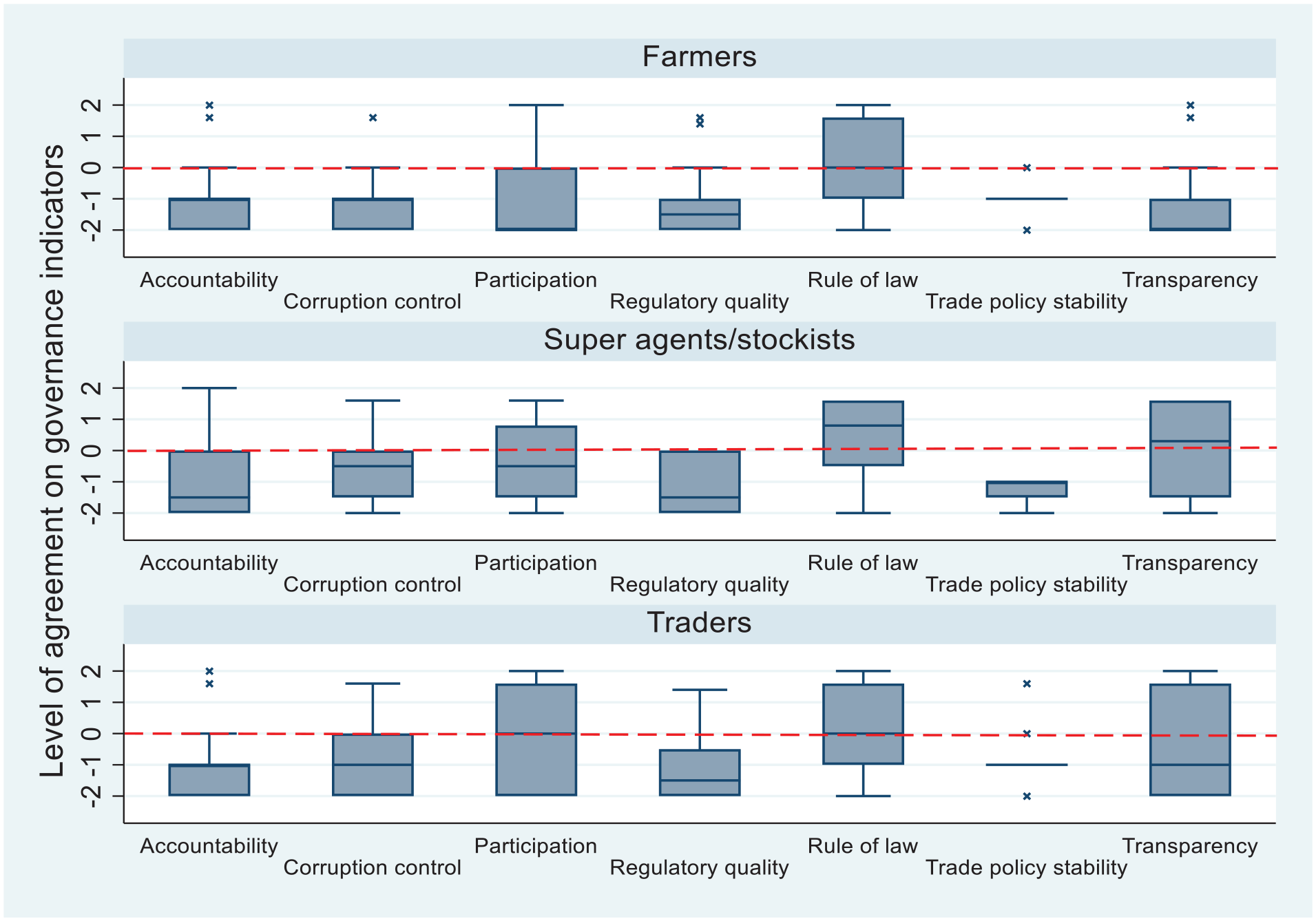
Level of agreement on governance indicators.
Many respondents (37%) agreed with the situation of the existence of institutions of good quality “(Rule of law).” These findings imply that the attributes of good institutions which includes “the quality of contract enforcement and protection of property rights” were viewed as satisfactory by farmers, super agents, and traders. However, 70% of them disagreed about the existence of less-burden government regulations which is an indication of regulatory quality. Many (77.2%) disagreed with the statements that trade policies were stable. Trade policy stability was rated the lowest by all respondent categories, especially super agents. This implies that sugar trade policies were less predictable. This suggests the existence of abrupt trade policy changes with no prior information on the policy changes which is likely to affect forward contracting and investments within the sugar sector.
Additionally, 23.3% of the respondents agreed to be involved in debates or decision-making processes that is participation. However, more of the farmers responded unfavorably on participation than traders and super agents. Likewise, 23.9% of the respondents agreed to have been provided with timely but accurate and up-to-date information on the sugar trade. This implies that transparency of trade policies and participation of sugar supply chain actors were low especially among farmers. This is validated by the results of the analysis of qualitative information (Figure 5) where many respondents who were involved in the study reported participation and transparency of trade policies as being the key challenges in the management of the sugar trade. The level of participation and transparency varied across different sugar trade participants. For example, farmers reported to lack opportunity of overseeing the harvesting process and control over the amount of cane being produced. Farmers were also confronted with the loss of sovereignty in quality controls, price settings, weighing of sugarcane, and timing of payments which they are all connected to participation and transparency. Inadequate transparency leads to irregular payment for trade (corruption). The challenge of corruption was reported by many respondents (67.9%) who also linked it to the existence of sugar smuggling. These findings are consistent with Andreoni et al. (2020) who also noted practices of corruption in the Tanzania sugar sector.

Word cloud of the qualitative information on trade governance indicators.
Effects of trade governance on the sugar trade
Trade governance was found to positively influence trade among sugar supply chain actors (Table 6). There were variations in the level of effects of trade governance on trade between traders and farmers. There was a significant effect of trade governance on the sugar trade among traders. The findings further confirm that the effect was more intense for traders than farmers. These findings suggest that all other factors held constant, a unit improvement in trade governance would increase sugar trade for traders by about 24.4%. These findings suggest rejecting the hypothesis that trade governance affects sugar trade for farmers and accepting it for traders.
Effect of Trade Governance on Sugar Trade.

Source. Authors’ calculations using sugar supply chain actors 2021 survey data.
Indicates values in brackets being p-values.
Level of significances are such that “*p < .1. ** p < .05. ***p < .01.”
The level of specialization and experience in trading affected the sugar trade. The level of specialization is measured by the proportion of sugar trading portfolio to depict the level of economies of scale that was found to positively influence the sugar trade. Assuming all factors to be constant, a 1% increase in the proportion of sugar trading portfolio would increase sugar trade by 0.4%. The effect of the level of specialization was more intense for traders (2.2%) than farmers (0.5%). Sugar trading experience was found to significantly affect the sugar trade positively for both traders and farmers. Results show that the sugar trade is expected to increase by 2.1% for every additional year spent by the sugar supply chain actor in doing the trading activities.
The absence of abrupt trade policy change stands out to be the main factor with high significant effect on sugar trade (p < .05). Findings reveal that one abrupt policy change experienced within the period of 12 months reduces the level of sugar trade by 35.2% and 29.1% for traders and farmers respectively. Generally, the abrupt trade policy change was found to affect the sugar trade, reducing trade by almost half (47.7%) implying that ad-hoc policy change significantly affects the level of sugar trade. However, the effect of the abrupt trade policy change on farmers was found to be minimal and not statistically significant. The abrupt trade policy changes affected traders and other supply chain actors on the level of efforts to invest in the sugar sector since they are uncertain about the status of their business situation. Additionally, some respondents involved in the study indicated encountering a situation where they had to make bribes connected with sugar stock acquisition or supplying sugarcane to the factory in the past 12 months. The frequency of irregular payment for trade (IPT) was found to reduce the level of trade by 6%. This implies that IPT reduces trade once practiced by supply chain actors.
Discussion
Most studies on governance have not attempted to measure trade governance using cross-sectional survey data. This study has filled this knowledge gap using specific cross-sectional survey data and indicators that reflect the key dynamics in the sugar supply chain. The study has revealed that governance positively influences the sugar trade. The finding suggests being consistent with earlier studies such as Dehshiri et al. (2013), Gani and Scrimgeour (2016), Álvarez et al. (2018), and Adedoyin et al. (2020), “who found a positive relationship between trade and governance” implying that institutional quality is important in enhancing trade. This suggests that domestic production and trade, imports and exports depend on trade governance. Moreover, the current study has established that governance affects trade and trade participants differently. Traders are more affected by poor governance than farmers.
In policy practices for sustainability of the supply chains, stability of the trade policies is imperative. The findings show that sugar trade policies in Tanzania are not stable and difficult to predict. It is clear from the findings that the abrupt policy change is the key factor with a high significant effect on sugar trade. This affects the level of trade along the supply chain. The study has shown that the abrupt trade policy changes affected trade and the overall level of efforts to invest in the sugar sector due to uncertainties caused by the policy shifts. The abrupt policy change is sometimes interpreted as a lack of policy. For trade policy to be supportive it needs to be stable and predictable to allow forward contracting and investments. Policy instability leads to misalignment of all policies supporting the sector. Therefore, under these situations, it is also difficult to achieve policy coherence. This is because previous studies such as Siitonen (2016) have established that policy coherence can be achieved under a stable policy environment in the sector.
To improve trade governance within the supply chain it is important to embark on extensive awareness creation about institutions and organizations managing the sector. This is because awareness of the trade participants on the institutions and organizations managing the supply chain is important and varies from one supply chain actor to another. Study findings show that the level of awareness of the regulative institutions such as acts, rules, and regulations, is low and varies with the scale of trade. The level of awareness increased with the scale of trade. The normative institutions that are standards and quality were more known to many sugar supply chain actors than the other pillars of institutions (regulative and cognitive). Additionally, the study established that the level of awareness of institutions and organizations managing the supply chain varies with the socio-economic features of the trade participants. The findings showed that youth are more aware than the other age groups of trade participants. Male were found to be more aware than female. This implies that trade governance and the implementation of sugar trade policies cannot produce gender-neutral results, hence gender differences should be considered. However, the overall level of awareness of organizations and institutions was found to improve with the level of education of the trade participants.
The level of awareness of institutions and organizations can be improved by encouraging transparency in trade policy administration and practices. This is due to the fact that previous studies such as Fukuyama (2016) have established that transparency and accountability improve the policy practices in many of the global value chains. The findings from this study suggest that to enhance the transparency of trade policies and make many supply chain actors aware of institutions and organizations, trade information needs to be availed using different media. This is because the type of media used to get trade information varied with the type of sugar supply chain actor. Traders were more active in sourcing information through ICT than farmers who were found to depend on face-to-face and radio. This has a positive contribution to trade development. Wang and Choi (2019) argued that increased use of ICT is important for increasing the level of trade in the country. Nevertheless, industry-based organizations were found to be the main source of trade-related information for both traders and farmers. These findings imply that trade related information on agricultural commodities supply chains should be channeled through supply chain actors’ collective actions especially farmers and traders’ associations.
Conclusion, Limitations, and Areas for Further Research
This study has used cross-sectional survey data and indicators that reflect the key dynamics in the sugar supply chain to evaluate trade governance and how it specifically affects sugar trade in Tanzania. This is because good sugar trade governance is expected to be the panacea for Tanzania to achieve optimal trade policies in the sugar sector. The study has revealed that governance affects sugar trade with the magnitude of its effects being felt differently between farmers and traders within the sugar supply chain. The study shows further that abrupt trade policy change significantly (p < .05) reduces sugar trade by almost half (47.7%) and lowers the overall level of efforts to invest in the sugar sector due to uncertainties caused by the policy shifts.
It is thus important to ensure that trade policies are stable and predictable to allow forward contracting of imports and/or exports and investments. To improve trade governance within the supply chain it is important to create awareness on institutions and organizations managing and/or supporting the sector. The level of awareness on institutions and organizations can be improved by encouraging transparency in trade policy administration and practices. This should include availing trade information using different medias through industry-based organizations which are supply chain actors’ collective actions.
The study has provided the importance of trade governance in shaping the way countries should implement trade policies. The awareness of the trade participants in organizations and institutions leads to a trust in the trading system landscape of the country. It has shown further that stability and predictability of the trade policies are key in supporting trade and investment in the sector. However, notwithstanding the contribution of this study to the trade governance and trade policy practices empirical literature, it still has some limitations and areas for further research. This study did not include all the categories of sugar supply chain actors. Consumers (households and industrial consumers), and input suppliers and service providers in the sector were not included. Further research can also be done to assess trade policy coherence which is also a key component of trade governance and an important issue in the efficient implementation of trade policies.
Footnotes
Acknowledgements
The authors acknowledge all the sugar supply chain actors who participated in the study and provided information. Three anonymous reviewers who provided comments that improved the article are also acknowledged.
Ethics statement
The study was conducted according to the UN Environment Programme World Conservation Monitoring Centre (UNEP-WCMC) Code of Practice on Ethical Standards in Research and approved by the Trade, Development, and the Environment Hub (TRADE Hub) Research Ethics Committee on 12 October 2020.
Declaration of Conflicting Interests
The author(s) declared no potential conflicts of interest with respect to the research, authorship, and/or publication of this article.
Funding
The author(s) disclosed receipt of the following financial support for the research, authorship, and/or publication of this article: This research was funded by the UK Research and Innovation’s Global Challenges Research Fund (UKRI GCRF) through the Trade, Development, and the Environment Hub Project (Project number ES/S008160/1).
