




Abstract
A sense of belonging is a need for interpersonal connections; it is a crucial factor that decides whether new graduate nurses can adapt to group working life in a clinical setting. Thus, a detailed understanding of the experience of workplace belonging could assist new graduate nurses adjust to entering the workforce. This study employed the qualitative methodology of phenomenology to examine the meaning of the experiences of workplace belonging of 12 new graduate nurse participants. Data collection methods included in-depth interviews and observations during the interview sessions. After data were collected, they were transcribed verbatim for the purpose of data analysis. New graduate nurses experience related to workplace belonging can be explained using five themes were identified, namely “adjust oneself to blend in,” “not being ignored,” “becoming an ally,” “achieving goals through concerted efforts,” and “sharing emotions and becoming family.” New graduate nurses experience various types of stress when they first start working in a clinical setting, and this is an issue that warrants the attention and support from all health professionals. Nursing managers could apply the findings of the current study to guide their unit colleagues. Identifying methods that could enhance new graduate nurses’ sense of workplace belonging and mutual recognition between employees and their work groups is beneficial for cultivating new graduate nurses’ sense of workplace belonging and facilitating their career growth.
Applying Research to Nursing Practice
A sense of belonging is crucial to whether new graduate nurses are willing to continue to work in nursing. Nursing managers can use the research findings to understand new graduate nurses’ workplace expectations to improve the environmental arrangements for belonging. For new graduate nurses, the support and attention of the entire healthcare team and the environment will help them to be more willing to stay in nursing.
Background
A sense of belonging is a need for interpersonal connections and is the basis for an individual’s self-esteem and self-actualization needs (Hagerty et al., 1992). Nurses who have just started to work in hospitals inevitably yearn for acceptance, care, attention, encouragement, and support from their counterparts (Levett-Jones & Lathlean, 2008). However, in a busy clinical setting, new graduate nurses often feel like an outsider or intruder; they indicate that they often feel that they are not suited for, or do not belong to, the unit they are in (Honda et al., 2016; McAvoy & Waite, 2019). By contrast, a clinical learning environment that is friendly, welcoming, and instills confidence in new graduate nurses could have a considerable influence in their work life; such an environment would make new graduate nurses feel like they are a part of the team and make them realize their role as healthcare personnel working in wards. As a result, these new graduate nurses would perform clinical tasks with more dedication (Grobecker, 2016; Honda et al., 2016; Mohamed et al., 2014).
At the 19th Asian Workforce Forum organized by the International Council of Nurses, the shortage of new graduate nurse resources in Asia was highlighted as a problem (International Council of Nurses, 2018). With the increase in health care needs caused by current trends of population growth and societal aging, many regions globally face workforce shortages and related challenges (Kinghorn et al., 2017). Numerous researchers have argued that strengthening the training and retention of domestic nurses is fundamental to resolving nurse shortages (Buchan et al., 2015; Janiszewski Goodin, 2003). The results of relevant research have indicated that a sense of belonging is the basis for effective clinical learning in new graduate nurses (Gerrard & Billington, 2014; van Rooyen et al., 2018). Additionally, it has been argued that a sense of belonging is a crucial factor in enhancing professional identification (Zarshenas et al., 2014) and job satisfaction (Borrott et al., 2016). The lack of a comfortable and supportive belonging environment may result in new graduate nurses feeling marginalized, uninterested in engaging in essential clinical learning, and unable to blend into the group working life in hospitals. Ultimately, these new graduate nurses may resort to resigning and distance themselves from a career in nursing (Albloushi et al., 2019; Grobecker, 2016; McAvoy & Waite, 2019). Currently, new graduate nurse shortages remain an unsolved problem. Therefore, the researchers examined new graduate nurses’ experiences of workplace belonging with the hope that the findings of this study could serve as a reference for those involved in enhancing talent retention and job satisfaction.
A workplace that lacks a sense of belonging blocks the career progression of employees, which may in turn lead to low levels of group morale and poor work performance in addition to impacting their physical and mental health (Hunter & Cook, 2018). Although a growing body of research has examined sense of belonging in the nursing setting, most relevant studies have focused on nursing students on clinical placement; few studies have explored the sense of belonging in the workplace among nurses who have recently graduated. Therefore, in this study, new graduate nurses who have just started working in clinical settings were invited to share their experiences related to their sense of belonging in the workplace. The researchers hope that this study, conducted using a phenomenology- approach methodology, may provide an applicable description of the experiences of these nurses. Therefore, this study described the nature of this phenomenon by conducting in-depth interviews and verifying the importance of related concepts.
Methodology
Research Design
Using a theoretical framework based on the phenomenology proposed by Edmund Husserl, the researchers examined the perceptions of belonging of new graduate nurses just entering the workforce (Polit et al., 1997). Husserl believes the essence that human life experience consists of the necessary essential structures of experience itself. Essence allows experience to take on various forms, which may be explored through phenomenology. Phenomenology is an inquiry to describe an individual’s lived experience in a particular situation and the meaning attached to that experience. Therefore, this study chose this method to understand personal experience. Implementing a phenomenological methodology to highlight the intentionality of consciousness in actual environments of new graduate nurses will inform their perceptions of belonging (Husserl, 2021; Moran, 2002).
Recruitment Procedures and Participants
The procedures of this study were approved by the Institutional Review Board of center hospital (Approval No. 2018-04-001CC). The recruitment period was from April 2018 to December 2018. This study adopted the purposive sampling method, and the participants were new graduate nurses from a medical center in Taipei, Taiwan. The inclusion criteria were as follows. (1) aged 20 years old or older; (2) their first nursing jobs since graduation were at the medical center; (3) more than 1 year, but less than 3 years, of experience working in a hospital; (4) required to be able to communicate fluently in either Mandarin or Taiwanese; and (5) agree to their interview sessions being audio-recorded for data collection purposes. Participants were obtained using two methods including a submitted official request to the unit head for permission to display recruitment posters and/or directly invited nurses to participate. Recruitment continued until data saturation had been achieved.
Data Collection
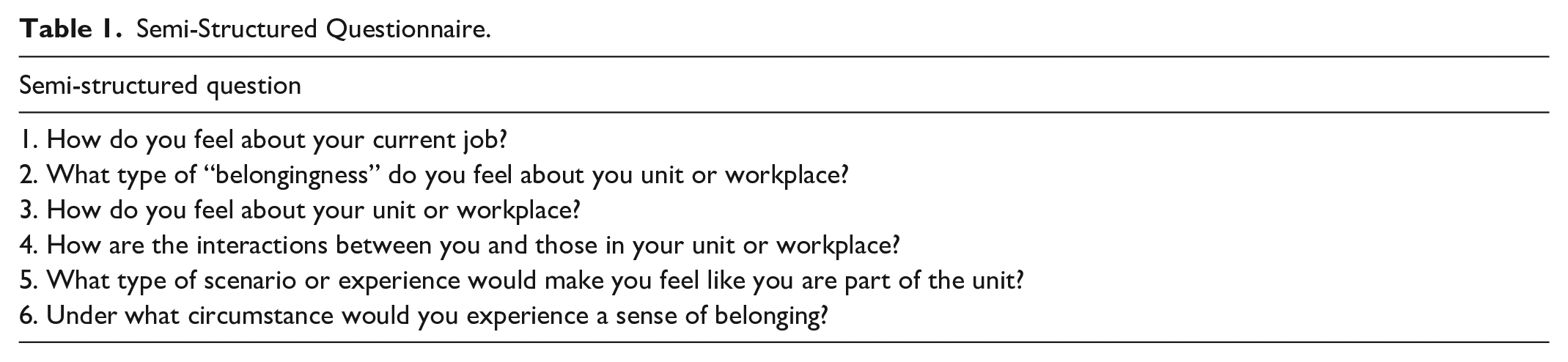
The researchers obtained data by conducting in-depth interviews with participants who met the inclusion criteria. Before each interview session, the researchers worked on creating a pleasant and comfortable ambience and then briefed the participants on the purpose of the interview; this was done so participants could express their opinions freely and comfortably. Next, the researchers invited participants to join and provided them with information related to the research topic. A semi structured questions was employed to interview the participants. The following questions were used to ask the participants: (1) How do you feel about your current job? (2) What type of “belongingness” do you feel about you unit or workplace? (3) How do you feel about your unit or workplace? (4) How are the interactions between you and those in your unit or workplace? (5) What type of scenario or experience would make you feel like you are part of the unit? and (6) Under what circumstance would you experience a sense of belonging? (Table 1) The interview sessions persisted until the participants indicated that they had reported everything they wished to express. Each interview session lasted for 40 to 60 minutes. Each participant was interviewed twice. In the first interview, the researcher explained the purpose and process to the participants and initially established a rapport with each other. In the second interview, the researchers conducted interviews with the participants using a semi structured questions interview guide.
Semi-Structured Questionnaire.
Data Analysis
Giorgi’s phenomenological methods were employed for data analysis. Such methods focused on describing the lived experience of an individual using phenomenological concepts such as description, reduction, searching for essence, and intentionality. First, through repeated reading and rereading of the collected data by the researchers, the main concepts of the phenomenon are extracted from the contexts of participants’ expressions (Camic et al., 2003; Giorgi, 2006). The crucial meanings of these phenomena are explicated and translated into psychologically sensitive language that represents the participants’ experiences and finally synthesized into consistent statements relevant to their experiences (Giorgi, 2006). In this study, the researchers employed several strategies to enhance the rigor and trustworthiness of the study results by considering factors such as credibility, transferability, dependability, and confirmability (Lincoln & Guba, 1985; Morse et al., 2002). To enhance the credibility of the data, the researchers engaged in repeated interactions with the participants to establish a relationship of trust with them. During the first interview, the interviewer/researcher first introduced themselves and explained the purpose and process of the study. During the second interview, the interview questionnaire was used. The researcher conducted the interviews and transcribed the interview recordings. During the interview, the researcher noted the nonverbal communication of the participants. After the interview, the researcher recorded their thoughts. These rich descriptive data expand the transferability of the results.
The transferability of the study results was ensured by collecting enriched descriptive data through various sources. Accurate records enabled researchers to examine the relevance between research bias and personal prejudice; this ensured the dependability of the study results. Finally, the researchers employed various means to enhance the confirmability of the study results. First, the researchers employed a peer review approach to classify and reclassify the verbal transcripts and similar themes. Next, to identify the real meaning of the collected data, the researchers constantly reviewed and reinterpreted the obtained results throughout the analysis period. To ensure that the collected data accurately reflected new graduate nurses’ experiences of workplace belonging, the researchers recruited new graduate nurses who fit the inclusion criteria and invited them to share their experiences. Finally, the researchers objectively analyzed the collected data. The researchers first coded and anonymized all the written documents of the participants. Subsequently, the texts were carefully and repeatedly read. Meaningful units from the text were selected. These units were then classified into subcategories that finally constituted essences, or themes. During the process, the researchers utilized peer review to carefully analyze the data. When a dispute occurred, discussions were held to reach consensus.
Findings
In this study, the researchers recruited 12 interviewees. All of the interviewees were women aged 21 to 25 years (Mage = 23.1 years). Half of the participants possessed a bachelor’s degree, whereas the other half possessed a 5-year junior college qualification. Participants had been in service for 1 to 3 years (average = 2.1 years). At the time of the study, all participants were working at internal medicine and surgery wards of a medical center in Northern Taiwan (Table 2). In analyzing the experiences of workplace belonging of the new graduate nurses, we identified five themes, namely “adjust oneself to blend in,” “not being ignored,” “becoming an ally,” “achieving goals through concerted efforts,” and “sharing emotions and becoming family.” These themes described new graduate nurses’ experiences from entering the workforce to perceiving a sense of belonging at said workplace.
Basic Data List of Participants.

Note. College = 5-year junior college qualification; F = female; M = male; University = Bachelor’s degree.
Adjust Oneself to Blend in
Individuals often imagine various possibilities before entering a new workplace. Upon entry, they would also adjust themselves so that they can become accustomed to their surroundings and blend into the group as quickly as possible.
Expectations and reality
Before participants started working in a new unit, they would first envision how the unit would be. They hoped that the members of the unit would be friendly to them and that they would have the competence to perform the job tasks.
I joined the surgery ward because I like surgery-related work. I was a bit scared when my senior first started guiding me. Luckily, my senior was kind enough. I later realized that the colleagues in my unit would help each other out. I liked that.【A-5】I didn’t really like the surgery unit at first because I felt that the work pace in this unit was too fast. Later, I realized that the work pace of the surgery unit suits me. I started working faster after I joined the unit because I have been taking care of patients every day since I joined the unit.【B-1】
Strive to blend into the group
The participants were unfamiliar with their new ward and the diseases commonly treated there. To overcome these challenges and adapt as quickly as possible, they prepared both before and after work.
Actually, you would be very nervous if you are unfamiliar with the ward environment of your new unit. Because you are unfamiliar with this ward and the diseases commonly treated there, you would be very nervous at first. You would engage in great deal of preparation every day, hoping to become accustomed to the new environment as quickly as possible. Now I am already more familiar with the ward environment and the postsurgical patient care routines for each patient. If I could perform the orthopedic nursing routine independently, like my senior colleagues, which makes me feel like I’m a part of the ward.【B-10】
Anticipation of being accepted by the group
The participants felt lonely when they first entered their unit. They stroved to learn the routines quickly and perform the tasks to the best of their ability so that they would be accepted by the group.
When my seniors assigned jobs to me or asked me out to lunch or dinner, it made me feel like I was being accepted, which made me happy.【E-18】 I would worry about working on my own because nursing is basically group work, it’s impossible to work alone. You need help from others. I tried to perform my tasks and blend into the group as quickly as possible; it’s best for everyone.【D-8】
Not Being Ignored
When people mention their names or think of them, it means that participant exist in a group; they are not ignored, but recognized by others in the group.
My name is stamped in the unit records
The participants’ names represent them as a role. Therefore, when their names appear within the environment of the unit, it means that they exist in this unit.
We would write down the names of everyone who wanted to order lunch on a piece of paper. You wouldn’t see the newcomers’ names, because the others would only write the names of the people they knew. One day, my colleagues took the initiative to ask me if I wanted to order lunch, and they wrote down my name on that piece of paper. It was little things like that that made me feel like I was part of the unit.【B-14】
I exist in the unit
Whenever their unit supervisor or seniors were making arrangements, participants would cross their mind. For example, when supervisors or seniors were arranging for people to attend in-service professional training sessions or organizing unit gatherings, they would include participants instead of ignoring them.
Our head nurse would arrange a specific time for me to submit reports and request that a senior help me out. She would also arrange for me to attend in-service professional training sessions. In short, I did cross their minds.【A-20】 Sometimes my senior would ask me why I hadn’t been working for a few days and that she would get bored when I wasn’t there. So I think I did cross her mind.【B-15】
Becoming an Ally
The participants eventually became part of the group from novice nurses who know little in the beginning.
Learning the ropes
In their new environment, the participants encountered several new problems, but their clinical preceptors helped them learn the ropes quickly.
When I first started learning, the clinical preceptor who was in charge of guiding me would brief me on the details of every disease, each doctor’s habits, and important things to consider when working with each doctor so that I wouldn’t be reprimanded.【B-11】 When I first joined this unit, I felt like everyone was willing to teach me something. As I see it, this unit provides a happy working environment. People are willing to teach you things. I think I am coping okay with the learning process; I didn’t feel particularly frustrated.【D-1】
Mutual trust and recognition
The participants blended into the group and received recognition from the unit. At the same time, they also identified with the unit.
When my seniors are willing to assign tasks to me or require my assistance, that means they recognize that I have the competence to help them achieve their targets. It is in these moments that I feel that my competence has been recognized by my seniors: they assign tasks to me because they trust me.【B-4】 When new interns joined our unit, they would call me “xué jiě” (i.e., senior) and request my assistance. In such moments, I feel like I had really blended into the unit, and the new interns recognize that I am a senior in this unit.【C-12】 When other people say something bad about our unit, we would help to clarify what they said is not true.【D-3】
Support and backup
The participants received support and backup from the colleagues in their unit .
If my unit needed me to complete a task, I would feel more at ease if someone with ample help. Even though I didn’t like writing reports, I would be more motivated when others in my unit offered help.【A-15】Whenever I felt unhappy or frustrated, my colleagues would console me or come up with ways to help me. This made me happier and helped me continue with my tasks.【A-16】 For example, when I got into a dispute with people from another unit, the seniors and head nurse from my unit would help me explain if it was not my fault. That feels kind of warm to me.【D-10】
Achieving Goals Through Concerted Efforts
The participants completed the goals as a group instead of by themselves.
Mutual assistance
The moments when people work with each other instead of shouldering the responsibilities alone tend to make people feel that they belong to this unit.
My nursing section takes care of some patients from the intensive care unit. Because they are often in critical condition, the nursing procedures are more complicated. Sometimes my colleagues help out when I’m overwhelmed by my workload and sometimes they help me finish work that I can’t. This makes me feel like we’re working together in a group.【A-7】
When you work with someone for a long time, you reach a certain understanding of each other. They only need to look at you to know what you’re doing and whether you need help. When your colleagues see that you’re busy, they often help out.【B-6】
Achieving goals together
Everyone has a sense of completing a mission through achieving goals together.
Working together with unit colleagues makes people feel happy. That creates a good working atmosphere, and this in turn leads to higher level of efficiency in achieving work goals collaboratively.【A-9】For departmental assessments, everyone in the department would stay after work or come to the hospital on their off day to help with preparation. The hospital would give everyone an evaluation manual describing noteworthy precautions that we had to memorize. Our head nurse would also use the morning briefing sessions to help us study. Having common goals that everyone can strive toward gave me a sense of belonging.【B-20】
Sharing Emotion and Becoming Family
The participants expressed their emotions and thoughts to one other; each felt as comfortable talking to their group as they would their family.
Venting and sharing emotions
As long as the participant is willing to, they were able to share both work-related and personal matters with their colleagues.
Whenever we’re frustrated, our colleagues play music, chat with us, and listen to us vent, which lets me get out my feelings. My senior colleagues are very kind because they are always willing to listen to me complain.【C-5】You can tell them what is on your mind. You would not feel that you cannot tell them anything: because you have already accepted them, you would feel like you can tell them anything. It is in such moments that you feel you can work in this unit for a long time.【D-9】
Feeling of home
Familiarity with their unit helped the participants feel comfortable and at home.
The unit gives me the feeling of being part of a big family. I am part of this unit because I am already familiar with the working environment of it. Everyone always has casual conversations, which is what makes it feel so comfortable and at home.【B-22】 When you talk about your problems, everyone shares their experiences and offers advice. Sometimes you don’t how what to do in certain situations, like an interpersonal conflict or how to improve your care skills, but talking to others makes you calmer and gives you insight into how you can solve your problems.【D-11】
Discussion
As a basic human need, a sense of belonging has a positive influence on the learning motivation and self-confidence of new graduate nurses (van der Riet et al., 2018). In this study, the researchers explored experiences related to workplace belonging of new graduate nurses, and attempted to understand the emotional and behavioral changes that they went through during the integration process. The results of relevant studies have revealed that new graduate nurses often possess certain ideals and expectations about the nursing role before that entered the workforce. However, after entering the nursing workforce, they often discovered discrepancies between the actual nursing environment and the one they imagined; this would often lead to loneliness, anxiety, and restlessness (Ebrahimi et al., 2016). However, most new graduate nurses would choose to believe in their own career choices and the learning achievements they had invested in for many years. Therefore, most are still motivated to become adjusted to their working condition. Most new graduate nurses have also reported that they desire acknowledgement and acceptance in the workplace (Borrott et al., 2016; Thomson et al., 2017). The results of these relevant studies are similar to those obtained in the current study. These results are similar to those of the present study. New members of groups often attempt to adjust, blend in, cooperate, and maintain positive relationships with other members to gain acceptance. Most people hope to be respected, accepted, and acknowledged in interpersonal interactions. These results correspond to the second theme of this study, namely not being ignored. To become accepted into a group composed of personnel working in a ward, new graduate nurses must express their commitment to the group and gain the recognition of group members. Therefore, when new graduate nurses are just entering the workplace, nursing supervisors are advised to pay attention to how they adapt and to provide personalized assistance. For example, during the first 3 months of a nurse joining the unit, the supervisor may spend some time each week to meet with the new graduate nurses to understand how they are getting used to the environment, whether problems they encounter at work are being resolved, and whether they feel physically and mentally satisfied. Supervisors may further welcome new graduate nurses through preparations such as arranging the work environment before they come on board (e.g., work shift list and name stickers), making orientation rituals, and organizing caring activities, all of which can ensure that the new graduate nurses integrate successfully and gain the acceptance of others in the group.
Support and acceptance from clinical preceptors also create a sense of workplace belonging for new graduate nurses (Albloushi et al., 2019). Clinical preceptors, who oversee new graduate nurses, play a crucial role in creating a sense of belonging. Experienced clinical preceptors should help new graduate nurses integrate into their new environment and relieve their stress (Hunter & Cook, 2018; Vinales, 2015). The results of the current study indicate that for new graduate nurses who have gone from being a novice to a professional, clinical preceptors exert a positive influence on their learning throughout this journey. When clinical preceptors support the learning of new graduate nurses and treat them as part of the team, such new graduate nurses gradually gain recognition and support within the group. At this time, the relationship between clinical preceptors and new graduate nurses turn into one of allies who can work and achieve goals together. A strong sense of belonging often results from efficient operations in the group overall rather than from the actions of an individual (Mohamed et al., 2014; Panda et al., 2021). Therefore, nursing supervisors should arrange in-service training sessions to help senior nursing staff members understand new graduate nurses’ experiences and create a supportive atmosphere in which new staff members can learn. In addition, clinical preceptors should have experience, patience, empathy, and enthusiasm and implement standardized teaching procedures. Comprehensive training programs for new graduate nurses help them quickly understand the rules and operations of their unit. Fully supportive environments also help new graduate nurses learn to perform assigned tasks quickly and become allies to their coworkers.
A sense of belonging is crucial to creating a supportive workplace culture and to high job satisfaction (Chang, 2015). Employees working in an organization with a supportive culture feel like they are part of a family; feelings of trust, security, openness, and fairness exists between them. They encourage each other and work well together (Kilic & Altuntas, 2019; Sedgwick & Yonge, 2008). The results of the current study indicated that after new employees adapt to the work environment, they feel that they belong to the team and are therefore part of the team. Ultimately, they see their colleagues in the unit as friends or family and proceed to engage in the mutual sharing of emotions. The results of this study are aligned with those obtained by Honda et al. (2016), which indicated that when an individual felt that they belong to a group, they see this group as a family and they feel comfortable in it. The transition from graduate to professional is complicated and stressful. Several participants reported that support and recognition from colleagues and head nurses were crucial to maintaining their emotional well-being throughout this process. Supportive and uncritical working environments encourage new employees to remain in their position, and positive relationships with colleagues create a sense of belonging (Hayes et al., 2012; Oshodi et al., 2019).
Limitations
In this study, the present results can help nursing educators create a sense of belonging among employees. However, this study has several limitations, and the findings should be interpreted with caution. The limitations are the small sample, lack of male participants, and fact that all participants were recruited from a single medical center. In addition, all participants worked in units with 20 to 30 members. Therefore, this study may not be representative of all populations of health-care professionals or new nursing graduates with other backgrounds. Nevertheless, the results provide new insight into workplace belonging in nursing. Studies should explore the opinions of new male nurses, clinical teachers, and senior staff members to provide different perspectives on workplace belonging in nursing.
Implications for Nursing Practice
A sense of belonging is a crucial factor determining whether new graduates remain willing to work in nursing. This study examined workplace belonging by interviewing new nursing graduates, who indicated that they face various types of stress upon entry into a clinical setting; this warrants attention and support from the entirety of the medical field. This study also revealed new nursing graduates’ expectations for their new workplace. Nursing supervisors may use the results as a reference to prepare for new nursing graduates, and senior nurses may also reference the results to help new nursing graduates feel a sense of belonging, which helps them grow as nurses. This study fills the gaps in the literature left by other quantitative studies and provides a practical reference for retaining nurses.
Footnotes
Author Contributions
All authors have read and approved the final manuscript. Y.C.H. was responsible for study design and data collection. Y.C.H. and T.F.Y. participated in data analysis and manuscript preparation. Y.C.H., T.F.Y., and K.U.W. contributed to data analysis and maintaining data robustness.
Declaration of Conflicting Interests
The author(s) declared no potential conflicts of interest with respect to the research, authorship, and/or publication of this article.
Funding
The author(s) received no financial support for the research, authorship, and/or publication of this article.
