




Abstract
Conformity consumer behavior refers to a preference of using the behaviors or expectations of others as a guideline for one’s own consumption patterns. Significant characteristics of conformity consumer behavior have been observed during the COVID-19 pandemic, and it has greatly hindered resource allocation and pandemic management. Nonetheless, the reasons why a public health emergency, exemplified by COVID-19, triggers conformity consumer behavior remain unclear. This study proposes and tests a theoretical framework to explore the psychological mechanisms of conformity consumer behavior during the COVID-19 pandemic. Results indicate that pandemic severity positively affect conformity consumer behavior, sense of fear plays a mediating role between pandemic severity and conformity consumer behavior, and sense of control does not play a moderating role. This implies that fear drives conformity consumer behavior and people may tend to consume in this way when they perceive a strong sense of fear no matter how strong their sense of control is. The conclusion will help managers to guide consumer behavior during social crisis and emergencies.
Introduction
Severe acute respiratory syndrome coronavirus 2 (SARS-CoV-2), the virus that causes COVID-19 disease, has a faster transmission speed and higher infection rate than other viruses, and poses an immediate threat to people all over the world following the virus outbreak. Such a sudden public health emergency not only has caused losses to people’s lives and economic wellbeing, but also has affected mental health, thereby changing consumer behavior (Cai & Wyer, 2015; Fransen et al., 2008; Friese & Hofmann, 2008; Hansen et al., 2010; Kim, 2020; Kim et al., 2020; Kim & Lee, 2020; Liu & Smeesters, 2014; McCabe et al., 2015; Pennycook et al., 2020; Roberts & Maxfield, 2019).
Conformity consumer behavior is one manifestation of social influence, referring to a preference of using the behaviors or expectations of others as a guideline for one’s own consumption patterns. Deutsch and Gerard (1955) identified two types of social influences: informative and normative. Based on these influences, informative conformity behavior is defined as the tendency to accept information obtained from others as guidance to simplify the decision-making process, while normative conformity behavior is the tendency to conform to others in order to gain a sense of group belonging or to avoid group punishment. In the COVID-19 situation, consumers’ choices seem to be affected by both informative and normative social influences. On the one hand, consumer behaviors are based on information from others to maximizes the likelihood of effective action with minimal expense to one’s cognitive resources. For example, many consumers in China blindly follow the advice of unproven pseudo-experts to buy Shuanghuanglian, an oral Chinese herbal medicine treatment that is only effective in treating fever, cough, and sore throat and has nothing to do with pandemic prevention. On the other hand, consumers desire to obtain a sense of group belonging in order to seek collective shelter. For example, many consumers frantically snapped up toilet paper just because they saw others buying it at the supermarket, which even led to a toilet paper crisis in Japan.
However, most existing literature about conformity consumer behavior mainly focus on the influence of personality traits and group characteristics (Berger & Heath, 2007; Deutsch & Gerard, 1955; Leary et al., 2013), only few works study conformity consumer behavior and its psychological mechanisms in the context of social crisis and emergencies. In fact, it is crucial to study conformity consumer behavior in the context of social crisis and emergencies. This is because conformity consumer behavior under emergencies is not only a simple behavior related to an individual, but also has the characteristics of group behavior, which has a significant impact on society. For example, conformity consumer behavior during the COVID-19 pandemic cause social panic and shortage of materials, thereby increasing the social management cost and burden of market supply (Woodside, 2020). More importantly, the gathering and queuing during panic buying may increase the risk of the spread of the virus. In addition, due to its special situation and concentration, conformity consumer behavior under emergencies has many characteristics that are not features of common situations, which means it is difficult to fully apply the experience gained from research on conformity consumer behavior in common situations to inform and control emergencies.
Based on the abovementioned practical needs and research gaps, this study focuses on the factors and psychological mechanisms that affect people’s conformity consumer behavior during the new COVID-19 pandemic. The research team of this study investigated the data of 1,548 residents in 297 prefecture-level cities in 31 provinces in China through an online questionnaire during the outbreak period (February 15–20, 2020). The team sought to answer the following two important questions through empirical research. (a) Did the pandemic severity affect residents’ conformity consumer behavior? and (b) What was the psychological mechanism of this influence? Based on the results, this study provides guidance on how to mitigate conformity consumer behavior under emergencies.
Theoretical Background and Hypotheses
Research on Consumer Behavior in the Context of Emergencies
Social crisis and emergencies refer to natural disasters, accidents, public health incidents, and social security incidents that occur unexpectedly and require emergency measures. They usually have the characteristics of suddenness, high uncertainty, harmfulness, public nature, and urgency. They can cause serious damage to social order, public environment, and resources, and threaten people’s economic wellbeing, health, and/or personal safety. Previous research has shown that these sudden public health emergencies also have an impact on consumer behavior. They may either prompt consumers to exhibit positive and constructive behavior, such as increased willingness to donate (Cai & Wyer, 2015; Roberts & Maxfield, 2019), purchase of healthy goods (McCabe et al., 2015), and preference for domestic brands (Fransen et al., 2008; Liu & Smeesters, 2014), or they may prompt consumers to exhibit negative and irrational behavior. For example, after the September 11 terrorist attacks in the United States in 2001, consumers increased their consumption of alcoholic products owing to huge psychological pressure (Perrine et al., 2004). In the face of death-related threats, consumers also indulge in consumption, such as excessive eating (Friese & Hofmann, 2008) and smoking (Hansen et al., 2010).
In 2020, consumer behavior was also indeed influenced by the social emergency triggered by the COVID-19 pandemic. During the outbreak of COVID-19 pandemic, conformity consumer behavior was observed in many countries around the world, which manifested as a preference for people to use the behaviors or expectations of others as guidelines for their own consumption patterns.
Conformity Consumer Behavior in the Context of Emergencies
Conformity consumer behavior refers to a preference of using the behaviors or expectations of others as a guideline for one’s own consumption patterns. Previous studies have shown that conformity consumer behavior is affected by many relatively stable factors, including group interaction (Deutsch & Gerard, 1955), need to belong (Leary et al., 2013), identity signaling (Berger & Heath, 2007) and so on. Moreover, recent advancements in conformity research have shown that conformity tendency can be influenced not only by relatively stable factors such as group characteristics and personality traits but also by situational factors. For instance, the complex, ambiguous and unfamiliar decision-making environment will encourage consumers to seek more reference information from others to compensate for decision-making confidence which increased conformity consumer behavior (Ross et al., 1976). Jointly engaging in synchronous activities can activate the mind-set of copying others, resulting in increased conformity consumer behavior in subsequently unrelated situations (Dong et al., 2015). Even the mere exposure to others’ immoral behaviors can raise the perceived threat to the social order, thereby increasing consumers’ endorsement of conformist attitudes and thus their preference for majority-approved choices in consumption situations (Dong & Zhong, 2017).
We propose that, as a typical social emergency, COVID-19 pandemic forces people to face sudden external threats and thereby show conformity consumer behavior. This is because, on the one hand, the behavior of others which can provide certain information can be used as indirect information for guidance on how to act in a pandemic situation without direct information. Consumers may exhibit a tendency to consume in line with others based on informative social influences to resist decision anxiety and maximizes the likelihood of effective action with minimal expense to one’s cognitive resources. On the other hand, conformity with others can allow individuals to gain more social recognition from others and groups. Thus, they may be influenced by normative social influences to conform to the behavior of others in order to achieve the purpose of integrating into groups and using group resources to resist the threat of emergencies (Murray & Schaller, 2012). Therefore, information conformity behavior and normative conformity behavior can help individuals to cope with public crisis. The former refers to the tendency to accept information obtained from another as guidance to simplify the decision-making process, while the latter is the tendency to conform to others in order to gain a sense of group belonging or to avoid group punishment. The more severe the pandemic, the stronger people will be affected by these two types of social influences, and the more obvious conformity consumer behavior will be as a result. Based on this, this study proposes the following hypothesis
External Threats and Sense of Fear
Extrinsic threats are actual or potential occurrence of events with negative repercussions for consumer well-being. They can have a disruptive effect on consumers’ ontological security, including disrupting consumers’ sense of order, meaning, and social framework, and then leads to a variety of consumer reactions, from initial affective and psychological, such as fear, anxiety and depression, to behavioral (Campbell et al., 2020; Galoni et al., 2020; Jiang & Wen, 2020). Particularly, under the influence of external threats with strong degree, close psychological distance or wide scope, consumers will have a strong affective and psychological reaction and consequently a rapid behavioral response (Campbell et al., 2020).
COVID-19 is a highly infectious, fast-spreading, and lethal virus, which makes its outbreak a wide-ranging and complex external threat (He & Harris, 2020; Pantano et al., 2020; Sigala, 2020). It is obvious that COVID-19 poses a threat to consumers’ own health and that of their relatives and friends, including the actual threat of being diagnosed and the potential threat of being infected. Economically, COVID-19 leads to limited economic development in various countries, posing potential and actual threats to consumers’ income and quality of life. Furthermore, COVID-19 also harms the consumer’s place and role in society or society itself. Stay-at-home and physical distancing orders cuts consumers off from social interactions, including events such as celebrating weddings, graduations and funerals, and in some cases, even losing the opportunity to see their families as a result. Potential social threats might entail facing terrorism or social unrest. Moreover, lack of information, misinformation, and conflicting information threaten consumers’ ability to understand, plan for, and respond to health, economic, and social threats. Therefore, COVID-19 pandemic is a threat not only to health but also to the economy, socialization and information, which can destruct consumers’ ontological security and trigger a strong sense of fear, including fear of death, economic decline, social isolation, and lack of information for decision making.
When multiple threats occur simultaneously, they also interact with each other and magnify the overall disruptions, leading to behavioral response. Previous research has showed that sense of fear as a strong negative emotion, can weak individual’s rational decision-making ability (Visser-Keizer et al., 2016), and hence produce irrational consumer behavior. For example, existing studies have found that fear makes individuals more impatient when making intertemporal decisions and more inclined to abandon greater future returns; thus, they choose smaller immediate returns (She et al., 2017). We assume that during the COVID-19 pandemic, consumers’ rationality similarly can be diminished by fear and they may tend to follow the advice of others or follow the actions of others in order to maximize the correctness of their decisions, thus show informative conformity consumer behavior. On the other hand, when fear occurs, people tend to adopt various types of psychological defense mechanisms and behavior to alleviate this discomfort (Burke et al., 2010). One of the effective ways of doing so is to seek close relationships and group asylum, which can help individuals to obtain resources and emotional support to cope with external threats (Cox & Arndt, 2012; Mikulincer et al., 2003). For example, people are more inclined to sit with others when facing threat of death (Wisman & Koole, 2003), even change their original views to adapt to the group’s way of thinking to obtain a more intimate interpersonal relationship (Renkema et al., 2008). In addition, there are studies showing that when the behavior of individuals and other members of the group is consistent, they can gain a stronger sense of psychological security (Lakin et al., 2008). Therefore, during the COVID-19 pandemic people may also be motivated to conform to the behavior of others by seeking group shelter and thus show normative conformity consumer behavior. Based on this, the study proposes the following hypotheses.
Sense of Control
Sense of control refers to the degree to which an individual perceives that he or she can determine his or her own internal state and behavior, and the extent to which he or she can predict, explain, influence, and change the occurrence and development of external events (Burger, 1989). Previous study suggested that when in a negative life situation for a long time, including performance decline, interpersonal tension, and natural disasters, individuals are more likely to perceive lack of control (Newcomb & Harlow, 1986) and produce a need to compensate strongly for this lack of control. However, in addition to situational factors, sense of control is also related to static factors such as age (Infurna & Okun, 2015), native family (Griskevicius et al., 2013), stress (Bhanji et al., 2016), physical health (Karasek, 1990), and social class (Marmot et al., 1997). This means that even if sense of control will reduce in a negative situation, there is still a difference in the level of control among individuals of different native families, physical health, and social classes. Therefore, sense of control is not only a situational psychological variable, but also an important individual difference variable. The results of Specht et al. (2013) show that people with high sense of control usually have confidence in their abilities and can influence external activities, while those with low sense of control prefer to use luck, opportunity, or other means to enhance their abilities. Similarly, individuals with high sense of control are generally considered to possess more resources, higher socioeconomic status, higher sense of autonomy and effectiveness, and better ability to resist, and therefore are better able to resist uncertainty in the external environment and cope with negative life events (Frazier et al., 2011; Kraus et al., 2009; Shek & Lee, 2007; Zhou et al., 2012). In addition, research on the aggressive of negative stimuli has shown that individuals with high sense of control usually judge the severity of the problem more correctly and work hard to cope with it, while individuals with low sense of control are more likely to perceive difficulties, magnify them, and even view difficulties more seriously than the actual situation. Therefore, the uncertainty and disorder elements in the situation will make individuals in low control state feel more anxious (Kay et al., 2009), behave more pessimistic, report lower self-esteem level and even induce depression (Chung et al., 2016). As a variable of individual difference, sense of control characterizes the psychological and behavioral differences of individuals when facing risks, pressures and threats. Among them, individuals with high sense of control can cope with negative events better than individuals with low sense of control.
In the context of COVID-19 pandemic, people with different sense of control feel different degrees of fear and adopt different coping behavior. Because of possessing higher socioeconomic status, more internal resources, and more aggressive ways of dealing with stimuli, individuals with higher sense of control are more likely to consider that threats are controllable than those with lower sense of control, resulting in less fear and relatively strong rational behavior among the former group. These individuals are more likely to choose to utilize or enhance their own resources to cope with sense of fear, and then show less conformity consumer behavior. Therefore, we propose the following hypotheses.
Based on this discussion, Figure 1 shows the proposed conceptual model of this study.

Conceptual model.
Methods
Participants and Procedure
A questionnaire survey method was used to collect data through the Credamo online data platform in 31 provinces of China (excluding Hong Kong, Macao, and Taiwan) according to a quota of about 50 copies in each province. To ensure the questionnaire’s reliability, we set the following two standards and questionnaires that did not qualify were not entered in the database. First, the location of the mobile phones of the participants should be consistent with the region we set, so as to ensure that the questionnaire could be related to the relevant data of the pandemic situation in the region. Second, participants should pass the test items to make sure they answer the questions carefully. The survey lasted from February 15 to February 20, 2020 to covering 1,548 participants from 31 provincial-level administrative regions and 297 prefecture-level cities, which could accurately and comprehensively describe the psychology and behavior of Chinese citizens during the pandemic. The distribution characteristics of the participants are shown in Table 1.
Distribution of Participants (N = 1,548).

Measure
The independent variable in this study is pandemic severity. Due to the different levels of pandemic severity in different regions, this study selected pandemic-related data published by National Health Commission of the People’s Republic of China on the day of the test answer as the measure of the severity of the urban outbreak. When looking for the officially published pandemic-related data, we found that the most comprehensive and representative indicators in the published data are “cumulatively diagnosed number” and “newly diagnosed number,” and the relevant data of “suspicious cases” were missing in most cities. In addition, the numbers of “deaths” and “cures” were zero in many cities where the pandemic was not serious. Therefore, we determined the “cumulatively diagnosed number” as the independent variable of the hypothesis test in this study, and the “newly diagnosed number” as the independent variable of the robustness test.
The mediator in this study is sense of fear during the pandemic. It was measured directly by asking the participants to evaluate “how scared you felt during the pandemic” on a seven-point scale.
The moderator of this study is sense of control of residents during the pandemic. The scale of control sense is from Michinov’s (2005) research on sense of control. It is adapted from the pandemic situation and includes three measurement questions, including “during these times, I feel helpless.” The higher the score, the lower the degree of control. Crobach’s α coefficient is .852, indicating good reliability of the scale.
The dependent variable is the conformity consumer behavior during the pandemic. We compiled a total of six items to measure conformity consumer behavior in the pandemic (Bearden et al., 1989). Three of the items were used to measure the informational conformity consumer behavior, including “My recent purchase decision is largely influenced by expert recommendations.” The Crobach’s α of this subscale is .748, indicating good reliability. The other three items were used to measure the normative conformity consumer behavior of residents during the pandemic, including “I recently bought some of these products because people around me bought them.” The Crobach’s α of this subscale is .813, indicating good reliability. The Crobach’s α of the conformity consumer behavior scale for the abovementioned six items is .837, indicating good reliability.
We selected basic demographic variables as control variables, including gender, age, average monthly income of individuals and families, average monthly expenses of individuals and families, education level. Additional factors such as number of cohabitants, social isolation, and going out frequency that may affect sense of fear during the COVID-19 pandemic were also added as control variables. Going out frequency was measured by the question “How often have you gone out since the beginning of the pandemic?” (1 = hardly ever went out, 5 = went out several times a day); degree of social isolation was measured by the question “Since the beginning of the pandemic, to what extent have you implemented social isolation? “(1 = it’s the same as before the outbreak, 5 = completely isolated). Among them, the gender variables were treated as dummy variables (female = 0), and to reduce heteroscedasticity, we logarithmized the variables related to income and consumption and the number of people.
SPSS 23.0 and AMOS 23.0 were used to analyze the reliability and validity of the data. As shown in Table 2, all variables’ Cronbach’s α are greater than .70, which satisfies the questionnaire consistency standard, indicating that these scales have good internal consistency. All the CR values are greater than 0.7 and those of AVE are greater than 0.5. In addition, the research used the diagonal matrix analysis method to test discriminant validity. As shown in Table 3, the value on the diagonal is the square root of each variable’s AVE, and the value under the diagonal is the correlation coefficient between the variables. The former is greater than the latter, which means the relevant variable can be explained by the item to which it belongs more than it can be explained by other variables. Therefore, these scales have good discriminant validity. Furthermore, the descriptive statistics of the variables and the correlation between the variables are also presented in Table 3.
Reliability and Validity Analysis (N = 1,548).

Note. SC = sense of control; CCB = conformity consumer behavior; ICCB = informative conformity consumer behavior; NCCB = normative conformity consumer behavior; C.R. = construct reliability; AVE = average variance extracted.
Correlation analysis of variables (N = 1,548).

Note. SF = sense of fear; SC = sense of control; CCB = conformity consumer behavior; ICCB = informative conformity consumer behavior; NCCB = normative conformity consumer behavior.
***p < .001(two-tailed).
Homology Bias Test
The homology bias is widely used in psychology and behavioral science research to eliminate systematic errors that arise due to similarity in the data source, measurement environment, and characteristics of the project itself. We used Harman’s single factor test to conduct factor analysis on all variables. The variation of the unrotated first factor was 21.13%, which is less than the critical standard of 40% and less than half of the total variation (61.38%), indicating that this study better controls the similarity bias problem.
Results
Analysis of Main Effect
We used “the cumulative number of confirmed cases” as an indicator to measure pandemic severity and built regression Models 1 to 2 to verify whether the pandemic severity can positively affect conformity consumer behavior. Model 1 is a regression model of conformity consumer behavior on control variables, and Model 2 is a regression model with pandemic severity added as an independent variable based on Model 1, which results showed that pandemic severity had a significant positive impact on conformity consumer behavior during the pandemic (β = 0.128, p < .001), indicating that the more severe the pandemic, the stronger the conformity consumer behavior. Therefore, H1 was verified.
Similarly, we build Models 4 to 5 to verify whether the pandemic severity can positively affect informative conformity consumer behavior and Models 7 to 8 to verify whether the pandemic severity can positively affect normative conformity consumer behavior. Results of Models 4 to 5 showed that pandemic severity had a significant positive impact on informative conformity consumer behavior during the pandemic (β = 0.099, p < .001), and Models 7 to 8 showed that pandemic severity had a significant positive impact on normative conformity consumer behavior during the pandemic (β = 0.126, p < .001), indicating that indicating that the more severe the pandemic, the stronger the informative and normative conformity consumer behavior. Therefore, H1a and H1b were verified (see Table 4 for details).
Main Effect and Mediating Effect (N = 1,548).

Note. DV = dependent variables in models; CCB = conformity consumer behavior; ICCB = informative conformity consumer behavior; NCCB = normative conformity consumer behavior; SF = sense of fear; CV = control variables in models; IV = independent variables; CNCS = the cumulative number of confirmed cases, the indicator to measure pandemic severity; ME = mediator.
p < .05. ***p < .001(two-tailed).
Analysis of Mediating Effect
By applying the regression analysis method proposed by Baron and Kenny (1986), we further built models to test the mediating role of sense of fear between pandemic severity and conformity consumer behavior. These models included Model 3, Model 6, Model 9, and Models 10 to 11. Model 3 is a regression model with sense of fear added as a mediator variable based on Model 2, which results showed that sense of fear had a significantly positive impact on conformity consumer behavior (β = 0.328, p < .001) and after the addition of sense of fear, pandemic severity also had a significant impact on conformity consumer behavior (β = 0.082, p < .001). Similarly, Model 6 is a regression model with sense of fear added as a mediator variable based on Model 5, which results showed that sense of fear has a significant positive effect on the informational conformity consumer behavior (β = 0.303, p < .001) and after adding sense of fear, the cumulative number of diagnoses in the city still has a significant effect on informative conformity consumer behavior (β = 0.057, p < .05). Model 9 is a regression model with sense of fear added as a mediator variable based on model 8, which results showed that sense of fear has a significant positive effect on the normative conformity consumer behavior (β = 0.086, p < .001) and after adding sense of fear, the cumulative number of diagnoses in the city still has a significant effect on the normative conformity consumer behavior (β = 0.281, p < .001). Model 10 is a regression model of sense of fear on control variables, while Model 11 is a regression model with pandemic severity added as an independent variable based on Model 10. Results of Models 10 to 11 showed that pandemic severity had a significantly positive impact on sense of fear (β = 0.142, p < .001). All these results indicated that sense of fear played a partially mediating role between pandemic severity and conformity consumer behavior during the pandemic (see Table 4 for details). Therefore, H2 was verified.
Following Preacher et al. (2007), we used a bootstrap procedure (sampling times 5,000, confidence interval 95%, Model 58) to re-verify the mediating effect. The results show that the confidence interval does not contain 0, which means that sense of fear plays a mediating role. Bootstrapping yields the same results as the regression analysis. H2, H2a, and H2b are all verified (see Table 5).
Mediating Effect (Bootstrapping Times = 5,000, N = 1,548).

Note. CI = confidence interval; CDN = cumulatively diagnosed number; CNCS = the cumulative number of confirmed cases, the indicator to measure pandemic severity; SF = sense of fear; CCB = conformity consumer behavior; ICCB = informative conformity consumer behavior; NCCB = normative conformity consumer behavior;  refers to positive affect; If the upper and lower limits of 95% confidence interval do not include 0, the path is significant.
Moderating Effect Test
Because the model has two moderating paths, the method of regression is too complex for the analysis. Therefore, we use bootstrapping (Model 58, sampling times 5,000, confidence interval 95%) to analyze the moderating effect directly (Preacher et al., 2007). We use cumulatively diagnosed number as the independent variable, sense of fear as the mediator, sense of control as the moderator, and conformity consumer behavior, informational conformity consumer behavior, and normative conformity consumer behavior as dependent variables separately. Results showed that when using conformity consumer behavior as dependent variable, the interaction between pandemic severity, and sense of control was not significant (β = 0.024, p =.342, 95% CI = [-0.025 to 0.072]), and the interaction between sense of fear and sense of control was also not significant (β = -0.018, p = .123, 95% CI = [-0.041 to 0.005]); when using informational conformity consumer behavior as dependent variable, the interaction between pandemic severity and sense of control was not significant (β = 0.024, p = .342, 95% CI = [-0.025 to 0.073]), and the interaction between sense of fear and sense of control was also not significant (β = -0.008, p = .490, 95% CI = [-0.032 to 0.016]); when using normative conformity consumer behavior as dependent variable, the interaction between pandemic severity and sense of control was not significant (β = 0.024, p = .342, 95% CI = [-0.025 to 0.073]), and the interaction between sense of fear and sense of control was also not significant (β = -0.027, p=.062, 95% CI = [-0.055 to 0.001]). That is, the interaction between pandemic severity and sense of control and the interaction between sense of fear and sense of control were not significant, indicating the moderating effect of sense of control is not significant (see Table 6).
Moderating Effect and Total Effect (Bootstrapping Times = 5,000, N= 1,548).

Note. SC = sense of control; CNCS = the cumulative number of confirmed cases, the indicator to measure pandemic severity; CI = confidence interval; SF = sense of fear; CCB = conformity consumer behavior; ICCB = informative conformity consumer behavior; NCCB = normative conformity consumer behavior; = positive affect; Int-1 refers to the interaction term of SC and CNCS; Int-2 refers to the interaction term of SC and SF; If the upper and lower limits of 95% confidence interval do not include 0, the path is significant.
Robustness Test
To confirm the robustness of the conclusion, we conduct a robustness test. We use the “newly diagnosed number” to replace the “cumulatively diagnosed number” in the main analysis. In the robustness test, bootstrapping (Model 58, sampling number 5,000, 95% confidence interval) is also used for the analysis (Preacher et al., 2007). The results of the robustness test completely replicate the results of the hypothesis test, indicating that the results of this study are robust (see Table 7).
Robustness Test (Bootstrapping Times = 5,000, N = 1,548).
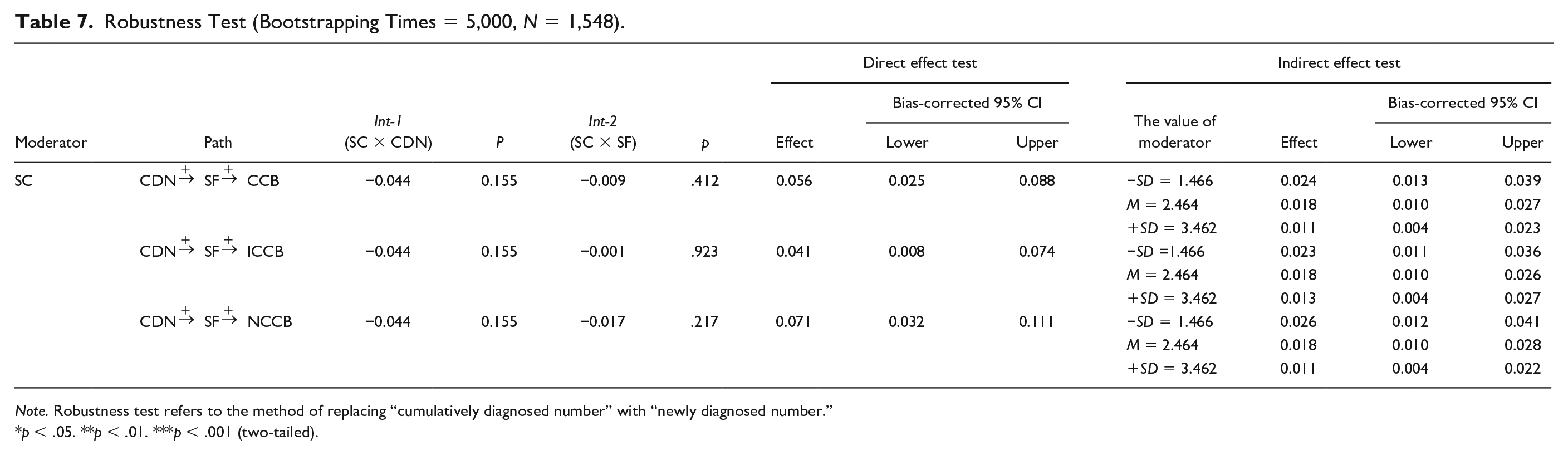
Note. Robustness test refers to the method of replacing “cumulatively diagnosed number” with “newly diagnosed number.”
p < .05. **p < .01. ***p < .001 (two-tailed).
Discussion
This study investigated the relationship between the pandemic severity, sense of fear, sense of control, and conformity consumer behavior in the context of COVID-19. The results show that sense of fear plays a mediating role in the impact of the pandemic severity on conformity consumer behavior, while sense of control does not play a moderating role in the impact of the pandemic severity on sense of fear, and in the impact of sense of fear on conformity consumer behavior.
Theoretical Contributions
By studying the relationship between the pandemic severity, sense of fear, sense of control, and conformity consumer behavior, this study makes the following four main theoretical contributions.
First, this study enriches research on conformity consumer behavior in the context of social crisis and emergencies through theoretical construction and empirical testing. Existing studies have shown that conformity consumer behavior is affected by relatively stable factors (Berger & Heath, 2007; Deutsch & Gerard, 1955; Leary et al., 2013), but few studies have taken social crisis and emergencies as the situational factors affecting conformity consumer behavior. However, the research on conformity consumer behavior in this context not only could aid theoretical understanding of the psychological mechanism of people’s conformity consumer behavior in a concentrated and special period, but also could help to manage people’s irrationality in sudden public events. Based on the actual situation of COVID-19, this study takes the consumer behavior of the whole population during the pandemic as the research theme and conclude that the pandemic severity can cause conformity consumer behavior through theoretical construction and empirical testing, which fills the gap in the previous research on conformity consumer behavior.
Second, this study explores and verifies the psychological mechanism of people’s conformity consumer behavior in the context of COVID-19. The results for H2, H2a, and H2b show that consumers feel strong sense of fear facing external threat brought by the pandemic. The more severe the pandemic, the stronger the people’s fear. Based on the decision-making needs in ambiguous situations and the psychology of seeking group refuge, people tend to show irrational conformity consumer behavior and blindly believing information from other people or groups (Mikulincer et al., 2003). Interestingly, during the COVID-19 pandemic almost everyone in every country was involved in conformity consumption. We have also explored the reasons for this phenomenon. Although previous studies have shown that individuals with high sense of control have higher socioeconomic status, possess more resources, have stronger coping ability, and produce less fear and irrational coping behavior under threat (Frazier et al., 2011; Kraus et al., 2009; Shek & Lee, 2007; Zhou et al., 2012), H3, H3a, H3b failed to pass the hypothesis test, indicating the moderating effect of sense of control was not significant. This means that the threat of the COVID-19 pandemic is unique, which poses to people are global, sudden, intense, and persistent. Faced with such threats, even individuals with high sense of control have a strong sense of fear, making it difficult to make rational decisions and tend to cope with threat through conformity consumer behavior. Therefore, regardless of sense of control, people have the same degree of fear and conformity consumer behavior during the pandemic. Indeed, during the pandemic, top executives, entrepreneurs and stock managers did show a high level of fear. They were eager to resume work, fearing that there would be problems, such as broken supply chains, loss of raw materials, and loss of customers. However, resumption of work would bring threat to life and health and might even increase the spread of the pandemic. As a result, their feelings were in constant turmoil, and they were increasingly worried, anxious, and suspicious and thus involved in conformity consumption.
Third, this research has important implications for complementing theories related to external threats and reactive behavior. Researchers believe that the field of consumer research is uniquely positioned to shed light on questions related to responses to threats, including threats by physical health, financial health, social lives, and personal identity (Campbell et al., 2020). Notwithstanding, we argue that much more can be done in examining the processes underlying how consumers respond to threats as well as the effects of threats, particularly large-scale ones, on consumer behavior. For example, although terror management theory can explain the effects of death-related fear on individual psychology and behavior, due to the proximal defenses, fear of death only potentially stimulates fear or anxiety and does not immediately lead to coping behaviors. Similarly, although threats associated with uncertainty or ambiguity, such as lack of decision information, company layoffs, hurricanes, and the Fukushima nuclear disaster, can also interrupt consumer certainties and routines (Coser & Giddens, 1991), research generally agrees that consumers who feel insecure and uncertain may engage in a variety of strong emotional responses such as anxiety, fear, and stress, without necessarily producing immediate reactive behavior (Carver et al., 1989). However, COVID-19 has proven to be a highly infectious, fast-moving and lethal disease, making it a severe threat with broad scope. It is a threat not only to health but also to the economy, socialization, and information. Furthermore, when multiple threats occur simultaneously, interactions among them can magnify resultant disruptions in an ongoing cycle (Campbell et al., 2020). For example, the effect of health, economic, and social threats during COVID-19 can be exacerbated by the abundance of misinformation about causes, cures, and outcomes. Such a severe threat with broad scope can disrupt consumers’ ontological security to stimulate fear and consequently coping behaviors immediately.
Fourth, our study suggests a plausible conjecture about informative and normative conformity consumer behavior, which provides directional guidance for future research. Previous research has shown that in uncertain and ambiguous decision-making contexts, consumers are more likely to be influenced by informativeness and to consume in conformity with others in order to make accurate decisions (Ross et al., 1976). On the other hand, in contexts of social exclusion or group conflict, consumers prefer to consume in conformity with others to conform to group expectations (Shan & Park, 2019). It may imply that consumers are likely to act primarily on one of these influences in less critical threat contexts. However, our study shows that in large-scale and complex external threats, consumers are fully committed to the threat and thus tend to consume normatively and informatively. Therefore, although our findings suggest that there is not a significant difference between normative and informational influence during the pandemic, it seems to be related to a conjecture that consumers will rely on both types of influence to make decisions rather than just relying on one in large-scale and complex external threats. Future research can further investigate the characteristics and internal logic of informational conformity behavior and normative conformity behavior under the influence of different threat intensities and different types of threats by manipulating threat complexity and threat types.
Managerial Implications
The current research provides several suggestions for the management of social crisis and emergencies in the context of the pandemic. First, those in charge of managing the pandemic should increase the distribution of factual information and reduce the spread of false information. During the pandemic, many consumers blindly followed others or groups and snapped up a large number of ineffective anti-pandemic products, such as Shuanghuanglian, smooth fabric clothes, and toilet paper. These products are not effective to prevent the pandemic, and their purchase increases the risk of cross-infection of the virus, resulting in a waste of social resources. In addition, with the alleviation of the pandemic, people’s ability to make rational judgments is gradually restored. When rumors are exposed, there may be a crisis of confidence, making people skeptical even of factual information related to the pandemic, which is not conducive to the later control of the pandemic. Therefore, with the help of authoritative media, those in charge of managing the pandemic should timeously and truthfully release pandemic-related news information during the pandemic to help consumers to understand the real-time dynamics. At the same time, information about popular anti-pandemic products should ensure that consumers receive correct knowledge to avoid conformity consumption due to insufficient and incomplete information.
Second, the government should properly participate in regulating the market. Conformity consumer behavior with the participation of all people resulted in many commodities being sold out and harmed the market mechanism. On the one hand, many consumers snapped up anti-pandemic products and daily necessities, and even hoarded goods that they did not use after the pandemic, giving rise to the problem of a shortage of anti-pandemic products. On the other hand, excessive panic buying led to a rapid increase in market prices. Even unscrupulous merchants raised commodity prices to make huge profits from the markups. Thus, the market is faced with the problems of short supply, chaotic resource allocation, and rapid price increases. The government should strictly control pandemic prevention-related items, adopt certain control measures to restore the market mechanism, such as implementing commodity purchase restrictions to alleviate supply shortages, use legal means to rigorously prohibit raising prices, and adopt on-demand allocation to improve resource allocation efficiency.
Third, under the premise of respecting people’s life, relevant departments, or organizations can appeal for reducing activities that may cause gathering, such as panic buying, queuing, and so on. Although seeking group belonging is an effective way for consumers to cope with threats. Activities that may cause gathering during the pandemic not only directly increases the risk of cross-infection, but also increases the chance for individuals to access group information. In an irrational state, consumers can easily follow group information blindly and consume in conformity. A large number of conformity consumer behaviors bring about a shortage of related products, which increases the difficulty of pandemic prevention and control. Therefore, it may be very effective for pandemic prevention and control to appeal for people to reduce such activities and promote one-to-one logistics distribution.
Finally, to control the pandemic, psychological counseling should be provided. The fundamental reason for conformity consumer behavior is that people are afraid of the threat of the pandemic. Therefore, providing online psychological counseling and other ways to reduce people’s fears and enhance their rational decision-making ability could fundamentally improve their behavior in response to the pandemic.
Limitations and Direction for Further Research
First, the pandemic is inevitably affected by differences in threat of death in different countries. As the data of this study are from only a Chinese sample, future research could analyze data from other countries for comparative research. Second, we used a single item mediator model and cross-sectional study to provide only one possible explanatory mechanism for the conformity consumer behavior caused by the COVID-19 pandemic. Future research could explore a variety of other possible explanations, and a combination of measurement and manipulation could be used in the design of mediation study to justify the study more rigorously. Third, this study used sense of control as an individual difference variable to reveal the psychological mechanism of large-scale conformity consumer behavior in the complex threat context. However, sense of control can also be a situational psychological variable. Future research can further explore the relationship between sense of control and conformity consumption in different threat contexts by taking sense of control as a situational psychological variable and using an experimental approach. Or future research could explore other variables that more effectively characterize consumers in the context of the threat of death. Notably, social isolation still had a significant effect on sense of fear when controlling for other variables, implying that social isolation policies are likely to influence fear. However, our study only controlled for objective social isolation to exclude confounding by regional policy differences but did not measure consumers’ perceived social isolation during the pandemic. It has been shown that perceived social isolation does have psychological and behavioral effects on consumers (Loveland et al., 2010). Therefore, future research remains to be done to reveal whether perceived social isolation has alternative explanatory effects. Finally, our study considers the COVID-19 pandemic as a complex and widespread threat that includes threats to health as well as economic, social and informational. However, different types of threats may have different effects on consumer psychology and behavior. For example, Huang & Sengupta’s research (Huang & Sengupta, 2020) suggests that exposure to disease cues can prompt consumers to avoid typified products. This is due to the fact that people have a psychological desire to avoid the threat of being infected, and typified products are associated with many people and may potentially imply a risk of being infected. Therefore, we suggest that future research could segment threats and delve into reactive consumer behavior and its psychology triggered by different external threats.
Conclusion
This study analyzes the impact of COVID-19 pandemic severity on conformity consumer behavior and the mediating effect of sense of fear. In addition, this study discusses the moderating effect of sense of control, so as to reveal the reasons for the conformity consumer behavior of almost every people during the pandemic. Based on the results, this study recommends that the government should take reasonable control measures to reduce sense of fear caused by the external threat of COVID-19 pandemic, reduce the risk of pandemic infections, and alleviate the adverse consequences caused by conformity consumer behavior.
Footnotes
Authors’ Note
This manuscript has not been published or presented elsewhere in part or in entirety and is not under consideration by another journal. We have read and understood your journal’s policies, and we believe that neither the manuscript nor the study violates any of these.
Declaration of Conflicting Interests
The author(s) declared no potential conflicts of interest with respect to the research, authorship, and/or publication of this article.
Funding
The author(s) received no financial support for the research, authorship, and/or publication of this article.
