




Abstract
With the growing focus and development on the industrialization of the research and development (R&D) outcomes of universities, academic patents have witnessed significant growth in recent years. However, previous development directions for the technologies of academic patents have mostly focused on patents approved by or applied for with major patent offices; few have examined from the perspective of standard-essential patents (SEPs). This study examined key technologies of academic SEPs through network analysis. The findings revealed that most of the key technologies of academic SEPs are involved in wireless communication networks and the transmission of digital information, electric digital data processing, control or regulating systems, and secret communication systems. Among these, secret communication systems are key technologies in academia, and more scientific research resources should be invested in secret communication R&D in the future. In addition, the key technologies of academic SEPs have changed; specifically, image coding technology has undergone major developments. Accordingly, this study developed a key technology network model for academic standard-essential patents to verify those academic technologies that are vital to industrial applications.
Introduction
The Bayh-Dole Act was passed in the United States in the 1980s. The Act allowed patent applications for research projects funded by the federal government, and its passing led to a surge in university patent application, authorization, and relevant technology transfer activities (Aldridge & Audretsch, 2011; Tseng & Raudensky, 2014). U.S. universities have expanded the basic mission of education and now influence society and the economy through the knowledge industrialization and diffusion of patented technologies (Azagra-Caro et al., 2017; Thursby et al., 2009). With increases in innovative activities and globalization trends, how universities respond to the needs of enterprises and society, strengthen connections between research and social systems, accelerate the flow of knowledge, and create values have become areas of public concern (Azagra-Caro et al., 2017; Meissner et al., 2018). The aforementioned trends are known as the third mission of universities, reflecting the university’s active role in industrialization (Kitagawa et al., 2016; Mejlgaard & Ryan, 2017).
In fact, the knowledge industrialization in universities has become a topic of global concern, and applications for academic patents have become an indicator of universities’ research and development (R&D) achievements (Ardito, 2018; Azagra-Caro et al., 2017; Dornbusch et al., 2013). However, past measurements of the industrialization of universities’ R&D achievements were also based mainly on information regarding approved patents and patent applications in major patent offices, such as the patent information published by the United States Patent and Trademark Office (USPTO; Lei et al., 2012) or the European Patent Office (EPO; Dornbusch et al., 2013) among other offices worldwide. Few measurements were made using standard-essential patents (SEPs); however, the ability to define a technical standard can allow market dominance. Setting standard technologies and the application of SEPs often provide opportunities to monopolize a technology market; they also represent concrete results of universities in leading industry developments. Therefore, this study took SEPs as a starting point to observe the development trends of universities.
The study focused on identifying key technologies of academia that led to a standard setting in an industry through academic SEP technology networks. Previous studies of SEPs have focused discussion on specific technological fields (Trappey et al., 2017; Xihua et al., 2018), regulations and layout of intellectual property rights (Contreras et al., 2017; Sidak, 2014), and compensations brought about by SEPs (Layne-Farrar et al., 2014; Pohlmann et al., 2016). Studies of key technology trends in SEPs are relatively few. Therefore, this study adopted key technology trends in SEPs and academic patents as the core of the research and research target, respectively, and identified the key technologies in standards through the observation of SEPs. These key technologies represent the technology required for universities to participate in the standard setting of industries.
Accordingly, the scope of this study covered the approval of academic SEPs, that is, SEPs of whom the patentees are involved in academia. Because the technologies protected by SEPs are indispensable standard technologies in the industry, examining SEPs can elucidate the technologies patented by academics that have the most commercial value as well as technical discourse in the development of industrial technology. Therefore, this study focused on the approval frequency of academic SEPs in different technical fields and further explored key technologies of academic SEPs through network analysis. Because academic SEPs are both academic patents and industry standards, they are considered the intersection of the two, which elucidates the fields in which academia dominates industry-setting standards through academic SEPs. This study intended to compensate for two research gaps. First, it observed the specific actions of universities in leading industrial development through the perspective of SEPs. Second, it focused on SEPs due to the relatively sparse research on technology development trends in SEPs. The technologies contained in SEPs are technologies necessary for industrial development. The identification of a SEP technology network enables a fuller understanding of key technologies of academia leading to standards.
In summary, this study differs from other research in that it focused on the technical and legal aspects of SEPs and primarily discussed the key technologies of academic SEPs, with a focus on the establishment of an SEPs technology network model, which can serve as a reference for governments, academia, and industries.
Literature Review
The literature review is divided into three sections that discuss relevant literature on knowledge industrialization and development of academic patents, SEPs, and technology network analysis.
Knowledge Industrialization and Development of Academic Patents
According to the relevant literature on systemic innovation, the innovation process is based on a complex interaction among the various actors (universities, research centers, industry, and governments) in the system (D’Allura et al., 2012). In the triple helix model, the innovation processes of industries, universities, and governments overlap and are interdependent (Lei et al., 2012; Patra & Muchie, 2018). In recent years, universities have expanded the basic mission of education and transformed it into more complex entrepreneurial models. This trend implies that universities play an increasingly prominent role in the industrialization of knowledge (Patra & Muchie, 2018). With this background, university research systems have gradually proceeded toward a more interdisciplinary knowledge production model involving academic research applications, with longer-term interaction with industries and higher consistency in R&D directions.
As a result, numbers of academic patents have substantially grown in the United States and many European countries (Coronado et al., 2017), and research on academic patents has gradually increased (Azagra-Caro et al., 2017; Dornbusch et al., 2013; Gong & Peng, 2018). For example, studies by Ardito (2018), Y. C. Kim and Rhee (2018), and Wu et al. (2015) explored the model of university invention in knowledge collaboration and technology licensing and commercialization. This indicates that the application of university R&D achievements to improve technologies is gradually receiving more attention. In fact, universities have played increasingly active roles in regional and national economies over the past three decades (Piirainen et al., 2016), where their R&D achievements must be capable of meeting public needs and addressing national and social problems. This slow and continuous change has resulted in a new mission for universities. In addition to conventional teaching and research activities, they are seeking solutions to practical problems through the application of scientific principles (Kitagawa et al., 2016; Mejlgaard & Ryan, 2017). Numerous studies have noted that the country in which a university is located and that country’s citizens have high expectations for the university’s R&D outcomes and new requirements for university accreditation to strengthen R&D uses in social problem solutions (Ardito, 2018; Chatterjee et al., 2018; Perkmann et al., 2015). Therefore, universities have become crucial institutions for accumulating research, solving social problems, and generating new social applications. This social expectation is reflected in an increasing body of research on how universities can effectively transfer technology and measure their performance (Azagra-Caro et al., 2017; Iacobucci et al., 2021; Viana et al., 2018). Supporting academic researchers in developing scientific concepts suitable for social applications and solving social problems while ensuring the application, protection, and usage of intellectual property has become a major policy issue in various developed countries (de Paulo et al., 2018; Martinez & Bares, 2018; van Burg et al., 2021). Academic patents have become a means of demonstrating that university R&D achievements have industrial applications and can be used to solve social problems (Hsu et al., 2021; van Burg et al., 2021). Therefore, university-owned patents have become a research topic of great interest in many countries (Kauppinen, 2014; Viana et al., 2018), many of which also support the application for academic patents (Coronado et al., 2017; Rasmussen, 2008).
This study focused on academic patents and used them as a means of measuring the specific performance of the industrialization of university knowledge work. However, little evidence can directly verify that academic patents are conducive to university creation of cutting-edge technologies. On the contrary, relevant literature noted that academic patents pose a threat to scientific progress, teaching, and existing industries (Baldini, 2008). With the Bayh-Dole Act, a rapid increase in academic patents was accompanied by a decline in their quality (Henderson et al., 1998). Academic patents sometimes merely reflect pure basic knowledge and do not consider market applications. Accordingly, this study identified several academic R&D achievements that met market demands through SEPs. SEPs are described in the following sections.
Standard-Essential Patents
SEPs can be regarded as the convergence of standards and patents (Trappey et al., 2017). The technologies disclosed by SEPs are an indispensable standard in the industry and are referenced by subsequent technologies, thereby influencing the development of technology to a certain extent (Pohlmann et al., 2016). The value of a patent increases when it becomes a standard (Pohlmann et al., 2016; Rysman & Simcoe, 2008), and manufacturers have space to use SEPs as a bargaining chip in authorizations and price negotiations (Pohlmann et al., 2016). Moreover, because SEPs shape technological and business development, a company’s position in a specific technology market depends on the number of SEPs it owns (Bekkers et al., 2002), with ownership of SEPs allowing companies to control technological standards in a market (Pohlmann et al., 2016).
The purpose of establishing a standard is to reach a consensus on a specific technology (Pohlmann et al., 2016), ensuring technological compatibility between manufacturers. A standard is regarded as an open document that establishes the guidelines or rules for products and development processes. Currently, many international organizations (e.g., the Alliance for Telecommunications Industry Solutions, European Telecommunication Standard Institute, Institute of Electrical and Electronics Engineers, American National Standards Institute, and Internet Engineering Task Force) are developing standards related to different technologies.
Standard-setting organizations (SSO) have become common agreement organizations and are essential to promoting industrial development and effective competition (Layne-Farrar et al., 2014). Farrell and Saloner (1988) discovered that the promotion of standard setting is vital. Despite the time-consuming and costly nature of reaching a consensus, the participation of enterprises in the process of standard formulation can reduce risk in innovation. Participants are generally obliged to disclose relevant patents during the standard setting process (Layne-Farrar et al., 2014), and these patents are known as SEPs—standard, common technologies combined with patent protection. At the same time, the patent holders must commit to fair, reasonable, and nondiscriminatory terms (FRAND) and charge reasonable patent licensing fees, based on principles of fairness, reasonableness, and nondiscrimination for paid use by SSO members (Pohlmann et al., 2016).
This study focused on SEPs and explored the leadership of academia in setting standards through these SEPs and identified key technologies that met industry standards and market needs through a technology network. The exploration of the key technologies was conducted using technology network analysis, which is detailed in the following section.
Technology Network Analysis
In recent years, studies have adopted network analyses to evaluate development trends in specific technologies (Cecere et al., 2014; D. H. Kim et al., 2017; Sun et al., 2018), the role of national technology development (de Paulo et al., 2018; Shen & Ma, 2018; Zhou et al., 2016), and the status of knowledge diffusion and technology exchange (Choe & Lee, 2017; Shiu & Yasumoto, 2017). Based on common features of technology network analysis, this study used co-classification to analyze relationships between technology fields and to identify key fields in the technology network. Co-classification is applied to classify the technology field(s) to which a patent belongs. Technology fields are assigned a patent classification code by patent offices according to their technology content, and any patent might involve multiple fields (patent classification codes); thus, the co-classification method can be used to define relationships between technology fields (Dolfsma & Leydesdorff, 2011; C. Kim et al., 2015; Ko et al., 2014). The major focus of this study was SEPs. Because SEPs are indispensable technology standards (Pohlmann et al., 2016), academic SEPs can be regarded as concrete manifestations of the industrialization of R&D achievements. Accordingly, this study constructed a technology network of academic SEPs through the multiple technology fields in which the SEPs are involved and discussed the connectivity and key technologies of these fields.
Regarding the definition of key technology nodes, according to social capital theory, the value of a network node depends on the centrality of its location within the network (Nahapiet & Ghoshal, 1998). Nahapiet and Ghoshal (1998) argued that social capital has three main dimensions: structural dimension, cognitive dimension, and relational dimension. The structural dimension involves the position of an individual in an overall network, emphasizing relational embeddedness and the patterns of connections between individuals. The cognitive dimension involves the shared language and code and shared narratives among members of a social network. The relational dimension involves the interpersonal relationships that people develop through interactions over a period. This study generally focused on the structural dimension. Structural position strongly affects network members’ acquisition of resources and power; when an individual obtains a higher position in their network, they obtain more power and resources (Burt, 1992). Several studies have evaluated the importance of a node in an overall network according to the structural position of the node in the network (de Paulo et al., 2018; Li et al., 2019; Shen & Ma, 2018), and the importance of a node in a network can be assessed by identifying key participants within the network through a network centric analytic approach (Choe & Lee, 2017).
The objective of this study was to discuss the key technologies of academic patent industrialization through the technology network of academic SEPs. It can provide two policy implications: first, the integration of academic R&D capacity and industrial needs has attracted governments’ attention in recent years (Coronado et al., 2017; Romano et al., 2014). Therefore, this study discussed the centrality of each technology field in the technology network of academic SEPs, and this centrality was used to define technology niches and to allow for reliable technology development guidelines (Pohlmann et al., 2016). Thus, the technology network analysis conducted on SEPs can help determine key areas of industry standards. The study discussed the core technologies and trends of the academic community to observe the academic patent layout in standard technologies and to understand development trends of commercial technology.
Research Design
Key Technology Analysis
Co-classification network analysis has been conducted to identify key technology fields. This type of network analysis enables assigning a participant the role of star or gatekeeper, thereby determining whether the participant is key (Borgatti, 2006; Whelan et al., 2013). Because a SEP can belong to multiple IPCs, higher occurrence of the same SEP among IPCs indicates a stronger technological correlation between the IPCs. Accordingly, the relationship between an IPC (node) and the number of SEP occurrences between IPCs (edge) can be used to construct a technology network. The participants in the center of the network are key nodes, that is, they receive higher attention. Borgatti (2006) was referenced for the centrality of each technology field, in which the key technologies were defined using the concepts of key player problem-positive and key player problem-negative. The equations are shown in Table 1.
Analysis and Measurement Methods of Key Technologies.

As mentioned previously, the methodology of this study was network analysis. Because an SEP can belong to multiple IPCs, coclassified data can be used to define the relationships among technology fields and to form a technology network analysis matrix, as illustrated in Figure 1.
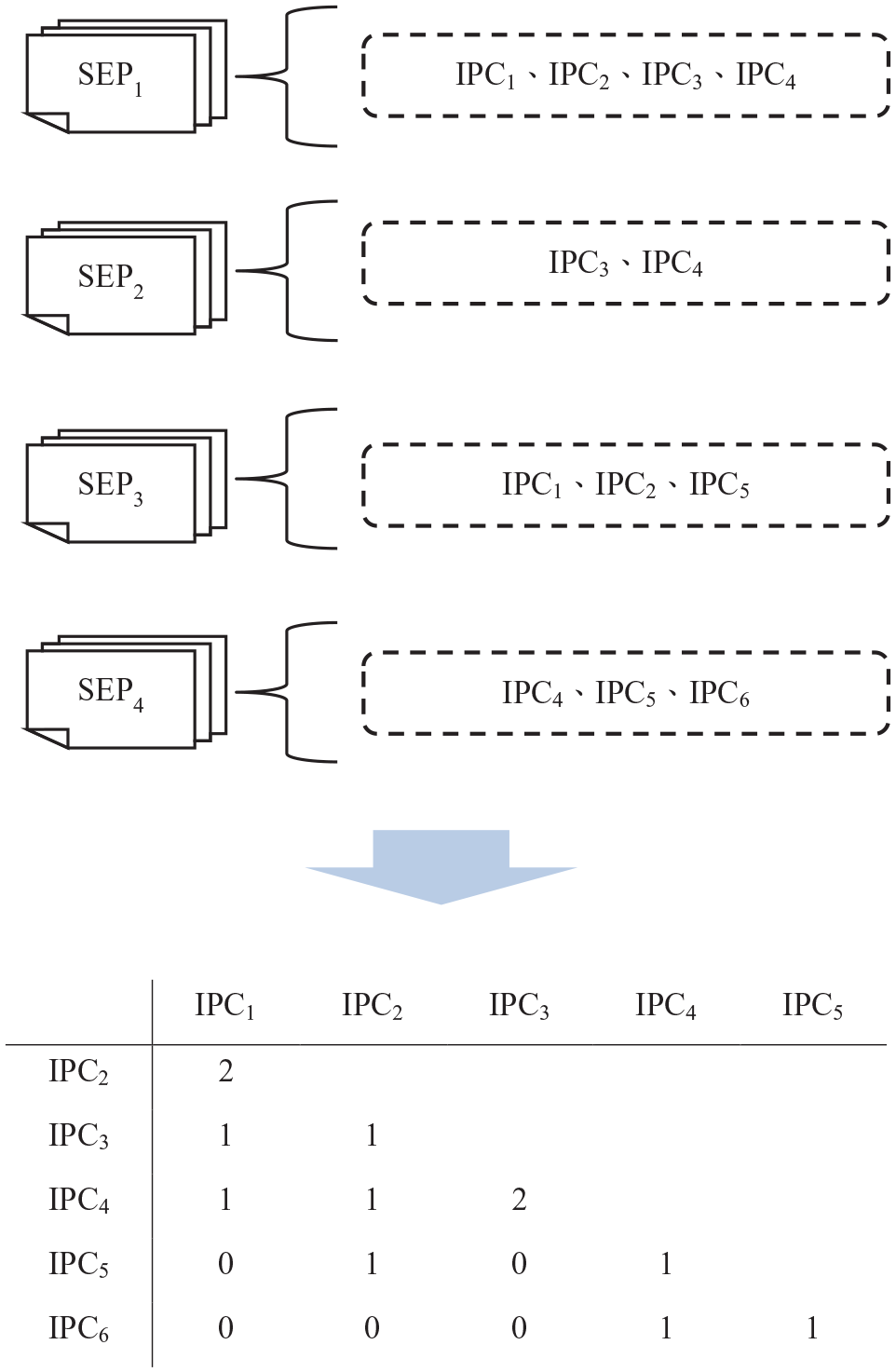
SEP technology network analysis matrix.
The numbers in the matrix in Figure 1 represent the number of occurrences of the same SEPs in different IPCs. Higher numbers indicate stronger technological correlations among IPCs. On this basis, the relationship between an IPC (node) and the number of occurrences of the same SEP in different IPCs (edges) can be used to construct a technology network, and the nodes in the center of the network are key nodes (i.e., the nodes that receive the most attention).
“Key player problem-positive” refers to the degree to which a node connects to other nodes compared with other nodes; it is largely based on closeness centrality and eigenvector centrality. Closeness centrality refers to the reciprocal of the shortest distance between a node and other nodes; the closer a node is to others, the higher the proximity or accessibility of that node. Eigenvector centrality means that if a node is connected to other nodes with higher centrality, then that node has higher centrality, that is, the centrality of the current node depends on that of neighboring nodes, taking into account the contribution of neighboring nodes to the centrality of that node (Knoke & Yang, 2007).
Key player problem-negative concerns the role of maintaining network stability. If removing a node from the network causes it to become a fragmented network type, the node is problem-negative; this is described through fragmentation centrality. Betweenness centrality refers to the degree to which certain nodes within a network must rely on particular nodes (intermediates) to connect with others in the network. Fragmentation centrality refers to the proportion of nodes that cannot be connected in relation to the overall number of nodes after a node is removed. A smaller value indicates that the network remains relatively stable following the removal of the node, and the centrality of the node is lower. This study referenced research by Borgatti (2006) and measured fragmentation centrality using distance-weighted fragmentation.
Measurement and Data Collection
In the collection of SEPs, this study largely adopted the IPlytics platform as its data foundation; 2,000,000 standard documents from over 800 standard setting organizations (SSOs) and 200,000 SEPs have been collected. In the classification of academic patents, the initial screening was conducted based on patents containing the keywords “university,” “college,” or “institute” (Tseng & Raudensky, 2014). Next, authority control, a procedure that unifies the names of the patentees, was implemented because the names of assignees may exist in different forms such as listings of full or abbreviated names of organizations or only of names of affiliated organizations. In addition to facilitating the accuracy of the records, it can also prevent patents belonging to the same patentees from being recorded under different patentees. Moreover, names with subtle mistakes, such as the capitalization of letters, spelling errors, and differences in punctuation, can be renamed and unified through authority control and confirmed that they belong to the patents through manual reading. Regarding the data acquisition period, academic SEPs from 2010 to 2019 were used to identify key academic technologies for the past decade, and technology development trends were described using a 5-year interval. Furthermore, the International Patent Classification (IPC) was used for technology classification for the technology network. Although the USPTO implemented the Cooperative Patent Classification in 2013, several patents in this study were approved prior to the implementation. Thus, the IPC was used for the analysis.
Empirical Study
Overview of the Distribution of Academic SEPs
This study collected a total of 2,742 academic SEPs, of which most (2,002) were declared by European Telecommunication Standard Institute; Advanced Television Systems Committee and ITU Telecommunication Standardization Sector each declared 365 SEPs. Before technology network analysis was conducted, the search results were analyzed to understand the technology distribution of the academic SEPs. Previous studies have indicated that the third-order IPC code is sufficient to represent the technological characteristics of a patent in related fields (Gwak & Sohn, 2018; Lee & Sohn, 2017; Park et al., 2018). Table 2 presents the top 10 third-order IPC codes for academic SEPs.
Distribution of Top 10 Third-Order IPC Classification Codes.

Note. A patent can belong to more than one IPC.
As Table 2 indicates, most academic SEPs involved the technology fields H04W, H04L, and H04B. Definitions of the IPC codes are provided in Appendix 1 (World Intellectual Property Organization [WIPO], 2021). The results of an analysis of the distribution of patent offices for academic SEP applications are provided in Table 3.
Patent Office for Academic SEP Application.

Note. WIPO patents refer to patents under the Patent Cooperation Treaty applied for with the WIPO International Bureau. USPTO = United States Patent and Trademark Office; KIPO = Korean Intellectual Property Office; CNIPA = China National Intellectual Property Administration; EPO = European Patent Office; WIPO = World Intellectual Property Organization.
A third of the academic SEPs were applied for with the USPTO, indicating that the United States remains the most prominent technology market in the world, and most standard patents are deployed in the U.S. market.
Key Technologies of Academic SEPs
Regarding the key technologies of academic SEPs, this study relied on third-order IPCs. Figure 2 depicts the network model results of the key technologies, and Table 4 lists the key IPCs.
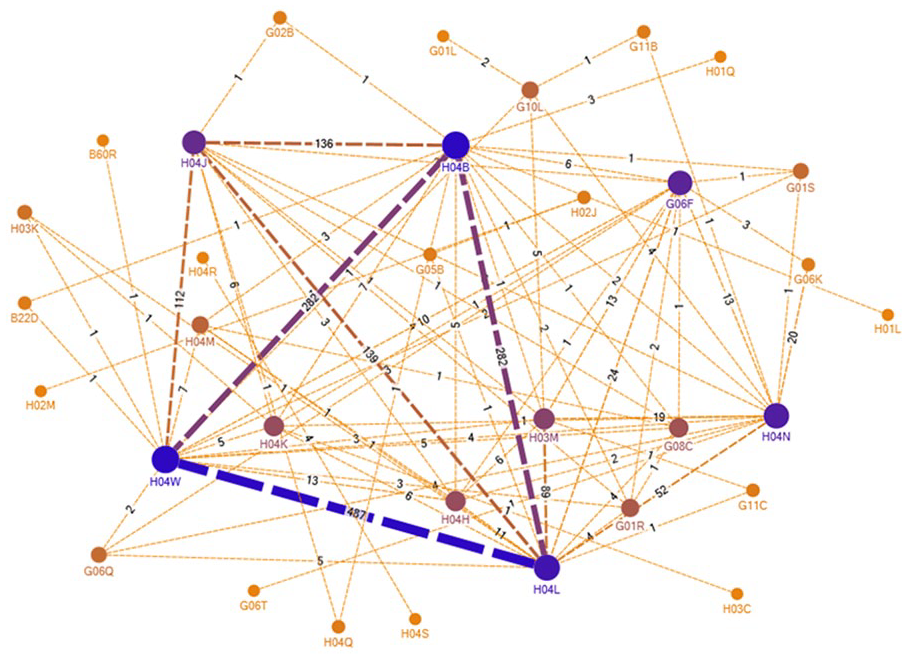
Third-order network map of the IPCs of academic SEPs.
Top Five IPC Codes for Academic SEPs.
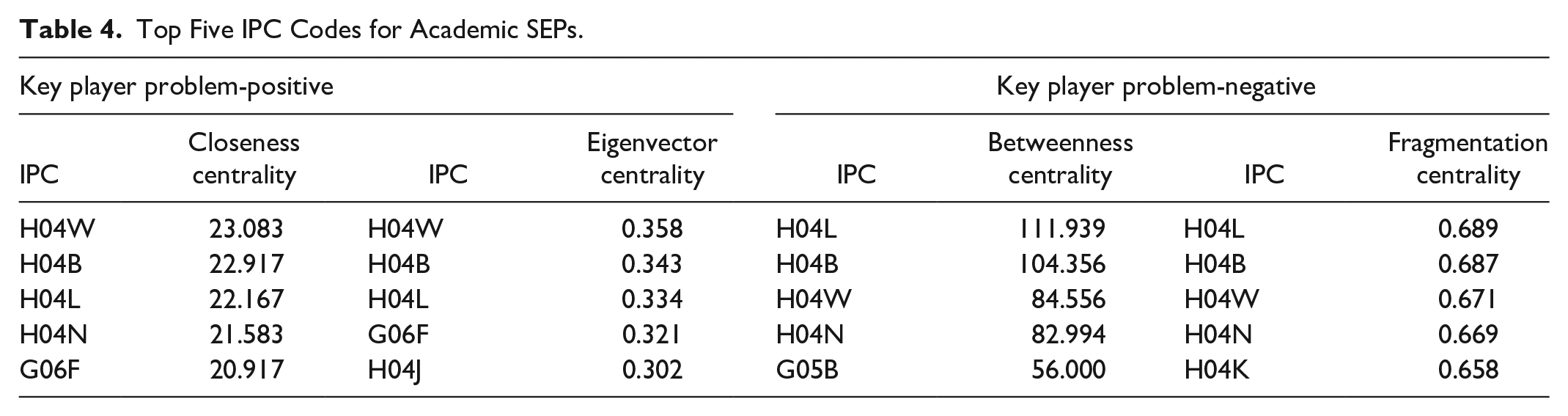
Closeness centrality and eigenvector centrality indicate how close a technology field is to other fields, with a higher value indicating that the technology is related to more technologies in the network and suggesting that it is a key field of the network. As shown in Figure 1 and Table 4, H04W, H04B, H04L, H04N, and G06F are the top five technology fields in both closeness and eigenvector centrality, with most involving in wireless communication networks and transmission of digital information (e.g., H04W, H04B, and H04L) or electric digital data processing (G06F). Betweenness centrality and fragmentation centrality can represent the intermediary degree of nodes in a network. Here, a node can act as a bridging technology between technology groups. As Table 4 indicates, highly intermediary fields include control or regulating systems (G05B) and secret communication technologies (H04K). The aforementioned analysis demonstrated that bridging (or intermediate) technologies tend to involve control systems (e.g., adaptive control systems) or secret communications, which can be said to be the foci of interdisciplinary technology applications.
Technology Development Trends in Academic SEPs
This study also identified changes in R&D foci to describe technology development trajectories. The development trends were described by increases and decreases in the centrality indices of earlier and more recent (with 2014 as the demarcation point) IPC codes. The results are shown in Table 5.
The Trend of Technology Development Focus of Industrialized Academic Patents.
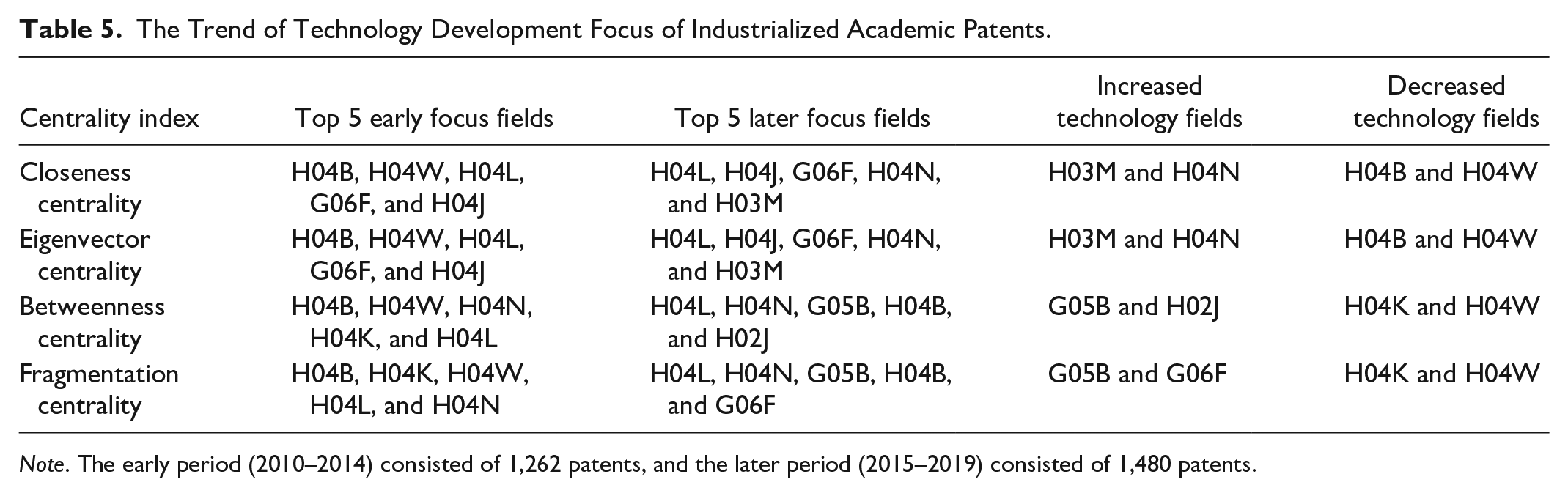
Note. The early period (2010–2014) consisted of 1,262 patents, and the later period (2015–2019) consisted of 1,480 patents.
As Table 5 reveals, changes in key player problem-positive (closeness and Eigenvector centrality) elements indicated that pictorial communication’s coding, decoding, or code conversion (H03M and H04N) gained in relevance for other technologies. By contrast, the relevance of wireless communication networks and transmission (H04B and H04W) declined, suggesting that their technological development had become more mature. Regarding key player problem-negative traits, control or regulating systems (G05B) was the key technology field, with increased betweenness and fragmentation centrality; thus, technologies such as adaptive control systems became crucial bridging technologies.
Conclusion
Discussion
This study used the data of academic SEPs and technology network analysis to explore key technologies. Network models of different periods were then employed to understand trends in key technologies. Relevant literature was compiled to derive the research models used throughout the research process. The major findings are now described.
H04W, H04B, H04L, G06F, G05B, and H04K were all key technologies in the technology network of academic SEPs. Academic SEPs largely concentrated on wireless communication networks and transmission of digital information (e.g., H04W, H04B, and H04L) and electric digital data processing (G06F), which are fields or nodes with relatively high closeness and eigenvector centrality. These technology nodes connect with relatively more nodes and exhibit greater connectivity with other fields. The connotations of these SEPs suggest these technologies are indispensable to academia in setting industrial standards and represent optimal performance in the industrialization of academic technologies. These technologies have the most frequent and closest connections with others and can be regarded as the star technologies in academic R&D achievements. In addition, betweenness and fragmentation centrality can represent the degree of intermediarity of the nodes in a network. The findings revealed that certain technologies act as bridging technologies, such as control or regulating systems (G05B) and secret communication technologies (H04K), indicating that relevant technologies are applied in different fields and suggesting that these technologies are bridging technologies with interdisciplinary academic attributes.
Regarding technological trends, the study discovered that the foci of academic SEPs changed. At time of writing, academic SEPs are largely inclined toward pictorial communication coding, decoding, or code conversion (H03M and H04N), indicating that the technologies relevant to image coding and facial recognition have gained attention. Image coding technologies have been rapidly developed and widely applied. Several SSOs related to image coding, such as the coding standard for still images (JPEG) of the International Organization for Standardization and the ITU-T’s video coding standard for television phones/conference televisions, and related academic SEPs have also been applied extensively.
For the theoretical contribution of the study, previous measurements of the industrialization of university R&D achievements remained based on approved patents or patent applications with major patent offices (e.g., the patent data published by the USPTO or EPO; Dornbusch et al., 2013; Lei et al., 2012); few researchers have studied them from the perspective of SEPs. Furthermore, although some recent studies have examined SEPs, they have focused discussion on specific fields (Trappey et al., 2017; Xihua et al., 2018), regulations and layout of intellectual property rights (Contreras et al., 2017; Sidak, 2014), or the compensation brought by SEPs (Layne-Farrar et al., 2014; Pohlmann et al., 2016). Relevant research on the key technologies and technology trends of SEPs was lacking, particularly for academic patents. This study provided a technological overview of academic SEPs from the perspective of a technology network and evaluated them to provide explanatory power.
Regarding practical contributions, studies have revealed that SEPs are mostly concentrated in communication firms, such as Nokia Corporation, Samsung Electronics Co. Ltd., QUALCOMM Incorporated, and Ericsson, and the relevant technologies are mostly used in wireless communication networks and the transmission of digital information (H04W, H04B, and H04L; Pohlmann & Blind, 2016). The results of this study also indicate that although academic patents attach great importance to the development of wireless communication networks and the transmission of digital information (H04W, H04B, and H04L), R&D of technologies for controlling or regulating systems (G05B) and secret communication technologies (H04K) are more important for academia. Academia has contributed considerably to the development of secret communication technologies, especially given that in recent years, quantum secret communication technologies—which combine modern physics and optical communication technology—have attracted considerable attention (Liu et al., 2021; Zheng et al., 2022). A secret communication system realizes multipoint-to-multipoint connections through both quantum and classical channels.
In recent years, the industrialization of university knowledge work has become a topic of global interest (Azagra-Caro et al., 2017; Thursby et al., 2009), with increasing numbers of studies of the application of and discussion around academic patents being conducted (Ardito, 2018; Azagra-Caro et al., 2017; Dornbusch et al., 2013; Gong and Peng, 2018; Y. C. Kim & Rhee, 2018; Wu et al., 2015). However, exploration of the key technologies for academia in leading standard setting was lacking. This study therefore focused on SEPs and discussed the key technologies of academic patents among standards.
Policy Implications and Practical Contributions
In terms of policy recommendation, this study provides valuable information to the government and proposes a technology roadmap of academic SEPs. In the technology network, the focus of academic SEPs is understood through key technology analysis, and information is provided that can assist resource allocation for academic R&D activities and the government’s promotion of emerging technologies. The practical contributions of the study are elaborated as follows.
Relevant information for resource allocation for academic R&D activities
The technologies disclosed by SEPs are often indispensable standards in industries, and they establish guidelines or rules for products and development processes that are followed by subsequent technologies. Ownership of SEPs allows the control of the technology standards in a market (Pohlmann et al., 2016), and the SEPs owned by academia represent concrete achievements of universities to industrial development. However, information on the current state of technology in academic SEPs was lacking. Generally, an academic SEPs means the technologies have high industrial application value and can be used for further development in an industry. Furthermore, identifying the technology network of academic SEPs can provide insight into these key technologies. Therefore, this study can generate an effect on accreditation requirements for university-declared R&D% allocation, particularly because the country in which a university is located and its citizens have high expectations regarding the practical applications of the university’s R&D outcomes in solving social problems (Ardito, 2018; Chatterjee et al., 2018; Perkmann et al., 2015). Consequently, an increasing number of studies have evaluated university technology transfer and commercialization performance (Azagra-Caro et al., 2017; Iacobucci et al., 2021; Viana et al., 2018). The results are of great significance to researchers, technology transfer offices, and policymakers for resource allocation, in particular answering relevant questions to technologies are at present crucial to the academic community.
The study uncovered that certain technologies, such as wireless communication networks and transmission of digital information (H04W, H04B, and H04L), electric digital data processing (G06F), control or regulating systems (G05B), and secret communication technologies (H04K) are prominent in the technology network of academic SEPs. Departments that combine these fields require additional attention and resource injection because the patents they develop are more likely to become standards.
Reference for governments to promote key technologies
This study provides the government with valuable information for promoting key technologies. In fact, the focus of technology development in academia is often related to the government’s innovation strategies, in particular during early research stages, and the government’s financial allocation often determines the scale and direction of a university’s research activities. Previous studies have indicated that financial resource input plays an essential catalytic role in the process of technology transfer (Powers & McDougall, 2005; Siegel et al., 2003), and the government’s funding of technology applications has contributed to promoting applied research, commercialized output, and the creation of intellectual property rights. This study identified key technologies through a technology network analysis of academic SEPs to provide a reference for the government to formulate science and technology policies.
Limitations and Future Research Directions
First, this study identified key technologies developed by academia from the perspective of SEPs. However, although SEPs can reflect indispensable standard technologies and fields in which academia guide industries, the formulation of standards and applications for SEPs require time. Thus, a time gap exists in responding to the latest technology developments, resulting in a major study limitation. Next, the study employs a quantitative research that attempted to describe the breadth of the topic, but it lacks the necessary depth. A combination of interviewing, textual analysis, or other methods is recommended and should increase the academic value of this study. Regarding future research directions, because of human resource and funding constraints, this study only analyzed the technology field and did not mention the country distribution of academic organizations nor analyze individual patent offices. However, patents are subject to principle of territoriality, and the lack of analysis of geographic structure made measuring specific market data impossible. In future studies with sufficient human resources and funding, the effect of geographic structure should be analyzed. Finally, this study operated from a macrolevel perspective. However, due to differences in the attributes and industrial environments of technologies, motivations for and the necessity of applying for SEPs differ. For example, fields such as textiles and paper have fewer SEPs. This study analyzed only the fields that SSOs and SEPs focus on; therefore, future studies are recommended to target specific technology fields or topics, which should more accurately observe the development of emerging and key technologies in academia.
Footnotes
Appendix
Definition of IPC Categories.

| IPC categories | Meaning |
|---|---|
| G05B | Control or regulating systems in general; functional elements of such systems; monitoring or testing arrangements for such systems or elements |
| G06F | Electric digital data processing |
| G06K | Recognition of data; presentation of data; record carriers; handling record carriers |
| G10L | Speech analysis or synthesis; speech recognition; speech or voice processing; speech or audio coding or decoding |
| H02J | Circuit arrangements or systems for supplying or distributing electric power; systems for storing electric energy |
| H03M | Coding, decoding or code conversion, in general |
| H04B | Transmission |
| H04H | Broadcast communication |
| H04J | Multiplex communication |
| H04K | Secret communication; jamming of communication |
| H04L | Transmission of digital information, for example, telegraphic communication |
| H04N | Pictorial communication, for example, television |
| H04W | Wireless communication networks |
Source. WIPO (2021).
Declaration of Conflicting Interests
The author declared no potential conflicts of interest with respect to the research, authorship, and/or publication of this article.
Funding
The author disclosed receipt of the following financial support for the research, authorship, and/or publication of this article: This work was supported by the Ministry of Science and Technology, Taiwan (TW) [MOST 109-2410-H-492-001].
