




Abstract
In this paper, we examine the impact of trade facilitation on the export technological sophistication from the European transition economies over 2004 to 2020. It is found that, in terms of trend, the export technological sophistication of labor-intensive and traditional resource-intensive industries is primarily concentrated in a lower range. In contrast, the export technological sophistication of capital and technology-intensive industries is generally low. Trade facilitation in each country shows a slow upward trend. The regression results show that trade facilitation significantly impacts the export technological sophistication of transition economies in general. In terms of heterogeneity, the impact is significant only in the Baltics economies, upper-middle-income and above countries, and to varying degrees in all types of light and heavy industries, differentiated industries, and technology-type industries. The mechanism analysis shows that the “reconfiguration” effect, “pushback” effect, and “spillover” effect are virtual channels through which trade facilitation affects the export technological sophistication.
Keywords
Introduction
In the past decade, the transition economies have achieved faster growth in export trade and have significantly improved their position in the international market. During 2004 to 2020, European transition economies’ average annual export growth rate is as high as 9.5%. For example, Russia’s exports in 2004 were US $35.5 trillion, increasing to US $81.9 trillion in 2019, with an average annual growth rate of about 8.4%. Belarus’ exports in 2004 were US $2.6 trillion, rising to US $6.3 trillion in 2020, with an average yearly growth rate of about 8.8% (data from World Bank Statistical Database WDI, growth rates calculated by the authors). However, at present, the world is still in a period of weak demand and deep restructuring of the manufacturing industry, and under the dual influence of the European sovereign debt crisis and the rise of trade protectionism, the former export model of developing countries, including transition economies, of expanding exports by volume and “winning by size” is unsustainable, which will inevitably impede the further development of their export trade (Hakobyan, 2017). For the European economies in transition, the critical way to maintain their international economic and trade position is to improve their export competitiveness.
However, at present, the global tariff level has declined significantly, traditional trade barriers have been reduced, trade liberalization has reached a high level, there is insufficient incentive to use tariff reductions to enhance the level of export competitiveness, and technical barriers, regulatory protection, and complex customs clearance procedures have become significant barriers that limit the technological level of exports (Baldwin & Harrigan, 2011), seriously undermining social welfare (Yue & Beghin, 2009). At the same time, trade facilitation-broadly defined as the set of policies aiming at reducing export and import costs has been in the spotlight in policy fora as the next critical option to reduce trade costs in developing countries. Therefore, trade facilitation continues to be vigorously promoted in response to the WTO and is increasingly becoming one of the crucial elements of regional economic cooperation in the “post-tariff” era. Trade facilitation is mainly to promote the expansion of exports by effectively reducing the cost of trade within the borders of each country. At the same time, as the focus of international trade research changes from export quantity to export quality, the Export Technological Sophistication (ETS), also known as Export Technological Content, is an indicator of a country’s ability to produce and export industrial products and is widely used to measure export competitiveness, has become an essential factor in the development of regional economic cooperation in recent years. It is a comprehensive indicator based on export data and other economic indicators, which was first proposed by Hausmann et al. (2007). Hausmann et al. (2007), based on a capability theory perspective, argues that different products require different capabilities for their production, with some products requiring only simple capabilities and others requiring complex capabilities. The greater the capacity a country or region has, the greater the ability to produce complex products and the higher the level of product quality. And the accumulation of capacity will continue to increase with the number and level of capacity that the country already has, which will promote the production of even newer products, thus increasing the level of export technology.
This method, compared to the previous export competitiveness index, has shown excellent results in measuring and assessing the level of export competitiveness. With the continuous efforts of scholars in recent decade, the index has been greatly improved and has become the mainstream of trade competitiveness measurement research (Ge et al., 2020; Hausmann & Hidalgo, 2010; Hu et al., 2021).
At present, world demand is still weak, the scale of exports “incremental dividend” is extremely thin, countries began to accelerate the change in export model to the level of trade competitiveness. In this background, what is the mechanism of the impact of trade facilitation on the export technological sophistication of transition economies? Through what means to exert a significant impact on the export technological sophistication? Moreover, if the export competitiveness effect of trade facilitation is objective, the further question that needs to be answered is whether this effect manifests itself as a significant facilitation effect. Does it lead to an effective increase in export competitiveness? Is this so-called boosting effect consistent or differentiated at the regional and industry levels? The existing literature has some research results on trade facilitation and export technological sophistication. However, since trade facilitation involves more internal efforts to reduce trade costs within an economy and the institutional arrangements that need to be designed to enhance trade facilitation, it is entirely different from trade liberalization. This systematic measure emphasizes significant tariff reduction. The export technological sophistication, on the other hand, as the mainstream measure of export competitiveness, focuses more on the expansion of export performance in the direction of product quality, that is, it mainly concentrates on the measurement and measurement of the level of export competitiveness itself and the impact of external factors such as foreign direct investment and imported intermediate goods on it, so the two types of issues have not been effectively intersected and thoroughly explored.
To answer the above crucial questions, based on modern growth theory, this paper tries to explore the channels through which trade facilitation affects export competitiveness from the perspectives of “reconfiguration” effect, “pushback” effect, and “spillover” effect. In addition, this paper explores the channels through which trade facilitation affects export competitiveness and provides a theoretical basis for improving export competitiveness under the significant effect of these three effects. In addition, this paper tries to discover the heterogeneity of the effects from regional and industrial levels.
In terms of marginal contributions, first, existing studies have mainly focused on the impact of trade facilitation on export expansion while neglecting the qualitative aspects such as its impact on export competitiveness. However, global product expansion is approaching a bottleneck. When countries are scrambling to promote their export modalities and find new growth drivers for exports, exploring the relationship between trade facilitation and export technological sophistication is more relevant. It can bring long-term insights into enhancing a country’s export competitiveness and maintaining its original international market. Second, unlike the export expansion effect, the export competitiveness effect of trade facilitation is more complex. Based on Hausmann’s et al. (2007) Capability Theory, the export technological sophistication is the best measure of the “export capability” of trade participants, and “capability” itself is directly related to the quality of export products or qualitative export performance, so this approach is usually regarded as the closest measure of export competitiveness from a capability perspective. Thus, this paper focuses on the impact of trade facilitation on export technological sophistication from the perspective of competitiveness, which helps to enrich the relevant research and fill the gap of existing research on the relationship between trade facilitation and export competitiveness to a certain extent. Thirdly, there are problems of continuity and comparability in constructing the composite index of trade facilitation in existing studies. The World Bank Doing Business Database is more systematic, and the composite index measured in this paper based on this database can be closer to the actual level of trade facilitation. Therefore, it is of great theoretical and practical significance to examine the impact of trade facilitation on the export technological sophistication of European transition economies in the “post-tariff” era.
The rest of the paper is organized as follows: the second section composes the literature and points out the shortcomings of existing studies. A helpful extension explains the theoretical mechanism by which trade facilitation affects the export technological sophistication based on the relevant theories. The third section carries out the empirical design, constructs the econometric model, and makes a detailed measurement of this paper’s most crucial dependent variable, the export technological sophistication index, and the independent variable, the trade facilitation index. The fourth section reports the relevant regression results, contains an in-depth examination of the endogeneity issue and further examines the heterogeneity of country and industry classification effects. The final section compares the main findings and makes several policy recommendations based on the conclusions.
Literature Review and Theoretical Basis
Literature Review
Related concept definition
First, trade facilitation. The concept definition of trade facilitation in the academic community has not yet been agreed upon. According to the World Trade Organization (WTO)’s definition, “the flow of goods in international trade requires the collection, transmission, and processing of data, trade facilitation is the process involved in the behavior, practices, and procedures to simplify and harmonize the processing.” The World Customs Organization defines it as “the level of control that can be improved in an internationally coordinated manner through the adoption of modern technology and techniques to achieve unnecessary trade restrictions.” The APEC Trade Facilitation Action Plan identifies four primary areas of trade facilitation, including customs procedures, standards and consistency, business flows, and finance and e-commerce, as the main elements of trade facilitation and defines the scope of trade facilitation. In a narrow sense, trade facilitation is associated with reducing on-the-border transaction costs other than tariff cuts, which essentially involves simplifying and standardizing customs formalities and administrative procedures related to international trade. In a broader sense, trade facilitation includes at-the-border issues and beyond-the-border issues, dealing, for instance, with the business environment, the quality of infrastructure, transparency, and domestic regulations.
Second, the export technological sophistication. It is necessary to mention a measurement tool called the estimation method of export product technological content. The estimation method of export product technological content includes the technology classification method according to the factor intensity of products and the product complexity measurement method. As an essential indicator of export quality competitiveness, export technological sophistication belongs to product sophistication measures. Since Hausmann and Rodrik (2003) introduced the concept of Export Technological Sophistication (ETS), many scholars have improved and modified the ETS index to measure the technological content of products produced in a country or region (Hausmann et al., 2007; Jarreau & Poncet, 2012; Lall et al., 2006; Rodrik, 2006).
A study on the nexus of trade facilitation and export performance
Scholars have found a positive relationship between trade facilitation and export performance for a long time (Wilson et al., 2003, 2005). In the early years, export performance focused mainly on export size and export diversification. Vijil and Wagner (2012) examined the contribution of trade facilitation measures such as infrastructure development and institutional environment improvement to export size from aid for trade perspective. Feenstra and Ma (2014) examined the impact of trade facilitation on export diversification and found that the increase in port efficiency contributes to export diversification, but the effect is more significant between OECD member countries.
Puertas et al. (2014) examined the impact of the logistics performance index on the export competitiveness of the EU. Martí and Puertas (2017) examine the impact of trade facilitation on export performance from the perspective of logistics infrastructure development, using emerging market countries as a study. In addition to measuring logistics performance indicators, scholars have also examined the impact of trade facilitation on export performance based on other perspectives, such as transportation (Lun et al., 2016), institutional quality (Heo et al., 2020), political institutions (Makhlouf et al., 2015), the rule of law environment (J. Li et al., 2013), financing facilitation (C. Li & Lu, 2018), environmental regulation (Ge et al., 2020), and regulation quality (Iwanow & Kirkpatrick, 2007), etc.
Besides, some scholars have considered multiple factors to measure trade facilitation. Zaki (2015) conducted a comparative study of the international trade effects of trade facilitation in developed and developing countries, incorporating elements such as internet, bureaucracy, corruption, and geography in the trade facilitation indicators, and the empirical study found that all these factors have an impact on the time of import and export transactions.
Moreover, the study of comprehensive trade facilitation indicators measured based on multidimensional indicators is not typical in recent years. However, it is an important step forward for studying trade facilitation measurement and has become a paradigm for the current relevant research. Sakyi et al. (2018) chose multiple indicators to measure three aspects of trade facilitation: infrastructure, institutions, and market efficiency, and based on the above indicators examined and found a positive impact on social welfare, including exports. Cheng et al. (2018) argued that the global competitiveness report published by the World Economic Forum does not accurately reflect the level of port-oriented trade facilitation, so they examined its impact on export competitiveness by establishing port-level trade facilitation indicators and drew revealing conclusions. Indicators encompass regulatory quality and fundamental social indicators to explore the impact on the export performance of the African region in a comprehensive manner and found that the improvement of the regulatory environment and basic transport infrastructure will be conducive to achieving improved export performance in the area. Similar studies have been conducted by other scholars (Dai & Jin, 2014; Shepherd & Wilson, 2009).
From the above literature, it is easy to find several limitations in the research on the correlation between trade facilitation and export competitiveness. First, the export competitiveness area focuses mainly on the export binary margin, export size, and less on the export technological sophistication. Second, scholars have primarily measured trade facilitation based on one dimension, but this approach fails to comprehensively examine the level of trade facilitation. In addition, too many single indicators from global competitiveness reports or trade promotion reports also create indicator coherence problems. Third, at the level of research subjects, the literature on European transition economies is scarce, and there is a lack of empirical examination in this regard. Based on the above limitations, this paper tries to enrich the relevant literature in the following aspects: first, research perspective. In this paper, trade facilitation and export technological sophistication are incorporated into a unified analytical framework to explain trade facilitation from the perspectives of the “reconfiguration” effect, “pushback” effect, and “spillover” effect. The transmission mechanism of trade facilitation affects the export technological sophistication of transition economies. Second, indicator measurement. This paper uses the World Bank’s Doing Business Database, adopts a linear transformation method and principal component analysis to calculate the level of trade facilitation more accurately for each country while ensuring the continuous comparability of trade facilitation indicators.
Theoretical Foundation
Can trade facilitation have a significant impact on the export technological sophistication? What are the mechanisms behind the effect? The few existing works of literature have provided their answers, but the theoretical interpretations are not comprehensive in our opinion. Based on the literature and with useful extensions of current theories, we summarize the possible paths through which trade facilitation affects export technological sophistication in three ways.
First, the “reconfiguration” effect. Trade facilitation reduces transaction costs, reduces import and export times, increases the level of access of advanced foreign products to the domestic market, and increases the level of competition in the domestic market, leading to the elimination of low-productivity firms from the market and the concentration of more resources and market shares to high-productivity firms, thus increasing the productivity of the country as a whole (Baumol & Lee, 1991). As a result of the resource “reallocation” effect, firms that gain more resources and markets benefit from the ensuing economies of scale and resource allocation effects (Helpman & Krugman, 1987). In addition, thanks to the expansion of resources at their disposal, surviving firms will have more sufficient funds to carry out R&D innovation activities and thus upgrade their export technology (Amiti & Konings, 2007). Many studies conclude that R&D innovation can increase the level of export technology, the export technological sophistication (Ivarsson & Alvstam, 2010; Mowery & Oxley, 1995).
The second, the “pushback” effect. The increase in the level of trade facilitation will lead to the entry of a large number of similar foreign products into the domestic market, and these imports, many of which are of high technology and high quality, will gradually access the domestic market competition, generating a substitution effect on domestic products (Krugman, 1979). The resulting import competition may force enterprises to increase R&D investment to produce high-quality products that can compete with imports to maintain their original market share, and this “pushback” effect from the competitive pressure of foreign products will objectively improve the country’s export technology level (Aghion et al., 2001).
Third, the “spillover” effect. The improvement of trade facilitation will lead to the importation of high-quality foreign products, and when enterprises have technical “bottlenecks” in product quality improvement, high-quality imports are an effective way to promote product quality improvement (Blalock & Veloso, 2007). Due to the non-competitive nature of knowledge innovation, that is, the “spillover” effect, firms can learn from the technical expertise, and R&D results in imports and imitate the production and manufacturing processes (Xu et al., 2017). In addition, due to the incomplete substitutability of imports and domestic products and the diversity of product preferences of enterprises, technological integration and imitation between products can also occur (Halpern et al., 2015), thus achieving a “leap” in their production technology. Finally, trade facilitation can further generate “learning” and “sharing” effects by combining the externalities of industrial agglomeration (Duranton & Puga, 2004), thus making the “spillover” effect an essential mechanism for export technology upgrading is possible.
Hypothesis
Hypothesis
Three sub-hypotheses are
Hypothesis
Hypothesis
Hypothesis
Empirical Design
Benchmark Model Construction
In general, the form of the econometric model depends on the data structure. The sample of this paper covers 20 European transition economies and the corresponding 27 industry-level data for the period 2004 to 2020, with typical short panel data structure characteristics, and is, therefore, suitable for panel OLS models. Further, a multidimensional fixed effects algorithm is introduced in the panel OLS model, that is, time trends, country fixed effects, industry fixed effects, and year fixed effects to control many complex and unobservable factors. The main advantages of using multidimensional fixed effects in panel OLS models are the omitted variable problem. Unobservable individual differences often cause the omitted variables, and if such individual differences do not change over time, the model used in this paper provides a reference method to solve this problem. Second, information on individual dynamic behavior. Since the model used in this paper examines both cross-sectional and temporal latitudes, it can help solve issues that separate cross-sectional, and time-series models cannot solve. Third, estimation accuracy. The model used in this paper has a more prominent package capacity for the data, and the precision of estimating the estimated coefficients in the regression process will be improved.
The following benchmark econometric model is constructed to examine the impact of trade facilitation on the export technological sophistication from European transition economies.

Where
In Table 1, the export data of the dependent variable data are obtained from the UN Comtrade database, and the GDP per capita data are obtained from the World Bank WDI. The critical independent variable trade facilitation indicators are obtained from the World Bank Doing Business Report and calculated by the authors. All control variables and mediator variables data are obtained from the World Bank WDI.
Variable and Data Source Description.

In the sample selection of European transition economies, in this paper, we select 20 countries based on Tamazian and Bhaskara Rao (2010), Nepal et al. (2017) and Nguyen (2022). In detail, there are Central and Eastern European economies (CEE): Albania, Bulgaria, Croatia, Czechia, North Macedonia, Hungary, Poland, Romania, Slovakia, and Slovenia. Baltics: Estonia, Latvia, and Lithuania. Commonwealth of Independent States (CIS): Armenia, Azerbaijan, Belarus, Georgia, Moldova, Russia, and Ukraine. The classification of CEE, Baltics, and CIS is based on the IMF (2000). IMF, Transition Economics: An IMF Perspective on Progress and Prospects, (https://www.imf.org/external/np/exr/ib/2000/110300.htm#box2).
Indicator Construction
Trade Facilitation Index
The current academic field has used chiefly two sources of data in constructing trade facilitation indicators, one is the World Bank open database (Asteriou et al., 2021; Baldé, 2011; Cho & Lee, 2020), such as Moïsé and Sorescu (2013) who use the World Bank Logistics Performance Index (LPI) to measure trade facilitation The approach has some relevance, but as the authors argue, transit trade is recognized as a significant issue for developing landlocked. Transit countries and separate transit indicators are developed within the current phase of work. Available public data in the area of transit measures are minimal. We find that the LPI also suffers from a significant data deficit in the sample of transition economies. In addition, LPI mainly focuses on transport-related infrastructure measures, which cannot fully reflect a country’s trade facilitation level. Another category is the Global Competitiveness Report (GCR) and the Global Enabling Trade Report (GETR). However, these databases only release data in even years, with missing data in odd years, and often use the average of two even adjacent years when measuring the average of two even adjacent years to estimate (Brooks & Davidson, 2004; Koh & Phan, 2015; Wongwuttiwat & Lawanna, 2018). In addition to the above studies, there are also pioneering attempts to incorporate many different databases into a unified system. Portugal-Perez and Wilson (2012) chose 18 principal indicators from WEF’s Global Competitiveness Report, Doing Business, the World Development. The authors also point out that the two criteria are not the same. However, they also point out that two criteria were used to select the indicators that are part of the aggregated indicators, it should be available for at least the sample period and cover more than sample countries. In fact, from our study, the above two criteria were not well met, and there are not many indicators in the four databases mentioned above that have both continuity and full coverage 20 of the European transition economies. Moreover, due to the differences in the statistical caliber and tendencies of the different databases, even if they are standardized, the aggregation process into comprehensive indicators may be disturbed by the presence of some missing sub-indicators in the year, which may lead to bias in the final measurement.
In summary, based on a thorough review of the existing literature, we use the World Bank Doing Business Report 2020 to construct trade facilitation indicators, which provides quantitative indicators on business regulations and property rights protection, covering 12 areas of business regulation such as cross-border trade, enforcement of contracts, access to electricity, registration of property, and access to credit, with far greater coverage than other databases. More importantly, the Doing Business Report is consistent, with no systematic missing data across time, except for individual sub-indicators for individual countries, and no potential bias caused by fitting missing values.
In the Doing Business Report, there are a total 10 of sub-indicators, including Starting a Business, Dealing with Construction Permits, Getting Electricity, Registering Property, Getting Credit, Protecting Minority Investors, Paying Taxes, Trading across Borders, Enforcing Contracts, and Resolving Insolvency. Protecting Minority Investors, Paying Taxes, Trading across Borders, Enforcing Contracts, and Resolving Insolvency. Two calculation criteria exist for the sample period for all indicators except Starting a Business and Resolving Insolvency indicators. The 2020 version of the data spans the period 2004 to 2020. The details are shown in Table 2.
Sub-Indicators and Standards.

To construct a composite indicator of trade facilitation, we perform the following steps. In the first step, we apply the linear transformation method to the above data using the docking years of the two periods continuously according to the following equation.

Where
The sub-indicators are standardized according to the following equation in the second step.

Where
We choose the principal component analysis to integrate the sub-indicators in the third step. First, we perform the KMO test and SMC test, and the overall test results are 0.903 and 0.427, respectively, and the data characteristics meet the applicability conditions of the principal component analysis method. Secondly, the variance maximization rotation using principal component analysis found that the cumulative variance contribution of the former six main components is about 83.9%, which could be used as a comprehensive indicator for evaluation. The coefficient characteristics of each subindex in the principal component are shown in Table 3.
The Results of Principal Component Analysis.

Again, the coefficients corresponding to each indicator of each principal component are multiplied by the contribution rate of that main component, respectively, divided by 83.9%, and finally summed up. After measurement, the comprehensive evaluation model of trade facilitation indicators is as follows.

In the fourth step, the values of each indicator are substituted into the above equation to finally estimate the level of trade facilitation for each transition economy in each year. The change of the trade facilitation index is shown in Figure 1.

Changes in trade facilitation in transition economies (2004–2020).
In Figure 1, the trend of the trade facilitation index for transition economies is more or less the same during the period 2004 to 2020, showing a steady increase, but some countries such as Albania and Romania offer different degrees of fluctuations at other times.
Export technological sophistication
Scholars have made unremitting efforts to measure export technological sophistication and have expanded a variety of measurement methods, the most representative of which is the two-step method of Hausmann et al. (2007). Hausmann et al. (2007) developed a technological sophistication measure for exports based on country income levels, taking into account problems such as the non-objectivity of previous methods in terms of technology and sophistication settings. Referring to Hausmann et al. (2007), this paper identifies 161 countries and 261 manufacturing products based on the three-digit level in the Standard International Trade Classification (SITC Rev. 3) for 2004 to 2020 according to the UN Comtrade database. Country and product-level exports and GDP per capita are deflated in constant 2004 U.S. dollars to remove the effects of inflation and obtain constant prices.
In the first step method, the export technological sophistication of a given product is calculated as follows.

Where
In the second step of the method, the national and industry level export technological sophistication is measured separately. First, the country-level export technological sophistication index formula is as follows.

Where the subscripts
Secondly, this paper refers to X. Li et al.’s (2015) practice and uses the Standard International Trade Classification (SITC, Rev. 3) as the basis to classify 261 manufacturing products into industries. Specifically, the agro-food processing industry and food manufacturing industry data are combined into the food manufacturing industry. Crafts and other manufacturing industries, waste resources, and waste materials recycling processing industry are not used due to unclear categorization, so we finally determine 27 manufacturing industries. Specific classification details are shown in the Appendix 1. The formula is as follows to measure the export technological sophistication at the industry level.

Where the subscript
After measuring the indicators of export technological sophistication at the national and industrial levels, the trend of changes is shown in Figures 2 and 3. It is easy to see from Figure 2 that Albania, except for a significant fluctuation during 2014 to 2018 (there is a lack of export data for 2019–2020), Azerbaijan, Belarus, Ukraine, and Russia experienced a slow decline, while the other countries have a relatively stable trend. It can be seen from Figure 3, the degree of differentiation in the movement of changes in the export technological sophistication of various industries is becoming more and more apparent, such as leather, clothing, textiles, and other manufacturing industries have a stable trend. In contrast, other manufacturing industries have experienced fluctuations of different magnitudes, where pharmaceuticals, chemical raw materials, crude oil, general machinery, and professional machinery are the most obvious. The export technological sophistication of labor-intensive industries and traditional resource-intensive industries is mainly at a medium level. In contrast, the export technological sophistication of capital and technology-intensive industries is generally not high, which is very much related to the industrial tendency of the transition economies, and the industrial foundation is not firm compared with the developed countries in Western Europe. There are generally more severe technological shortcomings.

Trends in export technological sophistication at the country level (2004–2020).

Trend of export technological sophistication at the industry level (2004–2020).
In Table 4, this paper reports descriptive information on the observation, mean, median, minimum, and maximum values of the dependent variable ETS, the critical variable TF, the control variables IA, CD, PI, ER, and TD, and the mediating variables TFP, CG, and FDI.
Descriptive Statistics.

Empirical Results and Analysis
Analysis of Benchmark Results
We apply the panel OLS high-dimensional fixed effects algorithm to regress the constructed econometric model to examine the effect of trade facilitation on the export technological sophistication of transition economies. The results of the benchmark regression are shown in Table 5.
Regression Results of the Impact of Trade Facilitation on the Export Technological Sophistication.
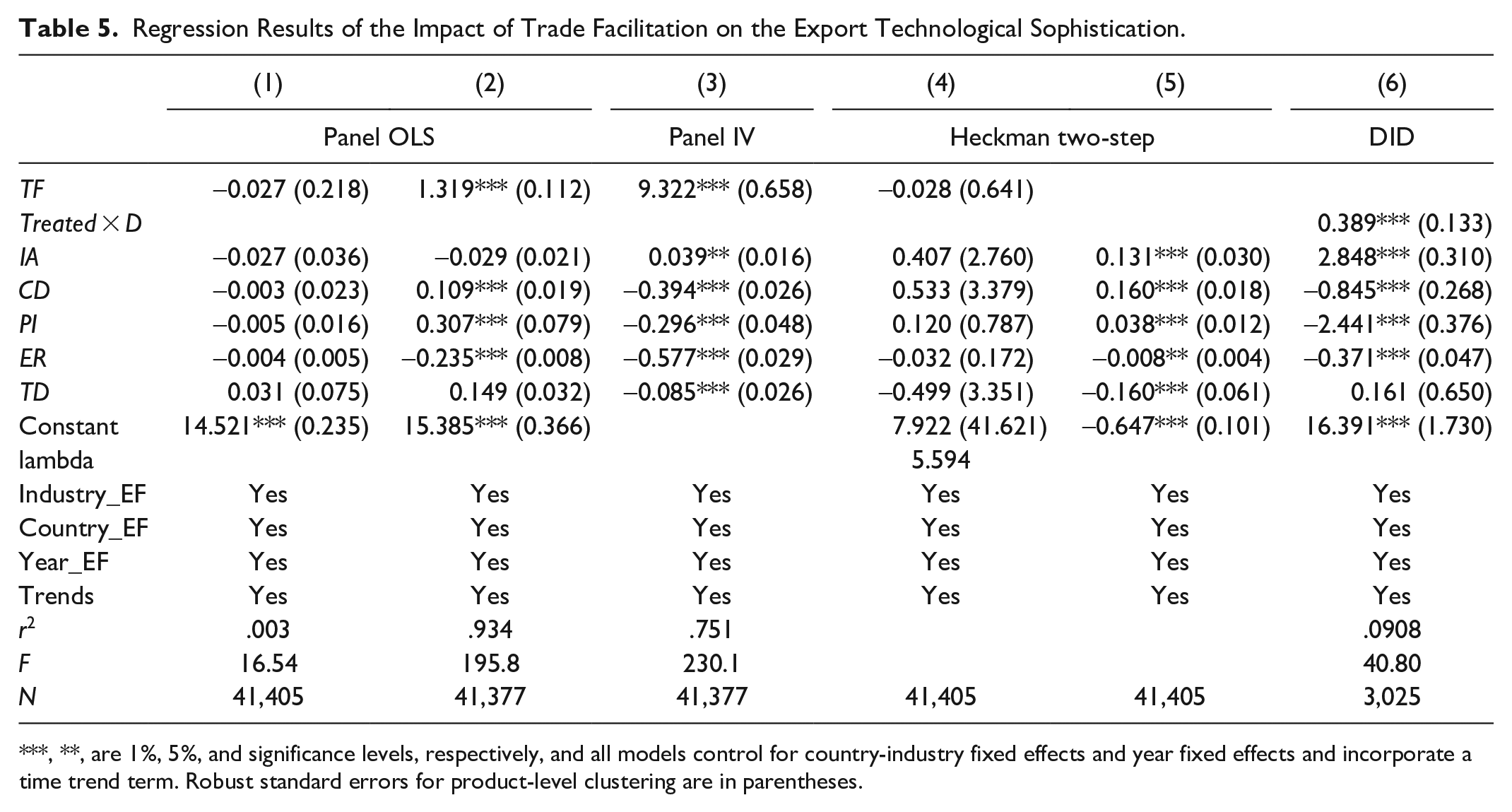
, **, are 1%, 5%, and significance levels, respectively, and all models control for country-industry fixed effects and year fixed effects and incorporate a time trend term. Robust standard errors for product-level clustering are in parentheses.
Columns (1) to (2) report the results of the benchmark regressions, and compared to the results of columns (1) and (2) takes into account the effects of multidimensional fixed effects such as country, industry, and year. In terms of comparison, the estimated coefficient of trade facilitation is 1.319, after the inclusion of multidimensional fixed effects, significant at the 1% level, indicating that trade facilitation has a significant positive effect on the export technological sophistication of transition economies in general.
CD and PI are significantly positive from the estimated coefficients of the control variables, indicating that carbon emission intensity and population intensity positively affect export technological sophistication. ER is exceptionally negative, meaning that an increase in the exchange rate level is not conducive to a rise in export technological sophistication. In contrast, IA and TD indicate that industrial value-added and export dependency do not have a significant effect on export technological sophistication.
Robustness Tests
Endogenous problems
In empirical studies, endogeneity is a topic that researchers cannot avoid and is bound to produce biased conclusions if not treated carefully and correctly. In general, there are three primary forms of endogeneity. The first type is omitted variables, endogeneity arising from the inclusion of unobservable factors in the model’s random error term that may potentially affect the critical independent variables, which we mitigate by controlling for country-industry fixed effects and year fixed effects and incorporating a time trend term. The second type is reverse causality, where the dependent and independent variables influence each other. The critical independent variable in this paper is trade facilitation, which is subjected to first-order lags considering the possible time lags associated with the effects. As a national-level policy related to improving the business environment, it is exogenous in itself. At the same time, the dependent variable in this paper, export technological sophistication, is a product-level variable, and the contemporaneous reverse effect of the low-level variable on the high-level variable is not apparent. With the lagging of the critical variable, the problem of reverse causality is better avoided. However, we use the instrumental variable two-stage least squares method 2SLS to test the above issue further. The third type is the sample selection bias. The endogeneity problem arises from the observations coming only from a non-random finite sample, tested by the two-step method Heckman (1979) proposed.
In Table 5, column (3) reports the regression results for the instrumental variable two-stage least squares 2SLS. We refer to some literature (Lv et al., 2018; Yu et al., 2014), using the first-order lag of the mean trade facilitation as the instrumental variable. The estimated coefficient of trade facilitation is significantly positive at the 1% level, which is consistent with the benchmark results, again indicating the positive effect of trade facilitation on the export technological sophistication. Columns (4) and (5) report the results of the first and second steps of the Heckman two-step method, respectively. The value lambda is 3.849, not statistically significant, indicating that the constructed model does not suffer substantial sample selection bias.
Further exploration of the model identification problem
We analyze the possible endogeneity of trade facilitation impacting the export technological sophistication of transition economies by using a combination of multidimensional fixed effects models, sample selection bias tests, and instrumental variables methods. However, there may still be some shortcomings in the endogeneity tests. Therefore, we try to use the multiplicative difference method, which is currently attracting attention in econometrics, further to examine the possible model identification problems in the study. As one of the essential research methods in quasi-natural experiments, the Difference in Difference method (DID) has a more rigorous causal identification mechanism.
Therefore, selecting representative policies or events to which trade facilitation belongs is critical to the identification study using the multiplicative difference method, as the implementation of relevant policies or the occurrence of events is exogenous to the quasi-natural experiment. In 2004 to 2020, the Cooperation between China and Central and Eastern European Countries (CEE) was officially launched with the first China-CEE Leaders’ Meeting in Warsaw, Poland, on April 26, 2012. On December 16, 2014, China and 16 Central and Eastern European countries jointly published the Bucharest Platform for China-Central and Eastern European Countries Cooperation, which put forward 38 cooperation initiatives (Official document URL: http://www.scio.gov.cn/zhzc/35353/35354/Document/1505277/1505277.htm).
The cooperation document emphasizes such issues as “promoting customs clearance facilitation in relevant countries, creating new logistics feeder routes and building logistics centers,” “strengthening cooperation in infrastructure construction such as roads, railroads, ports, and airports, and actively exploring cooperation in building regional transportation networks,” “joining the pilot program of the China-Europe Customs Safe and Smart Trade Route,” “forming the China-Central and Eastern European Countries Federation for Cooperation on Transport Infrastructure,” “supporting the holding of the high-level Eurasian Transport and Logistics Conference in 2015” and many other policy initiatives involving trade facilitation.
Therefore, we choose the matter of China-CEE cooperation as an exogenous event shock for the DID method, and the constructed DID model is as follows.

Where the subscript
The DID model is identified by satisfying the critical assumption that the interaction term is uncorrelated with the random error term given a set of control variables. In other words, the export technological sophistication of manufacturing firms in the treatment and control groups exhibit similar time trends. Therefore, we conduct a parallel trend test and plot a line graph with the mean value of export technological sophistication of the subgroups as the trend of annual changes in the export technological sophistication level of the treatment and control groups. It is easy to see from Figure 4 that the movements of changes in the treatment and control groups have pronounced similar trend characteristics until 2015, thus satisfying the parallel trend hypothesis.

The parallel trend test.
In Table 5, column (6) reports the results of the DID regression. The interaction term is the critical independent variable, which refers to the trade facilitation systematically promoted by the treatment group, which can be contrasted with the treatment group. It can be seen that the estimated coefficient is 0.389, significantly positive at the 1% level, indicating that the trade facilitation process promoted by bilateral economic and trade cooperation substantially raises the level of export technological sophistication, which again validates the robustness of the benchmark regression results.
Mechanism Analysis
Having confirmed that trade facilitation has a positive effect on export technological sophistication in transition economies, we naturally ask the new question, through what transmission mechanism does trade facilitation affect export technological sophistication? Based on the theoretical analysis section above, we conduct a mediating effects test to examine the impact mechanism behind the effect. Specifically, we refer to the stepwise regression method proposed by Baron and Kenny (1986) to test for mediating effects, in which the test for the multiplication of coefficients is the critical of the test for mediating effects. However, in practice, the multiplication of coefficients is significant, but the sequential test is not (Judd & Kenny, 1981; MacKinnon et al., 2002). In the sequential test, if at least one of the independent variables and the mediating variable is not significant, the Sobel (1982) method is used to test the coefficient’s multiplication term further to determine whether there is a mediating effect.
The econometric model based on the stepwise regression method is constructed as follows.


Where
Table 6 reports the results of the mediating effects tests. Column (1) shows the results of the benchmark regressions, and columns (2) and (3) shows the results of the “reconfiguration” effect mechanism, which shows that trade facilitation
Results of Intermediate Effect Test.

, **, are 1%, 5%, and significance levels, respectively, and all models control for country-industry fixed effects and year fixed effects and incorporate a time trend term. Robust standard errors for product-level clustering are in parentheses.
Extended Research: Heterogeneity Analysis
The benchmark regressions show that trade facilitation significantly contributes to higher levels of export technological sophistication of transition economies in general, so is the impact the same across a sample of countries of different nature and different types of industries? We attempt to answer this question through country-level and industry-level heterogeneity analysis.
Heterogeneity at the country-level
In the country-level heterogeneity analysis, we divide the transition economies according to the two categories of their region and income level, respectively. First, regionally, we divide the sample into Central and Eastern European economies (CEE): Albania, Bulgaria, Croatia, Czechia, North Macedonia, Hungary, Poland, Romania, Slovakia, and Slovenia. Baltics (BAL): Estonia, Latvia, and Lithuania. Commonwealth of Independent States (CIS): Armenia, Azerbaijan, Belarus, Georgia, Moldova, Russia, and Ukraine.
Second, in terms of income, we divide the sample into high-income countries based on the classification criteria in the World Bank Doing Business Report: Croatia, Czechia, Estonia, Hungary, Latvia, Lithuania, Poland, Slovakia, and Slovenia. Higher-middle-income countries: Moldova and Ukraine. Lower-middle-income countries: Albania, Armenia, Azerbaijan, Belarus, Bulgaria, Georgia, North Macedonia, Romania, and Russia. See Appendices 2 and 3.
In Table 7, columns (1) to (3) report the regression results for the CEE, BAL, and CIS samples, respectively. The estimated coefficient of trade facilitation in column (2) is significantly positive, while the estimated coefficients for the CEE and CIS countries are not statistically significant. The results indicate that trade facilitation in the three Baltic countries has a significant contribution to export technological sophistication, which is not unrelated to the more favorable economic conditions of the countries in the region. As early as the Soviet era, the region’s countries were already economically developed and ranked among the top socio-economic development indicators of 15 republics in the former Soviet for decades. In addition, after independence, the region has a relatively higher degree of privatization and a more solid foundation for a market economy. The pace of recovery of productive life was significantly higher than other countries during the same period. The promotion of the trade facilitation process relies heavily on supporting the region’s hardware facilities and peaceful business environment. The comprehensive level of economic and social development determines whether trade facilitation can fully exploit its export competitiveness level of driving potential.
Heterogeneity Regression Results (Country Level).
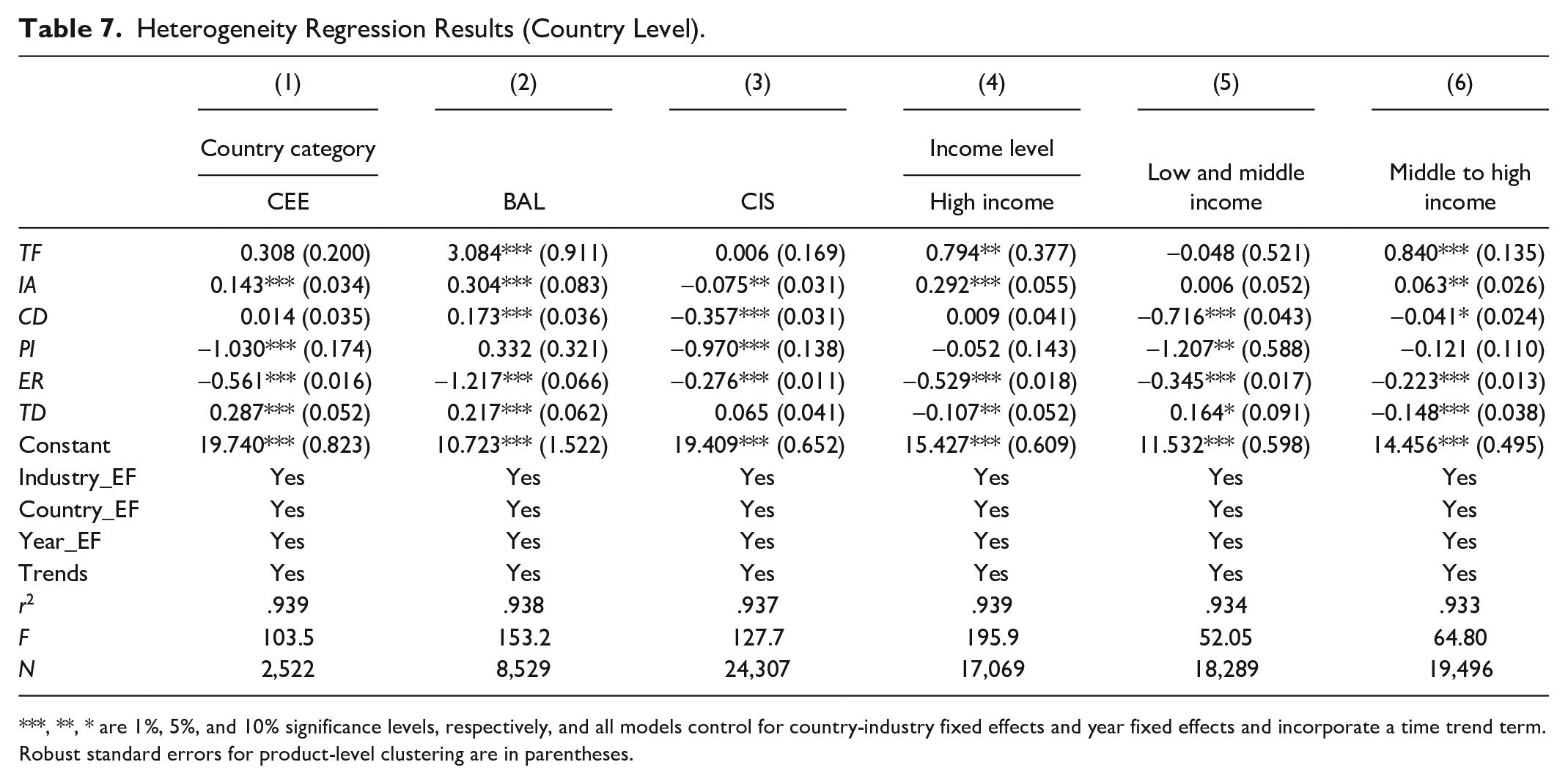
, **, * are 1%, 5%, and 10% significance levels, respectively, and all models control for country-industry fixed effects and year fixed effects and incorporate a time trend term. Robust standard errors for product-level clustering are in parentheses.
In Table 7, columns (4) to (6) report the regression results for the samples of high-income, lower-middle-income, and upper-middle-income countries, respectively. Not surprisingly, the estimated coefficients for the samples of high-income and upper-middle-income countries represented by columns (4) and (6), respectively, are significantly positive, indicating that trade facilitation significantly contributes to the export technological sophistication for both types of countries mentioned above. The economic implications embodied in this result are very similar to the results in columns (1) to (3), where the income level is an essential reflection of a country’s level of social governance and economic sophistication, as well as an essential guarantee and support to promote trade facilitation as a standardized cost reduction measure that can be effectively implemented. The implications of the findings of this paper are clear. Whether trade facilitation can be effectively promoted and play its role in the export sector is highly dependent on the regional government’s governance capacity and level of economic development and hardware and software construction conditions. The competitiveness effect of trade facilitation is also heterogeneous.
Heterogeneity at the industry-level
In the industry-level heterogeneity analysis, we follow X. Li et al. (2015) and divide the sample into three dimensions, such as light and heavy manufacturing types, differentiated degree manufacturing types, and different technology manufacturing types, respectively. See Appendices 4, 5, and 6.
In Table 8, columns (1) and (2), (3) and (4), and (5) to (7) report the regression results for the samples of light and heavy type, differentiated type, and technology type, respectively. From the heterogeneity results of each type, trade facilitation contributes to the export technological sophistication to different degrees. Among the light and heavy types, trade facilitation has a more substantial effect on enhancing export technological sophistication, strongly related to heavy manufacturing products’ dependence on logistics infrastructure. Among the technology types, trade facilitation is more effective in increasing the export technological sophistication of medium and high technology products, which indicates the importance of the business environment and the level of hardware facilities for the development and international competitiveness of knowledge and technology-intensive industries. Different from the differentiated results at the country level, the results show that trade facilitation contributes to the export technological sophistication of varying industry types to various degrees. Trade facilitation seems to be more sensitive and unstable to country-level differentiation. In contrast, the promotion effect of trade facilitation on industries is relatively stable under the premise that a country’s economic development level and hardware and software conditions are constant.
Heterogeneity Regression (Industry Level).

, **, * are 1%, 5%, and 10% significance levels, respectively, and all models control for country-industry fixed effects and year fixed effects and incorporate a time trend term. Robust standard errors for product-level clustering are in parentheses.
Conclusion and Insights
We examine the impact of trade facilitation on the export technological sophistication of European transition countries during 2004 to 2020. The main findings are as follows: each country’s trade facilitation level shows a slow upward trend in terms of trend. In comparison, the level of export technological sophistication in each industry shows differentiated characteristics, with labor-intensive industries and traditional resource-intensive industries primarily concentrated in the low to medium range. In contrast, export technological sophistication in capital and technology-intensive industries is generally low. The regression results show that trade facilitation significantly affects export technological sophistication in transition economies in general. The robustness of the findings is verified by various endogeneity tests such as Heckman’s two-step method, instrumental variable 2SLS method, and DID practice. In terms of heterogeneity, the effect of trade facilitation on export technological sophistication is significant only in Baltics, high-income and upper-middle-income countries, while there is no significant effect in CEE, CIS, and lower-middle-income countries. In contrast, the positive effect is significant in various light and heavy industries, differentiated industries, and technology industries to varying degrees. The mechanism analysis shows that the “reconfiguration” effect, “pushback” effect and “spillover” effect are virtual channels through which trade facilitation affects export technology sophistication.
Based on the above findings, we try to propose some countermeasures. The trade facilitation indicators in this paper are constructed based on the sub-indicators of the World Bank’s Doing Business Report, so the measures and efforts taken to improve the level of these indicators will be feasible. First, improve the trade regulatory system. Governments should focus on the simplification of the customs clearance process, the implementation of a class of goods customs clearance measures such as multiple validities of a single declaration, the establishment of a service desk for enterprises in the free trade zone, 24 hourly services for enterprises to reduce their operating costs. Second, innovation and improvement of financial services mechanism. The focus is to provide more convenient investment and financing services for enterprises through the development of offshore financial services, such as two-way debt issuance, two-way loans, two-way equity investment, and other innovative businesses, to provide more preferential services to enterprises. Third, to create a more innovative investment management system. Governments can try to establish a pre-entry national treatment plus negative list model, improve foreign-invested enterprise laws, take measures to protect small investors’ investment rights, and lay the judicial foundation for trade and investment facilitation. Fourth, enhance the degree of cross-border e-commerce facilitation. In response to the needs of cross-border e-commerce, governments can try to launch cross-border e-commerce experience stores, implement such initiatives as multiple batches of small goods in customs clearance, as well as numerous validity of one type of goods in one customs declaration, and abolish restrictions on domestic equity investment in non-investment foreign enterprise capital.
There are several limitations in this study as follows: first, because of the spatial differences in the regions where the transition economies are located, there may also be spatial dependence or spatial correlation in the differences in trade facilitation, and the spatial factor is not included in the model setting of this paper. Second, although the promotion effect of trade facilitation on export technological sophistication is verified in this paper, does this promotion effect follow the law of the marginal decreasing level of export technology, that is, does the promotion effect on export technological sophistication gradually diminish as the level of trade facilitation continues to increase? In this paper, the above factors will be taken into account in the subsequent study, and further attempts will be made to construct a spatial Durbin model or a spatial lag model to capture the spatial dependence effect and to introduce the quadratic term of trade facilitation into the model or to construct a threshold model to examine whether the promotion effect follows the law of diminishing margins.
Footnotes
Appendix
Technology Type Industry Classification.

| Low-tech industries | Medium Technology Industry | High Technology Industry |
|---|---|---|
| Food processing and manufacturing | Petroleum processing and coking industry | Chemical raw materials and chemical products manufacturing |
| Beverage processing manufacturing | Chemical fiber manufacturing | Pharmaceutical Manufacturing |
| Tobacco processing and manufacturing | Chemical fiber manufacturing | General machinery manufacturing |
| Textile industry | Rubber products industry | Professional equipment manufacturing |
| Clothing and other fiber products manufacturing | Plastic products industry | Transportation equipment manufacturing |
| Leather, fur, and down and its manufacturing | Non-metallic mineral products industry | Electrical machinery and equipment manufacturing |
| Wood processing and bamboo, rattan, palm, and grass manufacturing | Ferrous metal smelting and rolling processing industry | Electronic and communication equipment manufacturing |
| Furniture manufacturing | Non-ferrous metal smelting and rolling processing industry | Instruments and cultural office machinery |
| Paper and paper products industry | Metal products industry | |
| Printing industry recorded media reproduction | ||
| Cultural, educational, and sporting goods manufacturing |
Data Availability Statement
These data were derived from the following resources available in the public domain: [UNComtrade, https://comtrade.un.org/data]. [World Bank WDI, https://databank.worldbank.org/source/world-development-indicators/preview/on]. [World Bank Doing Business Report,  ].
].
Declaration of Conflicting Interests
The author(s) declared no potential conflicts of interest with respect to the research, authorship, and/or publication of this article.
Funding
The author(s) received no financial support for the research, authorship, and/or publication of this article.