




Abstract
Work engagement is arguably one of the key challenges confronted by the higher education sector of Pakistan. Therefore, it is important to understand the diverse perspectives of work engagement in this sector. This study examines the effect of job demand and spiritual leadership on work engagement in public universities of Pakistan through the mediating role of burnout and moderating effect of spiritual leadership between job demand and burnout and between burnout and work engagement. The study framework was established from theories, namely, the job demand-resource theory and the spiritual leadership theory. The respondents were 271 faculty members working in different universities of Pakistan. The findings show a significant relationship between job demand and burnout and between burnout and work engagement. Moreover, the results show a positive relationship between spiritual leadership with work engagement and negative relationship with burnout. However, the findings show the insignificant direct relationship between job demand and work engagement, whereas burnout mediates the relationship between job demand, spiritual leadership, and work engagement. Interestingly, spiritual leadership plays an important role in moderating the relationship between burnout and work engagement but does not moderate the relationship between job demand and burnout. Besides, the findings of the study will redound to organizational benefits by enriching research on the area of burnout and work engagement, which is so far in its infancy by referring to its potential antecedent and moderating variable. Finally, the study will be useful for both organizations and employees to achieve desired outcomes.
Introduction
In research, though the idea of work engagement is in its inception, it has initially gained much attention in both theory and implication (Byrne & Canato, 2017), encouraging the researchers to translate more and more intuitive theoretical and industrial ideas into empirical sciences for organizations and societies. Such a strong emphasis is aimed at cultivating potential and beneficial outcomes of work engagement, where it enhances the individual’s physical and psychological well-being (Roelen et al., 2015), improves organizational performance (Alessandri, Borgogni, Schaufeli, Caprara, & Consiglio, 2015), organizational citizenship behavior (Gupta, Shaheen, & Reddy, 2017), organizational commitment (Hanaysha, 2016), individuals’ job satisfaction (Gutiérrez, Tomás, Romero, & Barrica, 2017), and employee retention (Chen, 2017).
Even though the world acknowledges the importance of the concept, it lacks in research which results in the form of employee disengagement. This phenomenon is prevalent throughout the world and thus the amount of engaged employees is not satisfactory in any country. According to Gallup (2017), the United States is leading in terms of an engaged workforce, though with an unsatisfactory winning figure of 33%, and the remaining world is still far behind. In Western Europe, which is economically one of the most developed regions of the world, only 10% of employed residents are engaged, whereas in Eastern Europe, 15% of employees show engagement at work. Although the major cause remained unidentified, studies have revealed that if leadership style is brought into consideration, then there are probabilities of making the employees engaged in their work.
The situation seems to be even more problematic in some other regions as work engagement has been declining over time particularly in the sectors such as education, where lack of management and motivation might raise the issue, particularly in teaching side, thus resulting in lower productivity growth. Considerably, it should be important to take up the issue seriously particularly in terms of planning and improving factors which lead to enhanced work engagement. According to the survey, work engagement has fallen worldwide but it is more in Asia (Roman & Frantz, 2013). Obviously, if a manager or a supervisor works, communicates, and recognizes problems of a team and sympathizes with them, employees undoubtedly feel engaged in work as well as for an organization (Byrne & Canato, 2017). Therefore, organizations need to find a better way to encourage their employees to reduce burnout and help them be more engaged in their workplace (Balch & Shanafelt, 2018; Southwick & Southwick, 2018).
Besides, the current study has examined the novel relationship of spiritual leadership as an antecedent of work engagement and burnout and, simultaneously, work as an interaction construct to make a viable demonstration of the relationship between burnout and work engagement. It is also contextualized in a teaching environment which is developing a concern about instructors’ well-being and the need to consolidate individual and expert procedures for keeping up their energy. Undeniably, teaching is one of the most important occupations among other professions (Aluede, 2009). Teachers play a significant role in providing the foundation of every subject to the students, which not only enhances the knowledge of the students but also provides a career pathway for their upcoming future. But, unfortunately, teachers are facing serious stressors which not only hinder their performance but also create burnout among them. According to the findings of Shaifo (2009), the factors causing average stress in Pakistan include financial concerns (83.5%), posting and transportation (74.33%), unavailability of facilities (70%), workload (75.14%), autocratic supervision (87%), pressure from head office (78.33%), political factors (71%), parental pressures (10%), and domestic life (74.25%); thus, the total average stress is 69.3%. Among these stressors, the stress from the supervisor/manager is most crucial for a teacher to deal with because it decreases the morale of teachers.
Moreover, the productivity of a teacher is greatly affected by the stress they receive from their institute or management and that will create not only exhaustion among the teachers but also a negative environment for students and ultimately the learning process abolishes, leaving the bad impact on the students (Herman, Hickmon-Rosa, & Reinke, 2018). However, such affected teachers not only got exhausted but, ultimately, also plans to leave the organization or they stop getting engaged in their regular work. Studies have ignored the serious issue of teachers’ work engagement and their burnout as affected by the leadership style like spiritual leadership and also their job demand–related matter. Therefore, to address the key solution to this problem, several leadership styles need to be adopted by the institutes to decrease the stress level of the teachers and to enhance the learning and personality development of the students. Therefore, the current study has emphasized more on the role of spiritual leadership to decrease burnout among the teachers and to make them more engaged in their work. Thus, spiritual leadership has also been examined as a moderator to strengthen the inconsistent relationships of current study framework that was kept ignored in the past literature (Oh, Cho, & Lim, 2018).
Studies reveal that teachers are continuously facing emotional, intellectual, and physical traumas specifically due to workplace demands. Besides, a teacher joins this teaching profession with certain expectations and objectives in life. For instance, he or she hopes to deliver the best knowledge to his or her students and to own a futuristic vision for his or her career, but the job demands and the negative leadership style have created hurdles in career development and affected the mental health of the teacher, leading to lack of engagement and exhaustion. In this scenario, a leader is required who spiritually inculcates a faith, hope, and vision into his or her employees and takes the organization toward a sustainable workplace where every individual is provided with a complete option for their personal and professional development (Najam, Inam, Awan, & Abbas, 2018). Such leaders impart spiritual intelligence among employees that reduces burnout among teachers and these empathetic and devoted leaders are termed as spiritual leaders (Smith, Minor, Brashen, & Communications, 2018; Zhaleh & Ghonsooly, 2017). Moreover, recent studies have highlighted the importance of a leader in organizational sustainability by making the employees completely engaged in their work and leading the institute to sustain competitive advantage (Dalati, 2016; Jiang, Zhao, & Ni, 2017; Shriberg & Macdonald, 2013; Suriyankietkaew & Avery, 2016).
In relation to the academia, stress has been considered as a major setback, which is drastically affecting the performance of the employees, although studies have highlighted that well-qualified and experienced personnel face more stress during their jobs as they were overburdened in their works because of the skills they have as compared with other employees (Shoaib, Mujtaba, & Awan, 2018). In addition, in the public higher education setting, the stress on teachers is due to over workload and high job-related expectations which, if not catered properly, result in burnout (Yusoff & Khan, 2013). In Pakistan, leadership plays a vital role and considered as a mean in reducing the work-related stress (Rasheed, 2018) and making the employees engaged in their work (Raziq, Borini, Malik, Ahmad, & Shabaz, 2018; Said Saeed & Ali, 2018).
Burnout and work engagement in Pakistan higher education have turned out to be one of the principal worries for academicians, policymakers, and experts and furthermore for the partners who are directly or indirectly influenced by the employees’ poor performance in this specific segment. In the past couple of years, an employee’s issues of burnout and work engagement have increased in Pakistan (Bhatti, Alshagawi, & Syah Juhari, 2018).
Employment in the academic sector is considered to be tough and stressful because the teacher works extensively hard in meeting the requirements of their particular institute and in covering a course outline in the required period of time (Maricuţoiu, Sulea, & Iancu, 2017). In this profession, salary is low when it is compared with the size of a class. Along with an increase in class strength, problems also increase to such an extent that a teacher feels exhausted. This is because he or she alone has to tackle any issue of his or her students. Moreover, work pressure and the workload are rising with the passage of time which ultimately leads toward exhaustion and cynicism (Ahola, Toppinen-Tanner, & Seppänen, 2017).
Theoretical Foundation
Spiritual leadership theory (SLT) has been used to explain the relationship of spiritual leadership as a moderator and also its effect on endogenous variables; this theory affects the organizational change which intended to build up motivation and learning (Fry, 2003). It shows the feeling of importance and participation in one’s lives, which makes them feel comprehended and acknowledged. Besides, job demands-resources (JD-R) theory is used, which propelled by job plan and job pressure speculations. JD-R theory consolidates the two research customs and clarifies how job demands and (job and individual) resources may result in job pressure and inspiration (Bakker & Demerouti, 2007).
The study conducted by Crawford, LePine, and Rich (2010) on the role of the JD-R model and its impact on employees’ outcomes has given some important insight. The results of the study were that higher job demands lead to higher burnout, whereas when employees were provided with enough resources at the job, the relationship between resources and burnout becomes negatively associated. This study also highlighted that resources provided at the job also lead to higher work engagement; however, job demands and engagement were highly contingent to the type of job demands.
Based on these theories and results, the findings of the present study on spiritual leadership play a significant role by affecting the relationship between burnout and work engagement in the higher education sector of Pakistan as a moderating variable and also negatively and directly influencing the burnout and positively affecting the work engagement, which implies that spiritual leader reduced the burnout of the employees to make them engaged in their work.
Hypothesis Development
Burnout as a Mediator Between Job Demand and Work Engagement
The term work engagement, also known as employee engagement, was coined first by Kahn (1990) under the name of “personal engagement.” Khan (1990) has explained it as “harnessing of organization members’ selves to their work roles, in engagement, people employ and express themselves physically, cognitively and emotionally during role performances” (p. 3). He categorized engagement with three psychological conditions. First, the condition is meaning fullness, that is, how much worth and wellness it provides to the employee and how much the employee’s work is considered to be valued. The second condition is safety, which explains how many people feel safe and comfort at their workplace. The third condition is availability, which explains how much physical and psychological resources at work are available and accessible at work (Abu-Shamaa, Al-Rabayah, & Khasawneh, 2015).
Work engagement comes from mental and physical efforts carried out by employees while performing their desired organizational roles. Employees are very likely to be fully absorbed in their jobs when they find their work meaningful, safe, and available (Kahn, 1990). The term “engagement” has been under discussion from the past many decades; although many researchers have tried to define the term from different dimensions still, a comprehensive definition is needed (Kahn, 1990).
Macey and Schneider (2008) defines work engagement in terms of work-related well-being by being in a positive, fulfilling, and affective-motivational state. Furthermore, Bakker and Leiter (2010) suggested that more engaged employees experience a higher level of energy which enables them to be enthusiastically focused on their jobs. Schaufeli, Salanova, Gon, Alez-ro, and Bakker (2002) described it as vigor, dedication, and absorption; among these three dimensions, vigor and dedication are the core dimensions of employees’ engagement, whereas absorption is mostly related to consequential flow (González-Romá, Schaufeli, Bakker, & Lloret, 2006). Therefore, the current study has used dedication and vigor as core dimensions for work engagement.
According to van Loon, Heerema, Weggemans, and Noordegraaf (2018), stressful teachers behave in different ways: some resist the work-related pressure, some speak up, and some develop useful coping strategies. Professional coping is considered a relatively more effective strategy for reducing stress and enhancing employee engagement in work. Garrick et al. (2018) indicate that increased working hours more than normal will increase mental fatigue. A study conducted by Bakker, Schaufeli, Leiter, and Taris (2008) revealed that job demands such as time pressure, that is, to work very fast has a positive relationship with work engagement. Sonnentag (2003) examined the relationship between job demand and work engagement; he found that job demands have a significant negative relationship with work engagement, which implies that job demands such as time pressure have an insignificant relationship with work engagement. Based on the findings, the literature has indicated the inconclusive relationship between job demand and work engagement; thus, based on the above discussion, the following hypothesis was formulated:
Many organizations are offering high-demanding jobs which require a high amount of resources. If such demands are not met properly, then employees may leave their organizations (Fletcher, Carter, & Lyubovnikova, 2018). It is assumed that for every sector, the working conditions and the demands of that workplace vary from one person to another. Such work-related demands are often added by the emotional demands. These emotional demands cause emotional exhaustion. If such exhaustion prolongs for a passage of time, then it creates an intention among employees to leave their workplace (Azharudeen & Arulrajah, 2018). This pressure is increased when an employee faces some pressure that affects their cognition. According to Mintz-Binder and Sanders (2012), the pressure is increased when an employee is expected to do more and more work. However, in the health care sector, nurses face a large amount of emotional labor, which makes them more emotionally exhausted and stressed (Parry-Jones et al., 1998). These demands do not increase burnout significantly until and unless it prolongs for a longer period; thus, continuous overload creates high job-related stress for the employee (Tourigny, Baba, & Wang, 2010). Theorell, Karasek, and Eneroth (1990) argued that time pressure along with psychosocial job demands is also the cause of job-related stress which can even cause illness in the employee’s mental health. Thus, based on the above-discussed literature, the following hypothesis was formulated:
Hakanen and Schaufeli (2012) have discussed the well-being of employees at a workplace which affects the general well-being with the passage of time. Moreover, exhaustion and de-personalization were indirectly related to dedication and vigor. In the stage of burnout, an employee is no longer engaged in a job and person psychological distress increases as well. Moreover, a two-wave longitudinal study that has been carried out for almost 8 months by Llorens-Gumbau and Salanova-Soria (2014) holds that there exists an inverse relationship between burnout (cynicism and exhaustion) and work engagement (vigor and dedication). An employee feels exhausted at a job when demands are too high to cope with. Similarly, an employee becomes pessimistic when the employee is not being given a fair treatment. The permission leads him further to cynicism (Leiter et al., 2013). These employees feel less energetic in coping up with exhaustion and cynicism. Cynicism is very likely to affect the cognitive abilities of an employee making him less dedicated toward work. A recent study on Iranian teachers illustrates that there is a significant relationship between burnout and work engagement (Faskhodi & Siyyari, 2018). According to the conservation of resource theory (Hobfoll, 2011), employees who spend their energy in dealing with stress and burnout feel afraid of losing their performance and even jobs. In other words, an individual exerts more energy to tackle such problems which lead them toward burnout. Thus, based on the above-discussed literature, the following hypothesis has been derived:
Next, Hakanen, Schaufeli, and Ahola (2008) have conducted research which indicates that burnout mediates the negative relationship between quantitative workload and poor physical working conditions on job satisfaction of teachers. The qualitative and quantitative workloads of a high job lead one to burnout which further leads one to psychosomatic symptoms, including headaches, cardiovascular problems, and gastric problems. However, several studies do not confirm the mediating role of job burnout in the relationship between job demand and somatic ill health in the group of Austrian blue- and white-collar workers. Therefore, it seems that job demand affects both mental and physical health problems directly and indirectly through job burnout, which in turn affects individual and organizational outcomes. It is quite evident from the previous studies that job demand affects employee’s minds, which in turn affects burnout and work engagement (Bakker & Albrecht, 2018; Schaufeli & Bakker, 2004; van der Doef & Schelvis, 2018). Therefore, we have formulated the following hypothesis:
Spiritual Leadership as a Moderator and Antecedent of Burnout and Work Engagement
A person’s spiritual attributes are the most essential and animating force that is believed to be the invisible, life-affirming energy in oneself (Fry, 2003). Moreover, several studies have highlighted the importance of spiritual attributes and employees at a workplace which cannot be ignored. To make an organization impart the knowledge and practice of spirituality in their employees is not an easy job to do; rather, it is a great challenge (Fry & Slocum, 2008).
Almost everyone has the element of spirituality in them. Sometimes, it is backed by religious values and sometimes it is triggered by nonreligious beliefs (Fruzzetti, 2006). Similarly, in the workplace, everyone comes with a spirit and a body. Most particularly, that spirit is fostered by leadership at the workplace (Brown, 2017). Moreover, at a workplace, there are various views about spirituality and financial concerns of the employees. Some views state that money is the major obstacle in spiritual development and that spirituality leads to financial gains (McDonald, 2018). It also helps in coping with the emotional needs of those employees who face a hard time surviving in an organization (Nandram & Bindlish, 2017).
The feeling of making an impact through one’s work and a requirement for being a part of a team are considered essential needs of an individual. Workplace spirituality and related leadership must be comprehended to interlink social and individual qualities. In this way, it gives benefit to associations and its pioneers; any definition of workplace spirituality must demonstrate its advantages by impacting execution, turnover, efficiency, and other related adequacy criteria (Bush, 2010).
With the beginning of another century, there is an expanding requirement for societal and industrial change. For this, an organization requires more comprehensive leadership that incorporates four basic regions that characterize the embodiment of human presence, the body (physical), personality (coherent/sane idea), heart (feelings, emotions), and soul. Spiritual leadership is vital for the change to and proceeded with the achievement of learning firms. Spiritual leadership takes advantage of the basic needs of both pioneer and supporter for spiritual survival, so they turn out to be more authoritatively dedicated and profitable.
The causal theory of spiritual leadership is created inside an intrinsic motivational model that joins faith, vision, trust, confidence, theories of workplace spirituality, and spiritual survival. The motivation behind spiritual leadership is to impart vision and confidence in the team for better efficiency and performance.
It has been found that intrinsic motivation is the feeling of challenge or competence resulting from performing the job (Keaveney & Hunt, 1992). Intrinsic motivation plays an important role in any job. Feeling challenged and getting personal satisfaction can help minimize other difficulties. According to Low, Cravens, Grant, and Moncrief (2001), intrinsic motivation and two major role stressors are the possible antecedents of burnout. Low et al. (2001) describe the negative relationship between intrinsic motivation and burnout. Moreover, recent studies show that spiritual leadership reduces the worker’s burnout (Yang & Fry, 2018a; 2018b).
Schaufeli and Bakker (2004) argued that the presence of specific demands such as work overload and conflicts provided having no intervention from the organization as support will lead to employee burnout. Furthermore, such burnout will lead toward employees’ other negative outcomes such as turnover intention, work disengagement, and even counterproductive work behavior. Another study by Demerouti, Bakker, Nachreiner, and Schaufeli (2001) found empirical evidence regarding the JD-R model that job demands are associated with employee exhaustion and burnout. On the theoretical ground, the JD-R model assumes that an enthusiastic process of working under high job demands drains out the energy of an employee. This drain-out leads an employee toward exhaustion which further leads toward burnout. This burnout can be regulated with an organizational intervention such as leadership. However, the JD-R model also posts to incorporate the job resources as a variable for predicting the employee burnout. This study has posited the boundary condition of having a spiritual leader as a resource gain for the employee. According to the conservation of resource theory by Hobfoll (2011), supervisory positive support is also considered as a resource gain as resources also travel in a caravan from leader toward his employees.
In the current article, we extend the JD-R model as proposed by Demerouti et al. (2001) by incorporating the further outcome of burnout along with the intervention of spiritual leadership toward employee engagement.
Therefore, based on the above literature, the following hypotheses were derived:
Based on the above-discussed literature and hypothesis development, the following research frame has been framed for the current study (Figure 1).

Research model.
Method
Participants and Procedure
The target population of this study comprises of employees working in the public higher education sector of Pakistan. The universities included in the research survey are Air University, Bahauddin Zakariya University, Islamia University Bahawalpur, Nust Islamabad, Quaid-e-Azam University Islamabad, Punjab University Lahore, and National University of Modern Languages. The unit of analysis was the employees working as a faculty member in these universities. As the population parameter cannot be obtained because of lack in the proper availability of updated lists of the current employees working as a faculty in the public sector universities, the purposive sampling method was used to obtain the required sample. Initially, 350 questionnaires were distributed across the population based on the expected response rate from the education sector of Pakistan, but only 278 were returned. The sample size of 271 was the usable sample that was taken into the final analysis.
As the measure was self-reported, the procedural and statistical remedies were applied to control the common method bias (Tehseen, Ramayah, & Sajilan, 2017). The data were collected with a lag of 3 weeks. However, the questionnaire consisted of two parts. The first part of the questionnaire provided the purpose of the study, making sure that the confidentiality of the provided information is maintained and welcomes the suggestions. The second part contained 33 observed variables and seven demographic variables. A total of 40 questions were added to the survey questionnaire.
It has been noted that 47% of the participants in this survey were females. On average, the respondents were aged 26 to 44 years. With regard to the highest academic qualification, most of the respondents 54% were holding a postgraduate degree. Out of 271 participants, 35% had been with the work experience for more than 2 years. Majority of the participants (68%) were working as a lecturer.
Measures
For spiritual leadership, a 16-item scale with three formative dimensions has been adapted from Fry, Vitucci, and Cedillo (2005). However, dimensions of vision and hope/faith contain five items, whereas altruistic love has six-item scale.
Burnout has been operationalized as a syndrome of exhaustion and cynicism. It is measured by adopting a scale developed by Schaufeli et al. (2002) which consists of eight items measuring two reflective dimensions of burnout: exhaustion and cynicism (Schaufeli & Salanova, 2007).
Work engagement is operationalized as a positive, fulfilling, and work-related state of mind that is characterized by vigor and dedication. It is measured by adopting a scale from Utrecht Work Engagement Scale (UWES; Schaufeli, Bakker, & Salanova, 2006). It consists of six items bifurcated into two reflective dimensions: three items tapped in the vigor dimension and three items tapped in the dedication dimension (Van De Voorde, Veld, & Van Veldhoven, 2016).
Job demand refers to role overload in terms of combination between workload and time pressure. It is measured by adopting a scale which was proposed by Karasek et al. (1998). It consists of three items (Hessels, Rietveld, & van der Zwan, 2017).
All the responses were recorded on a 5-point Likert-type scale ranging from (1 = strongly disagree to 5 = strongly agree; Table 1).
Variables—Number of Items.

Data Analysis
Structural equation modeling (SEM) is a statistical technique which is used to analyze the structural relationships among the selected variables (Kline, 2011; Ullman & Bentler, 2003). Partial least squares (PLS) SEM, which is the second-generation SEM, was adopted for measuring the relationship of the constructs as suggested by Joe F. Hair, Ringle, and Sarstedt (2011). The output revealed only 31.85% of the total variance that is accounted by a single factor, representing the absence of common method bias. The mean and standard deviation of gender (M = 1.47, SD = 0.507), city (M = 1.38, SD = 0.847), work experience (M = 2.36, SD = 1.375), education (M = 1.56, SD = 0.527), age (M = 1.61, SD = 0.845), organization type (M = 1.75, SD = 0.832), and designation (M = 1.53, SD = 0.906) were also calculated.
A two-step process was followed to evaluate and generate the results of PLS-SEM path, which was proposed by Henseler, Ringle, and Sinkovics (2009). The first step is an assessment of the measurement model and the second step is the measurement of the structural model. As shown in Table 2, the values of composite reliability of vision (0.918), hope/faith (0.896), altruistic love (0.910), job demand (0.821), exhaustion (0.914), cynicism (0.910), vigor (0.827), and dedication (0.899) are in the acceptable range and show high internal consistency (Fornell & Larcker, 1981; Joseph F. Hair, Sarstedt, Pieper, & Ringle, 2012).
Validity, Reliability, Means, Standard Deviations, and Two-Tailed Correlations.
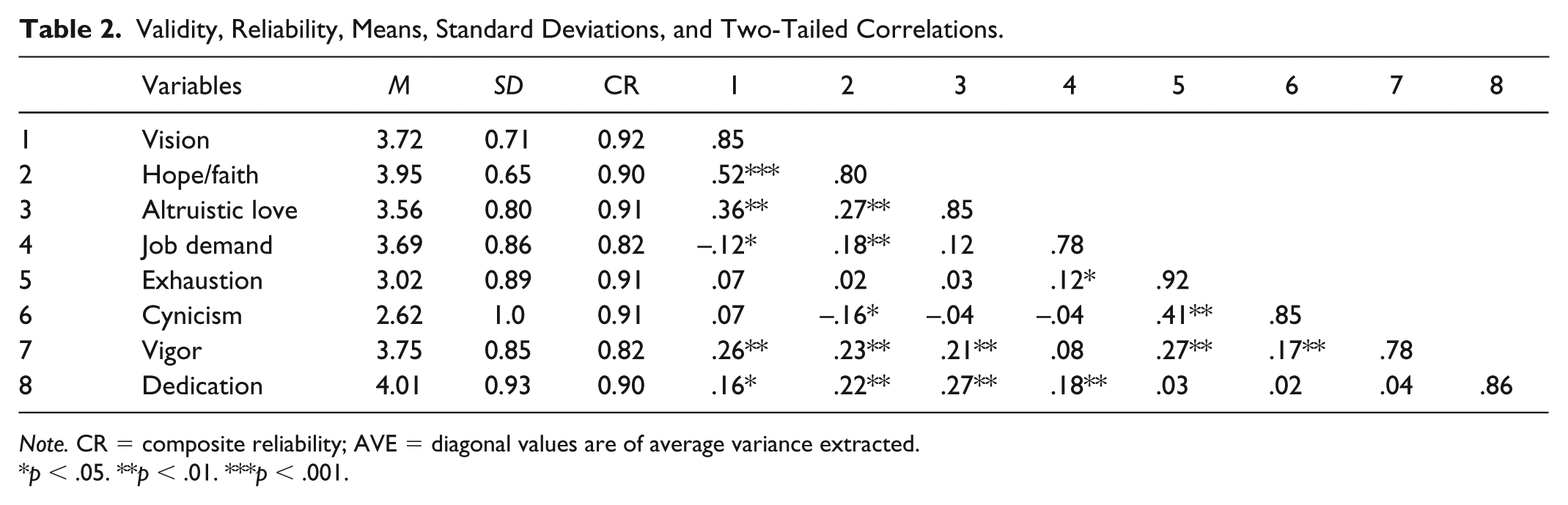
Note. CR = composite reliability; AVE = diagonal values are of average variance extracted.
p < .05. **p < .01. ***p < .001.
The square root of AVE (average variance extracted) of the constructs: job demand (JD) = .78, burnout = .71, spiritual leadership = .71, work engagement = .75. This explains that the square root of AVE is greater than the correlation between the latent variable indicating the acceptable discriminant validity (Fornell & Larcker, 1981).
The findings highlighted that out of 33 items, four were deleted as their loadings were less than the cutoff value of 0.50. Thus, the rest of the models were left with 29 items which are within the range of 20% deletion of lower factor loadings and rest of the loadings were retained ranging from 0.510 to 0.953 (Table 3; Joe F. Hair, Sarstedt, Hopkins, & Kuppelwieser, 2014).
Confirmatory Factor Analysis.

Note. α = Cronbach’s alpha, MSV = maximum shared variance.
Item deleted during factor analysis.
Three structural model assessments have been done: direct relationship model, mediation analysis model, and moderating model. Five hypotheses which have direct relationships have been tested, however, out of five hypotheses, four hypotheses were proved to be supported and only one was considered not supported based on the recommended significance level and t values (Table 4). The results were obtained from the bootstrapping with 5,000 sampling iterations for 271 cases/observations.
Results of Hypothesis Testing (Direct Effects).
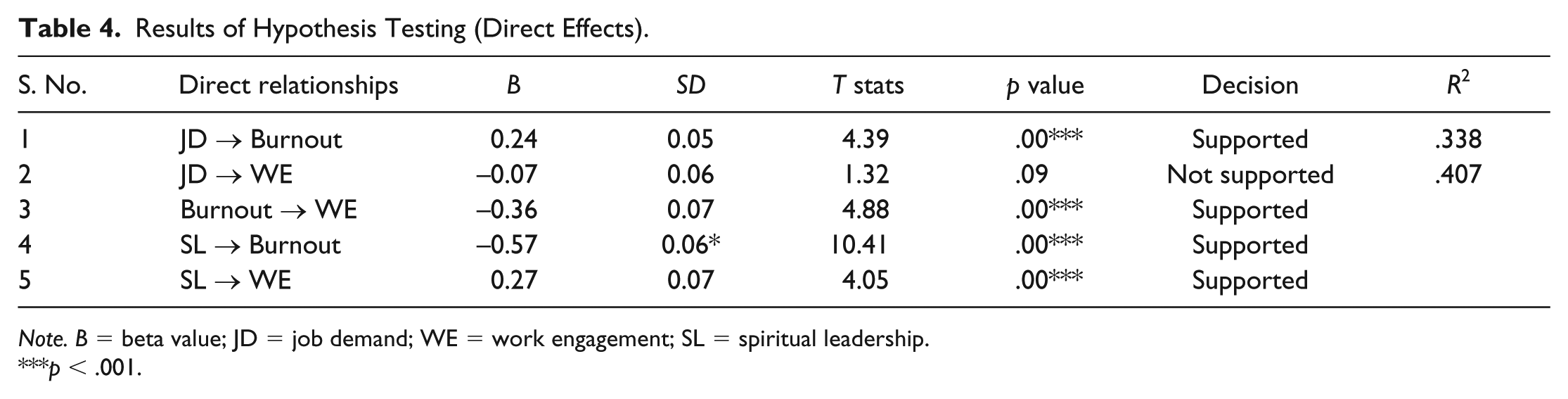
Note. B = beta value; JD = job demand; WE = work engagement; SL = spiritual leadership.
p < .001.
The results reveal the direct influence of every latent construct on work engagement (dependent variable). At the outset, Hypothesis 1 predicted that job demand is significantly and positively linked with burnout of higher education sector. Moreover, a positive significant association between job demand and burnout (β = 0.236, t = 4.39, p < .00) supports Hypothesis 1. Hypothesis 2 articulated that job demand is having an insignificant relationship with work engagement. The insignificant association among job demand and work engagement (β = −0.072, t = 1.32, p > .05) does not support Hypothesis 2. Hypothesis 3 predicted that burnout is negatively related to work engagement. The negative relationship between burnout and work engagement (β = −0.355, t = 4.88, p < .01) supports Hypothesis 3. Similarly, Hypothesis 7 predicted that spiritual leadership is negatively related to burnout. A negative significant association among spiritual leadership and burnout (β = −0.572, t = 10.41, p < .01) supports Hypothesis 7. Furthermore, a positive relationship between spiritual leadership and work engagement (β = 0.272, t = 4.05, p < .01) supports Hypothesis 8.
Table 4 illustrates the influence of the variables on work engagement in the higher education sector of Pakistan (dependent variable).
According to the methodology testing (Hayes, 2009; Preacher & Hayes, 2004), Table 5 shows the results of burnout as a mediator. The study found that burnout partially mediates between spiritual leadership and work engagement. On the other side, burnout fully mediates between job demand and work engagement. Therefore, Hypotheses 4 and 9 have been supported.
Test of Mediation and Moderation.

Note. B = beta value.
Interaction Effect
This current study model indicated the main moderating effect of spiritual leadership on the relationship between job demand and burnout and between burnout and work engagement. Table 5 shows the moderating effect of spiritual leadership in predicting burnout and work engagement. The results demonstrate that spiritual leadership moderates between burnout and work engagement (β = 0.233, t = 2.27, p < .05). Therefore, Hypothesis 6 has been supported, whereas Hypothesis 5 has not been supported (Figure 2).
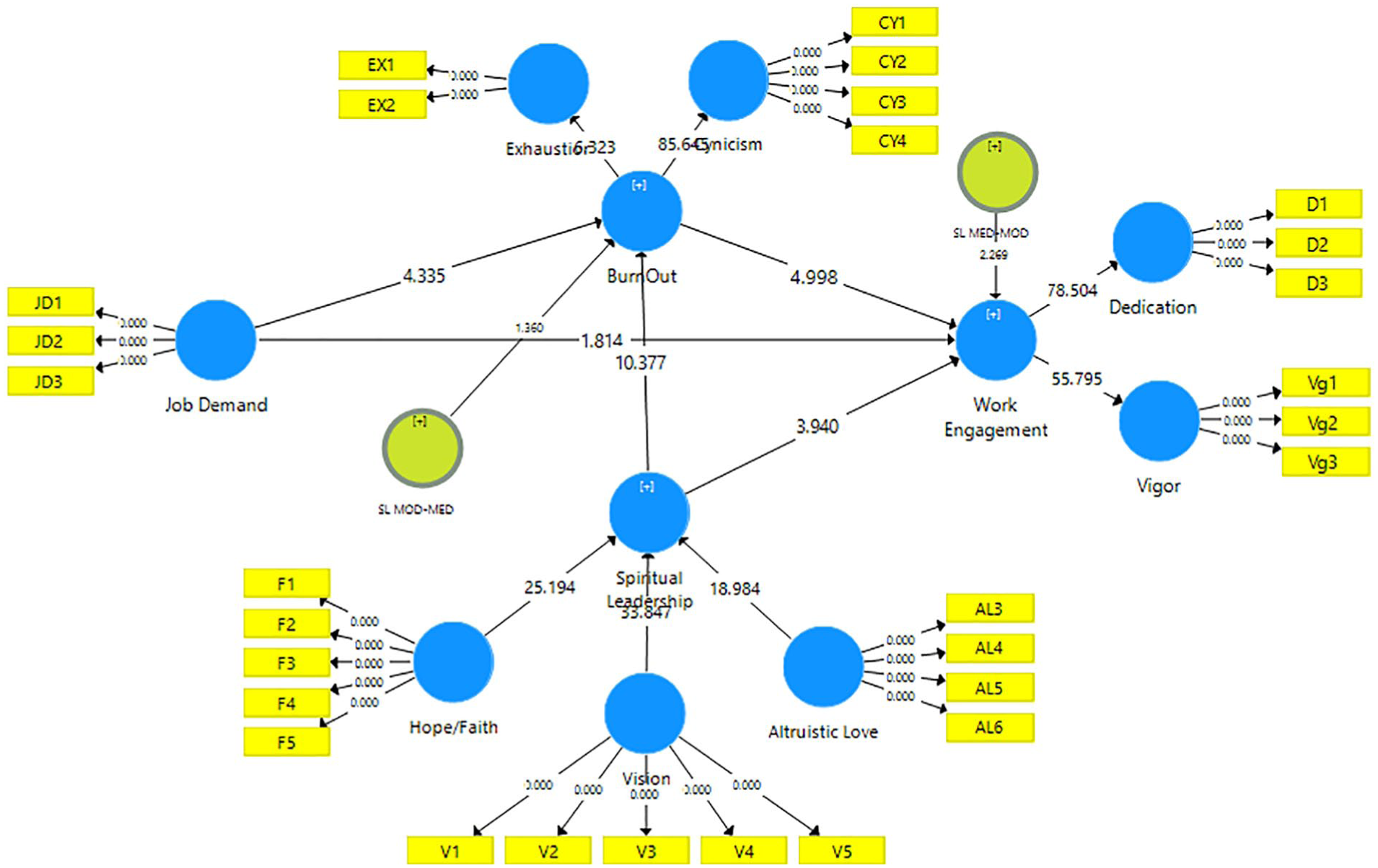
Structural model with moderating variable.
Information received from path coefficients was utilized to plot the moderation effect of spiritual leadership on the relationship between burnout and work engagement.
The data have presented significant support for burnout as a mediating variable between the relationship of job demand, spiritual leadership, and work engagement. Importantly, concerning the moderating effect of spiritual leadership on the relationship between job demand and burnout and between burnout and work engagement, PLS path coefficient demonstrates that the spiritual leader has moderated the relationship between burnout and work engagement, but it has not moderated the relationship between job demand and burnout. According to the results obtained, all hypotheses have been accepted, whereas Hypotheses 2 and 5 have not been accepted (Figure 3).
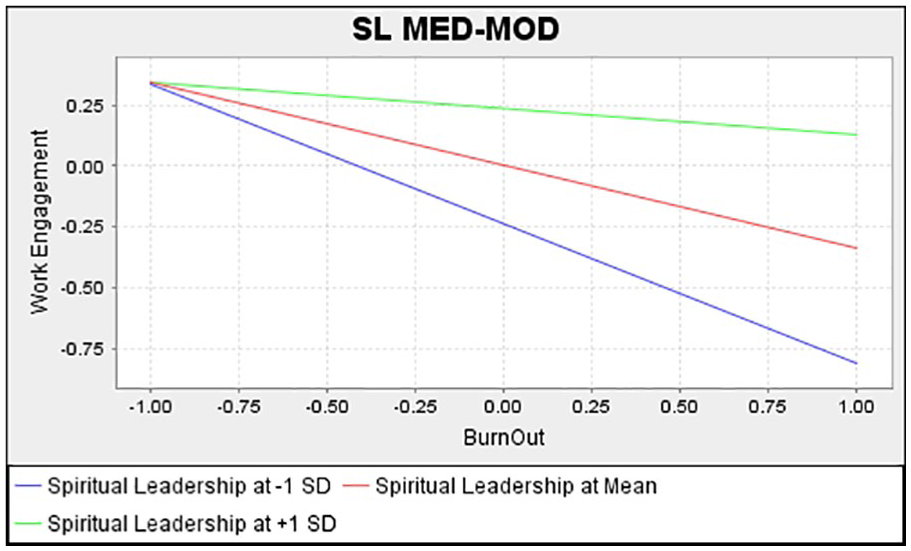
Interaction of spiritual leadership between the use of burnout and work engagement.
Discussion
To address the main objectives of the study, the study findings have highlighted that work demand is positively related to burnout, but, unfortunately, the study has found no relationship between job demand and work engagement. Spiritual leadership has a negative relationship between burnout and positive relationship with work engagement. Furthermore, burnout has mediated the relationship between spiritual leadership and work engagement. However, spiritual leadership did not moderate the relationship between job demand and burnout, whereas burnout has shown a negative relationship with work engagement. This study highlights that, in the case of working teachers in the universities of Pakistan, if the organizational demands related to job decrease, the employees are more engaged in their work.
In many cases, exposing individuals to high job demands will lead toward exhaustion and negative attitude (cynicism); the current findings empirically showed that job demand has a positive relationship with burnout. According to the regulation model of compensatory control, to understand the performance, one must understand the cognitive-emotional framework (Pessoa, 2015). This framework is better understood when it is observed under certain stress. This model also describes the sustainability of the performance under workplace conditions most particularly related to the various demands of the workplace.
Besides, a negative relationship between burnout and work engagement is in line with recent studies (Mäkikangas, Hyvönen, & Feldt, 2017; Maricuţoiu et al., 2017). Findings show that job demand is not a predictor of work engagement based on the core discussion of job demand-resource theory. Job demand is one of the major predictors of burnout in faculty working in public universities of Pakistan. Furthermore, burnout is high among teachers working in the higher education sector of Pakistan that might cause reduced employee engagement (Bakker, Demerouti, Taris, Schaufeli, & Schreurs, 2003). However, when employees feel such exhaustion, they show cynical attitudes toward work as they try to gain emotional distance from their job as a way of coping with stress, and burnout caused by job demand may lead toward psychological withdrawal or lack of work engagement.
Besides, due to increased burnout caused by high job demands, there is a need to tackle the situation so employees could maintain their positive state of mind and develop the motivation of doing work even in high job stress. Therefore, a spiritual leadership can play a significant role in moderating the relationship or even directly deals with the mental stress of the employees by creating vision and value congruence across employees and teams and foster higher levels of productivity and performance in them. The findings of this study are also consistent with SLT as when employees are working in an organization, where culture is based on altruistic love, they will be satisfied and happy, which in turn would enhance their job satisfaction, organizational commitment, work engagement, creativity, and reduced burnout of employees.
However, there is a negative relationship between spiritual leadership and burnout which implies that when spiritual leadership increases, burnout will be reduced. Other than that burnout mediates the relationship between spiritual leadership and work engagement. Spiritual leadership provides intrinsic motivation to employees through which employees are able to cope with difficult situations caused due to several job demands. The current study findings revealed that spiritual leadership moderates the relationship between job demand and work engagement which implies that when spiritual leadership is high, it reduces the negative relationship between burnout and work engagement by making the employees more engaged and less burnout through vision, faith, and altruistic love.
Implication
Based on the literature review and future recommendation, lack of investigation has been found to couple the job demand, spiritual leadership, and burnout in explaining work engagement based on JD-R theory and SLT theory. It has also been found that job demands and spiritual leaders do not usually affect work engagement directly. Hence, it has been highlighted that there is a missing link between job demand and work engagement. To fill this gap, researchers employed burnout as a mediating variable. Furthermore, spiritual leadership has been used as a moderator in the current study. Thus, the current study has significantly contributed to its findings on spiritual leadership in a relationship with burnout and work engagement as well as through burnout.
The current findings also indicate that teachers tend to be more engaged when they are working under certain work pressure. Therefore, the university’s management needs to ensure that their academics are constantly been given a task that needs to be completed within a limited time frame. However, the study will further contribute to helping the management of universities, policy makers, academicians, and practitioners to focus on the importance of spiritual leadership, job demand, and burnout and work engagement based on the current study findings in particular and by reviewing literature in general.
To engage employees, a leader needs to give importance to the spirit of employees which is possible if the leader has a vision, delivers a sense of faith and hope in subordinates, and has a concern and care for them. This study highlights the impact of extensive demands from employees in the workplace. For instance, such high demands create exhaustion and cynicism among employees. To sustain the engagement of employees, a spiritual leader can play a significant role. Moreover, a spiritual leader was found to be effective in decreasing the exhaustion and negative attitudes of the employees. Thus, the findings of the current study present a comprehensive insight into the understanding of work engagement and spirituality in academic institutions.
To have a sustainable engaged workforce in the current time where job demands cannot be compromised nor even resources can be enhanced, the academic institutes need to have leaders with spiritual leadership style. Institutes may consider spiritual aspect in a leader while promoting an employee toward such a position or at the time of hiring. They can also initiate a training program based on enhancing spiritual sides of employees, specifically leaders, which can help them in being an effective spiritual leader.
Future Recommendation
This study was limited to some universities in Pakistan. For better generalizability of the model, the research may be extended to increase the samples and consider other institutions and geographical areas. The model may extend its contributions in adding emotions related to variables such as surface acting, deep acting, and other cognitive variables to better understand the process of burnout and work engagement.
The study design was cross-sectional in nature which may increase the common method bias. So, experimental studies should be carried out to get quality results and for a better understanding of the phenomenon.
The results were obtained by considering only spiritual leadership. Literature showing that there are various other types of leaderships which should be taken along with spiritual leadership for better comparison. Moreover, trait, behavior, and situational-based theories of leadership should also be compared for the effectiveness of this model.
Footnotes
Declaration of Conflicting Interests
The author(s) declared no potential conflicts of interest with respect to the research, authorship, and/or publication of this article.
Funding
The author(s) disclosed receipt of the following financial support for the research, authorship, and/or publication of this article: This research was academically supported by Universiti Putra Malaysia, Universiti Malaya, and Air University Multan Campus, Pakistan.
