




Abstract
Hosting international sporting events brings various benefits to the host city, including direct and indirect economic benefits. However, few studies have explored the association between psychic income and marketing variables and life satisfaction. This study examined whether the perceived psychic income of the 2017 Taipei Universiade predicted intention to attend games, intention to purchase licensed merchandise, and life satisfaction. Convenience sampling was used to recruit 1,102 Taipei residents aged above 20 years in the city. The research sample was randomly split into an analysis sample and a validation sample to test the research hypotheses and ensure generalizability. Confirmatory factor analysis and hierarchical linear regression were performed for data analysis. The research findings indicated that perceived psychic income positively predicted intention to purchase licensed products, intention to attend the sport events, and life satisfaction. The results of this study have both academic and practical implications.
Introduction
Residents’ perceptions of the value of hosting a sporting event have tended to be discounted in event planning and decision-making procedure (Teye et al., 2002), and event proponents attempt to convince relevant stakeholders that hosting a sporting event is financially beneficial (Kim & Walker, 2012). However, the estimated monetary value associated with hosting a sporting event is usually inflated, making the value of such economic reports dubious (Coates & Humphrey, 2003; Gibson et al., 2003). Researchers have explored the perceptual effects of hosting major sporting events because the equivocal quality of economic impact analysis may undermine the persuasiveness and effectiveness of such analyses (Kim & Walker, 2012). Therefore, investigating how residents’ perceptions of major sporting events affect the local community is worthwhile (Ko & Stewart, 2002).
Scholars have called for increased research on the social impact of hosting an international sporting event. In addition to investigating the economic benefits related to hosting an international sporting event, scholars have suggested that the psychological impact of sporting events on residents should also be evaluated (Crompton, 2004). Among the numerous benefits associated with hosting a sport event, an intangible benefit called psychic income has attracted the attention of researchers (Inoue & Havard, 2014). Studies regarding psychic income in the sporting context have explored its relationship with social capital (Gibson et al., 2014; Oja et al., 2018), and psychic income-based arguments have been used to support public funding of sports facility construction (Crompton, 2004; Grieve & Sherry, 2011; Seifried & Clopton, 2013); moreover, psychic income has been applied to assess sports tourists’ satisfaction (Steynberg et al., 2004), perceived legacy of major sporting events (Liu et al., 2014), and scale development (Kim & Walker, 2012; Liu, 2017). Studies have explored psychic income in the context of sports events. However, the correlations of psychic income with manageable marketing variables and life satisfaction among local residents have not been investigated. This study examined the correlations between psychic income, game attendance intention, licensed merchandise purchase intention, and life satisfaction. Few studies have examined the association of psychic income with the hosting of a major sporting event from the perspectives of marketing and life satisfaction. Therefore, this analysis is valuable.
The 2017 Taipei Summer Universiade was the largest sporting event hosted by Taiwan since the Kaohsiung World Games and Taipei Deaflympic Games were held in 2009. Maximizing marketing benefits is usually one of the primary goals of the organizing committee when hosting a sporting event. Inoue and Havard (2014) argued that the social impact of sporting events may influence residents’ intention to attend the event and to purchase event-related merchandise. Compared with corporate sponsorship and broadcasting rights, licensed merchandise and ticket sales appear to account for a relatively low proportion of the total revenues of an international sporting event. Nevertheless, these revenues can be managed at the business-to-consumer (B2C) level (Mullin et al., 2014; Pitts & Stotlar, 2013). Therefore, this study examined whether psychic income significantly predicts event attendance intention and purchase intention of licensed event merchandise.
Unsurprisingly, attendance of sporting events correlates with social well-being (Inoue et al., 2015). Sport events can also boost residents’ perceived quality of life (Eitzen, 2005; Inoue & Havard, 2014). Moreover, the perceived pride and accomplishment associated with hosting an international sporting event can trigger residents to have positive attitudes toward hosting such events (Chalip et al., 2003; Crompton, 2004; Dwyer et al., 2000; Kim & Walker, 2012). The government agencies of the host city tend to be highly concerned with not only the economic benefits but also the noneconomic benefits, such as psychic income, derived from a sporting event because city council members tend to scrutinize the benefits of decisions made by city hall. If the rationale for hosting an international sporting event can be scientifically supported by the positive correlation between psychic income and residents’ life satisfaction, the sport authority of a city or nation can justify its decision to bid for such an event.
The purpose of this study was to examine whether psychic income significantly predicted the event attendance intention, the licensed merchandise purchase intention, and life satisfaction associated with the 2017 Taipei Summer Universiade. The contributions of this article are twofold. First, the association of psychic income with marketing variables was empirically investigated. Thus, this article enriches sports management literature regarding psychic income and broadens the scope of psychic income research. Second, this study provides government agencies with scientific evidence that psychic income is associated with life satisfaction when hosting a major sporting event.
Theoretical Framework
Social exchange theory, which provides a theoretical framework for social impact analysis (Andereck et al., 2005), was applied in this study. Social exchange theory argues that residents evaluated the costs and benefits of hosting a major sporting event. Individuals tend to be in favor of hosting a sporting event if they believe that the benefits of the event exceed its costs. By contrast, individuals are unfavorably inclined to hosting a sporting event if they believe that the costs of the event exceed its benefits. Support from city residents for hosting an international sporting event conveys the prospective host city’s determination to successfully bid for the event. This support also implies that the residents are willing to allow the city’s resources to be used for hosting the sporting event because they believe that the benefits of hosting the event would exceed the costs related to it (Brida et al., 2014; Kim & Walker, 2012). On the basis of this theory, Crompton (2004) and Kim and Walker (2012) have assumed that residents’ support for hosting major sporting events is a function of five dimensions: community pride as a result of enhanced image, enhanced community attachment, event excitement, community excitement, and pride in efforts to improve community infrastructure.
Review of Literature
Psychic Income
Psychic income refers to the emotional and psychological benefits derived by residents from a sporting event, even if they are not involved in hosting the event or do not personally attend the event (Auld et al., 2011; Crompton, 2004). Crompton (2004) as well as Kim and Walker (2012) have presented seven dimensions of psychic income: community pride, civic pride, resuscitation of nearby areas, collective self-esteem, social bonding, excitement associated with a sporting event, and emotional involvement with a sport event. Community pride results from increased community visibility domestically or internationally due to a sporting event. Community pride may in turn stimulate city residents’ sense of self-esteem (Crompton, 2004; Gibson et al., 2008). Civic pride, which was proposed by Crompton (2004), refers to city residents’ positive mental reconstruction due to hosting an international sporting event (Groothuis et al., 2004; Kim & Walker, 2012). The third dimension of psychic income is the pride involved in efforts to resuscitate deteriorated areas and sense of pride from revitalization of a certain area (Rosentraub, 2009). The fourth dimension of psychic income is the morale of host city residents when the city hosts an international sporting event. This dimension is called enhanced collective self-esteem (Kim & Walker, 2012). The dimension of social bonding refers to the increased friendship and interactions among city residents because of the sporting event (Funk et al., 2002; Trail & James, 2001). The sixth dimension of psychic income comprises the psychological state of excitement and the increase in the tourist inflow due to the sporting event (Chalip, 2006; Crompton, 2004; Green, 2001; Liu, 2017). The seventh dimension is the city residents’ emotional involvement with a sporting event (Kim and Walker, 2012).
Kim and Walker (2012) reexamined the conceptual framework of psychic income proposed by Crompton (2004). They performed model comparisons and scale development procedures and identified five factors that theoretically and empirically represent psychic income: community pride as a result of enhanced image, enhanced community attachment, event excitement, community excitement, and pride in efforts to improve community infrastructure. Compared with Crompton’s conceptual model, the work of Kim and Walker provided empirical evidence for the elements that form psychic income in the context of the Super Bowl (the championship of National Football League [NFL]). Studies on psychic income have developed new measurement scales (Liu, 2017) or adopted existing measurement scales (Gibson et al., 2014; Oja et al., 2018). Liu (2017) developed a seven-dimension scale to measure the psychic income associated with hosting the Beijing Olympics. By contrast, Oja et al. (2018) adopted Kim and Walker’s (2012) measures of psychic income in their work. Gibson et al. (2014) used a four-item scale to measure psychic income. Although Liu’s research may be the most appropriate basis for this study, it was not published before this study was conducted. Furthermore, the four-item scale used by Gibson et al. (2014) may oversimplify the measurement of psychic income. Consequently, the empirical model suggested by Kim and Walker (2012) was used in this study.
Intention to Attend Sporting Events and Intention to Purchase Licensed Merchandise
Predicting consumer behavior is critical for business entities and sport organizing committees for sporting events because this factor is related to revenue generation, marketing communications, community building, and relationship building with participants, spectators, host communities, and sponsors (Funk, 2008). However, measuring actual consumer behavior is often difficult. Therefore, intention to engage in a certain behavior has been used as a proxy variable in some research settings (Blackwell et al., 2006). Furthermore, intention has been validated to be an effective predictor of consumer behavior (Miniard et al., 1983). As suggested by Funk (2008), the sports decision-making process involves three major phases: the input, internal processing, and output phases. The input phase represents various external factors that affect the evaluation of the sport object. The internal processing phase represents the internal processing of inputs through motivation, personality, perception, and memory, which shape the evaluation of the sport consumption experience. The output stage represents psychological and behavioral outcomes, such as attitudinal and behavioral loyalty to a sport object. For sports marketers, transforming nonconsumers or low-interest consumers into loyal customers is important because attending sporting events and purchasing sports merchandise are one of the primary revenue sources for sports organizations; this accords with the frequency escalator concept (Mullin et al., 2014). In sports marketing research, intention has been proved to be a significant antecedent to consumption and game attendance behaviors (Kwon & Armstrong, 2002; Kwon et al., 2005, 2007; Trail et al., 2005; Wakefield & Blodgett, 1996; Yoshida & James, 2010). Therefore, intention to attend sporting events and intention to purchase licensed merchandise were adopted as proxy variables to measure actual consumer behavior in the context of the 2017 Taipei Summer Universiade.
Life Satisfaction
Life satisfaction refers to an individual’s overall cognitive assessment of their quality of life (Diener et al., 1985; Pavot et al., 1991; Shin & Johnson, 1978). Diener et al. (1985) argued that life satisfaction is an individual’s subjective judgment regarding their quality of life rather than an objective comparison with a criterion. Certain individuals may be dissatisfied with some aspects of their lives but may be satisfied overall with their lives. By contrast, other individuals may be satisfied with most aspects of their lives but may be dissatisfied overall with their lives. An individual’s global life satisfaction is more stable than their satisfaction regarding specific matters (Diener et al., 1985; Headey & Wearing, 1989). Thus, an individual’s global life satisfaction was considered in this study rather than their satisfaction with the 2017 Taipei Universiade.
Psychic Income and Intention to Attend and Purchase
The five dimensions of psychic income suggested by Kim and Walker (2012) are conceptually in line with the attachment stage specified in the psychological continuum model (PCM) proposed by Funk (2008). According to Funk and James (2006), the attachment stage of the PCM describes an individual’s psychological attachment to a sport or a sporting event. A strong psychological attachment drives an individual to attend the sporting event or purchase licensed merchandise related to the sporting event. This result has been observed in empirical research conducted on international sporting events, just as the 2009 World Games in Kaohsiung and 2009 Deaflympics in Taipei found such a correlation (Wu, 2012). Furthermore, the social impact of a sporting event on residents positively predicts event attendance and consumption of related products or services (Inoue & Havard, 2014). The civic pride of being the host city of a major sporting event and the community pride achieved due to increased community visibility may cause residents to have positive attitudes toward hosting an international sporting event. Civic and community pride may also attract participants and spectators to the event (Chalip et al., 2003; Dwyer et al., 2000). Studies have argued that sporting events can increase local residents’ community attachment as a community member (Heere & James, 2007). Moreover, Waitt (2003) suggested that the excitement level before and during a major sporting event is high due to the influx of visitors and event-associated activities. Thus, the 2017 Taipei Universiade can be reasonably described as an “euphoric” event because of its prominent promotion by government agencies in Taiwan. Moreover, the game atmosphere, which reflects the excitement of the event, directly and indirectly influences the behavioral intention to attend an event and purchase licensed products (Chen et al., 2013; Yoshida & James, 2010). Studies have revealed that demographic characteristics affect intention to utilize sports services (Y. S. Chiu, 2007; I. S. Chiu et al., 2018) and purchase sports merchandise (Lei & Wu, 2012). Demographic variables were not of interest in this study; however, they influence the intention to attend sporting events and the intention to purchase sports merchandise. Therefore, demographic variables are regarded as control variables to reduce bias on the relationship between psychic income and the dependent variables. This study proposed that psychic income derived from the 2017 Taipei Summer Universiade positively predicted intention to attend the event and intention to purchase licensed products. Consequently, the following hypotheses were tested:
Psychic Income and Life Satisfaction
Although life satisfaction is considered a relatively stable concept, it does not necessarily remain constant. Instead, life satisfaction can be affected by incidents in life. Empirical studies have indicated that participating in walking and running events can promote life satisfaction (Sato et al., 2016, 2017), and attending sporting events in person is associated with life satisfaction (Inoue et al., 2017). Event excitement, civic pride from being the host city of a sporting event, and community pride due to increased community visibility can also trigger residents’ positive attitudes toward hosting international sporting events (Chalip et al., 2003; Dwyer et al., 2000; Kim & Walker, 2012). City residents may attain psychic income from the honor of hosting an international sporting event because they believe that the host city is capable of hosting the event (Crompton, 2004). The event correlated with the life satisfaction of Taipei residents. Studies have indicated that demographic characteristics influence life satisfaction (Diener et al., 1999; Zullig et al., 2009). Demographic variables are not of interest in this study; however, these variables are correlated with life satisfaction. Therefore, demographic variables are treated as control variables to reduce bias on the relationship between psychic income and life satisfaction. Thus, the following hypothesis was proposed:
Method
Research Setting
The 2017 Taipei Summer Universiade (a 12-day sport event), which was held from August 19 to 30 in 2017, was the research setting of this study. Taiwanese citizens were excited that their country was hosting this international sporting event, which was the largest sporting event held in Taiwan after the 2009 Kaohsiung World Games and 2009 Taipei Deaflympics. More than 10,000 student-athletes and officials from more than 100 countries attended the event investigated in this study. The event comprised 21 sports competitions. Furthermore, more than 50 international and domestic media companies broadcast the event. Overall, tickets sold exceeded 700,000 units, constituting approximately 87% of the entire ticket capacity (“2017 Summer Universiade,” 2020). This event was used as the research setting because it was a major sporting event in terms of the number of nations, athletes, and spectators involved, which can increase the robustness of the study.
Taiwan’s sports authority, the Sports Administration of the Ministry of Education, spent approximately US$700 million on sports facility construction and renovation for the 2017 Taipei Summer Universiade. Taipei Dome, the planned venue for the opening ceremony, was initially intended to be ready before the 2017 Taipei Summer Universiade. However, construction was halted after the newly elected Taipei City Mayor Ko took his office because he suspected that the construction project involved some legal issues. Therefore, the opening ceremony for the 2017 Taipei Summer Universiade was relocated to Taipei Athletic Field (Liberty Times Net, 2015). A protest was held during the opening ceremony to undermine the ceremony. Due to this protest, for some delegations, only the flag-bearer athlete participated in the parade (The News Len, 2017). Despite the issues with the Taipei Dome and the protest during the opening ceremony, Team Chinese Taipei achieved an unprecedented overall performance in the 2017 Taipei Universiade, earning 26 gold medals and ranking third among all the participating teams.
Participants and Procedure
This research was approved by the research ethics committee (REC) of National Taiwan University (NTU). Data collection was conducted using convenience sampling in crowded locations, such as Taipei Railway Station, Mass Rapid Transit (commonly referred to as the “MRT”) stations, and department stores, during the 2017 Taipei Universiade. In accordance with the guidelines of the REC of NTU, participants below the age of 20 years were excluded from this study. Therefore, Taipei residents above the age of 20 years were the target population of this study. Participants were approached by the research assistants and were asked whether they were willing to participate in this study. The individuals who were willing to join this study were provided the research survey and they spent 5 to 10 min completing the survey. After completing the survey, the participants returned the survey to the research assistants. A total of 1,102 valid surveys were collected for analysis. To ensure generalizability, the research sample was randomly divided into an analysis sample (563 responses) and a validation sample (539 responses) to test the research hypotheses. Male participants accounted for 50.2% and female participants accounted for 49.8% of the research participants. The proportions of male and female individuals in Taiwan in July 2017 were 49.7% and 50.3%, respectively (Department of Statistics, Ministry of the Interior, 2020). The overall sample (χ2 < .01, p > .05), analysis sample (χ2 < .01, p > .05), and validation sample (χ2 < .01, p > .05) were representative of the population of Taiwan. Moreover, 53.3% of the participants were married and 46.7% were unmarried (Table 1). Similar patterns regarding demographic variables were found for the analysis and validation samples.
Summary on Demographic Variables (N = 1,102; N1 = 563, N2 = 539).

Note. US$1 = NT30. N = sample size for the overall sample (N = N1 + N2); N1 = sample size for the analysis sample; N2 = sample size for the validation sample.
Measurement
Demographic variables, psychic income, intention to attend the event, intention to purchase the licensed merchandise, and life satisfaction were measured in this study. The demographic variables included gender, monthly income, and marital status. The scale used for measuring psychic income was a modified version of Kim and Walker (2012). Specifically, the research setting of the Super Bowl used by Kim and Walker was replaced with that of the 2017 Taipei Universiade in the questionnaire for this study. The concepts of intention to attend the event and intention to purchase licensed merchandise were adopted from the study of Kwon et al. (2007). Life satisfaction was adopted from the Satisfaction with Life Scale (SWLS) suggested by Diener et al. (1985). A 7-point Likert-type scale was adopted to measure psychic income, intention to attend the event, intention to purchase the licensed merchandise, and life satisfaction. The scale ranged from 1 (strongly disagree) to 7 (strongly agree; Table 2).
CFA Results for Analysis (N1 = 563) and Validation Sample (N2 = 539).
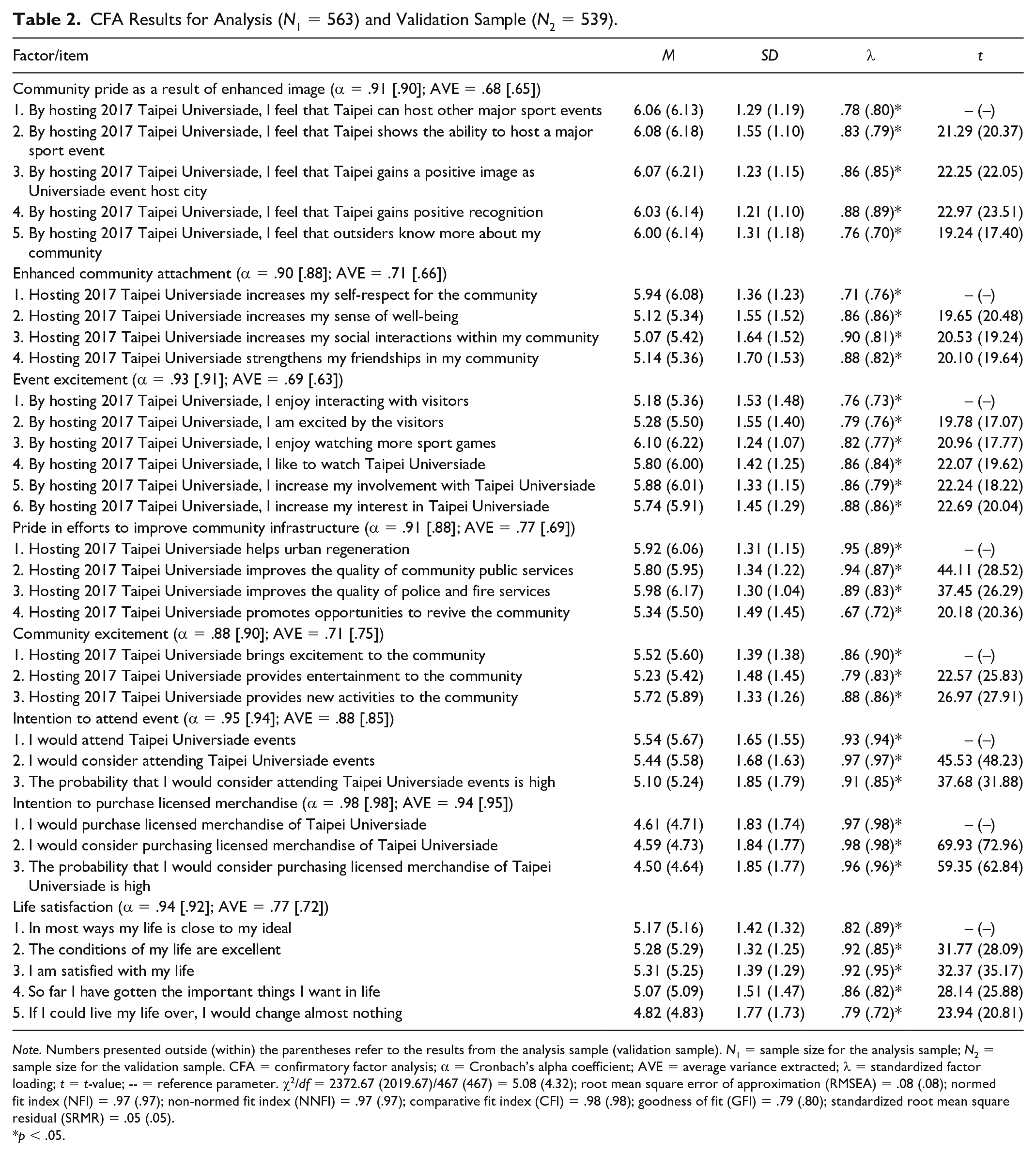
Note. Numbers presented outside (within) the parentheses refer to the results from the analysis sample (validation sample). N1 = sample size for the analysis sample; N2 = sample size for the validation sample. CFA = confirmatory factor analysis; α = Cronbach’s alpha coefficient; AVE = average variance extracted; λ = standardized factor loading; t = t-value; – = reference parameter. χ2/df = 2372.67 (2019.67)/467 (467) = 5.08 (4.32); root mean square error of approximation (RMSEA) = .08 (.08); normed fit index (NFI) = .97 (.97); non-normed fit index (NNFI) = .97 (.97); comparative fit index (CFI) = .98 (.98); goodness of fit (GFI) = .79 (.80); standardized root mean square residual (SRMR) = .05 (.05).
p < .05.
Prior to data collection, back-translation was conducted to ensure the validity of the content. Furthermore, a pilot study was conducted with 30 college students recruited from a university in northern Taiwan by using convenience sampling. The students were asked to provide their opinions regarding the understanding and wording of the items in the research questionnaires. After conducting back-translation and the pilot study, a few modifications were made to the wording of the questionnaire items.
The construct validity and reliability of the measurement used in this study were examined by performing confirmatory factor analysis and analyzing the Cronbach’s alpha coefficient according to the criteria suggested by Hair et al. (2006) and Fornell and Larcker (1981). Although the root mean square error of approximation (RMSEA) and χ2/df value did not meet the criterion, most of the other fit indices of psychic income revealed acceptable model fit for the analysis and validation samples. The Cronbach’s alpha for all the constructs ranged from .88 to .98 for both the analysis and validation samples, which indicated satisfactory internal consistency. Furthermore, the average variance extracted (AVE) for all the constructs and the standardized factor loadings of all the indicators were greater than .5, which suggested satisfactory convergent validity (Table 2). However, certain dimensions of psychic income failed to demonstrate sufficient discriminant validity because the shared variances between two dimensions were greater than their individual AVEs (Table 3).
Shared Variances and AVEs for Analysis and Validation Sample.

Note. Numbers presented outside (within) the parentheses refer to the results from the analysis sample (validation sample). Numbers listed in diagonal denote AVEs; numbers listed in the off-diagonal refer to shared variances between constructs. “a” and “b” denote the failure of constructs to pass the discriminant validity criterion for analysis sample and validation sample, respectively. AVE = average variance extracted; CE = community excitement; CI = pride in efforts to improve community infrastructure; EE = event excitement; CA = enhanced community attachment; CP = community pride as a result of enhanced image; PIE = purchase intention for event; PIP = purchase intention for product; LS = life satisfaction.
To account for common method bias, item ambiguity was avoided by using a valid and reliable measurement scale (Podsakoff et al., 2003). Furthermore, Harman’s single factor test was conducted on the analysis and validation samples. Exploratory factor analysis was performed on all items (k = 33) with the unrotated factor solution. The results of the Kaiser–Meyer–Olkin test (0.96/0.95) and Bartlett’s Test of Sphericity (χ2 = 20,777.49/18,015.41, df = 528/528, p < .01/p < .01) indicated that the analysis and validation samples were suitable for factor analysis (Kaiser, 1974). The five factors extracted from the factor analysis for the analysis and validation samples explained 76.22% and 73.80%, respectively, of the total variance among the 33 variables, and the first factor accounted for 54.03% and 49.20% of the variance, respectively. Thus, the effect of common method bias may warrant further attention.
Data Analysis
Hierarchical linear regression analyses were conducted to explore the three proposed research hypotheses by using the average score of the items for each construct. The correlation matrix for the constructs in this study is presented in Table 4. The hierarchical linear regression analysis for H1 was performed using intention to attend the game as the dependent variable. Moreover, demographic variables were used in the first block of the regression model and psychic income was used in the second block (Pedhazure, 1997). Dummy coding was used for categorical demographic variables. The same settings were used for the hierarchical linear regression analysis for H2 and H3; however, intention to purchase licensed merchandise and life satisfaction were used as the dependent variables to analyze H2 and H3, respectively. The residual plots and normal probability plots indicated that the model assumptions of linearity, normality, and homoscedasticity were met. Furthermore, multicollinearity among independent variables was an issue in this study because the values of variance inflation factor (VIF) were less than 10 (Montgomery et al., 2012).
Correlation Matrix Among All the Constructs in This Study.

Note. Analysis sample in the upper triangle; validation sample in the lower triangle. CP = community pride as a result of enhanced image; CA = enhanced community attachment; EE = event excitement; CI = pride in efforts to improve community infrastructure; CE = community excitement; PIE = purchase intention for event; PIP = purchase intention for product; LS = life satisfaction.
Results
Psychic Income to Predict Intention to Attend the Sporting Event
This study examined whether psychic income explained intention to attend the sporting event. The demographic variables entered into the model as the first block explained 3.1% of the variance in game attendance intention (F = 2.53, p < .05). The results of hierarchical linear regression analysis revealed that enhanced community attachment (t = 5.815, p < .05) and event excitement (t = 6.325, p < .05) were positively correlated with intention to attend the sporting event in the analysis sample. For the validation sample, the demographic variables entered into the model as the first block explained a nonsignificant proportion of the variance in game attendance intention (F = 0.762, R2 = .01, p > .05). Similar to the results obtained for the analysis sample, those obtained for the validation sample revealed that enhanced community attachment (t = 6.342, p < .05) and event excitement (t = 7.126, p < .05) were positively correlated with game attendance intention. Community excitement (t = −2.802, p < .05) was negatively correlated with intention to attend the sporting event in the validation sample. The aforementioned correlation was not significant in the analysis sample. Moreover, pride in efforts to improve community infrastructure and community pride, as a result of enhanced image, were found not significantly correlated with intention to attend the sporting event in either the analysis sample or the validation sample (Table 5). Overall, H1 was partially supported in this study.
Hierarchical Regression of Psychic Income to Predict Intention to Attend Games for Analysis Sample (N1 = 563) and Validation Sample (N2 = 539).

Note. Numbers presented outside (within) the parentheses refer to the results from the analysis sample (validation sample). CP = community pride as a result of enhanced image; CA = enhanced community attachment; EE = event excitement; CI = pride in efforts to improve community infrastructure; CE = community excitement; VIF = variance inflation factor.
p < .05.
Psychic Income to Predict Intention to Purchase the Licensed Merchandise
This study also investigated whether psychic income explained intention to purchase licensed merchandise. The demographic variables entered into the model as the first block explained 2.7% of the variance in licensed merchandise purchase intention (F = 2.16, p < .05). The results of hierarchical linear regression analysis suggested that enhanced community attachment (t = 6.800, p < .05) and event excitement (t = 2.830, p < .05) were positively correlated with intention to purchase licensed merchandise in the analysis sample. For the validation sample, the demographic variables entered into the model as the first block explained a nonsignificant proportion of the variance in licensed merchandise purchase intention (F = 0.82, R2 = .011, p > .05). Similar to the results obtained for the analysis sample, those obtained for the validation sample indicated that enhanced community attachment (t = 5.174, p < .05) and event excitement (t = 4.136, p < .05) were positively correlated with licensed merchandise purchase intention. Community excitement (t = 3.846, p < .05) was positively correlated with intention to purchase licensed merchandise in the analysis sample; however, this correlation was not significant in the validation sample. In addition, pride in efforts to improve community infrastructure and community pride, as a result of enhanced image, were not significantly correlated with intention to purchase licensed merchandise in either the analysis sample or validation sample (Table 6). Thus, H2 was partially supported in this study.
Hierarchical Regression of Psychic Income to Predict Intention to Purchase Merchandise for Analysis Sample (N1 = 563) and Validation Sample (N2 = 539).

Note. Numbers presented outside (within) the parentheses refer to the results from the analysis sample (validation sample). VIF = variance inflation factor; CP = community pride as a result of enhanced image; CA = enhanced community attachment; EE = event excitement; CI = pride in efforts to improve community infrastructure; CE = community excitement.
p < .05.
Psychic Income to Predict Life Satisfaction
This study explored whether psychic income explained life satisfaction. The demographic variables entered into the model as the first block explained 3.1% of the variance in life satisfaction (F = 3.24, p < .05). The results of hierarchical linear regression analysis indicated that enhanced community attachment (t = 2.807, p < .05) and event excitement (t = 2.186, p < .05) were positively correlated with life satisfaction in the analysis sample. For the validation sample, the demographic variables entered into the model as the first block explained 3.6% of the variance in life satisfaction (F = 2.79, p < .05). Similar to the results obtained for the analysis sample, those obtained for the validation sample revealed that enhanced community attachment (t = 3.611, p < .05) and event excitement (t = 2.711, p < .05) were positively correlated with life satisfaction. Community excitement (t = 1.979, p < .05) was positively correlated with life satisfaction in the analysis sample but not in the validation sample. Moreover, pride in efforts to improve community infrastructure and community pride, as a result of enhanced image, were not significantly correlated with life satisfaction in either the analysis sample or validation sample (Table 7). Thus, H3 was partially supported in this study.
Hierarchical Regression of Psychic Income to Predict Life Satisfaction for Analysis Sample (N1 = 563) and Validation Sample (N2 = 539).
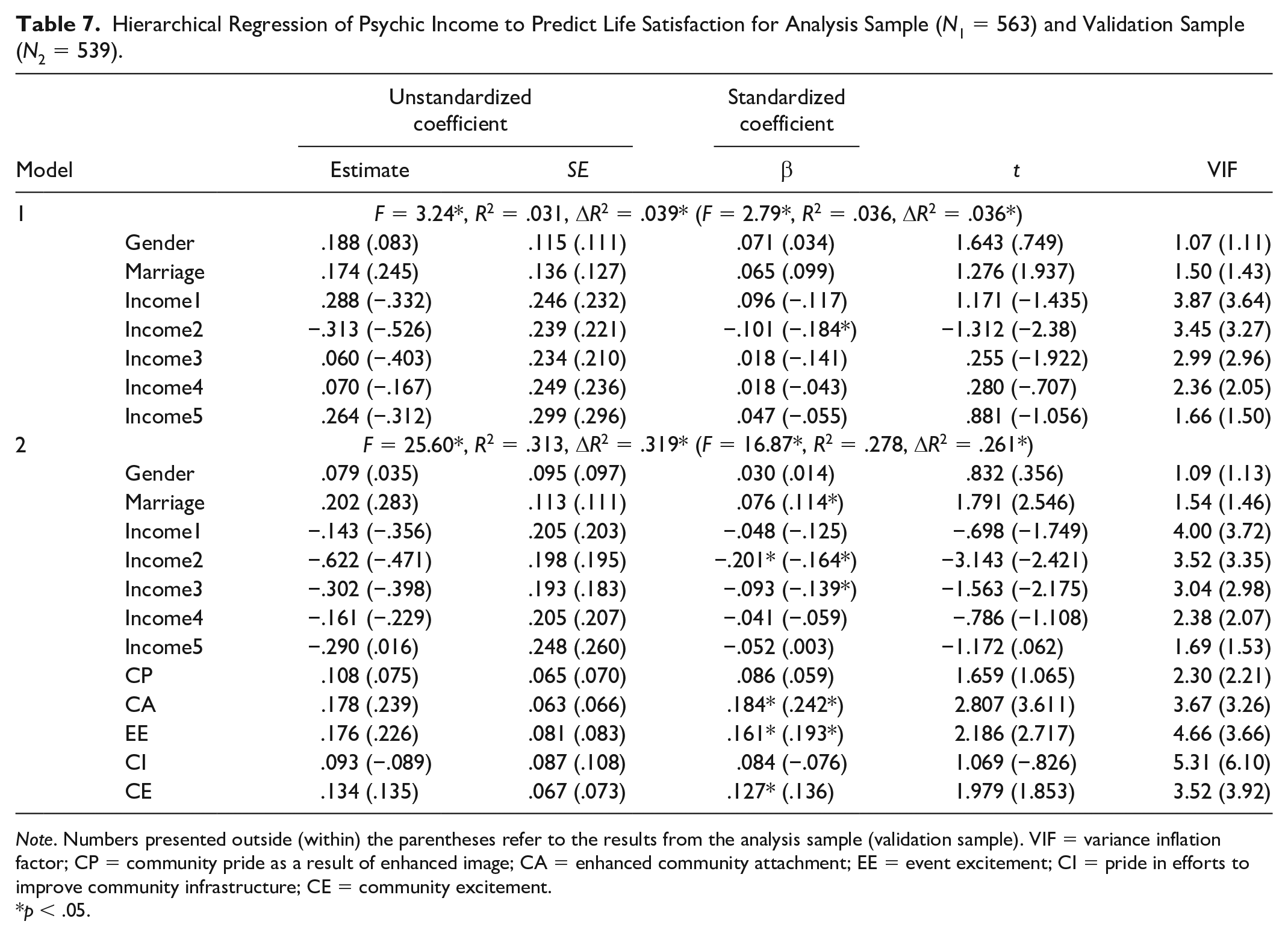
Note. Numbers presented outside (within) the parentheses refer to the results from the analysis sample (validation sample). VIF = variance inflation factor; CP = community pride as a result of enhanced image; CA = enhanced community attachment; EE = event excitement; CI = pride in efforts to improve community infrastructure; CE = community excitement.
p < .05.
Discussion
General Discussion
Overall, the participants exhibited a high level of psychic income related to hosting the 2017 Taipei Universiade. All the dimensions of psychic income were scored higher than 5 on a 7-point scale, which indicated that the participants perceived psychological effect from hosting the aforementioned sporting event. This finding is consistent with the findings of studies regarding the perceived psychological and societal effects associated with major sporting events (Chalip, 2006; Crompton, 2004; Kim & Walker, 2012; Rosentraub, 2009).
This study explored whether psychic income was positively correlated with game attendance intention, licensed merchandise purchase intention, and life satisfaction after controlling for demographic variables. To enhance the generalizability of this cross-sectional study, the research sample was randomly divided into an analysis sample and a validation sample. The results of hierarchical linear regression analysis provided partial support for the three proposed hypotheses.
Enhanced community attachment and event excitement were positively correlated with intention to attend the sporting event for both the analysis sample and validation sample, implying that greater perceived enhanced community attachment and event excitement are associated with higher intention to attend a sporting event. This finding is in agreement with the finding of Funk and James (2006) and (Wu, 2012) that psychological attachment drives an individual to attend a sporting event. The perceived enhanced community attachment of the sporting event was positively correlated with residents’ consumer behaviors, which is in agreement with the results of Inoue and Havard (2014), Chalip et al. (2003), and Dwyer et al. (2000). In addition, event excitement positively predicted intention to attend the sporting event, which is in agreement with the empirical finding that game excitement or event atmosphere is positively related to intention to attend a sporting event (Chen et al., 2013; Yoshida & James, 2010). However, community pride, as a result of enhanced image, and pride in efforts to improve community infrastructure were not significantly correlated with intention to attend the sporting event in either the analysis sample or validation sample. The nonsignificant correlation between pride in efforts to improve community infrastructure and game attendance intention may have resulted from the failure to construct the Taipei Dome on schedule due to the aforementioned decision of the mayor. From the perspective of social exchange theory (Brida et al., 2014), Taipei residents did not perceive more positive benefits than negative costs from the failure to construct the Taipei Dome on schedule because of the failure to enhance the city’s image and stimulate pride in efforts to improve community infrastructure, which led to the nonsignificance of community pride. Furthermore, an unexpected negative correlation between community excitement and game attendance intention was noted in the analysis sample. This result may have resulted from issues such as the failure to construct the Taipei Dome on schedule.
Enhanced community attachment, event excitement, and community excitement positively predicted licensed merchandise purchase intention, which confirms that the social impact associated with a sporting event is related to licensed product purchase intention (Inoue & Havard, 2014). Studies have argued that the perception of enhanced community attachment and the game excitement level of a major sporting event are positively correlated with residents’ consumer behaviors (Chalip et al., 2003; Dwyer et al., 2000). The results of these studies support the positive relationship identified in this study between enhanced community attachment, event excitement, community excitement, and licensed product purchase intention. Community pride that results from image enhancement and pride in efforts to improve community infrastructure failed to significantly predict licensed merchandise purchase intention, which may also be attributed to the failure to construct the Taipei Dome on schedule.
Life satisfaction was positively predicted by enhanced community attachment, event excitement, and community excitement. The “euphoric” promotion of the Taipei Universiade elicited residents’ positive attitudes toward the event (Chalip et al., 2003; Dwyer et al., 2000; Kim & Walker, 2012). This finding is in agreement with that of Crompton (2004), who stated that a sense of honor and satisfaction may be generated in host city residents when their city hosts an international sporting event. Furthermore, the positive correlation between the life satisfaction and psychic income of Taipei City residents due to hosting the Taipei Universiade indicates that an individual’s life satisfaction or subjective well-being is associated with specific occurrences in life (the Taipei Universiade in this study; Headey & Wearing, 1989). Community pride, which results from an enhanced city image and pride in efforts to improve community infrastructure, were not significantly related to life satisfaction, which may be attributed to the failure to construct the Taipei Dome on schedule.
Although the explanatory power of the variables in the first block of the model appears to be relatively low, the inclusion of demographic variables in the first block of the model is meaningful and essential in this study. Empirical evidence has indicated that demographic variables can be the confounding variables between an independent variable (psychic income) and the dependent variables (intention to attend sporting events, intention to purchase licensed merchandise, and life satisfaction). Some inconsistencies were observed between the analysis sample and validation samples in terms of the significance and direction of the effects in the regression models in which game attendance intention, licensed merchandise purchase intention, and life satisfaction were the dependent variables. For example, for the validation sample, the effects of demographic variables in the models with game attendance and licensed merchandise purchase intention were nonsignificant but those in the model with life satisfaction were significant. This discrepancy may be because game attendance and licensed merchandise purchase intentions are only marginally influenced by demographic variables, whereas life satisfaction is more strongly affected by demographic variables.
Taipei had not hosted a mega sports event for a considerable time, which may explain some of the positive influences of the event on psychic income, game attendance intention, and licensed merchandise purchase intention rather than the characteristics of the event itself. Therefore, any other sporting event hosted in Taipei would have had a similar effect and would positively influence community excitement.
Academic and Practical Implications
The findings obtained in this study have academic and practical implications. The correlations between psychic income, marketing variables, and well-being were empirically investigated. Accordingly, this study enriches the literature on psychic income in the field of sports management and broadens the scope of psychic income. The correlations between psychic income, game attendance intention, licensed merchandise purchase intention, and life satisfaction were investigated, which can broaden the scope of the literature on psychic income. From the practical perspective, this study provides government agencies and event bidders with scientific evidence that the psychic income of hosting major sporting events can be used as a part of the master plan for marketing. In addition to the argument based on the economic impact analysis report, the positive correlation between psychic income and life satisfaction can be a powerful argument to convince the citizens of countries interested in bidding for major sporting events. Specifically, enhanced community attachment and event excitement can be the primary themes leveraged by sporting event organizers to increase marketing performance and citizens’ life satisfaction.
Limitations and Directions for Future Study
This study has certain limitations. First, the problems of insufficient discriminant validity for some constructs in this study may be an issue. Future studies should examine the applicability of the adopted psychic income scale outside the U.S. context or consider using a different psychic income scale. Second, the nonsignificant associations between community pride and enhanced image, pride in efforts to improve community infrastructure, and the dependent variables were potentially caused by the potential political issue of the failure to construct the Taipei Dome on schedule. Research should be conducted on the effect of political factors on the variables considered in this study. Finally, the items were added into a single measure in the data analysis. Although adding multiple items into a single measure can cause data loss, such addition is essential for conducting multiple linear regression analysis.
Conclusion
This study provides theoretical and practical contributions. From the theoretical perspective, this study contributes to sports management literature through its examination of the association between psychic income, life satisfaction, and marketing variables when an international sporting event is hosted. The research sample was divided into an analysis sample and a validation sample to increase the generalizability of the cross-sectional research approach. From the practical perspective, the empirical findings of this study provide prospective bidders for international sporting events outside the United States with evidence that the psychic income generated from hosting an international sporting event can lead to an increase in life satisfaction, intention to attend the game, and intention to purchase licensed merchandise. This study enriches the sporting event literature.
Footnotes
Declaration of Conflicting Interests
The author(s) declared no potential conflicts of interest with respect to the research, authorship, and/or publication of this article.
Funding
The author(s) disclosed receipt of the following financial support for the research, authorship, and/or publication of this article: This research was funded by Ministry of Science and Technology (MOST 106-2410-H-179-002).
