




Abstract
The study helps in construct development for identifying motivators for adopting ecopreneurial behavior in StartUps. The study aims to address the limitations of previous studies that we are unable to suggest any such scale. The extensive literature review helped in forming initial statements. These statements underwent a few rounds of expert consultation and helped in identifying 20 statements. The exploratory factor analysis on a sample of 140 StartUps, suggested three major motivations that lead to ecopreneurial behavior. Later, confirmatory factor analysis using 160 respondents helped in offering a reliable and valid scale to evaluate these motivations in another sample of Startups to adopt ecopreneurial behavior. The study initiates to fill the gap of empirical contribution in the field of ecopreneurship and would help in the expansion of this field globally by identifying factors that are responsible for adopting ecoprenuerial behavior and foresee its linkages further.
Keywords
Introduction
Ecopreneurship as a concept has emerged in late 90’s. Anderson and Leal (1997) gave it a formal definition as follows
“entrepreneurs using business tools to preserve open space, develop wildlife habitat, save endangered species, and generally improve environment quality.” (p. 3)
Schuyler (1998) also identified ecopreneurs’ commercial endeavors more environment motivated rather than profit oriented. Ecopreneurship is a novel market based technique for identifying and capitalizing on opportunities that are promising in improving environmental quality. The concern of environment for an ecopreneur is as important as we perceive need for achievement for any entrepreneur (Vijaya & Kamalanabhan, 1998). Numerous academicians and organizations have confirmed the relationship between adoption of ecopreneurial practices and its benefits to the environment (Kirkwood & Walton, 2010; Schaltegger, 2002). However, a few questions remain unanswered. What drives eco-behavior? Are these drivers unique for every ecopreneur? Do these drivers result in the observable behavior of ecopreneurs?
Studies contributing to the above question are limited in their approach. It has very few empirical contributions. Ecopreneurship is relatively a new research field that requires more qualitative and quantitative contributions (Guleria & Kaur, 2021). This paucity in empirical research could be because of lack of availability of measurement scale that can remove ambiguity surrounding this concept. Another challenge, particularly in countries like India, is a lack of knowledge, which results in a lack of visibility for ecopreneurship business ideas. Collaboration between researchers, ecopreneurs, consumers, and producers is necessary to ensure long-term sustainability (Rodríguez-García et al., 2019; Santini, 2017). Thus, this study is one of its kind that aims to fulfil these gaps by developing a valid scale to measure the motivations of ecopreneurs and their ecopreneurial behavior (Figure 1).

Guidelines for scale development and analysis.
Scale development and validation is a vast field of knowledge. Initiating a scale construction involves conscious decisions while choosing various scale development techniques. In this study, we followed certain steps viz. item generation, expert consultations, and statistical validation. For statistical validation, exploratory factor analysis (EFA) and confirmatory factor analysis (CFA) are used and as recommended by Hair et al. (2019), responses form two different samples are used. With one sample, EFA is executed, while the other sample is used to examine measurement model to confirm it with CFA.
Thus, Motivation for Ecopreneurial Behavior (MEB) scale follows steps given by Hinkin et al. (1997) for scale construction and validation. The development process underwent three steps.
We used expert consultation for settling upon the items of scale for further analysis.
We constructed a scale for measuring motivation using first survey of startup owners or entrepreneurs.
We examined the three-factor scale for reliability and validation using a second survey.
Theoretical Framework
Scale development begins with establishing a conceptual knowledge of the construct. The need to identify ecopreneurial motivation or the motivation behind adoption of ecoprenuerial behavior is of utmost importance for understanding and promotion of ecopreneurship. Many researchers identified motives for environment engagements (Kirkwood & Walton, 2010; Mittal & Sangwan, 2014; Nhemachena & Murimbika, 2018). Also, many qualitative studies to define ecopreneurship’s conceptual dimensions (Gómez-Haro et al., 2015; Kainrath, 2009; Santini, 2017; Schaltegger, 2002) helped in deriving our framework.
Conceptual Evolution of Ecopreneurship
Entrepreneurs have a very important role to play in the economy and business practices toward a sustainable economic system. Thus, Schaper (2002) highlighted the importance of eco-entrepreneurship in developing innovative and dynamic business solutions. Ecopreneurship or eco-entrepreneurship provide new prospects for the “nimble first movers” who identify and exploit such opportunities. In addition to this, out of all forms of environmental management initiatives, ecopreneurship is a start-up of pioneering initiatives, supplying eco-friendly products and services. According to Schaltegger (2002, p. 48).
“Ecopreneurship is thus distinguished from other forms of corporate environmental development by the company’s vivid commitment to environmental progress and its strong desire for business growth.”
Wagner (2009) conducted an empirical study on students and alumni of science and engineering programs to study the relationship between adoption of environmental management system (EMS) and firm size on a firm to become an ecopreneur. The results indicated that the adoption of EMS is necessary to be an ecopreneur and that small and medium-sized enterprises are less likely to be ecopreneurs. Thus, it becomes essential to adopt techniques for popularizing EMS in small-sized firms and synchronize their practices accordingly. To develop a better understanding of engagement of small and medium-sized enterprises (SMEs) in environmental practices, Hoogendoorn et al. (2015) comprehended that stringent ecological legislation and financial support in any form, encourages firms to take on environmental activities, actively.
The field of ecopreneurship has few empirical contributions to its credit. An extensive literature review by Santini (2017) revealed the gradual increase in the popularity of ecopreneurship as a research field and contributing to this field with more quantitative and qualitative research based on available conceptual models. Additionally, introducing new models, expanding case studies across numerous dimensions, and doing empirical research on a bigger scale can all contribute significantly to embodying development and broadly disseminating the theoretical roots of this field. Ecopreneurship as an emerging sector is believed to be in continuous progress by Rodríguez-García et al. (2019). Concepts like green marketing can help managers and ecopreneurs to raise awareness and inform, educate, and change consumer behavior, particularly in nations that have recently developed interest in sustainable entrepreneurship and ecopreneurship (Kardos et al., 2019).
Furthermore, ecopreneurship, or sustainable entrepreneurship (Rodríguez-García et al., 2019), is a developing field. The absence of knowledge and a visible business plan is the most significant obstacle. To achieve long-term sustainability, ecopreneurs, consumers, and producers must work together to achieve it. Potluri and Phani (2020) indicated that including a “green” aspect in entrepreneurship education is one strategy to bring about this shift by merging environmental and entrepreneurial education. However, they raise concern pertaining to policy and capital structure for green businesses. Interestingly this does not stops the ecopreneurs to act in accordance with their green values and offer environmentally friendly products and services.
The thematic evolution under bibliometric analysis of ecopreneurship field conducted by Guleria and Kaur (2021) revealed that the creation of themes to identify constructs demonstrates very well how the focal field of ecopreneurship has evolved from developing contexts and presenting concepts to establishing ecopreneurship and environmental entrepreneurship as research subjects. These fields have developed over time toward sustainability as a research field. The global acceptance of sustainable development goals has had a considerable impact on this evolutionary trajectory. Ecopreneurship, green entrepreneurship, environmental entrepreneurship, and sustainable entrepreneurship have all been used interchangeably in the reviews examined for this analysis (Isaak, 2002; Dixon & Clifford, 2007; Schaltegger, 2002), and these concepts have evolved as the foundations for sustainability and sustainable practices.
However, for better understanding and setting boundaries for the research field, the constructs initially suggested by Kainrath (2009) were adopted for the current study of scale development, viz. eco-innovation, eco-commitment, and eco-opportunity.
Motivation for Becoming Ecopreneurs
The contributions of Post et al. (1994) marked the starting point for identifying motivation to be an ecopreneur. After an extensive review of the literature published before 1994, they identified three distinct forms of environmentalism, in the form of legal, market, and value or ethical aspects. First, compliance-based environmentalism or legal form in which all laws, regulations, and hundreds of statutory represent the government and societal concern for environment. Second, market-driven environmentalism emphasizes on encouraging innovative manufacturing solutions to reduce waste and toxins, improve quality, and enhance product efficiency. This also encourages ecological beneficial behavior. By offering Total Quality Environmental Management (TQEM). Third, “value-driven environmentalism, where consumers were willing to act on their environmental values and pay for it” (pp. 64, 65). In addition, they had a notable contribution with the finding that
“communities would no longer accept major environmental damage as the price for economic opportunity. Thus, jobs and a safe environment would have to be achieved at the same time and finding ways to harmonize economic activity and environmental protection in order to serve future generations as well as today’s population. This principle has become popular as sustainable development” (Post et al., 1994, p. 66).
Gómez-Haro et al. (2015) identified the fourth motivator, the intrinsic motivation that defines the environmental values of entrepreneurs. To illustrate this, they examined a case study from the tourism industry, as the environment forms a significant part of this industry’s product. The research exemplified ecopreneurial motivation to generate multiple organizational capabilities to the competitive advantage of the company. According to the researchers, this environmental philosophy epitomized the contribution that ecopreneurship can make to sustainable development.
An interview based study by Kirkwood and Walton (2010) also identified some factors like green values, passion, and existing gaps in the market that act as motivation, similar to entrepreneurial motivation but indifferent from their green motivation and low monetary motivation. The study is case-based with limited understanding of ecopreneurs suggesting adoption of qualitative and quantitative studies.
Jayashankar et al. (2018) have indicated that the motives of ecopreneurs engaged in agriculture impact perceived value creation. While the motivation maybe internal or external; either economic, environmental, socio-ethical, or structural, they lead to value addition. This value added is in the form of social, financial, environmental, or livestock benefits. Thus, a clear understanding and identification of motivation among various industrial entrepreneurs can also highlight the value of socio-economic domains.
Nhemachena and Murimbika (2018) suggested enterprises motivated for sustainable practices could generate inclusive socio-economic benefit and thus, make a significant contribution toward sustainable development. These studies have emphasized factors that impact environmental performance of enterprises as well as pro-environmental entrepreneurial motivation.
In another study, Gunawan, Essers, and van Riel (2021) studied the confluence of value-based motives and social identities such as gender, religion, and ethnicity. For various reasons, the degree of masculinity and femininity plays a vital role. In the ecopreneurial industry, male entrepreneurs are guided more by more feminine principles compared to other industrial sectors. Entrepreneurs’ reasons for adopting ecopreneurial methods are influenced by religious teaching of “harmony with the environment” and “sharing blessings and resources.”
How Ecopreneurial Motives Lead to Adoption of Ecopreneurial Behavior?
Ecopreneurial behavior helps to understand the association between the activities of entrepreneurs and their sensitivity toward the environment through the products or services that they deliver in the market, with a motive to bring some observable change. It is also important to provide financial assistance to such pro environmental entrepreneurs, who often face challenges, as Bergset (2018) highlighted. Lack of awareness and high level of innovativeness may sometimes make it tough for ecopreneurs or green start-ups to arrange finances compared to other entrepreneurs. This is also because radical behavioral modifications and clear motivation behind such behaviors remain unexplored. However, to fill this gap, Kainrath (2009) suggested three sub concepts for ecopreneurial behavior; eco-innovation, eco-commitment, and eco-opportunity.
Leitner et al. (2010) anticipated that technological innovation would have a solution for many environmental problems. Strict regulations and environmental obligations do fulfil long-term ecological goals. In addition, a survey conducted on German SMEs by Klewitz et al. (2012) aimed at introducing the concept of sustainable development through the implementation of eco-innovations in various organizations. The research identified drivers for eco-innovation, namely “profit and sales margin; reputation and brand image: attractiveness for employees; risk management as well as cost and cost reduction” (p. 452). For a successful demonstration of ecopreneurial behavior of the company, it is necessary to involve all employees in a common environmental commitment (Gómez-Haro et al., 2015).
An exploratory interview data collected by Wagner and Llerena (2011) supported this by revealing that a better understanding of the corporate tools (such as foresight techniques, road mapping, or scenario planning) among stakeholders also increases diffusion of eco-innovation in the organization.
Mittal and Sangwan (2014) are credited to a detailed analysis for identifying green manufacturing drivers; including legislations, public pressure, and top management commitment. The drivers and their prioritization suggest that government incentives encourage ecological innovation by investing in green technologies and environmental practices. In addition, community awareness encourage customer demand for environmentally friendly products.
Hojnik (2017) has broadly discussed motives responsible for adopting eco-innovation; one of the behavioral constructs. Compliance-based, market-based, and value-based policies induce environmental innovation. Compliance-based is based on legislations, taxation and subsidies; market-based in quality products, competitiveness and value-based in individual commitment, green values, and public pressure. Environmental innovativeness can be achieved by adopting emerging technologies and offering environmentally friendly products and services.
The value of pro-environmental activities in achieving economic gains has been proven time and time again by researchers. Ljungkvist and Andersen (2021) proposed assessment of environment business practices on economy, revealing a positive and significant association between the two. Gender disparities influence ecopreneurial behavior and motivation. Gunawan, van Riel, and Essers (2021) developed a conceptual framework for recognizing the differences in motivation and entrepreneurial behavior between men and women. According to the study, female entrepreneurs are more strongly driven by “personal, social, ecological, and familial values” than their male counterparts are.
Scale development and validation comprises of two processes: interview/expert consultation and statistical validation. Methodology usually stems from literature review when there is abundant information available. However, interview/expert consultation is preferred when limited knowledge or information exists about a particular topic. This method serves objective of supplementing some information to an unexplored research topic. For example, a researcher wants to investigate about some feature of mobile phones before its inception; in such cases it is essential that the researcher opts for in-depth interviews. However, it must be kept in mind that a novice scale cannot be developed only on expert advice of an individual’s previous experience or hold over that body of knowledge. Scale development is a well-established procedure which requires certain rules to be followed. According to the rule of thumb—the more the experts, the better it is. However, no researcher has either unlimited time or money to perform this work. According to Hair et al. (2019), around four to six experts are sufficient for providing solid base for scale construction. Another matter of concern is the seriousness of the experts for recommending changes in the scale. Changes in wordings or the item(s) can have great impact on the final development of the scale.
The second step is statistical validation. According to Hair et al. (2019), the following techniques can be used:
Exploratory Factor Analysis (EFA)
Confirmatory Factor Analysis (CFA)
Confirmatory Composite Analysis (CCA)
Item Response Theory (IRT)
EFA helps to understand and clarify new items/constructs of various scales. The main focus of EFA is data reduction and sheds light on uncorrelated factors. CFA on the other hand, is a statistical technique which mainly focusses on the factor structure for a set of observed variables. EFA and CFA both are multivariate statistical techniques commonly used in scale development, purification, measurement, and validation process. CCA measures all the variables in the measurement model. ITR is another way to analyze the questionnaire with the objective of improving accuracy or reliability (Hair et al., 2019).
Expert consultation coupled with statistical validation including EFA and CFA will be used for scale development process of this paper.
Method
We conducted a thorough literature analysis and were unable to locate a validated scale to identify an entrepreneur’s motivation that enables them to adopt ecopreneurial behavior. To achieve this, we undertook development of the scale by describing 1) adop(tion of expert consultation for settling upon the items of scale, (2) scale development for motivation using factor analysis. For scale development, we conducted two separate studies with two different samples. The first sample included 140 entrepreneurs from northern states of India. We used study 1 to construct a scale and explore the factor structure using Exploratory Factor Analysis (EFA), and (3) The second study helped us to examine the scale’s reliability and validity using Confirmatory Factor Analysis (CFA) with a second sample of 160 entrepreneurs.
Item Generation
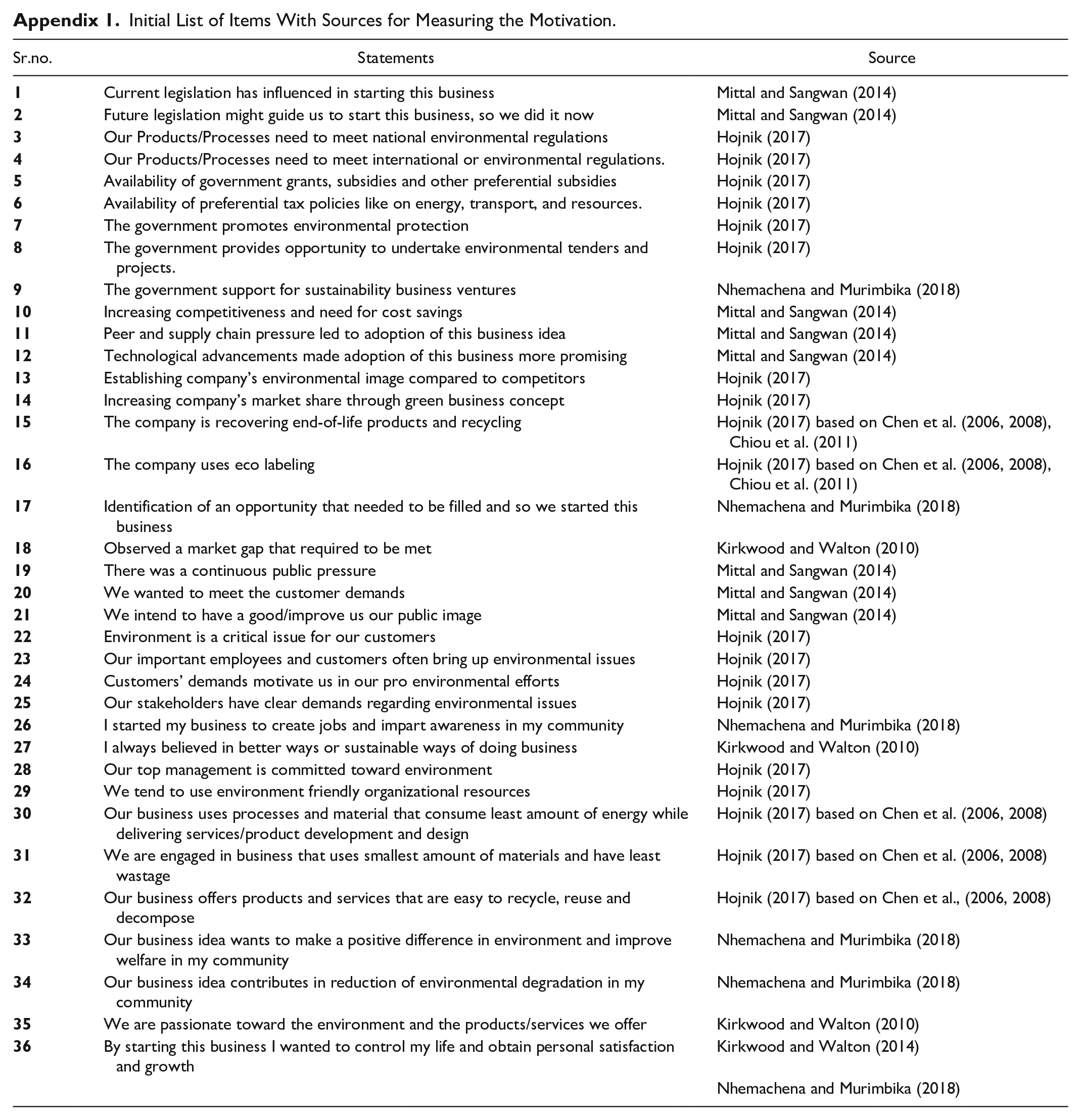
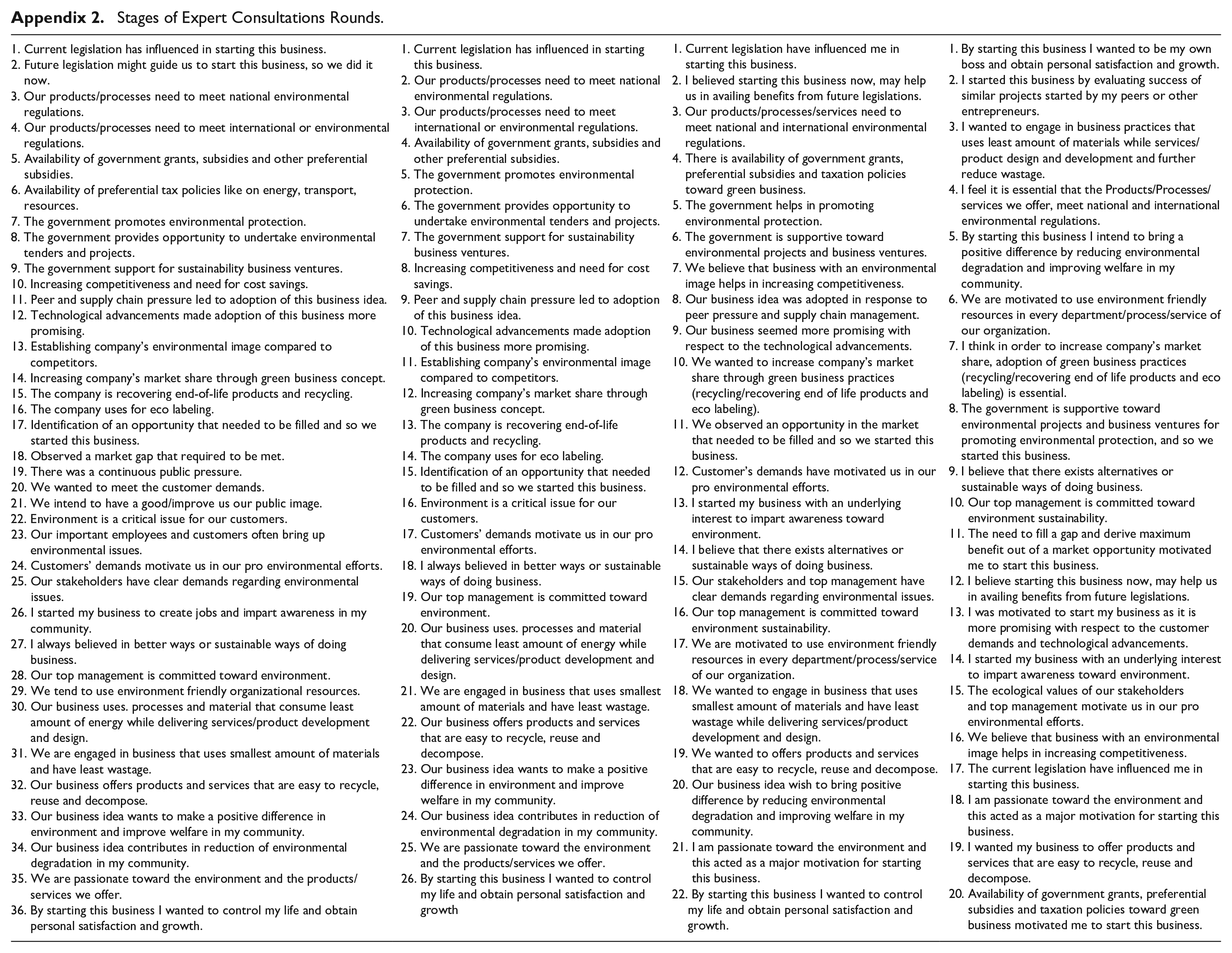
We developed potential responses through expert consultations, a modified Delphi technique (Younas & Porr, 2018). We made a list available to the expert panel to address the underlying motivation that remain unexplored. The panel expresses their judgements upon the listed items and prioritize on a given criteria (Avella, 2016). This process is also responsible for converting opinions into group consensus (Hasson et al., 2000). The panel included academicians of diverse backgrounds with vivid educational expertise and conceptual understanding. In addition, industry experts were included because of their leadership roles, market understanding, and interest in the topic. Initially, we sought consent from 20 experts to become the part of the panel but eventually 13 experts agreed to participate. In the first expert consultation round, we generated an initial list of 36 items (Appendix 1) to measure the motivation for ecopreneurial behavior. We distributed the list to the experts in order to assess the importance of each item for being a motivator for starting a business and adopt ecopreneurial behavior. The ratings were collected on 4-point likert scale where; 1 = very relevant; 2 = relevant; 3 = non relevant; and 4 = eliminate. Follow-up calls, along with complete information about the statements in the form of supplementary sheets were provided to the experts in order to encourage participation from the experts. We also asked the experts to provide feedback or suggestions in the form of change in wordings or phrases, noting redundancies, or even proposing additional items.
We used central tendency and dispersion measures to analyze the responses and reach group consensus by eliminating the statements scoring less than the mean value. As a numerical indicator for group consensus, the mean value of 2.0, the midpoint of the 4-point scale, was used. (Newman & Johansson, 2009). The mean values less than 2.0 were included. The standard deviation (SD) was used to quantify the dispersion of responses for each criterion and to provide additional evidence of group consensus. The smaller the standard deviations, the greater the agreement. So, the standard deviation less than one were eliminated. The process was repeated for all rounds.
After receiving the responses from experts for first round, we eliminated the items according to the suggestions of experts and made some changes in wordings. The 36 items were reduced to 26 items. We summarized the list and again emailed the items to the experts with the request for participating in the second round. The resulting list consisted of 22 items removing the items that seemed having similar meanings and seemed redundant. Finally, after third round we were left with 20 items with minor changes in wordings and clubbing of items which somewhat hinted toward same meaning. These 20 items reached full consensus. And thus, we used a five-point Likert scale (Likert, 1932) to rate each motivation criterion of an entrepreneur that enables them to adopt ecopreneurial behavior, where five stands for strongly agree and one stands for strongly disagree. Appendix 2 consists a table that explains the stages of expert consultation rounds followed to derive the items for motivation of ecopreneurial behavior (MEB) scale.
Sample Selection
The sampling frame for both the studies (Study 1 and Study 2) were the StartUp owners registered under StartUp India program. The entrepreneurs and their organizations that are registered as starups avail many ascertained benefits by the Government of India. Moreover, startups have less compliance bindings and contribute most to ecological damage (Wagner, 2009) thus, it becomes important to focus a study to identify pro environmental motivation of these entrepreneurs.
The updated sampling list of registered StarUps was made available from the Department for Promotion of Industry and internal Trade (DIPP or DIPPT) under Ministry of Commerce and Industry, Government of India. StartUp initiative was launched in January 2016, and since its inception, there is a substantial progress under StartUp India program and DIPP is responsible for its implementation.
Study 1: Construction of the Ecopreneurial Motivation Scale
Reliability analysis
The 20-item scale was subjected to a pilot study in order to measure internal consistency. The 140 respondents for the survey were contacted personally (through appointments and emails) for explaining the objective and methodology of the study. The responses were collected using close-ended questionnaires rating the motivation accordingly. The internal consistency or reliability analysis was done using Cronbach’s alpha. The coefficient alpha was high (α = .96, 95% confidence interval). Missing data and outliers were also checked and handled. After initial screening of items in expert consultation, we conducted EFA on Survey 1 to identify underlying motivation factors that enable ecopreneurial behavior adoption.
Data analysis
We conducted EFA with a sample of 140 respondents. The respondents represented were startup owners from industrial sectors like agro-based (n = 33, 23.57%), manufacturing (n = 29, 20.71%), services (n = 42, 30.01%), and technology/innovation (n = 36, 25.70%). The sample included Male (n = 123, 87.86%) and Female (n = 17, 12.14%) entrepreneurs to test the factor structure and identify items for final measure. We used Bartlett’s test of sphericity and Kaiser-Meyer Olkin (KMO) test to evaluate the appropriateness for conducting EFA (Table 1). In Figure 2, the anti-image correlations, in the main diagonal for measuring sample adequacy using KMO test for each variable was conducted. The table image clearly indicates that because the values were above 0.5 or 50% (Hair et al., 2019), thus no variables were eliminated.
Output for KMO and Barlett Tests.


Exploratory factor analysis’s correlation matrix.
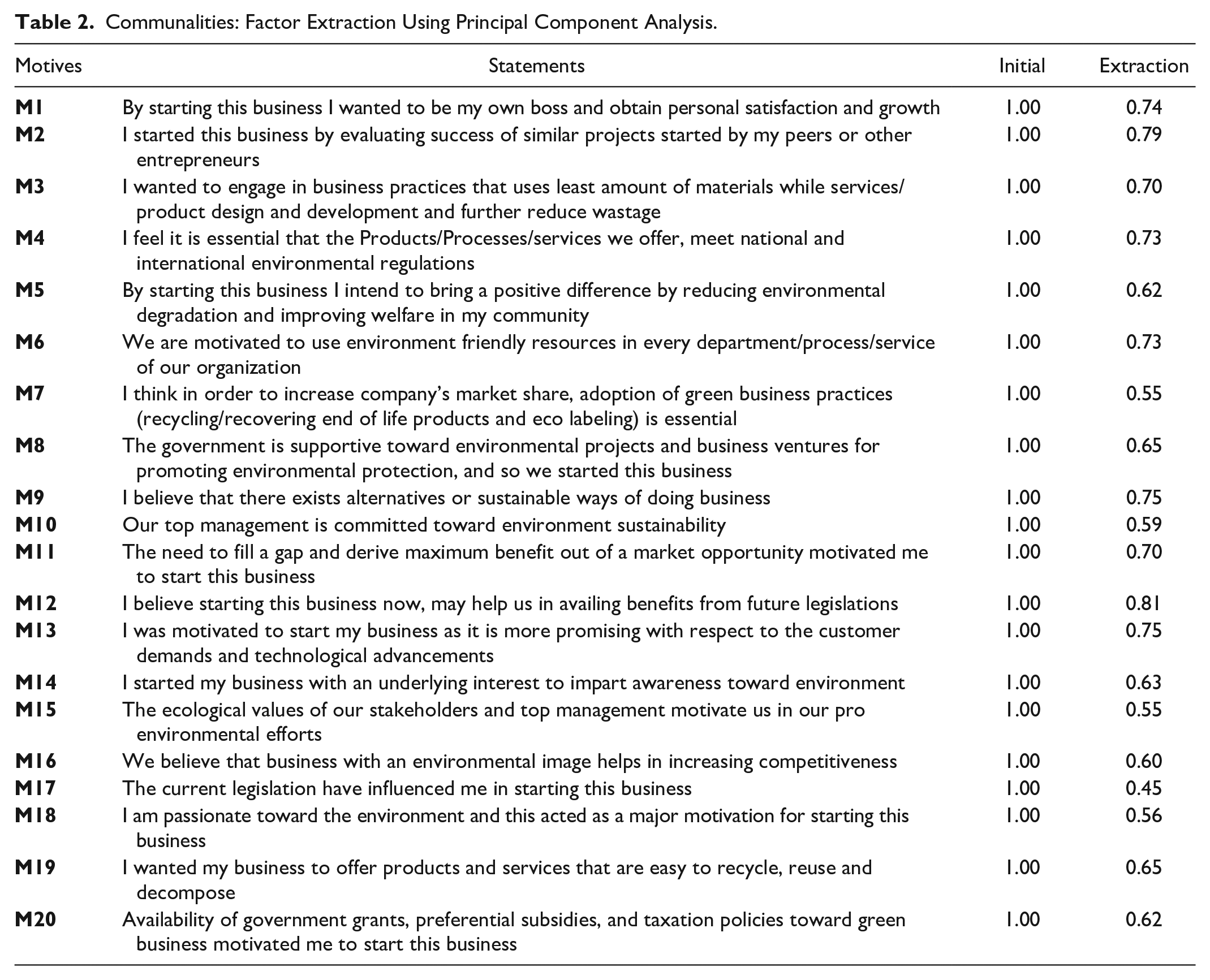
We used the principal component analysis method of extraction and the varimax rotation method (Osborne, 2014). The following criteria followed for determining the number of factors; (a) Eigen values > 1; (b) each factor should at least contain three items; and (c) item loading >0.4 (Costello & Osborne, 2005; Hinkin et al., 1997). Results revealed extraction of three factors from 20 items. Market-driven (eight items), compliance-driven (eight items), and value-driven (four items) as shown in Table 2. Communalities greater than equal to 0.4 are considered acceptable (Osborne et al., 2008). Table 2 shows the communality values of all the 20 items. They are greater than equal to 0.5 signifying the greater sum of variance extracted by the factor solution. The factor loadings of all the items ranged from 0.461 to 0.796. Total variance explained (TVE) values are at 0.5 or above 50%, considered appropriate. Table 3, shows 56.33% of variance, indicating that the factorial model is adequate. Table 4, describes the factor loadings for the three-factor scale. The principal component analysis and varimax rotation with Kaiser normalization was used to obtain the three factors converged with seven iterations. Multiple cross-loadings on the factors were not present, which further supported preliminary discriminant scale.
Communalities: Factor Extraction Using Principal Component Analysis.
Total Variance Explained.
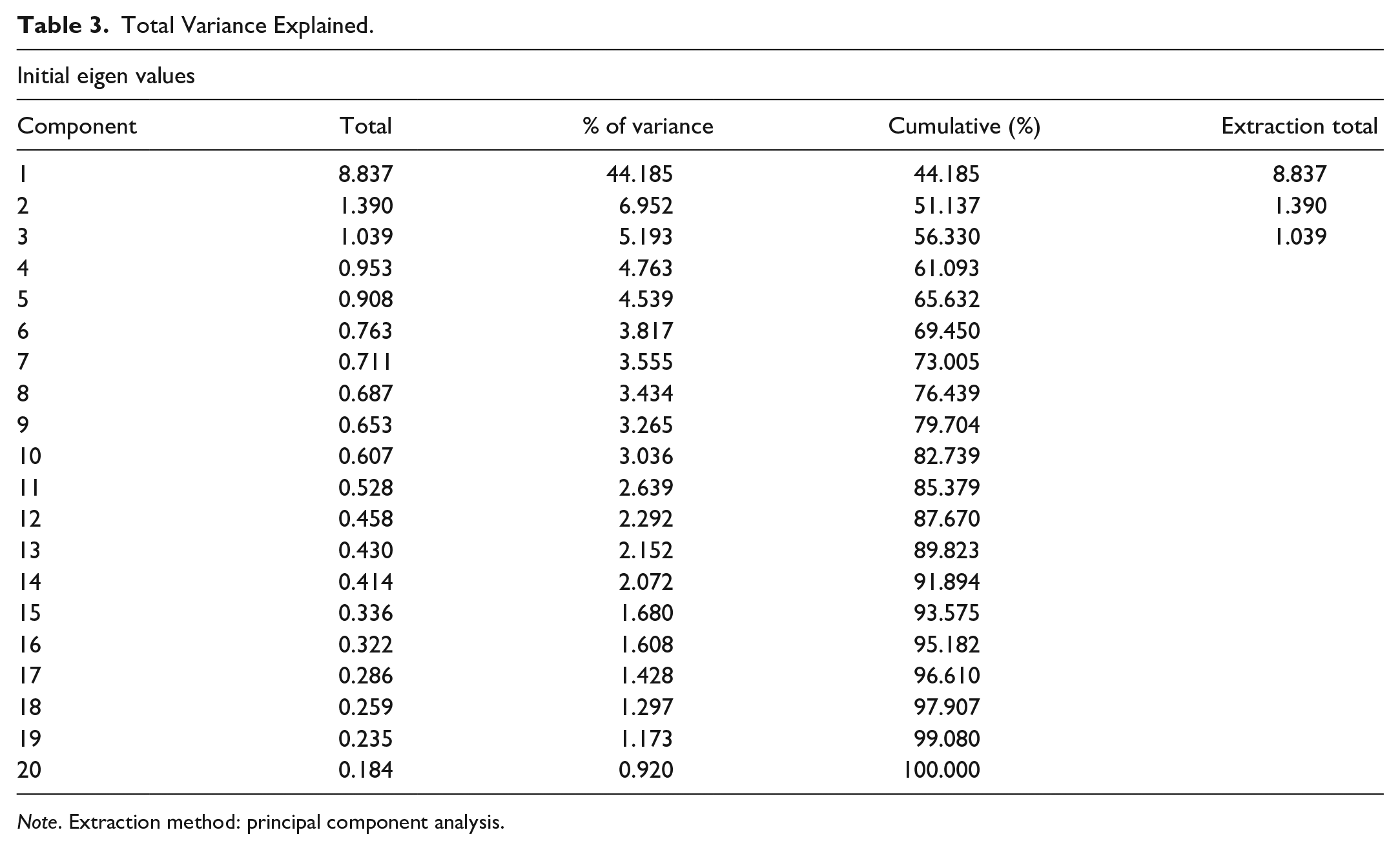
Note. Extraction method: principal component analysis.
Exploratory Factor Analysis: Factor Extraction With Varimax Rotation.
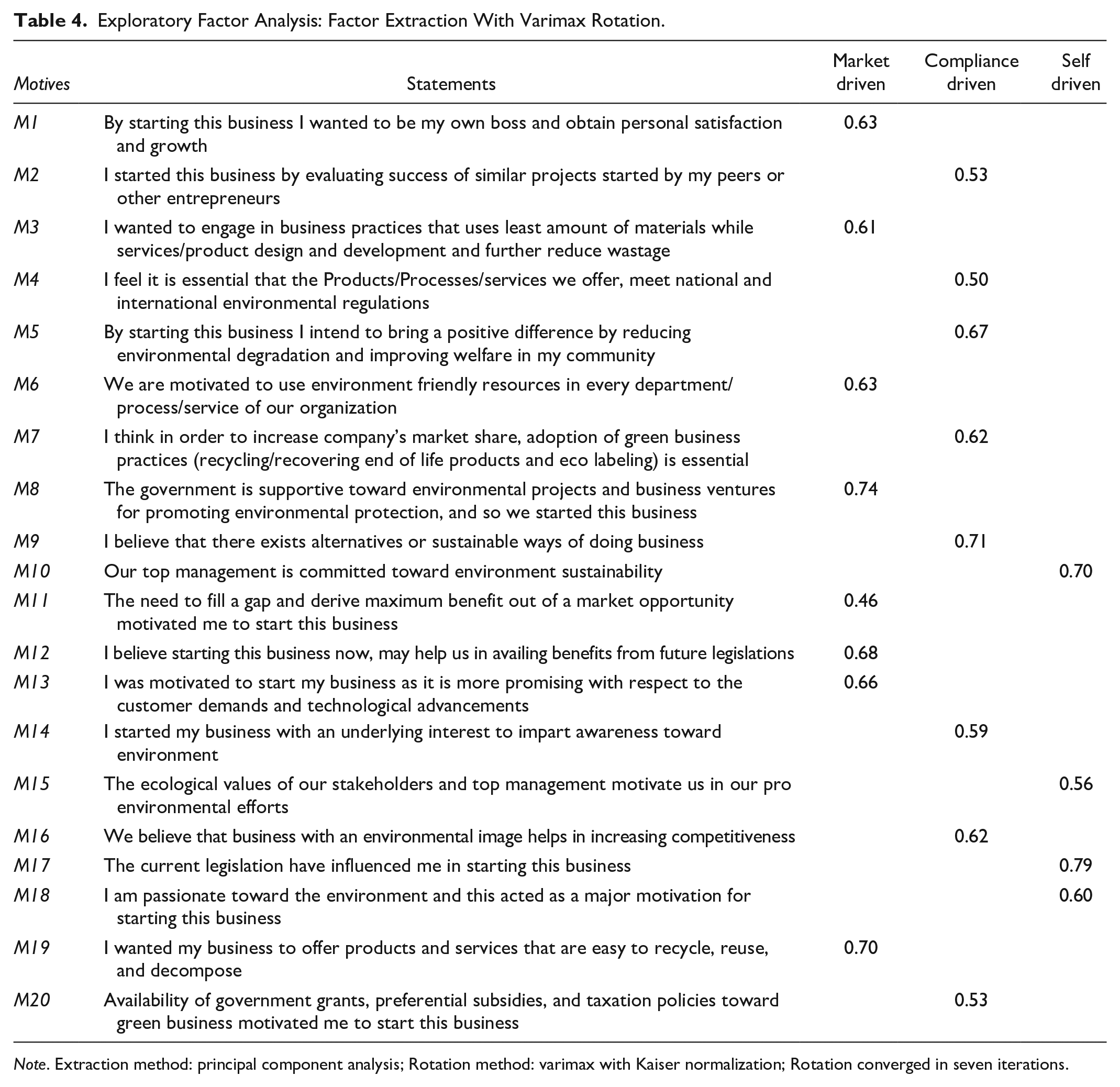
Note. Extraction method: principal component analysis; Rotation method: varimax with Kaiser normalization; Rotation converged in seven iterations.
Study 2: Validation of Ecopreneurial Motivation Scale
We conducted CFA to validate the motivation scale. A sample of 160 respondents was engaged for this purpose. The participating entrepreneurs were contacted personally (through appointments and emails) for explaining the objective and methodology of the study. The responses were collected using close-ended questionnaires rating the motivation accordingly. The respondents represented major start-up/industrial sectors like agro-based (n = 31, 19.37%), manufacturing (n = 52, 32.50%), services (n = 39, 24.37%), and technology/innovation (n = 38, 23.75%). The sample included Male (n = 134, 83.75%) and Female (n = 26, 16.25%) entrepreneurs to test the factor structure and validate items for final measure.
Model fit was tested using lavaan version 0.6 to 5 (Rosseel, 2012) in R Studio 1.2.5033 with the help of 64 bit R 3.6.3 using 39 iterations. We used various indices to evaluate the goodness of model fit. These included: (1) Value of v2 statistic, chi square, and degree of freedom as χ² = 1,720.487, dƒ = 190, p < .001. (2) Root mean square error of approximation (RMSEA) = 0.058, at 90% CI [0.044, 0.072], which should be <0.08 (Browne & Cudeck, 1992), and the standardized root mean square residual (SRMR) = 0.049. In addition, Tucker Lewis Index (TLI) = 0.932 and comparative fit index (CFI) = 0.944, which should be >0.90 (Medsker et al., 1994). Results of the CFA suggested good model fit for the three-factor model of ecopreneurial motivation, RMSEA = 0.058. All factor loadings were statistically significant, ranging from 0.482 to 0.757 (p’s < .001). In addition, the high value of CFI indicated uni-dimensionality indicating that one variable does not measure multiple constructs as compiled in Tables 5 and 6.
Results of Confirmatory Factor Analysis.

Results of Confirmatory Factor Analysis: Indices for Goodness of Fit.

In Table 7, the reliability information for three-factor ecopreneurial motivation scale. The internal consistency (Cronbach’s Alpha) value for considerably high, that is, .939 level of reliability. The item total statistics also revealed Cronbach’s alpha in case a particular item is deleted. The values were less than overall Cronbach’s alpha value, indicating that presence of each item increases reliability.
Reliability Coefficients for Three-Factor Ecopreneurial Motivation Scale.

In Table 8, Cronbach’s alpha, composite reliability, and average extracted variance (AVE) was also calculated to confirm the reliability and validity of the three-factor scale. The Cronbach’s alpha coefficients value were greater than 0.70 (Nunnally & Bernstein, 1994) for each factor indicated acceptable internal consistency and reliability. Composite reliability was achieved greater than 0.70 (Fornell & Lacker, 1981; Hair et al., 2019), indicating good construct reliability and validity. While the AVE was greater than 0.50 (Fornell & Lacker, 1981) throughout, denoting that, the variables have ideal convergence ability.
Composite Reliability and Validity.

Discussion and Conclusion
The scale development is a challenging process; however, framework of Hinkin et al. (1997) and recommendations of Hair et al. (2019) has acted as an explicit guide to achieve our ultimate aim of scale development and validation. The process of development and validation followed three steps: item generation, expert consultations, and statistical validation. The expert consultations helped in determining a cohesive set of agreed-on items for the scale that would help to identify the motivation for adopting ecopreneurial behavior in StartUps. Statistical validation included two techniques EFA and CFA, always applied with two different samples. Exploratory factor analysis (EFA) conducted with sample of 140 respondents helped identify the factor structure of motivation for ecopreneurial behavior. In addition, to confirm this factorial structure, confirmatory factor analysis (CFA) was used with another sample of 160 respondents. For both analyses, we observed a high gender gap in the demographic profile of respondents. This was due to existing gender gap in entrepreneurship, innovation, and patenting prevalent in India and will take years to reach parity (Chatterjee & Ramu, 2018). With limited empirical contribution in the field of ecopreneurship, we filled the gap by identifying motivation for becoming an ecopreneur or adopting ecopreneurial behavior.
The present study aims to develop a reliable and valid scale for identifying and measuring motivation in the startup owners for adopting ecopreneurial behavior. The study used three-step approach, from item generation using expert consultations to build group consensus and finalize 20 items for scale construction using exploratory factor analysis on sample 1 with high reliability and offering three-factor scale. Further, confirmatory analysis on sample 2 validated the scale. With high Cronbach’s alpha coefficients, each motivation factor had 4 to 8 items. This model was evaluated for goodness of fit with multiple indices, indicating good model fit and uni-dimensionality. A good scale should be reliable and valid (Hair et al., 2019) and thus, composite reliability and convergent validity was found satisfactory for the three factor scale for identifying underlying motivation of ecopreneurial behavior.
The emerging environmental issues prompt the organizations to improve their pro environmental behavior. This study is competent to make theoretical and managerial contributions. First, it constructed a measurement scale for identifying motivations of ecopreneurs and addressed the gaps and limitations identified in previous studies (Rodríguez-García et al., 2019; Santini, 2017). The resultant scale is expected to remove the ambiguity surrounding the concept and help researchers in differentiating ecopreneurs from other entrepreneurs.
Second, the present article extended the present knowledge base. The study is in context of India, which, like other developing countries, have become preoccupied with concept of sustainability, and highlights the need of adopting dynamics of ecoprenuership. Existing studies are limited to the aspects of eco-behavior in the context of product, process, and model. This study tends to fill that gap by offering a validated scale to identify motivations and build strong theoretical grounds for ecopreneurial behavior.
The third contribution is the reliable and valid model that can help academicians to replicate this study in other areas to identify impact of certain motivations on the ecoprenuerial behavior and eco-efficiency. Eco-efficiency plays an important role in mitigating the impact of industries on environment and leads to strategic development of the industries and reduction of their corresponding impact on the environment.
These indicators may represent as a useful tool for ecopreneurial policy making and training and development. Researchers may further use this for identifying ecopreneurial motivation and study their behavioral impacts. The findings offer not only a validated scale but also itself open doors for empirical research on ecopreneurship globally. By identifying motivation, we can distinguish ecopreneurs and can develop academic trainings and career development programs.
Limitations and Recommendations
Although, the present study has few limitations. First, the respondents were startup owners of Indian manufacturing and service sector; hence, the scale is subjected to national cultural bias and a prevalent gender gap. We suggest that replication of this scale in other national contexts would help in understanding its generalized usage.
Secondly, we need to ascertain causal relationship with ecopreneurial behavior with other performance parameters like environment impact assessment or ecological efficiency to understand the effect of these motivation on the environmental efficiency. This might in itself be an expansion of this research area and lead to more empirical investigations and contributions.
Appendices
Initial List of Items With Sources for Measuring the Motivation.
Stages of Expert Consultations Rounds.
Footnotes
Declaration of Conflicting Interests
The author(s) declared no potential conflicts of interest with respect to the research, authorship, and/or publication of this article.
Funding
The author(s) received no financial support for the research, authorship, and/or publication of this article.
