




Abstract
Scholarly endeavors in psychology, environmental, and geographies of health research have shown that the exposure to natural spaces influences children’s wellbeing. However, little is known regarding the experiences that influence children’s feelings of wellbeing for those who live in natural environments. This study investigates the perceptions of nature and wellbeing of 10 children living next to the Altos de Lircay Reserve (Chile). A geo-narrative analysis of the interviews shows that participants living closest to the reserve relate nature to their physical wellbeing, while those living further away often relate it to their psychological wellbeing. Recommendations to plan interventions that improve the children-nature connection are provided.
Introduction
Our wellbeing is widely known to be related to, at least partly, our exposure to natural spaces (i.e., non-urbanized areas such as natural reserves, national parks, natural sanctuaries, and unprotected natural areas), as studies of, for example, visitors to national parks show (Buckley, 2020). In particular, natural environments are spaces of wellbeing for children (McCormick, 2017) who from an early age have an innate need to connect with nature and natural elements (Wilson, 1984). This child-nature connection results in positive emotions (such as calmness and joy), cognitive improvement (such as the development of different forms of adaptive learning and behavior), and judgmental (referred to as ethical) development of children (such as ecological awareness; Mundaca et al., 2021; Sobko et al., 2018). However, in our modern society children have progressively lost their connection to nature as their interaction with natural environments has decreased mainly in favor of a higher exposure to technological advances (such as cell phones and online gaming) and of inhabiting densely populated urban and suburban areas which often lack natural spaces (Henn et al., 2019). This disconnection with nature (or “nature-detachment”) has, undoubtedly, resulted in poor mental health conditions (Mundaca et al., 2021; Cox & Gaston, 2018).
In this context, multidisciplinary teams around the world have acknowledged the compelling need to plan strategies that enhance and strengthen the child-nature connection. The authors of this article, as part of one such team, believe this can be done by designing educational interventions that emulate the positive experiences of children who live in or close to national reserves and are in contact with natural environments on a daily basis (Fleuret & Atkinson, 2007). In addition, the potential existence of differences in the perceptions of nature by children living either in the proximity or far from natural areas emphasizes the need and importance of designing educational interventions that are contextually appropriate and situated, which can be achieved by resorting to a flexible approach that takes into consideration sociodemographic features of the target community, such as age, gender, and cultural background. Thus, investigating these children’s perceptions would allow scholars to obtain valuable information to setup an adequately designed educational intervention to focus on the positive psychological functioning of children living in natural environments, as well as those psychosocial dimensions that can account for adaptive patterns of development that can lead to improved mental health.
With this in mind, and guided by the principles of positive psychology (Passmore & Howell, 2014), this study explores experiences of wellbeing of children living close to a national reserve in a central region of Chile. To this end, this investigation contributes to the fields of geographies of health, social psychology, narrative inquiry, and environmental studies by employing a qualitative geographical information analytical approach supported by complementary statistical methods to analyze narratives that are associated with perceptions of wellbeing of these children. Finally, the paper provides recommendations to plan future educational interventions that aim to help improve children’s connection to nature.
Background
Wellbeing and Children’s Experiences in Natural Environments
Wellbeing is defined as a person’s subjective perception of their quality of life, and is related to individuals’ degree of satisfaction and happiness with their life, where positive states of mind prevail in all spheres of life, including both their mental and their physical health (Denegri et al., 2015). Wellbeing, as explored in this study, involves three dimensions: the physical, the psychological (both cognitive and emotional), and the social (C. García et al., 2017; cf. Alfaro et al., 2015). Though these dimensions relate quite transparently to different aspects of someone’s life, it is worth mentioning that in this study the social dimension is also explored in connection to the child-nature relationship, as part of children’s socialization activities heavily depend on how they interact with their surrounding space and environment (Jennings & Bamkole, 2019). In this study, these three dimensions of wellbeing help to investigate the aspects of human functioning that are related to children’s relationship with nature and how this is perceived to influence their wellbeing.
The environment in which children live plays a vital role in their wellbeing. Their connection with nature consists of an affective and experiential feeling of belonging to the natural world and can be directly related to not only pro-environmental behaviors, but also elements of children’s wellbeing, among which, happiness, life satisfaction, and pro-sociality can be highlighted (Richardson & Sheffield, 2017). In this regard, several studies show that green areas may foster the social and cognitive development of children with difficulties in motivation and attention (Turner-Skoff & Cavender, 2019). Similarly, green school gardens have been found to improve mood and wellbeing and to decrease physiological stress (Kelz et al., 2013; Roberts et al., 2020), show a reduction in behavioral problems and increase attention and factors associated with resilience in children (Chawla et al., 2014; Flax et al., 2020).
Though most of this research has been conducted in outdoor/green spaces in urban environments rather than in natural spaces, similar findings have been reported in forest settings (McCree et al., 2018) and with visitors in national parks (Schebella et al., 2019). These studies show that the closer children are to natural spaces with dense vegetation, the more positive feelings of wellbeing they report. Thus, natural environments with dense vegetation have been found to better neutralize the effects of stress that children experience in their daily lives (Corraliza & Collado, 2011) and nurture restorative feelings (Egner et al., 2020). Similarly, children who live in rural areas also display higher levels of affective connection with nature, show greater interest in environmental issues, and integrate nature more saliently as part of their identity (Chawla, 2020; Galli et al., 2016). Most of these studies emphasize the idea that children’s perception of wellbeing may vary depending on the natural space and environment they are in contact with, their distance to the natural space and their interaction with that environment and space (Foo, 2016). Thus, based on findings of this nature, a collaboration network of countries such as Finland, Sweden, Luxembourg, and France developed the first therapeutic forest trail, with the aim of enhancing the restorative and stress-reducing effects of nature and improving people’s mental health (Ten Brink et al., 2016).
Strategies such as the therapeutic forest trail have been designed to face one of the major challenges of the 21st century: to improve human wellbeing based on the strengthening of ecosystem services, since these are the basis for the development of an improved quality of life (Elwell et al., 2018). In this light, scholarly endeavors have shown that valuable information can be obtained on how people perceive and respond to ecosystem management initiatives (Gelcich & O’Keeffe, 2016), and on the kind of priorities people have for personal and community wellbeing (Ruckelshaus et al., 2015). This all attests to the fact that studying the perceptions of wellbeing of children who live in natural environments becomes a valuable input for the design of environmental and educational interventions that aim to promote children’s affection toward nature in other contexts and to inform environmental and wellbeing decision-making (Bratman et al., 2015; Profice et al., 2017).
However, though these studies have undeniably shown that the child-nature relationship has a direct impact on their wellbeing, very little is known about which aspects of this relationship children privilege and value most as part of their wellbeing (Farmer et al., 2020; Fleuret & Atkinson, 2007). What is more, children’s wellbeing in relation to their exposure to nature has been explored mostly through self-reported surveys, which has been sometimes shown to be problematic in the way they measure wellbeing (Fleuret & Atkinson, 2007) and often provide no room for a detailed development of participants’ opinions, life experiences, and stories. Moreover, Ten Brink et al. (2016) also emphasize that there is still little research regarding the perception of permanent inhabitants (as opposed to visitors) of natural environments. This study then proposes to address these knowledge gaps by exploring which aspects and experiences of the human-nature relationship are perceived to influence the wellbeing of children who live in natural environments through an exploration of the narratives of children of the locality of Vilches Alto, the adjacent area of the Altos de Lircay National Reserve in central Chile. To achieve this, the study focuses, in particular, on comparing children’s perceptions according to their geographical closeness to the reserve. In line with suggestions made by Farmer et al. (2020), this knowledge will advance theoretical and practical discussions on the causal mechanisms responsible for the wellbeing of children in natural environments. From a methodological viewpoint, this paper builds on previous studies (Adjei & Agyei, 2015) that show the value of geo-narratives as an analytical resource for interdisciplinary studies. Finally, adopting a positive psychology perspective throughout the exploration of the data, the findings of this study will allow the authors to discuss suggestions that guide concerns, attitudes, and interactions involving natural environments and to outline future educational interventions based on the positive experiences of those children who live in natural spaces.
Vilches Alto (Upper Vilches) Locality
Administratively the Vilches area belongs to the commune of San Clemente and is divided in three main areas, recognized as such by its inhabitant as Lower Vilches, Central Vilches, and Upper Vilches. Regarding their orientation from the reserve, Lower Vilches is the area of the town located near the main road and connected to the town of San Clemente, and Upper Vilches is the part of town immediately adjacent to the National Reserve. For the purposes of this study, data collection was carried out mostly in the area of Upper Vilches due to its particular climatic and topographic conditions (Soto, 2008). This area was also considered appropriate since it is the least environmentally disturbed and includes only a few scattered patches of small-scale agriculture and residential spaces, and it is in close physical contact with a portion of the Reserve (Figure 1).

Altos de Lircay National Reserve and the commune of Vilches location in Central Chile (image modified from GoogleEarthTM).
Method
Study Site: Altos de Lircay National Reserve (ALNR)
The Altos de Lircay National Reserve is the largest natural area of the El Maule Region (comprising 12,163 ha), located in the commune of San Clemente, 65 km west from the city of Talca, in Central Chile (35°35′40.7″S, 70°57′12.6″W; Figure 1). The Reserve was created in 1996 by the National Forest Corporation (Sp. Corporación Nacional Forestal—CONAF, 2013), and is protected under the national law no. 18,362 for the National System of State Protected Wild Areas (Sp. Sistema Nacional de Áreas Silvestres Protegidas del Estado—SNASPE). Furthermore, as Martínez (2016) indicates, this National Reserve is part of the 1 of the 25 biodiversity hotspots in the world, which makes it one of the few representatives of forest occurring within a Mediterranean-type ecosystem on the planet. Such Mediterranean ecosystems occur only along the surroundings of the Mediterranean Sea, west of Australia, California, and South Africa (Veblen et al., 2015). The Reserve is rich in flora and fauna, including some representative species of the Chilean flora, such as hualos (Nothofagus glauca), raulies (Nothofagus alpina), and macrofauna, such as burrowing tricahue parrots (Cyanoliseus patagonus), Chilean black woodpeckers (Campephilus magellanicus), condors (Vultur gryphus), and pumas (Puma concolor) among others (de la Barrera et al., 2011; Fuentes Lásmar, 2010; C. García et al., 2017). This reserve is valued for its uniqueness and its role as a haven of a portion of the Chilean biota occurring in an otherwise highly disturbed area of the country.
This study was approved by the Ethics Committee of the Pontificia Universidad Católica de Valparaíso (BIOEPUCV-H 299-2019). Data collection was carried out between May and July 2019. The study consisted of two stages. First, ethnographic work was carried out through an observation of the daily routines of the community of Vilches. For over 2 months, the researchers participated in activities with the community at the refuge of Biota Maule, walked around the areas where the participants live, hiked in the reserve and visited the different spots mentioned by the interviewees to get a sense of the community’s relationship with their natural surroundings. Observations were recorded in the form of field notes (Marra & Lazzaro-Salazar, 2018) during and after walks, and before and after interviewing participants. The second stage involved semi-structured interviews (see description below) conducted by the main author with a total of 10 children from the Upper Vilches sector, with ages ranging from 6 to 12 years old (see Table 1 below). The interviewer was herself a psychologist with extensive experience working in public school of the region where this study took place and with children of these same ages. At the time of the data collection, the interviewer was finishing her MA studies in the Child and Youth Mental Health program. It is also worth clarifying that this is the total number of children between 6 and 12 years old living in this area of Vilches. Participants were partly contacted following the snowball sampling technique, as participants provided contact information of new potential community participants (Goffman, 1983). In order to access the community, the research team also had the valuable support of the NGO Biota Maule, who facilitated the team’s access to the Vilches community. In this regard, a representative of Biota Maule would often accompany the interviewer from home to home to help make contact with the families. This offered researchers further insights into the community’s routine and cultural norms. Finally, all the children contacted by the researchers participated in this study.
Location and Socio-Demographic Information of Participants Interviewed in Each Sector.

Sector Description
For the purposes of this study, participants were grouped into three sectors (Figure 2), represented by categories, based on the distance of their house from the main entrance of the reserve, since it has been demonstrated that, for instance, pro-environmental behaviors decrease as participants’ living distance from the protected areas increases (Cazalis & Prévot, 2019).

Categories (sectors) and participants’ location at different distances from the ALNR (Altos de Lircay National Reserve) in the commune of Vilches, in Central Chile (image modified from GoogleEarthTM).
Distance intervals from the main entrance of the ALNR representing each sector were delineated based on the location of participants in order to provide a balanced number of participants per category (or sector). Thus, sectors were arranged in the following categories (distance intervals): Category I, participants (n = 3) located within 0 to 300 m from the main entrance of the reserve, Category II, participants (n = 3) located between 300 and 3 km and Category III, participants (n = 4) located >3 km from the main entrance (Table 1). The location of each participant was georeferenced using Global Positioning System (GPS), although no individualized information is given to protect participants’ identity.
Interviews
The semi-structured interviews were conducted with children from the three sectors of Upper Vilches regarding their perceptions of nature, their relationship with the Altos de Lircay Natural Reserve, and their perceptions of the impact this relationship has on their wellbeing. Before the interview began, participants and their parents read the informed consent with the researcher. The informed consent contained information regarding the researcher’s credentials, the title and objective of the project, the supporting institutions, and other relevant information (such as the duration of the project and interview details). All participants and their parents signed consent forms.
The interviews were conducted following the semi-structured interview protocol created for the purposes of this study based on the experience of the research team (S3 and S4 material). The interviews consisted of 10 questions that were piloted with colleagues from the psychology and the basic science departments. Interviews took 33 minutes on average each. At the start of the interview, the researcher asked participants to define what wellbeing meant for them. In all cases, participants had a similar understanding of the concept to the definition supported in this study, as they replied, for instance, it’s when a person feels good, comfortable, when we feel happy (interviewee 4). The interview questions were complemented with an activity where participants were asked to photograph their surroundings, a spot (or spots) that showed what the Upper Vilches sector is to them. The use of photography in a narrative approach constitutes a psychosocial tool that allows researchers to include a creative element that helps trigger participants’ memories and enhances participation (Cifuentes-Munóz & Rojas-Jara, 2018). These photos were then used as prompts for the contextualization of the interview questions and the elicitation of children’s stories. The interviews in this study were conducted in participants’ homes with an adult present (often the mother) and they were audio-recorded and transcribed verbatim. Transcripts were not shared with participants to avoid participant burden.
Analysis
In this study, narratives of children’s experiences with nature are the discursive vehicle through which different aspects of their wellbeing are reflected upon (Alfaro et al., 2015). By definition, narratives are the (re)telling of one or more events that are often organized in chronological order, around certain characters, settings, and plot, and they “represent [not only] storied ways of knowing” (Riessman, 1993, p. 1) but also of “doing” as narratives help construct social realities (De Fina & Georgakopoulo, 2015). In terms of their structure, narratives may take on very different forms, from fully-fledged stories displaying the six-part narrative structure proposed by Labov and Waletzky (1967), which include abstract, orientation, complicating action, resolution, coda, and evaluation, to stories which are not told in their entirety (Georgakopoulou, 2007), to “mini-tellings” (Bamberg & Georgakopoulou, 2008). The latter case is particularly relevant for the narratives provided by children, which were often choppy and rather brief possibly because children often focus the narrative action on the evaluation as it is where they reflect on the character’s feelings and state (González-Tapia, 2020; Shiro, 2007). The narratives analyzed here correspond to those provided when answering three key questions of the interview: (1) What do you like/value most about living close to the reserve?; (2) Do you think that being in contact with nature influences your wellbeing? If so, how?; and (3) Can you share an anecdote regarding your experiences living in this area?
The answers to these questions were analyzed in three stages. Firstly, narratives were identified and explored through a thematic analysis to identify and classify recurrent topics related to participants’ experiences of wellbeing. The topics mentioned and reflected upon in participants’ narratives were classified into different categories according to those common in the human-nature relationship literature (Mundaca et al., 2021) and different aspects of wellbeing (such as self-satisfaction). The themes identified for each category then emerged from the data itself. To this end, the data was topic-coded independently by the three researchers and discussed in peer-meetings. The coding of the data was done following the steps suggested in Rodriguez et al. (1996), the coding structure suggested in Oyanedel et al. (2015) and expert suggestions of the second author, who is a linguist and an expert in narrative analysis (Barone & Lazzaro-Salazar, 2015). The coded data was then shared with an external researcher who is a recognized expert in the field of narrative analysis to revise our initial assumptions and coding, and presented our preliminary analyses in a number of scientific seminars (both national and international) to further help to triangulate our interpretations.
The second phase consisted of a quantitative analysis performed to identify the relationship between the number of times a specific topic was referred to and the distance of the participant from the main entrance of ALNR. The relationship between the themes and children’s distance from the reserve was analyzed using a Chi-Square test and a post hoc test, using Bonferroni adjusted probabilities for each adjusted residual, to identify the significance of each association. The analysis was performed using PAST v3.20 (Paleontological Statistics software; Hammer et al., 2001).
The third, and last, phase of analysis of the narratives involved geo-narrative analysis, which is a qualitative research method that sits at “the intersection of qualitative geographic information systems (GIS), narrative analysis, 3D GIS-based time-geographic methods, and computer-aided qualitative data analysis” (Kwan & Ding, 2008, p. 443). The qualitative GIS analytic approach was used to map webs of knowledge (Gebauer & Doevenspeck, 2015) by representing sectors and participants’ locations on GoogleEarth™ maps, to visually show how participants perceive and relate to their natural surroundings. This representation sheds light on participants’ personal and cultural meanings of their surroundings as reflected in their narratives (Milton et al., 2015). To this end, and to emphasize the geographical aspect of the narrative analysis, one further phase of data depuration involved selecting only those narratives that made explicit reference to natural places and spaces. The 3D GIS-based time-geographic analytical method then was used as the representational framework to compare and contrast children’s perceptions of their relationship with nature and their wellbeing per sector.
Results and Discussion
Following the analytic procedures explained above, narratives were grouped into three main dimensions, namely, (A) Perceptions of Nature, which is composed of three sub-dimensions (positive and negative perceptions of the environment, and perceptions of comfort related to the environment), with each sub-dimension including two themes; (B) Activities in the Natural Environment (including three themes); and (C) Knowledge of the Environment (including two themes). In what follows, the results for each dimension are presented and discussed as shown in Table 2 below. Moreover, a set of maps showing narratives for each sector (Category) and dimensions was elaborated to further illustrate the results of this study (Figure 3).
Results of Differences Among Perceptions, Activities, and Knowledge of the Environment Mentioned by Each Participant at Different Distances From the Main Entrance of Altos de Lircay National Reserve.
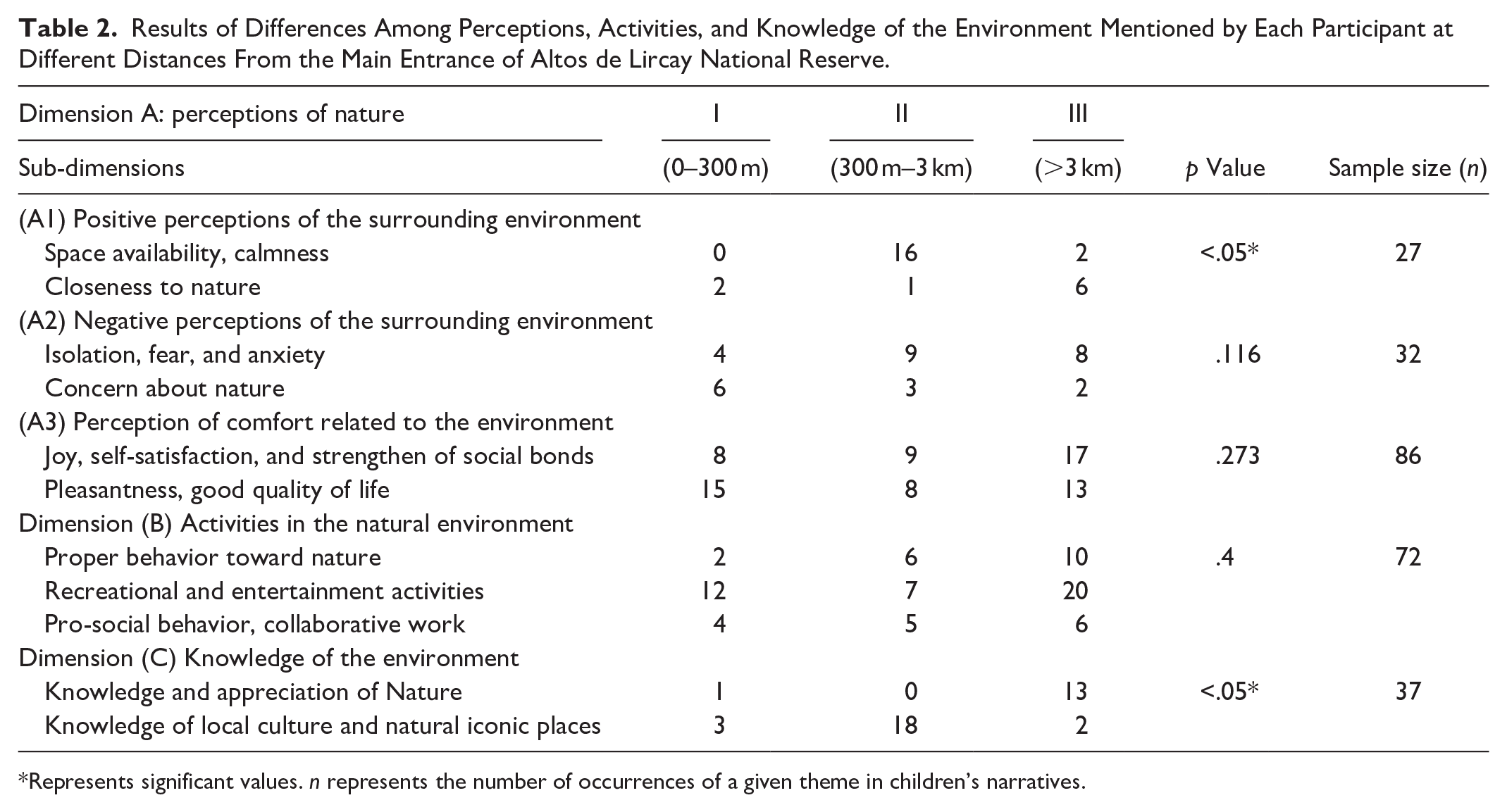
Represents significant values. n represents the number of occurrences of a given theme in children’s narratives.

Narrative trajectories of participants interviewed in each Sector (Category) showing testimonies related to the three dimensions of wellbeing examined in this study, in the area of Vilches Alto (Upper Vilches), in Central Chile (maps modified from GoogleEarthTM).
Perceptions of Nature
In regards to the first sub-dimension, a significant relationship (χ2 = 16.01, df = 2, p < .05) was found between participants’ positive perceptions of their surrounding environment and their distance to the ALNR. A detailed analysis of both themes included in this sub-dimension showed that space availability and calmness was higher (p < .05) for participants living between 300 and 3 km away from the reserve, while this topic was not mentioned by participants living nearby the ALNR (0–300 m). In addition, closeness to nature was more frequently reflected upon by participants living at >3 km (p < .05) from the ALNR. However, no significant relationship was found between the perception of being close to nature in participants living at a distance lesser than 300 m from the ALNR.
Interestingly, more often than not, studies on the human-nature relationship have found that people’s (close) distance to natural areas is positively related to their positive perceptions of nature (Richardson & Sheffield, 2017). The findings of this study, however, seem to suggest that the opposite may be true for children living in natural areas, as those children living at short distances from the ALNR did not draw on stories related to space availability, calmness, and closeness to nature as positive aspects of their relationship with the environment and their wellbeing. This is in line with the findings reported by a few recent studies conducted with children living in close contact with natural spaces, which have shown that such involvement does not necessarily translate into immediate appreciation of nature and/or close connection to it (Skar et al., 2016). Thus, the common belief that the closer children live to natural environments, the more positive their perceptions of nature and of their wellbeing will be, may be an idealistic vision embraced by those who live outside such communities. Then, while for those children who live at a distance from the reserve (300–>3 km) spending time there involves a conscious effort to go and to interact with the ALNR (see Extract 1), for those children living next to the reserve being in contact and interacting with that natural space is part of their daily routine (see Extract 2; Burgess & Mayer-Smith, 2011). This possibly helps to explain why the children in Categories II and III often narrated stories of recreational activities in the reserve and those in Category I did so regarding daily activities such as collecting wood and fruits, as the extracts illustrate. In this light, it is then possible to suggest that children in Categories II and III “notice” (Passmore & Holder, 2017) natural aspects of the environment more saliently than children in Category I, and that while the benefits of this relationship seem to be more associated to the psychological wellbeing for children in Categories II and III, for those children in the sector adjacent to the reserve the benefits of this relationship seem to be rather more related to aspects of their physical wellbeing.
Extract 1
Interviewee 3: I like nature when one wants to go to the forest, when one wants to be alone and listening to the little birds when they sing . . . um . . . nature belongs to us
Extract 2
Interviewee 10: I would go out with my grandfather. I used to help him sometimes look for the animals, when we had animals . . . there were some cows there and I helped him give them food, even once I prepared milk for a little cow and it was awesome and sometimes I went out, sometimes they taught me how to put, how to pick up the fruit to put it in the sun.
In regards to the results for the two remaining sub-dimensions of the perceptions of nature, neither negative nor comfort perceptions of nature were found to be significantly related to participants’ distance to the ALNR. In general, values remained homogeneously distributed throughout the sample showing that negative feelings (such as isolation and anxiety) and concerns about nature (e.g., rubbish management) are similarly shared by the participants in this study. Likewise, perceptions of comfort (such as joy, self-satisfaction, and strengthen of social bonds, as well as pleasantness and good quality life) did not display any relationship with participants’ distance to the ALNR, although they are more frequently reflected upon by participants in Categories I and III.
Negative perceptions about the natural environment are frequent among people living in remote natural settings, which is possibly why no significant differences among participants of the three sectors were found. In this light, previous studies have also reported feelings of isolation (Baills & Rossi, 2001), fear (LoBue, 2013), and feelings of vulnerability to natural phenomena (e.g., rains and snow; Veslinovska, 2020), to name a few. In this study, current concerns of these children were found to be related to the ongoing transformation processes affecting their territory. In this regard, children are particularly aware of the threats to their quality of life involved in the proposed pavement of the main road in Vilches, as they express longing for the way life used to be before the road (Extract 3) and they reflect on the impact of a paved road on the environment (Extract 4).
Extract 3
Interviewee 8: Because before the dirt was more fun. It’s just that in the past, when we drove the car there was a lot of stones and we bounced. Because the pavement is bad for the earth, the asphalt is, that pavement.
Extract 4
Interviewee 4: [reflecting on the fact that due to the pavement of the road, there are more shops near the reserve] almost every day they [parents] send me to clean over there, in the old road. As there are businesses here, all the rubbish is thrown away anywhere, we throw it in the rubbish bins.
Activities in the Natural Environment
In regards to the activities performed by children in the natural environment, none of the three reported themes were found to be significantly related to participants’ distance to the ALNR. As a consequence, proper behavior toward nature (e.g., taking care of plants and animals), recreational and entertaining activities (e.g., trekking and horse riding), and pro-social behaviors and collaborative work (e.g., collecting fruits and snow ploughing) were not found to play a distinctively salient role in any of the sectors, although these are more frequently mentioned in the narratives of children from Categories II and III.
At this stage, it is important to mention that proper behavior, recreational games, and pro-social behaviors toward nature are known to occur and to be positively valued in children living in natural/rural settings as well as in urban environments (Beaudoin & Thorson, 2004). Nevertheless, our findings support the idea that such behaviors do not necessarily relate to the geographical proximity of the participants to the natural environment. In this regard, these three aspects of children’s relationship with nature (especially for participants in Categories II and III) are influenced by the role that their families and the local school play in educating them and helping them to develop nature awareness. Thus, as maps in Figure 3 illustrates, as children narrate their experiences in the reserve they reflect on the school as a facilitator of their interaction with nature taking them to excursions and doing pedagogical activities in the reserve (Phenice & Griffore, 2003). Moreover, family values can also play a more vital role than children’s geographical location when it comes to developing children’s pro-social behaviors and collaborative work, as families teach them about the flora and fauna of the place, for instance. Finally, for those children living next to the reserve (Category I) this facilitating role is more prominently played by the local organizations associated to the reserve (see Figure 3). Therefore, these children’s interaction with nature, their environmental awareness, and their perceptions of wellbeing are also influenced by these cultural mediators (Galli et al., 2016). In time, it is expected that these stories about their families, school, and the organizations connected to the reserve become part of the collective experiences of the community of each sector, as they become part of their cultural identity and legacy (González-Tapia, 2020; Zayts & Lazzaro-Salazar, 2020).
Knowledge of the Environment
Our results show that there is a significant relationship between the themes related to knowledge of the environment and participants’ distance to the ALNR (χ2 = 26.442, df = 2, p < .05). However, when looking into the results for each Category, there was no significant relationship between the themes and participants’ distance to the ALNR for children in Category I. In contrast, participants living >3 km away from the ALNR displayed a higher knowledge and appreciation for nature in their narratives (p < .05) than children living between 300 m and 3 km from the ALNR. Moreover, children in Category II displayed a saliently higher frequency of reflections regarding their knowledge of the local culture and iconic places in their narratives (p < .05) than those participants in Category III.
Children’s knowledge about nature is known to be related to their experiences and exposure to nature (Avery, 2013). In this study, it was found that children living >3 km away from the ALNR draw on their knowledge and appreciation of nature much more frequently when reflecting on their relationship with it and their wellbeing than children living in at closer distances from the reserve. This is consistent with the findings for previous dimensions, and this difference could be explained by taking into consideration what was previously mentioned in terms of the fact that children who live at longer distances from the ALNR tend to view and appreciate nature and the natural space differently than those living immersed in it. Thus, for children living at further distances from the reserve (and in particular those in Category III) knowledge and appreciation of the environment, regarding the ALNR, seems to be a vital part of the way they perceive their relationship with nature and, also, of a master narrative into which they are socialized (by the school and their families) as members of their local community, as Extract 5 illustrates (also see maps of Categories II and III in Figure 3).
Extract 5
Interviewee 2: The parents teach us, for example, it depends on the family, the traditions. For example, my family here my dad is a muleteer and my mom is a food handler, but for example in the case of other children the mom sells. . . has a grocery store, the dad goes to work to cut wood, for example, then, each child has a different concept of their wellbeing.
Narratives about these aspects of their relationship with nature and their wellbeing become part of their cultural background and may be foregrounded especially when having conversations with outsiders (such as, in this case, the interviewer). Similarly, knowledge of local culture and iconic places was evidently higher in children living between 300 and 3 km from ALNR. Such knowledge about iconic places and local culture has been particularly reported in children that play active roles on the activities of their communities, especially in remote or natural settings (Harun & Zin, 2018). Thus, authors such as Monterrubio et al. (2016) have demonstrated that children who play these active roles develop a great amount of knowledge on local culture and natural places, making them more prone to reflecting on this kind of issue, especially when communicating with outsiders. This is also the case for the studied community, where many children, who play active roles as local guides and even as part of rescue teams in the area, feel proud of such activities as they see them as enhancers of social status within their community.
Conclusions
This study analyzes how children’s relationship with nature is perceived to influence different aspects of their wellbeing in an area adjacent to the Altos de Lircay National Reserve in central Chile. To achieve this, the study adopted a positive psychology perspective in order to identify key points in children’s narratives to help support theoretical and practical decisions for future interventions, based on the experiences of children living at different distances of a national reserve in central Chile. In this regard, it is often assumed that children living in closer contact with natural spaces would, somehow by default, be more ecologically aware in their perceptions than children living further away from the reserve. Following this line of thought, this study was initially conducted to identify these children’s positive experiences in order to emulate them in educational interventions planned to strengthen the child-nature relationship, develop and/or foster ecological awareness, and enhance the perceptions of wellbeing for children living further away from the reserve and in semi-rural/urban environments. However, the results of this study show that children’s perceptions of their relationship with nature and their wellbeing are more positively related to their psychological wellbeing for those living at greater distances from the reserve, whereas for children living closest to the reserve the benefits of this relationship are perceived to be rather physical. Thus, it could be argued that children living further away from the reserve (Categories II and III) “notice” and value nature for its recreational and affective benefits more strongly than those living closest to the reserve (Category I) who perceive nature in rather instrumental (or utilitarian) ways as they reflect on the reserve as their families’ work environment, for instance.
In general, our results serve to point out that educational interventions should not be standardized in their structure and objectives, as perceptions of children living in natural-rural settings and those inhabiting urban settings may differ, as in this study, in quite unexpected ways and would then require a different educational approach. In this light, findings draw scholarly attention to the fact that educational interventions may need to be particularly targeted to children living closer to natural reserves and that they should be designed to either strengthen children’s perceptions of physical wellbeing (e.g., Van Dijk-Wesselius et al., 2018) or to reveal the importance of nature in their psychological wellbeing (see Adams & Savahl, 2017). However, the opposite emphasis would be needed for children living in urban settings. Thus, findings also suggest the need to plan educational interventions that follow an integrative approach that includes not only psychological (affective), cognitive and social (or behavioral; e.g., consider the role of the school in all three sectors) aspects of wellbeing, but also physical ones to enhance the perceptions of wellbeing in relation to children’s interaction with nature that may be relevant to other similar contexts around the world.
In line with these findings and reflections, the authors propose to develop what they will here call “BioGeoArt Blitz” an innovative multidisciplinary educational intervention that is specifically designed in terms of a number of sociodemographic features of the participants to reinforce the perceptions of wellbeing of participating children with the ultimate aim of fostering their ecological awareness and involvement as active committed adults who will probably participate in decision-making processes involving the future of their communities and their surrounding environment. The concept is originally based on a particular type of intervention called “Bioblitz” (Baker et al., 2014; Wolf et al., 2008), which consists in developing rapid biodiversity surveys, normally carried out in areas with a conservation interest (such as National Parks, Natural Reserves, and Natural Sanctuaries), with the intervention of experts, educators, and the local community. Adapting this to an integrative approach (as for the BioGeoArt Blitz) then would consequently imply, for instance, that the mere count and identification of species is expanded and reoriented toward a wider interpretation of non-human collectivities by re-interpreting them through novel practices. These practices include artistic and geographic representations of and within the natural environment, in addition to including the more traditional activities involving biodiversity elements (as with the previous “Bioblitz”). Hence, a BioGeoArt Blitz adapts and draws relevant parallels between psychological interventions (such as the sandtray therapy; Flahive & Ray, 2007) and findings of environmental studies to foreground the design of a wide variety of novel and creative activities, such as for example, observation and interpretation of biodiversity elements (e.g., flora and fauna). It also includes other aspects, such as an appreciation of geographic elements (e.g., local soundscapes or the mountainous relief), and the development of more emotional and physical activities by the means of artistic expressions, such as, for instance, Biodance theatrical performances and finger painting.
Last but not least, the findings of this study and the suggestions provided here may certainly apply to a number of other geographical areas since the occurrence of human populations closely associated to natural areas is relatively common in Central and South America (Anaya & Espírito-Santo, 2018) and other parts of the world (Tanalgo, 2017). In some national parks, reserves, and sanctuaries around the world, particularly in Central/South America (Dufour & Piperata, 2004), human populations are present within the boundaries of these protected natural areas, and, thus, conservation strategies involve not only biodiversity conservation, but also the protection of indigenous people’s culture and sacred-heritage lands (Ban & Frid, 2018). The situation of children living in close contact with nearby natural protected (or unprotected) areas (as in this study) then shows a frequently observed interaction of such communities with natural areas, which should be further explored in other contexts in future studies.
Footnotes
Acknowledgements
We would like to thank participants for their support, and Ana Maria Aguilera (Biota Maule) for their valuable help during the data collection phases of this study. We would also like to thank Dr. Dorien Van De Mieroop for her valuable comments at the early writing stages of this manuscript.
Declaration of Conflicting Interests
The author(s) declared no potential conflicts of interest with respect to the research, authorship, and/or publication of this article.
Funding
The author(s) disclosed receipt of the following financial support for the research, authorship, and/or publication of this article: This work was funded in all its stages by ANID (National Agency for Research and Development), Associative Research Program (Programa de Investigación Asociativa—PIA) Anillos of Social Sciences and Humanities, project ANID PIA SOC180040.
