




Abstract
Although protected areas (PAs) have become pivotal components in the pursuit of environmental sustainability, they have had mixed success in achieving environmental goals, in part due to internal factors such as governance design and insufficient ability to operate within, and connect to, wider social, economic, and institutional frameworks. A growing body of scholarship reveals that there are fundamental mismatches between rhetoric and practice in state-driven “participatory” conservation, and that state–community cooperation is extremely challenging. This study draws on data from qualitative research on institutions and interactions in conservation planning and management to examine factors influencing collaboration between Parks Canada and Nuu-chah-nulth communities adjacent to the Pacific Rim National Park Reserve. We consider the evolution of policies, institutional arrangements, state-community interactions, and socio-cultural and legal frameworks within which state-led conservation takes place to assess progress in multilevel cooperation. We found that despite differences in degrees of authority and decision-making power, and a land tenure framework that favors the state, there is a shift from domination toward negotiation in the interplay between the federal government and grassroots actors. That shift is linked to the recognition of First Nations’ ancestral tenure and custodianship, and the particularities of grassroots and state leadership. The findings suggest significant progress in sustaining the PA as a multilevel effort, and that cooperation in conservation helps all parties to build capacity for environmental stewardship beyond the PA and to fashion conservation institutions that are responsive to changing social–ecological conditions.
Keywords
Introduction
In the face of global environmental challenges such as climate change and the loss of biological diversity (Díaz et al., 2019; Meehl et al., 2000; Webster et al., 2005), there is a growing recognition of the importance of environmental governance in general, and in particular, the role institutions and interactions across and within levels of social organization play in building capacity to address environmental change (Robinson & Berkes, 2011; Ward-Fear et al., 2019). The creation of protected area (PA) systems has become the major strategic component of many environmental governance regimes and a cornerstone in the pursuit of environmental sustainability (Venter et al., 2014; Visconti et al., 2019). In particular, confronting environmental change and degradation by reducing human disturbance, protecting key ecosystems and ecosystems services, protecting diversity, and enabling repopulation of species and restoration of habitats (West et al., 2009), have all been championed through the establishment of PAs. On the whole, research suggests PAs can play a critical role in building capacity to adapt to change (McNamee, 2009; Venter et al., 2014), such as climatic (Hannah et al., 2002) and livelihood change (Naughton-Treves et al., 2005).
The increase in the number of PAs established worldwide, which currently comprise about 15% of the earth’s surface (Juffe-Bignoli et al., 2014) and 7.59% of the oceans (United Nations Environment Programme World Conservation Monitoring Centre [UNEP-WCMC], 2019), is notable. However, despite the effort directed toward confronting the unprecedented scale and magnitude of environmental change being experienced globally, the dominant approach of PAs has had mixed success in achieving social and environmental goals. The challenges associated with PAs include factors such as governance design and insufficient ability to operate within, and connect to, wider socioeconomic and institutional frameworks (Brandon et al., 1998; Christie & White, 2007; Duffy, 2006). These challenges have situated governance as one of the leading concerns in the study of PAs (Borrini-Feyerabend et al., 2007; Dudley et al., 1999; Smith, 2003). Despite growing insights in current literature on approaches to environmental management (Huntjens et al., 2012) and on PAs (Borrini-Feyerabend et al., 2007; De Pourcq et al., 2019; Jentoft et al., 2007) there are persistent gaps in our understanding of how institutional interactions and arrangements in conservation enhance our capacity to confront environmental challenges (Chapin et al., 2010). Through an examination of official governance frameworks and local-level governance dynamics at Pacific Rim National Park Reserve on Vancouver Island in British Columbia, Canada, and in Nuu-chah-nulth First Nation 1 communities within which the park is located, we elaborate on how institutions and institutional interactions influence the sustainability of the PA and the larger social–ecological landscape.
Within a tenure framework favorable to the state, Canada’s approach to establishing national parks has been primarily unilateral and characterized by economic motivations rather than ecological conservation (Bella, 1986). In Canada, no less than 1,031,231 km2 (10.36%) of territorial land and 165,311 km2 (2.9%) of territorial waters are protected (UNEP-WCMC, 2019), and, of these, national parks are the second most numerous type of PAs and comprise 22.15% of the country’s protected territory (UNEP-WCMC, 2019). Canada’s territorial lands and waters, which formerly comprised the traditional territories of First Nations communities, fall under the ownership of the Crown, 2 represented by the federal and provincial governments (Cahill & Mcmahon, 2010). Yet, First Nations communities, the original inhabitants of today’s resource-rich Crown lands, live in extreme poverty, with sub-standard housing, declining physical and mental health, and high crime and suicide rates, among other symptoms of inequality and colonialism (Aboriginal Affairs and Northern Development, 2003).
Institutional reforms and judiciary rulings challenging the status quo, and addressing the rights of First Nations communities have been influencing a transition toward multilevel participation in biodiversity conservation. However, what is now represented as a shift toward co-management within park reserves 3 (Brown-John, 2006) has not diminished the degree of decision-making power, or territorial control enjoyed by crown agencies. Federal and provincial governments hold full land and resource use and management rights over Crown lands falling under or excluded from treaty processes, which are, in large part negotiations over land rights. Seminal court decisions, on the contrary, have made it a government duty to consult and accommodate Indigenous interests in Crown lands on asserted traditional territories (Sossin, 2010). How are the new patterns of interplay among the federal government and First Nations regimes shaping PAs and environmental stewardship on Canada’s Vancouver Island west coast? What is the significance of different patterns of interplay and cooperative conservation for addressing the sustainability and health of natural and human communities connected to PAs?
Employing Young’s (2006) analytical concepts of interplay or institutional interactions (horizontal and vertical) among scale-dependent or nested regimes, the article draws on narratives from different stakeholders involved in environmental governance to investigate the following: the social, economic, and institutional contexts framing environmental governance on Vancouver Island’s west coast and drivers triggering new patterns of interactions among federal and First Nations governance systems. We investigated co-management arrangements at Pacific Rim National Park Reserve (PRNPR) and ways in which they were influenced by institutional and organizational changes taking place during the last three decades. We also explored ways in which interplay may or may not have promoted multilevel cooperation, responsive conservation institutions, and capacity to sustain and enhance environmental stewardship. Illustrating the ubiquity of institutions and their importance in ensuring the sustainability of conservation efforts, the findings show the importance of land tenure regimes and interplay patterns that replace domination with negotiation in interactions among different levels of social organization and the relevance of these interactions for building capacity at the grassroots and higher levels to preserve nature and culture within and beyond PAs.
Institutions, Interplay, and the Sustainability of Protected Landscapes
Relationships between humans and the environment have become a central issue in interdisciplinary research (Young, 1992, 2002b). Directly related to these relationships are the norms that shape behaviors, the structures that allow those behaviors to manifest and take new forms of expression, and the ability and power to exercise such behaviors (Fligstein, 1999). These relationships manifest through different institutional arrangements embedded within larger governance systems.
Governance is defined as “a process through which societies or organizations make their important decisions, determine whom they involve in the process and how they render account” (Graham et al., 2003, p. 1). Governance systems are comprised of the structures of society through which power, rights, and responsibilities are settled and exercised (Graham et al., 2003). Governance regimes are defined by and reliant upon institutional arrangements. Institutions for governance or steering institutions are defined as sets of binding rules, rights, and normative procedures that frame collective decisions and actions, determine actors, and steer their interactions (North, 1990; Young, 1999a).
After three decades of acknowledging the importance of institutions, “the integrated and interdependent nature of the new challenges and issues [resource depletion, population growth, environmental degradation, poverty, etc.] contrast sharply with the nature of the institutions that exist today” (Brundtland et al., 1987, p. 9), progress has been made in understanding how institutions affect social and environmental outcomes. The role institutions play in shaping governance approaches is widely accepted (O’Riordan & Jäger, 1996; O’Riordan & Jordan, 1999; Young, 1999b). Institutional interplay or interactions among institutions within and across various levels of social organization, act as catalysts in the emergence of conservation strategies, as well as shape social and environmental outcomes (Young et al., 2008).
Environmental governance literature defines interplay as the institutional or regime interactions taking place between and across levels of social organization (Young, 2006). Important forms of institutional interplay (Young, 2006), include the following: patterns of dominance (where interactions can lead to the dominance of one level over the other such as is the case of power or jurisdictional differences); patterns of separation (where interplay dynamics can lead to a dissociation of nested institutions); patterns of merger (where institutions interacting closely can eventually merge into one); patterns of negotiated agreements (where degrees of power and influence in interactions change across time and lead to a degree of stability and harmonization among different regimes); and interplay leading to system change (where interactions among regimes can eventually lead to the emergence of new institutions (Young, 2006). Ultimately, it is the nature of regimes (the rules of the game, bundles of rights, normative procedures) and the interplay among different, but interconnected regimes, which determine the ability of actors to enforce rules, gain jurisdiction, influence dominant agendas, gain legitimacy, and a degree of decision-making control over the social and ecological communities under their purview (Young, 2006).
In the context of Canada’s shifting approach to environmental governance, which presently accounts for the protection of the country’s biological and cultural wealth, we set out to learn about the ubiquity of institutions and their interplay in framing the actions of the state and central outcomes affecting the country’s ability to preserve both nature and cultures. We do this by examining the institutional framework and social–economic dynamics influencing organizational interactions among grassroots and higher level governance systems, triggers of change in federal approaches to conservation, emergent structures signaling a transition toward multilevel cooperation in conservation, and the social, institutional, and capacity-building outcomes which emerge from that cooperation in the context of Pacific Rim National Park Reserve in British Columbia, Canada.
Case Study Background
Land and Resource Ownership in Canada
The majority of Canada’s territorial lands and waters fall under the ownership of the Crown, as represented by federal and provincial governments. At present about 90% of the land is also under government control, with about 41% and 48% of the country’s lands classified as federal and provincial Crown lands, respectively (Cahill & Mcmahon, 2010). Federal and provincial governments hold full resource use and management rights over Crown lands. However, historic court rulings have played a central role in elaborating the legal implications of rights vested over Indigenous peoples, including the government’s current duty to consult and accommodate aboriginal interests over Crown lands encompassing asserted traditional territories. These rulings include cases on Aboriginal constitutional resource use rights preceding the enactment of the 1982 Constitution, which cannot be unilaterally extinguished by the Crown Sparrow v The Queen (1990); on sovereign Aboriginal laws and title over lands which are pending or excluded from treaty Delgamuukw v British Columbia (1997); on the strength of treaty rights, which are not subject to Provincial Crown resource regulations Marshall v The Queen (1999); and on the Crown’s legal duty to consult and accommodate First Nations interests wherever it plans to undertake actions which might affect such interests Haida Nation v British Columbia (2004), among others (Elias, 1989).
Treaty negotiations are the processes through which First Nations and the federal and provincial governments aim to define rights and title over asserted traditional First Nations territories. In areas of Canada under land agreements, such as the 1992 Nunavut Lands Claim Agreement, or the more recent Maa-nulth Treaty on Vancouver Island’s west coast, there are different types and degree of land use and control, as well as different percentages in the share of revenues between the federal and First Nation governments. Of the areas falling under treaty or other land agreements, the totality are automatically recognized as asserted traditional lands where Indigenous communities have a degree of input on their use and governance. Of this total extension there is a percentage of territory, different for each negotiating nation, classified as “settlement” lands, where nations exercise full self-governance and socioeconomic control, and which normally include rights to a percentage of revenues coming from subsoil resources. In Vancouver Island, the Maa-nulth Treaty Agreement was signed with five First Nations (Huu-ay-aht First Nations, Ka:’yu:’k’t’h’/Che:k’tles7et’h First Nations, Toquaht Nation, Ucluelet Nation, and Uchucklesaht Tribe) with the extent of settlement lands different for every nation; in no instance were settlement lands more than 10% of the total extent of the nations’ traditional territories.
Vancouver Island and PRNPR
Located along the coast of British Columbia, Canada’s highest annual rainfall area (often over 2,500 mm), Vancouver Island comprises dense temperate rainforests and unique coastal, riverine, and marine ecosystems that are home to commercially important but also ecologically diverse aquatic and terrestrial species. At the same time, mining and the prospect for economic extraction of gas, oil, and methane (Hannigan et al., 2001) together with current rates and extent of forest resource extraction ventures (Province of British Columbia, 2006) threaten its cultural and ecological diversity as well as the integrity of its ecosystems and its ability to sustain life.
Home to the 15 First Nation groups comprising the Nuu-chah-nulth First Nations (Vancouver Island, 2014), Vancouver Island’s west coast has long been a battlefield between conservation and development perspectives. The west coast of Vancouver Island is home to the PRNPR and the Clayoquot Sound, an area designated as a UNESCO Biosphere Reserve in 2000 (Clayoquot Biosphere Trust, 2011). It is a place of historically rich interactions among strong competing interests in the fruits of the land and sea from industry (primarily logging, fishing and mining industries), governments who obtain revenue from development, Civil Society conservationists, and First Nations who argue that they have managed their territories sustainably for centuries. Established unilaterally by the federal government in 1970, the Pacific Rim National Park Reserve (PRNPR) became the first national park on the west coast of Canada. Its status as a “park reserve” has its roots in ongoing and unsettled First Nations’ land claims and treaty negotiations. This status allows Parks Canada to continue implementing federal national parks conservation processes established by law, while also permitting First Nations’ claims on park lands (Parks Canada Agency, 2013). The Park is composed of three separate geographic units: West Coast Trail, Broken Group Islands, and the Long Beach Unit (Parks Canada Agency, 2010). (See Figure 1 for environmental and conservation interventions on Vancouver Island’s west coast).

Pacific Rim National Park Reserve and other jurisdictions on Vancouver Island’s west coast.
Method
Research Design
This study of institutional interplay and cooperation in environmental governance in a coastal protected area was part of a larger research program Protected Areas and Poverty Reduction: A Canada-Africa Research and Learning Alliance (PAPR). 4 The Pacific Rim National Park Reserve (PRNPR) was one of several partners in the research. The particularly rich and diverse conservation dynamics and interactions taking place between First Nations and higher levels of government for the last three decades on Vancouver Island’s west coast provided an opportunity for this exploration of institutional interactions. The case study research aimed to involve Parks Canada officers leading interactions with First Nations (staff within the park’s First Nations Program [FNP]), members of bilateral cooperative management bodies, and leaders or members of institutions from all nine First Nations who were involved in treaty negotiations and park–community interactions (normally one or two primary contacts designated by the Nations as regular contacts, who facilitate consultations between the park and each nation’s larger membership). Constraints on the time frame for the fieldwork and time limitations faced by members of First Nations involved in multilevel interactions limited research participation to only four of the nine nations. The primary qualitative field research took place from March to July 2012 with feedback, informational, and clarity seeking contacts after that.
Research Participants
The primary data presented in this article are derived from 15 semi-structured interviews with members of four of the First Nations and park officers (Park: n = 4; First Nations: n = 11). Participants included park program managers and personnel (former and current First Nation Program Managers and staff); leaders and/or members of governance structures from the four First Nations (among whom were chiefs, councilors, community liaisons, and elders engaged in treaty negotiations and/or negotiations with Parks Canada); and members of the only Cooperative Management Board (CMB) established at the time. Four of the five First Nations involved in the research have a treaty with the Canadian government that was ratified in 2011, and the other participating Nation is engaged in treaty negotiations.
Data and Analysis
Using a case study approach, we drew on qualitative primary data and other types of data from secondary sources to enable a multifaceted exploration of environmental governance of PRNPR. The findings presented include data from both the semi-structured interviews, 5 presented as direct quotations and summaries, and from secondary sources, which are referenced.
Primary data from open-ended interview questions helped to gather respondents’ perspectives on (a) the social–institutional context, including treaty processes and other factors shaping environmental governance; (b) drivers of change in the interplay between federal and First Nations governance systems; (c) co-management efforts at PRNPR as illustrated by organizational and institutional changes taking place during the last three decades; and (d) impacts of interplay on multilevel cooperation, the crafting of adaptable conservation institutions and on capacity building to address the needs of ecological and social communities within and beyond the PA. Interview responses were transcribed and coded. Initial themes for coding were derived from the research questions and additional themes were identified during the course of coding. Then central commonalities and differences and representative responses for the coded themes were identified. For this article, responses are either presented as quotes or as summaries as representative of various positions among First Nations and Park officials.
Secondary data collected from observers and participants included published and unpublished documents on PA management (park policy on involvement of First Nations, park approaches to ecological management, documents describing consultations and degree of progress in involving First Nations, types of economic and other bilateral agreements, and steps taken to develop the park management plan [PMP]). We also analyzed First Nations’ governance and management strategies (First Nations’ strategies to manage traditional territories and asserted and/or treaty territories and Indigenous approaches to pursue meaningful engagement with non-Indigenous partners).
The research also involved the gathering of secondary spatial (shapefiles) data and some statistical data (from provincial and federal government sources, and First Nations) on territorial land claims, spatial connections to the park, the amount of land under treaty settlement lands, descriptions of land use and resources within the park and First Nations’ territories, and areas under federal or provincial resource use schemes. These data were employed to develop individual maps of traditional territories, which were used during the semi-structured interviews, to contextualize and gather First Nations’ positions on the cultural, ecological and overall significance of park lands, degree of jurisdiction over traditional territories, and resource extraction activity and other interventions impacting social and ecological communities in the landscape. The spatial data also served to develop the maps presented in this article.
Findings
Socio-institutional Context Shaping Environmental Governance on Vancouver Island’s West Coast
Pacific Rim park lands include coastal, tidal, and intertidal zones, but also marine areas and islands inextricably connected to First Nation’s identity, culture, social, spiritual, and economic life. As one respondent said, “ . . . the whole territory makes us who we are in many ways.” The importance of marine life, coastal lands, and the entire territories have been recognized as repositories of traditional knowledge, as well as First Nations art and culture (Haugen & Crookes, 2009; West Coast Aquatic, 2013). For First Nations, the areas within and beyond PRNPR, not only comprise important reservoirs of terrestrial mammals and whales, plants, shellfish, salmon, herring, rockfish, halibut, crab, prawn, and others resources, but constitute archeologically rich, critical ecosystems connected to spiritual and cultural identity and traditional practices.
The entire Pacific Rim National Park Reserve area is on Nuu-chah-nulth traditional territory. The Pacific Rim National Park Reserve is culturally and/or physically connected to the Pacheedaht, Huu-ay-aht, Ditidaht, Tseshaht, Yu?lu?il?ath (Ucluelet), Hupachasath, Uchucklesaht, Toquat and Tla-o-qui-aht First Nations. Of these nine nations, the Uchucklesaht and Toquat Nations have no park lands within their collectively owned lands (treaty settlement lands), but they have been traditionally engaged in subsistence harvesting and cultural practices within park lands. Hupachasath has one of its 21 Indian reserves located within park lands, and all the other six nations have park lands within their asserted territories and/or treaty lands (Figure 2 shows park–First Nations spatial connections). It is these ancestral traditional, spiritual, habitation, and livelihood connections which have driven First Nations leaders’ systematic and strong efforts to reassert ownership and jurisdiction rights within and beyond PRNPR.

Pacific Rim National Park and asserted Nuu-chah-nulth First Nations territories.
Constrained by larger provincial and federal land, resource and environmental regimes, First Nations’ approaches to conservation and degrees of engagement in multilevel environmental governance have been directly influenced by encompassing regimes. Relevant elements of encompassing regimes (such as federal policies and regulations on land ownership and resource exploitation) vest full authority over federal and provincial governments to conserve and exploit land and resources (e.g., national parks, forestry concessions) within territories outside the confines of treaty, and various degrees of control over traditional territories under treaty (Figure 3 shows multiple of interests and interventions on land and resources on Vancouver Island, Canada): . . . we never always had the greatest relationship with Parks Canada and that relationship has been troubled because of the fact land that we traditionally enjoyed we were marginalized, displaced and dislocated from our own traditional territory . . . prior to the establishment of the park our people were literally chased into these little Indian Reserves. (First Nations leader) The way it worked for us is that we have one head chief that controls it all, but we also have sub chiefs, we have one chief that is responsible for this area, another one here . . . And they had the responsibility for those resources, if someone came in they wanted to get some cedar barks from over here . . . or they needed food gathering areas. So, that’s what they were accustomed to . . . and then for the government to come in and say “well, we decided that we gonna take this, and we will give you this reserve here, we give you little while one over here . . .” (Elder and former member of First Nations government)

Multiplicity of interests and interventions on land and resources on Vancouver Island, British Columbia, Canada.
Federal policies and regulation furthered by the Indian and Northern Affairs Secretariat (INAC) through the Indian Act have had equally significant consequences in cultural disenfranchisement, dispossession, and poverty (Moss, 1990) within what were once complex Indigenous systems with thriving land and resource-rich Indigenous populations. The Residential Schools Program has had the greatest and most enduring negative impact on First Nations in Canada. First Nations’ children were uprooted from their families and territories to be sent to church-operated residential schools to ensure their cultural assimilation. Under the Residential Schools Program many children were exposed to physical and emotional abuses (and many died)
6
with intergenerational traumas that persist to this day (Milloy, 1999). The confinement of Indigenous populations to Indian reserves, poverty, the imposition of settler governance structures and restrictions on cultural practices such as banning the potlatch and artifacts subverted the role of First Nations as stewards of traditional lands and resources and undermined their traditional institutions and knowledge systems as well as their ability to address increasing conservation and development conflicts within traditional territories (King, 2004): As it stands now, for those Indian Reserves lands within the park lands, the communities have no jurisdiction whatsoever, INAC holds that responsibility. (Former manager of the FNP) As aboriginal peoples we didn’t have the right to say, just being under the Indian and Northern Affair Canada. Because, INAC they looked after us right from birth to death, from the day we were born we have to register with them and to build a house you got to go through a process with them . . . so many things in between that you can’t do unless you go through Indian and Northern Affairs Canada. Well, our elected government was basically dictated by our hereditary system, our hereditary chiefs that looked after all of this was something that we never gave up, even in the 1970s when INAC all of a sudden they introduced “you are gonna have to have elected chiefs . . .” all the nations all of a sudden had to get elected chiefs. And so, what happened over 20, 30 years . . . because they were doing election every year, they lost sight of who their head chief really were and that was really sad. (Elder and former member of First Nation government) [when] the anti-potlatch laws were in effect we couldn’t practice our traditional culture, we couldn’t utilize our resources . . . [because of this] so called jurisdiction. This was up until the 1950s . . . however, we were to remain in this small Indian Reserves. (First Nations leader and member of government)
Imposed Indigenous leadership out of sync with traditional principles and relationships to the natural world, often focused on “getting a piece of the pie”; cultural assimilation, the loss of collective identity and the resulting individualism, as well as inter-nation and intra-nation conflicts, would emerge as important outcomes of the influence of encompassing regimes with significant impacts on the welfare and performance of First Nation communities in environmental governance. “What I have found in my work is that the province or developer will focus on the leadership. In other words, give leadership some benefits or something and then that’s all they require” (Former First Nations Chief).
Drivers Influencing New Patterns of Interactions Between the State and First Nation Communities
Documentation of early environmental governance processes (Miller, 1972) and our findings highlight growing social discontent and the lack of involvement of First Nations governing structures in both the establishment and subsequent management of the park: No. We weren’t consulted . . . As a matter of fact, one of the things that happened was Parks Canada hired a consulting firm to do an economic study to show what benefits would be realized by Huu-ay-aht First Nation . . . with the reserves within the park and as part of the Tribal Council we declined that study. We didn’t accept it. This was unacceptable. It wasn’t hitting on all the issues and that . . . And that’s why it became park reserve. It was the Nuu-chah-nulth Tribal Council that forced the government of Canada to change their approach to the management of the park. (Former First Nations chief)
Although based on some sources of agreement such as that the land comprising the park should be protected, the interaction between Parks Canada and the First Nations communities remained ultimately dependent on the nature of engagement in planning and management and the ways in which these engagements acknowledged ancestral tenure, and furthered communities’ welfare and the exercising of agency (custodianship) at the grassroots: We then . . . Too we opposed that because we didn’t feel that somebody should arbitrarily take our land away and include it within the park although we weren’t opposed to the establishment of the park. We favored the establishment of the park because it enabled the federal government to keep the land intact . . . (Former First Nations Chief) In the early 1990s, I should say, we entered into an agreement with Parks Canada [to be] joint partners in the management of the West Coast Trail . . . I actually looked at it as a kind of a pre-treaty initiative, and a pre-treaty initiative that enabled us to develop capacity so that we could hopefully, maybe someday, take over the overall management of the West Coast Trail. (Former First Nations Chief)
Two decades after the establishment of the park, a collection of social, institutional, organizational, and policy factors and the cross-level interplay they instituted would lead to Parks Canada’s creation of programs, to establish and develop links with Nuu-chah-nulth First Nations inhabiting Vancouver Island’s West Coast: In the first number of years in the First Nations Program we had project-based relationships, so our intent was to build trust, learn about the hopes and desires of the communities. And we kind of reached a point when we needed to take it to the next level . . . (Former PRNPR First Nations Program Manager)
Most significant social and institutional processes engendering new patterns of interplay included the following: (a) decisive assertions of rights and civil disobedience by First Nations, who together with environmentalists and local communities pushed for changes to practices that amounted to “mining” of forests on the island’s west coast (Wilson, 1998); (b) a growing awareness, on the part of agencies, on the importance of engagement in multilevel socioeconomic and environmental decision-making (Dobell & Bunton, 2001); (c) court cases challenging the status quo of First Nations communities which led to the enactment of policies and regulations in the early 1970s, legitimizing subsistence harvesting over asserted traditional territories, communities’ right to pursue land claims over federal PAs and related legislation on the rights of First Nations’ communities and; (d) the Constitution Act (Elias, 1989) which enables a progressive recognition of First Nations’ rights and institutions that preceded the colony.
Assertions of rights leading to replacing domination with negotiation in multilevel interactions included both First Nations de facto sovereignty actions and engagement in treaty negotiations. As exercised by one of the participating nations, de facto sovereignty enabled the strengthening of Indigenous institutions and regimes through the development and implementation of intricate and scientifically sound land, resource, and ecosystem management planning integrating conservation with sustainable use (Murray & King, 2012, Tla-oqui-aht Tribal Parks, 2009). Similarly, collective protest, unified values and agendas, and networking among local Indigenous communities supported Nuu-chah-nulth First Nations’ efforts to confront power differentials perpetuating land and resource control by federal and provincial agencies: It had to take civil disobedience, direct action in order to get the park to listen to us. The federal government finally listened to us and our community [without treaty] is the first community in Canada to build within a so-called park jurisdiction. (First Nation leader)
Engaging in treaty negotiations, where First Nations and the federal and provincial governments aim to define the degree of ownership and jurisdiction over asserted traditional territories, and treaty agreements, which define the extent of such rights and title, as a means of gaining autonomy has not been pursued by all Nuu-chah-nulth Nations. All research participants agreed that the written and unwritten policies that guide treaty making are directed to reduce the extent of traditional territory they can collectively own to the minimum, which in turn limits the Nations’ ability to be self-sustaining and sustainable: So aboriginal title is what I call lock, stock and barrel. You want everything. Exclusive jurisdiction, that’s what you’re after. And that wasn’t going to happen in any treaty and it will never happen in any treaty . . . Well, we couldn’t get aboriginal title but we could get self-governance in the area here. (Former First Nations Chief)
However, the ratification of the Maa-nulth Treaty (in 2011) showed how three of the participating Nations have chosen treaties as the means to pursue self-governance and territorial control: . . . that’s exactly why we have a treaty. It had to take into consideration both parties and in my view that . . . you know, it is a fair structure, fair governance structure. We have what I call meaningful participation. The only unfairness that I’ve seen is that it didn’t get close to where we wanted it to be which was exclusive. I mean we can live with it . . . So, in terms of that type of fairness and then they said okay, you can participate in cooperative management over here, you can have a joint management in a forest tenure over here. So, in some way we got 100 percent say in our territory and to me that’s a good place to be where you have at least a say. So, then the way I look at it is that you got exclusive jurisdiction over about 15 percent of your territory and you have joint jurisdiction about another 40 percent and then you have cooperative management in the remaining portion . . . (Former First Nations Chief)
Co-Management at PRNPR: Institutional and Organizational Changes
By the early 1980s Parks Canada had embraced a co-management policy. In this connection, PRNPR’s approach to environmental governance evolved toward making regular and strategic efforts to pursue collaborative management and stronger relationships with First Nations. Relationship building processes started in 1995 with the creation of PRNPR’s first nations program (FNP). The FNP’s dual purpose included first, developing the PMP collaboratively with all concerned nations and, second, taking regular steps to establish CMBs (formal, bilateral, decision-making bodies) with each nation. Figure 4 presents organizational and institutional developments at Parks Canada and PRNPR suggesting an evolution toward co-management in approaches to environmental conservation. It shows how since the creation of the Aboriginal Working Group in 1994, Parks Canada has taken regular steps to change relationships with Indigenous communities. These include the establishment of consultative bodies involving Indigenous leadership (Aboriginal Affairs Secretariat and Aboriginal Consultative Committee) and building capacity of members of Indigenous communities (Aboriginal leadership Development Program). The transition toward inclusion of Indigenous communities in conservation, is manifested in the creation of the PRNPR First Nations Program and the multiplicity of interactions and arrangements it has been seeking since 1995. Park–community relations are not limited to the provision of economic opportunities; they also aim to enable each Nation to work collaboratively in management activities and to collaborate in land planning, cultural restoration, capacity building, research, and other activities beyond park borders: So [the . . . First Nation] they’re not at that Cooperative Management level with us right now but they are working with us on operational levels . . . work with us on the Guardian Program on the West Coast Trail . . . . So Cooperative Management is an overarching commitment, but they’re not there yet. They want to make sure Treaty is in place before they get to that level. We just signed a Cooperative Management Memorandum of Agreement with the . . . First Nation. So, we’re actually just going to be having our first formal Cooperative Management Board meeting in the next coming weeks, and that’s going to be similar to the Huu-ay-aht. So, we’ll be meeting quarterly, we’ll be looking at priorities and how we’re going to manage the whole Broken Group Islands collectively. (PRNPR First Nations Program Manager) The overall park’s management plan had to be reviewed and considered by each of the First Nations present within the Pacific Rim Park . . . So we all had a chance to review that plan and that to me was a first time I’ve never had . . . As a matter of fact, what I do know is that plan was not tabled until the input of the First Nation reserves and as a matter of fact, I know that management plan had many revisions by First Nations and so that . . . I mean to mean that was about as holistic as you can get. Parks has been flexible in acknowledging our traditional knowledge and our histories to the local areas. And I think that’s ultimately what kind of brought us to the table at the onset was because of that reaching out and understanding that hey there’s been people that have been here for a long time already and let’s ask them. (Former First Nations Chief)

Organizational and institutional developments at Parks Canada and Pacific Rim National Park Reserve illustrating an evolution in approaches to conservation over the past three decades.
With the overarching objective “to build relationships or create cooperative management regimes with nine of the 16 Nuu-chah-nulth Nations” (Parks Canada Agency, 2010, p. 7), FNP’s approaches for engaging with First Nations involves integrating Nuu-chah-nulth values such as Iisaak (respect) and Hishukish ts ’awalk (everything is one) (Atleo, 2005) into park principles and approaches (Crookes & Haugen, 2010). FNP then convened formal and informal government to government consultations and workshops with treaty and non-treaty nations on an equal basis to share views, build common understanding, trust and respect. FNP focused on the establishment and strengthening of individual relationships, agreements and collaborative action to address both development and conservation issues connected to park management (Crookes & Haugen, 2006; Haugen & Crookes, 2009) and an unprecedented number of consultation meetings with the First Nations to devise and create the PRNPR’s first management plan published in 2010 (Haugen, 2010): When we did consultation with all of the Nations on the creation of the Management Plan, we were very inclusive of what they wanted in it. So, if there were things they wanted to see in there, we worked to ensure that we made those changes within that Management Plan . . . (PRNPR First Nations Program Manager) The park has a Management Plan already, the next step in that Management Plan is zoning, is how we zone the park for wildlife zoning, special zoning . . . There’s five zoning areas. But that would be done in consultation with the First Nations . . . So that would be in consultation with them on creating that zoning plan for the park, which would then, that would be their avenue to feed their land plan to us and say this is how we see it. (PRNPR First Nations Program Manager)
At the time of data gathering in spring 2012, one Cooperative Management Memorandum of Agreement had been signed with the Tseshaht First Nation, various levels of engagement with other nations (see Table 1), and the first fully operational Cooperative Management Board (CMB) established with the Huu-ay-aht First Nation. At the end of 2018 CMBs have been increased to four. Engagement actions with First Nations, other than CMBs, called One-off Programs in Table 1, include cultural heritage preservation, interpretation, and representation through specific bilateral and multilateral partnerships, two-way training and capacity building to improve First Nations understanding and action on scientific and other approaches to resource and environmental management, to increase staff knowledge and awareness of cultural practices and traditions and pursuing employment and economic opportunities for Indigenous peoples (Haugen & Crookes, 2009). Table 1 shows types of interactions and status of relationships between Parks Canada and the nine Nuu-chah-nulth First Nations in 2013. Figure 4 lists PRNPR’s organizational and institutional developments suggesting a shift in the nature of interactions between federal and First Nations governance systems.
Nuu-chah-nulth First Nations’ Geographic and Organizational Connections to Pacific Rim National Park Reserve.
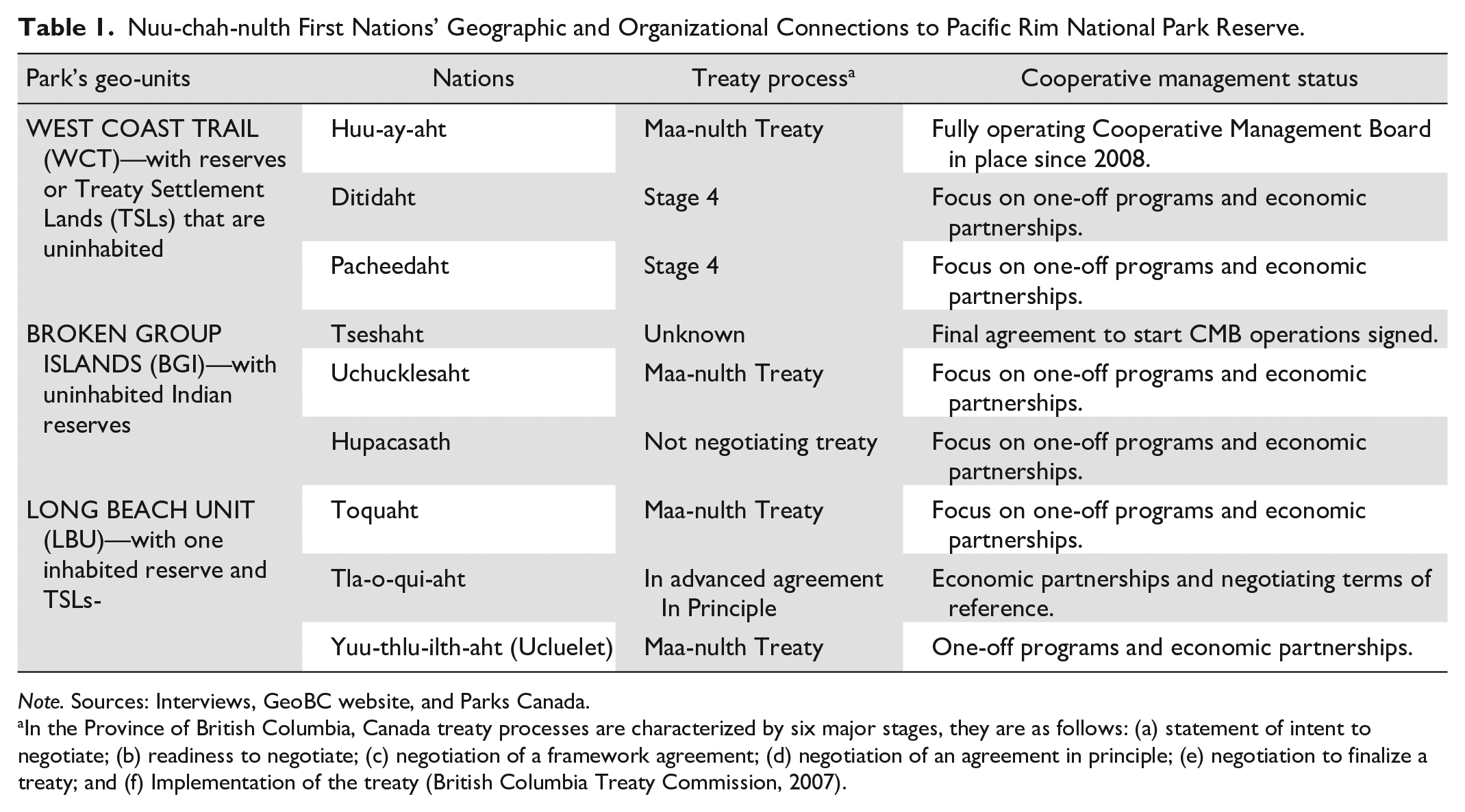
Note. Sources: Interviews, GeoBC website, and Parks Canada.
In the Province of British Columbia, Canada treaty processes are characterized by six major stages, they are as follows: (a) statement of intent to negotiate; (b) readiness to negotiate; (c) negotiation of a framework agreement; (d) negotiation of an agreement in principle; (e) negotiation to finalize a treaty; and (f) Implementation of the treaty (British Columbia Treaty Commission, 2007).
Four nations under the Maa-nulth Treaty Agreement are among the nine nations connected to the park (see Table 1). As treaty nations, they are also party to the Parks Side Agreement contained within the Maa-nulth Treaty. Negotiations within the Maa-nulth Treaty process involved federal and provincial government agencies and five First Nations. Although the Park Side Agreement contains the conventions on cooperative management between the park and four treaty nations, there are no shortcuts to the process of establishing CMBs, which, as pointed out by participants’ contributions, are the outcome of extensive consultation processes. By 2013 (5 years after the singing of the Maa-nulth Treaty and close to 3 years since its ratification, in 2011) only one CMB had been established, with the Huu-ay-aht Treaty Nation.
Park strategies, however inclusive or unprecedented, do not override the degree of authority already vested in the federal government: The Minister of Environment (now Environment and Climate Change) retains authority for the management, administration, and control of National Parks and National Marine Conservation Areas, or any other protected areas that are owned by Canada and administered under the jurisdiction of the Parks Canada Agency. (Government of Canada, Province of British Columbia, & Maa-nulth First Nations, 2009, p. 258)
Despite power differences and the retention of authority at the federal level, there have been outcomes in bilateral and multilateral engagements between PRNPR and Nuu-chah-nulth First Nations suggesting progress in co-management arrangements. These include the development of the first comprehensive PMP that includes both ecological needs and values and aspirations of First Nations, and consistent progress in establishing CMBs with one Nation by 2013 and with four nations by 2018.
Outcomes of Interplay: Multilevel Cooperation, Responsive Institutions and Building Capacity Within and Beyond the PA
Changes in the institutional, legal, and policy environments along with new approaches to leadership eventually contributed to new patterns of interactions and co-management arrangements between Parks Canada and Huu-ay-aht First Nation over lands formerly and exclusively controlled by the federal and provincial governments: We pursued cooperative management and again, you know, it was respecting and recognizing that someone else had the jurisdiction, we didn’t. And again, they weren’t prepared to negotiate losing the control or the jurisdiction, to manage say the park. So we said okay. Well, what is the next best thing to protect our interest? And like I said, our interest, you know, wanted to leave the integrity of the land the way it is. We wanted to make sure our cultural heritage resources are protected . . . So the way to do that is okay, let’s enter into a cooperative management as opposed to exclusive jurisdiction. I think Parks Canada and Huu-ay-aht is . . . They’re taking a lead. It was the lead example that allowed us to move into how we manage forestry, how we manage fisheries. If we hadn’t developed that knowledge there, we wouldn’t have been able to apply that anywhere else. It was a very key element of us advancing and developing capacity to do other things. [We] . . . began to see some huge gaps and issues that we didn’t have control of . . . wanted to see us get more control of activity in our territory . . . And in doing that . . . established different things so that we can negotiate or develop the capacity to where we are now. One, we formed a treaty committee to negotiate a treaty. Secondly, we hired professional people to manage natural resources within our territory. And thirdly, we entered into negotiations with federal and provincial jurisdictions so that we can realize economic benefit for resources in our territory; accommodation, economic accommodation. And also to make sure that our cultural heritage resources weren’t impacted by development . . . we set up a natural resource and we set up a finance committee and these were all people that had responsibilities of getting us to the point we have the capacity to manage our own affairs and to be self-governing. That was the whole goal. (Former Chief of the Huu-ay-aht First Nations)
The building of trust and cooperation through genuine engagement influenced (a) the design of new conservation management arrangements, such as the 2010 Park Management Plan, which was collectively sanctioned by all nine nations, and the establishment of diverse bilateral partnerships the park pursues with the nations on a regular basis, and; (b) The development of responsive institutions (or institutions able to respond/adapt to changing social and ecological circumstances) to formalize cooperation in environmental conservation, as represented by the Park Side Agreement (agreement within the Maa-nulth Treaty, on the implementation of the Cooperative Management Boards and bilateral management of park lands): . . . we’re all on really good terms and going well, in terms of the consultation that goes on. Like what the treaty says is that there’s a 15year review process. So, in other words if the Park Side Agreement [component of the treaty agreement] . . . 15 years from now we do an evaluation and assessment of it and find out what we can improve and you know, what isn’t working. So, I really like that 15 year process. To me that was one of the keys in the treaty, because again there’s no sense having a treaty agreement that sits on a shelf. You want it to be alive. You want it to be working. So, that 15 year review process allows us to do that because now it’s a living document. (Former Chief of the Huu-ay-aht First Nations)
Unfolding interplay patterns suggesting a transition from domination toward negotiation in federal approaches to conservation would assist Huu-ay-aht First Nation in its efforts to address its welfare status, to close pervasive gaps in developed capacity, to address knowledge management and exchange needs, to get official recognition and sanction of its actions in environmental conservation, and to support their overall performance in land and resource management and governance by applying two knowledge systems to address conservation issues: So we can have, you know, those experts with us to help us make decisions internally now and not only that Parks has always been flexible in terms of using their knowledgeable resources, their human resources that they have on staff, right, to help us out with any kind of specific projects that we’re working on . . . We’re getting there now, you know, in terms of that knowledge level with their knowledge level. [also] Because of the treaty now we have proper positions now, right, where before we never had, we never had the organization that we do now in terms of being appointed to specific resources whether it be fisheries or forestry . . . So we now I would say we’re at a level where, whereas before it was just the chief and council, right. Now we’re a governing First Nation. We have responsibilities and areas of responsibilities like fisheries manager, forestry manager so we’re quite specific now within the organization’s structure. (Former Chief of the Huu-ay-aht First Nations) And there has been points, for example, there was a logging opportunity in . . . area would have been a really economic benefit to the nation but because it was interfering with the environment and our cultural integrity we said no, even though there was a really significant economic gain . . . that is another important principle is being able to balance, you know, the economic and the environmental integrity of the nation. And in doing that that’s when you get people more . . . feeling more inclusive, more willing to participate because we’re asking them, you know, should we do this or shouldn’t we do it. (Former Chief of the Huu-ay-aht First Nations)
The Huu-ay-aht First Nation, the first to become involved in management activities within the park (addressing maintenance of the West Coast Park Trail), also became the first to engage in formal collaborative management of the park (since 2008). This collaborative management entails joint decision-making, integrating traditional approaches to governance and the Park’s approach through the Cooperative Management Board, and the engagement in multilevel management of parklands within the nation’s traditional territory.
By 2013, the Huu-ay-aht, a Maa-nulth treaty nation, was in charge of forestry management for approximately 40% of its traditional territory and consulted on the remaining forestry management in its territory. After having ratified its treaty in 2011, the Huu-ay-aht have in place recognized governance institutions, a comprehensive land use plan and elaborate management structures (Huu-ay-aht First Nation, 2014), all of which enhance the Nation’s technical expertise and administrative capacity to address emergent resource and land-based challenges, but also cultural, social, and ecological needs within and beyond the park.
Discussion
The case study research aimed to understand how the institutions and practices of the Canadian federal government evolved to address the sustainability of the PA and of the stakeholder Indigenous communities and to ensure positive mutual benefits. Benefits to First Nations include increased self-determination, economic opportunities, and ability to manage their own resources. Perhaps more significantly benefits to Parks Canada include access to superior First Nation knowledge and experience of the ecosystem honed over centuries of living in place and the ability to apply different knowledge systems to conservation challenges. Drawing on narratives from park and community leaders involved in conservation practice within and beyond the PRNPR we examined the socio-institutional context shaping multilevel interactions, identified critical drivers triggering new patterns of interactions between federal and First Nations regimes, traced institutional and organizational changes signaling a shift from domination toward negotiation in approaches to conservation, and identified some repercussions of these changes for multilevel cooperation, the building of responsive institutions and capacity to enhance and sustain environmental stewardship within and beyond the PA. The findings are discussed below under the analytical themes: context and drivers of change, co-management at PRNPR, critical outcomes of multilevel cooperation, and limitations.
Context and Drivers of Change
The history of interactions between federal and provincial regimes and First Nations on Vancouver Island’s west coast, similar to other parts of Canada, is illustrative of deep-seated patterns of dominance. Widespread discontent resulting from discriminatory policies and regulatory frameworks that undermined the welfare and socioeconomic status of Indigenous peoples, together with Indigenous actions to challenge the status quo through social protest and the national judiciary and institutional mechanisms, set the stage for changes in interactions between federal and First Nations regimes. Landmark court decisions acknowledging First Nations’ subsistence hunting and harvesting rights, the enactment of new institutional arrangements, chief among them Canada’s 1982 Constitution Act, establishing these rights, and the emergence of a regulatory framework mandating provincial and federal governments to consult and accommodate First Nations’ interests, constrained the powers of federal and provincial agencies.
For the participating Nuu-chah-nulth First Nations (under no treaty), as well as for Huu-ay-aht treaty First Nation, for whom management and consultative interactions with Parks Canada have preceded treaty status, Indigenous leadership has been critical to push for and facilitate a more meaningful engagement. Moreover, leadership at the federal level, pushed to pursue conservation interactions which acknowledge ancestral tenure and Indigenous custodianship within parklands and the larger landscape, has also been important to trigger new patterns of interaction leading to collaborative conservation. Up to the present, civil disobedience, court rulings and de-facto governance of traditional territories, although important to upset the status-quo, had been insufficient to alter the central authority and land ownership powers vested in Crown agencies.
Two of the treaty Nations connected to PRNPR suggest that treaties, which help to define degrees of territorial jurisdiction, have played an important role in stimulating meaningful interplay. However, not all respondents view treaties as positive for the relationship between Parks Canada and First Nations. The federal government has imposed limits on the extent of lands and resources allocated to First Nations and the powers and use rights of the Nations over those lands and resources. Thus, there is little trust that treaties will reverse those injustices. For Huu-ay-aht, however, law-making and self-determination powers, together with the freedom to govern in accordance with traditional values within treaty settlement lands, and to be consulted on developments within the wider traditional territories, have contributed to gaining authority and in building capacity and structures to address persistent social and environmental needs on the larger traditional territory within which part of PRNPR is located.
Co-Management at PRNPR
Federal organizational structures signaling a transition from domination toward negotiated conservation planning and management include Parks Canada’s Aboriginal Affairs Secretariat, the Aboriginal Consultation Committee and the Aboriginal Working Group. At the level of the park, central structures and institutional processes developed to aid this transition include the creation of the First Nations Program involving Indigenous leadership, the development of the PMP through a process of consultation and accommodation with all the nine Nations, the establishment of multiple economic, land planning, cultural representation, and other Park-First Nations bilateral partnerships and the establishment of structures and processes of cooperative management with Huu-ay-aht and three other nations.
Based on our observations and supported by the scholarly literature on co-management, we speculate that these initiatives have led to and will continue to create positive conservation outcomes and behaviors, despite having to overcome persistent power differentials in the operation of co-management regimes. Drawing on Indigenous expertise and knowledge of ecosystems developed over the long-term, and ensuring the involvement of Indigenous peoples in conservation decision-making and management has led to improved conservation and sustainability in other locales (Berkes & Adikhari, 2006; King, 2004; Menzies, 2016; Murray & King, 2012; Sene-Harper et al., 2019; Stronza & Pêgas, 2008). For Huu-ay-aht First Nation, the early and regular involvement in collaborative management of conservation efforts had important repercussions in building governance and management capacity at the grassroots, and in tackling social and ecological stewardship strategies within and beyond PA borders.
Critical Outcomes of Multilevel Cooperation
Outcomes of interplay in the form of negotiated agreements, such as the Park Side Agreement with Maa-nulth Treaty First Nations, and the establishment of Cooperative Management Boards (CMB) with four of the nine nations reveals progress in multilevel cooperation. Formulated as an institution which will undergo review in 15 years to assess its impact and effectiveness, the Park Side Agreement has been designed to adapt to evolving needs. Similarly, the tailoring of CMBs to preserve and restore both cultural and ecological integrity (seen by First Nations’ leaders as part of the same goal); to integrate Indigenous and park decision-making structures; to approach park zoning in a cooperative fashion (acknowledging both traditional “man-in-nature” and more science-based “no-use-zones” paradigms) and; to regulate harvesting quotas within park limits, also suggest versatility at the level of structures, latitude to build collective capacity, and an alternative to address challenges documented by previous research showing a pre-existent dichotomy between park and First Nations’ mandates and overarching goals (Hanna et al., 2008; Murray & King, 2012).
Limitations
The extent to which Parks Canada has devolved decision-making power to First Nations has been a central concern. As attested by PRNPR PMP, final decisions rest with the Park Superintendent, which reveals the degree of power still held by federal agencies over First Nations. The data show that collaboratively designed multilateral and bilateral agreements have so far been honored at the national level and that changes in the nature of interplay are taking place both nationally and locally. But, will the current framework, requiring consultation and accommodation with First Nations and Parks Canada’s effort to establish cooperative conservation be enough for all remaining nations to welcome CMBs is yet to be seen. The land question is a central one for all participating nations and the shared struggle for Indigenous peoples worldwide (Borrini-Feyerabend et al., 2004, 2007). Further research will also be required to examine the impacts of the power held by federal agencies on the functionality and performance of CMBs in terms of shared power and management authority, as well as to assess the performance and differences among CMBs with treaty and with non-treaty nations. Moreover, data on actual ecological conservation outcomes in different locales will be needed to assess the potential of this co-management model to conserve marine and terrestrial ecosystems within and around PRNPR.
Conclusion
At PRNPR, although conditions of unequal distribution of power prevail, as is often the case in multilevel governance of protected areas established by the state, there is an institutional transition toward providing increasing recognition on the role, tenure, and custodianship of First Nations over traditional and “shared” territories. In this regard, flexible leadership, institutions, and policies clarifying the rights and roles of First Nations within ancestrally inhabited territories, are contributing to the emergence of adaptable multi-custodian conservation regimes. Ultimately, the transition from domination toward negotiation in the interplay between state and Indigenous environmental regimes is enhancing the capacity of various actors to address environmental and social needs in the larger landscape in which the PA is embedded, to pursue multiple and multilevel goals and values and to fashion institutions which are more responsive and adaptable to rapidly changing social–ecological conditions.
Ever-growing research documenting the importance of Indigenous peoples strategies and territories to address and sustain biodiversity conservation (Alcorn, 1993; Borrini-Feyerabend et al., 2007; The United Nations, 2019) reveals correlations between cultural and biological diversity (The United Nations, 2019). Yet, there is growing scientific evidence documenting clashes between state-led approaches to conservation and grassroots governance systems (Duffy, 2006; Orozco-Quintero & King, 2018) and persistent gaps in understanding how multilevel institutional and organizational interactions including co-management arrangements can sustain both the protection of nature and of the social communities to which it is connected (Young, 2002a). Considering the clear support of world governments to establishing PAs (Visconti et al., 2019), we documented ways in which new patterns of interplay among the federal government and First Nations regimes are shaping PAs and environmental stewardship on Canada’s Vancouver Island west coast and the significance of different patterns of interplay and cooperative conservation for addressing the sustainability and health of natural and human communities connected to PAs.
The findings highlight how subtle and consequential institutional interactions among nested systems of social organization are for achieving multilevel cooperation and the stewardship of nature and culture. Institutional and organizational interactions shaping conservation practice within and around Canada’s Pacific Rim National Park Reserve show that multilevel management can take place despite significant decision-making power disparities between the state and communities. The findings reveal how essential leadership and social action have been to confront exclusion and to navigate power differences. However, achieving multilevel cooperation in conservation may require a shift in the interplay between federal and First Nations’ regimes - a shift away from the pursuit of full territorial control and toward progressive action to address shared jurisdiction, unwavering inclusion in decision-making and, ultimately, clear communal land rights. Notably, interplay outcomes in the form of negotiated agreements and cooperative conservation, are enhancing collective capacity to sustain nature and culture within and beyond the PA and have been conclusive in fashioning conservation efforts that are more responsive to an ever-changing social–ecological landscape.
Supplemental Material
Appendix_A_InterviewGuide_FirstNations_1 – Supplemental material for Interplay and Cooperation in Environmental Conservation: Building Capacity and Responsive Institutions Within and Beyond the Pacific Rim National Park Reserve, Canada
Supplemental material, Appendix_A_InterviewGuide_FirstNations_1 for Interplay and Cooperation in Environmental Conservation: Building Capacity and Responsive Institutions Within and Beyond the Pacific Rim National Park Reserve, Canada by Alejandra Orozco-Quintero, Leslie King and Rosaline Canessa in SAGE Open
Footnotes
Acknowledgements
Our special thanks go to the members and leaders of Nuu-cha-nulth First Nations within whose ancestral territories Pacific Rim National Park Reserve is located, and in particular Sheila Charles and to the leaders of Huu-ay-aht First Nation who generously shared their time, knowledge, and resources. Our sincere thanks also go to Parks Canada staff for the time and information they shared. Finally, we would also like to thank Dr. Lance W. Robinson for his valuable comments on the earlier version of this article.
Ethical Approval
The research was approved by the University of Victoria’s Human Research Ethics Board through Certificate No. 12-075 and by Parks Canada Agency through Permit No. PRN-2012-10713. All procedures performed in studies involving human participants were in accordance with the ethical standards of the University of Victoria’s Human Research Ethics Board and with the 1964 Helsinki Declaration and its later amendments or comparable ethical standards.
Declaration of Conflicting Interests
The author(s) declared no potential conflicts of interest with respect to the research, authorship, and/or publication of this article.
Funding
The author(s) disclosed receipt of the following financial support for the research, authorship, and/or publication of this article: The research upon which the article is based was possible thanks to: a doctoral scholarship from The International Development Research Centre (IDRC) and the Social Sciences and Humanities Research Council of Canada (SSHRC) through the Protected Areas and Poverty Reduction Canada-Africa Research and Learning Alliance Project.
Supplemental Material
Supplemental material for this article is available online.
Notes
References
Supplementary Material
Please find the following supplemental material available below.
For Open Access articles published under a Creative Commons License, all supplemental material carries the same license as the article it is associated with.
For non-Open Access articles published, all supplemental material carries a non-exclusive license, and permission requests for re-use of supplemental material or any part of supplemental material shall be sent directly to the copyright owner as specified in the copyright notice associated with the article.
