




Abstract
Human trafficking is an imminent problem not limited to certain regions of the globe. Although the problem of human trafficking is severe over the world, Sub-Saharan African countries are some of the most vulnerable to human trafficking. Despite the severity of human trafficking in Sub-Saharan Africa, only 23 countries, less than half of Sub-Saharan African countries, have introduced domestic statutory laws addressing human trafficking. Why do some African countries adopt laws for combating human trafficking, while others do not? Focusing on the role of gender-related factors in the introduction of laws addressing human trafficking, this article aims to fill this academic lacuna by conducting time-series cross-national analysis on 49 African countries from 1960 to 2016. The empirical results from this study demonstrate that increases in the percentage of women in legislative branches and in women’s participation in civil society organizations lead countries to introduce anti-human trafficking laws.
Keywords
Introduction
Human trafficking, defined as “. . .the recruitment, transportation, transfer, harboring or receipt of people through force, fraud or deception, with the aim of exploiting them for profit” (UNODC, n.d.a.), is one of the most lucrative crimes not limited to certain regions of the globe. According to the report from the United Nations Office on Drugs and Crime (UNODC), based on 148 countries, the global average rate of convicted people from human trafficking per 100,000 population increased from about 1.00 to 3.00, and about 70% of victims are adult women or girls (UNODC, 2020). With some variations in estimations, the International Labor Organization (ILO & Walk Free Foundation, 2020) reports that 11.4 million victims (55%) of total labor trafficking are women and girls. Given that crimes tend to be underestimated and veiled, the actual number of victims of human trafficking might be higher than the number of detected victims.
Although the problem of human trafficking is severe throughout the world, Sub-Saharan African countries are some of the most vulnerable to human trafficking. Almost no countries in this region are immune to human trafficking (Allais, 2006). For instance, standing against “baby factories” growing in Nigeria, Alabi (2018) argues that human trafficking is expanding and is prevailing in African countries. Compared with other geopolitical regions, Sub-Saharan Africa has the highest rate of children and female victims of human trafficking (Umukoro, 2021). The UNODC revealed that 86% of detected victims are women or children (UNODC, 2020). Among the detected victims, 20% have experienced sexual exploitation and 77% have been exploited for forced labor (UNODC, n.d.b.). In addition, the Walk Free Foundation (2020) finds that women and girls account for 71% of the victims of modern slavery.
Despite the severity of human trafficking in Sub-Saharan Africa, only 23 countries, fewer than half of those in the region, have introduced domestic statutory laws addressing human trafficking. Even after the U.N. adopted the Elimination of Human Trafficking/Forced Labor as Target 16.2 to meet its sustainable development goals, and despite the growing body of literature on human trafficking, potential driving factors of the adoption of anti-human trafficking laws have not been thoroughly examined empirically, especially in Sub-Saharan African countries which have suffered the highest rate of children and female victims (Okech et al., 2018; Russell, 2018; as an exception see Yoo & Boyle, 2015).
Why do some African countries adopt laws for combating human trafficking, while others do not? Focusing on the role of gender-related factors and the introduction of laws that are the most basic and important legal means to address human trafficking, this article aims to fill this academic lacuna by conducting time-series cross-national analysis on 49 African countries from 1960 to 2016. The empirical results from this study demonstrate that the increase in the percentage of women in legislative branches (women’s descriptive representation in legislative branches) and the increase in women’s participation in civil society organizations lead countries to introduce anti-human trafficking laws.
This article proceeds with the following orders. In the next section, previous literature on human trafficking is reviewed. In the theories and hypotheses section, this article introduces five gender-related socio-economic and political factors: (1) women’s descriptive representation in legislative branches, (2) women’s participation in civil society organizations, (3) women’s property rights, (4) female unemployment rate, and (5) women’s international non-governmental organizations, which can plausibly affect the adoption of laws addressing human trafficking. Variables and data, modeling strategy, and empirical results are then presented. Finally, this article concludes with potential limitations of this study and promising future directions of research on human trafficking.
Literature Review
Previous studies on human trafficking started from analyzing various costs of human trafficking. At the individual level, victims of human trafficking are likely to suffer from physical, mental, and emotional trauma (Dhital et al., 2011; Hardy et al., 2013; Hossain et al., 2010). Specifically, related to mental health, Gezie et al. (2018) investigating trafficking returnees in Ethiopia revealed that 58.3% and 51.9% of returnees suffered from depression and anxiety respectively. Moreover, interviewing 39 female Libya returnees in Nigeria, Edegbe and Imafidon (2021) showed that the interviewees experienced unwanted pregnancy, vaginal injuries, and complications from unsafe abortions.
The fatalistic impacts of human trafficking are not confined to individuals but also impose tremendous costs at the national level (Babatunde, 2014; Shelley, 2010; Walby et al., 2020). For instance, Bello and Olutola (2022) argued that human trafficking causes national security problems and threatens states’ internal security. Based on a case study on Nigeria, Babatunde (2014) emphasized multiple security challenges from human traffickers to governmental and national security: “Human trafficking also threatens national security in its link to transnational organized crime, for in many states, including Nigeria, international criminal networks that support mafia-like organizations undermine the state’s sovereignty over particular areas” (p. 73). Also, Uzokwe and Ofuoku (2006) argued that the increase in the number of trafficked women degrades the farming industry and threatens food security in African countries. Other studies have also revealed various economic and social costs of human trafficking (Iroanya, 2018; Makisaka, 2009; Rahamtalla, 2018).
In Sub-Saharan African countries, the exploitive nature of human trafficking counts human trafficking as a new form of slavery, and inefficient policies and absence of legal tools have made penalizing the activities of human trafficking or smuggling of human beings extremely difficult (Adepoju, 2005). Although there have been relatively few academic studies on human trafficking in African countries compared with other geopolitical regions, some studies provide insights about human trafficking in such countries. One study argued that the cocoa belt of Sub-Saharan Africa is largely based on slave labor exploitation from human trafficking (Onuoha, 2011), while another study demonstrated that the erosion of social protection and other social deprivation exacerbates the problem of human trafficking in sub-regions of Africa (Truong, 2005). Truong (2005) identified six representative processes that are likely to result in trafficking: (1) selling children by parents, (2) placement for a specified period in return for gift items, (3) bonded placement of children to reimburse a debt, (4) enrollment with an agent for domestic work, (5) fees to paid agents, and (6) abduction.
In African countries, women and girls are most vulnerable to human trafficking (Chukwuebuka, 2010; Donno et al., 2022). For instance, in Benin, 361 girls (67.35% of 536 recorded victims) were victimized by human trafficking (UNODC, 2018). In addition, some studies investigated examples of recruitment of women and girls into the sex industry and revealed that those debt-trapped victims are forcibly sexually exploited (Bello & Olutola, 2020; Msuya, 2017; UNICEF, 2005). Thus, although a few studies examined the trafficking of men (Allais, 2013; Gutmann, 1997; Surtees, 2008), most studies focus on the trafficking of women and girls. Based on feminist approaches, studies on human trafficking have focused on research areas including human rights (D’Cunha, 2002; Heyzer, 2006), policies against human trafficking (Cho, 2015; Potrafke, 2016), migration (Truong, 2008), prostitution (O’Neill, 2001), sexist stereotypes (Lobasz, 2009), and sex trafficking (Jeffreys, 2002; Samarasinghe, 2012).
However, it still should be noted that although the dominant human trafficking narrative describes female victims subordinated and exploited through sex trafficking by violent males, this does not completely capture the diverse nature of human trafficking (Hebert, 2016; McCarthy, 2020). Some studies demonstrated that the number of cases of women’s involvement in human trafficking is not negligible (Denton, 2010; Hübschle, 2014; Wijkman & Kleemans, 2019). For instance, Denton (2010) found that women were involved in 37% of human-trafficking cases, while Hübschle (2014) argued that women engage in recruiting women relatives for sex trafficking and recruiting men for labor trafficking in Sub-Saharan Africa.
Even though the previously described studies broaden our understanding of human trafficking, empirical studies to reveal reasons why countries legislate laws which are the most basic tool to illegalize human trafficking are not thoroughly developed (Okech et al., 2018). Given the enormous costs of human trafficking on individual development, national and global security, human rights, and women’s rights, and given broad research areas related to human trafficking (Bello & Olutola, 2022; Heyzer, 2006), the shortage of empirical studies on what drives countries to adopt anti-human trafficking laws especially in the African contexts is unexpected. To contribute to the literature on human trafficking, this article attempts to explain the variations of the adoption of anti-human trafficking laws among African countries based on the role of women.
Theories and Hypotheses
With the focus on gender-related factors, the goal of this study is to reveal factors promoting the adoption of laws addressing human trafficking in Sub-Saharan African countries. First, this article sheds light on the role of women’s descriptive representation in legislative branches in the adoption of anti-human trafficking laws. The increased proportion of women in parliaments has visibly affected various aspects of this legislation and policy adoption, including feminist changes and engendering policies (Bauer & Britton, 2006). Largely based on the critical mass theory from Kanter (1977) and politics of presence theory from Pitkin (1967), previous studies on the link between women legislators and policy priorities showed that women legislators tend to have different policy priorities because of their gender (Koop & Conrad, 2021; Mansbridge, 1999; Reingold, 2003; Saint-Germain, 1989; Schwindt-Bayer & Mishler, 2005; Swers, 1998; Tam, 2020; Thomas, 1991).
To be specific, myriad studies demonstrated that female legislators pay more attention to “women’s issues” broadly defined as issues women are likely to be interested in such as welfare, education, women’s health, human rights, and crime (Donno et al., 2022; Meloy, 2015; Osborn, 2012; Schwindt-Bayer, 2010). As a cornerstone work, analyzing the voting records in the U.S. 103rd congress, Swers (1998) demonstrated that the gender of legislators has significant impacts on their legislative behaviors. Through regression analyses, she found that women legislators are likely to initiate women’s issue bills such as family planning, public health, and crime bills. In addition, Bouché and Wittmer (2015) found that U.S. states with higher percentages of women in the House are more likely to have comprehensive legislation concerning human trafficking. More recently, Koop and Conrad (2021) showed that female representatives tend to prioritize non-traditional policy domains including the environment and social services.
The different policy priorities of female and male legislators have also been demonstrated in previous studies focusing on other geo-political regions outside of the United States. By examining bills proposed in the Legislative Assembly of Costa Rica, the Congress of Colombia, and the National Congress of Argentina, Schwindt-Bayer (2006) revealed that female legislators tend to place a higher priority on women’s issues including sex crimes. In addition, Taylor-Robinson and Heath (2003), analyzing the Honduran Congress, found that gender is a crucial factor explaining why female legislators compared to male counterparts pay more attention to women’s issues. Also, relying on the case of Hong Kong, Tam (2017) showed that female lawmakers in an undemocratic or semi-democratic legislature are more likely to propose bills concerning crimes such as violence against women.
The tendency of women legislators to focus on crime bills that include anti-human trafficking legislation has also been revealed in studies on African countries (Bauer & Britton, 2006; Britton, 2006; Meintjes, 2003). Even though some case studies found the null effects of women’s descriptive representation (Devlin & Elgie, 2008; Disney, 2006), there are non-negligible findings supporting the importance of women legislators on legislative outcomes. For instance, Bauer and Britton (2006) argued that women legislators have broader policy agendas and policy priorities on crime bills such as violence against women. More specifically, Meintjes (2003) emphasized the crucial role of women legislators in adopting the 1988 Domestic Violence Bill in South Africa. Based on the above studies, it is expected that the increase in women’s descriptive representation tends to lead Sub-Saharan African countries to introduce anti-human trafficking laws.
Hypothesis 1: The increase in women’s descriptive representation in legislative branches increases the probability of adopting anti-human trafficking laws, all other things being equal (ceteris paribus).
In addition to the increasing number of women legislators, the crucial role of women’s participation in civil society organizations has also been spotlighted (Barberet, 2014; Basu, 2016; Htun & Weldon, 2012; Karim & Beardsley, 2016; Weldon & Htun, 2013). The crucial work from Htun and Weldon (2012) revealed that feminist autonomous movements in individual countries promote policy changes addressing the problem of violence against women and violation of human rights. With cross-national data in 4 years (1975, 1985, 1995, and 2005), they found that the impact of feminist movements on policy changes combating violence against women is statistically significant and argued that feminist movements are more crucial than the mere number of women in parliaments.
As theorized by Htun and Weldon (2012), the logic behind the association between feminist movements and policy changes for human rights is straightforward. Given that violation of human rights including violence against women is seldomly raised as a salient issue (Weldon, 2002), the pressures from feminist organizations or movements, and women’s participation in such movements are essential to lead governments to advance policy adoptions for social justice. The strong feminist movements are likely to be a catalyst for government action against human rights violations. Furthermore, some studies argued that, rather indirectly, feminist movements can provide resources for decision-makers to start initiatives relating to human rights (Joachim, 1999; Weldon, 2011). Borrowing the argument from Htun and Weldon (2012), this article hypothesizes the relationship between women’s participation in civil society organizations as below.
Hypothesis 2: The increase in women’s participation in civil society organizations increases the probability of adopting anti-human trafficking laws, all other things being equal (ceteris paribus).
Women’s financial independence and economic vulnerability can also affect the adoption of laws addressing human trafficking (Edlund & Pande, 2002; Edlund et al., 2005; Iversen & Rosenbluth, 2006; Olken, 2010). The degrees of female citizens’ financial independence and economic vulnerability are closely related to women’s policy prioritization (Gottlieb et al., 2018). This literature is rooted in the ethic of caring theory developed by Gilligan (1982) which argued that women, rather than men, tend to care about other people including children. In her work, she described the moral development of women by dividing it into three stages: pre-conventional, conventional, and post-conventional. In the pre-conventional stage, women’s decision-making is largely driven by self-interest to survive. However, when women get into the second stage with sufficient resources to make their lives, they are more likely than their counterparts to care and to exhibit responsibility for others. In the last stage, women have developed a mature and holistic ethic of caring.
Supporting the ethic of caring theory, some studies empirically showed that female citizens have preferences for social justice-oriented policies and legislation to address violence. Cavalcanti and Tavares (2011) found that the increase in women’s labor motivates them to demand governmental spending on social services. Even earlier, Goertzel (1983) and Smith (1984) empirically found that women are more hostile to violence and support human rights. Like previous studies, this article, relying on the ethic of caring theory, expects that financial independence and less economic vulnerability leads women to politically express their policy preferences and priorities to governments. In turn, the improved status of women gives more pressure on representatives to perform legal reforms against human trafficking.
Hypothesis 3: The increase in women’s property rights increases the probability of adopting anti-human trafficking laws, all other things being equal (ceteris paribus).
Hypothesis 4: The increase in female unemployment rate decreases the probability of adopting anti-human trafficking laws, all other things being equal (ceteris paribus).
Last, this article examines the relationship between the presence of women’s international non-governmental organizations (INGOs) in individual countries and the probability of adopting laws addressing human trafficking. This attempt is based on the previous literature supporting the crucial role of INGOs in policy diffusion (Dobbin et al., 2007; Evans & Davies, 1999; Graham et al., 2013; Shipan & Volden, 2008). INGOs act to transform domestic norms, interests, and, in turn, policies (True & Mintrom, 2001). Among countries, policy diffusion can be taken through diverse mechanisms including coercion, learning, and social construction (Dobbin et al., 2007; Shipan & Volden, 2008). It has been revealed that INGOs tend to make the diffusion mechanisms more likely to work (Velasco, 2018; Wotipka & Ramirez, 2008; Yoo & Boyle, 2015). Largely based on the lens of constructivism, Dobbin et al. (2007) summarized well how INGOs lead countries to learn or imitate new policies from other countries. To be specific, they mentioned that policy makers tend to adopt policies that they observe experts such as those from INGOs promoting countries embracing. Moreover, INGOs can also facilitate policy diffusion through the coercion mechanism, in which transnational nongovernmental actors including INGOs lead countries to adopt certain policies through physical force (Beck et al., 2006; Dobbin et al., 2007; Owen, 2002).
Previous studies have supported the significant role of INGOs in the diffusion of various types of policies. Analyzing the legislation of feminist policies in 157 countries from 1975 to 1998, True and Mintrom (2001) found that transnational actors such as women’s INGOs tend to lead countries to adopt policies improving gender mainstreaming. Also, developing a demonstrated lesbian, gay, bisexual, and transgender (LGBT) Policy Index for 156 countries, Velasco (2018) demonstrated that targeted advocacy efforts of LGBT INGOs are indispensable for the diffusion of LGBT policies. The conducive impacts of INGOs in policy diffusion are also observed in the adoption of environmental policies (Frank et al., 2007; Longhofer et al., 2016) and labor policies (Greenhill et al., 2009).
In terms of human rights issues including trafficking, INGOs, especially women’s INGOs, have also received academic attention. INGOs, with support from human rights and feminist activists, moved the problem of human trafficking from a marginal to a central issue (Gozdziak & Collett, 2005; Laczko, 2005). Women’s INGOs have influenced policy-making processes related to human rights issues in individual countries around the world (Dean, 2016). Relying on the traditional feminist networks (Johnson, 2009; Mohanty, 2003; Tripp, 2006), women’s INGOs are more likely to exert their power on policy-making processes through lobbying in the international area (Weiss & Gordenker, 1996). There is some evidence to support the conducive role of women’s INGOs on the adoption of anti-human trafficking laws outside of the African context: post-Soviet region (Dean, 2016), Asia and Europe (Limoncelli, 2016), and North America (De Shalit et al., 2014; Musto, 2008).
For instance, Limoncelli (2016) found that over 1,800 INGOs around the globe work on the problem of human trafficking and they mainly target both labor and sex trafficking. In addition, she demonstrated that the anti-trafficking NGOs have engaged in legislative efforts to penalize human trafficking and provision of counseling to the victims. Also, by analyzing three post-Soviet countries (Russia, Latvia, and Ukraine), Dean (2016) demonstrated that INGOs play a crucial role in the implementation and the adoption of legal regulations against human trafficking. Thus, based on the previous literature on the crucial role of women’s INGOs in the legislation of anti-human trafficking laws, I expect that those findings can be generalized to the African context.
Hypothesis 5: The increase in the number of women’s INGOs increases the probability of adopting anti-human trafficking laws, all other things being equal (ceteris paribus).
Variables and Methods
Variables
In this section, variables, data sources on 49 African countries from 1960 to 2016, and modeling strategy will be introduced (the list of countries is displayed in Appendix). Coverages of countries and time depend on the data sources used to build independent and control variables. The broad time span of data used in this article prevents bias regarding estimates on the five independent variables. Therefore, the unit of analysis in the empirical analysis is country-year.
Dependent variable
As a dependent variable, the adoption of anti-human trafficking laws is used as a binary variable. To construct this variable, the global database from UN Women (n.d.) is used. The database provides information about when countries legislate anti-human trafficking laws and how they collect data on each country. The dependent variable is assigned 1 when countries adopt laws addressing anti-human trafficking. It is assigned 0 when they have not adopted such laws.
Among the 49 Sub-Saharan African countries in the database, only 23 (46.94%) have introduced laws addressing human trafficking. The number of countries with anti-human trafficking laws is surprisingly low, given the severity of human trafficking, and the costs imposed by human trafficking in the Sub-Saharan region (Table 1).
Adoption of Laws Addressing Human Trafficking in Sub-Saharan Africa.

Source. The Global Database from UN Women (n.d.). Please refer to UN Women (n.d.) to see the detailed information about each legislation.
Independent variables
To test the five hypotheses about the influence of gender-related factors on the adoption of anti-human trafficking laws, this study relies on some time-series cross-national databases rather than arbitrarily builds each variable. First, the global data on national parliaments from the Inter-Parliamentary Union (IPU) is used to measure the percentage of women legislators in legislative branches. The IPU provides information about the first female representative in parliaments in each country, with election years. It also continuously updates the changes in the percentage of women legislators over decades.
Second, to evaluate the influence of women’s property rights and women’s participation in civil society organizations, this article uses variables named v2clprptyw and v2x_gencs from the Varieties of Democracy (V-Dem) data (Coppedge et al., 2019). This choice to rely on the indexes from the V-Dem is based on the rationale that the V-Dem measures those gender-related variables more precisely rather than other indexes from the Gender Development Index (GDI), the Global Entrepreneurship Monitor (GEM), the Gender Inequality Index (GII), or the Cingranelli and Richards (CIRI) data (Sundström et al., 2017). Furthermore, the broad time coverage of the V-Dem data enables us to take advantage of the data on laws from UN Women (n.d.).
Third, the female unemployment rate is measured based on the data from the International Labour Organization (ILOSTAT, n.d.), which is modeled by the World Bank (n.d.). The ILO defines the persons in unemployment as “. . .all those of working age who were not in employment, carried out activities to seek employment during a specified recent period and were currently available to take up employment given a job opportunity.” (ILO, 2019). Thus, the female unemployment rate is computed as below:

Last, this article uses the independent variable “Number of Women’s INGO” to evaluate the association between the activities of women’s INGOs and the adoption of laws addressing human trafficking. By collecting data from the United Nations Civil Society (UNCS), I count the number of women’s INGO headquarters in each African country based on the data collection process from Ryu (2020).
Control variables
Estimating the influences of the five independent variables on the probability of adoption of laws addressing human trafficking without including relevant control variables will bias the estimated coefficients of the independent variables and lead to a wrong conclusion. Also, the omitted variable bias (OVB) can seriously distort inferences from this study (Wooldridge, 2016). To avoid this problem caused by the OVB, this article includes a series of control variables that might influence the dependent variable based on previous studies.
Given that the legislation of anti-human trafficking laws is highly dependent on the functions of legislatures, the degree of legislature corrupt activities is controlled. Legislative corruption especially in post-authoritarian societies is a significant challenge for legislative branches to perform better (Khmelko & Bonnal, 2020). It has been studied that legislative corruption causes legislative inefficiency and unfairness in decision-making processes (Kubbe & Engelbert, 2018; Rose-Ackerman, 1996; Yadav, 2012). Thus, this article includes the degree of corrupt legislature activities to parcel out the anticipated negative impacts of legislative corruption on the probability of adopting anti-human trafficking laws. The index named v2lgcrrpt from the V-Dem is used to measure legislative corruption. The V-Dem builds the index by defining the forms of legislative corruption as below: (a) legislative corruption includes accepting bribes, (b) helping to obtain government contracts for firms that the legislator own, (c) doing favors for firms in exchange for the opportunity of employment after leaving the legislature, (d) stealing money from the state or from campaign donations for personal use (V-Dem Institute, 2021, p. 148).
Next, GDP per capita and the level of democracy are also controlled. This decision is based on previous studies demonstrating those two factors tend to promote human rights. Some studies based on the modernization theory have demonstrated that economic development causes countries to put more emphasis on post-materialistic values such as human rights (Inglehart, 1988; Inglehart & Welzel, 2010), whereas others showed that democratic regimes are more likely than non-democratic regimes to secure human rights (Beetham, 1999; Koenig & Guchteneire, 2007). To estimate the influence of the five independent variables isolated from the impacts of economic development and regime types, this article controls for those two variables by relying on the democracy index (v2x_polyarchy) from the V-Dem and GDP per capita from the Maddison Project (Bolt et al., 2018). The democracy index from V-Dem is used instead of indexes from Freedom House or Polity Project, given that these two indexes have been criticized because of under- or overestimations of the level of democracy (Teorell et al., 2016, 2019). GDP per capita is measured as real GDP per capita in 2011 U.S. dollar.
The government system also can affect countries’ decision-making processes. It has long been discussed that there are significant differences related to policymaking accountability including consultation and participation, expertise, and partisan balance between parliamentary and presidential government systems (Carey, 2008; Moe & Caldwell, 1994; Rose-Ackerman, 2011). Those studies have continuously demonstrated that legislative behaviors of legislators are conditioned by their government systems. For instance, Rose-Ackerman (2011) argued that politicians controlling the government in parliamentary systems are less likely to participate in policymaking processes. On the other hand, in a presidential system, he said that the presence of multiple veto points makes changes and adoptions of new legislations hard to occur (see also Tsebelis, 2002). Therefore, rather than disregarding the possibility that government systems affect the probability of adopting anti-human trafficking laws, this article controls for the form of government systems of individual countries based on the classification from the Quality of Government (QoG) dataset (Teorell et al., 2018).
Next, this article takes the incidence of both international and internal conflicts into account. This is based on the rationale that countries are less likely to promote laws to combat human trafficking during experiencing such conflicts. To measure the magnitude of international and internal conflicts, the conflicts index from the Major Episodes of Political Violence (Marshall, 2019) is used.
Finally, the level of education of individual countries is controlled with an expectation that a higher level of national education leads citizens to care about human rights and give pressure on their governments to equip legal tools to handle crimes threatening human rights. Some studies support the link between citizens’ perception and the level of public education (Anderson et al., 2005; Carlson & Listhaug, 2007). The index e_peaveduc from the V-Dem data is used to build the “Education” variable.
Table 2 shows the descriptive statistics of variables used in this study. For the categorical variable “Government System,” frequencies for each category are presented rather than means and standard deviations. Each variable has non-negligible variations, which enables the application of the statistical approach.
Descriptive Statistics.
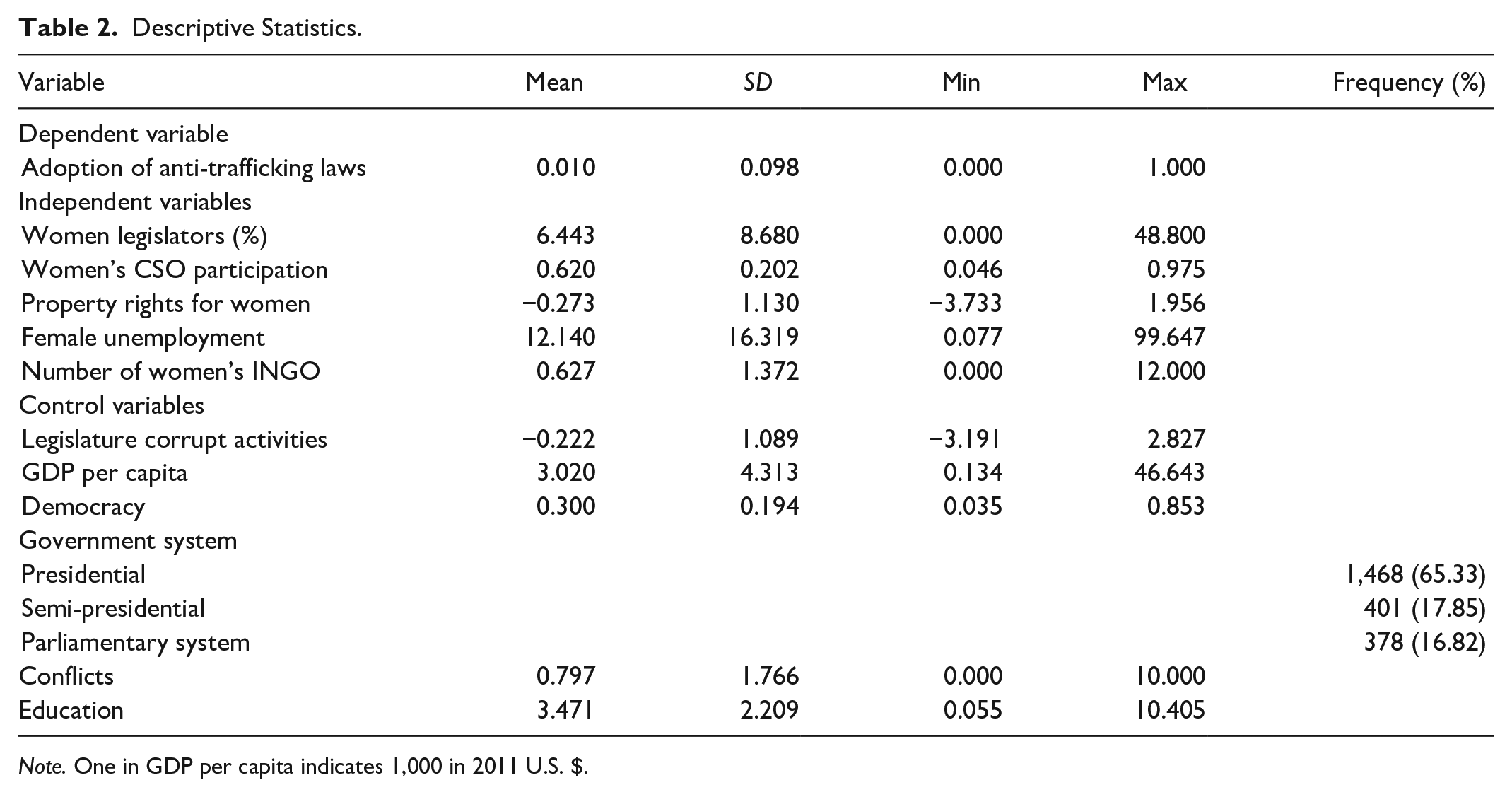
Note. One in GDP per capita indicates 1,000 in 2011 U.S. $.
Methods
Given the nature of the binary dependent variable, estimating the conventional ordinary least square (OLS) regressions is problematic. If OLS regressions are applied, the estimated coefficients of independent variables will be biased, the predicted values of a dependent variable will be non-sensical, and the estimated standard errors will be invalid (Dougherty, 2011).
Therefore, this article estimates logistic event history models (EHMs) to avoid such biases and problems. The logistic event history models are widely used to explain the adoption or diffusion of policies and laws (e.g., see Boehmke, 2009; Buckley & Westerland, 2004; Kreitzer & Boehmke, 2016). Because the unit of analysis is country-year and there are some tied events in our data that might cause problems in continuous event history models (Box-Steffensmeier & Jones, 2004), logistic event history models are preferred to other models including the Cox Proportional Hazard Models. Based on the notation from Tekle and Vermunt (2012), the formal expression of logistic event history models is below:

where
Results
This article starts by estimating five bivariate logistic discrete event history models to see whether each independent variable has a statistically significant relationship with the likelihood of adopting anti-human trafficking laws. Estimating the bivariate models enables us to preview the impacts of the independent variables.
As illustrated in Figure 1, three independent variables including Women Legislator (%), Property Rights for Women, and Women’s CSO Participation have statistically significant relationships with the likelihood of adopting anti-human trafficking laws at the level of p < .05. This result supports H1, H2, and H3. On the contrary, unlike theoretical expectations, the remaining two independent variables are not statistically significant at the level of p < .05.

Five bivariate models with each independent variables.
Table 3 presents the empirical result from a logistic event history model with all independent and control variables. As in bivariate models, women’s descriptive representation in legislative branches is statistically significant at the level of p < .05. The estimated beta coefficient of Women Legislators (%) is .044 in a positive direction, meaning that the log odds of adopting anti-human trafficking laws increase by .044 for every 1% increase in Women Legislators (%). This supports the expectation that the increased number of women legislators leads countries to pay more attention to the problem of human trafficking. Moreover, theoretically, this result provides additional empirical evidence for the argument that the number of women legislators leads to policy changes related to women’s interests including human rights and childcare (Barnes & Burchard, 2013; Reingold et al., 2021; Swers, 1998).
Estimations From Logistic Event History Models.

Note. The number of observations is determined by missing data. Again, only country-year observations without anti-human trafficking laws are included in empirical analysis. Pseudo R2, Akaike Information Criterion (AIC), and Bayesian Information Criterion (BIC) are presented for model comparison. Number of observations = 2,141, pseudo R2 = .146, AIC = 235.462, BIC = 309.159.
In addition, the participation of women in civil society organizations measured by the index from the V-Dem data has a statistically significant positive relationship with the likelihood of the introduction of anti-human trafficking laws. One unit increase in Women’s CSO Participation increases the log odds of adopting anti-human trafficking laws by 4.993. This empirical result is in the line with the argument that the improvement of female autonomous movements tends to promote policy changes on human rights including women’s rights (Htun & Weldon, 2012; Htun et al., 2013; Weldon & Htun, 2013).
On the other hand, the rest of the key independent variables does not show statistically significant relationships with the dependent variable as in Figure 1. This finding emphasizes the relative importance of political and sociological factors, such as the presence of women in legislative branches and women’s participation in civil society organizations, over that of economic factors including women’s property rights and the female unemployment rate. In addition, even though the null effect of women’s INGOs is not expected, this finding is consistent with the finding of Yoo and Boyle (2015) that INGO is not a driving factor of human trafficking prosecution. The result is also in accordance with the finding that INGOs in Sub-Saharan Africa have strongly focused on providing employment and vocational training assistance for the victims of human trafficking rather than policy advocacy and legislative efforts (Limoncelli, 2016).
Turning to control variables, none of the control variables is statistically significant. Even though this result is not expected, it is not strange considering that some previous studies did not find an association between those control variables and the adoption of policies for human rights. For instance, Htun and Weldon (2012) showed that the level of democracy and economic development does not have a consistently robust relationship with the adoption of policies combating violence against women. In addition, Gerring et al. (2009) found some null effects of the government system on political stability and government effectiveness. Also, although the estimates of Legislature Corrupt Activities, Conflicts, and Education have expected signs, they are neither statistically significant, which emphasizes the relative explanatory powers that the percentage of women legislators and women’s participation in civil society organizations have on the adoption of anti-human trafficking laws.
This article continues to evaluate the substantive impacts of the two significant independent variables by estimating predicted probabilities based on their values. Estimating predicted probabilities is essential to see whether the statistically significant variables have meaningful impacts on the adoption of anti-human trafficking laws.
Figure 2 demonstrates the predicted probabilities based on the changes of Women Legislators (%) and Women’s CSO Participation. Starting from the left side of Figure 2, the predicted probability of adopting anti-human trafficking laws is .624% when there are no female representatives in legislative branches. After the percentage of women legislators in parliaments reaches 10%, the probability increases to .958%. It exceeds 2% and 3% when the percentage of women legislators is over 30% and 40%. The right side of the figure illustrates the changes in the probability of introducing laws about human trafficking depending on the value of Women’s CSO Participation. As you can see, the predicted probability increases from .02% to 3.351% with the increase in Women’s CSO Participation. The average marginal effects (AMEs) of Women Legislators (%) and Women’s CSO Participation are .043% and 4.942%, respectively.

Predicted probabilities based on significant independent variables.
Interestingly, the impacts of both independent variables increase nonlinearly. This provides empirical evidence for the critical mass theory developed by Kanter (1977), arguing that the influence of women’s descriptive representation tends to be magnified when the number of women legislators reaches a certain point (for more information about the critical mass theory, see Dahlerup et al., 2014; Schilling & Osborn, 2020).
To further examine the substantive effects of Women Legislators (%) and Women’s CSO Participation, this article estimates percentage changes. Table 4 shows the percentage changes according to standard deviation changes. At the mean values of Women Legislators (%) and Women’s CSO Participation, the predicted probabilities are .809% and .497% respectively. The changes with positive directions of one standard deviation in each variable increase the predicted probabilities by 43.881% and 178.471%. On the contrary, the predicted probabilities increase by 22.868% and 64.588% respectively if the variables decrease by 1 standard deviation.
Percentage Changes According to Standard Deviation Changes.

Note. The percent changes are estimated, while all other explanatory variables are held at their observed values.
Given that the adoption of anti-human trafficking laws is a rare event, the results from Figure 2 and Table 4 reveal that the impacts of Women Legislators (%) and Women’s CSO Participation on the introduction of human trafficking laws are not only statistically significant but also substantively significant.
Robustness Check
The importance of a robustness check in social science has been emphasized recently by scholars. Thus, rather than concluding only with one model specification, this study replicates the analysis with country random effects for robustness check. The inclusion of country random effects prevents the empirical results from being biased because of country-specific factors such as political culture, legal system, or composition of religion. Moreover, robust standard errors are estimated to handle potential heteroskedasticity in the sample.
Table 5 shows the estimations with the inclusion of country random effects. The AIC and BIC are higher than those of Table 3, indicating that the model presented in Table 3 is the better-fit model. Even after country-specific unobserved factors are controlled for through random effects, Women Legislators (%) and Women’s CSO Participation are statistically significant at the level of p < .01 and p < .05, respectively. Although not presented because of space limitation, the estimated probabilities, AMEs, and percentage changes based on the two variables are only slightly changed. Other independent and control variables do not have statistically significant relationships with the dependent variable.
Estimations From Logistic Event History Models With Country Random Effects.

Note. Akaike Information Criterion (AIC) and Bayesian Information Criterion (BIC) are presented for model comparison. Pseudo R2 is not calculated in random effect models. Number of observations = 2,141, AIC = 237.393, BIC = 316.759.
Taken together with the empirical results, this study demonstrates that Women Legislators (%) and Women’s CSO Participation are strongly associated with the adoption of anti-human trafficking laws. The statistically significant relationships between those two independent variables and the likelihood of introducing laws about human trafficking are consistently significant even in the model estimated with the country random effects. Moreover, findings from Figure 2 and Table 4 provide evidence for the substantial impacts of Women Legislators (%) and Women’s CSO participation.
Discussion and Conclusion
Human trafficking is a serious global issue affecting people throughout the world (Bello & Olutola, 2020). According to a global survey conducted by the International Labour Organization (ILO) and the Walk Free Foundation in 2017 (ILO & Walk Free Foundation, 2020), over 40 million people suffer from modern slavery or human trafficking. Despite the tremendous costs of human trafficking imposed on individual countries (Broad et al., 2020; Moynihan, 2006; Wheaton et al., 2010), empirical studies to unveil potential factors behind policy changes criminalizing human trafficking have not been thoroughly developed. Given the importance of legal reforms to regulate human trafficking and protect the victims (Farrell & Fahy, 2009; Spohn, 2014), the shortage of empirical studies on potential factors leading countries to adopt domestic statutory laws penalizing human trafficking is unanticipated.
Filling this academic lacuna, this study empirically examines what leads countries to adopt anti-human trafficking laws, with a focus on five gender-related independent variables: (1) women’s descriptive representation in legislative branches, (2) women’s participation in civil society organizations, (3) women’s property rights, (4) female unemployment rate, and (5) the number of women’s INGOs. By applying logistic event history modeling strategies to the time-series cross-national data on 49 African countries from 1960 to 2016, this article demonstrates that the predicted probabilities of adopting anti-human trafficking laws increase substantially as percentages of women in parliaments and women’s participation in civil society organizations increase. To be specific, Women Legislators (%) and Women’s CSO Participation have statistically significant positive relationships with the log-odds of adopting anti-human trafficking laws, while other potential variables expected to affect the probability of adopting anti-human trafficking laws are controlled. On the contrary, the other three independent variables are not statistically significant. The empirical results are consistently robust in the alternative models with country random effects (Table 6).
Summary of the Results.

This article contributes to both literature on human trafficking and women in politics in the following ways. Related to the literature on human trafficking, this article unveils the factors driving the introduction of anti-human trafficking laws, including the percentage of women legislators and women’s participation in civil society organizations. This study broadens our understanding of individual countries’ legal reforms about human trafficking. Moreover, by analyzing with time-series cross-national data on 49 African countries from 1960 to 2016, this article strengthens the generalizability of the empirical findings. Given that previous studies on human trafficking usually take case or comparative approaches (Adepoju, 2005; Chukwuebuka, 2010; Onuoha, 2011), the empirical approach in this article complements the relative weakness in testing generalizability from other approaches.
For the literature on women in politics, this study makes contributions by providing empirical evidence for the link between women’s descriptive representation in legislative branches and human rights legal reforms. Despite studies demonstrating the distinct interests women legislators have in improving human rights, empirical evidence for this argument, especially among African countries, has not been robust (Okech et al., 2018; Russell, 2018). The empirical finding that a higher percentage of women legislators leads countries to adopt laws addressing human trafficking provides additional empirical support for the conducive impacts of women’s descriptive representation on human rights. Moreover, it supports the findings from previous studies on the association between women’s descriptive representation and substantive representation in terms of policy outcomes for women’s issues such as human trafficking (Bauer & Burnet, 2013; Bratton & Ray, 2002; Kittilson, 2008; Nistotskaya & Stensöta, 2018; Wiener, 2021).
In addition, by finding the positive influence of women’s participation in civil society organizations on the adoption of anti-human trafficking laws, this article emphasizes the importance of feminist movements for improving human rights. This result provides strong empirical evidence for the crucial role of women’s participation in civil society organizations on legal reforms to handle the problem of human trafficking, which is consistent with the findings from previous studies arguing that analyzing feminist movements is critical to understanding progressive social policy changes (Barberet, 2014; Basu, 2016; Htun & Weldon, 2012; Karim & Beardsley, 2016). Furthermore, given that the result gives a clue for the important role of Women’s CSO participation in legislating anti-human trafficking laws in Sub-Saharan African countries, it will be desirable to examine how civil society organizations and women’s participation contribute to political salience of certain issues in the African context.
The empirical results of this article also present a rationale for affirmative action policies to improve women’s descriptive representation in Sub-Saharan African countries. Although some Sub-Saharan African countries such as Rwanda and South Africa have high rates of women’s descriptive representation in legislative branches, the implementation of affirmative action policies, including legislative gender quotas to improve women’s descriptive representation, is slow due to the result of the unfavorable disposition to the descriptive representation (Abubakar & Ahmad, 2014; Okedele, 2021; Torto, 2013). By showing how the presence of women in parliaments translates into the adoption of anti-human trafficking laws, this article provides a practical reason why Sub-Saharan countries need to implement affirmative action policies. Moreover, by lowering structural and societal barriers against potential female candidates and women’s participation in civil society organizations, the institutionalization of less obtrusive devices, including funding for female candidates and daycare to support working, will be an effective indirect way to improve women’s descriptive representation, promote women’s active participation in civil society organizations, and in turn address human trafficking.
Despite this article’s contributions, this study is not free from potential limitations. First, the empirical analysis does not test theories themselves but tests hypotheses (Lieberman, 2005; Lijphart, 1971). In other words, even though this article finds the associations between the two independent variables and the adoption of anti-human trafficking laws, it does not show how those variables affect legal reforms. Therefore, a natural future direction of studies on this topic is to investigate the detailed mechanisms behind the associations through experimental or small-N approaches. Second, considering that other domestic policies are important to implement existing laws, it is also desirable to collect more information on different kinds of policies such as educational policies, prevention, budget plans, and social services related to human trafficking and to replicate the empirical analysis. Also, examining the contents of individual anti-human trafficking laws, tracking changes in such laws, and finding factors affecting those changes are also promising.
Footnotes
Appendix
Declaration of Conflicting Interests
The author declared no potential conflicts of interest with respect to the research, authorship, and/or publication of this article.
Funding
The author received no financial support for the research, authorship, and/or publication of this article.
