




Abstract
Institutional environment plays a key role in shaping latecomers’ strategic choices. Conforming with the institutional environment is believed to alleviate uncertainties and resource deficiency for latecomers. However, does being isomorphic with institutional environment help latecomers in R&D activities that aims at making differences? The purpose of this study is to comprehensively explore how the interplay of institutional and competitive pressures from institutional environment manifests in latecomers’ R&D practices. Based on multiple case studies of four pharmaceutical firms in China, the occurrence of isomorphic R&D strategy and its relationship with performance have been uncovered in this paper. The subjective initiative and efficiency predictability of isomorphic R&D strategies are characterized through investigating its differences with general isomorphic behaviors.
With these findings, this study provides a strategic approach to study institutional isomorphism, draws the attention on the dynamic interaction between institutional context and R&D strategies and adds to the literature on latecomer firms’ R&D strategies.
Research Background
With the desire to stimulate economic and job growth via the application of innovation has been a worldwide theme, the government makes continuous efforts to guide the direction and momentum of innovation, and promote the innovativeness of companies (Egnér & Trosvik, 2018; Geels, 2004; Ramamurti & Hillemann, 2018). The country-level innovation atmosphere exerts great impact on firms’ research and development activities, especially in developing countries (Peng, 2002). Traditional manufacturing firms are required to upgrade core technologies, improve innovation efficiency, and also to meet new standards from institutional environment. However, innovation involves a continuous search for new knowledge and new means of recombination, and is often characterized by considerable uncertainties (Levinthal, 1997; Nelson & Winter, 1982). It means that latecomer firms from developing countries are faced with the dilemma between being different to catch-up and being similar to fit in the transitional institutional environment. As followers in global market, latecomers crave innovation and learn fast as it is the key to achieve technological and market catch-up (Kim, 1997). However, their weak knowledge foundations and scarce resources make themselves vulnerable when facing uncertainties and risks.
Institutional environment can play a key role in shaping latecomers’ strategic choices and practices (e.g., Kroll & Liefner, 2008; Ray & Ray, 2021). Existing studies seek to explain firms’ isomorphic behaviors under institutional contexts, for example, location selection (Henisz & Delios, 2001), foreign direct investment (Ang et al., 2015), resource allocation (Wu & Salomon, 2016), human resource management (Chapman et al., 2018), etc. It is believed that isomorphic behaviors can bring firms with legitimacy through meeting the requirements of regulative institutions or converging to norms and model behaviors (Chan & Makino, 2007; Meyer & Rowan, 1977). However, the presence of institutional isomorphism has long wrestled with the notion of innovation and change, as the latter is to explain competency (DiMaggio & Powell, 1983; Raffaelli & Glynn, 2014). When it turns to latecomers in developing countries with a different set of resource endowments and institutions, an interesting conflict would occur. Latecomers’ decisions and behaviors in R&D activities are closely related with their institutional environment due to limited resources, network relationships, and the credibility required for growth (Kurpjuweit et al., 2018, Tumelero et al., 2019), they need to conform with the institutional environment to obtain strategically relevant resources, knowledge, and special management capabilities (Kuo et al., 2018), while their expectations are to develop a new or improved technology, secure a return on R&D investment or contribute to overall firm performance (Cunningham & Link, 2021). Therefore, we still do not understand well if “swim with the tide” could help latecomers in their pursuit of R&D activity. As previously indicated, the purpose of this study is to comprehensively explore how influences from institutional environment manifests in latecomers’ R&D practices, that is, how and why latecomers reach isomorphism in R&D. Accordingly, two research questions are pursued:
In previous studies, there are mixed findings regarding the relationship between isomorphic behavior and performance (e.g., Barreto & Baden-Fuller, 2006; Delmas & Toffel, 2008; Kondra & Hinings, 1998; Zhang & Hu, 2017). This research is distinguished from previous in that it specified the resource-meager context of developing countries lacking in technology and market access, and focused on latecomers’ R&D practices. For latecomer firms, they face steep learning curves to build capabilities (Ray et al., 2017), a push toward frontier research is by no means easy. Thus, it is worthy to examine whether latecomers’ isomorphic behaviors in R&D would bring differentiated performance.
This study disentangles the specific isomorphic practices present in R&D activities and examines its relations with firm performance in two phases. First, a multiple-case study based on four Chinese pharmaceutical firms is conducted to uncover latecomers’ isomorphic R&D strategies. We find the co-occurrence of institutional and competitive pressures in the formation of isomorphic R&D strategies, which enriches the institutional isomorphism literature and adds to latecomers’ innovation research, as well as corresponds to the trend of bridging institutional theory and resource-based views (Lieberman & Asaba, 2006). Second, adopting comparative case study, we conclude the relationship between isomorphic R&D strategies and firm performance, especially when latecomers are facing with innovation challenges. This study offers an understanding about how latecomers could turn “government-create advantages” into competitive advantages by adopting isomorphic R&D strategies. Thus, we add new insights to account for latecomers’ strategies under the unique institutional environments in developing countries (Peng, 2002; Ray & Ray, 2021). These findings correspond to a shift that focus on the enabling effect of institutional environment (Cardinale, 2018), explain to some extent the mixed findings of the extant literature, and provides feasible R&D strategies for latecomers to catch up with world-class enterprises.
Theoretical Background
Institutional Pressure and Competitive Pressure
Resource-accumulating and capability-building process is essential in R&D that creates competitive advantage. However, the process is very context-specific and a key driver of contextual factors is the institutional environment. Institutional environment effectively constraints firms’ behaviors by allocating legitimacy, which influences firms’ capability to acquire resources. Institutional pressures come from firms’ stakeholders in institutional environment, such as policymakers, community, suppliers, consumers, competitors, etc., who are able to evaluate whether a firm is legitimate (Delmas & Toffel, 2008; DiMaggio & Powell, 1983). In addition, institutional pressures manifest as firms’ perceived pressure and diffuse via professional inter-organizational networks (Liang et al., 2007). Out of legitimacy necessity, firms adjust their actions to resemble appropriate structure or behavior (Chan & Makino, 2007), and thus form regulative, normative, and cognitive isomorphism (DiMaggio & Powell, 1983).
Given the limitation of resources in institutional environment, a number of studies suggest that firms are competing for legitimacy, and thus competitive pressures affect firms’ actions (Deephouse & Suchman, 2008). Competition pressure comes from the total amount and the significance of competitors, as well as the level of product diversification (Younge & Tong, 2018). One aspect argues that competitive pressure induces the firm to further differentiate, so as to escape from homogeneous competition (Galdon-Sanchez & Schmitz, 2002); another aspect suggests that such pressures would decrease incentives to be different and trigger mimetic, learning, and standardize behaviors, which form competitive isomorphism (DiMaggio & Powell, 1983; Spulber, 2013). Although competitive pressures have been defined separately, it to some extent overlaps with the three pillars of institutional theory, especially with cognitive and normative pressures (see Table 1).
Institutional Pressure and Competitive Pressure.

First, cognitive pressure is developed when firms’ behaviors tends to be consistent with the mainstream, as they identify with common cognition for gaining legitimacy. However, when gaining more legitimacy than average is essential, it would lead to mimic and learning behavior under competitive logic (Lieberman & Asaba, 2006; Song & Zhao, 2021). At this time, the historical efficiency in institutional environment becomes an indicator for gaining legitimacy (Staw & Epstein, 2000). Latecomers tend to take up isomorphic behavior to exceptional behaviors instead of the most common behavior in the institutional environment, their aim is not to ensure efficiency, but to prevent being at a disadvantage in the competition for legitimacy and to avoid being trapped by isolation deadlock (Gomes-Casseres, 1994). Second, normative pressure is brought by professional market entities or recognized market standards, it may lead to non-rivalry behaviors such as compliance with accreditation, and even an accreditation race (Deephouse & Suchman, 2008). Under competitive logic, being isomorphic with standard pressure demonstrates legitimacy, when norms become indicators that measure firm performance. In accordance with standards making firms appear more professional and reliable in the eyes of stakeholders and further consolidating their power to obtain preferred resources (Wade et al., 2006).
Isomorphism in R&D Activities
The strategic choices of firms from emerging markets may be significantly shaped by pressures from institutional environment. Firms exercise less autonomy when they perceive high pressure, their activities are delineated and result in isomorphism (DiMaggio & Powell, 1983). However, it seems that the original theory has given undue analytical weight to isomorphism and neglects the observation of real situation (Beckert, 2010; Irwin et al., 2021). Recent research investigate the heterogeneous features of institutional isomorphism and claim that multiple institutional pressures constrain as well as enable organizational activities (Barley & Tolbert, 1997; Cardinale, 2018), and may lead to different isomorphic behaviors (Dacin et al., 2002). The implicit assumption is that organizations are conscious agents of the institutional environment and have the ability to make effective responses strategically (Cardinale, 2018). In this vein, firms can respond to institutional pressures strategically according to their claims for legitimacy (Greenwood et al., 2011), from acquiescing to, compromising, avoiding, defying, or manipulating institutional environments (Oliver, 1991; Zimmerman & Zeitz, 2002).
In innovation, firms respond to institutional pressures by adjusting their internal innovation agent, which is their research and development activities. From micro-institutional perspective, firms have the ability to develop a micro-context that positively respond to both internal and external institutional environment, and their perception on institutional pressure restricts or triggers firms’ R&D activities (Van Dijk et al., 2011; Vermeulen et al., 2007). Firms could choose stable and lasting R&D strategies to enhance legitimacy and decrease the uncertainty and ambiguity inherent in R&D, either from gaining support from the institutional environment, or from becoming institutional entrepreneurs regardless of their legitimacy status (Powell et al., 2007; Van Dijk et al., 2011). Being isomorphic to gain legitimacy is more crucial to latecomers, as they lack both innovation capabilities and innovation resources (Ray & Ray, 2021).
Isomorphism under institutional pressures provide firms with safety, affect the availability of legitimacy in R&D, while competitive pressures reflects right ways of working, prompt companies to change to innovative paths and concepts toward new technologies (Geels, 2004). Although a wide range of academic opinions imply that competitive pressures have potential impacts on companies’ R&D activities, it is still an area that has not been fully studied academically. One argument is that firms would increase their R&D investment along with the perceived level of competitive pressures (Laksmana & Yang, 2015), as the decision-makers will turn competitive pressures into motivation so as to occupy strategic effect and first-mover advantage in the industry. However, when it turns to latecomers, the effect of competitive pressures on their R&D investment increase is not significant as their innovation funds are insufficient and innovation capabilities are lacking (Aghion et al., 2005). At this time, latecomers are more inclined to adopt isomorphic behaviors to economize their efforts on R&D, which are represented by follow-up search, existing technology imitation, as well as using conventional standards and routines in decision-making and resource allocation (McDonald & Eisenhardt, 2020), so as to lower down the cost and lessen their attention in obtaining mature technology (Younge & Tong, 2018).
Therefore, the complexity in institutional environment influences latecomers’ pursuit of R&D activities. Though previous studies implies the necessity of adopting isomorphic behaviors, we are still ambiguous by the contradiction between innovation and isomorphism. Due to resources limitation, firms’ over-emphasis on technological innovation can easily fall into blind spots and “market vacuum”; while over-emphasis on isomorphism will cause products and services fall into “path dependence.” Then, does isomorphism exist in firms’ R&D practices and how should latecomer firms internalize institutional and competitive pressures to meet their profit goals? These questions are still unanswered.
Institutional Isomorphism and Performance
Research on institutional isomorphism indicates that meeting the institutional criteria would help firms gain positive social reputation, endow firms with legitimacy and further help firms leverage critical resources in the institutional environment (Deephouse, 1999). Following this logic, it is believed that isomorphism relates to firms’ performance outcomes (Oliver, 1991). Institutional isomorphism, especially normative isomorphism, is recognized as positively related to firms’ social performance (Chiu & Sharfman, 2011). However, when examining the profitability index of performance, there is much controversy about the relationship between isomorphism and firm performance (Barreto & Baden-Fuller, 2006). We summarize the representative empirical research in Table 2.
Institutional Isomorphism and Performance.

Kondra and Hinings (1998) claim that isomorphism would produce firms with similar performance and outcomes. It seems that isomorphism has nothing to do with efficiency. However, when firms need to avoid risks, decision-makers could steady firms’ performance development via isomorphism, as isomorphism helps maintain firms’ status quo and mitigate risks. Deephouse (1999) emphasizes the importance of strategic balance and claims that firms could make profits from differentiation while gaining legitimacy from conformity. Therefore, moderate isomorphism optimizes performance (Aghion et al., 2005). Some scholars argue that isomorphism brings not only positive social performance but also substantive financial performance through gaining legitimacy and endorsement from prestigious stakeholders (Heugens & Lander, 2009; Higgins & Gulati, 2003). Thus, implementing legitimate strategies could leverage resources that are crucial to firms’ profitability (Z. Wu & Salomon, 2016; Zimmerman & Zeitz, 2002). Other scholars claim that institutional isomorphism leads firms to behave in a take-it-for-granted manner without thinking about alternatives and explains why firms take nonprofitable actions (Kitchener, 2002). Thus, institutional isomorphism might cause inconsistency and raise costs in the short term, which do more harm than good for firms’ financial performance in a long run (Barreto & Baden-Fuller, 2006).
To conclude, extant literature asserts the enabling effect of institutional pressures from institutional environment (Cardinale, 2018), points out firms’ subjective initiative are embedded in firms’ isomorphic behavior (Z. Wu & Salomon, 2016). But there is a seemingly conflict in latecomers’ tendency of economizing R&D efforts by adopting isomorphic behavior: will too less isomorphism expose latecomers to risks and uncertainties and will too much isomorphism limit latecomers to their current position. This in turn affects firms’ starting point of pursuing R&D activities and therefore their subsequent performances. The research on institutional and competitive pressures may be usefully combined to explain firms’ decision-making on R&D activities and subsequent performance outcomes. In order to more clearly explain the impact of institutional environment on firms’ R&D activities, this article will build a theoretical analysis framework for the transmission and execution of pressures from institutional environment on firms’ R&D activities. The framework contains two types of important relationship chains: one is the transmission of pressures influences firms’ decision in R&D (Tigabu et al., 2015). As important subject of institutional environment, latecomers have the motivation to be isomorphic maintain a good interactive relationship with stakeholders to obtain legitimacy and relevant R&D resources (Li et al., 2019; Zoogah et al., 2015). The other is the effectiveness of isomorphic activities. The institutional and competitive pressure from their companion brought by the “advanced” label will prompt firms to enhance R&D activities and may affect efficiency (Mendi & Costamagna, 2017).
Methodology
The purpose of this study is to explore isomorphism in R&D and its effect on performance: how firms reach isomorphism in R&D activities
Case Selection
Four pharmaceutical firms within Zhejiang Province, China, are chosen as case companies using theoretical sampling method (Eisenhardt, 1989; Eisenhardt & Graebner, 2007). The case companies are selected for specific purposes. First, all four companies are Chinese pharmaceutical firms who have a late entry into the global industry market and strive to catch-up with global leaders. They are inferior in experience, resources and knowledge comparing with global competitors. Supports from institutional environment appears to be essential to reduce R&D risks and uncertainties. Second, pharmaceutical industry is policy-sensitive and heavily regulated. China’s pharmaceutical industry has stepped into an era of structural adjustment toward high-quality, a series of policies have been issued to prompt new drugs research, regulate drugs’ safety as well as strengthen patent protection in pharmaceuticals and chemicals. Therefore, the pressures of institutions transition have been passed on pharmaceutical firms. Third, a confined geographic area in Zhejiang Province enables us to trace institutional pressures consistently, thus to avoid the geographic advantage created by intergovernmental “regulation competition” (Fredriksson & Millimet, 2002). Thus, the study is set in the real situation of Chinese pharmaceutical industry, which is non-contrived but in line with our research question (Sekaran, 2003).
All case companies are private enterprises and conduct R&D activities, which relate to firms in similar situations to ensure the research universality (Krefting, 1991). Two of them are listed firms and the other two are in the tutoring process of going public, so we could acquire abundant public secondary information to ensure the objectivity and authenticity of research data. We use abbreviated names and omit interviewees’ names for privacy protection. Case companies’ basic information is shown in Table 3.
A Description of Case Company.

The drug approval number is the legal approval certificate issued by the drug supervision and administration department to a specific manufacturer in accordance with the legal standards, production process, and production conditions of a certain drug.
Data Collection
The cases were studied primarily through two rounds on-sites visits and three rounds semi-structured interviews from year 2016 to 2020, and were complemented by secondary data on policies and regulations, firms’ archival data, and a follow-up telephone interview in 2021. Different data sources provide an availability for data triangulation, improving the validity of the research (Yin, 1989). The interviewees are in a group of three to five people who have extensive understanding on R&D and have the authority to make decisions in R&D, including founders, executive officers, or R&D managers. During interviews, we constantly clarify our questions with interviewees to confirm the accuracy of their responses and conduct member-checking. The function diversity of interviewees helps offset individual bias and speaking errors (Krefting, 1991), ensures the data authenticity and richness (Lincoln & Guba, 1985). We transcribe interview recordings, synthesize second-hand data, so as to avoid potential bias and reach objective neutrality of our research findings (Guba, 1981). In this way, we verify the data from different sources, compare key R&D activities of each firm to form a chain of evidence (Langley, 1999).
Operationalization of Constructs
We then follow the three-step analysis method proposed by Gioia et al. (2013) to select and highlight all references related to research questions. The inductive approach was first used as particular narratives from selected cases were observed and then integrated into first-order concepts. Then a deductive approach was adopted, the R&D practices in selected cases help examine the second-order themes and three theoretical dimensions, and elaborate the correlations and implications between theoretical constructs (Patton, 2015). The data structure is shown in Figure 1.

Data structure.
First, we openly coded the antecedents for latecomers’ R&D, both constraints and motivators. The case material was analyzed using content analysis, and pressures from institutional environment were labeled based on its origins. Three researchers coded separately and reach a total of 258 entries, and resulted in eight concepts through mutual verification and integration (the upper five blocks in first-order concepts). Then, we coded for latecomers’ isomorphic decisions and actions to make sense of their responses out of pressures. The isomorphic R&D practices were distinguished and labeled as passive or proactive, resulted in six concepts in R&D activities (the lower three blocks in first-order concepts).
Second, the relevant concepts are closely related with the three pillars in institutional theory and firms’ responses (Oliver, 1991; Scott, 1995; Van Dijk et al., 2011), we then related and examined existing literature using emerged concepts, and combined the first-order concepts into a wider theme. Throughout the process, we match emerging themes with theoretical constructs. Institutional pressure was first captured by identifying the constraints and motivations from the data, after which the labeled concepts that cannot be categorized were analyzed. Thus, different pressures occurring in the cases are related to competitive pressures. In addition, three typical isomorphic R&D strategies were emerged, we inductively identified them as isomorphic R&D strategies. We iterated the process and reached theoretical saturation when obtaining eight second-order themes in three theoretical dimensions.
Third, we link latecomers’ R&D strategies with institutional and competitive pressures. We follow logical analysis to formalize regularities and interpret the relationships within the data. We strictly distinguish between efficiency-based convergence and legitimacy-based conformity, by asking “what is the overall theory has been used as the basis of making R&D decisions?” and “whether their response is for efficiency or for legitimacy” in content analysis. Thus, a schema of the overall formation structure of isomorphic R&D strategies for each cases was created. These structures were further analyzed with emphasis on the roles of different stakeholders in institutional environment. As a result, an illustration of the relations between different isomorphism mechanism and latecomers’ R&D strategies were identified.
Finally, we use cross-case study to identify the relationship between isomorphic R&D strategies with performance. We evaluate the intensity of isomorphism in R&D strategies according to Oliver (1991) and Van Dijk et al. (2011). As in a heavily-regulated industry, it is rare to defy the institutional pressures, but we traced from avoiding, acquiescing to, compromising, to manipulating in R&D activities. Therefore, a lower level of isomorphism in R&D manifests as avoiding from both institutional and competitive pressures: (1) processing only established products in a single categories; (2) moving out polluted production line to less-restrictive areas; (3) no responses to R&D incentive regime and rely on R&D outsourcing. A higher level of R&D isomorphism is to interact with and manipulate institutional environment, such as (1) to explore cutting-edge new drugs or techniques that are in line with the official industry development planning; (2) set up higher standards on clean production; (3) take a leading role in the R&D collaborations. As such, we compared latecomers’ intensity in R&D isomorphism and their growth throughout longitudinal knowledge and access to public data, which enabled analyzing and identifying the relationship between them.
Findings
Responses to Pressure in Institutional Environment
We draw on replication logic in analyzing each cases, and trace both institutional and competitive pressures that firms face in R&D. We find that latecomers respond to institutional pressures strategically through bypassing, conformity, and manipulation, and to competitive pressure through bench-marking and surpassing, as shown in Table 4.
Responses of Case Companies Under Institutional and Competitive Pressure.

In terms of institutional pressures, selected cases face with regulative pressure from both central and local governments. China central government issued Generic Consistency Evaluation since 2016, which strictly controls the quality and efficacy consistency of generic drugs. Strict approval procedures for equivalence prolong the time from R&D to the commercialization of final products. In addition, the growing concerns on sustainable development provide both opportunities and challenges to R&D (Y. W. Wu et al., 2020). Strict environmental requirements have been set up, guide firms to remove polluted processes gradually, and urge latecomers to restructure its production process. Moreover, a series of preferential policies have been issued to stimulate innovation, including financial subsidies, tax reduction, achievement rewards, etc. Latecomers who meet the standards could gain financial subsidies from local governments. Though such subsidies are utterly inadequate for R&D, it help “gain endorsement from government”(Director-in-R&D, NH), then “when there are new projects, an official elected high-tech firm could get more space to use than others “(CEO, YF).
Secondly, firms face normative pressure that comes from the pharmaceutical industry norms. Especially when “cooperating with international, big firms, they require you have normalized systems and accord with their sustainability goal “(Director-in-Strategy, NH). Such pressure urges firm to take non-mandatory responsibilities, for example, two firms take eco-protective responsibilities and invest on green technology; three in four firms flaunt on their Environmental, Health and Safety system inside the firm. In addition, industry standards on quality and safety prompt latecomers to develop professionally. Four latecomers are actively involved in applying for Good Manufacturing Practices accreditation. Notably, though Chinese authorities only require domestic GMP, four firms apply for GMP in international markets as they have important upstream or downstream partners from developed countries (NH and AP), and they seek to enter broader international markets.
Thirdly, cognitive pressure is from industry consensus on “developing towards a research-oriented firm, instead of a chemical factory”(Vice President, AP). It is well acknowledged that pharmaceutical firms should pay more attention on research, needless to say latecomers should try harder to keep up with global pharmaceutical industry. Three companies are developed from API business, which technologies are relatively low and yields are relatively high. With low profit in bulk API, it is common for API companies involved in drug R&D based on their accumulation. They need to elevate quality and conform with clients’ standards to keep stable clients; it is also necessary to develop specialized API or drugs to follow industry trends.
In terms of competitive pressure, firms’ R&D activities is shaped through normative and cognitive mechanism. Leading firms are standardized and professional, they are symbols of industry norms. Their behaviors become the best practice template within or across the industry. Latecomers refer to leading firms on R&D, because leading firms “have gained prominent innovation outcomes”(CEO, FN), or some are “famous for its sophisticated innovation systems” (Director-in-Strategy, NH). As to industry consensus on competition, industrial competition awareness direct firms’ R&D activities in a diverse and consistent way. Consistency with leading competitors ensures the safety of innovation outcome and lowers failure risks, while diversity helps latecomers surpass the current situation and develop “me-better” generic drugs to gain a firm foothold in domestic market.
For example, FN’s featured product is a generic drug of an international patent-expiring drug. FN increased complementary antibacterial spectrum, which is less likely to cause interactions with other drugs and has more usage scenarios, and they applied the patent for domestic exclusive formula. As FN’ s R&D director said, “There are radical difference on volume(comparing with leaders), we are encroaching their market shares little by little.”
Isomorphic R&D Strategies
Latecomers are firms from developing countries that participate in global competition, they are imitators and fast-learners with the aim of catching up with leading firms from developed countries (Kim, 1997), they are also deficient in resources, and suffer from backward technology and blocked market entry in the initial stage. Therefore, latecomers rely on the endowments “created” by institutional environment, such as technology, knowledge, or capacity for innovation in their R&D efforts (Cuervo-Cazurra et al., 2018; Ramamurti & Hillemann, 2018). The results show how three distinctive R&D strategies occurred in four pharmaceutical firms: (a) conforming to regulations and following the technologies directions advocated by the government, (b) manipulating their R&D investment with high-tech enterprises as the lowest standard, and (c) conforming to professional organizations to manage their R&D team. The identified responses of four cases to institutional pressures are depicted in detail in Table 5.
Specific Isomorphic Behavior in R&D Activities.

Isomorphism in technology directions
The first isomorphic strategy is on the choice of technology directions, four latecomers claim their tendency of complying with policymakers’ rules and regulations in R&D. Pharmaceutical regulatory policies are complex, time-consuming, and institutionally stubborn (Stern, 2017). Earlier access to regulatory advantages help companies take advantage of market opportunities (Carpenter & Ting, 2007). In our cases, Chinese central government issued a series of pharmaceutical policies related to R&D, including process regulatory policies, innovation incentive policies and environmental policies, in order to tease out the industry structure by closing businesses with high pollution, renovate the extensive condition in API production, and encourage R&D toward high-value and high-quality products. Latecomers are aware of the importance of R&D and they have the eagerness to do research, but they do not know where to head and cannot afford to take risks. As a result, they adhere to what policy encourages, “commit to novel targets and develop specialized chemical drugs,” so as to lower down their attention and costs in knowledge searching, as well as the risks in R&D. For environmental policies, three companies actively investigate new ways to ensure safe and environmental-friendly production. Even though it brings larger costs, labeled as green production is a signal that can bring strong environmental legitimacy, thereby reducing the pressure of external stakeholders to directly intervene in their environmental governance. Such legitimacy guarantees their market power in pollution discharge and carbon emission rights trading in the near future. Therefore, firms strategically choose to be isomorphic with the advocated technology directions to win legitimacy from stakeholders, in a sense to shorten the pre-market approval procedures and get through environmental assessment much quickly.
Isomorphism in R&D investment
Previous studies proved the existence of isomorphism phenomenon in asset allocation (Deephouse, 1999; Z. Wu & Salomon, 2016). We find latecomers converge to leading firms in allocating their R&D investment, which is driven by both institutional and competitive pressure.
In configuring and allocating the R&D investment, latecomers are first in accordance with the standards of high-tech enterprise to gain policy endorsement, though the subsidies only occupies less than 10% of their total R&D investment. Meanwhile, leading companies keep on increase their R&D input, which makes large R&D investment become the industry norm. Therefore, all case companies’ R&D investment is higher than policy-required 4% of the annual sales, and converge to that of leading firms. Leading firms also set up standards on sustainable development due to the nature of chemical synthesis. Instead of moving out or terminating high-polluted business, leading pharmaceutical companies take the lead to walk on the path of “R&D expansion -environment protection-R&D expansion”(CEO, YF). The selected companies followed the steps of leading firms’, who are their competitors or clients, invest in production process elevation by adopting affordable technologies. Hence, latecomers would live up to leading firms’ standard and become qualified stakeholders in leading firms’ business ecosystem.
Another reason for firms referring to leading firms’ R&D investment allocation is to show their professionalism in R&D and to win legitimacy from a wider range. For example, NH follows the research-oriented leading pharmaceutical firms and add “marketing and independent academic promotion fees” as an important R&D expenditure. AP increases R&D investment in revitalizing production capacity and investing aggressively to build the Contract Development Manufacturing Organization platform, which is to provide technology transfer or production outsourcing service for leading research-oriented companies. Thus, their R&D investment is isomorphic with their competitors or conform to clients’ requirements, as the latter are signals of its technical competence and legitimacy in the field. It is not competing in the amount or the proportion of R&D investment, but to follow the allocation of professional, excellent companies. Therefore, isomorphic R&D investment help latecomers establish legitimacy and meet industry norms in pharmaceutical community and showcase their R&D capabilities (Bromfield & Barnard, 2010).
Isomorphism in R&D team management
Professional backgrounds can deliver how to value the standardized organizational forms or practices among organizations, guiding firms to adopt “appropriate” organizational forms (Boxenbaum & Jonsson, 2017). This reflects on isomorphic R&D team-building among selected cases. They recruit R&D teams and expand external R&D collaboration as responses to incentive policies and to converge to professional leading firms.
There is no clear industry norm that defines how pharmaceutical firms should build their own R&D teams. Thus, industry cognition forms a recognized code of conduct (Dacin, 1997). From the normative approach, firms’ converge to the “appropriate” structure to present their professionalism in R&D. In selected cases, they first align with global leaders in a) keeping an R&D team with a size of more than 1/6 of the total staff, b) strengthening the university-industry collaborations. They explained the decision as “though larger R&D team ensures capability, we benchmark with them within our capabilities” and “an internal R&D team is still necessary as it facilitates better cohesion (with external R&D institutes).” Second, with many leading domestic pharmaceutical companies are founded by overseas returnees, case companies recruit large amount of overseas returnees to lead R&D project as they believe overseas industry talents represent professionalism in knowledge sourcing and they feel difficult to “expend scarce resources to train human capital.” Third, they adopt isomorphic incentive plan as leading firms did. About two out of four companies adopt stock ownership incentives as there was little incentive to direct resources toward exploration, which is risky and has delayed outcomes. But aligning with leading firms, and even cross-industry leaders guarantees the internal legitimacy of incentive plan, so as to gain trust from R&D staff and lower down the turnover rate. Therefore, leading firms’ R&D team management become a recognized professional structure among the industry based on their historical professionalism advantage, latecomers are isomorphic with industry leaders in R&D team building as it maps ways of working, helps them to acquire legitimacy from external collaborators and internal employees in a economical and practical way.
Institutional Pressure and Isomorphic R&D Strategy
Based on the analysis on latecomers’ strategies out of institutional and competive pressures, a schema of how isomorphic R&D strategies formed in selected cases is depicted. We propose a framework for isomorphic R&D strategies in Figure 2.

The antecedents and mechanism of R&D isomorphic strategy
Both institutional pressure and competitive pressure shape latecomer firms’ isomorphic R&D strategies on: (1) isomorphic technology direction, (2) isomorphic R&D investment, and (3) isomorphic R&D team management. Regulative isomorphism drives latecomers to carry out R&D on isomorphic technology directions. Regulatory policies clearly draw the red line of what is not encouraged in the industry. Latecomers comply with regulatory requirements and win legitimacy from authorities, which could help shorten the time to market. Second, normative isomorphism boosts on the standard of doing R&D. As industry leaders’ professionalism represent industry norms, latecomers adjust their R&D investment allocation, invest in non-mandatory projects, set up R&D team accordingly, in order to be legitimate and gain recongition from both inside and outside the organization. Third, cognitive isomorphism reflects what the industry consensus think to be right in R&D. As leading firms are proved efficient by occupying the two ends of the value chain, latecomers comply with industry consensus and transform to research-oriented companies. They increase the scale of R&D investment and R&D team, with the aim of winning legitimacy, smoothing R&D collaborations and leveraging resources. In three mechanisms, we find that legitimacy building is the key motivation for latecomers to adopt isomorphic strategies. Legitimacy is understood as “a generalised perception or assumption that the actions of an entity are desirable, proper, or appropriate within some socially constructed system of norms, values, beliefs, and definitions” (Suchman, 1995). Being isomorphic with institutional pressures is most common in selected cases, as they wanted to get approvals and leveraging ties with institutional stakeholders as well as internal actors (Vershinina et al., 2020), facilitates them in accumulating and mobilizing resources necessary to drive R&D. It should be noted that competitive pressures plays an important role in isomorphic R&D investment and isomorphic R&D team management through both normative and cognitive mechanism. Being isomorphic with competitive pressures is more likely to increase latecomers’ legitimacy in R&D, which makes latecomers’ R&D efforts comparable to that of the leading firms and increases propensity to forge linkages with knowledge in an economized way (Irwin et al., 2021; Younge & Tong, 2018).
In this regard, the legitimacy orientation urges latecomers to develop specific R&D strategies, and we can address the difference between isomorphic strategies in R&D and general isomorphic behaviors. First, general isomorphic behaviors are driven only by institutional pressure. Firms comply with average behavior and resemble each other to avoid being isolated by the mainstream (DiMaggio & Powell, 1983), which means that isomorphism is to capture the key aspects of sameness no matter it brings advantages or disadvantages. While isomorphic strategy is influenced by both institutional and competitive pressure and manifests as firms’ proactive choices. Specifically, the very focused object that firms choose to converge to is leading firms with outstanding performance. Latecomers are proactively being isomorphic to seek legitimacy and to avoid being isolated from the right way of development. Thus, they can access supporting institutions closer to leading companies and leverage competitive resources (Zhu et al., 2018). Second, general isomorphic behaviors focus on basic standards among the institutional environment, while isomorphic R&D strategies put forward higher standards for latecomers. Since industry leaders representing industry norms and professionalism, latecomers look up to industry leaders to enhance R&D activities toward professionalism and even above the basic standards. Industry leaders also converge to leading firms in other industry or in different markets. Thus, the specificity of latecomers’ manner reflect that their expressions are in accordance with a standardized legitimate regime and then turn into self-interpretive practices. As the growth of industry leaders is highly visible, the results of latecomers’ isomorphism are more predictable, which implies relations between isomorphic R&D strategies and firm performance.
Isomorphic R&D Strategy and Firm Performance
We further investigate the relationship between isomorphic R&D strategy and firm performance through cross-case analysis. The novelty, riskiness, and number of innovation projects are different in latecomers, which determine firms’ perceptions on uncertainties in the overall innovation environment (Milliken, 1987). As different perceptions on innovation uncertainties would influence firms’ decisions on R&D strategies(Honig & Samuelsson, 2020), we list the uncertainties in firms’ R&D, the level of R&D isomorphism and firms’ performance in Table 6.
Innovation, Isomorphism in R&D and Performance.
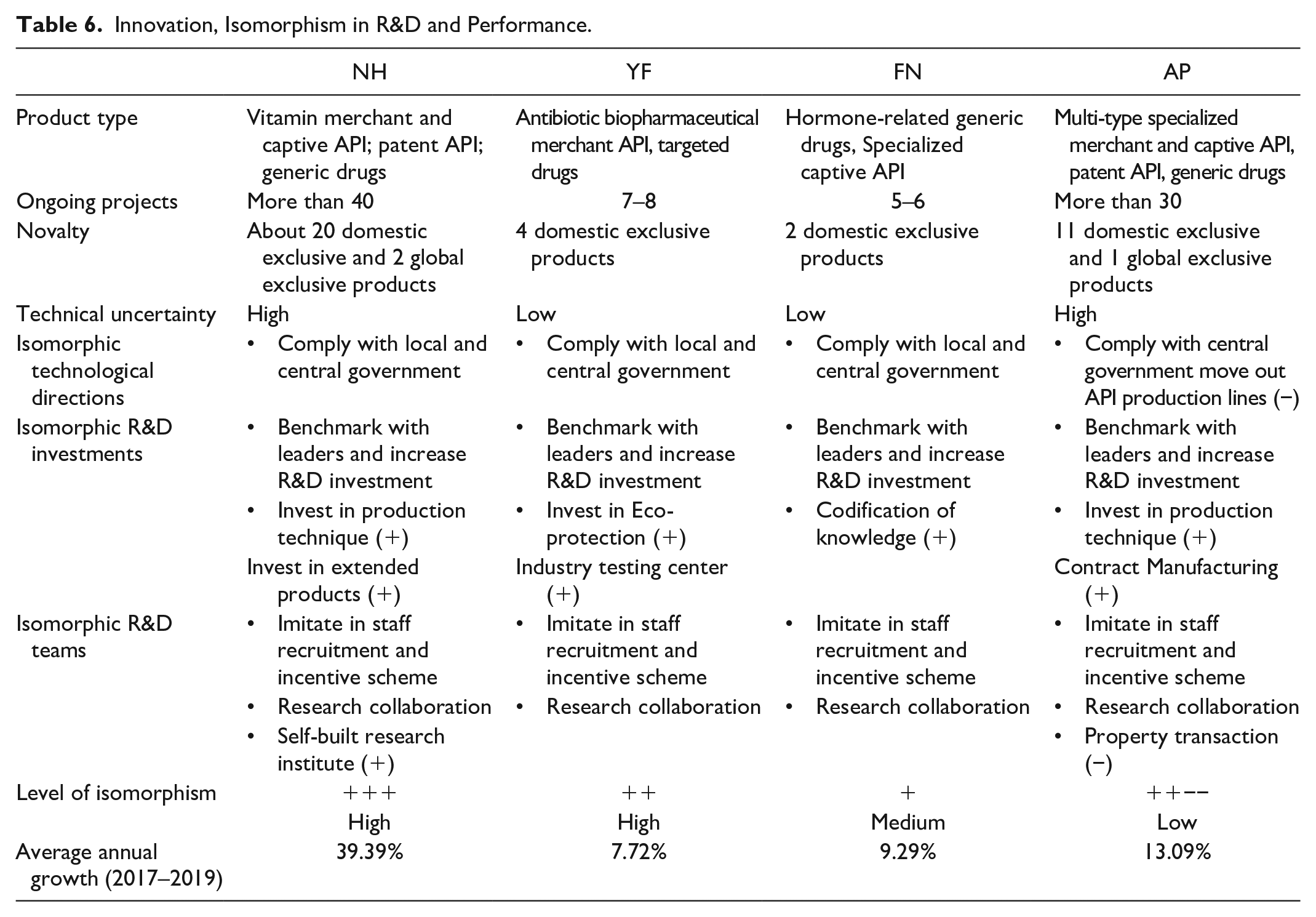
We employ the average sales growth rate in our observation window from 2017 to 2019, based on publicly disclosed data. For innovation uncertainties, we evaluate latecomers’ difficulty and novelty of ongoing projects. According to pharmaceutical industry research, the technology barrier for bulk-produced vitamin, anti-infective, and hormone API is lower than specialized API, including anti-hypertension, anti-diabetics, anti-cancer, and CNS drugs. Among which, patent API has the highest technology barrier and the highest added value. Considering the richness of uncertainty-related statements in managers’ interviews, we assess NH as high uncertainty and AP as medium uncertainty, whose technology barrier is also relatively higher than the other two. Then, we mark isomorphic R&D strategies as (+), while practices that avoid being isomorphic as (−). In this way, we draw a basic isomorphism level and see clearly if case companies floating up or down. On isomorphic technological directions, AP avoids the red line by moving out high-polluted production lines. On isomorphic R&D investment, NH, YF, and AP develop isomorphic strategies to acquire more legitimacy, which effectively alleviating problems in funds and business expansion. On isomorphic R&D team building, NH and AP have significant isomorphic strategies referring to industry leaders, but AP relies more on R&D outsourcing as their next plan is to develop contract manufacturing. Therefore, the isomorphic R&D strategy is more significant in NH and YF.
By comparing level of R&D isomorphism and performance, we find that, for NH, high-level isomorphic R&D strategies is related with their astonishing annual growth rate. Within high technical uncertainties, their isomorphic R&D strategies gain abundant support from government subsidies. Like their global competitors, NH initiated to contribute in establishing the new national standard in producing vitamin products in 2018 and 2020. Thus, they established legitimacy both from top-down and from close cooperation with upstream suppliers, which significantly economize knowledge and resource searching and then reduce the time consumption in new product development.
Isomorphic R&D strategies in investment and team management facilitates a smooth cohesion with their international research partners, thus to leverage distant knowledge. Their annual report in the year 2020 announces a net profit increase of 64.59%, as “the competitiveness of existing products continues to improve, and the research and development and industrialization of new products accelerate.” While for YF, a high-level isomorphic R&D strategies especially on environment-protection measures facilitates their exploitation on technology potentialities, they transferred their enzyme fermentation technology onto environment degradable techniques, which endows them market power in pollution rights transaction. But their growth rate for major business are not as good as FN’s. The reason is that with lower level of perceived uncertainty, YF is too much involved in manipulating their legitimacy by investing in non-mandatory practices and industrial services, which has greatly intensified their R&D expenditure. Though the total amount of R&D investment is converging to leaders, it seems that YF “put the cart before the horse” and trap in eco-protection without one step further to expand R&D on new products. FN and AP are cases with lower level of R&D isomorphism. FN has a huge advantage in a single product category based on their exclusive domestic formula and has few competitors globally. They has not been overly stressed in innovation uncertainty as their product is legitimate with regulative directions by its nature and enjoys policy dividends as an industry “hidden champion.” Though the formula used is similar with global leaders, FN manage to find the gap and invest in codification of knowledge embedded in technical procedures. These few isomorphic R&D strategies endows FN with “signals of competence” and attracts attention from several industry investment fund, thus to maintain a steady growth. AP has similar uncertainty conditions as NH, but it reduces isomorphism in R&D as they bypass regulative policies through moving out their API production line. AP choose to focus on contract manufacturing other than stick on original R&D. They struggled to meet downstream clients’ standard through R&D on production techniques. However, due to strong bargaining powers from downstream clients and long contract cycle, AP does not meet their expectations and suffers from uncontrollable R&D costs as they would lost their orders when downstream clients’ “experiment outcomes are not always good.”
From the selected cases, we can infer that isomorphic R&D strategies help gain legitimacy and find right way to conduct R&D, especially when latecomers’ R&D face with great uncertainties and risks. As R&D requires substantial attention to new ideas, methods, and abundant new sources of information (Banerjee & Mullainathan, 2008), legitimacy could help build the linkage with useful resources and knowledge when latecomers lack the capability in search and investigation. This is in accordance with the previous studies on the effectiveness of isomorphism in gaining legitimacy under exotic environment (Chiu & Sharfman, 2011; Z. Wu & Salomon, 2016). Thus, isomorphic R&D strategy is related with performance through economizing the time and costs in acquiring necessary resources, especially when uncertainties are severe. What we find in YF’s case shows that isomorphic R&D strategy with non-major business may not bring instant financial rewards. However, YF’s isomorphic R&D strategies make it to be seen by both government and pharmaceutics community. These secures YF’s position in government planning, evacuates environmental capacity, so as to ensure YF’s steady development in the near future. Thus, YF would be prepared in technologies, organizations as well as in environment when they do have a new project to land in the long term.
Discussion
In this paper, our aim is to draw attention on isomorphic behaviour in practices that requires differences. Through case studies, this study provides new insights on latecomers’ R&D practices. The key findings are: (1) Isomorphic strategies in R&D are isomorphic technology directions, isomorphic R&D investment and isomorphic R&D team building. Both institutional and competitive pressures drive the occurrence of isomorphic R&D strategies. (2) Isomorphic R&D strategies is more conducive to acquiring legitimacy and gaining recognition from stakeholders, specially when innovation uncertainty is high. Because legitimacy help leverage purposeful resources and technologies from stakeholders, shorten the search time, economize efforts, and attention in R&D, so as to contribute to performance. The results show that the antecedents of isomorphic R&D strategies to prove its occurrence and interpret its theoretical connotation so as to cast in a new conceptual light.
Theoretical Contribution
Previous studies generally defined isomorphism behaviors that forces firms to resemble each other driven by homogenizing pressures (DiMaggio & Powell, 1983). Though the notion of isomorphism has been widely employed and discussed in firms’ decision-making, little attention is drawn on isomorphism in activities that requires creativity and differentiation (Irwin et al., 2021). These led to the conventional wisdom assumes that isomorphism would lead to imitation and homogenization, and logically reduce the motivation in research and development. However, these hypothesis are founded in developed countries with mature market regime and for general firms. Is it still valid when turning to latecomer firms in developing countries with a transitional institutional environment? There is need to address the interplay between isomorphism and differences and draw the attention on the dynamic interaction between institutional context and R&D strategies (Ray & Ray, 2021).
This study shed light on how latecomer firms implement isomorphic R&D strategies. Previous isomorphism studies has a deliberate neglect on competitive pressures (Beckert, 2010), while market entities in institutional environment are active participants rather than passive recipients, so the institutional environment could be perceived and interpreted according to particular contexts (Latour, 1986). In contrast, the current work integrated both institutional and competitive pressures to explain the formation of isomorphic R&D strategies. Institutional pressures encourage latecomers to comply with ready-made regulations and norms to obtain basic legitimacy; Competitive pressures affirm latecomers’ subjective initiative in isomorphism, work as a complementary to formal market regimes and motivate latecomers to align with world’s best practices and thereby compete for legitimacy from the wider range of stakeholders. Instead of contradicting each other, the two are “loosely coupled” (Tan et al., 2013), and take different paths to obtain legitimacy. Hence, we enriched the emerging research on how institutions shape strategic choices and add to new theoretical insights by exploring new phenomenon. Therefore, this paper responded to the new development of institutional theory by emphasizing on the enabling effect of the environment and the initiative of participants (Cardinale, 2018).
The simultaneous influence of institutional and competitive pressure explains the inherent balance of sameness and differences in latecomers’ R&D activities, which also corresponds with the pursuit of both short-term survival and long-term success (March, 1991; Peng, 2002). As such, this paper complemented to explain the balance under specific contexts when latecomers’ from developing countries lacking technological resources and capabilities. The adoption of established practices in an isomorphic way has been analyzed in previous studies from the perspective of organizational inertia (March, 1991). Increasing organizational inertia could reduce technical risks, uncertainties, and unfamiliarity in organizational learning (Lavie & Rosenkopf, 2006), and thus firms could leverage their absorptive capacity to accumulate experiences for innovation. From a different angle of institutional theory, this paper expanded the scope of “sameness” from industry-level to wider institutional fields, and further demonstrated that the pursuit of legitimacy lead to latecomers’ R&D isomorphic strategy. Latecomer firms’ initiatives and consciousness in isomorphism would leverage “different” resources that are crucial to firms’ profitability (Z. Wu & Salomon, 2016; Zimmerman & Zeitz, 2002). Therefore, the existing literature conclusions on the importance of legitimacy and the interations between legitimacy and resources are empirically tested. To be more clear, isomorphic strategy in R&D differentiates from previous studies on imitation innovation from both motivation and contents. Imitation innovation has a resource-seeking incentives (Ali, 2021; Im & Shon, 2019; Krasteva et al., 2020), it inclines to imitate, introduce, or purchase successful technologies and technical secrets from technology owner (Kim, 1997). The concept of R&D isomorphic strategy is motivated by legitimacy-seeking orientations and highlights the convergence to highly visible behaviors, routines, or management measures. These behaviors may not be intuitive innovation actions, and are from leading companies from institituional field that set the benchmark because of historical superior performance or standardization.
The relationship between isomorphic R&D strategies and performance identified in this work aligns with previous studies (e.g., Heugens & Lander, 2009; Z. Wu & Salomon, 2016), and to some extent explain the mix findings. One reason is that R&D is an uncertain activity with highly skewed outcomes (Popp et al., 2013), and proper R&D decisions most likely to confer its effectiveness (Menke, 1997). As such, isomorphic R&D strategies provide latecomers with optimal choice in uncertainties and resource limitations, which increases the possibilities of walking on the right path. Besides, convergence and standardization provide cognitive stability and necessary simplification, economize on effort and attention (Younge & Tong, 2018), and get support from formal or informal linkages (Mathews, 2006). These are critical in determining the success in knowledge-intensive industries that draw on multi-disciplinary knowledge base (Ray & Ray, 2021). Another reason is that, leading firms may not willing to be isomorphic with latecomers, in the contrast, latecomers strive for matching with leading firms’ standard and behavior. It would help latecomers to gain legitimacy from leading firms and then increase the opportunities of integrating into leading firms’ innovation value chains, hence latecomers would get a slice from leading firms’ lucrative businesses. Thereby, this paper contribute to the nascent body of knowledge on the interplay between institutional environment and firms’ strategy, especially for latecomers under the unique institutional environments in transitional economy (Peng, 2002).
Apart from the theoretical contributions, the findings of this study have strategic implications for business practitioners and policy makers in developing economies. For practitioners from latecomer firms, it is critical to balance between isomorphism and grasping the autonomy in R&D. Isomorphism with government, global leading firms, and other stakeholders establishes signals of competency and thus acquires legitimacy, which are beneficial in building professional linkages and could later translate into more business opportunities for higher value activities such as research collaboration and order acquiring. Despite the challenges of uncertainties and limited resources on R&D, latecomers need to internalize what they gain through isomorphism, turning the environment endowments into resource diversification and competencies according to their own missions and businesses, instead of accepting pressures from institutional environment in a “take-it-for-granted” way.
In addition, the current work also has implications for policy makers in developing countries, particularly in helping to identify the precise timing of regulations and policies. In this study, we find regulative mechanism and marketization mechanism are both effective to latecomers, regulative mechanism guide the bottom line of R&D efforts, while marketization mechanism incentive latecomers to increase their R&D efforts. Thus, policy-makers need to increase investments in education and research, make industry requirements more applicable and refine the distribution mechanism of government subsidies in regulative mechanism. It is also necessary to push forward hierarchical flexible marketization mechanism, such as the selection of R&D model enterprises, to make good practices visible and spread across the industry, so as to publicize the industry norms toward high-quality and robust supply chain. Although the observation in this paper is made in China, there are other emerging countries strive for research and development with limited resources and imperfect market regime. Thus, the findings may be of great interest to other countries aim at moving toward a technology-driven country.
Limitations
The research has some limitations based on the chosen research method based on qualitative designs. As we discussed the phenomenon is a unique institutional context, an inherent limitations is the study’s single country and single industry focus. The generality of study could be increased if we introduce other latecomer firms’ in technology-intensive industries from other developing countries into comparison. Another limitation is that the case material focused on a relatively short period of time, that means there is no interpretations about the accumulated experience and legitimacy before the observation window. Therefore, a series of longitudinal studies using with up-to-date data can provide valuable insights into the historical nature of isomorphism in firms’ decisions. The last but not least recognized limitation is different sources of firms’ heterogeneity are not accounted in assessing firms’ performance. Though we inferred that isomorphic R&D strategies relate to performance by comparative case study, we still do not know how and when would isomorphic R&D strategies generate positive influences to firms’ performance.
Further Studies
Overall, the present research presents a first step toward building a comprehensive understanding of how latecomers respond to institutional environment transition and reveals possibilities for future research on latecomers’ applicable strategies in catching up. Based on above-mentioned limitations, quantitative approaches should be further developed to examine the effectiveness of isomorphic strategies in R&D and the casual relationship between isomorphic R&D strategies and firm performance. The results of this study also raise further questions. Does the perceived pressures vary with the ownership types of latecomers (e.g., state-owned, mixed ownership, or private firms)? Does the occurrence of isomorphic R&D strategies differ between countries and industries? These questions would demand more studies on cases across industries, countries, and specific institutional environments. By exploring these questions, the nuances and consequences of isomorphism would be better understood.
Footnotes
Declaration of Conflicting Interests
The author(s) declared no potential conflicts of interest with respect to the research, authorship, and/or publication of this article.
Funding
The author(s) disclosed receipt of the following financial support for the research, authorship, and/or publication of this article: This work was supported by the Science Technology Department of Zhejiang Province under Grant 2022C35065, Department of Education in Zhejiang Province under Grant Y202044809 and National Natural Science Foundation of China under Grant 62073112.
