




Abstract
This study examined the association between perceived social support, parental psychological capital, and multiple dimensions of mental well-being in mothers of children with autism. Psychological capital was assessed as a mediator in the proposed model. Data were collected from 112 mothers recruited from autism institutes in two cities of Pakistan. Analysis was done using partial least square structural equation modeling. The findings revealed that social support and psychological capital had a significant direct relationship with life satisfaction and perceived stress. Only psychological capital was related to parental satisfaction and negative affect. We found that psychological capital mediated the path between social support and all four dimensions of well-being outcomes. Our study shows that the informal social support enhances the multiple dimension of well-being of mothers of autistic children by enhancing their personality resource of psychological capital.
Keywords
Parents can have a simultaneous positive and negative appraisal of their parenting experiences (Coleman & Karraker, 1998). On the positive side, a parent often finds this universal task as gratifying, satisfying and exhilarating. On the negative side, it may tax physical, cognitive and emotional energies due to various contextual and uncontrollable factors such as rearing a child with autism spectrum disorder (ASD). ASD is a group of neurodevelopmental disorders characterized by a wide range of symptoms, skills, and disabilities, hence the term “spectrum.” These disorders are pervasive, lifelong and usually diagnosed during infancy or early childhood. It is generally marked by a child’s inability to communicate, behave, and socialize effectively. Repetitive behaviors and movements, self-harm, insensitivity or over-sensitivity, emotional display not aligned with the situation, coordination problems, oblivion to pains, slow language acquisitions, tantrums, uncooperative attitude etc. are few symptoms peculiar to this disorder (American Psychiatric Association, 2013)
The challenges of coping with the symptoms and burden of diagnosis, treatment, and education of autistic children increase the risk of psychological issues among parents of such children (Ekas et al., 2010). Parents and other caretakers of the autistic child are constantly exposed to the stressors related to challenging behavior (Karst & Van Hecke, 2012). However, the mothers of autistic children are more prone to stress as they have to take more responsibility in child rearing (Dabrowska & Pisula, 2010). Upbringing of such children require more physical effort and time devotion. Besides that mothers are emotionally invested in the challenging endeavor. A recent qualitative study conducted in Greece identified three emotional burden, family burden and social burden as three challenges of raising an autistic child (Papadopoulos, 2021). These challenges face by the mothers become the cause of distress (Estes et al., 2013; Siman-Tov & Kaniel, 2011), depression (Allik et al., 2006; Olsson & Hwang, 2001) and lower overall wellbeing (Ekas et al., 2009). Prior studies have also shown that as compared to the mothers of those children who have down syndrome and orfragile × syndrome, mothers of the autistic children are more vulnerable to stress (Abbeduto et al., 2004).
The resource-based view of individual coping, well-being and adaptation points out that individuals who can sustain mental health in adverse situations draw resources from the external social environment and their internal sense of mastery (Caplan et al., 1975; Hobfoll, 2002). Social support, particularly informal support, is an external resource regarded as one of the essential coping factors to mitigate the distress that arises when raising a child with this disorder (Ekas et al., 2010; Halstead et al., 2018). Liu, Pang et al. (2013) argue that social support becomes a more effective resource when a related internal psychological resource is available. Previous research has found that personality resources such as optimism, hardiness, self-efficacy, and locus of control are related to maternal well-being (Siman-Tov & Kaniel, 2011; Weiss et al., 2013; Willis et al., 2016). Psychological capital is one such personality resource that may play a more influential and functional role in enhancing the mothers’ well-being (PsyCap). PsyCap is a second-order personality construct consisting of four state-like psychological capacities: hope, self-efficacy, optimism, and resilience. Existing research suggests that PsyCap is related to better psychological and physical health (Avey et al., 2009; Luthans et al., 2013; Shen et al., 2014) and compelling evidence indicates that it can enhance the influence of social support resources on well-being (Xanthopoulou et al., 2007).
Diener et al. (2017) posit that well-being is a multi-component concept that refers to various dimensions of cognitive evaluations of affective experiences in life. These dimensions are separable, have a differential relationship with predictors and outcomes, and contribute to overall mental well-being. We operationalized maternal well-being as a combination of positive evaluations, namely, life satisfaction and parental satisfaction, and negative evaluations, that is, perceived stress and negative affect. Past research on the well-being of mothers has also operationalized it as multiple dimensions. Studies have shown that positive and negative dimensions of well-being are highly related to each other (Ekas et al., 2009, 2010). Therefore, the assessment of multidimensional well-being helps psychologists understand how social and personality resources relate to different aspects of mothers’ well-being and develop customized interventions for each dimension.
The current research expanded upon the existing literature by examining the mediating effect of parental psychological capital (parental PsyCap) on the well-being of mothers of autistic children in Pakistan. Although a handful of research has explored mothers’ well-being across the globe, research is scarce in Pakistan. Pakistan is a third-world country and has a severely crumpled primary health facility. According to a recent estimate from the Pakistan Autism Society, there are around 350 thousand autistic children. However, minimal institutional facilities are available to share the burden of the families and guide them through the parenting process (Imran & Azeem, 2014). Cultural norms dictate that mothers are the primary caretakers of the child (Minhas et al., 2015). There is generally a low level of empathy in society because the general public does not have much awareness of the disorder (Furrukh & Anjum, 2020). Pakistani mothers experience those social and personal issues different from those experienced by western counterparts, where most of the earlier studies are carried out. By employing a sample of mothers from Pakistan, the study will address another critical gap in autism research
Literature Review and Hypotheses
Social Support and Well-being
Social support available to mothers can be functional social support and structural social support (Cohen & Wills, 1985). Past studies show that both types of social support alleviate the stress and distress of parents who have to raise an autistic child (Bromley et al., 2004). Functional or informal social support occurs when the companionship needs and emotional, informational and/or tangible assistance are provided by the social network members (Dunst et al., 1986). Structural social support (formal social support) includes financial aid, psychological guidance or medical help by some institution (Bristol & Schopler, 1983). Since this latter type of support is scantly available in Pakistan, the current study focused only on functional social support. When we measure informal social support in a self-rated survey, it is a perception that people can be helped by close persons or people important in their lives. They can be either family members, friends or significant individuals in one’s life. Social support as a resource helps to increase well-being and reduces stress by enhancing feelings of control, a sense of receiving and motivation to give something in return (Hobfoll, 2002). In a study on mothers of autistic children, Siman-Tov and Kaniel (2011) found that social support significantly reduced parents’ stress. According to Mak and Kwok (2010), the perception of high social support helps to cope with the financial, emotional, physical, and social burdens of upbringing an autistic child. In another longitudinal study, it was found that larger and positively supporting social networks predicted maternal well-being after 18 months (Smith et al., 2012). We believe that as a resource, mothers’ social support enhances the positive aspects of well-being and diminishes the negative dimensions. We, therefore, propose that:
H1: Social support would have a positive relationship with: (a) life satisfaction and (b) parental satisfaction and negative relationships with (c) parenting stress and (d) negative affect.
Parental PsyCap and Well-being
Inspired by principles of positive psychology and applying them to organizational behavior, PsyCap was proposed by Luthans and Youssef (2004) as a second-order personality construct composed of hope, self-efficacy, resilience, and optimism. There were multiple reasons these four constructs were chosen as constituents of PsyCap. First, they are strongly grounded in the existing literature. Second, they all have valid and reliable tools to measure them. Third, research has shown that these personality constructs are not like dispositional traits but somewhat malleable and can be developed. Last but not least, these four personality constructs have been shown to influence a wide range of attitudes and behaviors. Research over time has proven that PsyCap is a potent resource that enhances an individual’s ability to handle strenuous and problematic situations (Luthans et al., 2014). A growing body of evidence also indicates that PsyCap is positively related to individuals’ workplace behaviors and attitudes (Luthans & Youssef-Morgan, 2017). Another attribute that makes PsyCap unique is domain specificity, as it can be operationalized according to a specific domain. Although it is most commonly operationalized as a workplace-based personality resource, some researchers have adopted it for other domains such as academic PsyCap, relationship PsyCap, health PsyCap, and overall life PsyCap (Luthans et al., 2012, 2013). This study introduces “Parental PsyCap,” which indicates a cognitive resource pertinent to the parenting domain in life. Consistent with the general definition of PsyCap, we define parental PsyCap as an individual’s positive psychological state of development characterized by (a) perseverance in establishing and striving toward parental goals (hope); (b) having enough confidence to take on and put necessary efforts into successfully executing the challenging task of parenting (self-efficacy); (c) making positive attributions about being a successful parent (optimism); and (d) when encountering adversities and setbacks as a parent, having the ability to bounce back with greater force (resilience).
There is ample evidence that indicates that higher-order PsyCap and its components are associated with better mental health conditions. Avey et al. (2009) researched a heterogeneous sample of employees and found that workplace PsyCap was related to lower symptoms of occupational stress. In a longitudinal study, Avey et al. (2010) reported a positive influence of PsyCap on employees’ mental, physical, and overall health conditions. Luthans et al. (2013) found a positive relationship between health PsyCap and employees’ health indicated by lower BMI and cholesterol levels and the subjective health appraisal. Manzano-García and Ayala (2017) reported a positive relationship between psychological capital and mental well-being of direct support staff of Autism Specialist Services.
Autism-related studies have also shown a positive impact of constituent personality types of PsyCap on wellbeing. For example, in research with parents of autistic children as a sample, self-efficacy was positively related to life satisfaction (Salas et al., 2017). In another study on mothers of autistic children, optimism was negatively associated with depression, negative affect, and parenting stress and positively associated with positive affect, life satisfaction, and psychological (Ekas et al., 2010). Similarly, maternal resilience was related to lower anxiety and depression symptoms among mothers of ASD children (Halstead et al., 2018). As a combination of these four positive personality resources, PsyCap possesses a common underlying thread of positive agentic capacities (Avey et al., 2008) and is shown to have a greater influence on outcomes compared to the sum of the effect of individual components (Luthans et al., 2007; Sweetman et al., 2011). Therefore, we proposed that mothers’ high-level confidence, optimism, hope, and resilience regarding their parenting tasks would enhance their well-being.
H2: Parental PsyCap would have a positive relationship with (a) life satisfaction, (b) parenting satisfaction, and a negative relationship with (c) parenting stress, and (d) negative affect.
Parental PsyCap as a Mediator
According to the conservation of resources theory, there are many types of resources (such as contextual and psychological resources). These resources do not act in isolation. Instead, the availability of a resource helps to develop other resources, which may then aggregate, leading to their synergistic manifestation over time and across contexts (Hobfoll, 2002). Considering that PsyCap is a state-like changeable personal capacity, a strong social network may enhance PsyCap as a positive cognitive resource for mothers, fostering their well-being. Therefore, in addition to the direct effect of social support, we believe that PsyCap also explains the underlying indirect relationship between social support and well-being. Although limited, enough empirical evidence exists to support this notion. In their study, Li et al. (2014) reported a mediating role of PsyCap between social support and subjective appraisal of well-being which was assessed as a combination of life satisfaction and positive and negative experiences. In another study by Ekas et al. (2010), optimism mediated the relationship between family support and positive and negative well-being outcomes of mothers of ASD children. In an organizational setting, it was found that employees’ PsyCap mediated the association between perception of organizational support and indicator of depression among male correction officers in China (Liu, Hu et al., 2013). Therefore we proposed the following hypothesis:
H3: Parental PsyCap would mediate the relationships between social support and (a) life satisfaction, (b) parental satisfaction, (c) parenting stress, and (d) negative affect.
Figure 1 depicts the schematic diagram of these relationships.
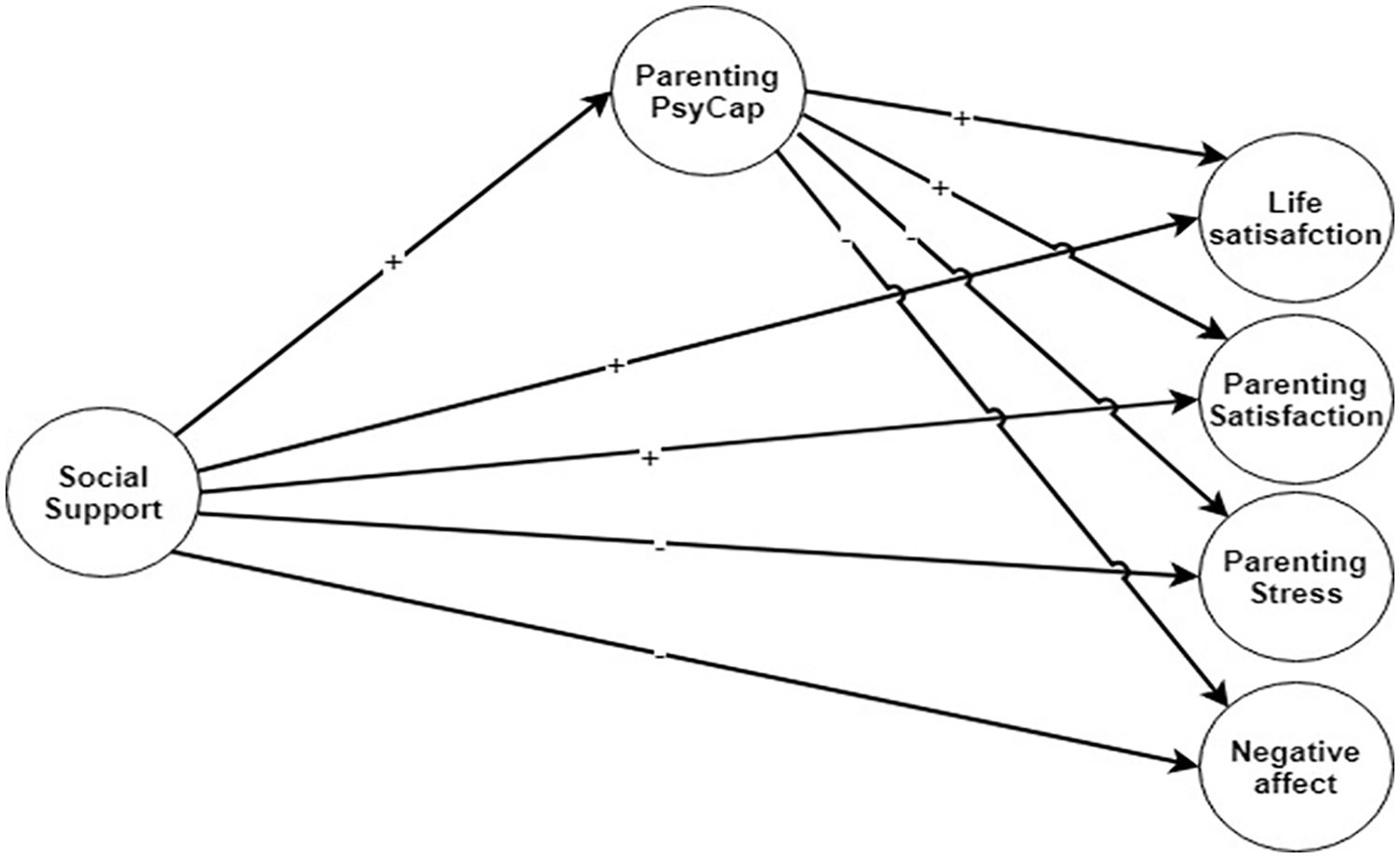
Path relationships of direct effect hypothesis. + indicates that proposed relationship is positive, - indicates that the proposed relationship is negative.
Method
Participants and Procedure
The study was approved by the ethical approval committee of the Faculty of Education, Allama Iqbal Open University. The study’s participants comprised 112 mothers recruited with the assistance of four specialized autism institutes in two cities of Pakistan: Lahore and Faisalabad. Contacting and administering the questionnaire to the mothers of autistic children was left to focal persons at these institutes. Fifty printed survey packages were handed over to the focal persons per institute. Each package consisted of a cover letter explaining the purpose of the study, a consent form, and a questionnaire. After a gap of 2 weeks, focal persons were contacted at the institutes to return the filled questionnaires. One hundred sixteen questionnaires were returned from the four institutes, of which four were rejected due to more than 10% of missing values.
The 112 mothers who participated in this research ranged from 25 to 57 years, M = 34.8, SD = 7.0. The ages of participants’ autistic children ranged between 2 years and 16 years, with a mean age of 8 years. Most of the children were boys, 78%. A large percentage of the participating women lived with their husbands, 94%, while a small fraction reported being separated or divorced, 6%. Most of the mothers were highly educated with graduate or higher degree qualifications 64.8%. Other responses for education level included Grade 12, 13.7%; Grade 10, 15.7%; not graduated from high school, 3.9%; and no response, 2%. Our data also revealed that most of the mothers were not professionally active, 80.4%. Slightly more than half had some kind of external help or a secondary caretaker for their child, 54.9%, while the remainder reported they were their child’s only caretaker, 46%. Mothers were asked to rate their child’s autism level based on their continuously required intensity of support. Level 1 is the mildest level, such that these children have higher functioning compared to the other two. These children are better at communication and can speak fuller sentences. However, they have issues finding the right words for the occasion or reading social cues. They also face problems with organizing activities. Children at level two require substantial support as they can only speak simple sentences and lack nonverbal communication skills. They find limited activities of interest and show signs of indulgence in repetitive behaviors. Finally, those children who require substantial support (Level 3) have minimal verbal ability and avoid interaction with people. They find it very hard to deal with change and indulge in repetitive behavior (Masi et al., 2017). In the questionnaire, symptoms of each level were outlined so that respondents could identify their child(ren) level of severity. Of the total, 37.3% of mothers opted for level 1; 37.5% chose level 2, and a slightly smaller number of mothers, that is, 25.9%, chose level 3. Two of the mothers (1.8%) reported having more than one autistic child.
Measures
All the scales used in this study are initially in English. They were translated into Urdu using the standard back-translation method (van Widenfelt et al., 2005). Four independent translators and language judges were involved in the process. First of all, an independent translator whose mother language is Urdu and proficient in English translated all the scales in Urdu. Then another translator translated the scale back to English. Finally, two independent judges well versed in psychology compared the translated Urdu and English versions to resolve any contradictions and ambiguities in vocabulary.
Well-being
All the well-being measures were adopted from existing studies. The mother’s level of life satisfaction was assessed by the Satisfaction with Life Scale (SWLS: Diener et al., 1985). The five-item questionnaire assessed the mother’s cognitive evaluation of life in general. A sample item is “I am satisfied with life.” The mother’s satisfaction with parenting was measured by nine items adopted from the Parenting Sense of Competence Scale (PSOC: Johnston & Mash, 1989). The nine items assessed the mother’s general overall satisfaction with anxiety and frustration about, and motivation for, parenting. Some items had negative connotations, which were reversed during the analysis phase. A sample item is “Sometimes I feel like I’m not getting anything done as a parent.” The responses of both SWLS and PSOC were recorded on a 5-point Likert scale (1 = “strongly disagree” to 5 = “strongly agree”). The Perceived Stress Scale determined the mother’s stress levels (Cohen et al., 1983). This instrument uses 10 questions to which the mothers in the current study responded by assessing various intense, irregular, overloaded, and generally stressful life scenarios during the previous month on a 5-point Likert-type scale (1 = “never” to 5 = “very often”). A sample item was “Felt nervous and stressed.” The Positive and Negative Affect Schedule (PANAS: Watson et al., 1988) was used for negative affect. It comprised nine words that assessed an individual mother’s emotional affect in a negative mood on a 5-point Likert-type scale (1 = “not at all” to 5 = “extremely”). An example of negative emotion is “distressed.”
Perceived Social Support
We measured informal social support with a multidimensional scale of perceived social support (Zimet et al., 1990). This scale comprises 12 items covering three types of social support: family, friends, and significant others. Responses were measured on a 5-point Likert scale (1 = “strongly disagree” to 5 = “strongly agree”). A sample item is “I get the emotional help and support I need from my family.”
Parental PsyCap
We adopted the shorter 12-item version of the Psychological Capital Questionnaire (PCQ-12), as compiled by Luthans et al. (2007), and rephrased it to match the parenting domain instead of the work environment. The original scale is available for downloading from these authors’ websites <www.mindgarden.com>, and they have provided guidelines on how to rephrase the PCQ-12 according to specific domains. A sample item is “I feel confident in performing various tasks and activities related to parenting.” Responses were measured on a 5-point Likert scale (1 = “strongly disagree” to 5 = “strongly agree”).
Data Analysis Strategy
We tested the hypothesis using variance-based partial least squares structural equation modeling (PLS-SEM). The software, SmartPLS v3, was used for this purpose (Ringle et al., 2015). We adopted the PLS approach for analysis as it can test a complex hypothesized relationship with a small sample. As it is a non-parametric technique, parameters can be estimated even if data are not normal (Hair et al., 2017). A two-step approach was used to analyze the PLS model (Keenan et al., 2016). The first step is to assess the reliability and validity of the outer (measurement) model (i.e., the relationship of items with their latent construct). We assessed reliability using composite reliability (CR) and Cronbach’s alpha (α) values. Using factor loadings and average variance extracted (AVE) statistics, we established convergent validity. We determined discriminant validity using the Fornell–Larcker (F-L) criteria (Fornell & Larcker, 1981) and the heterotrait-monotrait ratio of correlations (HTMT: Henseler et al., 2015). Next, we assessed the inner model (i.e., the structural model representing the relationships between latent constructs). This included the analysis of path coefficients for direct and indirect effects, the adjusted coefficient of determination (R2 adj ), effect size (f2), and blindfolding predictive relevance (Q2). The significance of path coefficients was estimated using 3,000 bootstrapping samples (Hair et al., 2017). Since PLS SEM do not assume data is normal, it utilizes bootstrapping as a nonparametric procedure to test significance.
Results
Common Method Bias
We tested for common method bias as the study measures were based upon self-reported surveys and collected at one time. The psychological influence of questions related to one construct may interfere with the responses related to other constructs, leading to a potential response bias. We used exploratory factor analysis by fixing the loading on a single factor, as recommended by Podsakoff et al. (2003). The analysis revealed that loadings of items on a single factor were less than 50%. Hence, we concluded that common method bias was not a problem in this research.
Measurement Model
All our latent constructs were reflective. Table 1 presents Cronbach’s alpha, CR, and AVE values after the second execution of the PLS algorithm. In the first execution, we found that the AVE values of all latent constructs, except for perceived stress and the parental satisfaction scale, were greater than the cut-off value of 0.50 (Hair et al., 2017). Therefore, two low-factor loading items had to be deleted from the parental satisfaction scale and three low-factor loading items from the perceived stress scale, resulting in AVE values of 0.51 and 0.53, respectively. All the study constructs were above the cut-off values of 0.70 for Cronbach’s alpha and CR, thus indicating sufficient inter-item consistency.
Reliability and Convergent Validity of Study Measures.

Note. CR = composite reliability, AVE = average variance extracted
The lower half diagonal of Table 2 represents the correlations between constructs which are all less than the square root of AVE (bold diagonal) in a specific column, thus indicating discriminant validity. This technique is recommended by Fornell and Larcker (1981). A more contemporary approach is suggested by Henseler et al. (2015), according to which the HTMT values shown in the upper diagonal of the table should be less than 0.90. As is evident in Table 2, this approach also confirmed sufficient divergence among the study constructs.
Divergent Validity Results (HTMT and F-L criteria).

Note. Bold value represents square root of AVEs. Values in the lower half of the diagonal represents correlations between constructs. Values in the upper half of the diagonal represents HTMTs.
Structural Model
We analyzed the full structural model with the endogenous variables of life satisfaction, parental satisfaction, parenting stress, and negative affect; the mediator being Parental PsyCap, and the exogenous variable was social support. We first included all the control variables (child age, child gender, mother’s age, child’s level of autism, and mother’s job status) as exogenous variables. Amongst the control variables, child age was significantly related to life satisfaction, and the child’s level of autism was related to perceived stress. Then, to improve the interpretations of results and avoid confounding effects, the structural model was re-assessed by retaining only the paths of significant control variables (Becker et al., 2016). Figure 2 depicts the path coefficient results for direct effects.

PLS analysis results of direct effect path coefficients and significance values (p-value).
The relationships between social support and life satisfaction, H1a: β = .46, t = 6.92; social support and perceived stress, H1c: β = .30, t = 4.63; and social support and PsyCap, β = .24, t = 2.82, were significant. However, relationships between social support and parental satisfaction, H1b: β = .10, t = 0.78; and social support and negative affect were not significant, H1d: β = −.12, t = 1.23. In conclusion, H1a and H1c were substantiated and H1b and H1d were not accepted. With respect to H2, analysis revealed that PsyCap was significantly related to life satisfaction, H2a: β = .40, t = 6.66; parental satisfaction, H2b: β = .35, t = 3.52; perceived stress, H2c: β = −.40, t = 3.52; and negative affect, H2d: β = −.46, t = 5.98. Therefore, H2 was substantiated. All these path coefficients with p values are depicted in Figure 2.
The adjusted coefficient of determination (R2adj) values showed that the endogenous variables (social support and PsyCap) explained 48% of the variance in life satisfaction, 14% in parental satisfaction, and 34% in perceived stress, and 25% in negative affect. The effect sizes (f2) showed that the effect of PsyCap on all four endogenous variables and the effect of social support on perceived stress was greater than 0.15 and lower than 0.35, which is considered moderate. However, the effect size of social support on life satisfaction was greater than 0.35, which is considered substantial (Cohen, 1988). The predictive relevance (Q2) values were calculated using the blindfolding algorithm in SmartPLS 3. All values were above zero (“0”), thus indicating an acceptable level of predictive relevance of the model (Hair et al., 2017) (Table 3).
Coefficient of Determination, Effect Size, and Predictive Relevance.

Mediation Analysis
The mediation results are provided in Table 4. The mediation effect was tested using values from bias-corrected and accelerated confidence intervals (BCa-CIs), generated by 5,000 bootstrap samples. The non-existence of zero (“0”) between lower (2.5%) and upper (97.5%) confidence intervals (CIs) indicates a significant mediation effect: we found evidence of this effect in all four of the hypothesized mediation relationships. Therefore, all four mediation hypotheses (H3a, H3b, H3c, and H3d) were accepted. H3a and H3c indicated partial mediation as the direct paths of social support to life satisfaction and perceived stress were also significant. H3b and H3d indicated full mediation as the direct path coefficients of social support with parental satisfaction and negative affect were insignificant (Hair et al., 2017; Zhao, Lynch et al., 2010).
Bootstrapping Results for Indirect Effect.

Discussion
The behavior of children who have ASD and the associated demands pose consistent challenges to the mothers, detrimental to their mental and subjective well-being (Dabrowska & Pisula, 2010; Lovell et al., 2015). However, these mothers can cope with the challenges of upbringing the special child when they have enough social and psychological resources. Social support and PsyCap are two different types of predictors of well-being. Social support is an external factor that can be influenced but cannot be directly controlled as it is a function of one’s social environment (Li et al., 2014). On the other hand, PsyCap is an internal personality factor that, unlike dispositional traits, can be changed in a relatively short time either by contextual factors (e.g., institutional support) or through custom-designed interventions such as trainings (Li et al., 2014; Luthans et al., 2014). Our study has established that PsyCap of mothers mediates the influence of social support as predictor of well-being.
First, we assessed the direct association of social support with multiple dimensions of maternal well-being. The perceived sense of support from family, friends, or a significant other in an individual’s life has been found to be a buffering resource against mental health issues (Brissette et al., 2002). It has proven to be effective in coping with stress (Siman-Tov & Kaniel, 2011). In our study, social support was positively related to life satisfaction and negatively related to perceived stress, with these findings consistent with previous studies (Lu et al., 2015; Weiss et al., 2013). However, we could not find a significant relationship between social support and the mother’s satisfaction with the parenting role and social support and negative affect. However, this does not imply a lack of relationship due to a mediated model. On the contrary, it shows that a relationship exists and is fully mediated by PsyCap.
We also tested for the direct effect of PsyCap on outcomes. As hypothesized, the relationships of PsyCap with all facets of well-being; life satisfaction, parental satisfaction, parenting stress, and negative affect were significant. It shows that mothers with a higher level of the positive psychological resource, PsyCap, are more prepared to cope with the responsibility of raising an autistic child and show greater symptoms of well-being. The effect sizes indicated that this cognitive personality resource plays a larger role in mental well-being than an external factor. Moreover, our mediation analysis presented a clearer picture. We found a unique pattern of relationships in which PsyCap, as a mediator, indirectly related informal social support with all four indicators of well-being assessed in this study. Of the four associations, two indicated a partial mediation effect (social support → life satisfaction and social support → perceived stress) while, in the other two, PsyCap fully explained the associations (social support → parental satisfaction and social support → negative affect). A similar partial mediator effect between social support and a higher-order construct of subjective well-being (composed of life satisfaction and positive and negative experiences) was found by Li et al. (2014) with a sample of students. We suggest that social support is a more distal predictor of well-being in mothers, while PsyCap may play a more proximal role. However, the type of mediation also reinforced the notion that social support also directly influences mother life satisfaction and stress but only affects satisfaction with parenting and negative emotional state via the personality resource. Our results are conclusive that having social support available to mothers of autistic children makes them feel more optimistic, confident, hopeful, and resilient, which, in turn, improves their overall well-being.
Implications
The result of this study has various implications. First, we need to understand the results in the context of Pakistan, where this research was conducted. Our findings suggest that for the overall well-being of the mothers, there is a greater need that they are well supported by their family, friends, and significant others. Unfortunately, there is a lack of informal social support systems available for Pakistani females. Pakistan’s culture is collectivist, with close-knit families and a system of patriarchy. A single household often includes married couples, their married and unmarried children, and grandparents living together (Evason, 2016; Itrat et al., 2007). The cultural and social norms dictate good behavior and certain obligations toward parents, siblings, and relatives (Syed et al., 2015), who is a flourishing source of social support, especially in times of adversity and challenges. However, general masses do not understand that ASD is a neurological and developmental disorder and often blame the child or their mothers for the apparent misbehavior. Despite Pakistan’s culture of strong social support networks and extended families which generally offers wide instrumental and emotional support, the trend is for social scrutiny of the odd behavior of a child at family gatherings, with the mother being subjected to most of the criticism (Minhas et al., 2015). We recommend that health authorities organize large-scale awareness campaigns through relevant media channels.
Another type of social support, in addition to friend and family support which can help cope with parenting pressures, is membership in autism support groups. In recent years, various support groups have started playing an active role in providing mothers instrumental, emotional, and spiritual social support. An example of such a group is the “Pakistan Autism Meet-up,” which was started in 2003 and had hundreds of parents and health professionals as members all over the country. The group holds regular meetings in all major city of the country and also has an online presence (Azeem et al., 2013). However, there is still a need to raise awareness among mothers, especially in rural areas regarding these support groups’ availability.
The growing body of research and the awareness of contextual factors and personality characteristics as antecedents of psychological well-being and stress suggest that psychological interventions can play a very influential part. In a study carried out in 2010 on the relationship between autism and parents’ coping behavior and mental health, it was found that using cognitive reframing techniques helped eliminate the parents’ depression and anger, thereby improving their well-being (Benson, 2010). Individuals tend to increase their psychological resources to protect themselves from stressful situations. People with a high level of PsyCap are better able to handle a diffuse and changing environment, tackle risks and adversities, and always have a game plan if things do not go well (Manzano-García & Ayala, 2017). We believe PsyCap can provide a viable and cost-effective solution to enhance the well-being of mothers of ASD children, better preparing them for this strenuous and prolonged task. However, the operationalization of PsyCap outside the organizational domain is rare. Other than the workplace, PsyCap has been extended to relationships, health, academia, and overall life domains (Luthans et al., 2012, 2013). Although our study has identified social support as one of the situational factors that can enhance mothers’ PsyCap over time (Li et al., 2014), studies have also proposed short periods of traditional and online training to enhance an individual’s PsyCap (Luthans et al., 2006, 2008). For example, clinical and counseling psychologists who frequently work with mothers of autistic children could couple PsyCap training approaches with traditional psychological treatment approaches, such as cognitive-behavioral therapy (CBT), to cognitively reframe mothers for higher levels of PsyCap for their parenting task. Cognitive restructuring could also be applied in “social skills training” to enhance the ability of these mothers to establish and retain positive social relationships, thus enhancing their own higher level of well-being (Tay & Diener, 2011). The public health authorities can arrange short PsyCap training on a national scale for these mothers, especially targeting remote rural areas.
Limitations
This study on the well-being of mothers of autistic children is seminal research in Pakistan. One of the study’s prominent limitations was the use of self-reported measures at a single point in time, leading to common method bias. However, introspective self-reported questionnaires are the best option for personality-based and perceptual constructs. We catered to this issue by designing the questionnaire, so it separately measured independent and dependent variables. We also statistically tested for common method error using the exploratory factor analysis approach that Podsakoff et al. (2003) suggested and found no evidence of this bias. As the study design was cross-sectional in nature, it could not infer the causality between independent and dependent variables. The proposed directions of the relationships were based upon existing theory; however, it is completely plausible that mothers with higher Parental PsyCap are more equipped to attract greater social support for their parenting task (Ekas et al., 2010). Future researchers can verify these propositions by employing a longitudinal research design. Another limitation of the study was the use of a non-random sample. In our case, in which the target population was restrictive with no sampling frame in existence, the best option was to employ purposive sampling which is normally used for a limited target population. Nevertheless using established measures for the constructs, proposing relationships based on established theory, and obtaining results with little deviance from existing findings all support the use of non-random sampling and the adequate external validity of the current study (Calder et al., 1982; Lucas, 2003).
Footnotes
Declaration of Conflicting Interests
The author(s) declared no potential conflicts of interest with respect to the research, authorship, and/or publication of this article.
Funding
The author(s) received no financial support for the research, authorship, and/or publication of this article.
