




Abstract
Since the early years of the 21st century, the newspaper industries of Western liberal democracies have been in a perpetual crisis caused by disruptive digital innovators outside the industry. Until recently, the industry and researchers have conveyed a predominantly pessimistic view of the future. This paper argues that after numerous unsuccessful innovations, the industry is now in the middle of a global paradigm shift with a huge impact on journalism as a business and showing a promising path forward. The new “Readers First Paradigm” is replacing “Advertisers First” The former constitutes a new way of doing business, consisting of two main changes: a revised value proposition focusing on reader preferences and subscriptions; a fully digitized operational model built around AI and machine learning. The article shows that until recently, the paradigm shift has been largely overlooked by researchers in the field. Further, a theoretical framework of industrial paradigm shifts is developed to describe and explain the new paradigm’s emergence and growth. Additionally, a generic “ideal-type” systemic description of the paradigm is provided, identifying the individual components and how they work together.
Introduction
Since the turn of the century, the legacy newspaper industry has been in a perpetual crisis in Western liberal democracies. As a whole, it has shrunk around 25% to 50%—depending on the country—in terms of circulation, revenue, and number of journalists. Further, both the industry itself and researchers have conveyed a predominantly pessimistic view of the future.
Here, “legacy newspapers” is used to mean traditional newspapers transforming their journalism, reach, and way of doing business in the context of the digital attention economy. This definition is similar to that of Nygren et al. (2018, p. 37). Further, fully digital and “adjacent” news organizations like Huffington Post, BuzzFeed, and even Substack are considered to partly belong to this category, as they are spin-offs reminiscent of processes, personnel, and cultural outlooks stemming from the legacy players.
This paper argues that the industry is in the middle of a paradigm shift that shows a promising path forward for legacy newspapers. Moreover, differences exist between countries and newspapers targeting various segments (global, national, regional, local, and niche). However, here, the focus is on the striking similarities in both value propositions and operational models across such differences. Based on these changes, we suggest labeling this new paradigm the “Reader First Paradigm,” which is in the process of replacing the “Advertiser First Paradigm.” Whereas advertising typically comprised 60% to 80% of income in the latter, those figures are reversed by the former. At a high level, the Reader First Paradigm consists of a new system of two tightly interwoven components, each being innovative in its own right, as follows: a new value proposition focusing on reader preferences and a highly digitized operational model built on AI and machine learning organized as an AI factory (Iansiti & Lakhani, 2019). However, at a granular level, this paradigm consists of a bundle of smaller innovations knit together as a coherent systemic whole. The definition here of the Reader First Paradigm offers a more coherent and analytically well-defined systemic concept, than the terms “readers first,” “reader revenue model,” or “audience first” as applied interchangeably by The International Media Association (INMA) and practitioners in the field (Piechota & Brock, 2019).
Additionally, this article stipulates the key components and systemic aspects of the Readers First Paradigm. Further, we develop a framework for how those components come together and build a systemic whole. The systemic perspective is supported by a theoretical approach merging perspectives from innovation theory, recent works on business models and the digital attention economy, organizational theory, and design thinking. As organizations embedded in complex digital ecosystems are ontologically complex phenomena, we believe this broad approach is required to understand larger, systemic shifts of a paradigmatic nature. In this regard, the tendency of researchers to focus on narrow topics and research questions imbues the risk of not noticing such systemic changes. This may explain why many researchers did not recognize the wider significance of innovations among early movers of the new paradigm for a long time.
The arguments proceed in five steps. First, we lay out the research strategy and the methodological and philosophical foundations of the article. Second, we make a brief recapitulation of how until recently, researchers in the field interpreted the trajectory of the industry, arguing that they mostly missed the emergence of the new paradigm. Third, as the concept of paradigm shifts is elusive and often used as just a label for a bigger shift, we propose a generic analytical framework of industrial paradigms, their key components, and how they emerge and decline. Fourth, we consider the emergence and development of the Readers First Paradigm. Finally, we combine the analytical framework and empirical evidence to put together a coherent “ideal-type” description of the aforementioned paradigm.
Research Strategy
This article is part of an ongoing project initiated in 2019 that explores changes in value propositions and business models among newspapers in Norway and internationally. The research strategy is built on three key principles: it is multidisciplinary in perspective, has a mixed-method approach to collection and analysis of empirical data, and is based on a pragmatist epistemology reflecting our position coming mainly from the management sciences.
The multidisciplinary perspective is necessary given the subject matter of value propositions and business models, as those concepts relate to and build on a wide array of sub-disciplines of management sciences. Here, the sub-fields implied by the nine-variable business canvas of Osterwalder and Pigneur (2010) is an example.
The mixed-method approach is partly derivative of the multidisciplinary perspective but is also appropriate as the key objects of study—legacy newspapers and the industrial ecologies in which they are embedded—imply complexities. Thus, this approach is advantageous as it allows for a variety of sources to provide a more comprehensive understanding on the object of study. The data here includes the following: (1) quantitative data related to the development of the industry; (2) quantitative data related to the case studies extracted from cost accounting and other reporting systems; (3) qualitative and quantitative data related to the case studies compiled from internal and public documents, strategy papers, yearly reports, company presentations, etc.; (4) qualitive data collected from speeches, workshops, and interviews with key individuals; (5) secondary data as articles and studies related to the organizations and the ecology studied.
The study builds on the premises of pragmatist epistemology within the philosophy of science, as in its modern form expressed in the works of Rorty (1979, 1982, 1990) and recognized as a unique foundational position in recent works on research design and research methodology relevant to management and media sciences (Creswell & Creswell, 2020).
To select and prioritize case studies for this paper, we conducted a comparative quantitative industry analysis of the legacy media industries of Norway and the US (Bakke et al., 2021). Here, we identified newspapers with huge growth since 2015-2020, despite the industry contracting substantially and combined them with assessments by media executives to make the final selection.
The empirical support for our findings is built on a combination of primary and secondary data. The Norwegian primary data consists of an extensive case study of the media group Amedia, which owns 80 local legacy newspapers. Here, data gathering in included internal and open-source documents entailing both qualitative and quantitative data and 15 hours of semi-structured interviews with strategically selected managers. Further, a broader perspective on the Norwegian context was provided by including primary data from the Schibsted Media Group, the largest media group in Norway, from which three highly ranked managers were interviewed for about 6 hours in total. Moreover, a combination of primary and secondary data provides and enriches the data with a broader international context, thus exploring the international origin and development of the observed changes. Further, the Norwegian newspapers pointed to international case studies, gathered at the International News Media Association (INMA) as sources of inspiration. Thus, for the present study, we used INMA memberships over a period of 2 years, which gave access to 28 case studies and an extensive range of workshops, plenary discussions, oral presentations, QA sessions, and slide sets involving editors and other senior managers from the industry. The membership also secured access to INMA researchers, tech suppliers to the industry, like Piano, Viafoura, and others, and innovators outside the industry, like Netflix and Spotify. The audio-visual INMA material had a total duration of 51 hours. More specifically, the INMA case studies covered newspapers across all continents, including among others, the Financial Times (FT) and The Guardian in the UK, Politiken and Jyllands-Posten in Denmark, Washington Post (WP), Wall Street Journal (WSJ), and Boston Globe in the US, and Lensing Group in Germany. The INMA case-studies and the role of INMA itself as an international organization for newspapers propagating and teaching key elements of the new paradigm underline the global character of the paradigm shift. The material from INMA is best characterized as a mix of primary and secondary data and entails both quantitative and qualitative data. In the references, we have added Appendix 1 at the end to provide an overview of the main sources that were referred to in the Norwegian and INMA case studies.
These sources were supplemented by a wide range of open-source material from the industry like innovation reports from WSJ and New York Times (NYT), material from tech suppliers like Piano and extensive studies of relevant literature from the last 20 years.
Here, it is important to stress that this rich database is addressed in accordance with the mixed-method approach and the principles of case study research. As a mixed-methods approach, the study is positioned in the gray zone between an exploratory and explanatory mixed-method sequential design (Creswell & Creswell, 2020; Tashakkori & Johnson, 2020).
The proposed coherent systemic description of the new paradigm, its components, and how it works as an “ideal type” are built on the concept of analytical generalization (Yin, 2017).
The suggested “ideal type” description of the “readers first paradigm” may be ascribed a similar epistemological status for the legacy newspaper industry, as Womack et al. (2007) did for “physical product” industries when synthesizing the bundle of innovations in Japanese automotive industries under the “lean production” systemic umbrella (which later spread globally within automotive and other industries).
A New Paradigm Emerges: Without Being Suitably Recognized
When newspapers started digital experimentation by presenting some news for free on the web in the 1990s, it was on the backbone of often quite profitable businesses, thriving as local monopolies or oligopolies. The main source of revenue was usually advertising, whereas subscription and single-copy sales were seldom higher than 20% to 40%. In this context, the investor, Warren Buffet, made the following comments on the newspaper business:
When Charlie and I were young, the newspaper business was as easy a way to make huge returns as existed in America. As one not-too-bright publisher famously said, “I owe my fortune to two great American institutions: monopoly and nepotism.” No paper in a one-paper city, however bad the product or however inept the management, could avoid gushing profits (Cunningham, 2013, p. 89).
This description fits well with the state of the industry in Western liberal democracies at the turn of the century (Bakke et al., 2021). However, this privileged position has not been sustainable. Considering the emergence of the internet, Picard (2003) predicted changes in reader and advertiser behavior “that challenge [newspapers] long-term survival” (p. 127). Here, due to the likely slow change in consumer behavior, he saw no potential for a short-term crisis. More specifically, upon analyzing threats related to digitization, increased internet usage, mobile phones, etc., Picard (2003) predicted that “there will be no major shocks to their business models for a decade or more” (p. 133). While this prediction hit the mark, Picard was vague about what the required transformation would look like.
A decade and a half later, researchers in the field struggled to see a successful path forward. Without a broader systemic framework, a broad range of initiatives, like digitization, click-bait and viral reach, paywalls, data harvesting, subscription initiatives, new product bundles, etc., were investigated and mostly judged as failures. Here, the conceptualization of paywalls, metrics, and key performance indicators (KPIs) serve as an illustration. In this context, Myllylahti (2014, p. 179) studied paywalls across several legacy newspapers, found no consistent improvements, and concluded that “the revenue generated by paid online news content is not substantial enough to make paywalls a viable business model.” Similarly, Carson (2015) was unable to discern consistent performance differences and rejected paywalls as a “solution.” However, she noted that the WSJ and FT apply paywalls with success and, in our view, correctly identified the superior value of their content from the consumer perspective as the likely explanation. Nevertheless, she did not elaborate on possible wider implications. Meanwhile, Sjøvaag (2016, p. 14) found that most paywalled content relates to some of the most resource-demanding journalistic areas that a newspaper covers—such as politics, social issues, economy, and culture—and saw paywalls as a mechanism for protecting editorial investments. This is reminiscent of a monopolistic mindset, as it focuses on internal production costs rather than the demand side and reader preferences. Further, Myllylahti (2017b, p. 3) noted that legacy news increasingly uses audience monitoring tools as part of editorial decision-making. However, she predominantly viewed this as a threat to the quality of journalism and not as an opportunity to enhance quality. Thus, implicitly conveying the message of allowing reader preferences to exert increased influence on journalistic value propositions will negatively impact the quality of journalism. Additionally, Myllylahti (2017a) also espoused a pessimistic view of journalistic quality in relation to the impact of KPIs. The lack of conceptualizing metrics, KPIs, and paywalls within a systemic framework was still predominant in her latest summary on paywall research (Myllylahti, 2019).
Moreover, Anderson et al. (2012) recognized the crisis created by the emerging digital ecosystems in which newspapers are embedded. From the premise that “good journalism” was always subsidized, predominantly by advertising, they conveyed pessimism about the very possibility of profitable quality newspapers.
In this context, Picard (2016) noted that in revenue terms, the primary business of newspapers in the 20th century was advertising and that newspapers have been unable to develop journalism with a commercial value compensating for the loss of those revenues. Focusing on business models, Villi and Picard (2019) analyzed a range of innovation initiatives and concluded that none delivered sufficient results in terms of customer and revenue growth. Thurman et al. (2019) reflected the broader sentiment in this period with a contribution with the telling title “On digital distribution’s failure to solve newspapers” existential crisis: symptoms, causes, consequences, and remedies’, which pessimistically concluded that “newspapers’ online experiments have not reversed their falling fortunes.” A notable exception to this sentiment is Schlesinger and Doyle (2015), to which we will revert later.
Historically, when competitors challenged the Advertiser First paradigm, newspapers innovated by redefining the “jobs to be done” (Christensen et al., 2016), thus making their journalistic product more attractive. However, these innovations did not represent paradigm shifts as they aimed to maintain the attractiveness of newspapers as marketplaces for advertising and not in creating journalistic products that generate profits in their own right (Pressman, 2018, 2020). However, with the advent of the digital attention economy—with Facebook and Google offering vastly superior platforms for advertising—the potential of the Advertising First Paradigm dwindled. At this time, when the two-sided marketplaces of newspapers struggled, some innovators started to improve their journalistic products to make readers willing to pay for them. This was enforced upon them as their protected environments were replaced by global ecosystems constituting a fully digitized competitive battlefield. More specifically, the innovators of the digital attention economy offered the advertising-driven model of Google-Facebook-Fogg and the subscription-driven model of Netflix-Fogg (Bakke et al., 2020; Zuboff, 2019). Both operationally build on analytics as well as AI and machine learning algorithms informed by behavioral sciences (Fogg, 2003), offering powerful tools for the prediction and modification of consumer behavior. Innovative newspapers embracing the Readers First paradigm have adopted both versions to increase subscription revenue (first priority) and defend smaller but still important advertising revenue (second priority).
On the other hand, several newspapers fighting to maintain the Advertising First Paradigm opted for “click-bait” and viral strategies to generate traffic attractive to advertisers. Nevertheless, those attempts mostly failed, as they fundamentally reproduced an outdated advertising first approach by means of better technological tools (Wu, 2016). Further, attempts to protect the journalistic product through paywalls and other innovations tended—with the exception of a few high-quality newspapers focusing on business news—to also fail, as they did not address the weaknesses of journalism rooted in the Advertising First Paradigm, which was ill served to deliver on “jobs” that readers were willing to pay for.
First movers started innovating as early as 2008 to 2009 (FT) and 2013 (Amedia), but wider diffusion of the new concepts took time. It is only in the last 1 to 3 years that we have seen many newspapers delivering impressive growth based on the Readers First Paradigm. Moreover, the paradigm seems applicable across a wide range of newspapers—international, national, local, and with both a general focus and more niche players like business newspapers.
These changes in the newspaper industry can be contextualized into a larger cross-industry digital realignment where industries that were previously highly analog and insulated in nature have undergone digital transformations increasingly driven by AI and machine learning. This has led to broad convergences between industries operating within shared digital ecologies, which are intermingled in complex competitive and cooperative relations (Iansiti & Lakhani, 2019; McAfee & Brynjolfsson, 2017; Rogers, 2016). For legacy newspapers, the larger attention economy, as defined by social media in particular, is not only a competitor. Here, social media giants such as Facebook and Google are simultaneously important partners as sources of traffic generating new subscriptions and revenue through cooperation agreements. This is a symbiotic relationship, as newspapers generate free content that boosts revenues for the aforementioned players (Cf. Myllylahti, 2020; Venkataraman, 2022). Meanwhile, as a space where cultural and journalistic elites communicate and debate, Twitter seems to play an important role in forming epistemological and cultural biases that may affect the value propositions of newspapers. Specifically, it possibly alienates them from broader parts of the readership (Klein, 2021). To delineate the scope, in the following, we only cursorily discuss how those relations impact the Readers First Paradigm.
To achieve a better understanding of how the above changes took place, we start by proposing a generic theoretical framework of industrial paradigm shifts, which is also suitable to grasp the changes in the newspaper industry.
A Framework of Industrial Paradigms
There is a comprehensive tradition within media economics and management (cf. Albarran et al., 2018; Picard, 2017a), yet according to Storsul and Krumsvik (2013), until their anthology was published, innovation did not play a major role as a perspective within media studies. Storsul and Krumsvik (2013) requested more innovation media research be undertaken but recognized that apart from representing a distinct set of industries, there was nothing inherently special about innovation in media. Moreover, innovation has been studied from different perspectives, varying from philosophy and history of science (Barnes, 1982; Kuhn, 1970; Nickles, 2003) to economics (Fagerberg et al., 2006; Nelson & Winter, 1982; Schumpeter, 1934, 1950) and management sciences (Bower & Christensen, 1995; Christensen et al., 2015, 2016, 2018; Francis & Bessant, 2005). Our framework merges these perspectives, recognizing their joint conceptual distinctions between incremental and radical innovations while simultaneously taking advantage of how they enrich each other in other areas.
The concept of paradigm shifts originates from Kuhn’s (1970) study of innovations in science, in which he stipulated two modes: “normal science” and “revolutionary science.” Long periods of conservative, tradition-bound normal science are punctuated by occasional crises and revolutions. Normal science extends and articulates the paradigm, but does not test it, as the paradigm defines the research tradition, shared cognitive order, accepted tools, legitimate research questions, and practices of a discipline. Within normal science, a paradigm is a reproduced institutional order—including educational institutions, professional guilds, research journals, etc.—that productively adds to the growth of knowledge through small steps. Confronted with a crisis where a growing body of empirical and theoretical findings does not fit within the paradigm and the marginal gain of each new finding is diminishing, a conservative hegemony may be challenged, and transformative ideas and practices emerge as serious alternatives. Repeated failures of an established paradigm to handle a crisis, along with the emergence of a promising new approach, may trigger a revolution. During the final phase of a revolution, practitioners advocating for a new paradigm succeed in replacing the old paradigm and its supporters, subsequently rewriting the history of the field to make their paradigm appear to be the only true alternative.
Similarly, the Schumpeterian tradition describes incremental, gradual improvements adding to an existing order consisting of a complex of practices, organizational structures, and technologies, which can be understood as a Kuhnian paradigm that is occasionally replaced by a radical innovation, which creatively destructs the old order and signals the emergence of a new paradigm. Here, Schumpeter (1950) understood market-driven capitalism as a process of continuous change sometimes leading to “industrial mutation . . . that incessantly revolutionizes the economic structure from within . . . destroying the old one . . . creating a new one” (p. 85). Core to this perspective is the concept of selection of viable innovations within market-driven industrial ecologies. Nelson and Winter (1982) further developed the understanding of incremental improvements, emphasizing their programmatic nature based on institutionalized practices imbued with tacit knowledge. They incorporated rationality and planning in the bounded version of March and Simon (1993) and viewed businesses as entities that operate in open environments but with strong limits on their abilities to fundamentally modify themselves and enact change due to the conservational gravity of sunk-cost assets, existing operations, and cognitive orders. However, confronted with disruptive innovations, many organizations go out of business as their path dependencies are too hard to overcome (Antonelli, 1997). In this context, the market, competition, and disruptive innovations provide selection mechanisms, explaining why under certain ecological conditions, some paradigms are viable, and others are not (Baum & Rao, 2004; Lewin et al., 2004).
Christensen’s definitions of “sustaining and disruptive innovations,” originating within management sciences, are built on key provisions of the Schumpeterian tradition, where disruptive innovations from an innovative challenger may cause paradigmatic shifts within an industry. However, the origin of the disruption or the innovation it brings is often found outside the industry itself. Pointing to a complex of path dependencies incumbents suffer from “architectural inertia” that gives disruptive attackers advantages, Christensen predicted that incumbents would struggle to adapt, thereby becoming likely victims of negative selection.
Combining these approaches, we propose a three-phase framework for industrial paradigm life cycles. First, in the emerging phase, innovations reap high returns. Second, in the declining phase, returns are diminishing, enforcing a higher frequency of and investment in innovations to keep growing. Third, in the crisis phase, return on innovations approximates zero, and businesses within the paradigm experience significant losses. New paradigms are likeliest to emerge in what we call the “zone of increasing crises,” as illustrated in Figure 1.

Phases of paradigms and the crisis zone where a shift is likely to occur.
The outlined innovation perspective serves as an overarching reference for understanding the transformation of the newspaper industry and fits well with the high-level development observed since the early years of this century. In 2010, Picard noted that “innovation efforts in news organizations are at their highest levels ever but unfortunately spectacularly unsuccessful in solving the fundamental problems of the enterprise” (Picard, 2017b, Loc. 105). This picture is vivid in the NYT innovation report, which, in 2014, depicted an enterprise investing more than ever in innovations, only to see them brutally failing (New York Times [NYT], 2014). More specifically, the 2014 report illustrated the Advertising First paradigm in decline, where innovations delivered diminishing or negative returns, whereas the 2017 report indicated that a paradigm shift was underway (NYT, 2017). Picard (2018, p. 6) summarized important conditions for this shift “The market has shifted from oligopoly and monopoly tendencies to high competition for consumers time, attention and expenditures.” which led to numerous newspapers going out of business.
Moreover, to gain a deeper understanding of paradigm shifts, the conceptual framework needs to account for the underlying mechanics and transformations of real organizations in terms of their systemic properties, as defined by their value propositions, operational models, and cognitive orders.
However, the characterization of a shift as paradigmatic is a judgment call, as new paradigms evolve over time and tend to carry stocks of knowledge from the old paradigm while redefining their meaning, recombining them, and merging them with new elements. To make this judgment transparent, we propose a set of criteria to be fulfilled for an innovation to be deemed paradigmatic. More specifically, we suggest adding concepts from the business model frameworks of Osterwalder and Pigneur (2010, 2015), Bland and Osterwalder (2019), Iansiti and Lakhani (2019) jobs theory as outlined by Christensen et al. (2016) and design thinking and agile methods (Brown & Katz, 2019) to the merged innovation perspective outlined above.
Building on and combining the approaches discussed above, we propose the definition of a paradigm shift in business as a viable systemic change, transformatively affecting three main dimensions of the business: (1) the value proposition bundle and its gravitational profile; (2) the operational model; and (3) the institutional and cognitive order of the business. A paradigm entails a particular configuration of these three dimensions. Since the object of study is businesses, the change must produce outcomes superior in terms of competitiveness—which is measured by customer growth, customer satisfaction, revenue, and profitability—as compared to the old paradigm by proving fitter in surviving the selection pressures of the ecology in which it is embedded. We term this “the viability test” of a paradigm. The likelihood of passing it is decided by the balance of forces between ecological pressure and internal change abilities. In contrast to selection in a purely Darwinian sense, the ability to survive is thus contingent on the creative and transformative capabilities of organizations to enact successful innovations capable of withstanding (i.e., growing or contracting) the selection pressures of its environment determines whether it is an emerging or declining paradigm. This analytical framework of paradigm shifts is summarized in Figure 2.
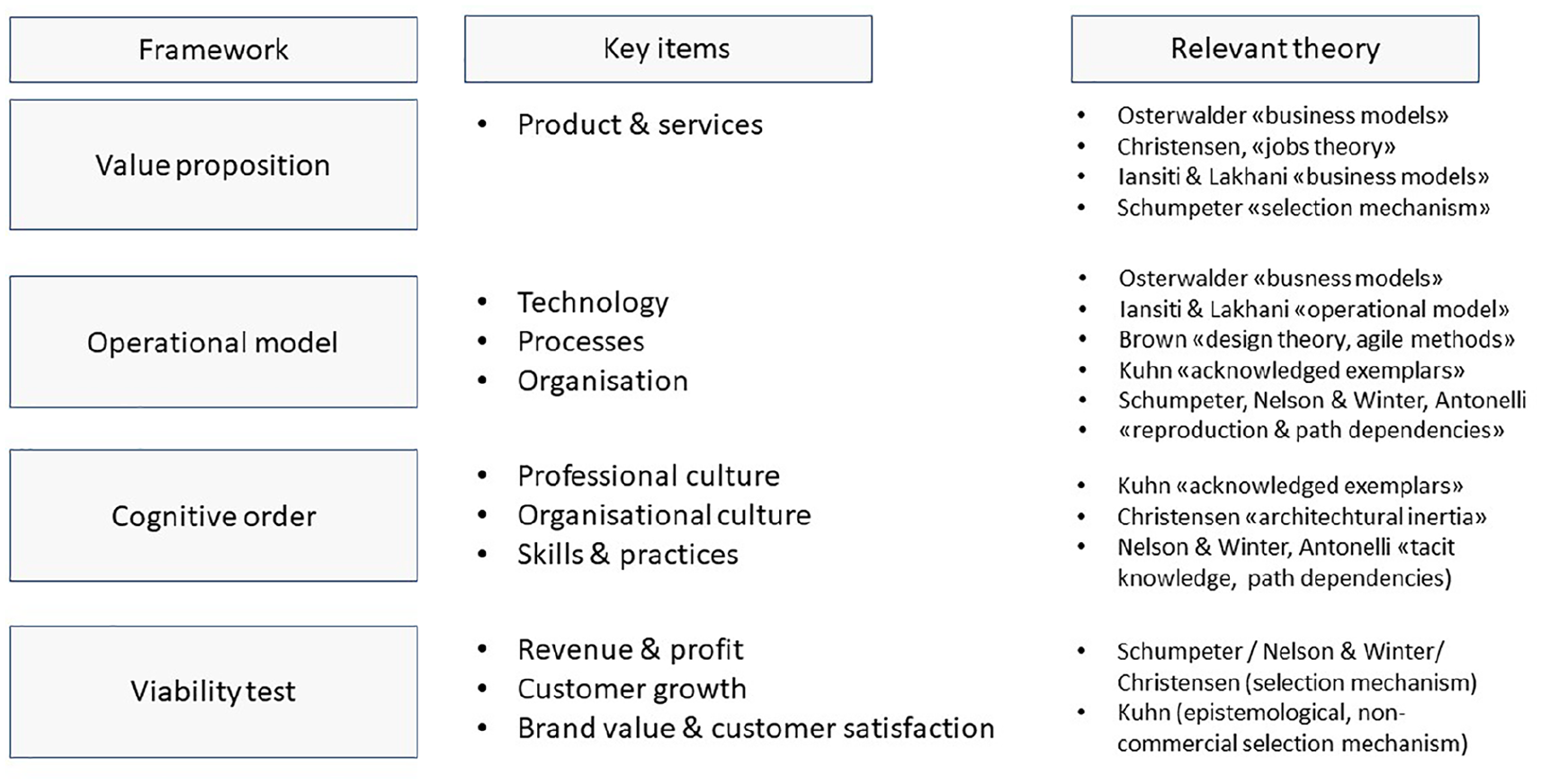
Framework for analysis of a business paradigm and relation to relevant theory.
In accordance with the innovation perspectives built on here, it can be expected that a paradigm shift within an industry and individual organizations takes time, as it is the accumulative and transformative systemic effects of a learning process affecting the three dimensions in a way that passes the viability test. This is well illustrated by the leaked internal report on the digital transformation of WSJ, as even though it is among the most successful examples within the new paradigm, it still struggles with its old paper-based legacy operation and associated culture (Wall Street Journal [WSJ], 2020a). A recent account of the change process in FT by an internal change agent pictures a similarly discontinuous and bumpy transformation process (Jones, 2022).
Moreover, when a paradigm shift occurs, incumbents may not recognize the systemic properties of the new paradigm and thus imitate individual aspects and make superficial adaptions in trying to emulate what they falsely believe is the key concept of the challengers’ new successful approach (Womack et al., 2007). As a new paradigm entails the development and adoption of a new cognitive order within the business—changing both the tacit and explicit assumptions of the previous paradigm—the cognitive order might be part of the architectural inertia that must be overcome. However, this cognitive order may be beneficial or obstructive in terms of making the transformation into a new paradigm. Thus, value- and ideology-driven cognitive orders may trump rational business deliberations and cause businesses to cling to a doomed paradigm or choose less-than-optimal ways forward from a viability perspective.
In this context, it should be noted that it is to be expected that a new paradigm surviving the viability test takes a significant amount of experimentation and trial and error before a successful configuration emerges. Additionally, adaptions and broader acceptance within an industry are likely to take time.
Early Instances and Subsequent Followers of the Readers First Paradigm
As we have not identified earlier cases, FT is likely among the earliest innovators of the Readers First Paradigm. Through open sources and INMA material, we have reconstructed key elements of the developmental history of FT. As Amedia was an early follower, we also applied the material gathered from our study of them. Further, Amedia senior manager (PN) claimed that “In 2013, FT was the global innovation leader and inspired us to adopt key features of their approach that was suitable to the local media market in Norway.” Information about FT that gained public attention in 2012 to 2013 largely confirms the Amedia assessment and fits our stipulated timeline of the innovation trajectory of the new paradigm (Indvik, 2013).
Additionally, Schlesinger and Doyle (2015) observed major systemic changes in the FT value proposition and operational model. Through a Schumpeterian lens, they speculated that the time when it was written was the early days of a Schumpeterian creative destruction of legacy newspapers. Whereas digital income in 2000 was negligible, by 2012, with 316,000 digital subscriptions out of 602,000, the FT digital transformation was already a success. Schlesinger and Doyle (2015) viewed this as the result of a premeditated management strategy. Furthermore, in January 2013, an email memo from Lionel Barber, editor of the FT, to his staff became public. The memo revealed a strategy “to reshape the FT for the digital age” and called for a response to the disruptive effects of new entrants such as Google, LinkedIn, and Twitter: “. . . our competitors are harnessing technology to revolutionize the news business through aggregation, personalization and social media. Mobile alone, for example, accounts for 25 per cent of all the FT’s digital traffic” (Barber, 2013; Giner, 2014). Public reports since 2013 show consistent growth in digital subscriptions, which passed one million in 2019 (Mayhew, 2019), and increased profitability despite advertising trending downward. Proving sustainability, the FT readership showed increased engagement measured by frequency and duration of reading the digital edition, which now comprises about 90% of total subscriptions (De Bono, 2021). Since 2007, FT has gone from being largely a UK print outlet to a global digital product for business professionals and decision makers, with >80% of the readers being from outside the UK, according to the Global Capital Markets Survey 2020.
Closer examination of the FT case supports the hypothesis of a Schumpeterian creative destruction. A starting point is the second paywall in 2007. As important as ensuring online subscription revenue was that the new paywall provided comprehensive electronic user data informing further product development. These data taught FT indispensable lessons about how readers engage with their product, which allowed them to develop their journalistic value proposition with a keen awareness of user behavior and preferences. In this context, an FT executive stated:
I can see through our analytics exactly what . . . people are doing on the site and am actually understanding their behavior and their needs . . . and judge from their behavior as to which parts we can improve, and that leads to product innovation (cited in Schlesinger & Doyle, 2015, p. 313).
Thus, user data from inside the paywall turned out to be “pure gold” from an advertiser’s point of view, according to Bob Grimshaw, managing director of FT.com and the architect of the metered subscription model (Starkman, 2014). It allowed FT to adopt the “Google model” for targeted advertisements. This double value of the data harvested turned 2008 into the year when FT, as per Grimshaw, “really accelerated down” on the digital subscription model (Starkman, 2014). By 2021, FT confirmed that “AI and machine learning become increasingly important . . . those tools open up a lot of new opportunities” (De Bono, 2021). In this context, the head of analytics at FT defined three phases on top of the original concept, each of which added new innovations to their Reader First-strategy since 2014 (Seale, 2021): phase 2, the “quality era,” focused on improving quality for repeat visitors through personification and recruiting subscribers among them; phase 3, the “engagement era” built on the “Recency, Frequency, Volume” concept to increase the use of their product; and most lately, phase 4, the “Life Time Value” era, which enabled FT to virtually eliminate churn with a net retention of approximately 110% as the revenue from existing customers has been increasing year-on-year (De Bono, 2021).
The Amedia case mirrors FT. First, the journalistic product was improved through data harvesting and analytics and eventually through AI and machine learning, both of which secured growth in digital subscriptions. Next, the same tools were applied to a targeted advertising operation. In Amedia, this, along with other innovations, led to new priorities in terms of topics to cover and writing stories in alignment with user preferences, which enabled the prediction of the number of readers per article, reading duration per subscriber, and the number of new subscribers elicited as a direct result of an article.
The first priority of both FT and Amedia is developing journalism as a business, with advertising and other products as the second. Regarding advertising, in 2012, FT concluded the following:
. . . [advertising is] increasingly subject to competition because of the movement of revenues from print to digital and the strong position in the digital space of players such as Google, Apple, and Amazon. The ambition is to drive up subscription or “content revenues” so that in the next few years these become the main basis of the enterprise’s revenues (Schlesinger & Doyle, 2015, p. 311).
Amedia came to the same conclusion in 2013 to 14, when their click-bait and viral reach initiative Buzzit failed to protect advertising revenue. Senior manager (PN) in Amedia described the decision to focus on subscriptions and readers first as “a lifesaving strategic move confronted with an existential crisis.” Since then, as measured during 2015 to 2020, the six newspapers in Norway with the highest growth in subscriptions and revenue are all from the Amedia Group (Bakke et al., 2021). Since 2015 to 16, numerous other newspapers have also made astonishing progress by emulating the approaches of FT and Amedia, Similarly, by embracing this approach, INMA has become a key institution, giving the paradigm momentum. Starting around 2020, on a weekly basis, INMA offers case studies, courses, and workshops teaching key aspects of the Readers First paradigm. The case studies cover all continents to consistently report on the high yearly growth in digital subscriptions, some of which are well beyond 100%. INMA recommends the same approach to advertising, as behind their walled gardens, newspapers can offer highly attractive arenas for targeted advertising in environments with trusted brands, attractive demographics and high conversion rates (Bakke et al., 2020). Additionally, in alliance with FT Strategies (The FT consulting arm) and Google, INMA has built a lab with the objective of optimizing strategies, methods, and tools for the legacy newspaper industry with the aim of increasing subscriptions (King, 2021a). In 2020, FT Consulting supported 71 newspapers in their endeavors to implement Readers First strategies (De Bono, 2021). Further, FT consulting describes the transformation as comprehensive, implying substantial changes in the three dimensions of our paradigm framework (Harding & Eisenband, 2021).
Moreover, upon assessing the empirical material, we propose in Figure 3 a condensed, high-level description of the timeline, the main phases, and key developments of the “Readers First Paradigm.”

Phases in the evolving of the readers first paradigm.
Key Properties and the Systemic Character of the Readers First Paradigm
Applying the analytical framework proposed above, this section elaborates on the key components and systemic properties of the Reader First Paradigm.
Value Proposition Bundle and Gravitational Profile of the Readers First Paradigm
The idea of systematically developing the value proposition of a business can be traced back to the ontological analysis by Osterwalder (2004), and the succinct observation by Peter Drucker that “the customer rarely buys what the company thinks it’s selling him,” which is arguably the starting point of Christensen’s “jobs theory” (McGrath, 2017). In recent years, the value proposition concept and associated toolboxes have been elevated to a strategic approach across industries (McGrath, 2017; Ulwick, 2017).
More specifically, a value proposition consists of the jobs that a product or service aims to support through the related customer segments (Osterwalder & Pigneur, 2015). The specific product or service needs to address pains and possible bad outcomes related to those jobs as well as the positive outcomes/gains that they may deliver to specific customer segments.
Any newspaper may offer a combination of value propositions tailored to different markets, segments, and individuals. Therefore, it is important to understand the bundle of value propositions and their individual items’ relative importance, which we will term its gravitational profile.
The key value proposition questions answered differently as per the new paradigm are as follows: (1) What is the most important customer segment for the organization? (2) What job is your product undertaking for that segment? Briefly stated, the answer for question (1) is a shift from advertisers (old paradigm) being the most important customer segment to readers (new paradigm). For question (2), in the old paradigm, the most important job is to provide advertisers with an attractive marketplace, whereas the role of journalism is mainly a supportive function delivering that marketplace. In the new paradigm, the primary job is to deliver journalistic value that the readership is willing to pay for, whereas advertising remains an add-on and secondary source of revenue.
Historically, newspapers, with few exceptions, have offered two-sided marketplaces, where the key to success was mutually reinforcing network effects. However, journalistic quality, as experienced by the readership, was not totally insignificant; it had to achieve sufficient circulation to be an attractive platform for advertising. Thus, in conditions of monopoly or semi-monopoly, demands placed on journalistic quality, humility, and receptiveness toward user preferences were modest, according to Picard (2017b), Pressman (2020), and the interviewees in this study. In the past, newspapers were forced to innovate and improve their products from the readers’ point of view whenever reduced circulation threatened advertising revenue. Here, Pressman (2018) noted that journalistic ideals of being fact-based, fair, and striving for objectivity in the American press evolved as a commercial response to crises in circulation:
Although some people think objectivity is the press’ natural mode, for most of American history, newspapers were proudly partisan. Not until the 1920s did objectivity catch on as a professional ideal. A wave of newspapers mergers and closings [. . .] and the surviving papers had to appeal to a broader swath of the public. Overt partisanship in the news pages would alienate large parts of the target audience.
Similarly, journalistic innovations during the 1960s to 80s, such as deep diving, critical and opined journalism, and broader coverage of soft topics, are answers to competition from TV, which made newspapers inferior in areas where they used to enjoy semi-monopoly (Pressman, 2020). However, whereas those innovations aimed to preserve the Advertising First Paradigm, the innovations of the Readers First Paradigm represent a disruption.
Osterwalder and Pigneur (2015, p. 12) distinguished three types of jobs that are relevant to the value proposition of newspapers. First, “functional jobs” relate to specific problem tasks to be solved. Here, newspapers may deliver a broad array of actionable knowledge relevant to functional jobs important to their readership. Second, they perform “social jobs,” where the choice of newspaper contributes to social status, belonging, identity, and readers’ cultural capital. Finally, they also perform “personal jobs,” where newspapers may create emotional value for their readership. In this context, the polarized climate of the US and several Western countries indicates a viable commercial space for newspapers appealing to emotions rather than fact-based, actionable knowledge. While the new paradigm gravitates to be more sensitive and deferring toward readership preferences, newspapers have a business choice concerning the segments being focused on and the preferences being prioritized. Further, successful newspapers may balance jobs differently depending on the segments being targeted. As a recent example, the publisher of WSJ indicated a keen awareness of the aforementioned types of jobs for his newspaper (Latour, 2021; Watford, 2021), with the priority being functional jobs to emphasize facts, truth, and trust and deliver actionable knowledge for business as key parts of the value proposition. Nevertheless, WSJ also focuses on social jobs by building communities for CEOs, CTOs, etc., and ensuring that it enhances the cultural capital of its readership, while also focusing on undertaking personal jobs for each reader through personalization and insight into particular personal needs.
The full power of the value proposition of the Reader First Paradigm is dependent on the AI factory, which is the core of its operational model. The term was introduced by Iansiti and Lakhani (2019, Loc. 940) as a scalable technological and organizational mechanism that “reinvents the core of the modern firm.” Further, the AI factory enables an organizational decision-making engine capable of overcoming traditional human and organizational cognitive limitations and boundaries. More specifically, for newspapers, it is key to personalize the product, enabling every reader to experience a unique version. This helped solve a major problem of segmentation, which so-called “market driven journalism” (cf. McManus, 1994, 2009) did not solve. In this context, Picard (2017a, Loc. 2014–2018) stated the following: “Because audiences are collections of individuals, it is impossible to assess what each wants,” which created journalism aiming to serve the “largest audience group to the detriment of smaller groups.” Further, he noted that this approach had detrimental effects on the quality of newspapers and contributed to their downfall. Here, the AI factory enables a solution by growing audiences through the addressing of multiple overlapping microsegments that can be aggregated to larger audiences while simultaneously precisely targeting individuals. Through its cognitive capabilities, the AI factory allows for value propositions serving a unique product to every individual, thus creating a dynamic link between value proposition and operational model and consequently enabling rapid, continuous improvement of the former by facilitating learning among journalists and readers that is mediated by AI software. This allows newspapers to identify small segments that are still large enough to vindicate journalistic attention and thus, optimize editorial investments.
Operational Model of the New Paradigm
The operating model defines the way a firm delivers value to their customers—that is, how they, in practical terms, as defined by business process, technologies, skill sets, and organizational set-up, deliver their value proposition to their customers.
Traditionally, journalism has been an endeavor with humans as the key productive resource that selects the topics, conducts research, and frames the narratives by means of professional expertise. However, as humans scale poorly both in handling large data volumes and broad scales of competencies, the digital attention economy represents major challenges to this “old” model.
News media face pressure to build organizational and cognitive capacities that can process exponentially growing quantities of information within continuous news cycles. The responses among early innovators combined agile design thinking and the AI factory. Agile design thinking relies heavily on insights into limits on human rationality, focusing on continuous learning through experimentation in short cycle times (Brown & Katz, 2019; Harvard Business Review, 2020; Kahneman, 2011; Simon, 1971; The Agile Manifesto, 2001). It is a human-driven concept combining key elements of the philosophy of the Toyota Production System and modern approaches to the development of software. Through this approach, rapid learning is, as the WP described it, “achieved by hypothesizing, testing, learning, and implementing in continuous cycles” (King, 2021b). The power of this approach is multiplied when integrated with the AI factory, which, as an organizational and technological construct is part of a cross-industry shift where organizations are increasingly built on software as opposed to humans (cf. Iansiti & Lakhani, 2019). The AI factory exponentially extends the cognitive and learning capabilities of humans and other organizational processes through AI-driven algorithms for collecting, analyzing, and testing huge amounts of behavioral and other data. As examples, see NYT (https://www.nytimes.com/privacy/cookie-policy#what-is-a-tracker) and Der Spiegel (https://www.spiegel.de/how-we-deal-with-your-data) who make their data harvesting policies transparent on their websites. In the Readers First paradigm, mutual learning between journalists and readers is increasingly mediated through AI and machine learning. Figure 4 illustrates how the systemic combination of the human-driven agile design (red section) and software-driven learning of the AI factory (green section) drive perpetual innovation. Here, it can be seen that both rely heavily on data and use raw (input—gray section) and second order data as interpreted by either machines or humans.
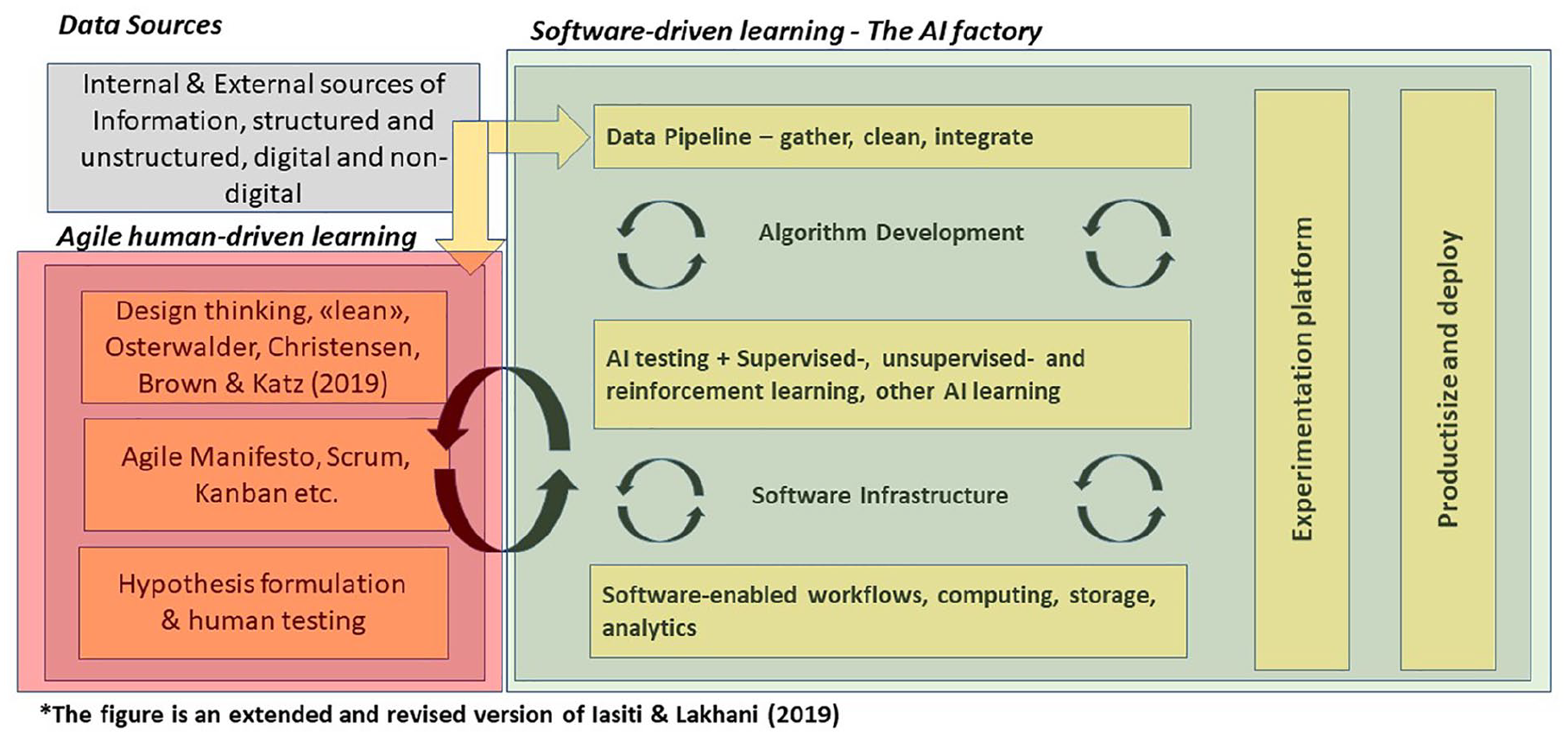
The AI factory as a scaling tool enhancing learning by human driven design thinking and agile methodologies.*
The AI factory is part of a “learning triangle” where journalists and readers interact while mediated by AI agents (Figure 5). This scales much better than traditional journalistic processes. Consequently, this also introduces a new set of agents that populate organizational processes, creating hybrid human–machine combinations. Thus, the trend of organizations being increasingly built using software and AI agents is likely to intensify (Brynjolfsson et al., 2018). The field of AI and machine learning is expanding rapidly across industries. If anything, its impact on journalism as a business is likely to grow. For a better understanding of the technology and its trajectory, see Taulli (2020).

The AI-driven human-machine learning triangle.
Cognitive Order and Strategy Alternatives in the Reader First Paradigm
When value propositions and operational models are transformed, it is to be expected that they are accompanied by changes in the cognitive order of news organizations and the institutional superstructure of journalism in which they are embedded (Bjerke et al., 2019; Picard, 2017b). As noted, those institutions were allowed to develop self-sufficient quality criteria that were partly insulated from readership preferences (Shirky, 2008). However, Pressman (2018, 2020) showed that when distribution volumes fell below critical thresholds, newspapers were pressured to innovate and align their value propositions with reader preferences, which indirectly reduced the impact of this institutional superstructure. However, within the Readers First paradigm, protection of the institutional superstructure against market forces becomes disrupted, bringing journalism into continuous interaction and dialog with readers. This is both a daily process and serves as aggregated input to analytical exercises aimed at adjusting editorial strategies and directing editorial investments. Senior Manager (PN) at Amedia stated that “we made dashboards for every journalist, so they could monitor reader responses to all their articles, number of readers, responses to the content, etc. When they learn that ‘my article generated twenty new subscriptions yesterday’, it is proof that ‘I am making a difference’, which causes enduring behavioral changes.” Further, Amedia Publisher (GJ) noted that “when I ask for a quantitative analysis of stories doing well in terms of reader frequency, duration, ranking, etc., and stories not doing well on those metrics, I apply this to redirect journalistic resources to topics and ways of framing that are evidently doing well.”
Over time, it is likely that journalism as a practice and institution will be shaped and transformed by new reader-centric value propositions and AI-based operational models. Here, the outcome in terms of journalistic culture and quality, is contingent on strategy choices driven by economic considerations constrained by the size and preferences of the addressed market segments.
In this context, the Amedia case points to a culture of less moralizing and less arrogance replaced by more humility in the selection of topics and storytelling accommodating readership preferences as well as an increased emphasis on fairness, balance, and inclusiveness in the journalistic strategy. This is well tailored to smaller local markets, where huge market shares are required to reach economies of scale (Bakke et al., 2020).
Meanwhile, newspapers with a national or global reach have more options to balance the types of jobs they seek to undertake for their readership. WSJ, for instance, focuses on functional aspects, and its news operation enjoys the highest credibility in the US market (WSJ, 2020b). However, it allows for more biased and less rigorous contributions in the Op-Ed section, apparently appealing to a segment of their center-right readership (Trachtenberg, 2020). Nevertheless, Latour (2021) estimated a US potential of about 10 million new subscribers based on their facts-driven news operations. Here, the news section’s strict organizational independence from the Op-Ed section can be reasonably interpreted as a business move to protect this growth potential. On the other hand, NYT has recently experienced challenges to their traditional “objective” fact-based approach from a vocal internal group of journalists demanding journalism based on “moral clarity” and more journalism like the 1619 Project (NYT, 2019), which has been heavily criticized by professional historians for grave factual inaccuracies (Gurri, 2021; Magness, 2020; Stephens, 2020). The NYT’s internal media critic, Smith (2021) indicated a possible move in a direction that is “opposite of its stated broader strategy” and that it, for business reasons, may drift toward appealing to an attractive leftist niche and produce more journalism like the 1619 Project. In this context, Pfister (2021) cited a former senior editor: “We cannot afford to give our readers the impression that NYT is going to be a leftist version of Fox” (our translation). Here, we are not judging whether NYT is actually going in the direction Smith (2021) predicted or whether it would be wise from a business perspective, instead we are using it as an example of internal ideological power plays enforcing a potentially hurtful business strategy. The point of these examples is given that the Reader First Paradigm is sensitive to reader preferences, there are segments requiring different journalistic value propositions to succeed, and commercial strategies, journalistic cultures, and internal power plays may affect value propositions and prioritized reader segments. Further, profitable journalistic value propositions appealing to social jobs, personal jobs, and ideology-driven niche segments may lead to recklessness when it comes to adherence to facts, balance, and fairness, as the value created for their readerships is peripherally related to functional jobs.
The Viability Test of the Readers First Paradigm
By 2021, a growing number of newspapers adopted the new paradigm, succeeding independently of segment, global, national, local, general, or business news. Figure 6 lists some selected innovators. Those are no exceptions; publishers worldwide gained 50% net digital subscribers in 2020, according to the Piano benchmark of 320 media sites (Silberman, 2021).

Key figures of selected early readers first innovators.
Recent case studies show newcomers to the paradigm succeeding rapidly, taking advantage of strategies and tools developed by the innovators. Several are documented by INMA. For instance, The Telegraph, a British newspaper, adopted the Readers First strategy in 2018 to 2019 and almost doubled their subscriptions between January 2020 and December 2021, from approximately 400,000 to 800,000 (Taylor, 2022). This indicates that the paradigm has matured into an institutionalized stock of knowledge that is transferrable to new organizations and capable of supporting significant improvements when skillfully implemented.
By January 2022, these developments caught the attention of the community of industrial analysts, when Mather employed David Clinch to report on the reader revenue and subscription focus now embraced globally by all types of news media (Clinch, 2022).
The Reader First Paradigm as a Coherent Whole
As indicated above, the value proposition, operational model, and cognitive order need to be coherently interwoven to be effective (Figure 7). More specifically, the value proposition must deliver on jobs that readers are willing to pay for. Unless this condition is satisfied, paywalls are obviously useless. Within the Readers First Paradigm, paywalls are not simple charging mechanisms; they are part of an elaborate system of growing subscriptions through conversions and churn reduction. Conversions are achieved by building personalized profiles of visitors on their websites, social media, etc. before they become paying customers by tracking behavior, reading patterns, etc. Here, the key is offering a few free articles per month on the condition that users register using their name, email, and cell phone number. This is termed metering, and typically implies offering 1 to 5 free articles per month. In this context, Seaman and Zohar (2021) reported that, on average, registered users enact 20 to 30 times more page views than non-registered users, and the likeliness of conversion to a paying customer is 15 to 20 times higher than that for non-registered users. The process is continuously algorithmically optimized and accompanied by a battery of KPIs. However, the measurement of clicks and viral reach is a poor driver of conversion and retention. The WSJ group CEO illustrated the significance of this by warning that without the machinery of personalization, “great media brands might not survive” (Tobitt, 2020).
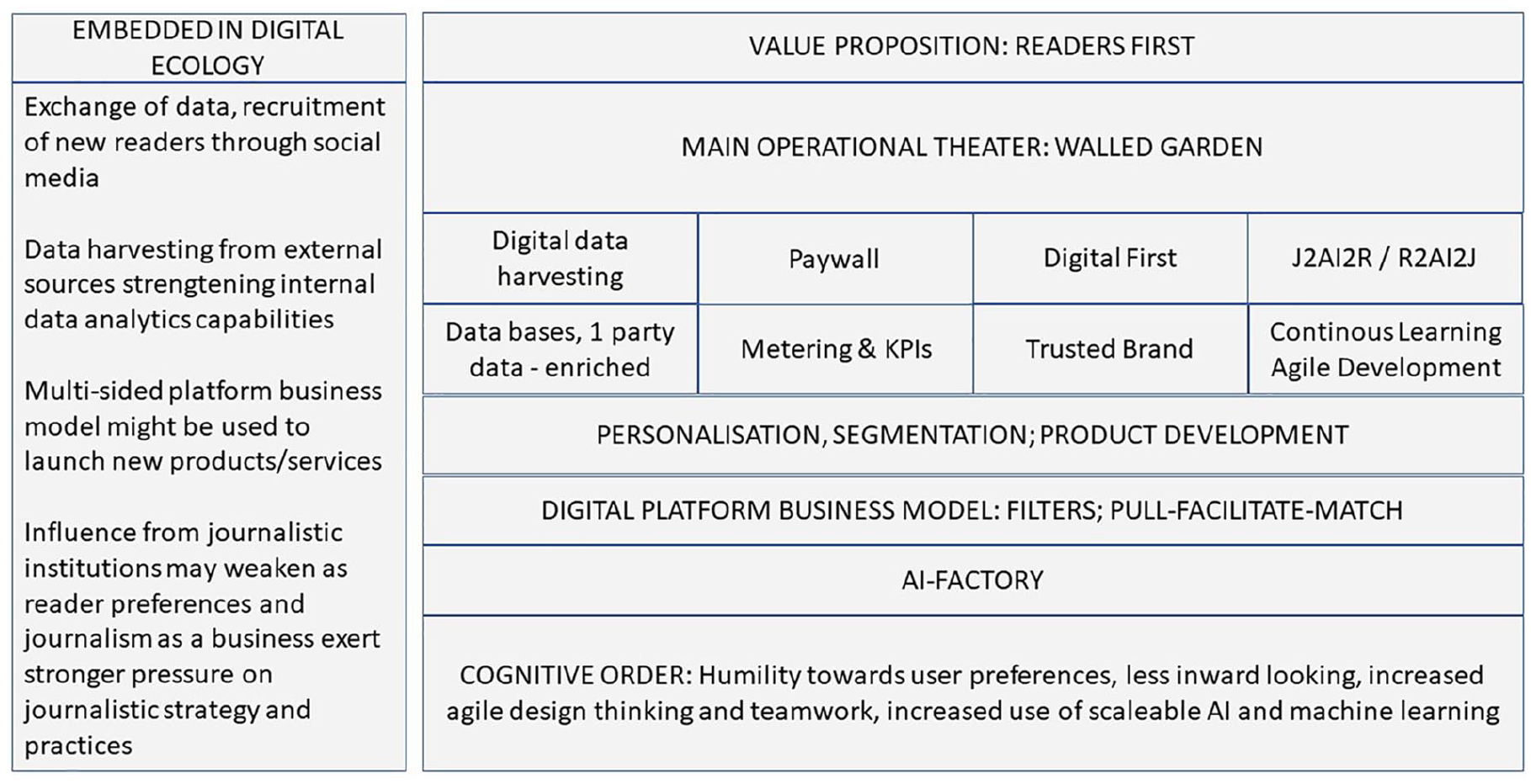
The readers first paradigm and its components.
Digital first is mostly understood as taking distributional advantage of the growing market for 24/7 and 365-day digital news, with the paper edition as a snapshotted second priority. Here, the Reader First Paradigm adds scalable data-harvesting, personalization, and additive micro segmentation as well as agile continuous product development and improvement through combining agile organizational processes and the AI factory. Thus, the AI Factory properly combined with agile design thinking offers newspapers an innovation machine that supports improvements in all aspects of their offerings (Bakke et al., 2020).
By adapting the new paradigm, newspapers have a strategic opportunity to become structurally and operationally multisided platforms that are more like Facebook, Google, etc. Here, the core interaction and value units determining the character of the platform are pieces of journalistic work (articles, videos), on top of which several new offerings can be built. Further, through the analytic capabilities of the AI factory, newspapers are put in a position to perform pull-facility-match operations that efficiently filter and match individual profiles with the various offerings on the platform (Choudary, 2015, pp. 121–136). The platform model may serve as an innovation enabler through which newspapers continuously improve their core product and offer their own add-on products (reader communities, in-depth journalism for special market segments, etc.), in addition to offering a variety of third-party products, including engaging the readers as content producers—all of which are optimized for micro segments down to the individual. The most successful example of expanding a newspaper into a multisided digital platform is probably the NYT, which in the first 6 months of 2020 reported 24.1 million USD as subscription revenue from stand-alone products that are vaguely but still related to journalism such as cooking, games, and others (Perlberg, 2020).
However, for newspapers fundamentally built on functional jobs and trust, additional products need to be carefully evaluated to ensure compatibility with their brand values (Bakke et al., 2020).
Moreover, the Readers First Paradigm is immersed in complex digital ecologies. Successful newspapers are likely to both protect their own data and business behind a walled garden, while simultaneously remaining deeply entangled with the big platform players that serve as distribution partners and sources of new subscriptions (Myllylahti, 2020; van Dijck et al., 2019). In this context, newspapers with significant revenues dependent on Facebook and Google are exposed to considerable risk, as minor changes in platform policy and algorithms may have detrimental effects on their revenues. Amedia is aware of this and, consequently, factors in the risk and opportunities in their choice of strategy: “Facebook cannot be wished away . . . it is about optimization, utilizing advantages and protecting against downsides” (Senior manager, PN). Additionally, Facebook plays a key role in Amedia’s ecology: “Measured against total traffic, Facebook is very important in the routing of external traffic into our walled garden” (PN). However, when platforms go in new directions, this may affect the strategic options available to the news industry, like the new limitations put on tracking across websites for Facebook and others, which may strengthen the value of the walled garden data of newspapers.
Overall, these developments make continuous focus on developing and refining the value proposition a key success factor, entailing a balancing act enshrined with dilemmas. Chief editor (EEH) from Aftenposten illustrated this by stating: “Relying 100% on automatic personalization is antithetic to editorial driven quality journalism. Our job is also to challenge and widen readers’ horizons. We therefore combine automatic personalization based on user preferences with push of material reflecting editorial strategy and judgement.” From a business perspective, we note that this strategy relies on the assumption that there are sizeable reader segments that appreciate being challenged.
Overall Conclusions and Outlook
We predict that the Readers First Paradigm will continue to spread, evolve, and improve and propose five preliminary conclusions:
First, the Readers First paradigm seems adaptable to virtually all types of digitized newspapers and content in all kinds of format.
Second, the Readers First Paradigm offers an innovation platform for newspapers, which enables growth in both depth (improved journalistic quality) and breadth (launching of several new products and services based on a platform model).
Third, the Readers First Paradigm challenges the concept of quality as historically developed by the institutions of journalism, which is weakly linked to reader preferences. In this context, the Advertising First Paradigm allowed for standards internal to the journalistic institutions, which were influenced by enlightenment ideals that considered the readership in need of education and moral improvement. However, as the sole or main guide to quality, it may cause the downfall of those adhering to it. However, the Readers First paradigm productively engages with reader preferences and behavior as sources of quality enhancement, which enables product innovation similar to other competitive industries.
Fourth, there is a sophisticated market for factual and actionable knowledge to help readers navigate an environment characterized by information overload and fake news that the Readers First Paradigm has the capacity to address. However, when applied without the constraints of core journalistic values of adherence to facts and fairness, this paradigm is a powerful tool that may, by playing on emotions and tribal epistemologies, grow audiences and revenue, even if the realm of the factual is ignored or obstructed. This option is available to newspapers along the entire ideological spectrum.
Fifth, while we expect further bankruptcies, many players still have significant growth potential, which is due to the following but to varying extents: a fully digitized business model with zero marginal cost scales well, thus opening growth opportunities in terms of geography and segments not available in the paper era; the demand among elites for actionable knowledge from trusted sources may grow; the new regulations hampering Facebook, Google, and others may be advantageous for newspapers, as the value of their unique datasets may increase; if polarization and culture wars increasingly define the market, there will be profitable positions for newspapers appealing to segments to the right and left with less emphasis on functional jobs.
However, we emphasize the tentative character of these takeaways. This is because the ecology of the digital attention economy, in which newspapers are inextricably intermingled, is changing dynamically with an unseen pace of new innovations, consumers changing their preferences, and regulators trying to change the competitive playing field.
Footnotes
Appendix 1
Declaration of Conflicting Interests
The author(s) declared no potential conflicts of interest with respect to the research, authorship, and/or publication of this article.
Funding
The author(s) disclosed receipt of the following financial support for the research, authorship, and/or publication of this article: This study is funded by our institution, Kristiania University College.
Ethics Statement
Nils Arne Bakke and Jens Barland confirm that all ethical guidelines that apply to interviews of sources and processing of data have been observed. The sources are resourceful top executives, and they have all received written information about the project, about data processing, about the right to withdraw their statements, and they have signed this information document. Other data is in publicly available documents. The project’s data processing is registered with the “Norwegian center for research data” with reference number 289059.
