




Abstract
Using data from six East Asian countries and regions participating in the PISA2022 test, a sample of 34,968 middle school students aged 15 and above was selected to explore the complex relationship between student perceived cognitive activation strategies and their mathematical achievement. Descriptive statistical method, independent sample testing, and analysis of variance were used to analyze the characteristics of independent variables, mediating variables, moderating variables, and dependent variables, and the mediated moderating effect was tested using the Bootstrap sampling method. The results showed that: (1) Boys performed better in perceiving cognitive activation strategies, had stronger problem-solving perseverance, lower mathematical anxiety, and performed better in mathematics academic performance than girls. Meanwhile, children from medium to high-level socioeconomic status families have significant advantages in perceiving cognitive activation strategies, problem-solving perseverance, and academic performance, and their mathematical anxiety is relatively lower (2) The perceived cognitive activation strategies of students are significantly positively correlated with problem-solving perseverance and mathematical academic performance, but negatively correlated with their mathematical anxiety (3) Perseverance has a significant positive predictive effect on the middle school student’s mathematical achievement (4) Perseverance has partial mediating contribute to the impact of student perceived cognitive activation strategies on their personal mathematical academic performance (5) compared with low-level mathematical anxiety, higher levels of mathematical anxiety have a more significant inhibitory effect on the positive impact of individual perceptual cognitive activation strategies on their perseverance. In the future, providing students with sufficient opportunities for mathematics learning in classroom teaching, cultivating their problem-solving perseverance to enhance their cognitive activation level, and minimizing their academic burden both inside and outside the school to alleviate their mathematics anxiety are important ways for East Asian middle school students to improve their mathematics academic progress.
Keywords
Introduction
In recent years, research on the OTL (opportunity to learn) in mathematics education has provided a richer theoretical perspective for classroom teaching analysis and international academic comparison (Zhu & Wang, 2022). In this theoretical framework, students’ mathematical opportunities to learn depend on three aspects, namely, mathematics learning content, mathematics teaching practice, and mathematics teaching quality (OECD, 2013). Among them, teaching quality (such as teacher support, classroom atmosphere, and cognitive activation) has been proven among the most important variables affecting student learning results and motivation (Baumert et al., 2013; Zhang et al., 2021). Moreover, under the continuous influence of investigation on MPCK (Mathematical Pedagogical Content Knowledge) in academia, mathematics teaching characterized by promoting cognitive activation has become an important scale for measuring the quality of mathematics curriculum implementation (Kunter et al., 2007). Actually, many classroom studies have discovered that cognitive activation strategies play a positive role on students’ mathematical achievement (Klieme et al., 2001). However, some studies have also pointed out that teachers’ teaching strategies do not directly affect students’ mathematical learning, but rather rely more on their individual cognitive level (Hiebert & Grouws, 2007). It can be seen that students’ perception of teacher cognitive activation strategies in classroom teaching may have a direct impact on their future mathematical achievement.
On the other hand, the sustained outstanding mathematical performance of East Asian students in global academic comparisons has also attracted widespread attention worldwide, thereupon more researchers are turning their attention to mathematics classroom in East Asia and further analyzing the differences of opportunities to learn among East Asian students (Fan & Zhu, 2004). Therefore, to some extent, analyzing the classroom teaching process from the perspective of student perceived cognitive activation strategies seems to provide breakthrough point for further explaining the high mathematical performance of learners in the Chinese-character cultural circle. At the same time, non cognitive processes (such as perseverance, beliefs, etc.) in mathematical learning should also be included in the range of cross-cultural study. Unfortunately, current systematic research on cognitive activation in mathematics education is mostly based on Western educational contexts, and these studies indicate that cognitive activation strategies are mediating variables between teacher’s MPCK and students’ performance (Baumert et al., 2010), and using mathematical emotions as mediating variables for students’ perceived cognitive activation strategies in predicting their mathematical achievements (Hascher et al., 2024). Moreover, recent surveys on the quality of mathematics teaching in European countries have found that students’ perception of teachers’ cognitive activation levels may have a negative impact on their mathematics grades, such as potential misconceptions in guiding mathematical thinking (Liu et al., 2024). By contrast, Western culture’s exploration of the relationship between students’ perceived cognitive activation strategies and mathematical academic achievement is mainly based on the control value theory, and more often considers emotional variables such as mathematical anxiety and self-efficacy as mediating factors; while East Asian culture emphasizes the value of individual self, so it tends to use self-determination theory to analyze the relationship between these two, and Chinese local research often uses perseverance and interest as mediating variables (Li et al., 2021; Zhang et al., 2021). In view of this, this study will take the cultivation of students’ classroom learning opportunities as the starting point, while comprehensively considering the control value theory and self-determination theory. Among them, perseverance will still be used as the mediating variable, but mathematical anxiety will be used as the moderating variable, thus running through the entire process of students’ mathematical knowledge transfer and mathematical thinking cultivation, and systematically exploring the complex relationship between students’ perceptual cognitive activation strategies and their mathematical academic performance in East Asian culture. On the one hand, the theoretical contribution of this study lies in its focus on the moderating effect of mathematical emotions in classroom teaching. On the other hand, on the premise that students from Chinese Mainland did not participate in international academic comparison, the results of this study can also provide evidence and supplement for previous local study in practical terms.
Literature Review
The Conceptual Origins of Cognitive Activation
In the past 30 years, MPCK has become one of research hot spots in mathematics education, and the evaluation on MPCK has also received increasing attention from all parties. Therefore, many studies on the evaluation of MPCK have emerged both domestically and internationally, such as the research of MKT (Hill et al., 2004), the project of TEDS-M2008 from the International Association for Educational Achievement Evaluation (Tatto et al., 2012), the project of COACTIV from German (Krauss et al., 2008), and a survey study on MCK of Chinese primary school mathematics teachers (Bao, 2017). Among them, the research of COACTIV is particularly influential. This is a domestic longitudinal study implemented by Germany to expand the project of PISA2003, and which the MPCK was divided into three dimensions, namely: knowledge about mathematical tasks as teaching tools, knowledge about student cognition and evaluation of student comprehension, and knowledge about various representations and interpretations of mathematical problems, which can be seen. Thus, the MPCK from mathematics teachers includes the sub-dimension of promoting cognitive activation in students, such as promoting mathematical thinking and cultivating reasoning skills. Subsequently, more relevant studies attempted to classify and evaluate mathematical tasks which reflects students’ cognitive activation potential to some extent (Blum et al., 2004; Jordan et al., 2006; Knoche et al., 2002). Overall, students’ opportunities to learn mainly come from teaching tasks provided by mathematics teachers, among which cognitive activated mathematics tasks can help students establish connections with their existing knowledge structures by doubting and checking their pre-existing opinions and faiths (Klieme et al., 2009). Therefore, cognitive activation is an important indicator for measuring students’ cognitive needs and knowledge understanding level, which profoundly affects the quality of mathematics teaching and the entire process of mathematical problem solving from students.
Student Perceived Cognitive Activation Strategies and Mathematical Achievement
Unlike other methods of analyzing teaching quality, the current evaluation of cognitive activation in mathematics classroom teaching mainly relies on self-report inventories from teachers or students. Therefore, students’ perception of cognitive activation strategies largely reflects the actual state of cognitive activation (Klieme et al., 2001). Moreover, as mentioned above, providing challenging tasks in mathematics teaching can stimulate students’ cognitive potential and the formation of mathematical thinking, thereby providing them with sufficient opportunities to learn (Baumert et al., 2013; Seidel & Shavelson, 2007). At the same time, under the promotion of cognitive activation by students, they can freely establish contact with previous knowledge and experience, thereby achieving the transfer and application of mathematical learning (Neubrand, 2006). Furthermore, research has found that cognitive activation can directly promote the improvement of students’ mathematical academic performance, and it is related to positive mathematical academic emotions (Chen, 2025; Yi & Lee, 2017). Therefore, we have reason to assume that students’ perceptual cognitive activation strategies will have a positive impact on their mathematical achievement, which we call it the hypothesis 1 (H1).
The Mediating Effect of Perseverance between Student Perceived Cognitive Activation Strategies and Mathematical Achievement
Nowadays, the positive impact of perseverance on solving mathematical problems seems to be validated in practice, and the performance of students with higher perseverance is always closely related to better mathematical achievements (OECD, 2013). Usually, the process of mathematical problem solving requires to maintain perseverance from individual in long-term calm thinking and experimentation. Among them, the role of perseverance in problem solving is mainly to encourage students to develop resilience when facing mathematical problems and established tasks, while promoting knowledge transfer, the cultivation of reasoning skills, and the selection of learning strategies (Berenguer et al., 2012). On the other hand, some studies have pointed out that the perceived sense of challenge by students due to cognitive activation is a powerful predictive factor for the development of mathematical learning interest and motivation, and this intrinsic learning motivation will in turn positively affect students’ problem-solving perseverance (Ainley et al., 2002; Kunter & Baumert, 2006). In the Self-Determination Theory (SDT), the self is the determining force for personal psychological development and academic growth, so an individual’s learning experience has an extremely important impact on their learning outcomes (Deci & Ryan, 2012). Moreover, the theory of OTL also suggests that classroom teaching guided by cognitive activation can provide bridges and bonds for teacher-student interaction and common progress, ultimately providing sustained motivation for student academic progress (Klieme et al., 2009). In addition, if students want to achieve better math performance in classroom teaching, their efforts, perseverance, and beliefs are essential (Noftle & Robins, 2007). Meanwhile, many researchers have also found that perseverance may has a mediating effect on the correlation between cognitive activation and mathematical performance (Bazelais et al., 2016; Zhang et al., 2021). Therefore, this study hypothesizes that students’ perceived cognitive activation strategies have a positive impact on their mathematical academic achievement mainly through individual perseverance (H2).
The Moderating Effect of Mathematical Anxiety between Student Perceived Cognitive Activation Strategies and Perseverance
It is worth noting that the moderating role of emotions cannot be ignored in the pathway of how students perceive cognitive activation strategies to affect perseverance. This point seems to be supported by existing discussions in educational psychology, and the current transfer theory of mathematical learning points out that the key to establishing connections between new and old mathematical knowledge in an individual’s cognitive structure depends on their own perseverance and self-monitoring ability (Zhang, 2006). Moreover, their ability to withstand various negative emotions in learning is also an important regulatory factor. On the other hand, some surveys based on the control value theory (CVT) of achievement emotions have found that students’ perceived cognitive activation strategies have a greater direct promoting effect on math academic performance than the indirect effect mediated by math emotions such as math anxiety (Hascher et al., 2024). In addition, perseverance personality is a multidimensional concept, and current evaluations of perseverance always include negative dimensions that reflect lack of perseverance and easy abandonment, as well as positive dimensions that reflect perseverance and pursuit of excellence. However, the impact and path of these two components on mathematical performance are significantly different (Zhang & Li, 2022). In fact, the negative impact of anxiety on perseverance and mathematical performance has long been well-known to the public (Richardson & Suinn, 1972). Overall, mathematical anxiety may has a moderating effect on the impact of students’ perceived cognitive activation strategies on perseverance. Based on this, this study hypothesizes that mathematics anxiety plays a moderating role in the first half of the period when students’ perceived cognitive activation strategies affect their mathematical academic achievement through their personal perseverance. Compared with low-level mathematical anxiety, higher levels of mathematical anxiety have a more significant inhibitory effect on the positive impact of individual perceptual cognitive activation strategies on their perseverance (H3).
The Present Study
We established a moderated mediation model based on the previously mentioned literature. Former findings have demonstrated that students’ perceived cognitive activation strategies may be connected with their perseverance, which may sequentially affect mathematics achievement. At the same time, mathematical anxiety regulates the process of students perceiving the influence of activation strategies on perseverance. To further deepen related research, this study explored the mediating effect of perseverance on the correlation between cognitive activation strategies and mathematics performance, as well as the moderating role of mathematical anxiety between cognitive activation and perseverance (See Figure 1 ).

Theoretical model of the mediating effect of perseverance and the moderating effect of mathematical anxiety.
Objects and Methods
Participants
The data for this study mainly comes from PISA2022 data set provided by the Organization for Economic Cooperation and Development (OECD). The Programme for International Student Assessment (PISA) is an international student assessment program implemented every 3 years, which aims to evaluate the effectiveness of the school education system by testing students in three main subjects, namely science, mathematics, and reading
(OECD, 2016). In detail, the PISA test in China uses a two-stage sampling method. First, in the first stage, the OECD will ask international contractors to choose sample schools by using the Probability Proportional to Size (PPS) method, these sample schools will contain urban and rural schools, ordinary middle schools, vocational middle schools, middle and high schools, and schools of different running level, public schools and private schools. Next step, the PISA National Center will apply the software provided by OECD to randomly select several students from the sample schools (Xu & Fang, 2021). Finally, the project team selected a sample of middle school students which are 15 years old above from the East Asian participating regions of PISA2022, namely, 34968 East Asian students represented by Singapore, South Korea, Japan, Hong Kong, Macao and Chinese Taipei, which is the data source of this paper. Among them, there are 17105 girls (49%) and 17863 boys (51%) ;6606 students (18.9%) in Singapore, 6454 students (18.5%) in South Korea, 5760 students (16.5%) in Japan, 5907 students (16.9%) in Hong Kong China, 4384 students (12.5%) in China’s Macao, and 5857 students (16.7%) in Chinese Taipei. It should be pointed out that due to the lack of participation of middle school students from Chinese Mainland in this round of PISA test, the popularization of this research conclusion within the East Asian education system is still limited, thus ignoring the possible cultural differences between countries and regions. In terms of ethics and informed consent statements, this study is not an initial investigation, observation, or experimental intervention of the subjects. It is only a secondary analysis of publicly available data (PISA test data developed for the public), and therefore will not cause any actual physical or psychological harm to the subjects. On the other hand, the results of this study are only intended for academic publication and exchange, and do not involve any commercial interests, so there will be no potential negative impact. In addition, as a representative international student evaluation project, the implementation process of PISA testing has already obtained informed consent from the participants in the survey. Therefore, it was deemed to be of low risk and did not require any additional ethical approvals.
Instruments
The research tools used in this study were all from the PISA2022 test, including a student questionnaire consisting of the Cognitive Activation Strategy Questionnaire, the Perseverance Questionnaire, and the Mathematics Anxiety Scale, as well as mathematics achievement indicators. Among them, SPSS 26.0 software was used to test the internal consistency reliability of the questionnaire. The overall Cronbach’s coefficient of the questionnaire was 0.890, and the Cronbach’s coefficients of the three sub-dimensional scales were 0.862, 0892, and 0.853, respectively, all of which were higher than 0.8, indicating good internal consistency and high reliability of each indicator. In terms of validity testing, it was found that the KMO value was 0.860, which is greater than 0.8. The Bartlett sphericity test meets the significance level requirement (p < .05), indicating that the questionnaire has high validity and is suitable for factor analysis.
Questionnaire on Student Perceived Cognitive Activation Strategies
The cognitive activation strategy refers to teaching based on student experience, in which teachers actively seek and establish connections between new and old information by combining the existing experiences of students in teaching. Therefore, students’ perception of cognitive activation strategies helps them achieve the transfer of mathematical knowledge, thereby achieving academic progress. Since PISA 2018, at the student level, cognitive activation strategy testing has been conducted by asking middle school students about their experiences of perceiving teacher cognitive activation teaching strategies in learning, and mainly investigating their frequency of experiencing four teaching strategies, such as asking questions, encouraging expression, connecting with life, and constructing information. In the PISA 2022 test, the design of the student perceived cognitive activation strategy questionnaire is aimed at the mathematics discipline, with a focus on cultivating reasoning skills and promoting mathematical thinking as two sub dimensions (OECD, 2023). Among them, there are a complete set of 18 related items, that are used for test the circumstance of students’ perceptual cognitive activation strategies as a whole, and it is composed of similar items such as “The teacher asked us to solve mathematics problems without computing anything”, “The teacher asked us to explain how we solved a mathematics problem”, “The teacher asked us to think of problems from everyday life that could be solved with new mathematics knowledge we learned” and “The teacher gave problems from everyday life involving numbers and asked us to make a decision about the situation”, the item options from “Never or almost never” to “Every lesson or almost every lesson”, which are all in the Likert five point dimension. In addition, the PISA project team obtained estimates (Mean = 0, SD = 1) of two sub dimensions of student perceived cognitive activation strategies through statistical methods. In this study, the average of these two estimated values was mainly used as a measure of student perceived cognitive activation strategy.
Perseverance Questionnaire
Since the PISA2012 test, the positive role of perseverance in solving mathematical problems has been increasingly valued in mathematical education. Therefore, the PISA project team initially set up five related questions to test the problem-solving perseverance of middle school students, mainly involving the attitudes of students in two opposite aspects such as persevering in tasks and activities until they get done and giving up easily when confronted with obstacles. In the PISA2022 test, the structure of the Perseverance Questionnaire remains unchanged, only the number of test items was increased to 10, which is used as a whole to assess students’ persistence in completing mathematical problems or tasks. And this questionnaire is composed of similar questions such as “I keep working on a task until it is finished” and “ I stop when work becomes too difficult”, the question options from “Strongly disagree” to “Strongly agree”, which are all in the Likert five point dimension. In this study, researchers specifically used the Perseverance Index (Mean = 0, SD = 1) as the main measure of middle school students’ perseverance in solving mathematical problems. This index is a comprehensive indicator formed by the PISA project team estimating students’ performance in answering the above 10 items through statistical methods.
Mathematics Anxiety Scale
Since the PISA 2003 test, the structure of the Mathematics Anxiety Scale has been relatively stable and has been used to this day. The scale mainly measures middle school students’ mathematics anxiety from various aspects such as lack of confidence in course learning, learning tension, and academic performance concerns (OECD, 2013). In the PISA 2022 test, the number of test items in the Mathematics Anxiety Scale has been increased from 5 to 6, and it is composed of similar questions such as “I often worry that it will be difficult for me in mathematics classes”, “I get very tense when I have to do mathematics homework” and “I worry that I will get poor marks in mathematics”, the item options from “Strongly agree” to “Strongly disagree”, which are all in the Likert four point dimension. In this study, researchers specifically used the Mathematics Anxiety Index (Mean = 0, SD = 1) as the main measure of middle school students’ mathematics anxiety. This index is a comprehensive indicator formed by the PISA project team’s statistical estimation of students’ performance in answering the six items mentioned above.
Mathematics Academic Achievement
Like previous PISA math tests, students’ academic performance is estimated using the Rasch model to identify their latent ability traits in solving various math problems, and after linear transformation, the final standard score (Mean = 500, SD = 100) is obtained, which serves as a measure of middle school students’ mathematical academic achievement. Due to the time limit of the PISA test, students are unable to complete a complete set of test papers. Therefore, in order to address the issue of comparability in academic achievement, the overall mathematical ability was estimated through a connected sampling method, and 10 plausible values were ultimately identified. The fact that these 10 indicators do not differ significantly in numerical values, they will not have a significant effect on the conclusions. Therefore, in this study, their average is used to represent mathematical academic performance.
Analysis Method
At present, the methods for testing mediation effects are mainly based on regression models. Therefore, multiple linear regression or structural equation modeling can be used to decompose the possible causal relationship between independent variables and dependent variables into two parts: direct effects and indirect effects. Among them, there are mainly two types at the specific method level. One is the causal stepwise regression test method, which generally consists of three steps. However, this method has low statistical power and has also been improved. The other type is the product coefficient method, which includes the Sobel test based on mediation effects with a normal distribution and the Bootstrap sampling method based on mediation effects with a non-normal distribution. In addition, with the increasing complexity of research, multiple mediating effects of multiple mediating variables (such as chain mediation) and mediation-moderation models that simultaneously consider the influence path of moderating variables have also emerged in practice (Fang & Zhang, 2012). Actually, in the exploration of the relationship between students’ perceived cognitive activation strategies and their mathematical academic performance, more scholars have chosen to use chain mediation models or the multi-level mediation model for testing (Hascher et al., 2024; Li et al., 2021; Zhang et al., 2021; Zuo et al., 2024). In view of this, and based on the theoretical assumptions mentioned earlier, we constructs a moderated mediation model to explore the indirect effects of students’ perceived cognitive activation strategies on their mathematical academic performance through problem-solving perseverance, as well as the moderating role of mathematical anxiety in the impact of students’ perception of cognitive activation strategies on their perseverance (See Figure 2 ), and testing the model with the Bootstrap sampling method (Wen & Ye, 2014).


Among these, Y represents middle school students’ mathematical achievement, X represents their perception of cognitive activation strategies, M represents perseverance, and U represents their mathematics anxiety. The coefficient c in equation (1) represents the total effect of student perceived cognitive activation strategies on mathematics academic performance; a1 + a2U in equation (2) represents the effect of students’ perceived cognitive activation strategies on perseverance after controlling for mathematics anxiety and its interaction with their perception of cognitive activation; b in equation (3) is the effect of perseverance on mathematics achievement after controlling for the influence of students’ perceptual cognitive activation strategies; and c’ is the direct effect of students’ perceived cognitive activation strategies on their mathematics academic performance, after controlling for the influence of perseverance. The mediating effect of perseverance is equal to (a1 +a2 U) b . The relationships among the mediating, direct, and total effects are as follows:
Total effect (c) = direct effect ( c’) + indirect effect ( a1b + a2bU )

The moderated mediation effect model setting.
Results
Descriptive Statistics and Correlation Analysis
Differences in Gender and Socioeconomic Status of Related Variables
The differences in gender and family socioeconomic status among different variables are shown in Table 1 . Through independent sample t-test and one-way ANOVA, it was found that there are certain differences in perceived cognitive activation strategies, problem-solving perseverance, mathematical anxiety, and academic performance between students of different genders (t = –14.792, p < .01, d = 0.16; t = –13.107, p < .01, d = 0.15; t = 29.836, p < .01, d = 0.33; t = –7.737, p < .01, d = 0.08), but only gender differences in mathematical anxiety have practical significance. Among them, male students perform better in perceiving cognitive activation strategies, have stronger problem-solving perseverance, lower mathematical anxiety, and perform slightly better in mathematics than female students. By contrast, in terms of family socioeconomic status, children from different levels of families have certain differences in perceived cognitive activation strategies, problem-solving perseverance, mathematical anxiety, and academic performance (F = 34.937, p < .01, η2 = .002; F = 117.780, p < .01, η2 = .008; F = 136.065, p < .01, η2 = .008 ; F = 2049.278, p < .01, η2 = .105) . Although they are all small effects, children from medium to high-level SES families have significant advantages in perceiving cognitive activation strategies, problem-solving perseverance, and academic performance, and their mathematical anxiety is relatively lower.
Differences in Gender and SES of Related Variables.

Correlation Coefficient Between Related Variables
Table 2 presents the correlation coefficients between each variable. The results showed that students’ perceived cognitive activation strategies were significantly positively correlated with perseverance and mathematical academic performance, but significantly negatively correlated with their mathematical anxiety, which indicates that if middle school students can effectively utilize cognitive activation strategies in learning and moderately alleviate their personal mathematical anxiety, they can achieve greater success in their mathematical studies. At the same time, these results also confirm the validity of the hypothesis (H1) to some extent. In addition, gender and family socioeconomic status are significantly positively correlated with students’ perceived cognitive activation strategies, perseverance, and mathematical academic performance, but at the same time, there is a significant negative correlation with mathematical anxiety.
Correlation Coefficient Between Related Variables (n = 34,968)a.

p < .01.
The Intermediary Effect Test
The Size of Mediating Effect
Considering the issue of nested data in this research, we calculated the intra-class correlation coefficient (ICC) between the student level and the school level through the null model checking up of the direct effect of the independent variable (student perceived cognitive activation strategies) on the dependent variable (mathematical achievement), and the ICC was 0.05. According to the previous literature on mediation effects, it is generally believed that if the ICC is below 0.06, multilevel analysis is not considered (Wen, 2009), so the researchers chose the Bias corrected non-parametric percentile Bootstrap method to run simple mediation test. In comparison with other mediating effect testing methods, the main merit of this method is that it does not rely on distribution assumptions, so it prevent the problem in product of coefficients testing which infringes distribution assumptions (Xu & Wang, 2021; Williams & Mackinnon, 2008). About this research, the operation is executed by the SPSS macro program PROCESS (Hayes, 2013), and using the model 4 of PROCESS to test the mediating effect of perseverance. The results are shown in Table 3 and Figure 3 in detail.
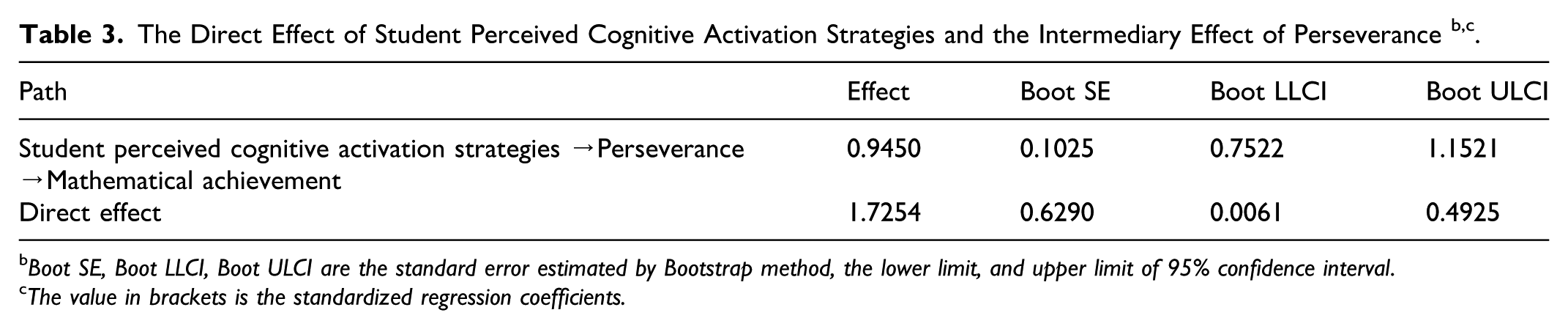
Boot SE, Boot LLCI, Boot ULCI are the standard error estimated by Bootstrap method, the lower limit, and upper limit of 95% confidence interval.
The value in brackets is the standardized regression coefficients.

The mediating effect of perseverance between student perceived cognitive activation strategies and mathematical achievement.
After controlling for students’ gender and SES, the mediating effect of perseverance was significant, represent for 35.4% of the total effect, indicating that irrespective of the type of family background and gender of students, their perception of teacher cognitive activation strategies can affect individual math academic performance through perseverance. Moreover, after controlling for the mediating variable perseverance, the direct impact of students’ perceived cognitive activation strategies on their own mathematical academic performance remained significant, accounting for 64.6% of the total effect, thus verifying the validity of the H1 and H2. It can be seen that students’ perceptual cognitive activation strategies will have a significant direct promoting effect on their mathematical academic performance. On the other hand, it can also exert indirect influence through perseverance.
The Moderated Mediation Effect Model Test Results
Next, conduct a moderated mediation effect test. According to the previous hypothesis, the first half of the path when students perceive that cognitive activation strategies affect mathematical academic performance through perseverance will be moderated by mathematical anxiety. Therefore, SPSS macro program PROCESS model 7 is used for testing, that is, after controlling for gender and family socioeconomic status, perseverance is used as the mediating variable, and mathematical anxiety is used as the moderating variable to establish a moderated mediation model. Among them, the moderated mediation effect test results are shown in the Table 4 , and the complete results of hypothesis testing are shown in Table 5 . After incorporating mathematical anxiety into the model, the correlation between mathematical anxiety and students’ perception of cognitive activation strategies was significant, indicating that mathematical anxiety has moderating effect in the influence of students’ perceived cognitive activation strategies on their perseverance.
The Moderated Mediation Effect Model Test Results d .

p < .001.
The Results of Hypothesis Testing in This Study.

To specifically illustrate the moderating effect of mathematical anxiety, a simple slope analysis was conducted in this study, as shown in Figure 4 . For students with low mathematical anxiety, the higher their perception of cognitive activation strategies, the greater the likelihood of improving their perseverance of problem-solving (β simple = .16, t = 20.163, p < .01). In contrast, for students with high mathematical anxiety, although their effective perception of cognitive activation strategies can also promote the improvement of their own perseverance, this promoting effect is relatively smaller (β simple = .11, t = 13.349, p < .01), which also indicates that the moderating effect of mathematical anxiety is more significant for low stress groups. This discovery provides data support for the validity of the hypothesis 3 (H3). Further analysis of the moderated mediating effect reveals that for students with low levels of mathematical anxiety, the mediating effect of perseverance is 1.059 (95% CI [0.820, 1.312]), while these students with high mathematical anxiety, the mediating effect of perseverance is 0.745 (95% CI[0.562, 0.942]). This indicates that compared to students with high math anxiety, students with low math anxiety have a more prominent partial mediating effect of perseverance, that is, this group has a more significant effect on improving their math academic performance through perseverance.

The moderating effect of mathematical anxiety on the association between student’s perception of cognitive activation strategies and perseverance.
Discussions
Different Manifestations of Student perceived cognitive activation strategies, Perseverance, Mathematical Anxiety, and Mathematical Achievement in Different Genders and SES
Understanding the process of learning mathematics has always been dependent not only on positive emotions such as interest and self-efficacy, but also on negative emotional factors such as mathematical anxiety. Compared with Western culture, the East Asian education system, represented by Confucian culture, seems to place special emphasis on promoting high-risk competitive exams in the middle school mathematics education stage to achieve talent selection, resulting in high levels of mathematical anxiety among students (Leung et al., 2006). Moreover, this study also found significant gender differences in math anxiety among East Asian students, but there was no gender difference in statistics in terms of perceived cognitive activation strategies in classroom teaching, problem-solving perseverance, and math academic performance. If we don’t consider the power of a statistical test, male students perform better in perceptual cognitive activation strategies, have strong perseverance in problem-solving, have lower math anxiety, and perform better in math learning, these findings are consistent with many existing research findings (Zhu, 2013). To some extent, these conclusions seem to find answers from cultural uniqueness, as in the male dominated traditional East Asian society, the education system always advocated that mathematics was a field of expertise for men, while women were naturally low achievers in mathematics and told that their poor math performances are due to their lack of mathematical talent (Tobias & Weissbrod, 1980; Zhu, Kaiser & Cai, 2018).
On the other hand, this study also found that children from families with medium to high socioeconomic status have significant advantages in perceiving cognitive activation strategies, problem-solving perseverance, and mathematical academic performance, and their mathematical anxiety is relatively low. In fact, as the most basic unit of human life, the family is an important place that influences the growth and development of children. Especially during adolescence, the influence of family background on students’ academic progress and psychological development may be more profound than the school environment. For example, the social capital theory has pointed out that the socioeconomic status of a family can have an impact on the growth of children through cultural capital such as parental participation and educational expectations (Coleman, 1966). Traditionally, parents of East Asian students have higher educational expectations (such as further education and employment) and are more participated in their kid’s education. In contrast, families with high socioeconomic status in East Asia, which have significant advantages in economic conditions and social resources, their children also receive more learning support outside of classroom teaching, such as encouraged to strengthen their self-awareness and value identification, and being guided on how to alleviate exam anxiety, so that they can gradually cultivate problem-solving perseverance in fierce learning competition and ultimately achieve greater academic progress (Masarik & Conger, 2017; Sohr-Preston et al., 2013).
The Mediating Effect of Perseverance
This research also discovered a significant positive correlation between students’ perceived cognitive activation strategies and their perseverance in problem-solving, as well as their mathematical academic performance (Yi & Lee, 2017), which means the hypothesis 1 is valid. Evidence can be found from previous studies on motivation theory, as supplying students with tough mathematical tasks alone is not insufficient to promote them to participate in insightful learning process, but rather requires sufficient cognitive activation support in their learning (Pintrich et al., 1993). In addition, mathematics classrooms in East Asia have always presented a teaching model of “Learning-Questioning” and “Learning-Reviewing”. In this model, teachers ought to ask questions to encourage students’ mathematical thinking, so that students can consciously review previous knowledge and try to establish links with new knowledge (An, 2004). However, it is also important to pay attention to effective guidance of mathematical thinking, especially as recent European research has shown that students’ perceived cognitive activation strategies have a negative impact on their mathematical achievements (Liu, 2024). In addition, if students want to have a more positive mathematical learning experience, they often need to exert higher perseverance in order to achieve better grades. Therefore, under the motivation of teacher cognitive activation teaching strategies, students will spontaneously establish connections with previously learned mathematical knowledge, and gradually cultivate their mathematical cognition and reasoning skills through continuous persistence, thereby providing necessary intellectual support for future academic progress (Klieme et al., 2009).
In addition, this study also confirmed the validity of H2 that students’ perseverance incompletely mediates the positive association between their perceived cognitive activation strategies and mathematical performance, which is in accordance with the former findings (Li et al., 2021). The possible explanation for the above results is that students in a cognitively activated state need to demonstrate a high degree of perseverance in exploring complex mathematical assignments to conquer the various difficulties they encounter in learning mathematics and guarantee that they could get good performance (Deci & Ryan, 2012; Ryan & Deci, 2000). In addition, in the East Asian education system, hard learning has always been regarded as an important cultural characteristic and educational dominant value. In fact, Asians have a much higher belief in effort than in ability in the West, so diligence is considered the most important explanation for high academic achievement. To some extent, East Asian middle school students tend to consider learning as a process of individual growth, emphasizing exertion and perseverance, and even if they confront some failures in mathematics learning, they can still aspire to the academic success (Li, 2004; Hau & Ho, 2010). Therefore, in the process of students perceiving cognitive activation, they will actively explore challenging tasks with persistent learning qualities, further cultivating their mathematical learning resilience, and ultimately making greater progress in their studies (Sengupta Irving & Agarwal, 2017).
The Intermediary Effect of Mathematical Anxiety
This study confirms the validity of the H3 that mathematical anxiety among East Asian middle school students plays an important moderating role in the impact of their perceived cognitive activation strategies on problem-solving perseverance, which is different from previous studies that only analyzed mathematical anxiety as a mediating variable (Hascher et al., 2024; Zuo et al., 2024). This also indicates that there are significant differences in the paths through which students perceive the relationship between cognitive activation strategies and mathematical academic achievement, supported by different theoretical foundations. Specifically, for middle school students with lower levels of mathematical anxiety, the effect of using perseverance to improve personal mathematical performance is more significant. The reason for this is that the key to establishing a connection between old and new mathematical knowledge in an individual’s cognitive structure not only depends on their own perseverance and self-monitoring ability, but also on the regulatory role of emotions. On the one hand, in the actual classroom teaching of East Asian education systems, providing challenging mathematical tasks often triggers negative emotions among students (Wong, 2004). Actually, as a negative emotion of tension and anxiety, mathematical anxiety always prevents or suppresses the execution of mathematical problem-solving at different stages of student life and academic development (Richardson & Suinn, 1972), and the perseverance personality itself also contains both positive and negative characteristics of persistence and easy abandonment. On the other hand, in the process of transferring mathematical knowledge, negative emotions represented by mathematical anxiety can further interfere with students’ problem-solving perseverance. Therefore, reducing stress and anxiety has become a very important regulatory way for students to perceive the impact of cognitive activation on perseverance (Zhang, 2006).
Implications and Limitations
Implication and Significance
Firstly, compared with existing research, this study also found significant gender differences in math anxiety among East Asian middle school students, with female students having a higher level of math learning anxiety than male students. This consistent finding provides an important direction for mental health education for East Asian students, which is to moderately reduce their academic burden inside and outside school (such as schoolwork and private supplementary tutoring) to alleviate their academic anxiety. Secondly, this study points out that students’ perceived cognitive activation strategies not only have a direct positive impact on their mathematical performance, but can also play a mediating role through perseverance. This further indicates that individual perseverance is an important factor in achieving knowledge application and transfer in mathematical problem solving. In future mathematics teaching, sufficient learning opportunities should be given to middle school students, encouraging them to firmly seek and establish connections between new and old knowledge to develop mathematical thinking and ultimately enhance their mathematical reasoning abilities. Finally, unlike previous studies, this study states that mathematical anxiety not only directly affects students’ mathematical performance, but also further moderates the process of students’ perceived cognitive activation strategies affecting problem-solving perseverance, indicating that mathematical anxiety is the key to whether middle school students can persistently apply various cognitive activation strategies in their mathematical learning.
Limitations and Deficiencies
Firstly, although the overall performance of middle school students in East Asia has been relatively close in previous PISA mathematics subject tests, there was a lack of samples in Chinese Mainland to participate in the PISA2022 test due to the continuous impact of the COVID-19 at that time, which may affect the popularization of the conclusions of this study to some extent. Also, it is even possible to underestimate the impact of Chinese Mainland samples on some conclusions, such as the direct impact of students’ cognitive activation on mathematical achievement, so we can continue to follow in the next PISA test. Secondly, even within East Asian countries or regions, there may be certain differences in the mechanism by which middle school students perceive cognitive activation strategies to affect their mathematical academic performance. In particular, some recent local studies in Chinese Mainland also regard emotional variables such as mathematical self-efficacy and mathematical anxiety as mediating variables to analyze the relationship between these two (Zuo et al., 2024). Therefore, subsequent research can conduct moderated mediation effects tests by regional grouping for specific comparisons. Moreover, based on the magnitude of the mediating effect, it is necessary to comprehensively consider whether emotional variables such as mathematical anxiety should be regarded as mediating variables or moderating variables. Finally, from the current analysis methods, regression analysis based on cross-sectional data is still used. However, non-intellectual factors such as perseverance and mathematical anxiety may change over time. Therefore, future research can consider adopting a tracking design and using the perception cognitive activation strategy test of middle school students as an opportunity to focus on exploring the growth trajectory of their mathematical cognitive development.
Significance of the Study for the Contemporary Classroom
In theory, this study provides a new opportunity to understand contemporary East Asian high school mathematics classroom teaching, as analyzing the classroom teaching process from the perspective of students’ perception of cognitive activation strategies can provide an important breakthrough for further explaining the high mathematics scores of learners in the Chinese character cultural circle. On the other hand, based on a cross-cultural perspective, this study integrates control value theory and self-determination theory, using perseverance as the mediating variable and using mathematical anxiety, an emotional factor that is easily overlooked in existing research, as a moderating variable, to systematically explore the complex relationship between students’ perceived cognitive activation strategies and mathematical academic performance in East Asian cultures.
At the practical level, the findings of this study also provide important references for mathematics learning activities for teachers and students in East Asian middle schools. Firstly, mathematics teachers can adjust the teaching difficulty in a timely manner based on students’ existing cognitive levels, thereby effectively promoting students’ cognitive activation and obtaining sufficient learning opportunities. Secondly, teachers can also help students resolve math anxiety in a timely manner during in class and out of class math teaching, thereby strengthening their learning motivation and confidence, and enabling them to persistently complete math tasks. Finally, students can change their perseverance and exert their maximum effort and subjective initiative to overcome various difficulties in mathematics learning.
Conclusions
This research uses a two-stage sampling method, they are the Probability Proportional to Size (PPS) method and simple random sampling, respectively, to obtain valid test data of 34968 middle school students who involving in PISA 2022 from East Asia, which established a moderated mediation effect model, and systematically examine the association between students’ perceived cognitive activation strategies and personal mathematical academic performance, and also illustrate some of the mediating effect played by perseverance between students’ perceived cognitive activation strategies and academic performance, as well as the moderating effect of mathematical anxiety between students’ perceived cognitive activation strategies and personal perseverance, thus verifying the validity of three theoretical hypotheses. The main findings are outlined below:
Firstly, there were no differences in practical significance in perceived cognitive activation strategies, perseverance, and mathematical performance among middle school students, but there were significant differences in mathematical anxiety between boys and girls. Specifically, boys perform better in perceptual cognitive activation strategies, have stronger problem-solving perseverance, lower math anxiety, and better math learning performance. Meanwhile, middle school students from different family backgrounds did not show statistically significant differences in perceived cognitive activation strategies, perseverance, mathematical anxiety, and mathematical academic performance. Among them, children from families with medium to high socioeconomic status have significant advantages in perceiving cognitive activation strategies, problem-solving perseverance, and academic performance, and their math anxiety is relatively weak.
Second, the perceived cognitive activation strategies of students are significantly positively correlated with problem-solving perseverance and mathematical academic performance, but negatively correlated with their mathematical anxiety. On the other hand, the perseverance plays a significant positive predictive role in the mathematical achievement of middle school students.
Finally, the perseverance of students has a partially mediating effect in the correlation between their perception of cognitive activation strategies and mathematical academic performance, and the intermediary effect represent for 35.4% of the total effect. Meanwhile, students’ mathematical anxiety plays a significant moderating role in their perceived cognitive activation strategies affects perseverance. Among them, for students with low levels of mathematical anxiety, which has a more significant influence on promoting their mathematical achievement through perseverance.
Footnotes

Ethical Considerations and Consent to Participate
It should be pointed out that this study is not an initial investigation, observation, or experimental intervention of the subjects. It is only a secondary analysis of publicly available data (PISA test data developed for the public), and therefore will not cause any actual physical or psychological harm to the subjects. On the other hand, the results of this study are only intended for academic publication and exchange, and do not involve any commercial interests, so there will be no potential negative impact. In addition, as a representative international student evaluation project, the implementation process of PISA testing has already obtained informed consent from the participants in the survey. Therefore, it was deemed to be of low risk and did not require any additional ethical approvals.
Funding
The authors disclosed receipt of the following financial support for the research, authorship, and/or publication of this article: This research was supported by the Fundamental Research Funds for the Central Universities, Shanghai International Studies University: “Research on the development and application of the diagnostic analysis tool of middle school mathematics core literacy enabled by technology (no:2022114029)”.
Declaration of Conflicting Interests
The authors declared no potential conflicts of interest with respect to the research, authorship, and/or publication of this article.
Data Availability Statement
Data sharing not applicable to this article as no datasets were generated or analyzed during the current study.