




Abstract
This paper reports on an exploratory study regarding the current continuing professional development (CPD) situation of basic schoolteachers in Ghana. The study investigates the teachers’ CPD needs, frequency and nature of CPD provisions, and barriers to teachers’ participation in CPD activities. Using a cross-sectional survey involving 456 teachers, the study found that teachers required to be developed in areas of “ICT skills for teaching,” “research and dissemination,” and “teaching students with special learning needs.” It was also revealed that the predominant CPD practices were workshops, in-service training, and continuing education. However, these practices were seldom provided and rarely met the development needs of the teachers. Teachers’ participation in CPD activities were also found to be minimal due to factors such as non-available CPD offerings, lack of pre-requisite information on CPD activities and lack of schools’ support. The study concludes that the current CPD situation of teachers in Ghana reflects a lack of implemented CPD policy framework. There is therefore the need for a broader CPD policy framework that will guide the provision, participation, and CPD practices of teachers in Ghana.
Introduction
In recent times, teachers’ continuing professional development (CPD) has been of growing interest to governments, educators, and researchers alike. While governments are implementing CPD policies as conduits for improved education (Guskey, 2000), educators, on the other hand, are demanding professional development opportunities for teachers as viable means to enhance knowledge, teaching, and learning within schools (Borko, 2004). Similarly, among researchers, there has been an exponential growth in interest in teacher CPD studies. This is necessitated by the need to provide information to guide the provision, reforms, and effective teaching practice and the reiteration of the urgency in fostering teachers’ continuous learning to support student development.
Despite its growing interest, teacher CPD remains underexplored in educational literature and efforts to improve quality education in most sub-Saharan African countries. There is less attention to the professional development and learning opportunities that can promote teachers’ competencies in real classrooms in these countries (Pryor et al., 2012). Specifically in Ghana, it has been observed that teacher CPD attracts minimal policy interests (Asare et al., 2012; Kadingdi, 2006). There is the absence of well-defined standards for teachers’ professional development activities and the use of CPD as critical aspects of teachers’ development after their initial education (Agbeko, 2007). Though these observations were made decades ago, Ghana has yet to implement a national CPD policy framework to guide teachers’ practice and the implementation of practical teacher CPD activities. Although, in 2012 the Ministry of Education (MOE) enacted the Pre-Tertiary Teacher Professional Development and Management (PTPDM) policy to institutionalize teacher CPD activities, the policy’s deficiencies in terms of what should constitute teacher CPD, the standards against which it is to be organized and a coherent framework to guide CPD practices as an ongoing learning process among teachers allow further development of a coherent policy that addresses these concerns more holistically and adequately.
In different countries, governments are implementing well thought out policies to support teachers’ engagement and participation in CPD activities, as it is well known that policies provide a much broader framework for the conduct, design, and implementation of teacher CPD activities (Desimone, 2009; Hardy & Melville, 2013). For instance, in the United States, the UK, and Germany, educational policies oblige teachers to engage in CPD activities with stipulated standards to guide practice (de Vries et al., 2013; Jaquith et al., 2010). Similarly, in Australia, there is the “Quality Teacher Program” that includes other programs (such as the Australian Government Teacher Quality Program, Australian Professional Standard of Teachers) that provide standards for the conduct and implementation of CPD for teachers. However, the same cannot be said of the CPD situation for teachers in Ghana. Yet, notwithstanding the absence of a broader and coherent CPD policy framework, Ghanaian teachers engage in CPD activities as far as their professional development is concerned. However, given that policies affect how CPD is enacted and practiced, the current study sought to investigate teachers’ CPD activities within such an absence to illumine critical areas for policy formulation and improvement in practice. The findings have implications for the effective design and implementation of CPD activities for teachers, especially in sub-Saharan African countries where teacher CPD is limitedly explored in educational improvement efforts.
The following research questions were addressed in the study:
What are the professional development/learning needs of Ghanaian basic schoolteachers?
What are the prevailing CPD practices and the frequency of their provision?
What factors influence teachers’ participation in CPD activities?
CPD Policy Framework in Ghana
Within global educational reform initiatives, the professional development of teachers has been recognized as an important approach for improving the quality of teaching and learning within schools (Groundwater-Smith et al., 2012). However, in spite of this recognition, the CPD of teachers attracts minimal policy interest in educational reforms and efforts to improve quality education in many sub-Saharan African countries (Pryor et al., 2012). In Ghana, although several reform initiatives have been adopted within teacher education curriculum and structure, there is yet to be implemented a broader and a coherent policy framework that guides teacher CPD practices, design, and implementation.
At present, there is the Pre-Tertiary Teacher Professional Development and Management (PTPDM) policy, which was drawn from the 2008 Education Act (Act 774) to provide some standards and guidelines for teachers’ professional development activities. Among other things, the PTPDM policy stipulates that all professional development programs adopt a competency-based approach in both the program specification and assessment. Hence, teacher professional development activities must equip teachers to meet specific demands of the teaching profession and the management and responsibilities that go with them. CPD programs must also be designed to reflect the aims and objectives of pre-tertiary education in Ghana (Ministry of Education, 2012). With its implementation, the existing teacher promotion system that is based on years of teaching experience, is to be supplanted with evidence of teachers’ professional development activities. Participation in professional development activities is to be linked to teachers’ career advancement and evidence of professional growth and achievements to form the basis of career progression and awards (Ministry of Education, 2012).
The PTPDM policy also underscores teacher licensing as a measure to ensure teachers stay abreast of current trends in knowledge and classroom pedagogies. Teachers are mandated to be licensed and eligibility for licensing is to be dependent on the completion of induction and participation in other required in-service training programs. While the PTPDM policy attempts to institutionalize teachers’ professional activities, Ghana is yet to implement its central tenets years after enactment on a larger scale. Also, other deficiencies in the policy calls for new policy that will address them holistically. For instance, the current PTPDM policy does not stipulate clearly what should constitute as teacher CPD. It also fails to specify the standards against which CPD activities are to be organized. Finally, the policy lacks a broader framework to guide CPD implementation as an ongoing learning process for teachers.
It is also relevant to mention that in 2018 a new teacher education reform was introduced known as “The Cabinet Memorandum on Policy on Teacher Education Reform” (CMPTER). This new policy captures “The National Teachers Standards” (NTS), which unlike the PTPDM includes teachers’ professional values with emphasis on teachers’ critical and collective reflection on practice to improve their personal and professional development through lifelong learning and CPD (National Teaching Council [NTC], 2017). While this is assuring, the NTC is an aspect of a broader teacher education reform policy and thus does not constitute a broader framework of teacher CPD activities and practices.
Against this background, this study explores the current CPD situation in Ghana within a lack of a broader policy framework that guides practice. Focusing on teachers in the Central region of Ghana, the study explores teachers’ needs for professional development, the nature of prevailing practices and provision, and the barriers and supports for teachers’ participation in CPD activities. The study provides implications for developing a broader CPD policy framework to guide the design, implementation, and practice of CPD for Ghanaian teachers.
Conceptualizing Teacher CPD
CPD ensures that teachers are part of a skilled and up-to-date profession. It is a continuous process where teachers build on existing knowledge and understanding to access up-to-date knowledge needed to be effective on their job (Ememe et al., 2013). Guskey (2000) defines CPD as “those processes and activities designed to enhance the professional knowledge, skills, and attitudes of educators so that they might in turn improve the learning of students” (p. 16). While CPD has been conceptualized differently, this study adopts the definition provided by Day (1999), which captures the various aspects of what CPD is and isn’t. He defines CPD as:
all-natural learning experiences and those conscious and planned activities which are intended to be of direct or indirect benefit to the individual, group or school, which contribute, through these, to the quality of education in the classroom. It is the process by which, alone and with others, teachers review, renew and extend their commitment as change agents to the moral purpose of teaching; and by which they acquire and develop critically the knowledge, skills, and emotional intelligence essential to good professional thinking, planning, and practice with children, young people and colleagues throughout each phase of their teaching lives. (p. 4)
The variously perceived notions of CPD reflect its multifaceted nature and the varied ways to develop professional teachers. CPD focuses on activities that address teachers’ behaviors, knowledge, emotions, and cognition (Borg, 2015) for changes in their classroom practice. Such activities are not isolated events but rather a continuous learning process occurring throughout teachers’ working lives. When CPD is viewed as an event, it limits the opportunities for teachers to learn; thus, CPD must be considered an “ongoing, job-embedded process of which every day presents a variety of learning opportunities” (Guskey, 2000, p.19).
Conceptual Framework: Kennedy’s Model of CPD Practices
Kennedy (2005, 2014) integrates nine models of CPD into a framework to analyze and compare CPD practices. These models are the training, award bearing, deficit, cascade, standard-based, coaching/mentoring, a community of practice, action research, and transformative model. She further categorizes these models into transmissive, transitional, and transformative based on their fundamental purposes (see Figure 1).

Kennedy’s (2005) CPD conceptual framework.
According to Kennedy (2005), CPD with transmission purpose equips teachers with the required skills and knowledge to conform to educational reforms. However, they proffer the slightest space for teachers to take charge and own their learning. Involving teachers’ continuing education, workshop, and in-service training activities, these approaches to CPD are described as delivery, empty-vessel, and teacher-as-technician models and are thus inappropriate for developing a well-educated teaching force (Dadds, 2014). In contrast, the transformative models support teachers’ learning and contribute to shaping educational policy and teachers’ professional practice. CPD activities with transformative focus include action research and collaborative professional enquiry that enable teachers to experiment with different methods to pursue and develop their practice. Through these approaches, teachers become reflective practitioners who can understand, challenge, and transform their practices and change educational agendas (Kennedy, 2014; Sachs, 2007).
At the intersection of the transmission and the transformative approaches is the transitional, which she later referred to as malleable, the purpose of which is to empower teachers with the capacity to support the underlying agendas of either transmission or transformative. Transitional models align with teachers’ engagement in coaching and mentoring processes, study networks, and collaborative teaching.
Kennedy’s (2005) framework also illustrates the levels of teachers’ autonomy in their professional learning in CPD. It hierarchically demonstrates the increasing capacity for teachers’ professional autonomy and agency as the models move from the transmission to transformative approaches. Therefore, transformative approaches provide teachers with the needed autonomy and control to determine and pursue their learning pathways, unlike the transmission models (Kennedy, 2005). CPD activities are more effective if they underscore the human agency on the part of teachers to plan, initiate, and direct their own learning needs for their professional growth and development. CPD practices need to be transformative focused to equip teachers individually and collectively to act as shapers and promoters of their own learning to inform their practices (Kennedy, 2014).
Other CPD Models
de Vries et al. (2013) classify CPD activities into three: updating knowledge and skills, reflection, and collaboration with colleagues. Activities that focus on updating professional knowledge and skills aim to develop teachers’ practical and theoretical knowledge based on varied content (Verloop et al., 2001). This includes participation in activities such as: reading professional literature/textbook, education reform policy documents, and PD activities outside the school, including courses, workshops, training, and conferences.
CPD practices with a reflective focus involve activities requiring a specialized form of thinking to enable teachers to confront their challenges by mulling or pondering over them to arrive at a better resolution (Brookfield, 2000; Schön, 1987). Such reflection is critical in CPD. It helps teachers make their tacit knowledge and beliefs explicit and provides them more control over their routine actions in the classroom as they learn and refine their expertise through continuous learning from their experience (Eraut, 1994; Schön, 1987). Teachers’ reflective activities include practical research, peer meetings, and feedback from colleagues or students intended to improve teaching practice. Finally, CPD collaborative activities occur within and outside the school to produce supportive benefits that lead to better teaching and learning outcomes (Cheetham & Chivers, 2001). Collaboration fosters and builds openness, trust, and support among teachers (Forte & Flores, 2014) and allows teachers to gain new ideas by encouraging reflection on their professional practices and fostering authentic learning. In CPD, collaboration takes different forms, including decision-making, team teaching, professional dialogue, research, and peer coaching and mentoring.
Studies suggest teachers’ participation in variety of CPD forms for their professional development. For instance, Wermke (2011) found in a comparative study among Sweden and Germany teachers the prevalence of both transmissive and collaborative CPD approaches including the participation in formal courses, conferences, self-directed or voluntary CPD practices, and team teaching. However, teachers differed in what influenced their CPD practices within their schools. Heba et al. (2015) also found different ways teachers learn as part of their CPD including participation in school-based CPD activities and individual teacher initiation of their learning. In their study, teachers reported they learned best in CPD activities that were cooperative and enabled them to interact and dialogue with other teachers. Similarly, Méndez et al. (2017) found among pre-school teachers’ professional development engagement that informal CPD activities that were collaborative were significant to teachers’ classroom practices than formal CPD forms.
Within the African context, there is paucity of literature on teacher CPD activities comparatively to pre-service teacher education. The available evidence suggests the predominance and participation in rarely organized CPD forms such as in-service training, workshops, and seminars (Abakah, 2019; Abonyi et al., 2020; Atta & Mensah, 2015; Oluremi, 2013). However, there is often the challenge of lack of school support for effective implementation of CPD activities, infrequent provision of CPD activities, lack of diversified practices, and teachers’ reluctance to engage in CPD activities (Geldenhuys & Oosthuizen, 2015).
It is important to mention that while traditional or transmissive CPD practices continue to dominate professional development efforts, there are calls for alternative approaches that foster continuous learning. Evidence of the effectiveness of collaborative approaches justify the need for implementation and adoption of more collaborative models and approaches to teachers’ professional development that promote co-operation and increases teachers’ autonomy and self-directedness toward their learning.
A plethora of literature equally suggests that participation in CPD impacts teachers’ professional practices. Studies have found that participation enables teachers to change their instructional practices and impacts teachers’ ability to decide on and implement valued changes in teaching (Gersten et al., 2010; Saunders, 2014). Other studies have also noted the long term impacts of CPD on teachers’ content and pedagogical knowledge (Jacob et al., 2017; Trumper & Eldar, 2015), leading to greater confidence in practice, leadership, student management (Gabriel et al., 2011; Harris & Sass, 2011) and general improvements in student learning (Garet et al., 2001). In Ghana, Mensah and Jonathan (2016) found participation in CPD impacts positively on teachers’ knowledge and skills related to their classroom practices, competency, and efficacy.
CPD and Teachers’ Professional Development Needs
As observed earlier, the dominant approaches to CPD require teachers to attend one-offs workshops, in-service training, or participation in courses to achieve a qualification. However, these approaches, which are transmissive models, have been criticized extensively. For instance, Borg (2015) argues that these approaches do not promote learning as teachers become dependent on others for their professional development rather than learning to take charge of it themselves. Another area of criticism is the fact that these CPD practices are exclusively externally driven and hardly meet the needs of teachers in the classroom (Ríordáin et al., 2017; Shriki & Patkin, 2016). The result is that such programs fail to have their intended impact on teachers’ professional development.
To ensure that CPD is effective to have sustained positive changes on teachers’ classroom practices, activities, or programs need to be relevant to the needs of teachers and their students. Teachers obtain foundational knowledge and understanding during their pre-service training, yet, they have ongoing learning needs that develop at every stage of their career (de Vries et al., 2013). This makes it prudent for professional development initiatives to target teachers’ specific needs for development.
Investigations into CPD needs of teachers have revealed that generally, teachers require development in pedagogical content knowledge (PCK), although there is also significant need to learn to cope with emergent challenges in education such as ICT integration in teaching and learning and teaching students with special learning needs. For beginning teachers, Organization for Economic Co-operation and Development (OECD, 2014) found that they need to develop in canonical skills for applying knowledge to practice. Shriki and Patkin (2016) also found in a study that teachers have professional development needs in areas of didactical knowledge and the capacity for dealing with emotional aspects of students’ learning of mathematics. Among Ghanaian basic schoolteachers, it has been observed that they require the following CPD needs: PCK, knowledge and use of teaching and learning materials, knowledge and use of ICT related technologies, school management practices, and student behavior management (Abakah, 2022). It is therefore the responsibility of educators, CPD program designers, and facilitators to identify teachers’ CPD needs and help teachers adapt to the changes they have to generate in their teaching.
Factors Affecting Participation in CPD Activities
Some studies have shown many challenges associated with teachers’ participation in CPD activities, and notable among them are teacher time factors (Kwakman, 2003; Postholm, 2011) and finance (Birman et al., 2000; Postholm, 2011). Teachers’ time factors relate to work-time and personal and family time. Heavy teacher workloads take away much of teachers’ free time and reduce their intentions to participate in CPD activities. Also, the intensity of participation in CPD can support or hinder participation (Avalos, 2011). Studies have suggested strategies for providing adequate time for teachers to participate in CPD activities. Ozer (2004), for instance, proposed that CPD activities be integrated into teachers’ working schedules at school. Others have suggested extending the school day or year, taking some time from existing school schedules, and buying and restructuring time (Corcoran, 1995; Raywid, 1993). Other barriers to CPD participation include accessibility, staff motivation, marketing, and advertising, and financial issues (Geldenhuys & Oosthuizen, 2015).
Methods
A cross-sectional survey design was used for the study. This involved the gathering of quantitative data at a particular point in time through self-report measures (Cohen et al., 2018). This design was also utilized to enable the determination of possible relationships between some variables in the study.
The research cohort was teachers in public Junior High Schools (JHSs) (i.e., from Grade 7 to 9) in the Central region of Ghana. Multiple probability sampling techniques (Teddlie & Yu, 2007) or multi-stage sampling strategies were used in the selection of teacher respondents (Creswell, 2013). This approach enabled the exclusion of more units at each stage of the sampling process to arrive at a concise sample in the final stage (Kumekpor, 2002).
At the first stage, the 20 districts in the Central region were clustered into four zones. Each zone was made up of five districts. Using a simple random strategy, 3 districts were selected from each zone to make up 12 districts. In the second stage, all public JHSs in each of the selected district were enlisted to constitute a different sampling frame for each district. A systematic sampling strategy was then used to select five schools within each district based on their corresponding sampling interval (Onwuegbuzie & Collins, 2007). This involved the selection of every Kth member from a list of sampling frame where K typifies the population divided by the preferred sample size (of 5; Onwuegbuzie & Collins, 2007). A total of 60 schools were selected to be part of the study. In the final stage, all trained teachers in the 60 schools were selected, bringing to a total of 522; however, data from 456 respondents were used for analysis due to non-response and incompleteness of data (see Table 1 for names of selected districts and the total number of respondents.
Names of Selected Districts With the Corresponding Number of Teacher Respondents.

Data was collected by means of a questionnaire. We utilized an amended version of the Teaching and Learning International Survey (TALIS) instrument sections on teacher learning needs and CPD practices (Organization for Economic Co-operation and Development [OECD], 2014). The response format included forced choices, Likert scales, and open-ended questions. The questionnaire was self-administered and pretested in eight private schools in the Greater Accra region of Ghana.
The study had ethical clearance from the University of Technology Sydney, and all other ethical conditions adhered to. The Central Regional Education Directorate in Ghana also granted permission for the conduct of the study among teachers in the region.
Data Analysis
The data was analyzed using SPSS version 23.0. Predominantly, descriptive statistics and multivariable multinomial logistic regression were used to interpret the study results. We fitted two multivariable multinomial logistic regressions to examine the relationship between some demographics and teachers’ learning needs and CPD engagements. The rationale for the regression analysis was to investigate how characteristics of teachers generally affect uptake of each of the three main categories/types of CPD. One of the models was used to assess teacher characteristics (comprising age, sex, education, teaching experience, and a total number of subjects taught) and perceived learning needs (made of content knowledge related needs, ICT and assessment related needs, and lastly, pedagogical related needs), presented in Table 5. The second was used to investigate teacher characteristics, and CPD participation (consisting of reflection, knowledge, and collaboration), and the outcome has been presented in Table 8. For perceived learning needs, the reference category was pedagogical related needs, whilst knowledge was the reference category for CPD. Results were presented as relative risk ratio (RRR) at 95% confidence interval.
The reliability test of the instrument using the Cronbach alpha (α) values (see Table 2) is deemed as acceptable based on the common threshold values recommended by accepted literature (Nunnally & Bernstein, 1994).
Test of Reliability Results.

Findings
Socio-Demographics of Participants
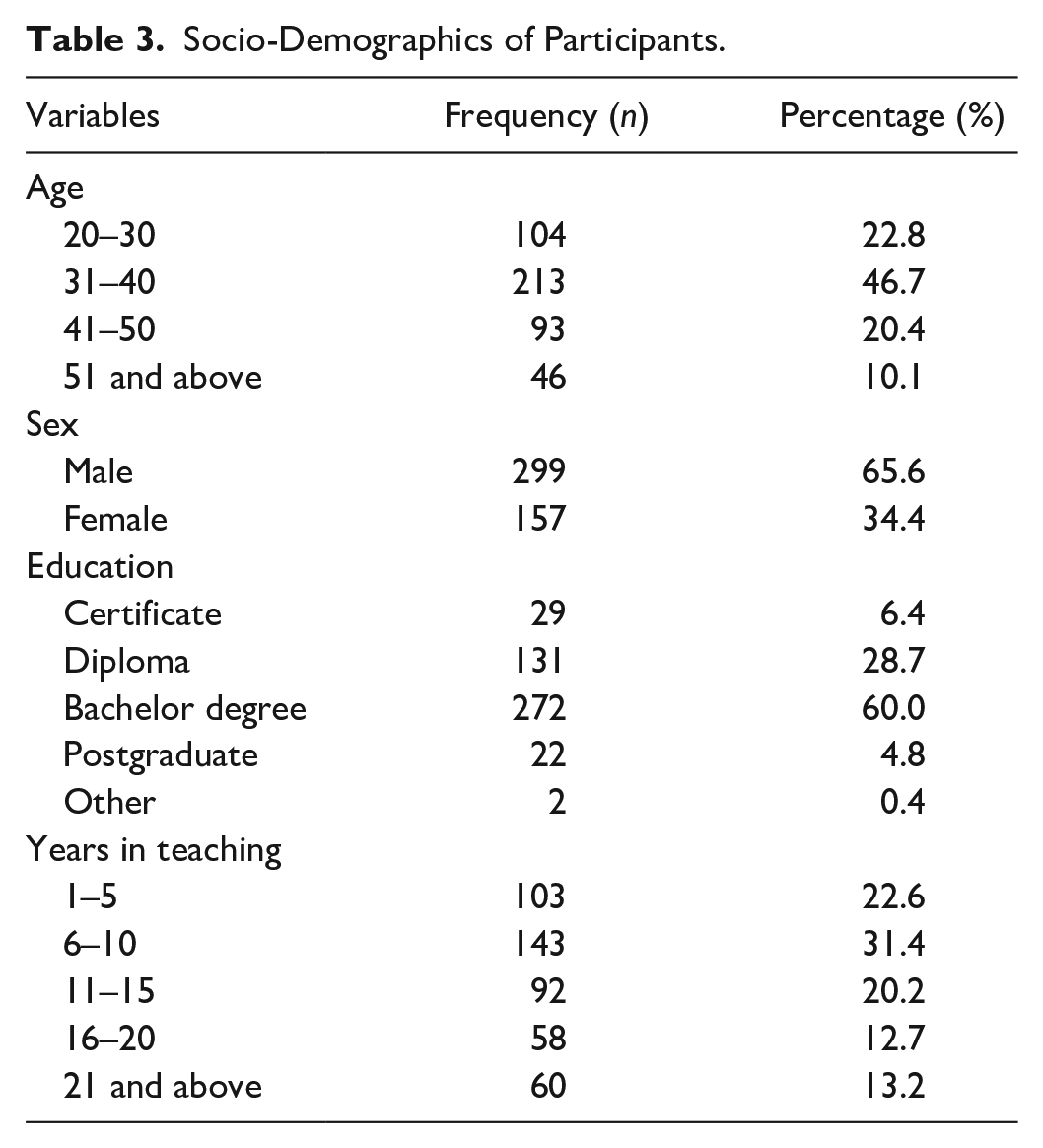
The analysis was done with 456 teachers, with the majority of them being males (65.6%). Most of the participants could be described as middle-aged (67.1%) between 31 and 50. All participants were professionally trained teachers: 131 of them held a diploma (28.7%), 272 (59.6%) a bachelor’s degree, 29 (6.4%) a certificate, and 22 had postgraduate qualifications (4.8%). The most experienced teachers in the study had taught for more than 21 years (13.2%), but the majority of the participants had instead taught for 6 to 10 years (31.4%) (Table 3).
Socio-Demographics of Participants.
Teachers’ Professional Development/Learning Needs
A 4-point scale from “low-level need” to “high-level need” was used to rate the extent of teachers’ professional development/learning needs. The highest-rated needs were “ICT skills for teaching” (52.1%), followed by “research and dissemination in teaching” (42.8%) and “teaching students with special learning needs” (37.7%). In contrast, “understanding teaching strategies” and “knowledge of content in my main subject area” were reported as low-level needs (Table 4).
Extent of Teachers’ Professional/Learning Needs.

Multinomial logistic regression of teacher characteristics and perceived learning needs
As illustrated in Table 5, females had a higher relative risk of perceiving content knowledge related needs than pedagogical related needs (RRR = 5.27, 95% CI [1.72,8.32]). Similarly, respondents with postgraduate education had a higher risk of perceiving content knowledge related needs relative to pedagogical related needs (RRR = 10.0; 95% CI [3.86,31.90]). The analysis also revealed that research participants teaching three subjects (RRR = 2.62; 95% CI [1.03, 3.21]) and those with postgraduate education (RRR = 4.01; 95% CI [2.98, 4.71]) had a higher risk to perceive ICT and assessment related needs than pedagogical related needs.
Multinomial Logistic Regression of Teacher Characteristics and Perceived Learning Needs.

Prevailing CPD Practices and Frequency of Provision
The predominant CPD activities identified by the teachers were in-service training (51.6%), continuing education (48.0%), and workshops (46.3%). There were also peer class observations (30.1%) and collaborative teaching (27.6%). However, as the study further reveals, these opportunities were occasionally provided (Table 6).
Prevailing CPD Practices and the Frequency of Provision.

Teachers were again requested to indicate the extent to which existing CPD activities addressed their learning needs for development. Many of them (41.2%) answered “Not at all” whereas about 13.2% indicated to some “greater extent.”
Teachers’ Participation in CPD Activities
Teachers were asked to indicate which CPD activities they had participated in the past 24 months. The results revealed participation in more transmission models such as “in-service training” (91.2%), “workshops” (88.1%), and “further studies” (73.9%). Participation was also higher in informal PD activities such as “informal dialogues with colleagues to improve practice” (89.3%). In contrast, less than 50% of them had participated in “education conferences” (31.4%) and “study networks” (32.5%). It was also observed that though most of the teachers had participated in these transmission models of CPD, their participation was not as often as expected. The category most frequently chosen to rate teachers’ participation in CPD activities was “4 to 5 times” (sometimes), whereas “1 to 3 times” was the lowest (see Table 7).
Proportion of Respondents Rating How Frequently They Participated in CPD Activities.

Further questions were asked about the funding of the CPD activities. It was revealed that CPD activities were either self-sponsored (59.9%) or were funded by the school/Ghana Education Service (GES) (69.1%), non-governmental organizations (28.9%), or teacher associations (18.6%).
Multinomial logistic regression of teacher characteristics and CPD participation
The multinomial logistic regression shows how the various characteristics of teachers affect uptake of CPD (reflection, knowledge, or collaboration). The analysis revealed that research participants aged 41 to 50 had a higher relative risk ratio or tendency of participating in reflection CPD than knowledge CPD (RRR = 58.84; 95% CI [1.19, 29.00]), and a similar observation was made among female participants (RRR = 5.67; 95% CI [1.31, 24.55]). There was a lower risk of participation in reflection CPD among teachers with 16 to 20 years of teaching experience (RRR = 0.01; 95% [0.00, 0.28]) than participating in knowledge CPD. It was also evident that participants with Diploma were more inclined toward collaboration CPD than knowledge CPD (RRR = 53.21; 95% CI [3.45, 82.5]), as shown in Table 8.
Multinomial Logistic Regression of Teacher Characteristics and CPD.

Perceived usefulness of CPD participation
Teachers perceived CPD to shape their professional lives (84.2%) significantly. The results on the perceived usefulness of the participated activities to teachers’ professional practice suggest the informal activities have more positively impacted. About half (50.7%) of the teachers indicated the “informal dialogue with colleagues on how to improve teaching” impacted positively on their overall professional development than organized activities (in-service training (50.4%) and workshops (43.0%). See Table 9 below:
Teachers’ Perceived Usefulness of Their Participation in CPD Activities on Their Development.

Factors That Influence Teachers’ CPD Participation and Non-Participation
In ranking their reasons for participating in CPD activities, teachers identified the need “to better develop as a teacher” as the most significant factor. “To increase knowledge in my subject teaching” was considered the second most influential factor, while “to introduce new technologies” was ranked the least significant factor, even though they had earlier suggested to be developed in using ICT skills in their teaching (see results on Table 7). Teachers’ non-participation was because no suitable CPD opportunities were offered (65.1%). Non-participation was also due to the poor information dissemination regarding CPD activities (52.2%). See Tables 10 to 11 respectively for details:
The Mean Ranking of the Factors That Explained Teachers’ Reasons for Participating in CPD Activities.

Reasons for Non-Participation.

Multiple responses.
Further, open-ended questions were also used to elicit teachers’ responses on factors affecting their CPD participation. These responses were sorted and categorized: school/system factors and individual teachers’ dispositions. Describing influences from the school, teachers enumerated factors such as lack of schools’ support toward participation, lack of teaching and learning resources, and poor information dissemination on CPD programs. As part of school/system factors, teachers also identified their lack of knowledge and awareness about CPD policies and unfavorable policy implementation of the Ghana Education Service (where new teachers are prohibited from engaging in continuing education until after a period of 5 years) to have negatively affected their professional development undertakings, especially regarding their continuing education. Teachers also identified the lack of teacher self-motivation toward their own development, lack of collegiality among colleague teachers, the cost involved in CPD participation, and teacher workload as individual teacher characteristics that affected their CPD practices.
General CPD Situations Within Schools
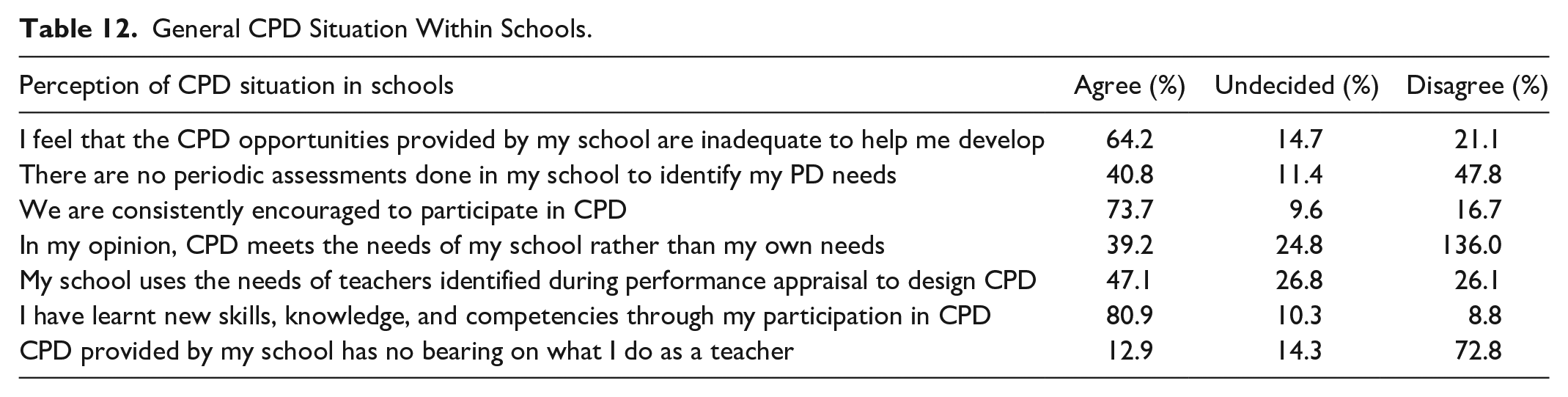
This section explores how teachers’ felt about the general CPD situation in their various schools. The majority (64%) of teachers believed CPD activities were inadequately provided in their schools. They nevertheless perceived CPD to be significant to their professional lives (Table 12).
General CPD Situation Within Schools.
Discussion
This study’s purpose was to explore the CPD activities of teachers in Ghana, especially within a non-existent policy framework that guides and informs practice. Three objectives framed the study: (1) to identify the teachers’ professional development needs, (2) to investigate the frequency and nature of existing CPD practices, and (3) to explore teachers’ participation and the factors that affect their CPD engagements.
The findings on teachers’ development needs reveal the inadequacies of teachers’ foundational knowledges obtained at their pre-service education and the critical need for their continual re-construction of new ideas, skills, and practices throughout their professional careers (Borko, 2004; Darling-Hammond & Bransford, 2007). Teachers’ reported needs exemplify their quest to cope with new educational challenges, necessitated by the increasing globalizations and the need for support to meet those demands. For instance, the study revealed teachers’ prioritized needs in the areas of “ICT skills for teaching” (52.1%), “research and dissemination in teaching” (42.3%), and “teaching students with special learning needs” (37.7%). Although, such knowledges are limitedly explored during their pre-service training, the changing demographics of students in today’s classrooms, and the technological and cultural changes happening around the globe (Lieberman & Pointer Mace, 2010), makes it imperative that they are grounded in those skills to support students learning, hence their request for development in them. Particularly in Ghana, teachers’ highly prioritized needs in ICT skills was foreseeable as attempts to increase ICT literacy in basic schools have yielded minimum impacts because teachers lack basic ICT knowledge and skills for possible integration in classroom teaching (Mereku, 2013). This finding therefore support a previous study that revealed that there are still teachers in Ghana who have never used ICT technologies in their classrooms (Buabeng-Andoh & Totimeh, 2012). Similar findings of the study have also been reported in different contexts (Heba et al., 2015; Mukeredzi, 2016; Shriki & Patkin, 2016). For instance, Mukeredzi (2016) found that rural teachers in Zimbabwe have prioritized needs in areas of pedagogy and PCK.
Despite the significance of teachers identified needs, the study also revealed that provisions of CPD activities for teachers did not adequately address those needs. This was probably due to the very nature of existing practices, which were identified to be more transmissive focused, and hence offering limited space for teachers’ self-directed learning.
Secondly, the findings also show that the current CPD offerings for teachers in Ghana were inadequate (Borko, 2004) both in diversified practices and the frequency of provisions. The predominant practices were in-service training (85.1%), continuing education (81.8%), and organized workshops (68.2%), which could not be described by many as often provided. In Ghana, the provision of CPD activities is the responsibility of the Ministry of Education and the Ghana Education Service. However, other stakeholders also provide opportunities to teachers to complement efforts toward teachers’ development. However, as identified by teachers, opportunities suggest irregular and one-shot activities. The study also revealed that this affected teachers’ opportunities to participate, and the amount of quality time and experience teachers could have shared through participation. Such irregularity owes much to finance (Birman et al., 2000; Postholm, 2011), as schools in Ghana are handicapped with limited capitation grants to fuel the costs involved in organized CPD activities. This finding thus resonates with the CPD situation in other sub-Saharan African countries where teachers participate in hardly organized workshops, in-service training, and seminars as part of their professional development (Atta & Mensah, 2015; Abakah, 2019; Oluremi, 2013).
The regression analysis showed that teachers in the 41 to 50 age bracket and females had increased chances of participating in reflection than knowledge, meanwhile, there was a lower tendency of participation in reflection CPD among teachers with 16 to 20 years of teaching experience. These variations may indicate that teachers have different preferences for the distinct CPD activities. Factors that could affect teachers’ choice of a particular CPD may include the subject the teacher handles, needs of his/her students, pedagogical approach among other factors (Abdulai & Osman, 2018; AlMutlaq et al., 2017; Zhang et al., 2021). Zhang et al. (2021) similarly noted that factors such as teaching experience and previous experience with learning activities affect participation in CPD. Meanwhile, some teachers may be compelled to attend a particular CPD training or event plausibly because that is the only option accessible to him or her. In all these, the findings suggest that teachers acknowledge the importance all the types of CPD.
It was also found that, the available CPD practices teachers engaged in appealed to the transmissive models of CPD, which offered limited space for teachers to take charge of their own learning (Kennedy, 2005). Although the available practices of continuing education, in-service training, and workshops significantly remained sources of learning for teachers’ learning and development, such practices have widely been observed to be ineffective in fostering genuine learning among teachers (Borko, 2004; Boud & Hager, 2012). It, therefore, becomes problematic if such transmissive approaches become the only route to teachers’ development, as it is in the case for teachers in Ghana, for they breed unreflective teacher practitioners who will not be challenged to transform their practice (Borg, 2015). Interestingly, teachers considered their engagements in informal CPD forms to be more beneficial to their professional development than those transmission forms (workshop, INSET, continuing education). From the findings, “informal dialogue with colleagues to improve practice” was identified to be an activity with the most significant impact on teachers’ overall development (50.7%). This affirms other studies that have also found informal CPD activities more significant to teachers’ classroom practices than organized CPD forms (Abonyi et al., 2020; Méndez et al., 2017). In the case of Ghana, this finding raises the critical question of how to recognize and legitimize teachers’ informal learning activities as part of teacher CPD activities as teachers in the study did not perceive CPD to be outside what the schools provide for them.
Furthermore, the findings reflect CPD contextual factors that affected practice and teachers’ participation. The seeming ad hoc and one-off nature and the lack of CPD implementation as an ongoing learning process for teachers could be alluded to the very absence of a CPD policy context to guide and inform practice. Hardy (2012) argues that the enactment of CPD policy affects its practice within schools. Therefore, CPD policy would provide a broader framework for conducting and implementing CPD activities for teachers in Ghana. Other factors that affected teachers’ CPD undertakings included limited offerings, finance, lack of information regarding CPD activities, and the lack of diversified practices. Similar challenges were highlighted in a study by Geldenhuys and Oosthuizen (2015) on challenges influencing teacher CPD involvement in south African schools.
Finally, the findings confirm that teachers’ participation and professional development needs vary according to certain demographic characteristics (Coldwell, 2017; de Vries et al., 2013; Khandehroo et al., 2011). In the current study, teachers aged 41 to 50 had a higher relative risk ratio of participating in reflection CPD than knowledge CPD. Also, females and those with postgraduate education had a higher relative risk of perceiving content knowledge related needs than pedagogical related needs. These possibly suggest that teachers’ CPD preferences vary at any point in time, based on several factors. Therefore, it may be prudent for CPD organizers to investigate the dominant CPD needs of teachers prior to organizing each of such events to achieve high patronage. Besides, when teachers experience that CPDs concentrate on their priorities, they are likely to recommend it to other colleagues, resulting in increased participation subsequently. In Pakistan, Dilshad et al. (2019) also noted that teachers have different CPD needs and emphasized satisfying these varying needs. In Malaysia, Khandehroo et al. (2011) also observed in a study that there is a significant relationship between teachers’ experience, educational and school levels, and their CPD needs.
Conclusion
Ghanaian teachers have varied professional development needs ranging from ICT skills for teaching, teaching students with special learning needs, and subject matter and pedagogical needs. Therefore, it is expedient that CPD offerings for these teachers derive its content from such needs to be meaningful. The study’s findings also suggest that available CPD practices are inadequate to prepare teachers to face the complexities of many Ghanaian classrooms today. However, it is essential that varied opportunities, including informal learning activities, are regularized and institutionalized for teachers’ access to assist in their professional development. Such opportunities must be continuous and not be used as ad hoc measures to re-train teachers to be accountable for educational policies. Teacher CPD must be embedded within the practice of teachers’ work occurring daily throughout teachers’ professional lives. Also, CPD providers must adopt a bottom-up approach to teachers’ professional development, focusing on activities that will make teachers determine their professional development needs.
Finally, the study’s findings support the importance of transformative or the growth approach to teachers’ professional development. The limited impact of organized CPD on teachers’ professional practice suggests the need to incorporate much richer CPD offerings that foster genuine learning and enable teachers to contribute and shape educational policy and practice. We, therefore, argue that opportunities for teacher learning and CPD for Ghanaian teachers be extended beyond the discrete activities of the in-service training and workshops to include much richer and varied opportunities which foster collaborative learning and underscore human agency on the part of teachers to construct and co-construct their own knowledges for their professional growth and development.
Footnotes
Declaration of Conflicting Interests
The author(s) declared no potential conflicts of interest with respect to the research, authorship, and/or publication of this article.
Funding
The author(s) disclosed receipt of the following financial support for the research, authorship, and/or publication of this article: This study forms part of a doctoral study which was supported by the Australian Government Research Training Program.
