




Abstract
The purpose of this study is to use statistical evidence to better understand professional development impact and its causal determinants. The study creates a plausible structural equation model (SEM) and tests it. This study uses Abu Dhabi teacher’s data drawn from the Teaching and Learning International Survey (TALIS) 2013. A sample of 4,941 teachers from public and private schools participated in the study. The proposed model represented the hypothesis that the latent variable impact of professional development is causally related to other latent variables related to school climate (job/work, school, teacher/student, and attitude), feedback (appraisal, emphasis, and effect), environment, teacher’s variables (beliefs and general), student’s behavior, and perceived needs for professional development. Results show that professional development impacts are most influenced by feedback effect, school climate (attitude and teacher/student), and student behavior. In addition, variables such as school climate (school), feedback emphasis, and school climate (job/work) have significant effects but indirectly. Teaching in general shows a direct path (effect) to effects; it also shows an indirect effect (through the mediation of feedback effects). The perceived impact is affected also by teacher’s gender and age group, and type of school (public or private). Results show that perceived needs, feedback appraisal, and teacher’s beliefs do not affect professional development’s perceived impact significantly. Teacher categories (gender and age) and school categories (public or private) had significant effects on teachers’ attitude with regard to most constructs of professional development.
Keywords
Introduction
The Teaching and Learning International Survey (TALIS) included items that are researched from literature and thought to have extensive impacts on teachers’ professional development. Other items included in the survey are thought to explain variations in teachers’ actual participation in professional development activities. A whole dimension of items were also included to measure the perceived impact of the professional development programs that are offered (Organization for Economic Co-Operation and Development, 2013). These items formed factors (or dimensions) that included variables attributed to teachers, such as their beliefs and attitudes. Other factors described teacher appraisal and feedback, school climate, school management styles, and student behavior. The survey also included items related to teacher and school characteristics.
For Abu Dhabi, there is a need for more rigorous methods of assessing professional development offerings. The methods should assess the “true” needs for professional development programs. This study tries to explore the teacher’s perceived impact of related variables on teachers’ participation in professional development and on the impact. The practical purpose is to ideate about the impacts on the impact of professional development. Such explorations might increase our knowledge of how teachers’ professional development might be further enhanced and improved. The study will provide a description of the measurement models used and the analyses performed. The most important results are reported and discussed. The main objectives of this study are as follows:
Identify the constructs (and measurement models) related to the determinants of the perceived impact of teachers’ professional development.
Develop a structural equations model of the determinants of the perceived impact of teachers’ professional development.
Better understand the significant causal links affecting the perceived impact of teachers’ professional development.
Identify the significance of teachers’ gender and age and type of school (public or private) on the perceived impact of teachers’ professional development.
Literature Review
Professional development of teachers should take a performance-oriented perspective, with an “emphasis on the meaning of professional development for the quality of education, in the sense of fostering educational performance and educational effectiveness” (Organization for Economic Co-Operation and Development, 2009, p. 47). Recent studies that focused on the professional development of teachers tried to combine a variety of constructs that included subject matter and pedagogical knowledge, teacher characteristics and personality, teachers’ beliefs, teaching style, teacher appraisal and feedback, class environment and school climate, and other teacher-related variables (AL-Qahtani, 2015; Gamrat, Zimmerman, Dudek, & Peck, 2014; Hemphill, 2015).
Perceived Needs for Professional Development
For any professional development program to be effective, it should be able to address the specific needs of the participating teachers (Muijs, Day, Harris, & Lindsay, 2004). Dillon (2010) argued that teacher’s professional development is a significant factor in meeting teachers’ needs. The author points out that if such needs are not met, the experiences could frustrate participating teachers and effect their teaching styles and abilities. Other researchers also point out that offering professional development programs without considering their needs might not affect their teaching qualities (Day & Sachs, 2004; Noh, Cha, Kang, & Scharmann, 2004). Baird and Rowsey (1989) also highlighted teachers’ frustrations that much time spent during in-service professional development programs was wasted when such programs did not meet their classroom needs. Loughran and Invarson (1993) argued that it is important that as a profession, we are able to articulate what teachers need to know and are able to do. Without identifying the teachers’ needs, poorly directed and inadequately focused interventions may emerge (Carey, 2004; Mansour, 2010b; Rhodes & Beneicke, 2001).
Subject Matter and Pedagogical Knowledge
Pedagogical knowledge and subject expertness are considered to be the most frequently used analytical explanations when attempting to explain or assess teacher’s effectiveness (Hawk, Coble, & Swanson, 1985). Educators also acknowledge that the quality of instruction is the main factor in developing meaningful understanding of the subject. Lee (2001) noted that effective professional development participations are usually designed to help enrich and enhance teachers’ understanding of teaching and learning (Lee, 2001). Darling-Hammond (1999) referred to studies that have correlated results of subject matter tests with student achievement and teachers’ subject matter areas of teaching. They list a number of researches indicating the significant link between pedagogical professional development programs and subject matter mastery related to those programs. Byrne (1983) also reached the same conclusion that subject matter mastery has a positive effect on the knowledge of how to best teach the specific subject. Wayne and Youngs (2003) acknowledged the significant link between pedagogical professional developments related to language teaching achievement results in lower level classes. Shulman (1986) also called to establishing strong links between subject matter mastery and teachers’ pedagogical skills development. Krauss et al. (2008) hypothesized that teachers who possess richer pedagogical content knowledge could offer and display a broader range of teaching strategies for producing intellectually stimulating learning situations. Results from Baumert et al. (2005) show clear positive influences of pedagogical content knowledge on achievement in mathematics.
Characteristics of Teachers and Personality
Darling-Hammond (1999) reported that in research on teachers and teaching effectiveness, several important features related to teachers’ personality have been studied. Variables used included efficacy, verbal intelligence, general intelligence, flexibility/rigidity, locus or control, and extraversion/introversion. These studies hardly found any consistency between a teacher’s personal characteristics, such as being warmhearted or inflexible, and pupil achievement. The author concluded that the effects of general intelligence are mixed. He found that some studies have resulted in inconsistent and small positive impact of verbal ability.
Teaching Styles
When studying teaching styles, Davies (1972) recommended that attention to focus on two requirements, the behavioral repertoire of teachers and aspects of their personality. He also recommended explicit attention to be placed on the relation between teacher behavior and student achievement. Weeda (1986) identified such research as “process-product studies” (p. 68). Variables that emerged “strongly” in the various studies included clarity of presentation, flexibility, enthusiasm, task-related and/or businesslike behavior, criticism, indirect activity, and making use of stimulating comments. In the United Kingdom, Hay (2000) identified some features that need to be addressed in this regard and associated with effective teachers. These features are closer to learnable competencies than to personality characteristics. The list includes some motivational aspects that are strongly focused on. It should be also stressed that the variable related to teacher motivation is correlated with teacher beliefs about different teaching strategies.
Teacher Beliefs
Mastering content in learning is significantly related to several other variables that include learning to learn, learning strategies, and reflecting on these learning strategies (meta-cognition; Duffy & Jonassen, 1992). Ravitz, Becker, and Wong (2000) researched the degree to which U.S. teachers in primary and secondary schools considered in what they call “the traditional transmission of instruction” perspective or “the constructivist compatible view of instruction.” The results of a study of Dutch secondary schools (Meirink, Meijer, & Verloop, 2007) called for the importance in national policy in streamlining constructivist teaching behavior. They also note that many teachers instead preferred more traditional-centered teaching subject matters. Research on the beliefs of 260 Dutch secondary school teachers about self-regulated and independent learning and vocational and adult education provided evidences that teachers’ beliefs are more process oriented (i.e., constructivist) than traditional (i.e., oriented toward knowledge transmission; Bolhuis & Voeten, 2004). Bolhuis and Voeten (2001) observed 130 lessons of 68 teachers in upper secondary education classes of six schools. Their observations conclude that teaching is best located somewhere between the traditional and process oriented. Furthermore, no significant relationship existed between how teachers conceived student learning and teaching (Bolhuis & Voeten, 2004). van Veen, Sleegers, Bergen, and Klaassen (2001) studied the aspects related to educational goals and instruction in relations to role of teachers. Their study involved 452 Dutch secondary school teachers. They classified several professional orientations to aspects related to teachers’ work: “a transmission orientation versus a self-directed learning orientation (instruction); an orientation towards qualification versus an orientation towards personal and moral development (educational goals); and a restricted versus an extended orientation.”
Teacher Appraisal and Feedback
Appraisal and feedback systems can motivate teachers by affecting their professional learning (Lustick & Sykes, 2006). Effective appraisal and feedback play an important role in supporting teachers in their careers and enhance their abilities to play other new responsibilities in their schools (Barber & Mourshed, 2007). Such systems can effectively enhance teachers’ know-how and understanding of their teaching methods, practices, and student learning (Santiago, Roseveare, van Amelsvoort, Manzi, & Matthews, 2009). Continuous feedback of teaching could create contingencies toward improving the practices of teaching, which could directly affect student learning and student outcomes (Hattie, 2009; Jacob & Lefgren, 2008; OECD, 2013). Teacher appraisal and feedback can recognize great teaching, and at the same time, it could observe great teaching while confronting teachers to work on their weaknesses when it comes to their pedagogical practices (Santiago et al., 2009). Many authors link teacher appraisal and feedback to teachers’ job satisfaction (Bolam et al., 2005; Michaelowa, 2002). Teachers who share views and experiences and work with others to coordinate practices report increased levels of both self-efficacy and job satisfaction (Vieluf, Kaplan, Klieme, & Bayer, 2012). Those teachers also develop better teacher–student relationships, which is a significant forecaster of student accomplishment and achievement (Caprara, Barbaranelli, Steca, & Malone, 2006; Clement & Vandenberghe, 2000; Goldstein, 2004; Jensen, Hunter, Sonneman, & Burns, 2012; Zwart, 2007). When observations are perceived by some teachers as threatening or confrontational, teachers also feel that their teaching and learning are improved (Kennedy, 2005; Kumrow & Dahlen, 2002).
Class Environment and School Climate
It should be mentioned that some strategies and practices of teaching “engender effective classroom learning” (Hattie, 2009; Hattie & Timperley, 2007). Some authors refer to the strategy related to active teaching, where a teacher involves individual students or groups of students to talk about a certain concept that requires deep thinking (i.e., mapping or reflective activities; Adesope & Nesbit, 2013; Orlich et al., 2013). A number of studies refer to the advantages and positive effect of using active teaching strategies in the classroom on student learning (Dunlosky, Rawson, Marsh, Nathan, & Willingham, 2013; Johnson, & Mayer, 2009; Lefrancois, 2000). Many authors refer to the role and effect of school climate in fostering effective teaching and learning, as well as their effect on job-related attitudes, teacher stress, and efficacy (Chong, Low, & Goh, 2011; Cohen, McCabe, Michelli, & Pickeral, 2009; Collie, Shapka, & Perry, 2012; Emmer & Evertson, 2009; Evertson & Emmer, 2009; Moore & Signor, 2014; Woolfolk, 2010). Teacher’s beliefs about various issues may be influenced by successful teaching practices (Sheen & O’Neill, 2005). Meanwhile, there are other factors that influence teaching practices. These factors are usually linked to teaching beliefs, professional development, and teacher characteristics (OECD, 2009; Vieluf et al., 2012).
Effect of Teacher’s Gender, Age Group, and Type of School
Studies indicate that professional development drives or initiatives had diverse influences with regard to effectiveness according to the characteristics of the teachers who participated in them (Newmann, King, & Youngs, 2000). In a study by Torff and Sessions (2000) in New York State, results indicate that support for professional development increased as age increased.
In a study by Karaaslan (2003) in Turkey, gender of the teacher affected their perceptions of professional development with respect to learning a new idea or acquiring a new technique in teaching. A study by Hürsen (2012) in Turkish Republic of Northern Cyprus showed that female teachers have higher positive attitude toward professional development activities than male teachers. With regard to age differences, younger teachers recorded significantly more positive attitudes. The author used independent samples t test where results showed that male teachers differ significantly from female teachers in their perceptions on trying new ideas, concepts, or new techniques in teaching. Age is also significantly related to only the teachers’ perceptions of testing any idea or technique in teaching. Results also suggested that younger teachers seemed to be more complacent and comfortable to test new technique in teaching in the classroom.
In general, in both TALIS-2008 (OECD, 2009) and TALIS-2013 (OECD, 2013), there were no significant differences between male and female teachers according to the number of days they participated in different professional development activities. This result was common across the participating countries. Results also showed that on an average in the participating countries, public school teachers spent more days participating in professional development activities relative to their private school counterparts. Results did not reveal any statistically significant difference. It should be mentioned that some results pointed slightly in favor of private school teachers. Also on an average, age had some noticeable effect on the amount of professional development that teachers received; in general, as age increased, the amount of professional development decreased. One simple interpretation could lead us to imply that on an average, more experienced teachers participated in less professional development activities than less experienced teachers.
Structural Equation Modeling of Professional Development
Studies dealing with professional development in schools using structural equations modeling are scarce. Chien, Kao, Yeh, and Lin (2012) used structural equation modeling to study the attitude and motivation of elementary school teachers toward participating in web-based professional development. Data were gathered from 322 elementary school teachers. They found significant and positive correlation between the teachers’ attitudes and their motivation levels toward web-based professional development. Results also showed that as teachers’ motivation increased, more positive attitudes toward web-based professional development were observed. De Vries, Van de Grift, and Jansen (2013) surveyed 260 Dutch secondary school teachers and used structural equations modeling in their analysis. They examined the correlation between teachers’ beliefs about learning and teaching and their participation in continuous professional development. Their study featured two basic dimensions related to student and subject matter orientation and three types of continuous professional development activities: updating, reflective, and collaborative. Results showed that student-oriented beliefs relate positively to teachers’ participation in continuous professional development. Porter, Garet, Desimone, and Birman (2003) used structural equations modeling to show that specific strategies linked to management and implementation, which lead to higher quality professional development.
Method
Basis Conceptual Framework
To be consistent with the TALIS review (OECD, 2009), four sets of variables could be noted to analyze differences in teachers’ participation in professional development activities and their direct or indirect impact as perceived by schoolteachers.
The TALIS model consists of several sets of variables. The first set is made up of variables that relate to teachers’ background or characteristics (sex, level of education, years of experience, grade level, classes taught, location of work, etc.). The current review of literature, except the level of education, revealed inconsistent effect of these teacher-related variables on the quality of teaching. In addition, our research on continuous professional development did not reveal distinguishing and significant effects of these variables on teacher participation or involvement in the various programs. TALIS included teacher’s background variables in its model to control for possible unseen effects.
Another set of variables was related to the context of schools where teachers are coming from. Considerable school effectiveness research has revealed the significant effects of certain school features (i.e., school composition, school characteristics [rural, private, etc.], contextual factors, etc.) that exert noticeable influence on school matters (i.e., policies, the quality of the teaching staff, teachers’ instruction, etc.). However, most studies did not point to consistent or strong influence of most of these variables on the professional development of teachers. Nevertheless, some results show some indications that teacher participation in professional development activities is linked to school autonomy and composition. For these reasons, TALIS included certain school characteristics in the model.
An important set of variables is associated with teachers’ teaching practices and related variables such as teachers’ beliefs and attitudes. Most research links school improvement to teachers’ attitude, knowledge, and beliefs. Research also links professional development practices with significant impacts on improved instruction and student learning. Research points to the effect of some teacher characteristics (i.e., subject knowledge, sense of self-efficacy, etc.) in explaining the needs for professional learning and, hence, its impacts on improving teachers’ practices, as well as, improved student learning. Variables associated with teachers’ self-efficacy are considered to be origins of motivation that have significant effects on their motivation to learn. Furthermore, research points out that another antecedent motivating teachers to engage in professional development activities is the correlation between teacher learning and teacher’s beliefs and practices. Other factors are associated with school policies and their desire to embark on reform journeys. As a result, teacher’s participation in professional development activities is also linked to other teacher’s features such as his or her instructional strategies.
A critical set of variables included in the TALIS model relates to school organization. Promoting teacher learning and learning is a significant outcome that is dependent on school, colleagues, and principal’s support and feedback. Teachers believe that positive school climate and trust could affect their efforts on improving the quality of education and student learning in the schools. All these factors have important roles to play in encouraging teachers to engage in more professional learning activities. The general framework adopted by the second round of TALIS in 2008 and used in this study is depicted in Figure 1.
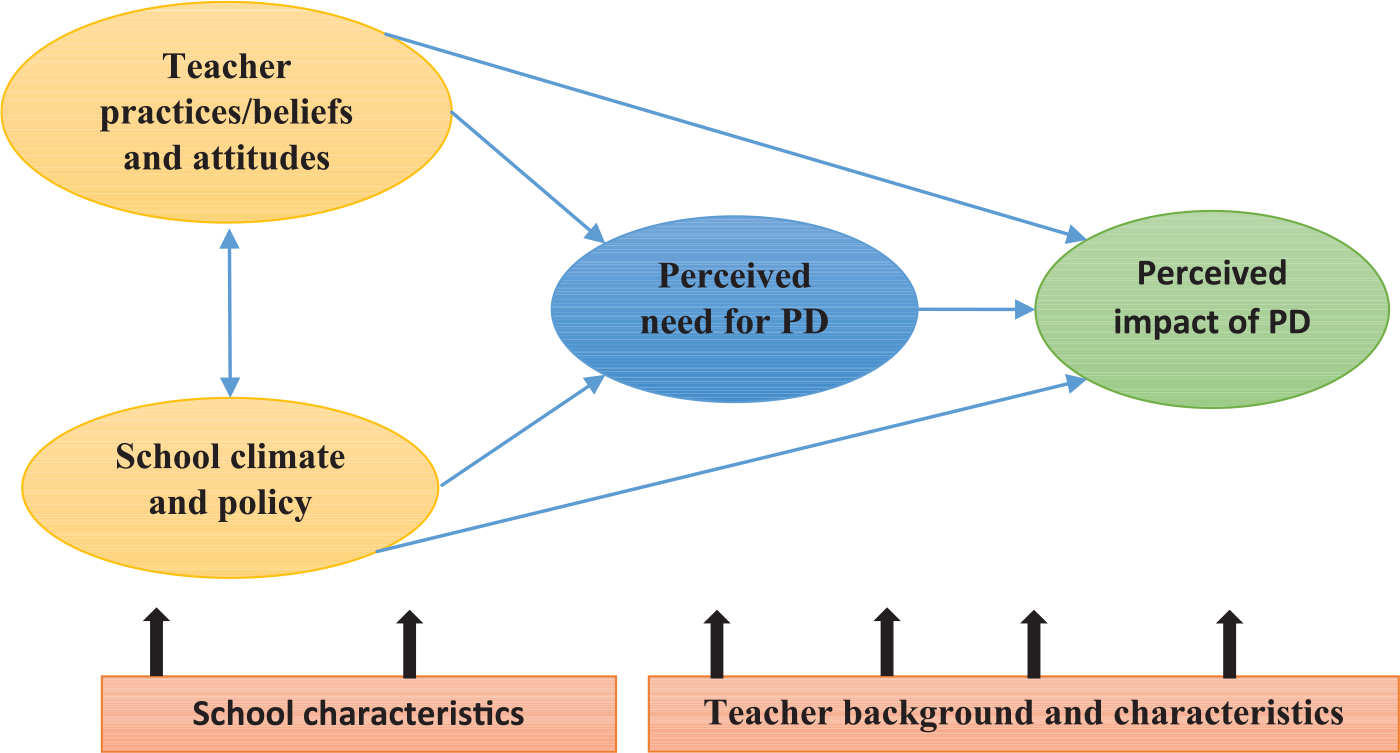
Basic conceptual model in TALIS.
The TALIS Instrument and Distribution
TALIS asked teachers to give their feedback if the professional development they participated in covered each of 14 specific topics. Teachers were asked to rate on a 4-point scale, ranging from low level of need to high level of need, their development needs for various aspects of their work. TALIS also asked teachers to address the impact of the professional development activities on their own development and evolution as a teacher and on teaching using a 4-point scale from low impact to high impact. The “impact” dimension included the same 14 items used in the “need” dimension.
TALIS also asked teachers about their experiences to formal and informal appraisal and feedback from colleagues and other school personnel, or other sources external to their schools. The survey contained items related to the focus and content of the various appraisal and feedback processes that teachers encountered. It also asked teachers on their opinions of possible linkages between the type of appraisal and feedback that they received, and other features related to school autonomy. With regard to teachers’ feedback and appraisals, three constructs are included in TALIS. Teachers were asked to rate on a 4-point scale (from not considered at all to considered with high importance) the feedback emphasis placed on 11 different areas. On a 4-point scale (no positive change to a large change), teachers were asked to what extent the feedback has directly led to positive change in any of 14 outcomes. The third construct was related to feedback appraisal. Teachers on a 4-point scale (strongly disagree to strongly agree) were asked to identify their level of agreement with regard to eight items.
With regard to teaching in general, using a 6-point scale (from never to once a week or more), teachers were asked to indicate how often they conducted each of the eight activities. For reporting means and standard deviations, the scores are adjusted or transformed accordingly to a 4-point scale for the sake of comparisons. With regard to the management of students and student behavior, on a 4-point scale (from not at all to a lot), teachers were asked to indicate to what extent they used each of the 12 related actions.
School climate and job satisfaction were addressed using four constructs. The first construct (five items) was related to factors that were applied to their particular school. The second construct (four items) was related to teacher satisfaction with regard to four teacher/student issues. The third construct (10 items) was related to teachers’ feeling about their job and work. All three constructs were evaluated using a 4-point scale to identify their level of agreement with regard to five issues (from strongly disagree to strongly agree).The final construct (10 items) was related to teachers’ attitude about being a teacher. This construct was evaluated using a 7-point scale to identify their level of agreement with regard to five issues (from totally disagree to totally agree). For reporting means and standard deviations, the scores are adjusted or transformed accordingly to a 4-point scale for the sake of relative comparisons.
The OECD selected the participating schools. Teachers used links to access the online survey that was available in both Arabic and English.
Teacher Sample
A total of 4,981 teachers from private and public schools in Abu Dhabi participated in the study. Public school teachers were 47.6% and private school teachers were 51.2% of the total. From all public school teachers, 3.1% (around 152 teachers) were from schools that use different curricula and teaching methods. These schools are called Technical Schools. About 55.1% of the responding teachers were female, whereas 44.9% were male. With regard to the age group of teachers, 15.1% were 30 years or younger, 44.3% were between 31 and 40 years of age, 29.6% between 41 and 50 years of age, 10.9% between 51 and 60 years of age, and only 1.1% above 60 years of age. Almost all teachers were full-time teachers, and most of them had 11 to 20 years of experience. It should be mentioned that only secondary school teachers were asked to participate. It should be noted too that TALIS target population excludes teachers who only taught students with special learning needs. Table 1 provides a summary of the sample of teachers who participated in the TALIS project.
Sample of Teachers.

Note. ISCED = International Standard Classification of Education.
Analysis Methods
The TALIS-2013 survey contained 12 specific dimensions that are related to teachers’ professional development: perceived needs, perceived impact, feedback emphasis, feedback effect, feedback appraisal, personal beliefs, teaching in general, student behavior, school climate (school), school climate (teachers/students), school climate (job/work), and school climate (attitude). Each of the dimensions represented measures into the structural equation for the current study. Each measurement model contained a large number of variables.
As a first step, it was necessary to reduce the number of variables of each measurement model to a manageable size. Each measurement model or construct was individually tested using the linear structural relations model (LISREL) to produce confirmed factors. Several features available in LISREL were looked at for reducing the number of items for each construct if necessary (i.e., adding error covariances, recognizing largest negative standardized residuals, and adding paths related to modification indices). For each measurement model, fit statistics were used (i.e., chi-square, degrees of freedom [df], root mean square error of approximation [RMSEA], normed fit index [NFI], goodness of fit index [GFI], and comparative fit index [CFI]; Ullman & Bentler, 2004).
Using some indications from related literature, the best fit model will be identified using structural equations model. The same fit statistics mentioned earlier will be used to identify the best fit model. It should be also mentioned that several items required reverse coding. For each construct, descriptive statistics of the items remaining in the final structural equation model (SEM) and the summated means for each of the factors will be calculated and presented.
We used MANOVA as a way to test the hypothesis that independent variables such as teachers’ gender, teachers’ age group, and school type have an effect on a set of dependent variables comprising the constructs in the SEM. In the case that the multivariate test informs us of the significance of at least one mean pairing, it would be unclear from the multivariate test for which individual comparison (for which contrast between groups), the observed mean difference is significant. To determine the significance of these differences, a series of univariate ANOVAs are conducted. In other words, if MANOVA resulted in significant F value, further ANOVA or t tests are carried out to see what variables are causing the differences.
Results
The Measurement Models
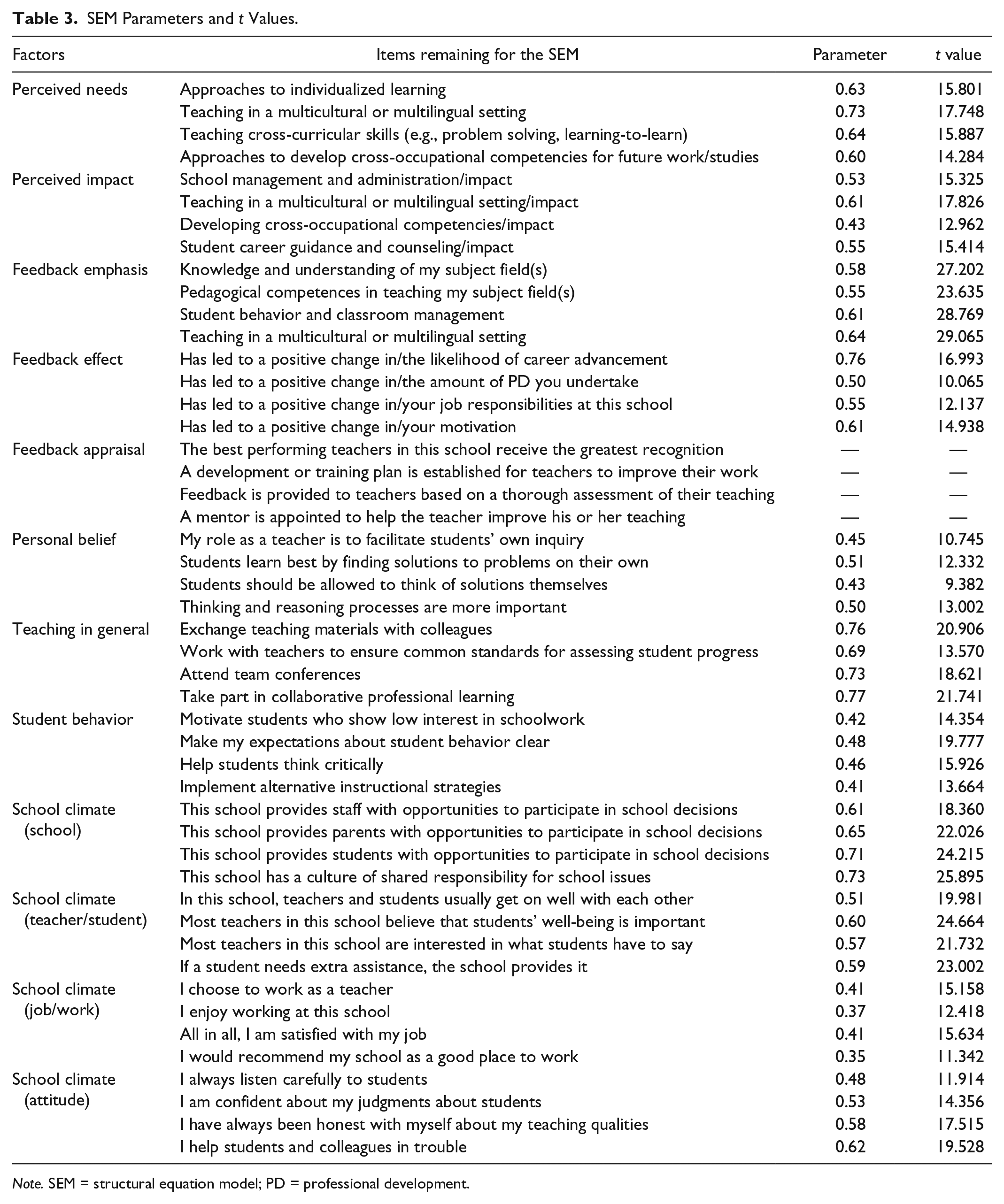
The overall TALIS model contained 114 items divided on 12 factors (or 12 latent variables). In essence, and before we could be sure that the correlations or covariances between constructs (or latent variables), it is necessary to first estimate the measurement model. This process could serve as requirements before estimating structural coefficients between constructs or latent variables. Confirmatory factor analysis of each of the 12 measurement models produced acceptable results. Table 2 shows that each model was reduced to smaller constructs containing four variables only. Table 3 shows the parameter values and t values. Based on the fit statistics obtained, the smaller versions of each of the measurement constructs enjoy acceptable fits. All RMSEA parameters are below the threshold of 0.05 indicating good fits (range = 0.003-0.034). All NFI (0.995-0.999), GFI (0.996-0.999), and CFI statistics (0.996-0.999) are larger than a minimum of 0.95.
Characteristics of Measurement Models Used in the SEM.

Note. SEM = structural equation model; RMSEA = root mean square error of approximation; NFI = normed fit index; GFI = goodness of fit index; CFI = comparative fit index.
SEM Parameters and t Values.
Note. SEM = structural equation model; PD = professional development.
The Final SEM
The final best fit SEM is shown in Figure 2. Fit statistics provide indications of a good overall model (χ2 = 1,606.55, df = 741, χ2/df =2.168, p = .004967, RMSEA = 0.039, NFI = 0.9543, nonnormed fit index [NNFI] = 0.929, CFI = 0.958, RMR = 0.0291, GFI = 0.953, adjusted goodness of fit index [AGFI] = 0.920). Table 2 shows the overall outcome of fit parameters, and t values in the model. The final dependent variable considered was perceived impact of professional development. For each of the constructs in the final model, the table summarizes the items, the parameters, and the t values for each parameter. It should also be noted that using Abu Dhabi data, the factors related to feedback appraisal did not remain in the final model. None of the paths to or from this factor was significant. Each of the remaining factors consisted of only three items.

The professional development structural equation model for Abu Dhabi schools.
For the SEM, Table 4 shows the direction of paths, path coefficients, and their corresponding t values. The highest coefficients are 0.37 (t = 8.57) from feedback emphasis to feedback effect and 0.28 (t = 5.74) for the path from school climate (job/work) to feedback effect. For direct paths to perceived impact, the most significant effect is from student behavior (0.21 with t = 3.96).
Structural Equation Results (Paths, Estimates, t Values).

Table 5 shows the direct, indirect, and total effects on perceived impact from other factors. Five factors pose direct impacts to perceived impact: student behavior, school climate (teacher/student), school climate (attitude), teaching in general, and feedback effect. The highest total effect of 0.301 is caused by the feedback effect provided to teachers. Figure 2 shows that feedback effect is a mediator between the perceived impact of professional development and four other factors (teaching in general, school climate [school], feedback emphasis, and school climate [job/work]).
Direct Effect, Indirect Effects, and Total Effects on “Perceived Impact.”

There are several additional conclusions that could be made looking at the overall results of the SEM:
There are no significant direct paths observed from teacher’s personal belief, feedback emphasis, feedback appraisal, and school climate (school, and job/work) to “perceived impact.”
There are direct significant effects of several constructs on the perceived impact construct—student behavior (0.21, t value of 3.69), school climate (teachers/students; 0.12, with a t value of 2.77), school climate (attitude; 0.13, with a t value of 2.79), teaching in general (0.19, with a t value of 4.10), and feedback effects (0.30, with a t value of 7.88).
The construct related to “feedback appraisal” does not influence any of the other 11 constructs in the model. It is not influenced by any of the other constructs either.
Teachers believe that perceived needs for professional development has no significant effect of their perceived impact of professional development activities that they participated in.
They believe that the effectiveness of feedback that they get from the school has a significant influence on the perceived impact of professional activities they participated in. Among the other constructs, it has the highest significant effect (.301 of total effect).
The feedback effect of professional development does not influence their perceived needs for certain professional development activities.
Perceived needs for professional development are affected significantly by only teachers personal belief (0.13 with a t value of 2.53), and student behavior (0.16 with a t value of 2.79).
The construct related to feedback effect plays a significant mediator role between perceived impact and four other constructs of teaching in general, school climate (school), feedback emphasis, and school climate (job/work).
Four different constructs have direct and significant effects on professional development feedback effect: teaching in general (0.11, t = 2.69), school climate (school, with 0.20 and t = 4.10), feedback emphasis (0.37, t = 8.57), and school climate (job/work, with 0.28 and t = 5.74).
There is no significant path from perceived need for professional development and perceived impact of professional development.
Effect of Teachers’ and Schools’ Features
Table 6 shows the results of MANOVA on each of the 12 factors in the model. With regard to teachers’ gender, results show significant effects with all constructs in the model except perceived impact of professional development, where the significance level is only .666 with a small 0.596 value for F.
MANOVA Tests of the Measurement Models (Constructs).

With regard to teachers’ gender and perceived needs, individual t test shows significant difference for “teaching in a multicultural or multilingual setting” only. Female teachers recorded a mean of 2.09, whereas male teachers recorded a mean of 2.29. For the construct of feedback emphasis, significant effects are witnessed with regard to all four items. Female teachers score higher than male teachers with regard to all four items. For feedback effect, significant differences are observed with regard to two variables where male teachers recorded significant higher scores. For personal belief, male teachers scored significantly higher than female teachers with regard to three items. For teaching in general, significant differences were observed with regard to two items, where male teachers scored significantly higher than female teachers on both. For student behavior, male teachers recorded significantly higher scores with regard to only one item. For school climate (school), male teachers scored significantly higher with regard to all four items. For school climate (teacher/student), male teachers scored significantly higher than female teachers on two items. With regard to school climate (job/work), male teachers scored significantly higher with regard to all items.
With regard to teachers’ age, for perceived impact, perceived emphasis, and teaching in general, no significant results were found. For perceived needs, individual t test showed that in general, as the age increased, the scores decreased except for “approaches to develop cross-occupational competencies for future work or future studies.” For feedback effect, as the age group increased, the scores given to three items significantly also increased. For personal belief, there is a significant effect on two items. As teacher age increases, the scores increase too. For school climate (school), significant effects are witnessed for two items, where in general, as the teacher becomes older, the scores also increase. For school climate (teacher/student), there is a significant effect only with regard to “most teachers believe that student well-being is important.” As the age goes up, the score goes up too. For the constructs of student behavior, school climate (job/work) and personal attitude, as the age goes up, the scores go up significantly for all items in each construct.
With regard to type of school and perceived needs, private school teachers assigned significantly higher scores for “approaches to individualized learning,” whereas public school teachers assigned significantly higher scores to “teaching in a multicultural or multilingual setting.” For perceived impact, public school teachers assigned significantly higher scores to three out of four items. For feedback emphasis, private school teachers gave significantly higher scores to all four items. For feedback effect, private school teachers assigned significantly higher scores for “the likelihood of career advancement,” but public school teachers assigned a significant higher score for “the amount of professional development you undertake.” For personal belief, public school teachers gave significantly higher scores to three items. However, private school teachers assigned higher score with regard to “thinking and reasoning processes are more important.” For teaching in general and school climate (school), public school teachers scored significantly higher than private school teachers on all items. For school climate (teacher/student), private school teachers scored significantly higher than public school teachers with regard to “teachers and students usually get on well with each other,” but public school teachers scored significantly higher with regard to “if a student needs extra assistance, the school provides it.” For school climate (job/work), private school teachers scored significantly higher with regard to one item, whereas public school teachers scored significantly higher with regard to three items. Finally, for school (climate/attitude), public school teachers scored significantly higher than private school teachers with regard to three items.
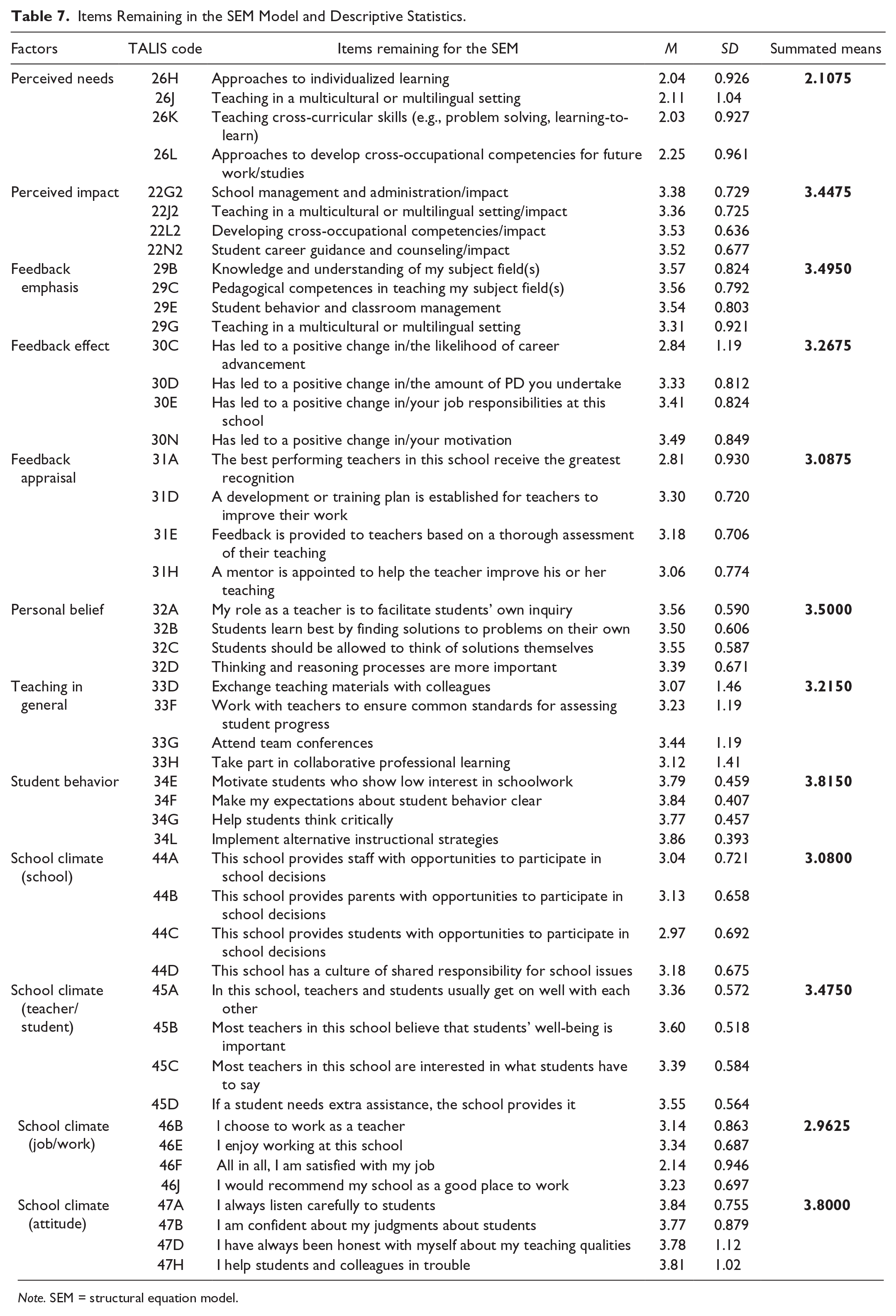
Table 7 shows the means and standard deviations of the factors remaining in the model after performing exploratory and confirmatory factor analyses. The highest summated means is related to the teacher’s efforts with regard to student behavior (3.815). More specifically, the teachers focus highly on implementing alternative instructional strategies and making their expectations about student behavior clear. The second highest summated mean is associated with school climate (attitude; 3.80). Relatively high scores are assigned to attitude toward always listening carefully to students (3.84) and attitude toward helping students and colleagues in trouble (3.81). The third highest summated means is related to feedback emphasis (3.495). Relatively high scores are assigned to knowledge and understanding of the subject field (3.57) and pedagogical competencies in teaching the subject fields (3.56).
Items Remaining in the SEM Model and Descriptive Statistics.
Note. SEM = structural equation model.
The lowest summated means is related to teachers’ perceived needs for professional development (2.1075). All four items belonging to this construct received low scores. The highest score of (2.25) was assigned to the teachers’ perceived needs for approaches to develop cross-occupational competencies for future work studies. The lowest score (2.03) was assigned to the perceived needs for teaching cross-curricular skills. Other constructs receiving low summated means include school climate (job/work; 2.9625) as teachers gave relatively low scores for being satisfied with their job (2.14).
It might be important also to look into the means of some of the individual items comprising some of the summated factors, especially with regard to perceived needs for professional development. The factor identified four items with means of 2.04, 2.11, 2.03, and 2.25, respectively. It should be noted that the factor did not include items related to subject training or pedagogical instruction. For the perceived impact factor, the four items reflected the highest mean scores (ranging from 3.36 to 3.53). The impacts focused on school management, teaching in multicultural setting, developing cross-occupational competencies, and student career guidance.
Discussion
In light of the existing theories on teacher professional development, results of the current study highlight the importance of some cultural issues that should not be ignored. It might seem obvious to understand that a culturally embedded approach to implementation would promote a more systemic professional development for teachers. Ladson-Billings (1995) recommended “culturally responsive teaching.” They refer to it as an instructional method, which gives students more knowledge at several levels (intellectually, socially, emotionally, etc.). Others recommend encouraging students to better grasp their own culture to be able to develop an appreciation of different cultures in the classroom (Reynolds, Cain, & Manarino-Leggett, 2014). In other words, the instruction would validate the student values, their prior experiences as well as awareness of other cultures.
To better fulfill the needs of teachers’ professional development, policy makers in Abu Dhabi Education Council (ADEC) and school leadership find it necessary to put forward effective plans to encourage teacher participation, as well as to ensure that their exact perceived needs are met. Many goals should be aligned. For example, teachers’ perceived needs for professional development should match the wider strategic and tactical goals of school development. Moreover, teachers’ professional development should be balanced and coordinated with school systems related to appraisal and feedback. However, a serious examination should be made of the effect of the various professional development participations and the expected impact of such participations. It might be advisable to structure each professional development offering with precise key point indicators related to expected impact.
The absence of a significant path from perceived needs to perceived impact might reveal that the high levels of teacher participation in professional development activities for Abu Dhabi teachers, the perceived needs of a large segment, are not being satisfied or met. This result is also supported by the low mean scores for the four items comprising the perceived needs construct. Many authors warn that the perceived impact of professional development is reflective of how the programs are carefully selected to adapt to their perceived needs (Dillon, 2010; Noh et al., 2004).
Noticeably, the construct of perceived needs focused on individualized learning, teaching in multicultural or multilingual school environment, teaching cross-curricular know-how and proficiency, and cross career competencies. This result provides both ADEC and school policy makers clear directions to understanding the major challenges in Abu Dhabi. In terms of the topics for which professional development needs are most significant, teachers also reported a high level of need for training activities in the area of teaching students coming from different cultures and backgrounds. The construct ignored specific subject matter and pedagogical knowledge. This is not consistent with the calls from authors who recommend that subject matters should be the focus of successful professional development programs (i.e., Hawk et al., 1985). It should be mentioned that more than 80% of the teachers in Abu Dhabi come from other cultures and countries; as a result, teaching in multicultural or multilingual environments is important. In addition, the main theme included in the curriculum design is focus on cross teaching cross-curricular skills and cross-occupational competencies. For Abu Dhabi, it is an important issue to have concerns about the performance of their students who come from cultures completely different from their teachers. It is, therefore, not surprising that a comparatively high percentage of teachers recognized the significance of acquiring skills necessary for teaching in a multicultural setting and teaching students with special learning needs. They also considered that these factors should be looked at seriously when it comes to their appraisal and feedback.
It should be mentioned here that in the TALIS-2013 study, results showed that more than half of the teachers expressed that they needed more professional development programs than they received during the previous 18 months (Organization for Economic Co-Operation and Development, 2013). For ADEC, this reflects more needs and support for teachers to participate in professional development programs. It also calls policy makers and school leaders to ensure offering effective programs of teacher professional development that meet teachers’ true needs.
An expected outcome was that the construct related to feedback appraisal might not significantly influence the impact of perceived needs. Results showed that feedback appraisal of teachers in Abu Dhabi has significant connection with any of the 11 other constructs in the model. The feedback appraisal construct reflects the “the best performing teachers in this school receive the greatest recognition,” which received a relatively low mean of only 2.81. This indicates that most teachers recognize that school decision makers have not established efficient and effective links between being more innovative in their efforts in being more innovative in teaching and for improving the quality of their teaching. As a result, teachers might feel that lack of incentives and further recognition are the missing links in the professional development overall system. It is important for ADEC policy makers to note that according to research, appraisal and feedback have a strong positive influence on teachers and their work (De Nobile, 2003; Hakanen, Bakker, & Schaufeli, 2006). Teachers report that appraisal and feedback increase their job satisfaction and, to some degree, their job security, and they significantly increase their development as teachers (De Nobile & McCormick, 2005; Van Houtte, 2006). In addition, decision makers in ADEC should note that recognizing teachers’ performance and to honor great teaching while asserting that teachers need to address deficiencies in their pedagogical habits are also important emanations of effective system appraisal and feedback (Santiago et al., 2009).
Results show that feedback effect has a significant effect of the perceived impact of professional activities directly and indirectly. It has both direct effect and indirect effects (as mediator between perceived impact and four other constructs of teaching in general, school climate [school], feedback emphasis, and school climate [job/work]). Such critical importance of perceived effect is consistent with other research outcomes (Barber & Mourshed, 2007; Lustick & Sykes, 2006; Santiago et al., 2009). ADEC policy makers should pay much attention to the significant effect of appraisal and feedback systems to increase teacher motivation and hence their professional learning. Results ascertain the significant role of both feedback emphasis and feedback effect on perceived impact in the current professional development system. Such results are consistent with other studies that show that meaningful feedback should be geared to teacher development and improvements in learning (Jacob & Lefgren, 2008; OECD, 2013).
The professional development framework presented here has four constructs related to school climate (job/work, school, attitude, and teacher/student). Results justify that there is a strong relationship between teaching practices and a variety of other factors such as teaching beliefs, professional development activities, and teacher characteristics and backgrounds (OECD, 2009; Vieluf et al., 2012). The largest total effect on perceived impact of professional development is seen with respect to teacher’s attitude and teacher/student factor. The related items of the construct include their positive attitude toward the students, their teaching qualities, their effect on student’s well-being, and their openness and seriousness to students. The results are consistent with other studies that reflect the interrelations between teachers’ beliefs and attitudes and their adjusted teaching practices (Hattie, 2003; Hattie & Timperley, 2007).
For ADEC, it is important to believe that the linkage between perceived impact of professional development and teacher’s attitude is having significant support for teachers to design their classrooms according to their established beliefs about effective methods of teaching and learning. Such design should be able also to encourage how students should carry out their work more effectively, and how they learn. It also should enhance how teachers structure their lessons and classrooms to enrich learning. This is also consistent with results in other studies (Lefrancois, 2000). It is believed that teachers’ personal experiences reflect their practices and beliefs. Personal experiences are usually carved by “cultural norms” and can also be formed through information acquired via related professional development and other educational training (Cohen et al., 2009; Collie et al., 2012). In this regard, checking the list of professional development programs offered by ADEC, many were related to “classroom management” where teachers take actions to organize instruction and classrooms effectively to facilitate student learning. The effectiveness of similar management professional developments is also addressed by many (i.e., Emmer & Evertson, 2009; Woolfolk, 2010). Results also support the social cognitive theory that predicts that a teacher’s behavior will be shaped through the interactions between their beliefs, behavior (practices), and environment (classrooms; Bandura, 1997; Klassen & Chiu, 2010).
An interesting outcome of this study is that student behavior significantly influences both perceived needs of and perceived impact on professional development. Results show that there is a direct impact of student behavior on the perceived impact of professional development. The related items more or less reflect teachers’ concerns with how best to manage their classrooms, promote learning, and minimize disruptive behaviors. Results are consistent with other studies that teachers would like to organize instruction and classrooms effectively to facilitate student learning (Emmer & Evertson, 2009; Woolfolk, 2010).
Significant differences were recorded between various categories (teacher’s gender, teacher’s age group, and type of school). Further investigation was made to gain some insights into these variations. With regard to the perceived need for professional development activities, the most significant variation was observed with regard to public or private schools. With regard to the impact of those activities, male teachers almost consistently assigned higher perceived impact scores than female teachers. Public schools also assigned higher perceived impact scores for all activities that they participated in. However, female teachers assigned significantly higher perceived barrier scores to five of the seven listed barriers to participating in professional development activities. The research has implications for professional development providers to ensure the effectiveness of professional development opportunities for educators in Abu Dhabi across all different categories of teachers and schools.
Conclusion
In the yearly “Teacher Survey” conducted by ADEC, one teacher makes the remark that
professional development offered by ADEC to schools has a bad reputation and for good reason as many teachers agree that what most teachers receive as professional opportunities to learn are thin, sporadic, and of little use when it comes to improving teaching.
Some studies point out that most professional development systems for teachers are, by all accounts, broken, and are unlikely to positively influence teaching and improve student achievement (Hill, 2009; Wei, Darling-Hammond, & Adamson, 2010).
The current study presented an overall professional development system with the added ability to estimate direct, indirect, and total relationships, and make direct statistical tests of the significance of any of the pathways modeled. Using SEM, we were able to better understand complex causal effects and mediations among constructs. Having such an integrated model would provide policy makers with understanding to design more effective professional development programs.
The SEM resulted in a missing path from perceived needs to perceived impact of professional development. This result calls for policy makers in ADEC and in the schools to design a process where the professional needs of teachers are taken into consideration before scheduling their related priorities and agendas. For ADEC in particular, it is hoped that the results from this study will stimulate future research on new models of teacher professional development activities and projects based on the true needs of teachers.
The LISREL model also confirms that the professional development system cannot be considered as various unconnected parameters. Rather, it should be considered as a system of several interrelated and integrated constructs leading to the development of the different aspects of teacher’s proficiencies. The results showed that the scope of such programs should be based on perceived needs, perceived impact, feedback (emphasis, effect, and appraisal), teacher’s belief and attitude, teacher’s practices, student behavior, and school climate (the school, teacher/student, and job/work).
Results might indicate that a regular and systematic detailed needs assessment is necessary to be applied on teachers. During this procedure, the true needs, aggressive ambitions, and hidden and unhidden conditions of each teacher group should be considered carefully. Based on the analyses of the needs assessment, professional development programs should be formulated for the teachers. Besides the new teachers, the entire teaching population should also attend these programs regularly. Rewarding credits may be attributed to successful participation, and these credits may be regarded as their performance measurement criteria and affect their academic incentives and rewarding system and appraisals mechanism. Based on individual school needs and expertise, decentralized professional training programs may be established. Rouseff-Baker and Holm (2004) called for a credible partnership between teaching and learning. They described such partnership as a dynamic event that coordinates good teaching and ongoing learning. There is also a crucial need for the rigorous assessment of ongoing professional development activities. The continuous feedbacks and evaluations should be able provide effective recommendations and redesign when necessary.
Badri et al. (2016) used the same sample and reported ANOVA of the individual variables of the two constructs of perceived needs and perceived impacts of professional development. Their study provided some insights into the variations of those perceptions relative to other independent variables such as teachers’ age and gender and type of schools. Future research may find it useful to combine the items (or variables) in each of the constructs of perceived needs, perceived impact, and other constructs. It might be advisable to perform ANOVA tests on the composite constructs instead. The benefit is that we could simplify the complexity in the data and are able to present a more parsimonious explanation of differences if they exist.
The study provides a causal model explaining the various independent variables as they link to perceived impact of professional development. Future studies might consider designing a questionnaire for students as well to provide their feedback on the impact of those professional development activities on their own knowledge and learning. Most probably, the students might be the most credible voice to judge the impact of professional development activities that their teachers undertook.
Footnotes
Declaration of Conflicting Interests
The author(s) declared no potential conflicts of interest with respect to the research, authorship, and/or publication of this article.
Funding
The author(s) received no financial support for the research, authorship, and/or publication of this article.