




Abstract
This study investigates the communication and learning needs of Master of Business Administration (MBA) business English students and their perceptions of effective curriculum design. The research instruments are two-stage surveys of 99 MBA students from a public university in China. The results of the study show that English is not extensively used in the workplaces of MBA business English students, and that the majority of them use Chinese. Most English usage occurs in foreign businesses. The most difficult skills for MBA business English learners are found to be oral communication and listening comprehension. However, there are still very strong needs for further improvement in English communication. For the MBA business English courses, oral communication activities, especially with expatriate teachers, are particularly needed. The MBA business English courses should connect with real-world practice and be relevant to job and business needs. This study has significant implications for MBA business English curriculum reform in both Chinese and international contexts.
Introduction
Various types of Master of Business Administration (MBA) programs have been established in Chinese higher education institutions, including executive, joint and international programs, and China’s own MBA programs. The MBA students can pursue their studies part-time or full-time. MBA programs usually require students to have years of work experiences. Chinese MBA programs are now aimed at attaining international standards and certified accreditation by MBA agencies, such as the International MBA Association. Datar, Garvin, and Cullen (2011) suggest that in the global context, an MBA program needs to “expand the global horizon, develop leadership skills and integration skills, understand the organizational reality, act creatively, think critically as well as understand the business and the market,” but these aims can create challenges for both teachers and students in the MBA programs (p. 8).
In China’s higher education context, Zou (2015, p. 153) suggests that the business English course is the foundation course of MBA program. The teaching of business English is special. This is mainly evident in the student group. MBA students all have very strong career motivations. A primary objective in teaching MBA business English is to develop “application ability,” and the teaching methods and assessment approaches are different from those of traditional examination-oriented English teaching.
Dudley-Evans and St. John (1998) have divided business English courses into English for general business purposes courses and English for specific business purposes courses. The MBA business English courses in China’s MBA programs are English for general business purposes courses. Theoretically, Dudley-Evans and St. John (1998) also suggest that business English courses should focus on “discourse communities, business genre, key communicative events, functions, grammar and lexis and learners’ expectations and strategies” (p. 61). Thus, MBA business English course designers should consider incorporating the students’ work and industry backgrounds, including key discourse and communicative activities and learning strategies and expectations to realize the course aim, to develop international business communicative competence.
Most analyses of business English needs and curriculum studies focus on pre-experience student groups, such as university students. The empirical studies focusing on job-experienced student groups, such as MBA students’ business English curricula, are limited. This study investigates MBA students’ communication and learning needs analysis and business English curriculum development, which is addressing the limitation of previous research on job-experienced student groups. The study furthers the understanding of the diverse communication and learning needs of MBA business English students, and of effective curriculum design, through empirical investigation.
Literature Review
Studies on MBA Learning in the International Context
Studies in the international context generally focus on MBA learning from the empirical perspective. One of the focuses is on the challenges and adaptation process of Chinese students who take MBA courses overseas. Parks and Raymond (2004) investigate 18 Chinese students taking MBA courses in Canada and the changes to their learning strategies. They find that the learning strategies of the Chinese students are influenced by Canadian native students, as observed through their reading, lectures, and teamwork. Their learning strategies are mediated by the social context, which can become complex. Shi (2011) investigates the learning experiences of 13 Chinese students who go to the United States for MBA study. Her study is conducted through interviews, course observations, classroom interaction audio recordings, and observations of out-of-class activities. Her research shows that constraints in English communication ability and cultural ability can hinder the second language learners’ access to learning resources and academic recognition.
Other studies in the international context focus on the learning experiences and preferences of MBA international students. Bambacas, Sanderson, Feast, and Yang (2008) investigate the learning preferences of students in an overseas MBA program of an Australian university. Their study shows that MBA students prefer face-to-face learning and communication with lecturers. Their preferences for online learning are low. MBA students should also be supported by cooperative learning. Uhrig’s (2012) comparative case study of MBA and Master of Law students demonstrates that their academic performance is influenced by specific disciplines, such as the teamwork requirements and the highly competitive academic environment of law school. Individual differences will also influence their learning methods.
Another group of studies in the international context focus on MBA students’ oral and written communication activities. The courses can then be redesigned based on the oral and written data. Basturkmen (1999) conducts her study based on the MBA seminar’s student interaction discourse. She summarizes the main interactional language features. Based on the results of discourse analysis, English for academic purposes course material and syllabus can be designed. Yang and Shi (2003) compare the summary writing strategies and processes of three first-year MBA students from China and three from English native language backgrounds. Their study finds that students’ previous disciplinary writing experiences, students’ perception toward writing tasks, and key writing skills influence MBA students’ summary writing process.
Language courses for MBA programs in the international context can help learners to better prepare for their business studies. Westerfield (1989) indicates that non-native English-speaking students demonstrated strong writing abilities in their MBA course learning, but they have inadequate speaking and group discussion skills. To address the inadequacy, video-based methods can be used in language preparation courses for MBA programs to enhance the speaking and writing abilities of learners. In the international context such as in the United States, students in MBA programs typically come from multicultural backgrounds. Their native language is not English. Under this background, Jones, Wills, and Berte (2017) investigate English native and non-native speaking MBA students’ perceptions of business leadership. The results show that their understanding of business leadership differs. The effect of cultural differences should be further examined in the teaching methods.
In summary, the MBA curriculum studies in the international context, particularly those related to the language courses, have important implications for business English teaching in China. However, the course learning environments differ greatly. The international and multicultural environments have brought challenges in MBA studies, particularly for non-native English-speaking international students, including Chinese students.
Studies on Business English Teaching for MBA Students in the Chinese Context
Compared with the international context, MBA student groups in China are more diverse in terms of industrial backgrounds. The MBA business English studies have conducted needs analysis research. The results show that MBA students tend to have significant differences in English proficiency and work experiences. For example, Lu (2015) conducts a needs analysis research in the Anhui Business Administration College. The study shows that students’ subjective and objective needs as well as subjective and learning needs have significant differences. The needs analysis research shows that although MBA students have low English proficiency, they have a high level of interest in business English learning. There are fewer job-related needs in business English, but there are also very high requirements. The MBA business English courses in this college have received positive feedback in teaching content and methods.
In addition, China’s MBA business English teachers are aiming at innovating teaching methods and teaching modes. Zhao (2016, p. 117) indicates that MBA business English teaching should be problem based and should create a cooperative learning environment. MBA business English teaching should create models that provide “project-based learning, case teaching and create a learning atmosphere.” Therefore, the assessment for MBA business English teaching should not be only through written tests. It should include “project report, short drama performance and oral report.” Yu (2014) indicates that MBA teaching should focus on the main business activities, such as marketing, business plans, and negotiations. MBA teaching should integrate video resources and be based on real cases.
Moreover, Li’s (2008) study indicates that group work should be used in MBA business English teaching. Group work can enhance students’ cooperative learning abilities and change the teaching atmosphere. Cui (2013) finds that in the Chinese MBA teaching context, students’ English proficiency, and work experiences vary. MBA business English teaching should also adapt to market demands. She indicates that case-based approach can result in better outcomes. Sun, Liu, and Ren (2016) in their study mention that the party activities make teaching more effective. Their research suggests that MBA business English teaching should be listening and speaking oriented, followed with writing and translation practices.
However, most MBA teaching research in previous studies is based on personal observations rather than systematic business English teaching theories. There are still inadequate empirical studies on MBA business English teaching and curriculum development based on student needs. Thereby, this study addresses the gap by systematically and empirically studying MBA students’ communication and learning needs and curriculum development based on a comprehensive business English theoretical framework, as discussed in the following section.
Theoretical Framework
The theoretical framework of this study focuses on MBA business English student communication and learning needs analysis and curriculum development based on the needs. Dudley-Evans and St. John (1998) indicate that needs analysis can be categorized as “target situation analysis, learning situation analysis” and students’ “present situation analysis” (p. 123). Needs analysis can be conducted from an outsider’s perspective and insider’s personal experiences. Dudley-Evans and St. John (1998) further indicate that in needs analysis, learners’ “personal information, lacks in skills, professional information, language learning needs, wants from the courses and how to communicate in target situations” should be identified (p. 125). The key issues in needs analysis are to understand learners’ expectations of the course and in what kind of work English is used. Moreover, Frendo (2005, p. 24) indicates that needs analysis should also include investigating learners’ learning styles and learning strategies. The students’ learning styles and strategies are influenced by cultures and there are cultural differences. Moreover, Dudley-Evans and St. John (1998) indicate that the needs analysis research instruments include “questionnaires, structured interviews, observation and tests” (p. 132). Long (2005) also suggests that “ethnography, diary, and role-play” can be used in needs analysis research (p. 31). This study specifically investigates the MBA students’ learning styles and strategies with diverse cultural and work backgrounds.
Based on learners’ needs, business English teachers can design their teaching content. Frendo (2005) indicates that business English curricula should cover “grammar, lexis, pronunciation, functions, business skills, topics, situations, texts, language skills, intercultural skills and tasks in which language is used” (p. 35). Furthermore, Ellis and Johnson (2002, p. 89) suggest that the course design can be based on performance areas. This includes “meeting and discussion, telephoning, business correspondence, and socializing.” Business English teachers can design their teaching content based on business documents and the texts provided by the learners. Basturkmen (2010) stresses that needs analysis is an ongoing process and it can help in revising the course content.
Moreover, this study is also based on the theoretical framework devised by Xie (2016). The course design is based on needs analysis and English for specific purposes theories. The course design, implementation, and evaluation are based on learners’ individual differences in learning styles, learning strategies, motivation, aptitude, work experiences, and occupation. The course implementation is dependent on teachers’ roles, including teaching planning, materials, teaching methods, and activities. The learner outcome evaluation is based on the considerations of whether learners’ employability and human capital can be developed. Vocational context factors, such as the availability of learner resources and learner autonomy, should also be considered in the implementation of courses.
Research Questions
Business English learners have been categorized as “pre-experience, low-experience, and job-experienced learners” in the relevant research (Ellis & Johnson, 2002, p. 15). Frendo (2005) further indicates that pre-experience learners could be university students or secondary school students. They need teachers to explain the world of work to them. Job-experienced learners understand more about the world of work. They do not rely on teachers for business world knowledge as they already understand it to some extent. Low-experience learners are in the middle. They typically need to learn English to get new positions or skills. The students studying business English are therefore diverse in terms of their skills and needs.
For Chinese MBA learners, their differences lie in work experiences, positions in their organizations, communication needs, and language proficiency. Research has indicated that Chinese MBA students exhibit significant differences. This study focuses on the issue of how to better design business English courses based on different learning needs.
The main research questions are as follows:
Research Methodology
This study is based on a case of MBA business English courses offered in a public 985/211 university in the east of China. In this case, the course aims can be summarized as follows, based on the program syllabus: To enhance students’ English comprehension, use and communicative ability in the international business environment; To enable students to understand the standard and original English use and expressions in the main business activities; To enable students to further understand business culture, background knowledge and practices in international business activities; To enable students to master basic functions and skills in communication with foreign business people.
Business English is MBA program’s foundation course. MBA students’ other courses are business related and include law, finance, management, accounting, and so on.
This study is a single case study of MBA business English courses. The purpose of the study is to explain MBA business English students’ diverse communication needs and perceptions of business English teaching. The data collection methods of this case study are mainly qualitative and multidimensional. Ellis and Johnson (2002, p. 73) indicate that surveys are the most effective and convenient data collection methods for job-experienced business English learners. The case data analytical paradigms are both qualitative and quantitative (Yin, 2010). The case research is empirical and the key issues are MBA learners’ diverse communication and learning needs and how to effectively design the business English curriculum. The data collection, participants, and data analysis procedures are described in the following sections.
Data Collection
This study has two stages. The data collection instruments are two-stage surveys. The first stage survey (see Appendix A) focuses on the main communication and learning needs of MBA business English students. The first stage survey was administered in March 2018 to 99 MBA business English students in the second author’s class. The survey uses open-ended questions. The questions are adapted from Dudley-Evans and St. John (1998, p. 140) and Ellis and Johnson (2002, p. 85). The first stage survey aims to investigate the MBA business English students’ language use in the workplace, their difficulties in English use, their future use of English, and the descriptions of their work experiences. From the Stage 1 results, the researcher can understand the MBA business English students’ job experiences, language level, and language learning needs.
The second stage survey (see Appendix B) focuses on effective MBA business English curriculum design. In the second stage survey, 58 MBA students in the second author’s class who particularly need business English skills were invited again to complete a more detailed questionnaire in May 2018. The survey questions include learning styles and strategies, the benefits of learning business English, their perceptions of business English teaching activities, as well as good practice in business English course design. The second stage survey mainly includes open-ended questions, adapted from Frendo (2005, p. 20) and Xie (2016, p. 255).
Most of the adapted survey questions were previously piloted and used in the Xie’s (2016) previous study, which generated meaningful results. This ensures the validity and reliability of the data in this study.
Participants
The participant profiles are shown in Table 1. In total, there are 99 participants in the study. More than 46% are male and more than 41% are female. The average age of the participants is 32 years old. The age range is 26 to 45 years old. More than 43% have passed the College English Test Band 4 (CET-4) and more than 40% have passed the College English Test Band 6 (CET-6). There are a minority of participants who have completed the Test of English Major Band 4 (TEM-4), the Test of English Major Band 8 (TEM-8), the Business English Certificate (BEC) test, the International English Language Test System (IELTS), and the Intermediate Interpretation Test. Their average working time in their current positions is 5.40 years. The standard deviation is 4.29, and 41.4% of the participants are in managerial positions, including human resources (HR) managers, CEOs, and directors.
Participant Profiles.
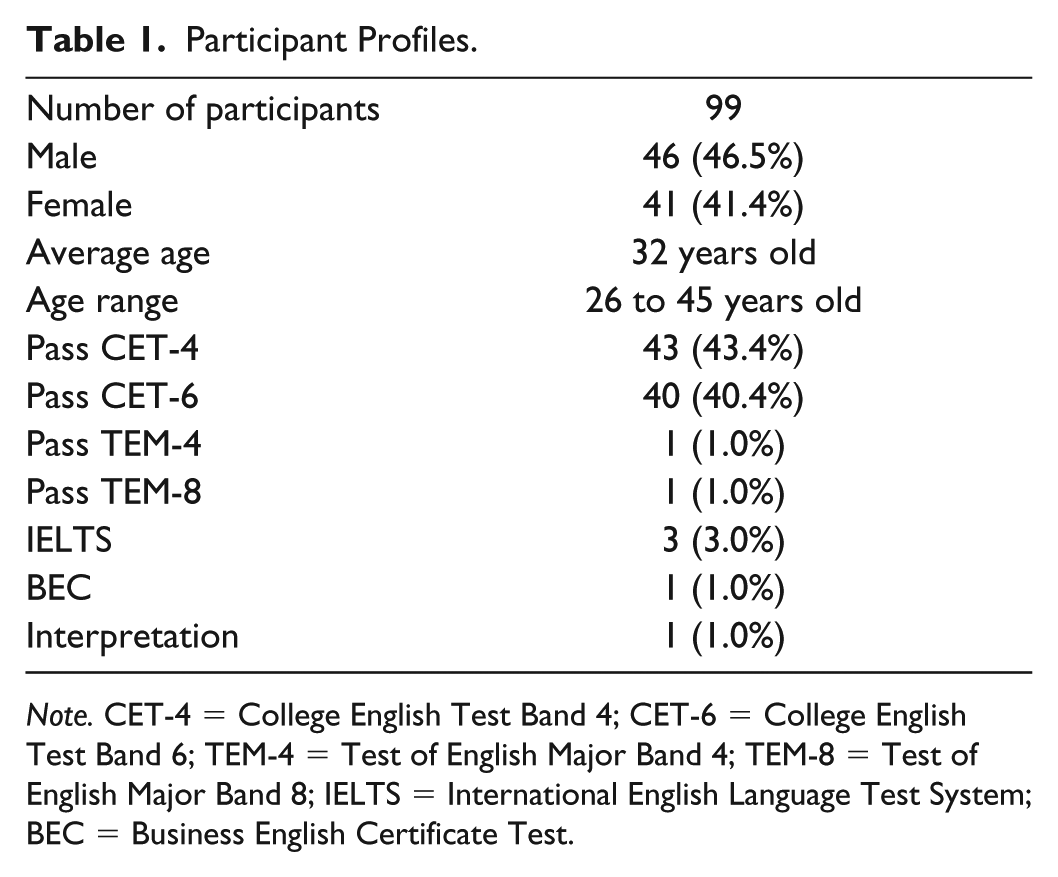
Note. CET-4 = College English Test Band 4; CET-6 = College English Test Band 6; TEM-4 = Test of English Major Band 4; TEM-8 = Test of English Major Band 8; IELTS = International English Language Test System; BEC = Business English Certificate Test.
The industrial sectors in which participants work in are summarized in Figure 1. The industrial sectors participants work in range from service to manufacturing and local to international organizations. Around one third of the participants work in the technology sector, which includes high-tech companies such as network businesses. More than 10% of the participants work in various banks, including some regional banks, such as the Bank of Jiangsu. More than 14% of participants work in various machinery companies, such as Caterpillar and automation businesses. Around 4% of the participants work in securities, education, and electricity companies. Around 5% of participants work in energy and government sectors. Around 3% participants work in electronics, real estate, and insurance businesses. Around 2% of participants work in investment, material, sports, automotive, and international trade businesses, and about 1% of participants work in clothing, retailing, media, logistics, transportation, medicine, packaging, tourism, and water processing businesses.

Participants’ industrial sectors.
The departments in which the participants work are shown in Figure 2. In all, 13.1% of the participants, which is the largest group, work in HR and Administration Departments, which include office administration and management work; 9.09% of participants work in Finance Departments, which include Internet finance and securities; 7.07% of participants work in R&D, production and international business, which include international divisions for the United States and Europe; 6.06% of participants work in operations and sales and marketing departments. Other functions include logistics and supply chain (3.03%), purchasing (4.04%), law (2.02%), and quality control (3.03%).

Participants’ departments.
Data Analysis
In the data analysis stage, the researchers conduct a content analysis of the responses, and the main themes are categorized. The researchers also calculate the frequency of the responses and the percentage of participants, which are then presented in different figures (Dörnyei & Taguchi, 2011, p. 99). The best quotes are then selected (Guest, MacQueen, & Namey, 2012), which represent the various communication needs, the learning needs of MBA students, and their perceptions of business English teaching practice. The best quotes provided in Chinese are translated into English by the researcher. To ensure the confidentiality of the participants’ identity, pseudonyms are used in the study.
Results
Main Communication and Learning Needs of MBA Business English Students
Workplace language usage and contexts of English use
The participants’ workplace language usage is reported in Figure 3. In all, 64.6% of participants reported using Chinese in their workplace. The Chinese here mostly means Putonghua. More than 14% of participants reported using both Chinese and English in their workplaces. One participant stressed that English played a minor role. Another participant indicated that English was only used in email communication. More than 7% of participants reported English as their working language. These participants mostly worked in foreign businesses. More than 1% reported the use of a third language such as French or German in their workplaces. One participant also mentioned the parallel use of the two foreign languages of English and German rather than Chinese in the workplace.

Participants’ workplace language.
The participants’ English use in the workplace is reported in Figure 4. Around 49% of the participants indicated that they did not use English in their everyday work, whereas around 27% indicated that they used English in the work. More than 6% of participants sometimes used English at work, whereas around 5% of participants indicated that they rarely used English at work.

Participants’ English use in the workplace.
The participants’ main types of English use in the workplace are shown in Figure 5. More than 26% of participants used both written and oral English in the work. More than 14% of participants used English in the written form. More than 6% of participants used English only orally.

Types of English use in the workplace.
The average number of hours participants used English per week is 8.0225 hr. The standard deviation is 13.52. The contexts of English use are described in Figure 6. More than 34% mostly used English in external communication. More than 14% mostly used English inside the companies. More than 20% used English in both internal and external communication.

Contexts of English use.
Participants’ communications with English speakers are described in Figure 7. More than 52% communicate with both native and non-native English speakers, from countries such as the United States, Germany, Switzerland, Japan, Italy, France, the United Kingdom, India, Sweden, and Norway. More than 4% of participants communicate with non-native English speakers, such as those from Southeast Asia. More than 27% have no communications with English speakers.

Communication with English speakers.
The participants’ main situations of English use are shown in Figure 8. More than 43% used English in writing letters or faxes, which was the highest proportion. More than 41% used English in face-to-face situations. More than 31% used English in telephoning. More than 21% had meetings in English.

Situations of English use.
When describing their main responsibilities in their various workplaces, 5.05% of the participants identified the direct needs for English use in their daily work. These included communications with international customers and branches when dealing with overseas businesses. Chang’s comment is very typical of English use in the business: I have communication with overseas customers. My position is international business agent. My responsibilities include negotiation, signing contract, commodity export and after-sales service. Once there is quality complaints, it would be very hard to solve the problem. (Chang, Translation)
Difficulties in English communication
The participants experienced difficulties in English communication, as shown in Figure 9. More than 44% of the participants mentioned various difficulties in using vocabulary and English expressions effectively in English communication, including professional terms. Chen had the following explanation: The problem lies in to express what I think using suitable vocabulary and grammar. It is the vocabulary and usage issue, to integrate grammar into speaking. (Chen, Translation)

Difficulties in English communication.
More than 21% of participants also mentioned various difficulties in English oral communication and more than 15% mentioned the difficulties in listening comprehension. For example, Wang had the following experience: It is difficult to get information totally when talked with people from Indian by phone. (Wang)
More than 2% of participants indicated the lack of English use opportunities could create difficulties in English communication. One participant said that he had not used English for 10 years and this made the language strange to him. Other difficulties were found in cultural differences (2.02%), grammar (2.02%), fluency (3.03%), pronunciation (2.02%), being shy (1.01%), and spelling (1.01%).
Overseas experiences
For overseas experiences, 43.4% had no overseas experiences and 25.3% had overseas traveling experiences. They have traveled to Australia, the United States, and Europe for business purposes. They had also traveled to Asian countries as tourists. Zhang described his experience as follows: In April, 2015 I have attended the exhibition in Paris, France; In April, 2016, I have attended the exhibition in Munich, Germany. (Zhang)
Future use of English and the needs to improve English in the work
For future use of English, 36.4% said that there would be no major changes in English use and 35.4% said there would be some changes in future English use. They said that English use would be more oriented toward writing or speaking. If there would be job changes, the future jobs would involve more direct contact with English-speaking colleagues or new areas of work such as investment.
More than 61% of the participants indicated the need to improve English in their work. Four participants expressed urgent needs to improve their English. They mentioned “the need to change job and improve English for enhancing competitive edge” (Li, Translation). Or they may need to use English “to communicate with customers” (Xuan, Translation). In total, 70.7% of the participants indicated the needs to take courses to improve their English skills. It includes self-study. However, 18.2% of the participants had no intentions of taking further English courses.
Business English learning strategies
Moreover, the participants suggested various business English learning strategies, as shown in Figure 10. Of the 58 participants in the Stage 2 survey, 44.8% suggested simulation and communication practices with native speakers. Xu had the following observation: Communication with people, especially with foreign teachers with good pronunciation. It is better to use English every day. It is easy to forget. (Xu, Translation)

Business English learning strategies.
12.06% suggested on-the-job learning, learning based on video and audio resources, and doing additional exercises; 5.17% of participants suggested group discussion and case analysis could improve their English. For example, Xiang had the following comment: The most efficient is to learn on the job. It is better to learn in practical business environment. (Xiang, Translation)
Effective MBA Business English Curriculum Design
Best practice MBA business English teaching practices
The best practices for MBA business English teaching practice are summarized in Figure 11. Of the 58 participants in Stage 2 survey, 22.4% indicated the necessity for expatriate teachers. Chu had the following comment: If there is expatriate teacher, it can increase practical experience. Through practice, I can understand my weaknesses. (Chu, Translation)
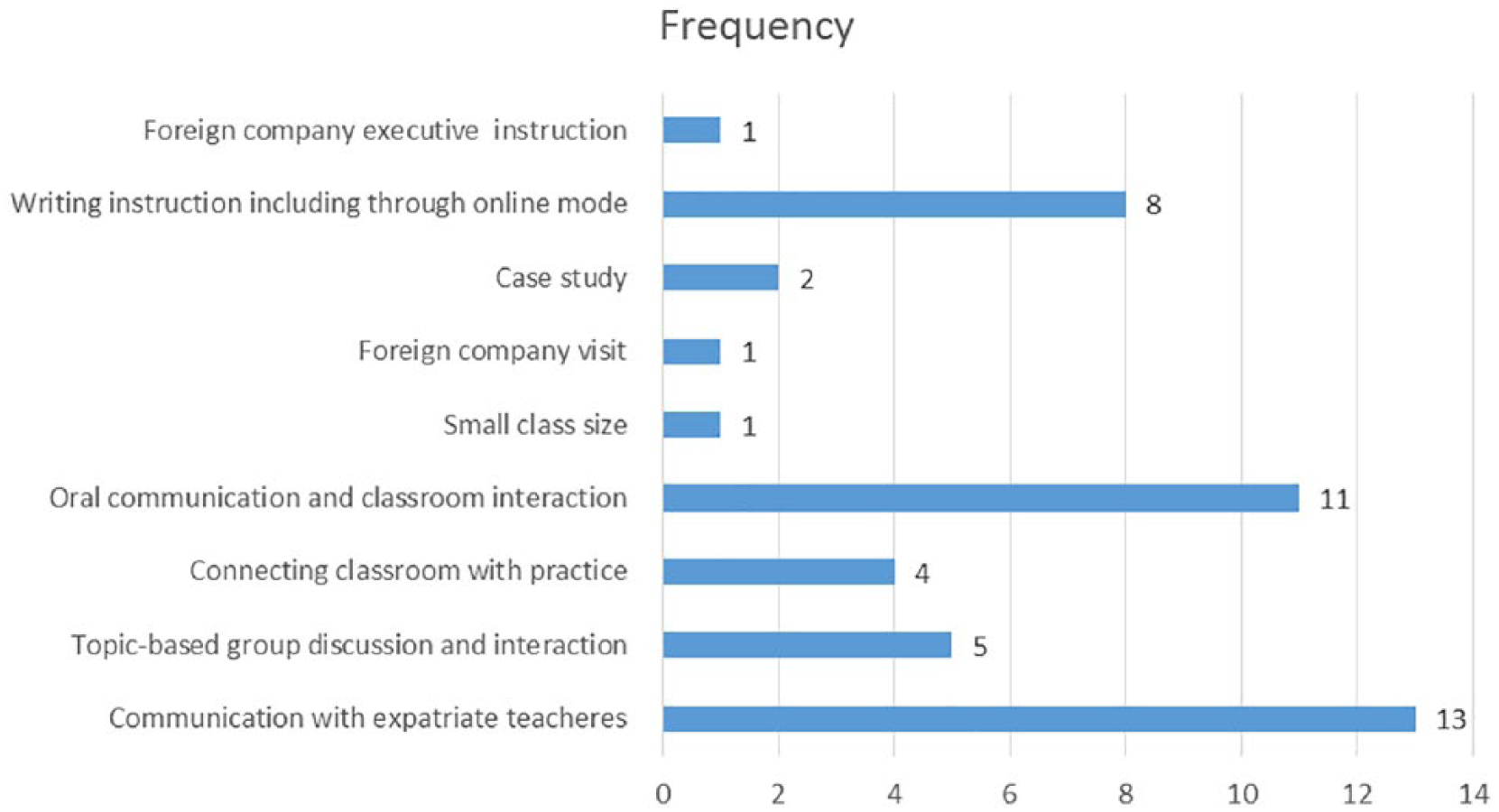
Best practice MBA business English teaching.
18.97% of the participants mentioned oral communication and classroom interaction; 8.6% of the participants identified topic-based group discussion and interaction; 13.79% of the participants recommended writing instruction including through online mode. Zhang had the following explanation: The writing feedback website. Through repetitive reading, we can find the gap. (Zhang, Translation)
6.9% of participants mentioned connecting with the real-world practice. This includes “practical business, such as the process of inquiry-offer-order-packing-shipment” (Lv, Translation); 3.4% indicated the necessity of case study, which includes “the common scenario case analysis and explanation” (You, Translation). Other best practices include foreign company executive instruction (1.7%), foreign company visits (1.7%), and using smaller class sizes (1.7%).
Characteristics of MBA business English teaching
The characteristics of MBA business English teaching are shown in Figure 12. Of the 58 participants in the Stage 2 survey, 36.2% indicated that the teaching was practical and relevant to their jobs and workplaces. Zeng commented that “the teaching should be close to students’ practical job needs and business needs” (Zeng, Translation); 17.2% indicated integrating business knowledge and scenarios. Sheng commented that “it should be practical and experiential” (Sheng, Translation). Shi further commented It should be typical business scenarios, so that it can be used in real world environment. (Shi, Translation)

Characteristics of MBA business English teaching.
Moreover, the participants suggested that the teaching styles should be humorous, relaxed, and interesting (5.17%). The teachers should have interactive and open-ended teaching (8.62%). Sometimes, the teaching can be intensive, targeted, and fast-tracking (10.3%). Some students also learned business language use (6.9%) and made friends (1.7%).
All of the participants in the Stage 2 survey agreed that the teacher conducted the business English teaching in “occupational or task settings by using simulation, conversation, cases, or specialized methods for developing global business communicative competence,” and the teacher has used scenario-based teaching. Wen observed that the “key content would be based on situations. The students can have simulation and have role plays” (Wen, Translation).
However, 5.2% of the participants indicated that the MBA business English teaching should take into consideration the class size factor. It would be more effective if the business English teaching is conducted in small classes. Other issues mentioned include class time constraints and the lack of sufficient oral interaction. Zang had the following comment: The class used to be too big. The teacher cannot have conversations and communication. It is suggested to have small classes, around 20 people per class. (Zang, Translation)
Meanwhile, all of the participants in the Stage 2 survey agreed that business English teaching is “learning centered, collaborative, experiential, reflective, and learning team based.” The participants said that the teaching was conducted in groups. However, two participants indicated that there were too many students in the class which hindered the good teaching practices.
Topics for further English courses
Topics for further English courses are described in Figure 13. In all, 27.3% of participants hoped to take further business English courses; 17.2% of participants mentioned the needs to take English communication courses, including oral English, English listening, writing, and reading courses; 5.05% of participants needed to take vocabulary courses, in particular, professional vocabulary. Other topics included tourism English (3.03%), interpretation (2.02%), and English culture (1.01%). Two participants indicated the needs to take online courses and use English reading app.
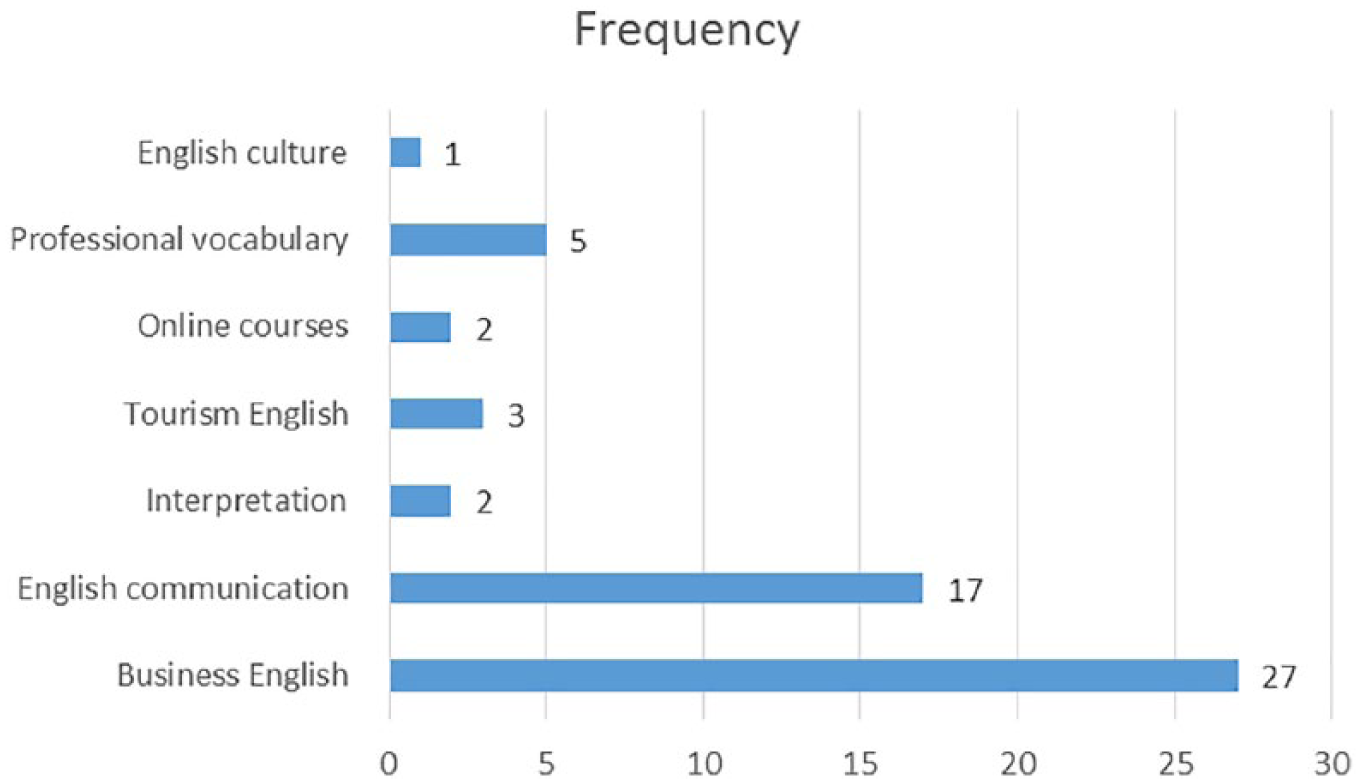
Topics for further English courses.
Favorite business English teaching activities
The MBA students’ favorite business English teaching activities are described in Figure 14. Of the 58 participants in the Stage 2 survey, 25.9%, the largest group, favored oral communication activities, particularly with native speakers. They mentioned the needs for communication with expatriate teachers. In total, 10.3% mentioned watching English movies/videos. These also include drama performance. In all, 8.6% mentioned interaction with teachers, particularly those with “self-study experiences or business experiences” (Wu, Translation); 6.9% of participants favored writing instruction, group discussion based on topics and English salons and simulations of negotiations; 5.2% hoped the teachers could explain text, grammar, and language expressions. 3.4% of participants hoped to have practical teaching content. This includes the “job related syntax, grammar and vocabulary (professional) training” (Xiang, Translation). Other favorite teaching activities include making presentations (5.2%), reading (3.4%), listening practices (3.4%), role play (1.7%), case analysis (1.7%), communication within the workplaces (1.7%), one-on-one teaching (1.7%), and games (1.7%).
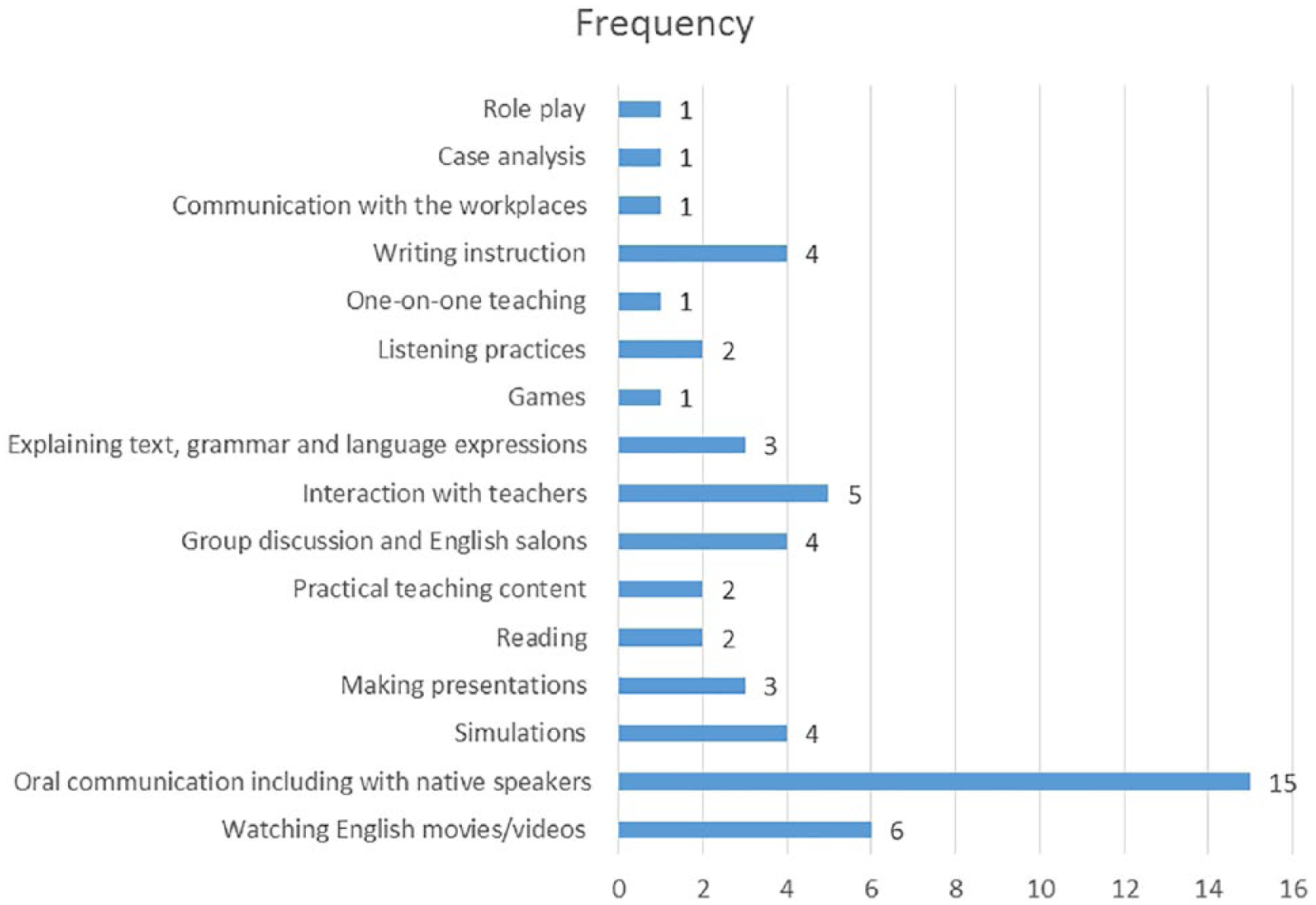
Favorite MBA business English teaching activities.
The benefits of MBA business English teaching
The benefits of MBA business English teaching are presented in Figure 15. Of the 58 participants in the Stage 2 survey, 63.79% mentioned that they had improved their English communicative competence. Li had the following observation: Improve global skills and cultural perspective. Excellent business English listening, speaking, reading and writing ability can help one better express himself in the work environment and demonstrate competence. It will indirectly influence promotion. (Li, Translation)
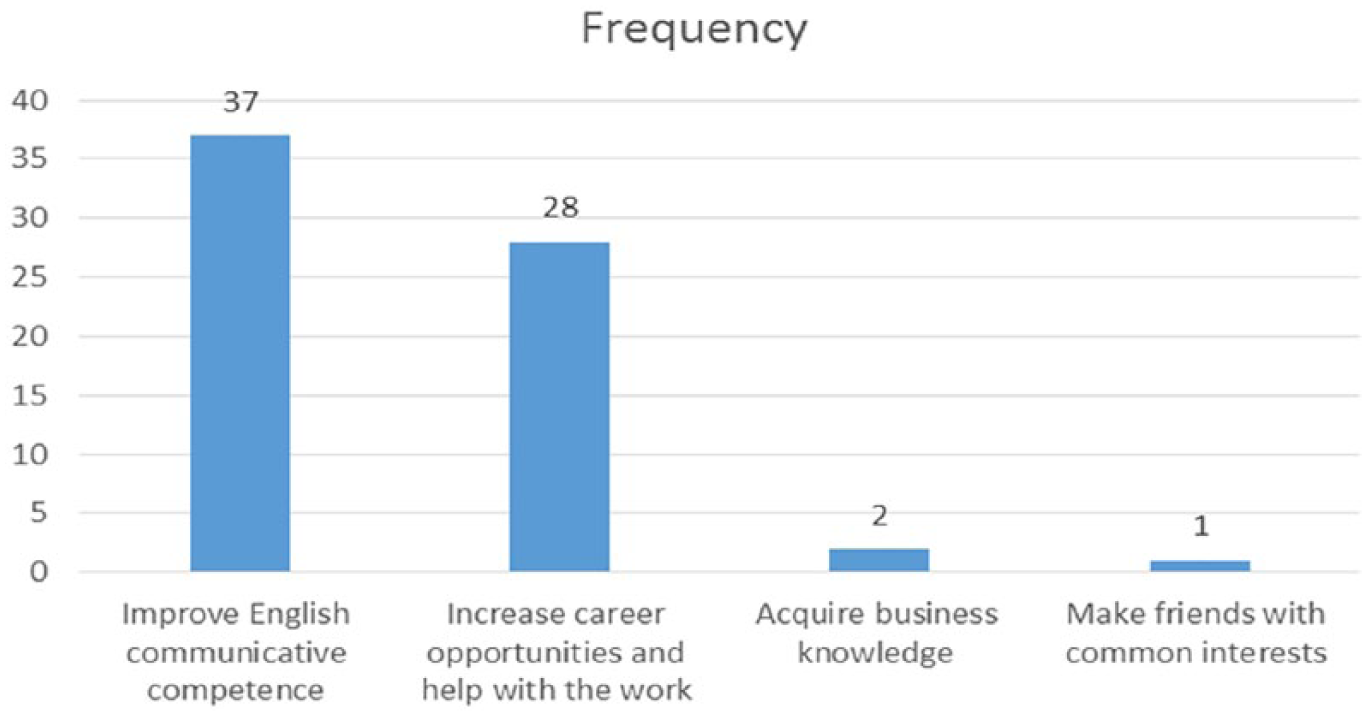
Benefits of MBA business English teaching.
48.3% of the participants mentioned the increase in career opportunities and the benefits related to their work. Shen had the following comment: In foreign (US or European) companies, fluent English can enable employees to better communicate with managerial levels and increase the promotion and salary increase. (Shen, Translation)
3.4% mentioned the acquisition of business knowledge. One participant mentioned making friends with common interests. In all, 29.3% of the participants said that the MBA business English course can bring promotion and salary increase. However, Xiang had the further comment: It depends on different people in various businesses. Overall, language is very important. (Xiang, Translation)
Discussion
Main Communication and Learning Needs of MBA Business English Students
For workplace language usage, the majority of the participants used Chinese. Slightly over 10% of the participants used English in their workplaces. Some very rare instances of using a third language in the workplace along with English were mentioned. Around half of the participants did not use English in their workplaces. Around one third of participants indicated both the written and oral use of English in their workplaces. Moreover, there is more written English use than oral English use. More than one third of the English use was with external communication. There is more external than internal communication in English. More than half of the participants used English with both native and non-native speakers from various countries in Europe and Asia and in the United States. More than 40% of participants mainly used English in writing letters or faxes. There was less use of English in oral communication, such as face-to-face situations, telephoning, and meetings. There are only around 5% of the participants who had direct use of English in their main job responsibilities. The results of this study are different from the findings of Evans (2010, p. 153) in the Hong Kong context. In Hong Kong, English is the dominant language for written communication, whereas Cantonese is the main medium of oral communication. Written and spoken English use increases with “rank and experience.” In the context of this study, Chinese is still found to be the dominant workplace language in China, but the participants who work in foreign businesses tend to have more opportunities to use English in their work, in both written and oral forms.
For difficulties in English communication, more than 40% had problems in using professional vocabulary and English expressions. There were also problems in oral communication and listening comprehension. The lack of English use opportunities could also be a major constraint factor. More than 40% of the participants had no overseas experiences. More than one third of the participants expected changes in the future use of English. Around two thirds indicated the needs to improve English in their work. There were even urgent needs of improving English in the work. For business English learning strategies, more than 40% mentioned simulation and communication with native speakers. On-the-job learning could also provide good opportunities for learning business English. Ellis and Johnson (2002, p. 18) recognize that business English learners may have different prior learning experiences, “learning characteristics,” and attitudes which may hinder the learning processes. It is suggested that business English teachers should be flexible and “pragmatic” to cater to the various learning needs, styles, and strategies.
Effective MBA Business English Curriculum Design
For best practice MBA business English teaching, more than 22% of the 58 Stage 2 survey participants indicated the necessity for expatriate teachers. There were also oral communication and classroom interaction, group discussion, and writing instruction. More than 6% mentioned the needs of connecting with real-world practice. Frendo (2005) indicates that the typical teaching methods for business speaking skills include “role play and simulations” for developing communicative competence in the contexts of “small talks, meetings, telephoning and presentations” (p. 61). For teaching business writing, “process and genre based approaches” should be used, to address the writing of “contracts, reports, CVs, agendas and minutes, as well as online website documents” (p. 90). The results of the study confirm the business English teaching best practice theories in the literature through empirical evidence.
For characteristics of MBA business English teaching, more than one third of the 58 Stage 2 survey participants mentioned practical teaching content, which is relevant to the students’ job and business needs. The teachers should integrate business knowledge into their teaching. There are also the unique, humorous, and relaxing teaching styles. Teachers should have interaction with students. The constraint factors for effective MBA business English teaching include the class size and time limitations. Li (2010) further confirms that MBA business English teaching should link theories with practice. Through analyzing real-world cases, the MBA students can develop both oral communication skills and problem-solving skills. The teachers and students should cooperate. For those factors which constrain teaching effectiveness, they should be adjusted for optimizing the learning outcomes.
For topics of further English courses, more than 27% hoped to take further business English courses. More than 17% needed to have English communication courses, including English reading, writing, speaking, and listening. Other suggestions included vocabulary, tourism English, interpretation, and English culture. For favorite business English teaching activities, more than 25% of the 58 Stage 2 survey participants favored oral communication practices, particularly with native speakers. They also favored watching English videos, interaction with teachers, writing instruction, group discussion, simulation, and English salons. Donna (2000) further suggests that for business English courses to bring improvements to specific communication skills, the business English teachers should consider “students’ abilities to achieve a task,” provide contexts for the communication practices, “use authentic materials or real-life situations,” and use “ongoing assessment” (p. 126).
More than two thirds of the participants indicated that MBA business English teaching improved their English communicative competence. There were benefits for career opportunities. Less than one third recognized the link with promotion and salary increases. Yan (2009) also indicates that business English students expect the courses to improve their practical ability. The business English courses should also be designed to motivate students to further their learning. The results of the study confirm the pragmatic orientation of MBA business English teaching.
Conclusion
This study reports a two-stage investigative study for the communication and learning needs of 99 MBA business English students and their perceptions of effective curriculum design. For main communication and learning needs of MBA business English students, it can be concluded for this study context that there is not extensive English use in the workplaces of MBA business English students and that the majority of them use Chinese. Most English usage occurs in foreign businesses, where there is more written communication than oral communication. There is also more external than internal communication in English. Only a minority of learners have direct needs for English in the work. The most difficult skills for MBA business English learners are found to be oral communication and listening comprehension, partly due to the lack of opportunities to use English. However, there are still very strong needs for further improvement in English communication. For more effective MBA business English curriculum design, oral communication activities, particularly with expatriate teachers, are particularly needed, along with other communicative approaches and multimedia learning resources. Moreover, the MBA business English courses should connect with the real-world practice and be relevant to the job and business needs. Business knowledge should be integrated and the teaching styles should be interesting and humorous. Through taking business English courses, MBA students have gained English communicative competence and also better career opportunities.
This study is based on theories of business English teaching, English for specific purposes, and educational research. This study summarizes students’ diverse learning and communication needs, as well as effective MBA business English teaching practices to suit the Chinese business reality and better facilitate business communicative competence development, to ultimately serve economic globalization. The results of the study have significant implications not only for MBA business English teaching reform in Chinese universities but also for teaching practices in other educational contexts. The results of the study can also inform the future direction of business English curriculum development. The results of the study can also have practical value for MBA business English teachers and corporate trainers with adult learners. Business teachers can learn how to design effective curricula based on adult learners’ diverse needs, which are different from those of university students. The results of the study also have important implications for policy makers. This empirical study with MBA student group can help policy makers and educational administrators to set benchmark, to make MBA business English courses more standard.
The limitations of the study lie in that it is conducted in only one Chinese university context. However, the in-depth two-stage investigation process can be replicated in other cultural contexts. Future research can further investigate the implications of the higher education internationalization on MBA business English curricula, in terms of how teachers and students can cope with the challenges of economic and educational globalization.
Footnotes
Appendix A
Appendix B
Acknowledgements
The authors would like to express heartfelt thanks to the participants for their helpful contributions to the study. The authors are also grateful for the expert comments from editors and reviewers for revising this article.
Declaration of Conflicting Interests
The author(s) declared no potential conflicts of interest with respect to the research, authorship, and/or publication of this article.
Funding
The author(s) disclosed receipt of the following financial support for the research, authorship, and/or publication of this article: This work was funded by 9th China Foreign Language Education Research Fund (ZGWYJYJJ2018B14).
