




Abstract
This study examined the contribution of teachers’ engagement in collaborative professional learning, engagement in individualized professional learning, and job satisfaction to their professional capital development using structural equation modeling. The study tested three hypotheses: teachers’ level of engagement in collaborative professional learning and development activities has a significant contribution to their professional capital development, teachers’ level of engagement in individualized professional learning and development activities would have a significant contribution to their professional capital development and teachers’ job satisfaction has a significant effect on their professional capital development. The sample consisted of 379 teachers randomly selected from Awi district primary schools, Ethiopia. Data were collected using 25 items. Cronbach’s alpha (α) coefficients for internal consistency ranged from .806 to .919. Composite reliability, convergent validity, and discriminant validity of latent variables were established using CFA. The measurement model and structural model showed a good fit based on established criteria. Findings showed a significant effect of teachers’ engagement in collaborative learning, engagement in individualized learning, and job satisfaction on their professional capital development. These independent variables accounted for 68.3% variance in professional capital development, thereby indicating 31.7% unexplained variance. In conclusion, the study highlighted the importance of teacher-level factors to boost professional capital in the teaching profession.
Introduction
To meet the dynamic demands of the knowledge economy, schools and teachers shoulder the great responsibility of producing well-equipped manpower by providing quality education. In this regard, building teachers’ professional capital is increasingly recognized as a fundamental strategy to ensure quality education (Hargreaves & Fullan, 2012, 2013; Reichenberg & Andreassen, 2018; Uba & Chinonyerem, 2017). Hargreaves and Fullan (2012) first coined the term professional capital from the viewpoint of the teaching profession. Professional capital is a mix of human capital, social capital, and decisional capital (Fullan, 2016; Hargreaves & Fullan, 2012, 2013).
Teachers’ human capital, as a sub-construct of professional capital, refers to their knowledge, skills, competencies, and experiences (Hargreaves & Fullan, 2012; Reichenberg & Andreassen, 2018; Stiles & Kulvisaechana, n.d.; Uba & Chinonyerem, 2017). Social capital, as the second dimension of professional capital, implies the professional assets, skills, and qualifications of a group of teachers (Watts, 2018). Social capital entails building individual and collective knowledge and skills to enhance practice and improve student learning (Fullan et al., 2015). The third dimension of teachers’ professional capital is decisional capital. This dimension denotes the teachers’ ability to make discretionary judgments as a professional, including the abilities of individuals and groups to make effective decisions (Hargreaves & Fullan, 2012).
By recognizing the need to invest in teachers’ professional capital, the scholars have proposed establishing continuing professional learning and development programs as a fundamental strategy to develop teachers’ professional capital (Fullan & Hargreaves, 2016; Hargreaves & Fullan, 2012; Nolan & Molla, 2017). In line with this focus, many countries across the world, including Ethiopia, have devised teacher professional learning and development programs, regardless of their economic level (International Labour Organization [ILO], 2012, MoE, 2004; OECD, 2014; United Nations [UN], 2016). In one or another, the primary goal of such programs is to provide teachers with opportunities for career-long professional learning and development to acquire up-to-date knowledge, skills, and competencies—building professional capital. However, establishing a quality program will not guarantee teachers’ professional capital development unless they actively engage in professional learning and development endeavors. Therefore, teachers should be dedicated to engaging in individualized and collaborative professional learning and development activities (Harris & Jones, 2017; OECD, 2016, 2020; Thoonen et al., 2011) that are formulated to build teachers’ professional capital. In general, teachers’ highly engaged in professional learning and development undertakings may develop high professional capital. However, little is known about the influence of teachers’ engagement in professional learning activities on building professional capital in primary schools. Thus, demystifying the effect of teachers’ level of engagement in individual and collaborative professional learning activities on their professional capital development using structural equation modeling (SEM, hereinafter) becomes imperative.
In addition to engagement in professional learning, hiring and retaining more qualified individuals is a prominent strategy to improve teachers’ professional development (ILO, 2012; UN, 2016) and consequently, boost their professional capital. However, the previous researchers in Ethiopia have shown that teachers in sample Ethiopian schools exhibited an intention to leave the teaching profession whenever they get a better opportunity (MoE, 2015; Tuli & Tynjälä, 2015; Yalew et al., 2010). In connection to this, a large body of evidence has shown that retaining qualified teachers depends on their satisfaction with their job and work environment (e.g., Jain & Verma, 2014; OECD, 2014, 2020). Briefly, teachers’ sense of job satisfaction showed a significant relationship with their intention to stay in the profession, their performance, and professionalism (Jain & Verma, 2014; Pilarta, 2015; Toropova et al., 2020; Werang & Agung, 2017). Therefore, intensifying teacher job satisfaction positively influences professional capital development by retaining quality teachers equipped with subject matter knowledge and pedagogical competencies (OECD, 2014, 2020). In the Ethiopian context, however, most teachers felt dissatisfied with their profession and intended to leave the teaching profession (MoE, 2015; Tuli & Tynjälä, 2015; Yalew et al., 2010), which deteriorates professional capital in the teaching profession. As local studies showed, inadequate salary, poor incentive mechanisms, and poor working environment of the school are mostly mentioned reasons for the Ethiopian teachers’ dissatisfaction and intention to leave the teaching profession (Aweke, 2015; Gedefaw, 2012; Hilina, 2011; Mahlet, 2017), which obstructs teachers professional capital development in primary schools of Ethiopia. So far the contribution of teachers’ level of engagement in individual and collaborative professional learning activities and job satisfaction to their professional capital development has been obscured. Thus, the present study aimed at examining the direct effects of teachers’ job satisfaction and engagement in professional learning and development activities on their professional capital development using the structural equation modeling (SEM) approach.
Theoretical Framework
As teachers are adult learners, the theoretical base for this study was adult learning theory. Adult learning theory guides that the professional learning and development of teachers, as adults, is self-directed (Knowles, 1975) and transformative (Mezirow, 1991), assuming that teachers as adult learners are capable of engaging in self-directed and transformative learning in a way that ensures their professional growth and development—professional (human, social, and decisional) capital development (Merriam, 2018). This theory suggests that building professional (human, social, and decisional) capital requires teacher engagement in self-directed and transformative learning, and a favorable learning environment (Knowles, 1975; Mezirow, 1991). It is a self-directed professional learning program that can promote teachers’ engagement in individual and collaborative professional learning activities (Smith, 2017).
As it provokes self-directed learning of teachers as adults, adult learning theory contends that teachers engagement in self-directed learning builds not only overall professional capital (human, social, and decisional capital), but also their sense of professional identity, especially self-efficacy and job satisfaction(Merriam, 2018; Smith, 2017). Put it briefly, in the context of self-directed learning, “teachers demonstrated an increasing sense of professional identity, articulated personal principles of professional practice and actively worked through a process of aligning personal professional reasoning with action and recognized the importance of their emerging expertise” (Smith, 2017, p. 49). Based on the self-directed learning theory’s assumption, teachers can build their professional knowledge of practice daily through the very interactions that define quality in learning and teaching (Smith, 2017).
The key assumption of adult learning is that “adults need to know why they need to learn something before undertaking to learn it” (Knowles et al., 2015, p.47). In this regard, teachers’ should first understand where they are now and where they should be in the future in terms of their professional expertise. Teachers as adult learners have a deep need to be self-directed (Knowles et al., 2015); therefore, the school leadership should create a conducive school climate for teachers’ self-directed professional learning. In connection to this, creating a conducive learning climate is a major principle of adult’s self-directed learning (Lawler, 2003; Smith, 2017). Based on the adult learning theory perspective, self-directed learning fosters a sense of self-determination among teachers that explains their satisfaction in basic psychological needs for autonomy (decisional capital), competence (human capital), and relatedness (social capital; Miles, 2012; Taylor et al., 2015). Guided by the aforementioned theoretical assumptions, we proposed the influence of teachers’ engagement in individual and collaborative professional learning as well as satisfaction with job and with school environment on their professional capital—human, social, and decisional-development.
Conceptual Framework
Teachers’ Professional Capital
Professional capital, according to Hargreaves and Fullan (2012), is the deliberate development and integration of three types of capital in the teaching profession: human, social, and decisional capital. Hargreaves and Fullan (2012) contended that the notion of professional capital could alter people’s perceptions of the teaching profession, teachers as professionals, and how to achieve the quality of education. Briefly, the concept of professional capital in teaching stresses how improving teachers’ professional capital can help to create a dynamic new profession that benefits all schools in all countries (Hargreaves & Fullan, 2012). Simply put, professional capital denotes an investment in the development of educators to increase teacher quality and student achievement (Watts, 2018).
In the teaching profession, professional capital is a combination of three sub-concepts: human capital, social capital, and decisional capital that must be addressed clearly and in combination to develop teachers’ professional capital across and beyond the school (Fullan, 2016; Hargreaves & Fullan, 2012, 2013). Though human capital was previously mentioned by economists in the 1960s, Hargreaves and Fullan (2012) were the first to mention it as one dimension of teacher professional capital. It refers to the teachers’ subject matter and pedagogical expertise, as well as their awareness of students and their learning patterns, as well as their emotional and social abilities to support students from various backgrounds (Fullan, 2016; Hargreaves & Fullan, 2012). Human capital development is a technique that helps individuals grow their personal and organizational skills, knowledge, and ability in any organizational context, including the school (Healthfield, 2011). In the field of education, social capital is another facet of professional capital (Hargreaves & Fullan, 2012). Within the schools, teacher social capital can be built through the amount and quality of trustful interactions and social relationships (Hargreaves & Fullan, 2012; Häuberer, 2011; Leana, 2011; Sell, 2015). Social capital can be developed through positive interpersonal and professional relationships among the teachers (Fullan, 2016; Hargreaves & Fullan, 2012).
Although human and social capitals are important aspects of teacher professional capital, they are insufficient without decisional capital to generate professional capital (Hargreaves & Fullan, 2012). Consequently, decisional capital has been recognized as the third dimension of professional capital (Fullan, 2016; Hargreaves & Fullan, 2012). As one component of teachers’ professional capital, decisional capital refers to the teachers’ teachers’ ability to make the best choices, wise, and informed decisions during instruction as well as in more complex and often unfamiliar situations (Fullan, 2016; Hargreaves & Fullan, 2012; Reichenberg & Andreassen, 2018; Sell, 2015), and it should be assumed both at the individual level that implies teacher expertise and at group levels that exhibit the collective judgment of two or more teachers (Fullan, 2016; Hargreaves & Fullan, 2012; Reichenberg & Andreassen, 2018). Furthermore, decisional capital could not be generated just via the efforts of individual instructors, but rather through the collaborative efforts of teachers and school leaders (Fullan, 2016). To summarize, this study used Hargreaves and Fullan’s (2012) original theoretical model, to conceptualize teachers’ professional capital development as a combination of human, social, and decisional capital development.
Teachers’ Engagement in Professional Learning Activities and Professional Capital
As a learning organization, the schools should have well-led groups working and learning together to create specific improvements in instructional practice that promote student learning (Fullan, 2016). In this regard, evidence has shown the importance of establishing a professional learning community within the school as a foundation for developing professional capital (Hargreaves & Fullan, 2012; Harris & Jones, 2017). At both the local and central levels, ensuring quality professional learning communities through collaboration within, between, and across schools has been a powerful strategy for increasing teachers’ professional capacity and capital (Harris & Jones, 2017). In this regard, school leaders and cluster supervisors must ensure that all teachers have access to and participate in professional development (OECD, 2014).
Nolan and Molla (2017) noted that effective professional learning programs, such as mentorship, are critical to enhancing the professional capital of teachers. Teachers’ participation in such professional development activities will help them enhance professional capital because mentoring has the potential to build teachers’ decisional capital (Hargreaves & Fullan, 2012) and provides them with a way to build relationships with other teachers and collaborate to improve their teaching practice (OECD, 2014).
In a similar vein, Thoonen et al. (2011) indicated that teachers can improve their professional development as well as the development of their school by participating in professional learning and development activities, and thus make a significant contribution to improving teaching practices. Hence, the teachers’ level of engagement in both individual and collaborative professional learning activities would have a significant impact on their professional capital development, as human capital refers to the quality of their initial training and continuing professional development, as well as their professional skills, qualifications, and knowledge (Harris & Jones, 2017). Teacher competency improvement opportunities, such as short-term training, career development, coaching, monitoring, and performance management and development, are parts of teachers’ professional capital development (Healthfield, 2011). Similarly, providing professional learning, training, and development opportunities for teachers is necessary for their professional capital development in general and human capital development in particular (Uba & Chinonyerem, 2017).
Teachers who participated in collaborative professional learning activities at least five times a year reported significantly stronger professional development—professional capital (OECD, 2014, 2020). As social capital refers to the impact that teachers have on one another as learning professionals through collaboration and professional learning communities (Harris & Jones, 2017), their level of participation in collaborative professional learning activities like team teaching, collaborative action research, and visiting other schools could have an impact on professional capital development. Teachers’ professional capital can be boosted by providing them with access to other teachers’ human capital and expanding their networks of influence and opportunity, as professional capital and social capital are built in the quantity and quality of interactions and social relationships among the school community (Hargreaves & Fullan, 2012). According to the OECD (2014), encouraging teachers to participate in collaborative professional development activities not only provides them with new skills and knowledge but also aids in the development of strong professional relationships between teachers. This is a critical opportunity for teachers to build their professional capital in general and their social capital in particular. Briefly, the most effective technique for providing teachers with opportunities to learn from one another both within and across schools is to intentionally use teamwork to create cultures and networks of communication, learning, trust, and collaboration around the team (Hargreaves & Fullan, 2012). This idea highlights the link between teachers’ participation in collaborative professional learning and their professional growth. Likewise, teachers’ participation in self-reflective practices and professional decision making, as well as the practice of utilizing constructive comments and feedback from other teachers and students, has the potential to increase their professional capital, as decisional capital denotes the growth of the teachers’ professional judgment and career (Harris & Jones, 2017).
Furthermore, teachers can increase their social capital in schools by sharing valuable information or advice about how to teach more effectively with other teachers (Leana, 2011). According to Leana (2011), substantial social capital can be developed in a school setting where teacher interactions are marked by high trust and regular contact. Teachers’ participation in reflective professional practice and learning is crucial for the development of decisional capital (Hargreaves & Fullan, 2012). As a result, decisional capital is made up of the quality of reflective practices, the use of research to inform practice, and shared and agreed-upon frameworks that guide the school’s decision-making process (Sell, 2015). According to Campbell et al. (2016), individual and group professional development that enables and validates teachers’ professional judgment and influence increases teachers’ decisional capital. They also showed that teachers, as well as schools and local education systems, can develop their social capital by participating in professional learning communities, collaborative inquiry, and networking outside of their classrooms. Teachers can improve their decisional capital, according to Hargreaves and Fullan (2012), by incorporating their colleagues’ perspectives and experiences when making decisions on several occasions. Teachers should get constructive evaluations and comments in this regard to build their professional capital, particularly decisional capital (OECD, 2014). Moreover, literature has shown the link between a professional learning community that evokes teacher individual and collaborative learning and building professional capital in schools (Hargreaves & Fullan, 2012; Harris & Jones, 2017). Put it clearly, Harris and Jones (2017) highlighted a strong and positive connection between the quality of professional learning communities within the school that evokes teachers’ engagement in individual and collaborative professional learning activities and teachers’ professional capital development. Thus, we proposed that the teachers’ level of engagement in individual and collaborative professional learning activities will have a positive influence on building professional capital in primary schools.
Teachers’ Job Satisfaction and Professional Capital
Teachers’ job satisfaction influences their decision to stay in or leave the profession (OECD, 2016, 2020; Pilarta, 2015), which in turn obstructs teachers’ professional capital development. Briefly, evidence has shown the link between the teachers’ job satisfaction and their decision to stay in the profession, as well as their performance and professionalism (Jain & Verma, 2014; OECD, 2020; Pilarta, 2015; Toropova et al., 2020; Werang & Agung, 2017). Sintayehu’s (2021) study recently showed that teachers’ job satisfaction has a positive impact on their professional capital development. Another study also indicated a strong link between teachers’ professionalism and their satisfaction with their profession and work environment (OECD, 2016). Furthermore, research has revealed a link between teachers’ job satisfaction and their belief in their professional abilities (OECD, 2014, 2020). Given that teacher job satisfaction is linked to teacher retention (e.g., Pilarta, 2015; OECD, 2016, 2020), it is critical to meet teachers’ professional, psychological, and human needs to improve their job satisfaction, and consequently, build up professional capital in the teaching profession as a whole. However, scant empirical evidence has been available regarding the relationship between teachers’ job satisfaction and their professional capital development. As a result, we purported a positive relationship between teachers’ job satisfaction and their professional capital development based on the above-mentioned evidence (Figure 1).
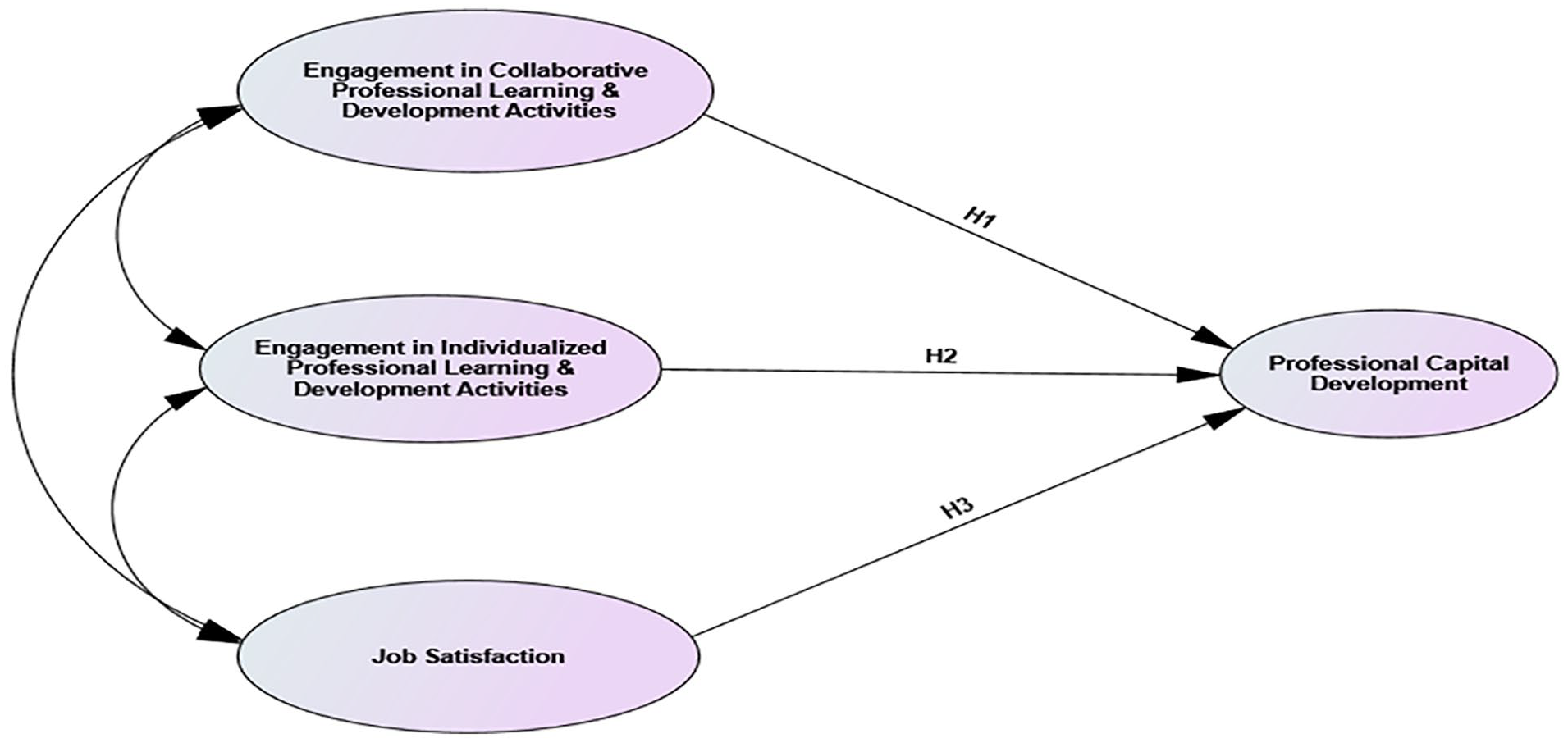
A hypothesized structural equation model.
Research Hypotheses
Based on the aforementioned theoretical end empirical evidence, the current study tested the following three alternative hypotheses.
H1: Teachers’ level of engagement in collaborative professional learning and development activities has a significant contribution to their professional capital development.
H2: Teachers’ level of engagement in individualized professional learning and development activities would have a significant contribution to their professional capital development.
H3: Teachers’ job satisfaction has a significant effect on their professional capital development.
Method
Participants
The sample consisted of 379 teachers randomly selected from Awi district primary schools, Ethiopia. The sampling procedure had gone through three stages. First, 4 local administrations (woredas) were selected randomly from 12. Second, 12 primary schools that comprised grade levels ranging from grade 1 to 8 were chosen from selected local administrations, as 3 schools were randomly selected from each local administration. Finally, 400 (male = 250 and female = 150) teachers were recruited in this study. However, 380 sample teachers returned the filled-in questionnaire, thereby showing a 95% response rate. Since one participant had 28% missed data, the data from 379 (male = 247 and female = 132) teachers were reported in the study. The age of sample teachers ranged from under 25 years to above 50 years, while most of them (77.04%) had between 25 and 39 years of age. Regarding their educational level, a large number of the sample teachers (77.6%) had a diploma and a very small number of them had certificates (0.3%) and master’s degrees (0.5%). Furthermore, the majority (44.6%) of sample teachers had teaching experience that ranged from 8 to 15 years, followed by those who had between 4 and 7 years (27.2%) of teaching experience.
Variables and instrumentation
As aforementioned, this study examined the contribution of teachers’ level of engagement in collaborative and individualized professional learning and development activities and job satisfaction to their professional capital development using structural modeling. The study had one endogenous variable (teachers’ professional capital development) and three exogenous variables (teachers’ engagement in collaborative professional learning, engagement in individualized professional learning, and job satisfaction).
Teachers’ professional capital
Professional capital is an integrative function of teachers’ human capital, social capital, and decisional capital (Hargreaves & Fullan, 2012). Based on this theoretical perspective, professional capital was conceptualized as a second-order factor measured with three first-order factors, namely human capital, social capital, and decisional capital. Teachers’ professional capital development was a second-order endogenous (dependent) variable measured with human capital, social capital, and decisional capital as first-order factors. Based on Hargreaves and Fullan’s (2012) original model, in the present study, teachers’ professional capital is defined as a composite of human capital, social capital, and decisional capital that represents teachers’ professional assets.
In this study, human capital pertains to teachers’ view of whether the career opportunities provided within school improved their professional growth and practices, the professional feedback they received had improved their professional practice, they were able to access and consult with specialists to improve their teaching practice, and the school’s priority to attract highly effective teachers (Hargreaves & Fullan, 2012). Likewise, social capital refers to teachers’ reliance on the professional guidance and support of other teachers, regular participation in teacher collaboration meetings, and improvement in teachers’ instructional practice because of collaborating with other teachers. Moreover, decisional capital denotes teachers’ ability to: provide evidence of what worked and what did not in their lesson, reflect on how well their lessons are going while they are teaching, take time to reflect on what did not work in their teaching, and figure out how to do things better next time as well as confidence in their ability to mentor or coach other teachers (Hargreaves & Fullan, 2012).
In the present study, researchers adapted and used Hargreaves and Fullan’s (2012) questionnaire devised to survey teachers’ professional capital. Researchers assumed that the three sub-constructs are intercorrelated because each is a manifest indicator of the underlying construct of teacher professional capital. Initially, the scale had 36 items as suggested in Hargreaves and Fullan (2012), all measured with a 6-point Likert-type scale that ranged from 1 (strongly disagree) to 6 (strongly agree). However, after a series of iterations, factor analyses (EFA and CFA) identified 11 items of the scale by eliminating items with cross-loadings and low factor loadings (<0.6) to establish construct validity. This measurement scale consisted of three dimensions: (1) human capital (four items, α = .849, e.g., “Professional feedbacks I received in this school improved my professional practice”); (2) social capital (three items, α = .818, e.g., “I rely on the teachers I work within this school for professional guidance and support”); and (3) decisional capital (four items, α = .844, e.g., “I am confident in my ability to mentor or coach other teachers”).
Teachers’ engagement in collaborative professional learning and development activities
This construct focused on the teachers’ level of engagement in continuing collaborative professional development activities such as team teaching, collaborative action research, and visiting schools to share good practices, which were established by the Ethiopian Ministry of Education (MoE, 2009) on national teachers’ continuous professional development (CPD) documents. Based on MoE (2009), we initially developed 12 items to measure this construct. However, we identified three appropriate items to teachers’ level of engagement in continuing collaborative professional learning activities through a series of iterations of factor analyses (EFA and CFA) by eliminating five items with high cross-loadings and four items with low factor loadings (<0.6) to establish construct validity. Hence, in the current study, engagement in collaborative professional learning activities entails teachers’ level of participation in team teaching, conducting collaborative action research, and visiting other schools to see examples of good practices. The construct was measured using a 6-point Likert-type engagement frequency scale that ranged from 1 (never) to 6 (always). The scale comprised three items (α = .806, e.g., “I engage in conducting collaborative action research”).
Teachers’ engagement in individualized professional learning and development activities
This exogenous construct focused on teachers’ level of engagement in individualized continuing professional development activities such as reading professional literature and textbooks, receiving and providing constructive feedback from learners, preparing teaching materials, and other activities which were established by the Ministry of Education (MoE, 2009) on national teachers’ continuous professional development (CPD) documents. Based on MoE (2009), researchers initially developed 12 items to measure teachers’ engagement in individual professional learning and development activities. However, eight items were retained to measure teachers’ level of engagement in individualized professional learning activities after a series of iterations of factor analyses that eliminated two items with high cross-loadings and two items with low factor loadings. Hence, engagement in individualized professional learning activities entails teachers’ level of teachers’ level of involvement in reading professional literature, studying textbooks and lesson material thoroughly and regularly, making their teaching materials, using students’ reactions to improve their classroom teaching, talking to their students, and providing constructive feedback for students’ future development. The construct was measured using a 6-point Likert-type engagement frequency scale that ranged from 1 (never) to 6 (always). The scale comprised eight items (α = .919, e.g., “I engage in reading professional literature”).
Teachers’ job satisfaction
This construct focused on teachers’ level of satisfaction with the teaching profession and their school environment. The scale was adapted from OECD (2020). Initially, researchers adapted eight items that were originally developed by OECD (2020), all measured with a 6-point Likert-type scale that ranged from 1 (strongly disagree) to 6 (strongly agree). After a series of iterations, factor analyses identified three items of the scale used to measure teacher job satisfaction by eliminating two items with high cross-loadings and three items with low factor loadings (<0.6). As a result, the final measurement scale had three items (α = .821, e.g., “I am satisfied with my job; I enjoy working at this school”). Hence, job satisfaction measures teachers’ satisfaction with the school environment and teaching profession.
Data screening and multivariate assumptions testing
Before testing models with the variables of interest, all cases and variables were checked for unengaged responses, missed values, multivariate outliers, and influential scores as well as multivariate statistical model assumptions. To determine unengaged responses, we assessed each respondent’s likelihood of answering each research question, in the same way, using standard deviation. Unengaged responses subject to deletion are presumed to have a standard deviation value less than .25 (Collier, 2020), indicating the respondent answering each research question in the same way. In the current study, the standard deviation for each respondent’s responses was greater than .65, which is above the threshold standard deviation value. Regarding missed data, Hair et al. (2019) argue that the “observations with up to 10% missing data are generally acceptable and amenable to any imputation strategy” (p. 62). Based on this view, only one respondent with 30% missed data was excluded, while five respondents’ data with <1% missed values were imputed for analysis purposes. Moreover, we assessed multivariate outliers and influential scores using Mahalanobis’s D and Cook’s D, respectively. Hair et al. (2019) suggested a significance level threshold of .001 to determine multivariate outliers using Mahalanobis distance. Responses that had Mahalanobis’s D value with a significance level (p-value) less than .001 were assumed multivariate outliers and those with Cook’s D >1 were assumed influential values. In the current study, SPSS output indicated no multivariate outliers and influential scores, as evidenced in significance levels for Mahalanobis D ranged .0013 to .999 and Cook’s D ranged .000 to .067.
Assumptions were tested to determine the adequate quality of data for factor analysis. To test the linearity of relationships among variables included in the model, we performed curve estimation for all relationships on our model and determined that all relationships were sufficiently linear to be tested using covariance-based structural equation modeling using AMOS. The relationship between teachers’ job satisfaction and their professional capital was significantly linear, F(1, 378) = 5,283.769, R2 = .933, p < .001. As well, the relationship between teachers’ level of engagement in collaborative professional learning activities and their professional capital was significantly linear, F(1,378) = 5,138.597, R2 = .931, p < .001. Also, the relationship between teachers’ level of engagement in individualized professional learning activities and their professional capital was significantly linear, F(1,378) = 14,167.886, R2 = .931, p < .001 These results attested that the relationships between independent and dependent variables were sufficiently linear, thereby indicating the possibility to conduct structural equation modeling using AMOS. In the same vein, the multicollinearity assumption was tested by computing the variance inflation factor (VIF). SPSS output showed that variance inflation factor (VIF) values ranged from 1.083 to 1.228 (<10), thereby ensuring the absence of multicollinearity issues and the possibility to test a hypothesized structural equation model using AMOS.
Furthermore, the normality assumption was checked using skew and kurtosis values based on the rule of thumb suggested by Collier (2020). Data are presumed normally distributed if the range of skew values is between −2 and +2, and the range of kurtosis values is between −10 to +10 (Collier, 2020). In this study, skew values ranged from −0.398 to −1.629, while kurtosis values ranged from −0.764 to 3.122, thereby affirming the normal distribution of data.
Results
Initially, the adequacy of the sampling was assessed using Kaiser–Meyer–Olkin’s (KMO) test, while the existence of significant correlations among variables was assessed using Bartlett’s test of Sphericity (Hair et al., 2019). KMO value greater than 0.5 indicates adequate sample size and a significant Bartlett’s Test indicates that the correlation matrix has significant correlations among at least some of the variables, indicating the data is suitable for factor analysis (Hair et al., 2019). The results showed KMO values greater than 0.71 and Bartlett’s test significant (p < .001), which affirmed the data suitability for factor analysis. Given this evidence, exploratory factor analysis (EFA) was conducted using the maximum likelihood estimation (ML) method followed by Promax rotation to determine the structural dimensions of the constructs (factors) and to eliminate items with high cross-loadings and with factor loading estimates less than the threshold value (0.4; Hair et al., 2019; Ho, 2006; Kline, 2016). Based on the EFA result, CFA was performed using AMOS 23 to assess the fit of the measurement model and confirm the reliability and validity of the constructs. Finally, SEM analysis was performed to examine the effects of teachers’ level of engagement in individual and collaborative professional learning activities and job satisfaction on professional capital development.
Exploratory Factor Analysis Results
In EFA, we used the maximum likelihood extraction method with Promax rotation (oblique rotation), and factors with eigenvalues greater than or equal to 1 were retained, while items with less than 0.4 value factor loadings were suppressed. Factor analysis results showed that professional capital had three factors, engagement in professional learning two-factors construct and job satisfaction single-factor. The factor loadings of professional capital items ranged from 0.437 to 0.877. Items that measured teachers’ engagement in collaborative professional learning activities had factor loadings that ranged from 0.522 to 0.851, while items that measured teachers’ engagement in individualized professional learning activities had factor loadings that ranged from 0.552 to 0.860. Factor loadings for items measured teachers’ job satisfaction ranged between 0.489 and 0.834.
Confirmatory Factor Analysis Results
Based on the EFA results, CFA was conducted with the data from 379 sample primary school teachers using AMOS to develop an adequate measurement model. Initially, observed indicators (items) for each latent variable and a variable to designate metric value within each latent variable were identified using a unidimensional CFA test, resulting in the deletion of items with factor loading less than the threshold (<0.7) for latent factors that had convergent validity issues (AVE < .5). To do so, we scaled latent variables by fixing marker variables’ values to 1. The researchers assessed the standardized factor loadings of each indicator against a threshold value of 0.70 for factors with unacceptable convergent validity (AVE < .5) and against a threshold value of 0.60 for factors with acceptable convergent validity (AVE > .5) as suggested in recent literature (Collier, 2020). In this study, we used the relative chi-square test (χ2/df), Tucker–Lewis Index (TLI), Comparative Fit Index (CFI), Incremental Fit Index (IFI), Root Mean Square Error of Approximation (RMSEA), and Standardized Root Mean Square Residual (SRMR) to determine whether or not the developed measurement model fitted to the sample data. In multivariate statistics literature, the relative chi-square test (χ2/df) <5 is labeled as an acceptable fit while its value <3 is considered as a good fit. Also, TLI, CFI, and IFI values of 0.90 or above, as well as RMSEA and SRMR values of 0.08 or below, indicate an adequate fit of the measurement model to the sample data (Collier, 2020; Hair et al., 2019). As two constructs (social capital and decisional capital) had serious discriminant validity problems (MSV > AVE), the initial measurement model required modification to establish construct validity. Consequently, we performed measurement model modification using AMOS suggested modification indices and step-by-step deletion of items (observed variables) that had a standardized factor loading less than the threshold value of 0.70. Finally, PC7 (β = .68), PC11 (β = .65), PC12 (β = .64), PC17 (β = .65), Sat (β = .49), Eng2 (β = .58), Eng6 (β = .59), and Eng16 (β = .56) were removed to establish construct validity.
As the CFA result showed, the unstandardized regression weights were all statistically significant by the critical ratio test (>±1.96, p < .001) except those items fixed to a value of 1. The unstandardized regression coefficients ranged from .712 (Sat4) to .991 (PC3). As depicted in Table 1, standardized factor loading values of all included variables ranged from 0.633 to 0.867. This indicated that measurement variables were significantly represented by their respective latent constructs. The explained variances for observed variables were represented by their squared multiple correlations (R2). Variance explained ranged from .401 or 40.1% (PC4) to .751 or 75.1% (PC1) for measured variables, thereby indicating the percentage of unexplained variances (residuals) that ranged from 59.9% to 24.9%, respectively. Furthermore, the measurement model achieved good model fit (χ2 = 619.349, df = 260, p < .001, χ2/df = 2.382, CFI = 0.933, TLI = 0.923, IFI = 0.934, RMSEA = 0.06, SRMR = 0.0476) that established the reliability and validity of constructs. Table 1 depicts the details of CFA results.
Confirmatory Factor Analysis.

Note. Model Fit Statistics (χ2 = 619.349, df = 260, p < .001, χ2/df = 2.382, CFI = 0.933, TLI = 0.923, IFI =0.934, RMSEA = 0.06, SRMR =0.0476).
Items constrained for identification purposes.
Figure 2 presents the standardized estimates and model fit indices of the final measurement model established using CFA.

Measurement model after deletion of items.
Reliability, Convergent Validity, and Discriminant Validity Analysis
After establishing the final measurement model through CFA, internal consistency reliability analysis for each factor was performed using SPSS version 23. As a result, the Cronbach’s alpha (α) coefficients ranged from .806 to .919 for the variables used in the analysis, thereby affirming good internal consistency among items within each construct. Based on the CFA results, the constructs (professional capital, engagement in individualized and collaborative professional learning, and job satisfaction) measured by multiple items were tested for composite reliability and convergent and discriminant validity. The correlation matrix showed that the composite reliability (CR) of each latent variable was acceptable (i.e., >0.7) in CFA and ranged from .810 to .920. Likewise, the maximum reliability ranged from .825 to .921. In addition, the average variance extracted (AVE) of each latent variable was also acceptable (i.e., >0.5) with a range varying from .579 to .618, which confirmed the convergent validity of the measurement model and indicated that the variables within a single latent factor were highly correlated. Since AVE was greater than maximum shared variance (MSV) and the square root of AVE was greater than inter-construct correlations of all latent variables, it was confirmed that the measurement model had adequate discriminant validity, entailing that variables had significantly high correlation with variables intended to measure their major latent factor. Simply put, the square root of AVE for all latent variables that ranged from .761 to .786 was greater than inter-construct correlations of all latent variables that ranged from .300 to .746, affirming acceptable discriminant validity evidenced by variables strongly correlated to their factor than to another factor. Hence, the measurement model had no reliability and validity concerns, suggesting the possibility of performing CFA and structural regression model using maximum likelihood approach in AMOS (Table 2).
Reliabilities, Convergent, and Discriminant Validities.
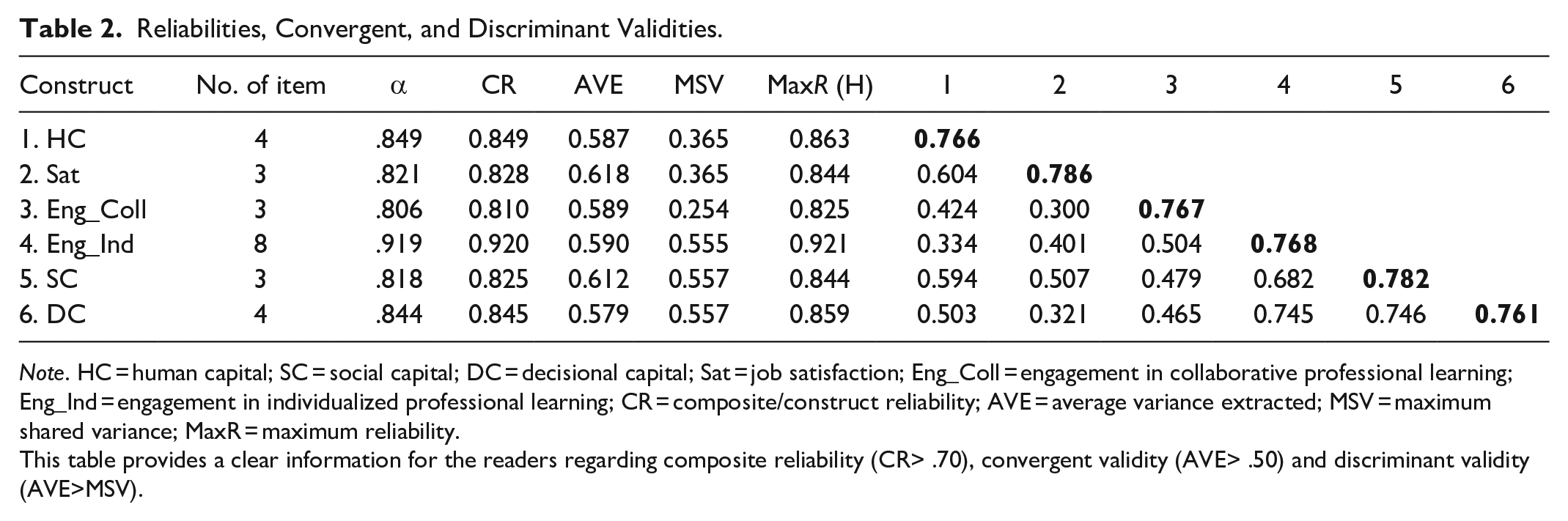
Note. HC = human capital; SC = social capital; DC = decisional capital; Sat = job satisfaction; Eng_Coll = engagement in collaborative professional learning; Eng_Ind = engagement in individualized professional learning; CR = composite/construct reliability; AVE = average variance extracted; MSV = maximum shared variance; MaxR = maximum reliability.This table provides a clear information for the readers regarding composite reliability (CR> .70), convergent validity (AVE> .50) and discriminant validity (AVE>MSV).
Structural equation model test results
Collier (2020) suggested reporting standardized regression weights, t-values, model fit statistics, and R2 values of dependent constructs with the structural model. As indicated in Table 3, unstandardized regression weights were all statistically significant by the critical ratio test (>+1.96, p < .001) (except for those parameters fixed to 1). The standardized estimates indicated that the teachers’ level of engagement in collaborative professional learning activities significantly contributed to their professional capital development (β = .179, CR = 3.262, p = .001). This implies that teachers with a higher engagement in collaborative professional learning activities show greater professional capital.
Structural Model Test Results.
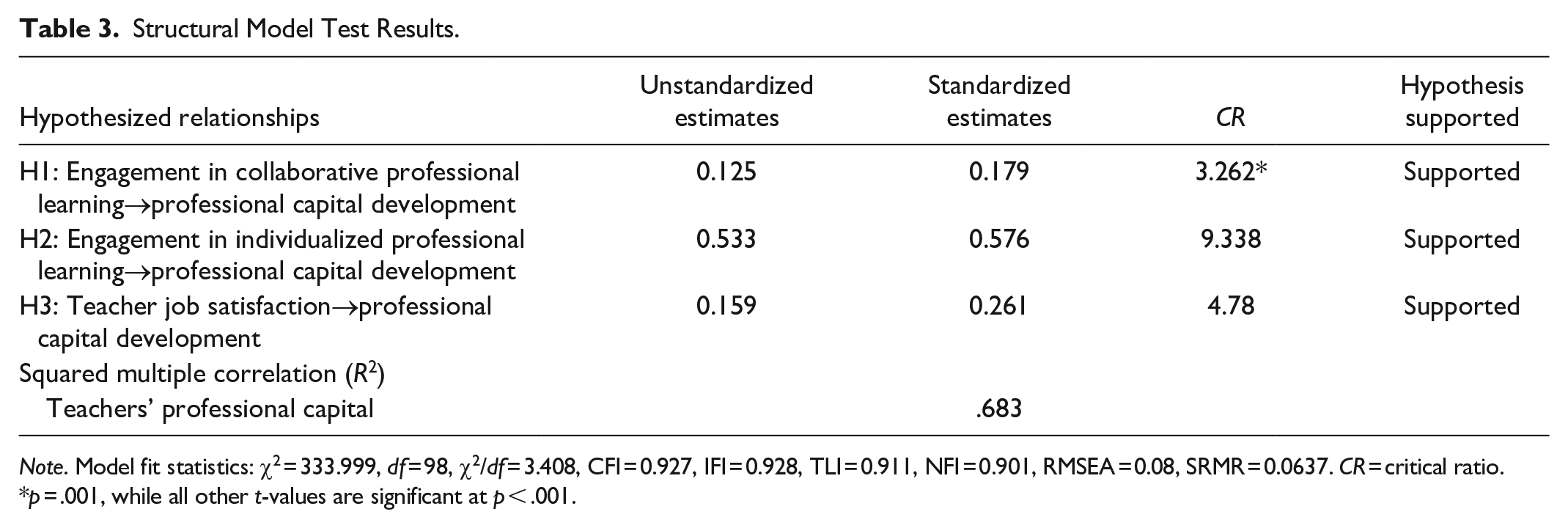
Note. Model fit statistics: χ2 = 333.999, df = 98, χ2/df = 3.408, CFI = 0.927, IFI = 0.928, TLI = 0.911, NFI = 0.901, RMSEA = 0.08, SRMR = 0.0637. CR = critical ratio.
p = .001, while all other t-values are significant at p < .001.
Standardized regression results also showed that teachers’ engagement in individualized professional learning activities (β = .576, CR = 9.338, p < .001) and job satisfaction (β = .261, CR = 4.78, p < .001) had a significant positive contribution to their professional capital development. This implies that teachers with a higher engagement in individualized professional learning activities show greater professional capital. Likewise, teachers with higher job satisfaction show greater professional capital. As the standardized regression weights indicated, teachers’ level of engagement in individualized professional learning activities (.576) has a relatively stronger influence on professional capital development, followed by the influence of teacher job satisfaction (.261) and engagement in collaborative professional learning activities (.179).
Squared multiple correlations (R2) results showed that teachers’ engagement in collaborative learning, engagement in individualized learning, and job satisfaction accounted for .683 or 68.3% variance of their professional capital development, thereby indicating .317 or 31.7% unexplained variance. This structural model achieved adequate model fit (χ2 = 333.999, df = 98, χ2/df = 3.408, CFI = 0.927, IFI = 0.928, TLI = 0.911, NFI = 0.901, RMSEA = 0.08, SRMR = 0.0637). Figure 3 portrays pictorially the effect of teacher job satisfaction, teacher engagement in collaborative and individual professional learning activities on their professional capital development.

Structural equation model with standardized estimates.
Discussion
The purpose of this study was to examine the contribution of teachers’ level of engagement in collaborative and individualized professional learning and development activities and job satisfaction on their professional capital development using the structural equation model. The results showed a significantly positive contribution of teachers’ level of engagement in both individualized and collaborative professional learning and development activities on their professional capital development.
This finding is consistent with previous results (Watts, 2018) that showed a positive influence of teachers’ professional development on their professional capital development within the schools. Likewise, our findings corroborated the existing evidence that has shown a significant contribution of teachers’ level of engagement in individual and collaborative professional learning activities to building their professional capital (Sintayehu, 2021).
Simply put, the study has also revealed that the teachers’ time of engagement in collaborative and networking activities of professional development had a significant contribution to their social capital development (Watts, 2018). Specifically, the above-mentioned results regarding the effects of engagement in collaborative professional learning support previous findings in the literature that indicated the great contribution of teamwork and collaborative learning in building teachers’ professional capital, especially social capital (Hargreaves & Fullan, 2012; Ikoma, 2016; OECD, 2014; Thoonen et al., 2011). Specifically, Hargreaves and Fullan (2012) note that a purposeful use of teamwork is the most powerful strategy that provides teachers with opportunities to learn from each other within and across schools as well as to build “cultures and networks of communication, learning, trust, and collaboration around the team” (p. 89). Likewise, OECD (2014) indicated the importance of collaboration between teachers for their overall professional development and learning which led to high teacher professional capital.
Our finding also lends support to the previous study (Campbell et al., 2016) that showed a positive contribution of the experiences of teachers in individual and collaborative professional learning to their professional capital development. According to Campbell et al. (2016), individual and collective professional learning that enables and values teachers’ professional judgment and influence are powerful in building teachers’ decisional capital. They also showed that teachers engaged in developing and expanding professional learning communities, collaborative inquiry, and networking beyond their classrooms, schools, and local education systems are capable of developing their social capital. Furthermore, professional learning and development programs that provide teachers with an opportunity to “learn and innovate in the area of their choice” (human capital development), to “engage in critical inquiry, reflection, professional dialogue, and collaborative learning” (social capital development), and to “lead projects and teams toward developing and sharing improved professional knowledge, skills and practices” (decisional capital development) significantly contributed to teachers’ overall professional capital development (Campbell et al., 2016, p. 231). These results suggest the importance of supporting teachers’ engagement in self-directed individual and collaborative professional activities as well as their involvement in the decision-making process to realize the goal of professional capital development in a way that ensures a successful education system.
As far as professional capital development is concerned, all aspects of teacher professional learning and development programs must deliberately work in ways that “actively recognize and develop teacher professional expertise, particularly within their everyday practice, and enhance each teacher’s capacity to function as empowered and valued professionals” (Smith, 2017, p.15). Smith also explained that professional learning programs devised to develop teachers’ professional capital support them to build their knowledge, skills, and capabilities in ways that enable them to maximize their improvement—human capital development. Such programs also foster teachers’ engagement in collaborative model learning through interaction to develop the levels of trust that contribute to their mutual learning—social capital development (Smith, 2017).
The present study also found a significant direct effect of teachers’ job satisfaction on their professional capital development. This result corroborates the previous studies’ results that have shown that the teachers’ job satisfaction had a significant relationship with their intention to stay in the profession, their performance, and professionalism (Jain & Verma, 2014; Pilarta, 2015; Toropova et al., 2020; Werang & Agung, 2017). The aforementioned findings also concur well with a previous study that indicated a strong relationship between teachers’ perception of job satisfaction, including their satisfaction with profession and work environment and professionalism (OECD, 2016).
Moreover, our finding corroborates the Teaching and Learning International Survey (TALIS) findings of OECD (2014) which showed that the teachers with a high level of job satisfaction reported that they had high professional abilities and skills (human capital development). This study also indicated a strong relationship between teachers’ job satisfaction and their involvement in school-wide decision-making (decisional capital development). In addition, this study showed a significant relationship between teachers’ job satisfaction and their collaborative relationship with the school community (social capital development). Similarly, another study has shown that teachers’ job satisfaction had a significant contribution to retaining quality teachers within the profession (professional capital development) (OECD, 2020). In this study, teachers’ job satisfaction with the teaching profession and with the current work environment showed a positive relationship with teachers’ self-confidence in their ability and skill to teach (human capital). Furthermore, our finding is consistent with recent research result that has shown a positive and strong association between teachers’ job satisfaction and their professional capital development (Sintayehu, 2021). These results suggest the importance of maximizing teachers’ job satisfaction with the profession and with the work environment to build their professional capital in a way that benefits their improvement, students’ learning, and the whole education system.
Conclusion
This study set out to determine the effect of teachers’ engagement in professional learning and development and job satisfaction on their professional capital development using structural equation modeling. Theoretically, teacher professional capital is a higher-order concept defined as an integrated function of three sub-constructs namely, human capital, social capital, and decisional capital. Consistent with Hargreaves and Fullan’s (2012) original model of professional capital in the teaching profession, the present study established the concept of professional capital as a mix of human capital, social capital, and decisional capital using second-order confirmatory factor analysis. The study also attempted to extend teacher professional capital development determinants research by indicating how teachers’ engagement in professional learning and development endeavors and job satisfaction were related to their professional capital development. In conclusion, this study foregrounded the importance of teacher-level factors in building professional capital in the teaching profession.
Taken together, the present study makes three noteworthy contributions. First, this research extends our knowledge of teacher-level determinants of professional capital development in primary schools by providing new and solid evidence on the relationships between teachers’ level of engagement in professional learning activities, job satisfaction, and teachers’ professional capital development through rigorous application of structural equation modeling. Thus, our study uniquely foregrounded the importance of teacher-level factors in building professional capital in the teaching profession. Second, the current findings add to a growing body of literature on professional capital development that highly recognizes the importance of individual and collaborative investment to boost professional capital in the teaching profession and transform the overall educational system. Moreover, as professional capital in the teaching profession is an emerging issue, the present study may serve as a base for future studies that would be interested in exploring the powerful determinants of teachers’ professional capital development both at individual and institutional levels, including pre-service and in-service teacher education and development.
Implications
Given the recent education policy reform and curriculum change induced by the Ethiopian education development roadmap (MoE, 2018) and currently under pilot program implementation, building teachers’ professional capital becomes imperative to let teachers cope with the demands of the new education policy and curriculum. Our findings suggest that building teachers’ professional capital depends on their level of engagement in both individualized and collaborative professional learning activities. At the national level, the ministry of education needs to devise a need-driven and self-directed professional learning program because the teachers are adults and self-directed learners who want to participate in self-directed professional learning activities both individually and in a group (Smith, 2017). Besides, at the local or school level, education officials and school leaders need to institute a positive school climate that promotes teachers’ active involvement in self-directed professional learning activities, such as visiting other schools, team teaching, conducting collaborative action research, reading professional literature, textbooks, and lesson material thoroughly and regularly, preparing teaching materials, self-reflection, and using student feedback to improve their classroom teaching. To promote teacher participation in diverse self-directed professional learning activities, providing both monetary and non-monetary support is a key factor (OECD, 2014).
The current study’s findings also show a positive and significant association between teachers’ engagement in professional learning activities and their job satisfaction, suggesting the importance of satisfaction with job and work environment in promoting teachers’ participation in professional learning and development activities. Likewise, our findings indicate a significant influence of teachers’ job satisfaction on their professional capital development. Therefore, intensifying teachers’ job satisfaction by fulfilling their professional, economic, social, and psychological demands is important to the efforts of building professional capital in the schools. Because of that low salary, poor incentive mechanisms, and poor working environment of the school are mostly mentioned reasons for teacher dissatisfaction, especially in Ethiopian schools (Aweke, 2015; Gedefaw, 2012; Hilina, 2011; Mahlet, 2017), improving remuneration, financial and nonfinancial incentive mechanisms, and instituting conducive working conditions within schools may help step-up teachers’ satisfaction with job and work environment to boost their professional capital.
Limitations and Future Research
Despite promising contributions of this study to professional capital theory and research, acknowledging its limitations is very important. First, the current study is completely correlational and limits causal interpretations. Therefore, further research could provide empirical evidence on the causal effect of teachers’ engagement in individualized professional learning, engagement in collaborative learning, and job satisfaction on their professional capital development using experimental designs. Second, the current study did not explain 31.7% of the variance in teachers’ professional capital. Thus, future research will incorporate other important teachers-level factors such as self-efficacy, self-image, and motivation to better explain the variance in teachers’ professional capital development.
Footnotes
Declaration of Conflicting Interests
The author(s) declared no potential conflicts of interest with respect to the research, authorship, and/or publication of this article.
Funding
The author(s) received no financial support for the research, authorship, and/or publication of this article.
