




Abstract
Involuntary autobiographical memories are memories of personal events that come to mind without an intentional attempt at retrieval. Previous studies have shown that positive involuntary autobiographical memory retrieval improves negative mood, known as the mood repair effect, in daily life. However, the cues relating to involuntary autobiographical memories were not controlled in these previous studies, and the mood repair effect has not been shown experimentally. Therefore, this study aimed to experimentally examine the mood repair effect of positive involuntary autobiographical memory among Japanese adults. After a pilot study to select cue words, we examined whether positive involuntary autobiographical memory retrieval could improve negative mood. As a result, mood improvement was enhanced by positive memory being recalled involuntarily, while mood improvement was shown with and without the retrieval of the positive involuntary autobiographical memory. Therefore, the mood repair effect by positive IAM was shown even after preventing the influence of the emotional valence of retrieval cues. From these results, the mood repair effect of positive involuntary autobiographical memory retrieval was experimentally demonstrated among Japanese adults.
Keywords
Introduction
Involuntary autobiographical memories (IAMs) are memories of personal events that come to mind without an intentional attempt to retrieve them (Berntsen, 2010). IAMs are retrieved around 20 times per day, equal to or more frequent than voluntary autobiographical memories (Rasmussen & Berntsen, 2011; Rasmussen et al., 2015), which are intentionally recalled in a goal-oriented manner. Also, the emotional valence of IAMs is predominantly positive in daily life, at least in healthy individuals (e.g., Berntsen & Hall, 2004; Rasmussen et al., 2014; Watson et al., 2012). Therefore, positive IAMs may help an individual maintain and improve mood states in everyday life (Clark et al., 2013), and it has been suggested that one function of positive IAMs is the mood repair effect (e.g., Rasmussen & Berntsen, 2011). However, the mood repair effect of positive IAMs is not demonstrated because the other factors that influence mood improvement (e.g., the emotional valence of retrieval cues) are not controlled in previous research. Thus, this study examined the mood repair effect under controlled experimental conditions.
The mood repair effect is the improvement of negative mood, and some previous studies have shown that this effect is obtained following the retrieval of positive autobiographical memories (e.g., Erber & Erber, 1994; Josephson et al., 1996). In experimental psychological studies, the mood repair effect has been shown mainly in voluntary autobiographical memory (e.g., Joormann & Siemer, 2004; Matsumoto & Mochizuki, 2018). For example, Joormann and Siemer (2004) examined the mood repair effect by asking participants to recall positive autobiographical memories in high school. Matsumoto and Mochizuki (2018) presented a cue (e.g., happy) that was more likely to recall a positive memory and asked for memory recall from the cue. In both studies, participants were explicitly instructed to recall their memories, and they recalled them in a goal-oriented manner (i.e., voluntary autobiographical memory). Participants’ mood states were measured before and after the positive voluntary autobiographical memory recall task. As a result, positive voluntary autobiographical memories improved negative mood, demonstrating the mood repair effect.
On the other hand, a few studies examined the mood repair effect as one of the functions of IAM using the diary method, in which participants were asked to note their IAM experiences in daily life (Rasmussen & Berntsen, 2011; Rasmussen et al., 2015; Yamamoto et al., 2018). Rasmussen and Berntsen (2011) asked participants to select functions of IAM from a list (e.g., problem solving, emotion regulation). The results showed that about 13% of all IAMs involved emotion regulation (i.e., mood repair effect). Yamamoto et al. (2018) asked for open-ended responses on how IAMs influenced emotions and subsequent behavior. The study revealed that people recognized the positive mood induction effect of the retrieval of positive IAMs, such as “I felt happy.”
These studies suggested that positive IAMs improve negative mood. However, the diary method has difficulties controlling various factors that influence mood states because the situation at the time of involuntary retrieval is participant-dependent in this method. In particular, the majority of IAMs are elicited by prior external stimuli as the retrieval cue (e.g., Ball & Little, 2006; Berntsen & Hall, 2004), and these stimuli are an important factor that influences the mood state. For example, music can trigger IAMs (Amemiya et al., 2011), even though listening to music itself improves mood (Thayer et al., 1994). Therefore, it is difficult to discriminate between the effects of IAM on mood and the effects of retrieval cue on mood using the diary method. To overcome this problem, it is necessary to examine the mood repair effect of positive IAM in a controlled experiment.
One previous study pointed out this problem with the diary method and experimentally examined the mood repair effect by using the positive involuntary picture memory, controlling the emotional valence of retrieval cues (Hashimoto et al., 2019). Hashimoto et al. (2019) compared the difference in the mood repair effect between voluntary and involuntary memory retrieval for depressed and non-depressed people using the experimental method. To control the emotional valence of retrieval cues, they used positive pictures as the retrieval object and neutral sounds as the retrieval cue. They showed that involuntary memory improved negative mood in depressed individuals as compared to voluntary memory. However, there was no significant difference between voluntary and involuntary memories in non-depressed individuals. In other words, the degree of mood improvement was equivalent between the voluntary and involuntary memory conditions in non-depressed individuals. Given that positive voluntary memory improves negative mood (e.g., Joormann & Siemer, 2004), these results suggest that positive involuntary memory improves negative mood to the same extent as positive voluntary memory, at least in non-depressed individuals. However, there are two limitations in Hashimoto et al. (2019). First, the retrieval object was not the autobiographical memory but the affective picture, which was completely irrelevant to participants’ past experiences. Therefore, it is unclear whether the positive IAM, which is recollection of the participants’ past experience, also improves negative mood. Although the affective picture is a useful tool to control the content of memories, it is important to conduct a study that is relevant to our daily lives (i.e., autobiographical memory; Neisser, 1978). Second, it remains possible that the monotonous task used to induce the involuntary memory improved the mood state. Hashimoto et al. (2019) used a simple attention task to induce involuntary memories, and it is known that such monotonous tasks improve negative mood as distractions (McRae et al., 2010; Van Dillen & Koole, 2007). Moreover, they set only the involuntary memory condition (and the voluntary memory condition) but did not set the control condition. Therefore, this study sets a no-retrieval condition as the control condition, which conducts the monotonous task without retrieving any IAMs, in order to distinguish between mood improvement by positive IAM and by the monotonous task.
The standard experimental method for IAM is the vigilance task by Schlagman and Kvavilashvili (2008). In this task, participants are engaged in a monotonous task involving the detection of rarely-presented vertical lines in a stream of horizontal lines, to induce boredom. Simultaneously, a stream of short sentences is presented as retrieval cues for IAM. If participants retrieve an IAM, they interrupt the vigilance task and report the IAM. This method is usually used in experimental IAM studies, with several minor modifications (e.g., Barzykowski & Niedźwieńska, 2016; Vannucci et al., 2015).
This study also uses the vigilance task to induce the positive IAM, but modifies several points. One major modification point is the retrieval cue. Previous studies (e.g., Schlagman & Kvavilashvili, 2008) did not restrict the emotional valence of IAMs, and presented many retrieval cues with positive, neutral, and negative emotional valences. On the other hand, we need to only induce positive IAMs to examine the mood repair effect of positive IAM. If we use the same experimental paradigm as previous studies (e.g., Schlagman & Kvavilashvili, 2008), participants may retrieve IAMs with various emotional valences (i.e., positive, neutral, and negative IAMs). Therefore, we used positive stimuli as retrieval cues because the emotional valence of the retrieval cue aligns with the emotional valence of the IAM (Schlagman & Kvavilashvili, 2008). The details of the vigilance task and the other modifications are referred to in the vigilance task section.
This study aimed to demonstrate the mood repair effects of positive IAM. Specifically, we measured the mood states before and after the IAM retrieval task. Additionally, we compared the mood states of the positive IAM condition and the no-retrieval condition as the control condition to control the emotional valence of retrieval cues and the mood improvement by the monotonous task. There were two similarities in both conditions. First, we used stimuli with equivalent emotional valence to control the emotional valence of retrieval cues, that is, positive stimuli to induce positive IAMs (i.e., retrieval cues) were used in the positive IAM condition; in the no-retrieval condition, we used equivalent positive stimuli, but no IAMs were induced. Second, we conducted the same monotonous task (i.e., the vigilance task) between the two conditions to control mood improvement from the task itself. The difference was in the retrieval of IAM: retrieving positive IAMs in the positive IAM condition and not retrieving any IAMs in the no-retrieval condition. We predicted that the mood state after the retrieval of positive IAM would be more positive than the mood state before retrieval. More importantly, if positive IAM, regardless of the retrieval cue and the monotonous task, improves negative mood, it is predicted that the positive IAM condition improves negative mood more than the no-retrieval condition.
The mood repair effect of positive IAM was suggested not only in Western countries (e.g., Rasmussen & Berntsen, 2011) but also in Eastern countries, including Japan (Hashimoto et al., 2019; Yamamoto et al., 2018). Although there are no studies comparing the mood repair effect of positive IAM between Western and Eastern countries, previous studies in Japan that used the diary method (Yamamoto et al., 2018) and affective pictures (Hashimoto et al., 2019) showed the mood repair effect of positive involuntary memory. Therefore, our study may reveal the universality of the mood repair effect of positive IAM. Unfortunately, no studies in Japan have examined IAM using vigilance tasks. Therefore, kanji words (i.e., the Japanese language) need to be selected as retrieval cues before the main experiment.
To this end, in this study, first, we conducted a pilot study to select the stimuli used in the main experiment. Then, we examined the mood repair effect of positive IAM as the main experiment.
Pilot Study
The aim of the pilot study was to select three types of words used in the main experiment. Two types corresponded to two conditions: (a) cue words for positive IAMs (hereafter referred to as “positive words inducing IAM”) corresponding to the positive IAM condition and (b) words with equal emotional valence as positive words inducing IAM, but without inducing IAM (hereafter referred to as “positive words non-inducing IAM”) corresponding to the no-retrieval condition. We also selected words that had little influence on the experiment (i.e., neutral emotional valence and not inducing IAM) as filler words to use in the vigilance task (hereafter referred to as “neutral words”).
Methods
Participants
We asked 87 individuals to volunteer for this research; responses were obtained from 78 participants (43 females, Mage = 25.0 years, SD = 4.1, 21–56 years old). The participants were recruited from a university and other environments by the first author through convenience sampling. The sample size was determined based on the procedure of Schlagman and Kvavilashvili (2008) to select retrieval cues. This study was conducted with the approval of the Ethics Review Committee of the graduate school to which the first author belongs. We explained that (a) the data obtained will be processed statistically, the individuals will not be identified or disclosed, and (b) the data will not be used for any purpose other than research. We asked the participants to respond to the research if they consented to these explanations.
Stimuli
We selected 1,080 two-compound kanji words from Gotoh and Ohta (2001) and Kawakami (1999), excluding negative words, because the present study focused on positive memory. Although previous studies have often used short sentences as cues for IAMs (e.g., Schlagman & Kvavilashvili, 2008), we used words as cues because words also led to sufficient IAMs (Amemiya & Sekiguchi, 2006; Mazzoni et al., 2014) and because of the ease of controlling emotional valence.
Procedure
The research was conducted on the Internet, and we asked participants to respond to three questions (Figure 1). The first question was how one’s emotional state was affected by the presented word (1: very negative and 7: very positive). In the second question, we asked whether a past personal event was spontaneously retrieved from a word (none, general memory, and specific memory). If the response to the second question was general memory or specific memory, participants were asked to evaluate the emotional valence of this memory in the third question (1: very negative and 7: very positive). Each participant responded to 90 or 180 words.

The procedure of the pilot study.
Participants were told that the research aimed to select words to use in the other experiment. After participants rated the word “年月” (years and months) as a practice trial, they started responding to the study stimuli.
Results
For each word, we calculated the rate of retrieval by dividing the number of participants who retrieved an involuntary memory by the total number of respondents. Specifically, if the response was specific memory or general memory, we considered it as involuntary memory. We selected nine positive words inducing IAM (“旅行” [travel], “友人” [friend], “縁側” [veranda], “元日” [New Year’s Day], “高校” [high school], “勝利” [victory], “遠足” [excursion], “進学” [going on to school of high grade)], and “公園” [park]; emotional valence of words: M = 5.50, SD = 0.26, emotional valence of memories: M = 5.54, SD = 0.45, mean rate of retrieval = 0.95), and eight positive words non-inducing IAM (“好転” [change for the better], “好調” [well], “最良” [best], “有効” [effective], “納得” [consent], “最適” [optimal], “特選” [special selection], and “明朗” [cheerful]; emotional valence of words: M = 5.44, SD = 0.23, mean rate of retrieval = 0.16). Emotional valence of words between inducing and non-inducing positive words was equal (t (14) = −0.50, p = .63). Additionally, we selected 30 neutral words (e.g., “商船” [merchant ship], “灌漑” [irrigation], “公算” [probability]; emotional valence of words: M = 4.00, SD = 0.15, mean rate of retrieval = 0.00). All words were two-compound kanji words in Japanese.
Main Experiment
The main experiment aimed to examine the mood repair effect through positive IAM. For this purpose, we compared mood states before and after the retrieval task of IAM (i.e., vigilance task) with the no-retrieval condition as the control.
Methods
Participants
About 29 individuals participated in the experiment (18 females, Mage = 21.3, SD = 3.1, 18–33 years old and 1 participant’s age was unknown). Five participants were added to the sample size in Rasmussen & Berntsen’s (2011) study (24 participants in the IAM condition). The reason for this addition was that there was a likelihood that some participants might not retrieve any positive IAMs. We explained the experiment to participants in writing and orally, and written informed consent was obtained from all participants.
Experimental design
This experiment used a 2 × 2 within-factorial design: retrieval condition (positive IAM, no-retrieval) and mood measurement (pre-mood and post-mood). The positive IAM condition was the condition in which one positive IAM was retrieved. The no-retrieval condition was the condition that no memories were retrieved.
Negative mood induction
We selected 120 negative pictures (emotional valence below 4.00, range 1–9) from the International Affective Picture System (IAPS; Lang et al., 2008) to induce negative mood. A total of 120 pictures were divided into 12 sets (each set included 10 pictures), among which 8 sets were used per participant.
Mood measurement
Participants rated their own mood using a 9-point scale (1: very negative, 5: neither, and 9: very positive). Mood measurements were conducted before and after the vigilance task (pre-mood and post-mood).
Procedures
This study repeated the task flow series eight times (Figure 2). Task flow for one session consisted of negative mood induction, mood measurement before the vigilance task (i.e., pre-mood), the vigilance task (details in the vigilance task section), mood measurement after the vigilance task (i.e., post-mood), and the questionnaire about the IAM. The positive IAM condition and the no-retrieval condition were conducted using the same task flow four times each (i.e., total of eight times). The difference between the two conditions was the presented words in the vigilance task. That is, positive words inducing IAM were presented in the positive IAM condition, while positive words non-inducing IAM were presented in the no-retrieval condition. The order of two conditions was mixed and randomized.

Overall flow of the experiment.
The experimenter told participants that the aim of this experiment was to measure concentration during the monotonous task. Before beginning the experiment, the flow of the experiment was explained to the participants and they were instructed that the same task flow would be repeated. Almost all the experimental tasks were automatically controlled by a program running on Psychopy v1.84.2 (Peirce et al., 2019).
At the beginning of each session, negative mood was induced. Each negative picture in the 10-picture set was presented for 6 seconds. After the mood induction, participants were asked to rate their mood state and, as a filler question, predict their concentration on the next task (1: not concentrate at all and 9: concentrate very well). Subsequently, the vigilance task began after the presentation of a black fixation cross on the center of the screen for 1.5 seconds. After the vigilance task ended, participants again rated their mood state and their actual concentration on the task (1: not concentrated at all and 9: concentrated very well).
Next, a question was presented on the screen as follows: “Was a past event remembered ‘involuntarily’ in the task (i.e., the vigilance task)?” If participants retrieved a past event, they pressed the “Y” key; if not, they pressed the “N” key. In the case of pressing the “Y” key, participants were asked to complete a questionnaire with 17 items related to the memory (Table 1). The questionnaire was constructed using items referred to in Cole et al. (2016); additionally, some original questions were added by the authors. The reason for requiring the report on IAM after the vigilance task, rather than during the task, was to control for task time and task contents across conditions. If more than one memory was retrieved during the vigilance task, we asked participants to respond only to the last retrieved memory. After completing the questionnaire, the next task flow was started. If the “N” key was pressed, the questionnaire was omitted and participants proceeded to the next task flow. The average duration of one task flow was around 7 minutes.
Items on the Autobiographical Memory Questionnaire.

After completing all task flows, participants were debriefed about the actual purpose of this experiment and we obtained their approval for the false instruction. At the end of the experiment, we confirmed participants’ mood state, and if they felt negative mood, we presented positive pictures from the IAPS.
The vigilance task
We conducted the vigilance task to induce IAMs similarly to Schlagman and Kvavilashvili (2008), but we modified several points fitting our purpose. The flow of our vigilance task is shown in Figure 3. In our vigilance task, a stream of words was presented on the center of the screen, and the color of words was different. We asked participants to detect one target color (red, blue, green, or orange) and press the spacebar if the target color was presented as the filler task in order to induce boredom. In Schlagman and Kvavilashvili (2008), it did not matter if some cues were ignored, because many cues (800 cues) were presented and they did not aim to retrieve IAMs from any specific cues; however, our task required ensuring that participants paid attention to the cue, because we induced the positive IAM from a few specific cues. Assignment of target color was counterbalanced among participants.

The flow of the vigilance task.
One image included a word in a color and was presented for 3 seconds. For the first 15 to 25 images, one neutral word was repeatedly presented in different four colors. The order of color presentation was pseudo-random for each participant. For the next 15 to 25 images, one neutral word, different from the previously presented one, was repeatedly presented in the four different colors. For the last 15 to 25 images, one positive word was presented repeatedly in the four different colors. In the IAM condition, the positive word was a positive word inducing IAM, whereas in the no-retrieval condition, the positive word did not induce IAM (Procedures section). The total number of presented images in one session was 60. The appearance of the target color happened 6 times and the other three colors were shown 18 times each. The duration of the vigilance task in one session was 3 minutes (i.e., 60 images × 3 seconds). The task duration was short compared to the original vigilance task (above 20 minutes; Schlagman & Kvavilashvili, 2008) because we were concerned that mood could naturally improve during a long task duration whether the positive IAM was retrieved or not.
The definition of positive IAM
We defined reported memories as positive IAM if participants answered as follows in the questionnaire (Table 1): First, the response was “I just involuntarily retrieved” to the question “How was the event retrieved?” (Question 3). Second, the response was “Yes” to the question “Is the retrieved event your own experience in the past?” (Question 6). Third, the rating was “4” or “5” to the question “Is the retrieved event positive or negative?” (1: very negative and 5: very positive; question 13). These indicated that the retrieved memories were unintentional retrievals of their own past experiences (i.e., IAM) and were rated as emotionally positive.
Data analysis
First, we conducted a test for independence to determine the relationship between the retrievals and presented words. Then, as the main analysis to examine mood repair, we conducted a repeated two-way analysis of variance (ANOVA) with the retrieval conditions (positive IAM and no retrieval) and mood measurements (pre-mood and post-mood) as the within-subject factors. In addition, as a sub-analysis to examine the effect of positive IAM on mood repair, we conducted a multiple regression analysis with the mean score of post-mood in all eight sessions as the objective variable, the number of retrieved positive IAMs as the explanatory variable, and the mean score of pre-mood in all eight sessions as the control.
Results
One participant dropped out of the experiment and was excluded from all analyses. Analyses were performed in R 4.0.2 (R Core Team, 2020). The mean percentage of correct responses to the target color was 98.1% (SD = 4.9) for all participants.
The relationship between positive IAM and the types of presented word
Fourteen participants were excluded from the analysis because they did not retrieve any positive IAMs. In the data of the remaining 14 participants, we calculated both the number of times they retrieved positive IAMs and did not retrieve any memories for the two types of the presented word (i.e., positive word inducing and non-inducing IAM; Table 2). We tested for independence in the relationship between the retrievals and the presented words, and no significant effect was found (χ2 (1) = 0.64, p = .43, ϕ = .12). This result indicated that the number of positive IAMs was not different between positive word inducing and non-inducing IAM. In particular, this suggested that positive words inducing IAM did not function as the retrieval cue. Therefore, regardless of presented words, we set the condition where positive IAMs were actually retrieved as the positive IAM condition (25 times total) and set the condition where no memories were actually retrieved as the no-retrieval condition (53 times total). The characteristics of positive IAMs are presented in Table 3.
The Numbers of Occurrences for Retrieved Positive IAMs and No Retrieval of Memories in the Two Types of the Presented Word.

The Characteristics of Positive IAMs.

The rates of specific memories (%).
Mood repair effect
For each combination of retrieval conditions (i.e., positive IAM and no-retrieval) and mood measurements (i.e., pre- and post-mood), we calculated the median of mood scores in sessions as the index of the mood score for each participant. To examine mood repair, we conducted a repeated two-way analysis of variance (ANOVA) on the mean of this index among participants in the retrieval conditions (positive IAM and no retrieval) and mood measurements (pre- and post-mood) as the within-subject factors (Figure 4). We found that the main effect of mood measurement (F (1, 13) = 27.30, p < .001, η2 p = .68) and the interaction (F (1, 13) = 5.69, p = .03, η2 p = .30) effect was significant, whereas the main effect of retrieval condition was not significant (F (1, 13) = 0.18, p = .68, η2 p = .01). The analysis of the simple main effect demonstrated that post-mood in the positive IAM condition was the higher than in the no-retrieval condition (t (13) = 2.06, p = .03, d = 0.55, one-tailed). We conducted a post-hoc power analysis using G*power (Faul et al., 2007) with an effect size η2 p = .30, α = .05, sample size = 14. As a result, sufficient power was confirmed (1 − β = .99).

Mean for pre- and post-mood state with and without positive IAM. Higher values indicate positive mood (error bars = SE. *p < .05. ***p < .001).
Although we did not aim to retrieve neutral IAMs, participants retrieved a few neutral IAMs, but with an insufficient number of retrievals to set a neutral IAM condition. As the explanatory analysis, we compared the mood change of neutral IAM added to the no-retrieval condition to the positive IAM condition. The two-way ANOVA showed that the main effect of mood measurement was significant (F (1, 16) = 36.16, p < .001, η2 p = .69) and the interaction was marginally significant (F (1, 16) = 3.86, p = .07, η2 p = .19). Although the interaction was marginally significant, the analysis of the simple main effect demonstrated that the positive IAM condition was higher than the no-retrieval added to neutral IAM condition in the post-mood (t (13) = 1.85, p = .04, d = 0.45, one-tailed).
Additionally, to examine the effect of positive IAM on mood repair, we conducted a multiple regression analysis adding the 14 participants (n = 28) who did not retrieve any positive IAMs (i.e., the number of positive IAMs = 0) with the mean score of post-mood in all eight sessions as the objective variable, the number of retrieved positive IAMs as the explanatory variable, and the mean score of pre-mood in all eight sessions as the control. The result indicated that higher numbers of positive IAMs significantly predicted higher positive post-mood state (β = .25, p = .02; Figure 5).
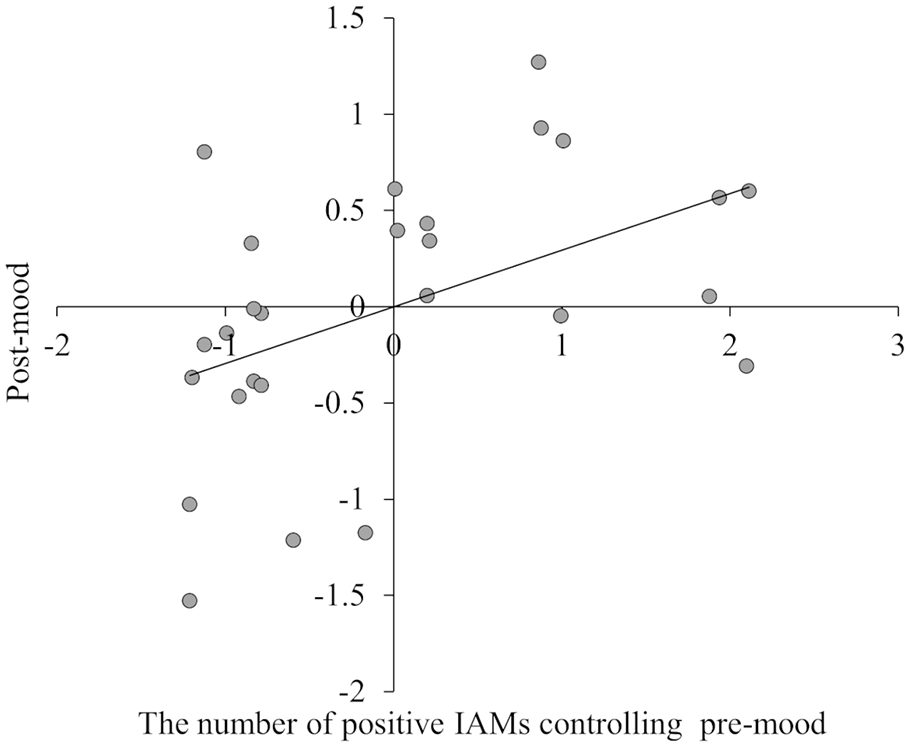
The scatter plot between post-mood and the number of positive IAMs controlling pre-mood. The higher score for post-mood indicated more positive mood.
Discussion
The purpose of the present study is to demonstrate the mood repair effect of positive IAM. We predicted that the mood state after the retrieval of positive IAM would be more positive than the mood state before retrieval, and predicted that the positive IAM condition would improve negative mood more than the no-retrieval condition. We found that the post-mood state with the positive IAM showed more improvement than the no-retrieval condition, while the post-mood state was more positive than pre-mood state in both conditions. Additionally, the more positive IAMs were retrieved, the more the mood state was positive. These results showed that the positive IAM enhanced mood improvement (i.e., the mood repair effect).
Previous studies using daily-life paradigms had difficulties controlling various factors, particularly the emotional valence of the retrieval cue that influence mood states (e.g., Rasmussen & Berntsen, 2011). One previous study examined the mood repair effect using the involuntary positive picture memory under the controlled experiment (Hashimoto et al., 2019), but not using the IAM and not setting the control condition. To overcome these limitations, we compared the mood state after the retrieval of positive IAM and no retrieval, using the equivalent emotional valence of positive words. As a result, the positive IAM condition improved negative mood more than the no-retrieval condition. This result showed that positive IAM improves negative mood regardless of the retrieval cue and the conduction of the monotonous task. Additionally, in the case of the neutral IAMs with the no-retrieval condition, although the difference post-mood between conditions was small, the enhancement of positive IAM to the mood repair effect was retained. Therefore, the present study provides experimental evidence of the mood repair effect of positive IAM.
It has been shown that the greater the number of positive IAMs, the more positive the mood state after their retrieval. This result also supports the mood repair effect of positive IAM and suggests that positive IAM contributes to good mood state constancy in our daily life. The emotional valence of IAMs is predominantly positive in daily life (e.g., Berntsen & Hall, 2004; Rasmussen et al., 2014; Watson et al., 2012), but not enough is known about why positive IAMs are frequently retrieved. Our results suggest that we may be able to keep a good mood state by retrieving many positive IAMs in daily life. Additionally, from the clinical perspective, it is suggested that positive IAM improves negative mood in depressed people but positive voluntary autobiographical memories do not improve their mood (Hashimoto et al., 2019; Watson et al., 2012). Therefore, positive IAMs may be retrieved to live a mentally healthy life, as one function of IAM.
From a clinical perspective, it has been suggested that positive IAM is also useful among people with deficits in voluntary autobiographical memory. For example, depressed people (Joormann & Siemer, 2004) and children with autism spectrum disorder (ASD; Bruck et al., 2007) have deficits in voluntary autobiographical memories. One of the factors common in them is poor executive function (Dalgleish et al., 2007; Goddard et al., 2014), that is, the impairment of cognitive function that causes difficulties in voluntary retrieval. On the other hand, IAMs may be functional in these individuals because the retrieval of IAMs requires little executive function (Berntsen, 2010). Positive voluntary autobiographical memories do not improve negative mood in depressed individuals (Joormann & Siemer, 2004), while positive IAMs have been suggested to improve negative mood in them (Hashimoto et al., 2019; Watson et al., 2012). A focus on positive IAMs may help people with mood or developmental disorders in future studies.
An additional suggestion is the universality of the mood repair effect by positive IAM, regardless of culture. Previous studies have suggested that positive IAMs improve negative mood not only in Western culture (e.g., Rasmussen & Berntsen, 2011) but also in Eastern cultures such as Japan (Hashimoto et al., 2019; Yamamoto et al., 2018). In this study, we showed that positive IAMs improve negative mood among Japanese adults and suggest that the mood repair effect is a common function of autobiographical memory among a variety of cultures. In voluntary autobiographical memory studies, the function of autobiographical memory is compared between Western and Eastern countries (for a review, Ross & Wang, 2010), and it has been shown that Japanese people use voluntary autobiographical memories less than American people (Maki et al., 2015). On the other hand, no studies have compared the mood repair effects of positive IAM in different cultures. A direct comparison in future studies may show whether the functions of IAM are universal.
The manipulation of the retrieval of positive IAMs is one major limitation in this study. We tried to manipulate the condition with and without the retrieval of the positive IAM by using positive words inducing and not inducing positive IAM. However, no relationship was found between the presented words and the retrieval of positive IAMs. It is possible that a retrieval cue does not always trigger IAMs; conversely, a stimulus that is unlikely to trigger IAMs may lead to IAMs. In other words, it is suggested that the certain retrieval of IAMs is difficult and the certain not-retrieval of IAMs is also difficult. For increasing the certainty of IAM retrieval, a clearer connection between autobiographical memories and retrieval cues may be needed. In previous studies, the retrieval rates of IAMs (the number of memories/the number of cues) were very low, specifically about 1% (Barzykowski & Niedźwieńska, 2016; Barzykowski et al., 2019; Schlagman & Kvavilashvili, 2008; Vannucci et al., 2015). For example, in Barzykowski et al. (2019), 393 IAMs were retrieved by 28,000 cues (i.e., a retrieval rate of 1.4%) among 35 participants in the IAM condition. On the other hand, the retrieval rates of memories using emotional pictures were increased to around 20%, because the pictures were explicitly linked to retrieval cues within the experiment (Staugaard & Berntsen, 2014, 2019). Therefore, it may be important to previously combine the cues with the IAMs when it is necessary for the retrieval of IAMs of a specific nature, as in the present study.
As another explanation for the lack of stable retrieval of IAMs, it is important to confirm whether the vigilance task satisfies the low cognitive load, because IAMs are more likely to be retrieved in situations with lower cognitive load (Barzykowski & Niedźwieńska, 2018; Vannucci et al., 2015). The vigilance task itself had a low cognitive load, because the mean percentage of correct responses to the detection of color in the task was very high (98.1%). Additionally, many previous studies used real-time reporting of IAMs during vigilance tasks (e.g., Schlagman & Kvavilashvili, 2008). This method has been noted to be burdensome because of the need to monitor one’s own thoughts during the task (Vannucci et al., 2014). On the other hand, we did not require online monitoring during the vigilance task, but we asked participants to report IAMs after the task. Based on the above two points, it is suggested that the low cognitive load was sufficient in our vigilance task.
There are five other limitations to this study. First, in relation to the above major limitation, the sample of the pilot study was likely to be biased because we conducted convenience sampling. This bias might influence the non-relationship between retrieval cues and the retrieval of positive IAMs. The second is in ensuring the involuntariness at retrieval. If the memory is recalled fluently (i.e., immediately after the retrieval starts) with preceding attempts at retrieval, it is assessed by the participants to be involuntary (Sanson et al., 2020). Thus, the assessment of voluntariness at retrieval by the participants themselves is one way to confirm the involuntariness, but it may be difficult to ensure it at the retrieval, because this method is retrospective. It is necessary to ensure the involuntariness at retrieval in a way that does not depend on the participants’ own evaluation. Third, we asked participants to report only one IAM that was retrieved during the vigilance task. In this method, it is possible that the retrieval of other memories could not be confirmed and the IAM that is retrieved was, in fact, forgotten. However, at least the positive IAMs, which could be reported in retrospect, were shown to contribute to the improvement of mood. Fourth, although positive IAMs enhanced improvements during post-mood more than the neutral IAM added to no-retrieval, the mood repair effect of the positive and neutral IAMs could not be compared directly in this study because of the insufficient number of neutral IAMs retrieved. In other words, the difference of the mood repair effect by the emotional valences of the IAM (i.e., positive IAM and neutral IAM) is not clear. Although it may be difficult to induce neutral IAMs using retrieval cues with equal emotional valence to positive IAMs, direct comparison between positive and neutral IAMs should be examined in future studies to clarify the mood repair effect of the positive IAM. Fifth, the number of participants included in our main analysis (i.e., ANOVA) was limited because of the experimental paradigm. We clarified that half of participants possibly drop out from the study because many people could not involuntarily retrieve positive memory even if we controlled the things to be remembered. Therefore, the experimental paradigm is room for improvement and it is important to keep sample size throughout the experiment.
Conclusion
The present study aimed to demonstrate the mood repair effect of positive IAM and examined it under a controlled experimental condition. We found that positive IAM enhances mood, as was expected. This result shows that positive IAM improves mood regardless of retrieval cues and suggests that positive IAMs play a role of maintaining and improving mood state in our daily life.
Footnotes
Author Contributions
All authors contributed to the study design. Junya Hashimoto conducted the experiment, performed analyses, and wrote the original draft. Noriaki Kanayama, Makoto Miyatani, and Takashi Nakao reviewed and edited the draft. Makoto Miyatani supervised the study.
Declaration of Conflicting Interest
The author(s) declared the following potential conflicts of interest with respect to the research, authorship, and/or publication of this article:
Funding
The author(s) disclosed receipt of the following financial support for the research, authorship, and/or publication of this article: This work was partially supported by JST Center of Innovation Program, grant number JPMJCE1311 and by JST COI Acceleration Support, grant number JPMJCA2208.
Ethical Approval
This study was conducted with the approval of the Ethics Review Committee of Hiroshima University.
