




Abstract
Most researchers have studied students’ academic self-concept within native language and mathematics, indicating the multidimensional nature of academic self-concept. However, there is a shortage of studies that examined the twofold multidimensional structure of verbal self-concept within the internal/external frame of reference (I/E) model of two foreign languages. This study aims to examine affective and cognitive components of English and Russian self-concepts for defining the separation or conflation of these components within the I/E model and evaluate cognitive and affective components across gender. A total of 540 eighth-grade Azeri students participated in this study. Confirmatory factor analysis indicated self-concept structure as twofold multidimensional, distinguishing affective and cognitive components as two different constructs. Study of the I/E model of two language self-concepts showed that Russian achievement correlated with Russian cognitive self-concept and English cognitive self-concept related to English achievement. One general verbal self-concept for different languages may not adequately represent multilingual learners and can produce misleading interpretations. The relationship between the two dimensions of self-concept in two target languages was invariant. The results of this study should encourage researchers to examine subject-specific self-concepts that conceptualize cognitive and affective dimensions of the self-concept and their relationships with achievement.
Academic self-concept is defined as a person’s perception of academic ability that develops through interactions and experience in learning domains (Marsh & Martin, 2011). Research (Abu-Hilal et al., 2013; Arens et al., 2011) has found that cognitive factors influenced on academic achievement. Shavelson et al. (1976) conceptualized the self-concept structure as multidimensional and hierarchical, dividing a global self-concept into academic and nonacademic components. Although the present understanding of the multidimensional structure of self-concept can be found in Williams, 2017 (1890/1963) seminal work, The Principles of Psychology, where he proposed the self as multifaceted and hierarchical that played an essential role in the conceptualization of self-concept theory, previous research on self-concept was based on unidimensional perspective. However, as research on the unidimensional perspective of self-concept failed to capture the richness and specificity of the different components of self-concept, this approach was criticized (Rosenberg et al., 1995).
A meta-analysis of Möller et al. (2009) on 69 data sets (N = 125,308) concluded self-concept as multidimensional and hierarchical, indicating close to 0 (.10) correlation between mathematics and verbal self-concepts. Furthermore, academic self-concept was revealed to be distinguishable into more specific domains (facets) for specific school subjects. Yeung and Wong (2004) found that each language had distinctive self-concept structures that were unrelated to each other. They also found a negative correlation between Cantonese and Mandarin self-concepts (r = –.11). However, most researchers (e.g., Marsh, 1986) have concentrated on traditional self-concept domains, such as mathematics and verbal domains. Marsh and his colleagues (2020) examined juxtaposition of psychological operations by incorporating social and dimensional comparison theories that were based on synthesis of five contradictory frame-of-reference and contextual effects in self-concept development at multiple levels. They found theoretical and empirical contribution to juxtaposition of psychological operations that influenced self-beliefs and their relationships to distal results. Arens et al. (2020) studied methodologies that were the essential models implying the structure of academic self-concept and examined their inherent psychometric properties. Each academic self-concept construct had its contributions and disadvantages with regard to various research issues and suggested attentive review in selecting a distinct academic self-concept construct.
In contrast, this study examines cognitive and affective dimensions of verbal self-concept in two target languages arguing for the twofold multidimensional nature of the verbal domain. Moreover, most studies (e.g., Marsh, 1986) have examined students’ verbal self-concept in the native language. Therefore, there is a lack in the research which studied twofold multidimensional verbal self-concept in foreign verbal domain.
Domain Specificity of Self-Concept and Relation With Achievement
Throughout the years, various studies (Erten & Burden, 2014; Marsh & Hattie, 1996) have been conducted to explore relations between academic achievement and academic self-concept. Revealing the domain specificity of self-concepts, most studies (Calsyn & Kenny, 1977; Hansford & Hattie, 1982; Marsh & Hattie, 1996) have proposed two models such as the skill-development model and the self-enhancement model. The skill-development model suggests that self-concept in a particular domain is a consequence of achievement in that domain. In contrast, the self-enhancement model presumes that self-concept in a particular domain is the primary determinant of academic achievement (Marsh & O’Mara, 2008).
Moreover, the internal/external (I/E) frame of the reference model is the consequence of social comparison and the skill-development models, which implies that achievement in a specific school subject can positively predict self-concept in that specific school subject (Marsh, 1986), but achievement in one school subject can negatively predict self-concept in another school subject. Marsh et al. (2006) determined that, in an external (normative) frame of reference, students compared their self-perceived performances in a particular school subject and other external standards of actual achievement levels, while in an internal (within-self) frame of reference students compared their performance in one particular subject with the other school subject.
Early research (Marsh, 1986) on the I/E model has revealed strong contrast effects between mathematical and verbal domains. Dimensional comparison theory suggests two kinds of comparisons. A dissimilarity occurs when achievement in a particular domain indicates a negative effect on self-concepts in another domain, whereas an assimilation effect implies that achievement in a particular domain indicates a positive effect on self-concepts in another domain. Further research (Chiu, 2008; Marsh et al., 2001) studied these two effects within various domains, such as Marsh et al. (2001) and found contrast effects between two verbal subjects, while Chiu (2008) explored contrast effects between science and mathematics. Karimova and Csapó (2020) extended the classical I/E model by contrasting the mathematics domain with two foreign languages (English and Russian) and found separate subject-specific self-concepts for each school subject. However, there is a shortage of studies that examined these effects within two foreign language self-concepts.
The main purpose of developing the I/E model was to explain why mathematics and verbal self-concepts were not correlated although their achievements were correlated. As individuals tend to evaluate themselves in different ways, people perceive themselves as either a mathematics person or a verbal person but not both (Marsh & Hau, 2004). Möller et al. (2006) extended the I/E model by examining physics and English as a foreign language, and their findings supported the existence of separate specific subject domains. Yeung and Wong (2004) found four domain-specific self-concepts for each language, revealing a negative correlation between Cantonese and Mandarin. They emphasized the impossibility of using a single verbal self-concept construct that involved a third language of multilingual speakers. Karimova and Csapó (2021) examined the twofold multidimensional structure of reading self-concept in two foreign languages and found better fit of separate dimensions of the reading self-concept model than a conflated model. Most empirical studies in cross-sectional and longitudinal research (Marsh et al., 1988, 2001, 2012, 2014; Marsh & Koller, 2004; Marsh & Yeung, 1998; Möller et al., 2011) have supported this frame of reference. This experimental approach to the self-concept was also confirmed by studying the relationship between self-beliefs and achievement (Marsh et al., 2001; Xu et al., 2013). However, there is a shortage of research that studied the I/E frame of reference within two foreign languages.
Separation of Cognitive and Affective Components of Self-Concepts
The main research goal in modern self-concept research is to examine the controversial question of whether each separate domain of academic self-concept is further differentiable into cognitive and affective components. (Arens et al., 2011).
Shavelson et al. (1976) reported the impossibility of differentiating self-description (affective) from self-evaluation (cognitive) components of self-concept. However, Harter (1990) explored both components of self-concept. Irwing (1996) proposed a distinction between cognitive and affective components of self-concept. In the cognitive component, students construct the self by examining their abilities with peers within a reference group, which corresponds to social influences. In the affective component, students construct the self by comparing their abilities in one domain with their qualities in another domain, which corresponds to personal or psychological influences. The former implies the external frame (social comparison), whereas the latter one constitutes the internal frame of reference.
Furthermore, to support one’s self-concept, Swann (1997) proposed a theory of self-verification. Self-verification processes were differentiated into two dimensions of self-competence (cognitive) and self-liking (affective), which functioned differently. Particularly, an individual with low self-liking would search for feedback to approve their unlikable self. In contrast, another student with low self-competence would search for feedback that demonstrated their perceived incompetence. Marsh et al. (1999) revealed that separating the cognitive and affective components of self-concept would produce better fitting models than conflating two components. Likewise, Deci and Ryan (2000) distinguished the cognitive component of self-concept from the affective component, indicating the importance of the former one over the latter.
Bong and Skaalvik (2003) concluded that the question of whether the cognitive and affective components of self-concept might be empirically differentiated had not been solved. Marsh and Köller (2003) found a distinction between the cognitive and affective components of self-concept, arguing that even if students were not good at mathematics, being their best subject, they would still have a favorable mathematics self-concept. Arens et al. (2011) revealed that regardless of the high correlations between cognitive and affective dimensions of self-concept, mathematics and language subjects of academic achievement had different correlations with the two components of self-concept. Similar findings of Marsh et al. (1999), and Arens et al. (2011) showed that models would fit better to the data if the two components were separated rather than conflated as there was a higher relationship between achievement with the corresponding domain of self-concept than affective component (cognitive math: r = .61, verbal r = .63; affective math: r = .37, verbal: r = .33; cited in Karimova & Csapó, 2021)
Moreover, some studies (Arens et al., 2011, 2014; Marsh & Ayotte, 2003; Marsh et al., 2012) examined the twofold multidimensional structure of self-concept within different countries and cultures. Studying the twofold multidimensional nature of native (Chinese) and nonnative (English) languages, Yang et al. (2014) found that Chinese vocational students distinguished between two dimensions of academic self-concept. Abu-Hilal et al. (2013) investigated cognitive and affective dimensions of mathematics and science self-concepts. They revealed a clear distinction between two components, indicating that the achievement of the matching domain showed stronger relationships with the cognitive components than affective components. As a cognitive dimension implied ability belief and affective component implied attitude toward the corresponding domain, results expected to indicate the separation between two components. Nevertheless, there is a lack of research that studied the twofold multidimensional structure of self-concept within two target languages.
The Study
The study aimed (a) to reveal whether there is a separation or conflation between cognitive and affective components of verbal self-concept if we divide assessment items equally into cognitive and affective components, (b) to validate self-concept structure in the verbal domain by examining the assumption of a single verbal self-concept for different language learners, and (c) to evaluate cognitive ad affective components of the verbal self-concept construct across gender. Arens et al. (2011) claimed that “as self-concept was a latent construct that could not be directly observed, rigorous scrutiny was required for validity to establish” (p. 971). Therefore, this study applied within-network and between-network approaches employing a confirmatory factor analysis framework to produce clear relationships between two components of academic self-concept. As the cognitive dimension implied a student’s self-perception of ability, the study hypothesized that achievement would be more highly correlated with the cognitive component than the affective component of the corresponding subject domain of self-concept. Most studies (Möller et al., 2009) have examined mathematics and language domains of self-concept, which were traditional subjects of academic self-concept. This study investigates cognitive and affective components of self-concept within the verbal domain to reveal the distinct verbal self-concept structure for each language and determine whether one single verbal domain can represent a learner’s self-concept in different languages.
Method
Participants
Participants of the present study were eighth-grade secondary students (N = 540; boys 48.9%, girls 51.1%) of Baku city secondary schools (16 schools of 12 districts) in Azerbaijan. All participants’ native language was Azerbaijani. From the first grade, students studied the first foreign language 3 hr per week, which was English. The second foreign language (Russian) was studied in the fifth grade for an hour per week (Ministry of Education of Azerbaijan Republic [MoE], 2012). Program for International Student Assessment (PISA, Organisation for Economic Co-operation and Development [OECD], 2018) indicated the indifference in material and insufficiency within staff between advantaged and disadvantaged schools. Different ability–level students were clustered in the same schools. They completed online achievement tests in English as a first and Russian as a second foreign language (see also the study Karimova & Csapó, 2020). For online assessment, the Electronic Diagnostic Assessment (eDia) online platform was used (Csapó & Molnár, 2019; see also the study Karimova & Csapó, 2021). This study attempted to include all (12) administrative districts to provide the best representation. The Baku Educational Department randomly selected schools.
Procedure
The eighth-grade students were randomly selected without considering their background characteristics. Students’ participation in the achievement tests was obligatory, but participation in the survey was voluntarily. The study required parental consent and it was obtained. However, the author explained the purpose of the study and additional explanatory information was included to facilitate and support student understanding. Collection of data began by completing achievement tests in two sequential periods, each lasting 45 min, with a 15-min break in between. Afterward, the verbal self-concept questionnaire was completed and took around 25 min. Achievement tests and the questionnaire were administered by the author. All participants were guaranteed anonymity and confidentiality of their answers.
Instruments
Administered achievement tests comprised listening and reading tasks (Table 1). These tests were adapted from language test booklets from Célnyelvi mérés (2013–2014; see also Karimova & Csapó, 2020). They were skill-specific (reading and listening) tests that had been created by experts and instructors (psychometric properties of tests; see Csapó & Nikolov, 2009; Nikolov & Szabó, 2015; see also Karimova & Csapó, 2020). These tests were based on the national curriculum of Hungary and constructed to correspond to the A2 level of the 6-point scale based on the Common European Framework of Reference for Language (Council of Europe, 2001, see also Karimova & Csapó, 2021). This was similar to the Karimova and Csapó (2020) study, which stated, two-way translators were engaged in translating the achievement tests into Russian to ensure clear understanding, and the tests consisted of the same number of tasks, comprising A2 levels in English and Russian (Table 1). The focus of the tasks was on meaning (not form), and the texts were authentic and adequate for students aged 12-14 years old. Weighted likelihood estimates (WLEs; Warm, 1989) were used to compute students’ ability from the test items using the software ConQuest 2.0 (Wu et al., 2007). The WLE reliabilities were good to excellent for assessed achievements in two skills in each of the two target languages. Total WLE reliability of English is .88 and Russian is .91. These two receptive skills were combined to represent the language (English and Russian) achievement domain (p. 8).
The Structure and Content of Language Tests.

Similar to the Karimova and Csapó (2020) study, “students’ verbal self-concepts were evaluated by adapting the Self-Description Questionnaire II (Marsh, 1990) in the two-target language scales without mentioning skill-specificity (pp. 8-9).” The questionnaire was internationally validated and recently used by most studies on academic self-concept research (Arens et al., 2011; Bong, 1998; Marsh et al., 2020; Yang et al., 2014). The same two-way translation procedure was implemented to translate the questionnaire into Azerbaijani. The same items were used in both target languages, and students were asked to consider about only one respective domain while responding to the items (see also Table 4 for discriminant validity). Original questionnaire SDQ ll (Marsh, 1990) consisted of four items for each domain that this study adapted only three items. As Hair et al. (2018) emphasized that for statistical identification of latent factors, latent constructs should be evaluated by at least three measured variables, and preferably four or more items, this study provided the reason for using three items. The item that this study deleted was “I get good marks at. . . .” The previous pilot study showed low reliability for this item. This study did not integrate marks as achievement measures. All scales consisted of three items and were used on a 4-point Likert-type scale (strongly disagree, disagree, agree, and strongly agree). High values on the scales indicated higher levels of self-concept. Similar to the Karimova and Csapó (2021) study “all scales used in this study demonstrated excellent reliability estimates in Cronbach’s alpha (α)” (see also Table 2).
Descriptive Statistics.

Note. α = Cronbach’s alpha reliability coefficient. Reliability for achievement is reliability of Warm’s weighted likelihood estimate (WLE; Wu et al., 2007). The self-concept means and standard deviations demonstrate accumulation of the items.
Statistical Analysis
This study tested several sets of models within a structural equation modeling (SEM) framework using Mplus software, Version 7.31 (Muthén & Muthén, 1998–2015). Before analyzing the hypotheses, the study examined the skewness and kurtosis of all variables (Table 2). The analyzes of CFA has been described in the statistical literature (Byrne, 2012; Kline, 2010; Schumacker & Lomax, 2016; Wang & Wang, 2020). Therefore, similar to Karimova and Csapó (2020) study, this study selected the robust maximum likelihood estimator (MLR) to be adequate against any violations of normality assumptions while analyzing the scales with four categories (Beauducel & Herzberg, 2006). As the scales contained parallel wording items, such as I am good in English the model fit could be prone to be less than adequate, and the parameter estimates could be biased which could lead to systematic inflation of the correlations among matching latent factors across various domains (Marsh et al., 2012) p. 9.
First, this study examined models assuming that all (12) items related to two target language self-concepts would load on a common factor (Model 1 in Table 3), indicating one single verbal self-concept for the two target languages. Next, a two-factor model of verbal self-concept structure was analyzed to reveal whether the conflation of the two components of self-concept would show adequate or poor fit (Model 2). To test these assumptions, the study inspected the relations of the conflated models with achievement tests in English and Russian (Model 3). Furthermore, one-factor models for English and Russian were investigated to find out whether the conflation of cognitive and affective dimensions of self-concept demonstrated a similar or varied structure in the two target languages.
Goodness-of-Fit Indices.

Note. All models contain the uniqueness of parallel items which correlated across domains. CFI = confirmatory fit index; TLI = Tucker–Lewis index; RMSEA = root mean square error of approximation; SRMR = standardized root mean square residual.
The next models implied two-factor models for each language and were analyzed to test the distinction of two dimensions of verbal self-concept (Models 6 to 9) These models, which included the competence- and affect- related items for each target language, were expected to be separate factors. Finally, to examine the validity of the self-concept scale within the I/E model (Model 10) and to investigate the assumption that the cognitive domain of self-concept would correlate more highly with achievement results compared with the affective domain, this study integrated English and Russian achievement test scores (Model 11).
To examine whether boys and girls demonstrate comparable verbal self-concept constructs in the two target languages, which implied the separation of cognitive and affective components, the study analyzed measurement invariance across student’s gender by a three-step multigroup confirmatory factor analysis. First, the study tested configural invariance, which required the same factor structures across groups, involving the same number of factors and the same item compositions for each factor (Millsap, 2007). The next stage was metric invariance, which implied that the factor loadings would have the same magnitudes across all groups (Horn & McArdle, 1992). The final stage, which involved testing scalar invariance (also strong factorial invariance; Meredith, 1993), entailed that the measurement intercepts would be equal across groups. Furthermore, testing gender differences in factor means additionally required to consider effect sizes. Researchers were recommended to use suggested cutoff values only as rough guidelines (Marsh & Hau, 2004).
The hypothesis of the present study implied the analysis of nested models. Subsequently, freely estimated parameters in the general model were fixed in the nested model. Considering chi-square dependency on sample size, researchers were suggested to examine different goodness-of-fit indices for the comparison of nested models (Byrne, 2012; Marsh et al., 2005; Wang & Wang, 2020). Similar to Karimova and Csapó (2020, 2021) studies, model fit was evaluated with the most commonly used goodness-of-fit indices such as the comparative fit index (CFI), Tucker–Lewis index (TLI), root mean square error of approximation (RMSEA), and standardized root mean square residual (SRMR). Hu and Bentler (1998, 1999) recommend the stricter cutoff value above .95 as a criterion of a good fit for confirmatory fit index (CFI) and TLI. Regarding RMSEA and SRMR, values below .05 indicated a good fit (Hooper et al., 2008). Moreover, the correlations between two dimensions (cognitive and affective) of self-concept with achievement results in corresponding domains were studied to reveal the impact of each component of self-concept on achievement in the related domain.
Results
Models 6 to 7 in Table 3 which implied two-factor models Model 10 in Table 3; Figure 1a which implied four-factor model, assumed separate cognitive and affective components for two target language self-concepts and showed good levels of fit to the data. However, the models (Models 1 to 8 in Table 3) that assumed conflation of these two dimensions for both target languages did not show good fit to the data. The self-concept structure was well defined in two target languages when two components were differentiated within the I/E model as it is clear from their substantial and positive standardized factor loadings (Figure 1a).
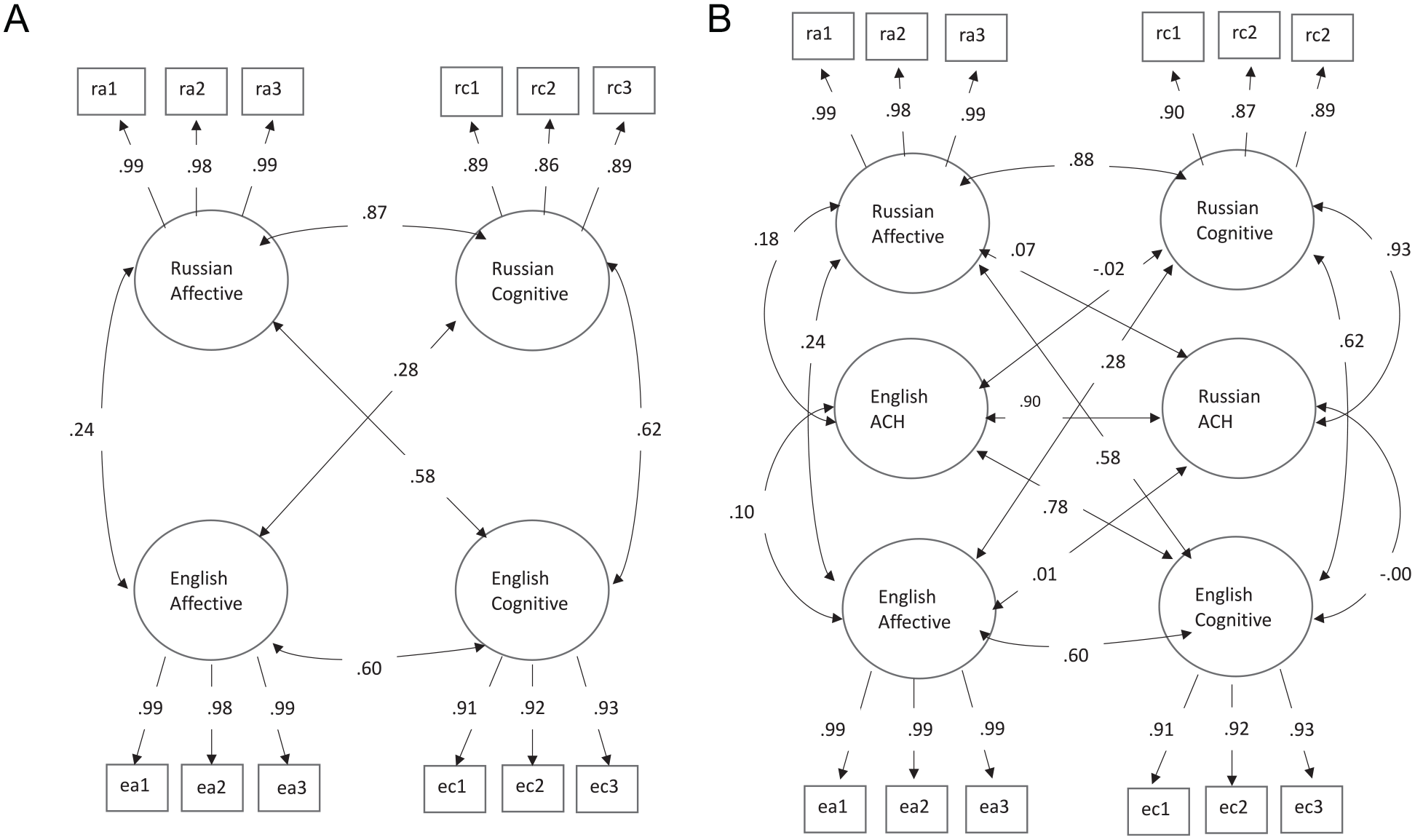
Verbal self-concepts. Items: ea = English affective; ec = English cognitive; ra = Russian affective; rc = Russian cognitive

Note. Correlation is significant at the p < .001, two-tailed. The uniqueness of each item is the residual variance related uniquely to that item and is independent of residual variance related to other measured variables.
As the model (Model 1 in Table 3), assuming that all items load on one factor and proposing one single verbal self-concept for two target languages, did not show good fit to the data, the English and Russian domains (Model 2) were separated and achievement scores were integrated (Model 3) to test conflated models and their relations with achievement. As the two-factor model for English and Russian did not show adequate fit, one-factor model (Models 4 to 5) for each language was examined separately to determine whether the conflation of cognitive and affective components of language self-concept was supported within the specific verbal domain. One-factor models showed poor fit to the data; therefore, these results contribute the assumptions of twofold multidimensionality and separation of cognitive and affective components within specific language self-concepts.
As one-factor models demonstrated poor fit, the study tested the next set of models that assumed separation of two dimensions within the verbal self-concept for each language. Based on the goodness of fit values, the two-factor models (Models 6 to 7 in Table 3) indicating separation of two components of self-concept showed better fit to the data. Further, when achievement measures were incorporated to the two-factor models, the model showed slightly better levels of good fit than when achievement measures were not included in both English (Model 8: ΔCFI = –.003; ΔTLI = –.006; ΔRMSEA = + .018; ΔSRMR = + .001) and Russian (Model 9: ΔCFI = –.002; ΔTLI = –.005; ΔRMSEA = + .013; ΔSRMR = +.000). These findings were the same across English and Russian.
In the next step, the study examined the internal construct of verbal self-concept analyzing cognitive and affective components of English and Russian in one model (Model 10), which demonstrated excellent fit indices. Two dimensions of verbal self-concept were well defined, as explicitly shown by the significant and positive standardized factor loadings. Figure 1a depicts standardized factor loadings resulting from Model 10. For the assessment of the external structure of verbal self-concept, achievement measures were included in the model (Model 11) that showed the best fitting model.
Table 5 reported the standardized correlations between conflated and separated models with achievement measures. The relations between the conflated models and achievement measures in matching domain were weak compared with nonmatching domains, which showed near-zero correlations. Results of separated models demonstrated high positive correlations between cognitive domains of the two target languages (r =. 62; p < .001), whereas the correlation between affective components was weak but positive (r = .24; p < .001). Consistent with other studies (Möller et al., 2009; Xu et al., 2013), English and Russian achievements were substantially and positively correlated (r = .90). As this study expected that the cognitive dimension that represented a student’s ability would correlate with achievement in the corresponding domain, the correlations between the cognitive component and achievements within languages were high (English r = .78; Russian r = .93, p < .001, Figure 1b), but correlations between the affective dimension and achievement in the corresponding domains of the two target languages were low or near-zero (English r = .10; Russian r = .07; p < .001). In addition, there were insignificant relations between English achievement and the cognitive component of Russian self-concept (r = –.02, ns); and between Russian achievement and the cognitive component of English self-concept (r = .007, ns).
Standardized Correlations Between Latent Constructs and Achievements in English and Russian.

Note. SC = self-concept; ACH = achievement.
p < .05. **p < .001.
However, when examining a higher order factor with four first-order factors, the model showed a poor fit (Model 14 in Table 3). The findings confirmed the separation of self-concepts into cognitive and affective components. The findings of the internal structure of English and Russian self-concepts implied the validity of the twofold multidimensional nature of verbal self-concept that was separated into specific domains such as English and Russian indicating one single verbal self-concept could not represent multilingual learners and verbal self-concept comprised of cognitive and affective components within each target language.
To examine twofold multidimensional verbal self-concept structure across gender, measurement invariance was conducted, assuming boys and girls would produce the same results. Table 6 showed that structural invariance at the first stage demonstrated perfect model fit to the data. The model-data fit χ2 value was statistically significant at the level of .01. These results indicated that a four-factor model consisting of two components of verbal self-concepts for two foreign languages was significant and applicable for each gender. In the next stage, the study tested metric invariance and showed that all goodness-of-fit values were within acceptable score ranges for adequate model fit. This result indicated that the model had the similar predictive level and self-concept structure for each gender. In the final stage, scalar invariance was examined, which also demonstrated adequate levels of fit, indicating the same correlations between factors in each gender subgroup. However, when achievement measures were included in the four-factor model, the model fit declined for configural invariance and showed poor model fit to the data (χ2 = 301.622, CFI = .969, TLI = .955, RMSEA = .072, SRMR = .111). Moreover, the girls’ mean levels significantly and positively deviated from boys in all components of both target languages (Table 2; Figure 2). Therefore, girls demonstrated higher mean levels in two components of foreign language self-concepts.
Goodness-of-Fit Indices of Partial Invariance Across Gender for Model 10, Figure 1b.

Note. CFI = confirmatory fit index; TLI = Tucker–Lewis index; RMSEA = root mean square error of approximation; SRMR = standardized root mean square residual.
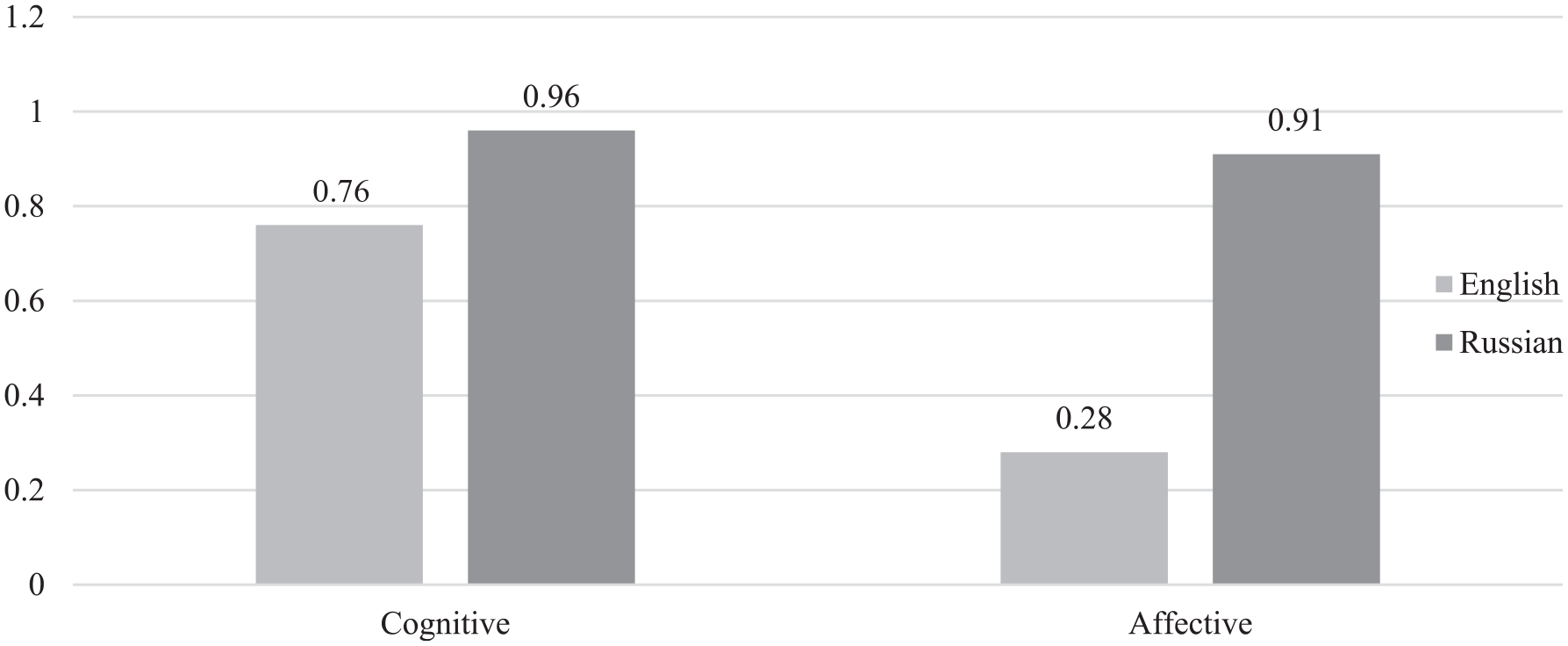
Self-concept components across gender.
Discussion
Previous research on the cognitive and affective dimensions of the academic domain has revealed a distinction between these two components within mathematics and verbal domains (Abu-Hilal, 2005; Arens et al., 2011; Marsh & Ayotte, 2003; Pinxten et al., 2014), and within science and mathematics domains (Abu-Hilal et al., 2012). This study analyzed (a) the applicability of the separation or conflation of affective and cognitive components of English and Russian self-concepts within the I/E model, and (b) the validity of the construct of verbal self-concept in English and Russian. Moreover, the invariance of cognitive and affective dimensions of verbal self-concept was tested across gender. The findings of this study supported the separation of cognitive and affective dimensions of verbal self-concept within English and Russian and the application of the I/E model within target languages. Support for the separation of two components within verbal self-concept domain was provided by better fitted models of verbal self-concept, which distinguished cognitive from affective dimension of self-concept than unidimensional models. The relation between these two components was found to be moderate but not high, further contributing their separation.
Contribution to the applicability of the I/E frame of reference within language domain was provided by the better fitted four-factor model, indicating distinction between two components of English and Russian self-concepts than a conflated model which showed weak relation between English and Russian, demonstrating distinct verbal self-concept for each language. This study is consistent with Yeung and Wong’s (2004) research that found distinct verbal self-concepts for each language showing the impossibility of a general verbal self-concept to introduce multilingual learner’s language self-concept. Furthermore, this study is also in alignment with Abu-Hilal et al.’s (2013) study which revealed the twofold multidimensional structure of academic self-concept within science and mathematics. Therefore, the present research amplified evidence of the separation of self-concept facets by demonstrating it within the verbal domain of self-concept and supported the evidence that the two dimensions should be distinguished.
Moreover, the twofold multidimensionality of self-concept was substantiated by the better fitted six-factor model with integrated achievement scores within the I/E models than conflated models. Furthermore, this study investigated the correlations of cognitive and affective components with achievement scores and found differentiation between cognitive and affective components of verbal self-concept. “Cognitive component suggested students’ ability highly correlated with achievements in matching domains than affective components suggested students’ attitudes towards language (p. 20)” (Karimova & Csapó, 2021). These results are in alignment with Abu-Hilal et al.’s (2013) research that revealed strong relationships between cognitive component with matching domains of achievement within science and mathematics, r = .57 and r = 58, respectively. Similar findings were reported by Arens et al. (2011), which found a high relation between cognitive components and achievements within mathematics (r = .81) and German (r = .78; see also cited in Karimova & Csapó, 2021). These results contribute to the twofold multidimensionality of foreign language self-concept within the I/E model.
This study also examined a near-zero correlation between achievement scores with conflated models as well as nonmatching domains of cognitive component and achievements, which was similar to the Abu-Hilal et al. (2013) and Arens et al. (2011) studies. These findings that indicated higher correlations of English and Russian achievements with the cognitive components of their matching domains of self-concept, but nonsignificant correlation between nonmatching domains, was also consistent with Marsh and Hau’s (2004) study. These results suggest students have a different perception for cognitive and affective components of verbal self-concept in English and Russian and extended the I/E frame of reference.
Further substantiating the notion of twofold multidimensionality, the higher order analysis in SEM provided additional evidence by demonstrating a poor fit model of higher order construct. The distinction of verbal self-concept into two dimensions provided a clear, comprehensible structure to the relationships that distinguished between these two variables, indicating the affective component as a part of affective (internal) self rather than the social (external) self. This pattern provided further evidence for the importance of the separation between competence and affective components within more skill-specific domains, such as reading, listening, writing, and speaking.
Most studies (Fredricks & Eccles, 2002; Jacobs et al., 2002; Skaalvik & Skaalvik, 2004; Wilgenbusch & Merrell, 1999), which have examined gender differences in mean levels of classical academic self-concepts, found that these differences conformed to gender stereotypes. Thus, consistent with these studies, the present research provided further evidence indicating that girls tended to demonstrate higher mean levels of verbal self-concept than boys. This study also aligned with some studies (Arens et al., 2011) that confirmed the invariance of the twofold multidimensional structure of the academic self-concept across gender subgroups.
Moreover, this study provided evidence of the multidimensionality and domain specificity of the verbal domain of self-concept, indicating a distinction between two different language self-concepts. The weak correlation between English and Russian in the conflated models (r = .24) showed that a single verbal self-concept structure did not adequately represent the self-concepts in both English as a first foreign language and Russian as a second foreign language. These results supported the findings of Yeung and Wong (2004) that one single verbal self-concept was inadequate for different languages. It is interesting to note that relations between cross domains of English and Russian cognitive self-concepts with achievements were near-zero and not statistically significant.
The construct validity of twofold multidimensional verbal self-concepts was evident from the relation between two components in the two target languages and with their achievement measures, and from internal structure (discriminant validity). Marsh’s (1986) I/E theory provided a framework for self-concept research and indicated the multidimensional nature of the self-concept that is the basis of further self-concept models. These findings might benefit language self-concept research by enriching the present scope of the relations between language achievement in different foreign languages and by the two dimensions (cognitive and affective), which made the current study worthy of attention.
Limitations, Future Research, and Practical Implications
Although the study contributed to support the twofold multidimensional and domain-specific nature of the verbal self-concept, certain limitations should be considered. As the nature of self-concept is not stable but dynamic (Harter, 1988), a deep understanding of the verbal domain is required within different languages. Thus, longitudinal studies are necessary to examine the development of students’ abilities to distinguish between the two dimensions (cognitive and affective) within verbal self-concepts. As this study focused only on the foreign language domain, it is necessary to study how the verbal domain can be differentiated between foreign languages and persons’ native tongue.
Moreover, educators are suggested to consider that students have separable competence-related and affect-related self-concepts. Therefore, inferring students’ affective perceptions from their competence self-perceptions would lead to misleading interpretations. Students’ cognitive and affective perceptions should be considered separately, and it is necessary to assess them by different scales. The results have substantial practical implications for designing interventions for developing learners’ verbal self-concept and performance. Likewise, verbal self-concept enhancement interventions should integrate skill development. The distinction between affective and cognitive dimensions of verbal self-concept should be incorporated into self-concept enhancement intervention strategies. Moreover, the distinction between the two components of self-concept allows researchers to design resilient educational interventions to foster students’ academic achievement. As for strong relations between the cognitive component of verbal self-concept and achievement, if the main aim of educators is to improve students’ performance, they should focus on strengthening learners’ self-perceived cognition.
This study revealed a distinction between English and Russian self-concepts of bilingual students that indicated the twofold multidimensional nature of the verbal domain. This multidimensional nature was supported by the separation of cognitive and affective components of verbal self-concepts. Therefore, it is necessary to test further the distinction of two dimensions of verbal self-concept in more skill-specific domains with larger samples. One single verbal self-concept would lead to invalid interpretations if a second language teacher assumed that those students who perceived themselves as competent in one foreign language would perceive the same level of competence in another foreign language. The present finding that a general verbal self-concept cannot introduce students’ self-concepts in different languages means that the notion of a single verbal self-concept can be problematic.
In conclusion, the findings of the present study should foster researchers to contribute to human understanding by examining subject-specific self-concepts that conceptualize two dimensions of self-concept and relationships with achievement.
Footnotes
Declaration of Conflicting Interests
The author(s) declared no potential conflicts of interest with respect to the research, authorship, and/or publication of this article.
Funding
The author(s) disclosed receipt of the following financial support for the research and/or authorship of this article: This research was supported by Stipendium Hungaricum Scholarship Program launched by the Hungarian Government; the program was managed by Tempus Public Foundation.
