




Abstract
Adopting the framework of projection from Systemic Functional Linguistics, the present study explored the deployment of projection in summary writing by three levels of college EFL learners from a university in mainland China. Data were collected from one summary writing by three classes of different levels’ learners in an English program from a university in the southern part of mainland China. Quantitative analysis showed that projections increased dramatically from Year 1 to Year 2 and dropped slightly from Year 2 to Year 3. Qualitative analysis revealed that the use of projecting verbs showed huge differences among the three levels of learners. Year 1 students used only a very limited range of projecting verbs. Year 2 learners used a more comprehensive range of such verbs but tended to use them repetitively and inappropriately. In contrast, year 3 students used a much more comprehensive range of projecting verbs in their summary writing and construed projection at different levels. It is recommended that more attention should be paid to the teaching of projection at phrase and text levels in EAP.
Introduction
It is widely recognized that reporting verbs are one of the essential resources in academic writing, especially in building up support and expressing authorial stance (e.g., De Oliveira and Pagano, 2006; Ignatieva & Rodríguez-Vergara, 2015; Thompson & Yiyun, 1991). In particular, reporting verbs help authors integrate information from different sources to support arguments or personal claims (Liardét & Black, 2019). In the past decades, reporting verbs in academic writing have been studied widely with different foci ranging from types of reporting verbs (Hyland, 1999; Thompson & Yiyun, 1991), stance (Hyland, 1999), native and non-native speakers’ differences in reporting verbs (Liardét & Black, 2019; Pickard, 1995), and disciplinary differences in the use of reporting verbs (Thompson & Tribble, 2001). These findings have deepened our understanding of the teaching and learning of reporting verbs in the field of English for academic purposes.
From the perspective of Systemic Functional Linguistics (hereafter SFL), reporting verbs represent only one of the many grammatical resources to construe what is referred to as “projection.” Projection is defined as relating “phenomena of one order of experience (the processes of saying and thinking) to phenomena of a higher order (semiotic phenomena – what people say and think)” (Halliday & Matthiessen, 2014, p. 441). Although this definition refers only to projection at the clause level, elsewhere, they make it clear that they consider projection to be a semantic domain that spreads across a wide range of grammatical units, including clause complexes, nominal groups, prepositional phrases, adjuncts, etc. (which will be explained in Section 3). This extended view of projection goes beyond simply looking at the use of reporting verbs at the clausal level to a broader system of resources for representing speech and ideas that contribute significantly to the academic meaning-making process. Therefore, in researching this, it is necessary to go beyond “reporting verbs” and the structures they are part of and use the broader notion of projection to gain a fuller picture of how this critical aspect of students’ academic writing skills develops over time. To contribute to this line of research, the present paper explores the deployment of projection in summary writing by different levels of college EFL learners in China. The learners are from a university in mainland China, majoring in business English in their undergraduate studies. Data are from one summary written by three classes of learners from year 1, 2, and 3, respectively. The summary task is a timed writing activity based on a 900-word reading task.
Literature Review
Reporting Verbs and Academic Writing Studies
Over the past decades, investigations drawn upon different linguistic frameworks have enriched our understanding of reporting verbs methodologically and epistemologically (Hyland, 2002; Thomas & Hawes, 1994; Thompson & Yiyun, 1991). For example, the study of reporting verbs used in different disciplines showed how reporting verbs were used in different genres (Monreal & Salom, 2011; Thomas & Hawes, 2001). Reporting verbs were found to manifest disciplinary differences (Swales, 2014; Moore, 2002). For example, the use of reporting verbs was quite different in politics and material science (Charles, 2006). Charles (2006) found that while “argue, note, and suggest” were frequently employed in politics, “find, observe, and show” were the top reporting verbs that are used in material science.
Reporting verbs have also been studied from the perspective of appraisal, looking at how authors express stance and evaluative meanings by adopting different reporting verbs (Hood, 2010). For example, Liardét and Black (2019) noted that different verbs had very different evaluative meanings to capture the stance or authorial voices in the argument. Their findings suggested that teachers of EAP should make the teaching of these verbs explicit and let the learners have a more thorough understanding on how to deploy them. A study by Nguyen (2017) examined the use of reporting verbs in TESOL master dissertations written by Vietnamese students in a Vietnam university. Her findings showed that those Vietnamese TESOL MA students were not competent in using reporting verbs that critique other researchers’ work. Therefore, they usually used reporting verbs that indicated a neutral attitude when engaged in an academic argument.
Reporting verbs have also been extensively studied in the academic writing of non-native English speakers. For example, Pickard (1995) compared ESL learners’ use of reporting verbs of “saying” with that of expert writers. She found that students enrolled in ESL writing courses had a limited range of “saying” reporting verbs, and they overused the word “say” when they reported or cited other writers in their academic writing. However, expert writers had better control of a range of reporting verbs and used fewer instances of “say” in their academic writing. Liardét and Black (2019) compared ESL and English L1 learners and experts’ use of reporting verbs in their academic writing. In contrast to the findings of Pickard, they found that there is no difference between ESL and English L1 learners in terms of the types of reporting verbs they used in academic writing. Both of the two groups of learners in Liardét and Black’s (2019) study deployed the same set of reporting verbs with exactly almost the same frequency in their academic writing.
Several studies have also examined the use of reporting verbs in different contexts. Swales (2014) found that the top five reporting verbs were “show, find, suggest, propose, and argue” in the biology assignment written by students. In addition, his findings showed slight differences in citation practices between undergraduate and graduate students in biology. Undergraduates preferred to use non-academic materials, such as Wikipedia and online resources, while graduates never used such resources in their writing. In another study, Thomas and Hawes (1994) focused on the reporting verbs from medical science and found that three-fourths of the reporting verbs were deployed in the results and findings sessions from medical science. Cognition verbs were correlated with reaching an agreement in scientific circles, while what they called “discourse verbs” were associated with the conclusion and reporting of findings.
Projection and Academic Writing Studies
The studies reviewed above have all focused rather narrowly on the use of reporting verbs. Only a few studies have been done using the wider framework of projection. The importance of using this wider perspective in studying academic writing has gradually been recognized in recent years (Xuan & Chen, 2020). However, even studies claiming to take this perspective have still often focused almost entirely on the deployment of “verbal process” structures at the clause level, that is, reporting verbs and their structures. Such studies have focused on the projection used in different genres (Ignatieva, 2011; Ignatieva & Rodriguez-Vergara, 2015; Zhao, 2014); and comparison between L2 learners of English and native English speakers’ use of projection (Zhou & Liu, 2014). For example, Ignatieva (2011) investigated the two genres, “question and answer” and “essay,” written by Mexican students, and she found that there were registerial differences in terms of deployment of verbal processes. More verbal processes were used in the question and answer texts than in the essay texts. Findings from a subsequent study by Ignatieva and Rodriguez-Vergara (2015) showed that verbal processes played an essential role in construing emotion and opinions in academic writing in linguistics and humanities. Moreover, genre, the writing topic and the students’ academic writing experiences directly influenced the appropriateness of deployment of verbal process in their academic writing. In another study, Zhao (2014) found that while book reviews in finance tended to deploy projection to contract dialogic space (Martin & White, 2005), book reviews in linguistics tended to use projection to expand dialogic space.
In terms of projection from the more comprehensive framework mentioned above, Zeng (2007) studied the deployment of projection in academic writing from grammatical metaphor. She concluded that grammatical metaphors of projection helped authors to construe complicated and sophisticated meanings. In a subsequent study, Zeng and Liang (2007) introduced the concept of multisemiotics to broaden studies of projection and they concluded that projection could be realized by various non-linguistic semiotic resources such as figures, tables, footnotes, hyperlinks, code-switching, etc.
Few of these studies concentrated on learners’ texts. However, Zhou and Liu (2014) compared the use of projection in the academic writing of English learners in China and native speakers in the US. Their findings showed that Chinese EFL learners deployed more projections in their writing than the American native speakers did. In addition, the authors found that Chinese learners used projection to build up agreement and confirmation with the readers but failed to build up different stances or opinions.
So, to summarize, to date, even studies of projection from the SFL perspective have primarily focused on reporting verbs per se and have not related them to other functionally relevant resources in English. Also, while academic writing was the most investigated register in the previous studies, few studies focused on one specific academic genre, like a summary. Moreover, most of the extant studies only focused on projection realized at the clausal level, and they have ignored projection construed at other levels, such as phrasal, and textual levels. A more comprehensive understanding of the deployment of projection at different levels is lacking. Furthermore, the previous studies focused mainly on one level of learners. Studies concerning the different levels of learners’ use of projection in students’ writing are scant. It is essential to know more about how EFL learners develop their use of projection at different proficiency levels. However, there are rare opportunities to observe the intensive use of projection in the ordinary college English writing tasks given to the students before they really approach academic writing. That is the reason why we designed the summary writing task in this study to steer the students in question to intensively use projection for our observations. Hence, a developmental study of reporting verbs used in summary writing by Chinese college EFL learners from the perspective of projection will add new knowledge in projection and EAP writing studies.
Research Questions and Theoretical Framework
To address the research gap, this study aims to answer the following two research questions:
(i) How do Chinese EFL learners deploy the range of projection resources in their academic writing at three different years?
(ii) Are there any developments across the 3 years? If there are, what are they?
The coding scheme of our study is based on the systematic description of projection in SFL (see in particular Halliday & Matthiessen, 1999, 2014; Mattheissen, 1995). The term projection was first introduced by Halliday (1977) as a type of logico-semantic relationship, alongside expansion, between two clauses. A formal explanation of projection is offered in Halliday (1985) and Halliday and Matthiessen (2014) as follows:
(1) Expansion: the secondary clause expands the primary clause, by (a) elaborating it, (b) extending it, and (c) enhancing it.
(2) Projection: the secondary clause is projected through the primary clause, which initiates it as (a) a locution or (b) an idea.
Thus, projection is the term used in SFL to refer to quoting and reporting of saying and thinking. It is typically realized as a clause complex consisting of a projecting clause and a projected clause. However, the notion of projection is different from the traditional notion of reporting in that it is a semantic category that is general enough to cover all grammatical items representing the representation of language. Halliday and Matthiessen (2014) conceptualized projection as a semantic domain that spreads across a range of grammatical environments. In this study, we pay particular attention to projection realized as clause complexes, verbal groups, prepositional phrases, and embedded clauses because they are highly relevant to acknowledge the sources of ideas in the summary writing tasks. For instance:
(a) He says he will come. (Clause complex) (logical projection)
(b) He wants to come. (Verbal group) (experiential projection)
(c) According to him, he will come. (Prepositional phrase) (projecting circumstance: angle)
(d) He talks about coming. (Prepositional phrase) (projecting circumstance: matter)
(e) It is said that he will come. (Embedded clause) (fact projection)
Examples (a) and (b) represent projection realized through complexing, one of the logical resources in language. (a) Is more or less equivalent to what in traditional grammar is called “reported speech.” Examples (c) and (d) belong to what is called “projecting circumstance,” forming a relationship between the main clause and the mini-clause (prepositional phrase). Example (e) demonstrates fact projection in the form of embedding. Based on the observations above, we developed two coding schemes in the UAM corpus tool, one for projection at the clause level and the other for the phrase level, as follows:
It should also be noted that Zeng (2016) takes one step further to model projection beyond the clause rank. Based on her observations on English translations of Lunyu (The Analects of Confucius), she posits that “in real texts there exist not only projection clause nexuses but also projection paragraphs or projection texts.” Projection text, in her model, consists of hyper-clause complex projection, paragraph projection, cross-paragraph projection, and complex group projection. Here is an example from Zeng (2016, p. 49):
Confucius remarked, “A wise man who is not serious will not inspire respect; what he learns will not remain permanent.” “Make consciousness and sincerity your first principles.” “Have no friends who are not as yourself.” “When you have bad habits do not hesitate to change them.”
In this case, several paragraphs that constitute the projected message share the same source of projection in the first paragraph as in Confucius remarked. In this study, we will employ the notion of projection text in our qualitative analysis to refer to the construal of projection beyond clause complexes.
Methodology
Participants
Participants of this study were 91 English majors (35 students from Year 1, 28 students from Year 2, and 28 students from Year 3) from a university in South China. The school is a provincial public undergraduate university specialized in six disciplines including economics, management, law, art, science, and engineering, with finance as the leading major. In 2019, 51.37% of the English majors in this university passed TEM 8 (the Test for English Majors Band 8), comparatively high in comparison with an average of 34.96% of all Chinese English majors nationally. These students, in this sense, were slightly higher in their English proficiency than the average English majors in mainland China. The curriculum for the English majors in this university includes a range of writing courses, such as Fundamental English Writing, Academic Writing, Business Correspondence Writing, and Thesis Writing, etc. All are compulsory courses, which means that the participants of this study have received basic training in academic writing. In addition, this group of learners show great enthusiasm in learning it. Therefore, when we started to recruit participants for this study, they all showed great interest and promised to participate in the research immediately. In return, we promised to provide some feedback on their summary writing and offer consultations on academic writing.
Methods
Aiming at exploring Chinese university EFL students’ deployment of projection in summary writing, the present study employs a mixed-method approach that integrates a quantitative and qualitative analysis of projection used in Chinese undergraduate students’ summary writing. Quantitative analysis refers to our observation of the data generated from the UMA corpus tool that reveals the distribution of various projection units. Qualitative analysis means we read through all the texts closely to identify features that may be associated with the quantitative results.
Protocol
The study selected an argumentative essay (a review of different voices concerning some agricultural risks) of 912 words from IELTS reading comprehension as the reading materials. The participants were given 80 minutes to read the text and write a summary in class. The length of the summary was to be about 300 to 500 words. The reason for choosing this argumentative text was that it is information-dense and has numerous arguments and viewpoints. Given this particular feature, inviting the participants to write the summary provided good opportunities to observe how they use projection to report or cite different opinions or information from the source text.
Procedure
The research comprises four stages, namely, summary writing assignment, manual coding, software-assisted analysis, and manual analysis of the texts. At the first stage, an argumentative essay with 912 words was given to the students in class, who were then instructed to summarize the essay in 300 to 500 words within 80 minutes. The instruction of the assignment is as follows:
This writing task is designed to assess your ability in writing up a summary based on a piece of reading material. In this task, you need to read a passage and summarize its main ideas. Your Task: Read the passage provided. Write the summary (300–500 words) Include the following parts into your summary: Part 1: An introduction of the passage you read: (1) Introduce the passage you have read, such as the title, the author etc.; (2) Sum up the thesis of the passage in one sentence. Part 2: A detailed and logical summary of the main ideas from the passage. Format: Write in paragraphs.
Once the summary texts were collected, they were checked by the three researchers of this project. At this stage, all instances of projection were identified and annotated manually through the UAM corpus tool following the coding schemes we developed based on the SFL framework (as shown in Figures 1 and 2). The UAM Corpus Tool is a state-of-the-art environment for the annotation of text corpora. The tool provides functions of coding scheme creation, text annotation, corpus searching as well as statistical studies. It can be accessed through the website http://www.corpustool.com/index.html. Each instance of projection was annotated with its projecting process (verbal/mental), the type of projected clauses (complex/embedded), and, where relevant, the projecting circumstance (angle/matter), and the choice of projecting verb. The UAM then would generate relevant statistics automatically for further observations and analysis.

Coding scheme for projection at clause rank.

Coding scheme for projection at phrase rank.
Coding of the data
Three researchers of this study conducted a pilot annotation of 10 samples for coding accuracy and consistency. The inter-rater reliability was 91%. The major discrepancies occurred in the coding for embedded projection (traditionally referred to as “a noun clause,” realized as a noun plus a “that-clause”). More specifically, expressions such as “hold the view that,” “harbor the view that,” “put forward its view that” were coded as clause complex by one and embedded clause by another. It depends on whether the analyst treats the expression as a phrasal verb (an idiom) or a nominalized mental process followed by a “that-clause.” Finally, we came to agree that these expressions are relatively fixed constructions that are semantically equivalent to mental processes, and thus coded as clause complex. Then we had to decide whether the verbs “hold,” “harbor,” “express,” etc. should be coded as a mental process (actions of thinking) or verbal process (actions of saying). Our final criterion was that the verbs that carry a sense of keeping within, such as “hold” and “harbor,” were coded as mental processes whereas the ones with the meaning of giving out, such as “put forward,” “express,” and “share” were coded as verbal process. It turned out that, in our data, only the common “it is . . . that” construction, such as “it is believed that,” was coded as embedded projection. Another issue was that one researcher did not recognize the category “matter” that occurs in relational clauses as in “it is mainly about . . .” In addition, when all the data coding was finished, we double-checked each other’s coding to ensure the accuracy of the data analysis. These problems were all solved before the massive analysis of annotations through the UAM corpus tool.
Results and Findings
Quantitative Results
Statistics for projection at the phrase level
Projecting circumstances, typically realized as prepositional phrases, are important grammatical resources for projection. Figure 3 displays the number of projecting circumstances (/1,000 words) including those of angle and matter from year 1 to year 3. In particular, the proportion of angle circumstances increased from 1.56 at year 2 to 2.07 at year 2 while that of matter circumstances decreased from 3.61 to 2.48. However, the pattern of angle and matter circumstance used by year three students was substantially different. As indicated in Figure 3, the number of angle circumstances was the lowest among the 3 years (0.72/1,000 words). In contrast, the number of matter circumstances grew from 2.48 to 5.55.
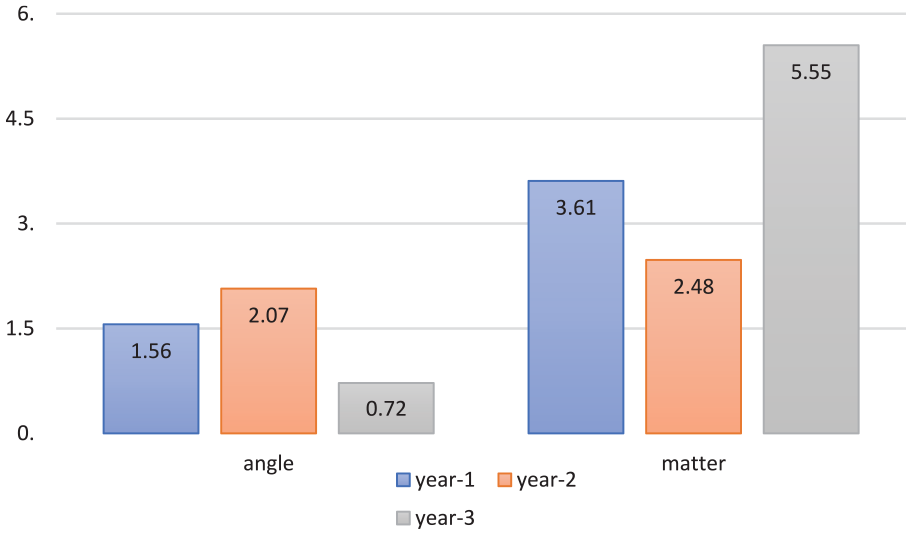
Distribution of projecting circumstances across 3 years (/1,000 words).
Statistics at clause level
Figure 4 shows the number (/1,000 words) of projection units realized as clause complex and embedded clause across the 3 years. The frequency of locution and idea both increased from year 1 to year 2 and dropped at year 3. In other words, the year two students are inclined to use more projection than those in the other 2 years. The numbers of verbal processes and mental processes in projecting clauses were apparently higher at year 2 than at year 1. Similarly, the number of verbal and mental processes at year 2 were higher than those at year 3. Figure 5 shows lexical variations for verbal and mental processes across the 3 years. Contrary to our expectation, no obvious development could be identified except a slight increase in the number of verb types realizing the mental process. In this sense, the quantitative data show no obvious developmental features in the use of projection among the three levels of learners.
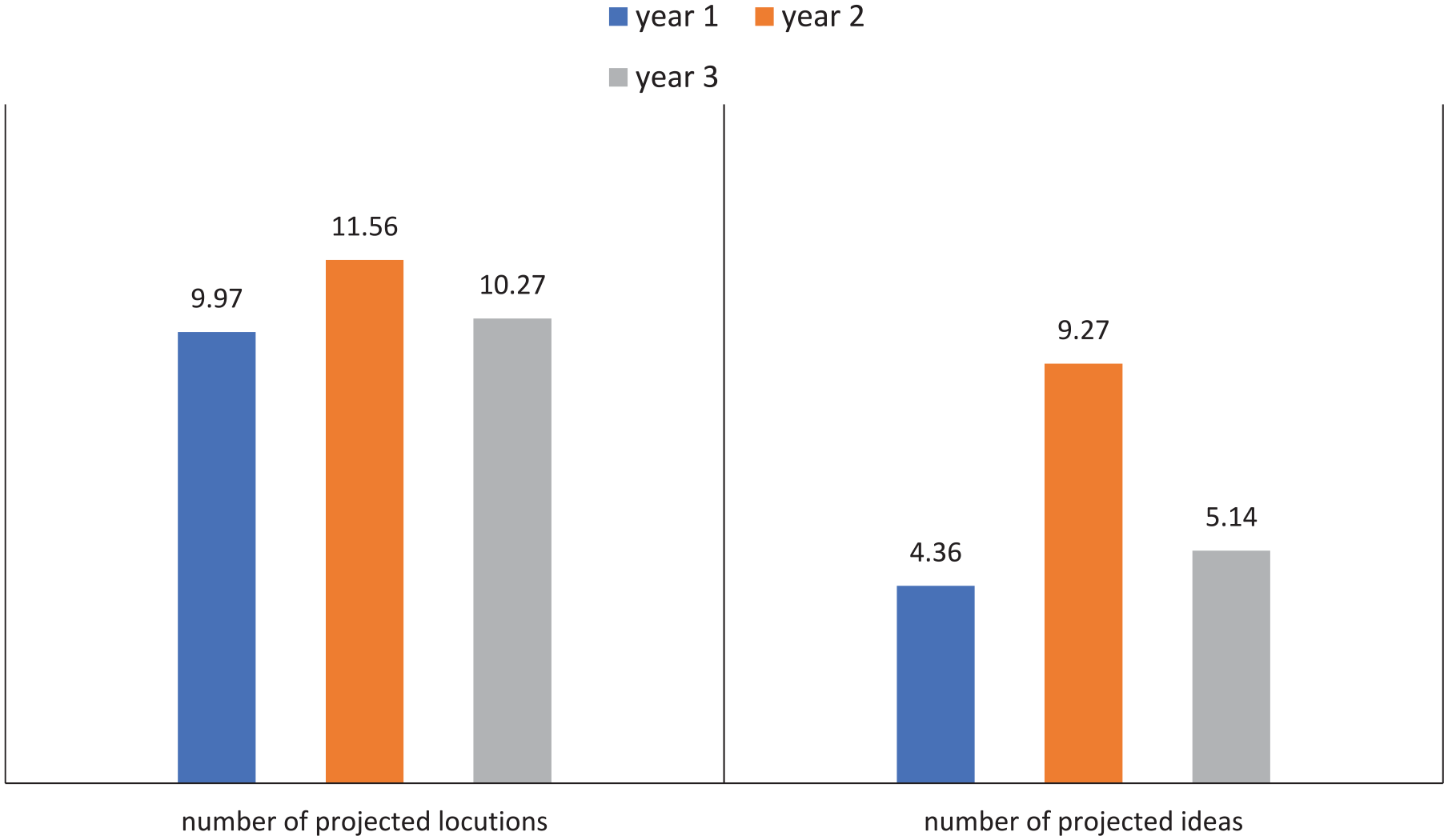
Number (/1,000 words) of locution and idea realized as clause complex and embedded clause.
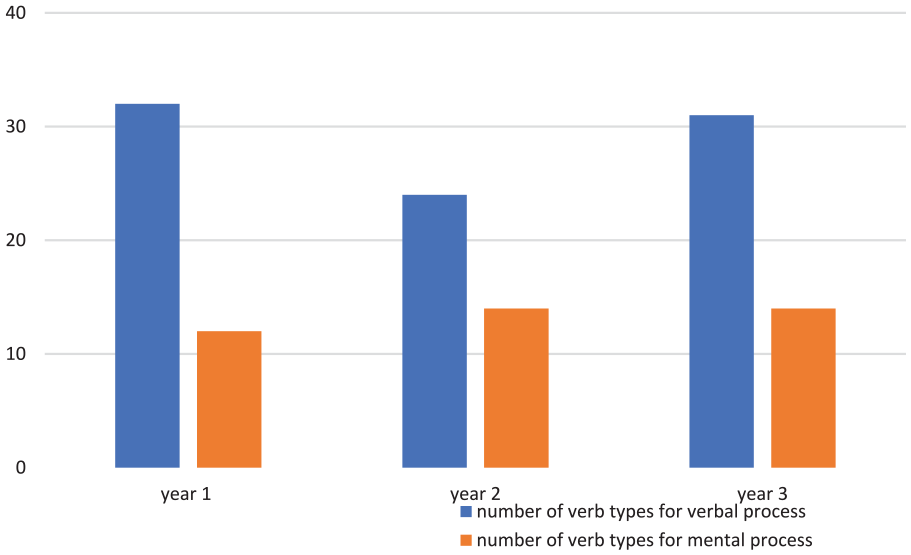
Different verbs used to realize the verbal and mental process.
Tables 1 and 2 display the top ten words chosen to construe verbal process in projection across the 3 years. The general distributions across the 3 years show no obvious variation.
Top 10 Words for Construing Verbal Process Across the 3 Years.
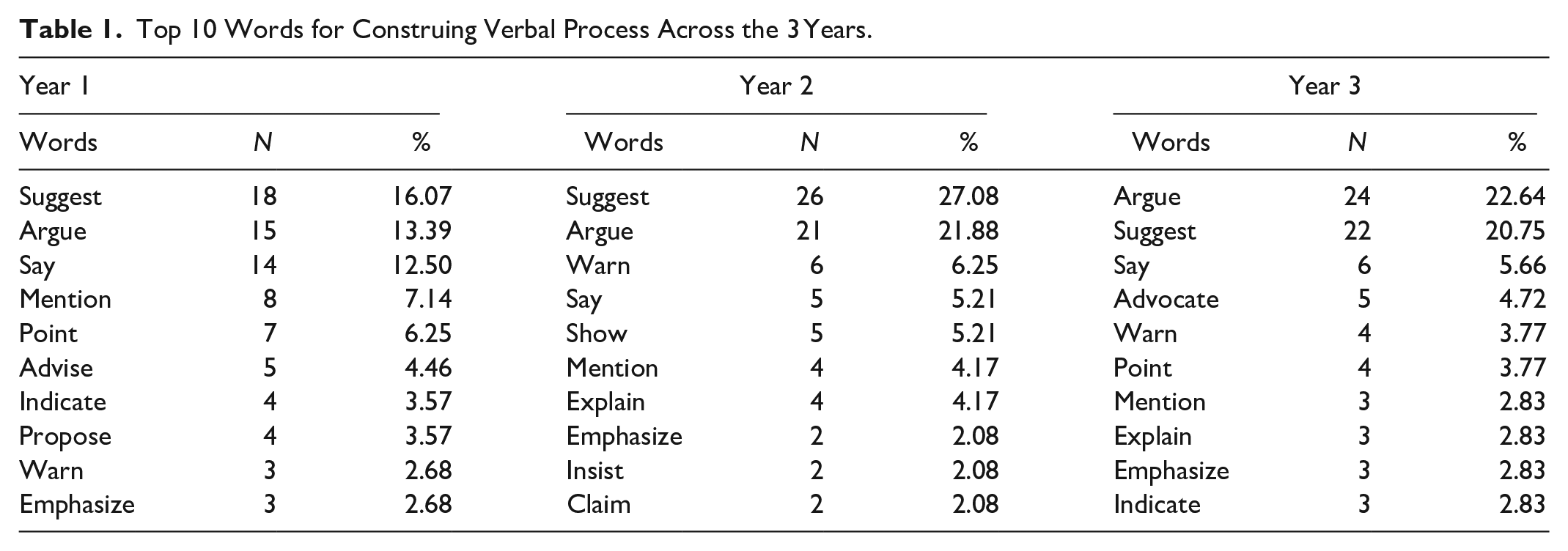
Top 10 Words for Construing Mental Process Across the 3 Years.

It is evident that “suggest,” “argue,” and “say” are the most frequent words used by students of all the 3 years (c.f. Liardét & Black, 2019; Yang et al., 2019). However, the frequency of “say” and “mention” reveals a salient pattern in the students’ academic writing over the years. The frequency of “say” dropped remarkably from 12.5% at year 1 to roughly 5% at years 2 and 3. The frequency of “mention” declined from 7.14% at year 1 to 4.17% at year 2, and further down to 2.83% at year 3. A similar pattern can be observed in the use of mental processes. The 3 years share the top three choices of words, viz, “think,” “believe,” and “hold.” However, looking at the trend of the frequency across the years, we find that the frequency of “think” decreases drastically from 51.02% at year 1 to around 30% at years 2 and 3. The frequency of “hold” (usually expressed as “hold the view that”), on the other hand, increases from 10.20% to 20.75%. Moreover, some sophisticated reporting verbs such as “harbor (the view that)” and “conceive” occur only in the writing of year 3. This distribution of specific words for projecting process resonates with Liardét and Black’s (2019) idea that use of a wide range of projecting verbs is an important indicator of the students’ academic writing development.
Qualitative Findings
Development of projection usage across the 3 years
Qualitative analysis shows that the use of projection developed across the 3 years. For example, we found that there were four students in year 1 who didn’t use any projection in their summary writing, which was quite a big difference compared with the other 2 years. Students from year 2 and 3 used projection more evenly and we found that most of the students from these 2 years used it. Hence, students from year 2 and 3 have developed the concept of using projection in academic writing, while year 1 students have relatively weaker awareness.
Developmental features at phrase level
Some qualitative features could be found, which reflect the development of the students’ use of projection at the phrase level.
Double projecting units
Some of the year 1 and year 2 students construe the projecting unit repeatedly through the pattern “angle circumstance ^ projecting clause.” Consider the following example:
(1) As far as the author is concerned, he believes cultural values are highly entrenched in food and agricultural systems worldwide. (Year 1)
In example (1), the projecting units are construed in an unnecessarily repeated manner. For instance, the angle “as far as the author is concerned” could be combined with the mental clause “he believes” into a projecting unit like “the author believes.” This type of inappropriate use of projection is not found in the year 3 data. This partly explains the higher frequency of angle circumstances at the early stage of writing.
Use of “say” in circumstances of angle
A close examination reveals that there are a few cases in which the use of circumstances of angle has been affected by their mother tongue (Chinese in our case). For example,
(2) From what the author said, it is of great essentiality that there is one way to increase crop diversity. (Year 1)
(3) For example, improving the infrastructure such as constructing the roads benefits the farmers according to what Nwanze said in his essay. (Year 1)
The two cases demonstrate that the year 1 students are aware of the meaning potential of construing projection through circumstance (See Halliday & Matthiessen, 1999; Mattheissen, 1995). However, they employ the word “say” in the circumstantial element as in “From what the author said” and “according to what Nwanze said.” This type of projecting circumstance, though grammatically correct, seldom occurs in academic citation. For instance, the search of “according to what * [say]” in COCA generates only a total number of 19 samples. However, the “according to . . . say” is a common pattern in Chinese (see Chen, 2016 on circumstances of angle in English and Chinese). This pattern of projecting circumstance vanishes in writings of the second and third years. Therefore, the word “say” may not only indicate the lower delicacy of the word choice for reporting process, but may also reflect the influence of the first language (language transfer) in projection construal at the early stage of the undergraduate’s academic writing.
Incremental use of circumstances of matter
In our data, the circumstances of matter occur mainly in three types of grammatical environments, and they are found across all the 3 years. First, they occur with verbal or mental processes, serving as the circumstantial equivalent of verbiage or phenomenon (cf. Halliday & Matthiessen, 2014). For example:
(4) Not only are they required to think about weather, . . . (Year 1)
The circumstance of matter in the example 4 goes with the mental process (think about).
Secondly, the unit occurs as the qualifier of a nominal group, functioning similarly as an embedded projection. See the examples below:
(5) The passage presents different views over the solutions of risks of agriculture in developing countries. (Year 1)
(6) This passage integrate different individual’s opinions about what agriculture risks are the developing countries facing. (Year 2)
Thirdly, the unit serves as the attribute in a relational clause. For instance:
(7) Next part is concerning solutions to lower the risks. (Year 1)
(8) The passage “The risks agriculture faces in developing countries” is about different views online on how to reduce the risks farmers face. (Year 2)
The use of circumstances of matter in the grammatical environments above reflects the students’ ability to compress information into a nominal group (Xuan & Chen, 2020). In example 7, the information of the article has been “packed” into a nominal group “different views online,” and then the messages of the views have been summarized with another embedded clause “how to reduce the risks farmers face.” The corresponding lines in the original text is as follows:
In his essay, Kanayo F. Nwanze, President of the International Fund for Agricultural Development, argued that governments can significantly reduce risks for farmers by providing basic services like roads to get produce more efficiently to markets, or water and food storage facilities to reduce losses, Sophia Murphy, senior advisor to the Institute for Agriculture and Trade Policy, suggested that the procurement and holding of stocks by governments can also help mitigate wild swings in food prices by alleviating uncertainties about market supply.
This is a rather intricate paraphrasing/summarizing process for a second language writer. Thus, the increasing number of matters, as shown in Figure 3, mirrors the development of the students’ writing skills.
Developmental features at clause level
The deployment of projecting verbs shows development in students’ writing. Starting from the first year, we find that several students didn’t use projection in their summary at all. The statistics show year 1 students tend to use simple projecting verbs such as “say,” “think,” etc. but not make more delicate choices among projecting verbs (cf. Liardét & Black, 2019; see example 9). This sometimes makes the style of writing seem a little colloquial. For example,
(9) In terms of the external power, people think the governments, public welfare, and social safety should provide greater help. . . .. . . They say farmers must alter their productive mode from individuals to collective action groups. . . .. . . In addition, they also think that farmers are able to take full advantage of tools, like private insurance, commodity futures markets, rural finance, and policies. (Year 1)
The colloquial tendency is also reflected in the use of “come up with” by the first-year students. The colloquialism of the phrasal verb is evidenced in COCA, which shows that the phrase occurs most frequently in spoken section and most infrequently in the academic section (as illustrated in Figure 6).

Distribution of “come up with” in COCA with the search syntax “[come] up with.”
Consider the two examples:
(10) Seeing the title at the first sight, I came up with some information that it may intend to talk about the risks the agriculture faces in developing countries but I wonder what the risks are and what measures will the governments take to protect their agriculture from destruction. (Year 1)
(11) thus Marcel Vernooij and some others came up with a proposal that we could use what we have commanded to create more value with all stakeholders like business, government, etc. (Year 1)
The two cases reveal that year 1 students are capable of employing the grammatical resource of embedded clauses to construe projection as in “information that . . .” and “a proposal that . . .” This ability has been further developed in the following years as shown in the use of “hold the view that” in years 2 and 3 data. However, the first-year students in the cases above choose the idiom “come up with” as the reporting verb, which shows their lack of proficiency in choosing the most appropriate words for the academic context. No such instance has been found in the writings of students in higher years.
Furthermore, students at year 2 use a limited range of projecting verbs in quoting without much lexical or grammatical variation (see example 12).
(12) First of all, on account of the long-term climate change and extreme weather, the output of food product is probably decreasing sharply, which may lead to the widespread hunger in the developing countries. Aside from the natural factors, for human, the infrastructure, financial systems, markets, knowledge, and technology are supposed to be supported. Secondly, some participants argued that whether sufficient food are able to be ensured depended on fossil fuels and the improved government policies. When the food production is sufficient, basic services should be provided by the government, such as food storage facilities and transportation. Kanayo F. Nwanze, President of the International Fund for Agriculture Development thought that these indispensable basic services play an essential role on reducing the losses. (Year 2)
In contrast, students at year 3 use a wider range of verbal/mental clauses to realize projection (see example 13).
(13) In terms of state intervention, some argued that it was the government that should be responsible for providing convenient infrastructure, . . .. . .As for the establishment of welfare programed in the poor countries, people held their views that this implementation simply benefit this traders and capitalists . . .. . . Regarding the so-called private risk management tools, financial scheme, by employing high- input agricultural practices, expert argued that from a long- term perspective, it was not able to cope with the issue but triggered food insecurity. Some accentuated the transparency of market, while others insisted that it attributed to those agribusiness companies.
. . .. . ., author viewed that the development of various crop is vital which contradicted the scaling down crop field tactic. However, confronting climate change, a parallel perspective showed that the diversity of plants and animals species was absolutely essential. In addition, . . .. . . Others emphasized the importance of integration among government, citizens, and involved organizations. (Year 3)
Developmental features above clause level
The functions of projection also show differences among the three levels beyond the clause level. At years 1 and 2, students merely restate or report what they have read from the original text. In contrast, students from year 3 begin to use projection as examples or illustration to support their viewpoints or ideas summarized from their reading.
(14) A large number of essayists stated that governments are supposed to play a dominate part in mitigating the risks farmers face. Kanayo F. Nwanze insisted that providing basic services is a good way for governments to help reduce losses. Sophia Murphy suggested that the procurement and holding of stocks by governments also work efficiently.
Shenggen Fan held up social safety nets and public welfare programs. However, some commentators argued that this plan would not increase food security. In fact, it is shown that the main beneficiaries of subsidies are not for the poor themselves. (Year 2)
(15) In light of these statements, some measures are mentioned to diminish the risks. According to online debate, some individuals conceive that it is most significant and challenging to tackle why agricultural system fails to protect the food security. Besides, many essayists suggest that state government should interfere and control more to remit the problems confronted by farmers. Kanayo F. Nwanze proposes that infrastructure should be advanced and Sophia Murphy advises that government should take part in the market. Additionally, Shenggen Fan supports the destitute people in some areas of southern hemisphere, however, many critics harbor that it is dispensable because most of those who receive subsidies are not poor in reality. (Year 3)
As exemplified extracts (14) and (15), students in year 1 seldom use paraphrase in projection but only restate what they have read. In contrast, the writing of year 3 students shows that they use projection to contribute to the cohesion and coherence of their writing at the level of paragraphs. For example, in excerpt (15), this student firstly summarizes the idea as a topic sentence at the beginning of this paragraph (using “A large number of essayists” as the projector). He then continues to illustrate the main ideas by citing examples from his reading, synthesizing the information he obtained from the original text.
Another noticeable feature is that students at year 3 begin to use projection at the level of paragraphs, formulating what is called projection paragraphs (Zeng, 2016). Such a phenomenon is found in two texts in the year 3 data. Consider the following example:
(16) To mitigate the risks, participants put forward the following suggestions.
First of all, state intervention. Such as providing basic services and facilities and alleviate uncertainties about market supply with the stocks instead of offering subsidies.
Secondly, the whole society need to be responsible. For example, the markets need to be more transparent and illustrate whether adequate stocks and supplies are available.
Thirdly, diversify the plant and animal species. Climate change increases the magnitude and the frequency of extreme weather events, so we need to develop crop varieties that are more resilient to new climate trends and extreme weather patterns.
What’s more, all stakeholders need to pay attention to the risks. The collective action can benefit the farmers but it needs time, effort, and money. However, all stakeholders must work together, starting at the beginning of the value chain.
Lastly, different methods to minimize market price volatility. Farmers can control the price and minimize price volatility by selling directly to consumers. More attention can be paid to Community-supported agriculture and direct food distribution systems, which can encourage small-scale agriculture and enable consumers to control the food they consume. (Year 3)
Excerpt (16) shows that some students can use projection in their writing to contribute to the development of the text. In this excerpt, the student uses projection to indicate the information that they are going to elaborate on. The author summarizes the suggestions provided by the authors in the original text. By using such a projection, the author makes the logic of the summary crystal clear and logical, which directly contributes to the coherence of the writing. This shows that advanced students can deploy projection in their writing beyond clause level. It also echoes what Zeng (2016) argues in her paper: projecting paragraph.
Discussion
The model of projection as a semantic domain offered in SFL has important pedagogical implications. The function of projection can be realized at the lexicogrammatical level (SFL deems lexis, or vocabulary, and grammar, or syntax, lying at the same level interfacing with the other, hence the term lexicogrammar or lexico-grammar) through various grammatical units at different levels. This diverse manifestation pertains to grammatical variations in students’ writing which are often considered indicators for “advancedness” in many academic writing tests (Ryshina-Pankova, 2011). The variation in the students’ use of projection at different levels as shown in our data also displays their increasing “advancedness.” However, this progress is quite limited except in very few students (see section 5.2, example 19). Therefore, it is recommended that we should pay more heed to the teaching of projection at phrase and text levels, making the projecting resources explicit to the learners.
As mentioned earlier (Pickard, 1995; Swales, 2014), teachers of academic English typically focus almost exclusively on projection at the clause level, that is, so-called “reported speech” and “reported idea,” often introducing a relatively restricted range of reporting verbs presented as a list with insufficient contexts for students to grasp the often subtle differences among them. Although other structures at other levels, such as prepositional phrases using for example “according to” maybe introduced, they are seldom presented within a systematic framework for realizing projection, including exploring the contexts in which they use of structures at one level might be more appropriate than structures at a different level.
At the text level, our qualitative analysis reveals that even at the most advanced level (year 3), most of the students did not use projection with adequate awareness of its textual or rhetorical functions. That is, they simply gave an inventory of projected or quoted ideas and presented them without sorting out the relations between those ideas. For instance, as mentioned earlier, only a few students at year 3 used projection as supporting arguments for a general point of view, and there are only two instances in which projected paragraphs are used. A similar finding has been reported by Kwon et al. (2018). Since summarizing and grouping others’ propositions is a vital skill in academic writing, there is a need for activities in our writing lessons to guide the students to explore how different sources of ideas are related to each other (Jones & Lock, 2011; Lock, 1996).
Conclusion
The present study aimed to investigate the deployment of projection in summary writing by college EFL learners in China. The findings showed that development in the use of projection in the students’ writing across the 3 years of university study is obvious qualitatively but not quantitatively. Quantitatively, there was no obvious development observed across the three levels of the learners, since students from year 2 deploy more instances of projection than those from year 3. Qualitatively, however, the higher the level of the learners, the more accurate and appropriate was their use of projection. In addition, the rhetorical and textual functions of projection used by the learners also show development. Based on these findings, we have proposed some pedagogical suggestions on improving the teaching of projection used in academic writing, particularly at the phrasal and textual levels.
However, before generalizing the findings, we should be cautious about the following limitations of the present study. First, we only looked at three classes of students’ writing from one university in mainland China and the sample was quite small. The findings might be a little different if we change aspects of the context, such as the student’s background, the school culture, and the school’s location. Those factors will affect the reliability and representativeness of the findings. Second, we only investigated summary writing of one text type. Third, we utilized cross-sectional data rather than longitudinal data, which may have not fully captured the nature of development in this area.
For future studies, we suggest that more participants from different schools should be included to be able to generalize across different contexts. Secondly, a more comprehensive range of writing tasks should be adopted as test materials, motivating learners to use projection across different contexts. Finally, a longitudinal approach could complement the current design.
Footnotes
Declaration of Conflicting Interests
The author(s) declared no potential conflicts of interest with respect to the research, authorship, and/or publication of this article.
Funding
The author(s) disclosed receipt of the following financial support for the research, authorship, and/or publication of this article: The author(s) received financial support from a research project ‘Establishing and Applying the Blended Model of English Writing Teaching on Mobile Terminals’ (YUEJIAOGAOHAN [2018]180) and ‘2021 International Chinese Language Education Research General Project’ (21YH21C).
