




Abstract
Although English for Academic Purposes (EAP) needs among undergraduate and graduate students in both English as a second language and English as a foreign language contexts have been widely researched, there is still a scarcity of research on the EAP needs of graduate students in less-developed parts of China. Adopting a mixed-methods approach (MMR) and collecting data through a questionnaire from student and teacher interviews, this study examined the views of graduate students at a public university in northwestern China on the importance of academic speaking, listening, reading, and writing skills. The study also examined the graduate students’ general perceptions of their English classes, and the problems they had with academic speaking, listening, reading, and writing. Additionally, students’ and teachers’ perspectives on EAP were compared and contrasted. The findings revealed that productive skills were rated as more important as compared to receptive skills. Furthermore, over 82% of the comments on their English classes were negative. Several important issues and specific pedagogical implications for curriculum design were discussed.
Keywords
Introduction
English for Academic Purposes (EAP) is usually defined as “teaching English with the aim of assisting learners’ study or research in that language” (Hyland, 2006, p. 1). EAP instruction can take place in a variety of contexts. It can take place in tertiary education settings in English-speaking countries, such as the U.S.A, or in countries like China where English is taught as a second language and viewed as an important additional language for study (Harwood & Petric, 2010). Due to the diversity of learning situations and the profiles of students in EAP instruction, needs analysis is viewed as the “cornerstone of EAP” (Dudley-Evans & St John, 1998, p. 121). Even though needs analysis of EAP courses have been conducted among undergraduate students worldwide and in some parts of China, little is known about the EAP needs of graduate students in China. Furthermore, due to the imbalance in the economic development, there might be differences between EAP needs of graduate students in less-developed areas in comparison to their counterparts in developed areas (e.g., see Cheng, 2016 for a review of EAP programs in China). Thus, this study aims at investigating the EAP needs of graduate students in a public university in a less-developed part of China.
Needs Analysis and EAP Needs Analysis
Needs analysis refers to “the systematic collection and analysis of all subjective and objective information necessary to define and validate defensible curriculum purposes that satisfy the language learning requirements of students within the context of particular institutions that influence the learning and teaching situation” (Brown, 1995, p. 36). Needs analysis can be a useful tool for collecting information from stakeholders such as students, teachers, and administrators about the different aspects of a language course, including materials, teaching approaches, and difficulties. It is an integral part of systematic curriculum building. A needs analysis must follow certain steps. According to Brown (1995, 2016), there are three basic steps in conducting a needs analysis: making basic decisions about the needs analysis, gathering information, and using the information (p. 36). Decisions about who will be involved in the needs analysis, where the data will be collected, and what types of information will be collected need to be made at the beginning of a needs analysis. In the process of gathering information, different types of questions can be taken into consideration. Questions that have to do with problems can be asked to identify difficulties that are being experienced by the students. Questions of priority are related to the relative importance of topics, skills, tasks, and language uses for the students. Attitude questions uncover information about participants’ feelings and attitudes toward elements of the program. Solution questions can be asked to elicit ideas for solving the problems uncovered in the program. The needs analysis in this study included questions seeking participants’ views about difficulties, priorities, and solutions. This study also solicited perceptions from both teachers and students to triangulate the data.
The purpose of conducting a needs analysis is to gather information from various sources in order to understand what is going on in the curriculum. Needs analysis underlines course design, materials development, teaching, and evaluation of the students and the course (Anthony, 2018; Bocanegra-Valle, 2016; Carkin, 2005; Charles & Pecorari, 2015; Viktorovna & Victorovna, 2020; Woodrow, 2017). Through a systematic analysis of the data gathered, decisions can be made on how to make improvements to the current curriculum. Based on the results of a needs analysis, student learning outcomes can be outlined, and appropriate teaching approaches can be selected to best fulfill the needs of the students. Meanwhile, teachers can adopt and adapt materials that will assist the achievement of learning goals. Lastly, appropriate assessment methods can be selected to measure the progress students have made.
A large number of EAP needs analysis studies have been conducted to examine the needs of undergraduate students (e.g., Abdullah, 2021; Akyel & Ozek, 2010; Bosuwon & Woodrow, 2009; Chen, 2021; Eslami, 2010; Gholaminejad, 2021; Huang, 2018; Kaewpet, 2009). With more and more international students going aboard to pursue graduate studies, EAP needs analysis has been conducted among graduate students in different contexts (e.g., Atai & Hejazi, 2019; Hekmati et al., 2021; Huang, 2010; Kathpalia et al., 2020; Kim, 2006; Son & Park, 2014). Previous research has shown that learners might have different needs for EAP courses based on their learning contexts.
College English Language Teaching in China
In mainland China, “College English” is a compulsory course for all undergraduate students. Like undergraduate students, graduate students at most Chinese universities are required to take English language courses. The main objectives of these courses are to improve students’ English language proficiency and promote students’ understanding of Western culture (e.g., Cai, 2015). These courses have usually been referred to as English for General Purposes (EGP) courses. College English language teaching in China has long been criticized as time-consuming and inefficient (e.g.,Cai, 2013, 2015; Dai, 2001). After several years of learning English, it is not uncommon that students have learned “dumb English” and “deaf English” (Dai, 2001), which means that they cannot speak or understand the language.
With the globalization of higher education in different countries (e.g., Dalton-Puffer, 2011; Evans & Morrison, 2016; Hu & Lei, 2014; Wilkinson, 2013; Zare-ee & Hejazi, 2017), there is an increasing need for graduate students to continue their academic studies in English (Cai, 2015). Most Chinese universities require their graduate students in different disciplines such as math, physics, chemistry, and engineering to read and publish articles in English language journals (e.g., Cheng, 2016; Luo, 2014). There is also an increasing need for Chinese graduate students to attend seminars, go to conferences, and present their research in English. To enable their students to be internationally competitive in their disciplines, Chinese educators have called for reforms of college English language teaching in China (Cai, 2015, 2016; Shu, 2013; Wang, 2013; Wen, 2013). Replacing EGP with EAP is one of the reforms advocated by educators (e.g., Cai, 2015, 2016). Shanghai, one of the biggest cities in China, initiated an EAP reform movement in 2013, in which 26 universities gradually replaced their EGP courses with EAP courses (e.g., Cai, 2016). Realizing the importance of EAP, the Guidelines for College English Teaching issued by the Chinese Ministry of Education integrated EAP into the content of college English teaching for the first time in 2016 (e.g., Cai, 2015).
A few EAP needs analysis studies have been conducted in Chinese contexts, mainly in Hong Kong (e.g., Evans & Green, 2007; Hyland, 1997; Littlewood & Liu, 1996). These studies have indicated that productive skills and the acquisition of specialized vocabulary were the central concerns of the students. A few EAP needs analysis studies have also been conducted with undergraduate or graduate students in mainland China (e.g., Cai & Chen, 2013; Chen, 2019; Luo, 2014; Rao, 2018). Cai and Chen (2013) conducted a large-scale ESP needs analysis with undergraduate students, college English instructors, and discipline instructors. The study found that there was a pervasive dissatisfaction among undergraduate students and discipline teachers regarding college-level English language teaching and learning. Luo (2014) conducted an EAP needs analysis with science and technology graduate students and their supervisors at one university in central China. The study revealed that the supervisors thought EAP training should focus on reading and writing while graduate students felt that more training should be provided in listening and speaking. Cai (2013) reported the academic writing needs of 50 graduate students in a public university in the southern part of mainland China. The study found that the participants had little intrinsic interest in learning academic writing.
Though EAP reform has been conducted in cities like Shanghai, it has not been carried out in less developed areas such as the northwestern part of China. As Bocanegra-Valle (2016) stated, EAP needs may vary across educational contexts, disciplines, and students’ groups. Also, the reforms have mainly been limited to a few key universities and the remaining 90% of Chinese universities have received little attention (e.g., Wang, 2016). Cheng (2016) called for more EAP studies to further examine different contexts and student groups in China. Thus, although a few EAP needs analysis studies have been conducted, the EAP needs of graduate students in average universities are still not well-researched in less developed areas of China. More importantly, previous needs analysis studies did not examine the importance of specific academic listening, reading, speaking, and writing skills, which is essential since knowing the importance of the skills can provide guidance for curriculum design. This study was carried out to fill in these gaps in the research.
The Purpose of the Present Study
The present study aimed to investigate the importance of specific academic speaking, listening, reading, and writing skills among graduate students in a less-developed area in mainland China. Moreover, the study intended to examine the general opinion of graduate students about their English language classes, and the problems they face. The following four research questions motivated the current study:
What academic listening, speaking, reading, and writing skills do learners consider as important?
What problems do Chinese EFL graduate students have while speaking, listening, reading, and writing English according to both students and teachers?
What are Chinese EFL graduate students’ opinions about their English language classes?
What improvements would students like to see and teachers like to make in their English language classes?
Method
Participants
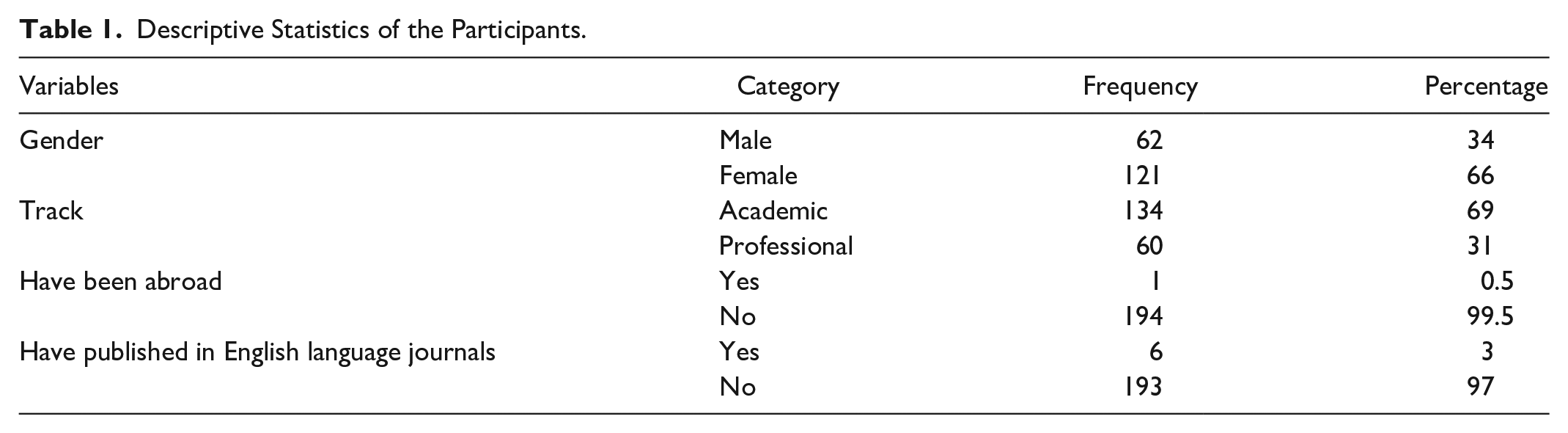
The participants were 200 EFL learners at a public university in northwestern China. All the students were enrolled in master’s programs in this university. English language courses were required for all students. Table 1 lists the descriptive statistics of the participants. The ages of the participants ranged from 18 to 34 (M = 24.37; SD = 1.738). Of the 200 participants, 62 were males (34%) and 121 were females (66%). About 134 students (69%) were in academic-track (i.e., 3-year program) and the remaining 60 (31%) were in professional-track programs (i.e., 2-year program). The number of years that the students had been learning English ranged from 7 to 20 years, with a mean of 12.40 years (SD = 2.322). Among the 200 participants, only 1 participant had been abroad (0.5%) and only 6 students had published in English language journals (3%). The participants were enrolled in 23 majors.
Descriptive Statistics of the Participants.
Instruments
Questionnaire
The questionnaire consisted of three parts (see Appendix A). The first part collected personal information on the participants such as their name, age, gender, major, years of learning English, experience of being abroad, program type, and experience publishing on English language journals. The second part was adopted from Evans and Green (2007) and included 45 Likert-scale items on academic speaking, listening, reading, and writing. An additional group of four items targeting attitudes toward English language classes and Chinese teachers of English were added. The participants were asked to rate the importance of specific academic speaking, listening, reading, and writing skills on a Likert-scale ranging from 1 (not important at all) to 5 (very important). The third part was composed of four open-ended questions which asked about the participants’ general opinions about their English language class, problems they encountered in the four skills, suggestions for improvement and other comments about their English language class. The questionnaires had satisfactory reliability. The Cronbach’s alpha values were found to be .821 for academic speaking skills, .789 for academic reading skills, .890 for academic writing skills, .837 for academic listening skills, and .944 when all skills are combined.
Semi-structured interviews
Interviews are a direct way of finding out what people think (e.g., Long, 2005). Interview with both students and teachers were conducted to triangulate the findings obtaind from the questionnaire. The interview questions were designed based on the research questions and asked students and teachers about their perceptions of the English language classes, the importance of four academic English skills, and the suggestions for improving their English language classes (see Appendix B for the full list of interview questions).
Four instructors and four graduate students were interviewed in total. Three of the instructors were interviewed face-to-face, one was interviewed via Skype, and the four students were interviewed by phone. The interviews were conducted mostly in Chinese because the participants were more comfortable expressing themselves in their native language. The interview with one of the instructors was conducted in English because it was his first language. The interview data was fully transcribed and translated into English for later theme analysis.
Data Collection
The data were collected from one public university in northwestern part of China. One of the authors of this paper who was working in the university first contacted other English language instructors and explained the purpose of the study. Four instructors were willing to participate in the study and be interviewed. Three of the four instructors were willing to disseminate the recruiting flyers to the students in their English language classes. One of the authors of this paper then went to those classes to explain the purpose of the study to the students. Students who were willing to participate in the study signed the consent form and completed the survey in class. It took them around 20 minutes to complete the questionnaire. At the end of the questionnaire, they were asked to indicate whether they were willing to participate in a follow-up interview. After the questionnaire data were analyzed, one of the authors conducted face-to-face or phone interviews with four graduate students and four instructors.
Data Analysis
Several types of quantitative analyses were conducted using SPSS (version 20). Means and standard deviations were computed for all skills. To answer RQ-1, the importance of skills in each academic skill domain was ranked by mean values. A mean rating of 4 (important) or higher was selected as a criterion to distinguish the most important skills from those with lesser importance. Four principal component analyses (PCAs) were conducted to extract the factors underlying each academic skill domain. To answer RQ 2, students’responses to Q6 in the survey and teachers’ responses to interview question 3 were thematically analyzed using Nvivo 11 Pro for Windows. Teachers’ and students’ responses were compared and contrasted. To answer RQ 3, the responses to open-ended Question 5 on the questionnaire were analyzed and coded under three main categories: positive, neutral, and negative comments using Nivo 11 pro for Windows. If students stated that they liked their English classes, the response was coded as positive. If students stated they did not like their English classes, the response was coded as negative. If students did not express a strong opinion of their English classes, their responses were coded as neutral. RQ 4 was answered by analyzing the responses to question 7 on the students’ questionnaire and teachers’ interview.
Results
RQ1: What Academic Listening, Speaking, Reading, and Writing Skills Do Learners Feel Are Important?
The importance of each speaking, listening, reading, and writing skills
We reported the importance of each speaking skills (Table 2), listening skills (Table 3), reading skills (Table 4), and writing skills (Table 5) ranked by students. Table 2 lists the nine academic speaking skills and their importance rated by the graduate students. The mean values of all the speaking skills were above 3. Items S6 “Communicating ideas confidently,” S7 “Speaking clearly,” and S3 “Participating actively in discussions” all had mean values above 4, which indicated that the participants viewed these skills as very important.
The Importance of Academic Speaking Skills.

The Importance of Academic Listening Skills.

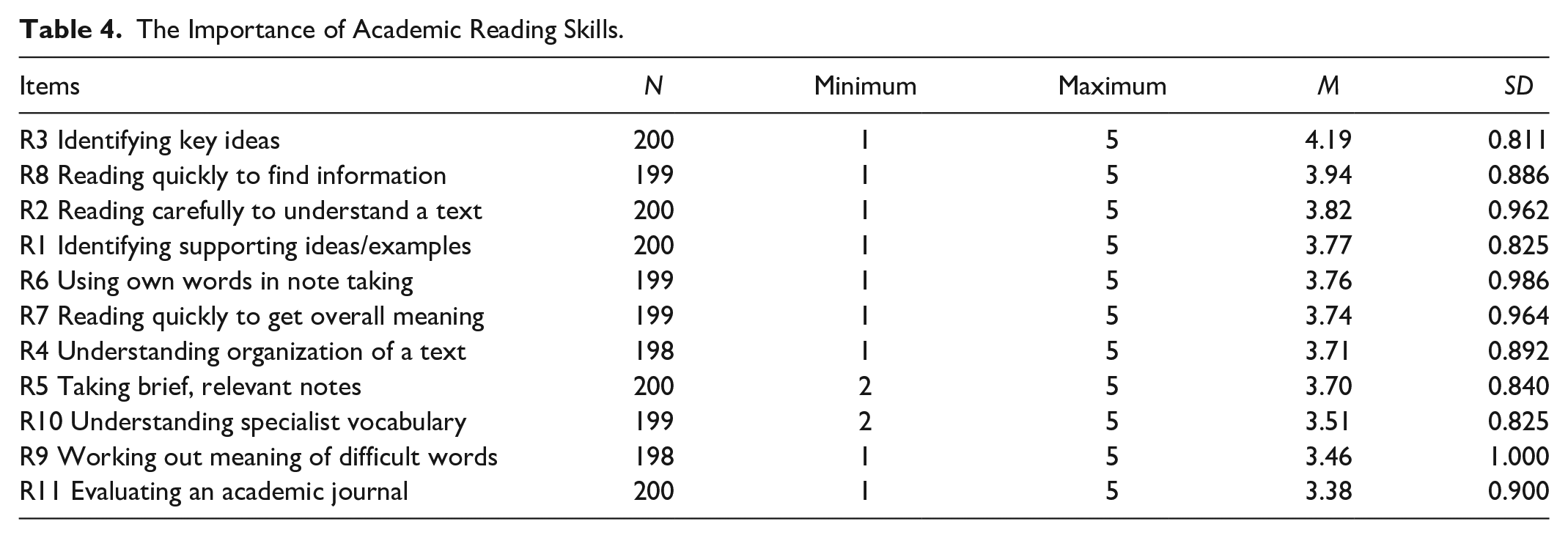
The Importance of Academic Reading Skills.
The Importance of Academic Writing Skills.

Table 3 lists the 10 academic listening skills and the mean importance ratings given by the graduate students. Item L3 “Understanding the main idea of lectures” was rated as the most important academic listening skill (M = 4.28), followed by Item L10 “Understanding key vocabulary” (M = 4.12). Item 2 “understanding questions” was identified as the third most important academic listening skill (M = 4.08).
Table 4 lists the academic reading skills in order of importance. Only one academic reading skill, item R3 “Identifying key ideas,” was rated as very important by the participants (M = 4.19). The second most important academic reading skill was R8 “Reading quickly to find information” (M = 3.94).
Five academic writing skills were rated as very important by the participants (Table 5). Item W9 “Expressing ideas clearly/logically” was rated as the most important academic writing skill (M = 4.21), followed by the W14 “Expressing ideas in correct English” and W4 “Writing references and bibliographies” (M = 4.14). Items W7 “Summarizing/paraphrasing” and W5 “Writing conclusions” were also very important academic writing skills identified by the graduate students.
The principal components analyses of academic skills
The PCA was conducted to investigate the internal structure of the questionnaire items and to extract the factors underlying the four academic skill areas. Before conducting PCA, the assumptions associated with PCA analysis were examined and found to be satisfied. The Kaiser-Meyer-Olkin (KMO) Measure of Sampling Adequacy was .925 for academic writing, .828 for academic speaking, and .804 for academic reading. A KMO value above .800 is very good and a value above .900 is excellent (e.g., Cohen, 2008).
Secondly, Bartlett’s tests of sphericity were significant for all academic skill domains: χ2 = 495.348 (36), p < .01 for the academic speaking domain, χ2 = 411.148 (55), p < .01 for the academic reading domain, and χ2 = 929.87 (105), p < .05 for the academic writing domain. The testing of assumptions confirmed that each item shared some common variance with other items in the same academic skill domain and factor analysis was deemed to be suitable for the 9 academic speaking items, 11 academic reading items, and 15 academic writing items.
A PCA of nine academic speaking skills was conducted using varimax rotation. Three factors were extracted, explaining 65.2% of the total variance. The three factors are Transactional Speaking: the skills of communicating one’s ideas to others, Interactional Speaking: speaking skills required while interacting with others and Using Notes. A PCA of 11 academic reading skills was also conducted using varimax rotation. Like in academic speaking, three factors were extracted, explaining 52.5% of the total variance. The first factor is General Academic Reading Skills. This factor was more related to skills required in academic reading such as evaluating an academic journal. The second factor is Basic Reading Skills, which refers to basic reading skills such as reading carefully to comprehend, understanding the key ideas, and identifying supporting details. The third factor is Reading Rate. A PCA of 15 academic writing skills was also conducted using varimax rotation. Two factors were extracted, Basic Writing Skills and General Academic Writing Skills.
The mean importance of each factor was calculated for each academic skill domain by comparing factor means. We can see that the graduate students in this study rated Transactional Speaking Skills (M = 4.02) the most important academic skills, followed by Basic Writing Skills (M = 3.92) and Interactional Speaking Skills (M = 3.91). The graduate students rated Academic Listening Skills the fourth most important category of academic skills (M = 3.90; Table 6).
Factor Means.

RQ2: What Problems Do Chinese EFL Learners Have While Speaking, Listening, Reading, and Writing English According to Students and Teachers?
Question 6 in the open-ended question part on the questionnaire asked about the problems that graduate students had while speaking, listening, reading, and writing English. Among the 310 comments, over 39% were related to speaking, 28.71% to listening, 23.23% to writing, and 9.03% to reading (Table 7).
The Problems the Participants Have with Four Academic Skills.

Speaking was the academic skill domain which the students had the most problems with. The most pressing issue with speaking was pronunciation (7.42%). For example, student comments included “my pronunciation is not accurate” (Reference 1, Pronunciation), “my pronunciation is not standard” (Reference 2, Pronunciation), and “while speaking English my pronunciation is not accurate, which to some extent also affects my listening” (Reference 4, Pronunciation). For academic listening, over 13% of the comments were concerned with the category “can’t comprehend others.” The participants said they did not understand what they listened to. As for academic writing, grammar seemed to be the biggest issue (9.39%). For example, students stated “when writing English sometimes the grammar is not correct” (Reference 2, Grammar), “I could not write good sentences, and can only write simple sentences” (Reference 12, Grammar), and “for writing I can’t write complex sentences. All I write are simple sentences” (Reference 19, Grammar).
Four instructors were also interviewed on their opinions of what problems their students had in learning English. The instructor in (1) stated that students did not have a positive attitude toward English (IE: interviewee, IR: interviewer).
IE: That is one difficulty. The other is, of course, the attitude to English, well if they are doing a major, will they ever use English? They will never gonna use English, they are not that interested, you know, like history students, they really did not care. So in a class you got 8 maybe out of 50 who really think, well, this is any good? You know now of course we have the Silk Road thing, and all that kind of thing, and now the role is a little bit stimulated. The fact that maybe history of China maybe is of interest to others. The level of interest is not good.
(2)
IR: Yeah, sure, ok, last question, we kind of talked about it, what do you think is the greatest source of difficulty with your students?
IE: Well, one of the biggest problems is the spread of the students, you know, some arrive and they are in the same college, or doing similar majors, but some are good, some are very poor. It would be much better if we have classes with students who are placed according to their proficiency level.
The instructors also mentioned class sizes and student proficiency levels. It was common to have 50 to 60 students in one class and students did not have plenty of opportunities to practice. Also, student proficiency levels were not balanced. One instructor mentioned that some students’ English proficiency was low, so it was hard to organize teaching. In (2), another instructor commented that because students’ proficiency level was not balanced, there were a lot of difficulties in teaching. He suggested that the students should be placed according to their proficiency levels.
RQ3: What Are Chinese EFL Graduate Students’ Opinions of Their English Classes?
To answer this research question, the responses to open-ended Question 5 on the questionnaire were coded under three main categories: positive, neutral, and negative comments (Table 8). Altogether, there were 48 positive, 10 neutral, and 272 negative comments. Thus, over 82% of students’ comments on their English language classes were negative. The 272 negative comments were on the following themes: teaching (38.24%), skills (24.26%), content (18.01%), class atmosphere (8.46%), students (3.31%), equipment (3.31%), textbook (2.21%), teacher (1%), and time (1.1%).
The Participants’ Negative Comments About Their English Classes.

Note. x stands for no subthemes under each main theme.
Over one third of the 272 negative comments were about teaching (38.24%). Specifically, the participants did not like the current teaching approach. Based on students’ comments, lecturing and grammar translation were the main teaching approaches. The participants wished that there could be more activities, more discussion, more student-student interaction and student-teacher interaction. For example, some responses stated that “there should be more interaction among students” (Reference 4, S-S interaction), and “the English language class should allow students to communicate, to communicate with each other” (Reference 5, S-S interaction). Among the 272 negative comments, 24.26% of the comments were related to the four skills. Speaking (8.46%) and listening (3.68%) were the two skills that the participants commented on most. In general, the participants would have liked to have more speaking and listening practice. About 11 comments (4.04%) were concerned with instructional language. Individual comments included, “In English language class we should use English to express ourselves as often as possible” (Reference 2, Class language), and “I hope that in English language class the teacher and the students should try their best to speak English” (Reference 3, Class language). They also commented negatively on the content of their English language classes (18.01%). The first concern they had with the content was that it was boring (3.68%), not practical (4.78%), and not related to their majors (4.04%). Instead, they wished that they could learn more about English culture (2.21%) and watch more movies and videos (3.31%).
RQ4: What Improvements Would the Students Like to See and the Teachers Like to Make in Their English Classes?
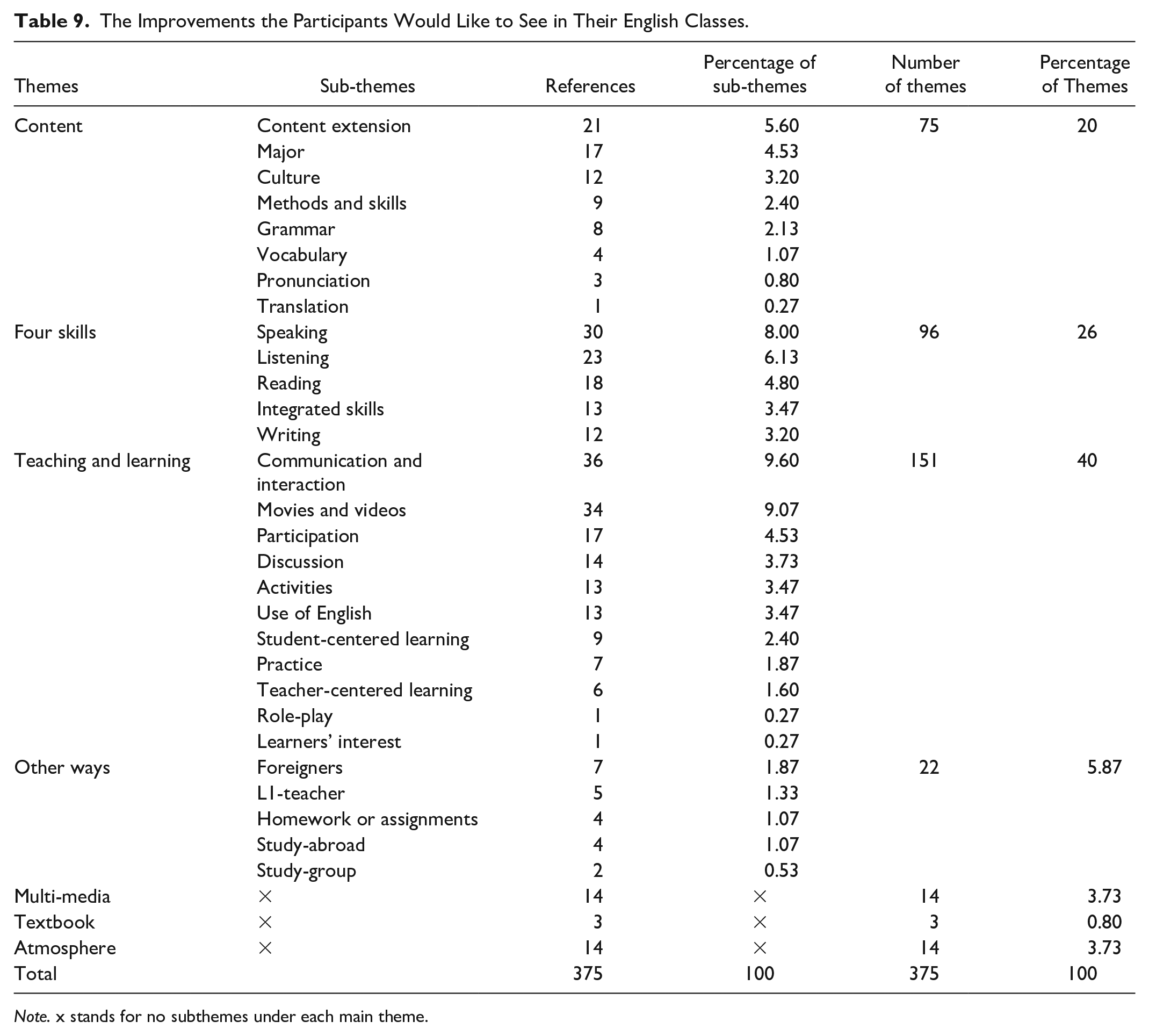
Question 7 asked the participants what improvements they would like to see in their English classes. Among the 375 suggestions, 40% of them were related to teaching and learning, 26% of them to the four skills, 20% of them to content, and another 7% to multi-media, the textbook, and class atmosphere (Table 9).
The Improvements the Participants Would Like to See in Their English Classes.
Note. x stands for no subthemes under each main theme.
As for teaching and learning (40%), the participants suggested that there should be more communication and interaction in English classes (9.6%). Around 9% of the comments were about movies and videos. The participants suggested that English movies or videos could be played in the class. A student-centered classroom (2.4%) was preferred to a teacher-centered one (1.6%). The participants would like to have more discussion and different activities as well.
As for the content (20%), students hoped that the content should not be limited to the textbook and should be extended (5.6%). For example, one student commented that “in English class, teach some English knowledge that is not covered in the textbook (that students are interested in)” (Reference 3, Content extension). Two major areas they would like to learn were the content related to their majors (4.53%) and culture (3.2%).
As for the four skills (26%), speaking was the first skill domain where students would like to improve (8%). The participants expressed their desire to practice speaking and improve their speaking competence. For example, one student said, “to create more opportunities and let students speak more and talk more, and feel the joy of learning English” (Reference 18, Speaking). Besides speaking ability, students also wanted to improve their listening ability (6.13%).
The participants also wanted to see other improvements (5.87%). For example, they wanted to communicate with native speakers of English, to study abroad, to have L1 teachers, and to have more homework and assignments.
Teachers’ perspectives on how to improve their English classes were also collected through interviews. The teachers mentioned five areas where they would like to make improvements in: increasing student interest, expanding class time, encouraging student participation, obtaining updated textbooks, and using multi-media resources in their teaching. (Reference: Teachers’ perspectives).
Discussion
This study investigated the EAP needs of graduate students at a public university in a less-developed part of China. Specifically, the study examined graduate students’ opinions about their English language classes, the importance of specific academic speaking, listening, reading, and writing skills, the problems they had with their English language classes, and suggestions for how to make improvements.
The first outcome of this study was that it identified EAP skills that students viewed as important. The graduate students in this study rated transactional speaking skills, basic writing, interactional speaking skills, and basic listening as the most important academic English skills. Graduate students in this study have strong communication needs both in speaking and writing. This result was in agreement with EAP needs analysis studies conducted in other Chinese contexts such as Hong Kong (e.g., Evans & Green, 2007; Hyland, 1997; Littlewood & Liu, 1996) and in other countries such as Iran (e.g., Atai & Hejazi, 2019). Currently, most Chinese universities adopt a general English curriculum for undergraduate and graduate students (e.g., Cheng, 2016) and the university in this study is of no exception. Proponents of general English curriculum stated that China’s CET (college English teaching) should focus on general English because China is a vast country with huge educational discrepancy (e.g., Wang & Yao, 2013). However, opponents stated that general English language courses were insensitive to students’ communication needs for future study and work and should be replaced by EAP courses (e.g., Cai, 2012). The findings of this study indicated that graduate students in a less developed part of China expressed strong needs for general academic speaking, writing, and listening skills. Thus as suggested by Cheng (2016), CET in China could transform its curriculum model to one which include a series of required English for general academic purpose (EGAP) and elected English for specific academic purposes (ESAP) courses.
The second finding of the study concerned the problems students encountered in their English language courses based on the thematic analysis of responses to open-ended questions. Unlike EAP students in other contexts (e.g., Saudi context, Gaffas, 2019) where unfamiliar terms caused difficulties, students in this study encountered difficulties in basic language skills. Speaking and listening were the two skill domains that the graduate students rated as the most important, which they also had the most difficulty with. Pronunciation was the main obstacle for the graduate students in speaking in this study. It is possible that compared to those in more developed areas, students in less-developed parts of China had less resources and opportunities to practice speaking skills. Despite the importance of pronunciation, it is essential for the teachers to inform the students that perfect pronunciation should not be the goal of language learning (e.g., Brinton, 2012). As long as their pronunciation is intelligible, they should have confidence in speaking (e.g., Brinton, 2012). Regarding listening, the participants reported that they did not understand what they were listening to in class. A few factors that might affect L2 learners’ academic listening performance, including word recognition and formulaic sequences in bottom-up processing, and content and genre knowledge that are essential for top-down processing were discussed by Rodgers and Webb (2016). The L2 learners in this study might need help with both bottom-up and top-down processing. English language instructors could use multiple resources (e.g., Academic Formulaic List by Simpson-Vlach & Ellis, 2010; Academic Collocation List by Ackermann & Chen, 2013) and different teaching approaches (e.g., Audio Lingual Method, extensive listening) to improve the speaking and listening abilities of L2 English learners.
The third finding of the study revealed extensive negative comments on English language classes among the English language learners in a less-developed part of China. Due to the important role affective factors played in language learning (e.g., Dörnyei, 2007; Ortega, 2008), the overwhelming negative attitudes should be addressed in curriculum design. Firstly, students were not satisfied with the materials in their English language classes, which calls for English language teachers to adapt, adopt, or develop authentic materials for L2 learners (see Stoller, 2016 for a discussion on EAP materials). Students’ views (e.g., Zare-ee & Hejazi, 2018) and teachers’ perceptions (e.g., Basturkmen & Bocanegra-Valle, 2018; Kaivanpanah et al., 2021a, 2021b) on the materials could be collected in this process to get a balanced view on the appropriateness of the materials. Secondly, instructors could draw on the teaching methodologies of the professional domain and include long and task-based tasks that requires a high level of student engagement (e.g., Basturkmen, 2021; Hiver et al., 2020; Mercer & Dörnyei, 2020; Sadoughi & Hejazi, 2021). Language teachers are encouraged to define achievable goals by considering students’ current language proficiency levels (Atai & Hejazi, 2019). Thirdly, students in this study expressed their interest in interacting with other students and teachers in English. Due to cultural and motivational factors, students’ limited participation and teachers’ complete dorminance could lead to unbalanced interaction patterns in English classes (e.g., Vattøy & Gamlem, 2020; Wang, 2011; Zare-ee & Hejari, 2019). It is recommended to move from traditional teaching approaches such as grammar translation to more communicative based teaching approaches such as communicative language teaching (CLT) and task-based language teaching (TBLT).
The last finding of the study was related to comparing and contrasting the perceptions of students and teachers. Similar to the students, the teachers felt that students experienced difficulty speaking and listening to English. However, the two sides also differed in their perceptions about the difficulties that students had. For example, three out of four instructors stated that students had problems with vocabulary. Three instructors stated that their students had small vocabulary sizes and had difficulty using vocabulary. However, the students did not see vocabulary as a main source of difficulty. As for the suggestions for improvement, students wanted to interact and communicate in English with the teacher and other students. The instructors talked more about the textbook, the class time, and the use of multi-media resources. It is not uncommon that teachers and students do perceive things differently (e.g., Bernaus & Gardner, 2008; Bhowmik & Kim, 2018; Luo, 2014; Schulz, 2001). When teachers’ teaching behavior do not meet students’ expectations, learner motivation and teachers’ credibility might be diminished. Bhowmik and Kim (2018) stated that classroom should be a place where students could express themselves freely without any fear or inhibition. To encourage students to express their needs, they can be asked to write reflections where a specific section could be about what suggestions they have for the language class and their instructors. Collecting reflections three times, at the beginning, during the middle, and at the end of the semester would give language teachers a general picture of their students’ needs, difficulties, hopes, and so on. Suggestions collected in this study were all valuable comments. For example, the English language classes needed to transfer from a teacher-centered format to a more student-centered one. The graduate students wanted to have English language classes where they could use English to interact and communicate with each other and the teacher. Last but not the least, the students expressed a desire for culture to be an essential component of the English language classes.
Conclusion and Limitations
Using a questionnaire and interviews, this study investigated mainland Chinese graduate students’ and their instructors’ perceptions regarding the importance of EAP skills. The study also examined the graduate students’ opinions about their English language classes, and the problems they had with the four EAP skills. The findings of this investigation have significant implications for the understanding of the EAP needs of graduate students in less-developed areas of China.
The study had a few limitations. First, the data were collected at a public university in the northwestern part of China. Thus, care should be taken in generalizing the findings to other graduate students in public universities in the other less-developed region in China as well as all graduate students in China. More studies in other contexts, especially less developed parts, are needed. Secondly, even though this study triangulated data sources and data collection methods, further triangulation methods could be used. For example, the researchers can observe the classes to get a better understanding of what is actually happening in the English classrooms. Thirdly, since academic English courses were designed to assist the study of majors, future research can probe content courses instructors’ views about the skills needed.
Despite the aforementioned limitations, this study extended the current understanding of Chinese graduate students’ needs in EAP classes to a less-developed part of China, identified the gaps between what the graduate students need and what the instructors think they need, and made suggestions to revise the curriculum.
Footnotes
Appendix A: Needs Analysis Questionnaire
Appendix B: Interview Questions
Declaration of Conflicting Interests
The author(s) declared no potential conflicts of interest with respect to the research, authorship, and/or publication of this article.
Funding
The author(s) received no financial support for the research, authorship, and/or publication of this article.
Ethical Approval
An ethics statement (including the committee approval number) for animal and human studies. This research has been approved by IRB of University of Hawaii at Manoa (exempt).
