




Abstract
This mixed-method study examined the impact of the KWL Plus strategy on university students’ note-taking habits, academic listening achievement and proficiency. The study involved 66 students, with 33 in the experimental group and 33 in the control group. The experimental group received a 7-week training program using the KWL Plus strategy, while the control group received standard classroom instruction. During the experimentation period, quantitative data were collected through achievement tests and scales. Also, qualitative data were collected through focus group discussions, semi-structured interviews and student diaries. ANCOVA and t-tests with SPSS 21 were used to analyze quantitative data, and content analysis with MAXQDA 2020 was used to analyze qualitative data. Quantitative results revealed that the KWL Plus strategy significantly improved both note-taking skills and academic listening proficiency among students in the experimental group compared to those in the control group. Students also reported positive experiences with KWL Plus, viewing it as a systematic and effective learning method. This study suggests that KWL Plus offers a valuable alternative to traditional approaches and recommends its use for enhancing note-taking and listening skills in academic settings.
Plain language summary
This study evaluates the effects of the KWL Plus strategy on university students’ academic listening and note-taking skills. Over the course of this 7-week study, the KWL Plus method led to a significant improvement in students’ core skills, such as organizing information, making sense of it, maintaining focus, and taking notes. Specifically, students who used this method were able to organize the information they listened to more systematically, demonstrated greater success in their comprehension processes, and exhibited more effective and organized note-taking habits compared to before. The KWL Plus strategy also contributed to a notable improvement in students’ focusing skills, enabling them to sustain their attention for longer periods and process information in more detail. These findings suggest that the KWL Plus strategy is an effective learning tool that can significantly contribute to the academic development of university students in academic listening and note-taking contexts.
Introduction
Academic success at the university level is intricately linked to the development of students’ language skills and the strategies they employ to comprehend and process information (Klímová & Zamborová, 2020). In particular, listening skills and note-taking practices play a vital role in academic achievement. Listening, occupying a significant portion of communication time – about 45% – in educational contexts (Palmer, 2014), directly influences students’ ability to engage with lectures, participate in discussions, and understand course material, thus shaping overall academic success (Al-Azzemy & Al-Jamal, 2019). In this process, note-taking skills, which are integrated with listening, play a critical role in making information permanent and making sense of it.
Research on note-taking and academic listening at the university level has received considerable attention (Salame & Thompson, 2020; L. Shi & Cheng, 2021; Zhou et al., 2024), as these skills are critical for academic success (Hrbáčková et al., 2012; Su Bergil, 2020; Valera, 2019; Vrdoljak & Velki, 2012). Despite this recognition, many students continue to struggle with listening and note-taking in academic settings (Liu & Chen, 2019; Maydosz & Raver, 2010; Ozturk, 2020; Tsang, 2023), indicating a need for effective strategies to support their development (Bonner & Holliday, 2006; Li & Hasegawa, 2014; Liu & Chen, 2020; Lynch, 2011). While the KWL Plus strategy has been explored in the context of reading comprehension (Yildirim, 2023), its potential to enhance other comprehension-based skills, such as academic listening and note-taking, remains underexplored. Additionally, although much of the research in this area has focused on second language (L2) learners (Li et al., 2016; Park, 2019; Siegel, 2020), there is limited evidence regarding the use of KWL Plus in supporting academic listening and note-taking among first language (L1) learners. These gaps suggest the need for further research to understand how KWL Plus can contribute to the development of these essential academic skills.
Finally, conducting this study within the Turkish context adds further significance. The education system in Türkiye is centralized and hierarchically structured (Çelik et al., 2017), and recent reforms have aimed to enhance the quality of undergraduate education (CoHE, 2018). However, Türkiye’s performance in international assessments of comprehension skills remains below expectations (PIAAC, 2016; PISA, 2022), highlighting the need to strengthen academic listening and note-taking skills to support higher comprehension levels among university students. Drawing on identified gaps, this study aims to examine the integration of KWL Plus into academic listening and note-taking skills at the university level. The research questions are as follows:
To what extent does the KWL Plus strategy affect students’ academic listening achievement, academic listening proficiency, and note-taking habits?
How do the effects of KWL Plus on note-taking habits, academic listening achievement, and proficiency compare considering control variables (pre-test scores)?
How do the qualitative data in the study explain the results obtained from the quantitative phase?
Literature Review
KWL Plus
KWL (Know, Want, Learn) is a strategy introduced by Ogle (1986) to enhance reading and critical thinking skills. Named after the questions “What Do I Know? What Do I Want to Learn? What Have I Learned?,” the KWL strategy helps students identify their prior knowledge, set learning objectives, and review newly acquired knowledge. By actively engaging students in the learning process, KWL fosters habits of knowledge construction. Carr and Ogle (1987) expanded on this strategy, developing KWL Plus by adding the steps of “Reviewing” and “Summarizing.” These additional steps allow students to process information more effectively through writing and restructuring text, reflecting the constructivist approach through brainstorming, recording prior knowledge, discussion, concept mapping, organizing information, and summarizing.
KWL and KWL Plus provide a multi-stage structure that creates an effective learning environment (Lou & Xu, 2016), offering an alternative to traditional learning approaches (Hamdan, 2014). Table 1 illustrates the features that distinguish KWL Plus-supported learning environments from traditional ones.
Features Distinguishing KWL and KWL Plus from Traditional Learning Environments.

As shown in Table 1, the opportunities provided by KWL and KWL Plus in learning environments align with the constructivist paradigm, which remains effective in today’s education systems. Beyond being a simple template, KWL Plus serves as a powerful metacognitive tool that supports individual learning. Extensive research on the use of KWL and KWL Plus in educational settings has highlighted their positive impact on student achievement, particularly when compared to traditional methods (Lismayanti, 2014; Sinambela et al., 2015; Siribunnam & Tayraukham, 2009; Tok, 2008; Zouhor et al., 2017). While originally designed to enhance reading comprehension, KWL and KWL Plus strategies have proven successful across various disciplines (see Figure 1).

Distribution of KWL and KWL Plus strategy in different study areas.
The existing literature shows that while the KWL model has been widely studied in various educational contexts, research focusing specifically on the KWL Plus model remains limited (e.g., Lou & Xu, 2016). KWL Plus, an extension of the original model, incorporates additional steps that guide students in monitoring and reflecting on their learning process. These features position KWL Plus as a potentially effective tool for supporting comprehension-based skills, including academic listening.
KWL Plus also provides a structured framework that can aid students in note-taking during listening tasks (Carr & Ogle, 1987) as illustrated in Figure 2. Note-taking strategies are widely recognized as essential components of academic listening (Gur et al., 2013; Kurudayıoğlu & Soysal, 2016; Şahin et al., 2015), and the structured phases of KWL Plus can facilitate the organization and retention of information during listening activities. Furthermore, studies have highlighted the metacognitive dimension of KWL Plus, emphasizing its contributions to higher-order processes such as analysis, synthesis, and evaluation (Bogdanović et al., 2022; Bryan, 1998; L. Shi & Cheng, 2021; Szabo, 2006; Tok, 2013). These findings suggest that KWL Plus can serve as a versatile instructional strategy that supports both comprehension and the development of metacognitive skills in various educational settings.

KWL Plus format.
Note-taking
Note-taking is recognized as an effective learning strategy that improves students’ reading skills but also supports their overall academic success (AlAdwani et al., 2021; Lou & Xu, 2016; Simonet & Simonet, 1995). It involves not only transcribing information but also extracting and organizing key points during listening, thus enhancing understanding. Research shows that note-taking is critical in improving students’ information recall, and exam success (Salame & Thompson, 2020); therefore, commonly employed by university students for educational interaction (Castelló & Monereo, 2005). The essence of note-taking lies in the student’s ability to restructure written or oral information in their own words, creating notes conducive to enduring learning (Faber et al., 2000; Titsworth & Kiewra, 2004; Tok, 2008). Note-taking is not only related to reading skills but is also closely connected to listening skills. Research shows that effective note-taking, which includes metacognitive skills like understanding and organizing information, helps students concentrate on important details while listening (Baker & Lombardi, 1985; Durukan & Maden, 2010; Ferris, 1998; Kim, 2019; Titsworth & Kiewra, 2004).
Numerous studies have demonstrated a strong relationship between note-taking and students’ academic performance (Luo et al., 2016; Y. Shi et al., 2022; Titsworth & Kiewra, 2004; Tok, 2008; Tok & Beyazıt, 2007). This effect is attributed to the complex nature of note-taking, which requires students to distinguish important information from irrelevant details, organize data, identify key terms, integrate new information with existing knowledge, and express it systematically (Najar, 1997; O’Malley et al., 1989). Processes such as integrating new knowledge with prior knowledge, identifying key concepts, and restating knowledge (Carr & Ogle, 1987) are also of significant importance within the KWL Plus framework, so it is predicted that KWL Plus can improve students’ academic listening and strengthen their note-taking skills due to its structured five-stage approach.
Academic Listening
Academic listening skills are essential in adult education, teacher training, lifelong learning, and the development of 21st-century skills (Dixon, 2017; Işık & Yılmaz, 2011; Nawaz & Mahboob, 2023; Perry, 2019). Research indicates that academic listening is not a passive process; it is a complex activity that involves multifaceted cognitive processes, such as actively processing, questioning, and interpreting information (Goh, 2008; Marx et al., 2017; Vandergrift, 2003). Canpolat et al. (2015) argue that this process is closely tied to cognitive strategies, including focusing attention, taking notes, asking questions, and making sense of the information. Successful meaning-making in listening activities also relies on metacognitive skills, such as the ability to analyze listening tasks, engage appropriate strategies, make predictions, and evaluate performance (Vandergrift, 2003).
The literature highlights several key features of academic listening: it is a cornerstone of communicative competence in university settings (Flowerdew, 1994), it is more complex than everyday listening (Christian, 2018), and it occurs in both unidirectional (e.g., lectures or presentations) and bidirectional (e.g., interactive lectures and student presentations) forms (Lynch, 2011). Over the past half-century, the literature has diversified in the context of academic listening; however, this diversity is mostly focused on L2 acquisition (Astika & Kurniawan, 2020; Huang & Su, 2013; Valera, 2019). Existing literature provides compelling evidence that academic listening is indispensable for achieving success in university settings (Christian, 2018; Huang & Su, 2013; Park, 2019; Singh, 2019), and students often require support with various strategies to enhance their academic listening skills (Flowerdew & Miller, 1997; Liu & Chen, 2020; Park, 2019).
Research on academic listening encompasses a range of topics, including “note-taking” (Hamp-Lyons, 1983; Locke, 1977), the “relationship between lecture content and exam grades” (Dunkel, 1988), “students' listening tasks” (Benson, 1989), “students' academic listening problems” (Ferris & Tagg, 1996), “academic listening needs” (Ferris, 1998), and “academic listening difficulties” (Huang, 2005, 2006). Notably, the literature consistently highlights note-taking as a persistent challenge in undergraduate students’ academic listening experiences (Ferris, 1998; Köse et al., 2019; Rahimirad & Moini, 2015). In this regard, KWL Plus emerges as a promising alternative for facilitating both note-taking and academic listening. Research shows that this strategy encourages students to activate prior knowledge, set purposeful goals, and effectively organize learned material, thus improving comprehension during reading tasks (Greenwood, 2019). For example, Lou and Xu (2016) found that the KWL Plus strategy significantly improved reading comprehension in students studying languages other than English by increasing metacognitive awareness and encouraging the effective use of reading strategies. The stated benefits of the strategy provide insight into the similar effects in academic listening.
The concept of “academic listening” can be addressed in two dimensions: “academic listening achievement” and “academic listening competence” (Rost, 2014; Vandergrift & Goh, 2012). While academic listening achievement focuses on the level of performance that students reach as a result of listening processes (Field, 2008), academic listening competence, on the other hand, covers the skills and processes required to achieve this performance (Graham et al., 2011). Evaluating these two dimensions together provides a holistic examination of both the result obtained in the listening process and the process followed in achieving this result (Rost, 2014).
Methodology
Research Design
In this study, an explanatory sequential design was used. This design involves first collecting and analyzing quantitative data and then deepening these results with qualitative data (Creswell & Creswell, 2021; Creswell & Plano-Clark, 2007). Creswell (2015 emphasizes the three stages of this method: i) collecting and analyzing quantitative data, ii) explaining quantitative findings with qualitative data, iii) making connections between both findings. This study, which investigated the effect of the KWL Plus strategy on note-taking and academic listening skills, follows this structure.
In the quantitative part of this study, a quasi-experimental design was adopted, and in the qualitative part, a constructivist paradigm was adopted. Qualitative research aims to understand the experiences, perceptions, and beliefs of individuals (Given, 2021). The constructivist paradigm seeks to reveal different perspectives (Creswell, 2019), and in this direction, the qualitative dimension of the study was based on a phenomenological design. Phenomenology is widely used in the in-depth analysis of human experiences (Merriam, 2013).
Participants
In the 2023 to 2024 academic year, a total of 66 pre-service teachers from the first language education department of a state university in Türkiye took part in this study. Among them, 33 were placed in the experimental group, and the remaining 33 in the control group. Participants were carefully chosen through purposive sampling, ensuring balanced or nearly balanced gender ratios, age groups of 18 and 19, and GPAs in the ranges of 3.00 to 3.50 and 3.51 to 4.00. Within these strata, the 66 students were assigned to the experimental and control groups using a stratified sampling method, a type of random sampling. There were no statistically significant differences between the groups regarding note-taking habits (t = 1.576, p = .120), academic listening achievement (t = 1.198, p = .235), or proficiency (t = 0.439, p = .662), confirming that both groups had similar characteristics. Moreover, none of the students in the study group had previously received training on note-taking or academic listening, nor were they familiar with the TEDx talks used in the study.
Data Collection Instruments
Note-Taking Habit Scale (NTHS)
To assess the changes in the note-taking habits of undergraduate students, the NTHS scale, developed by Aydın and Doğan (2018), was utilized both before and after the implementation of the KWL Plus application. The scale comprises 12 items and is evaluated using a 4-point Likert scale. Reliability analysis indicated that the scale’s reliability was adequate, with a coefficient of 0.857.
Academic Listening Skill Achievement Test (ALSAT)
The ALSAT was developed to assess the impact of the KWL Plus strategy on academic listening skills. Following Liu’s (2023) findings that TEDx talks are effective for academic listening, materials were selected from TEDx Türkiye talks. The suitability of the selected materials was confirmed by three language education experts with international publications and relevant experience. The details of the TEDx talks used in the test are provided in Table 2.
Implementation Process.

During the development process of the ALSAT, 30 questions were reviewed and revised by language teaching experts for quality and validity. A pilot test with undergraduate students in the 2022 to 2023 academic year assessed the test’s difficulty and reliability, with results analyzed using the Test Analysis Program (TAP). The analysis led to the removal of nine items, resulting in a final version of 21 items with acceptable difficulty and discrimination values (with a difficulty index of 0.498 and a discrimination index of 0.361; Crocker & Algina, 1986; Özçelik, 2011; Turgut & Baykul, 2010). The ALSAT demonstrated high internal consistency, with a KR-20 reliability coefficient of 0.80, indicating that the instrument is reliable for measuring academic listening skills.
Academic Listening Proficiency Scale (ALSCS)
In this study, ALSCS was utilized to assess changes in undergraduate students’ academic listening skills before and after the implementation of KWL Plus. Developed by Yıldız (2018), this 5-point Likert scale consists of 37 items across four subdimensions. Yıldız (2018) reported an internal consistency coefficient of 0.91. In the present study, this coefficient was calculated to be 0.89, indicating strong reliability.
Focus Group Interview and Semi-Structured Interview Form
To evaluate the implementation phase, face-to-face focus group interviews were conducted with 10 pre-service teachers after their informed consent. The interview questions were designed in line with the feedback received from three language education experts. Participants were coded to ensure confidentiality (e.g., SFG1, SFG2). The focus group questions were as follows:
How do you evaluate the positive impact of KWL Plus on your note-taking skills?
How do you evaluate the positive impact of KWL Plus on your academic listening skills?
Explain the reasons for the significant improvement observed in academic achievement tests and scales before and after the intervention.
The same set of questions was also used in semi-structured individual interviews. In these interviews, the participants were interviewed face-to-face for an average of 10 min and the participants were coded as S10, S11,…S20.
Diaries
During the implementation process, 10 students kept diaries to evaluate their experiences after each session. These weekly diaries were submitted to the researcher, with the students labeled from SD21 to SD30. The diaries, prepared to document the students’ weekly progress, revealed the effects of the KWL Plus strategy on their note-taking habits and academic listening skills.
Implementation Process
The study was implemented in two phases: a 3-week pilot phase followed by the actual implementation phase. The pilot phase aimed to identify issues, evaluate pre-test measures, and assess the learning tools’ effectiveness. Adjustments were made based on observations and feedback from the pilot phase to optimize the main study. Table 2 outlines the actual implementation process.
In order to determine the effect of KWL Plus on students’ note-taking and academic listening skills, a 7-week program was implemented with sessions lasting 2 hr per week. Pre- and post-tests were conducted before and after the program. Pre-tests and post-tests were administered before and after the program for both the experimental and control groups. In the experimental group, KWL Plus, note-taking, and academic listening activities were applied, while no specific development activities were conducted with the control group.
In the experimental group, students’ prior knowledge about the topic of the listening material was first assessed. Next, a brainstorming session was conducted to predict concepts related to the title of the listening material. Students were then given time to complete the “I Know” and “I Want” sections of the KWL Plus template, which allowed them to activate prior knowledge and set learning objectives. Following this, students listened to the material and completed the “Learned” section of the template by answering questions to capture key points. In the “Plus” phase, concept maps were used by students to summarize the information gathered, after which they wrote a summary. Responses were then reviewed in the classroom, and feedback on students’ weekly progress was provided.
Data Analysis
Quantitative data analysis was performed using SPSS 21. First, a normality analysis was conducted to determine whether parametric or non-parametric tests would be appropriate for the data analysis. Given that the sample size of each study group was below 50, the Shapiro-Wilks test was used to assess normality assessment (Büyüköztürk, 2017). Additionally, skewness and kurtosis values were examined for further confirmation of normality (Tabachnick & Fidell, 2013). As the data met the normality assumption, an Independent t-test and a Paired Samples t-test were chosen to address the first research question.
Second, to assess the impact of KWL Plus on note-taking habits, academic listening achievement, and academic listening proficiency in the experimental group compared to the control group, and to control for pre-test scores, an Analysis of Covariance (ANCOVA) was conducted. The dependent variables were the post-test scores for note-taking habits, academic listening achievement, and academic listening proficiency, while the independent variable was the intervention of the KWL Plus application.
Lastly, all qualitative data were analyzed in MAXQDA 2020 using a code-subcode model. In this process, transcripts of focus group discussions were analyzed, with semi-structured individual interviews and student diaries serving as supplementary data sources. The qualitative analysis began with familiarization of interview data through thorough reading, followed by a hierarchical coding process within MAXQDA 2020. The resulting themes were presented to participants for validation and then consistently referenced in the findings discussion.
Validity and Reliability
Validity and reliability principles were carefully followed during data analysis. Expert opinions confirmed the suitability of TEDx talks and ALSAT questions for academic listening, and a pilot study ensured the validity and reliability of the tools. Pre-test scores confirmed equivalency between groups, with no prior exposure to listening or note-taking training or the KWL Plus strategy. Regarding the qualitative component, careful attention was given to avoid leading language in the formulation of questions, and neutrality was maintained throughout the data collection process, allowing participants ample time to respond. The whole research process was thoroughly documented, and participant responses were included to support the coding process. Methodological, location, and source triangulation were applied (Given, 2021), and codes and themes were verified with both ChatGPT and participants (Figure 3).

Checking of the sub-codes by ChatGPT.
Ethical Procedures
Before the implementation process began, the participants were briefed on the study’s purpose and objectives. Participation was voluntary, allowing students to withdraw at any time without consequence. Informed consent was obtained from all participants, and ethical approval was granted by Zonguldak Bülent Ecevit University University’s Human Research Ethics Committee.
Findings
The Effect of KWL Plus on Academic Listening Achievement, Proficiency, and Note-Taking Habits
Table 3 shows descriptive statistics for the study variables, including academic listening achievement, academic listening proficiency, and note-taking habit scores before and after the intervention in both experimental and control groups.
Descriptive Statistics for Groups and Dependent Variables.

The pretest mean scores for academic listening achievement were close between the experimental (M = 8.21, SD = 1.69) and control groups (M = 7.66, SD = 1.99). However, after the intervention, the experimental group showed a higher mean score (M = 17.39, SD = 2.79) compared to the control group (M = 8.33, SD = 2.28). The posttest differences between the two groups were statistically significant, t = 14.41, p = .001 (Cohen’s d = 3.56). This result shows that KWL Plus produced a substantial positive effect value on academic listening achievement for the experimental group. In addition, the pre-post test score differences within the experimental group also show significance (t = 16.656, p = .001, Cohen’s d = 3.95).
The pretest mean scores for the academic listening proficiency had similar values between the experimental (M = 86.12, SD = 5.51) and control groups (M = 85.36, SD = 8.09). Following the KWL Plus intervention, the experimental group showed a higher mean score (M = 123.42, SD = 9.84) compared to the control group (M = 85.60, SD = 14.47). The posttest differences between the two groups were statistically significant, t = 12.41, p = .001 (Cohen’s d = 3.05). This result shows that there is a significant difference and effect value in favor of the experimental group in terms of academic listening proficiency. On the other hand, the analysis of the pretest-posttest scores of the experimental group participants shows that there is a significant difference (t = 22.735, p = .001, Cohen’s d = 4.63).
For the note-taking habits, the pretest mean scores were similar between the experimental (M = 26.21, SD = 2.26) and control groups (M = 27.24, SD = 3.00). However, after the KWL Plus intervention, the experimental group showed a higher mean score (M = 50.18, SD = 5.10) compared to the control group (M = 28.18, SD = 3.56). The posttest differences between the two groups were statistically significant, t = 20.3, p = .001 (Cohen’s d = 3.05). This result emphasizes that the KWL Plus had a strong difference and impact value on note-taking habits. In addition, there was a significant difference between the pre-test and post-test scores of the experimental group with KWL Plus intervention (t = 23.518, p = .001, Cohen’s d = 3.99).
Comparative Analysis of KWL Plus Effects Considering Pre-test Scores
ANCOVA analysis confirmed a strong and significant effect of KWL Plus on academic listening achievement (Table 4). The results of the analysis were F(1, 63) = 217.31, p < .001 and Partial Eta Squared (η2) value was 0.775. In addition, the effect of pretest results used as covariate on the dependent variable was also significant: F(1, 63) = 9.809, p = .003; η2 = 0.135. This result suggests that the baseline levels of the dependent variable play an important role and that part of the variance is due to these pretest scores. Thanks to the ANCOVA analysis, the significant effect of KWL Plus on academic listening achievement was found to be high even under control conditions.
ANCOVA for Academic Listening Achievement (Tests of Between-Subjects Effects).
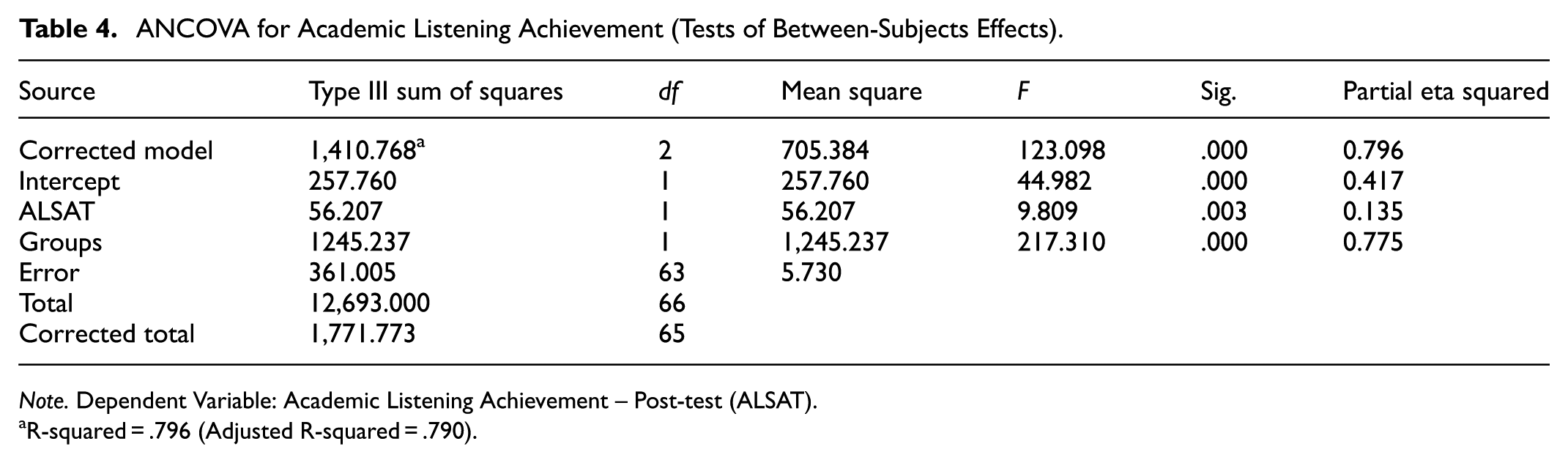
Note. Dependent Variable: Academic Listening Achievement – Post-test (ALSAT).
R-squared = .796 (Adjusted R-squared = .790).
The effect of the KWL Plus method on academic listening proficiency (ALSCS) was also found significant and strong (Table 5). The ANCOVA shows that the method explains 72.3% of the variance on the dependent variable, and this effect is at a high level. In addition, the significant effect of the pre-test results on the dependent variable was determined, and it was seen that the pre-test explained 10.3% of the variance. This situation shows that the initial levels of the dependent variable play an important role.
ANCOVA for Academic Listening Proficiency (Tests of Between-Subjects Effects).

Note. Dependent Variable: Academic Listening Proficiency (ALSCS).
R-squared = .737 (Adjusted R-squared = .728).
Table 6 shows that KWL Plus method significantly enhances university students’ note-taking habits. The corrected model yielded an F value of 210.344 (p < .001), demonstrating that the model explains 87% of the variance in the dependent variable (R2 = .870). The difference between groups is substantial; the improvement in note-taking habits in the experimental group is noticeably greater than in the control group. The F value for the group variable is 414.103 (p < .001), with a partial eta squared of 0.868, indicating a large effect size for the impact of group differences on note-taking habits. In contrast, the covariate for initial note-taking habits did not significantly influence the group difference (p = .162). These findings robustly support the potential of the KWL Plus method in enhancing students’ note-taking skills.
ANCOVA for Note-Taking Habits (Tests of Between-Subjects Effects).

Note. Dependent Variable: Note-Taking Habits (NTHS).
R-squared = .870 (Adjusted R-squared = .866).
Qualitative Findings
The participants clearly indicated that KWL Plus improved their ability to identify key information during note-taking (Table 7). SFG3 said, “Before KWL Plus, I thought that every word and sentence was important, but with this strategy, I realized that this was not the case. I learned to identify important information/words.” Similarly, S12 noted, “With KWL Plus, I can identify useful/qualified information more easily.” S13 added, “I can identify the important parts better, so I can keep my notes useful by removing unnecessary details.” SD27 wrote in her diary, “When I listen to a conversation with KWL Plus, I try to pick out the important points from the text.” Supporting this, SD25 remarked, “I can now better distinguish between important and unimportant information when taking notes.”
Qualitative Findings on the Effects of the KWL Plus Strategy on Note-Taking Skills and Academic Listening.

KWL Plus emerged as a significant gain under the “more functional note-taking” code. SFG3 and SFG9 shared, “I never took notes before. KWL Plus application gave me the habit of taking notes.” S16 added, “I thought I already had the habit of taking notes, but actually my note-taking habit has improved after KWL Plus.” S14 emphasized, “Making short and understandable sentences instead of long and tiring sentences reinforced my note-taking habit.” In her journal, S21 noted, “KWL Plus practices positively affected my note-taking habits in other lessons. I now take notes with pleasure.” Similarly, SD30 stated, “The structure of KWL Plus consisting of subheadings helped me develop a note-taking habit.”
Another key sub-code is “develop the ability to identify keywords while taking notes.” SFG4 said, “Before KWL Plus, I did not know that keywords were important. With this strategy, I understood.” S15 added, “With KWL Plus, I learned to capture keywords, and I found it more effective.” S22 noted, “Focusing on keywords while listening improved my ability over time.” SD23 stated, “The structure of KWL Plus that activates prior knowledge and the keyword identification section improved my focus on key concepts.” Another benefit was “the concept map facilitates note-taking.” SFG7 shared, “Before KWL Plus, I did not know that concept maps facilitate note-taking. With this strategy, I learned to use concept maps while taking notes.” S20 added, “I learned to note important words and terms more easily thanks to concept maps during the listening process.”
Beyond these sub-codes, other themes emerged, such as “helping to integrate notes, establishing sentence connections, making information permanent, focusing before, during, and after listening, reducing note-taking time, improving summarizing skills, and recreating notes.” These findings strongly support the positive impact of KWL Plus on note-taking habits and align with the quantitative results.
The second part of Table 7 highlights the impact of KWL Plus on academic listening skills. SFG1 emphasized the fun aspect of listening, saying, “KWL Plus makes listening enjoyable by thinking about what we know in the ‘Know’ section.” SFG9 agreed: “With KWL Plus, I started to enjoy a lesson that I did not like.” Similarly, S10 shared, “As KWL Plus has become a routine for me, I take notes over time without difficulty, enjoying it and improving my listening skills.” SD21 described a change in her attitude, stating, “Before, I thought that I listened to lectures as an obligation. Now, with KWL Plus, the obligation has turned into an enjoyable listening.”
Another important sub-code is “Preparing before listening.” SFG8 said, “I do more meaningful listening because I think about my existing knowledge and what I want to learn before listening.” SFG5 added, “Since I ask questions about ‘What do I want to learn?’ before listening, I listen more curiously and actively seek answers to the questions I want to learn.” Similarly, SD29 stated, “With KWL Plus, I acquired a listening purpose. Setting a purpose before the strategy makes listening more meaningful for me.” Some participants noted difficulties with mental preparation and pre-listening strategies, common in academic listening. KWL Plus addresses this by guiding students to listen with intent and focus.
“Increased attention span in academic listening” emerged as a key code. SFG6 noted, “Thanks to the template and steps of KWL Plus, my attention and focusing skills in academic listening increased.” S11 explained, “I look at the importance dimension of the topic and accordingly, if necessary, I listen without distracting myself at all, paying double attention to the important points.” SD28 highlighted the five-stage structure: “I started to listen more carefully every week during the KWL Plus implementation process in the experimental group. Especially, the structure of KWL Plus strengthened my attention.” SFG1’s remark, “Before KWL Plus, I was inadequate in listening comprehension. With this strategy, I understand the lessons better and more accurately,” reflects “development of listening comprehension skills.” Similarly, S13 stated, “After the KWL Plus practices, I realized that I understood the lessons more accurately.” SD29 confirmed, “My ability to understand what I listen to has increased significantly with KWL Plus, both in the lessons I like and in the lessons I find boring.”
Discussion
The current study investigated the effect of KWL Plus on university students’ academic listening skills and note-taking habits in L1. Quantitative data demonstrated that the KWL Plus method had a significant and positive effect on the note-taking habits of the students in the experimental group. Qualitative findings also revealed substantial improvements in both students’ note-taking skills and their in-class note-taking habits. This notable improvement can be attributed to the fact that students had not previously been exposed to any note-taking strategy, were inexperienced in identifying important information, and did not use keywords and concept maps effectively.
This study makes a meaningful and original contribution to the literature by adapting the reading comprehension-focused KWL Plus strategy to improve note-taking habits in academic listening processes. KWL Plus becomes a strategic tool in the field of academic listening by offering a flexible and versatile structure, especially with “Plus” steps such as reviewing and summarizing. In this way, it offers an innovative alternative to existing note-taking approaches and increases the depth of the method. The findings of this study suggest that university students’ academic listening deficiencies can be addressed through appropriate strategies and approaches, such as KWL Plus, contributing to those in the literature (Kim, 2019; Park, 2019; Taghizadeh & Emam, 2025; Zhou et al., 2024). KWL Plus enhances students’ ability to organize and comprehend information not only in academic reading but also in academic listening. Also, this strategy offers a novelty to the literature in terms of providing students with an important methodological support in the process of accessing and constructing knowledge while taking notes during listening (Titsworth & Kiewra, 2004). The results of this study align with a large body of literature emphasizing the importance of students developing a variety of note-taking strategies (Luo et al., 2016; Y. Shi et al., 2022; Titsworth & Kiewra, 2004; Tok, 2008). While this study is consistent with Tok’s (2008) study suggesting that KWL and note-taking strategies result in higher achievement compared to traditional methods in science and technology lessons, no significant difference was found between KWL and other note-taking strategies in this study. This may be due to the limited time allocated for the implementation of KWL. Nonetheless, KWL Plus provided participants with an opportunity to improve note-taking and demonstrated significant improvement in their note-taking habits compared to traditional methods. The qualitative data from this study and themes such as “helping to integrate notes, establishing a connection between sentences, recreation of notes, and develop summarizing skills in note-taking” are in line with the findings of Luo et al. (2016). Similarly the positive effect of the cascading structure of KWL Plus on students’ note-taking habits aligns with Y. Shi et al.’s (2022) findings that handwriting notes support the elaboration process.
The findings regarding the features of KWL Plus coincide with the multifaceted cognitive and metacognitive processes in academic listening documented in the literature (Goh, 2008; Marx et al., 2017; Vandergrift, 2003) such as activating prior knowledge, planning, combining new knowledge with old knowledge, observing the lecture, and focusing on the speaker. It is also noteworthy that KWL Plus addresses the gap that many university students lack adequate mental preparation and listening strategies prior to academic listening with the “What do I want to learn?” step. The findings of the present study show that KWL Plus can overcome issues such as “academic listening is not fun” and “disorganized listening.” Additionally, this study’s findings resonate with the available literature indicating that using background knowledge, capturing key terms, and functional note-taking skills are essential for the development of lasting listening skills (Ferris, 1998; Flowerdew, 1994). These factors summarize the core functions of KWL Plus and support how the method can be effective in academic listening.
The findings of this research reveal a significant relationship between academic listening achievement and academic listening proficiency (Rost, 2014). By linking these two variables for improving listening skills, the implementation of KWL Plus increased students’ information processing capacity (Ogle, 1986) and listening comprehension (Duke & Pearson, 2002; Fisher & Frey, 2004). While academic listening achievement reflects students’ immediate performance, listening proficiency indicates a sustainable skill development (Field, 2008; Goh, 2008). Notably, KWL Plus supports not only a short-term academic listening achievement but also a long-term listening proficiency.
In conclusion, this study demonstrates that KWL Plus is not only a reading strategy but also a multifaceted tool that improves academic listening skills. Considering the chronic problems in academic listening highlighted in the literature (Bourdeaud’hui et al., 2021; Park, 2019; Siegel, 2020; Zhou et al., 2024), KWL Plus can offer a new framework for listening pedagogy.
Conclusions, Implications, and Limitations
This study shows that KWL Plus offers an effective solution for improving undergraduate students’ note-taking and academic listening skills. With its five-step structure and “Plus” add-on, the strategy provides students with written prompts that guide them during listening and help them retain information for longer. Unlike traditional note-taking tools, KWL Plus allows students to think more deeply about the content, leading to significant improvements in note-taking and academic listening skills. The supportive nature of the strategy reduced students’ challenges in academic listening and helped improve their focus and disciplined listening habits. The results indicate that KWL Plus can be an effective tool across different learning domains. Qualitative interviews revealed that students’ initial negative perceptions, as well as their difficulties with note-taking and academic listening skills, decreased and became more positive after using KWL Plus.
This study has important implications for policymakers, educators, and students. First, the KWL Plus strategy shows promise as an integral component of note-taking and academic listening in adult learning. Therefore, educational policies may consider incorporating KWL Plus in the curriculum as a preparation for undergraduate programs. Second, as education becomes more individualized with distance learning and AI tools, students struggling with foundational skills like listening and note-taking may become more vulnerable (Maydosz & Raver, 2010; Ozturk, 2020; Tsang, 2023), making it important to support them through strategies like KWL Plus.
Despite its contributions, the study has some limitations that need to be acknowledged. The study aimed to improve undergraduate students’ note-taking and academic listening skills using the KWL Plus strategy; however, it did not include extracurricular listening experiences, which some interviewees reported as a challenge. Future studies should examine the effects of KWL Plus outside the classroom. Additionally, the experimental group used KWL Plus only in their L1; therefore, it is also important to investigate the effectiveness of the method in a foreign language. Furthermore, this study was conducted with a limited sample group; thus, further research with larger and more diverse sample groups may enhance the generalizability of the findings. Finally, future studies would provide a more comprehensive understanding of the KWL Plus’s potential contributions to other academic skills, such as speaking or writing.
Footnotes

Ethical Considerations
Zonguldak Bülent Ecevit University Human Research Ethics Committee.
Number of Registrations: 408842.
Protocol No: 479.
Funding
The author received no financial support for the research, authorship, and/or publication of this article.
Declaration of Conflicting Interests
The author declared no potential conflicts of interest with respect to the research, authorship, and/or publication of this article.
Data Availability Statement
The data supporting the findings of this study are available from the corresponding author upon request.