




Abstract
Explicitly, young professionals are at risk of facing the rigorous dilemmas of job burnout through victimization due to poor job performance in a multifaceted environment. Therefore, the present study aims to identify the relationship between innovative behavior, the joint role of in-role behavior and task interdependence, victimization, and job burnout in healthcare organizations. However, a cross-sectional sample of 330 early career healthcare professionals from public and private hospitals operating in Pakistan is included in the analysis which provides evidence for the generalizability of the research findings. Partial least structure equation modeling is implemented to test the proposed model of job burnout. Consequently, study results show a significant level of job burnout through victimization, leading to distress mental health, innovativeness, and job performance of early careers. However, investigation of job burnout has disclosed severe consequences which give meaningful direction for healthcare managers, to strengthen creative capabilities and performance of early careers by implementing useful strategies to reduce job burnout and other factors linked to job burnout.
Introduction
Job burnout has a substantial prevalence among early career healthcare professionals who are subjected to a highly demanding and challenging work environment in healthcare organizations (Rudman & Gustavsson, 2011; Vaezi & Fallah, 2011). Somehow the issue of job burnout has been found among early career healthcare professionals who seem to be more innovative, motivated, and energetic and often experience job burnout because of strict organizational policies, abusive supervision, victimization, and an unhealthy organizational environment. Rudman and Gustavsson (2011) report that 20% of the early career healthcare professionals are affected by job burnout in hospitals. Cho et al. (2006) conclude that 66% of young healthcare professionals were facing a serious issue of job burnout.
In a multifaceted and demanding hospital environment, early career healthcare professionals are frequently experiencing victimization like mistreatment, bad comments, gossip, abuse, etc. from peers due to role conflict regarding resistance to change and poor performance of in-role behavior and task interdependence by early-career individuals (Cho et al., 2020). Those individuals who become the potential targets of victimization are more likely to face the severe issues of job burnout because victimization has a greater impact on job burnout (Choi et al., 2020). According to job demand resources theory (Bakker & De Vries, 2020), when job demands are high like healthcare organizations demand innovation and creativity from early career healthcare professionals for organizational performance and sustainability but due to a high level of victimization from senior healthcare professionals or co-workers they lack in allocating their resources, that subsequently leads to job burnout (Bakker & De Vries, 2020).
Victimization from co-workers could negatively influence employees’ mental health, innovative behavior, work efficiency, and effective treatment, which resulted in job burnout (Choi et al., 2020; Kaur et al., 2013; Murodilla et al., 2020; Rudman et al., 2020). Kaur et al. (2013) in their study explain the negative potential effects of victimization and argue that victimization is an important factor of job burnout among healthcare professionals. At the personal level, job burnout can produce physical and psychological harms like a poor immune system, scarcity of accomplishment, work-related stress, and poor job performance which can drive to affect employees’ ability to perform daily tasks and responsibilities (Swider & Zimmerman, 2010). At the organizational level, individual burnout leads to negatively induces crewmembers and overall organizational performance (Rouleau et al., 2012).
Ferretti et al. (2020) report a significant level of job burnout through victimization that exists in healthcare organizations. To address this problem, prior studies have explained the relationship between innovative behavior and victimization along with the joint role of in-role behavior and task interdependence (Einarsen et al., 2003; Jensen et al., 2014; Murodilla et al., 2020; Van Dam et al., 2008). Subsequently, limited studies have found and concluded that early career individuals who become the potential target of victimization are going to face the issue of increased job burnout (Choi et al., 2020; Ferretti et al., 2020; Isenhardt & Hostettler, 2020). However, the implications of these studies are not sufficient and the job burnout problem still exists. Therefore, a more comprehensive study is required that better address the negative consequences of job burnout through victimization. Furthermore, this study also probes innovative behavior, the joint effect of in-role behavior, and task interdependence and victimization to predict the certain level of job burnout among early career healthcare professionals in health care organizations.
To achieve the study objective, this paper is well-structured thusly: The first section fully explains the literature review and development of the hypothesis which is followed by the COR (Hobfoll, 2001) and J-DR theory (Bakker & De Vries, 2020). Eventually, the second section describes the methods that are applied throughout the study comprising; participants, measurement scale, analysis, and results. The third section is discussing the results along with theoretical-practical implications and the conclusion of the present study. The final section points out the study limitations and future research directions.
Literature Review and Derivation of Hypothesis
Innovative Behavior and Job Burnout
The innovative behavior of an employee is a positive feature of an innovative personality (Li et al., 2019) which includes innovative thinking, originating, and implementing new innovative ideas (Qian et al., 2010). Anvari et al. (2011) conclude that early career healthcare professionals have a negative relationship with job burnout because they frequently deal with rigorous organizational culture, frustrated staff, indirect victimization (Murodilla et al., 2020), and diverse emergencies to solve problems in healthcare organizations that affect their physical and mental health and even leads to job burnout (Isfahani et al., 2015). Prior studies illustrate that early-career healthcare professionals who are lacking in performance or innovative work behavior have negative emotional reactions from peers (Berg et al., 1994). However, early career healthcare professionals are more likely to face the common issue of job burnout in an un-supportive culture (Choi et al., 2020; Kanai-Pak et al., 2008; Laschinger et al., 2009). Scholars provide further support to the argument by explaining those early career healthcare professionals who are facing the issue of job burn will no longer be capable of fulfilling their work-related tasks in an appropriate means which in turn leads to negative effects on overall organizational performance in healthcare organizations (Yener et al., 2020). Moreover, limited studies have demonstrated the pessimistic association between innovative behavior and job burnout (Ghanizadeh & Jahedizadeh, 2016; Li et al., 2019).
Innovative Behavior and Victimization
Based on the model of victim participation, the conservation of resource theory has given the appropriate reasoning for clarifying the relationship between innovative behavior and employee victimization in the healthcare sector (Dadaboyev et al., 2019; Hobfoll, 2001; Murodilla et al., 2020). COR theory (Hobfoll, 2001) states that early careers are more likely to become the target of victimization in hospitals (Murodilla et al., 2020) because they tend to be more enthusiastic, innovative, well-skilled, and proactive. Limited scholars argue that innovativeness brings trouble for individuals to take part in an important measure of progress or change and demanding changes as “the adjustment and continual re-definition of individual tasks through interaction with others” (Ientile, 2016). Considering the prior investigation, several researchers argue that creative thinking transfers unfavorable indications to members to face insecurity, ultimately, bringing conflicts among co-workers in hospitals (Murodilla et al., 2020). Additionally, changes in the organizational structure bring conflicts associated with employee victimization which further leads to job burnout as investigated in the literature (Aquino & Thau, 2009).
COR theory states that early-career healthcare professionals stay attentive and proactive to find inappropriate events in hospitals that challenge their resources (Hobfoll, 2001). Furthermore, evidence from past research has shown that early career healthcare professionals are more likely to become the potential target of victimization by co-workers in the healthcare sector (Cho et al., 2020; Murodilla et al., 2020).
In-Role Behavior and Task Interdependence as Moderators
Poor in-role behavior and task interdependence have consequences that intensified the optimistic relationship between innovative behavior and employee victimization (Murodilla et al., 2020). In-role behavior is a sort of conduct that is demanded and required by early career healthcare professionals for the completion of responsibilities, tasks, and activities in hospitals, generally known as employee job description (Lynn McFarlane et al., 1989). When working in a group every member is required to co-operate with one another. Over the past few years, few management intellectuals have paid tremendous interest to workplace victimization-experiencing several forms of mistreatment in healthcare organizations when early career professionals poorly perform their IRB and TI which in turn lead to produce negative outcomes like deteriorated firm performance, job burnout, and high turnover (Agervold & Mikkelsen, 2004; Aquino & Thau, 2009; Murodilla et al., 2020; Zapf et al., 1996). According to Kim and Glomb (2014), task interdependence is a major precursor to clarifying employee victimization.
Victimization and Job Burnout
Victimization has been experienced by early career healthcare professionals in hospitals (Fasanya & Dada, 2016). In a multifaceted and demanding hospital atmosphere, early career healthcare professionals often experience victimization such as threatening, mistreating, blaming, disrespect, trackless behavior, or treating early career individuals with condescension from co-workers or senior healthcare professionals because of poor in-role behavior and task interdependence (American Association of Critical-Care Nurses, 2019; Jensen et al., 2014). Experiencing victimization expressively affects the psychological health of early career healthcare professionals in hospitals including workload, fatigue, emotional exhaustion, stress, disrespect, and loss of confidence is linked to job burnout that early career healthcare employees will no longer engage in innovative behavior (Chang & Cho, 2016).
Burnout is usually referred to as “a psychological syndrome consisting of three dimensions: emotional exhaustion, depersonalization, and personal accomplishment” (De Vos et al., 2016). Furthermore, many other researchers investigated that job burnout has significant undesirable effects on employee productivity (Sun et al., 2020). Ferretti et al. (2020) verify the positive link between victimization and job burnout (Choi et al., 2020). JD-R theory of stress states that a higher level of victimization could persuade negative emotional reactions like stress, lack of enthusiasm, lack of motivation toward work, and reduced innovative behavior which eventually leads to job burnout (Bakker & De Vries, 2020).
Victimization as Mediator
Victimization has grown over the last decade (Heckemann et al., 2019). Ferretti et al. (2020) conclude that almost 98% of the early careers have been victims of abusive behavior, violence, and indirect victimization at some point in their careers from peers in hospitals. Although, early careers are star players or masterminds with considerable influence on the overall healthcare organization’s performance (Kim & Glomb, 2014). However, healthcare organizations need to understand that victimization damages the well-being, satisfaction, and performance of early careers, which results in a certain level of job burnout (Glomb & Liao, 2003; Kim & Glomb, 2014; Srivastava & Dey, 2020). Dadaboyev et al. (2019) argue that task interdependence among early career healthcare professionals directly drives victimization (Choi et al., 2020). More specifically, poor in-role behavior and task interdependence from early career healthcare professionals lead to victimization from co-workers or senior healthcare professionals (Murodilla et al., 2020). Consequently, such victimization leads to produce negative consequences which in results early career healthcare professionals are going to face the severe issue of job burnout which also further produces more severe negative consequences (Srivastava & Dey, 2020) including depression, exhaustion, fatigue (Bakker & De Vries, 2020), pessimistic physical and psychological symptoms, lack of motivation, low life satisfaction, increased turnover, and absenteeism (Rudman et al., 2020).
Theoretical Framework
In keeping with the theoretical background and above discussion for hypothesis development which is followed by COR and J-DR theory, the present study proposes a novel framework for better understanding the role of innovative behavior in determining victimization and job burnout. In addition, the joint effect of in-role behavior and task interdependence is also measured to identify its impact on victimization and job burnout. Furthermore, Figure 1 shows a relationship between IB, V as a mediator, and JB along with the joint role of IRB and TI as moderators.
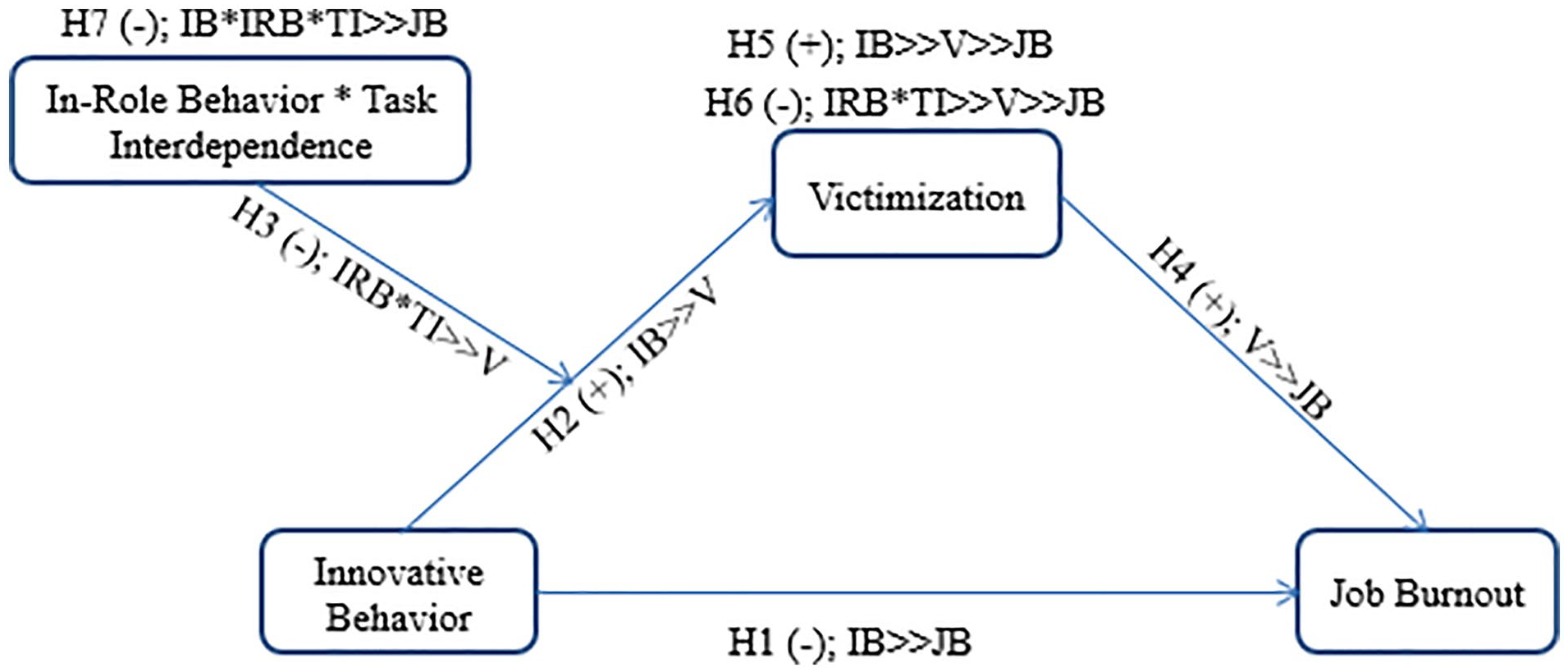
Theoretical framework of job burnout.
Research Design
This is a cross-sectional preliminary study for predicting a certain level of job burnout through victimization among early career healthcare professionals. The intent of this research in adapting the healthcare sector is because of its significance for the healthcare organizations and endorsement from prior studies (De Vos et al., 2016; Rudman et al., 2020).
For practical reasons, a convenience sample is used for testing the proposed hypothesis. Participants of this study are doctors, nurses, and other healthcare staff whose work experience is less than 3 years from public and private hospitals operating in Pakistan. A total sample of 330 healthcare professionals is collected to participate in this research for empirical analysis. However, the data is comprised of 138 male (41.8%) and 192 female (58.1%) respondents. Furthermore, Table 1 summarizes the participant’s demographic description in a meaningful way.
Participant Characteristics (n = 330).

Note. N = 330. Gender: M = male, F = female, Age: 18 to 22, 23 to 27, and 28 to 33.
Occupational position: Interns, doctors nurses, and other healthcare staff.
Occupational experience: ≤1 = Less than 1 year, ≤2 = Less than 2 years, ≤3 = Less than 3 years, in hospitals.
Survey Development and Measures
The questionnaire has two sections; the first section contains demographics whereas the second section is comprised of the survey of the early career healthcare professional’s innovative behavior, the joint role of in-role behavior and task interdependence, victimization, and job burnout. Respondents are asked to fill out a questionnaire, developed with Google form through face-to-face interaction.
Furthermore, Table 2 shows the measurement items for each of the variables that are used to investigate the status of early career job burnout through victimization. To maximize reliability and validity, we are applying measurement scales from already existing and well-established scales in this research. Innovative behavior: A 5-items IB scale is used as suggested by Scott and Bruce (1994) on a 5-point scale ranging from1 (strongly disagree) to 5 (strongly agree) to measure the innovative behavior of early career healthcare professionals. In-role behavior: Respondents indicate their response to three items from the IRB scale on a 5-point scale ranging from 1 (strongly disagree) to 5 (strongly agree) as recommended by Murodilla et al. (2020) and Williams and Anderson (1991).
Measurement Items of Constructs.

Task interdependence
A 3-item scale on a 5-point scale ranging from 1 (strongly disagree) to 5 (strongly agree) is used to measure task interdependence as suggested by (Campion et al., 1993).
Victimization
A 5-items scale is used as endorsed by (Aquino et al., 1999) on a 5-point scale ranging from 1 (strongly disagree) to 5 (strongly agree) to evaluate employee victimization among early career healthcare professionals in healthcare organizations.
Job burnout
Nine items from the Maslach Burnout Inventory model (Maslach & Jackson, 1981) are measured on a 5-point Likert scale, ranging from 1 (strongly disagree) to 5 (strongly agree) to evaluate job burnout (Maslach & Jackson, 1981; Maslach et al., 2001).
Procedure
A convenience sampling technique is used to collect the survey data from all public and private hospitals in Lahore, Pakistan. Before the collection of survey data, we contacted MS of public and private hospitals to explain the research purpose. Then, the crucial guidelines to the participants regarding these research materials are settled at the participant places. Once the participants are acknowledged and started to participate in this research, then participants from different departments and wards (like emergency block, operation theaters, Gynec, and dental) are given a questionnaire to fill and return the research questionnaire. The survey questionnaire requires the name, gender, age, position, and work experience of each of the participants who are willing to fill the questionnaire. Although, the survey data is collected within 30 days
Results
This research uses Partial Least Square Structure Equation Modeling to analyze the proposed model of job burnout through Smart PLS 3.0 statistical software (Wong, 2016). In recent years, PLS-SEM is extensively used statistical procedure (Wong, 2013) for evaluating complex relationships between observed and latent variables (Shakil et al., 2021). PLS-SEM is particularly appropriate for this research because of the complex framework of mediation and moderation (Wong, 2016) that is easy to operate in PLS-SEM (Hair et al., 2020; Hamdollah & Baghaei 2016; Shakil et al., 2021; Yener et al., 2020).
Measurement Model
PLS-SEM consolidates a two-step modeling technique to evaluate the measurement and structure model (Anderson & Gerbing, 1988). Confirmatory factor analysis is performed on variables to confirm the convergent validity (Hair et al., 2020), internal consistency reliability, quantitative measures of discriminant validity, and goodness of fit for assessing the measurement model (Hair et al., 2017). For validity, indicator reliability is first checked. Correspondingly, Table 3 demonstrates that all of the indicators have individual indicator reliability values that are greater than the minimum acceptable level of .4 or approximate level of .7 (Wong, 2016). Since ancient times, Cronbach’s alpha is operated to estimate internal consistent reliability (Wong, 2013) but now Composite reliability is widely used for estimation as recommended by Hair et al. (2012; see Figure 2).
Factor Analysis, Reliability, Validity, and Collinearity Statistics.

Note. IB = innovative behavior; IRB × TI = in-role behavior × task interdependence; V = victimization; JB = job burnout; FL = factor loading of each item; α = Cronbach’s Alpha; CR = composite reliability; AVE = average variance extracted; VIF = variance inflation factor.

PLS-algorithm.
More specifically, composite reliability indicates satisfactory values in Table 3 because latent variables have composite reliability of ≥.7 (Mugiono et al., 2020) which reveals high internal consistency reliability. Respectively, the average variance extracted ensures the construct’s convergent validity. Again from Table 3, the AVE values are greater than the minimum acceptance value of 0.5, which allows being seen as an adequate CV (Hamdollah & Baghaei 2016). Subsequently, the variance inflation factors VIF are used for examining multicollinearity (Hamdollah & Baghaei 2016). Wong (2013) states that multicollinearity occurs when the values of VIF are greater than 5 which is quite high. However, the result of the present research reveals the value of VIF as demonstrated in Table 3 that is lowered than 5 and prohibits the absence of multicollinearity.
The discriminant validity is assessed by the square root average variance extracted AVE of each latent variable AVE from Table 3, which should be greater than the latent variable correlations. The research findings in Table 4 demonstrate that discriminant validity meets the criteria (Hamdollah & Baghaei 2016; Wong, 2016).
Discriminant Validity.

Note. Additionally, the square root of AVE is displayed on the diagonal and printed in bold.
IB = innovative behavior; IRB = in-role behavior; TI = task interdependence; JB = job burnout; V = victimization.
Structure Model
Before reaching any conclusion, the structure model has to be appropriately assessed (Wong, 2016). A bootstrapping approach with 5,000 resamples is carried out to generate β-values, t-values, p-values, and mean and standard deviation values to verify statistical significance. Similarly, the findings of R2 signify that IB and the joint role of IRB × TI demonstrate 0.786% and 0.882% in victimization and Job Burnout, respectively.
Structure Equation Modeling SEM produces path coefficients, β-values, and related t-statics values as demonstrated in Table 5 and Figure 3, for hypothesis testing. The results point out that innovative behavior is negatively related to job burnout (β = −.169, t = 4.152, and p < .05) hence, supporting H1. Subsequently, the positive association between innovative behavior and victimization is statistically significant (β = .257, t = 2.261, and p < .05); thus, supporting H2. Furthermore, the joint effect of in-role behavior and task interdependence has a negative and significant relationship with victimization (β = −.577, t = 5.433, and p < .05); whereby, supporting H3.
Summary of Structure Model.

Note. IB = innovative behavior; IRB = in-role behavior; TI = task interdependence; JB = job burnout; V = victimization; β=Beta values; mean; SD = standard deviation; p-Values; t-Values; direct effects; indirect effect; total effects to measure path coefficients of each relationship among variables.

PLS-bootstrapping.
More specifically, the interaction between innovative behavior and the joint effect of in-role behavior and task interdependence (β = .311, t = 7.351, and p < .05) is positively and statistically significant in predicting victimization. Moreover, the results also indicate that victimization has a positive effect and significant impact on job burnout (β = .806, t = 21.196, and p < .05); therefore, supporting H4.
The mediating mechanism of victimization is assessed through bootstrapping analysis technique. The indirect effects indicate the association (β = .207, t = 3.349, and p < .05) between innovative behavior and job burnout through victimization among early career healthcare professionals. Further, the joint effect of in-role behavior and task interdependence also has an indirect effect (β = .434, t = 4.951, and p < .05) on job burnout through victimizations. Moreover, victimization directly and indirectly mediates (β = .251, t = 7.100, and p < .05) between moderating effect 1and job burnout as shown in Table 5.
The joint effect of in-role behavior and task interdependence as moderator variables changes the strength or even the direction of a relationship of the independent and dependent variables in the model.
To test the moderation effect, a product indicator is used to investigate the effect of moderators in between independent and dependent variables. However, results show a moderation effect (β = .251, t = 7.100, and p < .05) to predict victimization which ultimately predicts a certain level of job burnout. Figure 4 shows the moderation effect of IRB × TI at three different levels. Consequently, the red line represents that the slope would be very high when IRB × TI is a week which indicates the increased level of victimization and job burnout. And when the IRB × TI is strong at the green line then the slope is very small which ultimately shows a decrease in victimization and job burnout. When IRB × TI is weak the more the effect of the independent variable and on the dependent variable is strong. Figure 4 and Table 6 explain the moderation effect of IRB*TI in predicting victimization and job burnout.
Moderating Effects.

Note. JB = job burnout; V = victimization, joint moderation effect of in-role behavior × task interdependence to predict victimization and job burnout.

Moderating effect 1.
Key Findings and Discussion
In keeping with the concern regarding the rigorous consequences of victimization due to poor in-role behavior and task interdependence, the current study intended to scrutinize its impact on job burnout among early career healthcare professionals in the healthcare sector. As mentioned earlier job burnout through victimization against early career healthcare professionals is a substantial problem. Approximately, 90% of participants of this sample report that they have experienced job burnout through victimization from co-workers or senior healthcare professionals.
Further, the findings of this study signify that the hypothesized relationships between variables are supported by the data. However, the negative and significant association (β = .169, t = 4.152, and p < .05) between innovative behavior and job burnout is consistent with the results from the previous literature (Li et al., 2019). Wherein it is concluded that there is a considerable influence of job burnout among early-career healthcare professionals who have been exposed to victimization from co-workers or senior healthcare professionals that directly lower their creative tendency or innovative behavior (Choi et al., 2020; Li et al., 2019). Subsequently, the findings demonstrate the significant and positive relationship between innovative behavior and victimization (β = .257, t = 2.261, and p < .05) which is also providing support to previous research (Murodilla et al., 2020). However, this study also reveals that victimization partially mediates the positive and statistically significant relationship between innovative behavior and job burnout.
Moreover, this study also inspected that the early career healthcare professionals with poor in-role behavior and task interdependence are more likely to experience victimization from co-workers or senior healthcare professionals. On the other hand, the interaction between innovative behavior and the joint role of in-role behavior and task interdependence is positively significant in estimating victimization and providing further support to the previous studies (Dadaboyev et al., 2019; Murodilla et al., 2020).
Finally, the findings of this study endorse the previous research that victimization has a positive effect and significant impact on job burnout (Choi et al., 2020; Moon et al., 2020). Additionally, our findings are complemented by COR theory (Hobfoll, 2002) and J-DR theory (Bakker & De Vries, 2020) stating that early career healthcare professionals who lack in allocating their resources are going to perform their in-role behavior and task interdependence poorly when job demand is high. Hence, those early career healthcare professionals who become the feasible target of victimization from co-workers are going to face the severe issue of job burnout.
Research Implications
The findings of this inductive study contribute to the existing pool of literature in certain manners. Firstly, we probe the mysterious perspective of job burnout through victimization (Choi et al., 2020; Murodilla et al., 2020) among early career healthcare professionals from COR and J-DR theory which is a significant gap in the literature. This research provides a more comprehensive insight by applying COR theory to innovative behavior and victimization relationships because they are optimistically related to each other. However, this study also discussed JD-R theory in the relationship between victimization and job burnout because they are positively related to each other. More specifically, the COR and J-DR theory is applied to a proposed model of job burnout which proves a gateway that job burnout through victimization is a key antecedent of today’s organizational culture. Moreover, this research points out the negative outcomes of job burnout through victimization that not only affects the early career healthcare professionals but the overall healthcare organizations as well.
Therefore, the current research also has some important practical implications for both public and private healthcare organizations to develop useful strategies to reduce a certain level of job burnout through victimization. First, research findings propose that co-workers or senior healthcare professionals need to be aware of the negative severe consequences of job burnout through victimization and should encourage early career by applying useful strategies to prevent victimization to reduce a certain level of job burnout. More specifically, this study also scrutinizes the joint effect of in-role behavior and task interdependence which is negatively related to employee victimization and ultimately increases a certain level of job burnout among early career healthcare professionals.
Particularly, the present study also suggests a series of high-performance organizational practices which are enhancing the creative abilities, innovativeness, employee knowledge, skills, motivation, and enthusiasm. Although, this study also suggests providing some crucial opportunities for early careers in healthcare organizations such as resources, training, career development, and enable them to work independently and resolve workplace issues with great efficiency. Therefore, the implementation of such practices in healthcare organizations could lead to reduceing job burnout through victimization.
Conclusion
This empirical research intensifies the negative consequences of job burnout through victimization among early career healthcare professionals in healthcare organizations. Meanwhile, the findings highlight job burnout as an outcome of victimization that significantly mediates the relationship between innovative behavior and job burnout. Moreover, the main motive of this research is to examine the negative consequences of job burnout through victimization and also to evaluate the joint moderating effect of in-role behavior and task interdependence between their relationships.
This study concludes that early career healthcare professionals are facing the severe issue of job burnout through victimization from co-workers or senior healthcare professionals that not only affects their performance, physical and mental health but overall organizational performance as well. The research finding also provides a comprehensive gateway for managers, and policymakers to contribute in the healthcare sector of Pakistan by implementing useful strategies such as dispute resolution, decision making, empowerment, job autonomy, a reward system, and a healthy communication environment. Further, those strategies are beneficial for enhancing job performance of early careers that seems to be more innovative and fascinating for preventing job burnout through victimization among early career healthcare professionals in the healthcare sector.
Limitations and Future Direction
Despite the various significant implications, the interpretation of present research results should be assessed in light of diverse limitations. To increase the research scope, it is important to address some of the most important limitations of the present research. First, this research used a cross-sectional design and a single source to obtain survey data only from the both public and private healthcare organizations operating in Pakistan. In this case, future research should be carried out by increasing the sample size and obtaining data from multiple sectors using longitudinal studies to overcome this limit and enhance generalizability.
However, this research provides insight from the COR and J-DR model of burnout. Although, future research can pay more attention to the J-PF model of burnout and the major factors to reduce job burnout through victimization to improve the creative tendencies of early career healthcare professionals.
Footnotes
Declaration of Conflicting Interests
The author(s) declared no potential conflicts of interest with respect to the research, authorship, and/or publication of this article.
Funding
The author(s) received no financial support for the research, authorship, and/or publication of this article.
