




Abstract
In recent times, there has been sustained interest in how local governments in Nigeria can satisfactorily provide the critical needs of the people within their jurisdiction as stipulated in the 1999 constitution. Decentralization is enshrined in the constitution as a means of realizing these needs yet local governments have not been able to satisfactorily achieve them. This study examines the extent local governments apply the three components of decentralization; namely, political, bureaucratic, and fiscal. Relying on cross-sectional survey, the researchers obtained data, using adapted decentralization tool kit from World Bank Group. Data were analyzed using descriptive statistics and t-test. We found that the three components of decentralization are not completely applied toward achieving local government mandates.
Introduction
In recent times, interest on Local Government (LG) performance including South Eastern Nigeria (SEN) has blossomed as different factors affecting the performance of this tier of government have attracted the attention of many scholars who relate it to leadership incompetence (Dibie, 2003; Uche, 2014), fiscal issues, and constitutional crisis (Ikeanyibe, 2016; Viasuyi et al., 2010), as well as lack of autonomy, (Ikeanyibe et al., 2020). An increase in population and complexity of needs possibly led to structuring Nigeria into different tiers. LG is constitutionally assigned mandates to address these needs. As a result, there are increasing calls and pressures for LGs reform. In response, the 1999 Constitution (as amended) recommended three components of decentralization (3CD) to be incorporated in LG administration. The three components are political, bureaucratic, and fiscal.
The Fourth alterations Bill Numbers 5&6 of the Constitution emphasized that LGs mandates would be achieved through the 3CD. Decentralization is one of the key reform policies that could guarantee efficient attainment of needs of citizenry across developed and developing countries (Bardhan, 2002; World Bank Group [WB], 2018). Notably the efficiency of decentralization depends on policy makers and frontline workers (Dunlop, 2010). Consequently, this study broadly seeks to find out the extent to which LGs within SEN apply 3CD in pursuance of their mandates.
Schedule 4, Section 7 of the Constitution of the Federal Republic of Nigeria (CFRN, 1999) contains mandates and functions to the LGs as collection of rates, radio and television licenses; establishment and maintenance of cemeteries; licensing of bicycles; provision of basic education; establishment of slaughter houses; construction and maintenance of roads or such public facilities as may be prescribed from time to time by the State House of Assembly.
So far, decentralization scholars (Dunlop, 2010; Hidayat, 2017; Miller, 2002; Treisman, 2000) focused on Caribbean, Asian, and Western experiences. Currently, there is lack of literature on whether LGs in SEN combine the 3CD in pursuit of its mandates This is worrisome because the cultural background in the Caribbean, Asian, and Western countries may not be easily replicated in Nigeria which makes it difficult to theorize decentralization from this background. Inspired by the limited knowledge of the scope and context of decentralization, this paper seeks to address the main question: to what extent do LGs in SEN apply the 3CD in the pursuit of their mandates?
Scholars agree that the success of any level of governance in achieving its mandate mainly depends on effective decentralization policy adopted (World Bank [WB], 2013) because “Decentralization, the story goes, it frees managers to manage. It makes possible speedier and more responsive public services attuned to local or individual needs” (Pollit et al., 1998, p. 1). Scholars averred that “to rebuild relationships between citizens and their LGs means working on both sides of the equation - that is, going beyond ‘civil society’ or ‘state-based’ approaches, to focusing on their intersection, through new forms of participation, responsiveness, and accountability” (Fung, 2006; Gaventa, 2003, p. 2). Turner (1999, p. 4), conceptualized “decentralization as involving transmitting authority to perform some services from an individual or an agency in central government to some other individuals or agencies that are ‘closer’ to the people to be served.” Contemporary studies view it from the perspective of intergovernmental relations (Mohammed et al., 2017; Schneider, 2003).
Decentralization to the LGs in Nigeria
Nigeria is heterogeneous and largely populated, which explains the importance of a workable structure to attend to the numerous needs of the population. Nigeria operates federalism in which Local Government (LG) is the third tier after Federal and State governments. Also, the 1999 Constitution permits a presidential system of government. Federalism was adopted due to the geographical size and population of the country (Gutmann & Voigt, 2017), as well as to address all manners of inequality (Demarest et al., 2020). These variables could be measured through how the 3CD helps to achieve service delivery.
Decentralization in Nigeria entails that authorities, powers, functions, and mandates of LGs as assigned by the Constitution flow from federal and state governments. Such functions and mandates are discharged through the 3CD under a presidential system. The executive and legislative arms are elected through political parties. Councilors make bye-laws relating to LGs Therefore, LG executive and legislative arms drive decentralization through the 3CD relying the employees. (see, Schedule 4, Sec., 7, Sec., 7(1); CFRN, 1999; Federal Republic of Nigeria Approved National Scheme of Service for Local Government Employees, 2006).
Although Nigeria LGs run the presidential system, there are shreds of evidence of under service (see, Doho et al., 2018). Several issues such as corruption, insecurity, and religious differences (George et al., 2020), poor service delivery, resource allocation, injustice (Othman et al., 2019) are raised to question the effectiveness of decentralization. On LG decentralization, issues of corruption, underfunding, and insecurity are also identified (see, Ikeanyibe et al., 2020; Michael & Rich, 2020; Nurudeen & Marcin, 2019). The consensus is that corruption, underfunding, and insecurity amputate the 3CD. Political corruption manifests in the use of the state electoral commission to deny citizens their political rights. It also results in intimidation of LG bureaucrats as well as influencing deployment of any staff perceived to be a threat to their interest. This perhaps explains why Hasan and Tumba, (2020) cited selfish political interest as the difficulty facing presidential system. Underfunding could as well lead to incapacitation of the providing basic services as prescribed in the Constitution.
In the practice of decentralization, notable problems like corruption, underfunding, and insecurity, are surmountable. Weberian-like bureaucratic issues relating to corruption and political legitimacy could be reasonably resolved. It is possible that bureaucrats recruited meritoriously with clearly defined schedule of duty and protected by the condition of service would defend decentralization principles. There is a link between the prevailing natures of federalism and presidential system in practice as it has a valid theoretical base and defines decentralization.
The theoretical postulation of federalism by Wheare (1963) is of great importance in this discourse as it would specify the legal intergovernmental relationship. Wheare (1963) promotes legalistic federalism and postulates that the intergovernmental relationship would be driven by legal principles. The assumption is that intergovernmental relationships should have legal support to guarantee independence, political unity, and efficiency of each unit. Wheare states that “. . .a division of powers between one general and several regional governments, each of which, in its sphere, co-ordinate with the others; each government must act directly on the people; each must be limited to its sphere of action; and each must within that sphere, be independent of the others” (Wheare, 1963, p. 11). In Nigeria, the 1999 Constitution defines the legal relationship and mandates. The constitution legalizes decentralization to LGs under a federal structure arrangement and coordinated through the presidential system. The presidential system drives decentralization so that elected representatives would have legitimacy to operate.
Relying on the theory the researchers examined the application of the 3CD under the 1999 constitution in SEN and argue that true decentralization based on the 3CD would enhance service delivery. As evident in the present state of inefficient service delivery at the LGs, (Jan, 2014), the researchers argue that true federalism significantly correlates with decentralization.
Conceptualizing Decentralization: Focus on LGs Mandate
The more decentralized the governance of a country is the more efficiently responsive it would be in terms of providing the needs of its citizenry (Tarawneh, 2019). The decentralization approach that may be adopted by different countries is substantially cited among theorists as a major factor that determines the efficiency or inefficiency of any tier of governments (Crook & Manor, 2000; Jean-Paul, 2004. Decentralization in some countries seems to either cause neglect or aid provision of the critical needs of the people (WB, 2018). It has been attributed to the variety of successes or failures of governments in respect of being independent or autocratic in their policies. There are growing concerns for and against its impact on the relationship between Federal, State, and LGs. It impacts the physical infrastructure, institutional infrastructure, and political-institutions of government (Yee & Li, 2018, p. 174). In this study, we explained decentralization from the perspective of Falleti (2004, p. 2) who distinguished it into three key components; namely political, bureaucratic, and fiscal. The concept further includes local governance as implementation of the 3CD to achieve citizens’ participation, foster fiscal discipline through transparency and accountability by experienced and qualified bureaucrats.
Political Decentralization
This relates to citizens’ participation in decision-making process. Decentralization substantially encourages competitiveness among state institutions such as political pluralism through which citizens participate to evaluate service delivery (Makara, 2018). Political decentralization (PD) is concerned with systemic channels of ensuring citizens’ participation in electing their councillors as well as other forms of participatory democracy (Hidayat, 2017; Yuliani, 2004). It provides alternative for citizens’ participation in democracy with the capacity to grant political authority to elected representatives, ensure agreement between government and citizens, (Boräng et al., 2017). This position agrees with the assumption of Wheare (1963) on legalistic federalism. Political doors include but not restricted to increased civil society groups, a pluralistic party system, and independently elected representatives. Political decentralization (PD) requires a strong constitution to provide the lead-way and guarantee citizens’ freedom and rights, as well as respond to local needs (Fan et al., 2009).
As a result of the non-responsiveness of the central government, Burns et al. (1994) and Smoke (2003) have argued that local authorities need to improve service delivery through citizens’ participation.
It is therefore expedient to strengthen channels (Tobin, 2016) for citizens’ participation in the decision-making process as well as respect constitutional provisions to increase the intelligibility of office holders (Michels & De Graaf, 2017) and restore the confidence of the local populace. Hankla and Downs (2010) identified four key relationships that shape political decentralization: Federal, state control and LG, Council executives and LG Council legislatures, LG structure and influence of political parties, and Impacts of LG on citizen’s socio-political and economic participation. These relationships determine the efficiency or otherwise of political decentralization at the LGs.
In Nigeria, the earliest form of PD was patriarchal in procedure and practiced in clan and village meetings. “Local administration generally centered on the traditional ruler who was considered the repository of religious, legislative, executive and judicial functions” (Daniel & Osa, 2013, p. 129). This was however restructured and strengthened in the current LG system. In this perspective, we argue that lack of PD orchestrated by consistent interference by federal and state governments may considerably limit public service delivery. It is imperative to note that PD is domiciled in constitution (see, Sec., 7(1)) in the 1999 Constitution, making it expressly clear that LGs should be run by democratically elected executives and legislatures. Given the foregoing argument that the constitution supports decentralization and shreds of evidence of low performance prevails, we hypothesize thus:
Bureaucratic/Administrative Decentralization
It refers to “— the concentration of government functions at the lowest ranks of a geographically dispersed bureaucracy” and “it involves a more moderate method of restructuring intergovernmental relationships” (Kuhlmann & Wayenberg, 2016, p. 136). This component grants LG bureaucrats opportunity to learn, transfer sense of responsibility and capacity building to the locals and ensure, proper articulation of policies, and democratization of policy-making process. This act of aggregating policies that favor local needs is the core of governance at the local level. Bureaucrats could significantly prevent corruption (Charron et al., 2017; Suzuki & Hur, 2020) improve service delivery (Fernández-Carro & Lapuente-Giné, 2016), and ensure organizational success (Dahlström & Lapuente, 2017). Decentralization allows for increased service delivery, respect for the division of labor, and schedule of duties as well as transfers management of local affairs to the grassroots bureaucrats (Miller, 2002). Scholars argued that decentralization results in efficient utilization of local wealth to the benefit of the people whose needs are known by the LG bureaucrats, ensures that bureaucrats are retained at the LG level to implement decisions that are impactful to the grassroots, and maintains financial and administrative discipline at the LGs (Davas & Grant, 2003; Evans & Manning, 2004).
In contrast, administrative decentralization could lead to transmission of authority to a group of locals who are not experienced (Galiani & Schargrodsky, 2001). They maintained that local elite that are not well-informed in some areas could seize the opportunity to de-service the people. Beyond this, administrative decentralization, if not properly managed, could lead to delay, especially in an ethnic or religiously divided area. Such delay could also be inimical to the attainment of LGs mandates. Deconcentration could further lead to abuse of office, promotion of cliental politics, and distrust among the local people which could result in political apathy and bias.
In the Nigerian context, LGs bureaucrats constitute the employed members of staff. There are two classes of staff; namely, senior and junior. Senior staff members are on grade level 07 to 17 and are employed by Local Government Service Commission (Federal Republic of Nigeria Approved National Scheme of Service for Local Government Employees, 2006).
They are expected to support decentralization through their activities in the seven departments of LGs. These activities are as enshrined in Schedule 7 of the 1999 constitution. Not only that they are career civil servants, but their activities and conditions of service are also documented in the Scheme of Service for LG employees, (2006).
Career bureaucrats would likely resist undue interference from the political class. They are more likely to ensure that political decentralization is achieved and fiscal discipline entrenched (Charron et al., 2017). On the assumption of legalistic federalist theory, the Constitution and Scheme of Service for LG employees provided the needed support for bureaucratic decentralization, but the extent to which LGs within SEN apply it to achieve their constitutional mandates is unknown, hence we hypothesize thus:
Fiscal Decentralization
This is one of the widely discussed forms of decentralization (Kyriacou et al., 2015) as it leads to transparency effective accountability (Alonso & Andrews, 2018). Major debates on federalism among LGs, states, and the federal government revolve around fiscal decentralization. Fiscal decentralization is the dispersion of funds to other levels of government for adequate provision of critical needs of the people (Olabanji et al., 2020). It involves the collection and disbursement of revenue for improved services (see, e.g., Amire & Okufuwa, 2020). It is likely that transparency and accountability play critical role in ensuring that the much desired service delivery is achieved. It refers to the fiscal relationship among tiers of government based on constitutional principles. Fiscal relationship under federalism is a legitimate topic, as it is expected to instil probity accountability and transparent management of public funds (Arends, 2020) to allay fears among tiers of government.
The bases for fiscal relationship have been so politicized along regional, ethnic, and more often inordinate interest of the political elite (Ewetan, 2020), even when is a constitutional matter (see, Sec., 7(1)). Ohiomu and Oluyemi (2018) classified it based on need, national interest, and independent revenues. Omodero et al. (2019) included: equality of states, equality of access to development, continuity of government action, absorptive capacity, land areas, the principle of school enrolment, the pupil of school age but not in school, a national minimum standard. A large chunk in this classification could be found as the mandates of LGs, although not without issues. However, issues generated are principally related to sharing formula and resource control among the tiers and particularly between States and LGs.
Fiscal decentralization could be explained from three perspectives. First, it justifies spending on the provision of services. Second, provision of public needs to residents of the LG area as constitutionally provided. Third, it guarantees cautious use of such allocated and generated funds specifically for the services of residents of LGs jurisdiction by being accountable and transparent. There is theoretical support for this relationship relying on legal instruments to protect all levels of government (Wheare, 1963). The government can gain more legitimacy if it provides the needs of its citizens. Kyriacou et al. (2015, p. 89) believe that “fiscal capacity of sub-central governments can promote regional convergence because of the expectation that lower levels of government will react more efficiently to local needs either because they can provide better informed and tailor-made policies or because they strive to preserve or increase their tax base in the face of competition from other regions.” Fiscal decentralization largely determines the functionality of other components of decentralization. For example, in political decentralization and economic development, Martinez-Vazquez et al. (2016) found that fiscal decentralization at the LGs significantly contributes to new economic advancement. For Amire and Okufuwa (2020), fiscal decentralization reduces agitation for restructuring. Divergently, the “level of corruption will be higher and the quality of public services will be lower in countries with a larger number of tiers of government—especially in those which have relatively more autonomous sub-national governments with regulatory authority” (Treisman, 2000, p. 5).
In this context, fiscal decentralization flows from the Federation Account. The account houses federal government revenues deposited in the Consolidated Revenue Account. Members of the Federal Allocation Account Committee (FAAC) include State commissioner of finance from the 36 States and the Federal Capital converges and using the allocation formula enshrined in the 1999 constitution share such revenue. LGs share of the revenue is paid into a State Joint-LG account. However, fiscal decentralization to LGs legitimates and seems to not only negate theoretical assumptions of Wheare (1963) but contradicts Schedule 2 and 4 of the same constitution. For instance, whereas Section 162(6) supports joint account, Sec., 162(7) says that a certain proportion of its revenue as prescribed by the National Assembly is given to the LGs. Also, Sec., 162(8) gave the State House of Assembly powers to prescribe terms of distributing revenues in the joint account. Given the contradictions in Schedule 2 and 4 and the above sections, we hypothesize thus:
The Case Study
South Eastern Nigeria-SEN which could, alternatively, be called Igbo-land is one of the six geo-political zones in Nigeria inhabited mainly by people of the Igbo ethnic group. The region has 5 states and 95 LGs. From the context of Nigeria politics, the region is seen but not heard; it is widely believed that it still suffers from different forms of marginalization and underdevelopment for the reason that it tried to be independent of Nigeria which culminated in the Nigeria-Biafra war of 1967 to 1970. What seems to be a common experience is that any zone that challenges the federal government would be starved of basic infrastructures (Archibong, 2018). The existing few federal roads in the region are in deplorable states, health facilities in gory conditions, water and electricity are a luxury to the larger population of the people, yet LGs have the constitutional mandate to provide most of these facilities.
The Current Form of LGs’ Structural Decentralization
Across the five states in SEN, there is uniformity in structure and administration. However, what differs is the period of election because CFRN (1999) empowers the State House of Assembly to legislate on LGs. Each state decides when to conduct elections and the tenure of the elected officials. Generally, decentralization at the LGs is coordinated by three institutions/commissions established by the State government: political decentralization by the state electoral body, bureaucratic decentralization by the Local Government Service Commission, and fiscal decentralization by the State and Local Government Joint Account committee chaired by the State Commissioner for finance. This pattern is replicated across the states in SEN.
Notably, the diagram below explains how the 3CD is structured to accomplish LG mandates in the region.
From the above diagram, the 3CD are operationally interwoven. At the top is the Executive chairman, elected along with the Vice-chairman and the Councillors. A political secretary is appointed by the State government while the Chairman exclusively appoints the political aides such, see Figure 1. Other political appointees include Supervisory Councillors appointed to supervise some departments like Agriculture, Finance, Health care, Education, and Works. Their appointment is also done by the State government. The Legislative arm is the elected councillors from different wards within the LG. They are elected and inaugurated by the chairman of the Council. From among themselves they elect a Leader and Deputy Leader. Through the Head of Administration, support staff like the clerk is deployed to the legislative house to facilitate bye law-making. Whereas political decentralization is carried out through the chairman and legislatures, bureaucratic and fiscal decentralization are facilitated through seven departments in the Council. The departments are under the administrative supervision of Head of Local Government Administration. There are subunits in each of the departments for smooth decentralization. Head of Finance department is the treasurer of the Council; they handle fiscal matters, including attending and representing the Council at the State-joint Local Government Account and being signatory to LGs accounts.

Organogram of LG decentralization in SEN.
Method
Design
This study adopted a cross-sectional survey design. Ihemeje et al. (2012) argued that this type of design is best suited when a population characteristic is being studied using carefully selected samples of such population and such survey is carried out at one point in time.
Sample
The sample for this study was obtained from the 95 LGs within SEN. The staff composition comprises political office holders (elected and appointed) and members of staff of the different LG Areas. Due to lack of reliable and comprehensive records of the personnel of LGs in the region, we assumed the population of the study is unknown or infinite. Hence, the sample size of the study will be determined using Cochran (1977):

where, n = Sample Size, Z = Critical value at a given confidence level, p = assumed proportion of population picking expressed as a decimal, and ε = tolerable error.
Therefore, the sample size for this research is given by

This comprises political office holders and members of staff of LGs in SEN. Allocation of sample for each state was done proportionally based on the number of LGs in the states with the assumption that the state with more LGs has more personnel. The allocations are made thus: Abia (17)—118, Anambra (21)—146, Ebonyi (13)—91, Enugu (17)—118, and Imo (27)—188.
Procedure
To achieve wider coverage, we ensured that political (senatorial zones) and developmental (urban, semi-urban, and rural) areas were included. Each research team was requested to get a contact person from the LGs, and obtain their voluntary consent to assist the team. We further trained some research assistants to assist each member of the research team in distributing and collating data from the LGs.
Because there is no reliable record of personnel, we assumed unbiased convenience in selecting respondents. Respondents were met in their respective offices and informed about the research and that any information they gave would be treated with utmost anonymity and confidentiality. Their consent to voluntarily participate was first obtained before we administered the instrument. In administering the items, respondents were requested to write their short profile. They were told to skip any questions that didn’t apply to them or that were not clear, that they could choose not to participate or to withdraw or communicate with the lead researcher at any time and for any reason, that their name or personal details would not appear at any stage of the report, and that information they provided would only be used for the report. These measures ensured that all participants satisfied the objectives of this study. The instrument was administered by the research team member and the trained research assistants, in the presence of the LG contact person.
Those who accepted to participate were given copies of the instrument and asked to return them through our LG contact person. A follow-up was maintained for 28 days concurrently. After the first administration, 76 items were either unreturned or not completed. Some were eliminated based on the inadequacy of the profiles the respondents provided. We had to administer make-up items to ensure that all expected respondents were included. We undertook this process because since we were dealing with an infinite population, we did not want to risk reliability and generalization of the result by further reducing the sample size. The administration of make-up items took 17 days with follow-up.
Instrument
We relied on the content of the Decentralization Toolkit developed by World Bank (2001), and the empirical work of Evans and Manning (2004), both of which were adopted and adapted to suit this study. We selected the items as they applied to this study to ensure that our result serves the purpose for which it was undertaken. We revalidated the items with a significant index of .833 using Cronbach’s alpha coefficient.
The instrument consists of demographic characteristics including their educational qualifications, years of experience on the job, nature of the appointment, mode of entry to the job, staff status, and department. For example, on educational qualification, respondents were expected to state whether they had formal education, First School Leaving Certificate, Senior School Certificate, or attained Tertiary Institution. On years of experience, respondents were required to choose from two options: 10 to 20 or 21 to 29 years. Under the nature of the appointment, respondents were presented with four options: political appointee, elected, permanent staff, or casual staff. For the mode of entry into the service, each of the respondents were asked to state whether they came into the service through the process of formal advertisement, secondment, the service was requested for based on expertise, replaced another staff, or they were redeployed to the LG. On the staff status, respondents had two options, senior or junior. Finally, each respondent was expected to state their department from among the seven recognized departments.
We further presented respondents with options on the core mandates and functions of LGs, according to the CFRN (1999). Respondents were expected to select which of the listed core mandates and the functions as prescribed by the Constitution relates to their schedule. On the mandates, there were 11 options, samples of which are in Table 1. There are five options under the functions of LGs which are also presented in Table 1. However, respondents were free to select “undecided.”
Frequency Distribution of the Staff Core Mandate and Functions in the Various LGA.

Respondents were also required to answer questions on the 3CD (political decentralization (PD), bureaucratic decentralization (BD), and fiscal decentralization (FD). PD consists of eight questions, a sample of which is “to what extent does the LG operate the presidential system?” BD has 11 questions, a sample of which is “to what extent does LG have powers to recruit members of staff without external interference?” FD has 15 questions: for example, “what is the extent to which LGs get a financial allocation from the federal government?” Of the 34 questions in all, respondents could select from “very high extent,” “high extent,” “undecided,” “low extent,” and “very low extent.” Each of these rating scales was assigned a value ranging from 1 for very low extent to 5 for very high extent. Responses from the five states in SEN were summed up according to each state to determine the extent of applying 3CD. A rating scale of 0 signifies negative, suggesting that the component is not applied.
Analysis
Data generated from this study were controlled with demographic profiles and job-related information of the respondents. The data were analyzed with descriptive statistics (frequency, mean, and percentage) and t-test to ascertain a significant difference in the mean of observation and the mean of the Likert scale of the instrument.
Result
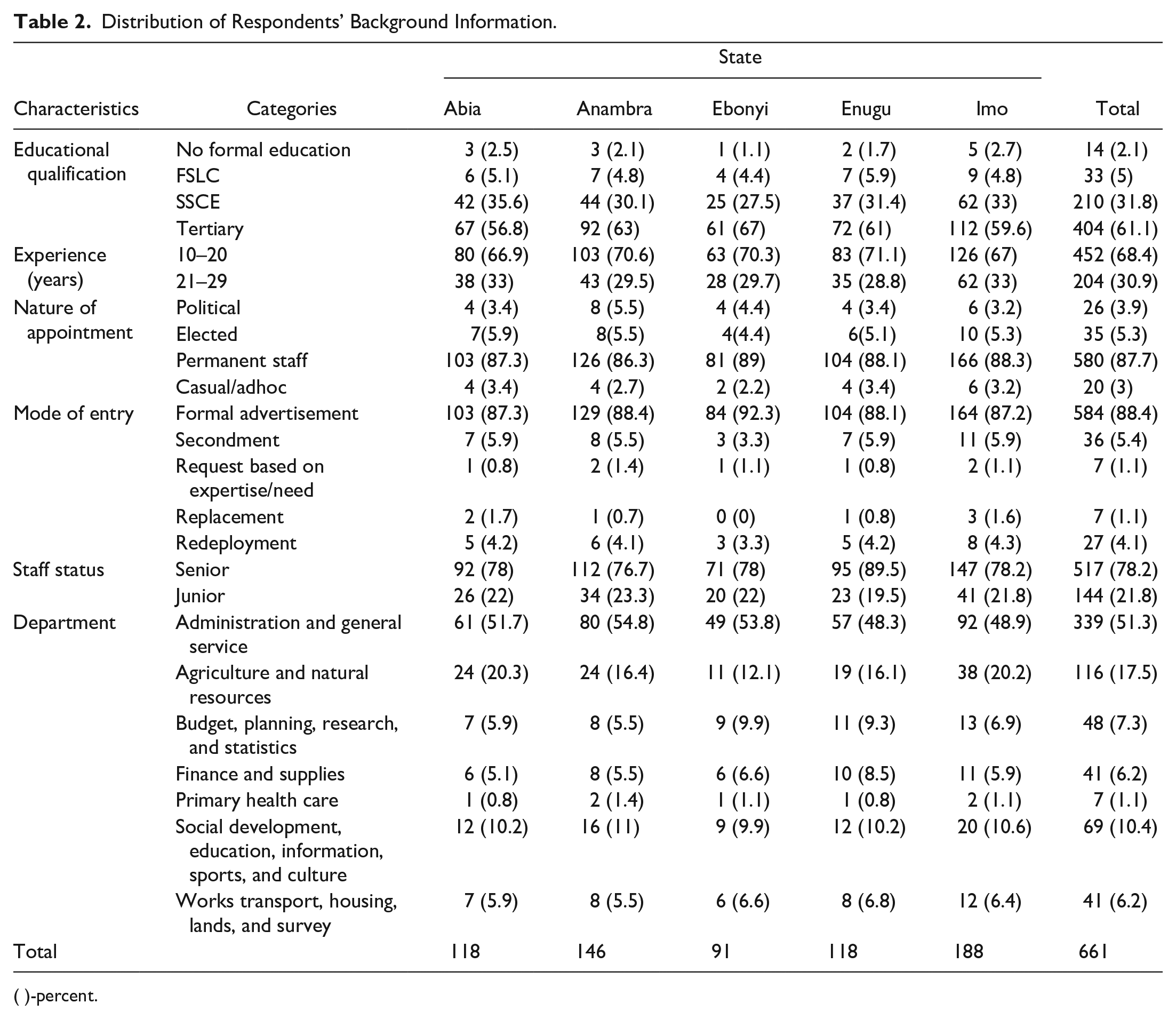
Table 2 provides an insight into the different characteristics of respondents. Our categorization was drawn from the provisions of the Federal Republic of Nigeria Approved National Scheme of Service for Local Government Employees (2006). The categories are educational qualification, experience on the job, and nature of the appointment, others include; mode of entry, staff status, and department (Figure 2).
Distribution of Respondents’ Background Information.
( )-percent.

Distribution of respondents based on state.
Educational qualification is categorized into formal education, First School Leaving Certificate FSLC, Senior School Certificate Examination SSCE, and tertiary education certificates. No Formal education refers to the class of staff/respondents that do not have formal education but were employed based on consideration of their special skill. Formal education is categorized into FSLC, which refers to those that finished first 6 years in primary school; SSCE refers to respondents that had 6 years secondary education; Tertiary education for those that have acquired either a degree certificate from the university or other certificates higher than SSCE “Experience” refers to the respondent’s experience on the job. This is categorized into 10 to 20 years to ensure that only experienced respondents were selected with the assumption that they would have gathered sufficient experience necessary for completing the questionnaire.
“Nature of appointment” refers to whether the respondent was a political appointee or elected. Appointed and elected respondents mainly perform functions relating to PD while permanent and casual staff members primarily carry out BD and FD. The permanent and members of casual staff as well perform their duties through the seven departments, see Figure 1 above. The casual staff could be engaged due to needs, special skills, or for political patronage.
“Mode of entry” is intended to elicit information on whether the respondent was engaged through formal advertisement, secondment, request based on expertise, replacement, or redeployment. This classification is vital in determining a respondent’s engagement status as this could significantly influence responses and action on duty. Those employed through merit perform better as Weberian bureaucrats (Suzuki & Hur, 2020); they are more likely to facilitate bureaucratic and fiscal decentralization.
“Staff status” relates to senior and junior staff. Junior staff is those within grade levels 01 to 06 while senior staff ranges from level 07 to 17. Junior staff members are usually employed by each of the LG council whereas senior cadre are employed by the LG local Government Service Commission.
There are seven departments in the LG, (see Figure 1). Bureaucratic and fiscal decentralization are mainly carried out through the seven departments. Respondents were drawn from these departments for this study. Below is the categorization of respondents as provided in the revised edition of LG Scheme of service, 2006.
Table 2 above make clear, issues relating to hypotheses 1, 2, and 3. Hypothesis 1 requires active role of LG employees to implement it. Hypothesis 2 deals with how LGs apply bureaucratic decentralization. Bureaucrats could significantly improve fiscal discipline and prevent corruption (Charron et al., 2017; Suzuki & Hur, 2020). The table further provides an insight to LG manpower stock in relation to the characteristics. These highlights play crucial role in assessing performance of LGs in relation to the 3CD. Again, qualification, experience, mode of entry, and status as indicated in the table gives an insight of the manpower stock of these LGs that would facilitate decentralization.
Core mandates and functions of LGs refer to the constitutionally assigned responsibilities (see, CFRN, 1999). These mandates are expected to be performed through LGs employees. The information was presented with the number of respondents. Decentralization at LGs can be evaluated in line with the ability of LGs to achieve these mandates and functions. This study specifically focuses on the extent LGs within SEN utilize the 3CD to achieve their mandates. The respondents are involved in the attainment of these mandates through their individual and or collective roles. Responses were elicited, having the 3CD in mind as well as their characteristics (see Table 2). Below is the distribution according to mandates and function, as well as states within the region.
Table 3 is the result of the analysis of the respondents’ evaluation of political decentralization in SEN. Descriptive statistics displayed were frequencies, mean, and standard deviation. The result showed an overall observed mean of 2.2. We applied t-test to examine if the observed mean was less than the mean of the scale which is 3. The observed mean falls into the scale of “low extent.”
Analysis of Political Decentralization of the LGA.
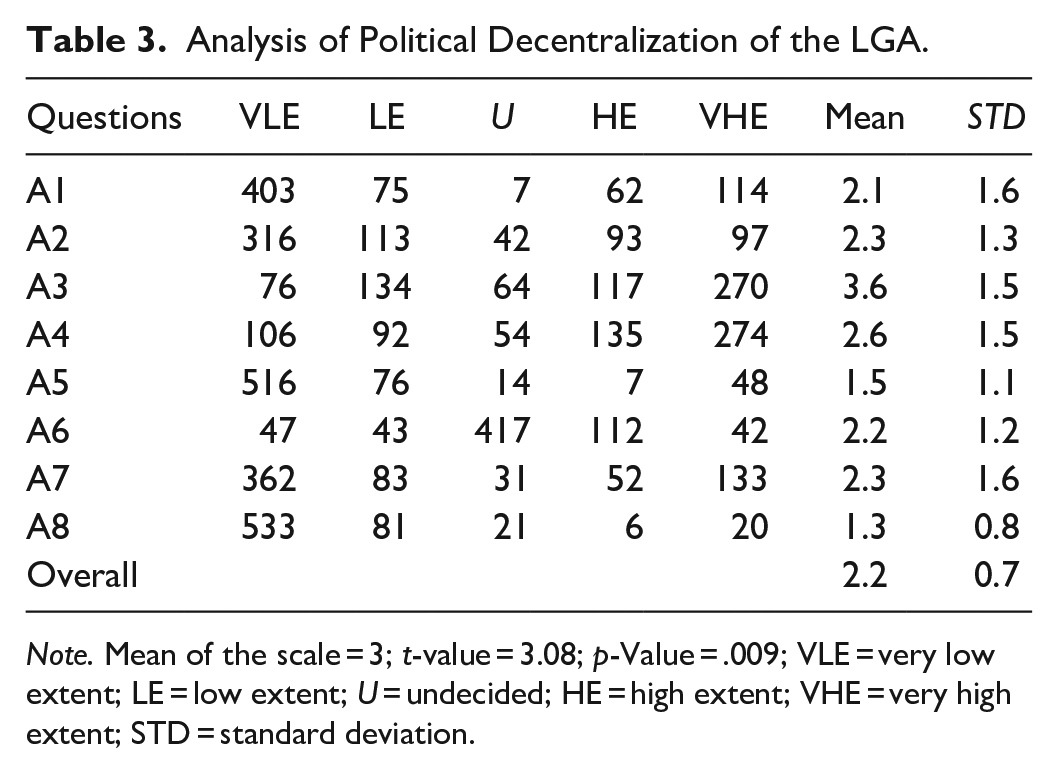
Note. Mean of the scale = 3; t-value = 3.08; p-Value = .009; VLE = very low extent; LE = low extent; U = undecided; HE = high extent; VHE = very high extent; STD = standard deviation.
The low extent reported in political decentralization further supports the prevailing circumstances of a single-party system for LGs in SEN. By implication, it casts doubt on the practice of true federalism and political legitimacy of the executive and legislative arms as well as questioning the capacity of the 1999 constitution to enthrone the presidential system and true decentralization at the LGs.
Hypothesis 1 was raised to test the extent LGs within SEN apply political decentralization. We focused on elected executives and legislatures. Section 11 of the 1999 Constitution empowers the State government to conduct elections at the LG through their respective State Electoral Commission (see, Mu’azu et al., 2017). Also, section 7(1) of the 1999 Constitution supports the presidential system at the LGs. Considering possible altercations that might arise; this hypothesis tested how each of the states in SEN effectively supports political decentralization.
Based on t-test statistics on the overall observed mean of 2, with t = 3.08 and p < .05 we do not reject the null at α = .05 level of significance, rather we affirmed that LGs in SEN do not apply political decentralization to a “high extent.”
Table 4 is the result of an analysis of the application of bureaucratic decentralization at the LGs. The overall observed mean is 2.1 and SD of 0.5. The observed mean was found to be significantly (p < .05) below the mean of the scale; hence it falls within the left part of the scale of VLE and LE. Thus, the application of bureaucratic decentralization at the LGs within SEN is of VLE as the table shows a significantly less than .05 statistically considered very low.
Analysis of Bureaucratic Decentralization of the LGA.

Note. Mean of the scale = 3; t-value = 5.83; p-Value = <.001; VLE = very low extent; LE = low extent; U = undecided; HE = high extent; VHE = very high extent; STD = standard deviation.
A test of hypothesis 2 hinged on whether LGs in SEN do not apply bureaucratic decentralization to a “high extent.” The hypothesis tested the extent LGs within SEN apply bureaucratic decentralization. Bureaucrats are very important class of staff that drive decentralization, especially as it relates to efficient public service delivery. Bureaucrats are housed in the seven departments of LGs and are mostly involved in policy initiation and implementation. Certain factors inhibiting decentralization such as corruption, (see, Suzuki & Hur, 2020) which results in poor service delivery (Fernández-Carro & Lapuente-Giné, 2016) could be significantly controlled by career bureaucrats.
With the result of the t-test on Table 4 at α = .05 level of significance, we do not reject the null hypothesis, rather we agree that LGs in SEN do not apply bureaucratic decentralization to a “high extent” but to a “low extent.”
Table 5 is the analysis of the application of fiscal decentralization by the LGs in SEN The result indicates that none of the observed mean except number 1 question is up to 3. The observed ground mean and the SD is 2.1 and 0.6, respectively. Application of t-test on it with the mean of the scale shows that it is significantly (p < .05) lower than the mean of the scale which is three. This proves that the mean is within the negative partition of the scale (VLE and LE). This indicates that application of fiscal decentralization is of “low extent” among LGs within SEN.
Analysis of Fiscal Decentralization of the LGs.

Note. Mean of the scale = 3; t-value = 5.73; p-Value = <.001.
Hypothesis 3 was that LGs in SEN do not apply fiscal decentralization to a “high extent.” The hypothesis was developed to investigate the extent to which LGs within SEN apply fiscal decentralization. Fiscal decentralization has generated debate among scholars. It is argued that poor service delivery by LGs is likely related to lack of fiscal decentralization despite the federal structure (Mu’azu et al., 2017). The 1999 Constitution from where LGs draw their strength provides for fiscal relationship flowing from the federal government. Sec., 162(7) of the 1999 Constitution provides that state government should maintain an account for monies from the federal allocation. The fiscal relationship between Federal, State, and LGs is often abused and this has continued to affect their performance (Fatile et al., 2018). Concerns relating to LGs poor performance due to fiscal indiscipline mostly from State government regardless of the provision of CFRN (1999) informed our resolve to test this hypothesis.
With the result of the t-test on Table 5 at α = .05 level of significance, respondents did not reject the null hypothesis, rather they agreed that LGs in SEN do not apply fiscal decentralization to a “high extent” but to a “low extent.”
Discussion
The idea of performance amongst the different tiers of government in Nigeria has continued to generate debate, especially LGs perform below constitutional provisions. Federalism in Nigeria is presumably guided by the postulations of Wheare (1963). This is evident in the content of the 1999 constitution, Part 1 Sec.,1 and 2 and Schedule 2 and 4 as well as in Fourth Alterations Bill Numbers 5&6. Thus, it is important to ascertain the extent to which the 3CD are applied to achieve service delivery (Makara, 2018). Our discussion of findings was guided by the scales; VLE, LE, U, HE, and VHE.
Our findings vary slightly on the extent these LGs apply the 3CD. Any variation ultimately negates the provisions of CFRN (1999). This variation further explains why LGs in SEN have performed below expectations (Ikeanyibe, 2016).
Under political decentralization in Table 3, the study revealed that 59% and 62%, respectively, scaled around HE and VHE on regular and free and fair elections. Also, on the secrecy of elections, 16% and 13% favor VLE and LE, respectively. Besides, 7% and 6% supported VLE and LE on external manipulation of elections. On citizens’ ability to hold representatives accountable, 12% of respondents share LE views. The understanding is that whereas there are regular elections, there is no secrecy in the election and the elections are externally manipulated. Dauda et al. (2018) in a study cited secrecy of the ballot as one of the key indicators of a free and fair election. If secrecy of the ballot is not guaranteed, the result would likely not be credible. Also, citizens cannot hold elected representatives accountable.
The implication of these revelations runs contrary to the fundamentals of political decentralization. In the assertion of (Hidayat, 2017; Yuliani, 2004), political decentralization is a channel that supports citizens’ participation in public policy, increases local trust in the system by affording local electorate to vote based on their perceived ability of the contestants, allows the representatives to concentrate on the local needs, and build a strong, efficient, and vibrant LGs that is responsive to the local needs (Fan et al., 2009). This revelation explains why there is constant pressure from citizens for LGs to respond to their needs. The more citizens lose confidence in the electoral process, the more illegitimate political representatives are and the more political decentralization is compromised (see, Hussain & Ismail, 2020). From Wheare’s (1963) classical view for the independence of the federating tiers, and as contained in Sec.,7(1) of the 1999 Constitution, our revelations point that political decentralization in SEN is less comprehensive.
On bureaucratic decentralization, 95% and 86%, respectively, consented to VLE and LE scales on the powers of LGs in SEN to recruit their staff. Nolte (2010) was of the view that this best enables the organization to hire members of staff that improve the goal of the organization. Revelation of VLE and LE among respondents were contrary to scholarly postulation of Fernández-Carro and Lapuente-Giné (2016), who believed that bureaucrats drive service delivery. The response was further explained when 87% of the respondents averred that senior members of staff do not have the powers to make decision. Also, 91% of our respondents fall within the scale of VLE and LE, supporting that LG Service Commission has an overbearing influence. This revelation coincides with our earlier finding that a probable cause of poor performance SEN LGs could be related to state governments’ control of LGs through the commission. This revelation further supports the position of Mukoro (2003) who argued that other tiers of government should not be deeply involved in the management of LGs. However, a certain level of control is allowed and this is specified in the 1999 Constitution. Over 50% of the respondents support that there is an external influence on promotion, merit, and transfer of staff. This finding reveals why bureaucratic/administrative decentralization is not applied amongst LGs in SEN The perceived external control plausibly explains the prevailing poor performance of LGs in SEN contradicts Wheare’s (1963) assumption of the ideal federal state where independence rather than dependence appendage holds. It also falls short of scholarly submission that qualified and experienced bureaucrats resist undue external influence.
This study revealed that fiscal relationship between LGs and State largely favors the State (Neyapti, 2003; World Bank, 2001). Respondents report 72% VL and LE of LGs influence in enjoying the balanced fiscal relationship. Again, 70% on the same scale reported the extent of LGs involvement in deciding how to use its fund. Also, 81% in the same scale reported on LGs determination of fiscal formula. This finding explains the argument for fiscal autonomy. The above revelations explain fiscal dominance of LGs by federal and state government (Olabanji et al., 2020).
This study revealed the theoretical assumptions of Wheare (1963), on the legalistic and independence of the federating tiers of government by testing applicability of 3CD. The study exposed hiccups that could occur under Wheare’s (1963) prescribed type of federalism which from our study observed contradictory clauses in the constitution. Although these clauses appear to weaken the constitution, they prove that certain amendments would not only guarantee the independence of the tiers, but also straighten federalism, and enhance provision of LG mandates.
Limitations
There are some limitations to this study. First, lack of reliable records of LG employees made us assume an infinite population; and such could affect the reliability and generalization of this result. Second, members of the LG Service Commission were not part of the study.
The findings and limitations have contributed to identifying grey areas for further research. Future researches may consider the following:
Strive further to get a reliable record of LG employees to include all groups.
Include members of the Local Government Service Commission who are in the front line of supervising application of the 3CD.
Conclusion and Implication of the Study
Across the globe, development is considered very important and every responsible government prioritizes it. Given the complex demand from the citizenry in Nigeria, it becomes expedient to have tiers of government. Each tier is assigned mandates and functions in the Constitution, and these are expected to be actualized through 3CD.The study concludes that LGs in SEN do not apply a significant aspect of the 3CD. Although federalism is structured under the Wheare (1963) principles, application of the 3CD would benefit greatly from amendments to guarantee the independence of the units. The implication of these findings is that LGs in SEN may have to continue to perform below constitutional provisions owing to two major debilitating factors: first, lack of local democracy orchestrated by non-secrecy of elections and inability of local citizens to trust and hold representatives accountable; second, constitutional clauses that transfer LGs to the State government.
Footnotes
Appendix 1
Declaration of Conflicting Interests
The author(s) declared no potential conflicts of interest with respect to the research, authorship, and/or publication of this article.
Funding
The author(s) received no financial support for the research, authorship, and/or publication of this article.
