




Abstract
Serious environmental problems occur as a result of the unconscious production and use of energy. Hence, there is a strong need to develop an effective energy culture to provide sustainability for the energy investments. This study aims to identify the influence directions of dimensions and criteria for energy culture in emerging economies for sustainable energy investments. For this purpose, a multi-criteria decision-making model is proposed based on 2-tuple linguistic values and interval-valued intuitionistic fuzzy sets. The weighting results of energy culture are also evaluated for E7 economies. The findings demonstrate that energy companies should consider investing in technologies, assets, and objects which enable to reproduce energy usage. Furthermore, the analysis revealed that there is a misalignment of practices with material culture and norms what creates the potential for behavior change of consumers. Finally, the potential of bigger countries for investment opportunities in sustainable energies has been disclosed by ranking emerging economies. The results let us provide insights into development of energy investments by considering strategic priorities of energy culture in emerging economies. The novelty of this paper is to define a set of criteria and dimensions for the strategic priorities of energy culture in emerging economies and construct a novel decision-making technique with DEMATEL and TOPSIS based on 2-tuple and interval-valued intuitionistic fuzzy sets.
Introduction
The growth of emerging market economies in the last decade has increased the needs for the energy and simultaneously created a challenge for these economies to respond to the sustainability related issues. In particular, the reliance on energy sources such as the fossil fuels, gas, and nuclear has the negative impact on security and sustainability of these countries. Moreover, some emerging economies such as China experience a lack of resources and energy reserves. Thus, the growing populations, increasing consumption of energy, degradation of ecosystem, and environment pollution have led to a need to transform energy system and foster transition to sustainable energy sources. Though the transition to renewable energy has been observed in the past few years, the countries such as India, Brazil, Indonesia are facing a challenge of funding. Though accounted the largest share of investments in renewables, investments fell in China 37% in 2018. Accordingly, investments fell 47% in Brazil and 16% in India (REN21 Global Status Report 2019). On the other hand, investing firms are experiencing the issues and uncertainties related to the unbalanced regional development of these countries. These challenges require to define strategic priorities for sustainable energy investments and integrate these priorities into the strategic planning of investing firms (Ahmad, Chandio et al., 2021; Ahmad, Jan et al., 2021).
Although investigated over the last 40 years, the energy research domain was predominated by the studies focusing on technical and economic aspects. However, the scholars observe that investigations almost neglected human factor related to sustainable energy consumption and use (Ikram, Sroufe et al., 2020; Ikram, Zhang et al., 2020). Thus, the suggestion to consider the attitudes and behaviors of final consumers which determine their energy consumption patterns has been proposed. Moreover, the assumption that the energy related behavior of consumers is driven by energy culture has been suggested. Though a universal definition has not been accepted for the concept of energy culture, the studies in the energy culture domain integrate technologies, activities, and aspirations which are the key aspects of energy culture concept (Ahmad & Zhao, 2018). The investments in sustainable energy appear to be significant in promoting and adoption of new energy sources in emerging economies. Thus, the understanding of energy culture and how the aspects of energy culture are interrelated and subsequently, shape the consumption of green energies reinforce the decision makers to consider sustainability issues in their investment decision-making process (Ahmad et al., 2020).
The evaluation of energy culture is a challenging issue, involving several various dimensions and stakeholders, defining the process as the complex problem. The investment process into sustainable energy is related to a few uncertainties and complex factors, which make the decision to invest very complicated without the appropriate scientific approaches. Currently adopted practices, linked to the analysis of energy cultures, are still demonstrating some limitations. Moreover, the scholars suggest that application of different systems-thinking approaches would be beneficial in the understanding of energy cultures (Klaniecki et al., 2020). Considering this context, in this study, it is aimed to identify significant points of energy culture for developing sustainable energy investments. Within this framework, a novel fuzzy decision-making model is generated considering 2-tuple linguistic values and interval-valued intuitionistic fuzzy sets. In the first stage, the dimensions and criteria of energy culture are weighted with the help of DEMATEL methodology. Secondly, emerging economies are ranked by using TOPSIS technique according to the energy culture performance. Thus, current study sought to find out the influence directions of dimensions and criteria for energy culture in emerging economies for sustainable energy investments.
The application of multicriteria decision analysis (MCDA) methods in the field of renewable energy investments have been already observed by other scholars (Strantzali et al., 2016). Thus, the potential of these methods is already justified in the scientific literature. However, no prior investigations have been found in this specific topic as in our study. By applying few MCDA methods, we expand prevailing literature on energy cultures and sustainable energy investments by adding new insights on energy cultures dimensions and priorities significant for the sustainable energy investments. On the other side, the decision-making problems become very complex and because of this issue, there is a need for new techniques to overcome this situation (Li et al., 2020). For this purpose, multicriteria decision-making model (MCDM) approaches are considered with fuzzy logic in many different studies in the literature (Dinçer et al., 2019; Qiu et al., 2020). In this context, different fuzzy sets are considered by the researchers, such as triangular, trapezoidal, and Gaussian (Liu et al., 2021; Yang et al., 2021). In this study, interval-valued intuitionistic fuzzy (IVIF) sets are considered so that positive and negative indication in terms of interval membership and non-membership of an element can be differentiated (Büyüközkan et al., 2018; Feyzioğlu et al., 2018). This condition has a positive contribution to handle uncertainty problem in decision-making process more effectively.
Another important novelty of this manuscript is to create a hybrid model by considering both DEMATEL and TOPSIS in the analysis process. In other words, criteria weights are not defined by the authors subjectively (Yüksel et al., 2019). Instead of this situation, these weights are calculated by using a MCDM technique. This situation has a positive influence on the objectivity of the analysis results (Dinçer & Yüksel, 2018). In addition to this issue, DEMATEL approach has some significant superiorities by comparing with other similar methods in the literature. For instance, with the help of DEMATEL, cause and effect relationship can also be defined (Ding et al., 2021). Therefore, influencing and influenced criteria can be identified so that more effective strategies can be developed (Kalkavan et al., 2021). On the other side, TOPSIS technique has also some advantages as well. In most of the techniques, the evaluation is made by only using the distance to the positive ideal solution (Haiyun et al., 2021; Kou et al., 2021). However, in the analysis process of TOPSIS, the distance to the negative ideal solution is also taken into consideration (Mojaver et al., 2022). This situation helps to reach more appropriate results.
The next section provides the overview of related literature. Section 3 provides methodology integrating DEMATEL and TOPSIS based on 2-tuple and interval-valued intuitionistic fuzzy sets. The fourth section provides analysis. The final section provides conclusions and policy implications.
Theoretical Background
The investments into sustainable energies have become a hot research topic over the past recent years. The motivation to focus on sustainable energies has been inspired by sustainability goals to tackle current needs without harmful effects for future generations to meet their own needs. Thus, the energy sector is facing the need to balance production and consumption without negative impact on the environment (Strantzali et al., 2016). While responding to sustainability issues, renewable energy sources have attracted a great interest of practitioners and scientists. These sources rely on wind, biomass, sun, and other sources generated from natural resources, which demonstrate a great potential to tackle increasing energy demand in emerging economies. However, the transition to renewable energy is related to initial investments and changes of the energy consumption behavior. Apparently, investors are facing several uncertainties and especially in emerging market economies. The literature has already documented trade-offs arising due to environmental benefits, existing energy systems, and costs (Garlet et al., 2019). The issues interrelated to economic, technical, and environmental aspects of investment projects were investigated by various scholars (Strantzali et al., 2016). However, investing firms must consider the energy consumption behaviors of consumers, which determine the transition to sustainable energies.
A stream of studies in environmental behavior domain revealed that behavior of consumers is impacted by personal and social factors (Gifford et al., 2014) what led to the idea to investigate a link between energy consumption and culture. For instance, the studies, focused on national culture characteristics, disclosed the differences across developed and developing countries (Morren et al., 2016). These studies confirmed that perceptions and attitudes of consumers to behave in environmental conscious manner are more expressed in individualistic countries. The investigation focused on the relationships between consumption of renewable energies and culture revealed the positive effect across several European countries. Finally, a large-scale study on energy security disclosed that perceptions of consumers from different countries were different and led to the idea about the existence of different energy cultures. Grounded in these studies, we can assume that culture influences the consumption of renewable energy and the differences across countries influence decision makers, responsible for the investment policy, and directions into sustainable energies.
The difference in consumers behavior has inspired the lively scholarly debate and the need for successful interventions, contributing to the changes of energy behaviors, has been expressed (Stephenson et al., 2010). Thus, grounded in the systems approach, the energy-cultures framework, explaining interacting elements such as, practices, material culture, and norms and their causal relations reinforcing predominating energy culture or changing energy culture, has been suggested (Stephenson et al., 2015). Though initially suggested as the multidisciplinary framework, explaining the patterns of behavior, later the framework was expanded by considering various actors from energy systems. Moreover, the extension of the framework comprised individuals, business sectors, or even nations. Referring to the energy-cultures approach, we suggest that prevailing energy cultures influence decision-makers of investing firms in emerging economies. More specifically, norms, practices, and material culture determine the opportunities for transition toward sustainable energy in emerging countries and subsequently, shape the most attractive investment decision.
The norms refer to expectations and aspirations of a particular service or behavior shaped by practices and material culture (Stephenson et al., 2010). The public might resist to accept sustainable energy technologies due to perceived risk, collective thinking, and perceived cost-benefit ratio (Huijts et al., 2012). Meanwhile, the acceptance of sustainable technologies reflects the behavior of consumers, which supports the usage. Thus, a stream of studies focused on public acceptance as the significant factor impacting adoption of renewable energy technologies. Notably, aspirations linked to the dissatisfaction with current material culture or practices appear to be significant in inspiring changes of culture. The survey carried out in China revealed a positive public support of renewable energy in rural areas and thus, demonstrated a potential to change prevailing norms (Liu et al., 2013). The studies related to energy observed that public intentions to support appear to be important in the redeployment of nuclear power plants of emerging economies, such as China or India and influence decision-making process. Meanwhile, other scholars focused on pro-environmental orientation, representing environmental worldview, and the impact of humans on the environment through beliefs, attitudes, and values. These studies emerged in environmental psychology domain and referred to the less harmful or beneficial to the environment behavior. For instance, some studies disclose that consumers’ altruistic values and environmental attitudes are significantly interrelated and influence the decisions to purchase energy efficiency appliances. Moreover, the studies referred to the new environmental paradigm scores and revealed the differences in attitudes while considering education, urbanization, and incomes. For instance, pro-environmental orientation was observed among educated, affluent, and urbanized individuals of emerging countries (Chen et al., 2011). However, the studies conducted in emerging countries context disclosed a lack of personal responsibility in terms of pro-environmental orientation and a tendency to transfer that responsibility to the government. Finally, a stream of studies focused on personal or social norms. While personal norms demonstrate individual responsibility and influence behavior, social norms are formed by the social pressure to behave in a particular manner. The investigations revealed that personal norms were significant determinant in adopting energy technology due to perception of issue, costs, risk, and benefits (Huijts et al., 2012). The scholars observed that personal and social norms significantly impact investment decisions of households into adoption of solar power technologies and energy efficiency appliances (Niamir et al., 2020). Thus, these norms appear important in changing behavior and the switch to the greener energy.
The practices are assumed to be spanning from everyday habits to the less frequent actions, which are common across social peers. A stream of studies focused on energy conservation intentions of consumers, which are shaped by environmental worldview and personal norms (Scherbaum et al., 2008). The investigations related to the intentions of consumers demonstrate that despite economic benefits customers are not keen to introduce energy saving products in their (Elisha et al., 2015). The scholars revealed that in ambiguous situations shaped by lack of knowledge (i.e., adoption of new technologies), intentions to use renewable energy devices are impacted by peers as informational sources and trust in peers (Fornara et al., 2016). On the other hand, the studies suggest that only high knowledge on energy related problems influence sufficient investment into energy efficient products and technologies (Han et al., 2013). Moreover, behavioral constrains to choose energy efficient technologies or reduce consumption of energy influence everyday habits of consumers (Klaniecki et al., 2020).
Energy culture is also very important for the sustainability of energy investments. Generating energy using fossil fuels causes serious damage to the environment (Du et al., 2020). Because of this issue, people’s health is deteriorating significantly (Meng et al., 2021). Since people with health problems cannot support the workforce, the economic development of the country will be adversely affected by this situation (Yuping et al., 2021). This situation jeopardizes the sustainability of energy (Su et al., 2021). Therefore, environmental factors should also be considered in energy production. In this context, in the context of energy culture, the use of renewable energy is recommended by many segments (Gatto & Drago, 2021). In this process, energy is produced by taking into consideration natural factors such as sun and wind (Serezli et al., 2021). Thanks to the use of renewable energy, carbon gas emissions are significantly reduced. Therefore, the use of renewable energy is accepted as environmentally friendly energy (Murshed, 2021). Another energy culture function that can be considered to ensure continuity in energy investments is the awareness level of the people (Zhe et al., 2021). If the people living in a country are more conscious about the environment, it will be more possible to ensure sustainability in energy investments (Levenda et al., 2021).
The energy cultures framework integrates the material culture which refers to various assets, technologies, and objects, enabling to reproduce energy usage practices (Stephenson et al., 2010). For instance, the scholars observe that a number of various appliances and especially energy-intensive appliances used by households significantly increase the usage of energy (Rao et al., 2017). These tendencies have become more pronounced in emerging economies where gradually increasing incomes and education result in a bigger number of energy-intensive appliances of households. On the other hand, the studies revealed that only a fraction of huge potential created by renewable energy is used in some areas of emerging economies (Chen et al., 2010). More specifically, the use of more efficient technologies, replacing fossil fuel is needed (Las-Heras-Casas et al., 2018). Though the consumption of renewable energy has been gradually increasing due to the usage of such energy sources as biomass and water, the customers are less tended to use modern energy production technologies such as photovoltaic panels (Klaniecki et al., 2020). Finally, a need to replace traditional energy production with modern energy production in emerging countries has been observed (Bilgen et al., 2015). Based on the comprehensive literature evaluations, a dimension and criteria list are created regarding the energy culture for sustainable investments. Table 1 summarizes investigations on energy culture and investments.
Strategic Dimensions and Criteria of Energy Culture for Sustainable Investments.
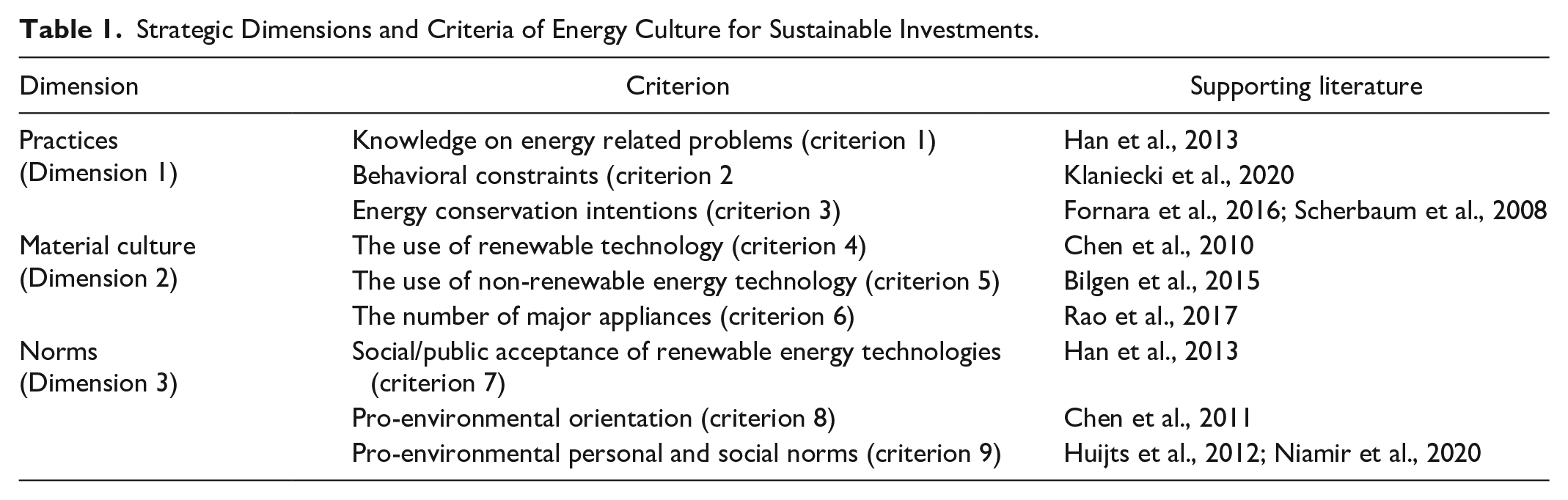
Table 1 indicates that practices can play a significant role for generating energy culture to provide sustainability in energy investments. Within this context, people should have sufficient knowledge regarding the energy related problem. This situation has a positive influence to create energy culture. Similarly, behavioral constraints and energy conservation intentions are also significant in this regard. Additionally, with respect to the material culture, renewable energy technologies should be taken into consideration. With the help of this situation, environmentally friendly energy can be produced. Moreover, the use of non-renewable energy technology can also be considered. Fossil fuels harm environment significantly. Because of this issue, carbon capture technologies should be used to prevent this problem so that an effective energy culture can be created. On the other side, regarding the norms, social/public acceptance of renewable energy technologies is a very critical issue. Furthermore, pro-environmental orientation and pro-environmental personal and social norms play an essential role for the energy culture.
Previous investigations in the energy culture domain adopted various methodologies. Klaniecki et al. (2020) used quantitative questionnaires and adopted energy cultures framework as post-hoc analytical tool. The obtained results let the authors explain prevailing energy culture and disclose some elements contributing to sustainable energy. Stephenson et al. (2010) used focus groups formed from the representatives of community and relied on case study method. The applied approach let the scholars to develop an illustration of energy culture in the selected community of New Zealand. Ford et al. (2017) investigated transition of traditional energy toward solar photovoltaic in New Zealand and adopted case study, which included interviews and data from surveys. However, the scholars provided limitations of these methodologies and especially limitations linked to the comparison purposes. Moreover, the surveys are subject to self-reported measures and thus, self-report bias.
In spite of recognition of energy cultures framework to investigate consumption behavior (Stephenson et al., 2015), there is a lack of investigations conducted in emerging countries context which adopted the framework with the purpose to detect strategic priorities for sustainable energy investments. Thus, the shortcomings of prevailing methodologies might be compensated by applying MCDA techniques. The application of these techniques in the field of renewable energy investments and especially in energy policy and management have been observed. The scholars investigated consumer demand scenarios by combining MCDA techniques (Babatunde et al., 2019), assessed energy technologies by considering values (Šliogerienė et al., 2012) or focused on the assessment of energy sector in general. However, no prior studies focused on the dimensions of practices, norms, and material culture. Thus, based on the literature review, we include a comprehensive range of energy culture related factors affecting sustainable energy investments in emerging economies. In the next section we are going to explain the methodology, which address the issue of energy culture assessment.
Methodology
Multi-criteria decision-making approach is generally employed for solving the performance results of alternatives in terms of factor evaluations (Solangi et al., 2020). In the complex decision-making process, fuzzy approach is introduced by Zadeh in 1960s to explain the results more accurately (Zadeh, 1965). However, the real-world problems of modern decision-making force to use some modifications of conventional fuzzy decision-making models such as triangular fuzzy sets and apply them to obtain the comprehensive results in the fuzzy environment (Liao et al., 2018; Xia et al., 2020).
Accordingly, 2-tuple linguistic model is firstly applied by Herrera and Martinez’ s (2000) to illustrate the computing with words and linguistic information of experts more effectively. However, interval-valued intuitionistic fuzzy sets are among the most known extensions of fuzzy sets. It provides the limits of belongingness and non-belongingness for the elements to obtain the vague sets with the limited numbers (Ye, 2009). Earlier version of this approach is presented by Atanassov in 1980s (Atanassov, 1986) and interval-valued intuitionistic fuzzy sets are applied for different kinds of decision-making problems gradually (Atanassov, 1994; Atanassov & Gargov, 1989).
Additionally, under the uncertain conditions in decision making process, the incomplete information, the difficulties in the constructing process of the linguistic scales and evaluations, the necessary of normalized and comparison matrices with the aggregated evaluations are among the main problems of complex multi-criteria decision-making techniques. However, there are several outstanding methods to solve the uncertainty related to data collection and methodologies including gray system theory and ordinal priority and gray ordinal priority approaches (Islam, 2021; Mahmoudi et al., 2020; Mahmoudi et al., 2021; Quartey-Papafio et al., 2021). To prevent these issues, in Table 2, the exact linguistic scales and evaluation sets are defined to obtain the experts’ opinion more accurately. And also, to minimize the misunderstood or the incomplete evaluations, the expert team is selected with the same experience and educational background. Again, the methods of DEMATEL and TOPSIS properly consider the essential computation processes for the uncertain conditions such as the normalized, the comparison, and the decision matrices to avoid the inappropriateness of the data processing and the final computing results as seen in the formulas (8–21).
Linguistic Evaluations for Expert Choices.

In this study, it is proposed a novel decision-making approach based on 2-tuple linguistic model and interval-valued intuitionistic fuzzy sets to provide more comprehensive and coherent results for the complex decision-making problem of energy culture in emerging economies. With respect to the emerging economies, the seven countries that have the greatest economy are taken into consideration that are Brazil, China, India, Indonesia, Mexico, Russia, and Turkey. The main reason of selecting these countries is that they represent the emerging economies significantly. Additionally, they are the important candidate to become developed countries. Accordingly, the proposed decision-making approach is applied with two stages. The first stage defines the weights of criteria and dimensions for energy culture with 2-tuple interval-valued intuitionistic DEMATEL. The second stage is used for measuring the performance of emerging economies using 2-tuple interval-valued intuitionistic TOPSIS. The details of 2-tuple linguistic model, interval-valued intuitionistic fuzzy sets, DEMATEL, and TOPSIS are given in detail as follows
A 2-tuple linguistic information is defined as
Linguistic information and numbers in 2-tuple form are presented in Figure 1 (Herrera & Martinez, 2000; Martinez, 2007; Rodriguez et al., 2013).

A 2-tuple linguistic information and sets.
The function is

Where the term of round assigns to β, ∆ is a bijective function, and the integer number

Intuitionistic fuzzy set is illustrated as follows (Narayanamoorthy et al., 2019; Ye, 2009)

Where the

Where

Unknown degree of an intuitionistic fuzzy interval of

The elements of IVIF set (

where
DEMATEL (Decision Making Trial and Evaluation Laboratory) is firstly applied by Geneva Research Centre in 1970s (Gabus & Fontela, 1973). The important specification of this method is to illustrate the influencing directions among the criteria and dimensions as well as the weights of factors (Abdullah et al., 2019). The extension of DEMATEL based on 2-tuple linguistic information and interval-valued intuitionistic fuzzy sets is defined in the following steps.
Step 1. Optimistic and pessimistic values of direct relation matrices are computed with 2-tuple linguistic information. For that, the upper and lower values of optimistic pessimistic degrees are selected and defined in the form of the interval-valued intuitionistic fuzzy sets with the equation (8)

Where,

where
Step 2. Direct relation matrix is constructed with the equation (10)

Step 3. Normalization procedure is applied for direct relation matrix as

Where bij is the values between 0 and 1.
Step 4. Total relation matrix is computed by the formula (12)

Where C is the total relation matrix and I is the identity matrix.
Step 5. The values of D and E are calculated by summing the vector rows and columns with the equations (13) and (14). The values of D + E give information about the weights of factors whereas the values of D to E present the influencing and influenced degrees among the factors.


TOPSIS (Technique for order performance by similarity to ideal solution) is introduced by Yoon and Hwang in 1980s to analyze the alternatives by considering both the negative and positive ideal solutions (Yoon & Hwang, 1981, p. 47). So, this method is widely used by many researchers because of this advantage (Lai et al., 1994). The extension of TOPSIS based on 2-tuple linguistic information and interval-valued intuitionistic fuzzy sets are detailed as follows
Step 1. The expert evaluations are modified based on the 2-tuple linguistic information and IVIFSs. For that, the first step of DEMATEL is similarly applied in this stage.
Step 2. Decision matrix is constructed. The defuzzified values of decision matrix is computed by the accuracy function with the formula (9). The matrix is presented by the formula (15)


where A1, A2, . . . Am are the alternatives and C1, C2, . . . Cn are a set of criteria. hij defines the defuzzified values of decision matrix. i = 1,2,3, . . .,m. k is the number of experts.
Step 3. Decision matrix is weighted and the values of


where
Step 4. The values of closeness coefficient (CCi) are computed with the equations (19) to (21).



Final ranking results of alternatives are obtained by ordering the values of CCi in the descending line.
Results and Discussion
Model Construction
In this study, an integrated approach with three stages is applied for measuring the performance of emerging economies in terms of energy culture for developing sustainable energy investments. In the first stage, the decision-making problem is defined, and the evaluations are converted into the interval-valued intuitionistic fuzzy sets. In the following stage, the weights of criteria and dimensions are calculated with 2-tuple IVIF DEMATEL. In the third stage, the ranking performances of emerging economies figured out by using 2-tuple IVIF TOPSIS. The flowchart of the proposed model is illustrated in Figure 2.

The flowchart of proposed model.
The integrated model is illustrated in the following steps.
Step 1. The problem of energy culture for sustainable energy investments is defined based on the literature review.
Step 2. The dimensions and criteria of energy culture are determined for the sustainable investments of emerging economies.
Step 3. The evaluations are collected from the experts and the boundaries of them are defined for illustrating the intervals of evaluations.
Step 4. The optimistic and pessimistic values are computed based on 2-tuple linguistic information.
Step 5. The values are converted into the interval-valued intuitionistic fuzzy numbers.
Step 6. Direct relation matrix is constructed with the IVIFSs.
Step 7. Normalization procedure is applied.
Step 8. Total relation matrix is constructed.
Step 9. Decision matrix based on 2-tuple IVIFSs is illustrated.
Step 10. Weighted decision matrix is computed.
Step 11. The values of closeness coefficient are calculated for ranking the emerging economies.
Analysis of Results
An integrated decision-making model with 2-tuple IVIF DEMATEL and 2-tuple IVIF TOPSIS is applied for ranking the energy culture for sustainable investments in emerging economies. For this purpose, three dimensions and nine criteria are defined based on literature review. The details are presented in Table 1. However, three decision makers who are the experts in the field of energy economics and management in emerging economies are appointed to provide their linguistic evaluations for the criteria, dimensions, and alternatives. These people have at least 17-year experience regarding the subjects of energy investment, energy culture, and strategy development. Two people in the expert team are top managers whereas one of them is academician. These people evaluate criteria and alternatives according to their importance. Within this context, criteria are compared with each other. Additionally, alternatives are also compared according to these criteria. The linguistic and evaluation scales for the criteria, dimensions, and alternatives are given in Table 2.
A 2-tuple IVIF DEMATEL is applied for weighting the criteria and dimensions. For that, the boundaries of linguistic evaluations are firstly constructed to define the intervals of terms for direct relation matrices. Table 3 shows the boundaries of linguistic term sets for the dimensions.
Boundaries of Linguistic Term Sets for the Dimensions.

At the following process, 2-tuple values of collective linguistic evaluations are defined for factors. Table 4 represents the optimistic and pessimistic values with 2-tuple linguistic information for the dimensions.
A 2-Tuple Values of Collective Linguistic Evaluations for the Dimensions.

After that, the optimistic and pessimistic values are converted into the interval-valued intuitionistic fuzzy sets to define the direct relation matrix for the dimensions and criteria. Table 5 illustrates the IVIFSs for the dimensions.
Interval-Valued Intuitionistic Fuzzy Sets for the Dimensions.

Direct relation matrix is constructed for dimensions and criteria for weighting the factors with DEMATEL. Table 6 shows the results of direct relation matrix for dimensions.
Direct Relation Matrix for Dimensions.

Normalization procedure is applied for direct relation matrix, and Table 7 gives information on the normalized values of matrix for dimensions.
Normalized Direct Relation Matrix for Dimensions.

At the following procedure of DEMATEL, total relation matrix is constructed, and the results of dimensions are given in Table 8.
Total Relation Matrix and Values of D and E for Dimensions.

According to the weighting results of dimensions, Dimension 2 (Material culture) is the most important factor among the dimension set of energy culture while Dimension 3 (Norms) is the weakest item.
Similar procedure of dimension weighting is also applied for the criteria of dimensions properly and the global and local weights of criteria and dimensions are obtained as seen in Table 9.
Global and Local Weights of Criteria and Dimensions.

Table 9 represents that use of non-renewable energy technology (criterion 5) has the highest priority with 11.9% in the global weights of criteria whereas pro-environmental personal and social norms (criterion 9) have the lowest degree of global weights. However, the averaged value of total relation matrix is defined as a threshold and the higher values than this value is assumed that there is an influence between the items of relation matrix. Accordingly, Tables 10 to 13 are constructed to illustrate the influencing directions among the factors. Table 10 gives information on the directions of energy culture dimensions.
Strategic Directions for the Dimensions of Energy Culture.

In Table 10, practices (Dimension 1) has an impact on the material culture (Dimension 2) only. However, material culture (Dimension 2) influences both practices (Dimension 1) and norms (Dimension 3). Norms (Dimension 3) effects the material culture (Dimension 2). It appears that there is a mutual relationship between Dimension 2 and Dimension 3.
Table 11 shows the strategic directions for the criteria of energy culture Dimension 1. According to the results, there is no mutual relationship between the criteria of Dimension 1. Behavioral constraints (criterion 2) have an impact on both knowledge on energy related problems (criterion 1) and energy conservation intentions (criterion 3). Additionally, knowledge on energy related problems (criterion 1) influences the energy conservation intentions only.
Strategic Directions for the Criteria of Dimension 1.

Table 12 define the strategic influence directions for the criteria and energy culture Dimension 2. Use of renewable technology (criterion 4) has a strategic direction on the use of non-renewable energy technology (criterion 5) and number of major appliances (criterion 6). Moreover, number of major appliances (criterion 6) effects the use of non-renewable energy technology (criterion 5). It is understood that there is no mutual relationship between the criteria and use of non-renewable energy technology (criterion 5) is the most influenced factor among the criteria of Dimension 2.
Strategic Directions for the Criteria of Dimension 2.

Table 13 illustrates that social/public acceptance of renewable energy technologies (criterion 7) has the most influencing factor by affecting pro-environmental orientation (criterion 8) and pro-environmental personal and social norms (criterion 9). However, pro-environmental personal and social norms (criterion 9) is the most influenced factor. It is affected by social/public acceptance of renewable energy technologies (criterion 7) and pro-environmental orientation (criterion 8).
Strategic Directions for the Criteria of Dimension 3.

Following stage follows the computation procedure of 2-tuple IVIF TOPSIS. Initially, boundaries of linguistic evaluations for the alternatives are computed. In the appendix, Table A1 shows the boundaries of linguistic term sets for alternatives. At the following process, 2-tuple values of collective linguistic evaluations are defined for alternatives. The results are given in Table A2. The 2-tuple linguistic information with optimistic and pessimistic values are converted into the interval-valued intuitionistic fuzzy sets for alternatives. The IVIF decision matrix is defined in Table A3. Defuzzified values of decision matrix are computed by the accuracy function and the results are given in Table A4. At the final process of 2-tuple IVIF TOPSIS, the weighted matrix, and the values of D+, D−, and CCi are computed, and the ranking results are illustrated in Table 14.
Performance Results for Emerging Economies.
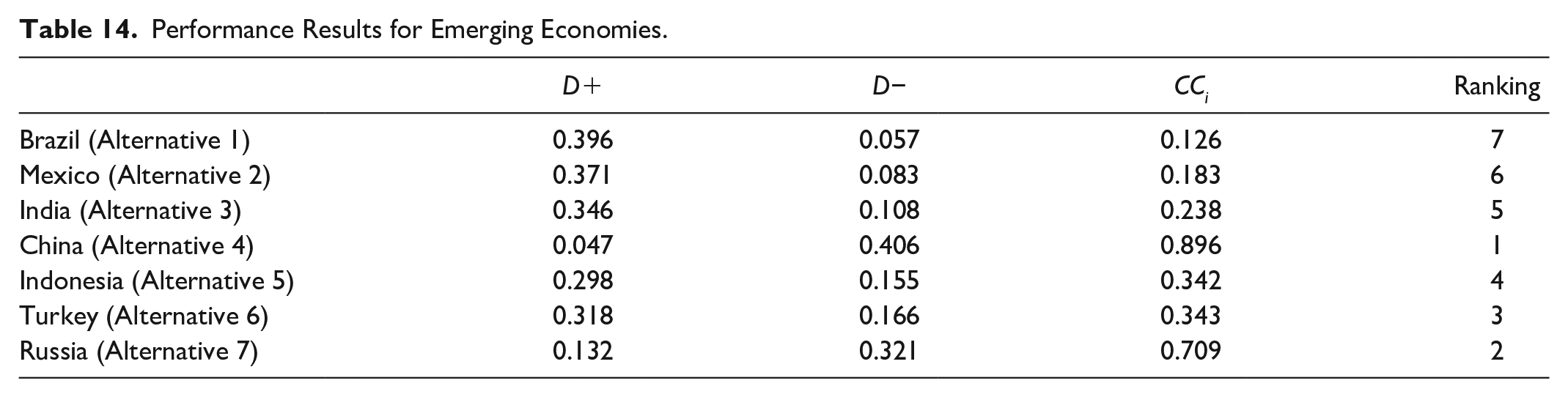
Table 14 presents the performance results for E7 economies. It is concluded that China (Alternative 4) is the best economy among E7 countries while Brazil (Alternative 1) has the worst performance of energy culture for the sustainable investments of emerging economies. To robustness check, scenario analysis is also applied with nine cases. The results are given in Table 15.
The Ranking Results of Scenario Analysis.

Scenario analysis demonstrates that an integrated decision-making approach based on 2-tuple linguistic information and interval-valued intuitionistic fuzzy sets provides coherent results for the performance of energy culture for the sustainable investments of emerging economies.
The increasing consumption of energy, impacted by increased population, economic, and technologic progress of emerging countries, has triggered several sustainability related issues. While increase of energy demand and consumptions are predicted in the future, the investments into renewable energies appear to be strategic priorities of these countries. However, investors are facing a challenge to define the investment priorities due to the different energy consumption patterns of consumers, which determine the transition to sustainable energies. Within this context, it is important to consider energy cultures and integrate the criteria of energy cultures in the decision-making process linked to sustainable energies investments. Though the scientific discussions on energy cultures have been developing, the criteria of energy cultures and their assessment are not entirely clear. Thus, this study sought to find out the influence directions of dimensions and criteria for energy culture in emerging economies for sustainable energy investments with a proposed MCDA technique.
The proposed model integrates DEMATEL and TOPSIS based on 2-tuple and interval-valued intuitionistic fuzzy sets. While sustainable energies investments are conflicting issue, the integration of few methods lead to a more comprehensive assessment system. Thus, the adopted methods let us overcome limitations reported in other scientific studies. The study expands prevailing literature by investigating criteria of energy cultures linked to sustainable energy investments in emerging countries. The analysis of scientific literature on energy culture dimensions interrelated to the consumers behavior and adopted methodology let us disclose the most significant criteria and subsequently, to answer the first research question. On the other hand, the application of MCDA technique in such specific field as presented in current study has not been applied. Thus, the answer to the second research question is provided.
The results reveal the significance of material culture for sustainable energy investments. A close look at energy cultures criteria discloses that the use of non-renewable energy technology, use of renewable technology, and number of major appliances are the most significant criteria linked to the sustainable energy investments. These findings echo other studies disclosing the significance of prevailing energy infrastructure for developing modern energy systems in particular country (Ford et al., 2017; Klaniecki et al., 2020). Moreover, these findings imply that investing firms must consider investing in technologies, assets, and objects which enable to reproduce energy usage. Furthermore, the analysis revealed that there is a mutual relationship between material culture and norms. Referring to previous studies (Stephenson et al., 2010), the results lets us confirm that material culture and norms of emerging countries reinforce each other. However, misalignment of practices with material culture and norms creates the potential for behavior change of consumers. Thus, knowledge on energy related problems, behavior constraints, and energy conservation intentions of consumers creates preconditions for shift of prevailing energy culture to greener energies. Finally, the comparison of emerging countries, let us reveal that China was ranked as the first option and demonstrates the potential for investing firms considering investment opportunities in sustainable energies. These findings are in line with other studies, focused on opportunities for renewable energies (Chen et al., 2010).
Conclusions and Policy Implications
In this study, it is aimed to identify the influence directions of dimensions and criteria for energy culture in emerging economies for sustainable energy investments with a proposed multi-criteria decision-making technique based on 2-tuple linguistic values and interval-valued intuitionistic fuzzy sets. The weighting results of energy culture are also evaluated for E7 economies. To weight the criteria, DEMATEL methodology is taken into consideration. On the other side, TOPSIS methodology is also considered to rank emerging economies. It is concluded that use of non-renewable energy technology has the highest priority whereas pro-environmental personal and social norms have the lowest degree of global weights. Moreover, behavioral constraints have an impact on both knowledge on energy related problems and energy conservation intentions. Additionally, use of renewable technology has a strategic direction on the use of non-renewable energy technology and number of major appliances. It is also identified that social/public acceptance of renewable energy technologies has the most influencing factor by affecting pro-environmental orientation and pro-environmental personal and social norms.
First, the understanding of energy cultures identifies a need to focus on material culture in the decision-making process. Moreover, the adopted technique appears to be a practical tool in identifying entrenched behaviors of consumers and disclose opportunities for the transition of energy-cultures. It should be noted that the study is not without limitations. First, the research included only limited number of criteria relevant for energy cultures. Thus, future studies could expand our investigation by adding other criteria. Second, the investigation was performed by considering emerging countries. Thus, the future studies could consider other countries. Taking into consideration the size of selected countries, the suggested approach could be applied on regional level (e.g., by investigating rural areas). Finally, the future studies could consider other MCDA techniques. Another important limitation of this study is that there is no practical implication in this manuscript. This study only recommends some factors to increase sustainability in energy investments. In the future studies, some practical implications can be conducted to test the validity of the proposed model.
Footnotes
Appendix
Defuzzifed Decision Matrix.

| C1 | C2 | C3 | C4 | C5 | C6 | C7 | C8 | C9 | |
|---|---|---|---|---|---|---|---|---|---|
| A1 | 0.800 | 0.700 | 0.533 | 0.733 | 0.700 | 0.700 | 0.533 | 0.700 | 0.667 |
| A2 | 1.000 | 0.533 | 0.533 | 0.767 | 0.900 | 0.533 | 0.733 | 0.583 | 0.700 |
| A3 | 0.967 | 0.800 | 0.583 | 0.700 | 0.900 | 0.533 | 0.700 | 0.667 | 0.667 |
| A4 | 0.900 | 1.100 | 0.767 | 1.167 | 1.133 | 0.967 | 0.933 | 1.100 | 1.133 |
| A5 | 0.767 | 0.733 | 1.100 | 0.733 | 0.733 | 0.700 | 0.700 | 0.767 | 0.733 |
| A6 | 0.767 | 0.733 | 0.700 | 0.617 | 1.133 | 0.800 | 0.700 | 0.533 | 0.767 |
| A7 | 0.933 | 0.933 | 1.067 | 0.933 | 1.133 | 0.933 | 0.800 | 0.767 | 0.933 |
Declaration of Conflicting Interests
The author(s) declared no potential conflicts of interest with respect to the research, authorship, and/or publication of this article.
Funding
The author(s) received no financial support for the research, authorship, and/or publication of this article.
