




Abstract
Our study aims to explore the process through which authentic leadership leads to employees’ initiative behavior and task performance. In particular, we focused on the mediating roles of emotional sharing and communication satisfaction. Based on data collected from 242 employee-supervisor dyads, we found that authentic leadership was significantly related to emotional sharing, which was sequentially significantly related to communication satisfaction. Communication satisfaction was significantly associated with initiative behavior and task performance. In addition, emotional sharing and communication satisfaction played significant mediating roles not only in the relationship between authentic leadership and initiative behavior, but also in the relationship between authentic leadership and task performance. The limitations and implications for future research and practice are discussed.
Keywords
As competition between companies intensifies and uncertainty increases, it is becoming important to try new adjustments in order to achieve performance in line with these environmental changes. In addition, companies are in a situation where they have to put forth various efforts to enhance their competitiveness (Lounsbury & Ventresca, 2002). As the business environment changes, the demands on organizational members are also changing. In the past, responsive actions to changes were emphasized, but initiative responses to changes are increasingly required, and achievement of performance is also emphasized (Ashford et al., 1998; Feldman & Pentland, 2003).
There are many ways to motivate members to take initiative behavior and achieve performance, one of them being leadership. Various studies have been conducted on the effects of leadership, and many recent studies have focused on the specific topic of authentic leadership (e.g., Gardner et al., 2011; Weiss et al., 2018). This increased interest in authentic leadership is due to recent corporate scandals and various immoral issues (Peus et al., 2012). These unethical corporate problems required desirable value-driven leadership, such as authentic leadership, which is believed to solve dysfunctional situations and build trust among organizational members of the leader (Weiss et al., 2018). Further, authentic leadership has been suggested to motivate followers and increase effectiveness within the organization (e.g., Gardner et al., 2011; Weiss et al., 2018; Yammarino et al., 2008).
Nonetheless, prior research does not sufficiently address the specific processes and mechanisms in which authentic leadership positively influences followers. Therefore, in the current study, the effect of authentic leadership on followers’ initiative behavior and performance is examined, and the specific path of influence is explored. In particular, we focus on emotional sharing and communication as an important component of the influence of authentic leadership on members. Since authentic leadership aims for a transparent relationship with its organization’s members, and because it focuses on eliciting respect and trust (Avolio & Gardner, 2005; Gardner et al., 2009), it is expected to be able to successfully achieve emotional sharing and satisfy members through communication.
This study focuses on emotional sharing because emotions are important for organizational life (Ashforth & Humphrey, 1995), and the way emotions are experienced and expressed within an organization has a broad and significant influence on work-related outcomes (Goleman, 1995). Emotions are subjective experiences that are mostly felt in social interactions (Parkinson, 1996). The expression and repression of emotions determines how people feel and influences cognitive functioning as well as the ability to form and maintain effective interpersonal relationships (Gross & John, 2003). Therefore, the sharing of emotions between a leader and members can be seen as a factor that can positively influence the attitudes, behaviors, and task performance of members within the organization.
In addition, satisfactory communication between leaders and members can lead to positive results within the organization by allowing members to form more effective work relationships (Gray & Laidlaw, 2004). In particular, satisfaction with communication for leaders can increase the overall satisfaction of employees within the organization and contribute to performance improvement (Butler et al., 2003). Therefore, in the current study, emotional sharing and communication satisfaction are expected to play an important role in authentic leadership, leading to positive results for members.
From this point of view, we focus on whether authentic leadership has a significant relationship with organizational members’ initiative behavior and task performance. In addition, we examine the mediating role of emotional sharing and communication satisfaction. Thus, our study makes two major contributions to the literature. First, we present a mechanism depicting the specific pathways which can explain the relationship between authentic leadership and followers’ initiative behavior and task performance. Second, through an empirical analysis, we suggest that leaders pay attention to members’ emotional sharing and communication satisfaction. This approach will not only expand the existing research findings, but also enrich the attention-grabbing areas of interactions between leaders and followers.
Theory and Hypotheses
Authentic Leadership
Authenticity is being true to oneself (Avolio & Gardner, 2005), acting in conformity with one’s true self with one’s own experiences, such as values, thoughts, feelings, beliefs, and expressing what one thinks and practices (Harter, 2002). Authentic leadership has been conceptualized as a multidimensional construct composed of self-awareness, relational transparency, balanced processing, and internalized moral perspective (Walumbwa et al., 2008). According to Walumbwa et al. (2008), authentic leadership is a way of being with a clear set of values.
Authentic leaders can promote follower authenticity when they present their authentic selves to others and generate an environment in which followers can have more opportunities for genuine self-expression (Algera & Lips-Wiersma, 2012). Previous literature on authentic leadership demonstrated that when leaders realize and act on their true values or strengths and help others do the same, followers have a greater chance of achieving well-being, which positively affects performance (Hsiung, 2012). Researchers also found that authentic leadership can have positive relationships with followers’ satisfaction with the supervisor, organizational commitment, and willingness to make an extra effort (Peus et al., 2012; Walumbwa et al., 2008).
Emotions play a substantial role in authentic leadership because people can utilize rich information that emotions provide about themselves, others, and the various interpersonal interactions inside organizational environments (Avolio et al., 2004; Lazarus, 1991). Authentic leaders can elicit positive emotions from followers and foster a sense of identification with their leaders and organizations (Fredrickson, 2001). Authentic leaders can broaden followers’ thinking and, in turn, induce behaviors focused on value-added behaviors (Emiliani, 1998). These behaviors help followers negotiate organizational challenges more effectively, improve their well-being in the workplace, and eventually build positive emotional states such as job engagement (Avolio et al., 2004).
Emotional Sharing
Emotional sharing means openly and candidly communicating one’s emotional experiences with others and expressing one’s true inner feelings to others who interact with oneself (Liu et al., 2011). Emotional sharing can help to stimulate social bonds and strengthen social relationships. By talking about an emotional event, people can build a collective memory and consolidate their memory of individual situations where the event occurred (Finkenauer et al., 1997). Further, individuals can increase the level of positive affect by speaking out about their positive emotional events or receive various types of help, including comfort, consolation, advice, and solutions, by sharing negative emotional experiences (Rimé, 2009).
Emotions occur when forecasts fail to live up to projections, such as when expectations are disproved or when activities are interrupted (Rimé, 2009; Weick, 1995). Cognitive functioning can achieve social sharing of emotions. For example, by communicating openly with others, people can unfold emotion-eliciting events and their own feelings and emotional reactions. Individuals can organize the emotional material into subsequent relationships that conform according to rational thinking (Werner & Kaplan, 1967). Repeated communication regarding an individual emotional experience serves as a powerful tool for evolving of its mental representation (Rimé, 2009).
Given that the process of social sharing is helpful for gaining social attention and interest and responding to the quest for meaning or for contributing to the production of meaning aroused by emotions (Rimé, 2009), emotional sharing sustained by the help of authentic leaders is more likely to succeed and thereby increase followers’ enthusiasm and motivation to work.
Authentic Leadership and Emotional Sharing
Employees often feel the need to engage in impression management when interacting with leaders because they recognized the power hierarchy (Yagil & Medler-Liraz, 2014). Rather than expressing their genuine feelings, followers often regulate emotions and hide negative emotions (Hecht & LaFrance, 1998). Previous authentic leadership scholars have emphasized the idea of “leading by example” (Avolio et al., 2004; Hsiung, 2012). Authentic leaders try to reveal their genuine emotions transparently and are more willing to accept the thoughts or opinions of their subordinates (Gardner et al., 2005). As followers learn to trust these authentic leaders, followers are likely to share ideas and express their feelings more openly (Walumbwa et al., 2008).
The emotional honesty of a leader is likely to be modeled by followers when they face emotional obstacles. Followers can feel more comfortable expressing their emotional experience, including negative emotions that are not usually considered appropriate, without the fear of ridicule or other social punishments (Liu et al., 2008). With an authentic leader, followers may feel more capable of displaying and sharing genuine emotions. The following hypothesis is drawn based on previous studies.
Hypothesis 1: Authentic leadership is positively related to employees’ emotional sharing.
The Mediating Role of Emotional Sharing
Authentic leaders serve as role models for subordinates by demonstrating high moral standards, honesty, and integrity, and motivate followers to respect and identify with their leaders (Avolio et al., 2004). In addition, authentic leaders show positive psychological states, such as optimal self-esteem and psychological well-being, and help others maintain a positive psychological state like themselves (Gardner et al., 2005). Because authentic leaders communicate through their own language and high-level moral standards and values, authentic leaders will communicate smoothly with their subordinates and share emotions naturally (May et al., 2003). Thus, emotional sharing is the open and candid discussion of mutual emotional experiences and expressing one’s own feelings (Liu et al., 2011). Emotional sharing with the leader strengthens the emotional bond of the subordinates and allows them to have positive emotions. Followers with strengthened bonds are more active and willing to take initiatives for the organizational benefit (Ashford et al., 1998). Initiative behavior is described as a self-initiating personality, an active approach, and continuous overcoming of difficulties in the pursuit of goals (Frese et al., 1997). Therefore, employees consider their social environment when evaluating the costs and benefits of initiative behavior (Hsiung, 2012).
On the other hand, task performance refers to the degree to which one’s job is successfully achieving official requirements or expectations (Williams & Anderson, 1991). In the workplace, emotional sharing with the leader occurs naturally in the work process and in life. Therefore, when emotions are shared well with the leader, intimacy increases due to the positive responses and perceptions formed in business promotion. Through this, information related to work is provided, which can help improve work progress and performance. In addition, the close relationship between leaders and subordinates, which can be formed in the organization through emotional sharing, removes uncertainties that may occur in human relationships and allows them to focus more on their work and increase their task performance (Collins & Miller, 1994). Therefore, if these theoretical discussions are linked, emotion sharing can be expected to play a mediating role in the relationship between authentic leadership and initiative behavior and between authentic leadership and task performance.
Hypothesis 2: Emotional sharing mediates the relationship between authentic leadership and followers’ initiative behavior.
Hypothesis 3: Emotional sharing mediates the relationship between authentic leadership and followers’ task performance.
Emotional Sharing and Communication Satisfaction
Communication satisfaction can be described as the personal satisfaction an individual experiences when successful communication occurs with others (Downs & Adrian, 2004) or a positive emotional response when expectations are met in a message exchange process (Hecht, 1978).
The social sharing of emotions facilitates the cognitive articulation of emotions. Unfamiliar or exceptional events stimulate storytelling which enhances shared knowledge and provides an outline within a context where the exception is significant (Bruner, 1990). Exceptions can be made understandable within the framework of a story. The communication process helps individuals reinterpret the situation and evaluate their coping potential more positively (Liu et al., 2008).
Emotional sharing between leaders and subordinates, and among subordinates themselves, is also a healing process. Sharing emotional experiences with leaders helps followers cope with stress more effectively (Harris & Kacmar, 2006). When others who have been subjected to similar experiences provide advice that these feelings have understandable origins, individuals are reassured that their feelings have some objective basis, thereby reducing self-disapproval (Thoits, 1985).
Social sharing of emotions supports a framework for conversation development (Liu et al., 2011). People can more easily step out of the shadow of frustration and experience positive emotional states in a workplace that has an atmosphere of high emotional sharing (Gross & John, 2003). Additionally, employees are more likely to be fully aware of their emotional experience, receive advice or support, and perceive communication satisfaction because of open and honest conversation and emotion management assistance.
Hypothesis 4: Emotional sharing is positively related to communication satisfaction.
The Mediating Role of Communication Satisfaction
According to organizational communication research, when employees’ needs for communication are met, they are likely to build more effective work relationships (Gray & Laidlaw, 2004). In contrast, counterproductive communication generates dissatisfaction with jobs, leaders, and organizations (Butler et al, 2003). Previous studies have investigated the various relationships between communication satisfaction and job satisfaction (Pincus, 1986), communication satisfaction and job performance (Pincus, 1986), and communication satisfaction and organizational commitment (Putti et al., 1990). Bolino (1999) refers to the reciprocity of employees in an organization. According to this study, employees behave differently depending on how they are treated and how they feel within the organization. Therefore, when the employees are satisfied with the communication, they reciprocate by committing initiative behavior or by making extra efforts to encourage the effective functioning of their organization.
Emotional awareness gained through emotional sharing also works for fine-tuning job performance, such as managing uncontrollable feelings, helping to develop positive emotional skills, and keeping motivated (Avolio et al., 2004; Zeidner et al., 2004). Therefore, we propose that communication satisfaction may mediate the relationship between emotional sharing and initiative behavior or task performance. The following hypothesis is based on the discussion above:
Hypothesis 5: Communication satisfaction mediates the relationship between emotional sharing and followers’ initiative behavior.
Hypothesis 6: Communication satisfaction mediates the relationship between emotional sharing and followers’ task performance.
The Serial Mediating Role of Emotional Sharing and Communication Satisfaction
Our study focuses on employees ‘emotional sharing and communication satisfaction to investigate the relationship between authentic leadership, employees’ initiative behavior, and task performance. Authentic leaders are characterized by being true to themselves and exhibiting behavior consistent with their values, thoughts, feelings, and beliefs (Avolio & Gardner, 2005). Leaders who understand their core values and who are consistent with them could be authentic in their emotional expressions because of self-discipline and congruity between values and behaviors. The clarity of their deep-seated value system may enable balanced processing and make leaders more inclined to accept the perspectives of others.
Based on this, authentic leaders openly and frankly share their emotions in their relationships with subordinates, and subordinates who actively share their emotions with the leader communicate more smoothly with the leader (Liu et al., 2011). In addition, sharing emotions with the leader allows them to experience a positive emotional state and provides help to get out of frustration more easily (Gross & John, 2003). Therefore, such emotional sharing can increase satisfaction regarding communication with the leader and enhance the positive aspects of communication. Communication satisfaction with the leader enables subordinates to form effective work relationships (Gray & Laidlaw, 2004) and can also affect positive attitudes and behaviors and achievement of task performance (Putti et al., 1990). On the other hand, employees show reciprocity, and if they are treated well in the organization, they will show effective actions and results in return for the organization (Bolino, 1999). As one of the effective behaviors and results, initiative behavior and performance improvement are also included. Therefore, the following hypotheses can be established based on these theoretical discussions.
Hypothesis 7: Emotional sharing and communication satisfaction sequentially mediate the relationship between authentic leadership and initiative behavior.
Hypothesis 8: Emotional sharing and communication satisfaction sequentially mediate the relationship between authentic leadership and task performance.
Methods
Sample and Procedures
We collected data from leaders and their followers in 20 companies across various industries in South Korea. Before conducting the survey, permission was obtained from each company to conduct the study and collect the data. In addition, informed consent was obtained according to the established ethical standards. We developed separate questionnaires for leaders and subordinates. The questionnaires were distributed to 298 matched leaders and subordinates (i.e., team leaders and team members). Leaders rated their subordinates’ initiative behavior and task performance, whereas subordinates evaluated their leaders’ authenticity, emotional sharing with leaders, and communication satisfaction. To ensure the confidentiality of participants’ responses, we collected completed survey questionnaires directly. A total of 242 leader-follower dyads remained after deleting the records of unmatched leader-follower pairs. It is important to note that this procedure was intended to address the concern over common source variance in measuring the key variables of the study. The average age of the participants was 33.4 years. The average organizational tenure was 5.6 years, and the subordinates’ average tenure with the leader was 3.1 years. Among the 242 respondents, 76.6% were male, 82.1% held bachelor’s degrees, and 17.9% had graduate degrees.
Measures
For all the measures, except demographic information, participants responded to questions on a 5-point Likert-type scale, ranging from 1 (strongly disagree) to 5 (strongly agree). The specific measures are described below.
Authentic leadership was operationalized through a second-order model, consistent with Walumbwa et al.’s (2008) original study that included eight items. The measure consisted of four dimensions: self-awareness, internalized morality, relationship transparency, and balanced information processing. Self-awareness includes two items, such as “My supervisor seeks feedback to improve interactions with others.” Relationship transparency includes two items, such as “My supervisor says exactly what he/she means.” The internalized morality perspective includes two items, such as “My supervisor demonstrates beliefs that are consistent with actions.” Balanced information processing includes two items, such as “My supervisor listens carefully to different points of view before coming to conclusions.”
As for emotional sharing, four items adopted from Liu et al. (2011) were used. Sample items were “I tended to express my true feelings with my supervisor;” “I openly talked about my emotions with my supervisor;” and “I shared my feelings about issues with my supervisor.”
We used the communication satisfaction scale developed by Zwijze-Koning and De Jong (2007). In the current study, we only used five items related to communication satisfaction with the supervisor. Sample items included “I feel free to approach my supervisor when I am having a problem;” “My supervisor is available when I have to deal with urgent matters;” and “When I need to ask my supervisor about something, I can always reach him/her.”
Leaders evaluated the initiative behavior of their subordinates. Initiative behavior was measured with seven items adapted from Frese et al. (1997). Sample items were “My subordinate . . . actively attacks problems;” “Whenever an opportunity to get actively involved emerges, my subordinate . . . takes it;” and “Usually, my subordinate does more than he/she is asked to do.” Leaders also assessed the task performance of their subordinates based on the seven items adapted from Williams and Anderson (1991). Sample items included “My subordinate . . . adequately completes the assigned duties;” “My subordinate . . . performs tasks that are expected of him/her;” and “My subordinate . . . engages in activities that will directly affect his/her performance evaluation.”
For accurate translation from the English version of the survey questionnaires, the Korean versions of the survey items were created by following Brislin’s (1980) translation-back-translation procedure. The English version of the authentic leadership, emotional sharing, communication satisfaction, initiative behavior, and task performance scales were initially translated into Korean by the authors. Back translation into English was subsequently performed by a bilingual assistant who was invited by one of the researchers. Finally, the English and back-translated versions were compared to each other.
Analysis and Results
Confirmatory Factor Analyses
We applied structural equation modeling (SEM) to test the hypothesized model. The advantage of SEM is that it can be tested concurrently on the entire structure of variables in the hypothesized model, and the degree to which the model is consistent with the data (Byrne, 1994). Based on Anderson and Gerbing’s (1988) comprehensive two-step analytical strategy, the measurement model was first confirmed using confirmatory factor analysis (CFA). We then performed structural equation modeling based on the measurement model to estimate the fit of the hypothesis model to the data.
We performed an exploratory factor analysis before performing a confirmatory factor analysis. Five factors were identified based on Eigenvalues greater than 1. Table 1 presents the results of the CFA. As shown, the baseline five-factor model fitted the data well (χ2 = 521.72, df = 314, p < .01; TLI = 0.93, CFI = 0.94, RMSEA = 0.06). The acceptability of the structural equation models can be assessed using goodness-of-fit indices. For TLI and CFI, the judgment criterion is 0.90 or more, and RMSEA is 0.10 or less (Hair et al, 2006). Against this baseline five-factor model, we tested four alternative models: Model 1 was a four-factor model with initiative behavior and task performance combined into one factor; Model 2 was a three-factor model with emotional sharing and communication merged into one factor and initiative behavior, and task performance merged into another factor; Model 3 was a two-factor model with emotional sharing, communication satisfaction, initiative behavior, and task performance combined into one factor, and Model 4 was a one-factor model with all the items merged into one factor. As Table 1 shows, the fit indexes supported the hypothesized five-factor model, providing evidence of the construct distinctiveness of authentic leadership, emotional sharing, communication satisfaction, initiative behavior, and task performance.
Results of the Confirmatory Factor Analysis.
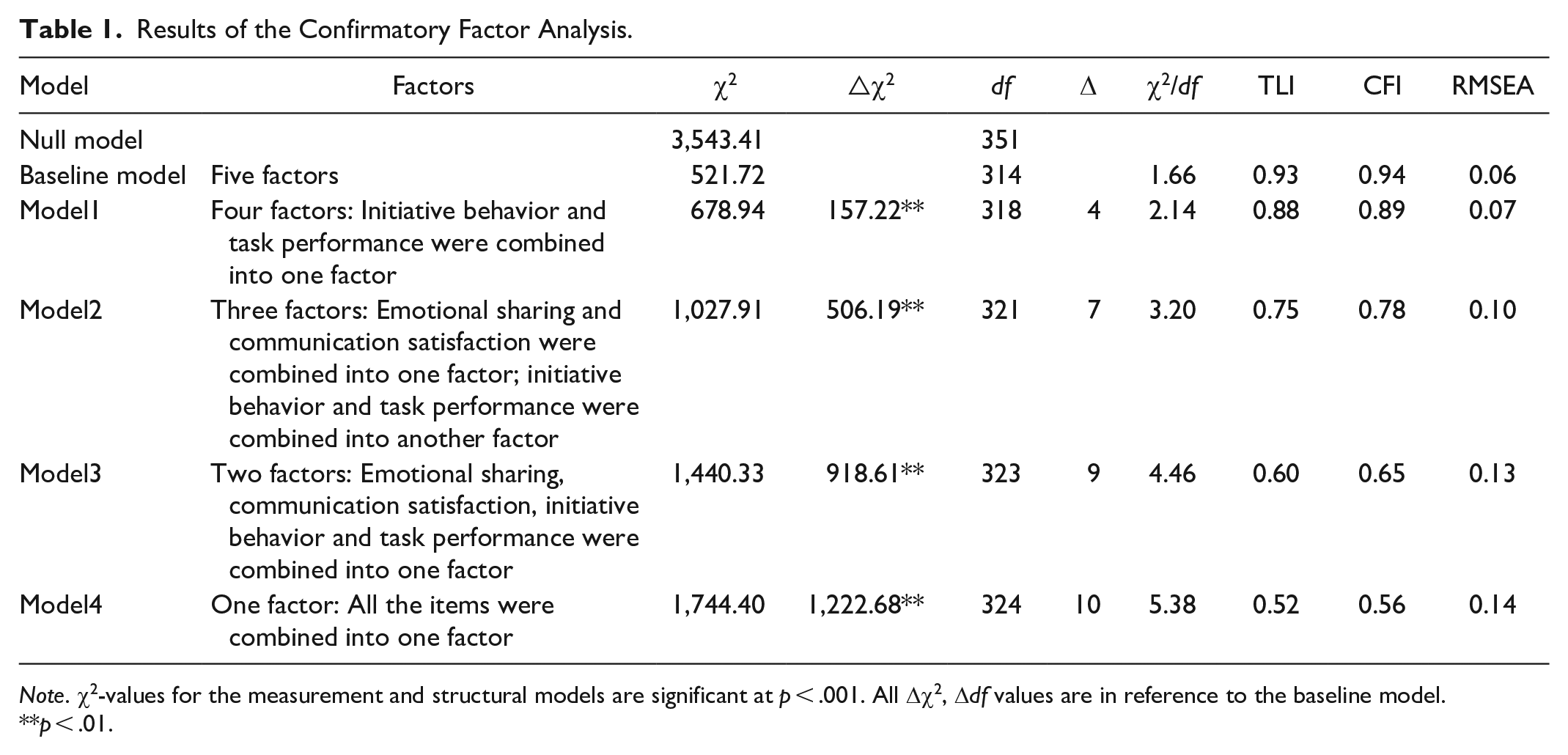
Note. χ2-values for the measurement and structural models are significant at p < .001. All Δχ2, Δdf values are in reference to the baseline model.
**p < .01.
A confirmatory factor analysis is suitable for confirming whether construct measures load on their respective priori-defined constructs (Browne & Cudeck, 1993). The range of loadings for the five factors was as follows: authentic leadership, 0.76 to 0.84; emotional sharing, 0.69 to 0.83; communication satisfaction, 0.77 to 0.83; initiative behavior, 0.67 to 0.72; and task performance, 0.66 to 0.82. The significance of factor loading can be judged based on 0.50 (Hair et al., 2006). The loading values of all the factors in the current study met the criteria. The results suggest a high reliability and validity of the measures.
Descriptive Statistics
Table 2 shows the means, standard deviations, zero-order correlations, and reliability coefficients. Among the demographic factors, gender and tenure with the leader were significantly correlated with emotion sharing, and age was significantly correlated with task performance.
Means, Standard Deviations, and Correlations.

n = 242. Reliability coefficients for the scales are in parentheses along the diagonal.
p < .05. **p < .01.
Test of Hypotheses
The SEM results suggest that the hypothesized model fit the data well (χ2 = 609.78, df = 387, p < .001; TLI = 0.92, CFI = 0.92, RMSEA = 0.05). Although the chi-square test shows statistical significance, the chi-square test is sensitive to sample size and may be significant even when the difference between the observed and model-implied covariances is relatively small (Kline, 1998). Therefore, we reported multiple indices for assessing model fit. We also conducted a series of nested model comparisons to assess the extent to which alternative models would result in a significant improvement in fit compared with the hypothesized model (Anderson & Gerbing, 1988). Table 3 summarizes all the model fit indices.
Structured Equation Model Comparison.
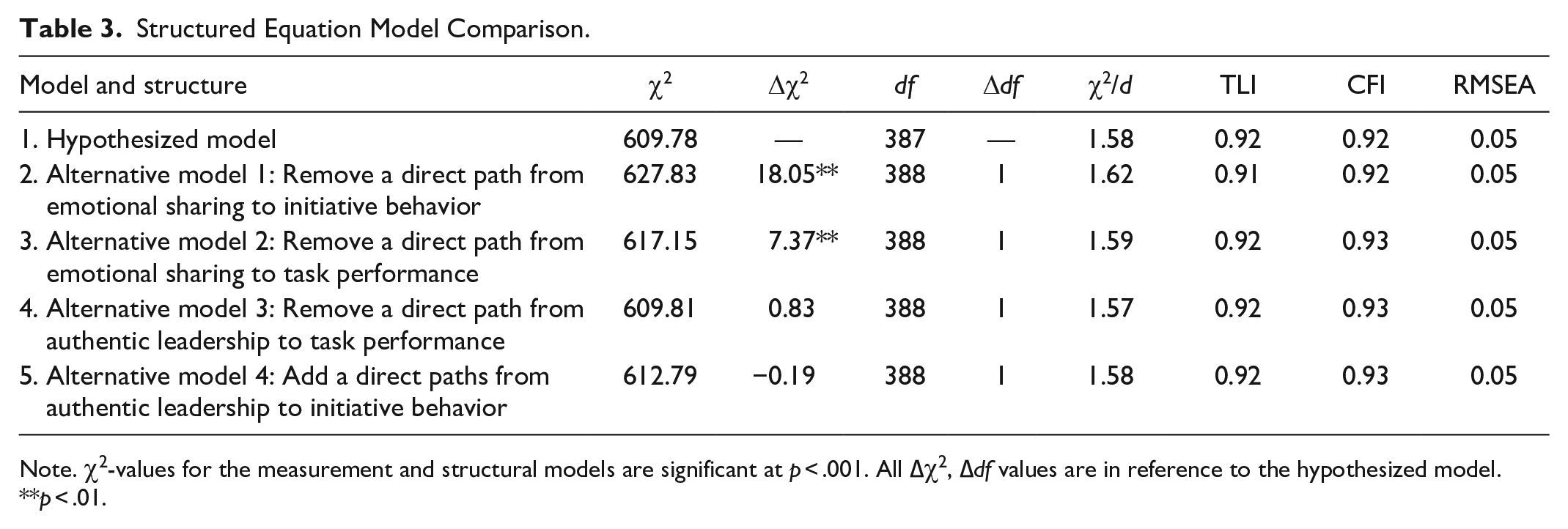
Note. χ2-values for the measurement and structural models are significant at p < .001. All Δχ2, Δdf values are in reference to the hypothesized model.
p < .01.
Model 1, our hypothesized model, represents a partially mediating model. We specified paths from authentic leadership to emotional sharing, from emotional sharing to communication satisfaction, and from communication satisfaction to initiative behavior and task performance. This model has direct paths from authentic leadership to initiative behavior, task performance, and emotional sharing to initiative behavior and task performance. We tested four nested models against the hypothesized model. In Model 2, we removed the direct path from emotional sharing to initiative behavior. In Model 3, we removed the direct path from emotional sharing to task performance. In our third alternative model, Model 4, we removed the direct paths from authentic leadership to task performance. In Model 5, we removed the direct paths from authentic leadership to initiative behavior.
As Table 3 shows, the differences between chi-squares were significant for Model 1 compared with Models 2, 3, 4, or 5. These alternative models provided good fits to the data but were not significantly better than the hypothesized model. The hypothesized model showed a significant difference in chi-square values for Models 2 to 3, but did not show a significant difference for Models 4 to 5. Together, the hypothesized model was adopted as the final model because the fit to the data was acceptable, even when compared to competing models.
Figure 1 presents the overall structural model with standardized path estimates. The results support Hypothesis 1, which states that authentic leadership is positively related to emotional sharing (.19, p < .05).

Results of structural equation modeling.
Hypothesis 2 relates to the mediating effect of emotion sharing on the relationship between authentic leadership and initiative behavior. Hypothesis 3 relates to the mediating effect of emotional sharing on the relationship between authentic leadership and task performance. In the SEM approach, establishing the role of a partial mediator involves satisfying two conditions: (a) the path from the independent variable to the dependent variable is significant; (b) the path between the independent variable and the mediator variable, as well as the path between the mediator variable and the dependent variable, are significant (James et al., 2006). If only condition (b) is satisfied, then a full mediation effect exists. In our study, we use bootstrapping to estimate the mediating effects. With regard to Hypothesis 2 to 3, authentic leadership was not only directly related to initiative behavior (.16, p < .05), but also indirectly related to initiative behavior through emotional sharing (.06, p < .05). There was no significant direct relationship between authentic leadership and task performance (−.01, p > .10), but there was a significant indirect relationship through emotional sharing (.04, p < .05). These results show that emotional sharing plays a partial mediating role in the relationship between authentic leadership and initiative behavior. Further, emotional sharing plays a full mediating role in the relationship between authentic leadership and task performance. Therefore, Hypotheses 2 and 3 are supported.
Hypothesis 4, which states that emotional sharing is positively related to communication satisfaction, was also supported (.18, p < .05). Regarding Hypotheses 5 and 6, emotion sharing had a significant direct relationship with initiative behavior (.30, p < .01), and also had a significant indirect relationship through communication satisfaction (.05, p < .05). In addition, emotional sharing had a significant direct relationship with task performance (.19, p < .01), and also had a significant indirect relationship with task performance through communication satisfaction (.09, p < .05). These results show that communication satisfaction partially mediates the relationship between emotional sharing and initiative behavior, as well as between emotion sharing and task performance. Hypotheses 5 and 6 are supported.
Hypotheses 7 and 8 relate to the sequential mediation of emotion sharing and communication satisfaction in the relationship between authentic leadership and initiative behavior, and between authentic leadership and task performance. The direct relationship was significant in the process from authentic leadership to initiative behavior (.16, p < .05). In addition, the indirect relationship mediated through emotion sharing and communication satisfaction was significantly suggested (.07, p < .05). There was no significant direct relationship between authentic leadership and task performance (−.01, p > .10); however, there was a significant indirect relationship through emotional sharing and communication satisfaction (.05, p < .05). These results show that emotional sharing and communication satisfaction play important mediating roles not only in the relationship between authentic leadership and initiative behavior, but also in the relationship between authentic leadership and task performance. Therefore, Hypotheses 7 and 8 were supported.
Discussion
An empirical study was conducted in the current study to examine the effects of authentic leadership on members’ initiative behavior and task performance. The results of the empirical analysis show that the enacting of authentic leadership tends to increase the initiative behavior and task performance through the sharing of emotions (with the members) and the satisfaction of the members’ communication. The implications that can be obtained from the results of our study are as follows.
Theoretical Implications
Our findings extend existing studies in three important ways. First, we established and verified the relationship between authentic leadership and members’ initiative behavior and task performance as a conceptual model. In particular, our study focused on emotional and communication aspects as important parts of authentic leadership that can influence members. The results show that emotional sharing and communication satisfaction between leaders and members play an important mediating role in linking the authentic leadership effect to initiative behavior and task performance improvement. This study enriches the literature on the effect of authentic leadership on subordinates’ outcomes (Avolio et al., 2004; Gardner et al., 2011; Luthans et al., 2006; Weiss et al., 2018). It further shows that the enactment of authentic leadership can provide benefits in various aspects to members.
Second, we conducted research in a new direction by examining the effect of authentic leadership on the initiative behavior of members within the organization. In today’s organizations, the actions of members who seek new attempts to keep pace with the changes of the times and proactively respond to changes are in greater demand. Therefore, in line with these changing times, the direction in which authentic leadership can affect was differentiated from existing studies. Despite the demand for initiative behavior, existing authentic leadership studies focus on outcomes such as organizational commitment (Peus et al., 2012), work engagement (Wang & Hsieh, 2013), and well-being (Weiss et al., 2018). Considering this, the results of our study are meaningful in that they can show the consequences of authentic leadership which have not been addressed in previous studies.
Third, our study tried to increase the reliability and validity of the study by using the measures verified in previous studies. Above all, the leader directly evaluates the task performance of the members, thereby increasing the reliability of the measurement. When data using the same method are used, various measurement errors may occur; in particular, in the case of task performance, there may be a tendency to overestimate due to having a self-serving bias when evaluating oneself. However, in the current study, the leader attempted to minimize such errors by direct measurement. As a result, our study was able to derive meaningful research results with greater reliability and validity.
Practical Implications
Through the results of our study, we discuss the following practical implications. First, it is necessary to make efforts to improve authentic leadership in managers’ leadership programs. Based on the theoretical considerations presented in the current study, to enhance authentic leadership, it is necessary to increase understanding of oneself and create an atmosphere that emphasizes ethical and moral aspects in the organization. Efforts should be made not only for regular ethical education but also for forming an overall climate that places importance on ethical regulations, principles, and practices. Creating a fair and transparent environment for emotional sharing and communication management is critical. Such climate-making and institutional improvement naturally form desirable minds, ethical values, and attitudes among subordinates. In addition, it is necessary to nurture and systematically manage potential authentic leaders by providing various opportunities to employees and encouraging their participation to have a balanced view and grasp the overall principle. By introducing participatory decision-making, it will be possible to encourage employees’ voluntary participation and provide an opportunity to acquire a more balanced perspective and competency.
Second, it is necessary to support healthy relationships among employees. For example, organizations need to provide opportunities for employees to express their feelings and share with their leaders and colleagues. Organizations also need to provide learning and development programs that emphasize the importance of honest communication based on trust, which can help improve the quality of mutual relationships. It is vital to enhance the satisfaction of relationships and communication in the workplace through these efforts. Because the role of the leader is essential in understanding the improvement of communication satisfaction among subordinates, the leader should show authenticity to subordinates, share feelings honestly with subordinates, and try to form a close relationship with subordinates. Active attitudes and practices are required to effectively deal with them. At the organizational level, sharing emotions and effective communication with employees should be designated as important roles, and leaders should be supported to devote their efforts and energy to this.
Limitations and Recommendations
Our study has several limitations and suggestions for future research. Above all, the results cannot be easily generalized because our relatively small sample size could limit the strength of the findings. Further empirical research is required to replicate our findings and test the applicability of the model to different types of organizations. A cross-cultural study would be another avenue for improvement.
Second, there is a further need to specify the processes that link authentic leadership with anticipated outcomes, including other meaningful variables with mediating or moderating effects. For example, several studies consider the role of gender in the realization and expression of emotion or self-disclosure within social interaction (Dindia & Allen, 1992; Reis, 1998). As females have been found to be more expressive of feeling and compassion, one could argue that gender differences exist between leaders and subordinates with respect to effective emotional sharing.
Footnotes
Declaration of Conflicting Interests
The author(s) declared no potential conflicts of interest with respect to the research, authorship, and/or publication of this article.
Funding
The author(s) received no financial support for the research, authorship, and/or publication of this article.
