




Abstract
This work on Pauline Discourse-Rhetorical Strategies for Community Building in the Book of First Thessalonians is carried out to examine how Apostle Paul deployed language in communicating his thoughts to the Thessalonian church in order to encourage them in their faith in Christ while establishing them as a strong community within the Thessalonian society. Previous research works on the book of First Thessalonians have either centered on theme, structure, and arguments on date and authorship in analysing the book. Discourse-rhetorical strategies for community building have not been investigated. This study uses the following discourse-rhetorical theories in its analysis: elements of Aristotelian Rhetoric, particularly Logos, and Bitzer’s Rhetorical Situation Theory. The data is composed of 14 utterances, purposively selected through careful reading and observation. The study finds that the rhetor responded politely to the exigence of the tendency to fall away from faith because of persecution by deploying identification strategy. He presented his exhortations, command, and instructions by deploying logos and use of persuasive strategies. The study concludes that rhetorical analysis is a very useful tool for discovering potent strategies political or religious leaders employ in communicating their thoughts and ideas to their audiences.
Introduction
The use of language in human existence and endeavours cannot be overemphasized. Thoughts and ideas of people all over the world are expressed through language. Nations, communities, and individuals are built up or influenced positively or negatively through the agency of language. Any concept or idea, no matter how beneficial it can become for man, must be communicated through language. Hence, great rhetors ever known employed linguistic devices in communicating their intentions to their audiences “original, intended or implied” (Strang, 2015, p. 9). Discourse analysis is today seen as a growing and evolving discipline with academic research in these different disciplines varying from one another (Schiffrin et al., 2001, p. 1). Several scholars have defined discourse in different ways with different perspectives in view. For instance, Fasold (1990) defines the study of discourse as “the study of language use” (p. 65). Generally, discourse is seen as an extended stretch of language beyond the boundaries of the sentence. Discourse is not just about language, but it has both linguistic and nonlinguistic aspects with social perspectives in view. Here, we also see the connecting link between discourse and rhetoric. While discourse construct the social ideological assumptions, identity and power relations in society, rhetoric provide the vehicle of discourses thus constructed. Discourse analyses dwell on the “construct” of discourse and making opaque the tacit meanings thereof; rhetorical analysis deals with explicating the strategies employed in the process of communicating the discourse. Rhetoric as an approach employed in analysing the language use in speeches and texts can be seen as the study of how language is used to persuade, convince, and influence the audience to accept a culture, a belief system, a new idea, or take an action in favor or against a movement. A background knowledge of the interlocutors and the relationship or distance that exists between them gives a clear view of what is meant by the speaker.
Scholars like Adams (2008) show that it is a possibility that Paul’s writings have been the most read, most studied, and most written about in the history of religious literature. The book of First Thessalonians is very apt for rhetorical analysis in that it was presented to the believers in Christ in one of the most famous cities in Asia Minor. The following statement by Ranzolin (2004) agrees with this: Like any city in the ancient world, the religious environment of Thessalonica was multifaceted; the city was host to numerous deities who were objects of adulation and worship. Deities such as Zeus, Artemis, Apollo, Aphrodite, Dionysus, and the Egyptian gods Serapis, Isis, and Anubis, along with many others, were venerated with the thanksgivings, prayers, and sacrifices of devout people (p. 427).
This city was not just a Center of religious worship, but a commercial Center. The merchants brought with them their goods and their gods; and the Thessalonians embraced these. The Thessalonians lived a life referred to as Millenarian piety. Jewett (1986) explains that the term “millenarian” is a term that sociologists use to indicate “religious movements that expect the total transformation of this world to occur in connection with a cataclysm in the near future” (p. 161). The characteristics of millenarianism presented by Talmon (1966) include the following,
“(1) a belief in a messianic figure who is gone now but will return to usher in a new age, (2) a tendency of members to drop out of economic and civil obligations, (3) a strong criticism of the current political and civil order, and (4) involvement in activities that challenge existing rules or standards” (p. 6).
We see then that any person trying to convince people in such community must use various strategies to communicate his ideas to them. There is the need to persuade the audience to receive a new teaching that will apparently lead them to imbibe a new culture. This was not going to be an easy task as the people’s minds were already made up on how to live. Paul, the writer of the book of First Thessalonians, was actually interested in reconstructing the Thessalonian church. As a community builder, Paul sets out to build a community of believers out of the millenarian movements which already existed in Thessalonica before he came.
To understand the discourse of First Thessalonians, one needs to have a view of the rhetorical context, situation, and exigence of the text. The author of the book writes bearing in mind the perception of his audience about his message. Baumlin explains that “from its inception, classical rhetoric has grounded persuasion upon a speaker’s knowledge of the varieties and complexities of human character and this background knowledge he has, enables the speaker to project a favorable self-image and to shape arguments in ways that accommodate differing audiences and occasions.” The genre of the text before us being a religious one helps us to determine the context of both the text, the writer, and the audience. They are all in a frame of mind of serving or worshipping a Supreme Being whom they may or may not understand. In this religious mindset, Paul was determined to make his audience have a sense of responsibility as they await an eminent rapture out of the world of “afflictions” they both share in. With this shared background and situation of afflictions, the rhetor is believed to achieve success in his persuasive attempts which we see as lucid language. Gee (2001) opines that language has a magical property such that when we speak, we craft the expression to fit the situation or context in which the person communicates. And the expression itself creates the situation or context (p. 11). Expatiating on the impact context has on discourse, Gee (2001) states that “context” determines meaning and you just have to have been there to understand what was being said (p. 31).
Different scholars have viewed context in different ways to reflect their discourse perspectives (Song, 2010). For Valiene and Čiužauskaitė (2019), rhetorical context is the audience, place, and time of the rhetoric. Conversely, some scholars have defined context as the distance or relationship between a rhetor and his audience. Simply put, context is the circumstance surrounding a given discourse or discourse element. In other words, context shapes the discourse, and the nature of the discourse helps in understanding the context. Context and discourse are inseparable as they are interwoven. The cultural background of the Thessalonians and that of Apostle Paul, will help us a lot in figuring out what the situation is and will answer the question of why the author of the book used the rhetorical language he used, and in the way he used it. The concern of this study, therefore, aims to explain the discourse of First Thessalonians by highlighting the Discourse-Rhetorical strategies employed by Paul as he writes to his audience and the possible effects the use of these strategies might have on the audience in convincing them to cooperate with the rhetor to alter the exigence and build a strong Christian community.
Statement of the Problem
Some of the works done on the book of First Thessalonians concentrated on the syntactic structure of some chapters, others on themes, authorship, and date of the book. Scholars like Adams (2008) have employed Discourse Analysis and Epistolary Theory in analyzing the book, However, researchers have not examined the discourse of the book with the view to discovering the rhetorical strategies for community building deployed by the author in writing it. Attempts to discover why the author wrote the way he did is a point that have been neglected by previous scholars, thus creating a lacunae upon which the present work finds its place.
Aims and Objectives of the Study
This study aims at analyzing the book of First Thessalonians rhetorically to assess Pauline discourse for building a strong community of Christian believers within the Thessalonian society. Specifically, the study shall,
Present an overview of Paul’s and The Thessalonians’ socio-cultural context and background to determine how it contributed to his response to the exigence and situation of the audience.
Discuss rhetorical persuasive strategies in the book, to show how these help in understanding Pauline discourse as a community builder interested in establishing a strong Christian community within the Thessalonian society.
Significance of the Study
Since this work is concerned with the way language is applied in communicating thoughts in the book, the contributions thereof will be relevant in linguistic studies. Language, especially English language studies, will find the contributions of this work very useful. The study also brings to light some salient issues raised by the way the writer used language, bearing his recipients, and his intentions in mind as he writes. The audience-centered approach to rhetorical discourse is highlighted.
Review of Related Literature
Introduction
It was as early as 5th century B. C. that the formal study of rhetoric “began in the ancient city-states of Greece and their colonies” (Brummett, 2011). Since “most rhetoricians regard Aristotle’s ‘Rhetoric’ as the most important single work of persuasion ever made” (Valiene & Čiužauskaitė, 2019); therefore, modern view of rhetoric derives from the work. Following the development of the discipline of rhetoric from Aristotle, “the Romans adopted the art of rhetoric where notable names like Cicero came up with the five canons of Rhetoric that were the first communication model” (Trenholm, 2017, p. 2).
Following the contributions by the Romans, the medieval period marked by sniffling of academic thinking by the church came up. According to Trenholm (2017, p. 2), rhetoric at this period focuses on public speaking to improve preaching. This was the period when only men were seen to possess required rhetorical skills to persuade at the time. Nevertheless, public speaking does not depend on social divisions like gender, age, race, religion, or ethnicity. “Renaissance saw the focus shift toward issues of style in speaking situation. The enlightenment reawakened the classical approach as well as coming up with new approaches like relying on scientific and morale arguments as well as approach that focused on style and delivery. Finally, the public oration reached its current stage where all the phases through history are being studied and applied” (Valiene & Čiužauskaitė, 2019). In the view of Valiene and Čiužauskaitė (2019), this discourse analysis approach which has taken over 2, 500 years since scholars began to consider it as a discipline with modern theories, cannot be effectively applied without a reference to the Aristotle tradition. Scholars have therefore, been concerned with redefining Aristotle rhetoric. The ethos, logos, pathos model remain valid, and prove very effective in many situations of rhetorical concern.
This section of literature review considers works that are done to analyze public speeches and representations using different rhetorical theories, as well as some works on the book of First Thessalonians. Palonen (2019) for instance, carried out a study on the transformations that occurred in the symbolic landscape of Hungary since 2010 on what she titled Rhetorical-Performative Analysis of the Urban Symbolic Landscape: Populism in Action. The study utilizes [a rhetorical-performative analysis which is seen as a veritable tool for exploring urban symbolic landscape and populism, and the relationality and materiality from the post foundational perspective which is based on the articulation theory of cultural theorists like Stuart Hall or political theorists like Ernesto Laclau and Chantal Mouffe and spatial analysis of cultural geographer, Doreen Massey]. Connecting these theories to the study of populism, Palonen (2019) notes that the case of Hungary shows how political frontiers have been articulated in the public space, with contestable interpretations of the past which are deliberately used to project key symbolic urban landscapes that are transformed radically to articulate a political “us” and “them” ideology. Furthermore, the study states that rhetoric is not simply about persuasion, but an approach that sees politics as the articulation of points of identification and political demands, rather than as representations of existing interests or identities. In Palonen’s (2019) view, the transformationations reveal that “meaning was made through synecdoche (part representing the whole), paradiastole (transforming the normative-ideological value), and catachresis through new symbols for a new era.”
Rhetoric has also proven to be potent in the analysis compositions and pedagogical materials. For instance, Van De Wege (2013) establishes “a preliminary work for one direction of further research on Arabic rhetoric in English language compositions and the related pedagogical implications for instructors of English.” The researcher traces the history of Arabic rhetoric to oral tradition under which the Qur’an was written. He states that the Arabic rhetoric is different from Western rhetoric on grounds of their relation to culture. While the Western world makes a distinction between church and state, and expects students to write their compositions without or with less reference to the Bible, it was not so in the Middle East. The dominant religious book in the Middle East, especially Saudi Arabia, the core center of Islam and their culture are not separated from their religion; students are expected to write in a way that reflects their religious beliefs in the God of the Qur’an. This major difference in cultural elucidation makes a clear distinction between Western Rhetoric and Arabic rhetoric. In this work, Van De Wege (2013) chooses Qur’an 52:22-24 and analyzes same side by side some composition essays written by Arabic students in English language. The study discloses that the indirectness in classical written Qur’an is one phenomenon that runs through the students’ composition essays. The researcher, therefore, notes that though education, audience, situation, and context can influence the rhetoric of an author, his culture does influence him more.
This work centers on the structure of rhetorical discourse with a view to highlighting the impact of different rhetorical backgrounds on the writing styles of students even when they find themselves in a different culture. This study is related to the present research in that it considers the impact of culture on any author or speaker as long as his rhetorical approaches are concerned. It also uses the Muslim Holy Book, Qur’an as part of its data, which is consistent with the present study that is based on the Christian Holy Book, the Bible. However, Van De Wege (2013) study uses only 3 verses of the Qur’an while the present study focuses on a book of 87 verses in the Bible. The cultural undertone of the Thessalonians are considered in this study as it will help in determining the extent Apostle Paul deploys his rhetorical strategies in communicating his thoughts and beliefs to them.
Howard (1988), who carried out a study on what is entitled Literary Unity of 1 Thessalonians 4:13-5:11, with the view to assessing the relatedness of the two topics “The Rapture” and “The Day of The Lord” seen in both chapters, respectively. The researcher notes that arguments abound on the issue of Pauline authenticity of 1Thess. 5:1-11 or it being a later interpolation into the whole text of 1 Thessalonians. He observes that the paraenesis on Christian purity put forth to the Thessalonian Christians started in chapter 4:3 and runs through chapter 5.
In 1 Thessalonians chapter 5:1-11, Howard (1988) presents Paul as continuing his paraenetic discourse from declaring the position of the dead in Christ to the living responsibilities of believers as they await the Day of The Lord, whose date, times, or seasons are unknown. For Howard (1988), Paul employs an indicative-imperative model in his discussion. This is evident in the way he addresses his audience. He tells them what they are and then exhorts them to live out what they are. This indicative-imperative model dominates all other discussions in the chapter. Howard (1988) stresses that Paul’s purpose in both 1 Thessalonians 4:13-18 and 5:1-11 is similar, namely, paraenetic. He was not concerned about eschatological details but instead how eschatology relates to ethics. Neither did he attempt to give any future chronology but instead was concerned about how a future event (the Parousia/Day of the Lord) affects the life of the believer in Christ. Howard (1988) maintains that there is an established parallelism between Matthew 24 and 25 and 1Thessalonians 4 and 5 in theses ways: Parousia Events, Times of The Day Unknown, Unexpected Nature of The Day, and Exhortations to Watch. He also notes that there is the striking parallels which exist between 1 Thessalonians chapter 4:13-14, 18, and chapter 5:9-11. The two passages appear to be stylistic brackets or borders for the entire pericope; and they are reasons for arguing that 1 Thessalonians chapter 5:9-11 is an inclusio with chapter 4:13-14, 18. This study brings out interconnectivity of ideas communicated in the book of First Thessalonians. The connectedness of ideas help in determining the pragmatic force of the rhetoric in the text in the present study. Since the overriding aim of the author of this book is to convince his audience, he uses rhetorical strategies that will move his audience to take action.
Adams (2008) employs an amalgamation of discourse and rhetoric in what is titled A Fresh Look at 1 Thessalonians: An Amalgamation of Epistolary Theory and Discourse Analysis to Evaluate the Pauline Letter. In this work, Adams applied epistolary and discourse analysis model to First Thessalonians with the intention of focusing on the formal semantic features of the text to indicate cohesion and prominence. The work notes that there are a number of observations that can be made. First, through the use and evaluation of discourse features, there is strong evidence that 1 Thessalonians employs a five-part letter form: opening, thanksgiving, body, paraenesis, and closing. Second, and perhaps the most important, is that the pairing of epistolography and discourse analysis is most beneficial when attempting to understand the structure of the letter and the development of the respective letter parts. Where epistolography ends, namely after identifying the major components within a letter, discourse analysis continues to provide structure and insight. Third, when compared to the rhetorical approach, it appears that the epistolary categories adequately account for the formal features of the text. Adams (2008) focuses on a way of analyzing the data using discourse analysis and epistolary theory. Though the present study employs discourse analysis, focuses on the grammatical structure of the letter to provide interpretive measures, yet it does not focus on the grammatical structure of the letter alone, but on how the language within the structure contribute to understanding the influence of the author over his audience, and the extent to which the rhetorical strategies employed could affect the life of the audience. This work employs Bitzer’s (1968) rhetorical situation theory in its analysis since the focus is to assess how Paul uses rhetorical strategies effectively to convince his audience. In rhetoric, the speaker understands his devices and strategies and what he wants to achieve with them. So, the present work draws upon some insights from previous researchers to develop fully Pauline intention in writing First Thessalonians and the shared contextual background of speaker and audience in the book. We conclude by noting that the reviewed works are related to the present research, but leave a gap for this work to fill.
Theoretical Framework and Methodology
Approaches to Rhetorical Discourse
Rhetoric as a field of study has three broad approaches. These are epideictic rhetoric, forensic rhetoric, and deliberative rhetoric. Epideictic rhetoric has to do with praise of both the dead and the living, eulogizing their achievements and capabilities or qualities, with the sole aim of moving them to action. This rhetorical approach can be used for funerals, inaugurations, installations, or coronations, etc. Empathy plays a very vital role in epideictic rhetoric. Forensic rhetoric concerns itself with law and court settings and proceedings. The jury face the judge bearing in mind all the protocol to be observed if a matter will have a fair hearing and adequate arbitration. The rule of law guides the rhetoric. In this approach, logos plays a vital role. The truism or falsity of the enthymeme justifies the premises and establishes an argument as valid or otherwise. Deliberative rhetoric is an approach that is mostly seen in politics and government. Here, the political or community leader faces an assembly to convince them to adopt a change, a new invention, a new idea considered to be capable of moving the country, state, or community forward (Vernon, 2013). Deliberative rhetoric is highly employed in political campaigns as a strategy of moving the masses to vote their choice candidates. It is deployed in events of trouble like murder of a political figure and the attending exigence of chaos, a feeling of insecurity in the populace, threats to economy of the society, and sometimes the endangered societal norms. In this approach, sometimes there is question and answers, interrogation, and other persuasive deployment of language. This approach can be effective only when the rhetor identifies with the audience, the situation, and the exigence. So, while logos is very important in this approach, pathos, and ethos also play a useful role.
Deliberative rhetoric is chosen against the other two approaches because the rhetor in our text appeals more to logos than pathos and ethos. Though his audience were not an assembly, they had their well-established norms and societal values which he has come to change or reshape. We shall show how this works in the analysis of the data.
Discourse-Rhetorical Framework for the Analysis of the data
This study employs aspects of Aristotelian Rhetoric and Bitzer’s (1968) Rhetorical Situation Theory for the analysis of the data. In Aristotelian rhetoric, logos is a rational appeal that stresses reason and logic; while pathos is an emotional appeal that denotes the arguments appealing to the audience’s compassion or evokes their emotions and ethos establishes the credibility of the rhetor. Bitzer (1968) defines rhetorical situation as “a natural context of persons, events, objects, relations, and an exigence which strongly invites utterance” (p. 5).These complex of persons, events, objects, and relations, must be capable of “presenting an actual or potential exigence which can be completely or partially removed; if discourse, introduced into the situation, can so constrain human decision or action as to bring about the significant modification of the exigence” (Bitzer, 1968, p. 6). So, the goal of rhetoric is to alter the exigence partially or completely in order to influence human decision or action. The fundamental claims of this theory are that, Rhetoric is situational, and so, “a work is rhetorical because it is a response to a situation of a certain kind; and a particular discourse comes into existence because of some specific condition or situation which invites utterance” (Bitzer, 1968, pp. 3–4). By this, it is meant that a discourse is rhetorical because it came out of a situation which is also considered rhetorical. Therefore, the rhetor creates the discourse to fit into the situation, as he is constrained by the situation and not his intention. Also, the exigence influences both the rhetor and the audience, as they participate in mediating a positive change. Bitzer (1968) postulates that the constituents of rhetorical situation are: (i) exigence, (ii) audience, and (iii) constraints.
This section is concerned with the method of collecting and analyzing data for this study. It contains the processes involved in both collection and analysis of data. The population of the research as well as its design is equally presented in this section. It is hoped then that this work should be able to examine the language of First Thessalonians applying a rhetorical context to interpret how the language is used, so as to bring forth the potential set of strategies employed by the author to communicate with his audience.
Research Design
The research work follows a descriptive and qualitative research design. The work is descriptive because it describes the social situation of the Thessalonian Christians at the time Apostle Paul wrote to them. It is qualitative since it will cover a detailed analysis of rhetorical utterances in the book of First Thessalonians.
Sample and Sampling Technique
The population of this study is the entire book of First Thessalonians. It has 5 chapters and 87 verses which contain different rhetorical discourses. Fourteen utterances presented as rhetorical discourses are selected to reflect rhetorical strategies for community building in the text.
Method for Data Collection
The method adopted in collecting data for this study is Purposive Data Collection. The utterances that form the data are purposively collected through careful reading of the text.
Method of Data Analysis
This research work attempts to examine the language of this five-chapter book of First Thessalonians within a rhetorical context. The thoughts are presented as discourses and analyzed under different rhetorical strategies observed in the discourses. There are sections that deal with rhetorical situation and context, others deal with identity, exigence, instruction, and logos. With these, we shall be able to determine how the rhetorical language and strategies have been useful in communicating ideas and intentions in the text.
To be more specific on the data, the analysis will follow this pattern: (1) the utterances are numbered and presented in a table; (2) the columns in the table are as follows: i. Utterance, ii. Rhetorical Discourse (nature of the utterance), iii. Meaning (of the utterance), iv. Rhetorical Genre, v. Rhetorical Strategy. The data is presented in charts. The rhetorical discourse is presented in a bar chart to show its nature of admonition, agreement, command, conscientization, emotion, enthymeme, instruction, and stand, as well as the percentage of these nature of discourse in the text under study. The rhetorical genres are presented in a pie chart to show the percentage of identification, situation, context, exigence, and logos in the text. The rhetorical strategies are presented in a bar chart to display the percentage of use of evidence, appeal to conscience, use of examples, appeal to emotion, use of persuasive words, and use of identity in the text of our study. With these we shall find out how rhetorical language is effective in convincing an audience to accept a position.
Data Presentation and Analysis of Discourse-Rhetorical Strategies for Community Building in First Thessalonians
In this section, the Rhetorical Discourse, Rhetorical Genres, and Rhetorical Strategies are presented, discussed, and analyzed to determine if the data yields results in line with the aims and objectives of the study. Findings are made from the data in this section, and the findings will form part of our summary and conclusions drawn from the study.
Presentation of the Data and Analysis
The data for this study is presented here in this manner: the utterances which become the Rhetorical Discourse (RD), the nature of the Rhetorical Discourse, the meaning of the rhetorical Discourse, the Rhetorical Genre (the type of rhetoric), and the Rhetorical Strategies observed from the data. This presentation has a numbering of 1 to 14, and it will be discussed hereafter. The analysis is believed to yield answers to the research objectives. That enables us to draw logical conclusions on the findings we are about to make.

Findings and Discussion
Discourse-rhetorical context, situation, and exigence of First Thessalonians
One key aspect of discourse analysis is the concept of context. Scholars view and present context in different ways in order to reflect their thoughts. We wish to point out one of such views on context, especially as we know it will help us in elucidating the rhetorical context of First Thessalonians. Fetzer and Oishi (2012) view context as a dynamic construct which is interactionally organized in and through the process of communication. The Bible book under consideration here, First Thessalonians, is a book that displays a context framed by communicative interaction. The Thessalonian Christians are people won to the faith in Jesus Christ through the agency of the gospel, which Paul refers to as “our gospel”, (First Thessalonians chapter 1, verse five). This appeal to logos and enthymeme of belongingness seen from the use of plural possessive agjective “our”, tries to suggest that the word “gospel” (being the head word of the phrase), belongs to the Apostle Paul and his associates. If someone hinges his understanding of the premise on the grammatical meaning expressed in the phrase, then he misses the message intended to be communicated. The rhetor however, uses the word “our” to show that the particular gospel referred to here, is the one preached by himself in the company of his associates. The gospel is the gospel of Jesus Christ but the bearer of that gospel matters much in convincing the audience to accept it. So, Paul stresses it is the gospel preached by me and my men that I am talking about here, not the one preached by any other persons. We shall see more effects of this highlighted expression in later sections. But it gives us a clue to the communicative interaction of context in the text. If Paul was talking about a gospel preached by another person, he might not understand the spiritual, emotional, and socio-cultural context of his audience, and presenting his message will be difficult. But here, he discusses the gospel he knows very well; a gospel he remembers how he presented it and the people he has interacted with in the past.
The Thessalonians have received the gospel, our gospel, according to Paul. Coming from a background of idolatrous society; they are exposed to all manner of persecutions for their faith in Christ.
Rhetorical Discourse number 1, presented above, was instrumental, not just in passing a message, but in creating a relationship. Paul uses this discourse to create a relationship between himself and his audience. Since the gospel is “ours,” and you know us very well, whatever we wish to say more concerning it should be accepted. The discourse therefore proves to us that there is a spiritual father/children relationship that exists between Paul and his audience. For Paul, it was “our gospel” that gave birth to the Thessalonian Christians spiritually. This context of an established father/children relationship will help in understanding why Paul wrote the way he did to the Thessalonians.
We noted earlier on that there existed a millenarian radicalism in Thessalonica as at the time Paul wrote the book of First Thessalonians. It is obvious that the Christians in Thessalonica were part of this movement and displayed the character of a people waiting for a total transformation of the state without human efforts. Paul therefore, has no fears if they will misunderstand him and pull away from faith, since they would be waiting for a Christ who is returning but whose times and seasons no one knows.
In this context also, the rrhetor’s use of the phrase “in much conflict” in 1 Thess 2:2, “shows the context of suffering and persecution and of his suffering for his Christian community in Thessalonica” (Cho, 2013, p. 206). His feelings for this community of people drives his rhetorical strategies as he deploys them. Cho (2013) maintains that “Paul attempts to show his altruism for the community”, who according to (Taylor, 2002), were persecuted by their Jewish brethren, other cultic movements in the society, the state, because of complete separation of church from synagogue, and other people whom those Christians had close social and economic dependence on. It is also believed that the hostility of outsiders against the Thessalonian church continued in contexts where the allegiance to civic and imperial deities and institutions was challenged by the Thessalonian Christians (1Thess. 1:9). The Thessalonian church’s persecution came from various quarters but primarily from their own brothers and sisters, so it called for attention. If the needed attention is not given, they might be pressurized into giving up their faith in Christ.
In this context of conflict, Paul further seeks to establish identification with the suffering and persecuted believers so that he might prepare them for the consolation and the exhortation in 1 Thess. 4:1-5:11. His use of the phrase “in much conflict” here, is “manifestly intentional to show this context” (Cho, 2013, p. 208). He believes that by establishing this context, he might partially or completely alter the exigence (Bitzer, 1968, p. 6) thereby bringing a change in the thought of the Thessalonians, who at this time, may have serious doubts in their minds about the ability of their Lord to keep them.
Furthermore, we discuss the situation of First Thessalonians alongside the exigence because exigence and situation are inseparable. The inseparability is such that we may never understand a rhetorical situation outside the exigence; and there cannot be an exigence if there is no situation that framed it. Rhetoricians employ language as discourse to paint a clear picture of exigence and situation. Gee (2001), portraying the power of language as discourse in shaping rhetorical situation states, Language has a magical property: when we speak or write we craft what we have to say to fit the situation or context in which we are communicating. But, at the same time, how we speak or write creates that very situation or context. (p. 11)
This means that we use language the way we do because the situation we find ourselves in at any given time, calls for it. We are constrained in our thoughts and speeches by the prevailing situation.
Bitzer (1968) defines rhetorical situation as “a natural context of persons, events, objects, relations, and an exigence which strongly invites utterance” (p. 5) The complex of persons, events, objects, and relations must be capable of “presenting an actual or potential exigence which can be completely or partially removed if discourse, introduced into the situation, can so constrain human decision or action as to bring about the significant modification of the exigence” (Bitzer, 1968, p. 6). Therefore, in the Thessalonian church, we see complex of persons, events, and relations, and a rulling exigence which invites discourse for its positive modification. Gee (2001) agrees with this statements of Bitzer when he shows that all human activities are constrained by the prevailing situation.
The Situation (Bitzer, 1968), of First Thessalonians is improper understanding of The Message of Christ as presented by Paul and his associates. With the millenarian radicalism existing in Thessalonica, it is obvious that the audience do not have a proper understanding of the message of the gospel presented by Paul and his companions. This situation apparently brings up rhetorical exigence. “An exignce is Rhetorical if, it is capable of positive modification and when the positive modification requires discourse or can be assisted by discourse” (Bitzer, 1968, p. 7). Since the Thessalonians do not properly understand the message presented, the situation creates a very big concern for Paul. If nothing is done urgently, they might fall away from the faith.
According to Bitzer (1968), a rhetorical situation must have a ruling exigence. This statement suggests there could be more than one exigence in a rhetorical situation. In our text, we see the need to build up a strong Christian community; and we see also the teaching about the afterlife. One is now left with the question of trying to find out the main issue the text is meant to address. Are the Thessalonians given nuggets of standing firm in their faith so that they can make Heaven at last or are they taught how to build their community so as to withstand the persecution they are currently facing? The ruling exigence (Bitzer, 1968) of First Thessalonians is building a strong community of believers in Christ. In “any rhetorical situation there will be at least one controlling exigence which functions as the organizing principle: it specifies the audience to be addressed and the change to be effected” (Bitzer, 1968). 1Thess. 1:6 presents a clear exigence that the author of the book sets out to alter. It reads “. . .having received the word in much affliction, with joy of the Holy Spirit” RD 2. The word “affliction” is used by Paul in this text to refer to the persecution they encounter over their faith in Christ. He remarks that his colleagues and himself are not exempt of the affliction, but “. . .we had suffered before and were spitefully treated in Philippi” (1Thess. 2:2 RD 5). Though the word “affliction” is not used in RD 5, the verb “suffered” connotes affliction.
The rhetorical effect of RD 5 is that the author applies Bitzer’s (1968) Rhetorical Situation Theory to make the Thessalonians have a feeling that the situation under which they received the gospel of Jesus Christ is common to all believers in Christ. They do not have a peculiar case since even those who preach the word of God to them have similar issues. Both the rhetor and the audience were therefore in the same exigence. He stresses this point in RD 7
“in all our affliction and distress we were comforted concerning you by your faith” (1 Thess. 3:7).
He utilizes two strategies together to further strengthen his point. We see Appeal to Conscience and Identity in this discourse. He reminds them that the information concerning the Thessalonians’ faith encourages them, the preachers, in the shared affliction they go through. By establishing this fact to them, it becomes easy to pass across his message to them.
In seeking to alter the exigence, the rhetor employs the strategy of Appeal to Conscience in that he says,
“For you yourselves know, brethren, that our coming to you was not in vain. But even after we had suffered. . .”
This strategy is very effective because it not only reminds the audience what they know, but brings them to the reality of the context created by the same Rhetorical Discourse-the social context of shared experience. The Thessalonians should not worry themselves any longer seeing the situation is shared by them and the speaker himself. In RD 3 and 4, the rhetor uses two strategies that are closely related. He employs Use of Example in RD 3 to show his satisfaction with them in the expression of their faith. He agrees with them in their level of faith. But within the same discourse he poses a questionable enthymeme.
“we do not need to say anything” (1 Thess. 1:8).
This is questionable because if their faith has been so established that you do not need to say anything, then of what use is the epistle you write to them? However, a closer look at the next verse shows us the rhetor provides evidence to authenticate the logos.
“For they themselves (people in Macedonia and Achaiah; neighbouring cities to Thessalonica) declare concerning us what manner of entry we had to you, and how you turned from idols to serve the living God” (1Thess. 1:9)
This Use of Evidence strategy tries to justify the enthymeme that he needed not say anything. But if the claim is simply based on the testimony of the people in neighbouring cities, then there may be some other things that are not said here about their faith. The rest of our discussion of the data before us will help us to establish this point about the text and will present different strategies employed to convey the thought of the text.
Exhortation and Instruction for Community Building in First Thessalonians
In this section we discuss the key points in the exhortations and instructions given by Paul to the Thessalonians which he considers will lead to building a strong Christian community in Thessalonica. With the Use of Persuasive Words, he reminds them of how he and his colleagues provided fatherly care and guide to them when they were still with them.
“. . .as you know how we exhorted, and comforted, and charged every one of you, as a father does” (1 Thess. 2:11 RD 6).
This strategy helps him to identify with them as being members of the same family. If they “exhorted, and comforted, and charged every one of them (you), as a father does,” them he creates a consciousness in them that they are his children. And if they are his children, then he has both authority and power to admonish them on the topics and matters he did. He applies Use of Evidence to encourage them, and to inform them that people outside their community speak well of them.
“For they themselves declare concerning us what manner of entry we had to you” (1 Thess.1:9a RD 4).
With this comes the exhortation to strive for purity in marriage. The aim of building a strong community cannot be achieved if the home front is not in order. He prepares their mind for what is coming next with the following instruction which can been seen as a command.
“Finally then, brethren, we urge and exhort in the Lord Jesus that you should abound more and more, just as you received from us how you ought to walk and to please God; for you know what commandments we gave you through the Lord Jesus” (1Thess. 4:1-2 RD 8).
The fact that the tone suggests a concluding note when the extract is at the center of the book points to the importance attached to whatever comes next. We see Paul discussing the topic of marriage immediately after telling them they urge and exhort in the Lord Jesus thatthe Thessalonians should abound more and more just as they received from them how they ought to walk and to please God. In RD 10, he stresses, “we urge you, brethren, that you increase more and more” (1 Thess. 4:10). He relies on Use of Identity to introduce the next rhetorical discourse.
He instructs them to pursue their marital goals in holiness as fitting for believers.
“FOR THIS IS THE WILL OF GOD, YOUR SANCTIFICATION: that you should abstain from sexual immorality; that each of you should know how to possess his own vessel in sanctification and honor, not in passion of lust, like the Gentiles who do not know God; that no one should take advantage of and defraud his brother in this matter, because the Lord is the avenger of all such, as we also forewarned you and testified. For God did not call us to uncleanness, but in holiness. Therefore he who rejects this (commandment) does not reject man, but God, who has also given us His Holy Spirit” (1 Thess. 4:3-8 RD 9).
The rhetorical effect of this instruction is that the Thessalonians will view Paul’s words of advice as commandments only when they understand him as their master. No one orders anybody that is not dependent on them. The Thessalonians were serving the Lord Jesus Christ under Paul. So he hak2d right to command them. The Use of Identity still runs through.
Another very vital point to note about this rhetorical discourse here is that while in plain language, Paul was teaching on chastity and purity in marriage; yet, beyond that, he was using the marital relationship to establish a point on community building. The expression, “that no one should take advantage of and defraud his brother in this matter” (1 Thess. 4:6), shows us he was not just interested in maintaining holy marriages, but in building a strong Christian Community. When the citizens do not take advantage of, or defraud one another in matters of marriage, they have peace among them. The Christian virtue of peace with all men and love among themselves is inculcated in the disciples here. When the unbelievers see the good conduct of those who profess to be Christians, they not only regard and respect them, but they will fear them for the strong ties among them.
Because the emancipatory paruosia was not coming soonest, the rhetor goes on to instruct them on what will ensure happy and peaceful living among themselves. So he says,
“Greet all the brethren with a holy kiss” (1Thess. 5:26 RD 14).
He employs Appeal to Emotion here to tell them to spike up the fire of love among them. This is logos in display. The phrase holy kiss has been grossly misunderstood by Christians. The misunderstanding comes out of giving a literal interpretation to the phrase without recourse to cultural background of the text. The Middle Eastern world generally salute and welcome others with a kiss. It thus became a mode of greeting in the church. This kind of kissing named here is called holy because it is believed to provoke love and care for brothers and sisters in the church. However, if cultural differences are not taken into consideration when applying this teaching, then unscrupulous individuals will abuse the virtue and promote excesses. By this, they strengthen the accusation of the outsiders which they level against the church, that the church encourage immoral practices. Though this work does not look at the moral phase of the book of First Thessalonians, we need to note that this misconception comes up because of the way this phase was used.
It is important to note here that, the phrase holy kiss fits in properly in the rhetorical discourse considering the situation and context of the church in Thessalonica. They were faced with troubles coming from the society and friends, and most of them suffer from the treatment given them by their immediate family members. It is commonplace for many of them to be shattered emotionally and distorted psychologically. That being the case, a good rhetor like Paul will find reasons to tell them to spike up a loving friendly relationship among them. Some of them might find succour for their battered minds in the church through that means. They will get the encouragement they could no longer get from their own family members from these church meetings. They would now have a sense of acceptability for the rejection they experienced from their blood relatives.
While they enjoy a reasonable relief in their minds by being members of the new community, they are reminded that whatever that is evil will spoil their relationships. They should be careful then the way they treat one another.
“See that no one renders evil for evil to anyone, but always pursue what is good both for yourselves and for all” (1 Thess. 5:15 RD 13).
This is a command for the Thessalonians to treat one another courteously in their community. The rhetor applies Use of Persuasive Words to render this Logos. He further instructs them and persuades them to encourage others with what they get working with their own hands, as we see in RD 11.
“And we urge you, brethren, to recognize those who labor among you, and are over you in the Lord and admonish you. Now we exhort you, brethren, warn those who are unruly, comfort the fainthearted, uphold the weak, be patient with all” (1 Thess. 5:12, 14 RD 12).
The rhetor here again utilizes Use of Persuasive Words to give this clear admonition. He admonishes them to care for others especially their spiritual leaders. If their community will stand firm, then there is every need that the needy among them be taken care of. The weak and the needy cannot contribute their utmost wits to community building if they are not cared for. Therefore they need to be supported for the mutual benefit of all members of the community. As they strive to care for others and provide for the needy, they must, as a matter of necessity, warn those who are unruly among them. That would promote the peace of the community.
In this section of our discussion, we present the findings and results the data have yielded. The Rhetorical Discourse, the Rhetorical Genres as well as the Rhetorical Strategies for community building observed in the book of First Thessalonians are shown in charts. There are 14 utterances referred to as rhetorical discourses in the text which formed the data for this study. These rhetorical discourses have peculiar natures, expressed in linguistic terms; and each belong to a specific rhetorical genre and are expressed by the rhetor using specific strategies. The rhetorical discourses, genres, and strategies are presented in percentages which is calculated by determining how many times each occurred or were used, multiplying the number by 100 and dividing by the number of indices in each case. In simple mathematical equation this is,

A bar chart of Paul’s rhetorical discourse for community building in First Thessalonians
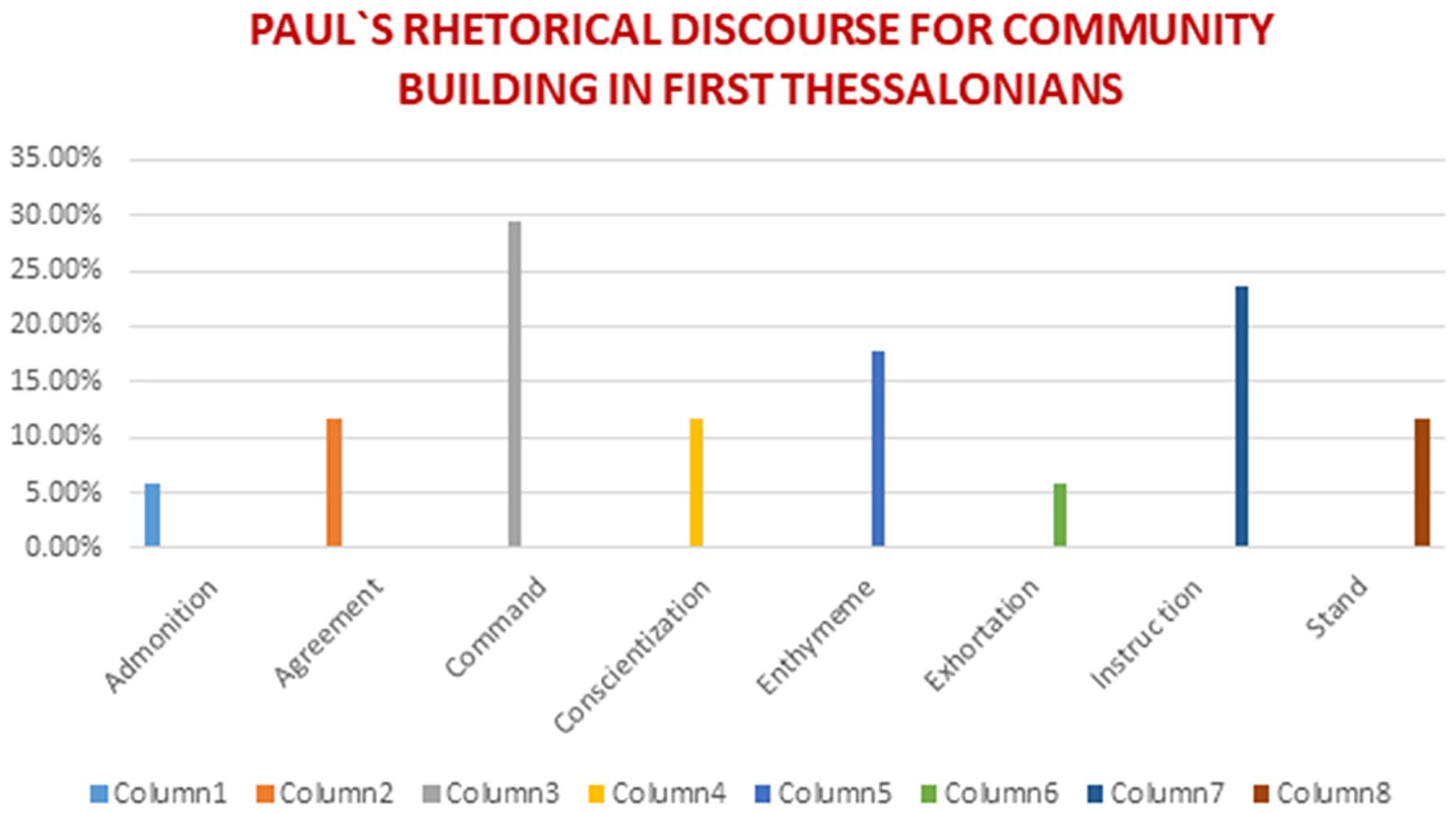
The bar chart shows that admonition and exhortaion occurred once each in the data, which is 5.88% each of the total number; while agreement, conscientization, and stand are seen twice each in the data giving us 11.77% each of the Rhetorical Discourse. On the other hand, enthymeme occurred three times, 17.65% of the data, while instruction recorded 23.53%, appearing four times in the data. Command in the data occurred five times which is the highest, 29.41% of the data.
The findings reveal that while admonition and exhortation are important in the rhetorical discourse, the two put together are not up to one-fouth of the entire data. Since agreement, conscientization and stand took 11.77% each of our data, it could be taken that these three are presented as elements for preparing the minds of the audience for what is next. Enthymeme brings out the premise for instruction and command. These three discourse elements form the basis for community building in our text. They took 70.59% of the data, thus suggesting they are the most important rhetorical discourse deployed for community building in the text.

A pie chart of the rhetorical genres for community building in First Thessalonians
The pie chart displays the different rhetorical genres for community building in the book of First Thessalonians. It shows that while the rhetorical discourse in the book portrays context only once which is 5.26% of the data, exigence, identification, and situation are portrayed three times each, taking 15.79% each of the data. The three genres together occupy 47.37% of the text. Though this percentage is significant enough to be considered very important in community building, the one rhetorical genre that took almost half of the data is logos recording 47.37%% as it appeared nine times in the data.
The findings of this analysis are that logos is the most rhetorical genre for community building observed in the book of First Thessalonians. There is no question as regards how realistic this statement is because issuing a command or giving instructions requires logos basically. We see from the bar chart above that these two elements took 52.94% of the data. So the dominating rhetorical genre of the text is logos.
Again, while context plays a vital role in communicating the thought of this book, identification with the audience in their situation of exigence is paramount in the text. These three genres took 47.37% of the data, occurring three times each. This is a clear indication that the rhetor understands that no matter how important the message you have for an audience is, you must identify with the situation of the people, and convince them of your willingness to work with them in altering the prevailing exigence if your opinion will be accepted. This point was given due consideration in the text of our study.
A bar chart of the rhetorical strategies for community building in First Thessalonians

We make more findings from this bar chart that presents the rhetorical strategies adopted by Paul for community building here. First, because the text is concerned more about instruction, guiding, and directing, the rhetor did not bother so much about using appeal to conscience, appeal to emotion, use of examples, and use of identity. Each of these four occurred two times, 13.33% each of the data. The three put together took only 39.99% which is not up to half of the data. He applied use of evidence three times, 20% of the data. This is because he knows he can providing evidence to support his enthymeme would convince his audience to listen to his much use of persuasive words, which occurred four times, 26.68% of the data.
Furthermore, a rhetor can achieve much with persuasion, but when he is able to get the audience to think along with him by appealing to their conscience and emotion, the work becomes easier. The audience see their worth and they swing into action. We have noted earlier that the text dealt mainly on instruction and tilted more toward logos. So it is clear why use of persuasive words appeared four times occupying 26.68% of the whole data. Paul is a great speaker, therefore he uses persuasive words so much to communicate his intentions to his audience.
Summary and Conclusion
This research work on Pauline Discourse-rhetorical Strategies for Community Building in the Book of First Thessalonians, whose aim is to assess the way language is used with the purpose of convincing the audience to stand firm in the midst of exigence and build a solid Christian community within the Thessalonian society, makes the following findings. The exigence in the book of First Thessalonians is tendency for the Thessalonian Christians to fall off the faith in Christ Jesus as a result of the tribulation they go through in their lives. This study reveals that the Thessalonian Christians contributed to the impending danger of backsliding from faith since they were idle and thus made themselves dependent on others for their sustenance. So, Paul who had desired to visit them but was hindered by circumstances, found the need to write them exploring all possible means to persuade them through a surrogate.
The purpose of the book centers on strengthening the faith of the believers in Thessalonica in the Lord Jesus Christ and to encourage them to build a strong Christian Community within the Thessalonian society in spite of the prevailing situation of persecution. Bearing this in mid, the rhetor concentrated on things that will encourage a people that are obviously battered by the exigence of persecution so as to redirect their thoughts to what will give them hope of standing firm. He appealed to their conscience with the view to making them see what they have and what they can do with them; and to their emotion to strengthen their hearts.
The study reveals that the rhetor and the audience shared a common situational context. They were both going through persecution for their common faith in Christ. This shared context helped the rhetor to easily speak to the audience hoping they will understand what he told them. It also afforded him the opportunity to identify with them and make them believe they are of the same family. The Thessalonians were not seeing Paul as just a preacher of the gospel but as a spiritual father who has right and authority to guide, direct, instruct, and command them.
Furthermore, It has been observed that a greater percentage of the data dealt with command, exhortation, and instructions. The rhetor believed that if the instructions were taken seriously, the exigence will not stop them from building; and if they build, then they will not have a reoccurrence of such exigence among them. So he gave full attention to exhortation, command, and instructions in the text.

Conclusion
Our discussion on the book of First Thessalonians in the light of Pauline discourse-rhetorical strategies for Community Building is hereby concluded by stating that the findings supported the assumptions of the study. Paul was interested in encouraging the faith of the Christians in Thessalonica so that they become responsible citizens. The study shows clearly that discourse is a response to rhetorial situation and exigence as Bitzer (1968) asserts. The author of the book of First Thessalonians responded to the situation in the church at Thessalonica and crafted his linguistic discourse to fit into the situation and alter the exigence. The rhetorical situation and exigence invited the discourse and Paul offered it intelligibly and wittingly. The findings of this study uphold the view that rhetorical discourse is discovered from the rhetorical situation (Bitzer, 1968).
It could be concluded that since the section that dealt with exhortation, command, and instruction took 58.82% of the wholle data, the purpose of the book was to convince the audience to imbibe new culture of standing firm in Christ and building a strong community of believers in Thessalonica. We see from the data that Paul, the apostle was not just a missionary interested in the religious life of his audience, but a community builder who utilized logos effectively in passing across his thoughts to his audience. This public speech, though presented through surrogates, meets the demand of discourse-rhetorical. The rhetor effectively appealed to the mind of the audience that they had no obvious reasons to reject what was presented to them. The strategies observed from the data present to scholarship a veritable instrument for assessing public speeches that are concerned with state life, religion, or government.
Since the study reveals logos played a paramount role in communicating thought in this Bible book, we submit therefore that classical writings can be examined rhetorically to determine how the rhetors employed language in communicating their thoughts. The discoveries of this study equally show that rhetorical theories applied here are very relevant to linguistic studies and therefore should be upheld for such examinations.
Footnotes
Declaration of Conflicting Interests
The author(s) declared no potential conflicts of interest with respect to the research, authorship, and/or publication of this article.
Funding
The author(s) received no financial support for the research, authorship, and/or publication of this article.
