



Abstract
In this study, we explored the relationship among mentoring functions (MFs), direct supervisor need for achievement (DSNFA), and employee organizational citizenship behavior (OCB) from the perspective of conservation of resources (COR) theory. A sample of 242 dyads was selected from new employees and direct supervisors employed in four- and five-star hotels in Taiwan. The results revealed that MFs and DSNFA were positively related to new-employee OCB. However, DSNFA negatively moderated the relationship between MFs and new-employee OCB. That is, low DSNFA positively moderated the relationship between MFs and OCB more than high DSNFA did. The results were explained using COR theory, which states that the development of positive personality traits is limited to in specific circumstances. Organizations in the hospitality industry that emphasize on OCB should examine their human resource activities to optimize performance.
Keywords
Introduction
Economic development contributes to the growth of investment in restaurants and hotels. To promote the “customer first” principle of businesses, owners in the hospitality industry often rely on their staff to provide working behaviors that benefit customers or the organization to elevate operational performance (Podsakoff et al., 2000). In service training, personality traits are critical to the training result (Goldner, 2016) and organizational resources facilitate appropriate frontline employee interaction with customers (Park & Levy, 2014). Therefore, human resource (HR) management often involves considering personality traits and organizational resources in training activities to reinforce an organization’s service functions.
In the hospitality industry, the emphasis is on satisfying customer needs, and frontline employees are trained for specific scenarios. During the service process, supervisors mentor new employees to interact successfully with various customers. A favorable relationship between supervisors and subordinates in which supervisors attempt to impart wisdom they have gained through experience to their subordinates is desirable. By providing guidance and enlightenment, mentors lead mentees to new discoveries and insights. Although supervisors desire to be effective mentors, imparting their knowledge and skills to subordinates without obstacles is challenging. The purpose of mentoring functions (MFs) is to help subordinates develop and learn until the former mentees can become mentors. Although mentees start from a certain level of dependence in a mentoring relationship, the ultimate goal is to develop strong and independent employees so that they can contribute to their organizations.
Companies often design their work processes around mentoring systems that integrate leadership and development; the mentor not only teaches the mentee skills and techniques but also learns management skills and receives work support and satisfaction (Walker & Yip, 2018). Socialization processes based on the mentoring system assist new employees in learning organizational culture and satisfying customer needs and manpower demands (Guthrie & Jones, 2017; Kim et al., 2015). During socialization, organizational citizenship behavior (OCB) is a manifestation of organizational commitment (Ahmed et al., 2013; Sun et al., 2007) and is positively correlated with service quality (Morrison, 1996). In the hospitality industry, in which the turnover rate is typically high, the OCB of new employees is a meaningful indicator for HR management results and service quality. Therefore, the present study used OCB as the dependent variable to identify the relationships between the mentoring system, new employees’ OCB, and direct supervisor personality traits. Moreover, conservation of resources (COR) theory was used in the discussion of relevant problems.
COR theory is a stress theory that describes the motivation that drives individuals to maintain their current resources when pursuing new resources. In COR theory, resources are defined as the things that individuals value, especially objects, states, and conditions. When resources are sufficient, individuals use their resources to reduce the influence of stressful events. Many work engagement studies have revealed that the input of individual resources can enrich job resources and ensure the attainment of goals (Karatepe et al., 2013; Weigl et al., 2010; Xanthopoulou et al., 2009). To understand the relationship between organizational resources and frontline employee behavior, the present study used COR theory as a basis to explore the relationships between MFs, direct supervisor need for achievement (DSNFA), and OCBs of new employees.
A mentoring system is typically used in the hospitality industry. Studies have confirmed a positive correlation between mentoring and job performance (Eissner & Gannon, 2018; Uen et al., 2018). Personality traits also influence job performance (Atkins, 2012; Xiong & King, 2018). However, despite these findings, no study has explored the concurrent effects of the mentoring system and direct supervisor traits on frontline employee behavior and the moderating effect, if any, of direct supervisor personality traits on these effects. In the current study, COR theory was used to investigate the effects and relationships of these factors to supplement research regarding direct supervisor traits as a moderator in the mentoring system.
The academic contributions of this study are as follows: First, previously published studies have mainly argued that a mentoring system and positive personality traits generate positive effects on organizational performance. The current study addressed the effects of the employee’s OCB because the primary goal of mentoring is to encourage employees to transcend performance expectations and apply their full capabilities to assist the organization or community. Therefore, HR researchers should carefully understand the goals of mentoring. Second, the present study provides insight into the interaction between personality traits of the mentors and system design. Direct supervisor traits were addressed because most mentoring studies focus on the personality of the employees and emphasize the effects on training. However, because supervisor traits affect the mentoring results, their personality should also be noted. Therefore, the results of this study can help organizations understand the role of DSNFA in the mentoring system and its moderating effect on OCB. Finally, the employees of international hotels with high turnover rates and intense brand competition were interviewed to enhance the generalizability of the results. The results of the verification can be used to expand the scope of mentoring applications to other areas of the service sector.
Literature Review
COR Theory
COR theory has been commonly used to explore stress generation, resource supply, and demand modes in individuals and social systems. According to COR theory, individuals acquire, retain, and preserve things they value, which individuals use when coping with stress and attempting to reinvest resources for future personal and organizational benefits. A COR theory principle is that people must invest resources to protect against resource loss, recover from losses, and gain resources (Hobfoll, 2001).
Hobfoll (1989) noted that personal resources generally include objects, personal characteristics, energies, and conditions. These resources are desirable because they can be used to generate positive employee outcomes (Xanthopoulou et al., 2007). Personal resources are limited, and workers protect their own resources to avoid their misuse or loss in the organization; thus, demonstrating OCB might be difficult for individuals. To align with self-interest incentives, the mentoring system is designed to enable workers to contribute their resources as an investment. Workers input their resources to receive the desired capabilities or knowledge and socialization skills through the mentoring system. In the resource demand mode, this investment is called resource gain (Hobfoll & Lilly, 1993). By contrast, resource loss is the primary cause of stress. When individuals face potential resource loss, encounter actual resource loss, or receive no resource gain after resource investment, they perceive psychological discomfort or experience stress (Hobfoll, 2011). Because social support is a resource that can provide or promote attainment and the protection of an individual’s valued resources, it can minimize the effects of stressors on performance outcomes (Darvishmotevali et al., 2017). Therefore, social support is a valuable mechanism through which employees can demonstrate positive effects and counteract stress. Through MFs, employees can gain resources and manage their stress when interacting with mentors. Thus, employees can offer OCB as resource feedback when they operate in a mentoring system.
MFs and New-Employee OCB
Because cultivation of hospitality skills is highly dependent on context, mentoring, and on-the-job learning can help employees acquire context-based professional knowledge. Therefore, a mentoring system is often used by the hospitality industry as a socialization strategy. Through mentoring, employees can not only understand the organizational culture to reinforce their organizational commitment but also learn skills with the support of the organization and their supervisors. This mechanism alleviates supervisor and employee stress. Given this contribution, a mentoring system can be critical for brand maintenance of hospitality organizations. To understand service quality and employee organizational commitment after training, OCB is crucial (Mathies et al., 2018; Riaz & Mahmood, 2017).
Although different types of mentorships have been discussed in the peer-reviewed literature, most studies have emphasized on the benefits for the organization or participants (Bradford et al., 2017; Burgess et al., 2018; Rollins et al., 2014). An advantage of positive mentoring experiences is that they can increase the likelihood of mentors and mentees participating in OCB. OCB has been defined as discretionary individual behavior that is not explicitly recognized by an organization’s formal reward system but contributes toward the effective functioning of the organization (Organ, 1997). Hotel owners expect their employees to engage in OCB. These acts by frontline employees often exceed their job description, focus on customer service (Ma et al., 2013), and are recognized as necessary to improve the service quality, competitive advantage, and financial performance of hotels (Morrison, 1996; Sun et al., 2007; Wuryanti & Sulistyo, 2017). Because the work environment encourages frontline employees to exhibit OCB, a support system is essential (Tang & Tsaur, 2016). That is, OCB is not explicitly recognized by the hospitality industry reward system but supervisory support system propagates the expected behavior of an employee.
COR theory states that social support is a unique and crucial resource that can help individuals relieve stress (Hobfoll, 1989). MFs support the interdependence an employee feels with other members of the organization. In the context of mentoring relationships, a positive self-evaluation resulting from engaging in reciprocal support exchanges with other organizational members (i.e., the mentor or mentee) leads to an increased sense of worth. Therefore, mentoring improves mentees’ self-esteem, self-confidence, sense of control, and enables them to have the courage to solve problems (Ghosh et al., 2012). Consequently, social support plays a crucial role in mentees’ development and conveys appropriate behavior for the mentees.
Studies on mentoring have confirmed that MFs promote employee OCB (Donaldson et al., 2000; Kwan et al., 2011). That is, increased self-worth of mentees can inspire mentors and mentees to perform OCB. Therefore, Eby et al. (2015) stated that mentoring was closely related to OCB, whereas Allen (2003) argued that mentoring was a type of OCB. Moreover, employees with high career self-esteem are more confident regarding their job-related knowledge and forthcoming in offering assistance to their coworkers than are those with lower self-esteem (Chattopahyay & George, 2001; Van Dyne & Pierce, 2004). Therefore, the mentoring system of an organization can provide employees with organizational and supervisor support, thus generating positive results from the gained experiences. Accordingly, the following hypothesis was proposed.
Hypothesis 1: MFs positively affect the OCB of new employees.
Need for Achievement and Its Moderating Effect
Frontline jobs in the hospitality industry are often characterized as providing employees with low pay and limited training because frontline service workers can be easily replaced (Poulston, 2008). Ross (1992) revealed that individuals who work in the business and have considerable craving for achievement viewed hospitality jobs positively. That is, supervisors’ traits should be considered because the supervisors demonstrated the ability to survive and achieved promotion in this competitive hospitality industry. According to McClelland (1985), the desire for achievement is the drive to excel a set of standards. Moreover, Jackson (1974) stated that the need for achievement is an individual’s desire to accomplish the work necessary for success. People with a strong need for achievement desire to complete tasks perfectly and efficiently; they mostly ignore the material rewards resulting from success. Therefore, these people prefer setting appropriately challenging goals to succeed; they dislike success achieved through luck and avoid undertaking particularly difficult or easy tasks, which may lead to failure or limited sense of accomplishment. Overall, people with a strong need for achievement hate to work aimlessly; they are always ambitious and enjoy participating in tasks that provide immediate feedback.
Because individuals with the need for achievement pursue goals and self-efficacy, they are enthusiastic about accepting challenges. However, they also fear failure; thus, they set realistic goals. They are willing to assume responsibilities, pledge long-term commitment to their job, and often feel satisfied with their work outcomes (Stewart & Roth, 2001). Therefore, the personality trait of need for achievement is positively related to goal achievements and progress; it is evident that if many members in an organization possess a high need for achievement, then the organization will develop rapidly because of the superior performance of the employees (Amyx & Alford, 2005; McClelland, 1987; Phillips & Gully, 1997).
The present study suggested that direct supervisors with a high need for achievement tend to use various personal resources and connections to assist their mentees during mentoring. Because mentoring behavior is similar to OCB, their need-for-achievement trait affects employee expectations (Young & Perrewé, 2004). Thus, the direct supervisor’s support and constructive suggestions help mentees not only overcome failures but also develop confidence to address problems positively and proactively without fearing punishment for mistakes (Luthans et al., 2008). Moreover, employee awareness of support from direct supervisors also increases the sense of obligation to repay favorable treatment by helping supervisors reach their stated goals (Eisenberger et al., 2002). Because meeting customer needs is the priority in a hotel, frontline employees can reciprocate the support they receive by exerting additional effort to achieve this goal (Subramony et al., 2004). Therefore, subordinates are likely to follow the DSNFA and increase OCB when they receive direct support from their supervisors (Baba et al., 2009).
In this study, we assumed that employees under a direct supervisor with a high need for achievement are affected by this trait through receipt of support or resources from the supervisor, leading to increased exhibition of OCB. Thus, the following hypothesis was proposed.
Hypothesis 2: DSNFA positively affects the OCB of new employees.
The need for achievement is a static personality trait and refers to the desire for accomplishment in a task that involves striving and planning to attain a standard of excellence (Weiner, 1974). Individuals with a high need for achievement tend to seek challenges and independence and prefer working alone or working with other high achievers (Fagenson, 1992). Such individuals desire regular and positive feedback regarding their work progress and experience satisfaction when they receive recognition for their achievements (McClelland, 1987). When individuals receive organizational support to satisfy their need for achievement, they exhibit strong willpower and desire as well as enhanced personal resources and psychological strength (Datu et al., 2018).
The need for achievement affects an individuals’ judgment of job requirements and decisions of whether to input resources; in addition, the need for achievement is a critical factor influencing employees’ senses of wellbeing or emotional exhaustion (Albrecht, 2015). Supervisors with higher need for achievement work with higher efficiency to achieve success; they are more likely to seek methods to improve their job-related self-efficacy, accept personal responsibility, and take pride in their work-related outcomes, identify their work, and feel that what they do is valuable and personally meaningful. However, mentoring requires considerable time and energy, potentially preventing immediate feedback (Zellers et al., 2008). When personal resources are limited, people with a higher need for achievement experience higher emotional exhaustion if they believe that the resources input into the mentoring process cannot be converted into resource gain or feedback within a reasonable period. Therefore, DSNFA can be used to moderate resource inputs and related consequent outcomes during mentoring.
In this study, DSNFA was assumed to affect supervisors’ decisions to invest personal resources and obtain relevant outcomes. New employees must gain new knowledge and learn new skills. If they are unable to demonstrate efficiency in their work, their effectiveness might not meet their direct supervisor’s need for achievement. Thus, with limited resources, high levels of DSNFA weaken the effect of MFs on new-employee OCB. The following hypothesis was proposed.
Hypothesis 3: DSNFA negatively moderates the relationship between MFs and the OCB of new employees.
Methods
Variable Measurement and Standardization
The hypotheses in this study involved three variables, namely MFs, new-employee OCB, and DSNFA. A five-point Likert scale was used in the questionnaire. Supervisors were requested to complete DSNFA and new-employee OCB scales, and employees completed supervisor MF scales. Scales translated from English to Chinese were reviewed by three experts before adoption. Figure 1 depicts the conceptual model.
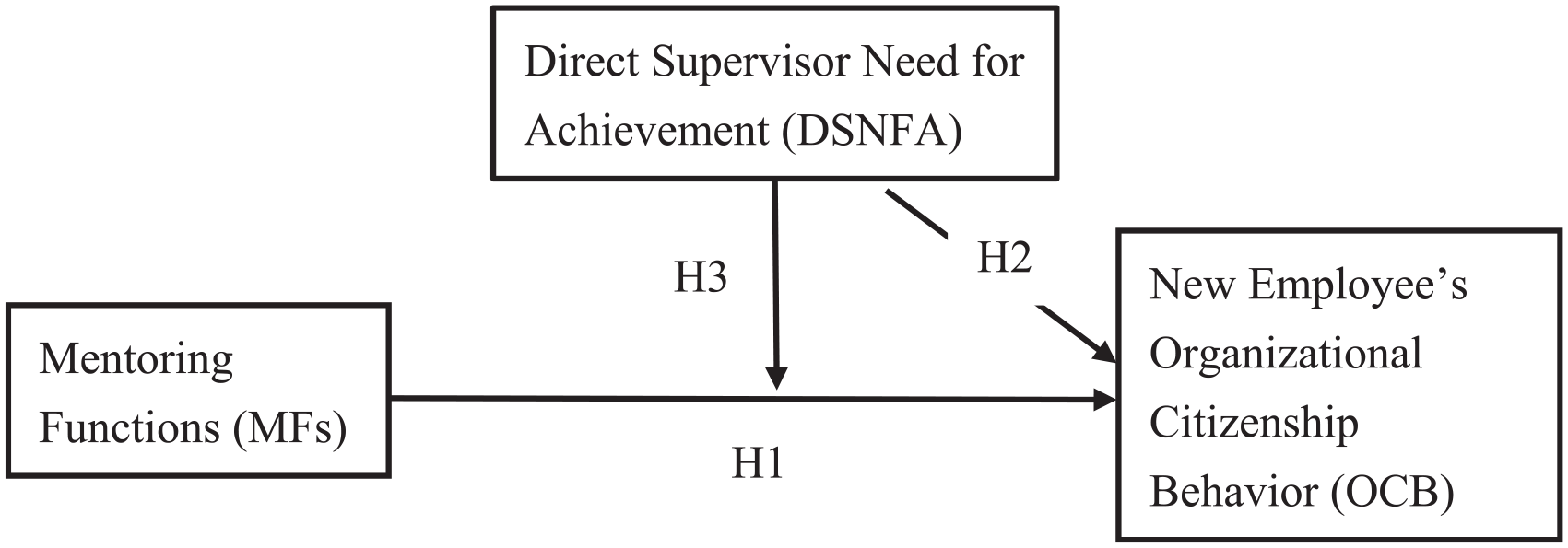
Conceptual model.
To validate the scales, confirmatory factor analysis (CFA) of the completed questionnaires was performed. Variable measurement is described as follows:
Main variables
Supervisor MFs mentioned in this study comprised psychological-support, role-modeling, and career-support dimensions. The MF questionnaire developed by Castro and Scandura (2004) satisfied the research requirements and was used in the study. The questionnaire, which was answered by new employees, had a five-point Likert scale (1 = strongly disagree; 5 = strongly agree), which was used to measure eight items.
The OCB scale developed by Farh et al. (2007) was adopted with OCB divided into altruism, voice, and conscientiousness dimensions. This five-point Likert scale comprised nine items; this questionnaire was completed by direct supervisors. In subsequent analysis, the three dimensions were integrated for discussion
The need-for-achievement scale (DSNFA) developed by Steers and Braunstein (1976) was used and DSNFA was measured on a five-point Likert scale. This scale was completed by direct supervisors.
Control variables
Gender is a commonly mentioned factor that influences mentoring (Ragins & Scandura, 1997); therefore, employee gender was considered in the analysis model.
Standardization
The primary variables were continuous, whereas the control variable was categorical. To unify the measurement units of the variables and avoid potential statistical redundancy resulting from collinearity, all measurement dimensions were standardized before regression analysis (Vansteenkiste et al., 2006).
Questionnaire Distribution and Reliability and Validity Tests
Participants and questionnaire methods
A questionnaire survey was conducted. The participants were direct supervisors and new employees from the room service, food and beverage, and management departments of four- and five-star international hotels, according to the hotel categories published by the Tourism Bureau of the Ministry of Transportation and Communications of Taiwan. The researchers provided hotels’ new employees (who had held full-time positions at their hotels for less than 1 year) and their direct supervisors with questionnaires regarding MFs, DSNFA, and OCB. The questionnaires were distributed in dyads. To enhance the diversity of questionnaire distribution and avoid concentration of the sample within a certain category of hotel, a maximum of 10 pairs of participants were recruited from each hotel. Questionnaires for direct supervisors and employees were colored differently for distinction. Envelopes attached to the questionnaires requested the participants to conceal their responses before returning them to the distributor.
Sample distribution
The researchers recruited personnel in hotels to distribute the questionnaires. A total of 301 pairs of questionnaires were distributed in two waves, and 242 pairs of responses were collected. After removal of incomplete responses, 237 pairs of valid questionnaires were obtained, yielding an effective response rate of 78.73%.
The demographic distributions of the participating direct supervisors and new employees were as follows: 41.9% and 32.9% of the direct supervisors and new employees, respectively, were men. Approximately 17.4%, 16.5%, 19.9%, 8.9%, 20.3%, and 16.9% of the participants were from customer service, room service, food and beverage service, kitchen, management (e.g., HR, sales, or marketing), and other departments, respectively. The management department was the most represented department probably because the distributors were HR or management personnel in the hotels. The proportions of other departments reflected the general HR structure in the hospitality industry. Among direct supervisors, 5.6%, 58.0%, and 36.5% were high-level administrators (e.g., vice president, administrative chef, and general manager), intermediate supervisors (e.g., manager, assistant manager, and chef), and frontline supervisors (e.g., director and foreman or forewoman), respectively. Among new employees, 2.5%, 4.6%, and 92.8% were intermediate supervisors, frontline supervisors, and frontline employees, respectively.
Supervisors were categorized according to the duration of their job in their current hotel. These categories included supervisor for 6 months or less, 7–12 months, 1–2 years, 2–3 years, and longer than 3 years and accounted for 6.2%, 11.9%, 16.3%, 18.1%, and 47.6% of the supervisor numbers, respectively. Among new employees, those who had occupied their current position for 6 months or less and 7–12 months accounted for 62.3% and 37.7%, respectively.
Reliability and Validity Tests
The internal consistency and reliability of the collected questionnaires was tested using Cronbach’s alpha, which was higher than .7, demonstrating high internal consistency and reliability among the questionnaires and scales.
The construct validity of the questionnaires and scales was confirmed through CFA. Table 1 indicates that the construct validity of the questionnaires and scales satisfied the value recommended by Hair et al. (2006) and Baumgartner and Homburg (1996), indicating favorable construct validity.
Validity for Study Measures.

Reference from Hair et al. (2006) and Baumgartner and Homburg (1996).
Results
Descriptive statistics, correlation analysis, and regression analysis were used to explain the relationships of variables in the hypotheses. The results are detailed in Tables 2 and 3.
Means, Standard Deviations, Alpha, and Correlations for Study Measures.

0 = female, 1 = male.
Statistics were unstandardized data, standardized variables were used in the later analyses.
Means the alpha for the measures.
p < .05. ***p < .001. ✝p < .1.
Regression of Supervisory Mentoring Functions, Direct Supervisor’s Need for Achievement on New Employee’s OCB.

p < .05. ***p < .001. ✝p < .1.
Main Variable Descriptive Statistics and Correlation Analysis
Table 2 presents the descriptive statistics and correlation analysis results of the main variable; the correlation coefficient between direct supervisor MFs and new-employee OCB was .132, reaching significance (p < .05). The correlation coefficient between DSNFA and new-employee OCB was .311, reaching significance (p < .001). Therefore, MFs and DSNFA are significantly and positively correlated with new-employee OCB.
Effect of Supervisor MFs on New-employee OCB
To determine the effect of MFs and DSNFA on new-employee OCB, hierarchical regression analysis was conducted. Because gender influences mentoring performance, gender was a control variable. In Table 3, Model 1 includes the control variable and Model 2 includes MFs with a β value of .123, reaching significance (p < .05); R2 was .038 and ΔR2 was .015. The result indicated that the MFs variable had a significantly positive effect on new-employee OCB. In Model 3, DSNFA was included in the regression analysis. The β value was .334, reaching significance (p < .001), with R2 of .141 and ΔR2 of .118. The result revealed that the inclusion of DSNFA into the model had a significantly positive effect on new-employee OCB. Both MFs and DSNFA had significantly positive effects on new-employee OCB, supporting Hypotheses 1 and 2.
Moderating Effect Analysis
To determine the moderating effect of DSNFA on the relationship between MFs and new-employee OCB, hierarchical regression analysis was performed again. Model 4 in Table 3 indicated that DSNFA had a significant negative moderating effect on the relationship between MFs and new-employee OCB, with the β value, R2, and ΔR2 being −.111 (p < .1), .160, and .122, respectively, with a 12.2% increase in the explanatory power. Thus, Hypothesis 3 was supported.
To determine the moderating effect on the relationship between the independent and dependent variables, DSNFA was categorized into high and low group by the average slop plus and minus 1 SD. A diagram of the moderating effect was plotted. Figure 2 depicts that the low DSNFA group has a positive slop (0.422) of the relationship between MFs and new-employee OCB. However, the high DSNFA group has a slightly negative slop (−0.11) of the relationship between MFs and new-employee OCB. The slop of the high DSNFA regression line clearly revealed that high DSNFA exhibited a less observable effect on the relationship between MFs and new-employee OCB, but low DSNFA has a positive moderating effect on their relationship. That is, in the high DSNFA group, the higher DSNFA was, the slightly less was the negative effect on the relationship; but in the low DSNFA group, the lower DSNFA was, the stronger was the positive effect on the relationship.

The moderating effect of direct supervisor need for achievement on the relationship between mentoring function and organizational citizenship behavior.
Conclusion and Suggestions
Conclusion and Discussion
The results of this study implied that system operation and personality traits resulted in different employee perceptions of applicable resources when employees were presented with challenges. Organizational mentoring support and positive direct supervisor traits positively affected employee performance. Additionally, personality traits can moderate the relationship between system design and performance outcomes. Management should consider this aspect during decision-making. Discussion is provided as follows.
First, MFs are conducive to strengthening new-employee OCB. This result is consistent with those of previous studies (Eby et al., 2015; Ghosh et al., 2012). MFs can enable organizations to input resources into employee training. Employees receiving organizational support can experience gain spirals and increase exhibit high OCB. Therefore, organizational resources can be invested through mentoring systems to encourage employees to perform OCB and experience a gain spiral effect.
Second, DSNFA can contribute to new-employee OCB. Previous studies have demonstrated that an employee’s need for achievement motivates their OCB (Duffy & Lilly, 2013). In addition, Steinmann et al. (2020) argued that a leader’s socialized power and their need for affiliation might enhance their followers’ outcomes. These studies reveal that both the supervisor’s and employee’s inner motivation might influence the employee’s attitudes and behaviors. The value of DSNFA and the relationship between DSNFA and OCB have not been addressed in the literature, but our study provides evidence that high levels of DSNFA can influence employees’ efforts through cognitive development and socialization. Employees learn to imitate their supervisor’s need for achievement, and this social attribute can enhance their OCB. Thus, both the employee’s and direct supervisors’ personality traits positively affect employees’ socialization.
Finally, high levels of DSNFA can weaken the effect of MFs on new-employee OCB, but low levels of DSNFA can strengthen that effect. In previous studies, the moderating role of employee OCB was examined only in terms of an employee’s need for achievement (Duffy & Lilly, 2013). An employee’s need for achievement plays a positive moderating role in the relationship between their perception of the organization and their OCB. Our study focused on the role of DSNFA, which has a negative moderating effect on the relationship between mentoring and a newcomer’s OCB. In addition, related research has asserted that the systematic development of organizational HR can result in an organization having a positive psychological status, thus becoming a competitive strength of the organization (Chand & Katou, 2007). The empirical results of the present study indicated that direct supervisors with a high need for achievement were less likely to invest time and effort in mentoring to maximize newcomer OCB because mentoring is an energy- and time-consuming process that rarely provides immediate results and is thus contrary to supervisors’ passion for challenges and the desire to succeed. When organizations aim to apply supervisors’ positive personality traits to mentoring systems, they should consider the mentor’s need for achievement.
Implications of COR Theory
COR theory was first proposed by Hobfoll (1989) to explore the conservation and loss of resources and reflect the phenomena of resource accumulation and stress generation. Studies applying COR theory generally explores two main aspects: (1) the effect of resource gain on mitigating negative effects (Neveu, 2007; Zhou et al., 2018) or attaining positive outcomes (Kim et al., 2015) and (2) negative effect of resource loss on individuals (Ito & Brotheridge, 2003; Pizam, 2013). The findings of this study indicated that when an organization partakes in MFs to provide resources such as career and work support to employees, the employees imitate their supervisors, and demonstrate their OCB. Then, the input of mentoring resources generates a positive gain spiral on organizational effectiveness. Similarly, high DSNFA positively influences employees’ OCB, generating a gain spiral of supervisor positive personality traits on organizational effectiveness.
Because people have limited personal resources, individuals tend to protect their valuable resources against loss. High levels of DSNFA result in supervisors regarding MFs as having a limited influence on employees’ extra-role behavior. However, low levels of DSNFA have a positive moderating effect on the relationship between MFs and OCB. This phenomenon is relevant to individuals’ tendency to cherish personal resources and effectively use the resources for intrarole rather than extrarole performance.
COR theory often emphasizes that resource development and gain generate positive spiral or relieve negative effects. Personality traits in positive organizational systems (condition resources) can cause different results because of their implementation; when developing personal traits to gain other energies, their synergic effect of positive cycles should be considered. Further research should be conducted in this regard.
Management Implications
The results of this study explain not only how MFs and DSNFA affect new-employee OCB but also the conflict and stress from DSNFA that can weaken the relationship between MFs and OCB in hospitality organizations. Accordingly, HR activities involving personality trait application and organizational system design should be planned considering possible positive results and relevant moderating effects. The following suggestions are proposed:
First, in the hospitality industry, overtime is occasionally required. Therefore, OCB is valued by organizations (Wang et al., 2017) because internal motivation for mentoring is regarded as more effective than mentoring based on a high need for achievement. Through suitable mentors, organizations can strengthen the relationship between MFs and new-employee OCB.
Second, supervisors with a high need for achievement enjoy pursuing personal development and desire to overcome obstacles to achieve goals. These supervisors’ tendency of actively pursuing success can influence the OCB of new employees. Because previous relevant studies have focused on the positive effect of need for achievement on job performance, the present study advocated that the negative moderation of DSNFA on the relationship between MFs and new-employee OCB.
This study thus proposed the following:
1. Organizations should appropriately praise employees’ extra-role behavior and supervisors’ efforts.
Incorporating employee extra-role behavior into performance evaluation can prompt direct supervisors with a high need for achievement to value new-employee OCB and enhance the moderating effect of DSNFA on MFs and employee OCB. Praising employees’ extra-role behavior and supervisors’ efforts on special occasions can not only reinforce the influence of MFs and DSNFA on employee extra-role behavior but also enable supervisors and employees to experience the various mentoring benefits (Canter et al., 2012), such praise can alleviate the negative moderating effect of DSNFA on the relationship between MFs and new-employee OCB. That is, it can promote the positive moderating effect from supervisors with a high need for achievement. The supervisors with low DSNFA would also feel better in the MFs because their effort have got the notice and they would strengthen the moderating effect in the relationship between MFs and OCB.
2. Organizations should allow supervisors with high needs for achievement to select employees to mentor, and they should also cultivate supervisors with low needs for achievement generosity.
Supervisors with high needs for achievement prefer taking responsibility for the consequences of their behavior and not let external factors determine consequences. In the arrangement of mentoring, having the supervisors select their mentees instead of letting the organization arrange the mentees can prompt the mentors with high DSNFA to assume the responsibility to supervise the intra-role and extra-role behaviors of the employees and promote job performance. In addition, training of management should include cultivation of supervisors’ generosity (Canter et al., 2012) to increase their willingness to value employees’ extra-role behavior. Particularly, one of the result shows that low DSNFA has a positive moderating effect on the relationship between MFs and OCB, the HR department should have a look on this moderating effect and excel at using low DSNFA when arranging the MFs.
Limitations and Concluding Summary
This study has some limitations. The data were collected from supervisors and new employees in pairs and multiple departments from four- and five-star hotels. Although probability sampling is a valuable approach, we did not select participants randomly within the selection parameters. We endeavored to contact as many hotel owners as possible and limited the numbers of participants to 10 pairs from each hotel. However, the total sample size was still insufficient for structural equation modeling. To analyze both the main effect and moderating effect, hierarchical regression analysis was conducted.
The effect of MFs and DSNFA on new-employee OCB was investigated, as well as the moderating effect of DSNFA on the relationship between MFs and OCB. MFs and DSNFA positively affected new-employee OCB; however, DSNFA negatively moderated the relationship between MFs and OCB. The result can serve function as a reference for the hospitality industry, which emphasizes OCB, and organizations that commonly apply mentorships. Future studies can expand the scope to other customer-first industries or focus discussion on a specific department (e.g., customer service, kitchen, or management) to obtain more specific or generalizable research results. Moreover, future studies can corroborate the results of this study to confirm the effect of MFs on new-employee OCB.
Footnotes
Declaration of Conflicting Interests
The author(s) declared no potential conflicts of interest with respect to the research, authorship, and/or publication of this article.
Funding
The author(s) received no financial support for the research, authorship, and/or publication of this article.
