



Abstract
In order to explore the contextual factors that may influence Chinese early study abroad students’ acculturation experiences in Canada, we conducted in-depth interviews with 20 Chinese early study abroad students and 6 Chinese parents. Using Oppedal and Toppelberg’s acculturation development model as the analytical framework, we identify six microsystem factors (parents, host family, custodian, overseas-study service agent, friends, and church), two mesosystem factors (parents-custodian relationship and custodian-host family relationship), three exosystem factors (social services, public safety, and immigration policies), one majority culture macro factor (multiculturalism), and the time dimension are related to Chinese early study abroad students’ acculturation experiences. In addition to these factors, locosystem factors such as geography, physical environment, and climate of the city in which they live are also important. Based on these findings, we advise all stakeholders to create a supportive and sustainable environment for Chinese early study abroad students to live in Canada.
Keywords
Introduction
With the growing trend of globalization and internationalization of education, an increasing number of Chinese students have chosen to study temporarily in Canada to have a better education. It was reported that the number of Chinese students studying in Canada has increased from 16,190 in 2000 to 167,665 in 2018 (Immigration, Refugees, and Citizenship Canada, 2019). Notably, many of these students are studying in primary and secondary schools and this cohort has become the second-largest student group since 2012, following Chinese students studying in Canadian universities. Specifically, in 2018, 43,630 Chinese students studied in Canadian primary and secondary schools, in addition to 97,745 in universities, 25,830 in technical colleges, and 460 in other studies (Immigration, Refugees, and Citizenship Canada, 2019).
Students who are pursuing primary and secondary education abroad are generally under 18 years old. These students are usually referred to as “little overseas students,” “early study abroad students,” and “parachute kids” in academic literature (Cheng, 2019; Hwang & Watanabe, 1990; Shin, 2013). In this paper, we use the term “Chinese early study abroad students” (hereafter CESAS) to refer to Chinese students pursuing primary or secondary education in Canada as well as those studying at CEGEP in the Province of Quebec. According to Kuo and Roysircar (2006) and Popadiuk (2009), many early study abroad students live and study in their host countries alone while their parents still work in their home countries. These students’ living and learning experiences become a significant issue to their parents who cannot accompany their children. Meanwhile, host schools and educators may also encounter many challenges when working with these students. While the CESAS has become the largest cohort of international students pursuing primary and secondary education in Canada, their lived experiences are still under-researched, particularly compared to the significant focus on university students in the existing literature. In this context, we decided to explore CESAS’ acculturation experiences in Canada with the aim to fill the research gap in current international education studies.
The following section starts with a literature review to analyze the existing literature about CESAS in Canada and other countries. Then, a theoretical framework will be described before introducing the research design and reporting findings, which will be further discussed through interpreting meanings and comparing with the existing literature. Finally, a concluding remark is provided to summarize the study.
Literature Review
In the recent two decades, issues related to early study abroad students have become a significant research topic in international education. These students are mainly from Asian countries, for example, Korea and China, and their study destinations are usually English-speaking countries, such as the USA, Australia, and Canada (Kang & Abelmann, 2011; Linder, 2018; Popadiuk, 2010; Song, 2012). Several researchers (e.g. Kuo & Roysircar, 2004; Popadiuk, 2009, 2010; Wu & Tarc, 2021a,b) have paid attention to early study abroad students in major study destinations. Notably, previous research primarily focuses on the students’ cross-cultural adaptation issues. For example, Zhou (1998) and Kim (1998) identify barriers that negatively influence early study abroad students’ acculturation in a new context, such as difficulties in shaping identity, school violence, and homesickness.
Similarly, some researchers investigated CESAS’ cross-cultural adjustment in Canada. According to a quantitative survey among 108 Chinese adolescents in Canada, Kuo and Roysircar (2004) find that Chinese adolescents’ intercultural adjustment experiences are influenced by factors such as English language proficiency, family socioeconomic background, age of coming to Canada, and duration in Canada. Specifically, students who do not have high English language proficiency and come from lower socioeconomic families may face more challenges than others in the process of intercultural adjustment. Later, Popadiuk (2009, 2010) investigates the strategies that unaccompanied Asian students, including Chinese high school students, adopt to adjust to the Canadian context. The following approaches are found as key approaches: making new friends, engaging in the local community, and consulting with school teachers. However, some students feel stressed due to language barriers, various life difficulties, and unfamiliarity with the new learning system.
Distinct from the above studies, in recent years, scholars started to explore CESAS’ personal growth while studying in Canada. For instance, Wu and Tarc (2019) reveal that learning in Canadian schools is a pathway for Chinese students to develop a “flexible identity” as global citizens who have intercultural competence to engage in international competition. More recently, on the basis of the above research finding about the “flexible” identity that CESAS have shaped through learning in Canada, Wu and Tarc (2021b) further analyzed a group of Chinese secondary school students’ learning experiences in Canada. They find that many students were engaging in a process of becoming flexible citizens who were also progressively developing a sense of cosmopolitism.
While these CESAS have progressively (re)shaped their identities, they are still in the developmental process, which is shaped by diverse contextual factors (Krishnan, 2010). In fact, several external factors have been identified to influence youth development in a cross-cultural context. For example, Chirkov (2009) finds that the historical, political, and sociocultural changes that individuals experience in their life trajectories may also impact their development in a new context. From a psychological perspective, Ward et al. (2010) recognize family, community, and society as three important contexts influencing individuals’ cross-cultural transition experiences.
Building on previous research, we conducted a qualitative study to identify the contextual factors influencing CESAS’ acculturation experiences in Canada, with an emphasis on the negative transition. The results generated from this study will help students, parents, and other stakeholders better understand the practical issues that CESAS encounter while studying in Canada and assist them in building a more supportive environment for the students to live in. The following of the paper is organized in five sections. The first section describes acculturation development model as the analytical framework of this study. Then, the second section outlines the research design, followed by research findings and discussion. Finally, we conclude with the contributions of this study and the suggestions for future research.
Analytical Framework: Acculturation Development Model
In this study, we adopt the acculturation development model as the analytical framework to explore the contextual factors influencing CESAS’ acculturation experiences in Canada. The acculturation development model was developed by Oppedal and Toppelberg (2016) to illustrate immigrant children’s acculturation and development process. Oppedal and Toppelberg (2016) highlight that different from adult immigrants’ acculturation involving changes in cognitive structures and behavioral patterns, immigrant children’s acculturation is manifested by the continued growth of their heritage culture competence and the acquisition of the majority culture competence. Moreover, as growing individuals, immigrant children’s acculturation is “an integral part of their life span ontogenetic development rather than a separate process” (Oppedal & Toppelberg, 2016, p. 72). Hence, their acculturation is not only impacted by the heritage culture group and the majority culture society that are unique to immigrant children, but also influenced by the domains that are common to all children, such as relationships with close adults and peers, and schools.
In order to present factors impacting immigrant children’s acculturation in a holistic approach, Oppedal and Toppelberg (2016) constructed the acculturation development model by incorporating ecological developmental models and the perspective from cultural psychology that “human beings and the context are culturally constituted and interdependent upon each other” (Oppedal & Toppelberg, 2016, p. 74). Based on Bronfenbrenner’s (1994) ecological system, Oppedal and Toppelberg (2016) categorize the individuals and sociocultural settings that affect immigrant children’s acculturation into microsystem, mesosystem, exosystem, and macrosystems. As shown in Figure 1, these different systems have near to far distances to the child and his/her family who are the center of the acculturation development model.

Oppedal and Toppelberg’s (2016, p. 73) acculturation development model.
The microsystem is the focus of the figure. It represents the individuals and institutions that immigrant children directly interact with, such as family members, friends, school, and religious community. Since immigrant children usually maintain frequent contact with family and friends in their country of origin, family and friends abroad are classified into the heritage culture part of the microsystem. Mesosystem is the peripheral layer closest to the microsystem. It comprises two or more microsystems that have transactions with each other (Bronfenbrenner, 1994). The third layer is exosystem, which includes “other specific social structures, both formal and informal, that do not themselves contain the developing individuals but impinge upon or encompass the immediate settings in which individuals exist, thereby exert[ing] their influence” (Bronfenbrenner, 1977, p. 515). The factors (e.g. neighborhood organizations, social services, and social media) within this layer usually do not have direct relationships with immigrant children. However, they may indirectly impact immigrant children’s daily activities.
The macrosystem represents the various values, traditions, beliefs, and habits of the culture or subculture in which immigrant children live. In the acculturation development model, the macrosystem is divided into two levels: the majority culture macro where immigrant children move to, and the transnational macro that immigration children belong to before migration and continue to belong to in the host country. It should be noted that the majority culture macro and the transnational macro may have indirect impact on immigrant children through the lower systems, as illustrated by the two-headed arrows that cuts through all systems in the figure. In addition, the microsystem, mesosystem, exosystem, and macrosystem have ongoing influences on immigrant children’s acculturation. Such influences are demonstrated by the single-headed horizontal arrow of the developmental time dimension.
Based on the above description, we can find that the acculturation development model is particularly suitable for exploring the contextual factors influencing immigrant children’s acculturation related issues. Compared to Bronfenbrenner’s ecological system, this model highlights the significant influences of different sociocultural features on children’s development. It therefore allows researchers to interpret immigrant children’s changes from a transnational perspective rather than only focusing on the sociocultural influences in the home country or in the host country. The acculturation development model has not been adopted to understand Chinese immigrant children or early study abroad students’ acculturation experiences. By adopting it to identify the contextual factors influencing CESAS’ acculturation experiences in Canada, we will be able to assess this model’s applicability to a new population in a cross-cultural context.
Research Methodology
Qualitative research methodology, located within the interpretivist research paradigm (Creswell, 2012), was adopted in this study with the aim to capture participants’ in-depth understanding of the contextual factors influencing CESAS’ acculturation experiences in Canada. Specifically, we conducted semi-structured interviews to collect data due to its advantages in generating rich data and eliciting further clarifications (Adhabi & Anozie, 2017). The data was then analyzed through content analysis approach.
Participants
After obtaining research ethics approval from the Research Ethics Board Office of McGill University, we started to recruit participants through two approaches: (a) distributing a “Call for Participants” advertisement in WeChat groups comprising of CESAS in Canada and their parents; (b) snowball sampling from the initial respondents. In total, 20 students and 6 parents participated in this study. Written consent was obtained from the students. When students were under the age of 18, their parents’ consent was obtained before the students participated in the study. As shown in Table 1, among the 20 student participants, 17 are female and 3 are male. At the time of interviews, which was in 2019, the participants’ ages ranged from 11 to 21 years old, and their lengths of residence in Canada varied from 1 to 7 years, with an average of 3.4 years. Sixteen students were studying/studied in the Province of Quebec and four were in British Columbia or Prince Edward Island. About 8 students were accompanied by one or both of their parents in Canada whilst 12 were not. Their diverse backgrounds enabled us to collect rich data about the complexities of CESAS’ acculturation experiences in Canada and the contextual factors influencing their experiences.
Summary of Student Participants’ Profiles.

As shown in Table 2, the six parent participants are mothers accompanying their children to complete studies in Canada and three of their children also participated in the study. At the time of the interviews, the parent participants were living in the Province of Quebec and their lengths of residence in Quebec ranged from 2 to 5 years, with an average of over 3 years. Since these parents were not eligible to work in Canada, they had sufficient time to engage with their children and cultivated a good understanding of their children’s overseas experiences. To ensure privacy and confidentiality, pseudonyms were given to all participants when reporting the research results.
Summary of Parent Participants’ Profiles.

Data Collection and Analysis
After selecting semi-structured interviews as the data collection method, we developed the interview questions, which covered three domains: (a) the students’ positive experiences during the initial transition period in Canada; (b) the students’ negative experiences during the initial transition period in Canada; (c) contextual factors influencing their experiences. The interviewer invited interviewees to tell their memorable stories. During the interview, follow-up questions were asked when the interviewer wanted to elicit more precise details. The interviews were conducted in Chinese in order to make the participants comfortable and to allow them to communicate more easily with the interviewer. Each interview lasted 1 to 2 hours and was audio-recorded.
Upon completion, the interviews were transcribed verbatim into Chinese and the transcripts were coded through Hsieh and Shannon’s (2005) directed content analysis approach in qualitative analysis tool NVivo 11.0. In this article, we placed our focus on CESAS’ living experiences. The coding scheme was developed according to Oppedal and Toppelberg’s acculturation development model, with microsystem, mesosystem, exosystem, majority culture macro, transnational macro, and time dimension being coded as parent nodes. The child nodes were the contextual factors influencing CESAS’ living experiences in Canada. The first two authors read and reread all the transcripts together to identify the recurring factors influencing CESAS’ living experiences and categorized them into the parent nodes. Note that during the analysis process, the first two authors did not find transnational macro factors that directly influence CESAS’ living experiences, but other factors falling out of the acculturation development model were recognized. These factors included the geography, physical environment, and climate of the city where participants were living/lived and were coded separately into the parent node of “locosystem” to indicate the influence of location on individuals and the interactive relationships between individuals and other sub-systems. After developing the coding scheme (see Figure 2), the first two authors worked independently to code the interviewee narratives into an appropriate child node.
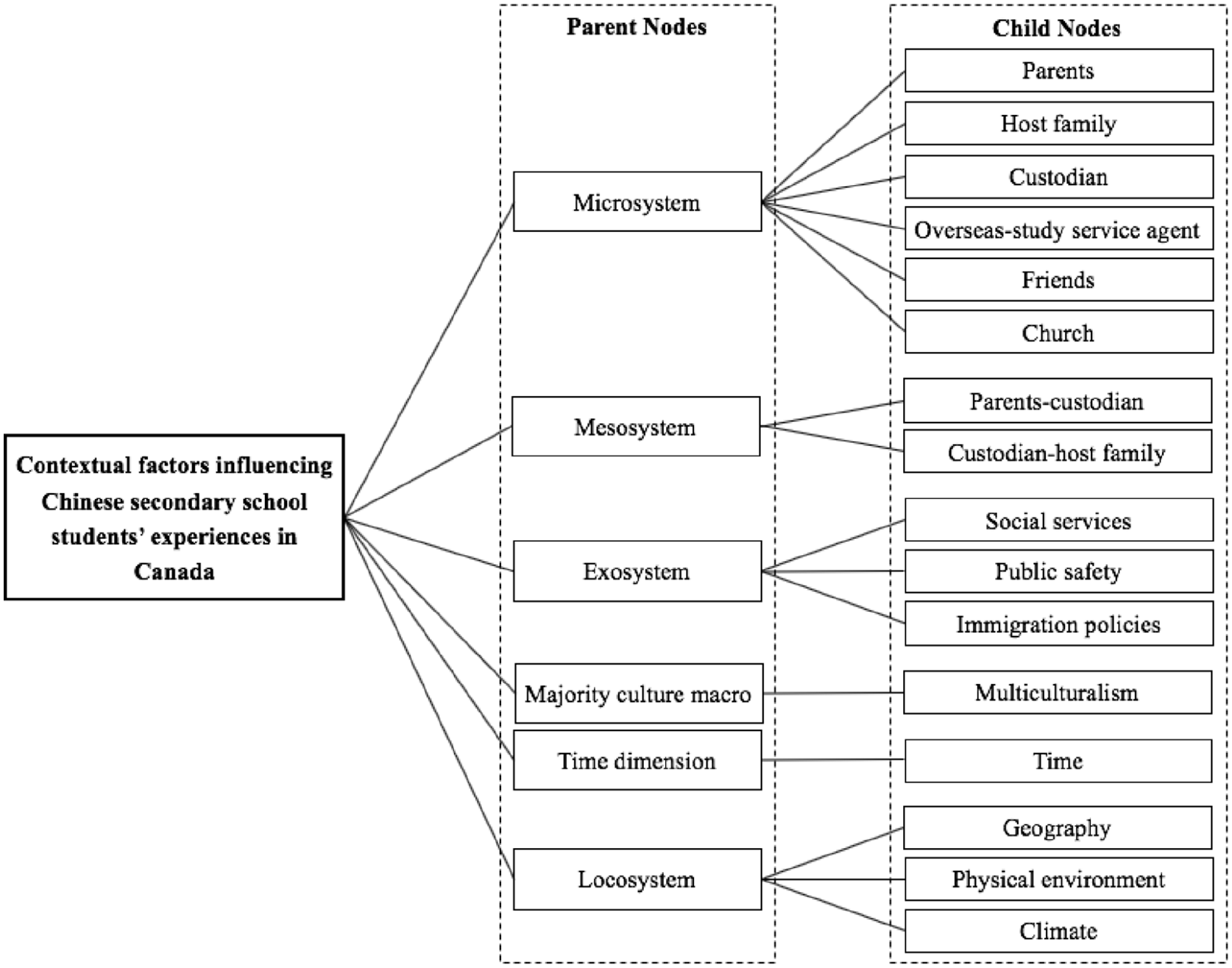
The coding scheme of contextual factors influencing Chinese early study abroad students’ acculturation experiences in Canada.
Once all the transcripts were coded, a coding comparison query was conducted in NVivo 11.0 to assess inter-rater reliability. The Kappa coefficient across all nodes was reported to be .78, indicating a substantial agreement between two coders (Landis & Koch, 1977). Concerning the disagreements, the two coders discussed and revised the discrepancy codes until consensus was reached. Supporting quotations were translated into English by the first two authors, and later cross-checked by the third author who has extensive experience translating between Chinese and English. Furthermore, to ensure validity and reliability of the analysis, we shared our interpretations with the participants and invited them to clarify or modify their initial responses.
Research Findings
To foreground how CESAS’ acculturation experiences interact with the various contextual factors, we organize the research findings into five sections: microsystem, mesosystem, exosystem, majority culture macro, and time dimension. We then subdivide each section according to the contextual factors that include individuals and institutions CESAS directly interact with, and systems, policies, and ideologies indirectly impact CESAS’ experiences. It is notable that although the data was gathered from both students and parents, the findings mostly focus on the data from student participants.
Microsystem
Among the individuals and institutions that CESAS directly interact with outside of school, parents, host family, custodian, overseas-study service agent, friends, and church are identified as the major factors influencing students’ acculturation experiences. These individuals and institutions constitute the microsystem.
Parents
Parents are crucial in CESAS’ social networks. No matter where parents live, their support, parenting style, and educational views significantly influence CESAS’ acculturation experiences in Canada. According to the interviews, students with their parents’ accompaniment in Canada had more positive experiences during the initial transition period. Such positive experiences were attributed to their parents’ strong support. For instance, when asked why she felt happy with her current living conditions, Student 13 replied that, “because my mom is also staying here. She looks after me very well, from daily care, assistance with homework, to encouragement, and almost every aspect of life.” Several students who were not accompanied by their parents in Canada also reported the positive effect of parental support on their overseas experiences. As Student 5 stated,
I have great parents. No matter how busy they are, they always manage time to make a video call to me every day. I feel very closed to them despite the distance, and this makes me feel comfortable.
In contrast, parents’ ignorance and indifference exaggerated students’ pains about their struggles. Student 8 shared this sentiment.
I still remember what happened once when I had a high fever of 39 degrees Celsius. On that morning, after I woke up, I made a telephone call to my mom who was in China. I told her that I felt very terrible. But she only responded, “you can drink more hot water and make sure not to be late for school”. You can never imagine how I felt at that moment.
In addition to parental support, parenting style is another factor influencing CESAS’ acculturation. The interviews reveal that CESAS’ acculturation experiences were negatively affected by their parents’ traditional parenting style. When studying in Canada, students are more easily influenced by the Western ideology of individualism (Daun, 2018) and are eager to build a stronger sense of self-esteem compared with they possessed when they were in China. However, some of their parents who still hold traditional parenting values that emphasize parent-child hierarchy and obedience to parents (Ho, 1994) cannot change their parenting style very quickly to align with their children’ ideological shift. Very often, intergenerational conflicts occur in this case. Student 2 complained much about her mother’s restrictive parenting style.
Like many other Chinese parents, my mom is very strict with me. There are lots of do’s and don’ts in my family. I must go back home right after school and cannot hang out with my classmates or go to the library. You know, I am already 16 years old. I have reached the age of majority in Canada and should enjoy many legal rights, but my mom still treats me like a little kid. I don’t have a say in the decision making. For example, in this February, when my mom and I went to a bank to transfer a bank account to me, she kept answering the banking assistant’s questions related to the account settings until the assistant said, “I’m not going to listen to you, because the account holder is not you but your daughter.”
Educational view is the third factor from parents that influences CESAS’ acculturation experiences. Several students reported a discrepancy between parents’ educational views and their Westernized learning style. Chinese parents, who are heavily influenced by Confucian education philosophy, believe that students should devote most of their time and effort to study. However, many CESAS change their learning style in accordance with the Canadian educational culture of “study hard, play hard.” These students may choose to spend time entertaining themselves rather than continuing to study after completing their homework. Such actions, however, often induce their parents’ complaints and really bother the students.
Host family
In this study, 10 out of the 12 student participants who were not accompanied by their parents were living/lived with host families. These students reported their efforts to develop close relationships with host families. However, only four students felt accepted as a family member while the other six students had very unpleasant experiences with homestays. Inadequate meal supply, food contamination, poor household sanitation, and overcrowding were the students’ major complaints. Moreover, one student shared her friend’s experience of sexual violence conducted by homestay father.
Since adolescence is a critical time for physical growth, CESAS need a balanced diet. However, some host families, particularly those in disadvantaged socio-economic positions, were reported to provide minimal meals to the students and care little about food hygiene. When Student 1 just came to Canada, she had such a homestay.
One day when I was very hungry, I ate part of the host’s daughter’ dinner after finishing mine, which was less than hers. Then the homestay mother swore at me and drove me out of their house on that cold, snowy December night. You cannot imagine how helpless I was on the suburb’s road. It is absolutely a trauma to me. And at that time, I was only 17 years old.
She further added that,
What was worse, on the second day, I had diarrhea. It was verified that my illness was caused by the meal provided by the host family the day before. The meal was moldy, and hairs were found in the rest of the meal. Fortunately, my school board helped me cope with this issue. In the end, I was made aware that my host family did not have the accreditation to host international students.
In addition, several students expressed their concern over the sanitation issues in their host families. From the background information, we noticed that CESAS came from middle- and upper-class families that could afford the high international student tuition fees and living expenses in Canada. They used to live in a clean and well organized apartment or house in China. Hence, when the household hygiene at their homestays was poor, the students felt very uncomfortable and feared contracting diseases. For example, Student 8 described that,
My first homestay was very dirty. The kitchen was a total mess and bugs crawled here and there! When I offered to clean the rooms, the host just said no. The only thing I could do was to keep my own room as clean as possible. Besides, their windows were never opened. The host explained that the windows were broken, but he had no money to fix them.
While the above-mentioned issues are serious, several young students had to contend with something worse. Several students disclosed experiences of living with other students in their host family. For example, Student 9’s host family in Montreal hosted six international students in a three-bedroom apartment. The most serious issue reported within host families was sexual violence. Student 19 shared her friend’s experience,
My friend’s homestay father placed a hidden camera in their bathroom and once attempted to sexually assault a Korean girl who was also living in the apartment as a guest. After hearing about this, my friend moved out of the homestay immediately.
Custodian
According to the immigration policy, international students who are legal minors should have a parent or legal custodian in place to provide necessary care and support during their stay in Canada (Government of Canada, 2018). For CESAS without parental accompaniment, their parents’ relatives/friends who are Canadian citizens or permanent residents usually serve as their legal custodians. For those that do not have relatives/friends in Canada, their parents often ask overseas-study service agents or school authorities to find a responsible Canadian adult to undertake the guardianship duty. In our study, among the 12 student participants whose parents were not living in Canada, 5 students’ custodians were their parents’ relatives/friends, with another 4 matched by overseas-study service agents, and the last 3 served by students’ school principals. The interviews demonstrated that custodians’ involvement impacts the students’ acculturation experiences in both positive and negative ways.
On the positive aspect, several students expressed gratitude to their custodians for fulfilling the responsibilities of assisting with their arrival, coping with emergencies, and coordinating between schools and parents. Such commitments enhanced the quality of students’ life in Canada. For instance, Student 12 stated,
My custodian is a school principal. He is very responsible and has done a lot for me. He is always there to help me and to provide me with constructive suggestions. He really knows how to mentor international students.
However, many custodians were reported not to properly perform their responsibilities. The four students whose custodians were matched by overseas-study service agents claimed that, even with very low expectations, they felt dissatisfied with their custodians’ performance. The students thought that such custodians charged a lot more than the value of services they provided and did a lot less than they promised. In addition, Student 6 disclosed unhappy experiences with his custodian, who is his relative. He stated that,
I am very grateful that my uncle would like to act as my custodian, but I could not get along with him. He set a lot of restrictions on me. Disagreements and conflicts between us often occurred. He sometimes threatened to send me back to China, which really hurt me.
Overseas-study service agent
Overseas-study service agents are very popular among Chinese students whose parents do not know much about the educational system in foreign countries (Agencies Helping Chinese Students Study Abroad Cash in On Lucrative Business, 2017). To make informed decisions on issues such as school applications, homestay selection, and custodian match, many parents prefer to seek professional advice from overseas-study service agents. While some agents do recommend excellent homestays and custodians to students, others fail to offer satisfactory services and are thus criticized. Having lived in Canada for some time, some students reflected that their current living experiences was associated with their agents’ services regarding homestay and custodian recommendations, as well as their pre-arrival information provision, both of which had an adverse impact on their experiences. For example, Student 1 stressed,
The unaccredited homestay that drove me out of the house was recommended by my overseas-study service agent. It is very annoying that some agents clearly know the regulation that homestays should get official approval before hosting international students, but they do not conduct background investigation of the homestays and directly recommend these unaccredited homestays to the young students and their parents. This is also true for the custodian recommendation. The agents are not reliable at all. They only regard international students as ‘cash cows’.
Apart from the dissatisfactory homestay and custodian recommendation services, some students expressed disappointment with overseas-study service agents’ pre-arrival information provision. They argued that after students were admitted into Canadian schools, agents should have provided necessary information or training sessions on how to start a new life in Canada and how to manage the cross-cultural differences between China and Canada. However, in practice, no agents provided such information. This issue increased the students’ acculturative stress.
Friends
Friends are indispensable parts of CESAS’ social supporting system. Prior research (e.g. Beech, 2018; Hendrickson et al., 2011) has shown that interactions with friends can decrease international students’ feeling of homesickness and segregation in host countries. In this study, 12 student participants reported the positive effect of friends’ understanding and support on their acculturation experiences.
Like other international students, CESAS encounter many challenges in adapting to the new environment in Canada (Popadiuk, 2010). However, as teenagers in their formative years, they can hardly overcome the challenges by themselves. In this circumstance, friends, particularly co-nationals from the students’ home country, are one of the major support sources. Student 12 remarked that,
Whenever I share my experiences with my friends, they always understand my problems very well and try their best to help me. What my friends have done for me really touches me.
In many cases, friends brought happiness and joy to CESAS and transform their unpleasant experiences into sweet memories. For example, during winter in Montreal where there are frequent heavy snow falls, few people like to walk on the cold icy streets. But as stated by Student 12, walking with her friend can be very delightful.
I remember on a windy and snowy day, we bought a lot of stuff from a supermarket and carried them walking back home. The wind blew so hard that we could not feel our face. Our noses went red while our faces were white. It was a misery. But my friend was very optimistic and found joy amid hardship. She took a short video in which I waddled through the deep snow with the huge shopping bags in hand. We found this experience very funny.
Church
In addition to the above-mentioned individuals, one student participant highlighted the facilitating role of church, which is an institution, in his acculturation experiences. Student 6 pointed out that church participation promoted his integration into the local community. Specifically, he described that,
After coming to Canada, I had a really hard time to fit in. During that difficult period, I felt I was only accepted in a Christian church. The church was dominant by Chinese immigrants. My uncle took me there although I did not have any religious beliefs at that time. But the church members’ care and acceptance increased my confidence and helped me get through those tough days.
Apart from creating an inclusive environment, churches also helped CESAS address some practical issues students encountered in Canada. Student 6 added that, since his church leaders noted the increasing trend of Chinese students studying in the city, they started to provide English language tutorials for the students to enhance their English proficiency. In addition, the church also organized activities such as festival celebration and Bible teaching classes, which increased his knowledge of the Canadian culture. Students 6 summarized the topic by stating that, “Now I believe in Christianity. I think conversing from atheism to Christianity changed my life trajectory in Canada!”
Mesosystem
Mesosystem refers to the interactions between two or more microsystems that have direct influences on individuals (Bronfenbrenner, 1994). In this study, the relationship between parents and custodian in addition to the relationship between custodian and host family constitute the mesosystem impacting CESAS’ acculturation experiences in Canada.
Parents-custodian relationship
Several CESAS without their parents’ accompaniment in Canada reported unhappy experiences resulting from the relationship between parents and custodians. Custodians are expected to communicate with parents about the students’ school performance, emergency situations, and daily issues. However, such communication may make students feel depressed about their relationships with their parents. Student 1 shared,
Because we are minors, parents would rather believe the custodians than trust their own children. When I had a problem with my former host family, my mother chose to believe what the custodian said about the situation and even wrote the custodian an email saying that it was I who should be blamed for what happened and the conflict had nothing to do with the custodian. That really hurts!
Custodian-host family relationship
In addition to communicating with parents, custodians, who are not living with students at the same location, need to maintain regular contact with the students’ host family. When conflicts occur between students and their host family, custodians should intervene to address their problems. However, the interactions between custodian and host family can sometimes incur more issues. Student 1 depicted such an unpleasant incident.
My parents paid my custodian a lot for his service, but the custodian did not stand with me when I was about to call the police to address the conflicts between my homestay and me. Also, when I wanted to end the lease with the homestay and to get back the rest of my rent, the custodian spoke for the host family and threatened me not to do that. It is really hard to understand why the custodian did not speak for me. I do not know what kind of deal the host family made with the custodian.
Exosystem
Exosystem considers aspects of the environment beyond the immediate system containing individuals (Hong & Espelage, 2012). In this study, social services, public safety, and immigration policies are examples of exosystem factors influencing CESAS’ acculturation experiences in Canada.
Social services
Previous research indicates that adolescent Asian international students encounter many difficulties in Canada due to the daily life differences between their home and host country (Popadiuk, 2009). Students feel uncomfortable and are even bothered by these differences. In line with this finding, the students interviewed in our study described that local healthcare services and online shopping services made their life in Canada not as convenient and enjoyable as that in China.
Canada’s healthcare system seems to be more advanced than that of China (Hu et al., 2016). However, many CESAS are annoyed at being unable to receive timely medical treatment in Canada. Even when facing a medical emergency, they have to suffer through a long wait, experiencing acute physical pain, and mental distress. For example, Student 3 waited for 10 hours before getting an appendicitis surgery.
In addition, two student participants mentioned the inconvenience caused by online shopping services in Canada. While the online shopping industry in China is able to provide a large variety of high-quality goods and services at reasonable prices (Online Retail is Booming in China, 2017), the e-commerce market in Canada is not as developed (Lipsman, 2019). Therefore, for CESAS who are accustomed to purchasing products on the Internet, they cannot enjoy the online shopping experiences in Canada.
Public safety
While Canada has a good reputation for being one of safest countries in the world for international students (EduCanada, 2019), several CESAS and parents felt threatened by public safety concerns such as robbery and kidnapping, cannabis consumption, and offences committed by homeless people.
In recent years, there has been frequent news reports about violent robbery or virtual kidnapping targeting Chinese students (Humphreys, 2019; The Canadian Press, 2018). Therefore, students become increasingly concerned about their safety in Canada. Although virtual kidnapping has never happened to the students interviewed, parent 1 mentioned that attacks and muggings did take place on students’ way to school and back home. She described that, “it happened to two students. I heard that they mug boys only! I am afraid that my kid will become the victim later.”
Cannabis consumption is another concern among CESAS and their parents. According to the Cannabis Act that came into force in October, 2018, adults who are above18 years old are legally able to possess up to 30 g of cannabis and share it with other adults (Government of Canada, 2019a). On the one hand, parents became worried that some adults would entice their kids to use cannabis. On the other hand, students started to fear about the increased risks of violent behaviors caused by cannabis smoking in public space.
Furthermore, student participants, particularly females, were anxious about the offences committed by homeless people. Despite understanding the harsh conditions of the homeless, Student 4 stated that, “I often come across homeless people on the Metro. They always murmur and sometimes yell. It is really scary.” Thus, the students have to keep vigilant about their surroundings whenever homeless people appear.
Immigration policies
As regulated by the immigration policies, foreign nationals are required to obtain a study permit for engaging in educational and training activity that is more than 6 months in duration at a Canadian education institution (Government of Canada, 2019b). During the interviews, both student and parent participants complained about the rules relevant to study permit, pointing out that the study permit application and renewal policy implemented at the federal level made them feel unaccepted in Canada. Specifically, they were unsatisfied with two rules: (a) study permits are issued on an annual basis. Every year when they renew their study permits, parents and students suffer from huge stress, fearing that their applications would be rejected; (b) family members who are accompanying students studying in Canada can only apply for visitor visas. As a result, parents have to leave Canada once having stayed for up to 6 months in the country.
While a study permit is sufficient for most international students to legally study at a Canadian education institution, those admitted into schools in the Province of Quebec must obtain an additional Certificate of Acceptance of Quebec (CAQ) (Immigration, Francisation et Intégration Québec, 2019). Similar to their concerns about the study permit renewal, students and parents felt pressure about their CAQ renewal results. Parent 4 stated,
I have to apply for CAQ for my son every year. Every time I apply for it, my son and I become anxious. You know, if we were unable to get the CAQ in time, my son would have to give up his studies in Quebec. This is not what I want to see.
Majority Culture Macro
Majority culture macro represents the values, beliefs, and traditions that are shared by the host country. In this study, we find multiculturalism is the majority culture macro factor relevant to CESAS’ acculturation experiences in Canada.
Canada, consisting of people from diverse racial and ethnic backgrounds, is a country of immigrants. When the Canadian Multiculturalism Act was adopted by the Parliament in 1988, Canada became the first country in the world to pass a national multiculturalism law (Library of Parliament, 2018). Since then, various policies and programs have been implemented to promote equality, integration, and mutual respect for people from different origins. As newcomers to Canada, the student participants felt that they were equally treated in the new society. Very few participants reported experiences of racial discrimination outside of school.
Time Dimension
The time dimension highlights the effect of time on both students and the external environment. This study detected that, as time passed, CESAS’ attitude change and their dynamic relationships with factors in other systems affected their acculturation experiences in Canada.
The students reported that they were fascinated by the people, buildings, and some other things upon arrival in Canada. However, after living in the country for several months, three student participants felt a sense of depression and frustration. The comment given by Student 12 is typical.
During that time, I felt extremely terrible. Living and learning in Quebec without my parents’ accompaniment was too difficult. I was doubting whether my decision of studying abroad was correct, and whether staying in Canada would really make me better.
Some students also developed feelings of homesickness. For example, Student 4 was longing for the delicious food and fruit in his hometown and urged his mother to take him back to China. With time passing, the students gradually acquired effective tactics to navigate the alien system. During this stage, the students tended to hold a more rational attitude toward the differences between China and Canada. According to Parent 4, after living in Canada for 2 years, her son said, “now I find Canada is not a paradise. Awful things are also happening here.”
Likewise, students’ relationships with factors in other systems also changed as time went by. Parent 4 described what happened to his son.
In the very beginning, my husband’s elder sister, who is a Canadian citizen, advised my son to come to study in Canada. When my son just came here, she [his son’s aunt] was very happy to host him. But gradually, my son became naughty and disobedient and in the meanwhile, his aunt lost her patience. So their relationship deteriorated. In order to give my son a happy childhood, my husband and I decided to move to Canada one year later, which was not initially planned.
Discussion
Our findings show that CESAS’ acculturation experiences in Canada are mixed with positive and negative feelings, and the complexities of their acculturation experiences can be explained by the various contextual factors the students are exposed to. Based on Oppedal and Toppelberg’s acculturation development model, we identify six microsystem factors (parents, host family, custodian, overseas-study service agent, friends, and church), two mesosystem factors (parents-custodian relationship and custodian-host family relationship), three exosystem factors (social services, public safety, and immigration policies), one majority culture macro factor (multiculturalism), and time dimension are related to CESAS’ acculturation in Canada (see the inner four layers of Figure 3). In the meanwhile, it should be noted that among the contextual factors in the microsystem, mesosystem, exosystem, majority culture macro, and time dimension, microsystem factors are most important. This finding is evidenced by the fact that while some students live in the same city, their experiences are significantly different according to their descriptions. In addition, we highlight that while having not found any transnational macro factors that directly influence CESAS’ acculturation experiences, we note the indirect influence of transnational macro culture on CESAS’ experiences through factors in other systems, such as parents in the microsystem and social services in the exosystem, as having been illustrated in the results.

Modification of Oppedal and Toppelberg’s acculturation development model in Chinese early study abroad students’ acculturation experiences in Canada.
Furthermore, we find another layer of factors that fall out of the acculturation development model significantly influence CESAS’ acculturation experiences in Canada. This layer is the locational characteristics of the city where students live. As shown at the outermost layer of Figure 3, which we term “locosystem,” factors including geography, physical environment, and climate are listed as examples. We recognize that climate and weather are significant factors influencing CESAS’ acculturation experiences. This finding is supported by the contrasting feelings shared by participants living in two different cities within Canada. While Student 17 expressed that she was enjoying the weather in Vancouver, several students complained about the snowy winter in Montreal. Based on the above analysis, we suggest integrating this layer (locosystem) into the acculturation development model. By doing so, we can not only create a more comprehensive landscape of the contextual factors influencing CESAS’ acculturation experiences in Canada, but also enhance the robustness of Oppedal and Toppelberg’s acculturation development model.
Our research findings confirm previous studies examining the cross-cultural experiences of CESAS in North America. For example, existing literature repeatedly highlights the effectiveness of parental support in alleviating CESAS’ isolation, loneliness, and acculturative stress (Cheng, 2019; Kuo & Roysircar, 2006; Minichiello, 2001). In alignment with these research results, we notice the important role parents play in CESAS’ acculturation experiences in Canada and advise parents to provide necessary and timely support to meet their children’s developmental and emotional needs. Parents should simultaneously be aware of the vast cultural distance between the East and the West when providing support and guidance to their children. Our study finds that the cultural difference gives rise to conflicts between CESAS and their parents. If parents want to decrease the intergenerational conflicts with their children, they should better understand western democratic and liberal values as well as the impact of these values on Chinese students.
In addition, similar to Chiang-Hom (2004) and Popadiuk’s (2009) findings, our study reveals the emotional and financial abuse as well as sexual harassment that host families may impose on CESAS. Considering the huge damage these issues can incur, host families should strengthen self-regulation or be regulated by the educational authorities to avoid these potential problems. For instance, the educational authorities can require homestay program providers to develop a strict screening process and deliver a comprehensive training for new host families. In addition, they can maintain the procedures for the dismissal of host families deemed disqualified for the homestay program.
Beyond this, we suggest that CESAS come to know about their host family from various information sources before signing contracts. Once having moved into their homestay, students should make efforts to maintain a good relationship with their host family who take care of their daily life. They can also read reference manuals containing relevant legislation, standards, and procedures applicable to CESAS’s homestay experience. When their health and safety is threatened, the students will be clear about the conflict resolution strategies and be able to access resources regarding child health and safety protection. Comparing CESAS with Chinese students pursuing post-secondary education in Canada, we can note that the former group of students have to deal with more complicated interpersonal relationships while studying abroad. We recognize that mediating relationships with unfamiliar adults such as a homestay mother and custodian from early ages would bring about an opportunity for promoting rapid personal growth, but it is also risky if students do not have sufficient capacity to navigate the relationships. Studies have demonstrated that premature transitions into adulthood are often linked to negative life outcomes such as increased rates of stress, substance use, and delinquency (Krohn et al., 1997).
Few literature has investigated CESAS’ experiences of using overseas-study service agents. Several studies (e.g., Coffey, 2014; Hagedorn & Zhang, 2011) examining Chinese students’ use of agents in higher education application process illustrate that students express some degree of satisfaction with their agents’ services despite recognizing the agents’ problems such as lack of consideration of students’ long-term needs. This study detected similar findings in CESAS’ attitude to their agents. Our participants revealed that while the agents did help them select a suitable host country, region, and school to study in, they often failed to match the students with a responsible host family and custodian, and to provide students with necessary pre-arrival information, both of which resulted in students’ increased level of acculturative stress. To build a good reputation within the industry and promote word-of-mouth recommendations, overseas-study service agents are advised to offer clients more satisfactory services. In addition, the educational authorities can strengthen their supervision of the overseas-study service industry by regularly evaluating the services provided by overseas-study service agents and updating the list of overseas-study service agents that provide high quality services.
Prior studies indicate that friends are critical in CESAS’ social support system (Chiang-Hom, 2004; Minichiello, 2001). In line with this finding, this study further reveals that friends, particularly those who are also early study abroad students, are more important than parents in CESAS’ acculturation experiences. This is because they are experiencing similar difficulties and have a better understanding of their peers’ struggles. However it is notable that, apart from developing friendships with co-national and other international counterparts, CESAS have strong desires to build close relationships with local students as expressed by Chinese students pursuing post-secondary education in Canada (Preston & Wang, 2017; Zhou et al., 2017). In this study, cultural difference was frequently mentioned as the barrier to establish meaningful relationships with local students. Therefore, we suggest that CESAS make more efforts to explore Canadian culture and to cultivate common interests with their Canadian peers.
Our finding of church participation facilitating CESAS’ acculturation in Canada echoes Yu and her colleagues’ studies about the cross-cultural adaptation of Chinese international students in British higher education institutions. For instance, through participant observation, interviews, and document analysis, Yu and Stoet (2020) found that Christian organizations in UK increased Chinese international students’ intercultural competence by organizing specific social events and adaptative religious programs. Moreover, it is revealed that compared with university services, the church activities are more regularly organized and make it easier for international students to establish close contact with locals (Yu & Moskal, 2019). Hence, for CESAS who want to have more meaningful intercultural engagement with locals, going to churches is a good option.
Regarding the immigration policies concerning the study permits and visas issued to CESAS and their parents, we recommend the federal and provincial governments issue longer-term study permits and visas, which cover the duration of the student’s course of study. Accompanying parents should be granted visitor visas that have the same valid period as their children. Such new policies will alleviate CESAS and their parents’ stress during the renewal process and make them feel more accepted in Canada.
In the above paragraphs, we suggest that CESAS, their parents, host families, overseas-study service agents, educational authorities, and other stakeholders make proper adjustments to enable CESAS to enjoy a better life in Canada. For the contextual factors that cannot be changed in the foreseeable future, we encourage CESAS to recognize and accept them as they are. For example, students can learn to understand the mechanism resulting in the structural differences of social services between China and Canada. A profound understanding would stimulate students to embrace the differences instead of feeling bothered. In respect to their concerns about public safety and study permit application, students have to be very cautious to avoid finding themselves in awkward and dangerous situations. In brief, all stakeholders should work together with CESAS to create a more supportive and sustainable environment for the students to lead a pleasant life in Canada.
Conclusion
This paper contributes to the international student literature from both theoretical and practical perspectives. On the theoretical aspect, this is one of the first studies having applied Oppedal and Toppelberg’s acculturation development model to explore CESAS’ acculturation experiences. Moreover, by using the acculturation development model as the analytical framework, we demonstrate broader contextual factors influencing CESAS’ acculturation experiences than previous studies. On the practical aspect, we present the complexities of CESAS’ acculturation experiences in Canada with an emphasis on the negative transition. This focus will enable readers to recognize CESAS’ actual life in Canada and to identify potential areas for improvement. Chinese parents, educational authorities, and other stakeholders will be inspired to create a more supportive and sustainable environment for CESAS to live in. One limitation of this study is that an overwhelming majority of our participants were studying/studied in the Province of Quebec. Therefore, the findings cannot be easily generalized to CESAS in other contexts. In the next step, researchers can explore CESAS’ acculturation experiences in the Province of Ontario and British Columbia that host a larger number of CESAS to present a more comprehensive landscape of the research question under investigation. CESAS’ educational, social, and cultural challenges beyond acculturation can also be examined to better understand this unique cohort of international students’ lived experiences.
Footnotes
Acknowledgements
We would like to thank all interviewees for making their time and efforts to participate in this study.
Declaration of Conflicting Interests
The author(s) declared no potential conflicts of interest with respect to the research, authorship, and/or publication of this article.
Funding
The author(s) disclosed receipt of the following financial support for the research, authorship, and/or publication of this article: The research is funded by China Scholarship Council (Grant No. 201706040043).
Research Ethical Approval
Ethical approval for this study was obtained from the Research Ethics Board Office of McGill University. The approval number is 19-11-008.
