



Abstract
Conversation openings are crucial for effective daily communication. However, existing research predominantly focuses on their sequential structures, with little attention given to their linguistic features and variations across different genres. To address this gap, the present study examines conversation openings from four perspectives (i.e., grammatical forms, sentential types, semantic categories, and social actions) by constructing a corpus of English TV dramas. The corpus comprises dialogues from popular TV series shown in recent years with high Internet Movie Database (IMDb) ratings, totaling 530 conversation openings in three generic settings: educational, medical, and judicial. To ensure data accuracy and reliability, the study employed comprehensive data processing and rigorous analysis using software tools such as AntConc 3.5 and IBM SPSS Statistics 26.0. The findings reveal that full sentences are more prevalent than elliptical ones, with declarative and interrogative sentences being the most frequently used. Speakers tend to favor other-oriented utterances, with requests and greetings emerging as the most common social actions. Additionally, the study identifies significant influences of factors such as gender, familiarity, and social status on the structure and use of conversation openings.
Keywords
Introduction
Conversation openings are the initial stage of conversational interactions and play a critical role in establishing an appropriate context for smooth and effective communication. With the advancement of Conversation Analysis, research has identified that conversation openings typically comprise several sequential components, such as greetings, introductions, how-are-you sequences, self-identification, other-identification, etc. (Kecskes, 2019; Kpogo & Abrefa, 2017; Pillet-Shore, 2018; Schegloff, 1968; Sinkeviciute & Rodriguez, 2021). These components are influenced not only by the mode of communication (e.g., telephone calls, face-to-face conversations, online interactions) (Abdelsamie, 2024; Bou-Franch, 2011; Farina, 2020), but also by contextual factors, including the degree of formality, age, and sex of participants, and social distance between interlocutors (Grieve & Seebus, 2008; Penn et al., 2017; Pütz, 2018). For instance, telephone openings typically include sequential components such as identification-recognition, greeting, how-are-you, etc., whereas face-to-face conversation openings often comprise the sequential components of greeting, introducing, personal state, registering, etc. (Wong & Waring, 2021, pp. 223–261). Regarding generic settings, the opening of a telephone call to a bookstore frequently differs from other types of calls, as it often begins with the caller stating the reason(s) for the call (Bowles, 2006). In terms of contextual factors, it is common for friends to favor “Hi” as a conversational opener while strangers are more likely to use expressions such as “excuse me” (Mondada, 2009).
While significant progress has been made in understanding the sequential structures of conversations and their contextual variations, there remain notable gaps in revealing the linguistic features of conversation openings and how these features are influenced by contextual factors. To address these gaps, the present study aims to identify the linguistic features that are characteristic of face-to-face conversation openings, with a focus on grammatical forms, sentential types, semantic categories, and social actions (a more detailed account of these terms is provided in Section “Analytic Framework”). Furthermore, the study also aims to explore how these features vary across generic settings (i.e., educational, judicial, and medical) and are influenced by the contextual factors of gender, familiarity, and social status.
The findings of the study are expected not only to advance our understanding of the linguistic features of conversation openings and their variations across different genres and contextual factors but also to contribute to the teaching of second and foreign language learners and the development of language teaching materials.
Literature Review
Structures of Conversation Openings
Conversation openings constitute the initial phase of an interaction between two or more participants. Effective conversation openings play a crucial role in fostering rapport and establishing trust among interactants. Considerable attention has been devoted to the study of conversation openings. For instance, Schegloff (1968) reveals that telephone openings consist of sequences such as summons-answer, identification-recognition, greeting tokens, and initial inquiries (“How are you”) and answers. Face-to-face conversation openings, however, differ in their sequential components. Pillet-Shore (2018) identifies eight regular elements in the opening phase of interactions in face-to-face conversations, including such practices as becoming co-present, greeting (adjacency pairs of hello-hi, and embodied resources like hand waves), touching (hugs, kisses, handshakes, etc.), introducing (self and other identifications), personal state/previous activity managing (each other’s physical or emotional states), registering (noticing or announcing a referent), setting in (opening doors, adjusting the room temperature, etc.), and bridging time (recalling or bridging the gap between previous meetings and the current occasion) (Wong & Waring, 2021). Building on these foundational works, researchers have examined conversation openings across various institutional settings, such as radio talk shows (Hutchby, 1999), emergency calls (Whalen & Zimmerman, 1987), mobile phones (Arminen, 2005), video conferences (Mondada, 2010), and Skypecasts (Jenks, 2009). Institutional settings have been found to significantly influence the structure of conversation opening sequences or adjacency pairs. For example, emergency calls deviate from typical opening patterns by omitting greeting sequences (Mortensen & Hazel, 2014).
However, current research on conversation opening components is predominantly qualitative in nature, focusing on case studies. There is insufficient examination of the frequency characteristics of these structural aspects, making it unclear which components are more commonly employed and which are not.
Conversation Openings and Generic Variations
With the advancement of the digital environment, conversation research has expanded from telephone and face-to-face communication to include computer-mediated communication, such as emails (Bou-Franch, 2011), video-mediated interactions (Licoppe, 2017), and new conversation modes on social media platforms, including political Twitter conversations (Abdelsamie, 2024) and Facebook comment conversations (Farina, 2020), etc. For example, Bou-Franch (2011) constructs a corpus of short email chats in Peninsular Spanish, analyzing the opening and closing sequences and the discourse strategies used. It is found that conversation openings in emails are highly subject to technological constraints and vary according to social and interactional factors. Licoppe (2017) investigates the openings in video-mediated talks using Skype, identifying specific phenomena (e.g., multiple greetings) unique to this mode of communication. Farina (2020) uses Facebook “@” expressions as an example to explore social media interaction through the lens of conversation analysis, and argues that conversation analysis should be integrated into social media research. The shift in conversation patterns has also fostered new developments in the principles and methodologies of conversation analysis (Ayaß, 2023; Paulus et al., 2016).
This line of research demonstrates that conversation openings vary across different genres (e.g., telephone, face-to-face, email, etc.) and institutional contexts, including meetings (Angouri & Marra, 2010; Lehtinen & Pälli, 2011), political interviews (Rendle-Short, 2007), and psychotherapeutic interactions (Martinez et al., 2014). For instance, Lehtinen and Pälli (2011) find that genre significantly influences the structural organization of conversations in company-internal meetings. Similarly, Rendle-Short (2007) reveals that address terms serve multiple pragmatic functions in political interviews. These findings, together with others, underscore the genre-specific nature of conversation openings. Nevertheless, the majority of existing studies focus on a single generic setting in isolation, and few have undertaken comparative analyses of conversation openings across diverse settings (e.g., formal/informal, media, judicial, or educational contexts).
Conversation Openings and Contextual Variations
Conversation openings are sensitive to contextual variations. Grieve and Seebus (2008) find that formality (business or private setting), sex (men or women), and age (<51 or ≥51) all contribute to different conversational opening practices. For instance, self-identification is more commonly observed in formal settings and is often preferred by male speakers (Grieve & Seebus, 2008). Similarly, social relations (strangers or acquaintances), situations (emergency or not), and identities (native or non-native speakers) also lead to variations in conversation openings (Park, 2015; Penn et al., 2017; Pütz, 2018). For example, strangers are more likely to open telephone conversations with “My name is …,” whereas friends or acquaintances tend to prefer the use of “This is …” in similar situations (Wong & Waring, 2021, p. 231).
From the review, it is evident that conversation openings have generated significant interest in academia and yielded numerous interesting results. However, several gaps still remain: (a) most existing research focuses on the sequential structures of conversation openings as stated in Section “Structures of Conversation Openings,” with few examining the linguistic features (e.g., sentential types, semantic categories, social actions) in these openings (The key literature on the linguistic features of conversation openings will be outlined in Section “Analytic Framework”); (b) most existing research is qualitative in nature as discussed in Section “Structures of Conversation Openings,” potentially yielding an incomplete understanding of the features of conversation openings since some features may be incidental and some intrinsic; (c) most existing research does not distinguish linguistic variations in different generic settings when discussing conversation openings as stated in Section “Conversation Openings and Generic Variations,” even though different genres potentially induce different linguistic practices due to varying contextual factors as illustrated in Section “Conversation Openings and Contextual Variations.”
Considering these gaps, the present study aims to explore the linguistic characteristics of conversation openings in different genres (i.e., educational, medical, and judicial). To be specific, the study seeks to answer the following two major research questions: (a) what grammatical forms, sentential types, semantic categories, and social actions are commonly used in English conversation openings? and (b) how do these linguistic features vary across different genres (e.g., educational, medical, judicial) and contextual factors (e.g., gender, familiarity, social status)?
Methodology
Sources of the Data
This study aims to analyze conversation openings in natural settings. However, collecting natural conversation data is quite challenging, especially conversation data of varied genres. Forchini’s (2012) analysis highlighted significant similarities between film language and speech corpus data, including features such as tense, modality, pronoun, word frequency, and lexical bundles. Similarly, Quaglio (2009) and Lin (2014) find that while TV series conversations exhibit minor variations from real-life conversations, their overall language characteristics are comparable. Furthermore, L2 learners can also acquire slang, phrasal verbs, and colloquial expressions through TV series subtitles (Frumuselu et al., 2015). Consequently, this study used conversations from English TV series as data. Building on this, the data were categorized by specific contexts, such as educational, medical, and judicial settings. Although some dialogues do occur in non-specific settings, they still align with the central themes of the TV series. For example, in educational dramas, even conversations occurring at homes are still related with educational themes, though they do not occur in a classical educational setting (e.g., homes).
Specifically, the study selected three English TV dramas for analysis: Love, Victor (2020), Critical (2015), and Better Call Saul (2015) (Table 1). They were chosen based on two primary considerations:
(1) Representativeness: All three TV dramas have Internet Movie Database (IMDb) ratings of 7 or higher, ensuring the data’s quality and reliability.
(2) Variations: The characters in these dramas exhibit sufficient diversity in gender, age, profession, and social status, enabling a fine-grained analysis of conversation openings.
The data collection and encoding process involves four steps: (a) downloading scripts from https://srtku.com/, and proofreading the scripts while watching the TV series; (b) creating a small-scale conversation corpus and developing four classification frameworks based on grammatical forms, sentential types, semantic categories, and social actions; (c) manually classifying the raw data by two researchers, followed by a discussion to reach agreement; (d) analyzing the data using SPSS 26.0 and AntConc 3.5.
Basic Information of the Corpus.

Analytic Framework
This study develops an analytical framework grounded in the existing literature on conversation openings. As illustrated in Figure 1, the primary objective is to analyze the characteristics of grammatical forms, sentential types, semantic categories, and social actions in the conversational openings of English TV series. The secondary objective is to examine the influence of various genres and contextual factors (such as gender, familiarity, and social status) on these characteristics.

Analytic Framework of Conversation Openings.
The following subsections present a detailed description and classification of each feature, including grammatical forms, sentential types, semantic categories, and social actions.
Grammatical Forms of Conversation Openings
Grammatical form refers to the structure and arrangement of words and phrases used to create well-formed sentences in a language. It analyzes various sentence patterns based on their grammatical forms. This study divides grammatical forms into two main types: full sentences and elliptical sentences. This classification is supported by prior research. For example, Biber (1999) examined ellipsis under the framework of clause grammar, while some other scholars have noted that ellipsis, in contrast to omissions in phonology, morphology, or meaning, constitutes a grammatical omission (Al-Khawalda, 2002; Quirk et al., 1972). Examining grammatical forms in conversation openings provides insights into variations in language use.
Full sentences possess a complete structure with a clear subject-verb-object relationship, capable of independently conveying meaning. Typically, a full sentence includes a subject, predicate, object, and other essential parts. Conversely, elliptical sentences, commonly used in speech, convey complete meaning even when one or more elements are not explicitly stated. Ellipsis frequently occurs in coordinated clauses as illustrated in Example (1), comparative clauses as in (2), and question-answer sequences as in (3) (“<…>” indicates the part being omitted; Biber, 1999, pp. 156–157).
(1) You’ve become part of me, and
(2) She looks older than
(3) A: When’s he coming back?
B: <He’s coming back>
The omissions in examples (1) and (2) do not affect the listener’s understanding of the full statement. In example (3), the response of “Next Friday” demonstrates comprehension despite the omission of “He’s coming back.” Studies indicate that elliptical sentences constitute a significant portion of everyday conversation. Fernández and Ginzburg (2002) found that approximately 10% of the utterances in the British National Corpus are elliptical. Van de Weijer’s (2001) research on family communication reveals that approximately 30% to 40% of utterances are elliptical. Therefore, this study will analyze whether the grammatical forms in the opening part of a conversation are full or elliptical.
Sentential Types of Conversation Openings
Sentential types focus on the interactional functions of sentences. This study adopts Biber’s (1999) classification, which categorizes sentential types into declaratives, interrogatives, imperatives, and exclamatives.
(4) You look fantastic with the new dress.
(5) Who’s calling?
(6) Get off the table.
(7) What a good dad he is!
Declarative sentences, as in (4), have a subject-verb structure and are used to make statements without expecting a specific response. Declaratives can also express questions and doubts, depending on the tone. Interrogatives pose questions and anticipate verbal answers, including wh-questions as in (5), yes/no questions, and alternative questions. Imperative sentences as in (6) issue commands or make requests. Exclamative sentences as in (7) convey emotions and usually do not require a reaction (Biber, 1999, pp. 202–226).
Semantic Categories of Conversation Openings
Semantic categories organize and understand language by grouping items with similar semantic content. This study adopts Laver’s (1981) three semantic category classifications for phatic communion due to their high relevance to conversation openings. Laver (1981) classifies phatic conversation into three categories: self-oriented, other-oriented, and neutral. Self-oriented conversations focus on the speaker’s own experiences, ideas, actions, etc., other-oriented on those of the listeners, and neutral on common factors neither restricted to the speakers nor hearers (like the weather). For example, “I do like a breath of fresh air” is self-oriented, “Do you come here often?” is other-oriented, and “Nice day” is neutral. These classifications facilitate understanding semantic variations in communication and reveal the interconnections among language use, social relationships, and individual psychology.
Social Actions of Conversation Openings
Social actions refer to the functions an utterance performs in conversations (Atkinson & Heritage, 1984). By examining naturally occurring talk, Sacks et al. (1974) explore how participants construct social actions (Sidnell & Stivers, 2012). Early recognition of the speaker’s social action can limit the potential meanings, enabling listeners to understand the intended message and respond promptly.
This study incorporates Schegloff’s (1968) and Pillet-Shore’s (2018) sequence structures for phone and face-to-face conversation openings. In English TV dramas, conversation openings focus on addressing, greeting, self-identification, and other identification. Addressing refers to how the speaker mentions the person they are talking to, often using names or titles. Greeting involves saying hello to other parties of the conversation, and self-identification entails introducing oneself to others. Other-identification focuses on other individuals. For example, “Good morning” is a greeting, while “Jimmy” is an addressing. “Hi, I’m Mia.” is a self-identification, and “Are you Ted?” is an other-identification.
In conversation, initiating actions involve a speaker’s attempt to prompt a future action, event, or situation (Couper-Kuhlen, 2014; Searle, 1976). In English conversation openings, various initiating acts, such as proposals, offers, requests, and suggestions, are typically connected with different linguistic forms that provide specific clues about the intended action. Drawing on previous research that categorizes social actions in conversation analysis (Couper-Kuhlen, 2014; Trujillo & Holler, 2021), this study examines six common social actions: apology, compliment, command, offer, request, and complaint. Other low-frequency social actions are categorized as “other.” Table 2 provides examples of the study’s analytic framework.
The Examples of Analytic Framework.

Genres and Contextual Factors
This study aims to analyze how conversation openings differ across various genre settings and social contexts. Swales (1990, p. 58) defines genre as “a succession of communicating events having a common communicative purpose.” This research focuses on three genres: educational, medical, and judicial, examining how conversation openings manifest in each. The educational genre in this study refers to interactions within school contexts, the medical genre pertains to settings primarily in hospitals, and the judicial genre involves interactions in court or legal-case-related settings. These genres represent typical formal and authoritative settings in society, each with its own linguistic norms, communication goals, and power structures. Analyzing conversation openings within these genres will provide insight into how they function within different social roles and identity relationships. Previous research by Chaemsaithong (2014), Rocchi and Pescatore (2022), and Tajeddin and Ghanbar (2016) offers valuable references for the selection of these three genres.
The contextual factors influencing conversation openings in these genres vary and include roles, statuses, and social relationships between participants, as well as their goals, intentions, group membership, and social affiliations (Van Dijk, 1997). These factors help explain how context shapes the use of conversation openings in different genres. Gender, a significant social characteristic, also plays a key role, with numerous linguistic features differing between men and women (Koppen et al., 2019). Additionally, Eckert (1989) and Labov (1990) incorporated social class as an important variable, suggesting that speakers of different social statuses influence communication patterns. Other studies have explored the impact of social distance on conversation, demonstrating that individuals display distinct conversational patterns when engaging with strangers compared to familiar people such as friends or family members (Yuan et al., 2006). Therefore, this study examines three social contextual factors (i.e., gender, familiarity, and social status of the speakers) and their influence on conversation openings across different genres.
Data Analysis and Coding
Utilizing the framework of grammatical forms, sentential types, semantic categories, and social actions, we first coded the conversation openings in the corpus. Additionally, the corpus was annotated according to the speaker’s social status, gender, and familiarity. The two authors coded the data separately, and their consistency reached 91%, with a Cohen’s kappa of 0.6, indicating a high degree of agreement between the coders. In the last step, the annotators resolved any discrepancies through discussion, reaching a consensus on the final annotation results.
Results
Grammatical Forms in English Conversation Openings
Frequencies of Different Grammatical Forms
There are altogether 339 full sentences in the corpus, accounting for 64.7% of the total conversation openings. Elliptical sentences total 185, representing 35.3%. According to the Chi-square test results (χ2 = 45.260, p = .00 < .01), there is a significant difference between the use of full and elliptical sentences in conversation openings.
In the analysis of the data, several openings use elliptical sentences, such as “You okay?,”“Kay, You ready?” In these instances, the full sentences would be “Are you okay?” and “Kay, are you ready?” Despite the omission of the verb “are,” the implicit meanings are still quite clear within the context. Elliptical sentences are common in informal and casual speech, but people still tend to use full sentences for meaning completeness and clarity.
For example, in the educational genre, speakers frequently use full sentences to convey more complete and accurate information. An instance is: “Okay, this is it, Salazars, our beautiful new home.” In this case, the speaker uses a full sentence for two reasons: first, to clearly introduce the new home to their children, and second, to comfort family members who may be anxious about the move.
Genre Variations in Grammatical Forms
The analysis of the grammatical forms of conversation openings revealed observable patterns in different genres. Table 3 presents the Chi-square test results, showing that full sentences consistently outnumber elliptical sentences across all three genres. Significant differences are observed in educational and medical genres, with the Chi-square values of χ2 = 25.877, p = .00 < .01 and χ2 = 28.896, p = .00 < .01 respectively. However, in judicial genres, the Chi-square test indicates no significant difference (χ2 = .508, p = .467 > .05), with full sentences of the proportion 53.2% and elliptical 46.8%.
Grammatical Forms of Conversation Openings and Genre Variations.
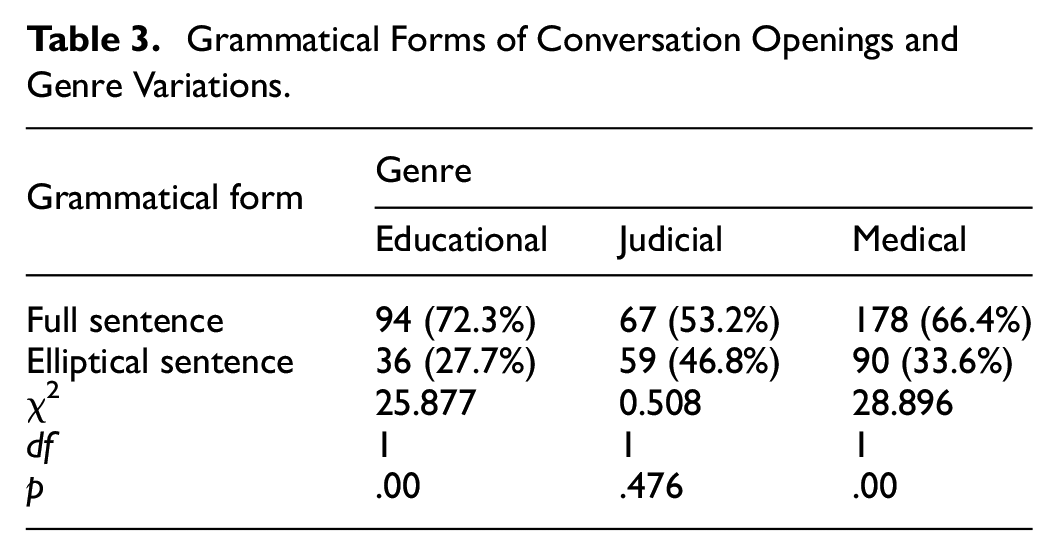
In judicial contexts, particularly in courts where efficacy is paramount, elliptical sentences are prevalent as they streamline communication by focusing on essential information. For instance, a speaker might ask “Name?” and receive the response “Charles McGill.” Conversely, medical settings prioritize clarity and details, exemplified by a doctor introducing herself with a full sentence “Sir, my name is Fiona Lomas, and I’m the trauma registrar.” In educational settings, conversations often start with full sentences like “How’s your first day of school going?” to ensure precise communication, essential for conveying instructions and imparting information.
That is to say, compared with the judicial setting, educational and medical settings have a clear preference for full sentences. Genre variations significantly influence the frequency of full and elliptical sentences in conversation openings, with judicial settings favoring efficiency through ellipsis, and medical and educational contexts prioritizing clarity with full sentences.
Influence of Contextual Factors on Grammatical Forms Openings
This study also examined the influence of contextual factors such as gender, familiarity, and social status on grammatical forms in conversation openings.
Table 4 demonstrates that gender and familiarity do not exhibit significant differences in the use of grammatical forms, with small effect sizes, indicating that gender and familiarity have a weak association with the use of ellipsis or full sentences. However, the percentage values still reveal subtle differences. Female speakers used more full tenseness than males in terms of proportion (67.0% vs. 63.3%). This preference is also observed among speakers who are acquainted with each other compared to those who are strangers (65.3% vs. 60.9%). For instance, men tend to use elliptical sentences “Hi, Vic.” while women might ask “How are you doing, Mia?” Strangers often start conversations with utterances like “Victor, right?,” whereas familiar interlocutors prefer full sentences like “Why did you say it’s a stoplight party?,” to convey messages more clearly.
Influence of Gender and Familiarity on Grammatical Forms of Conversation Openings.

Regarding social status, there are also no significant differences in the use of grammatical forms. However, a slight trend can be observed, with individuals of higher social status showing a slightly greater tendency to use full sentences (65.0% vs. 64.8% vs. 63.8%) (Table 5).
Influence of Social Status on Grammatical Forms of Conversation Openings.

Overall, the use of full and elliptical sentences is not significantly influenced by contextual factors. Comparatively, females, acquaintances, and speakers of higher social status prefer the use of full sentences, while males, strangers, and speakers of lower social status favor elliptical sentences.
Sentential Types in English Conversation Openings
Frequencies of Different Sentential Types
The Chi-square test results reveal significant differences in the types of sentences used in conversation openings (χ2 = 353.817, p = .00 < .001). Specifically, declaratives were the most frequently used sentential type, accounting for 275 instances (53% of all sentential types). For example, in medical settings, a doctor might open the conversation with “Sir, we’re going to clear your throat.” A declarative that conveys confidence and professionalism to the patient. Interrogatives were also common, with 194 instances (37%). However, opening a conversation with a question can sometimes lead to misunderstandings, as illustrated by a doctor’s question “Has anyone seen my cardie?” which went unanswered due to the context of a patient rescue. Imperatives and exclamatives were the least common, with 38 (7%) and 17 (3%) instances. In summary, declaratives and interrogatives dominate conversation openings, while imperatives and exclamatives are less frequently used.
Genre Variations in Sentential Types
Table 6 shows that genres do significantly influence the use of sentential types in English conversation openings. Though generally declaratives and interrogatives are the two most popular sentential types across the four genres, imperatives are more common in proportion than exclamatives in judicial and medical genres (9.5% > 5.6%, 8.2% > 1.5%). For example, imperatives like “Turn it off!” and “Scrub in, please” are used in these two genres to convey urgency and directness. Conversely, in educational settings, exclamatory sentences like “Congratulations!” are more common than imperatives, reflecting the genre’s focus on praise and encouragement.
Sentential Types of Conversation Openings and Genre Variations.

Influence of Contextual Factors on Sentential Types
Table 7 illustrates how contextual factors such as gender and familiarity influence the types of sentences used in conversation openings. The findings show that declaratives and interrogatives are the most frequently used sentential types across all contexts. Regardless of gender and familiarity, these two types remain dominant.
Influence of Gender and Familiarity on Sentential Types of Conversation Openings.

The Chi-square results presented in Table 7 reveal that gender and familiarity do not exhibit statistically significant differences (p > .05) in the use of sentential types. However, percentage-based trends suggest potential differences in the selection of sentential types. The lack of statistical significance may be attributed to an insufficient sample size, prompting the use of effect size tests. The effect size analysis reveals that the use of imperatives by males and females shows the strongest effect (V = 0.228), which is considered a moderate effect size, (0.1 < V < 0.3). Specifically, 8.5% of males employ imperative sentences, compared to only 5.3% of females, indicating that males are more likely to use imperative sentences. When examining the effect of familiarity on sentential types, exclamatives show a relatively larger effect size (V = 0.079) compared to other types. The use of exclamatives is higher when interacting with strangers (6.7%) than with acquaintances (2.7%). This pattern may reflect a conversational strategy employed by speakers to bridge the unfamiliarity and foster a more engaging and approachable tone when addressing strangers.
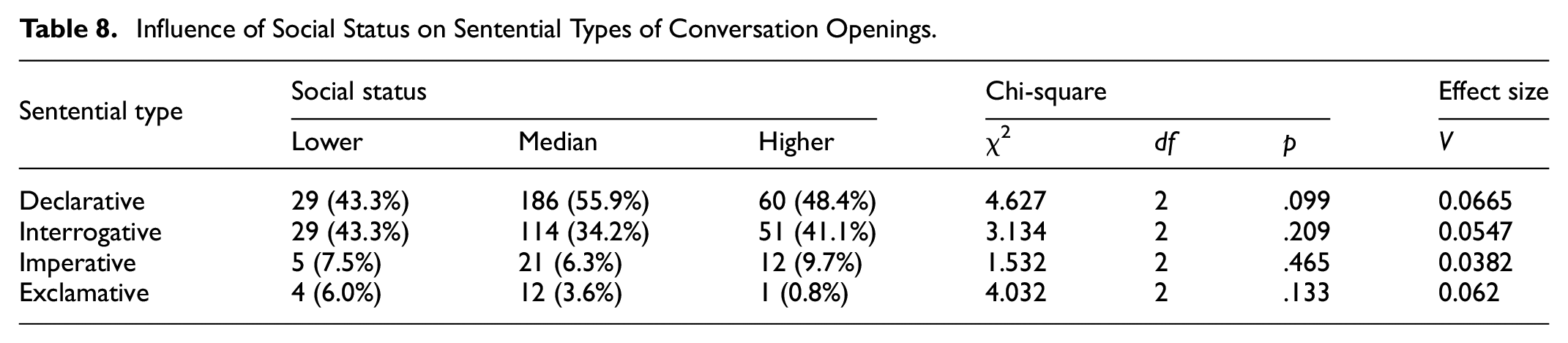
The influence of social status on sentential types, as shown in Table 8, indicates that declaratives (V = 0.0665) and exclamatives (V = 0.062) exhibit much larger effect sizes than other categories. For example, speakers of lower social status use exclamatives at a rate of 6.0%, possibly as a strategy to emphasize politeness and maintain a positive face in interactions with higher-status interlocutors.
Influence of Social Status on Sentential Types of Conversation Openings.
Semantic Categories in English Conversation Openings
Frequencies of Different Semantic Categories
Semantic categories in this study refer to the meaning orientations of the beginning parts of conversations. The Chi-square test results indicate a significant difference in the use of these three categories (χ2 = 157.469, p = .00 < .01). Other-oriented openings are the most frequent, with 310 instances (59%). For example, in “So, um, you make any friends?,” the speaker focuses on the listener’s experience. Self-oriented openings appear 111 times (21%), such as in “Here. I’m in a real rush,” where the speaker highlights his own experience in the opening part of the conversation. Neutral openings occur 103 times (20%), exemplified by “Hey, good work today.,” which lacks strong meaning orientations, neither the speaker nor the hearer being targeted.
The prevalence of other-oriented expressions can be attributed to their ability to foster warmth and empathy, often including inquiries about the listener’s well-being, expressions of gratitude, or acknowledgements of their presence, thus enhancing positive interpersonal relationships.
Genre Variations in Semantic Categories
This section examines how different genres influence the use of self-oriented, other-oriented, and neutral expressions in conversation openings. Table 9 demonstrates that there exist significant differences across all three genres (p = .000 < .01). That is to say, the three genres (i.e., educational, judicial, and medical) exhibit a marked preference for other-oriented expressions in conversation openings. The proportion of other-oriented expressions is significantly higher than that of self-oriented and neutral expressions.
Semantic Categories of Conversation Openings and Genre Variations.
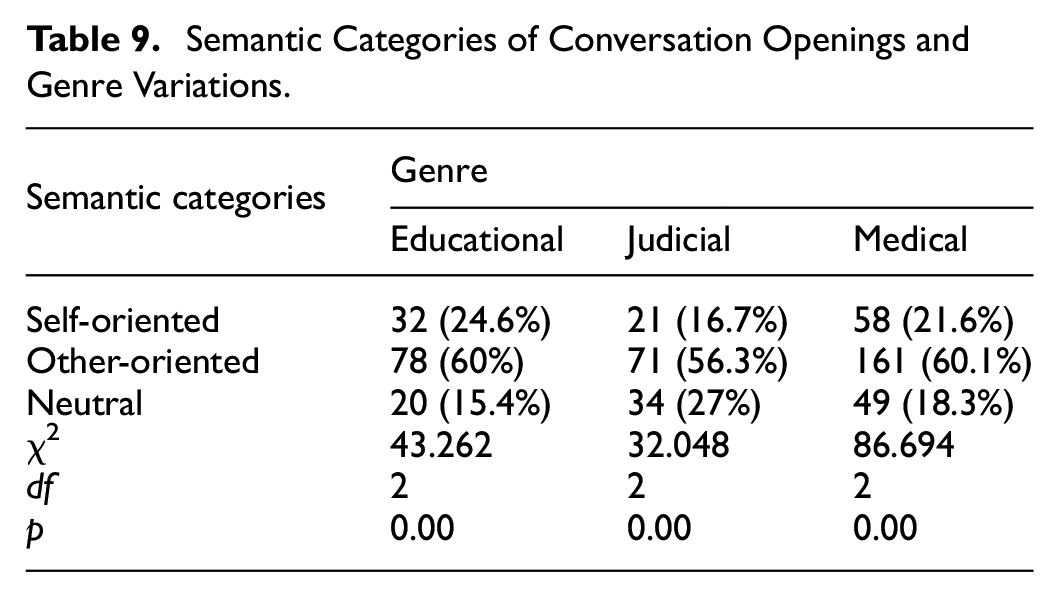
Although other-oriented expressions constitute the largest proportion across the three genres, the distribution of the remaining semantic categories varies. Both the educational and medical genres use neutral expressions the least, while in the judicial genre self-oriented openings are the least common. This may be due to the emphasis on maintaining objectivity and fairness in a legal setting. For instance, a lawyer might ask, “Where’s the doll?” during an interrogation to keep conversation neutral and focused on events, as noted by Black et al. (2023), who assert that neutral conversations enhance perceptions of the court’s legitimacy.
Influence of Contextual Factors on Semantic Categories
The p-values of Chi-square tests in Table 10 suggest that gender and familiarity exert some influence on the use of semantic categories in conversation openings. However, these differences are not statistically significant.
Influence of Gender and Familiarity on Semantic Categories of Conversation Openings.

Table 10 shows that the effect sizes of gender on the three semantic categories (i.e., self-oriented, other-oriented, and neutral) are 0.014, 0.04, and 0.034, respectively. The values are extremely modest (less than 0.1), indicating that gender has no major effect on semantic category selection. However, the effect size suggests that gender has a relatively higher influence on the use of the other-oriented category (V = 0.04). Females are more likely to use other-oriented expressions in conversation openings, whereas males tend to use self-oriented and neutral expressions. This indicates that female speakers are less inclined than male speakers to talk about themselves. Similarly, the effect sizes of familiarity (acquaintance vs. stranger) on the self-oriented, other-oriented, and neutral semantic categories are 0.04, 0.045, and 0.015, respectively. While these effect sizes are more than zero, they remain below 0.1, suggesting a modest relationship between familiarity and semantic category selection. The effect size indicates that familiarity influences the use of other-oriented expressions more prominently. Strangers are more likely to use self-oriented and neutral expressions, whereas acquaintances prefer other-oriented expressions. This pattern suggests that strangers are more inclined to introduce themselves than acquaintances.
The p-values of Chi-square tests in Table 11 indicate that social status does not have a statistically significant influence on the use of semantic categories in conversation openings. However, the effect sizes for social status on the semantic categories are 0.026, 0.047, and 0.054, respectively. These values, though modest, suggest that social status has a slightly greater influence on the selection of the neutral category.
Influence of Social Status on Semantic Categories of Conversation Openings.

Social Actions in English Conversation Openings
Frequencies of Different Social Actions
The study categorized social actions in conversation openings into 11 types: addressing, greeting, self-identification, other-identification, apology, compliment, command, offer, request, complaint, and others. After analysis, commands and offers, which were found quite infrequent, were thus included in the category of others. Consequently, only nine types of social actions were compared.
Typically, conversation openings consist of either one (88.57%) or two (10.72%) social actions each time, with a minor proportion involving three social actions (0.7%). For instance, “Lake, I’m so glad you came” encompasses three actions: greeting, addressing, and thanking. The highest proportion of social actions in conversation openings was requests (188, 35%). The distribution of other social actions from high to low is greeting (67, 12%), complaint (62, 12%), addressing (61, 11%), self-identification (27, 5%), apology (22, 4%), compliment (21, 4%), other-identification (10, 2%), and others (79, 15%).
Genre Variations in Social Actions
It is found that the distribution of social actions differs significantly across all three genres. That is to say, the social actions are not distributed evenly in conversation openings.
In educational settings, greetings (35, 24.8%) are the most prevalent. For instance, “Good morning, everyone.” and “Hi, new kid.” The frequent use of greetings in educational conversations reflects their importance in fostering a positive and conducive learning environment where interpersonal connections are paramount. In contrast, requests (116, 45.5%) dominate in judicial and medical genres.
Requests are also common in educational contexts, constituting 32 instances (22.7%). For example, “Hey Mia, would you wanna go on a date?” demonstrates the emphasis on politeness and specific permission in teacher-student and student-student interactions. In the judicial genre, complaints are relatively frequent, as exemplified by “What in the hell kind of math is that?” This prevalence is due to the high-stress nature of legal settings.
Addressing is notably common in medical conversations (29 instances, 20.6%), where respectful addressing can lead to better relationships and more effective communication.
The study also found that other-identification is least frequent in educational genres due to hierarchical structures, with teachers typically holding authority. Compliments are rare in judicial conversations, likely due to their serious nature. Apologies are infrequent in medical settings, as admitting errors conflicts with the pursuit of perfection in medication and creates a sense of vulnerability (Gallagher et al., 2006).
Influence of Contextual Factors on Social Actions
This section examines the influence of contextual factors on the use of social actions in English conversation openings.
The Chi-square test results show that gender does not have a statistically significant effect on the use of requests (p = .20 > .05). However, significant differences are observed in how males and females employ other social actions, such as addressing, greeting, self-identification, other-identification, apology, compliment, complaint, and others. While no significant gender difference exists in the use of requests, females utilize requests more frequently than males (42.5% vs. 30.6%). For example, a female doctor might ask, “Am I OK to cut?” This could be due to females being more risk-averse than males (C. H. Li & Zafar, 2023).
Familiarity also significantly influences the use of social actions during conversation openings, as speakers adjust their behavior according to distinct cultural norms and etiquette. When interacting with strangers, individuals are more likely to adhere to broader social standards, such as maintaining politeness and a respectful distance. For example, apologies are more common in interactions with strangers (5.7%) than with acquaintances (3.8%). Conversely, interactions with acquaintances are often characterized by a reliance on the exchange of information, leading to more direct and informal actions. For example, complaints are more prevalent among acquaintances (12.2%) than among strangers (8%).
The Chi-square test results demonstrate significant differences in the use of complaints among speakers of different social statuses in conversation openings, indicating that a speaker’s social status significantly influences use of complaints. In general, speakers with higher social status exhibit a higher frequency of complaint social actions (17%), while those with lower social status use them less frequently (4.6%).
However, no significant differences were found in the use of other social actions, including addressing, greeting, self-identification, other-identification, apology, compliment, request, and others. For example, when examining compliments, speakers of various social status groups (i.e., low, median, and high) express compliments at rates of 4.6%, 3.7%, and 4%, respectively, with little differences.
Discussions
The Characteristics of Grammatical Forms in English Conversation Openings
This study finds that the proportion of full sentences exceeds that of elliptical sentences in conversation openings, which aligns with previous research (Fernández & Ginzburg, 2002). Several factors contribute to this disparity. Elliptical responses are often perceived as less polite than full sentences (Clark & Schunk, 1980). Additionally, while elliptical sentences can enhance fluency and efficiency, they sometimes fail to convey complete information, thereby potentially hindering accurate comprehension (Gibson et al., 2019). Thus, the predominant use of full sentences at the beginning of conversations surpasses that of elliptical forms.
Significant differences in the use of full and elliptical sentences are observed across medical, educational, and judicial genres. In the medical and educational contexts, full sentences are preferred to ensure clarity for recipients lacking relevant expertise. In contrast, in judicial settings where fixed expressions or legal terms are prevalent, the use of elliptical sentences may be more common to convey legal concepts concisely and efficiently (Bergen & Goodman, 2015; Nykiel & Hawkins, 2020).
The study also reveals that gender, familiarity, and social status of speakers have no significant influence on the choice of grammatical forms in conversation openings, which is similar to previous research (A. B. Hancock and Rubin, 2015). Nonetheless, considering the effect sizes and percentage values in this study, there are still some correlations between gender and the use of different grammatical forms. Specifically, women tend to use more full sentences, while men use more ellipses than women. The analysis of effect sizes reveals that there is some correlation between familiarity and the use of grammatical forms. This finding supports the findings of De Stefani and Mondada (2018), which discover that acquaintances and strangers organize their social and spatial interactions differently, including differences in recognition, identification, greetings, and so on. This study discovers that acquaintances prefer to use full sentences, whereas strangers prefer to use elliptical sentences. The use of elliptical sentences is believed to be influenced by a preference for communication efficiency (Chia & Kaschak, 2024). Language users aim to convey information concisely while still enabling listeners to infer the intended meanings (Gibson et al., 2019). In interactions between strangers, while shared information might be limited, elliptical sentences are still preferred for the informality of daily dialogues. Thus, the choice between elliptical and full sentences depends on the communicative needs and formality of context. This result is similar to van de Weijer’s (2001) findings, which revealed that even in interactions with family or familiar persons, the use of ellipses accounts for about 30% to 40% and does not outnumber the percentage of full sentences. The proportion of full sentences is significantly higher, indicating that while elliptical sentences are frequent in conversation for efficiency, full sentences are still preferred for conveying complete information (Chia & Kaschak, 2024). Similarly, social status is also related to the choice of grammatical forms. This is consistent with Sodah (2019)’s findings. This study found that higher-status speakers prefer full sentences, while lower-status speakers tend to use elliptical sentences. This may be related to the differences in language awareness among speakers. In formal situations, people with higher social status may consider elliptical language as impolite. As a result, their language awareness makes them pay more attention to use more formal, standard language.
The Characteristics of Sentential Types in English Conversation Openings
This research indicates significant differences in the use of sentential types at conversation openings. Declarative and interrogative sentences are used more frequently, while imperative and exclamative sentences are less common. These findings align with the research of Saragih et al. (2023), which similarly demonstrates that declarative sentences occur most often in comparison to interrogatives, imperatives, and exclamatives, declarative sentences appear most frequently. This preference may be due to the assertive nature of declaratives, which effectively set the tone and direction of the conversation (Jary, 2020).
Genre variation significantly impacts sentential type usage. In the judicial and medical genres, imperative sentences are more prevalent, while in educational settings, exclamative sentences are more common. This discrepancy may be due to differences in genre requirements for language (McConnell-Ginet & Eckert, 2003). In judicial settings, lawyers and judges frequently ask other people to answer their questions, so imperatives prevail in this genre. Similarly, in medical settings, doctors frequently ask other people to help them during operations and in daily medical treatments, so imperatives are prevalent in medical settings. However, in educational settings, teachers frequently praise students to motivate their learning, so very common are the exclamatives.
Gender, familiarity, and social status have no significant influence on the use of sentential types at conversation openings. However, the analysis of effect sizes reveals that these factors are somewhat associated with the selection of sentential types. The effect size for males and females using imperatives was the strongest, indicating a slight gender difference in the use of imperatives. Specifically, males were found to be more likely to employ imperative sentences, a conclusion consistent with Gborsong’s (2016) findings. Similarly, West (1990) discovered that male doctors were more likely to employ imperatives than female doctors. This tendency may reflect a strategy by males to control the conversation’s direction and project authority. When analyzing the effect of familiarity on sentence types, exclamatives display a relatively large effect size. Strangers were observed to use exclamatives more frequently than acquaintances, often employing them to bridge social gaps and quickly establish rapport. In contrast, acquaintances tended to rely on less direct forms of expression. The effect size analysis also indicated a stronger relationship between social status and the use of declaratives and exclamatives. Speakers with lower social status were more likely to use exclamative sentences at conversation openings compared with those of higher social status. This tendency is often employed to enhance politeness and foster positive interpersonal relations.
The Characteristics of Semantic Categories in English Conversation Openings
Semantic categories at conversation openings are predominantly other-oriented, followed by self-oriented and neutral categories, indicating a focus on relationship-building (Linell, 1998; Schegloff, 2007). Self-oriented and neutral language behaviors are less common, as individuals typically avoid prioritizing their perspectives or maintaining a neutral tone to preserve the listener’s face (Hernández-Flores, 2008; Laver, 1981).
Genre variation significantly affects the usage of semantic categories. Other-oriented categories are most prevalent across all genres. In educational and medical genres, self-oriented categories rank second, aligning with the findings of J. T. Hancock et al. (2008). In the judicial genre, neutral sentences are more common than self-oriented ones, reflecting the need for objectivity and rationality (Black et al., 2023).
Contextual factors such as gender, familiarity, and social status have no significant influence on the choice of semantic categories according to the Chi-square results. However, the effect size analysis indicates these factors do impact the use of other-oriented expressions to a certain degree. Females are more likely to employ other-oriented expressions at conversational openings, while males tend to use self-oriented and neutral expressions. Previous research supports this finding; for instance, Coates (2015) observed that women are more inclined than men to use second-person referential pronouns. This tendency may explain why women favor other-oriented expressions, as they are more likely to consider others’ perspectives, focus on language choices, and foster emotional connections and social interaction. Familiarity has a greater influence on the choice of other-oriented expressions. Strangers predominantly use self-oriented and neutral expressions, whereas acquaintances favor other-oriented expressions. This finding aligns with earlier studies (Barnett et al., 2000; Tice et al., 1995). Strangers’ preference for self-oriented expressions may help mitigate the discomfort caused by social distance, reduce uncertainty, and facilitate mutual understanding.
The usage pattern typically follows other-oriented, self-oriented, and neutral categories. Regarding proportion, other-oriented expressions are found most popular in educational and medical settings, in which the conversations develop around the hearers. However, neutral expressions find their largest proportion in judicial settings, in which objectivity and impersonality are the pursuit of conversations.
The Characteristics of Social Actions in English Conversation Openings
This study found that speakers typically use one or two social actions at conversation openings, with three or more being quite rare. The request is the most common social action, whereas compliments and other-identifications are much less common in conversation openings.
Significant differences in social actions were observed across educational, judicial, and medical genres, supporting Grieve and Seebus’ (2008) findings that different conversation genres exhibit distinct conversational opening features. In educational settings, greetings are the most common, which serve a variety of purposes such as establishing social bonds, fostering community and involvement, and exhibiting communicative ability (Agyekum, 2008; Shields-Lysiak et al., 2020). In contrast, requests dominate in judicial and medical contexts. In the judicial genre, the frequent use of requests reflects the procedural nature of legal interactions. For example, Zimmerman (1992) notes that citizens frequently open conversations with requests (e.g., would you send the police to…). Similarly, in the medical genre, requests are prevalent as doctors collaborate through professional requests, or patients seek treatment or medication. Additionally, the medical genre often favors the action of addressing, where interlocutors directly name the hearer to maintain positive interpersonal relations and ensure communicative efficiency.
Speakers of different genders exhibit significant differences in the selection of social actions at conversation openings, particularly in addressing, greeting, self-identification, other-identification, apology, compliment, and complaint. However, no significant gender difference is observed in the use of requests. Although females appear to use requests more frequently than males, this difference is not statistically significant, contrasting with Önem’s (2016) findings on the influence of gender on request usage. This discrepancy may arise from the functional distinctions between requests in conversation openings and those in formal dialogues. In conversation openings, requests often serve as politeness strategies and casual connectors, following a conventional social script that diminishes the impact of gender traits. Familiarity also significantly affects the use of social actions during conversation openings, corroborating Koppen et al.’s (2019) study, which indicates that interlocutors with varying social distances exhibit different speech behaviors. Among acquaintances, shared backgrounds and mutual trust encourage the use of more direct social actions, such as complaints, and requests. Conversely, strangers tend to employ more polite and indirect social actions, including greetings and apologies. This pattern suggests that familiarity influences social actions at conversation openings. Social status does not significantly affect the use of social actions at conversation openings, except in the cases of complaints, which show a significant difference. This finding aligns with Jerger and Wirtz’s (2017) research, highlighting a close relationship between social status and complaint strategies. Individuals of higher social status, possessing greater power and resources, are more likely to use imperative or commanding expressions without concern for threatening the face of lower-status speakers. In contrast, speakers of lower social status tend to express dissatisfaction indirectly and tactfully.
Conclusions
The results of this study indicate that full sentences are more common than elliptical ones at conversation openings. Declarative and interrogative sentences are the most frequently used sentential types, followed by imperative and exclamatory forms. Speakers predominantly use other-oriented statements. The most common social actions are requests and greetings, with significant differences observed across grammatical forms, sentential types, semantic categories, and social actions. Various conversational genres and contextual factors, including gender, familiarity, and social status, significantly influence conversation openings. The findings not only expand our understanding of the features of conversation openings but also have great implications for English conversation education.
First, it is recommended that English teachers flexibly use conversation teaching materials that reflect the characteristics of natural, authentic conversations. For example, they could replace the unnatural or stilted conversation openings often found in textbooks with dialogue excerpts from TV dramas. At the same time, teachers should also be aware of the imperfections in natural dialogues, such as inappropriate openings, overlaps, and repairs, and adapt them as necessary to align with specific teaching objectives (M. Li & Xiao, 2024). Second, teachers should incorporate proper teaching methods into their lessons. They can guide students to transit from rote memorization of dialogues to engaging in real conversational exchanges. Activities like role-plays and situational simulations can be employed to teach essential conversational strategies, such as topic initiation, turn-taking, and appropriate responses. Third, teachers could create a resource repository of English conversations for students, categorizing and integrating materials from TV series to provide abundant conversational patterns to develop L2 learners’ conversational skills. Finally, curriculum designers are advised to include various real-life conversation genres in textbooks to help students understand how to adjust their conversation opening strategies to suit different contexts (e.g., professional settings, social situations).
However, this study has certain limitations. First, the corpus size is relatively small, comprising conversation openings from only three episodes of the first season of three English TV dramas. Future research should expand the corpus to include a broader range of English conversation openings from various contexts to enhance the universality and applicability of the findings. Building on the need for a larger and more diverse corpus, future research could also employ recording devices to capture authentic daily conversations from individuals of various ages, professions, and educational backgrounds in different contexts. Utilizing real-world natural language data could investigate the diversity and complexity of linguistic features in conversation openings. Second, the manual annotation method employed is somewhat subjective. Future research should adopt more objective and standardized annotation methods. Future research could adopt more objective and standardized annotation methods, fully utilizing artificial intelligence technologies. By training large language models for automated annotations, and combining this with manual verifications, it would enhance annotation efficiency while reducing the subjectivity inherent in manual annotations. This approach will ultimately improve the reliability and generalizability of the annotation results. Third, the selection of conversation openings prioritized the overall theme of the TV series rather than specific settings, leading to the inclusion of openings from broader contexts and potentially blurring contextual distinctions. Future research could address this by applying stricter context-based selection criteria to ensure a closer alignment with the central theme.
Footnotes

Funding
The author(s) disclosed receipt of the following financial support for the research, authorship, and/or publication of this article: This paper is sponsored by research grants from the Ministry of Education (22JJD740011) and Tianjin Municipal Education Commission (TJYG026) of the People’s Republic of China.
Declaration of Conflicting Interests
The author(s) declared no potential conflicts of interest with respect to the research, authorship, and/or publication of this article.
Data Availability Statement
Data sharing not applicable to this article as no datasets were generated or analyzed during the current study.