



Abstract
This study aimed to investigate the personal and contextual determinants affecting the employability perception of university students using a comprehensive model, and to compare the effects of these determinants with each other. The sample consisted of 463 university students from Turkish universities in İstanbul. Following explanatory and confirmatory analyses, the study variables were tested via hierarchical regression analysis. Across all variables, generic skills, academic performance, personal circumstances, and external labor market had significant and positive effects on the perception of employability, while students’ work experience and the contribution of university and consultants did not. The external labor market was identified as the strongest determinant of employability, and contextual factors were identified as having a stronger influence than personal ones. The results present a number of suggestions for stakeholders—including the Ministry of Education, university administrations, teaching staff, employers, students, families, media, and graduates—vis-à-vis perceived employability.
Keywords
Introduction
One of the most important factors a company needs to achieve a sustainable competitive advantage—and thus survive in dynamic, complex, and uncertain environmental conditions—is undoubtedly human capital. As businesses try to recruit individuals possessing the highest knowledge and skill levels for each position, students must make themselves more employable by cultivating the qualities these businesses need. Such qualities go beyond the academic to include the experience, knowledge and skills that the labor market demands, and universities play a critical role in their development. Although some 48 states and the European Commission have created Bologna Process initiatives for developing employability as it relates to the European higher education system, many concerns still prevail among employers, students, academics, higher education institutions, and governments (EHEA, 2020). According to research conducted by OECD countries, the number of employed graduates is not at a desired level, and the number of unemployed is increasing, despite the recent rise in the number of students attending higher education in some countries (Álvarez-González et al., 2017). It is often mentioned that the education received by college graduates is insufficient to meet job-related qualifications (Carroll & Tani, 2013). The concept of employability, which denotes the qualification to be hired in the various labor markets (Wittekind et al., 2010), has become a critical consideration for university students. While focusing on employability does not guarantee that the students will find the jobs they seek (McQuaid & Lindsay, 2005; Varheast & Van der Velden, 2013), it does give them the opportunity to acquire the skills that prospective employers demand (Rothwell et al., 2009), thereby increasing the likelihood of employment (Fugate et al., 2004). These skills are defined as the personal factors that determine the perception of employability (Rothwell et al., 2008), and are composed of the career development initiatives of the individual and their personal circumstances, such as networks, personality traits, and access to capital, as well as individual knowledge, skills, academic performance, and work experience.
There are also environmental factors that determine the perceptions of employability (Berntson et al., 2006). These factors consist of macroeconomic factors such as the labor market (Chou & Shen, 2012), and economic conditions (Qenani et al., 2014), as well as the university brand, the university’s academic program, the work experience provided by the university (Cabarello et al., 2015), and the impact of the teaching staff or consultant (Álvarez-González et al., 2017). Therefore, when examining the factors that determine the perceptions of employability, both individual and environmental factors need to be considered (Rothwell et al., 2008, 2009)
Several models and scales have been developed to investigate employability (Berntson et al., 2008; Rothwell et al., 2009). While many of the studies on perceptions of employability were conducted on employees (Álvarez-González et al., 2017; Kim et al., 2015; Wittekind et al., 2010), there are a limited number of empirical studies on the perceptions of employability of university students, which are somewhat inadequate (Álvarez-González et al., 2017). Some authors have suggested that future studies should analyze employability in a multidimensional way, to include individual and contextual factors (Berntson et al., 2006; Qenani et al., 2014). In addition, a limited number of scales have been used to measure students’ perceptions of employability (Álvarez-González et al., 2017), and some significant ones have been overlooked (Álvarez-González et al., 2017; Dacre & Sewell, 2007).
This study sought to test the factors affecting the perceptions of employability of university students within an integrated model, and to contribute to the literature by comparing the effects of personal and contextual factors. In this regard, many of the sub-factors that have been studied up to now on the perceptions of employability have been researched in an integrated model, and the main aspects of the effects of various personal and contextual factors on the perceptions of employability have been determined. Previous research has focused on factors affecting the perceptions of employability, but the effects of personal and contextual factors have not been clearly demonstrated.
This research consists of eight main parts. After the introduction, a brief review of the literature as well as personal and contextual factors are presented, followed by an explanation of the research methods and findings, and a discussion of the findings. Finally, a conclusion, implications of the study, the study’s limitations, and suggestions for future investigations are provided.
Literature Review
Concept of Employability and Its Antecedents
Although studies on the concept of employability date back to the early 1900s, employability has been seen as a timely reflection of the changing economy and public policies in the world since 1990 (McGrath, 2009). Accordingly, the concept of employability has been examined with interdisciplinary approaches from that year onward. Thus, studies in the literature on the concept of employability have focused on academic fields such as business administration, human resources management, educational sciences, and cognitive and social psychology (Van der Heijde & Van der Heijden, 2006). Moreover, researchers have examined the concept of employability and its determining factors in terms of human capital theory (Kim et al., 2015), social cognitive career theory (Chou & Shen, 2012), career development theory (De Guzman & Choi, 2013), and the career-focused approach (Van der Heijde & Van der Heijden, 2006). As such, the concept of employability plays a significant role at both the individual and organizational levels (Fugate et al., 2004).
Although there is a lack of concurrence on the definition of employability in the literature (Dacre et al., 2014), the most common definition pertains to an individual’s perception of their capacity to find a job, to keep the job they already possess, or to find a new, suitable, and fulfilling job, if necessary (Hillage & Pollard, 1998).
Most of the factors related to employability are theoretically researched (Finch et al., 2016), and the appropriate scales necessary to analyze these factors are also restricted (Dacre et al., 2014). Nevertheless, some research does exist that explains how employability occurs. Hillage and Pollard (1998) forwarded the notion that, theoretically, the concept of employability includes individual knowledge and skills as well as the labor market. According to Hillage and Pollard (1998), the capital that makes individuals employable is categorized according to their knowledge, skills, and attitudes such as reliability, self-discipline, communication, problem solving, teamwork ability, self-efficacy, and enterprise skills.
Knight and Yorke (2002) discussed the perception of employability from the viewpoint of cognitive and social psychology, suggesting the Understanding Skills-Efficacy Beliefs-Metacognition (USEM) model. They demonstrated that higher education institutions are one of the most important elements of the concept of employability, and in the guideline developed for the curriculum of these institutions, employability is a set of skills, understanding, and personal qualities that facilitate the graduates to acquire a profession and to be successful in their chosen profession.
According to Fugate et al. (2004), the employability is a socio-psychological structure consisting of a combination of elements such as career identity, personal adaptability, and social and human capital. Career identity combines employability and individual differences such as knowledge, skills, abilities, and dispositions that facilitate the identification and realization of career opportunities. Adaptable individuals can change their knowledge, skills, abilities, dispositions, and behaviors to satisfy the demands of the situation, and they are also eager for this change. Thus, employees with individual adaptability are more productive in the work domains and also more attractive to employers. Social capital is a concept that contributes to an individual’s employability through social networks. Strong social capital can provide employees with sufficient information flow and influence to access to career opportunities and reach their occupational goals. Similarly, another factor that enables employees to realize their career goals is human capital, which include characteristics such as age, education, work experience, job performance, tenure, emotional intelligence, and cognitive ability. Thus, investment in human capital bolsters the employability level of the employee by supporting their adaptability and disposition to learn continuously (Fugate et al., 2004).
McQuaid and Lindsay (2005) studied employability in a more comprehensive and multidimensional approach that takes into account the individual factors of employability such as knowledge, skills, and attitudes as well as contextual factors such as the labor market and employment policies. They examined employability according to three aspects: individual factors, personal circumstances, and external factors. While individual factors include employability skills and attitudes, demographic features, health status, job-seeking behaviors, compatibility, and job mobility, personal circumstances include a number of socio-economic factors related to the individual’s social and family circumstances such as social network and access to capital. Furthermore, external factors are factors that affect the employability of the individual, such as the labor market and macroeconomic factors.
Dacre and Sewell (2007) posited the Career EDGE model, which consists of career development effort, work experience, academic competence, generic skills, and emotional intelligence (Career EDGE Components: Career Development Learning; Experience; Degree Subject Knowledge, Understanding, and Skills; Generic Skills; and Emotional Intelligence). They explained employability in terms of self-efficacy, self-confidence, and self-esteem, and also used these concepts in scale development efforts. The components included in the model affect self-efficacy, self-confidence, and self-esteem, and thus employability.
Regarding empirical studies on the perceptions of employability of university students, Rothwell et al. (2008) developed the Self-Perceived Employability Scale, focusing specifically on students. Rothwell et al. (2008) stated that employability is related to an individual’s perception of their ability to get a new job or one that is better than their current job. Rothwell et al. (2008, 2009) expressed the perceived employability in scale development studies for the employability perception of university students and graduates in terms of the student’s/graduate’s self-belief, institutional perception toward university education, perception toward the department in which they study or the faculty with whom they study, and perceived external labor market dimensions.
Also, the perception of employability of the students in terms of demographic (major, gender, academic standing) and human capital (GPA and internship) factors, career development initiatives, and personality traits were studied by Qenani et al. (2014). It has been revealed that female students consider themselves less employable than male students. In terms of personality traits, outgoing and trusting students perceive themselves as more employable. Moreover, in addition to academic performance (GPA) and internships, field-specific technical skills and oral communication and critical thinking skills related to career development have a bolstering effect on the perception of employability.
In their more comprehensive model, Álvarez-González et al. (2017) recently suggested individual factors in terms of academic performance, personal conditions, and social networks; the generic skills of the students in terms of adaptation, expression, and emotional and negotiation skills; and environmental factors in terms of university environment, the contribution of the instructor, and the labor market.
The social cognitive career theory (SCTT), based on Bandura’s (2002) General social cognitive theory, suggests that self-perceived employability affects an individual’s career interest and behavior, and that self-perceived employability is a determinant of an individual’s ability to find a job (Álvarez-González et al., 2017). This theory has introduced many cognitive personality variables related to the individual and environmental factors affecting an individual’s career development (Lent et al., 2000). For this reason, some authors (Fugate et al., 2004; Rothwell et al., 2008) emphasized that both individual and contextual factors must be considered to understand self-perceived employability.
Personal Factors
Personal factors are conditions that facilitate individual employment and issues related to an individual’s perception of the inner world (Álvarez-González et al., 2017). Research has examined personal factors in terms of human capital factors and circumstances of graduates.
The theory of human capital suggests that the capital an individual possesses—that is, their qualifications, knowledge, skills, and experience—is likely to boost their business productivity or future income (Becker, 1993). Wittekind et al. (2010) explain the impact of individual qualifications on the perception of employability through human capital theory. Human capital is the cognitive ability, generic skills, academic performance, work experience, and so on that can be effective in an individual’s career development (Fugate et al., 2004). Although human capital plays a key role in the employability of new graduates, it does not guarantee them a job; in addition, there are some generally recognized qualifications—for example, problem solving, teamwork and negotiation abilities, and adaptability—that the business world expects graduates to possess (Clark, 2017). Two of the strongest determinants of human capital are an individual’s work experience and academic education (Berntson et al., 2006). In this study, students’ capital was examined with regard to three sub-factors: generic skills, academic performance, and work experience.
Generic skills (Soft/Transferrable Skills) are skills that do not require technical knowledge and ability, but are necessary and transferable for each job (Van der Heijde & Van der Heijden, 2006). Many competences—such as self-statement, adaptation, problem solving, and emotional intelligence—are assessed as generic skills (Dacre et al., 2014). According to Finch et al.’s (2016) exploratory study of university students, generic skills play a key role in employability. However, there is no consensus in the literature about what constitutes those skills, although it has been demonstrated that teamwork skills, in particular, are commonly emphasized by many authors (Tymon, 2013). Also, entrepreneurial ability (Dacre & Sewell, 2007) includes generic skills such as emotional intelligence (Knight & Yorke, 2002), creativity, adaptability, and the desire for learning, which are some of the skills that many businesses look for in graduates during the recruitment process. Accordingly, this study analyzed the following generic skills: teamwork, emotional intelligence, and entrepreneurial skills.
Teamwork ability improves an individual’s ability to participate in different working groups within or outside the organization, performance, and organizational citizenship behavior (Van der Heijde & Van der Heijden, 2006). Therefore, teamwork is one of the core interactive attributes preferred by employers, in addition to communication and interpersonal skills (Harvey, 1999).
Emotional intelligence is the ability of an individual to perceive their own emotions and those of others so as to motivate themselves and manage their emotions within themselves and in their relationships (Goleman, 1998). Individuals with high levels of emotional intelligence better motivate themselves and others to accomplish more; they have stronger personal relationships, and their careers are more successful. Moreover, Jaeger (2003) revealed that emotional intelligence can be developed by education and training in higher education institutions, and that it has a positive correlation with academic achievement. So, individuals are to have a developed emotional intelligence competency such to manage their employability potential (Dacre & Sewell, 2007).
Entrepreneurial individuals can overcome challenges and problems by developing creative and new ideas, and by taking the initiative to manage things with sufficient flexibility. In addition, they can manage change and easily adapt to developments occurring in their environment (Karlsson & Moberg, 2013). Entrepreneurial graduates are regarded as being more employable than those without enterprise skills and are more greatly preferred by employers. Thus, students’ entrepreneurship skills are to be improved by higher education institutions through educational programs (Bell, 2016).
Academic performance is the self-perceived satisfaction of the students that is developed through the results and grades earned during the course of their college education (Dacre et al., 2014). Students’ academic success is considered to be one of the factors affecting the perceptions of employability (Rothwell et al., 2008). Qenani et al. (2014) emphasized the contribution of academic achievement to self-confidence and thus to the employability of students. Moreover, academic performance is a significant criterion linked to perceived employability (Ng et al., 2010), and is likely applied by employers in the recruitment process.
Work experience prior to graduation can be gained via informal methods, such as part-time work, or within a specific curriculum framework, such as internships (Finch et al., 2013). In their research, Gault et al. (2000) found that new graduates who had participated in internships were more skilled and had higher levels of job satisfaction. Also, according to Andrews and Higson (2008), employers preferred new graduates with work experience. Thus, work experience has a significant effect on employability by developing students’ general abilities and preparing them for employment in the business world.
Personal circumstances are variables related to the social and family conditions that may affect the employability of university students, and the effect of personal circumstances on self-perceived employability has been studied at the theoretical level (McQuaid & Lindsay, 2005). The geographical mobility conditions of the students, flexible working hours, social networks, and access to financial capital can be evaluated in terms of personal circumstances. Accordingly, this study analyzed the following personal circumstances: access to capital and social network.
In this context, one of the most important steps for graduates to take in starting a new job is accessing capital (McQuaid & Lindsay, 2005; Sesen, 2012). Access to capital includes family income level, access to formal and informal financial resources, and budget management. These can affect an individual’s willingness and ability to take advantage of employment opportunities in the labor market (McQuaid & Lindsay, 2005). Therefore, McQuaid and Lindsay (2005) suggested that access to capital is one of the important predictors of employability. Also, it has been estimated that new graduates’ acquisition of such capital—whether through family, friends, business partnerships, or financial institutions—will have a positive impact on their entrepreneurial intention (Sesen, 2012) and, therefore, will very likely impact perceptions of their employability.
Beneficial personal connections or social networks (Fugate et al., 2004) during the recruitment process play an active role in students’ employability and in employees’ career development (Rothwell & Arnold, 2007). Social networks facilitate the career development and job search process of the individual (Álvarez-González et al., 2017). As such, social networks have a bolstering effect on both the employability of students and the career success of employees, as they directly affect the decisions and career processes of individuals (Lent et al., 2000; Rothwell & Arnold, 2007).
Against this background, the following hypotheses were developed by considering that the human capital and personal circumstances constituting the personality factors of the university students will be significantly related to their perceived employability:
Contextual Factors
Fugate et al. (2004) and Rothwell et al. (2008, 2009) highlighted the importance of contextual and personal factors in explaining perceived employability. According to Clarke (2017), perceived employability includes the employability characteristics of an individual in terms of the labor market and economic status. In research studies on university students, contextual factors have been examined regarding the perceived external labor market (Álvarez-González et al., 2017; Rothwell et al., 2008, 2009), reputation of the university/brand awareness (Álvarez-González et al., 2017; Finch et al., 2013), and impact of the instructor/consultant (Álvarez-González et al., 2017).
According to the dual labor market theory, labor market conditions are important determinants of employability (Berntson et al., 2006). Qualified workers, defined as core workers in the dual labor market paradigm (i.e., working full-time or part-time with a contract), are more preferred by employers and therefore more employable. On the other hand, it is highly likely that the peripheral workers who were defined as having relatively low educational levels and temporary workers will be less employable (Berntson et al., 2006). Perceived employability is based on the structure, conditions, and characteristics of the labor market (Hillage & Pollard, 1998), and individuals’ knowledge of this market (Wittekind et al., 2010). McQuaid and Lindsay (2005) described labor market factors as local and/or regional labor demand, qualifications required in the workforce, vacancies, sectors with high demand for labor, employers’ priorities and actions, and so on. Although the labor market has been studied theoretically in the literature (McQuaid & Lindsay, 2005), little has been done empirically (Álvarez-González et al., 2017; Berntson et al., 2006). The only study on university students belongs to Rothwell et al. (2008), who considered the external labor market as a dimension of self-perceived employability in their scale development study. Certainly, self-perceived employability would be high for those students who can recognize and understand the external labor market conditions as well as market opportunities.
Institutional brand perception by students, academics, parents, and even the business world are among the inevitable determinants of perceived employability, along with the universities’ educational programs. Findings indicate that university or faculty member reputation is positively related to graduates’ employment (Chevalier & Conlon, 2003). In addition, researchers have claimed that the titles of college programs (graduate, doctoral degree, etc.) affect the self-perceived employability of their graduates (Finch et al., 2013), as do the universities themselves and university ranking systems such as the Forbes Top Colleges List (Alessandri et al., 2006). In fact, the factor that bestows this brand or title on universities is their educational programs, which ultimately bring students to the business world. It is inevitable that perceived employability will be determined by universities’ curricular (Qenani et al., 2014) or extracurricular activities (Pinto & Ramalheria, 2017). Such educational programs or activities, which prepare the students for life in the business world, include teamwork, leadership, flexibility, entrepreneurship, communication, and job interviewing and CV preparation skills. (Cabarello et al., 2015). Thus, in this study, the contribution of the university was investigated in terms of its brand and curriculum dimensions.
The contribution of the academic consultant refers to the students’ perception of advisors’ guidance and counseling, both academically and in relation to the labor market. This role contributes to the development of a set of knowledge, skills, and attributes necessary for employment (Tsui et al., 1997). Thus, teaching staff or consultant performance plays an important role in developing students’ competence in relation to employability (Álvarez-González et al., 2017). As revealed by Tsui et al. (1997), managers or consultants impact the employability of employees. In the one study specifically focused on university students (Álvarez-González et al., 2017), lecturer performance was found to positively affect students’ perceived employability.
Accordingly, the following three hypotheses were developed to consider university students’ contextual factors—covering the labor market, university contribution, and impact of the academic consultant—as being significantly related to perceived employability:
Relative Impact of Personal and Contextual Factors
Both personal and contextual factors must be taken into account when attempting to understand the perception of employability (Fugate et al., 2004). Qenani et al. (2014) revealed that while the most important factor influencing university students’ perception of employability is internship experience, there is no effect of economic conditions. However, the effects of personal and contextual factors in the literature have not yet been compared using a comprehensive approach. Berntson et al. (2006) stated that in terms of the predictors of perceived employability, the relative impact of human capital variables is larger than that of dual labor market factors. With this viewpoint, we assumed personal factors to be more effective and postulated the following hypothesis:
In light of the above-mentioned theoretical information, a comprehensive, hypothetical model was developed. It includes many of the sub-factors studied thus far that impact students’ self-perceived employability (Figure 1).

Hypothetical model.
Method
Sample
Data were collected via survey in the fall terms of 2019 and comprised a random sample of 500 university students in İstanbul, Turkey. Participants were interviewed face to face and online. Students were from business administration, law, and engineering programs. All participants were informed of the research purposes and given the same assurances of data confidentiality. After deleting incomplete and incorrectly filled-out questionnaires, a total of 463 responses remained. The demographic features of the sample are shown in Table 1.
Demographic Features of the Sample.

Scales
The research survey consisted of a 34-item questionnaire that included demographic features and perceived employability; generic skills, academic performance, work experience, and personal circumstances as personal factors; and university contribution, academic consultant, and external labor market as contextual factors. All variables were measured via a 7-point Likert-type scale, ranging from 1 = almost disagree to 7 = totally agree. The scales were designed with higher scores indicating stronger intentions to variables.
Perceived employability
A three-item scale was used for measuring perceived employability. The scale was used by Wittekind et al. (2010) to measure the employability of employees and was adapted by Álvarez-González et al. (2017) for university students—for example, “After graduation I can easily find a job in my field.” Cronbach’s alpha coefficient for the scale was .76.
Generic skills
Generic skills were measured in terms of three skills: teamwork, emotional intelligence, and entrepreneurial skills.
Teamworking was measured via three items extracted from Wang et al. (2009)’s teamwork scale—for example, “I can collaborate with other students in school.” Cronbach’s alpha coefficient for the scale was .70.
Emotional Intelligence was measured via two items extracted from the scale developed by Dacre et al. (2014). They developed this scale to explore the Career EDGE employability model— for example, “I can share my emotions with others.” Cronbach’s alpha coefficient for the scale was .70.
Entrepreneurial ability was measured with three items extracted from the six-item scale developed by Liñán and Chen (2009) and was adapted by Sesen (2012) for university students— for example, “I can make all kinds of effort to start and maintain my own business.” Cronbach’s alpha coefficient for the scale was .78.
Academic performance
Academic performance was measured by three items taken from the 16-item employability scale of Rothwell et al. (2008) as concerns university students— for example, “Academic performance is privileged for my career aims.” Cronbach’s alpha coefficient for the scale was .85.
Work experience
Work experience was measured by two items extracted from the scale developed by Dacre et al. (2014)— for example, “I have a lot of work-relevant experience.” Cronbach’s alpha coefficient for the scale was .79.
Personal circumstances
Personal circumstances were measured in terms of two factors related to access to capital and social networks.
Access to capital was measured with a three-item scale developed by Kristiansen and Indarti (2004)—for example, “I can find capital if I want to start a business.” Cronbach’s alpha coefficient for the scale was .90.
Social network was measured by using a two-item scale taken from Álvarez-González et al. (2017). This scale was used by Rothwell and Arnold (2007) as concerns employees and was adapted by Álvarez-González et al. (2017) for university students—for example, “I have personal relations (family, close relatives, friends, etc.) that will make it easier for me to find a job.” Cronbach’s alpha coefficient for the scale was .86.
University contribution
The contribution of university environment was measured using two factors related to university brand and curriculum.
University brand was measured via five items taken from the 16-item employability scale of Rothwell et al. (2008) as concerns university students—for example, “Employers are eager to employ graduates from my university.” Cronbach’s alpha coefficient for the scale was .86.
University curriculum was measured by four items taken from the scale developed by Cabarello et al. (2015)—for example, “Courses to prepare students for the business world are given (preparation for job interviews, CV preparation, etc.).” Cronbach’s alpha coefficient for the scale was .85.
Academic consultant
The contribution of academic consultants was measured by a three-item scale developed by Álvarez-González et al. (2017) for university students—for example, “My academic advisor generally helps me.” Cronbach’s alpha coefficient for the scale was .92.
External Labor Market
External Labor Market was measured by using three items taken from the 16-item employability scale of Rothwell et al. (2008) as concerns university students—for example, “Students in my department have a lot of demand in the labor market.” Cronbach’s alpha coefficient for the scale was .77.
Control variables
According to the literature on perceived employability, as control variables, gender, income, maternal and paternal education levels, and academic standing affect perceived employability. Hence, these variables were included in the study as control variables so as to minimize the inconsistency of the results. Also, all were found to be significantly correlated with perceived employability.
Findings
Data were evaluated using SPSS 23 and AMOS 18 programs in three stages. First, we validated the proposed scales through checking psychometric properties. Second, the structural model was calculated to ensure how the model fits our data through CFA (Hair et al., 2010). Finally, hypotheses and effects of independent variables were analyzed by hierarchical regression analyses.
Exploratory factor analysis
Exploratory factor analysis (EFA) was carried out using the Varimax technique with the principal component analysis method to analyze the structural validity of the scales. As a result of the analysis, the Kaiser–Meyer–Olkin (KMO) test results (0.813) were greater than 0.7, and the sample size of the Bartlett sphericity test, χ2(595) = 9,966.582, p < .001, demonstrated that the data were convenient for factor analysis.
Regarding unidimensionality, it was determined that self-values of variables were above 1, the total explained variance was 75.805%, and communalities were above 0.50 (Hair et al., 2010). As Table 2 indicates, the generic skills scale covers three factors (Teamworking, Emotional Intelligence, and Entrepreneurial Intentions), and the university variable comprises two factors (University Brand and Curriculum) in a manner consistent with the literature. Although personal circumstances comprise two factors (access to capital and social networks), as mentioned in the theoretical background above, it is collected under a unidimensional structure.
Results of Validity and Reliability Analyses.

Notes. CR = composite reliability; AVE = average variance extracted.
To ensure scale reliability, since Cronbach’s alpha coefficients were above .70, the results confirmed reliability (Sürücü & Maslakçı, 2020).
Regarding convergent validity, because all factor loads are meaningful and above 0.5 (Hildebrandt, 1987), the average explained variance (AVE) values of the variables are over 0.5, and composite reliability (CR) value is greater than the average explained variance (AVE), the relevant scales have convergent validity (Hair et al., 2010). The results presented in Table 2 verify this validity.
For discriminant validity, correlations between variables are beneath 0.8 (Hair et al., 2010), and the square of the correlation between each variable does not exceed AVE (Fornell & Larcker, 1981). So, the results indicate discriminant validity.
Confirmatory factor analysis
Confirmatory factor analysis (CFA) was carried out through AMOS 18 software to verify the construct validity of the hypothetical model. Maximum likelihood estimation on covariance was carried out, all of the study variables were tested, and the model had a good fit. These results indicate that the recommended model is compatible and acceptable with the data (Table 3).
Results of Confirmatory Factor Analysis.

Notes. GFI = Goodness of Fit Index; CFI = Comparative Fit Index; TLI = Tucker–Lewis Index; IFI = Incremental Fit Index; RMSEA = root mean square error of approximation.
Correlation analysis
Table 4 shows the means and standard deviations of the variables, and two-sided correlation coefficients. There were significant positive relations between perceived employability and other variables, and the external labor market had the strongest relation with perceived employability (r = .55, p < .01).
M, SD, and Correlation Coefficients.
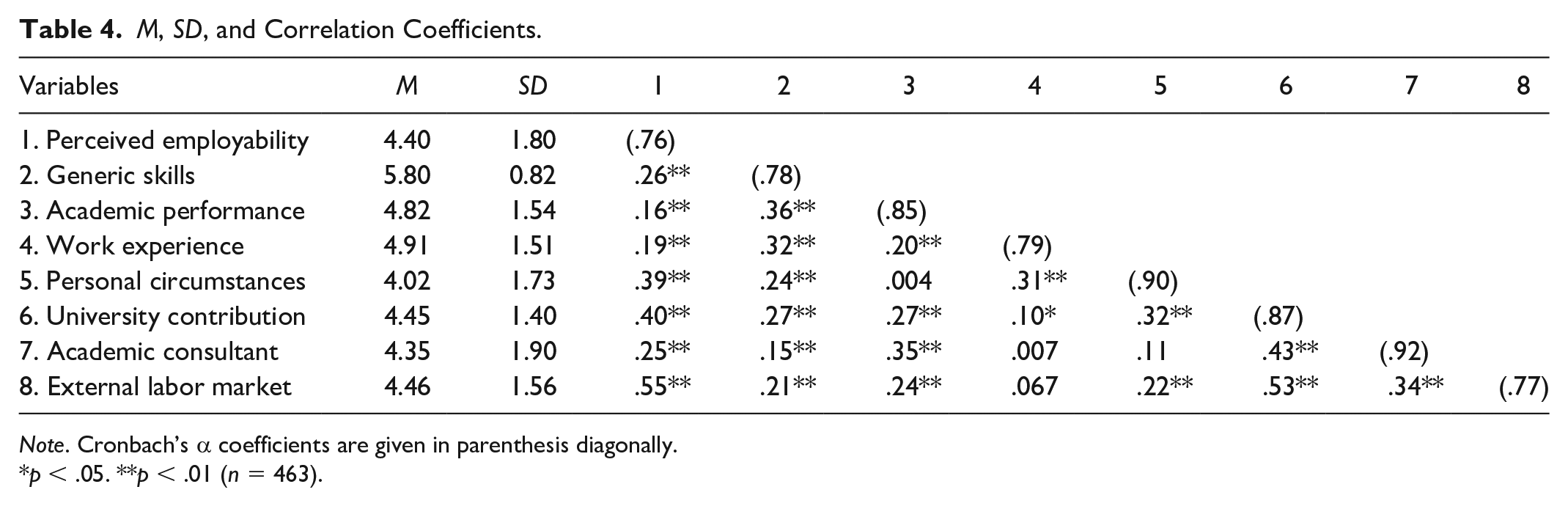
Note. Cronbach’s α coefficients are given in parenthesis diagonally.
p < .05. **p < .01 (n = 463).
Hierarchical regression analysis
Personal factors
As presented in Table 5, hypotheses and the effects of independent variables were tested by hierarchical regression analyses. Model 1 consists of demographic variables covering gender, income, maternal and paternal education level, and academic standing. Model 2 added generic skills (Team ability, EQ, and Entrepreneurial Skill), Academic Performance, Work Experience, and Personal Circumstances as personal factors, and in Model 3, University Contribution (University Brand and Curriculum), Academic Consultant, and External Labor Market as contextual factors were entered.
Hierarchical Regression Coefficients.

Notes. All columns are standardized β values.
p < .05. **p < .01 (n = 463).
H1 states that generic skills have a significant and positive relation with the perceived employability of students. Since generic skills are a significant part of every job (Van der Heijde & Van der Heijden, 2006), they need to be considered in the recruitment process. As expected, the results demonstrated that generic skills have a significant impact on perceived employability of students (β = .166, p < .01). So, H1 is supported.
H2 states that academic performance is significantly and positively related to the perceived employability of students. Academic success can contribute to self-belief and thus the employability of students. The results showed that academic performance has a significant impact on perceived employability of students (β = .108, p < .01). Thus, H2 is supported.
H3 states that work experience has a significant and positive relation with perceived employability. The work experience gained by informal methods such as part-time work or internships may be more preferable at the time of recruitment. Nevertheless, the results did not confirm this hypothesis; the impact of work experience on the perceived employability was not significant (β = .013, p > .05). Thus, H3 is rejected.
H4 postulates a significant and positive relation between the university students’ circumstances and perceptions of employability. Students’ circumstances such as network and capital are beneficial for employment and also for the career development process. Findings indicate that there is significant impact of students’ circumstances (β = .283, p < .01). So, H4 is supported.
Contextual factors
H5 states a significant and positive correlation between university contribution and perceived employability. The university brand and curricular and/or extracurricular programs are among the inevitable determinants of the perceived employability of students, and are also likely to be so in the eyes of parents, academics, and the business world. Nevertheless, the findings did not support the hypothesis (β = −.002, p > .05). Ultimately, H5 is rejected.
H6 postulates that consultants have a significant and positive relation with perceived employability. The teaching staff or academic consultant has a crucial role in developing the competence of employability. Nonetheless, the conclusion did not confirm the hypothesis (β = .073, p > .05). So, H6 is rejected.
H7 attests there is positive relation between perceived external labor market and perceived employability. Labor market conditions are a significant factor of employability according to the dual labor market theory. Correspondingly, the findings showed a significant relation with perceived employability (β = .440, p < .01). So, H7 is supported.
Finally, H8 states the effect of personal factors on perceived employability will be stronger than that of contextual ones. As presented in Table 5, demographic variables explained 11.5% (F = 11.840, p < .01) of the variance in perceived employability of students. However, personal factors (especially generic skills, academic performance, and students’ circumstances) explained 14.3% (F = 21.747, p < .01) extra variance, while the contextual variables (particularly external labor market) were higher at 18.7% (F = 50.485, p < .01). Thus, contextual factors have a stronger effect than personal factors. So, H8 is rejected.
When all independent variables were entered into the regression, income (β = .194, p < .01), generic skills (β = .110, p < .01), students’ circumstances (β = .178, p < .01), and external labor market (β = .440, p < .01) significantly and positively impacted perceived employability. It was determined that all independent variables explain the 44.4% variance in perceived employability of students.
Discussion
The aim of this research was to explain the strengths of the determinants affecting the perception of employability of students and to contribute to the literature by comparing the impacts of personal and contextual factors via a comprehensive model.
Although the results pointed out that personal factors such as generic skills, academic performance, and students’ circumstances, and contextual factors such as external labor market, had a significant and positive impact on the perception of employability, students’ work experience and the contribution of university and academic consultants did not. Accordingly, this study produced a number of important findings regarding the perception of employability.
Regarding personal factors, generic skills are the skills, abilities, and attributes that are often required in the many work environments in which graduates operate throughout their lives. Academic success alone is no longer sufficient for undergraduates’ employment, so it is believed that generic skills might facilitate undergraduates to succeed in both academic and occupational aims following graduation (Finch et al., 2013). These skills incorporate many competencies such as teamwork, emotional intelligence, entrepreneurial ability, adaptability, creativity, and communication skills (Tymon, 2013). Much research demonstrates that graduates who display generic skills are seen as being more attractive to potential employers and are also more employable (Finch et al., 2016). Accordingly, the available findings regarding generic skills coincide with other studies that have suggested the key role of generic skills in both the career development process and employability.
Academic performance is seen as a concrete and easily measurable assessment criterion that employers generally consider in the recruitment process (Ng et al., 2010). Therefore, GPA gives many important clues about the candidate in the recruitment process and is an important indicator for the employability of the graduate (Finch et al., 2013). In addition, students displaying a high academic performance have greater career-related expectations and motivations than those who display low academic performance (Ng et al., 2010). Research has also shown that high GPA and academic achievement are associated with higher job performance (Vinchur et al., 1998). Based on the findings we obtained in accordance with the literature, we conclude that the academic performance of the undergraduates is closely linked to perceived employability and is likely to be highly prized by employers in the recruitment process.
Previous studies have shown that work experience strengthens students’ self-confidence in making careers decisions, and contributes to their exploration of future job opportunities and gaining of knowledge and experience (Qenani et al., 2014). Therefore, pre-graduate work experience can reduce the effects of structural unemployment that result from educational inconsistencies and employment policies directed toward the young workforce. Also, in one study of graduates, it was determined that the graduates who completed internships possess greater job satisfaction and job-related skills (Finch et al., 2013; Gault et al., 2000). Accordingly, pre-graduate experience plays a key role in developing the preparation and achievement of undergraduates in the entry-level labor market (Gault et al., 2000). Similarly, in a study investigating the employability aspect of graduates and employers, findings demonstrate that employers attach great importance to the work experience of graduates and view this as an indicator of their readiness for the business world (Andrews & Higson, 2008). However, the findings for this study pointed out that work experience carries no significant effect for the students. Despite the many benefits of internship programs for undergraduates and higher education institutions, they are not without pitfalls, as pre-graduate work experience programs can draw away from a student’s academic pursuits as well as damage the university’s image. As highlighted by Kuzgun (2013), the legal framework for internships may be inadequate, as employers do not choose to employ graduates temporarily due to indirect costs. Moreover, employers view students as part of a semi-qualified, cheap workforce necessary to performing daily office work (Kuzgun, 2013). This may result in students’ failure to realize the importance of gaining work experience before graduation.
Students’ personal circumstances in terms of access to financial capital and social networks may affect their career decisions, employment-related skills, and aspirations after graduation (McQuaid & Lindsay, 2005). It has been claimed that social capital—related to personal and family-supported networks and formal or informal connections—are very effective and facilitating in the job search process (McQuaid & Lindsay, 2005). Many senior managers obtain jobs mostly via informal networks, so social capital has a positive effect on human capital and hence employability of individual (Fugate et al., 2004). Moreover, social capital affects the perception of employability by being included in the career identity of the individual. (Fugate et al., 2004). Also, accessing capital through family income, formal or informal financial resources, etc., is regarded as one of the most important steps of an individual starting a new job (McQuaid & Lindsay, 2005). In addition, financial capital encourages students by supporting their self-confidence and entrepreneurial intention (Sesen, 2012) before joining the business world. In this respect, the personal circumstances of the undergraduates we investigated as concerns access to capital and social networks concur with the approaches mentioned above, and hence successfully predict the perceived employability of students.
With regard to contextual factors, external labor market was determined to be the factor having the strongest impact, as external labor market conditions were found to create a significant effect on university students. Investigating the perceived employability of undergraduates, Rothwell et al. (2008) suggested the importance of the external labor market as well as university brand and demand for the degree subject within the scope of external factors. Students’ awareness of the external labor market, the demand for the academic field in the labor market, and the student’s awareness of opportunities in the labor market are some of the crucial contextual determinants that affect the perception of employability (Rothwell et al., 2008). In addition, decisions regarding the employment of workforce candidates are affected by demand factors such as the local and/or regional labor demand in the labor market, the qualifications required in the labor force, vacancies, sectors with high demand for the labor force, and the priorities and actions of the employers (McQuaid & Lindsay, 2005). Therefore, labor market opportunities and constrictions are vital when determining employability (Berntson et al., 2006). Hence, our findings, supporting previous research, demonstrated that external labor market conditions have a large impact on the perceived employability of undergraduates.
Universities are crucial institutions that provide students with the necessary competencies for entering the business world, thanks to their curriculum (Cabarello et al., 2015). Universities fulfill this mission by contributing students with the generic and occupational skills, knowledge, and attributes required for the labor market (Cabarello et al., 2015; Qenani et al., 2014). Moreover, universities create important career opportunities by bringing students together with important employers of the business world via activities such as business forums, workshops, and seminars (Cabarello et al., 2015). Such activities not only provide important chances for students to build up needed social networks, they also strengthen students’ awareness of post-graduation job opportunities. However, according to research findings, it was discovered that the university environment has no impact on students’ perceived employability. In other words, the idea that perceived quality in relation to university education should contribute to the employability of students was not supported in the Turkish context. The expected social benefits from the realities of Turkey and strategies for the schooling process could not be achieved sufficiently (Uysal & Aydemir, 2016). Also, criticism about the human capital development function of higher education is rising due to the differences between the content of the courses taught by the faculty and college programs of universities and market demands. In the Turkey University Satisfaction Survey, which was carried out to investigate the level of satisfaction of the students of the universities, it was concluded that the universities could not reach the students and meet their expectations, and that the support systems and culture in the universities were not sufficient to solve the students’ career, development, academic, and social problems (Karadağ & Yücel, 2019). In addition, while many reputable universities incorporate students’ concerns, the gap—or so-called “expectation trap”—between the high expectations of students for future employment and the contribution of universities in this regard is disappointing (Karadağ & Yücel, 2019). So, universities may be perceived as insufficiently meeting student expectations and demands related to employability skills, or in being sensitive to these demands.
An academic advisor can contribute to employability by providing feedback to students during the educational process (Álvarez-González et al., 2017). In terms of mutual benefits, teachers can act as mediators in the labor market between students and graduates, and share their experience; for their part, students can make inquiries and obtain information about the jobs they are interested in. As the teaching staff encourages their students in terms of the business protocol strategy suggested by Cabarello et al. (2015), they can help students to develop generic skills such as communication, negotiation, and leadership (Maxwell et al., 2010). However, in this study, it was determined that academic advisors do not have an impact on the employability perceptions of university students. Academic consultants may neglect employability when designing academic curriculum based on scientific, but administratively inefficient, content in their field (Cabarello et al., 2015). Therefore, they may not contribute sufficiently to the career development process of the students. Karadağ and Yücel (2019), in their research on students’ satisfaction with their universities in Turkey, concluded that academicians are more interested in incentive points or promotion, projects, conferences, and travel plans than in the quality of the education they provide, and emphasized that university administrations are neither student friendly nor student oriented. Thus, findings indicated that students have a perception that their academic advisors do not contribute to the students’ employability.
This research sought to compare the impacts of personal and contextual factors on perceived employability. Despite the fact that the effects of personal and contextual factors have not yet been compared in the literature, Berntson et al. (2006) stated that the relative impact of human capital variables is larger than that of dual labor market factors. Based on this study, we assumed personal factors to be more effective. However, contextual factors had a stronger effect than personal factors, and findings did not support our hypothesis. The factors behind the employability perception might vary by job opportunities and labor market conditions in each country (Álvarez-González et al., 2017). So, it means that undergraduates’ awareness of the external labor market, the demand for their academic field in the labor market, and opportunities in the labor market (Rothwell et al., 2008) have greater importance and attraction for students compared with some personal factors in the Turkish context. Also, unemployment rates among higher education graduates are gradually increasing in Turkey. Results obtained from the University Graduates’ Labor Data, collected by the Turkish Statistical Institute from 2014 to 2019, indicate that the unemployment rate among new graduates has risen from 10.6% to 13.7%, and that the rate of employment has fallen from 70.7% to 68.4% (TURKSTAT, 2020). Consequently, this may have made the external labor market context more important for undergraduates compared with personal factors.
Conclusion
What makes this study valuable and original compared with other studies is that it investigates the concept of employability with a comprehensive approach, as well as compares the impact of personal and contextual factors. Thus, by investigating the impacts of personal and contextual factors related to the employability perception of undergraduates using a comprehensive and integrated model, many results were obtained that may contribute to the literature.
In this context, among the personal factors of generic skills, academic performance, and students’ circumstances, and among the contextual factors of external labor market, there was a significant and positive impact on the perception of employability, while for students’ work experience and the contribution of the university and academic consultants, there was not. Particularly, external labor market was determined to be the factor having the strongest impact on perceived employability.
Findings demonstrated that contextual factors have a greater effect than personal factors. Although some studies advance the joint consideration of personal and contextual factors, using a comprehensive approach, as the determinants of the perception of employability, researchers historically overlooked whether personal or contextual factors had the greatest effect. Berntson et al. (2006) stated that in terms of the predictors of perceived employability, the relative impact of human capital variables is larger than that of dual labor market factors. However, this study revealed that contextual factors—especially the external labor market—have a greater effect than personal factors such as generic skills, academic performance, and students’ circumstances on the perception of employability.
Findings showed that students’ work experience and the contribution of university and academic consultants did not have any significant impact on undergraduates’ perception of employability. These results indicated that the educational system in Turkish universities and the contribution of universities need be reviewed. Therefore, a number of initiatives directed toward policy makers and university administrations, which seek to address the challenges related to the university’s contribution, were devised and are presented in the following section.
Practical and Policy Implications of Study
The results of this investigation may be of interest to policy makers, higher education institutions, teaching staff, undergraduates, and researchers.
According to many researchers (Fugate et al., 2004; McQuaid & Lindsay, 2005), personal and contextual factors that affect employability interact with, and cannot be considered independently from, each other. Similarly, in this study, many personal and contextual factors related to employability perception were determined. Therefore, the approach of administrators, universities, researchers, and policy makers to the employability of graduates should be considered in a multidimensional way, one that includes personal and contextual factors.
The contribution of higher education institutions to students in Turkey needs to be reviewed. In their study, Uysal and Aydemir (2016) emphasized that individuals’ education levels and employment in Turkey are, unfortunately, not on the same level. In short, employment-enabling programs must be given prominence, consistent with the conditions in the country. It is clear that higher education must be adopted as a state policy whose strategic dimension will ensure the qualitative transformation of employment. To strengthen the employability of graduates and therefore students’ perception of the university’s contribution, a strategic approach is required in which stakeholders such as university administrations, instructors, employers, students, student families, media, alumni, and policy makers are involved in the higher education process (Cabarello et al., 2015). Higher education institutions must develop strategies that will integrate students into the labor market under the most appropriate conditions. Accordingly, the strategies outlined by Cabarello et al. (2015)—which fall under the four categories of academic, business protocol, job matching, and alumni feedback—can serve as a model for higher education institutions. Actually, these categories include personal and contextual factors, and provide some courses of action to facilitate the employability of undergraduates in accordance with the conclusion of this study.
Thus, universities must, in the academic sense, make plans to adjust their curriculum to coincide with the requirements and realities of the business world (Knight & Yorke, 2002), ensure that students acquire the ability to access and use information technologies (Knight & Yorke, 2002), improve students’ language skills (Brennan et al., 2001), facilitate adaptation to university life and the academic learning process (Knight & Yorke, 2002), and develop generic and job-related skills.
Next, with regard to business protocol, universities must ensure that students acquire essential values and competencies that will prepare them for the business world (Cabarello et al., 2015). Therefore, universities must incorporate certain programs into their curriculum so that students develop generic skills in communication, decision-making and problem-solving, accountability, honesty, loyalty, teamwork, initiative, planning, organization, coordination, leadership, negotiation, and conflict management (Knight & Yorke, 2002).
In terms of job matching, universities must take steps to facilitate conformity between the students’ abilities and the requirements of the jobs they seek, and to develop measures to introduce them to the business world. Therefore, job forums and workshops must be held where the business world can demonstrate itself and provide relevant information (Cabarello et al., 2015), initiatives must be started in coordination with the private and public sectors to provide sufficient internship or part-time job opportunities for students (Blackwell et al., 2000), and universities must be aware of the competencies the business world and various sectors look for in an employee.
The fourth category, alumni feedback, is a platform of opportunity where former graduates who are currently in the labor market transmit their experience and insights to the students, acting as role models. Knowledge and experience can be conveyed, and employment opportunities can be noted by former graduates visiting universities, and by students visiting the workplaces of former graduates (Knight & Yorke, 2002). Universities must maintain contact with former graduates to identify the kind of jobs they have, and how long it took them to join the business world. Taking into account such data in the program development process will contribute to boosting students’ employability.
To provide a strategic approach to graduate employment issues, the Presidency of the Republic of Turkey Human Resources Offices (2020) has generated the Talent Gate (TAG) career platform. This platform brings together university students, graduates, and employers via career centers. Not only can employers support career opportunities for students such as internships and job and training programs, students can receive beneficial career planning guidance via services offered by employers or Career Centers through TAG. For the Turkish context, although the use of this platform just began in February–March 2020, many countries can consider this initiative to be a model (Presidency of the Republic of Turkey Human Resources Office, 2020).
In addition, higher education institutions, collaboratively with employers and policy makers, are to promote work experience opportunities such as internships, part-time work, and so on, which we believe should be developed in accordance with the realities of the labor market. Such work experiences can enable students to develop some of the core and occupational skills required by the labor market. Moreover, work experience can provide students the opportunity to recognize and appreciate the conditions and requirements of the labor market.
Also, academic consultants should identify their programs and activities to strengthen undergraduates’ employability. They can be beneficial by providing feedback to students during the education process (Álvarez-González et al., 2017) and establishing contact with employers and alumni that may improve long-term employability. Therefore, based on the potential contribution of academic consultants to undergraduates’ employability skills, the encouragement and training of these consultants should be included in the curriculum programs by the university administrations.
For researchers, with valid measurement tools, this study provided scales at explanatory and confirmatory levels to measure perceived employability. So, since this study developed a comprehensive and integrated model on perceived employability, it can be used for future research, particularly in the fields of educational sciences, human resources management, and cognitive and social psychology.
Study Limitations
Though this study’s many significant findings will contribute to the literature, there are certain limitations. First, data were obtained from a limited number of students studying in specific departments (i.e., law, business, and engineering). Future researches should have an expanded focus that includes a greater number of academic disciplines. Also, collected data were based on self-reported information and depend on self-perceptions. In addition, the sample is country-specific, and the role that personal or contextual factors play in perceptions might vary by country.
Another limitation is the evaluation of perceived employability from students’ perspectives. Analyzing the model through the employer’s perspective would thus prove beneficial (Finch et al., 2016), enabling the comparison of employer requests during the recruitment process, specifically with regard to the qualifications that make university students employable.
Yet, another restriction is the inclusion of a limited number of variables within the structural model referred to in the literature. Therefore, the variables neglected in the literature may be integrated into the model in future studies. Also, given the investigation’s cross-sectional research design, a longitudinal study is recommended for future research.
Suggestions for Future Research
The study has made some major contributions to future research. First, the determinant of the perception of employability was researched using a comprehensive model that included personal and contextual factors; as a result, it turned out to be a useful tool for measuring employability. This model can be an important resource for future studies, and additional determinants can be included in the model in the future.
It was observed that the institutional contributions of universities concerning university students’ perception of employability in Turkey are not adequately supportive. Also, work experience before graduation, as well as the contribution of academic consultants to the perception of employability, must be evaluated within the framework of the aforementioned strategies set for universities in the literature (Cabarello et al., 2015). This requires developing a strategic state policy introduced by means of a comprehensive approach, combining stakeholders such as the Ministry of National Education, university administrations, teaching staff, employers, students, families, media, and graduates. Therefore, future research should consider the role of these stakeholders when exploring the contribution of higher education institutions.
In addition, as studies comparing the role of the university environment in the perception of employability across different countries are needed, this study also serves as a reference for such investigations in the future.
Footnotes
Declaration of Conflicting Interests
The author(s) declared no potential conflicts of interest with respect to the research, authorship, and/or publication of this article.
Funding
The author(s) received no financial support for the research and/or authorship of this article.
Ethics Statement
The Turkey Index Journal Evaluation criteria were updated to be implemented in 2020, and the articles related to the ethics committee approval, which should be required especially in scientific research, were detailed. Under the heading of ethical rules, the requested documents and information process for studies requiring ethics committee approval will be mandatory for publications starting in 2020. However, retrospective ethics committee approval is not required for articles that have used research data before 2020, that have been produced from master’s/doctoral studies, that have been published in the journal in the previous year, accepted but not yet published. For this research, since data were collected in the fall terms of 2019, an ethics statement is not needed.
