




Abstract
Though being 30 years old, coopetition, is still earning popularity and represents a fresh, beneficial, but paradoxical approach to inter-organizational relations. The increasing interest is gradually filling the pool of coopetition knowledge with new and interesting qualitative findings and quantitative results. Nonetheless, if we search in this pool of empirical evidence, we will not find many theoretical works, especially those devoted to definitions, conceptualization, typology, or recognition of the foundations of coopetition phenomenon. Our reviewing paper taps into these cognitive gaps using the interpretative and descriptive revision of the theoretical underpinnings of coopetition concept. Our literature review reveals 10 main reference theories with the dominant relevance of three ones, namely game theory, resource-based view, and network approach. Identification of the theoretical lenses allowed us to develop two categorizations of theoretical rooting of coopetition. One is based on the approach to reasoning the adoption of coopetition strategy (i.e., economic, organizational, and inter-organizational) and the second considering the function of coopetition theory development (i.e., preparing, encouraging, and managing). Finally, by integrating these categorizations, reinforced by the process view to coopetition phenomenon, this paper offers a comprehensive configuration of theoretical lenses pointing at three sets of theories—construction, development, and maintenance theories—useful when improving coopetition across its life cycle.
Keywords
Introduction
To overcome the uncertainty of business environement, the strategic learning concept has led firms to adopt new strategies (Bouncken & Fredrich, 2016). Due to the same reasons, along with the complex and hyper-competitive environment of today’s business world, the adoption of relational strategies (e.g., utilizing alliances, networking, ecosystems, etc.) has increased dramatically (Bengtsson, Kock et al., 2016; Bouncken et al., 2015; Le Roy & Czakon, 2016). The consequence of such a situation is twofold. On the one hand, inter-organizational collaboration strategies have evolved and thereby, new concepts such as strategic alliances have emerged in the field of strategy (Lechner et al., 2016; McCutchen et al., 2008). On the other hand, business firms have put a more cooperative approach toward their rivals at the forefront of their plans by formulating the assumptions of strategic learning view (Dagnino, 2009), game theory (Brandenburger & Nalebuff, 2002), resource-based perspective (Bengtsson & Kock, 2000), and network approach (Chiambaretto & Dumez, 2016). Indeed, in the modern world, companies are far more willing to cooperate with their competitors. This quite new type of relationship is known as “coopetition,” as defined by Nalebuff and Brandenburger (1996, 1997), and is sometimes labeled as cooperation with frenemy (Bermudez et al., 2019).
Coopetition strategy was introduced in the field of strategic management literature due to the weaknesses of the two previous theories, namely “competition” and “cooperation.” In fact, from the early beginning, cooperation with rivals (von Hippel, 1987), later on, labeled as coopetition (Nalebuff & Brandenburger, 1996), has been shown as a “win-win” game (Brandenburger & Nalebuff, 2002). It is perceived as abolishing the limitations of both cooperation and competition approaches (Dorn et al., 2016, pp. 3–4), whereas due to the juxtaposition of these two approaches, it is at the same time considered to be paradoxical (Czakon, Fernandez et al., 2014), full of tension (Fernandez & Chiambaretto, 2016; Ritala et al., 2017; Tidström, 2014), and yet extremely promising (Ritala & Hurmelinna-Laukkanen, 2013) and beneficial (Ritala, 2012).
Most of the existing contributions acknowledge coopetition as a complex and dynamic phenomenon (Bengtsson & Raza-Ullah, 2016; Padula & Dagnino, 2007). However, the significant point that has been generally neglected in a variety of research projects examining the topic is a comprehensive and coherent framework for the theories underlying this strategy.
So far the majority of works have highlighted the impact of this strategy on the performance of enterprises (e.g., Bengtsson & Kock, 2000; Bengtsson, Kock et al., 2016; Gnyawali & Park, 2009; Lado et al., 1997; Le Roy & Czakon, 2016), or have explained coopetition drivers (Czakon et al., 2020; Kraus, Klimas et al., 2018), but have left the theoretical roots out of their interest scope.
Moreover, as argued in one of the recent systematic literature reviews (Della Corte, 2018), coopetition literature (including conceptual, empirical, and reviewing ones) generally focus on coopetition typology, coopetition process (including management and strategizing), (im-)balance of competition and cooperation, coopetition outcomes, and coopetition motives/factors/antecedents. It seems to confirm other literature reviews showing that so far the cognitive focus has been on coopetition antecedents (e.g., Dorn et al., 2016), coopetition types (e.g., Czakon, Mucha-Kuś et al., 2014), levels (e.g., Bengtsson & Raza-Ullah, 2016), and phases of coopetition process (Dorn et al., 2016); recognition of past trends and main streams in the exploration of coopetition (Della Corte, 2018; Devece et al., 2019; Gast et al., 2015), and preparation of future research agenda (Bengtsson & Kock, 2014; Bouncken et al., 2015).
Theoretical frameworks have hardly been investigated in SLRs, however, due to the low theoretical saturation in the literature, the lack of integrative synthesis of prior literature seems logical. In fact, among the existing literature reviews, we found just one research concentrating mainly on conceptual and theoretical issues, namely on the definition of coopetition phenomenon (Della Corte, 2018). Concerning exploration of theoretical underpinnings of coopetition, the available literature usually provides a brief outline (e.g., Bengtsson & Raza-Ullah, 2016), or sometimes recognizes different approaches adopted so far (e.g., Devece et al., 2019). All in all, any study that goes beyond merely brief descriptions and reasonings, and pays more attention to theoretical bedrocks should be considered as an exception (e.g., Czakon, Mucha-Kuś et al., 2014). At the same time, it is emphasized that we need to organize and synthesize theoretical issues if we want to run reliable and comparable studies on coopetition (Gnyawali & Song, 2016, pp. 12–13).
For instance, Bouncken et al. (2015) refer to “theoretical perspectives” as one of the five most relevant directions for investigations of coopetition area. In particular, the authors acknowledge the need for a deeper understanding of the theoretical lenses of coopetition and propose some more detailed directions including dynamics and game theory, resource-based view and dynamic capabilities, power (resource dependency and control theory), negotiation (contract building, contract learning, and different relational capital), and governance logic. Similarly, recent literature highlights the need for the exploration of theoretical issues (Devece et al., 2019). Unfortunately, despite the very first steps taken by Bengtsson, Kock et al. (2016) in exploring coopetition roots, the above claims remain unaddressed by a comprehensive approach to theoretical issues. In this regard, we believe that two questions remain unanswered: In what contexts the theoretical lenses of coopetition are used and how they can be categorized?; and finally, How the theoretical lenses of the coopetition concept can be framed into one multidimensional configuration? To our best knowledge, this article is the first reviewing-based one aimed at the exploration and synthesis of the theoretical underpinnings of coopetition in detail. Our review specifically targets one of the pre-defined gaps, namely “the need for an integration of theories” rooting the previous, present, and future research on coopetition (Bengtsson, Kock et al., 2016, p. 4).
To address the first question, we carried out a semantic analysis of theoretical descriptions included in the reviewed papers. Based on the analysis of the collected literature, the theories were categorized in the context of function for the development of coopetition theory (criterion important for coopetition researchers) and approach to reasoning coopetition strategy adoption (criterion important for managers). In both categorizations, the identified theoretical roots have been aggregated into three categories. On the one hand, given the leading approach to reasoning coopetition, we distinguished economic, organizational, and inter-organizational ones. On the second, given the leading function for coopetition theory development, we distinguished introductory, reinforcing, and those giving legitimization.
Simultanously, to answer the second question, we followed a configurational approach. We see the configuration approach relevant as there is a stock of—more or less coherent and ambidextrous—theories used or recommended to be used as a theoretical background when exploring coopetition (Bengtsson, Kock et al., 2016, p. 4). Nonetheless, this stock of knowledge is shredded and dismembered, even though it is possible to find some narrow areas of convergence possible to configure together (Bouncken et al., 2020).
Our configuration suggests that the theoretical underpinnings can be divided into three sets of theories. Particularly, given the above-mentioned categorization criteria and the phase of coopetition strategy to which the theories suit the most, the following theoretical underpinnings were distinguished: coopetition construction theories, coopetition development theories, and coopetition maintenance theories. Given our configuration, some theories are useful mainly for preparation and constructing coopetition between firms, some are more beneficial for fast and multidimensional development of the coopetition strategy adopted already, and finally, others are vital mainly for keeping the relationship strong, profitable, and long evitable.
The main contributions of this paper are threefold: synthesis and description of theoretical roots of coopetition phenomenon; typology of identified theories using two differentiation criteria, namely approach to coopetition reasoning and function for coopetition theory development; configuration of the identified theories using previously developed typologies organized following the process view to coopetition phenomenon. We saw it important as only 47% of studies on coopetition adopt a clear and coherent theoretical focus (Gnyawali & Song, 2016, p. 15). Hence, the argumentation of coherence with the underlying concept and internal coherence of theoretical arguments determine the level of conceptual rigor of scientific exploration (i.e., according to Suddaby (2010)coherence is considered as one of the four components of the conceptual rigor). Moreover, given that our review does not end with literature synthesis (Denyer & Tranfield, 2009; Fink, 2019) yet integrates prior findings and develops an original configuration of those findings, we see our work as a valuable source for the consolidation of knowledge on coopetition by its cumulative development (Elsbach & Knippenberg, 2020, pp. 2–3).
Research Methodology
The paper aims to clarify the theoretical views on the coopetition phenomenon by identifying the leading theoretical views, their categorization, and developing a comprehensive framework using a configurational approach.
Prior literature reviews (Bengtsson & Kock, 2014; Bengtsson et al., 2010; Bengtsson & Raza-Ullah, 2016; Bouncken et al., 2015; Czakon, Mucha-Kuś et al., 2014; Czakon & Rogalski, 2014; Della Corte, 2018; Devece et al., 2019; Dorn et al., 2016; Gast et al., 2015) provide evidence that in the coopetition literature there is a rich stock of empirical knowledge. Moreover, there is still an impressively dynamic upward trend in the number of publications. Nonetheless, we are still in need of works focused on theoretical (Bengtsson, Kock et al., 2016) and methodological (Gnyawali & Song, 2016) issues.
Particularly, as emphasized by Bengtsson, Kock et al. (2016), the present literature is characterized by conceptual ambiguity, lots of theoretical inconsistencies, and a lack of sound understanding of the theoretical roots of coopetition phenomenon. Therefore, we pose two research questions: In what contexts the theoretical lenses of coopetition are used and how they can be categorized? And how the theoretical lenses of coopetition concept can be framed into one multidimensional configuration?
We assume answering those questions as relevant since prior literature reviews have simply overlooked the importance of theoretical pillars of coopetition in an in-depth investigation. Furthermore, we claim that it is important to shed some light on the theoretical issues as the recognition of the theoretical foundations will contribute to integration and consolidation of the coopetition theory (Bengtsson, Kock et al., 2016, pp. 4–5) as well as to more accurate designing of future research and more reliable interpretation of their findings (Devece et al., 2019, pp. 208–209).
Systematic Reviewing—Literature Collection, Selection, Scanning, and Analysis
To answer our research questions, we adopted a systematic (Denyer & Tranfield, 2009) approach to reviewing. Therefore, besides the synthesis of prior literature, we developed an integrated configuration of the theoretical foundations of coopetition. Our review of the literature targets two main goals: (1) summarizing studies through detecting patterns, themes, and problems; and (2) identifying conceptual content in a field to push theory further (Fink, 2019; Seuring & Müller, 2008).
The literature review is considered as systematic when the process of reviewing takes a planned and replicable form (Fink, 2019). Therefore, our review was run using a predefined reviewing protocol and was divided into five typical stages (Denyer & Tranfield, 2009): (1) initial literature screening and development of research questions—July 2018; (2) literature gathering and initial database creation—September 2018; (3) initial screening and final database creation—October 2018; (4) literature analysis – November 2018; (5) drawing conclusions and reporting—January to June 2019.
The selection of works for our review consisted of three phases (Tranfield et al., 2003). Firstly, we identified the databases that hold comprehensive citation lists for inter-firm relationships studies which are usually in the areas (topics) related to management and strategy: Ebsco, Elsevier/Springer, Emerald, Proquest, and ISI Web of Knowledge. In this study, research questions and keywords were specified concerning some exploratory studies, well-documented texts, and well-known figures of the field. Secondly, we searched the databases for theoretical foundations of inter-firm relations studies explicitly related to business and strategy by applying a keyword search: competition, cooperation, strategic alliances, coopetition/co-opetition located in the title, abstract or keywords of papers published in English from 1987 (the first work done on cooperation between business rivals by von Hippel). Thirdly, we began to extract unrelated studies. Given that our study focuses on the theoretical foundations of coopetition, and that we need to review the study backgrounds of other inter-firm relationships such as strategic alliances, cooperation, and networking. To achieve the theoretical framework, we felt compelled by the historical commonalities of relationships. It was necessary to design more executive steps so that we can extract all the theories in this area. Accordingly, the steps adopted in collecting the literature are outlined in Figure 1.
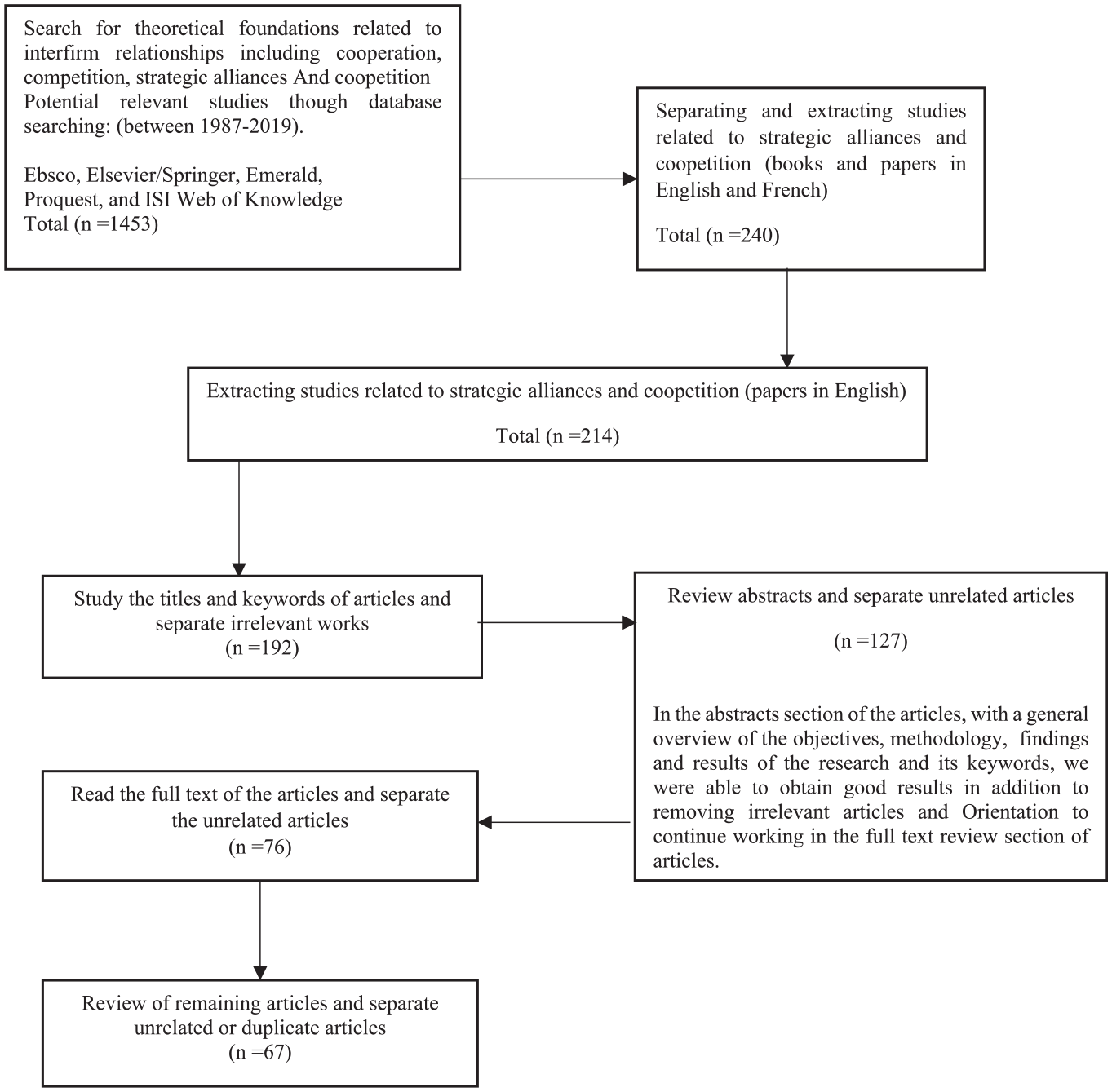
The process of literature selection.
Our initial database consisted of 1,453 works, however, the application of exclusion, inclusion, and screening criteria resulted in a limited final database covering only 67 articles. The timespan of the collected papers was 33 years (1987–2019). The vast majority of identified works were published in management journals including seven papers published in Industrial Marketing Management and Strategic Management Journal, six in the British Journal of Management, and 5 in Academy of Management Review (Table 1).
Dissemination of Coopetition Papers by the Journal.

Although the scope of our literature searching went a little bit beyond just coopetition, it does confirm that despite an observable growing trend in the number of publications on coopetition, there are some seasonal peaks like the peak in 2014 (Bengtsson & Raza-Ullah, 2016; Bouncken et al., 2015; Dorn et al., 2016) or 2017.
Integrative Reviewing—Categorization of Theoretical Lenses Using the Configurational Approach
Yang (2002), according to Benson and Hagtvet (1996), introduces three levels of research: theoretical, experimental, and assessment research. Eisenhardt (1989) also distinguishes between two main types of research: hypothesis and theory development; and theory and hypothesis testing (i.e., applied research and theoretical research). The methodologies of this type of research are quite different from those of the experimental research since theoretical structures and the relationships among them are the main focus of research. This paper presents findings from theoretical research based on systematic and integrative literature review.
Accordingly, there are two general approaches to study a social phenomenon: the reductionist approach and the holistic approach. The most important analysis method in the reductionist approach is the contingency method. The contingency method is considered as an appropriate solution to many organizational problems being at the same time quite simple and replicable (as contextually independent) analytical approach. The contingency approach concentrates only on one underlying factor and one structural feature and how they affect performance. This, of course, does not mean that the contingency approach makes no use of multivariate modeling; however, it indicates that the relationships in this paradigm are analyzed as bivariate as the other model variables are assumed to be controlled (Donaldson, 1996).
Nonetheless, as studies have progressed and more complex issues have raised, there have been criticisms of the closed and linear nature of the contingency approach, and it has been argued that the contingency approach does not apply to many complex phenomena since it leads to reductionism (Anderson et al., 1999). On the contrary, there is the holistic approach which examines the phenomena using a situational approach and considers the components of the social phenomenon to be inseparable. The best research method using the holistic approach is the configuration method (Meyer et al., 1993).
The configuration approach was developed to address the shortcomings of the contingency approach. To some extent, the new approach focuses on the overall synthesis to examine the bilateral and nonlinear relationships between the organization and the environment. Indeed, the configuration approach that views organizational phenomena holistically claims that understanding organizational phenomena is possible only when a large number of structural and contextual variables are analyzed simultaneously. Regarding the fact that this study can be considered as conceptual, along with the shortcomings of the contingency approach, the configuration or multi-contingency method is used to summarize and classify the theories. Given the above, in the following sections, first, the theories and features of each theoretical approach to coopetition are introduced, and then the theories and their logics are classified based on the function and approach, and then different typologies are presented. Finally, a new configuration is suggested based on both function and approach. This framework is based on the deductive analyses of the theories and their internal consistency.
Findings From Literature Analysis
The Plurality of Theoretical Foundations of Coopetition
Although the theoretical origin of coopetition in the business world is not crystal clear (Bengtsson, Kock et al., 2016), from a fundamental viewpoint, it is derived from the game theory (Bengtsson, Kock et al., 2016; Mariani, 2007) which is partly based on Brandenburger and Nalebuff’s (1995). Nevertheless, over time, the co-opetition has been explained by using other theories the most remarkable of which are the resource-based view and the network approach. Even though those three theoretical approaches are commonly acknowledged as dominant in coopetition literature (Czakon, Mucha-Kuś et al., 2014; Devece et al., 2019), coopetition is also seen to be as extensively drawn on in the cooperative inter-organizational relationships literature (Czakon, Mucha-Kuś et al., 2014) including strategic alliances in particular (Chen & Miller, 2015; Devece et al., 2019; Golnam et al., 2014; Lechner et al., 2016).
Indeed, the theoretical foundations of coopetition can be linked with 10 theories or theoretical concepts including game theory, resource-based view, network approach, transaction cost economy, institutional economy, dynamic capabilities, strategic learning (entailing knowledge management/sharing), mutual trust, and tensions management (Table 2).
Theoretical Pillars of Coopetition Strategy.
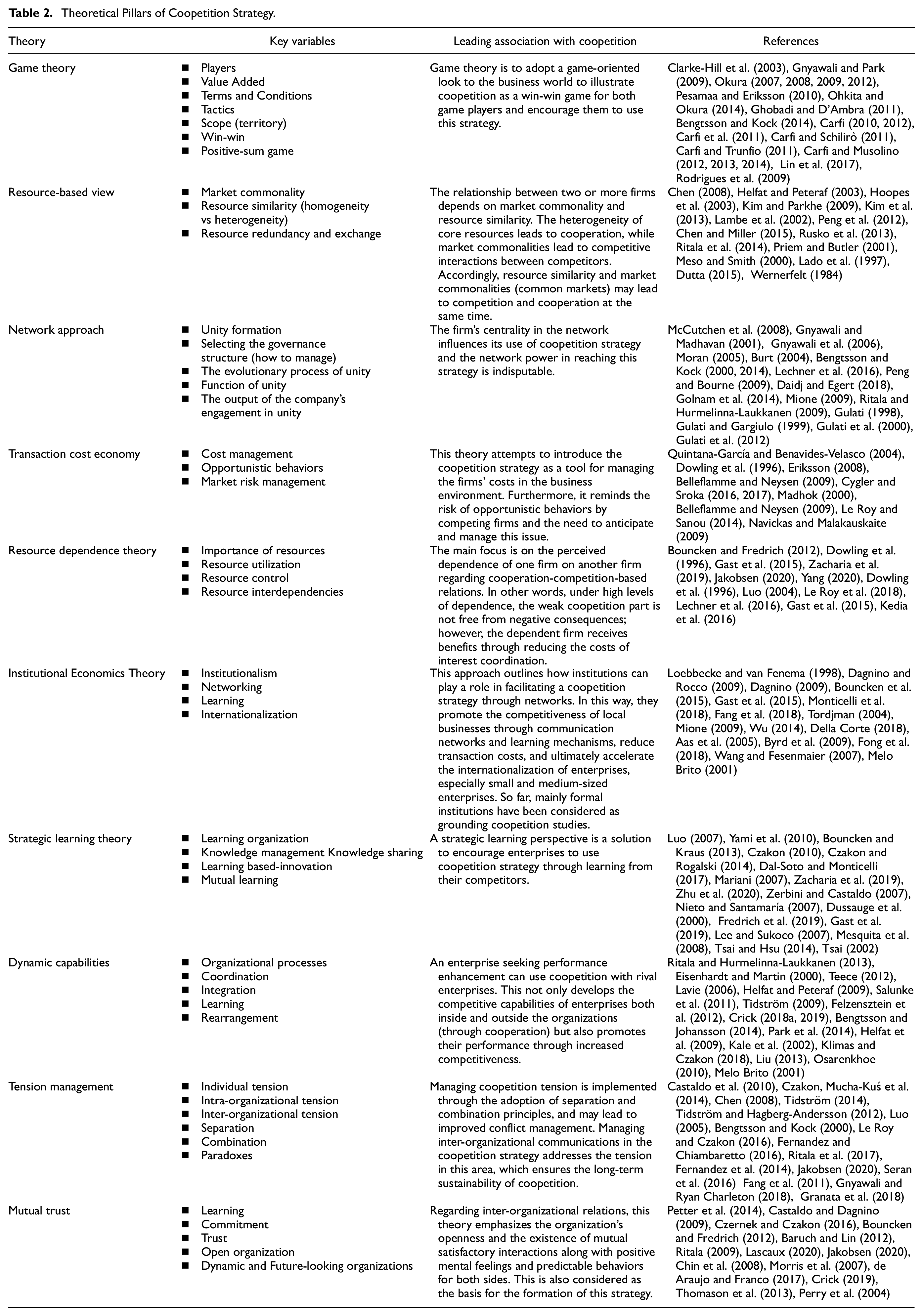
It should be emphasized that the set of 10 identified theoretical pillars (Table 2) does not exhaust the plurality of theoretical approaches used to explain coopetition. Indeed, in coopetition literature, one can find also such underlying theoretical explanations as those adopted from philosophy (Luo, 2004), legal sciences (Levin & McDonald, 2006), or evolutionary approach (Czakon, Mucha-Kuś et al., 2014). Among the recent ones, there is, for instance, the biological perspective (Cygler, 2015) including the ecosystem theory used to explain coopetition by ICT (Basole et al., 2015) or innovation (Bacon et al., 2020) ecosystem concepts. Furthermore, in recent papers, a more sociological view can be identified as the studies re-focus from tough managerial issues to more behavioral, cognitive, and social ones (e.g., Baruch & Lin, 2012; Czakon et al., 2020; Lundgren-Henriksson & Kock, 2016), thus coopetition appears as explained thought concepts adopted from sociology and psychology.
Summing up, the list of the identified theoretical pillars supports the results from previous literature reviews. First, as pointed out by Czakon, Mucha-Kuś et al. (2014) coopetition is explained using such theories as alliances (83% of papers), RBV (35%), game theory (39%), competition (24%), networks (23%), evolutionary economics (9%), TCE (8%), others (3%). Second, as shown by Devece et al. (2019) the phenomenon of cooperation of business rivals is explored using coopetition itself (19 of analyzed papers), RBV, dynamic capabilities, and knowledge management (12), alliance dynamics (11), dynamics and game theory (10), social perspective (8), network perspective (7), others (8).
Aggregation of Theoretical Roots of Coopetition
Theoretical roots of coopetition spread out over many different theoretical concepts (Bengtsson, Kock et al., 2016; Czakon, Mucha-Kuś et al., 2014; Devece et al., 2019). Nevertheless, the literature suggests that those theoretical roots can be distinguished in terms of the type of justification of coopetition strategy adoption and the leading function of the implementation of coopetition strategy
First, given the approach to coopetition reasoning, one can distinguish the following: (1) economic—generally focused on financial issues considered from the perspective of economic rent, (2) organizational—taking the internal perspective reasoning the strength of organization through the scarcity and differential rent, and (3) inter-organizational approach—focused on aspects remaining at the common edges of coopetitors, whereas leading to relational rent. The literature review shows that so far, some researchers have investigated coopetition using an economic approach, emphasizing the financial benefits of this strategy and its functions in managing the firm financial performance through appropriate pricing, cost management, or value appropriation in a financially profitable manner. Conversely, in the organizational approach, the focus of the researchers has been paid on the internal factors influencing the firm bargaining power at the market, the most important of which are resources (accessing, sharing, solving the redundancy problem, etc.), organizational learning, and reinforcing dynamic capabilities including coopetition capability in particular. Finally, the inter-organizational approach takes an open perspective considering the firm embeddedness external context, which if used properly can generate benefits from networking, maintenance of trust-based relationships, or balancing tensions including the tension between value creation and value appropriation in the long-term perspective.
Second, considering the leading function of the utilization of the theoretical roots when adopting coopetition, these roots can be divided into those focused (mainly) on (1) introduction to coopetition by emphasizing the multifaceted beneficial outcomes in the light of the shortcomings of the previous concepts, (2) reinforcement of coopetition concept by pointing at mutual gains not available without cooperation, including outcomes of cooperation with competitors, (3) legitimization of coopetition concept by highlighting the constitutive coopetition issues like balancing paradoxes and tensions, strengthening dynamic capabilities including coopetition capability in particular, and exploitation of coopetitive opportunities stimulated by formal institutions. Regarding the function of the identified theoretical concepts for the development of coopetition theory, the researchers have emphasized the need for the introduction of coopetition concept, then favoring and stimulation of its application in business practice, and finally the necessity of solving coopetition-specific issues.
Last but not least, it should be noted that some theories presented in Table 2 might be bi- or multi-functional. In practice, managers can find specific theoretical reasoning from one theoretical perspective as applicable in one, two, or three phases of coopetition theory development. For instance, the RBV (and the extended RBV covering the relational view by Dyer and Singh (1998) in particular) has been extensively used to introduce coopetition into strategic management literature. Nonetheless, the same theoretical lenses have been used to strengthen the need for acknowledging coopetition as relevant and different from cooperation strategies. Finally, the resource perspective is still used to give stronger legitimization to coopetition theory as referring to strategic (in terms of VRIO/VIRS features—Barney, 1991) role of coopetition capabilities as well as shared coopetition-related resources.
All in all, following a contingency approach it was possible to outline two different categorizations of theoretical roots of coopetition. Nonetheless, due to its reductionist nature, the contingency approach had found a major weakness in finding the appropriate holistic approach to categorization of the theories underlying coopetition. Therefore, one would like to ask “How should we evaluate and classify the coopetition theories concerning both categorizations simultaneously?”
As mentioned in the methodological section, the contingency approach is not decent for addressing such a question. Thus, a configuration methodology has been employed. It should be noted that for configuration theory advocates (Anderson et al., 1999; Meyer et al., 1993), the internal compatibility and coherence of joint configuration of the distinguished combinations is considered as the only one relevant and reflecting the real world, whereas any other cannot reflect the complex business surroundings due to the high modularity of the theoretical construct (i.e., competition on one side, cooperation on the other), fragmentedness of the cognition (that is missing from sound coopetition classifications, although some complementary typologies have been developed), and the lack of internal conceptual consistency (i.e., the developed typologies have been framed without an in-depth discussion about the theoretical roots of coopetition). At the same time, a configuration approach assumes that a limited number of combinations does exist (Bouncken et al., 2020) because the features or dimensions forming the configurations are interconnected and their changes are discrete and intermittent (Meyer et al., 1993).
In the field of strategic management, some prominent configurations have been developed by Miles et al. (1978) and Mintzberg (1979). Following a similar approach, the theoretical roots of coopetition have been framed. The framework, taking the form of a nine-field matrix, covers nine theoretical concepts classified by the approach to the reasoning of coopetition strategy adoption and the function for the development of coopetition theory simultaneously. Furthermore, those theoretical concepts were categorized in terms of their applicability across the coopetition life cycle, distinguishing a set of three group theories, namely coopetition construction, coopetition development, and coopetition maintenance theories (Figure 2).
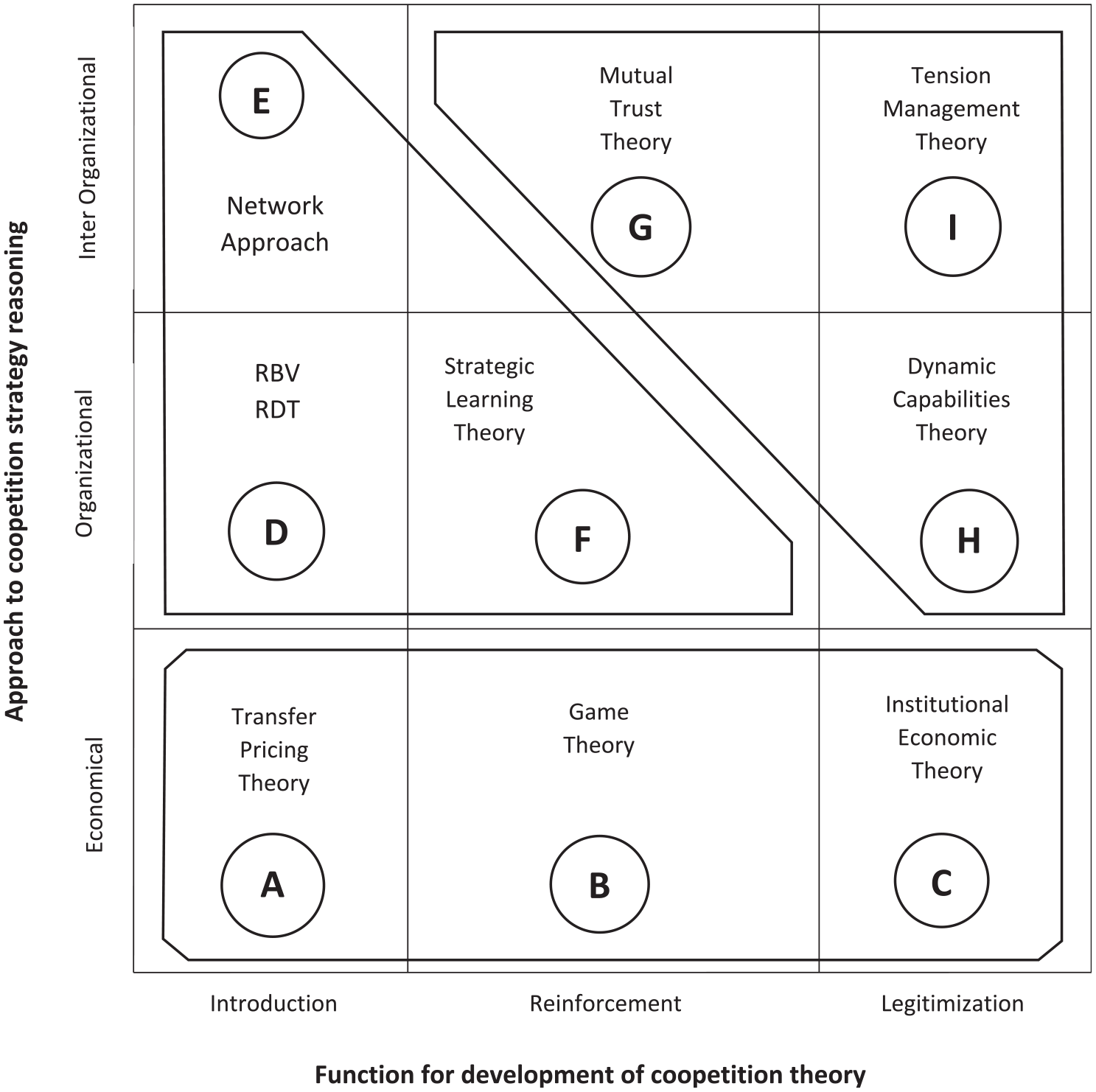
Two-dimensional configuration of theories underlying coopetition.
In general, categorization of theories underlying coopetition phenomenon is expressed as follows: “coopetition construction theories” are giving the foundation of coopetition strategy adoption, “coopetition development theories” are taking the form of setting up, initiation, and implementation of coopetition strategy, and “coopetition maintenance theories” are being a solid ground for a long-term and beneficial coopetition exploitation.
The identified categories of the theoretical roots of coopetition support the process view on coopetition phenomenon, as every category seems to be applicable at a different phase of coopetition. Following Dorn et al. (2016), coopetition as a dynamic phenomenon, develops in time. Using the life cycle approach, this development can be divided into four specific phases: a preliminary phase in which the antecedents for coopetition are identified, initiation when coopetition is established and the flows between coopetitors star, managing and shaping coopetition relationships including the flows inside, and evaluation phase in which coopetitors do assess the coopetition outputs. Given the above, the functions as well as the theoretical views assigned to them, seem to be the most applicable at different phases of the coopetition life cycle. In other words, the primary function of the coopetition construction theories (applicable mainly before coopetition is formally established) is to prepare business executives to be convinced to adopt this strategy. This is due to the complex nature of coopetition, the duality of cooperation-competition, and the arrangements linking these two concepts. Later on, there appear coopetition development theories (applicable mainly at the beginning of coopetition when it develops fast) used to stimulate enterprises to intensively and multidimensionally exploit coopetition strategy through leveraging the level of engagement and mutual investments. Finally, the coopetition maintenance theories were addressed (applicable mainly when coopetition is well-developed and mature) to be considered for conflict management, balancing tensions, symmetrical exploitation of coopetition capabilities, and also when experiencing cooperation with formal institutions can determine coopetition longevity and performance. As stated, in a long-term perspective, coopetition strategy is accompanied by the inherent contradictions, paradoxes, and tensions caused by the duality of cooperation-competition, and the management of these tensions requires proper executive mechanisms and well-developed coopetition capability taking the form of ambidextrous dynamic capability balancing between dynamics of coopetition and cooperation.
The first group of theories with an economic approach and the three-phase functions (e.g., introduction, reinforcement, and legitimization) was entitled “coopetition construction theories” which include transaction cost theory (TCT), game theory, and institutional economic theory (marked as theories A, B, C in Figure 2). Here, the label “construction theories” refers to the role of theories in the adoption and development of a coopetition strategy by business managers. In other words, those theories have been considered as an essential factor influencing the propensity of business managers to approach – before formal establishment – a coopetition strategy. According to the theory classification logic described above, those three theories have played a pivotal role in establishing and pre-shaping a coopetition relationship. They somehow familiarize business managers with the coopetition strategy and prepare them for entry into this paradoxical domain, which is an essential step in implementing this theory in the business world. The theories above provide good incentives for senior managers to make decisions on entering this area and focus on managing firm costs, acknowledging synergistic effects (i.e., “win-win” or “win-win-win” scenario), and promoting firm innovation also through the exploitation of the supportive business environment. All three items have a high impact on the perceptions and attitudes of senior managers to lean toward this strategy. For example, in his research using the transaction cost theory, Erickson (2016) seeks to justify coopetition in the buyer-supplier relationships; in their research using the resource-based view. In the case of game theory, the role of the stories of successful organizations in designing and forming the game, and even the role of this theory in the formation of an organization’s strategy are reported (Brandenburger & Nalebuff, 2002). Finally, in their study, Fong et al. used an institutional economics perspective to encourage coopetition in the tourism industry, hence other items such as organizational (Klimas, 2016) or national (Knein et al., 2020) culture reflecting informal institutions have been shown as important for considering entering coopetitive relationships. All in all, this group of theories tries to create a positive tendency toward a coopetition strategy.
The second group, labeled as “coopetition development theories” refers to the theories with the organizational and inter-organizational approach as well as preliminary and encouraging functions. This set of theories includes resource-based view/resource-dependency theory, network approach, and strategic learning of organization (marked as theories D, E & F in Figure 2). Here “development” means to develop the necessary arrangements for the establishment and initial (but fast) expansion of a coopetition strategy. Those theories, due to extreme complexity and interdisciplinary nature of coopetitive relationships, suit the most coopetition covering more components of the value chain (Fayazbakhsh & Sepehri, 2011; Klimas, 2014) and crossing dyadic relationships through different functions and industries (Knein et al., 2020; Luo et al., 2006), as well as coopetition with a wide range of firms including both direct and indirect business rivals (Kraus, Meier et al., 2018).
Given potentially wide and rich benefits (e.g., generation of the additional, relational rent, access to network resources, resource sharing and diffusion, mutual organizational learning including sharing tacit knowledge, experiences, and skills, etc.), those theories can convince senior corporate managers to try to expand the level of cooperation with their competitors in more parts of the value chain or to cooperate with more firms in an industry or even with other industries. In this group of theories, a coopetitor moves one step further and after deciding about coopetition adoption, the focus is paid to exploit its benefits to the greatest (and the fastest) extent. For instance, after the coopetition establishment, Chimbareto and Fernandez have shown that firms further tend to use a coopetition strategy in times of high uncertainty; in their research by taking advantage of the coopetition strategy, Sanou et al. (2016) showed that the network strength is effective in improving the performance of its member firms in an industry and improving the overall situation of the company. Finally, the learning organization has been considered useful for taking benefits that arise quickly including knowledge transfer, sharing, and diffusion as well as sharing and joint building of experience (Le Roy & Czakon, 2016; Luo, 2007).
Last but not least, the third group of theories labeled as “coopetition maintenance (continuity) theories” covers two levels of approaches to coopetition justification (i.e., organizational and inter-organizational ones) and two functions of theoretical lenses for coopetition theory development (i.e., reinforcement and legitimization). Chronologically, the last set of theoretical concepts includes mutual trust theory, tension management, and dynamic capabilities approach (marked as theories G, H, I in Figure 2). Generally, the theoretical roots considered here point at the issues specific (or even distinctive) for coopetition strategy faced by managers in a long-term perspective and determining coopetition survival and longitudinal performance. In this category, given the focus on longitudinal gains from coopetition, the theories concentrate on different ways of transforming the business coopetition surroundings into a favorable and peaceful environment based on trust, balanced tensions, or well-developed coopetition capability. Those theoretical lenses appear as apparent and become considered as significant when coopetition reaches the maturity phase of its life-cycle, as the more negative and problematic issues occur when coopetition is sufficiently intense, deep, and long-lasting, thus requiring management and strategizing (Le Roy et al., 2018). Regarding this stream of theoretical views, mutual trust is known as a powerful mechanism in the long-term development of inter-firm relationships (de Resende et al., 2018), hence dynamic, coopetition capabilities are known as good stimuli for both the development and maintenance of firm coopetitive behaviors (Bengtsson, Raza-Ullah et al., 2016; Gnyawali & Park, 2011; Raza-Ullah et al., 2014, 2018) especially when dealing with technological changes (Afuah, 2000). Similarly, tension management has been proven as being critical to sustaining coopetition at symmetrical and beneficial level (Fernandez et al., 2014; Tidström & Hagberg-Andersson, 2012), hence the inter-organizational communication management in the coopetition strategy is concerned as the most contributing to the sustainability of coopetition.
Concluding Remarks
This reviewing paper leverages our understanding of the theoretical roots of coopetition. The clarification of the coopetition theoretical background is achieved using a systematic (Denyer & Tranfield, 2009; Fink, 2019) and integrative (Elsbach & Knippenberg, 2020) literature review, semantic analysis, and configuration approach. As a result of our exploration, we identify 10 different, whereas interlinked and complimentary, theoretical lenses of coopetition phenomenon. The identified concepts are categorized using two separate criteria; one more important for conceptual transparency of coopetition theory (i.e., the function of theoretical roots for the development of coopetition theory) and one more significant for coopetition popularization in business practice (i.e., approach to the reasoning of coopetition strategy adoption). Finally, both categorizations, using a process and life-cycle view on coopetition phenomenon, are used to develop a multidimensional configuration of the theoretical roots of coopetition.
Following a systematic approach to literature reviewing (Denyer & Tranfield, 2009), our desk research started from setting up two research questions categorization of addressing the leading theoretical lenses of coopetition and their multidimensional configuration.
First, our findings reveal the following main theories underlying the coopetition strategy: game theory, RBV, RDT, network approach, TCT, institutional economic theory, dynamic capabilities, strategic learning, the concept of mutual trust, tension management. Furthermore, as discussed in prior literature reviews, some authors investigating coopetition use also other theoretical constructs (e.g., strategic alliances—Czakon, Mucha-Kuś et al., 2014; Devece et al., 2019) or even paradigms (e.g., cooperation, competition—Bengtsson, Kock et al., 2016) to give a theoretical background to their studies. Our study, focuses however on theories (labeled also as concepts, doctrines) acknowledged as more advanced and complex than theoretical constructs, whereas less complex than paradigm. On the one hand, theoretical constructs are conceptualized mainly through operationalization and measurement (Blalock, 1982), hence theory needs conceptual considerations and definition. On the other, a paradigm stands behind the set of coherent and compatible theories and allows those theories to be measured, verified, or tested (Kuhn, 2012).
Second, by integration and semantic analysis of the identified set of theoretical lenses, it was possible to develop their two categorizations. By the analysis of the contexts in which they are used as well as though the analysis of the similarities, and differences in reasoning, explaining, and understanding the coopetition specificity among them the following categorizations were developed: the one based on the approach to the justification of the applicability of coopetition strategy and the second considering the function of particular theoretical concept for the development of coopetition theory. As noted, several theories have been reported by researchers of the field. In an approach-based classification, they include economic, organizational, and inter-organizational theories. Regarding the function of theoretical lenses for the development of coopetition theory, some theories express the applicability and provide sound reasoning for coopetition strategy adoption, thus impact the awareness and popularity of coopetition theory. Moreover, some theoretical groups try to emphasize coopetition benefits, thus reinforce the meaning of coopetition-based approach to competitive advantage. Finally, the rest of the theoretical roots gives legitimization to coopetition theory by focusing on coopetition-specific problems. The last group of theoretical lenses, due to their specificity, can be seen as a piece of conceptual evidence for the autonomy of coopetition theory.
Third, the developed classifications, using the configurational approach, were used to create a multidimensional and comprehensive framework of theoretical lenses of coopetition. Our configuration, besides previously revealed categorization criteria, uses the process view on coopetition strategy, thus considers the applicability of the particular theoretical concepts for managing coopetition across its life cycle. All in all, our configuration covers nine theoretical concepts organized into three sets: coopetition construction theories, coopetition development theories, and coopetition maintenance theories. The identified constructs find applicability in sub-sequent phases of coopetition development starting from the preliminary phase aimed at recognition and acknowledgment of coopetition antecedents; initiation phase aimed at establishing and strengthening of coopetition relationships; and managing and shaping phase aimed at long-term, balanced, and beneficial exploitation of coopetition relationships. Given the entire coopetition process (Dorn et al., 2016), the above configuration leaves the last phase of coopetition life cycle, namely the evaluation phase, without theoretical support. The considered theoretical lenses, however, refer to coopetition reasoning and explanation, whereas the last phase does appear when coopetition is terminated. Thus, it does not have to be reasoned or explained anymore. Nonetheless, as the first configuration refers to antecedents, being at the same time possible goals and outcomes of coopetition, it seems to be reasoned to use recommendations from that set of concepts and assess to what extent coopetition has allowed reaching the preliminary considered goals and outcomes.
In this paper we focus on the categorization of theoretical lenses of coopetition as “The growth in the theoretical field (of coopetition) provides a deeper understanding of the phenomenon, yet the risk is that conceptual and theoretical inconsistencies and confusions will follow theoretical developments, thus hampering the consolidation of the field” (Bengtsson, Kock et al., 2016, p. 5). We do believe that our findings increase transparency in the theoretical background of coopetition. Moreover, we see our paper as valuable for future research as it contributes to a better arrangement of theoretical roots of coopetition and thus, it would add to the scientific rigor of future research in the field. According to Gnyawali and Song (2016), the rigor in scientific work can be considered as consisting of three building blocks: conceptual rigor (sound development of a theory that would provide a valid basis for empirical investigation), methodological rigor (appropriateness of methodological choices in terms of accurate measurement of the considered phenomenon), and empirical rigor (proper organization and interpretation of research findings). This paper develops a configuration of theoretical lenses of coopetition and makes a wide range of the theoretical lenses, concepts, and underlaying logics more transparent, showing how and when to rest on those different theoretical views. We see this as a potentially significant methodological contribution to the improvement of the conceptual rigor in future studies on coopetition.
Coopetition theory still has many dark spots in terms of the theoretical underpinnings of the entire concept. The present study attempts to bridge these theoretical gaps by presenting the comprehensive framework of theories in this field. Besides the conceptual and methodological contributions, we do notice managerial implications as well. Based on the configuration of the theoretical underpinnings, managers can more easily and quickly reach particular theories that would be useful in a certain phase in the life cycle of coopetition. Furthermore, the presented integrated view on theoretical roots of coopetition can be seen as reasoning for coopetition strategy adoption, for example, managers would know how to justify coopetitive behaviors from the economic, organizational, and inter-organizational perspective and how to develop coopetition as well as its outputs by paying greater attention to gains expressed by particular theoretical concepts. Finally, given the developed configuration, managers would know how to manage and maintain coopetition in a long-term perspective, for example, by focusing more on tensions and building up coopetition capability.
Although the developed classification contributes to coopetition literature and practice, we are aware of its limitations. First and foremost, is based on literature review, the findings are prone to typical reviewing biases related to the type and scope of adopted inclusion/exclusion criteria, accessibility of literature in full length, or subjectivity of analyses (Denyer & Tranfield, 2009). Moreover, as mentioned, in the research literature regarding relevant theories, the focus of most researchers is on three main theories and other theories have been used sparsely and in proportion to the needs of researchers. The main limitation of the research was related to the over-dispersion of theories. Besides that, so far some theories have been presented in a blurry way and there were some theoretical overlaps and misunderstandings. All of the above may result in classification bias. However, to limit this problem, the research team used intra-team brainstorming to discuss problematic papers.
Considering the future research directions and heeding the fact that our paper investigates theoretical roots of coopetition and proposes a configuration of the applicable theoretical views, we support prior claims that “the future growth of the coopetitive research field hinges on creatively combining– the identified and differentiated –existing theoretical approaches with novel research methods and contexts” (Bengtsson, Kock et al., 2016, p. 4). Furthermore, as coopetition is a complex and multifaceted area (Bengtsson & Raza-Ullah, 2016; Klimas, 2014; Le Roy & Czakon, 2016), it would be interesting to explore the applicability of other theories in the field of coopetition. For instance, as the link between coopetition and innovation output remains ambiguous, it would be interesting to consider concepts useful in innovation management including NPD in particular (e.g., co-innovation). Also, it remains blurry whether coopetition is stimulated or destimulated by cognitive similarity, technological overlap, or geographical distance of coopetitors. Thus, it would be interesting to consider the applicability of the proximity hypothesis (Albert-Cromarias & Dos Santos, 2020; Jakobsen & Steinmo, 2016) on the coopetition ground, especially as proximity does reflect parabolic (inverted “U”) link with innovation output (Boschma, 2005).
Footnotes
Acknowledgements
We are thankful to the Editors and Reviewers from Sage Open journal for their insightful and constructive comments. Dear Contributors, your willingness to give your time and insightful comments, to share ideas for improvements so generously is very much appreciated.
Declaration of Conflicting Interests
The author(s) declared no potential conflicts of interest with respect to the research, authorship, and/or publication of this article.
Funding
The author(s) disclosed receipt of the following financial support for the research, authorship, and/or publication of this article: The publication of the paper benefited from grant given by National Science Centre under the agreement No. UMO- 2020/39/B/HS4/00935.
Declaration of the Exclusivity of Submission
The manuscript has not been published previously, it is not under consideration for publication elsewhere, and if accepted, it will not be published elsewhere in the same form, in English or any other language.
