




Abstract
While past studies have attempted to understand the factors influencing the donation amount received by candidates, little scholarly attention has been paid to the consequences of political donation. Using the candidate-level data from three legislative elections in Taiwan from 2008 to 2016, this study examines the relationship between political donation and candidates’ election outcomes. The empirical findings demonstrate that political donation exerts a significant positive effect on candidates’ election outcomes. Specifically, candidates who receive more campaign contributions are more likely to get a high vote share and elected. However, different sources of political donations have different effects on election outcomes and donation from individuals plays a more important role among four sources of political donations. Furthermore, this study also finds that political donation has a larger impact on non-incumbent candidates’ election outcomes than that of incumbent candidates. Overall, the findings suggest that money matters for candidates’ electoral fate, especially for challengers. Given the importance of political donation in election outcomes, the government should enhance transparency of campaign contributions to ensure fair electoral competition.
Introduction
While there has been a concern about the potentially corrupting influence of money on politics, it must be acknowledged that there is no way to separate money from politics. Election lies at the very heart of the democratic process and candidates need money to run electoral campaigns for the purpose of winning the election. Moreover, the amount of campaign spending has been increasing in an incredible way. For instance, it is estimated that since the mid-1980s, the amount spent on elections by campaigns and outside groups, as measured by the Federal Election Commission, has grown 555% in the United States (Scherer et al., 2014). In particular, presidential elections are getting more and more expensive. In the 2016 United States presidential election, Donald Trump raised a total of US$ 646.8 million and spent US$ 616.5 million on his campaigns, whereas Hillary Clinton collected a total of US$ 1,190.7 million and spent nearly double the amount of Trump’s campaign spending (i.e., US$ 1,184.1 million) (Allison et al., 2016). Furthermore, United States House and Senate candidates running in the 2016 election cycle reported raising and spending a total of US$ 1.6 billion (Federal Election Commission, 2017). When it comes to campaign spending in Taiwan, according to the report on political donation from the Control Yuan, Tsai Ing-wen, the presidential candidate of the Democratic Progressive Party (DPP), raised a total of around NT$ 740 million (US$ 24.1 million) and spent NT$ 637.7 million (US$ 20.7 million) in the 2016 presidential election, whereas Chu Li-luan, the presidential candidate of the Kuomintang (KMT), collected a total of around NT$ 230 million (US$ 7.5 million) and disbursed NT$ 202.5 million (US$ 6.6 million) on his presidential campaign (Lin & Zhong, 2016). Therefore, there is no doubt that money has played a significant role in modern elections.
Given the importance of money in elections, a great deal of research has examined how campaign spending influences election outcomes (e.g., Benoit & Marsh, 2010; Bonneau, 2007; Ferguson et al., 2019; Gerber, 1998; Schuster, 2020; Shin et al., 2005) and the dominant finding is that electoral success can certainly be influenced strongly by campaign spending. However, the majority of work on the relationship between campaign spending and election outcomes has centered on the United States. By contrast, few scholarly efforts have been made to understand the influence of money on election outcomes in other countries probably due to the difficulties to access information about political contributions and expenditures, especially in Asian countries. In Taiwan, the Political Donation Act was finally enacted in 2004 with the aim to normalize and manage political donations, promote the political participation of the citizens, ensure the fairness and justness of political activities, and strengthen the development of democracy. Since then, several studies have tried to identify the factors influencing political donations received by candidates. For example, Wang (2007) finds that candidates’ levels of education, incumbency and partisanship have significant effects on the amount of political donation raised by candidates. Nonetheless, very few scholarly attention has been paid to the influence of political donation in Taiwan. Therefore, different from past studies targeting campaign expenditures, this study aims to uncover the effect of political donation on candidates’ election outcomes by focusing on three legislative elections in Taiwan respectively held in 2008, 2012, and 2016. Although what candidates spend in legislative contests is indeed relevant to how well they will perform on election day, to a certain extent, the amount and sources of political donations to candidates can reflect the levels of popularity or support candidates have in elections (Goldstein, 1979). Besides, Taiwan has set limits on how much a candidate can spend in the election and it is observed that the amount of electoral expenditure has been less than the amount of political donations for the vast majority of candidates. Moreover, due to loopholes in the coverage of campaign spending regulated by the Campaign Finance Law in Taiwan, it is likely that candidates underreport their election expenses (Su, 2019). Candidates might report less political campaign spending than the amount they actually spent in order to meet the regulations. Due to the difficulty of identifying whether candidates misreport their political campaign spending, this study could only use existing data available to conduct analysis. Furthermore, this study argues that we might underestimate or misestimate the impact of money on election outcomes when using the amount of election spending. Accordingly, instead of campaign spending, this study focuses on political donation and attempts to assess the impact that the amount and sources of campaign finance have on election outcomes.
This study is expected to broaden our understanding of the relationship between money and electoral politics in Taiwan. Furthermore, given little examination of the relationship between political donation and election outcomes, this study could make some contribution to the field. The remainder of this paper is structured as follows. Section 2 offers a theoretical framework to explain the relationship between political donation and election outcomes and formulates the hypotheses for empirical analysis. Section 3 describes the data, operationalization of variables and statistical methods. Section 4 reports the empirical results for the influence of political donation on election outcomes. Finally, section 5 summarizes the key findings of this study and discusses the implications for policy and future research.
Theoretical Relationship between Political Donation and Election Outcomes
Given high election expenditures, candidates for elective offices always desire political donations to help them win the election. After all, money is necessary for a candidate to be competitive, though it does not ensure electoral success. Due to the important role of money in elections, it is very common to see that candidates make great efforts to raise money to fund their campaigns, whereas voters are also glad to make political donations to their favorite candidates. Then some may wonder why people are willing to give money to candidates. Some early studies argue that voters view their political donations as a kind of investment and expect some benefits in return for their campaign contributions once candidates who receive their political donations are elected (McKay, 2018; Snyder, 1990). According to this view, voters contribute money to candidates mainly out of their own self-interest. On the other hand, voters might give money to candidates because they want to express their political support for candidates or participate in the political process (Barber, 2016; Gordon et al., 2007). Even, voters may perceive contributing money to political campaigns as a civic duty (Weinschenk & Panagopoulos, 2020). Regardless of the reason why people give money to candidates, there is no doubt that political donation comes into play in elections because it could provide candidates with significant financial resources to take political advertising and mobilize voters to cast ballots for them. Without adequate financial resources, candidates have little chance of campaigning effectively or conveying their messages to voters. Therefore, political donation matters for candidates’ electoral fate and could serve as a key explanatory factor of candidates’ election outcomes.
Since what candidates spend in elections is relevant to their election performance, most previous studies have investigated the effect of campaign spending on votes received by a candidate and the chances of winning a given election (e.g., Benoit & Marsh, 2010; Bonneau, 2007; Gerber, 1998; Jacobson, 1978; Shin et al., 2005). In Taiwan, Wang and Fan (2010) analyze the 2008 legislative election and show evidence that campaign spending influences the election result. Overall, the findings demonstrate that campaign spending has a positive and statistically significant effect on the percentage of votes received and the chances of winning a race. By contrast, only a few studies have attempted to investigate how political donation affects election outcomes. While it is important to understand the connection between campaign spending and election outcomes, it is also required to figure out whether political donation is associated with election outcomes especially given campaign spending limits in Taiwan. Campaign spending emphasizes how much and on which candidates spend in the election process, whereas political donation signifies not only financial resources candidates can spend on campaigns but also the levels of popularity or support for candidates. Previous research has confirmed the association of candidate popularity with campaign contributions. Goldstein (1979) shows that campaign funds tend to flow to candidates who are successful in raising grassroots support. In short, although political donation theoretically should be positively related to campaign spending, campaign spending is conceptually not equal to political donation.
Several studies in the United States have examined the effect of political donation on election outcomes. With the aim to test the influence of investor contributions, Snyder (1990) uses data on open-seat races for the United States House of Representatives in 1980, 1982, 1984, and 1986 and finds that the Democratic candidates win the election whenever they receive all the investor contributions and lose the election whenever they receive none of the investor contributions. From the perspective of investor contributions, if the candidates have favors to sell, then interested parties will donate money to them and do their best to increase their probability of winning. Consequently, the amount of investor contributions a candidate receives is positively associated with her probability of winning. Although the study done by Snyder (1990) lends support to the relationship between political donation and election outcomes, it is noted that Snyder (1990) only discusses the contributions made by four sources of political action committees (i.e., corporations; labor unions; trade, membership and health; cooperative) that are connected with organizations which have easily identified economic interests. Obviously, Snyder (1990) ignores other sources of political donations; moreover, his analysis merely includes open-seat races, making it difficult to generalize his findings to the elections where incumbents run for reelection.
Besides, Depken (1998) contends that the amounts of political donations from political parties, political action committees and individuals, especially the latter two sources, are an important indication of how well a candidate will fare in the election. Specifically, if candidates can raise campaign funds from particular individuals, they should be able to get electoral support from this group of people. On the other hand, political action committees giving financial support to a specific candidate can reasonably be expected to deliver a sizable bloc of votes to her. Using data on the 1996 United States Senate and House races, Depken (1998) demonstrates that political donations from political action committees and individuals both have significant positive effects on the percentage of votes received by a candidate and the chances of winning, with political donation from political action committees having a greater effect. By contrast, party contributions do not influence the percentage of votes received in a statistically significant manner but exert a significant negative effect on the chance of winning House and Senate races, which implies that party contributions are adverse to candidates’ election outcomes. Besides, Alexander (2005) investigates the impact of in-state donations, political donations from political action committees, and self-financing on election outcomes in open-seat United States House elections in the 1996, 1998, 2000, and 2002 cycles. He reveals that some kinds of political donations are correlated with electoral success, while others are related to electoral failure. That is, political donation from political action committees is significantly and positively associated with a candidate’s share of the major party vote percentage, which indicates that the higher the percentage of political donation a candidate receive from political action committees, the more likely she is to win. Likewise, in-state donation exhibits a significant positive correlation with candidate performance. Nonetheless, self-financing exerts a significant negative influence on candidate performance. As a result, there is solid evidence for the relationship between political donation and election outcomes, but different sources of political donations have different effects on election outcomes.
In the light of the above discussion, this study argues that if candidates can raise campaign funds, they should be able to simultaneously obtain donors’ votes. It does not make sense for an individual to give money to a specific candidate but vote for another candidate. Since giving money to a candidate is more costly than voting for a candidate, people who are willing to give pocket money to a specific candidate should rationally and emotionally have a commitment to that candidate. In other words, if candidates are able to raise more political donations, it implies that they should be more likely to gain more votes, which is further conducive their election outcomes. In addition, as mentioned previously, candidates who can receive more campaign funds tend to more popular and attractive to the electorate, which indicates that they ought to perform well in the election. Therefore, this study formulates the first hypothesis as follows:
While it is expected that there is a positive relationship between political donation and election outcomes, previous studies have suggested that different sources of campaign funds have different effects on election outcomes (Alexander, 2005; Depken, 1998; Snyder, 1990). According to the Campaign Finance Law in Taiwan, the sources of political donations can mainly be divided into four categories: individuals, political parties, for-profit corporations, and civic associations. Although political parties, for-profit corporations, and civic associations can donate more money to candidates than individuals, it does not necessarily mean that they can deliver a sizable number of votes to candidates compared to individuals. Besides, political parties could only provide the fixed amount of campaign funds to each of their candidates and moreover, weak candidates are more likely to receive political donations from their political parties compared to strong candidates who can count on themselves to attract donors. Consequently, as demonstrated by Depken (1998), candidates who receive more campaign funds from their political parties would fare badly in the election. On the other hand, this study contends that campaign contributions from for-profit corporations play a trivial role in candidates’ electoral performance because most companies would bet on both sides—the pan-Green coalition and the pan-Blue coalition – when making political donations to seek assurance that they could keep a good relationship with elected candidates. It is observed that many political action committees give money to both Democratic and Republican candidates in the United States in order to buy access (Brunell, 2005). This finding could be generalized to other countries given the importance of access for corporates and interest groups. Due to the scarcity of research in this topic, more investigation is needed to examine whether for-profit corporations equally or unequally give money to both pan-Green and pan-Blue coalitions in Taiwan. In a nutshell, campaign contributions from for-profit corporations do not help distinguish how competitive a candidate is. In addition, given that the percentage of political donations made by civic associations is very low (i.e., less than 3% in the 2008, 2012, and 2016 legislative elections), this study argues that campaign contributions from civic associations have nothing to do with candidates’ election outcomes. On the contrary, in line with Depken (1998) and Alexander (2005), it is expected that campaign contributions from individuals is positively associated with candidates’ election outcomes because to some extent this type of political donation reflects how much electoral support a candidate gain. To sum up, this study contends that different types of campaign funds exert heterogeneous effects on election outcomes and derives specific hypotheses as follows:
Lastly, past studies have identified that there exist differences in spending effects between incumbents and non-incumbents (or challengers) (Benoit & Marsh, 2010; Bonneau, 2007; Jacobson, 1990). In general, in campaigns against incumbents, the more non-incumbents spend, the more votes they receive, and the more likely they are to win. The rationale for the differentiated spending effects between incumbents and non-incumbents is that incumbents have already saturated the voters in their constituencies with information about themselves, their virtues and services before the electoral campaign begins, so further campaigning efforts could only produce very modest additional gains in electoral support. However, non-incumbents have a great deal to obtain by making themselves better known to the electorate by means of their electoral campaigns that is largely a function of campaign spending (Cole et al., 2018; Jacobson, 1990). Following a similar logic, incumbents might already exploit all potential sources of political donations in their constituencies and have difficulty in exploring additional sources of political donations and gaining additional electoral support. By contrast, if non-incumbents can raise more money in their constituencies, it not only means that they have more financial resources to spend on campaign activities, but also implies that they can gain more support from voters. Hence, this study argues that although overall political donation exerts a positive influence on election outcomes, political donation might have a larger effect on non-incumbent candidates’ election outcomes that that of incumbent candidates. Specifically, the third hypothesis is derived as follows:
Data, Measurement of Variables, and Methods
To examine the relationship between political donation and election outcomes, this study uses the publicly released data collected by the G0V, an online community aiming to promote transparency of government information, and Mirror Media about the legislative elections of 2008, 2012, and 2016 in Taiwan. The dataset can be downloaded at https://github.com/mirror-media/politicalcontribution. There is a total of 904 district candidates running for legislative elections in 2008, 2012, and 2016. Specifically, there were 283 district candidates in the 2008 legislative election, whereas the numbers of district candidates in the 2012 and 2016 legislative elections are 267 and 354, respectively. However, the dataset only includes data on 643 district candidates mainly because not all district candidates submitted the reports about political donations. Furthermore, 35 out of them are district candidates in the aboriginal constituencies. Since the single non-transferable vote (SNTV) system is used for the aboriginal constituencies and is different from the electoral system adopted in the single-member districts, this study excludes district candidates in the aboriginal constituencies from analysis and accordingly, the effective number of observations is reduced to 608. The variables used for empirical analysis are operationalized as follows.
In terms of the dependent variable, this study employs two ways to measure election outcomes. The first way is to use vote share as the dependent variable to examine whether political donation could increase the percentage of votes received by candidates; the second way is to investigate whether political donation could help candidates get elected. Therefore, vote share is measured by the percentage of votes for each candidate, whereas getting elected is treated as a dichotomous variable and is coded as 1 if the candidate is elected and 0 otherwise.
The key independent variable of this study is political donation that is measured in two different ways. The first way is to calculate the total amount of political donations received by each candidate and the second way is to divide the types of political donations into campaign funds coming from individuals, political parties, for-profit corporations and civic associations according to funding sources. In doing so, this study could not only evaluate the overall effect of political donation on election outcomes but also understand whether different sources of political donations might have different effects on election outcomes. The amount of political donation is measured by the unit of NT$ million. For ease of interpretation, this study does not take the logarithmic value of political donation for the purpose of easily understanding the effect of the exact amount of money on election outcomes. It is also difficult to figure out what the logarithmic value of political donation means in the real world. Besides, this study also estimates the associations of four different types of political donations with election outcomes. However, since not all candidates could receive political donations from all four sources, especially in terms of political parties and civic associations, the logarithmic transformation would produce missing data for those candidates who do not get donations from specific sources. This would lead to a significant loss in the number of observations. That is, more than half of observations would be excluded from analysis. Consequently, this study decides to use the amount of political donation without taking the logarithmic form. Lastly, this study also does not adjust the currency values of political donations for three elections due to the short time frame and relatively stable consumer prices in Taiwan.
In order to avoid the biased estimate of the relationship between political donation and election outcomes, this study controls for several variables relevant to the candidates’ electoral performance. First of all, previous research has demonstrated the advantage of incumbency in the congressional or legislative elections (e.g., Carson et al., 2007; Desposato & Petrocik, 2003; Dettman et al., 2017; Wang & Fan, 2010). Thus, this study generates a variable to indicate whether the candidate is incumbent or not and codes it as 1 for incumbent candidates and 0 otherwise. Although the turnover rate of legislators in Taiwan is relatively higher than that in most Western democracies, the reelection rate of incumbents in Taiwan is still quite high. The reelection rates for district candidates the 2008, 2012, and 2016 are respectively 60.3%, 82.2%, and 65.8%, which indicates the existence of the incumbency advantage. Sher (2017) also indicates that compared to legislative elections before 2008 which had used the SNTV system, being an incumbent could offer a significant electoral advantage in the legislative elections that have used the mixed-member majoritarian electoral system since 2008. This might be because the majority of legislative seats are elected from single-member districts that allow the incumbents to easily claim credit for expenditures in the district.
Second, compared to other political parties, the KMT and DPP have a strong, consolidated support base and more resources to help their nominated candidates win the election. Thus, it is expected that the KMT and DPP candidates are more likely to receive a higher vote share and get elected. In fact, the KMT and DPP together have won more than 90% of seats since the 2008 legislative election (Wang et al., 2018). Therefore, this study creates two dummy variables respectively for the KMT and DPP candidates and treats candidates nominated by other political parties or nonpartisan candidates as the reference group. Third, the number of competing candidates in one electoral district might have some influence on election outcomes especially in terms of vote share. Specifically, it is expected that the number of candidates in the electoral district is negatively associated with each candidate’s vote share and likelihood of getting elected. Fourth, two variables are generated to assess the effects of demographic characteristics on election outcomes, that is, gender and age. Finally, since this study combines all candidates in the 2008, 2012, and 2016 legislative elections to perform analysis, two dummy variables for the years of 2012 and 2016 are created in order to control for time-specific fixed effects. Table 1 reports descriptive statistics of variables used for empirical analysis.
Descriptive Statistics of Variables.

Note. The unit of political donation is NT$ million.
Given the attributes of two dependent variables, this study would employ two different models to respectively estimate the effect of political donation on vote share and likelihood of getting elected. One the one hand, the OLS regression model would be used to examine the relationship between political donation and vote share. On the other hand, the binary logit model would be utilized to investigate the association of political donation with likelihood of getting elected. Furthermore, since this study operationalizes the variable of political donation in two different ways, this study would respectively estimate two models to assess the effect of political donation on vote share and likelihood of getting elected. Finally, this study argues that the effect of political donation on election outcomes varies by incumbency, so two additional models would be estimated to evaluate whether political donation would interact with incumbency to affect vote share and likelihood of getting elected.
Empirical Results
The empirical investigation begins with descriptive analyses of political donation. Figure 1 shows the average amount of political donation in the 2008, 2012, and 2016 legislative elections. While the average amount of political donation in 2012 seems to be higher than those in the other two years, the ANOVA test indicates no significant difference in the average amount of political donation among these three legislative elections. In other words, the average amount of political donation does not vary by election. Figure 2 looks at the sources of political donation for each legislative election. It is obvious that the majority of political donation (41.4%) came from political parties followed by individuals (35.8%) in the 2008 legislative election. However, individuals became the main source of political donation in the 2012 and 2016 legislative elections, that is, 49.9% and 47.0%, respectively. Furthermore, the percentage of political donation from political parties had decreased from 41.4% in 2008, 34.9% in the 2012, to 32.2% in 2016. It appears that the role of political parties in providing campaign funds has been weakened, but it requires more time to gauge whether this trend is likely to continue into the future. On the other hand, Figures 3 through 5 assess the differences of political donation in terms of gender, incumbency and political parties. While the average amount of political donation received by male district candidates was slightly higher than that of female district candidates in 2008, on average, female district candidates received more campaign contributions than their male counterparts in both 2012 and 2016 (see Figure 3). Nonetheless, the t-test reveals that gender differences in political donation are not statistically significant for all three legislative elections. Therefore, in contrast to previous research (Crespin & Deitz, 2010), this study would not overemphasize gender differences in attracting political donations. By contrast, Figure 4 clearly demonstrates an advantage for incumbent district candidates in earning political donations compared to non-incumbent district candidates because voters think that they are more likely to win the election and hope to maintain good ties with them. The t-test shows that there are statistically significant differences in political donation between incumbent and nonincumbent district candidates in all three legislative elections. Last but not least, it is observed that on average, the KMT district candidates obtained more political donations than those district candidates nominated by the other political parties in both 2008 and 2012. The DPP district candidates, however, received the highest average amount of political donation in 2016 (see Figure 5). The ANOVA test illustrates that there are statistically significant differences in political donation among different political parties in all three legislative elections. While it is not surprising that the KMT and DPP district candidates received much more campaign contributions than their counterparts in the other political parties and nonpartisan district candidates, the result seems to suggest that the KMT or DPP district candidates are able to obtain more political donations when the political environment or climate is conducive to them. Overall, the above analyses demonstrate significant incumbency and partisan differences in political donation, but there is no clear evidence for gender differences in political donation.
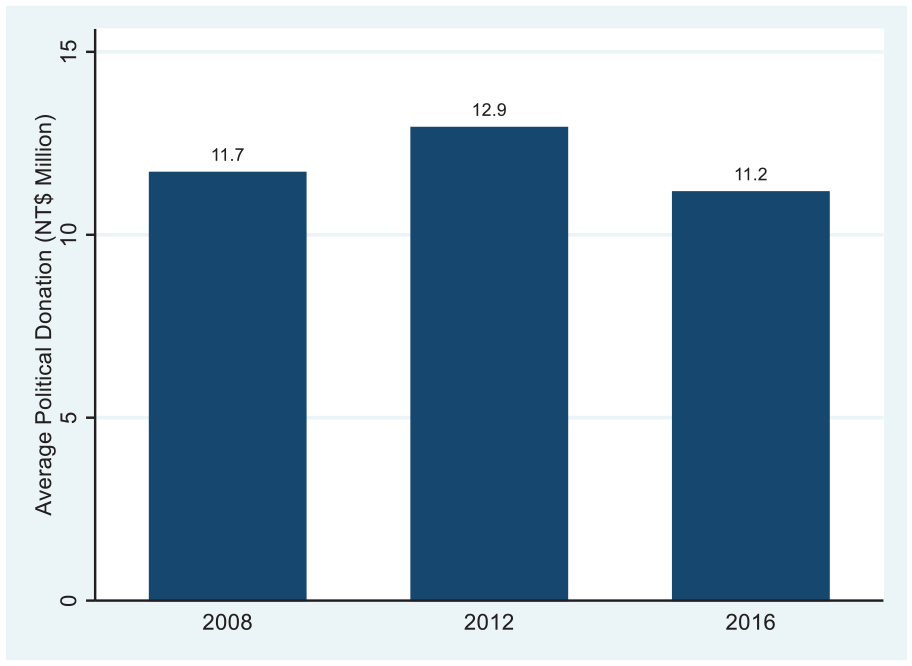
Average political donations by year.

Percentages of different sources of political donations by year.

Gender differences in political donations by year.

Differences in political donations between incumbents and non-incumbents by year.

Partisan difference in political donations by year.
The next stage of analysis is to examine the relationship between political donation and election outcomes. Table 2 reports the results for the effect of political donation on vote share. The result from Model 1 in Table 2 clearly indicates that political donation exerts a significant positive effect on vote share. That is, district candidates who receive more political donations are more likely to have a higher vote share. Specifically, on average, a one-NT$ million increase in total political donation is associated with a 0.544% increase in vote share, holding all other independent variables constant. Besides, the KMT and DPP district candidates tend to receive a higher vote share compared to those from the other political parties and nonpartisan district candidates. Also as expected, when there are more candidates in an electoral district, the vote share received by each district candidate would decrease. By contrast, demographic characteristics such as age and gender would not lead to differences in vote share. Next, this study divides total political donation into different sources of political donations and evaluates the effects of different sources of political donations on vote share. As demonstrated in Model 2 in Table 2, only political donation from individuals achieves the conventional threshold level of statistical significance and has a positive effect on vote share, whereas the influence of political donation from for-profit corporations on vote share is marginally significant (i.e., p-value = .071). Therefore, it implies that political donation from individuals matters more for vote share in comparison with the other sources of political donations. This is mainly because political donations from for-profit corporations, political parties and civic associations could not necessarily guarantee a transformation of votes. By contrast, if a candidate receives more political donations from individuals, she or he could expect to get more votes given the fact that votes who make a political donation to a particular candidate are very likely to turn out and vote for that candidate. In addition, as for the other independent variables, the results from Model 2 in Table 2 are consistent with those found in Model 1 in Table 2. Since this study argues that the effect of political donation on election outcomes might depend on incumbency, an additional model is estimated to examine the interaction effect between total political donation and incumbency. In line with the above results, both total political donation and incumbency are still significantly positively associated with vote share. More importantly, there exists a negative interaction effect between total political donation and incumbency (see Model 3 in Table 2), implying that with the increase of political donation, non-incumbent district candidates would boost a higher vote share than incumbent district candidates. Figure 6 displays the effect of political donation on vote share respectively for incumbent and non-incumbent district candidates based on the results from Model 3 in Table 2. It is evident that political donation has heterogeneous effects on vote share for incumbent and non-incumbent district candidates. Specifically, when the amount of political donation is more than NT$ 20 million, the predicted vote share for non-incumbent district candidates would be higher than that of incumbent district candidates with all other independent variables held at their observed values. Some might argue that although donation from political parties does not benefit strong candidates like incumbents, it might be helpful for non-incumbent candidates who need more financial support. Therefore, this study estimates another model with the interaction term between donation from political parties and incumbency to see whether there exists a conditional effect. The results show no interaction effect on vote share and thus fail to confirm the conditional argument. To save space, the estimation results are not reported here and are available upon request.
OLS Regression Analysis of Vote Share.

Note. 1. ***p < .001; $: p < .10.
2. Two-tailed test.
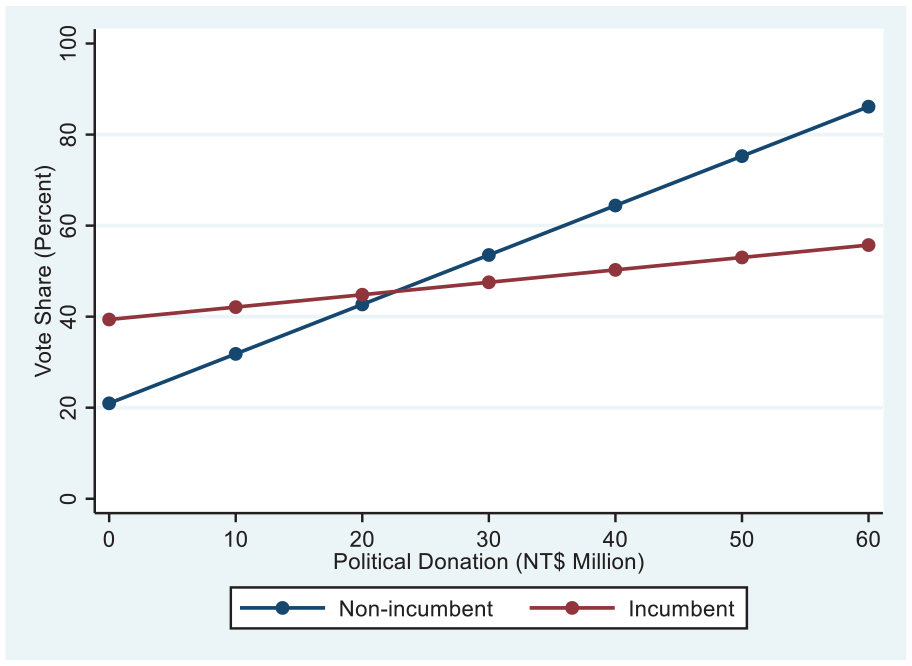
The effect of political donation on vote share by incumbency.
In addition to vote share, this study also uses whether a candidate is elected as another dependent variable. The results from Model 1 in Table 3 show that total political donation has a significant positive effect on likelihood of getting elected. Specifically, on average, a one-NT$ million increase in total political donation could increase the probability of getting elected by 1.4%, holding all other independent variables constant. Therefore, political donation influences not only vote share, but also whether a candidate gets elected. Besides, in consistency with the results for the model of vote share, incumbency and partisanship also play an important role in likelihood of being elected. That is, incumbent district candidates are more likely to get elected compared to non-incumbent district candidates. Furthermore, on average, the KMT and DPP district candidates tend to have a higher probability of being elected than their counterparts respectively by 29.1% and 27.2%. Likewise, this study also looks at whether different sources of political donations have different effects on likelihood of getting elected. The results from Model 2 in Table 3 reveal that political donations from individuals and political parties have a significant impact on whether a candidate is elected, but they exert the influence in opposite directions. That is, political donation from individuals is positively associated with likelihood of being elected, but political donation from political parties is negatively related to likelihood of being elected. One potential explanation for why political donation from political parties has an adverse influence on candidates’ likelihood of getting elected is that candidates who receive more donations from their political parties might have difficulty in securing funding from other sources and hence they need financial support from their political parties. To some extent this might reflect their disadvantages in name recognition and electoral support. As for the other independent variables, the results from Model 2 in Tables 3 give the same conclusions. Finally, this study examines whether political donation could interact with incumbency to affect candidates’ likelihood of getting elected. The results from Model 3 in Table 3 again confirm the interaction effect between total political donation and incumbency, indicating that as political donation increases, non-incumbent district candidates might have a higher probability of being elected compared to incumbent district candidates. As shown in Figure 7, when the amount of political donation is approximately more than NT$ 27 million, the predicted probability of getting elected for non-incumbent district candidates would be higher than that of incumbent district candidates, holding all other independent variables at their observed values. As a result, based on the results from Model 3 in Table 3, it seems that political donation matters more for non-incumbent candidates to get elected in comparison with incumbent candidates.

The effect of political donation on getting elected by incumbency.
Binary Logistic Regression Analysis of Getting Elected.

Note. Two-tailed test.
OR = odd ratio; AME = Average marginal effect in terms of probability change.
p < .001; **p < .01; *p < .05.
The above analysis proves the existence of the significant interaction effect between political donation and incumbency. As indicated by Ai and Norton (2003), the significance of the interaction varies according to the values of the entire set of predictor variables in the nonlinear model, which can be illustrated by plotting the z-scores for the interaction on a case-by-case basis against the predicted probability of the dependent variable. This study uses the Stata command, inteff, written by Norton et al. (2004) to plot the z-scores for the interaction effect. Specifically, this study plots the z-scores of the significant interaction term against the predicted probability of getting elected. As displayed in Figure 8, the likelihood of a significant negative interaction between political donation and incumbency is greatest among district candidates with the probability of getting elected roughly between 0.4 and 0.85. Therefore. This study concludes that the mean interaction effect between political donation and incumbency is negative and especially, the negative interaction effect between political donation and incumbency is more obvious among district candidates with a higher probability of getting elected. This study also investigates whether donation from political parties and incumbency exert an interaction effect on whether a candidate is elected. The results reveal that there is no interaction effect. To save space, the estimation results are not reported here and are available upon request.

Interaction effects involving political donation and incumbency.
To sum up, the above empirical findings lend strong support to the hypotheses. In short, this study confirms the important role of political donation in district candidates’ election outcomes in Taiwan, regardless of vote share or likelihood of being elected. Some might suspect that the 2008 legislative election was different from the other two legislative elections because it was the first instance of the new mixed-member majoritarian electoral system being practiced in Taiwan and many incumbents elected under the SNTV system ran for reelection in 2008. Therefore, this study performs robustness analysis by excluding the 2008 legislative election and sees whether the results still hold for the legislative elections of 2012 and 2016. As demonstrated in Appendix Tables A1 and A2, this study arrives at the same conclusion that political donation exerts a significant positive effect on candidates’ election outcomes and moreover, its effect varies by incumbency. This study also follows previous research on the relationship between campaign spending and election outcomes (e.g., Erikson & Palfrey, 1998; Gerber, 1998; Bardwell, 2005) to employ the simultaneous equations approach to estimating the effect of political donation on election outcomes by setting up political donation as an instrumental variable. The results from instrumental variables estimation still show that political donation is significantly and positively associated with election outcomes. To save space, the results are not reported here and are available upon request.
Conclusion
There is no doubt that money plays a big part in elections. Without money, candidates cannot amplify their messages to reach voters and it is even more difficult to motivate people to take interest and vote. In view of past studies mainly focusing on campaign expenditures, this study adopts a different approach to looking at the relationship between political donation and election outcomes. By using data on district candidates in Taiwan’s 2008, 2012, and 2016 legislative elections, this study provides evidence that political donation is significantly positively associated with election outcomes. Specifically, if the candidates receive more political donations, they are more likely to have a higher vote share and even get elected. In comparison with voter participation, giving money to candidates poses a heavy burden on voters because they need to take money out of their own pockets. If an individual is willing to endure the financial cost and make contributions to a specific candidate, she is bound to go to the voting booth and vote for that candidate on election day. Consequently, the amount of political donation a candidate raise could be regarded as a proxy for her electoral support. Furthermore, journalists tend to portray candidates who raise more money as more credible and provide them with unpaid coverage that would be conducive to their electoral campaigns (Burden, 2004). To sum up, political donation could be treated as one of crucial indicators in terms of candidates’ electoral performance.
While political donation has a beneficial effect on candidates’ election outcomes, this study finds that not all sources of political donations could benefit candidates’ election outcomes. That is, political donation from individuals could boost candidates’ vote share and increase their likelihood of getting elected, but the other three sources of political donations from political parties, for-profit corporations and civic associations play a trivial role in candidates’ election outcomes. It is noted that political donation from political parties would bring an adverse impact on whether candidates get elected or not. Although this study provides evidence to confirm the significant relationship between political donation and candidates’ election outcomes, it is acknowledged that the research design in the current study could not claim a causal relationship between them. Therefore, this study calls for future research to empirically identify the causal mechanism of how political donation influences candidates’ electoral performance. In particular, although there is a significant relationship between political donation and election outcome, it is required to identify the channels whereby political donation could influence candidates’ election outcomes. Consequently, we could have a better understanding of the causal relationship between political donation and candidates’ election outcomes.
This study simply focuses on the relationship between political donation and election outcomes in the legislative elections and a potential research direction is to extend the analysis to look at whether political donation could also exert a significant influence on election outcomes in the county and city council elections. However, the biggest challenge is to obtain the electronic data on political donation for candidates in the county and city council elections. While the Taiwanese government has made an effort to ensure transparency of government information, the information about political donations for candidates are currently only available to the public in hard copy form, which makes it very difficult to access. The current study must give a lot of credit to the G0V and Mirror Media for their great efforts and hard work to digitize the information about political donations so that the public and researchers are able to have easy access to that information through the internet. It is of utmost importance to make the information about political donation publicly available and easily accessible, so voters can know the sources of campaign funding for candidates and see whether their political donations mainly come from some particular individuals, companies, organizations or associations. It ought to be the government’s responsibility to promote transparency and accessibility of information about political donation and fortunately, the Taiwanese government hears the people’s voice and has begun to think about how to make the information about political donation more transparent and accessible. We hope that the public can easily access the information about political donation in the near future.
Finally, there is a growing concern about campaign contributions and policy outcomes and several studies have identified the influence of campaign contributions on public policy (e.g., De Figueiredo & Edwards, 2007; Rubenzer, 2011; Kalla & Broockman, 2016). Given public worry about the connection between political donation and legislative and policy outcomes in Taiwan, future research is needed to examine whether wealthy people, big businesses or interest groups have an unequal influence on legislative voting behavior and policymaking through political donation.
Footnotes
Appendix 1
Binary Logistic Regression Analysis of Getting Elected—2012 and 2016 Legislative Elections.

| Model 1 | Model 2 | Model 3 | ||||
|---|---|---|---|---|---|---|
| Coef. | O.R. | Coef. | O.R. | Coef. | O.R. | |
| (SE) | (A.M.E.) | (SE) | (A.M.E.) | (SE) | (A.M.E.) | |
| Total political donation | 0.099*** (0.018) | 1.104 (0.012) | 0.171*** (0.030) | 1.187 (0.020) | ||
| Donation from individuals | 0.164*** (0.041) | 1.178 (0.018) | ||||
| Donation from political parties | −0.626*** (0.162) | 0.535 (–0.070) | ||||
| Donation from for-profit corporations | 0.066 (0.051) | 1.068 (0.007) | ||||
| Donation from civic associations | −0.470 (0.328) | 0.625 (–0.052) | ||||
| Incumbent | 1.300*** (0.338) | 3.669 (0.161) | 1.243** (0.367) | 3.464 (0.138) | 3.257*** (0.654) | 25.968 (0.389) |
| Total political donation Incumbent | −0.126*** (0.036) | 0.882 (–0.015) | ||||
| KMT | 1.508** (0.572) | 4.516 (0.187) | 5.206*** (1.007) | 182.442 (0.580) | 1.216* (0.605) | 3.372 (0.145) |
| DPP | 2.819*** (0.553) | 16.755 (0.350) | 3.010*** (0.585) | 20.289 (0.335) | 2.602*** (0.592) | 13.485 (0.310) |
| Number of candidates | 0.087 (0.075) | 1.091 (0.011) | 0.110 (0.079) | 1.117 (0.012) | 0.112 (0.078) | 1.119 (0.013) |
| Age | −0.035* (0.017) | 0.966 (–0.004) | −0.032$ (0.018) | 0.968 (–0.004) | −0.033$ (0.017) | 0.967 (–0.0040 |
| Female | 0.203 (0.337) | 1.225 (0.025) | 0.243 (0.357) | 1.275 (0.027) | 0.272 (0.345) | 1.312 (0.032) |
| Year 2016 | −0.203 (0.295) | 0.817 (–0.025) | 0.425 (0.337) | 1.529 (0.047) | −0.263 (0.300) | 0.769 (–0.031) |
| Constant | −2.783** (0.999) | 0.062 | −3.538** (1.082) | 0.029 | −3.633** (1.086) | 0.026 |
| N | 424 | 424 | 424 | |||
| Likelihood ratio test | 219.11*** | 247.85*** | 231.92*** | |||
| Pseudo R2 | 0.40 | 0.46 | 0.43 | |||
| −2 Log likelihood | 325.60 | 296.85 | 312.78 | |||
Note. OR = odd ratio; AME = Average marginal effect in terms of probability change.
Two-tailed test.
p < .001; **p < .01; *p < .05; $p < .10.
Declaration of Conflicting Interests
The author declared no potential conflicts of interest with respect to the research, authorship, and/or publication of this article.
Funding
The author disclosed receipt of the following financial support for the research, authorship, and/or publication of this article: This work was supported by National Cheng Kung University (NCKU) within the framework of the Higher Education Sprout Project funded by the Ministry of Education (MOE) and the Humanities and Social Sciences Benchmarking Project from the MOE in Taiwan.
