




Abstract
Reform toward open-list elections in Indonesia has transformed the nature of campaigning to become more personalized. This has raised questions regarding the role of money in elections and calls for stricter campaign finance regulation. However, the merits of limits on campaign finance depend on whether and how campaign finance affects incumbents and challengers differently. Literature on this issue has produced ambiguous results, with only few studies conducted in a developing country democracy. This study estimates the effect of campaign money, along with other factors including list position and incumbency status, on the probability of a candidate being elected in the 2014 legislative election in Indonesia. Our econometric estimations confirm that campaign money effectively raises the probability of candidates being elected. The probability of getting elected will increase up to approximately 5 percentage points for each additional IDR 100 million of campaign money. Campaign money is positive and significant for both incumbents and challengers, with the magnitude being bigger for incumbents. However, the effect of diminishing returns of campaign money is slightly stronger for incumbents. Since raising additional campaign funding benefits incumbents more than it does for challengers, this study suggests the enforcement of campaign spending limits to create a more level playing field in Indonesia’s legislative elections.
Introduction
After the collapse of the authoritarian rule in 1998, Indonesia has undergone significant political change. Indonesia entered a period of democratization dubbed the Reform Era. The most visible move toward democracy in Indonesian politics was direct elections for both the executive and legislative branches. Among other reforms in this process, the legislative electoral system transitioned to an open-list system after decades under a closed-list system, where voters could only choose parties instead of individual candidates. This transition was completed in 2009 when the Constitutional Court ruled that only candidates receiving a plurality of votes could be elected to office. The open-list system transformed the nature of election campaigning to become more individualized, with the personalities of candidates becoming as prominent as their parties. Furthermore, a political party would have multiple candidates running within a single electoral district, meaning that candidates would have to also compete against other candidates from the same party, both to secure a strategic list position and win votes from their constituents. With the open-list system, the stars of the 2014 election were the candidates and not the political parties (The Asia Foundation, 2014). Individual candidates would therefore scramble to exert all available resources to campaign as they increasingly compete within and between parties.
The personalization of politics in elections led to campaign costs escalating particularly since the 2009 elections. Candidates became extremely focused on their personal campaigns, even forming personal success teams instead of relying on their party structures (Aspinall & Mietzner, 2014). Furthermore, recent elections still saw widespread vote buying as over one-third of respondents in a survey by the Polling Center admitted to having experienced vote buying despite it being illegal (The Asia Foundation, 2014). Muhtadi (2018a) confirms that vote buying became a common strategy among candidates to pursue personal votes. This practice adds to the cost of campaigning for many legislative candidates. In addition to campaign spending by political parties, each of the individual candidates expended large sums for their personal campaigns, and there were over 200,000 candidates participating in the 2014 legislative elections on all levels.
The sheer amount of campaign finance raises questions regarding the role of money in elections, particularly its effectiveness in helping candidates win elections. Furthermore, the context of competition in large open-list elections might affect how other factors, such as list positions and personal characteristics, influence electability as the role of money becomes more pronounced. In the case of Indonesia, such research on the productivity of campaign finance by legislative candidates has not been conducted.
This question of campaign finance effectiveness importantly relates to the issue of democratic fairness. In an ideal democracy, every candidate should have a level playing field in campaigning their platform and obtaining votes accordingly. But if money is found to be significantly effective, this would impose a barrier to entry for new politicians who bring meritorious ideas and excellent credentials but are not financially endowed. In particular, incumbents commonly have an advantage in raising campaign funds from interest groups as they are better positioned to carry out policy favors and win an election. The advantage can be so great that challengers are deterred from running, as highlighted by Ashworth (2006). Furthermore, there are deep-seated concerns that campaign finance hampers the accountability of politicians, considering that political campaigns are mostly financed by interest groups. Numerous studies have established that such interest groups contribute in expectation of policy favors or to move the candidate’s platform closer to their position (Ashworth, 2006; Coate, 2004; Prat, 2002). For example, Indonesian companies sponsor selected politicians based on whether they are specifically in charge of drafting legislation in sectors such as mining, fishery, and forestry to telecommunications (Mietzner, 2007).
These issues of campaign finance have led to calls for more stringent campaign finance regulations, a policy that is partially implemented in Indonesia. Articles 327 and 331 of the 2017 Election Law limit the amount of money that presidential and legislative candidates may receive from each donor at IDR 2.5 billion for individual donors and IDR 25 billion for group donors. This was a relaxation from the previous election, in which campaign contributions were capped at IDR 1 billion and IDR 7.5 billion for individuals and groups, respectively. However, there are no limits on total campaign spending by political parties and candidates. Along with the lack of legal sanction toward candidates failing to report campaign contributions, this renders the regulation rather weak. This contrasts with countries such as Canada, France, and Japan, where there are limits on both contributions and total spending. Meanwhile, countries such as Italy, New Zealand, and the United Kingdom place limits on total spending but not on donations. Behind these international differences incampaign finance policy is the lack of consensus regarding the merit of campaign spending limits.
The merit of campaign spending limits in making an election fairer depends on the relationship between campaign spending and electoral outcome. However, the nature of this relationship might not be straightforward, especially since campaign spending can influence electoral outcomes for incumbents and challengers differently. If campaign spending benefits challengers more than it does incumbents, then limiting campaign spending would backfire by benefiting incumbents and harming challengers (Samuels, 2001). Numerous studies have found this to be the case; estimates have shown that campaign spending by incumbents has less effect on their vote shares, sometimes even negative or insignificant, compared to spending by challengers (Abramowitz, 1988; Ansolabehere & Gerber, 1994; Denver & Hands, 1997; Jacobson, 1978, 1990; Levitt, 1994). In response to these curious results, several authors have offered counterarguments which point to statistical issues, such as simultaneity, as well as non-technical explanations for those results.
It should also be taken into consideration that most of these studies were conducted in the US, of which the single-member electoral districts and two-party system are rather unique. Meanwhile there is a paucity of replications in different democratic settings, particularly a young democracy in a developing country. Comparative study in such settings is important because the context of a developing country might interact distinctly with its electoral system, altering the relationship between campaign finance and election outcomes. For instance, the presence of incumbency advantage has been found to vary in large developing countries with open-list proportional representation (PR) systems (Dettman et al., 2017; Klašnja & Titiunik, 2017; Moral et al., 2015). To the best of the authors’ knowledge, a study on the relationship between campaign spending and electoral outcome in this setting has only been conducted in one developing country, Brazil, by Samuels (2001). The study found that, contrary to most results in the US, incumbent spending was just as effective as challenger spending. This paper explores if such result holds in Indonesia, another developing country with an open-list PR system.
This study estimates the effect of campaign finance on the electability of legislative candidates in the 2014 election for House of Representative (Dewan Perwakilan Rakyat, DPR) seats in Indonesia. The main contribution of the study is adding empirical evidence on the topic in the context of a young and large democracy with PR, multiple parties, and multi-member constituencies. The findings of this study provide fresh comparative perspective on campaign finance as well as insights into the role of money in Indonesia’s elections and policy implications for the country’s current lack of campaign finance regulations. At the same time, this lack of regulation and enforcement also presents various data constraints. First, reporting requirement is semi-voluntary so we settle with a limited sample that might be subject to selection bias. Second, campaign expenditure is not explicitly regulated so we use campaign contributions, which are more widely reported, as proxy for campaign financing. Notwithstanding these data constraints, our estimation still provides fresh insights on the role of campaign finance on the electoral success of legislative candidates in Indonesia.
The paper will proceed as follows. Section 2 provides a brief historical background of Indonesia’s legislative elections to provide some institutional context. Section 3 presents the conceptual framework and reviews findings from relevant literature. Section 4 explains the data and the econometric method used. Section 5 presents the empirical estimates, followed by a discussion of the findings. Section 6 concludes.
Background of Indonesia’s Elections and Campaign Finance Regulation
To provide context for the analysis of campaign finance in Indonesia, this section briefly describes the development of the country’s electoral system. Today, Indonesia is a presidential representative democratic republic with a multi-party legislative system. Prior to the 2014 legislative election which is the subject of this study, Indonesia’s electoral system went through several major changes: nascent liberal representative democracy in the Parliamentary Democracy era (1945–1959), repressed democracy bordering authoritarian dictatorship in the Guided Democracy (1959–1967), and New Order eras (1968–1998), and finally gradual progress toward the current open-list PR system in the Reform Era (1998–present).
Throughout the Reform Era, several features have had notable implications on the importance of campaign financing. First, less restrictions on the number of participants meant that campaigns suddenly became much more important because parties, most of them newly formed, needed to differentiate themselves against numerous other parties to an electorate that was previously used to voting between only three parties. However, the closed-list system in the Reform Era’s early years meant that political parties did not need to expend on individualized campaigns. Second, in regards to campaigning behaviors, political parties attempted to bedazzle voters with entertainment and pamper them with giveaways including money, despite this violating the election law (Thalang, 2005). Campaigns still focused on familiarizing voters with the party’s emblems. This might have had an implication on how campaign spending affects the behavior of voters since campaigns were not geared toward content that profoundly moves voters, spoiling them materially instead. Lastly, elections in the Reform Era saw the rise of mass media and political consultants in political campaigns, indicating increased commercialization of campaigns and the importance of campaign finance.
Finally, the 2014 election adopted a multi-member constituency open-list PR system with 77 electoral districts of 3 to 10 seats each. In terms of campaign behavior, campaigning continued to lack policy substance and was more focused on personalities, with Mujani and Liddle (2010) finding that voters are strongly attached to national party leaders in choosing parties. Aspinall and Mietzner (2014) observed that candidates were extremely focused on personal campaigns, forming personal success teams instead of relying on their party structures. Even merchandise distribution and vote buying were being organized at the candidate level. The limited influence of national issues such as party identification and presidential preference meant that campaign finance, which is reported individually, should have a stronger influence on candidates’ electability.
Given the important role of campaign finance in Indonesia’s elections, campaign finance is one of the aspects regulated in Indonesia’s election laws. The election law upholds transparency by stipulating the mechanism through which election participants record and report their campaign finance. It should be noted that reporting obligations are overwhelmingly placed on political parties but not individual candidates. For example, article 129 of the 2012 Election Law specifies that election campaign funds are to be placed in a special bank account of the political party. There are three types of campaign fund reports: Initial Campaign Funds Report (LADK), Campaign Funds Receipt Report (LPDK), and Campaign Funds Receipt and Spending Report (LPPDK) which is the last of the reports. These reports generally do not contain a breakdown of each candidate’s campaign contribution and spending. There is apparently no sanction for parties failing to submit these reports.
The election law also attempts to set limits on campaign finance, specifically on campaign contribution from external donors. For the 2014 general election, article 131 of the 2012 Election Law limits campaign contribution at 1 billion rupiah and 7.4 billion rupiah for individual donors and group donors respectively. Any amount of donation that exceeds the limit must be reported to KPU and the money transferred to the government. The source of campaign donation is also regulated; article 139 prohibits participants from receiving campaign funds from foreign parties, donors without identity, and government bodies. However, Indonesia does not restrict the amount of campaign donation from internal donors, or those coming from within the political party. It also sets a limit only for each contribution received by candidates but not on total spending during the campaign period (campaign spending caps only exist in regional elections). Furthermore, enforcement might be weak due to the lack of sanctions for participants failing to report their campaign finance, as well as reporting being obligated only at the party-level but not at the candidate-level. This gives rise to potential data issues that are discussed further in Section 4.
Conceptual Framework and Literature Review
While voting behavior is commonly described as a form of consumption and analyzed with a utility function, campaign behavior from the side of candidates could be framed as a production function through which campaign spending and other inputs are transformed into electoral results. We consider such a conceptual framework based on Welch (1974). To analyze the demand for campaign funds, Welch hypothesized two production functions in which money is the input, expected vote percentage is the intermediate product, and the probability of electoral success is the final product. The first production function is the transformation of dollars into expected vote percentages, written as follows.

The latter condition implies diminishing returns of

We then combine the two functions into an election production function where the main input is campaign spending

The reason behind this compression is that unlike the models developed in prior literature, we are studying an election in a PR system where there are more than two candidates running for multiple seats in an electoral district, and the number of seats vary based on district size. Unfortunately, we cannot specify the production function further, as was done in Welch (1974), using a probability distribution. Welsch’s approach defines the probability of electoral success as getting at least 50% of the vote, which does not apply in the case of Indonesia’s elections. A candidate getting elected in Indonesia’s 2014 election is not determined directly from the percentage of votes they obtain but instead uses the “number of voter divider” (bilangan pembagi pemilih, BPP) system, which is less straightforward. To bypass the complexity of formalizing the conversion of votes into a candidate’s electoral success with the BPP system, we use a production function that transforms campaign spending directly into the probability of electoral success. Besides, the relationship between campaign spending and electability is the focus of our study.
Aside from campaign spending, we include other inputs in our conceptual framework (represented by the aforementioned portmanteau variable

Conceptual framework of campaign as production function.
Many authors have conducted research on the effect of campaign spending on electoral outcomes, with various empirical models in different election settings (although most are mature democracies in developed countries) and with inconclusive results. There have been counter-intuitive results in which campaign spending is found to have a negligible or even negative effect on the vote share obtained (Abramowitz, 1991; Jacobson, 1978, 1985; Levitt, 1994). Furthermore, most of these studies distinguish between incumbents and challengers in their estimates, creating more ambiguity in the empirical results. Numerous studies have found that the campaign spending of incumbent candidates is less effective than that of challengers (Abramowitz, 1988, 1991; Benoit & Marsh, 2010; Jacobson, 1978; Palda & Palda, 1998; Pattie et al., 1995). Some studies, however, produced estimates where the effect of campaign spending is equal for both incumbents and challengers (Eagles, 2004; Green & Krasno, 1988; Rekkas, 2007; Samuels, 2001). Many of these studies have offered alternative models to ordinary least squares (OLS), such as using two-stage least squares (2SLS) and exploiting panel data.
Much of the discussion on the effectiveness of campaign spending revolves around the incumbents-challengers distinction because of its implications for campaign finance policy. As Jacobson (1978) argued, lesser gains of campaign spending for incumbents mean that campaign spending should be increased instead of limited, as it will help challengers and promote more competitive elections. Any reform measure which decreases spending by candidates will favor incumbents and public subsidies are recommended instead. Many authors have attempted to explain the seemingly counter-intuitive results of Jacobson and other authors. Jacobson initially believed that there might be reciprocal causality between vote share and campaign spending due to strategic fund raising: when incumbents expect to get many votes, there is less need for them to raise and spend much money. But after Jacobson addressed this simultaneity using 2SLS, campaign spending was still less effective for incumbents than for challengers. Nevertheless, it became standard for subsequent studies on this issue to account for the omitted variable bias that could result from simultaneity, usually by adding control variables related to the individual candidates.
Jacobson then offered another explanation that campaign spending by incumbents is no longer effective at garnering additional votes because incumbents are already well-known by voters, unlike challengers. Moon (2006) contested this explanation by stating that campaigning is not only about increasing name recognition, but also exploring new issues and negative campaigning, by which incumbents should still be able to gain from spending. A study by Pattie et al. (1995) found similar results in the British general elections where the system gives less name-recognition advantage to incumbents. Moon then proposed that incumbent spending efficiency depends on the marginality of their seats and relates to ideological voting decisions by voters. Meanwhile, Grier (1989) replicated the study on a different sample, senatorial candidates (Jacobson studied the US’s House of Representatives election), and found equal effects of campaign spending between incumbents and challengers. Stratmann (2005) explained that senatorial candidates may have less incumbency advantage compared to House candidates, which could be due to challengers in the Senate having longer track records in public office than challengers in the House.
Model specification is another aspect of the discussion, as it determines whether the estimates could detect diminishing returns. Green and Krasno (1988) accounted for diminishing returns by using logarithmic transformation for challenger spending and trichotomizing the sample based on spending level, resulting in estimates that indicate diminishing returns. On the other hand, Grier (1989) allowed for diminishing returns by introducing quadratic terms of campaign spending in his models and discovered that the quadratic terms are significant, implying diminishing returns as well. Grier (1989) proceeded to test whether the relative effects of campaign spending are equal for incumbents and challengers by restricting the spending variable as difference between incumbent and challenger spending. The study found that the effects of spending on votes are asymmetric between incumbents and challengers. Challenger spending is more effective at lower levels but diminishes faster than incumbent spending. These results, in which campaign spending is overall more effective for incumbents, contradicts Jacobson’s, and calls for the imposition of limits on campaign spending.
Aside from incumbency status, the discussion on campaign spending effectiveness has also considered other dimensions related to the institutional setting of the election. Pioneering studies have focused on congressional elections in the US with its rather unique two-party system and single-member constituencies. The nature of campaigns might differ in multiparty elections, which might warrant extra effort by candidates to differentiate themselves. To expand comparative evidence on the issue, some authors began researching campaign spending effectiveness in multiparty elections. Early models for multiparty elections by Katz and King (1999) and Tomz et al. (2002), which involve multivariate logistic transformations, have been criticized by Rekkas (2007) for being impractical, especially when each electoral district has a different number of parties running. Pattie et al. (1995) regressed each party’s votes in a British election on campaign expenditures and other controls using a linear function, finding that challenger spending effect is stronger. Palda and Palda (1998) reduced the multiparty system in French legislative elections into two parties, incumbents and challengers, then applied OLS with multiple control variables. The results indicated the significance of campaign spending for both incumbents and challengers, but higher marginal benefits for the former. Eagles (2004) and Rekkas (2007) conducted studies on Canadian elections, both using panel data but with different methods, and found that campaign spending is equally effective for incumbents and challengers.
With the exception of Samuels (2001), which examined campaign spending effectiveness in Brazil, all the aforementioned studies were conducted in Western democracies. More work in developing countries would be insightful due to reasons related to their distinct institutional settings. First, many democratic developing countries such as Brazil, India and Indonesia have populations much larger than their Western counterparts, which tends to mean larger electoral districts and more parties and candidates. Second, these countries have a larger numbers of poor voters who might exhibit specific voting behaviors. Third, the voters in these countries tend to live in relatively low-information environments where the average level of education is lower while media and communication technology is not as widespread or maturely developed.
These features of developing country democracies might lead to distinct election settings and voting behaviors which in turn influence the role of campaign spending. The size of electoral districts, both in terms of geography and population, means that campaign spending on mass advertising becomes more critical. On the other hand, campaign spending might only go so far in differentiating a candidate, considering the overwhelming number of candidates and parties participating. Some studies have documented how voters would resort to choosing based on heuristics, such as list position, and other noticeable demographic characteristics. Furthermore, the large number of seats in a single district combined with a low-information environment could weaken the recognition advantage of incumbents, an important variable behind the effectiveness of campaign spending. Finally, poor voters in these democracies might be more impressionable by media advertisement campaigns, as indicated by Ben-Bassat et al. (2015), and more susceptible to campaigns that hand out free goods. Section 4 explains how several of these factors are incorporated into the model used in this study.
Data and Methodology
Campaign Finance Data
To evaluate the effect of campaign finance, this study used data from the 2014 election. This study focused on the DPR election, which is considered by the public as the more prominent among the two national-level legislative bodies, the DPR and DPD. DPR stands for Dewan Perwakilan Rakyat (People’s Representative Council), which is the lower house of Indonesia’s legislative body similar to the House of Representatives in the US. Meanwhile DPD stands for Dewan Perwakilan Daerah (Regional Representative Council), which is the upper house of Indonesia’s legislative body. Each member of the DPD represents an Indonesian province, similar to how each US senator represents a state. Aside from having more localized representation, the DPR has wider legislative powers compared to the DPD. There are also more candidates running for the DPR. Furthermore, since most literature on this issue focuses on national-level legislative bodies, such as the US House of Representatives and the British Parliament, using the DPR as our sample will serve comparative purposes better than using the presidential election or local legislative elections.
The authors obtained the dataset from the KPU (General Election Commissioner), which is subject to several limitations. First, there was no comprehensive data on campaign spending by individual candidates. Data on campaign expenditures were available on the party level, but not broken down to the individual candidates. Furthermore, Indonesia’s election law explicitly regulates campaign contributions but not campaign spending. Therefore, campaign contribution was used as a proxy variable for campaign finance. However, there is also the possibility of underreported contributions, which means that the main coefficient estimates on electoral success might be overestimated. This is under the assumption that all candidates have a similar propensity to underreport their received contributions.
We are also aware that officially reported contributions might not include campaign finances used for illicit practices such as vote-buying, as well as those from foreign donors and other prohibited sources. Second, these campaign contribution data were only available for a small portion of participating candidates, partly because the KPU did not enforce the obligation for candidates to report their campaign finances. Lastly, there might be selection bias due to the semi-voluntary reporting requirements, in which there is a systematic difference between those that report their campaign contributions and those that do not. Therefore, we consider alternative interpretations of the variables in the discussion. Yet, given the imperfect conditions, the existing available data of reported contributions can still contribute significantly on the analysis of the role of money in Indonesia’s legislative elections.
The summary statistics of the data are presented in Table 1. After dropping observations with missing values for campaign contribution and accounting for missing data in the other independent variables, we reach a sample size of 925 candidates. Since most of the available variables are dummy, we report the mean value as the proportion of observations whose dummy variables take the value of 1, for example 58.1% of our sample ended up elected in the 2014 national legislative election. Compared to the population of candidates, in which some aggregate descriptive data are available from FORMAPPI (2013), our sample overrepresents male candidates (71.8% compared to 62.7% in population), higher educated candidates (8.2% with doctorate degrees compared to 5% in population), and incumbents (60.2% compared to 7.6% in population). However, there is a caveat to the last comparison; the population statistics for incumbency is only from members of the 2009 to 2014 DPR running again for seats in the 2014 to 2019 DPR, hence possibly excluding incumbents from the DPR in periods prior to 2009.
Descriptive Statistics.

Source. Authors.
Note. Data is obtained from PPID KPU, both retrieved online and received directly from KPU office.
Econometric Model
Based on our conceptual framework drawn from Eagles (2004), Aji and Dartanto (2018), Levitt (1994), Dettman et al. (2017) with an electoral production function involving a binary output, this study used the following econometric model to capture the relationship between the probability of electoral success and campaign spending:

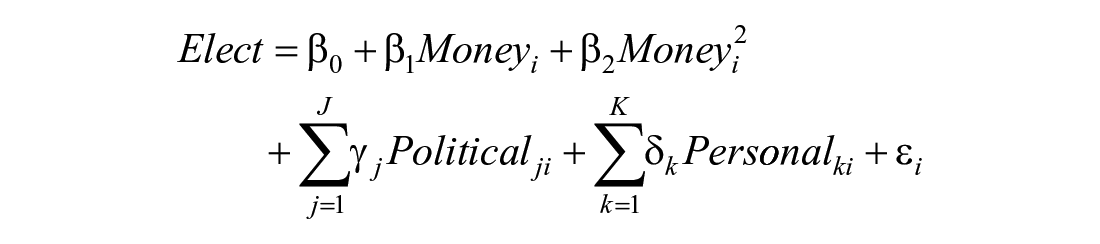
where
To distinguish between incumbents and challengers, this study used the following two approaches. First, we inserted the interaction variable
Results and Discussion
We report the logit regression results in Table 2 and the marginal effects in Table 3. The probit regression resulted in estimates of the same sign for all variables, with very slight differences in standard errors. Overall, the results indicate that campaign spending is effective in raising the probability of election for DPR candidates in 2014. Everything else equal, we would expect a 5-percentage-point increase in the probability of getting elected if the candidate raises an additional IDR 100 million of campaign funding. This result is generally intuitive and in line with the institutional context of Indonesia. As described in Section 2, the role of money in Indonesia’s elections has grown due to the crowded and competitive nature of open-list elections of Indonesia and the professionalization of campaigns. Our econometric estimations may also indirectly support evidence from Muhtadi (2018b) and The Asia Foundation (2014) that there is widespread vote buying in the election, though such expenses are likely not reported in our sample. Furthermore, the negative coefficient on the squared term in Model 1 shows that campaign spending generally exhibits diminishing returns, albeit only to a small extent. But these results are relatively uncontroversial, and we achieve more nuanced main findings by distinguishing the effect of campaign money between incumbents and challengers.
Logit Estimation Results.

Source. Authors.
Note. Figures in parentheses are standard errors.
Significant in 10%. **Significant in 5%. ***Significant in 1%.
Marginal Effects of Logit Model.

Source. Authors.
Note. Figures in parentheses are standard errors.
Significant in 10%. **Significant in 5%. ***Significant in 1%.
The effects of campaign spending are statistically significant for both incumbents and challengers, contrary to many previous results from the US house elections in which they are only significant for challengers, but similar to results from Brazil whose institutional context is more similar to that of Indonesia. Model 1 shows that the coefficient of the interaction term between incumbency and money is insignificant, meaning that neither incumbents nor challengers translate money into votes more efficiently than the other. This is also demonstrated by the results of Models 2 and 3, in which the sample includes only incumbents and challengers respectively. The coefficients of campaign money are both statistically significant at the 5% significance level, and at the 1% significance level for incumbents only. When we compare the magnitude, the effect of campaign spending is also slightly bigger for incumbents than for challengers. This therefore implies an unequal playing field since challengers would need more money to compete with incumbents. Based on the separated regressions, each additional increase of IDR 100 million of campaign funding will only increase the probability of being elected by 1 percentage point for challengers and 8 percentage points for incumbents. This figure is indeed a relatively small amount when we consider observations from other studies, which estimates campaign costs for the 2014 DPR election to range between IDR 750 million and 4 billion (Amru & Dartanto, 2014).
A plausible explanation for why money significantly affects electability can be found when we consider the institutional context in Indonesia, where constituents might be relatively disconnected with their DPR representatives. First, electoral districts are geographically large and multi-member (up to 10 seats per district), so it would be unsurprising that many voters are unable to keep up with the many politicians representing their district. Second, public attitude toward the DPR is characterized by political apathy and lack of awareness. As a result, many Indonesian voters might not realize and consider the fact that a candidate has already served as their representative. Therefore, a huge amount of money is needed to socialize and introduce themselves to constituents. In addition, we cannot neglect vote buying behaviors, as mentioned by Muhtadi (2018a) and The Asia Foundation (2014), which would require significant amounts of money. However, vote-buying expenses are likely not included in the campaign contributions officially reported, hence they are unfortunately outside the scope of our data. An important caveat to our result is the endogeneity bias, likely to be upwards, that arises from simultaneous causality between campaign money and the probability of electoral success. While campaign money should raise the probability of electoral success, the predicted odds of a candidate’s victory could also help them in raising funds. This study could not address this endogeneity issue, which previous studies address through an instrumental variable approach, due to data limitations.
Now we compare the effect of diminishing returns between incumbents and challengers. By looking at the coefficient of the money squared variable, we find that both spending by incumbents and challengers are subject to diminishing returns, though it is only significant at the 1% significance level for challengers. The effect of diminishing returns itself is stronger for incumbents, which might be due to incumbents starting with bigger marginal effects from a lower starting point. We illustrate this by plotting the predicted probabilities against the amount of campaign money (holding every other variable at their means) in Figures 2 and 3. Overall, candidates reach the maximum probability of getting elected at a campaign spending of around IDR 3 billion. This figure remains within the estimated range of the cost needed for a candidate to obtain a seat in the 2014 DPR election, IDR 750 million—4 billion (Amru & Dartanto, 2014). This suggests that there remains a portion of candidates that are spending more than they effectively need to. In sum, campaign spending is effective for both types of candidates; the only difference is that for incumbents, the magnitude of the effect is overall bigger (from a lower starting point of probability of election) but diminishes faster, while for challengers the magnitude is smaller but the effect diminishes more slowly.

The relation between probability of getting elected and campaign money.

The relation between probability of getting elected and campaign money, by incumbency status.
Due to our data constraints, there are some caveats to be noted regarding the interpretation of the main results. Firstly, the magnitude of relation between campaign finance and election success might be overestimated due to systematic underreporting of campaign contributions by the candidates. Furthermore, we use the proxy of campaign contributions instead of campaign expenditure, which implies that candidates might be spending more to secure their seats than our data suggests. Secondly, the semi-voluntary nature of reporting introduces another factor into our analysis, which is the willingness to report. The relation found between higher-reported donations and electoral success might also be due to stronger candidates attracting larger amounts of “legitimate” donations which they could report. While we have attempted to control personal characteristics with the available data, this could still render our main estimates potentially overestimated.
The political factor variables of list position and incumbency are found to be statistically significant. The estimate indicates that list position has a strong negative impact on the electability of DPR candidates in 2014; the lower a candidate is listed on the ballot (bigger number of list position), the lower their electability. This confirms a previous finding by Dettman et al. (2017) in the same legislative election that list position has a significant and negative effect toward the probability of winning a seat. This is intuitive since Indonesian voters had to choose from dozens of candidates on the ballot, the number of candidates reaching over 100 in some larger districts, and hence would understandably gravitate toward candidates higher up on the list. In the closed-list system of the past, list position has an absolute role in the election of candidates since voters only vote for political parties, which would afterward elect candidates based on an internal list. The regression result indicates that the open-list system reform has not brought significant change to the important role of list position.
The incumbency variable is found to be significant but with a negative coefficient, implying that incumbents are generally disadvantaged in terms of their electability. Although it was not found to interact positively with money, incumbency status by itself does lower the probability of electoral success. The magnitude is also considerable; being an incumbent lowers the probability of getting re-elected by 30.7 percentage points, all else equal. This indicates the presence of an incumbency disadvantage for Indonesian legislative candidates in 2014. Unlike the result for list position, this particular result differs with Dettman et al. (2017), which identified a consistent personal incumbency advantage in Indonesia. However, this result is consistent with several studies in other countries with similar democratic settings, where incumbency status was found to result in a disadvantage (Klašnja, 2015; Klašnja & Titiunik, 2017; Moral et al., 2015; Uppal, 2009).
A common explanation to this incumbency disadvantage, particularly for developing countries, is the constant state of discontentment among voters toward incumbent politicians, who are perceived as corrupt and failing to deliver public goods adequately. It would be unsurprising if the incumbency disadvantage in our results is due to the same phenomenon. However, this explanation requires that Indonesian voters are able to recognize which candidates are incumbents and which are not. This is at odds with our other hypothesis regarding the lack of incumbency advantage, which is that political awareness is so low that voters are not even familiar with their representatives. Alternatively, our results might be affected by our limited sample not adequately representing challengers in the population.
For personal characteristics, only the variable of gender is found to be significant across all regressions. The coefficient of the variable is negative, meaning that being female lowers the probability of winning a seat, with the effect having a stronger magnitude and significance for challengers. This could explain why minimum quotas for female political candidates, first implemented in 2003, has not led to a significant increase in the proportion of women in the national parliament, which stood at only 17.1% in 2018. The problem may lie in how voters perceive women candidates or how the candidates themselves conduct their campaigns, but this is beyond the scope of our study. For some of the other personal characteristics variables, the results differ slightly between regressions. Curiously, being born in the same area as the district the candidate is running in reduces the probability of electoral success, though this does not seem to apply for challengers.
Age has a significant negative effect except in Regression 2, which only uses incumbents as the sample. Being older seems to penalize challengers, indicating that there might be an expectation from voters that challengers should be somewhat younger. Lastly, organizational experience has a positive effect when it reaches the national or international level, though the effect is not found to be significant in Regression 3. Instead, Regression 3 found organizational experience of a provincial level to have a significant and negative effect. These particular results confirm that organizational experience at the national or international level has a superior positive effect across the board. The rest of the personal characteristics, including religion and education, were not found to be statistically significant. This finding suggests an interesting distinction in the role of religion in Indonesian politics. While religion seems to be an influential factor in the election of the president and local leaders, it does not seem to affect the electability of national legislative candidates, at least in our sample.
Conclusion
This study adds to the relatively scarce literature on campaign spending effectiveness in a young and large democracy with an open-list PR system. By using a sample of legislative candidates in Indonesia’s 2014 DPR election, we confirm that campaign spending is effective in raising a candidate’s the probability of getting elected. However, campaign spending is still subject to diminishing returns, especially for incumbents, though the magnitude is negligible. Based on our estimates, it is advisable for candidates to not raise more than IDR 3 billion in official contributions for their election campaigns.
Our research contribution helps affirm previous findings from developing countries regarding the role of money and the incumbent-challenger distinction. The effectiveness of campaign money is found to be significant for both incumbents and challengers, consistent with Samuels (2001) finding in Brazil while contradicting estimates from US elections. This could point to the lack of incumbency advantage in Indonesia, at least in terms of recognition. In fact, there might even be incumbency disadvantage; disregarding the role of money, having an incumbency status by itself lowers the odds of winning a seat. The incumbency disadvantage that our results imply conforms to much of the previous research in developing countries with young democracies, which could be explained by the attitude of voters toward the government in general. Hence, while campaign spending is productive for both types of candidates, incumbents might need to expend more to compensate for their incumbency disadvantage. In this sense, the playing field seems leveled for challengers, who are often disadvantaged in raising funds and unable to leverage official resources to support their campaign. However, incumbents remain slightly more advantaged because spending money has a bigger effect on their probability of electoral success than it does for challengers.
This result has important implications toward campaign finance regulation in Indonesia. The overall effectiveness of money means that Indonesian elections tend to favor those who are financially endowed. Knowing this, candidates would race to expend all available resources in order to secure victory. This leads to campaign costs spiraling out of control and imposing an entry barrier toward politicians who are less wealthy and connected. Therefore, in the spirit of democratic fairness and participation, placing more stringent limits on campaign contributions and adding limits on spending should be considered. Since raising additional campaign money benefits challengers no more than it does for incumbents, there is little worry about limits hurting challengers while helping incumbents. Yet, attempts to impose such limits might be severely constrained by the state’s lack of enforcement capacity. Furthermore, enforcement issues might lead to campaign limits backfiring if unreported expenses are an easy substitute to officially reported ones, as candidates might be prompted to switch focus to more illicit campaign practices.
For future research, we recall several limitations of this study. First and foremost is the limitation in available data, which severely restricted our sample size. We also use campaign contributions as a proxy instead of campaign spending. Since the true value of campaign spending might be higher than reported campaign contributions, this might have resulted in an overestimation of the effect of campaign spending in our study. Secondly, the semi-voluntary nature of campaign finance reporting indicates the possibility of selection bias. Further studies should be conducted with data from future elections where more candidates report their campaign finance or when reporting has become mandatory with adequate enforcement. Lastly, it would also be insightful to analyze not only the quantity but also the quality of campaign spending, such as by focusing on specific types of campaign spending should such data become available in the future. This also relates to the issue of selection bias, as the amount of campaign finances reported might only cover a portion of campaign spending. In particular, more illicit spending such as vote-buying might be funded by contributions that are not reported, which are unfortunately outside the purview of this research. Another improvement to this study is to control for the effect of challengers who are noticeably relatives of incumbent politicians, that is, candidates from political dynasties, as they would have the recognition advantage of incumbents. Similarly, future studies could also caution the possibility of election candidates who are challengers in the legislative arena but have held executive positions in the past.
Footnotes
Declaration of Conflicting Interests
The author(s) declared no potential conflicts of interest with respect to the research, authorship, and/or publication of this article.
Funding
The author(s) disclosed receipt of the following financial support for the research, authorship, and/or publication of this article: The authors thank the three referees who provided valuable and insightful suggestions for improving this article; and the members of Dartanto’s weekly seminar 2014 and the participants of Singapore Economic Review Conference 2019 for their comments and feedbacks in the early stage of this research; and the Faculty of Economics and Business, Universitas Indonesia for providing partial financial support for this article through the research cluster of poverty, social protection and development economics (NOMOR: PKS-0460.14/UN2.F6.D/HKP.05.01/2021).
