




Abstract
Preschool parents’ attitudes toward the online experience and their behavioral intentions to use parenting apps are influenced by their perceptions of social interactions and their mobile engagement with these apps. There have been few studies of how perceived interactivity affects the customer experience and consumption habits of preschool parents. This paper describes a study focused on preschool parents’ perceptions of the influence of online customer experience on their behavioral intentions to use parenting apps for young children. The study also explored how perceived interactivity moderated this relationship. We used the questionnaire to collect data with the valid sample size comprised 571 anonymous preschool parents. A Chinese questionnaire was developed to examine three factors: “online customer experience,” “perceived interactivity,” and “behavioral intentions to use.” To analyze the survey data, the researchers used partial least squares and tested the internal consistency reliability, convergent validity, and discriminant validity of the latent constructs in the measurement model. Additionally, the bootstrapping method was used to conduct 5,000 replications to test the statistical significance of perceived interactivity as a moderator. The results indicated that perceived interactivity has a negative moderating effect on the association between online customer experience and a parent’s behavioral intentions to use a parenting app to improve their parenting skills. Preschool parents with positive attitudes toward perceived interactivity showed little preference for gaining online experience via parenting apps. They can use the technical functions of their mobile phones or parenting apps to customize their cognitive experiences and emotions.
Keywords
Introduction
Online technology and mobile apps provide preschool parents more opportunities to access parenting services, allowing them to gain appropriate information about the educational and pastoral issues that are important to them. The quality of online services or products influences customers’ experiences of parents and impacts their cognition, emotions, behaviors, senses, and social interactions (Ameen et al., 2021; Wibowo et al., 2021). Mobile apps offer different customers’ experiences for preschool parents to search for information about parenting, interact with other parents, and make decisions about educating and caring for their children.
A customer’s experience and feelings are related to parents’ adoption of online services (Jebarajakirthy & Shankar, 2021). Their customer’s decision to adopt and continue to use parenting apps depends on their attitude toward its sociability and interactivity (Carbo-Valverde et al., 2020). Preschool parents actively interact with other app users and gain positive awareness, encouraging them to continue using the app (Chen & Yang, 2021; Huang et al., 2019). Parenting apps’ perceived interactivity optimizes parents’ usability and leads to their higher levels of consumption engagement and satisfaction.
Preschool parents in Taiwan have been using mobile apps for years. Parenting apps that are more interactive tend to provide more useful information, and they are valued by parents for their interactive features and abundance of information. These apps provide information about useful parenting strategies to parents. They can find these apps useful in educating their young children while developing cognitive and emotional skills. Using parenting apps creates social interaction or responds to their emotional needs so that parents can be more effective as parents.
Previous studies have tended to analyze preschool parents’ attitudes toward the relationship between their online experience and their behavioral intentions to use parenting apps to help them improve their parenting skills. Researchers have rarely considered the impact of social interactions and mobile engagement on preschool parents’ satisfaction with apps and their continued use of them. They have also not considered how customer experience and consumption practices should encourage mobile parenting service providers to innovate and improve the skills of preschool parents.
Preschool parents, however, want to have more willing, friendly, and responsive interactions with other parents and caregivers through their parenting activities. There is a need to study how the perceived interactivity of parenting apps can affect parents’ satisfactions or customers’ experiences and stimulate their desire to continue using and repurchasing those apps. Their attitudes toward parenting apps may be moderated by their online experiences and their perceptions of other topics. Therefore, this study explored the relationship between preschool parents’ attitudes to online customer experience, perceived interactivity, and their behavioral intentions to use parenting apps. It also examined the interactive effect of perceived interactivity on this relationship.
The Relationship Between Online Customer Experience and Behavioral Intentions to Use Parenting Apps
Online customer experience is derived from customer experience definitions and indicates customer intention to re-purchase from a website or shop in an online context (Rose et al., 2011). The online customer experience describes their internal position within the online purchase behavior models, and is linked to the intended behaviors of online purchases or online shopping experiences (Eroglu et al., 2001; Khalifa & Liu, 2007).
Online customer experience is defined as the entirety of a customer’s habits of consumption and the satisfaction they gain from engaging with an online product or community (Bitrián et al., 2021; Wang et al., 2019). Customer experience is measured by the degree to which mobile apps provide online resources and useful information to customers (Bleier et al., 2019; Tom Dieck & Han, 2021). Customers who have a positive experience display pleasurable feelings and sensations through the act of consumption (Jaziri, 2019). They express their pleasure and enjoyment at the fact that their needs are satisfied and fulfilled.
A person’s online customer experience is an internal and subjective feeling that is aroused by the interactions involved in buying and using a mobile app (Chopdar & Balakrishnan, 2020; Zhang et al., 2019). A customer’s experience of a mobile app derives from their intrinsic perception of and psychological reflection on the processes of accessing and engaging with online the community to which the app offers access (Kim, 2021; Lee et al., 2019). Mobile apps provide customers with a social network or an interactive platform to communicate with other people in multiple ways.
Based on the definition above, the concept of online customer experience is a way to highlight a person’s experience with a specific online service to encourage their continuing behavior toward that service. The mobile customer experience consists of the cognitive as well as the affective dimensions of satisfaction, trustworthiness, retention, and engagement. When a customer has a positive experience with an online service, they regard it as innovative and worthwhile. This encourages service providers to provide benefits to their customers while meeting their needs.
In term of behavioral intentions to use, the technology acceptance model is considered to be the main basis for modeling (Davis, 1989; Davis et al., 1989). The technology acceptance model is based on the theory of reasoned action, and argues that the key to the adoption of new technology by members of an organization is their acceptance attitude (Teo, 2009). It emphasizes that the new technology will not cause physical or psychological harm. When they agree with the practical value of a new technology, they show a more positive behavioral intentions to use and perform the actual application behavior (Davis, 1993).
Behavioral intentions to use are defined as a person’s stated tendency to act in a specific way (Chai et al., 2021; Hwang et al., 2019). The relative advantages and perceived usefulness of a mobile app are related to a customer’s behavioral intentions to use that app (Kaur et al., 2020; Wang et al., 2019).
A person’s behavioral intentions are the degree to which they are convinced to repeat a particular behavior after a favorable assessment of a product or service (Belanche et al., 2021; Nedra et al., 2019). Both customer experience and online usability affect a customer’s intentions to use a mobile app (Huang & Chueh, 2021; Ray et al., 2019). If a customer enjoys using a mobile app, then they will be positively encouraged to continue engaging with it and using it (Morosan & DeFranco, 2019).
From the above, customers use mobile apps for sharing information, interacting with online members, and resolving problems related to issues they are interested in. Designers of mobile apps should consider whether their app matches the needs and desires of their target customers. Customers’ behavioral intentions to use mobile apps are influenced significantly by their online customer experience, which encourages them to consume the content of the app. Mobile apps provide more benefits to customers and provide greater access to different services. Online customer experience significantly affects customers’ behavioral intentions to use mobile apps, encouraging them to consume the content of the app.
The online customer experience of preschool parents refers to their subjective reaction to how a specific mobile app connects them with mobile parenting services (Barari et al., 2020; Papadakis et al., 2020). Parents find apps that are convenient to be satisfying. These apps give them gratification (Riedel & Mulcahy, 2019; Susanto et al., 2021). Parenting apps provide an innovative way for preschool parents to search for and access services and products that help them care for and educate their children. If parents have a positive experience with an app and are satisfied with it then they will continue to use it and consume its online services.
Preschool parents like to use parenting apps because they provide original tips on how to care for and educate their children. They value such apps because of their perceived ease, usefulness, and the quality of their contents and information. Their experience of using such apps is reflected in their behavioral intentions to continue using them and their satisfaction with them. If they believe that they offer a useful function, then they will continue to use them. They recognize that parenting apps are innovative and interesting tools that can help them transform their make better parenting decisions. Therefore, we propose the following hypothesis:
Hypothesis 1: A positive online customer experience increases a customer’s behavioral intentions to use a parenting app.
The Relationship Between Perceived Interactivity and Behavioral Intentions to Use Parenting Apps
In the development of web-based advertising and website purchasing intention, perceived interactivity has a positive impact on customers’ attitudes toward websites as well as their purchase intentions (McMillan & Hwang, 2002; Wu et al., 2010). Customers expect new media and digital devices to interact in real-time, reciprocally, and playfully with each other (Jee & Lee, 2002).
Perceived interactivity refers to the technical functions and operations of a mobile app (Bozkurt et al., 2021; Bruggen et al., 2019). Perceived interactivity is the degree to which a customer understands a mobile app as a mechanism for interacting and communicating with others to gain relevant information. Perceived interactivity also refers to the extent to which a mobile app allows users to share information within a given mobile community (Shen et al., 2020; Zhang & Du, 2020). Perceived interactivity is a critical factor in a customer’s experience of the flow of an app and their satisfaction with it (Khare et al., 2020; Wu et al., 2021). It affects their behavioral intentions to use the app.
Customers value the quality of information sharing based on the following aspects: interactivity, abundance, social community, and technological convenience (Japutra et al., 2021; Yim & Yoo, 2020). It represents the customer’s integrated and individual assessment of the form and quality of interactions provided by an app (Huang et al., 2021). Mobile apps that provide users with more opportunities to correspond with others can increase customer engagement (Ting et al., 2021).
Different user interfaces offer different ways of interacting with a mobile app. Technical modalities offer customers a high level of autonomy when operating a mobile app (Hwang & Oh, 2020; Miraz et al., 2021). Apps that offer social interactivity encourage customer engagement through multiple, synchronous forms of communication. Apps that offer higher levels of perceived interactivity tend to increase their customer’s confidence in them (Liu et al., 2020). This positively affects their intention to continue using such apps because they provide benefits and are believed to be effective.
As discussed above, customer satisfaction is also related to their perception of interactivity; this, in turn, affects their interest in using an app. Customers are more likely to engage and participate in apps that offer more interaction and communication. This increases customer satisfaction and makes them value the apps. By sharing knowledge and information among themselves, their interpersonal connections with mobile members facilitate the creation of mutual value and experience for their customers. Customers’ perceptions of the quality and quantity of interactivity contribute to their social interactions and emotions of trust toward others.
Among preschool parents, perceived interactivity is related to their assessment and subjective evaluation of using a parenting app. Parents evaluate apps based on their ease to use and the extent to which they meet their needs. If they respond favorably to the functional and operational features of a parenting app, then they will be more likely to continue to use it. If they enjoy using the app, then they will respond positively toward it and continue to use it. Therefore, we propose the following hypothesis:
Hypothesis 2: Perceived interactivity positively influences people’s behavioral intentions to use a parenting app.
The Moderating Role of Perceived Interactivity
The experience derived from mobile apps and related applications encourages customers to share information and their opinions about the app (Kang et al., 2021; Wang et al., 2020). Online experience, interactivity, customer satisfaction, and continuance behaviors all have a significant effect on this (Amoako et al., 2020; Carvajal-Trujillo et al., 2021). Customers focus on the impact of mobile control, response time, and the effectiveness of the communicative model. They expect to be able to communicate with other mobile users, obtain instant responses, offer feedback, and discuss appropriate parenting strategies.
Mobile apps permit customers to gain information that is personalized to them, to interact with others, and to satisfy their individual needs. These factors all influence their behavioral intentions to use a specific app (Cheung et al., 2020; Zhao et al., 2021). This allows customers to enjoy using the app, respond emotionally to the app’s services, and enhance their understanding of the app. This will make them more satisfied with the app and encourage them to continue using it (Karampela et al., 2020; Rubio et al., 2019). Apps that are more interactive and responsive allow customers to interact with other users more frequently. Interactive apps allow customers to enjoy increased responsiveness, creating mutual understanding and innovative collaboration.
The relationship between perceived interactivity and behavioral intentions to use is affected by customers’ online experience and other related factors, such as service characteristics, readability, and the attractiveness of the online content (Li et al., 2020; Ul Islam et al., 2020). Customers’ perceptions about ease of use, aesthetics, interactivity, and customization also affect their attitudes toward an app and their continued use of it (Gligor & Bozkurt, 2020; McLean & Wilson, 2019). If customers have a positive experience of using an app and believe that it offers high levels of interactivity, then they will engage actively with its content and continue to use it.
If preschool parents find a parenting app to be interesting and enjoyable, and if it offers them opportunities to interact socially with others, then they will obtain a pleasurable experience from it and continue to respond to its content (Papadakis et al., 2019). Parenting apps reduce the geographical and temporal limits placed on social interactivity between preschool parents. They allow parents to gain information about how to care for and educate their children. Preschool Parents value these apps based on their responsiveness and the level of engagement they offer. The greater a customer’s experience with an app (and the greater the level of interactivity that they feel it provides), the more likely they are to respond positively to it and continue to use it. The following hypothesis and model (see Figure 1) are proposed:
Hypothesis 3: Perceived interactivity has a moderated impact on online customer experience and behavioral intentions to use.

Theoretical model.
Methods
Sample Characteristics
In Northern Taiwan, more than 100 preschools and childcare centers use a popular parenting app called the Smart Nursery APP. With this app, preschool parents can receive notifications for picking up children, access an electronic contact book, check the nursery, and measure the temperature in real-time over a Bluetooth connection. Moreover, it provides preschool parents with some helpful parenting tips to help them care for their young children. For example: the latest or new information about parenting, young children’s learning situations, snacks and lunches, height and weight development, hygiene, and information about children’s health. Most parents are very satisfied with the user interface of this app. They use it daily and find it a great communication tool for preschools and childcare centers.
In this study, we used a sample of 650 preschool parents with a similar experience using a parenting app in northern Taiwan. After excluding incomplete questionnaires, missing values, and non-responses, the valid sample size comprised 571 anonymous preschool parents, equivalent to an overall response rate of 87.8%. In this study, preschool parents were fully informed about both the purpose and the procedure of the study. Assuring them of privacy and confidentiality, they were asked to provide informed consent (Petousi & Sifaki, 2020).
Preschool parents of diverse genders, ages, educational levels, occupations, and experience with parenting apps comprised the survey sample. Female respondents made up 58.8% of the sample (N = 336), whereas male respondents made up 41.2% (N = 235). About 62.3% of the respondents were aged between 31 and 40 (N = 356). About 20.0% (N = 114) were 30 or younger. About 76.5% (N = 437) of the respondents were educated to university or college level. A 9.8% (N = 56) were educated to high school level. The majority of respondents were employed in the service industry (N = 211, 37.0%). A 31.2% (N = 178) were employed in the public sector, 17.7% (N = 101) in business, and 14.2% (N = 81) in other sectors. A 41.2% of the respondents (N = 235) spent approximately 4 to 6 hours on average every day using a parenting app. A 51.8% (N = 296) spent approximately 2 to 4 hours on average every day using a parenting app.
Measurement Instrument
This study aimed to measure preschool parents’ perceptions about the association between online customer experience and behavioral intentions to use a parenting app. It also analyzed the moderating effect of perceived interactivity on this relationship. A Chinese questionnaire, titled “Behavioral Intentions to Use Parenting Apps” (BIUPA), was developed for this research. We constructed the observed variables and factors of the BIUPA based on the theoretical foundation of the literature review and the model hypothesized for the study. This questionnaire was developed in consultation with three experts in the fields of mobile technology and parenting education. They provided assessments of the questionnaire.
The BIUPA questionnaire focused on three factors: “online customer experience,” “perceived interactivity” and “behavioral intentions to use.” In the original survey, there were 15 observed variables (5 variables for each latent construct). A 5-point Likert scale was used to measure whether respondents agreed or disagreed with the statements in the questionnaire (from 1 = strongly disagree to 5 = strongly agree). The following are the three latent constructs in BIUPA:
Online customer experience (OCE). This was used to assess preschool parents’ perceptions about the creative and useful features of parenting apps. The researchers analyzed and reviewed the relevant literature and arranged observed variables in the latent factor of OCE (Lee et al., 2019; Wang, Cao, et al., 2019; Zhang et al., 2019). Some sample observed variables were as follows: “I learned a lot of useful information from using the parenting app”; “I think the parenting knowledge obtained from the parenting app was beneficial”; and “The content of the parenting app made me efficient.”
Perceived interactivity (PIN). This was used to investigate preschool parents’ perceptions of the quality and quantity of parenting apps. It focused on information sharing, social interactions with mobile users, and engagement with the functional and emotional operations of apps. The researchers analyzed and reviewed the relevant literature and arranged observed variables in the latent factor of PIN (Bruggen et al., 2019; Shen et al., 2020; Zhang & Du, 2020). Some sample observed variables were as follows: “The quality of interaction offered by the parenting app was excellent in meeting my needs”; “The parenting app responded to me instantly and appropriately”; and “The parenting app listened to what I have to say.”
Behavioral intentions to use (BIU). This was used to assess preschool parents’ attitudes toward voluntarily continuing to use apps, as well as their overall thoughts on the mobile parenting services offered by the apps. It focused on usability and performance. The researchers analyzed and reviewed the relevant literature and arranged observed variables in the latent factor of BIU (Huang et al., 2019; Nedra et al., 2019; Wang, Ou, et al., 2019). Some sample observed variables were as follows: “I am likely to recommend the parenting app to others”; “I intend to continue using the parenting app rather than another service”; and “I intend to use the parenting app in the future.”
Data Analysis
We analyzed the survey data using partial least squares. The researchers tested the data to see the interaction of the moderation (Hair et al., 2016; Lowry & Gaskin, 2014). For analyzing the raw data and testing the convergent validity, discriminant validity, and internal consistency reliability of the latent constructs in the measurement model, the researchers employed SmartPLS 3 (Ringle, 2015). The factor loading of the observed variable in the BIUPA estimated by the use of confirmatory factor analysis. A total of 5,000 bootstrap replications were used to test the statistical significance of the factor loadings. The Cronbach’s Alpha, Composite Reliability (CR), Average Variance Extracted (AVE), and the correlation coefficient were calculated to test the reliability and validity of the latent constructs.
In the analysis of the structural model, we assessed R2, Adj. R2, Q2, and the standardized root mean residual (SRMR) of the relationship between latent constructs and theoretical hypothesis. We detected the multicollinearity of the latent constructs by using the variance inflation factor (VIF). We also measured the effect sizes (f2) to indicate the contributions of each latent construct. The moderating effect in the hypothesized relationship was tested by partial least squares. The statistical significance of the moderating effect was examined through the 5,000 bootstrap resamples (Chin et al., 2003; Esposito Vinzi et al., 2010; Wetzels et al., 2009).
Results
Measurement Model
In the BIUPA, confirmatory factor analysis was used to evaluate the observed variables and latent constructs. We deleted the observed variables in the BIUPA where the factor loading on each latent construct was less than 0.700. The 18 variables initially observed were reduced to 15 for the BIUPA. The 15 retained variables ranged from 3.816 to 4.142, and the standard deviations ranged from 0.741 to 0.927.
We observed that kurtosis of the observed variables ranged from −0.207 to 1.404, and their skewness ranged from −0.858 to −0.344. The measures for kurtosis and skewness were within the acceptable range from −1 to +1. Table 1 shows the standard factor loading for each variable ranging from 0.871 to 0.948. Based on 5,000 subsamples, the results showed that the t statistics of the observed variables were all greater than 3.29, indicating that they were statistically significant (p < .001).
The Mean, SD, Factor loading, and t value in BIUPA.
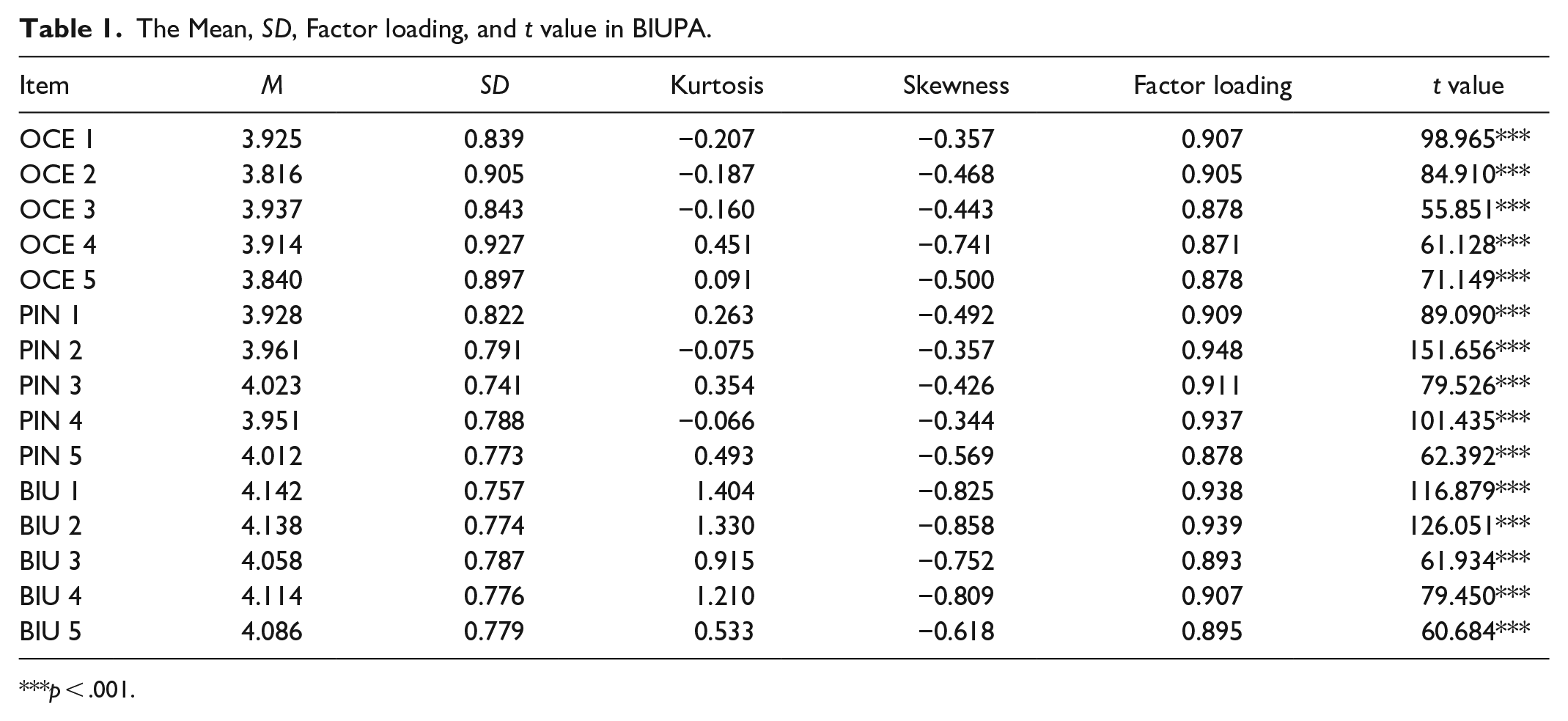
p < .001.
Table 2 shows the Cronbach’s alpha (ranged from .933 to .952, higher than the cutoff value of .800), rho_A (ranged from .935 to .952, higher than the cutoff value of .800), CR (ranged from 0.949 to 0.963, higher than the cutoff value of 0.800), and AVE (ranged from 0.788 to 0.841, higher than the cutoff value of 0.500) values for each latent construct of the BIUPA. All the measures of reliability and validity in the BIUPA were acceptable.
The Cronbach’s Alpha, Rho_A, CR, and AVE.

Table 3 shows that the correlations of the latent constructs in the BIUPA ranged from .774 to .792. The respective square root of the AVET were more than the correlation coefficients between each latent construct, which ranged from .888 to .917. Therefore, the discriminant validity in the BIUPA was accepted.
Discriminant Validity: Fornell–Larcker Criterion.

Note. The square root of the AVE of two latent constructs is given on the diagonal, and the correlation coefficient is given on the below diagonal.
Table 4 shows the detailed analysis using the Heterotrait-Monotrait (HTMT) Ratio of Correlations technique. All of the HTMT values were less than the cutoff value of .85, ranging from .818 to .839. A reasonable level of reliability, convergent validity, and discriminant validity is shown for the latent constructs. The results suggest that the BIUPA measurement model was internally consistent of highly reliable.
Discriminant Validity: Heterotrait-Monotrait Ratio (HTMT).

Structural Model
The researchers employed partial least squares to assess the quality of the structural model. All statistics, such as R2 = .68, Adj. R2 = .686, and Q2 = .565, were acceptable in terms of structural validity. The SRMR value was 0.040, indicating that the sample data fit the model used in the BIUPA. Table 5 shows the multicollinearity statistic results by VIF. All the VIF values (ranging from 2.691 to 2.704) of the latent factors were less than 3, indicating that multicollinearity had a small impact on the latent factors in the BIUPA.
The Collinearity Statistic (VIF) Results.

Table 6 shows the effect size results among the latent factors in the BIUPA. Effect sizes of 0.12, 0.20, and 0.32 reflected weak, moderate, strong effect sizes. The f2 values of the latent constructs ranged from 0.180 to 0.264 and indicated moderate predictive relevance for the latent factors.
The Effect Size (f2) Results.

In the path analysis of the structural model in the BIUPA, the OCE and PIN constructs explained 68.4% of the proportion variance of the BIU construct, corresponding to a standardized regression coefficient of .393 and .480, respectively. After performing a bootstrap with 5,000 resamples, all of the path coefficients were extremely statistically significant (p < .05) and supporting both H1 and H2.
The Moderating Effect of Perceived Interactivity
Converting the independent variable and moderating variable into standardized scores, we used SmartPLS 3 to test the interaction for the moderating role in the relationship. The path coefficient of the interaction effect terms of the standardized indicator values before multiplication with the OCE and PIN constructs on the BIU construct was −0.046 (t value = 2.516). The 95% Bias-Corrected bootstrap confidence interval of the moderator’s effect ranged from −0.073 to −0.004, and did not include zero. Thus, the results showed that the moderating effect of PIN is significant in this relationship. Figure 2 shows the results of the simple slope analysis of the moderator.
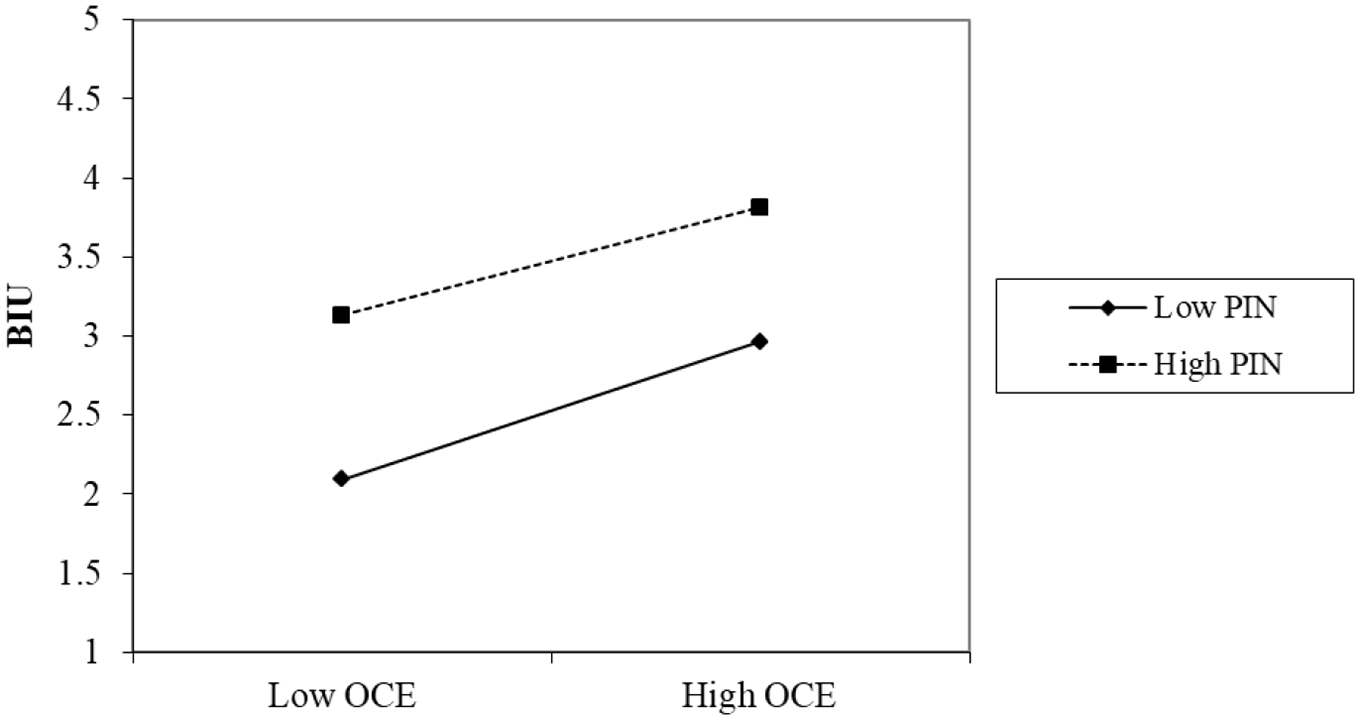
Interaction effect of perceived interactivity (PIN).
This study demonstrates the negative moderating effect of PIN in this relationship for preschool parents. The explanatory power of the main effect was 0.599 and the explanatory power of the moderating effect was 0.684. The effect value of the moderation was 0.269 with a medium moderating effect. These results support H3. According to the results, preschool parents with lower indications of PIN in their parenting practices had more positive attitudes toward parenting apps and responded more positively to their functional and emotional experiences. These parents were also more likely to continue to use these apps.
The negative moderator of PIN in this relationship in BIUPA contradicts the results from the above studies (Gligor & Bozkurt, 2020; McLean & Wilson, 2019; Rubio et al., 2019). The elements of perceived interactivity, such as synchronicity and controllability, may have contributed to this negative moderation. Generally, preschool parents in Taiwan live fast and stressful lives. After work, Taiwanese preschool parents just want to have a relaxed and stress-free lifestyle, and they don’t want to be disturbed or controlled by other mobile applications or parenting apps. The core features of parenting apps, such as fast responses and real-time feedback, stem from the unsatisfactory experience of using those services.
In addition to the perceived interactivity of multiple channels and mechanisms designed by parenting apps, these feelings create parents’ discomfort and contribute to their negative perceptions about the relationship between online customer experiences and continuance behavior. We care about preschool parents’ real-time interactions with parenting apps, but we also consider their positive emotional reactions to using these apps. The results of the study pointed out that parenting apps should focus on the psychological and desirable requirements of parents and develop a friendly and interactive interface to meet those needs.
Discussion and Conclusions
This study has explored preschool parents’ attitudes to parenting apps in Taiwan, focusing specifically on the interaction between online customer experience, perceived interactivity, and behavioral intentions. The study not only tested whether online customer experience and perceived interactivity were important indicators for parents’ behavioral intentions to use parenting apps but also highlighted the moderating effects of perceived interactivity in the relationship between online customer experience and behavioral intentions to use. Importantly, perceived interactivity was found to have a negative moderating effect on this relationship, supporting hypotheses H1, H2, and H3.
In line with previous research (Amoako et al., 2020; Cheung et al., 2020; Wang et al., 2020), the results indicate that perceived interactivity had a significant moderating effect on the functional experiences and operational behaviors of preschool parents using parenting apps to improve their parenting practices and care for their children. Preschool parents with a positive attitude toward perceived interactivity showed little preference for continuing to engage in online experiences based on the functional and emotional operations of the apps. If a parenting app satisfies a preschool parent’s expectations, then he or she will perceive this app as being interactive and responsive. Perceived interactivity not only refers to the information provided by a mobile parenting app but also indicates the responsiveness and the effectiveness of the mechanism contained within the app.
The results indicated an app’s interactivity and connectedness affect customers’ access to the app, their experience of it, and their continued use of it. Apps that fascinate customers and encourage them to engage or interact with them will cultivate appropriate mobile behaviors through their critical and functional services. Previous research findings are consistent with these findings (Morosan & DeFranco, 2019; Ray et al., 2019; Riedel & Mulcahy, 2019). Parenting service providers should design appropriate mobile platforms to encourage preschool parents to get involved in using mobile apps. They should focus on improving the online customer experience, increasing perceived interactivity, and encouraging parents to continue to use their apps.
According to previous studies (Bruggen et al., 2019; Hwang & Oh, 2020; Liu et al., 2020), online customer experience is now a crucial factor in parents’ satisfaction with parenting apps, affecting their decision to continue using them. Preschool parents who respond positively to functional and affective elements of parenting apps are more likely to perceive their benefits and continue to use them. Preschool parents believe that parenting apps that offer high levels of social interaction and effective communication across human-mechanic interfaces are useful and help them with their parenting. Their experiences with parenting apps do not only depend on their cognitive awareness but are also related to their behavioral intentions to use those apps.
Perceived interactivity increases preschool parents’ engagement and positively affects their behavioral intentions to use parenting apps. It increases their perception of the utilitarian and beneficial value of such apps. It makes them respond positively in cognitive and emotional terms, increasing their ability to care for and raise their children. Mobile interactivity enhances their sense of social presence when using parenting apps, increasing their sense of emotional intimacy concerning those apps and providing more enjoyable mobile experiences. Interactivity makes the process of caring for children more pleasurable for parents and provides them with beneficial consumption on mobile parenting practices.
It is important to design parenting apps that are enjoyable, inclusive, and immersive as this will encourage preschool parents to keep using them. To increase their acceptance of these apps and encourage them to use them, parenting service providers should design apps that are functional and that encourage emotional responses. They should help parents by designing interfaces that are easy to use. They should develop apps with useful information and effective menu systems that satisfy the needs of parents. Parenting service providers should pay more attention to parents’ needs. They should design friendly and interactive interfaces that allow parents to reflect on their parenting practices.
The contribution of this study indicated that service providers should see customers’ online experience as a critical factor affecting their ability to develop functionally and emotionally. Providers of parenting services should utilize mobile apps to maintain online engagement with their customer base and provide a responsive experience. Designing and developing parenting apps with a friendly interface and useful functionality ensures their engagement and satisfaction. We must create personalized and individualized services within parenting apps, and offer reliable, pleasing, and valuable content that encourages parents to participate in the online community and become better parents.
When it comes to the interactive mechanism of a parenting app, the connection between preschool parents and the app could be increased by using multiple channels and websites to stimulate parents’ behavioral intentions to use the app. Parenting service providers should generate interesting and useful content to target parents. They should provide them with worthwhile information that ensures a positive customer experience and maintains customer loyalty. Promoters should also focus on parents’ consumption attitudes and their perceptions about parenting apps. They should encourage positive emotions and develop a friendly community that helps to deliver positive cognitive, affective, and relational experiences through parenting apps. By motivating preschool parents, parenting apps can encourage them to continue consuming content and using the apps.
With regard to limitations and future suggestions, there are some considerations of sample collection and methodology employed. Taiwanese parents who have experience with parenting apps are surveyed for this study. Even though the sample data conform to Taiwan’s population characteristics, preschool parents with no experience in using parenting apps across Taiwan should take into account the research results and inferences. It might be helpful to compare the different perceptions of parents with different backgrounds and experiences with technology to determine what their usage levels and using styles are in the future.
Future studies could reassess the latent factors and observed variables in the BIUPA developed for this paper. They could also design new latent factors, moderating variables, and theoretical hypotheses to explore preschool parents’ attitudes toward their behavioral intentions to use parenting apps. Frameworks for studying innovation and continuance could be used to help service providers understand parents’ online customer experiences of mobile apps and identify whether they find them trustworthy, engaging, or satisfying.
Many preschool parents use multiple communication models to gather parenting information, and they are not always limited to online communication or mobile apps. Parents also participate in various parenting communities and other activities both physically and virtually. In this study, questionnaires are used for collecting data, interviews and observations aren’t used to acquire their opinions or satisfaction with how parenting apps are used. A variety of data collection and research methods may be used to enrich this topic in the future. We suggest that future scholars employ multiple research methods to collect more field data to analyze preschool parents’ perceptions about using mobile apps to develop their parenting skills and improve their parenting literacy.
Footnotes
Declaration of Conflicting Interests
The author(s) declared no potential conflicts of interest with respect to the research, authorship, and/or publication of this article.
Funding
The author(s) received no financial support for the research, authorship, and/or publication of this article.
Compliance of Ethical Standard Statement
All procedures performed in studies involving human participants were in accordance with the ethical standards of the institutional and/or national research committee and with the 1964 Helsinki Declaration and its later amendments or comparable ethical standards.
Informed Consent
Informed consent was obtained from all individual participants involved in the study.
