




Abstract
More than 50 years have passed since Edward Abbey published Desert Solitaire—his persuasive tribute to the preservation of wilderness and wildlife, and over 30 years since he penned. In Praise of Mountain Lions: Original Praises (1984), Abbey predicted how hyper-urbanization and anthropogenic stressors would lead to habitat fragmentation and to an extinction vortex among mountain lion populations. In this essay, I engage in an interdisciplinary approach employing Edward Abbey’s esthetic theory, political ideologies, and polemic land ethic to examine the urgent plight of mountain lions struggling to survive today in the Santa Monica Mountains. It is my hope that the synthesis of Edward Abbey’s political admonitions will contribute to the emerging body of interdisciplinary environmental literary criticism and research to advocate for the protection of mountain lions in urbanized landscapes.
Keywords
The charismatic king of the Santa Monica Mountains perched on a boulder only 9 to 10 feet directly above me like an idyllic sandstone statue. Our eyes met. The lion didn’t move, but I moved slowly on so as not to alarm him or my horse. Nothing worse than to incite a chase with a mountain lion. We all know who would win. The day was April 8, 2002, and I was on duty as a mounted patrol volunteer with the Mountains Research & Conservation Authority on the Eagle Spring Loop Trail approximately 2 miles from Trippet Ranch in Topanga Canyon State Park. It was the first time I had encountered this majestic being, also known as a cougar, mountain lion, brown tiger, puma, catamount, urban carnivore, or panther depending on the geographic location. Since 2002, I’ve been fascinated by this stealthy predator and did not encounter another one until November 20, 2019, while hiking the Will Rogers Trail in Pacific Palisades. Kicking up dust, a large deer sprung from the chaparral and dashed right past me to the other side of the fire road disappearing into the sagebrush. Startled, I jumped back out of the way. Not 2 seconds later, a mountain lion leaped out and plunged into the bush arcing in the same direction as the deer. I followed them into the bush hoping to catch a video—all I captured was the rustling of leaves, the fading thumping of feet.
I’ve been tracking mountain lions in the Santa Monica Mountains ever since. For two decades, I’ve physically examined scat, paw prints, and any signs of this mysterious being. My interest in mountain lions became even more heightened on June 25, 2019, when a 1-year-old 50-lb female cougar wandered down from Topanga State Park through Temescal Canyon Park and crossed busy Sunset Boulevard to take up a short residence in a tree at the Tahitian Terrace Park near my home in Pacific Palisades. The mountain lion now known as P75 was later sedated, collared with a tracking device by officials from the California Department of Fish and Wildlife (CDFW) and the National Park Service then released back into the Santa Monica Mountains.
I have, additionally, followed CDFW reports on mountain lion attacks on people in California. Since 2004, there have been 10 non-fatal attacks and one fatal attack. Since 2020, there have been four non-fatal attacks on children—an attack on a 3-year-old boy in Whiting Ranch Wilderness Park in Orange County on January 20, 2020, an attack on a 6-year-old girl on February 20, 2020, in the Open Space Preserve in the Santa Cruz Mountains, an attack on a 4-year-old boy in the Blue Ecological Reserve in San Diego, and most recently an attack on a 5-year boy in Calabasas in the Santa Monica Mountains on August 26, 2021 (California Department of Fish and Wildlife [CDFW], 2021). The mountain lions responsible for the attacks have been euthanized.
I have followed reports on lion/livestock attacks including the most recent attack report by a 4 to 5-year-old male cougar known as P-56 (a possible progenitor to P-75) who was charged with killing 12 privately owned sheep in the Santa Monica Mountains. Lion P-56, who is also the presumed father of “P-70, P-71, P-72, and P-73,” among others, has been tracked since April 2017, and is the first radio-collared cougar to be put to death for his predatory crimes against livestock (Shalby, 2020). On January 27, 2020, P-56 became the poster child for the 2020 enactment of California’s new depredation law (National Park Service, 2020). Certainly, the demise of a healthy male mountain lion in the Santa Monica Mountains has raised concerns about the fate of the dwindling cougar population.
All the reading, hiking, tracking, contemplation, and research into predator politics, habitation fragmentation, anticoagulant rodenticides, human/mountain lion conflicts, and extinction vortex probability has led me back to revisiting the radical environmentalist and essayist, Edward Abbey. Abbey (1968) recognized the catastrophic danger of human meddling in Mother Nature and her ecosystems and strongly advocated for the defense of the wilderness and all its apex predators: “We need more predators,” he admonishes (p. 31).
In this essay, I engage in an interdisciplinary approach employing Edward Abbey’s esthetic theory, political ideologies, and polemic land ethic to examine the urgent plight of mountain lions struggling to survive today in the Santa Monica Mountains. As early as 1968, Edward Abbey warned that mountain lions would be pushed to the edge of extinction and forced to survive between urbanized housing developments, crisscrossing freeway barriers, and a myriad of complicated political arrangements and policies instituted by California Fish and Wildlife to mediate human and mountain lion conflicts. The result of this forced habitat fragmentation and confinement is a genetically inbred homozygous population of pumas whose contact with human beings has been normalized (Allendorf, 1986; Benson et al., 2016; Frankham, 2005). Puma populations have become so alarmingly fragmented by excessive urbanized development and freeways that lead in and out of these developments that pumas are either winding up in people’s backyards in search of a meal, or residual roadkill on an automobile bumper on the 101 Freeway where 100 pumas annually meet their fate. Because mountain lions do not have enough protected habitats to roam and reproduce, they could face possible extinction in the next 50 years (Benson et al., 2016). Put simply: Edward Abbey knew this long ago. Now it is time we start not only adhering to his wilderness first ethic and begin as Leopold’s (1986) urges to think like a mountain, but more importantly to listen deeply to the mountain and the profound interconnectedness of all of its creatures—especially the mountain lion.
Felis Concolor
The mountain lion is an iconic symbol of the great Southwest. In California, mountain lions are considered essential predators in the state’s endeavors to preserve its ecosystems and myriad wildlife. Occupying urbanized and fragmented spaces in the Santa Monica Mountain range, this beautiful creature faces many challenges to survive even though one-half of California is deemed to be mountain lion country (Benson et al., 2016). For a map of mountain lion locations, see Figure 1. Abbey (1977) observed that with exception of the jaguar, the Felis concolor is a singular “species” of 30 races and one of the “largest cats in the Western Hemisphere” (p. 132). The mountain lion also carries many names from ghost cat to “the French cuguaror couguar, based on the Native American Indian name. Also known as panther, puma, painter, catamount, screamer, Indian devil, king cat” (Abbey, 1977, p. 132). As seen in Figures 2 and 3, the Santa Monica Mountain lion is genetically wired to live within the topographically complex “vertical fringes” of rugged slopes, steep ridges, and narrow canyons (Williams, 2018, p. 74). Built within their genetic make-up, is their ability to not only survive, but to understand, evolve, and physically master their geographical habitat becoming an almost perfect predator (Hansen, 1992).
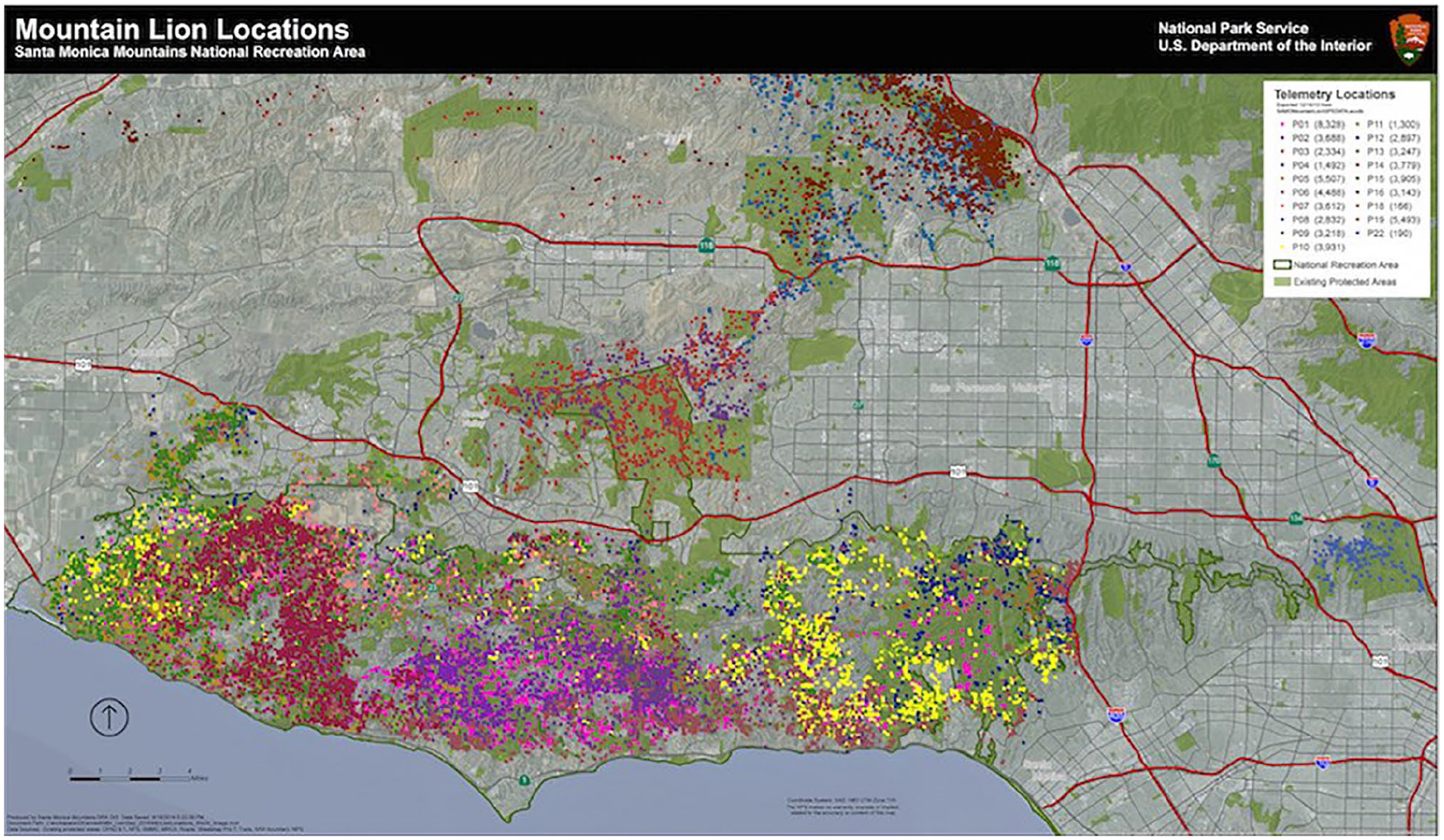
Map of Mountain Lion Locations. National Park Service.

Mountain Lion in Santa Monica Mountains. Photo by Priscilla du Preez.

Cougar on a boulder. Photo by Priscilla du Preez.
Since people rarely see this elusive and independent creature, descriptions of them are pieced together. In fact, having never had contact with a mountain lion, Abbey refers to an article from the Boston Gazelle in describing the features of an American Mountain Lion.
What does the American lion look like? According to the Boston gazelle (1738):
The Catamount has a Tail like a Lyon, its legges are like a Bear’s, its Claws like an Eagle, its Eyes like a Tyger and its Countenance a mixture of everything Fierce and Savage. He is exceeding ravenous & devours all sorts of creatures that come near. (Abbey, 1977, p. 132)
Indeed, the cougar’s metacarpal pads are quite huge. In my own tracking fieldnotes, they surely were larger than the size of my small hands averaging from 3–4 long × 3–5 wide. The tracks appear like trapezoids with sharp and slender retractable claws which enable them to scale cliffs and cling onto jagged ridges (Williams, 2018, p. 74). Their razor sharp protractile claws give them the extraordinary ability to seize and overpower their prey. The fur layering their pad silences their steps enabling them to stealthily sneak up from behind and capture their prey (predominantly deer). Their proportionately large hind legs give them the ability to spring 15 feet into the hour at a distance of 40 feet at a speed of 50 miles per hour (Tinker, 2013). Their 34 to 36 in long, cylindrical tail stabilizes and balances their large muscular frame and limber spine on uneven turf (Williams, 2018, p. 74). Once they have sprung into attack, the jaw “containing 16 teeth in the upper jaw and 14 in the lower,” grants them a mechanical advantage to forcefully cut through the neck tendons of their prey with almost surgical precision (Dixon, 1982; Hansen, 1992). Their tongues, with their sharp, microscopic projections, help them tear the flesh from the bone from their prey (Hansen, 1992).
Mountain lions are known for being silent shadows in the mountains. When a mountain lion does utter a sound, it is similar to a high pitch of human whistling or bird chirpings. When they growl, they sound like large domestic house cats. Abbey recognized that the high-pitched shrieks of the evening are not produced by mountain lions, but by other animals.
Our lion cannot, or at any rate does not, roar. But he—and she—are famed for the vehemence of their courtship and copulation. The screams at such a time have been compared to the cry of a woman in violent pain. Of this ‘most dismal distrusting yell,’ Mr. Theodore Roosevelt said, ‘certainly no man could listen to a stranger and wilder sound.’ He once shot fourteen cougars in one year. (Abbey, 1977, p. 133)
The ability of our stealthy ghosts to transverse the mountain range makes them hearty predators capable of devouring between 20 or 30 lb of meat in one meal. After catching their kill, lions will feed on it and then bury it in an isolated location for later nourishment. They will return to the carcass to eat the remains for the next several to 10 days. While cougars are active day and night, they are mainly nocturnal hunters with large eyes and exceptional crepuscular vision enabling them to stalk and capture their prey (Ewer, 1973; Hansen, 1992; Walls, 1942). Their keen vision, enhanced by equally sensitive hearing, makes the cougar an extraordinary ambush hunter allowing them to sense high-frequency sounds of future game. Lying in wait atop a crevice or deep within the chaparral, they are able to leap and pounce from their hiding space and attack (National Park Service, 2020). Mountain lions, “if attacked” have no problem thwarting off the attacker (Abbey, 1968, p. 41). Although habituated mountain lions are accustomed to the urban sprawl, there are “few authentic records of a lion actually attacking a human being. Apparently, they bear no malice towards us” (Abbey, 1977, p. 137). Abbey’s declaration still holds true today as human beings are generally not part of the mountain lion’s prey image and feasting menu. I state generally because there have been attacks on humans; however, the attacks were generated by disturbing the natural habitat, and “undermining the prey base,” which in turn distorted the predator behavior (Williams, 2018, p. 201).
Mountain lions are also quite large animals weighing from 75 to 175 lb, with one lion recorded weighing in at 276 lb (National Park Service, 2020). Abbey pushes the lion’s weight a bit heavier: He writes:
The mountain lion may weigh up to 220 pounds, grow eight feet long, have a front foot seven inches wide. Only the very lucky ever see this beautiful monster in the flesh in the wild. But you may, some purple evening, walking down the canyon, turn back suddenly on your track and find behind you his great footprint in the wet sand, slowly filling with water. (Abbey, 1977, p. 133)
Mountain Lions are constantly on the prowl and their movement can range from 25 to 785 square miles depending on the limitations of the habitat. Abbey notes that the “range of an individual” can transverse “up to 50 miles” and “sometimes travel 25 miles in one night” (Abbey, 1977, p. 132). Mountain lions, for the most part, are solitary, independent hunters searching for food and killing on their own terms (Koehler & Hornocker, 1985; Williams, 2018). In terms of sharing the mountain range, female lions are more likely to cohabit the same terrain with other female blood relations and sporadically with non-family members (Koehler & Hornocker, 1985; Seidensticker et al., 1973; Williams, 2018). Male lions, on the other hand, are territorial animals and seldom enjoy sharing their turf. When two males from different families encounter each other, a severe, injurious catfight can ensue resulting in a fight to the finish scenario (Koehler & Hornocker, 1985; Williams, 2018). Survival is rough for adolescent lions. Prominent territorial males may kill adolescent lions within their terrain, forcing young lions to live in peripheral regions and traverse busy freeways into urbanized spaces, which can lead to death and malnourishment (Hansen, 1992; Riley et al., 2007, 2014). There is a reason that once born, lions move from their birthplace to occupy other landscapes in which to reproduce and prevent inbreeding. The National Park Service reports that 75% of “kittens do not live to be 2 years old” (National Park Service, 2020).
In California, The California Department of Fish and Wildlife (CDFW) is accountable for mountain lion management and determines when a lion is judged dangerous to human safety. Mountain lions are deemed by law to “specially protected mammal,” status under Fish and Game Code Section 4800, which states that in section (b) (1): “It is unlawful to take, injure, possess, transport, import, or sell a mountain lion or a product of a mountain lion” (California Legislative Information, 2010). Abbey documented the mountain lion’s legal status in 1977 stating:
In California, Oregon, Nevada, Washington, Utah and Colorado the lion is classed as a game animal, which means that it has some protection. (Cannot legally be trapped, can be hunted only during specific season and killed in limited numbers.) Only Florida—where the lion is rare—and New Hampshire—where it is probably non-existent—give this scarce, elusive mix magnificent animal the complete protection it needs. (1977, p. 137)
Most recently in California, CDFW extended the limitations of its mountain lion depredation policy, also known as the “Three Strikes Rule,” which requires landowners whose pets and livestock have been attacked by mountain lions to mitigate the situation with non-lethal measures to deter further attacks. Originally approved in 2017, the policy became effective in February 2020. It is not until after the third strike that a landowner (after producing evidence of non-lethal measures to protect his pets and livestock) can a landowner seek a legal depredation permit.
Scientists and wildlife experts have confirmed that the mountain lion is threatened by myriad factors and in need of territory to roam and transverse diverse terrain to protect its genetic viability. In studying more than “75 mountain lions in the Santa Monica Mountain Range,” The National Park Service (2019) identified several threats to their populations:
A total of 21 mountain lions have been struck and killed by vehicles in the study area since 2002.
The #1 cause of death among study animals is intraspecific strife or mountain lions killing other mountain lions.
A typical home range is around 200 square miles for adult males and 75 square miles for adult females.
Mountain lions typically eat about one deer per week, along with other smaller prey as the opportunity arises. NPS researchers have analyzed more than 600 kills, of which 87% were mule deer (the second-most common prey was coyotes and then raccoons).
23 of 24 mountain lions have tested positive for exposure to one or more anticoagulant rodenticides (rat poison) and five have died directly of poisoning. (National Park Service, 2019).
In spite of all these challenges, the Big Cats persist in the shadows of the urban sprawl of Los Angeles and appear to be on the losing side of survival in terms of wildlife conservation efforts. Abbey, even though he “never wanted to be an environmental crusader,” developed an esthetic theory for mountain lion protection (Hepworth & McNamee, 1989, p. 39).
Why mountain lions? Because they are beautiful. For the same reason we need more bald eagles, golden eagles, coyotes, Gila monsters, alligators, red tail hawks, bobcats, badger, pigs, grizzly bears, horses, red racers, diamondbacks, sacred datura, wild grapes, and untamed rivers. How to say once more what has been said so often? Who is listening? (Abbey, 1977, p. 133)
Abbey’s environmental chronicle of America’s Southwest interrogates the political and commercial actors of wildlife conservation efforts—an essential investigation of political ecology. Abbey’s (1977) advocacy is a poignant “stylized debate,” which advances “a new argument “that wilderness should be preserved for political reasons” (p. 39). Abbey argues that the wilderness is one of earth’s greatest attractions and must be guarded and protected with all its creatures for all those who yearn to “rediscover” the adventures of the great outdoors. He argues that it is not simply a physical re-enchantment with the wild, but also a mystical adventure. “A place for the free” (Abbey, 1977, p. 88). His Wildlife Ethics on environmental protection maintains that: “A civilization which destroys what little remains of the wild, the spare, the original, is cutting itself off from its origins and betraying the principle of civilization itself” (Abbey, 1968, p. 211). His roaring call to action declares a fiduciary obligation for humanity to embrace the ethical and legal duty to defend, preserve, and sustain our wilderness.
Land Ethic
Edward Abbey understood the economic and demographic circumstances that stimulate habitat fragmentation and the extinction of mountain lion populations. He understood the perils of economic development projects, and particularly how infrastructure development such as roads and freeways are significant drivers of “biodiversity loss and ecosystem fragmentation and degradation” (Zari, 2014, p. 1). His fierce wilderness ethic pleads for a reversal of the processes of the industrialized modern world that has destroyed earth’s eco-diversity and wildlife population. I argue, in this section, how Abbey’s rhetoric is similar to calls from scientists for a return to the restoration of natural habitats and a rewilding of nature (Fagan & Holmes, 2006; Ovaskainen & Meerson, 2010; Williams, 2018; Wootton & Pfister, 2013). Abbey (1977) writes: “We have connived in the murder of our own origins” (p. 225). His fierce, often divisive rhetoric proffers that “human beings, like ecosystems, fare best when left alone” (McNamee, 1985, p. 21). It is because of Abbey’s (1977) apocalyptic rhetoric that readers today are still fascinated by his uncompromising observations and ideological musings on humanity’s “fanatical greed, and arrogant stupidity,” which has driven society to put its economic interests over the protection of our wilderness by further twisting the “future into a nightmare” (p. 225). The frightening result is “a civilization which destroys what little remains of the wild,” a world which has severed “itself off from its origins” and betrayed “the principle of civilization itself” (Abbey, 1968, p. 211). Abbey (1968) differentiates civilization from culture, comparing civilization to a fluid untamed river. “Civilization is the wild-river; culture, 592,000 tons of cement; Civilization flows; culture thickens and coagulates, like tired, sick, stifled blood” (p. 308). Abbey is not contemptuous of humanity, only to humanity’s anthropocentric ideology, which privileges humankind’s interest above the rest of earth’s creatures. In his strongest rhetoric reminiscent of revolutionary writer Paine’s Common Sense, Abbey’s (1988) calls on humanity to take up arms against the tyranny of destructive business ventures:
If our true home is threatened with invasion, pillage, and destruction—as it certainly is—then we have the right to defend that home, by whatever means are necessary. We have the right to resist, and we have the obligation. Not to defend that which we love would be dishonorable. (p. 31)
Similar to Paine’s concerns, Abbey voices his concerns in his August 30, 1979 Letter to George Sessions about the type of planet we ultimately want to leave our children and grandchildren. He questions the kind of world his offspring will have to live in if we do not start protecting it. Like many environmentalists, Abbey recognized the need for legal environmental advocacy and the protection of wilderness and its wildlife—as sentient beings deserving of legal personhood status and legal standing (Gordon, 2016). On advising on how to safeguard nature’s ecological equilibrium, Abbey (1991) writes:
Recognition of the rights of other living things to a place of their own, a role of their own, an evolution of their own not influenced by human pressures. A recognition, even, of the right of nonliving things—boulders, for example, or an entire mountain—to be left in peace. (p. 119)
Abbey (1968) opposed the view that humanity possessed more inherent value than other species, “that the world exists solely for the sake of man” (pp. 305–306). Abbey understood that a human-centered capitalistic society ravages the earth and its creatures. He writes: “Like my old man always says, capitalism sounds good in theory but it just doesn’t work; look around you and see what it has done to our country. And what it is going to do to our country—if we let it” (Yates, 2005). Abbey’s discourses caution mankind about what can happen when capitalistic development projects are unleashed without consideration of their impact on the environment. Abbey (1988) writes:
With bulldozer, earth mover, chainsaw, and dynamite the international industries are bashing their way into our forests, mountains, and rangelands and looting them for everything they can get away with. This for the sake of short-term profits in the private sector and multimillion dollar annual salaries for the three-piece-suited gangsters. (p. 30)
He understood the detrimental impact of unchecked urbanized growth on our wilderness spaces, the devastating effect of roads and the chokehold of automobiles moving through these spaces. He identified how development projects are first conceived and developed by the United States Congress who “is always willing to appropriate money for more and bigger paved roads, anywhere—particularly if they form loops” (Abbey, 1968, p. 82). Loops, according to Abbey (1968), direct cars right back to the gas stations from which they began (p. 62).
Abbey’s (1968) harshest criticism is against Industrial Tourism, which he refers to as the “big business” and “mean money” that includes all the commercial business associated with tourism—hotels, motels, restaurants, gift shops, fast food chains, and of course, yet more road building to filter the tourists in and out of spaces (p. 49). Of course, these development projects inculcate several businesses joining in to make a profit including “equipment contractors, the heavy equipment manufacturers, the state and federal engineering agencies and the sovereign, all-powerful automotive industry” (p. 49). According to Abbey (1968), not only are these private companies effective well-oiled machines, many of them earn more gross revenue than do many nations across the globe (p. 49).
Abbey’s (1968) biggest grievance was the take-over of national parks by paved roads and motorized vehicles (p. 68). To Abbey, nature is to be revered and appreciated like a “cathedral” or an “art museum” (p. 65). He believed that people needed to get out of their cars and plant their feet back onto Mother Earth and leave the stress of suburbia behind (p. 64). Abbey goes as far as to advocate for a “campaign of resistance” against the automobile because of its negative impact on both cities and wilderness (p. 64).
He isn’t wrong. Sadly, the vast construction of interconnected freeways crisscrossing through neighborhood and the Santa Monica Mountains has displaced more than just citizens who witnessed their homes demolished under eminent domain proceedings; wildlife was also affected (Avila, 2004). Under a 1947 master plan for the Los Angeles Metropolitan area on California Freeways, roads were developed to meet the needs of an ever-expanding automobile metropolis. Constructed in 1971 as part of the California Freeway and Expressway System, the 101 (Ventura) Freeway travels an east-west route from Los Angeles extending eastward through the northern Santa Monica Mountains to Santa Barbara/Ventura (Caltrans, 2011). Like most freeways, developers claim that the Ventura Freeway is an integral part of fostering the state’s economy enabling people and products to flow in a congested stream through California’s urbanized spaces. An equally crammed freeway adjoining the Santa Monica Mountains is the 405, which runs through two populous areas of West Los Angeles and the San Fernando Valley. The National Park Service monitors the mountain lion population cordoned off by these two heavily clogged freeways. Several lions have lost their lives to either the 405 or 101 attempting to cross to their natural habitat. Indeed, the geographic restrictions have negatively impacted the mobility and genetic diversity of the puma population. In one of his many statements against the construction of roads, Abbey (1977) advocates for an end to “joining city onto city until half the nation and half the planet become some smog-shrouded, desperate and sweating, insane and explosive urbanized concentration camp”—a camp where mountain lions meet their death on freeways (p. 235). Aware of the detrimental effects of anthropogenic degradation, Abbey warns that if human beings persist on displacing nature’s wild spaces for cities, freeways, and resource exploitation, earth’s few remaining wilderness areas could vanish in decades. Abbey’s discourse foretells the impact of the Anthropocene in which that 77% of the earth has been altered by human activities (Allan et al., 2017; Guo et al., 2010; Jones et al., 2018; Watson et al., 2018). He acknowledges how Americans possess myriad liberties, yet strongly admonishes against the excessive development of open spaces. He warns:
{i}f the entire nation is urbanized, industrialized, mechanized, and administered, then our liberties continue only at the sufferance of the technological megamachine that functions as both servant and master, and our freedoms depend on the pleasure of the privileged few who sit at the control consoles of that machine. (Abbey,1977, p. 229)
Abbey (1977) compares infrastructure development projects to “an iron monster” that has waged war on not only humanity but also launched a destructive crusade against earth’s ecosystems and all its creatures—all “in the name of Power and Growth” (p. 226). He likens the wreckage of free-market economy to the “semi-melancholic” rusting debris leftover from a construction site—the discarded remains of development projects (Abbey, 1968 p. 212). He cautions:
Something like a shadow has fallen between present and past, an abyss wide as war that cannot be bridged by tangible connection, so that memory is undermined and the image of our beginnings betrayed, dissolved, rendered not mythical but illusory. (Abbey, 1977, p. 225)
Scientists have confirmed that time is indeed running out to protect the health of earth’s wilderness spaces (Watson et al., 2018). Economic development has threatened ecosystems and biodiversity conservation. Collapsing ecosystems have resulted in the further “cryptic consequences” and collapse of apex predator populations that sustain these systems.
One impact of unchecked urbanization is what Galentine and Swift (2007) of the California Department of Fish and Game, and Wildlife is “intraspecific strife” wherein because of habitat fragmentation, mountain lions compete for the same limited resources (p. 162). Mountain lions kill and cannibalize each other as prey to survive (Galentine & Swift, 2007, p. 162). Logan and Sweanor (2001) detail how adult female pumas were slain either while protecting their cubs from attack, by defending their own deer prey, or by actually being the prey of the attacker (pp. 127–132).
Urban sprawl and interconnected freeways have also led to what scientists refer to as an extinction vortex among mountain lion populations. In order to survive, mountain lions have to deal with several demographic factors originating from urbanization. The fall-out from over-development has markedly increased the “probability of extinction” of isolated mountain lions in the Santa Monica Mountains (Benson et al., 2019). Because of their inability to roam freely through natural spaces, mountain lions have become isolated by anthropogenic barriers. This leads to the risk of inbreeding depression, “low genetic diversity,” and “poor demographic performance” (Benson et al., 2016, p. 2). Habitat fragmentation has created further concerns “over the absolute loss of heterozygosity, which may further exacerbate extinction probability” (Benson et al., 2016, p. 8). Benson et al.’s (2019) research validates Abbey’s ethical perspective concerning freeways and urbanization, which subject mountain lion populations to “an elevated extinction risk due to interactions between demography and genetics” (p. 12).
Freeways and urban development produce other dangerous toxic effects on mountain lion populations as well. One such dangerous byproduct is anticoagulant rodenticides, used for eliminating pesky rodents such as mice, rats, squirrels, and gophers that interfere with a homeowner’s enjoyment of his garden and home. Unfortunately, anticoagulant rodenticides harm more than just rodents. The rodenticides poisons are intended to eliminate rodents, but when mountain lions ingest them, they ingest poison. They severely impact the health and well-being of mountain lions and bobcats by causing notoedric mange, an ectoparasitic disease (Kuykendall, 2019; Riley et al., 2007). Anticoagulant poisoning has also been shown to cause internal hemorrhaging and organ dysfunction (Benson et al., 2020; Riley et al., 2007, p. 1882). Scientists at the National Park Service provide evidence of an autopsy report of two adult mountain lions that died from intraspecific fighting who carried levels of 2–-4 distinct anticoagulants in their bloodstream (Benson et al., 2020; Riley et al., 2007). Their results demonstrate that secondary poisoning of mountain lions and other wildlife in the Santa Monica Mountains might be more prevalent than originally thought. Other cases show how these chemical compounds can cause death by emaciation as was the case of P-3 and P-4, two lions who died from anticoagulant rodenticide (National Park Service, 2019). National Park Service has documented the “presence of anticoagulant rodenticide compounds in 17 of 18 local mountain lions that they have tested” (National Park Service, 2019). Researchers believe the exposure is due to “secondary or tertiary poisoning, meaning that they consume an animal that eats the bait, such as a ground squirrel, or an animal that ate an animal that consumed the bait, such as a coyote” (National Park Service, 2019).
In September 2019, two mountain lions in the Santa Monica Mountains died primarily from rat poison. The body of a 6-year-old male, identified as P-30, was discovered by biologists in Topanga State Park (Reyes-Valardes, 2019). According to the National Park Service, P-30′s necropsy revealed that he had five different poison rodenticide compounds in his body: “bromadiolone, brodifacoum, chlorophacinone, difethialone and diphacinone.” As a result, P-30 suffered internal “hemorrhaging in his brain and abdominal cavity with 5 liters of unclotted blood discovered in his abdomen” (National Park Service, 2019). He is the fifth mountain lion to die from anticoagulant rodenticide. The body of P-53, a 4-year-old female mountain lion has also been added to the list of primary rodenticide poisoning deaths when the compounds were discovered in her body. P-53 suffered from skin-disease mange widely linked to rodenticide ingestion and known to weaken a puma’s immune system. Abbey (1988) is correct in his assertion that “we are committing a slow but accelerating life murder—planetary biocide” (p. 177). He writes:
The earth is not a mechanism but an organism, a being with its own life and its own reasons, where the support and sustenance of the human animal is incidental. If man in his newfound power and vanity persists in the attempt to remake the planet in his own image, he will succeed in destroying himself—not the planet. The earth will survive our most ingenious folly. (Abbey, 1977, p. 226)
As fiery, polemic, and oftentimes hopeless as Abbey’s (1977) rhetoric is at times, it does offer humanity a way to reconnect with nature and rediscover a “balanced way of life somewhere between all out industrialism on the one hand and a make-believe pastoral idyll on the other” (p. 234). Abbey suggests a collaborative effort with humanity and urban livelihood and earth’s ecosystems and wildlife.
Final Praises
Although Edward Abbey died 33 years ago, his rhetorical prose and uncompromising advocacy for the preservation of the wilderness and its top predators lives on. His unwavering “loyalty to the earth” and to the processes of “natural selection” is a radical polemic that argues for nature to take its natural course. Mountain lions eat deer, which gives “the deer its beauty and speed and grace” (Abbey, 1977, p. 131). All animals, great and small, work together to maintain an ecosystem’s biodiversity and integrity. Mountain lions are crucial to this balance. Dave Foreman, Abbey’s devotee and founder of Earth First! knows this and created the term “rewilding” as a comprehensive means to protect its apex predators.
Rewilding is a form of ecological conservation to preserve and restore wilderness spaces. Foreman maintains that one way of restoring the wilderness is to reintroduce keystone predators back into their native habitat. Rewilding can mitigate mountain lion extinction and link three conservation principles also known as the 3 Cs—and yes, carnivores is one of them. The 3 Cs stand for conservation of Core habitats, Corridors, and Carnivores, requiring little to no human supervision and interposition.
Core habitat is the terrain in which mountain lions live and roam. Without sufficient habitat, lions, as mentioned earlier herein, suffer the dire consequences of inbreeding, interspecies fighting, food insecurity, and other lethal deaths. Benson et al. (2019) and his team of scientists have argued for the protection of “habitat patches large enough to facilitate persistence of populations of large carnivores,” which in turn can lessen some of the anthropogenic stressors such as habitat degradation, fragmentation, and destruction (p. 13).
The second conservation core is the need for corridors that allow for geographical connection between fragmented wildlife habitats and allow mountain lions to move across the landscape of the Santa Monica Mountains without ending up as mangled road kill on the 101 (Crooks & Sanjayan, 2006). Presently, there is a proposed 87 million dollar wildlife corridor known as the Liberty Canyon Wildlife Crossing that will extend 165 feet above the 101 Freeway to reconnect different sections of the Santa Monica Mountains and facilitate mountain lion immigration over the pass. Covered in Southern California native plants, scientists hope that the corridor “could increase gene flow sufficiently to minimize the loss of genetic diversity, as well as reduce extinction probability due purely to demographic stochasticity” (Benson et al., 2016, p. 8). The wildlife corridor, which is scheduled to open in 2023, will allow the indigenous mountain population the freedom to roam between publicly-owned Santa Monica Mountain landscapes (Mountains Recreation & Conservation Authority, 2018). According to Beth Pratt of the National Wildlife Federation, “This ecosystem needs to be reconnected for all wildlife,” including deer, coyotes, and other creatures (Pratt-Bergstrom, 2016).
Carnivores make up the final core. Carnivores are apex predators who play a critical role in the preservation of biodiversity in our ecosystems (Simberloff, 1998). Many scientists have connected thriving ecosystems to the presence of top predators (Berger et al., 2001; Ray et al., 2005; Ripple & Beschta, 2006). Multi-layered and crucial relational interactions are established on the backs of our carnivores, including resource facilitation, trophic cascades, and dependence on ecosystem productivity (Sergio et al., 2008; Williams, 2018). Without carnivores, the ecosystem shifts triggering a “mesopredator release,” “an increase in mesopredators,” which has damaging consequences on “some prey populations” as well as landscape vegetation (Sergio et al., 2008, p. 4).
Keystone predators such as mountain lions help to maintain ecosystems within the Santa Monica Mountains by preventing deer from overgrazing the landscape and allowing for ecological restoration (Berger & Smith, 2005). As Table 1 indicates, removal of the cougar causes a rise in the growth of the next trophic cascade level, the mule deer, which in turn causes a decrease in the vegetation. Removal of the top carnivore is called a top-down trophic cascade. The resilience of ecosystems is sustained by “top-down” trophic interactions that are set off by apex predators. Over 50 years ago, Abbey recognized how the balance of our ecosystems is maintained by this intricate relationship:
We are kindred, all of us, killer and victim, predator and prey, me and the sly coyote, the soaring buzzard, the elegant gopher snake, the trembling cottontail, the foul worms that feed on our entrails, all of them, all of us. (Abbey,1968, p. 34)
Trophic Cascades Initiated by Vertebrate Top Predators (Sergio et al., 2008, p. 5).

Rewilding is an effective strategy that identifies core habitat and connective corridors to maintain its carnivore populations—which are deemed essential to the overall health of the biological diversity of the ecosystem. Rewilding requires, as Abbey (1968) noted: “Loyalty to the earth, which sustains us” and a moral responsibility to the earth and its wilderness spaces (p. 167). Abbey (1991) proffers an eco-psychology that man needs wilderness for his physical, emotional, and spiritual well-being. “Wilderness is not a luxury,” he writes, “but a necessity of the human spirit, and as vital to our lives as water and good bread” (p. 148).
The Santa Monica Mountains is where I find my solace. Hiking the trails and searching for wildlife keeps my spirit alive. I seldom see a mountain lion, but I know they are out there. I know the mountain lion perceives life differently from me and other humans. I know when a mountain lion shows up clinging to someone’s backyard tree, or worse yet attacks a young child—something is off. His unusual behavior is a symbol, a harbinger to what happens when we do not protect our natural habitats. Perhaps this is where Abbey and I differ: “The idea of wilderness needs no defense,” he writes; however, how else did we get to this point of collapsing ecosystems and catastrophic global warming? To some, Mr. Abbey, the idea of wilderness
Footnotes
Declaration of Conflicting Interests
The author declared no potential conflicts of interest with respect to the research, authorship, and/or publication of this article.
Funding
The author received no financial support for the research, authorship, and/or publication of this article.
