




Abstract
With the increasing demand of individual customption and awareness of cost reduction in express delivery organizations, the Chinese express industry faced with serious challenges especially under the background of government’s strict restrictions on environment and transportation. Therefore, a new service mode called joint distruction (JD) is being tried by the logistics industry, which is expected to address the challenges on online shopping. However, the insufficient understanding of JD adoption factors and their complicated interactions blocks the effectively implementation of the joint distribution. This study aims at identifying potential factors for JD adoption and promoting an effective joint distribution by discovering the interactive relationships among addressed factors. Firstly, potential ingredients for the adoption and implementation of JD are summarized from the literature and industrial interviews. Then, 23 variables are selected and classified into as objectives, drivers, barriers and affected operations. The Interpretive Structural Modeling (ISM) approach is then employed to analyze the crucial factors and the mutual influences amongst 23 variables. Finally, a case study is performed to construct the hierarchical structure of factors toward joint distribution adoption using the proposed ISM-modeling steps. The perplex hierarchical co-relationships are also identified by categorizing the driving variables and dependent variables. Results can assist express enterprises to promote the novel joint distribution mode and acheive higher efficiency of logistics operation by better understanding on crucial factors of JD adoption and implementation.
Keywords
Introduction
With the evolution of rapid globlization and increasing internet popularization in China, online shopping shows an increasingly prevailing tendency, where oline retail sales had grew with 433.4% and reached 50 billion in 2020 (He, Zhou, et al., 2020). The rapid development and booming of e-commerce industry has brought great opportunities to the Chinese express service and transportation industry (Wang et al., 2020). The increasing online shopping product covers from consumption goods to creative service. The logistics link is a critical segment of online shopping, and it has become the main issue of online shopping industry since the long waiting time comparing with business flow and information exchange (Bask et al., 2012; Zhou, He, et al., 2020). With the soaring scale of e-commerce industry and increasing internet users, the rapid growth of online shopping industry is bringing serious challenges to Chinese express enterprises. For instance, express organizations are facing increasing cost pressures, as well as the diversified customer demands. In addition, the express industry is regulated by governmental departments regarding logistics-related regulations and environmental principles (He et al., 2016; Yu et al., 2014). However, the optimizaiton philosophy under traditional distribution mode limits the innovation practices of modern logistics, especially for the massive express delivery volume under e-commerce logistics scenario. To promote the development of online shopping logistics, the synergetic distribution mode is proposed to deal with the online shoping logistics by NUDDG (National Urban Distribution Development Guidelines) in 2013 (He, Zhou, et al., 2020). In the next year, the couple of objectives in terms of cooperative opration preformance for logistics organizations are launched to improve performance of online shopping logistics by National State Council of China (Zhou, He, et al., 2019). A novel logistics service modes is proposed by academic experts for online shopping, namely joint distribution (JD), and practical solutions are explored to put it into industrial practice by industrial practitioners (Ge et al., 2013; He et al., 2016). Joint distribution (JD) is defined as a novel logistics distribution by many enterprise participants in certain area, aiming at improving efficiency of logistics and resources integration. Driven by the win-win principle, the JD can be acheived by sharing logistics resources and designed profit allocation mechanism (He, Zhou, et al., 2020; Liu et al., 2020). JD is a concept at the organizational level, playing a significant role on reducing the logistics costs, improving the utilization of logistics resources, facilitating environmental performance, easing congestion, improving the logistics efficiency, and satisfying the personalized requirements of terminal customers in Chinese express enterprises for online shopping sector (He et al., 2016; Su et al., 2018; Sun et al., 2015; Wei & Sun, 2015). Theoretically speaking, the joint distribution will be regarded as an innovative distribution mode to assist achieve the distribution cost reduction and better service providing, comparing with other industrial applications in last mile delivery (He, Zhou, et al., 2020; Wang et al., 2019; Yuen et al., 2019). Based on the definition and theoretical philosophy of this innovative distribution mode, the JD can be performed by all involved participants, including logistics service providers, e-commerce organizations, and express logistics enterprises, which aims at achieving service efficiency improvement and environmentally friendly promotion by resource integration, business collaboration and information sharing (He, Zhou, et al., 2020; Zhou, Lim, et al., 2019). In addition, the development of logistics infrastructure and operational experience motivate to the novel distribution mode adoption (He, Zhou, et al., 2020; Wang et al., 2020).
The joint distribution concept has been put forward, and the theoretical models have been studied by many academic researchers (Wang et al., 2019; Yao, 2016a; Yuen et al., 2018; Zhou et al., 2018). The efficient implementation of JD mode assists to achieve the sustainable development by effective resource integration (He et al., 2017; He, Zhou, et al., 2020; Zhou, He, et al., 2019; Zhou, Wang, et al., 2019). In addition, the National Urban Distribution Development Guidelines (NUDDG) also encourages industrial organizations to perform this novel distribution mode with a better efficient logistics service. However, JD is still an emerging concept in the Chinese express industry for online shopping, and it is difficult to adopt JD especially in the Chinese express industry in practical industries (He, Zhou, et al., 2020). Due to the regulative and organizational boundaries among different organizations, the JD mode fails to apply into the industrial sector, especially for small-and-medium enterprises (SMEs).
For every express enterprise, such as objectives, drivers and barriers to adopting JD and affecting operations are extremely important (He, Zhou, et al., 2020; Liu et al., 2020). The reason why the industrial sector fails to perform JD mode is that it is not familiar to recogize these complex factors. Besides, it is also difficult for industrial managers to figure out the complicated interactions among these influentail variables. The interpretive structual modeling (ISM) approach, firstly propsoed by Warfield in 1974, enables industrial managers to understand the perplex interrelated factors of the complex system (Hsu et al., 2015; Zhou, Lim, et al., 2019). The ISM method provides a better understaning on the interpretive definition or term through constructing a structural hierarchy with multiple levels. It not only assists industrial managers to probe into the factor analysis, but also could improve the management performance. The ISM approach has been widely used to improve management performance in manufacutring and logistics sectors (Agrawal et al., 2020; Awan et al., 2018; Lim et al., 2017; Raj et al., 2008; Sarhan et al., 2019; Wan & Jones, 2013; Wu et al., 2012; Xu & Zou, 2020; Zhou, Lim, et al., 2019). The recent industrial practice contributions on the ISM approach and its applications are summed up in Table 1.
ISM Applications of Industrial Scenarios in China.

From the Table 1, the ISM approach has been proved to study the complicated interrelated factors of the industrial system. The better understanding on complex interactions of JD adoption factors will assist to identify the cruical barriers of JD adoption, contributing to JD implementation for industrial plants. Therefore, it is necessary to probe into mutual correlations among these factors and develop a framework for JD adoption in the Chinese express industry.
This research attempts to answer the following questions: (1) What are the potential factors influencing joint distribution adoption in Chinese market; (2) What are the main drivers and barriers of JD adoption, as well as complicated interactions among these potential factors? To the best of our knowledge, this study first tries to develop a hierarchy model by identifying the complex factors of JD adoption. Specifically, this research aims at identifying influenctial factors on joint distribution adoption, and tries to explore the interactative relationship among these ingredients. To promote JD adoption and improve mangement performance of logistics distribution business, this study employes an ISM approach to identify the interractive factors of JD implementation under the online shopping scenario in China. This is the first systematic study to identify the dominant variables and investigate the mutual relationship among the recommended variablers for adopting JD in China using the ISM approach. The better understanding on the factors’ interaction will assist industrial managers to perform JD implementation and innovative management practices.
The reminder of this research is organized as follows. Section 2 presents a literature review on the concept and applications of JD, as well as the factors are identified for JD adoption in terms of express industry. The solution methodology is proposed and illustrated in Section 3. Subsquently, the questionnaire development for the study is designed and described. Section 5 presents the industrial application using the developed interpretive structural modeling (ISM) approach. Findings and results are given in Section 6 from the investigated case, and finally conclusions are drawn.
Literature Review
Background of Joint Distribution in Express Industry
With the development of e-commerce industry, there are many innovative concepts, models and industrial practices being proposed and applied by academics and practitioners. Lan and Zhang (2003) argued that the economies of scale could be achieved by the dispersed logistics resource integration relying on the rapid-processing information technology and the integration of gathering customers. Much evidence shows that the effective collaboration among different logistics agents has proven to be efficient to improve logistics operations in many industries (Guajardo & Rönnqvist, 2015; Su et al., 2021). With the increasing of operational cost in the Chinese express industry for online shopping during the past ten years, JD (or called collaborative distribution) is proposed and introduced as an effective and efficient express logistics service mode in China (He et al., 2016; Yao, 2015).
In China, express logistics is an emerging trend and it is also one of the most rapid developing industries motivated by the booming of e-commerce industry. JD mode brings much benefits to express enterprises, for instance, the distribution cost reduction by the logistics resources integration and express delivery business innovation, alleviating environmental emission and traffic pressure (Ge et al., 2013; He et al., 2016; Hu & Qiang, 2013; Yao, 2015, 2016b). However, the implementation situation is not as good as expected in the Chinese express industry, and this novel distribution mode has not been taken into practice, especially for those small-and-medium enterprises (SMEs). To promote the JD adoption and achieve better performance, it is necessary to identify the mutual correlation among influential factors for JD adoption in the Chinese express industry. According to Borade and Bansod (2012), these factors are calssified into objective items, barriers, drivers and affected operations.
Objectives and Drivers of JD Adoption
Researchers also had various opinions about the objectives and strategic drivers for JD adoption. Zhang (2013) suggested that the primary objective of JD was to configure the resources in advance by forecasting express demand accurately, thereby improving logistics efficiency through resources integration and deployment. Wei and Sun (2015) believed that JD could serve more customers for small-and-medium enterprises (SMEs). However, with the increasing globalization of online shopping, large enterprises have to unite with one another to improve their coverage rate of the delivery network through JD mode adoption. Wang et al. (2015) argued that the purpose of JD was to improve profits for express enterprises no matter which service mode they adopt.
Research on JD shows that cost reduction is one of the most important drivers. According to the statistical report of the China National Post Office, the growth rate of business income is less than that of business volume, from 2008 to 2015, and the average price per unit continues to decline in 2015 (He, Zhou, et al., 2020).
Similar to the shipping transportation, the shipment resourses are usually integrated to undertake joint transportation task due to its sufficient to finish in a single way or waste reduction (Louwerse et al., 2014). The joint distribution is a similar service mode to achieve cost reduction in distribution link. With globalization of online shopping and increasingly personalized demands of customers, more and more express service prividers shifted their eyes on meeting customer’s demands and consumers stasfication. In this case, some express service providers were motivated to adopt JD to overcome the growing competition and to reduce distribution cost (Sun et al., 2015). Thus, the potential objectives and drivers in adoping JD are collected in Table 2.
Objectives, Strategic Drivers, Barriers and Affected Operations for JD Adoption.

Barriers of JD Adoption
There exists some discrepancy regarding barriers of JD adoption for different organizations. It is difficult to share various information of different organizations due to a lack of trust among partners in logistics alliances, and it will be a big barrier to adopt JD (Nyaga et al., 2010). There was research found that the reluctance of enterprises in sharing customer’s information are major problems to promote JD adoption.
Since the JD is always achieved by the logistics alliance, the effective alliance management had significant effects on the operational performance in industrial practice (Albers et al., 2013; Borade & Bansod, 2012; Brekalo et al., 2013; Wan & Jones, 2013). According to our interview with managers and the literature review, there existed some discrepant recognition on barriers of JD adoption. There are two groups based on whether they have adopted JD mode, and some differences were found between these two groups. Enterprises which had already adopted JD thought that internal/external integration was the main barrier, while the others viewed the leakage of business secrets and lack of top management involvement as the main issues. However, problems in cost-sharing and matters in benefit distribution were common problems for both groups. They argued that the effective mechanism design on cost-sharing and benefit sharing was crucial for JD adption. Moreover, many authors encouraged that we should also pay much attention to better understanding the value of joint distribution, and the lack of relative logistics standards and norms. Thus, the following barriers collected are taken into account in adoping JD (Table 2).
Operations Affected by JD
Under JD mdoe, the express enterprises try to forecast parcel deliveries requirement relying on shared information between themselves and e-commerce enterprises or express enterprises. And then the configured resources are deployed and planned to provide distribution service. In order to reduce the operation cost, express enterprises need to perform demand forecasting, transportation and sorting plans, which result in showing a great influence on the business process. To solve this kind of resources deployment problem, many programming models are formulated and developed to help achieve cost reduction and satisfaction improvement facing with dynamic customer demand in JD (Ge et al., 2013; Zhou et al., 2016; Zhou, Lin, et al., 2017). Besides, transportation and sorting plans were found to be significantly affected. Zhou et al. (2016) studied multiclass terminal location-heterogeneous VRP issue under JD environment in urban distribution. The study observed that JD reduced the distribution cost while meeting uncertainties in customer demands. Thus, the following affected operations are collected in JD adaption (Table 2).
In order to depict the variables in terms of the adoption and implementation of JD in the Chinese express industry, the twenty-three variables have been taken into account. From the Table 2, the twenty variables listed were taken from the previous literature and three were considered after discussion with managers from express enterprises. The list variables from literature review are also be approved by the industrial managers.
Solution Methodology
This study aims at developing a hierarchical model for the identification on the complex relationships among the above-mentioned potential factors of JD adoption. The ISM is an effective modeling method which is usually used to identify various ingredients (Raj et al., 2008), and it has been widely applied in the industrial sectors by developing different kinds of models.
ISM approach was developed to understand qualitatively the complex interactions among the various ingredients (Warfield, 1974; Zhou, Lim, et al., 2019). The adoption and implementation of JD in an express enterprise relys on the objectives, drivers, barriers and effects (Borade & Bansod, 2012). These four kinds of variables in adopting JD are strongly correlated, and the complicated relationshop hinders better understanding and JD practical implmentation. Based on the ISM approach, a variety of relationships among these variables are discovered, and these variables are structured into a multi-level hierarchy. The obvious characteristics of ISM are summarized by (Raj et al., 2008):
(1) This method is interpretive, so it can be used to decide whether and how these different variables are correlated and interacted.
(2) It is a structural hierarchy analytical method. Therefore, the factors are extracted and the structural hierarchy diagram is constructed from the complex factor set.
(3) The ISM approach has been widely applied to describe the order and direction of influential factors.
The ISM steps and implementation details involved are shown in the following Figure1 (Dixit & Raj, 2018; Kannan & Haq, 2007; Kannan et al., 2010; Sajid et al., 2017; Zhou, Lim, et al., 2019).

Implementation details of ISM-based approach.
From the above Figure 1, the ISM-based modeling steps are as follows (Ming et al., 2017; Sharma et al., 2020; Zhou, Lim, et al., 2019).
V: Variable i will contribute to achieving variable j;
A: Variable j will contribute to achieving variable i;
X: Variable i will contribute to achieving variable j, and vice versa;
O: Variable i and variable j are unrelated, and has no relationship.
If the element (i, j) is V, the assigned value R(i, j) = 1, and R(j, i) = 0.
If the element (i, j) is A, the assigned value R(i, j) = 0, and R(j, i) = 1.
If the element (i, j) is X, the assigned value R(i, j) = R(j, i) = 1.
If the element (i, j) is O, the assigned value R(i, j) = R(j, i) = 0.
The final rechability matrix is obtained by incorporating the transitivity rule.
ISM Application
Data Collection of Factor Interactors
The expert-based decision making information has proven to be efficient for factors identification and better understaning on the industrial application (Zhou, Lim, et al., 2019; Zhou, Soh, et al., 2020). For identifying the complicated relationships among different variables, the expert opinions are investigated based on expert-related techniques (e.g., brain storming, Delphi method, nominal group technique, etc.). In this study, an expert panel was generated, and five experts were consulted and asked to collect the contextual co-relations amongst the various varibles from the acedamia and industry. The investigation of the expert panel is performed at Industry & Innovation Research Center, and Business Logistics Research Center of Yellow River Basin. The reserach center has built a solid coopertation with logistics firms, e-commerce merchant, manufacturing enterprises and governmental departments, as well as collaborated with famous research teams worldwide. The expert panel comes from the research center, collaborative research institutes and industrial organizations. One author of this paper, two experts from academia and two experts from industrial organizations (two of the eight express organizations) were included in the pilot study to obtain expert judgment. Then, a contextual description on factor interation was discussed and collcected, meaning that one variable can influence or lead to the occurrence of another variable. On basis of the two pair-wise analysis and data collection, the perplex contextual relationships among the listed variables are constructed and formulated based on above ISM modeling step analysis.
Structural Self-interaction Matrix (SSIM) Generation
We develop a structural self-interaction matrix (SSIM) to manifest the interacted relations between any two variables within the same group. The investigated SSIM matrixes are found in Tables 3 to 6, respectively.
SSIM for Objectives.

Note. OB is short for objective variable.
SSIM for Strategic Drivers.
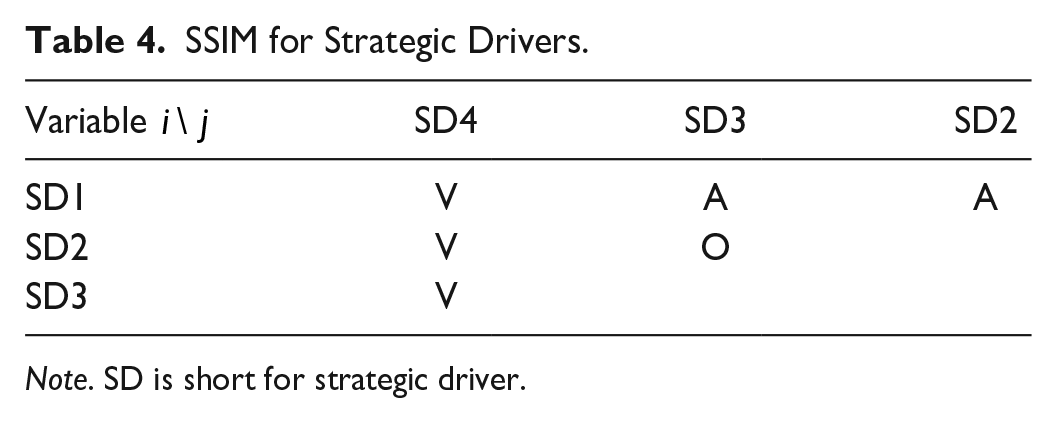
Note. SD is short for strategic driver.
SSIM for Barriers.
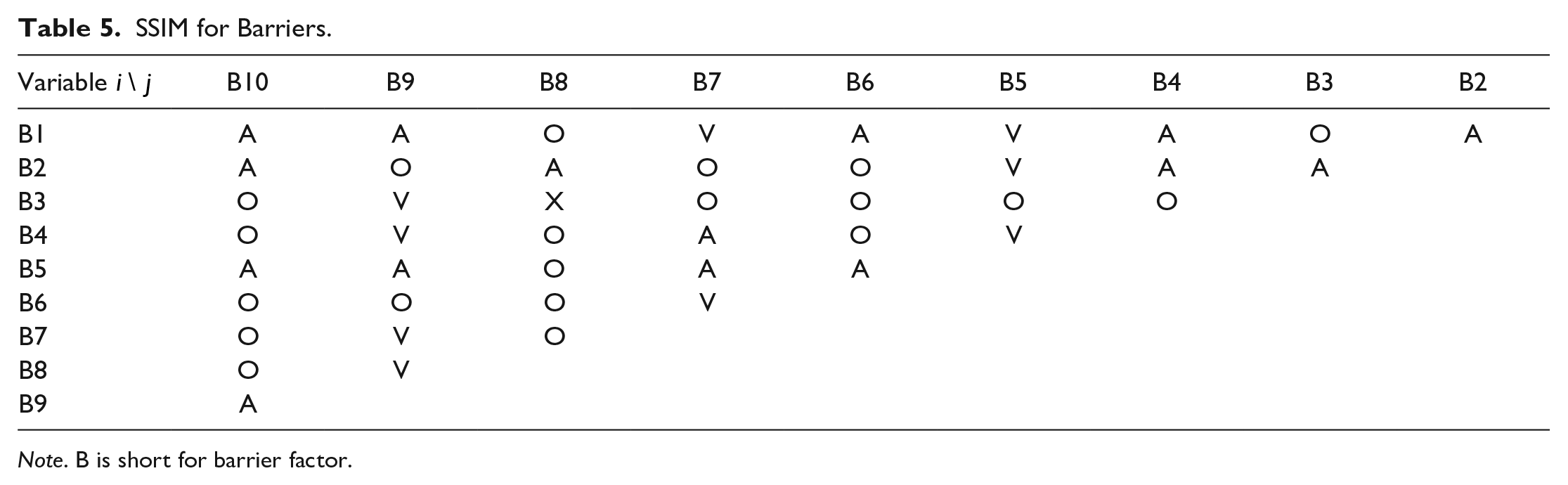
Note. B is short for barrier factor.
SSIM for Affected Operations.

Note. AO is short for affected operation.
Formulation of the Reachability Matrix
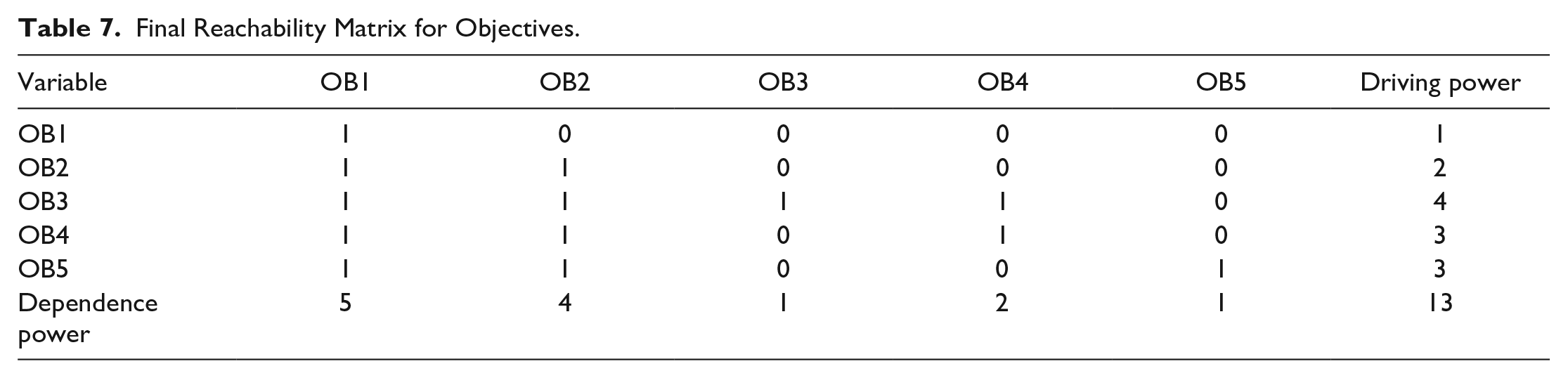
According to the generated SSIM above, the reachability matrix is calculated and developed based on the ISM-based modeling steps. The initial reachability matrix is constructed by converting the lingustic variable into a binary value based on investigated SSIM. The final reachability matrixes in terms of four kinds of listed factors are obtained by consolidating the transitivity analysis, found in the following Tables 7 to 10.
Final Reachability Matrix for Objectives.
Final Reachability Matrix for Strategic Drivers.

Final Reachability Matrix for Barrier Analysis.

Final Reachability Matrix of Affected Operations.

Level Partitions of the ISM Model
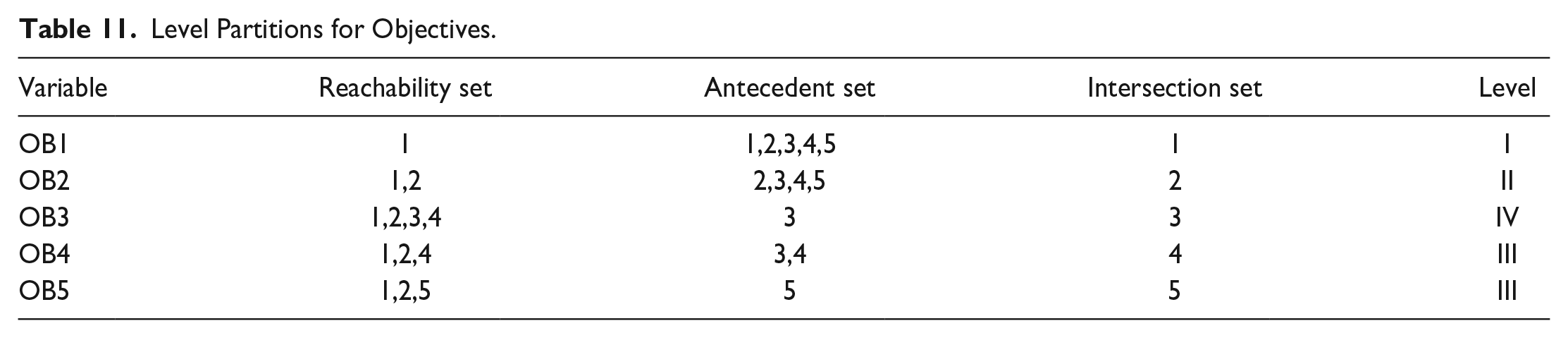
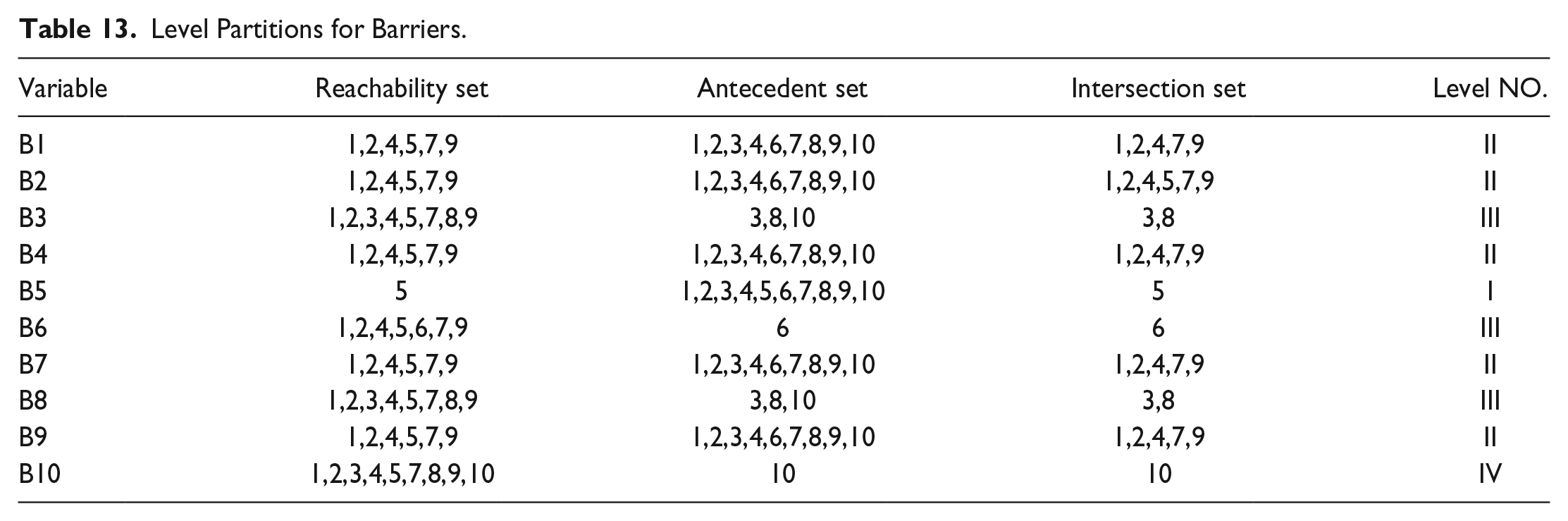
In this part, the reachability and antecedent sets are derived from the final reachability matrix (Warfield, 1974). The reachability set of each variable comprises the variable itself and those can assist to achieve. Whereas the antecedent set of each variable also comprises the variable itself and the those may contribute to alleviating it. The intersection set of each variable can be obtained by deriving from its corresponding reachability and variables in antecedent sets. The factors of both the reachability set and the intersection set included are made in the top-level of the ISM hierarchy (Ali et al., 2020; Babu et al., 2020; Lim et al., 2017; Singh et al., 2020). After that, it is discarded from the other remaining variables. The above procedures are repeated, and the specific level of listed factors is then obtained as shown in Tables 11 to 14, respectively.
Level Partitions for Objectives.
Level Partitions for Stragetic Drivers.

Level Partitions for Barriers.
Level Partitions in Terms of Affected Operations.

Formation of ISM-Based Hierarchy Model
According to the parted levels, the hierarchy model is structured and established, which is illustrated in the following Figure 2. The directed relationship among listed factors is represented by an arrow. After checking the logical inconsistency, the final ISM model for the factors in adopting and implementing JD illustrating the hierarchy levels is given in Figure 2.

ISM-based model for JD adoption factor analysis.
From the formulated ISM-based modeling steps, the hierarchical ISM model of JD adoption is established from objectives, barriers, drivers and affected operations dimension. As we can see from the Figure 2, improving profit objective (OB1) is located as the first level, which means the siginificant factor of OB1. This investigation result is similar to the previous reseach conclusion by Hu and Qiang (2013). In terms of strategic driver factors, the higher operation cost (SD3) is the most obvious driver to motivate the JD adoption. For barrier dimension, the internal/external integration (B5) factors is the most siginifcant barrier on joint distribution adoption, which is influenced by other barrier factors in a complicated interaction. The affected operations analysis after JD adoption assists to understand the interactive influence of these business links, and results show business process (AO1) factor will be influnced by other operation factors after implementing joint distribution. This reminds industrial managers should pay much attention to business synchronous innovaiton with adoption and implementation of the novel joint distribution.
MICMAC Analysis
On basis of multiplication properties of matrices, Matriced’ Impacts croises-multipication applique’ and classment, abbreviated as MICMAC, has been widely employed to assist to better understand the novel mangement concept in industrial sectors (Chandra & Kumar, 2018; Kadam & Bandyopadhyay, 2019; Singh & Bhanot, 2020; Zhou, Lim, et al., 2019). During the implementation of MICMAC analysis, the driving power and dependence power can be extracted and identified, which help industrial managers to better understand management practices. Generally speaking, MICMAC analysis is employed to classify the listed factors into four regions.
Following the above analysis, these factors distributed in different regions are shown and presented based on the driving power and dependence power value in Figures 3 and 4.

Driving and dependence power illustration of strategic JD factors.

Driving and dependence power diagram of barriers.
The MICMAC analysis assists us to better understand the factors’ influence on JD adoptions, as is illustrated in Figures 3 and 4. To our surprise, it is noteworthy that there are no autonomous variables which show little influence on JD adoption in our list factors. Hence, all considered variables listed have some effect on JD adoption. The dependent variables are identified, including improving profit (OB1), improving service quality (OB2), competition (SD1), personalized customer demands (SD4), internal/external integration (B5), and business process (AO1); suggesting that industrial managers should pay much attention to the influential mechanism of these variables affected by other listed factors.
In addition, problems in sharing information (B1), lack of trust between partners (B2), leakage of business secrets (B4), low level of management (B7), lack of top management involvement (B9), transportation and sorting planning (AO3, AO4) have high value for both driving power and dependence power, regarding as the linkage variables, demonstrate a strong influence on JD adoption. Half of the barrier factors are located at the linkage region. Therefore, effective management practices should be studied, developed and designed to overcome these integration barriers, facilitating to promote JD adoption.
Finally, scheduling resources in advance (OB3), improving logistics efficiency (OB4), improving the coverage rate of the network (OB5), globalization of online shopping (SD2), higher operation cost (SD3), lack of logistics industry standards and norms (B6), irrational distribution of economic benefits (B3), problem in cost-sharing (B1), lack of understanding of the value of joint distribution (B10) have high driving power while with low dependence power. These variables are strong drivers of JD adoption, which will have great effect on other factors of objectives, drivers, barriers, and affected operations. This reminds us that industrial managers should focus on these variables and understand the interactive relationship among them.
Discussions and Research Implications
In this study, an ISM model was built to provide a common framework for factor analysis of JD adoption in Chinese express industry. There are 23 factors being collected and addressed, which are supposed to be crucial for adoption and implementation of joint distribution mode. The generated parted levels and hierarchy model help to better understand JD adoption and promotion.
Research Discussions
The objective factor analysis could help indsutrial managers to better understand the objectives of JD adoption and their interactions. From the objective factor dimension, improving profit factor (OB1) is regarded as the most important objective regarding JD adoption. Hu and Qiang (2013) argues that it is urgent for Chinese express service enterprises to promote the logistics service chain strategy from a single mode to a joint distribution (JD) mode, thus bringing more profit for the whole distribution alliance and the system. This study also has the same conclusion, which shows that improving profit (OB1) is the most important objective of JD adoption, as Figure 3 illustrated. Therefore, improving profit variable has relative low driving power while with high dependence power presented in Figure 4. Scheduling resources in advance (OB3) and improving the coverage rate of the network (OB4) have a higher driving power while with low dependence power. Both industrial interviews and the literature reveal that an important crux of JD adoption is the dynamic information sharing among e-commerce enterprises, express service enterprises and customers. It is no doubt that the effective information sharing mechanism contributes to the resources scheduling, which motivates the JD adoption and implementation (Montoya-Torres et al., 2016). Considering the interactions of objective factors, for instance, the OB3 is at the bottom level, which will lead to other objective factors achievement. Therefore, industrial managers should pay much attention to the objective of scheduling resources in advance (OB3), which would directly bring more profits and better service quality.
To identify the drivers and motivations of JD adoption, the strategic driver factor analysis is taken into account in this study. Results show that higher operation cost (SD3) factor is the most important driver due to intense competition among more than ten thousand express service enterprises in China. This is also in line with the current e-commerce development environment and industry status in Chinese market. It is also found that personalized customer demands (SD4) and the globalization of online shopping (SD2) have higher driving power, indicating that express service enterprises should pay much attention to the personalized customer demands. However, it is difficult to meet the increasingly personalized customer demands just relying on express service enterprises under the globalization of online shopping atmosphere, specifically; on their own, thus JD is a novel way to collaborate with other industrial organizations and supply chain members for express service enterprises. Along with competition, personalized customer demand and globalization of online shopping are also strategic drivers motivating JD adoption in Chinese market.
The barrier factor analysis could assist managers to identify the crucial barriers of JD adoption, contributing to the contermeasures making for JD promotion. The resource integration among partners is regarded an essential factor for service quality and customer satisfaction improvement in previous study (Yao, 2016a), and this study also has the similar observations. The internal/external integration factor (B5) is discovered to be the principal barrier for JD adoption. This barrier is considered to be an internal cause in our study, and the barrier factors in the second level (e.g., problems in sharing information (B1), lack of trust between partners (B2), leakage of business secret (B4), low level of management (B7), and lack of top management involvement (B9) have indirect influence on the adoption of JD through the internal/external integration (B5) factor. The ISM model result shows that sharing information factor is as important as we investigated. Hence, managers must pay much attention to the internal integration within enterprises and external integration with supply chain members or other partners. It must be mentioned that lack of understanding of the value of joint distribution (B10) shows the highest driving power amongst all barriers. It indicates that the fundamental problem lies in the better understanding of JD, and therefore, it is important to make some training plan to help better understand the JD value. The traditional service mode (e.g., self-built logistics network or third party logistics service for online shopping enterprises) should be modified and new collaborative strategies could be integrated and developed under online shopping logistics service chain. Followed by the JD understanding, adoption and operational management, the logistics industry standards and norms, proper benefit distribution and cost-sharing mechanism should be developed and designed to promote joint distribution in Chinese industrial sector.
The affected operation factor analysis will contribute to better the influence of JD implementation on other business activities. After JD adoption, there would be some changes and bring some new challenges for other business activities of these enterprises. When the joint distribution is implemented in industrial scenario, the express service enterprises will be good at information sharing and joint management under the designed sharing mechanism (He et al., 2016). This will be conducive to the accurate and timely forecasting for scheduling of resources in advance and more effective transportation and sorting in the online shopping supply chain. From the MICMAC analysis result, the forecasting operation (AO2) has the highest driving power, followed by transportation and sorting planning (AO3, AO4). Therefore, express service enterprises should pay much attention on these affected operation factors. With the development and promotion of JD mode, those adopted JD express service enterprises also should focus on these affected operations by synchronous innovation.
Theoretical and Managerial Implications
This paper serves both scientific contributions and practical implications to modern logistics sector. In this part, we present the theoretical contributions to joint distribution management practice, and also provide some managerial insights for practical industry.
This study contributes to theoretical knowledge by identifying the potential factors influencing joint distribution adoption, thereby probe into better understanding on various factors of JD promotion. Firstly, the potential factors influencing JD adoption are explored and collected based on the literature review and industrial investigation. There are 23 factors that are addressed from objective, strategic driver, barrier, and affected operation dimension. Secondly, the ISM modeling method is designed to study various factors affecting joint distribution adoption. The employed ISM-based modeling enables to portray the complicated interrelationships maong listed factors. The theoretical implication of the established ISM model is that it can identify crucial drivers and barriers based on an explained multi-level heirarchy, also can observe the complicated interrelationships. The paper reveals the potential factors of JD adoption and promotion from the dimension of objectives, drivers, barriers, and affected opeartions. This study enriches the joint distribution management practice by exploring the factor analysis of JD adoption, which provides some theoretical guidance on better understanding joint distribution and further promotion.
This research also includes a few practical implications for modern logistics industry to promote the novel joint distribution service mode. The potential factors affecting JD adoption from multiple dimensions highlighted are based on previous literature and industrial investigation, and ISM-based model is established by inverstigating judgment of expert panel. Implications to practice of this research include to make full use of experts’ knowledge to serve for better understanding of complicated factors interaction followed by joint distribution promotion. From the eastablished hierarchy ISM model and MICMAC analysis, the crucial factors in each dimensional group are identified. The higher operation cost (SD3) is the most crucial factor motivating JD adoption, and the the internal/external integration (B5) is the major barrier factor for JD promotion. Besides, the affected operations are also discussed for those organizations who have adopted and implemented joint distribution. In addition, the established hierarchy model suggests how the variables are interrelated and interacted toward joint distribution adoption from multiple dimensions. Industrial managers should pay much attention to these crucial factors and the interactions influenced by other variables. It is significant to promote the driving factors to improve the joint distribution adoption. This study could assist industrial managers to concentrate their efforts toward promoting joint distribution through factors identification from multiple dimensions (objectives, strategic drviers, barriers, and affected operations). Finally, this research would contribute to promoting joint distributoin adoption and improve management performance of the modern logistics sector using the novel service mode.
Conclusions and Future Research Directions
Joint distribution is a novel operational way in distribution link, which has been regarded as an effective and efficient logistics service mode. It is faced with a huge challenge for the traditional service mode in logistics sector due to increasing cost pressures, dynamic personalized customer demands and stricter environment and traffic regulations. Besides, the booming development of e-commerce industry also motivates the innovation of logsticis service. To improve the operational efficiency and reduce cost faced with massive delivery packages, the novel joint distribution concept is proposed by logistics resources integration. However, the JD implementation is at infancy for Chinese express service industry, especially for small-and-meduim enterprises (SMEs). This study tries to discover influential factors on JD adoption by formulating a hierarchy ISM model, and probes into managerial insights for JD promotion.
This paper addresses 23 factors which are divided into four categories: objectives, drivers, barriers and affected operations. Then, an ISM-based modeling approach is employed to construct a hierarchy model, facilitating to a better understanding of contextual relationship among these variables. From the study, we can find that the listed 23 variables show great significance in the adoption and promotion of joint distribution. Results show that the principle objectives of JD adoption and implementation are improving profit (OB1) and service quality (OB2) by means of scheduling resources in advance (OB3). Further, it is concluded that the higher operation cost (SD3), as a strategic driver, is the most crucial factor motivating JD adoption and implementation due to the increasingly intense competition among tens of thousands of express service enterprises. However, the internal/external integration (B5) is the major barrier for JD adoption and implementation. Finally, it is also concluded that JD helps express service enterprises to achieve a better profit with innovative business process (AO1) and accurate forecasting (AO4). The academia and industry could benefit from these results for adopting and implementing JD in Chinese express industry.
This study also carries some limitations. Firstly, the ISM method is constructed only based on the local Chinese express service industry. In addition, limited 23 variables are taken into account, and more details should be considered and analyzed to assist better understand the factors of Chinese logistics industry. Besides, the external factors, for instance curtural, regional, type of express firm and scale factors will be also taken into account since the organizational discrepancy. With booming development of e-commerce and modern logistics industry, the novel distribution mode and industrial practices will become significant to JD promotion regarding as new factors. The innovative management practices from different perspectives can be studied to promote joint distribution development. The huge data will be generated with the operational management and industrial experience of joint distribution implementation. The big data analytics or artificial intellegence-based analysis fraemwork can be developed and employed to assist industrial managers to discover other crucial factors for JD promotion. Also, the innovative opertional management practices (forecasting, transpotation planning and vehilce routing problems etc.) toward supply chain activities could be studied under the novel joint distribution promotion era.
Footnotes
Acknowledgements
We would like to thank anonymous referees and editors for their valuable comments and advice.
Declaration of Conflicting Interests
The author(s) declared no potential conflicts of interest with respect to the research, authorship, and/or publication of this article.
Funding
The author(s) disclosed receipt of the following financial support for the research, authorship, and/or publication of this article: This study is supported by the following programmes: the Philosophy and Social Science Planning Project of Henan Province (grant no. 2020CZH012); the Key Technologies R&D Programme of Henan Province from Henan Science & Technology Department (grant no. 222102210005); the Think-tank Program of Henan Science & Technology from Henan Association for Science & Technology (grant no. HNKJZK-2021-07B); Fundamental Research Funds for Provincial Universities (grant no. 20KYYWF0107, 21KYYWF0103); the Basic and Applied Basic Research Fund of Guangdong (grant no. 2020A1515110785); Guangdong Province Enterprise Science and Technology Commissioner Project (grant no. GDKTP2020066700), and the Scientific Research Starting Fund from ZZULI (grant no. 2018BSJJ071). We also appreciate the Engineering Research Center of New Vehicle Networking Communication Technology, funded by Shenzhen Strategic Emerging Industry Development Project from Shenzhen Development and Reform Commission (grant no. XMHT20190101025).
