




Abstract
The COVID-19 pandemic will not be easily forgotten as its contagious impact has penetrated education. In response to this, educational practices have moved online within various forms and terms, and Emergency Distance Education (EDE) is one of them. Within this frame, this qualitative study aimed to investigate the recommendations of 118 English Language Teaching (ELT) Department students for their teachers and for students themselves in developing four language skills—reading, writing, listening, and speaking—during EDE settings to improve the efficiency of the online courses. In doing so, Framework Method via NVivo 11 Plus was utilized. The participants’ recommendations for EDE included a total of 152 comments for reading, 141 for writing, 131 for listening, and 147 for speaking skills. The participants’ recommendations for four skills centered on a total of seven themes: for teachers, for students, for online platforms, for eliminating technical issues, satisfactory, no recommendation, and no answer. The data analysis demonstrated that the majority of the recommendations for each skill were given for teachers under two sub-themes: content and implementation. While content had the highest frequency for reading, writing, and listening skills, implementation was found to be the top concern for speaking skills. The results of the study presented valuable insights not only for ELT contexts but also for all language education settings.
Keywords
Introduction
COVID-19 has struck the world and humanity. In order to control the viral spread, all human beings have been urged to take some precautions in educational contexts. All ongoing practices were in the atmosphere of uncertainty with the closure of all educational institutions which were the backbone of learning and teaching in the pre-COVID world. For the adaptation of quickly shifting circumstances, the immediate response was the promotion of remote teaching and learning (Murphy, 2020; Williamson et al., 2020). In other words, instruction moved into remote learning as a substitute of face to face education (Hodges et al., 2020; Talidong, 2020). Thus, “the digital and digitalization seems more important than ever” (Coeckelbergh, 2020, p. 547).
Online education is not a new phenomenon but different from the online courses implemented during the COVID-19 crisis. This difference should be taken into consideration for Emergency Distance Education (EDE) practices (Bozkurt & Sharma, 2020; Hodges et al., 2020; Murphy, 2020). Though EDE provides flexibility in participating and is convenient and easy to access (Lin & Gao, 2020), it is also associated “with poor online teaching infrastructure, the inexperience of teachers, the information gap (i.e., limited information and resources to all students) and the complex environment at home” (Carrillo & Flores, 2020, p. 466). Hence, hurrying to move educational practices online has also challenged both language teacher educators and ELT students, who are prospective English language teachers, to take advantage of this virtual procedure in many countries including Turkey. In the Turkish context, ELT students and teacher educators are among the vulnerable groups who have been afflicted by the pandemic.
Primarily, in English teacher education ELT students are not regarded as “students as learners of language,” but as “teachers as learners of language teaching” (Freeman & Johnson, 1998, p. 407). Knowing the complexity of the knowledge base of English teacher-learners, teacher training is far beyond knowing English as the content or subject matter (Freeman, 2001; Freeman & Johnson, 1998). Therefore, in the Turkish context, the objective of ELT programs is not only to guide ELT students to accomplish the mastery and proficiency of English but also to make them have the knowledge and practical skills for teaching English in the future (Boğaziçi Üniversitesi, 2021). Driven by the fact that “[t]he four language skills are at the heart of current practice in English language teaching” (Burns & Siegel, 2018a, p. xiii), skill-based courses especially in the first year are included in the curriculum of ELT programs in Turkey in order to lead ELT students to master the English language first (YÖK -the Higher Education Council, 2018). However, these students should be provided constant support for their skills development all through their tertiary education.
Within this emergency context, the need for appropriate and effective integration and transformation process in ELT programs is still considered a bone to pick in Turkey. Letting aside moving far beyond the subject matter itself, helping ELT students even to achieve language skills development with emergency distance education has challenged both teacher educators and students in ELT context (Karataş & Tuncer, 2020; Taşçı, 2021). Knowing that the learning process of ELT students is “normative and lifelong, it is built out of and through experiences in social contexts, as learners in classrooms and schools, and later as participants in professional programs” (Freeman & Johnson, 1998, p. 401). Driven by this idea, what they have experienced as students in EDE has the potential to influence their future profession. Thus, more needs to be done to explore the challenges experienced and their solutions in the ELT context. At this point, according to Subekti (2021), “very little attention has been given to how future teachers see the online learning they are experiencing now and what they believe about it” (p. 235). With these considerations in mind, this qualitative study aims to investigate the recommendations of ELT students to highlight the challenges faced in the development of four language skills -reading, writing, listening, and speaking- during EDE in ELT programs and thus improve the efficiency of the online courses accordingly. In doing so, Framework Method (FM), a systematic process of sifting, charting and sorting the data, was utilized to present the recommendations of ELT students as themes. Because NVivo is “compatible with framework analysis” (Parkinson et al., 2016, p.112), NVivo 11 Plus was preferred not only to portray themes and connections between themes but also to ensure the transparency of the analysis process.
Literature Review
In March 2020, the COVID-19 interruption shifted face-to-face (f2f) education to online delivery modes (Gacs et al., 2020). Online delivery was not only a response to this crisis but also even before COVID-19 it was regarded as a possible substitute for f2f education (Stacey et al., 2004). Thus, some have stated that online language delivery is effective as f2f education (Goertler & Gacs, 2018; Moneypenny & Aldrich, 2016). However, the affordances and challenges of online language teaching which require careful planning and designing vary in comparison to f2f teaching (Meskill & Anthony, 2015).
Education During the COVID-19 Pandemic: Emergency Distance Education
At the beginning of the COVID-19 pandemic, all teachers and students were in a rush to sustain education. Even before the pandemic, teaching was seen as a stressful profession (Johnson et al., 2005), yet in sudden life with COVID-19, it became more complicated (MacIntyre et al., 2020). Due to not having sufficient time in such a rush (Russell, 2020), “providing access to content rather than to worry about how well the content is designed and delivered” was what most teachers did (Egbert, 2020, p. 314). Thus, Emergency Distance Education (EDE) which is “crisis-prompted remote language teaching is not comparable to well-designed and carefully planned online language education” (Gacs et al., 2020, p. 380). It is because most teachers were not equipped with the knowledge and competencies required for effective online language teaching (Russell, 2020). However, considering the moral certainty that in the future continuity of education might be in online classes, it is vital to go beyond emergency lesson plans (González-Lloret, 2020) and develop a careful instructional planning for online teaching and learning (Carrillo & Flores, 2020; Hodges et al., 2020). Nowadays, the main focus is beyond the question of whether to conduct online education for language teaching or not but what responses are best to improve its quality (Stickler et al., 2020).
Thus, in order to improve the current circumstances and identify creative solutions for other global crises, it is essential to deal with the challenges posed by COVID-19 and reflect on the various approaches and lessons experienced in different countries (Rudnick, 2020). Specifically, focusing on the ones for language skills development, EDE inherently has resulted in unique challenges (Subekti, 2021).
Challenges of EDE for Language Skills Development
The wide use of EDE practices during the pandemic can inevitably bring various problems and obstacles (Bailey & Lee, 2020) because the modalities (fully online/blended) and modes of communication (synchronous/asynchronous) manifesting EDE in divergent contexts might vary (Moser et al., 2021, p. 2). EDE generates unique challenges associated with its preparation, design, implementation, and evaluation (Gacs et al., 2020).
The preparatory phase of the EDE which was severely short included a “truncated version” of students’ need analysis and professional development and training of educators (Gacs et al., 2020, p. 384). The COVID-19 pandemic begot professional isolation referring to the scarcity of rich professional networks in language learning and language teacher training contexts (Knight, 2020). This means that for effective language teaching, teacher professional development has a key role in guiding them on how to cope with online language instruction and language skills development during the pandemic and beyond. However, “most language educators have had little or no professional development in online language design, development, and delivery” (Russell, 2020, p. 339). Thus, EDE teachers as newcomers to online teaching have experienced difficulties during implementation (Bailey & Lee, 2020). What is also challenging is how to “create coherent and sustainable professional development for online language instructors” (Paesani, 2020, p. 292).
In order to design EDE practices, the mode and modality of the communication included in language teaching and learning have changed (Gacs et al., 2020). Despite not being well planned, EDE provides many opportunities to sustain language skills development. However, the challenge is teachers’ awareness on making distance learning successful for students by using a range of digital “resources available online and use those resources to supplement existing syllabi and curriculums” (Taguchi, 2020, p. 353). This means the problem is how to integrate online resources into online classes. Hence, for the quality of online language education, what is required next is the review of a designed course; however, this stage has been rarely accomplished during EDE (Gacs et al., 2020). In addition to obstacles occurring during the preparation and design of EDE, in the implementation phase, there are “some unique challenges associated with the delivery format that require careful planning and attention” (Gacs et al., 2020, p. 387). EDE embodies synchronous interaction and communication comprising f2f education (Meskill & Anthony, 2015) and asynchronous delivery. In asynchronous design, most teachers pay attention to providing access to content not to the quality of the content delivered (Egbert, 2020). For instance, teachers as new users of online teaching have started to overuse asynchronous assignments through the use of distance education platforms. In response to this, teachers are recommended to “set realistic online teaching goals, avoid common obstacles in online teaching, and learn which online assignment types are appropriate” (Bailey & Lee, 2020, p. 179).
Regarding language skills development, most EDE practices have failed to address the necessity of using the language in productive ways, but only enabled the essential input for language learning with listening and reading (González-Lloret, 2020). Lehman (2020) states that synchronous lessons emphasize the development of reading and listening, while writing improves most “via discussion posts and writing assignments in ASYNC study” (p. 76). However, the challenging point for writing skills is providing regular and continuous feedback online (Pelaez-Morales, 2020). Closely in line with this, speaking emerges to be the most negatively affected skill during the pandemic (Karataş & Tuncer, 2020) as EDE heavily relies “on activities that develop learners’ listening, reading, and writing skills, but fail to address speaking skills” (González-Lloret, 2020, p. 261). Payne (2020) also mentions some challenges for speaking skills such as building “class community, teacher–student rapport, and reciprocal trust among students without any face-to-face contact” (p. 244). Within such a context, teachers’ concern is whether their students will achieve speaking skills development in the target language (Lehman, 2020) as studies such as Hartshorn and McMurry’s (2020) report demonstrate that students have markedly progressed less with their speaking skills compared to the previous semesters.
To fill this gap, in addition to asynchronous interaction platforms many teachers prefer to use the synchronous interaction conducted in EDE through video conferencing tools like Zoom, Google Meet, etc. to find opportunities for live communication, which also poses several challenges (Bailey & Lee, 2020, p. 179). Despite some advantages of synchronous online courses such as developing an interactive learning environment and a sense of community by interacting, discussing, sharing ideas, and getting feedback from the instructor right away (Lin & Gao, 2020), “the online synchronous language classroom environment is distinctly different from the F2F classroom” (Moorhouse et al., 2021, p. 4). Additionally, most EDE instructors are not knowledgeable and experienced enough to best navigate those synchronous lessons (Guillén et al., 2020; Moorhouse, 2020). Another challenge of moving teaching practices to online is in “how to create a virtual presence, and engaging students in online spaces” (Lomicka, 2020, p. 307). According to Moorhouse (2020), “the tutor found that less than ten students joined, and unlike the face-to-face sessions, the students rarely talked, instead preferring the text chat function. The sessions were teacher-centered with the tutor mainly recapping the content of the PowerPoint” (p. 610). Thus, the synchronous lessons are “rarely ideal as a replacement for the classroom’s physically embodied engagement” (Guillén et al., 2020, p. 1). Since English is “both the medium of instruction and subject matter” (Moorhouse et al., 2021, p. 2) in English as a Foreign Language (EFL) classes, online synchronous lessons in which everyone is interacting in their first language (L1) are challenging enough to take a conversational turn, “let alone an L2” (Payne, 2020, p. 246). At that point, tasks can be used to encourage interaction and communication for language skills development especially speaking skills, but enhancing students’ language task engagement is hard for teachers to achieve when they are not actually f2f to have immediate contact with them during the task, which is another challenging point of the EDE (Egbert, 2020). Despite the attempts to encourage students to engage in tasks for speaking, another challenge is “significant levels of perceived language anxiety and/or anxiety related to their use of new instructional technologies and platforms” experienced by students (Russell, 2020, p. 338).
Additionally, for high-quality online instruction what needs to be done is to evaluate it critically to offer support and resources. However, in EDE, this is not the case which is its last challenging feature (Gacs et al., 2020). Those challenges of the instructional approaches adopted during EDE for language skills development show that more needs to be done on online instructional replacements and transition to f2f education (Carrillo & Flores, 2020; Moorhouse, 2020).
Despite those concerns, COVID-19 as the driver of the widest implementation of online education globally is an opportunity not only to exercise and evaluate EDE but also to overcome its challenges to “develop a coherent online education strategy for any other emergencies or natural disasters that can potentially happen in the future” (Ferri et al., 2020, p. 2).
Turkish Context During EDE
With the outbreak of COVID-19, “it was the first time in the educational history of Turkey that face to face education was interrupted countrywide” (Bozkurt et al., 2020, p. 83). Before the pandemic in Turkey, the majority of university courses were delivered f2f, and only a few courses at some universities had been implemented online (Bozkurt et al., 2020).
In order to adapt to the COVID-19 pandemic conditions, online education at universities in Turkey has been delivered through distance education platforms where students can go online and access virtual classrooms. Though the use of distance education platforms is the most common practice in Turkey to move learning and teaching online, the preferred modes and modalities of online learning at each university can change. Some conduct online courses through synchronous-based applications, some use asynchronous-based ones and some deliver education through the use of both, and keeping a standard among them was not possible, of course (YÖK-Higher Education Council, 2020). In this process, all students and teachers had to adapt themselves to distance education despite having no experience related to online instruction. Karadağ and Yücel’s (2020) study with 17939 students revealed that undergraduate students were satisfied with the decisions taken by YÖK, but not with the management and the digital content provided by universities in Turkey. Universities in Turkey might have some difficulties to attain full achievement (Durak & Çankaya, 2020b). However, even after the pandemic, teachers at universities might prefer to utilize online education tools (Durak & Çankaya, 2020a). In line with this, so as to overcome the educational challenges experienced during COVID-19, “radical reforms and strategic planning are needed to ensure continuity in education” (Bozkurt, 2020, p.112).
Specifically, concerning EFL teacher education in Turkey, no matter how EDE is delivered and conducted, the sudden shift into EDE has caused unconventional experiences for the EFL context.
The Study
Purpose of the Study and Research Question
This study gives voice to Turkish ELT students to reveal their recommendations for four language skills development during EDE so as to identify challenges and then propose solutions that might enable language teachers and learners to overcome those challenges. Within this frame, the following research question was formulated:
- What are the recommendations of ELT students for their teachers and students themselves in order to improve the quality of the online courses during EDE settings for effective development of (a) reading, (b) writing, (c) listening, and (d) speaking skills?
Method
Keeping in mind the research question, this study is qualitative research using Framework Method (FM) (Ritchie & Spencer, 2002). In this study, FM was utilized as means to analyze the data because FM supported a research design not driven by strictly predefined themes, concepts, or categories but developmental ones generated from the data through ongoing analysis. This means FM is a means to “undertake qualitative data analysis systematically” by a series of interconnected stages (Smith & Firth, 2011, p. 53). In the center of FM, there was a series of interconnected stages that guide the researchers to manage and thematically analyze the raw data gathered from open-ended responses in the questionnaire to move back and forth across the data until coherent themes and concept maps emerged (Spencer et al., 2003). In this study, FM was utilized because “this method employs a hierarchical thematic framework that is used to classify and organize data according to key themes, concepts and emergent categories” (Bonello & Meehan, 2019, p. 484).
Participants
The participants consisted of 118 students at ELT departments of eight state universities in Turkey. Convenience sampling was used in the study in which the researchers first requested their own students and then the researchers wanted help from their close colleagues working at other state universities in delivering the questionnaire to their own students. In total, 80 females (68%) and 38 males (32%) whose ages varied mostly from 18 to 24 years participated in the study. The sampling can be considered as homogeneous since the percentages of the students for each year are close to each other—freshmen (28%), sophomores (27%), juniors (22%), and seniors (22%), which demonstrates a thorough reflection of ELT students. The researchers received consent forms from the participants, and their anonymity was ensured.
Data Collection
The present study employed a qualitatively-oriented approach to scrutinize ELT students’ EDE experiences and thus to elicit their recommendations regarding the development of four language skills. With this aim in mind, a questionnaire consisting of four open-ended questions was prepared via Google Forms (Appendix). For piloting, the questions were shared with eight non-participant ELT students, and the students did not experience any problems with the questions, and their answers were on the correct path that the researchers targeted. After that, the link to the questionnaire was shared with the participants. For answering the questions, the participants were free to use Turkish or English, and most of them stated their answers in English. Data were collected at the end of the spring term of the academic year 2019–2020 (in June), and the process lasted for 1 month.
Data Analysis
In this qualitative study, the software NVivo 11 Plus, was used as a tool to condense data into themes and sub-themes because it was ideal for FM (Parkinson et al., 2016; Srivastava & Thomson, 2009). This process was constructed by three types of activity: data management, descriptive accounts, and explanatory accounts (Spencer et al., 2003). This non-linear but iterative process involved moving backward and forward between the data (Spencer et al., 2003, 2014). The following five stages based on FM (Ritchie & Spencer, 2002) were applied via NVivo:
Stage 1: familiarization,
Stage 2: identifying a thematic framework,
Stage 3: indexing,
Stage 4: charting,
Stage 5: mapping and interpretation.
Two researchers worked together during all stages and processes in FM. To do so, both researchers met via Google Meet more than 30 times in four months. Initially, the responses of all participants to each question were neatly filed in a separate word file and uploaded into NVivo as a separate project. After compiling and uploading procedures of four-word files, at Stage 1 both researchers read the raw data twice in order to familiarize themselves with the recommendations of the participants for four skills: reading, writing, listening, and speaking. This familiarization stage helped the researchers to have an overall view and commence making sense of the data. At this early phase, by reading the responses of each participant, the researchers slowly became aware of recurrent and non-hierarchical themes and key ideas defined as free codes (Bonello & Meehan, 2019). Then, during the open/ free coding process in NVivo, the two researchers together started to work with raw data and freely generated a set of themes and concepts by sorting the participants’ recommendations as codes and labeling them. In NVivo, codes can be expressed as “nodes” not only used as a tool to organize qualitative data but also to provide storage areas for particular themes, concepts, or categories (Bazeley & Jackson, 2013, p.17).
After gaining an overview of the richness, depth, and diversity of the raw data, Stage 2 started with the process of abstraction and conceptualization to identify a thematic framework for the recommendations for each language skill. Then, with the appearance of some recurrent themes, the researchers started to think about these themes in a more abstract way. They took notes, jotted down key ideas and recurrent themes, went back to the source, and repeated this process again and again. During this process, each new text segment or “unit of meaning” was categorized and coded within similar nodes by comparing it to all other units of meaning and checking for similarities and/or differences. Once the source was reviewed, the emergent and analytical themes in NVivo showed the essence of the data as a substantial number of free nodes which were descriptive and participant-driven in nature. Those free nodes showed no evident relationships to each other. The researchers prepared descriptive accounts identifying the definition and key dimensions of each free node. Eventually, the initial version of the thematic framework appeared.
After the emergence of the non-hierarchical codes, the researchers decided on the meaning of each free node. Then, they continued with Stage 3 indexing referring “to the process whereby the thematic framework or index is systematically applied to the data in its textual form” (Ritchie & Spencer, 2002, p. 180). In this stage, free nodes were structured into a more complex hierarchical structure -a set of substantive dimensions- by refining categories or more abstract classes as tree nodes in the light of the research questions and the purpose of the study. Each theme and sub-theme was identified and named. At Stage 4, the purpose was to summarize data by creating thematic charts. During charting, both researchers ensured the data was placed in charts consisting of themes and sub-themes as nodes clearly identified (Srivastava & Thomson, 2009).
In the final stage, mapping and interpretation, the researchers systematically tried to interpret and map the data set as a whole though themes, sub-themes, and associations were noted and recorded during the indexing and charting phases (Ritchie & Spencer, 2002). A concept map of the recommendations for the development of each language skill was drawn in order to visualize the connections between themes and sub-themes forming the thematic framework embedded in the data. The purpose was to move the data from descriptive to explanatory accounts, find themes associated within the data, and then account for why those themes and connections occurred. In the end, the frequency and percentage of codes for each theme were calculated, and inter-coder reliability was 0.97 presenting a high agreement between the researchers (Miles & Huberman, 1994). For each research question, this five-stage procedure was repeated.
Results
In this study, participants were requested to state their recommendations for their teachers and students themselves (It should be noted that “teachers” in this data refer to English language teacher educators at ELT departments while “students” refer to ELT students). Nevertheless, recommendations for online platforms and for eliminating technical issues were also observed in the data. Although 118 participants responded to the study, the frequency for each skill was always higher than that since each participant could state recommendations focusing on more than one theme. Results were presented in the following sections in relation to each skill, and all themes and sub-themes for four skills were given together in the overview section.
Recommendations for Reading Skills
The framework analysis for reading skills yielded six main themes: for teachers, for students, for online platforms, satisfactory, no recommendation, and no answer. A great part of the participants concentrated on recommendations for teachers (68%) as seen in Figure 1.

Recommendations for teachers for reading skills.
Most comments for teachers seen in Figure 1 concentrated on the content of online lessons (f: 76) which has three sub-themes: texts (f: 63), homework (f: 10), and exams (f: 3). Underneath texts, participants mostly stated that they needed their teachers’ reading texts suggestions for free time and texts could have variety in them:
Participant (P henceforth) 16: Teachers can give some advice about books which can influence us and lead to reading.
P78: There has to be a variety such as current articles related to language teaching for different age groups, different genres of literature or linguistics, and so on.
Regarding homework, participants reflected they can be given some extensive reading homework but the number of homework should be lessened:
P105: Teachers can push students into reading at least two books and they should let them talk about it.
P40: Teachers can give some reading text and ask students to analyze this text but they should give this kind of task once a month because students have at least eight lessons each term.
The participants had also recommendations for the content of exams as well:
P61: Maybe all of our teachers can ask for us to read the same book and they can make a quiz which affects our mark.
In addition to the content, there were some recommendations for the implementation of online lessons (f: 28), too. Among those, the most salient ones are that the participants desired for doing online group practice for reading and discussion (f:11) and that the teachers could include more audio visual materials (f:3):
P11: Teachers may ask students to suggest a reading text each week that they can use when they become teachers and a text which randomly chosen can be analyzed or discussed during the lesson, together. In this way, we prospective teachers can benefit from others’ ideas and I think that it will promote others to read and think critically.
P63: A set of videos, audios, PowerPoint presentations, websites, and texts designed to provide explanations and examples about the content of the unit can be shared.
As illustrated in the concept map in Figure 2, there were a total of 152 comments for reading skills, and the second most frequent theme for reading skills was satisfactory (14%). Those who put forward reasons for finding the online lessons during EDE as satisfactory thought that they received adequate reading practice (f:3), reading skill was easy to improve (f:1), and EDE was the same as f2f education (f:1):
P10: I think what we have done is enough for reading.
P67: It is easy to improve reading skills during distance education.
P42: Reading was no less than traditional settings so I don’t have any different recommendations for distance education.

Recommendations for Reading Skills.
The third theme was for students (11%) with seven sub-themes. The two highest frequencies belonged to reading more (f:9) and recording reading tasks (f:2):
P26: We should not limit ourselves only to the materials uploaded to the platform but we need to research and then share those useful materials with our friends [translated].
P100: Generally, we can read a specific article once a day and record our voice while reading it at the end of the week.
Two participants recommended some things for online platforms (1%) as well such as:
P60: Distance education platform should be used for homework. It should be the place where homework -based on the subject matter covered in the lesson- is checked [translated].
P76: Other than the sharing screen being small, there were no big factors that would prevent us from reading.
Recommendations for Writing Skills
The recommendations for writing focused on six themes: for teachers, for students, for online platforms, satisfactory, no recommendation, and no answer. The highest percentage belonged to the for teachers (64%) theme, and it was divided into two sub-themes: content (f:49) and implementation (f:41) of online lessons (see Figure 3).

Recommendations for Teachers for Writing Skills.
Regarding the content, homework was the dominant category for which the participants mostly focused on topics (f:16):
P61: The teachers can give homework which is not related to our subjects but requires creativity.
P63: Assignments should be given in which we can reflect our experiences and thoughts rather than specific information. This would make writing more efficient.
Another important category that received an equal frequency (f:9) was about the amount of homework: more homework and less homework. It seems that while some of the participants recommended an increase, some others needed a decrease in the numbers of homework given:
P97: Though I think there were assignments involving writing and writing skills, there can be more.
P34: Teachers, please do not expect us to write a whole decent thesis as an assignment or give too much homework. For the ones who give us millions of homework, it doesn’t make sense at all. I truly understand that you all want us not to lag behind but it doesn’t mean that you can give us 50 homework. On the contrary, it pulls down the efficiency of the task.
The participants also recommended that there should be a variety in topics (f:5) for writing skills development:
P78: There has to be variety instead of criticizing other people’s work. For example, different articles to analyze and write an assignment without plagiarism by putting references.
The last sub-theme to focus for content was exams (f:5), and most of the recommendations stressed the importance of time allocated for online exams:
P73: Either the duration of the exam should be extended or the questions should be easier.
In addition to content, participants recommended some things for the implementation as well (f:41). Among those, the highest frequency was for presenting a variety of activities (f:17):
P81: Writing essays, taking notes, keeping a diary . . .
P89: We can write letters to people from around the world.
Another important consideration for writing skills was that teachers should provide feedback (f:13):
P13: I know it is very difficult for teachers but giving detailed feedback to the homework would help a lot.
P45: There should be feedback from our teachers. Many of them said they were busy but it’s not okay to move on to the next writing task without knowing if we are on the right track.
In the concept map in Figure 4, there were 141 comments from 118 ELT students regarding the recommendations for developing writing skills during EDE. The second-highest percentage (16%) belonged to satisfactory. Most of those just stated that online lessons were satisfactory while some of them (f:9) reflected they had adequate writing practice and lessons were the same as f2f education (f:1):
P93: I think the studies we did during distance education were enough for us.
P42: Writing also was no less than traditional settings.

Recommendations for writing skills.
Participants put forward some recommendations for students themselves as well (6%):
P11: Students must be eager to improve themselves in written language.
P104: Students should learn grammar perfectly. Also, they should know punctuation rules correctly.
There were few participants who directed their recommendations at online platforms (4%):
P9: There should be a part in which we can easily write anything about lessons. It should be without any problems while writing.
P52: There must be a screen for students to write one by one when they have the right to talk.
Recommendations for Listening Skills
Participants’ recommendations for listening skills centered on seven themes: for teachers, for students, for online platforms, for eliminating technical issues, satisfactory, no recommendation, and no answer. More than half of the participants concentrated their recommendations for teachers (57%), and most of those focused on the content of online lessons (f:47) as seen in Figure 5. The most salient recommendations for the content were variety in listening materials (f: 23) and homework (f:10), especially content of homework:
P11: Teachers can provide lots of inspiring podcasts and useful songs or videos for the students.
P115: Listening to songs, listening to any story can be given as homework.

Recommendations for teachers for listening skills.
Teachers’ listening material suggestions for free time (f:7) was another recommendation for content:
P66: I would say that teachers should suggest more listening materials or sites which help students to improve their listening skills.
Participants had some recommendations for implementation (f:27) as well. They especially pinpointed the importance of doing more and regular listening practice (f:9) and of having more interaction (f:7):
P2: Periodical online listening practice so as to fasten our answer’s speed.
P106: If we can have students interact with themselves, they will have a chance to hear different accents and different opinions.
Although only one student focused on the digital literacy of the teachers, the researchers believed in the importance of this recommendation:
P105: Teachers should practice on computer stuff.
Figure 6 showed that there were 131 comments for developing listening skills during EDE. In addition to recommendations for teachers, there were also recommendations for students which highlighted the importance of doing more listening practice in their free time (f:10):
P61: I think there’s nothing our teachers can do about it. It’s a more personal skill compared to others. The person must do some things on his or her own to improve that skill.

Recommendations for listening skills.
For listening skills, few participants (5%) recommended the elimination of technical issues:
P5: There are some problems with the connection all the time. It must be fixed.
P110: Sounds and microphone problems should be handled.
They had also recommendations for online platforms (3%):
P65: In order to step toward developing listening skills, more and longer synchronous lessons or videos should be provided by improving the quality of distance education platforms [translated].
Recommendations for Speaking Skills
There were seven themes for speaking skills: for teachers, for students, for online platforms, for eliminating technical issues, satisfactory, no recommendation, and no answer. The highest percentage of recommendations for speaking skills belonged to for teachers (55%), and it had two sub-themes: content and implementation (see Figure 7).

Recommendations for teachers for speaking skills.
Implementation had the highest frequency (f:59) and almost all of those comments centered on having more interaction (f:58) by especially presenting a variety of activities (f:18) and by providing more time and opportunities to speak (f:14):
P100: We can play games in lessons by using our cameras.
P48: Teachers should give us some time and a chance to speak. They shouldn’t speak only.
Regarding the content, a great majority of recommendations were about homework (f:18):
P63: Students should be given video presentation assignments to improve speaking skills.
The other two sub-themes for content were teachers’ speaking material suggestions for free time (f:3), and exams (f:1):
P16: Teachers should recommend some websites to find friends and to speak with them.
P61: What is important is that we should be sure that our speeches will be graded fair and those things will be worth doing.
Analysis of recommendations yielded 147 comments for speaking skills as seen in Figure 8. The second highest percentage was for online platforms (16%) recommending the use of more interactive ones:
P59: The classes can be conducted in a different application where students can participate such as Zoom and Google Meet.
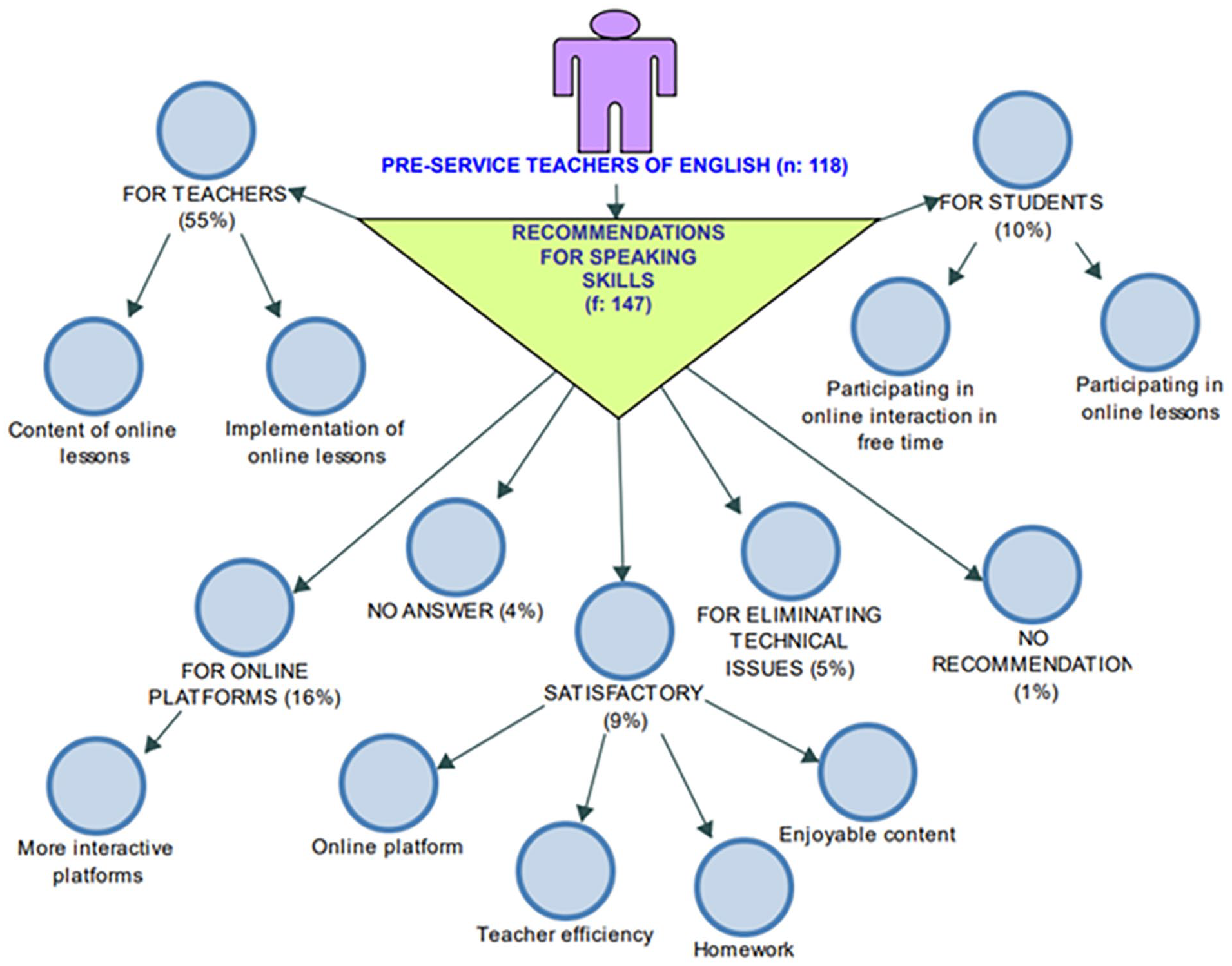
Recommendations for speaking skills.
Recommendations for students constituted 10%, and participants stressed the importance of participation in both online interaction in their free time (f:10) and online lessons (f:5):
P93: I think we should make more video calls with our friends and try to improve our speaking skills.
P11: Students mustn’t be passive and hesitant to join the online classes to speak.
Those who viewed online lessons as satisfactory especially enjoyed the homework aspect:
P1: We send our voice records and our videos. And I think it is sufficient.
Few participants had recommendations for eliminating technical issues (5%):
P6: Everyone needs a quality internet connection and proper communication equipment.
Overview of the Recommendations for Four Skills
The overview of the participants’ recommendations for four skills with seven themes, related sub-themes, and the frequencies and percentages of themes and sub-themes associated with each skill was depicted in detail in Table 1.
Recommendations for Four Skills.

Total f values are more than 118 as some responses were encoded into more than one theme or sub-theme.
Table 1 shows their recommendations for EDE through a total of 152 comments for reading, 141 for writing, 131 for listening, and 147 for speaking skills. Most of the participants’ recommendations for EDE addressed teacher educators to improve the content and implementation of their online lessons. Thus, the theme with the highest percentage for all four skills is for teachers described with two sub-themes, implementation and content. The sub-theme, content, had the highest percentage for reading (50%), writing (35%), and listening (36%) skills, while implementation had a higher frequency for speaking (40%). Satisfactory was the second-highest theme for reading (14%) and writing (16%), but it was no recommendation for listening (13%) and for online platforms for speaking (16%). The participants also put forward recommendations for students themselves. The highest percentage was calculated for reading (11%) followed by listening and speaking skills (10%). The least percentage was found for writing skills (6%). The percentage of the participants who remarked recommendations for online platforms for the development of speaking skills cannot be ignored due to showing the importance of the use of online platforms enhancing interaction for speaking skills. However, the same cannot be uttered easily for the other three skills. Additionally, for listening and speaking skills, recommendations for eliminating technical issues carry importance, but not for reading and writing skills. Despite a very low percentage (1%) and frequency, improvement of digital literacy for teachers was recommended as well.
Discussion
Recommendations of ELT students for the effective development of four language skills during EDE were scrutinized in the current paper. The data provided evidence for both similar and different recommendations for those skills. For each skill, more than half of the recommendations providing a vivid perspective of pre-service teachers of English were directed at English language teacher educators, which emphasizes the crucial role of teachers within educational contexts. The way teachers plan, design, and deliver online lessons widely affect the quality and success of EDE practices. Thus, effective EFL teachers are suggested to “have skills in planning and managing collaboration, designing appropriate activities, and choosing the right environment and appropriate tools” (Bailey & Lee, 2020, p.190). Participants of the current study accumulated their recommendations for teacher educators mainly around content and implementation of online lessons. While content had a higher frequency than implementation recommendations for reading, writing, and listening skills, a totally opposite situation took place for speaking, that is, implementation had more recommendations than the content. It might be because of the difficulty of integrating speaking into the online language curriculum (González-Lloret, 2020). Regarding speaking, almost all the recommendations for implementation centered on having more interaction because interaction with a sense of community is the core of learning in virtual settings (González-Lloret, 2020; Lomicka, 2020). From the data, it seems clear that participants felt that a better outcome for speaking skills can be obtained as long as synchronous lessons are conducted and students’ active participation is ensured whether by encouragement or suitable student-centered activities. When f2f education is not an option, synchronous lessons should not be “still more ‘bumpy’ and teacher-centered than face-to-face sessions” (Moorhouse, 2020, p. 610).
Variety emerges to be the key word in this study for content and implementation of each skill. The participants highlighted the importance of variety in texts and activities for reading, variety of topics and activities for writing, variety in materials and practice for listening, and variety of activities for speaking. In addition to this, they even recommended a variety in their assigned homework. By utilizing some words such as “fun” and “enjoyable,” the participants made it certain that the concept of variety in this study embodies the idea of enjoyment as well. By avoiding a one size fit all approach to online language learning, the inclusion of fun, engagement, and authenticity into online activities motivates learners and provides differentiated instruction during EDE (Bailey & Lee, 2020). Considering the gloomy and monotonous atmosphere of COVID-19, this recommendation might be easily accepted as a possible exit strategy.
The need for guidance from teachers is not limited to the boundaries of online lessons. Except for writing skills, participants stated that their teachers could suggest some reading texts, and listening/speaking materials for free time. Participants may be one click away from millions maybe billions of online sources. However, the main challenge does not seem to be about searching for them but selecting the most relevant ones, and they are clearly in need of teacher support for that. In addition to this, although only one student highlighted the importance of digital literacy of teachers, it carries a far more crucial role since performing all those recommendations given for implementation and content of online classes requires digitally competent teachers. Teachers were “caught unprepared to use technological devices, teach field skills through distance education, and conduct distanced student assessments” (Yucesoy-Ozkan et al., 2020, p. 50). Thus, further considerations should be undertaken in developing the required digital skills. All in all, teachers have lots of responsibilities, yet related guidelines in the field might help them in designing their online classes (Quality Matters, 2020; Schaffhauser, 2020).
Despite having a quite lower percentage than teachers, the recommendations for ELT students themselves demonstrated that participants feel the need to put some effort in the ongoing process whether by reading more or with active participation in online lessons. These rather fewer instances might be accepted traces for self-autonomy in the participants and the underlying belief in not expecting everything from teachers. A closer look at the literature on EDE highlights student’s lack of attendance, preparation, participation, and readiness in carrying out online learning in synchronous lessons (Atmojo & Nugroho, 2020; Moorhouse, 2020; Moorhouse et al., 2021). More needs to be done on understanding and learning from the interaction in online synchronous lessons in which teachers “promote dialogic, engaged and ‘safe’ classroom environments where students are actively involved and feel free to contribute and take risks” (Moorhouse et al., 2021, p. 3).
Regarding online platforms, there are recommendations for each skill but with varying percentages. What is common to all; however, is that participants desired to maintain the mode of communication open whether it is by writing or speaking, and any obstruction to this should be eliminated. Gacs et al. (2020) also state that EDE should be supported by the distance education platforms which provide “a communicative environment (e.g., discussion forums, chats, etc.) and take advantage of authentic materials and multilingual online communities (e.g., conversation exchange)” (p. 385). The highest percentage of recommendations for online platforms (16%) is for speaking skills which is again a proof of participants’ demand for being actively integrated into the education process, especially through synchronous lessons. The focus of online synchronous classrooms should be on the improvement of interactions and interpersonal communication (Gacs et al., 2020), and teachers “need to facilitate learner interactions with content and with other learners” (Parker, 2014, p. 75).
For the satisfactory theme, writing had the highest percentage because EDE somehow affected the reliability of online exams, and so there was a shift to formative assessment techniques. Thus, exams turned into homework and the majority of homework began to be writing-based, so it seemed to be the most nurtured skill. On the contrary, listening and speaking had the lowest percentage for satisfactory. What is more, combined percentages of satisfactory, no answer and no recommendation were the lowest for speaking. This situation might be one of the reasons why the integration of skills was recommended only for listening (f:2) and speaking (f:1). The number of those participants might be so low; nevertheless, this might point at a bigger picture indicating the fact that reading and writing can find a room for development in every lesson easily due to the quick inclination of online mediums to become text-heavy (Gacs et al., 2020). However, the same cannot be stated for listening and speaking as also emphasized by Hartshorn and McMurry (2020). Thus, for the participants of the current study who will be English language teachers and who will teach these skills to their future students, integration of skills might be advantageous as “it allows different skills to interact to strengthen language acquisition, and meet students’ own learning styles and preferences. Another [advantage] is that it creates variety and relieves the concentration required to focus on only one skill” (Burns & Siegel, 2018b, p. 3).
Conclusion
The COVID-19 crisis transformed f2f education into Emergency Distance Education modes, in which most of the educational settings were caught unprepared. In order to overcome this unpreparedness during emergency circumstances, what is required is to go beyond emergency practices. Thus, driven by the idea that “school ‘down’ time does not have to be ‘lost’ time” (Egbert, 2020, p. 318), the researchers commenced on this research journey to scrutinize and elicit the recommendations of ELT students, who are prospective teachers of English, regarding the development of four language skills (reading, writing, listening and speaking) with the aim of ameliorating future EDE contexts. To do so, recommendations of those students were collected by a questionnaire and analyzed according to FM by using NVivo 11 plus. This qualitatively-oriented study presented the recommendations centering around seven themes: for teachers, for students, for online platforms, for eliminating technical issues, satisfactory, no recommendation, and no answer. The majority of the recommendations for teachers were categorized under two sub-themes: content and implementation. For reading, writing, and listening skills, content had the highest frequency; nevertheless, implementation was the major concern for speaking skills.
The ELT students in the study, who are prospective teachers of English, recommended those points they viewed as challenges for developing four language skills, and they genuinely focused on many details that would otherwise go unnoticed. After all those analyses, it can be stated that ELT students in the current study desired that their online lessons should:
- be synchronous where real interaction can occur,
- encourage students to speak and participate actively for achieving authentic interaction,
- be student-centered,
- embody variety and fun elements,
- be implemented on an efficient platform where each skill can be facilitated,
- be free from technical issues,
- include teachers’ guidance for directing students to the most useful websites and materials,
- display clear instructions for homework, activities, tasks, and projects,
- entail students who are more active and autonomous,
- embody immediate feedback, and
- try to integrate all four skills as much as possible.
Evaluation is a fundamental element for the facilitation of educational contexts, and this study is thought to demonstrate an evaluative stance for every stakeholder such as teachers, students, administrators, policymakers, and so on. These recommendations are the responses of ELT students to evaluate their education regarding four language skills development. Following this idea, the study itself can also be perceived as a response—on teachers’ side—with the gains of what can be done to enhance current and forthcoming distance education contexts. After the COVID-19 crisis, the universe will never be the same in the future. The current study has its own pedagogical implications, and it is hoped those will enable teachers, teacher educators, students, and program administrators to welcome the post-COVID-19 world with an understanding of distance learning and education for language skills development and beyond.
Limitations and Suggestions for Future Research
The present study has some limitations, and future research may concentrate on eliminating them. Firstly, the study included 118 ELT students from eight universities; nevertheless, future research may consider increasing the number of participants by having a representative sample from each ELT department in Turkey. Secondly, this study included ELT students only in Turkey. Future research is suggested to include ELT students from various countries in order to present a more comprehensible view of the concerning context. Thirdly, this study provided concrete recommendations for improving the quality of EDE for ELT settings; however, it cannot be generalized to all ELT settings due to its qualitative nature.
Although the questionnaire collected detailed responses from the participants, a future study may consider adding interview dimension as well. Because of the emergency situations caused by the COVID-19 pandemic, there were some variations in applications among the universities though all could be considered under the umbrella term “Emergency Distance Education,” and this study could not take those variations into consideration due to its time constraint. Future research might focus on a single type of application or more and compare it to other applications. Lastly, it should be noted that this study only investigated four language skills development of ELT students, so research focusing on the development of other levels of competencies required for pre-service teachers can be scrutinized in another study.
Footnotes
Appendix
The purpose of this study is to gather the recommendations of ELT students for language skills development during the COVID-19 pandemic. Please answer the question given below sincerely considering your own experiences and thoughts regarding the courses you received during the Emergency Distance Education (EDE). The answers you give will only be utilized for this study. You are free to use English or Turkish. Thank you for your help and contributions.
Acknowledgements
We would like to express our gratitude both to the volunteering participants and our colleagues who assisted us with data collection. We would like to extend our gratitude to the reviewers and the editors for their meticulous reading of the manuscript and for their constructive evaluations.
Author contribution(s)
Both authors read and agreed to the published version of the manuscript.
Declaration of Conflicting Interests
The author(s) declared no potential conflicts of interest with respect to the research, authorship, and/or publication of this article.
Funding
The author(s) received no financial support for the research, authorship, and/or publication of this article.
Ethical Considerations
Ethics approval of the study was signed by the Ethics Committee of Çukurova University (09/09/2020-E.107086).
