




Abstract
This study examines the correlation existing between students speaking competency and their interaction with multimedia devices in the classroom learning process. A mixed-method study design has been employed to explore the impact of an interactive multimedia environment on their presentation and speaking skills. Initially, 46 Arabic-speaking students from the English Undergraduate Program (B.A. Degree) were recruited in this study. They were divided into two groups based on two intact classes for the same course. The total number of fully completed video-recorded presentations of the two sections was reduced to forty participants. These presentations served as the database for the pre-test result of the two sections before assigning one section as a control group and the other section as an experimental one. Moreover, a questionnaire was filled out by the experimental group students for further opinions and perceptions regarding the impact of multimedia technology on speaking skills. In addition, audio-recorded semi-structured interviews were conducted for in-depth understanding. The multimedia students’ group significantly outscored the non-multimedia group in the verbal presentation performance over the semester. The student’s performance showed that multimedia helped the students in learning better. The results revealed that there was a positive impact of multimedia environment on the development of presentation and speaking skills among the students.
Keywords
Introduction
The development of language skills among native speakers is a matter of concern for both learners and language experts (Rabbidge, 2014). The modern-day educational system relies on technologies that incorporate different strategies that may be highly favorable to increase the language competency of non-native English language speakers. Multimedia serves as an important tool that can be integrated into the modern-day language classroom to create a positive influence over the language learning process (Chapelle & Erik, 2016). Students through the given tool are able to understand the structure of language that is integrated into almost every other subject. The aim of providing greater language competency to native learners can be achieved by providing a linguistically rich environment to students through different means. Dramatizations, visual presentations, videos, and posters are some useful tools that are integrated into the modern-day language classroom. This can help learners to develop important connections that are related to the sentence structure and phonological aspects (Zhou, 2018).
Muslem and Abbas (2017) stated the role of immersing technique that is a form of experimental learning enabling students to understand and engage fully in the target language to improve their listening, speaking, reading, and writing skills. Multimedia that is supported by language-related video clips and presentations may serve as a useful input on part of the teachers’ contribution. This provides an opportunity for individuals to repeat words or sentences in order to understand the lexical as well as phonological usage of sentences.
Technological Assisted Language Learning (TALL) has been influential for the past few years in the process of language learning and teaching. Ahmad (2016) highlighted certain useful resources that are related to multimedia sources and their execution in language classrooms. Computer Assisted Language Learning (CALL), Web-based Language Learning (WBLL), Machine Translation Assisted Language Learning (MTALL) are some common examples of such sources that are widely used in the process of second language acquisition. The given sources offer a variety of opportunities for language learners to interpret, learn, and develop their language skills. Since this is the age of globalization, teachers, and students cannot ignore the significance of the use of multimedia resources during the process of language learning. A foreign language is mainly used to carry out effective communication, which integrates psychological, linguistic, and communicative variables (Mahdi, 2014). Leong and Ahmadi (2017) highlighted different factors that are significant during the process of learning. The speaking skills of EFL learners are greatly affected by semantics, phonology, learners’ motivation, personality, syntax, etc. For various EFL learners, phonological aspects can serve as a greater challenge during the process of language learning. Other issues that are related to the spelling of words that are similar in pronunciation but are complicated in structures serve as a greater challenge in this regard. For various non-native English language speakers, this causes a lot of confusion and thus hinders the process of language learning. Multimedia sources along with the use of subtitles can serve as a valuable resource in this regard.
The effectiveness of multimedia-based learning provides an opportunity for language instructors to design effective English-Medium instruction-based short courses that may be integrated as a classroom activity in language learning. Studies demonstrated positive results of language learning that is incorporated through multimedia resources. Besides this, learning that is supported through technology enhances students’ language competency. Min et al. (2019) suggested that learning materials such as; lecture notes supported by audio can provide better results in this regard.
Multimedia is also used in improving the English-speaking skills of non-native speakers, which is integral to improving their communication. However, the progress of students depends on the teaching and learning strategies employed by both students and teachers. The progress of students’ speaking mainly depends on the classroom structure, different assessments, lessons, and strategies (Mahdi, 2015b). It is believed that the implementation of the multimedia environment would help the students in improving their speaking skills. For instance, the use of videos and images can capture the students’ attention, and inspire them to speak (Damayanti, 2017). A study conducted by Nadirah et al. (2020) wanted to find out if the use of interactive multimedia improved reading ability of eighth-grade students. The findings of the study showed a significant difference between the achievement of those students who used interactive multimedia as compared to those who did not in reading comprehension. On the basis of the results, the researcher concluded that the use of interactive multimedia increased students’ ability in reading comprehension and the use of interactive multimedia strategy in reading comprehension was interesting for the students.
Research Objective
The objective of the study is to investigate the correlation existing between students’ speaking competency and their interaction with the multimedia devices in the classroom learning process.
Significance of the Study
The significance of the study is that it encourages the students to start verbal communication using English as the medium so as to become confident in their language. Moreover, the study aims to inspire EFL teachers to use multi-media-based programs in their classes to help non-native speakers learn the language in an easy and interactive way. Therefore, the present study has mainly focused on the effects of verbal presentations within a multimedia environment. The study has also investigated the association between the preferences of students regarding the multimedia environment and their speaking skills within the classroom learning process. The study also contributes toward the significance of an interactive multimedia environment in improving the speaking skills of students. The research question addressed in this study is the following:
Does interactive multimedia environment help in improving spoken English and presentation skills in non-native speakers?
Literature Review
It is significant to explore how educational technology contributes to the evolution and improvement of education. The integration of technology that is related to the multimedia resources provides a wide range of opportunities for language learning as illustrated by Miller (2018). Teachers through the given resources are able to identify the language requirements of students, as speaking, learning, and listening skills are highly integrated into the given process. The present students are widely engaged in modern means of communication; therefore, the use of technology in language classes can integrate high-level interest among students. Miller (2018) also stated that technology can never replace a teacher’s role in the classroom but it can act supportively. The study also posited that it is also very necessary while comparing technologies to find out which application would be best to address the specific needs of the students. In today’s world, children are already tech-savvy and have more than basic computer skills. They use multimedia on a regular basis as well as other internet resources on and outside the school premises. In order to keep them engaged at all times, the facilitators need to be adaptive toward this rapid change in the environment to make maximum use of the digital aid prevailing today (Miller, 2018).
Bajrami and Ismaili (2016) argued that the use of multimedia resources helps in improved participation of students during classroom practices. The study also provided students perspective of integrating multimedia resources, according to which multimedia sources help students to better understand the content of the everyday lessons. Besides this, the process of language learning was more interesting for students, since it captures students’ attention in enriching their vocabulary. Moreover, video lessons help students to understand the cultural background of the target language, providing active ESL learning practices. It further enables them to understand the lexical structure of words along with feasible audio pronunciations. This enables an opportunity for autonomy within the process of learning. Through visual representations, students can relate and remember the scenarios that are associated with a specific lexical structure. In short, the purpose of their study was to find out the benefits that English language teachers and learners attain by using audio-visual aids in the classrooms. Moreover, it also emphasized how these aids can be used appropriately by the facilitators in order to bring improvement in students as well as to make sure that the class is student-centered rather than teacher-centered thus ensuring students’ active participation in the activities (Bajrami & Ismaili, 2016). Mino and Butler (1995) also found a positive correlation between the communication skills of an individual and the use of an interactive media environment. The study suggested the use of audiotaped lectures and reading assignments to improve the oral communication skills of the students outside the classroom. The interactive media approach can give more exposure to verbal communication and can also cover the course in adequate time. Hawlitschek and Joeckel (2017) illustrated that learning that is integrated through videos motivates and entertains students making the process of language learning even more interesting for non-native speakers. It further provides useful topics for class discussions. The study also investigates the impact of integrating instructional support like a prompt that highlights the significance of learning through educational games. It found out that it is useful to make educational games as a part of learning in order to facilitate learning. The study carried out research on entertainment media and found that if this learning is implemented it increases learners’ mental effort as well as their learning outcome.
The interactive multimedia environment is beneficial for the students as it provides them with attractive features, which engage them in the learning process and let them feel free to learn in their own ways. Moreover, the study looked into the possibilities of mobile-game-based activities which enhanced the learning of the students. The results of their study suggested that game-based learning activities improved the speaking skills of the students if driven by a mobile system. The results of the study state that learning by using activities on mobile phones encourages them to speak English as a foreign language with fluency as well as to reflect on their speech. Also, to be able to construct meaningful sentences and communicate confidently (Hwang, Shih, et al., 2016). A study conducted by Fauzi (2016) stated that the speaking skills of those students increased when PowerPoint presentations were used during the classroom lectures. Speaking skills along with writing skills are considered as productive and need to be integrated into the development of effective communication. Moreover, the findings of the study also suggested that multimedia presentations should be a part of the speaking class in order to help the students become more fluent in English as these presentations help the students to become better at communication. This may be because of the characteristics of the multimedia which is attractive due to animations, videos, sounds, figures, etc. The study also stated that these tools can be a teaching-learning aid but the students need to be well versed in vocabulary, grammar, and model presentation, which are still very important in learning how to speak the language.
Golonka et al. (2014) also reviewed the impact of technology in learning and teaching of foreign language. The study was conducted with over 350 students and concluded that the computer-based approach was more effective than the traditional approach. Another study by Rahnavard and Heidar (2017), investigated the effect of web-based instruction in order to improve EFL learners’ pronunciation skills. The study findings showed that web-based learning was impactful in increasing the learners’ motivation to improve pronunciation. The statement has been evaluated by Hismanoglu (2012) based on video teaching lessons provided through the internet among Turkish EFL learners. The study followed a pre- and post-test strategy dividing students into two groups, that is, control and experiment. The results were produced using t-test and independent samples. The study data analysis showed that students who were exposed to internet-based video lessons were far superior as compared to those who got their training in a traditional way of pronunciation lessons. Moreover, the paired samples of the t-test results showed a noticeable progress in the two groups. The test results proved that the experimental group outclassed the other control group in a number of problematic word stress patterns (Hismanoglu, 2012). According to another study conducted by Praheto et al. (2019), both teachers and students felt the need of using interactive multimedia to help in the process of learning. Moreover, students use attractive multimedia to get rid of boredom. This study was conducted to find out the need for using interactive multimedia by the students who learn the Indonesian language skill. They carried out the study in the Department of Primary School Teacher Education during the two academic years 2017/2018 and 2018/2019. The study findings reflected that the teachers still use the traditional teaching methods while using interactive multimedia such as PowerPoint and modules. The study concluded that the students gave a positive response about the use of interactive multimedia as it helped them develop the Indonesian language skill. Also, the teachers kept the needs of the students in mind while creating interactive multimedia presentations by combining various elements such as pictures, sounds, animations, text, and appropriate use of colors. In short, the use of interactive multimedia does not only deliver teaching materials cognitively but involves the students in the utilization of interactive multimedia in learning Indonesian language skills.
Rahnavard and Heidar (2017) in their paper focus on the idea of web-based learning that has gained significant attention in the given context. From a theoretical perspective, web-based learning and instructions provide a suitable environment for learners. It further allows teachers to provide attention toward each student since learning takes place in the form of small groups. The study further indicated that students found it easy to develop listening and speaking skills in language classrooms that were incorporated through web-based language instructions. Modern-day technology provides greater opportunities to learners in comparison to those that were offered in previous times, where only computers served as a meaningful purpose of active learning. The study findings of Boonkit (2010) are consistent with the statement. They highlight that use of multimedia improves the students’ creative ability and their confidence which encourages them to speak by improving their speaking competence. This research examined the factors that enhanced the speaking skills of Thai EFL undergraduate students. The study found that students’ confidence in themselves developed during the 15 weeks of regular listening and speaking course. Moreover, the study found that a creative topic was considered a powerful tool for improving speaking skills. The speaking skills are needed to be integrated into the development of effective communication. According to Annala et al. (2016), speaking skills are the most important skills that are required for communication. A great number of benefits are created for the business organizations and speakers by maintaining effective communication through speaking.
Effective speaking skills help students in job interviews and other job training activities. Speaking and communication skills have been placed ahead of motivation, work experience, and academic credentials. Sommerauer and Müller (2018) focused on augmented learning environments that are beneficial in facilitating the process of language learning. Learning that is based on collaboration, reflection, and effective feedback that is followed within the given framework reduces students’ anxiety and involves each and every student as an active participant in the learning process. In different circumstances, speaking usually takes place in the context where the performance is conducted for the audience. A study conducted by Mahdi (2015c) investigated the association between communication competence and oral communication apprehension. The results depicted noticeable apprehension and lack of confidence among the students, which is related to fluency in speaking. Therefore, it was concluded that motivational activities are necessary to encourage verbal communication among them. To learn and speak a specific language, a number of factors are needed to be considered that include vocabulary, pronunciation, and collocations. The fluency of students in speaking English is improved by providing students with a variety of situations and frequent speaking tasks. A significant impact of multimedia technology has been found in the learning instructions and methods of communicating information among the students (Mahdi, 2015c). The results concluded by Bahadorfar and Reza (2014) stated that multimedia promotes individual interaction and positively affects the individual’s self-esteem and motivational level. This technology possesses the ability to process information with great speed and accuracy. It has entirely transformed the way students work, learn, and communicate. The study further suggested that theoretical and practical aspects in the learning of the second language can be combined together by using modern technical methods that should be adopted in order to achieve effective results in the teaching and learning of speaking skills. Lastly, the study suggested that English language teachers should motivate children to use technology to develop and further polish their speaking abilities.
A study conducted by Fauzi (2016) attempted to improve the four language skills through an interactive multimedia environment. The results showed that the use of computer applications in schools has changed the teaching methodologies throughout the curriculum. It allows the students to experience a world of real language opportunities. The use of PowerPoint presentations helped in improving students’ effective speaking skills. Another study by Mahdi (2015a) evaluated the techniques and strategies to foster the confidence of EFL students and reduce oral communication apprehension. The results showed that there was a significant impact of confidence on the oral communication apprehension of the EFL students. The communication strategy is interconnected with second language learning; however, they are considered to be different in many ways. Fulfilling the special needs of the EFL students resulted in the development of confidence among EFL learners, as they are provided with the appropriate environment (Mahdi, 2015a).
The paper of Kessler (2010) studied the fluency aspect among various EFL students. For evaluating two types of recording study, one is the audio journal recording whereas the other used mobile audio devices. The observational method was used for evaluating the effectiveness of the two mediums. It studied the independent factors such as the volume of the study, the pause he or she made, the length of the sentences being delivered, and the anxiety presence in the voice. The outcome of the study showed that the use of audio journal records was more effective in building speaking fluency among students in contrast to the use of mobile audio devices.
Windihastuti (2013) also investigated the improvement in the speaking skills of students by the use of picture series. The research population included tenth-grade students enrolled in the SMA Negeri 6 Surakarta in the confined bracket, that is, January to April. The data was gathered through observation, interviews, images, as well as tests. The outcome of the study was positive illustrating that the integration of picture series, explanation of teachers, and drilling techniques can assist in improving students’ narrative speaking skills. Nowadays, the process of acquiring knowledge has been diminishing and this has been the major concern for students today. As the text has been replaced by sound and image/illustrations and the handwriting is replaced by keyboard so multimedia technology should be engraved in the teaching resources for the English language but should not replace the role of teachers in the classrooms. It should be kept in mind that multimedia can be used as a supportive source and cannot replace teachers but can facilitate them in their methodologies by making their lessons more interactive and entertaining for the students through the use of audio-visual content.
Method
This given section includes information that is related to the involved participants, instruments, and procedures used for the collection of data along with the strategy used to analyze the data. The present research followed a mixed method. This method combines qualitative and quantitative approaches to data collection and the ensuing discussions. This hybrid approach is for gathering more information by combining the results of both qualitative and quantitative methods. Thus, conducting qualitative video-recorded presentations and audio-recorded semi-structured interviews in addition to a quantitative questionnaire enabled the researcher to gain a deeper understanding of the complexities of EFL students’ speaking skills at King Khalid University (Saudi Arabia).
Participants
The study initially employed (46) EFL male students enrolled in the B.A. program at the Faculty of Languages and Translation from King Khalid University for the academic year 2017/2018. The participants were enrolled in two sections of a course entitled “Speech Workshop Course.” The nature of this program is an advanced speaking course. Students aged between 19 and 23 years were included as participants. The two sections were given four initial hours on the given topic, that is, “how to prepare a short verbal presentation in English” for 2 weeks (i.e., two lectures each week). Then, the participants were told to send their video-recorded presentations as a pre-test. The total number of fully completed video-recorded presentations of the two sections was 40. These presentations served as the database for the pre-test result of the two sections before assigning one section as a control group and the other section as an experiment alone (i.e., 20 participants in each group).
The main parts of the language that were investigated included pronunciation, vocabulary, grammar, fluency, and accuracy in speaking, which were carefully assessed depending upon pre- and post-test results of students that were exposed to multimedia teaching. The researcher provided the study sample with some activities at the end of each session, associated with what they had learned to ensure that the study sample has mastered the skills of each session. The students’ progress in EFL speaking fluency skills at the end of the program was assessed after program implementation via the EFL speaking fluency test. Then, the experimental group was exposed to 12 hours of multimedia teaching (i.e., 6 weeks, 12 lectures). The experimental group was exposed to the interactive multimedia environment. The control group received a traditional teaching method with the same material at this stage. Finally, the participants were told to send their video-recorded presentations as a post-test.
Instruments and Data Collection Procedures
The Test
The experimental group was exposed to 12 sessions of multimedia teaching during 6 weeks (i.e., two sessions per week, and each session lasted for about 1 hour). These instructional sessions are aimed at developing some EFL speaking skills and its sub-skills. They were exposed to text, graphics, sounds, animations, and videos; which were identified as multimedia program-based resources whereas the controlled group received traditional teaching methods during this period, mainly lecturing via a teacher-directed method.
The material related to the 12 hours teaching design was based on different PowerPoint presentations, graphics, sounds, animations, and videos to analyze the effect of multimedia environment among different students. After this period, video-recorded presentations were sent from the control group and the experimental group to compare with their previous oral presentations for further evaluation. The speaking skills of the students from both groups were examined on the basis of their breakdown fluency, speed fluency, and repair fluency through their pre-and post-video oral speaking presentations in addition to audio-recorded semi-structured interviews. Audio-based semi-structured interviews with the 20 experimental group students were recorded in English and also in their native language, for a double-check. Their interviews were recorded then categorized into major themes which were consistent with the research topic.
The Questionnaire
A quantitative approach has been selected to gain an in-depth understanding of the opinions, perceptions, expectations, and obstacles faced by the students in learning to speak in a specific language. A questionnaire was distributed to the experimental group students for further perceptions of the impact of multimedia technology on speaking skills (see appendix). The research methodology was based on three steps that included the development of the questionnaire, observation, and analysis of the obtained data/observations from qualitative tools used in this work. Along with this qualitative approach, a Likert scale questionnaire also has been designed to get more quantifiable results. The questionnaire was designed on the basis of the five-point Likert scale and distributed electronically to the recruited students. The main aspect covered by the questionnaire included the significance of interactive multimedia resources toward improving the students’ English-speaking skills. The validation was submitted to a panel of experts regarding the EFL speaking fluency test in its preliminary form. They were asked to evaluate the validity of the test with respect to clarity, suitability, and instruction for the level of students. All jury members showed that the test guidelines were appropriate and clear. Nonetheless, they recommended some changes and noticed some mistakes, which the researcher had to correct. Lastly, they showed that the test appeared to be a valid measure of EFL speaking fluency skills. The test was administered in the English Department. The Pearson inter-rater reliability was computed and found to be .99.
The evaluation instrument was set to measure and assess the weaknesses and strengths of students in speaking. The data, obtained from the questionnaire, were analyzed using the Statistical Package of Social Sciences (SPSS) version 20.0.
Results
Quantitative Results
The study recruited 40 students who were divided into two intact classes. The first class was composed of 20 students, and they were treated as the control group. The other class was also composed of 20 students and they were treated as the experimental group. Their scores were analyzed to find if there was any significant difference in their performance.
Pre-and Post-Multimedia Environment Enhance Knowledge, Speaking Skills and Interaction
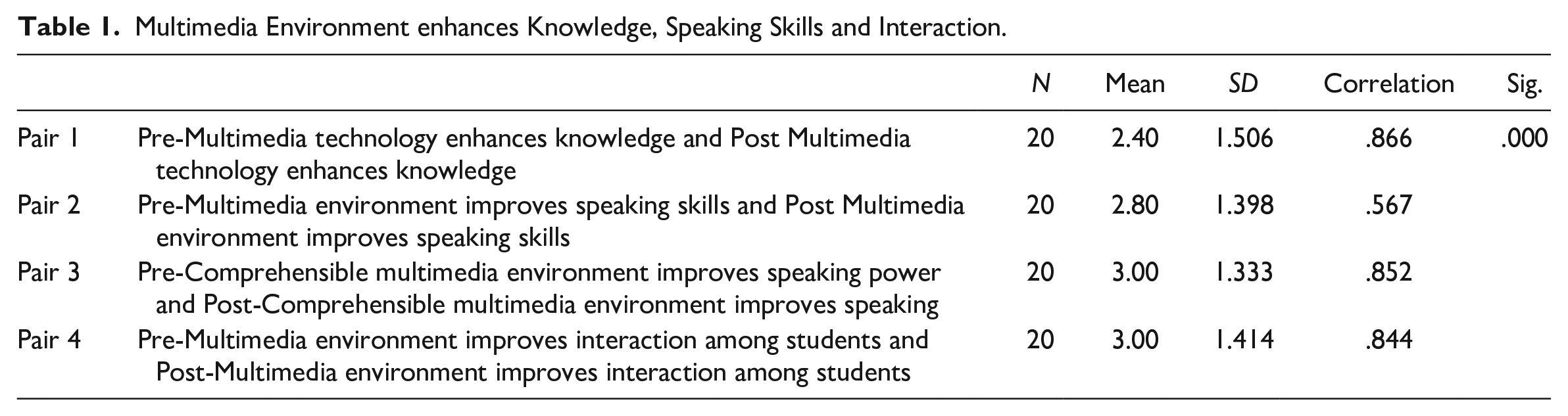
Table 1 showed the correlation between pre- and post-use of Multimedia environment by using four different themes like: Pre- Multimedia technology enhances knowledge and Post Multimedia technology enhances knowledge showed a correlation .866, then, Pre-multimedia environment improves speaking skills and Post Multimedia environment improves speaking skills showed a correlation of .567, another theme, Pre-Comprehensible and Post-Comprehensible multimedia environment improves speaking showed a correlation of .852 and the last theme, Pre-Multimedia environment improves interaction among students and Post-Multimedia environment improves interaction among students showed a correlation of .844. The correlation and the paired sample test showed a significant difference between the pre-and the post-test result analysis (p = .000). This means that the use of interactive multimedia-based programs enhanced the students’ English Language speaking skills.
Multimedia Environment enhances Knowledge, Speaking Skills and Interaction.
The results showed that using multimedia is effective for learning the language.
Statistical Representation of Pre-and Post Use of Interactive Multimedia Environment
Table 2 revealed the before and after results for using an interactive multimedia environment to improve students’ speaking skills, knowledge, and interaction among students. In the paired sample test, the first theme showed a mean value of 0.1677, the second theme showed a mean value of 2.18, the third theme showed a mean value of 0.43 and the fourth theme showed a mean value of 0.933. Thus, the results in Table 2 showed that the development of the academic achievement for the students learning in the interactive multimedia environment was greater than that of the students learning in a traditional environment.
Interactive Multimedia Environment Improves Students’ Speaking Skills, Knowledge, and Interaction.

EFL Speaking Focusing on Pronunciation, Grammar, Fluency, Vocabulary and Accuracy
Table 3 reflects the test scores of EFL students before and after exposure to a multimedia-based teaching program. It showed the p-value for pronunciation was .001 which is less than .05 which is significant, the p-value for vocabulary was .002 which is also less than .05 thus being significant, the p-value for grammar was .003 which also indicates its significance, for fluency and accuracy the p values were .000 and .015 which were also significant. The mean scores of the study sample in the post-assessment test of the EFL speaking focused on pronunciation, grammar, fluency, vocabulary, and accuracy. The results showed that the mean score of vocabulary, fluency, and accuracy was higher in post-assessment as compared to their pre-assessment of the same skills, with a significant difference at .05 level. This indicated that the use of multimedia-based programs helped the students in polishing up their pronunciation, grammar, fluency, vocabulary, and accuracy.
EFL Students Exposed to Multimedia-Based Program on the Pronunciation, Vocabulary, Grammar, Fluency and Accuracy Skills.

Qualitative Results
The pre- and post-results pertaining to the use of a multimedia teaching program showed significant differences between the performance of students in the two video oral presentations at the beginning and at the end of the experiment. Their performance showed remarkable improvement in terms of pronunciation, vocabulary, grammar, fluency, and accuracy. Results of the qualitative interview were based on semi- structured interviews. The main concern of the interview was to analyze students’ perceptions regarding the use of multimedia resources in improving students’ speaking skills. The data collected from the students was organized inconsistently. However, questions were used to investigate the influence of a multimedia environment in helping students to improve their speaking skills. Table 4 has provided an overview of the results obtained from the participants by asking them open-ended questions.
Correlation of Experimental and Controlled Group Performance With and Without Interactive Multimedia Teaching.

Correlation of Experimental and Controlled Group Performance With and Without Interactive Multimedia Teaching
Table 4 shows the correlation of experimental and controlled groups’ performance with and without interactive multimedia teaching. The experimental group showed a large correlation with interactive multimedia teaching as it improved their PowerPoint presentation skills (.77), their speaking skills (.64), as well as interaction among students (.74). On the other hand, the controlled group did not display any significant improvement in their speaking skills (.3), PowerPoint presentation skills (.4) and interaction with their peers (.2), thus showing no strong relationship with interactive multimedia teaching.
Influence of interactive multimedia environment
Many students (40%) stated that interactive multimedia environments had a significant influence on their learning and speaking skills. In particular, eight students (S 2, S 4, S 9, S 10, S 13, S 16, S 18, and S 19) of the experimental group stated that: “Different multimedia approaches used for teaching purposes helped us in improving English Language skills.” “Multimedia was indeed an effective tool for teaching as it helped us to enhance our English Language skills.” “This tool of learning was very engaging, it kept us active at all times which resulted in the improvement of English Language skills.” “This medium of teaching and learning was fun and helped us to develop interest in learning as it was interactive.” “It was a different learning experience and we found it to be more interactive and student centred compared to the traditional method.”
Multimedia improve speaking skills
The analysis showed that more than half of the students agreed on the fact that their speaking skills improved after being taught in the interactive multimedia environment. Students including S 5, S 6, S 9, S 11, S 12, S 14, S 17, and S 20 (40%) showed positive reactions toward the improvement of their speaking power as a result of attending multimedia-based lectures. The students stated that: “Our skills of speaking English have improved efficiently after being exposed to interactive multimedia classrooms.” “Our English Language skills surely improved with the use of multimedia technology in our classrooms.” “With the help of multimedia teaching tools, I experienced that my English Language speaking fluency improved.” “The use of classroom multimedia tools enabled us to improve our speaking skills to a great extent.” “Our speaking performance or fluency improved with the use of interactive multimedia tools in the classroom.”
Multimedia encourage interaction among students
Some students expressed positive feelings toward their interaction with peers. For example, six students including; S 1, S 3, S 7, S 8, S 10, and S 15 (30%) stated that; “After being exposed to multimedia classrooms, we are more likely to communicate with our classmates in English and imitate the gestures and body language of native English speakers.” “By working together either in pairs or groups, we got the opportunity to interact and mingle and it also improved our interactions with each other.” “We made new friends while working in cohesion using the multimedia tools in the classroom.” “We got the opportunity of interacting and making new friends as while we worked and learned together using multimedia tools.”
The qualitative results were summarized in Table 5.
Overview of Qualitative Results.

Discussion
The present study has conducted a quasi-experimental analysis to investigate the association between the preferences of students regarding the multimedia environment and their speaking skills during the language learning process. The qualitative results have shown remarkable improvement in terms of pronunciation, vocabulary, grammar, fluency, and accuracy among students. The findings of this study support the outcomes of the previous studies such as Bajrami and Ismaili (2016) and Mino and Butler (1995) as highlighted in the literature review when the students were exposed to two situations, where one group was taught using multimedia-based programs whereas the other was instructed using the traditional means, a significant impact was noted. The results of the experimental group were compared with the outcomes of the student who used traditional methods, that is, the control group. The results showed a major positive impact on the verbal post-test of the students, who used interactive media for learning. Mino and Butler (1995) also found a positive correlation between the communication skills of an individual and the use of an interactive media environment. The study suggested the use of audiotaped lectures and reading assignments to improve the oral communication skills of the students outside the classroom. The interactive media approach can give more exposure to verbal communication and can also cover the course in adequate time. These results obtained from the present study are consistent with the previous studies as discussed in the literature review since it showed a positive impact of the interactive media approach in improving the speaking/communication skills of the students.
The current research revealed that technology has a significant impact on EFL learning especially due to Automatic Speech Recognition (ASR). This is in line with the findings of a study conducted by Nadirah et al. (2020) which reflected that the use of interactive multimedia increased students’ reading ability and the use of interactive multimedia strategy in reading comprehension was very interesting for the students in their learning process. The study found a positive effect on the learner’s ability to understand language during valuable interaction, this finding was in line with another study conducted by Golonka et al. (2014). The current study results were also supported by the studies conducted by Hassani et al. (2016) and Annala et al. (2016) as they also found a positive impact of interactive media approach on the speaking and learning skills of the individuals. The study used an intelligent virtual environment along with pedagogical agents. The study was conducted on non-native English learners and a positive result was found on their listening and speaking skills. The study focused on equipping the learners with sufficient skills to help them communicate in public places. The results were positive as a drastic increase was observed in their speaking abilities as predicted by the numbers obtained. Similarly, the present study showed consistent results with research conducted by Lee (2014).
The author studied the impact of digital news on oral language skills and the development of content knowledge, by involving 15 Spanish students who used Voice Thread, which is an interactive media tool. A positive impact of digital news on the development skills of individuals has been observed. The technique empowered the students and resulted in increased collaboration between them. Furthermore, it increased the speaking fluency of the students. Studies conducted by Diyyab (2014) and Sommerauer and Müller (2018) found a positive influence of multimedia-based approach for learning on the EFL speaking fluency of the students. The study by Diyyab (2014) was conducted on the second-year students of Minufiya University, Egypt and the participants’ performance was analyzed after conducting the test two times. Moreover, Min et al. (2019) suggested that learning materials such as; lecture notes supported by audio can provide better results in this regard.
The results showed a significant increase in developing EFL speaking fluency skills among the students. The approach superseded the traditional tools of learning in the context of the effectiveness and development of speaking skills in the students. These results agree with the findings of the present study, which stated a positive influence of interactive multimedia environment on their learning and speaking skills. In short, the findings of the study showed that the use of interactive multimedia-based programs had a significant improvement in the English Language speaking skills of the students who were included in the experimental group.
Moreover, the finding of this study is also in line with the study conducted by Praheto et al. (2019). According to their findings, interactive multimedia is effective in the process of learning. Furthermore, the study stated that the teachers still use the traditional teaching methods by using customized PowerPoint presentations which means that they take their students’ needs into account while creating slides such as the use of elements like animations, pictures, sounds, texts, etc.
In this study, the same intervention, which was multimedia-based programs, could also be applied to the students who were put into the control group so that they can also enhance their knowledge and improve their English-speaking skills because they were exposed only to the traditional methods of teaching.
Conclusion
The study has investigated the impact of multimedia environment on the speaking skills of students by conducting pre and post-tests. The results have shown effective use of multimedia as compared to the traditional methods of teaching. The results clearly recommend the expansion of multimedia usage in teaching theoretical curriculum and the implementation of computers as a valuable tool in teaching and learning practices. An interactive learning environment tends to provide an effective alternative to traditional education. It is more effective for the cognitive abilities of students in comparison to traditional methods. Moreover, it is best for EFL students as in today’s world where technology is playing a significant role in every aspect of life, it has become the need of time. The non-native students can learn the language more quickly through interactive lessons planned by the teachers as nowadays students are very tech-savvy and have more than a basic knowledge of computers which can ease the facilitators’ role in imparting knowledge.
Study Contribution
The study has also investigated the association between the preferences of students regarding the multimedia environment and their speaking skills within the classroom learning process. The study also emphasizes the significance of an interactive multimedia environment in improving the speaking skills of students.
Study Recommendations
There should be classes focusing particularly on learning the spoken language through interactive multimedia-based programs. The students should be given the freedom to use any resources such as PowerPoint presentations, texts, graphics, sounds, animations, and videos to verbally present their assignments, which will enhance their speaking power and give them more confidence when they stand up to speak publicly.
Study Limitations and Future Suggestions
The current study was not able to examine the effectiveness of new ways and methods to develop EFL speaking fluency skills other than the use of multimedia based-programs. Also, it fell short of finding out the attitudes of the University students toward EFL speaking instructions. Therefore, there is a need to conduct future studies which should carry out the analysis on a large study sample to assess the effectiveness of using multimedia interacting systems.
Footnotes
Appendix
Acknowledgements
The author would like to express his gratitude to King Khalid University for providing administrative and technical support. Furthermore, the author is very thankful to all the associated personnel and students that contributed to the purpose of this research.
Declaration of Conflicting Interests
The author declared no potential conflicts of interest with respect to the research, authorship, and/or publication of this article.
Funding
The author received no financial support for the research, authorship, and/or publication of this article.
